

An English syllable has an internal, hierarchical structure (Treiman, Reference Treiman1986). The onset and rime are the two major constituents. For example, the three-phoneme syllable cat has its major division between onset /k/ and rime /æt/. The rime /æt/can be further divided into two constituents, a nucleus or vowel /æ/ and a coda or final consonant /t/. There is a great deal of evidence in the literature suggesting that the onset-rime structure is a predominant intrasyllabic structure that is important in processing spoken and written English for both adults and children. Treiman and colleagues are among the most well-known researchers in this line of work. For example, Treiman and Danis (1988) studied short-term memory errors for spoken syllables in adults. Results of error analyses showed that the participants did not randomly break up and recombine the phonemes in a syllable; instead, there were groups of phonemes recombined as units that appeared more frequently. These units, larger than individual phonemes, were the rime unit within a consonant–verb–consonant (CVC) syllable, the initial cluster within a CCV syllable, and a vowel-liquid group within a VCC syllable. The authors argued that these short-term memory error patterns are affected by the linguistic structure of the syllables. A later study (Treiman, Reference Treiman1995) replicated these findings across a wide range of age groups, including kindergarteners, third graders, sixth graders, and undergraduates.
In another seminal study by Treiman, Mullennix, Bijeljac-Babic, and Richmond-Welty (Reference Treiman, Mullennix, Bijeljac-Babic and Richmond-Welty1995), a careful statistical analysis was conducted on the orthographic neighborhood consistency of a comprehensive list of English CVC written words. The VC neighbors were significantly more consistent than CV neighbors. Their behavioral data on oral reading of English CVC words from both adults and children supported the interpretation of reliance on the consistency of the orthographic rime unit, consistent with the results from their distributional analyses of the written words. These researchers also suggest that the phonological structure of the language plays an important role in forming letter-sound correspondences in orthography and in learning to read. To further demonstrate this phonological role, Kessler and Treiman (Reference Kessler and Treiman1997) studied distributions of phonemes in a comprehensive list of English spoken CVC words. They found a significant connection between the vowel and the coda; however, no such significant associations were found between the onset and the vowel. The work of other researchers also supported the prominence of the rime unit in reading English. Goswami (Reference Goswami1993, Reference Goswami, Metsala and Ehri1998) showed that young readers typically used rime analogies to read unknown words, indicating that rime is a functionally important unit for learning to read English.
However, different languages in the world differ in terms of subsyllabic unit preference (see Ziegler & Goswami, Reference Ziegler and Goswami2005). Strong arguments against the relevance of the rime as a cohesive unit come from studies on languages such as Korean, Dutch, and Hebrew. For example, Yoon, Bolger, Kwon, and Perfetti (Reference Yoon, Bolger, Kwon, Perfetti, Vehoeven, Elbro and Reisman2002, experiment 1) used an analogy test in Korean adopted from Goswami (Reference Goswami1993), in which the children saw a printed clue word together with its pronunciation. Then the children were asked to use the clue word to help read a test word. The test words were varied in terms of the subsyllabic unit shared with the clue word. Four analogy conditions were included: the clue word shared CV, VC, CC, or V with the test word. Their results showed that children could read more test nonwords correctly when the clue words and test words shared the CV than when they shared the VC or CC.
Geudens and Sandra (Reference Geudens and Sandra2003) showed that it was more difficult for Dutch prereaders and first graders to segment a two-phoneme CV syllable (e.g., /toa:;/) into onset and vowel than to segment a two-phoneme VC syllable (e.g., /o:;t/) into vowel and coda (experiments 1 and 2). Furthermore, it was easier for prereaders to substitute a phoneme in a VC than in a CV (experiment 3). First graders also showed greater difficulty in segmenting CVs than VCs in CVC words (experiment 4). These findings together challenged the universality of the onset-rime structural division (see also Geudens, Sandra, & Martensen, Reference Geudens, Sandra and Martensen2005).
One important consideration in Geudens and Sandra's work is the sonority of the consonants in the syllables, an important factor in determining the cohesion between the segments. Sonority is defined via a ranking on a scale—from vowels (e.g., /æ/, /o/, /i/, /u/), glides (/j/,/w/), liquids (/r/, /l/), nasals (/m/, /n/,/j/), to fricatives (e.g., /f/, /s/, /θ/, /ð), affricates (/t∫/ and /d3/), and stops (e.g., /p/, /t/, /k/, /g/; Selkirk, Reference Selkirk, Aronoff and Oehrle1984; Spencer, Reference Spencer1996). Vowels, glides, liquids, and nasals are considered as sonorants, whereas fricatives, affricates, and stops are considered as obstruents involving less sonorance. Treiman and Danis (1988) found that in English, rimes with postvocalic liquids are more cohesive than rimes with postvocalic nasals, which in turn, are more cohesive than rimes with postvocalic obstruents. The retention rate of two phonemes was higher when the final consonants were liquids than when they were nasals or obstruents. Geudens and Sandra (Reference Geudens and Sandra2003) also showed that the degree of sonority of the consonant affected Dutch children's performance: it was more difficult to segment items with sonorants than those with obstruents.
There is some controversy concerning the role of phonological and orthographic properties of the language in affecting subsyllabic unit preference. Yoon et al. (Reference Yoon, Bolger, Kwon, Perfetti, Vehoeven, Elbro and Reisman2002) proposed a linguistic hypothesis stating that the difference between Korean and English in preference for subsyllabic unit in written words is due to difference between the spoken languages, not between the scripts. Yoon and Derwing (Reference Yoon and Derwing2001) also suggested that the distributional properties of the Korean language, for instance, that most syllables are of the CV type, may lead to a high salience of body structures instead of the rime structure. Share and Blum (2005) found that Hebrew children preferred a CV-C (body-coda) structure. Both preliterate and literate children found it easier to split a syllable into CV-C structure. Of more importance, their results suggest that this preference stems from both orthographic and phonological properties of the language. The abundance of simple open syllables in spoken Hebrew and the pointed orthography in written Hebrew jointly contribute to the body unit preference. Pointed orthography refers to a script whose vowel diacritics are mostly appended underneath the preceding consonant, resulting in an integral CV unit in a vertical arrangement.
In the present study, we were interested in examining the subsyllabic unit preference in Mandarin Chinese. Mandarin Chinese is interesting to study because it provides a good test case on whether the subsyllabic unit preference is driven by the linguistic structures. First, unlike languages with an alphabetic writing system, spoken and written Chinese are uniquely separated (Perfetti, Reference Perfetti, Brown and Hagoot1999; Perfetti, Liu, & Tan, Reference Perfetti, Liu and Tan2005). The graphemes in Chinese do not map onto individual phonemes; instead, they map onto syllabic morphemes (DeFrancis, Reference DeFrancis1989; Mattingly, Reference Mattingly, Frost and Katz1992). Second, the Chinese language shares an important feature of some languages such as Korean and Hebrew, that is, there exist a large number of open syllables in these languages. Previous research has demonstrated a body unit preference over the rime unit in both Korean and Hebrew, and attributed such a body preference to their unique language properties. Studying the subsyllabic unit preference in Chinese helps to further test the hypothesis that high frequency of simple open syllables determines the sensitivity of speakers to the body unit, thus contributing to our knowledge about how language properties affect the way we perceive and process the spoken syllables of the language.
Mandarin Chinese has many monosyllabic words. The onset of a syllable is always a single consonant. There are about 22 initial consonants, and about 24 vowels and diphthongs (Huang & Liao, Reference Huang and Liao2002). In this paper we used Pinyin phonetic transcriptions with italicization for Mandarin sounds. There are only two consonants that appear at the end of a syllable in Mandarin. They are the two nasal consonants n and ng (Siok & Fletcher, Reference Siok and Fletcher2001). Nasal sounds are ranked in the middle of the sonority scale (Selkirk, Reference Selkirk, Aronoff and Oehrle1984; Spencer, Reference Spencer1996). Many Chinese syllables are open syllables. According to an estimation based on a database of Chinese character information (Li & Liu, Reference Li and Liu1988), about 62% of Chinese syllables are open syllables (54% CV, 8% V structure). The remaining 38% have a final consonant (33% CVC, 5% VC structure). There are more syllables with the n ending than those with ng (22 vs. 16%). Does the large number of open syllables in the Chinese language encourage sensitivity to the body unit, or do the final sonorant consonants provide an opportunity for cohesion of the rime unit?
It is important to note that Chinese is a tonal language. There are four tones in Mandarin Chinese. The nature of tone in spoken Chinese is suprasegmental; it is attached to the vowel. We used tone numbers (i.e., 1, 2, 3, 4) to represent the four different tones in this paper. An important feature of Chinese tone is its lexical function. A change in the tone of a syllable leads to a change in its meaning. How would the tonal feature affect subsyllabic unit preference in the Chinese language? Would the tones enhance the sonority feature of the final consonants, and hence, push for the cohesion of the rime?
Because of the logographic nature of the Chinese writing system, there is a unique separation between its phonology and its orthography. However, to ease the great memory demand in learning to read Chinese characters and to promote universal literacy, the Pinyin system has been introduced. Pinyin is an alphabetic system that borrows Roman alphabetic letters to represent the speech sounds in Chinese. Pinyin has a shallow orthography; letters map directly onto sounds. The tone diacritics are marked on top of the vowels. Chinese children start to learn Pinyin in kindergarten at about age 5 and continue to use Pinyin in learning to read and write Chinese characters in their first 3 years of primary school.
In the present study, we carried out three experiments to examine the subsyllabic unit preference in young Chinese children. We tested the hypothesis that such preferences are determined by the nature of the spoken language. Experiment 1 used a Chinese sound similarity judgment task in Chinese monolingual preschool and Grade 1 children. The sound similarity judgment paradigm taps children's implicit phonological awareness. Preschool children at about age 4 were selected to minimize children's literacy experience in either the Chinese writing system or the Pinyin system. We were also interested in the development of children's sensitivity to the linguistic units across the two age groups. To examine the role of tone in processing subsyllabic units, we varied the tone similarity in the pair of stimuli.
In order to form comparisons of such preferences between the Chinese and English languages, we recruited preschool and Grade 1 Chinese–English bilingual children (Experiment 2). We examined bilingual children's sound similarity judgments in Chinese and English. Bilingual children provide a unique opportunity for testing the effects of cross-language and orthography differences within the same child. To further verify the differences between Chinese and English in subsyllabic unit preferences, we designed a sound-matching task, an explicit perceptual matching task, to tap children's skills in processing the different types of units in each language (Experiment 3). In this experiment, we also matched the sonority of consonants across the subsyllabic unit conditions in both English and Chinese.
EXPERIMENT 1
In this experiment, we were interested in addressing empirically whether young native Chinese speakers perceive Chinese syllables as structured by body-coda or onset-rime. We designed a Chinese sound similarity judgment task to examine the subsyllabic division preference in Chinese children. All Chinese syllables used in this experiment ended with one of the two final consonants. We constructed pseudosyllables to exclude any lexicality effect. We hypothesize that because of the high frequency of open syllables, Chinese speakers are more sensitive to the body unit than the rime unit, and they are also more sensitive to the body unit than other phonological units such as the vowel and onset-coda units. However, we cannot rule out the possibility that the nasal consonant codas and tonal feature allow for cohesion between the vowel and final consonant. Moreover, we predict that children develop their subsyllabic unit preference over time; Grade 1 children are more sensitive to the subsyllabic unit differences than preschool children. Previous literature has shown that children develop their phonological awareness across time, which interacts with their exposure to print and literacy instruction (e.g., Adams, Reference Adams1990; Goswami & Bryant, Reference Goswami and Bryant1990; Perfetti, Beck, Bell, & Hughes, Reference Perfetti, Beck, Bell and Hughes1987). Older children are better at reflecting upon and manipulating phonological units including onset-rime and phoneme units. Treiman et al. (Reference Treiman, Mullennix, Bijeljac-Babic and Richmond-Welty1995) also demonstrated that children develop their sensitivity to orthographic rimes across the early primary grades.
Participants
Twenty-nine preschool and 32 first-grade children in Beijing participated in the study. Their mean ages were 4.32 (SD = 0.46) and 6.84 years (SD = 0.53), respectively. There were 13 boys and 15 girls from the preschool and 14 boys and 18 girls from the first grade. The preschool-aged children were selected in a kindergarten to minimize their exposure to formal literacy instruction. Three classroom teachers were interviewed, and parents were contacted to confirm their minimal formal literacy instruction to children.
Method
Preparation for the experiment
Before the experiment started, the child was introduced to the three individual sounds in a Chinese syllable—the beginning, middle, and ending sound. The child heard the instructions over a pair of high-quality Sony headphones connected to a laptop computer. The computer screen simultaneously showed three solid little circles colored green. These circles represented the beginning, middle, and ending sound. To direct the child's attention to each of the sounds, two attention attractors were added: a red circle appeared outside the appropriate green circle and the green circle itself loomed larger. The goal of this procedure was to ensure that the child understood the three constituent sounds. Two examples of pseudosyllables were used for this preparation.
Materials and design
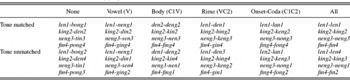
The sound similarity task paradigm used was similar to Yoon et al. (Reference Yoon, Bolger, Kwon, Perfetti, Vehoeven, Elbro and Reisman2002, experiment 4). The child was asked to judge how similar a pair of stimuli sounded. There were two types of pseudosyllables constructed in this study: one consisted of nonexistent syllable segments (e.g., fin), the other consisted of existent syllable segments but combined with a particular tone that made them nonexistent (e.g., the segment len when combined with tone 1). A nonexistent syllable refers to a syllable as a whole that is not available in Chinese. The inclusion of these two types of pseudosyllables was based on analysis of Chinese phonological structure. Segmental (CV or CVC syllable) and superasegmental (tone) information are the two major levels of the Chinese phonological system. Forty-eight items in total were included. There were six different types of pairs varying in terms of shared phonemes. The two stimuli in each pair shared (a) no phonemes (e.g., king2 and den2, where the numbers denote the four different tones), (b) vowel (V, e.g., king2 and din2), (c) body (CV, e.g., king2 and kin2), (d) rime (VC, e.g., king2 and hing2), (e) onset-coda (C1–C2, e.g., king2 and keng2), or (f) all phonemes (e.g., king2 and king2). We included four different unit types to test whether the body unit is the most preferred subsyllabic unit, similar to the design in Yoon et al. (Reference Yoon, Bolger, Kwon, Perfetti, Vehoeven, Elbro and Reisman2002). The body and rime units have both been claimed to be important subsyllabic units in processing different languages, which would be our main concern of the comparisons. The body unit will then be compared to the vowel and onset-coda units. The vowel unit represents a single phoneme, the obligatory nucleus of a syllable. The onset-coda unit has a size equal to the rime and body units, but represents the margin of a syllable. We hypothesize that children are more sensitive to the body unit than the vowel unit due to the larger unit size of the body. We also hypothesize that children are more sensitive to the body unit than the equally sized onset-coda unit because of the high occurrence of open syllables in the language.
There were eight pairs of stimuli of each type, which were further divided into two subgroups of four items each. In one subgroup the tones for the two stimuli in the pair were matched, whereas in the other subgroup the tones were not matched. We were interested in testing the effect of tone on children's similarity judgment. One of the two stimuli in the pair was kept same across all the types and the syllable segments were identical for the two tone conditions. Care was taken to ensure as much comparability as possible across the unit types and the two tone conditions. See Appendix A for the entire set of stimuli.
Procedure
The pairs of stimuli were recorded via a high-quality microphone by a native female Chinese speaker. Within each pair, the two stimuli had an interstimulus interval of 1 s. Each pair was repeated once with an interstimulus interval of 2 s. The child heard the stimuli over a pair of headphones connected to a laptop computer. The child was asked to judge how similar the pair sounded. We created five graphs, each having two circles. The first picture showed two separate circles, meaning the two syllables were not similar at all. In the final picture, the two circles completely overlapped, meaning the two syllables were exactly the same. The three intervening pictures showed the two circles increasingly overlapped, representing the different degrees of similarity. The overlapping part of the two circles was highlighted with green. The child was asked to point to or say the number of the graph that best showed the similarity of the two syllables. Four examples were given. Children were encouraged to guess if they were not sure about the answer.
Results and discussion
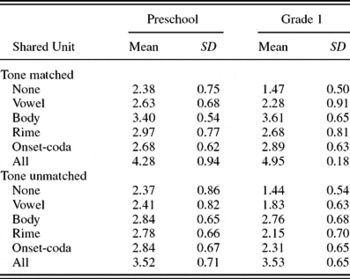
Means and standard deviations of children's ratings for both the tone matched and tone unmatched items are listed in Table 1. Children judged items with all phonemes shared most similar and those with no phonemes shared the least similar. This observation helps establish the meaningfulness of the similarity ratings. Children also judged items with shared body units more similar overall than those with vowel, rime, or onset-coda units shared, which indicated their preference for body units over different subsyllabic units.
Means and standard deviations of ratings in the Chinese sound similarity task for Chinese monolinguals

A 2 (Age Group) × 2 (Tone Similarity) × 4 (Subunit Type) repeated-measure analysis of variance (ANOVA) was performed in which the age group was treated as the between-subject variable and tone similarity and subunit type as the within-subject variables. Because the all phonemes shared and none shared conditions helped us establish the meaningfulness of the similarities ratings, we decided not to include them in the analyses. In reporting the ANOVA results and the post hoc t tests in Experiment 1 as well as the subsequent Experiments 2 and 3, we included results from both by-subject (represented by F1 and t1) and by-item analyses (represented by F2 and t2). Results of Experiment 1 showed significant main effects of age group, tone similarity, and subunit type: age group, F1 (1, 59) = 4.62, p < .05, F2 (1, 24) = 20.38, p < .001; subunit type, F1 (3, 57) = 32.67, p < .001, F2 (3, 24) = 4.39, p < .05; and tone similarity, F1 (1, 59) = 62.94, p < .001, F2 (1, 24) = 5.71, p < .05. Interactions between age group and subunit type, between age group and tone similarity, and between tone similarity and subunit type were also significant: Age Group × Subunit Type, F1 (3, 57) = 3.24, p < .05, F2 (3, 24) = 5.27, p < .01; Age Group × Tone Similarity, F1 (1, 59) = 15.32, p < .001, F2 (1, 24) = 12.52, p < .01; Tone Similarity × Subunit Type, F1 (3, 57) = 7.73, p < .001, F2 (3, 24) < 1. The three-way interaction was not significant.
To address the significant interaction between age and subunit type, we carried out several planned specific comparisons. Because the three-way interaction between age, unit type, and tone similarity was not significant, we pooled over the two tone conditions. Grade 1 children demonstrated a better sensitivity to the body unit than preschool children. For example, there was a larger difference in similarity ratings between the body and rime units for Grade 1 children compared to preschool children. The mean difference in ratings between body and rime units was .23 for preschool children and .76 for Grade 1 children when the two tone conditions were pooled over, t1 (59) = −2.91, p < .01.
Moreover, Grade 1 children judged the pairs with shared body units significantly more similar than those with shared rime units, t1 (31) = 5.59, p < .001, t2 (14) = 2.19, p = .046. For preschool children, the pairs with shared body units were also judged more similar than those with shared rime unit, t1 (28) = 2.16, p < .05, t2 (14) = 1.09, p = .29, but the effect size was smaller compared to the Grade 1 children. The results of by-item analysis for preschool children did not reach statistical significance. This is probably due to the small number of items involved in the analysis (i.e., eight in total). We decided to focus on the results of by-subject analyses here as well as in the subsequent experiments. Further analyses also showed that for both Grade 1 and preschool children, the body unit was judged significantly more similar than the vowel and onset-coda units (all ps < .01).
The interaction between age and tone similarity revealed that Grade 1 children's similarity ratings were more influenced by tone matching than those of preschool children, that is, the differences in their ratings between tone matched and unmatched items were greater than those for the preschool children. For example, the mean difference in ratings on body-shared items was .56 for preschool children and .85 for Grade 1 children, t1 (59) = −1.92, p = .06.
The interaction between subunit type and tone similarity indicated that tone seemed to modulate the body unit preference in children. For example, pooling over the two age groups, the difference in ratings between body and rime units was much greater under the tone-matched condition compared to the tone-unmatched condition, t1 (60) = 2.63, p < .05, that is, children were more sensitive to the body unit when tone was matched.
Taken together, the above results provided evidence that Grade 1 children prefer body over rime unit in processing spoken Chinese syllables. Preschool children showed a pattern similar to the Grade 1 children. We suggest that this preference is driven by the Chinese spoken language, in which the abundance of open syllables fosters children's sensitivity to the CV cohesion. Grade 1 children developed better sensitivity to the body unit than preschool children. It is also possible that Grade 1 children are more likely to understand and pay attention to the task and less likely to guess. Finally, tone affects children's processing of subsyllabic units.
EXPERIMENT 2
In this experiment, we further examined children's subsyllabic unit preference in Chinese as opposed to English by testing bilingual children. We designed a comparable English sound similarity task for comparison of children's performance in the two languages. The existing bilingual lexical processing models debate whether the two languages in a bilingual mind share an integrated lexicon or separate ones. The bilingual interactive activation model (e.g., Dijkstra & Van Heuven, Reference Dijkstra and Van Heuven2002) supports for an integrated lexicon in which the lexical forms of the two languages, including the phonological and orthographic forms, interact with each other. The model that advocates for separated bilingual lexicons (e.g., Kroll & Stewart, Reference Kroll and Stewart1994) suggests that the two languages have separated phonological and orthographic representations but a shared semantic representation. These two distinct bilingual lexical models are the basis for our two alternative hypotheses regarding subsyllabic unit preferences in bilingual children. The model of separated bilingual lexical representations would hypothesize that the children treat the phonological systems of the two languages independently; the properties of each language underlie the sensitivity to a certain linguistic unit. This hypothesis predicts that the bilingual children prefer body unit in Chinese and rime unit in English. The bilingual interactive model would support an alternative hypothesis that the properties of children's L1 and L2 phonological systems interact with each other, and for young bilingual children whose L1 is stronger than L2, it is likely that their Chinese L1 phonological structures influence processing of English L2 syllables. This hypothesis predicts that bilingual children show sensitivity to the body unit when making matching judgments on English syllables.
Participants
Twenty-eight preschool and 28 first-grade Chinese background children from the Washington, DC, area participated in the study. Most of them attended both English classes in public schools during weekdays and a Chinese school on weekends at two Hope Chinese School campuses in the Washington, DC, area. The mean age of the preschool children was 4.09 years (SD = 0.50 years) including 14 boys and 14 girls. About 64% of these children attended English preschool classes, 18% kindergarten classes, and 18% stayed at home. The majority of the stay at home children could speak both Chinese and English. The mean age of the first graders was 6.01 years (SD = 0.57 years) including 18 boys and 10 girls. Their mean grade in their English classes was 1.11 (SD = 0.58). Children started to learn Pinyin in their kindergarten class (around age 5) but not in the preschool class (around age 4) in the Chinese schools. Parents were asked to fill out a short questionnaire with basic demographic information and family language and literacy experiences. About 94% of the children were born in the United States, and 7% of the children were born in mainland China. About 80% of the parents reported that their child's first language was Chinese, 7% reported that they learned the two languages simultaneously, and 13% reported that they learned English first. About 85% of the children spoke both Chinese and English at home, 4% of the children spoke only Mandarin Chinese at home, and 11% of the children spoken only English at home. About 69% of the parents spoke both Chinese and English at home, and 29% of the parents only spoke Chinese at home. In some Chinese immigrant families, there were cases where parents used Chinese language to communicate with their children, who then responded in English. Because both parents and children can understand English as well as Chinese, there is rarely any confusion between them.
Preparation for the experiment. The Chinese–English bilingual children underwent the same preparation for the experiment as the Chinese monolingual children in Experiment 1.
Chinese similarity judgment task
The materials, design and procedure were identical to those in Experiment 1.
English similarity judgment task
Materials and design
We constructed pairs of monosyllabic CVC nonwords. There were six different types of pairs varying in terms of shared phonemes. The design was same as in the Chinese sound similarity judgment task. The examples for the six types are: no shared phonemes (e.g., /tƱp/ and /sal/), vowel (e.g., /tƱp/ and /sƱk/), body (e.g., /tƱp/ and /tƱs/), rime (e.g., /tƱp/ and /kƱp/), onset-coda (e.g., /tƱp/ and /tεp/), and all phonemes (e.g., /tƱp/ and /tƱp/). There were 5 pairs in each type, thus 30 pairs in total. See Appendix B for the stimuli. (We used International Phonetic Alphabetic General American English symbols throughout this paper.)
Procedure
The procedure was identical to the Chinese sound similarity judgment task. A native female English speaker recorded the stimuli.
The Chinese and English tasks were administered at different times with an interval of about 1 week. The order of these two tasks was counterbalanced among the children.
Results and discussion
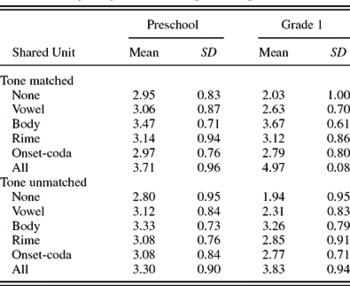
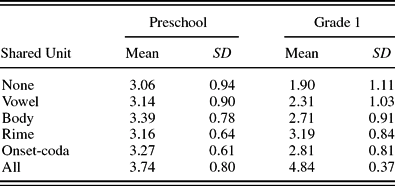
Means and standard deviations of children's ratings in the Chinese sound similarity judgment task are listed in Table 2. Means and standard deviations of the English similarity ratings are provided in Table 3. Overall, children judged items with all phonemes shared the most similar and those with no phonemes shared the least similar. Similar to Experiment 1, children also judged items with body units shared more similar than those with vowel, rime, or onset-coda units shared in Chinese. In English, however, children judged items with rime units shared more similar than those with vowel, body, or onset-coda units shared.
Means and standard deviations of ratings in the Chinese sound similarity task for Chinese–English bilinguals

Means and standard deviations of ratings in the English sound similarity task for Chinese–English bilinguals
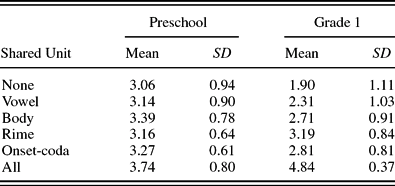
A 2 (Age Group) × 2 (Language) × 4 (Subunit Type) repeated-measure ANOVA was conducted in which the two tone conditions were pooled over for Chinese language. Results revealed significant main effects of age group and subunit type, F1 (1, 54) = 7.00, p < .05, F2 (1, 44) = 27.17, p < .001, for the effect of the age group, and F1 (3, 52) = 14.32, p < .001, F2 (3, 44) = 5.33, p < .01, for the effect of the subunit type. The interactions between age group and unit type, and between language and unit type were both significant; both ps < .05; for the effect of Age Group × Unit, p1 < .001, p2 = .17; for the effect of Language × Unit. The three-way interaction was also significant (p1 < .01, p2 = .15).
To further address the three-way interaction, we conducted two repeated-measure ANOVAs, one for each language. Within Chinese, a 2 (Age Group) × 2 (Tone Similarity) × 4 (Subunit Type) repeated-measure ANOVA yielded significant main effects of age group (both ps < .05), tone similarity (p1 < .05, p2 = .31), and subunit type (p1 < .001, p2 < .01). There was a significant interaction between age group and unit (p1 < .01, p2 = .11), and the three-way interaction was not significant. Within English, a 2 (Age Group) × 4 (Subunit Type) repeated-measure ANOVA revealed significant main effects of age group (p1 < .01, p2 < .001) and subunit type (p1 < .05, p2 = .09), as well as a significant interaction between age group and unit (p1 < .05, p2 < .05).
Planned specific comparisons for the English similarity judgment task revealed that for Grade 1 children, the pairs with shared rime units were rated significantly more similar than those with shared body units, t1 (27) = −2.68, p < .05, t2 (8) = −2.43, p < .05. This is contrary to the results in the Chinese task in which children judged pairs with shared body units more similar than those with shared rime units. Further analyses also showed that children rated items with shared rime units more similar than those with shared vowel unit (p1 < .01) and onset-coda unit (p1 < .05). For preschool children, there was a slight preference for the body unit over rime unit; however, the difference was not statistically significant (both ps > .12).
Planned specific comparisons for the Chinese similarity judgment task indicated that for Grade 1 children, pooling over the two tone conditions, children judged the pairs with shared body units significantly more similar than those with shared rime units, t1 (27) = 3.36, p < .01, t2 (14) = 1.46, p = .17. These children also rated the items with shared body units more similar in comparison to those with shared vowel and onset-coda units (both ps < .001). The preschool children showed a similar pattern in preference for body over rime units, t1 (27) = 2.06, p = .049, t2 (14) = 3.05, p < .01. These children also rated the body units more similar than the vowel and onset-coda units.
The above results indicated that for Grade 1 children the subsyllabic unit preference is different between Chinese and English. These children rated body matched pairs more similar than rime matched ones in the Chinese task, and rime matched pairs more similar than body matched ones in the English task. This contrast indicated cross-language differences in processing subsyllabic units, and therefore supported the bilingual model that hypothesizes two separated lexical representations. For Chinese, body matched pairs were also rated more similar than vowel and onset-coda matched pairs. For English, rime matched pairs were also rated more similar than vowel and onset-coda matched pairs. These results suggest that the body unit is the most preferred for Chinese and the rime unit is the most preferred for English.
Grade 1 children showed greater sensitivity to the body unit in Chinese (as in Experiment 1) and rime unit in English than preschool children. We found that preschool bilingual children did not show a significantly better sensitivity to the body unit in Chinese compared to the rime unit. However, in Experiment 1 the preschool monolingual Chinese children showed a preference for the body unit in Chinese when tone was matched. We think that this may be due to the fact that bilingual children who live in the United States have relatively less exposure to spoken Chinese than monolingual children who live in mainland China. The monolingual children should have better oral Chinese proficiency than the bilingual children. The monolingual children may also have more exposure to informal literacy activities than the bilingual children. Tone again played a role in the similarity judgment for Chinese syllables. This result again suggests that tone is an integral part of the Chinese syllable structure. When the tone was matched for the pair, children judged the two syllable segments to be more similar.
The sound similarity judgment task used in Experiments 1 and 2 tapped into children's global perception of the different subsyllabic units, a type of implicit phonological awareness often referred to as epilinguistic awareness (Gombert, Reference Gombert1992). It is possible that the difference in children's sensitivity to the subsyllabic units observed in the sound similarity task would not be mirrored in tasks that require explicit manipulation of the units, or a type of metalinguistic awareness. Accordingly, in the following sound-matching experiment, children were required to explicitly attend to and isolate the different units and make matching judgment. Although a final perceptual judgment is entailed in this task, the explicit manipulation of the individual units requires a level of metalinguistic awareness from the children. We hypothesize that there will be converging evidence supporting the cross-language differences. Specifically, children will demonstrate more sensitivity to body in the Chinese matching task and conversely, to rime in the English matching task. The model that advocates for separated bilingual lexicons would account for such cross-language differences. If there are separated lexical representations of the two languages in a bilingual child's mind, and the two languages differ in their subsyllabic structures, the bilingual child should show different sensitivity to different subsyllabic units in the two different languages.
EXPERIMENT 3
Participants
Thirty-two Grade 1 bilingual children were recruited in the same participant pool at the Chinese language school. Their mean age was 6.58 years (SD = 0.76). Thirty children were enrolled in Grade 1 English classes, and 2 were in Grade 2 English classes. None of them participated in Experiment 2. The reason for not including the preschool children in this experiment is that in pilot testing, they showed great difficulty in performing the matching task. The accuracy rates for their performance in the different conditions were around 0.5 (chance level).
English matching task
The matching task is a commonly used paradigm in assessing children's phonological awareness. Children heard three sounds: one was the target sound, and the remaining two were candidate sounds. The child was then asked to judge which of the two candidates shared the same subsyllabic unit with the target sound.
Materials and design
A total of 24 items were constructed. Four different conditions were involved, varying the subsyllabic unit shared with the target: (a) in the body-matching condition, one of two candidate sounds matched the body of the target; (b) in the rime-matching condition, one of the two candidates matched the rime of the target; (c) in the vowel-matching condition, one of the two candidates matched the vowel of the target; and (d) in the onset-coda-matching condition, one of the two candidates matched the onset-coda of the target.
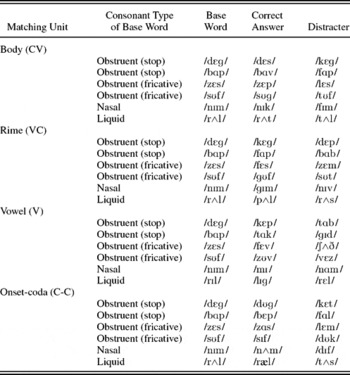
A set of six monosyllabic English nonwords was created. These six base nonwords were used for the four matching conditions. Hulme et al. (Reference Hulme, Hatcher, Nation, Brown, Adams and Stuart2002) used a similar method. This method ensured that similar items were used for the different unit type conditions to improve the comparability of the performance among the conditions. Only short vowels were used. The base nonwords were varied in terms of consonant sonority for both onset and coda in each condition to control for the effect of sonority. Four items included obstruents in both onset and coda positions, in which two were stops (dεg/ and /bap/) and two fricatives (zεs/ and /sƱf/). One nasal (/nim/) and one liquid (/rʌl/) consonant were included. In the body-matching condition, the distracter item shared the rime with the base stimulus (e.g., /dεg/: /dεs/ vs. /kεg/). In the rime-matching condition, the distracter item shared the body with the base stimulus (e.g., /dεg/: /kεg/ vs. /dεp/. In the vowel condition, both correct and distracter item did not share onset and coda with the base stimulus (e.g., /dεg/: /kεp/ vs. /tab/). In the onset-coda condition, the distracter item shared the vowel with the base stimulus (e.g., /dεg/: /dƱg/ vs. /kεt/). These treatments were to ensure the most accurate measure of the processing of different subsyllabic unit types. See Appendix C for the entire set of stimuli.
Procedure
The experiment was implemented using E-Prime (Psychology Software Inc., Pittsburgh, PA). Children were tested individually in a quiet space equipped with a laptop computer. The child was asked to listen carefully through a pair of earphones connected to the laptop. The first sound was played along with a target sign on the screen: the target word. Then the child heard two more sounds: the first one labeled with number one (1) sign and the second word labeled with the number two (2) sign on the screen. Each of the number signs was highlighted in red when the respective syllable was played to attract attention.
The child's task was to choose which of the two candidates shared (a) the body with the target sound in the body matching condition, (b) the rime in the rime-matching condition, (c) the vowel in the vowel-matching condition, or (d) onset and coda in the onset-code-matching condition.
Preparation for the experiment
Children received the same instruction about the beginning, middle, and ending sounds as the children in Experiments 1 and 2. Furthermore, before each condition started, the child was shown the three solid green circles on the computer screen. The solid green circles at the different positions were then circled in red as appropriate for the specific condition. For example, in the body-matching condition, the first and second circles were circled. Three examples were given for each experimental condition. When the experiment started, a hard color copy of this illustration was displayed in front of the child on the desk. This procedure was to ensure children's understanding of the task and reduce the memory demand in processing the individual sounds.
Chinese matching task
Materials and design
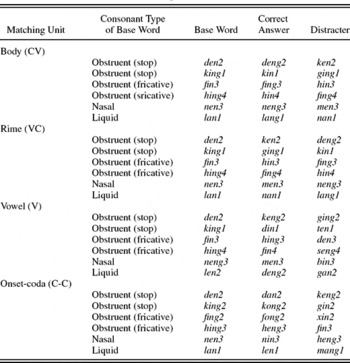
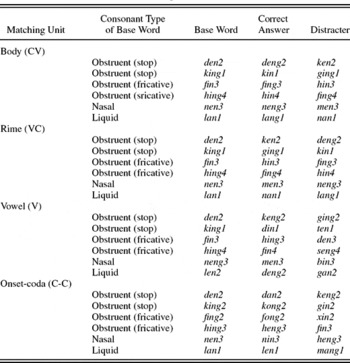
The design was similar to the English matching task. Four different conditions were involved varying the subsyllabic unit shared with the target: (a) body (e.g., king1: kin1 vs. ging1; (b) rime (e.g., king1: ging1 vs. kin1); (c) vowel (e.g., king1: din1 vs. ten1); (d) onset-coda (e.g., king2: kong2 vs. gen2). The only two existing final consonants in Chinese, n and ng were used. Six base items varying sonority in the beginning consonants were constructed. The manipulation of the sonority of consonants in Chinese varied from that used in the English items, due to the different phonotactic constraints in each language and also the need to meet the criteria for pseudosyllables. There were 24 items in total. Tone was kept consistent within the three stimuli in each item. See Appendix D for the set of stimuli.
Procedure
The procedure was identical to the English matching task.
The Chinese and English matching tasks were administered at two different times with an interval of about 1 week. The order of these two tasks was counterbalanced among the children.
Results and discussion
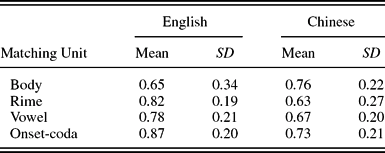
Means and standard deviations for the four experimental conditions in the order of matching body, rime, vowel, and onset-coda in English and Chinese are listed in Table 4. The Chinese data were based on 30 children. Two did not attend the school on the testing day. A 2 (Language) × 4 (Subunit Type) repeated-measure ANOVA confirmed significant main effects of language and subunit type, F1 (1, 29) = 10.81, p < .01, F2 (1, 40) = 3.36, p = .07 for language effect, F1 (3, 27) = 3.21, p < .05, F2 (3, 40) = .93, p = .43 for subunit effect. The interaction between language and subunit type was significant as well, F1 (3, 27) = 6.16, p < .01, F2 (3, 40) = 2.27, p = .09.
Means and standard deviations of accuracies in the English and Chinese sound matching tasks
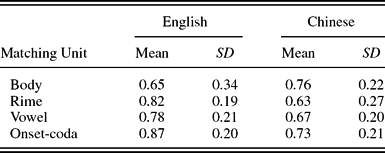
Planned specific paired sample t tests showed that for English, children were significantly better in matching the rime unit than matching the body unit, t1 (31) = 2.88, t2 (10) = 3.21, both ps < .01. For Chinese, however, children were significantly better at matching the body unit than matching the rime unit, t1 (29) = 2.32, p < .05, t2 (10) = 1.19, p = .26. This result provided converging evidence for the rime unit preference over the body unit in matching English words, and body unit preference over rime unit in matching Chinese syllables in bilingual children, as demonstrated in Experiment 2. This again supports the bilingual model that advocates for separated lexical representations.
We also observed that the matching performance was better on the onset-coda unit than the rime unit for both English and Chinese, although the difference was not statistically significant (p = .21 for English, p = .52 for Chinese). The high perceptual salience of the margin sounds may be the reason for good performance in matching onset-coda units. The two margin sounds are also separated, whereas the two phonemes in body and rime units are sequential. It is possible that the margin sounds were particularly easy for children to attend to in the matching task, when the task explicitly demanded the children to pay attention to these sounds. Children in general performed better in matching the rime unit than matching the vowel unit in English, and performed better in matching the body unit than the vowel unit in Chinese, but the differences were not statistically different (p = .19 for English, p = .07 for Chinese). It is possible that children did not benefit significantly in matching a large unit (double-phoneme sequence) such as body in Chinese and rime in English in comparison to a single-phoneme vowel unit.
GENERAL DISCUSSION
In this study, we reported three experiments investigating subsyllabic unit preference in young Chinese children. We observed a clear preference for body over rime unit in processing spoken Chinese syllables in Grade 1 children in all three experiments. Preschool children showed a pattern of preference similar to the Grade 1 children in the first two experiments. We suggest that this body unit preference is driven by experience with Chinese spoken language. A large number of syllables in Chinese are open syllables, with the possibility of having only one of the two final consonants: the two nasal sounds. It seems that the abundance of open syllables in Chinese may be more influential for sensitivity to subsyllabic units, favoring body over rime, compared with the sonorant final consonants, which should have favored rime units. In other words, the sonority of the final consonants is not decisive in determining the sensitivity to the rime unit.
We also observed in Experiments 2 and 3 different subsyllabic unit preferences for Chinese and English in Chinese–English bilingual children. Children preferred the body unit in processing Chinese and the rime unit in processing English. These results support the separation of phonological representations for the two languages of bilingual children. The results from our English sound similarity judgment and matching tasks are consistent with previous findings using different experimental paradigms (e.g., Treiman, Reference Treiman1986, Reference Treiman1995; Treiman & Danis, Reference Treiman and Danis1988). Our study joins studies in languages such as Korean, Dutch, and Hebrew to support the view of language specificity in considering the division of subsyllabic units. Chinese and English spoken languages have highly contrasting features. Chinese has a much simpler syllable structure compared to English. Chinese has no consonant clusters as onsets and codas. However, there are abundant open syllables in Chinese and tonal feature is unique to this language. Together with findings seen for Korean and Hebrew languages, it appears that high frequency of simple open syllables sensitizes speakers to the body unit.
It is important to note that compared to other languages such as Korean and Hebrew, the Chinese language presents a better test case for the linguistic hypothesis, in that the properties of the spoken language are solely responsible for the subsyllabic unit preference. The graphemes in the Chinese writing system do not map onto the individual sounds in the Chinese language, therefore resulting in an ideal disentanglement between phonology and orthography. Korean is an interesting case when compared to Chinese. The Korean language has relatively similar linguistic structures to the Chinese language; it is closer to Chinese compared to other languages such as Hebrew or Dutch. However, unlike Chinese, Korean Hangul is an alphabetic system, in which the letters map directly to sounds. Of more interest, it has a nonlinear spatial layout in which the onsets and vowels are grouped spatially on the upper part of the square-like syllable block, resulting in a natural separation between the CV and C parts of the syllable (Yoon et al., Reference Yoon, Bolger, Kwon, Perfetti, Vehoeven, Elbro and Reisman2002). Therefore, the properties of the spoken syllables are difficult to tease apart from the written characteristics of the letter strings. Hebrew is also a case where spoken language properties (large number of open syllables) and orthographic features (pointed orthography) may jointly contribute to the body unit preference (Share & Blum, Reference Share and Blum2005).
When discussing Chinese subsyllabic unit preference, it is necessary to take the unique phonological feature of tone into consideration. The tonal feature of the Chinese phonology adds a level of complexity into the system. This supersegmental feature interacts with the segmental information and affected children's processing of internal syllable units. When tones were matched for the pair, children were more sensitive to the subsyllabic unit differences. For example, the body effects were modulated by tone in Experiment 1. When tone was matched for the pair, the children were significantly more sensitive to the body unit in comparison with other units. Overall, children also rated the pairs of Chinese syllables more similar when the tones were matched compared to those when tones were unmatched. This novel evidence suggests that tone is an integral part of the phonological system of Chinese. There is limited empirical research on how tone is perceived in Chinese and how children develop tone skill relative to segmental information in Chinese syllables. Yip (Reference Yip2002) provided some interesting linguistic descriptions of variations of tone types in different tonal languages in the world, yet the psycholinguistic reality of the tone has not been paid enough attention in the literature. Future research is needed to investigate how children acquire different tones in spoken Chinese and especially in written Chinese when tone is not represented in the characters. Investigating the commonality and differences in processing tonal information across different tonal languages is also worthwhile.
Our study also provided evidence that children develop their subsyllabic unit preference in spoken language across time. Clearly, Grade 1 children showed a greater preference for the body unit in Chinese and the rime unit in English compared to preschool children in the sound similarity judgment task. There is a strong potential factor, literacy experience in Pinyin, which may help shape the subsyllabic unit preference in spoken language in literate children. The Chinese language provides an interesting case, in that the oral language has no direct linkage to the written language in the form of characters. Therefore, learning the logographic writing system may not have much to do with the subsyllabic unit processing. Chinese children also learn to use the Pinyin system to assist in reading the characters. The Pinyin system has straightforward letter–sound correspondences. Pinyin knowledge facilitates letter–sound correspondences in general; this may not affect either body or rime preference. However, in learning Pinyin, children are introduced to the tone markers (the diacritics) superimposed on top of the vowel grapheme. This graphic representation may promote children's awareness of tone. Better tone skill may help children direct more attention to segmental information.
Considering previous research on Korean Hangul, Hebrew, and Dutch orthographies, it seems that deep orthographies in the case of English favor rimes, because orthographic consistency is gained in the rime unit, which is otherwise low. Shallow orthographies favor small grain size mapping, and hence, phonemic structures with less distinct subsyllabic units (Goswami, Gombert, & de Barrera, Reference Goswami, Gombert and Barrera1998; Ziegler & Goswami, Reference Ziegler and Goswami2005). However, linguistic factors come into play to favor the body unit in Korean and Hebrew, two shallow orthographies. Chinese, a logographic system, favors the body unit, which we argue originates primarily from its linguistic properties.
Although there was no significant difference between similarity judgments on items with shared English body and rime units for the preschool bilingual children, the pattern of results may suggest some trend of preference for English body units. This trend was in the opposite direction when children reached Grade 1. They judged the items with shared rime units significantly more similar. We suggest that the trend for body preference in English similarity judgments in preschool children may be due to influence from children's first language (L1) Chinese. This result suggests that at an early stage of bilingual acquisition, there may be a shared bilingual lexicon as claimed by the bilingual interactive activation model. This shared bilingual lexicon is largely influenced by children's L1 system. As the bilingual children grow, the lexical representations of the two different languages become more separate. In other words, there may be a developmental shift in how bilingual children represent the two different phonological systems, that is, they may move from a shared to separate lexicons.
Two limitations of this study are noteworthy. First, the limited number of items in each condition in all of the three experiments affected the power for detecting differences in item analyses. Future research should include more test items. Second, the two experiments in our study (i.e., the sound similarity judgment and sound matching) tapped more into children's implicit awareness of the different subsyllabic units, rather than their explicit awareness. Among the various task paradigms addressing children's phonological awareness, oddity, matching, and similarity judgment tasks are considered as testing more the implicit sensitivity to shared subsyllabic units (e.g., Bertelson, de Gelder, & van Zon, Reference Bertelson, de Gelder and van Zon1997; Cardoso-Martins, Reference Cardoso-Martins1994). Tasks such as segmentation, deletion, and substitution involve conscious manipulation of phonological units (e.g., Duncan, Seymour, & Hill, Reference Duncan, Seymour and Hill1997; Hulme et al., Reference Hulme, Hatcher, Nation, Brown, Adams and Stuart2002; Stanovich, Cunningham, & Cramer, Reference Stanovich, Cunningham and Cramer1984; Yopp, Reference Yopp1988). The differences between implicit and explicit understanding of the phonological units in children may reflect the degree of task difficulty and may have different theoretical implications. In line with previous research, it is necessary to address both implicit and explicit subsyllabic unit preference in Chinese children. Segmentation and deletion tasks could be utilized in future studies.
CONCLUSION
In summary, our findings point to cross-linguistic differences in subsyllabic unit processing and provide evidence supporting our hypothesis that the subsyllabic unit preference is determined by the spoken language properties. The statistical properties of the Chinese language in having large numbers of open syllables may very well be responsible for children's sensitivity to the body unit. Children develop their sensitivity to the subsyllabic units over time, in which literacy experience in Pinyin may play a role. Tone is an integral part of the Chinese phonology and affects children's sensitivity to the different subsyllabic units.
Stimuli used in the Chinese sound similarity judgment task

Note: V, vowel; C, consonant.
Stimuli used in the English sound similarity judgment task

Note: V, vowel; C, consonant.
Stimuli used in the English sound matching task

Note: V, vowel; C, consonant.
Stimuli used in the Chinese sound matching task
Note: V, vowel; C, consonant.
ACKNOWLEDGMENTS
The research reported here was supported by an NIH/NICHD grant (R01HD048438). We thank all the teachers and parents in the Chinese language schools for their warm support and the children for their active participation. Charles A. Perfetti provided valuable discussion on key theoretical issues. Brett Kessler also provided constructive comments and suggestions on an early version of the paper. We thank Chen Yang, Amy Dai, Jing Tian, and Dongquan Zhang for their help with collecting data. Seunghyun Baek assisted in the stimuli construction in the English tasks. Emily Fox carefully proofread an early version of the paper.