INTRODUCTION
The Nephtyidae constitute one of the most conspicuous families of polychaetes found in marine soft bottoms. These worms are long, strongly muscular, with a cylindrical anterior region which includes the proboscis, and a median region rectangular in cross-section (Hilbig, Reference Hilbig, Blake and Hilbig1994). Although the family Nephtyidae is easily recognized and probably monophyletic, the only evidence put forward for this assertion is the characteristic interramal cirrus (also called interramal branchia) (Fauchald & Rouse, Reference Fauchald and Rouse1997). The parapodia along the body gradually change in size and development of lobes and cirri. They have well separated rami bearing dense chaetal fascicles diagonally pointed outwards. All chaetae are simple and include capillary and spinulose forms. The Nephtyidae are unique within Phyllodocida in possessing a single median pygidial cirrus/papilla (Pleijel, Reference Pleijel, Rouse and Pleijel2001).
Nephtyids are distributed worldwide and typically live in sediments ranging from sand to muddy sands (Pettibone, Reference Pettibone and Parker1982). Their bathymetric distribution is wide, but they are most frequent in shallow bottoms (less than 100 m), although abyssal species are also known. They are active burrowers and good excavators, helped by their strong eversible proboscis; they do not live permanently in the galleries they build. They are considered active subsurface carnivores, although some species such as Nephtys incisa might be non-selective surface deposit-feeders (Fauchald & Jumars, Reference Fauchald and Jumars1979).
The family includes five genera (Aglaophamus, Dentinephtys, Inermonephtys, Micronephtys and Nephtys) and over 110 nominal species (Pleijel, Reference Pleijel, Rouse and Pleijel2001). In the Gulf of California, Mexican Pacific, the nephtyids constitute one of the most abundant and widely distributed groups of polychaetes. They can be found almost everywhere on the continental shelf (Hernández-Alcántara & Solís-Weiss, Reference Hernández-Alcántara and Solís-Weiss1999; Hernández-Alcántara, Reference Hernández-Alcántara2002). In this region, 21 species belonging to the genera Aglaophamus, Inermonephtys and Nephtys have been recorded; seven species have been synonymized by several authors and at present 14 are recognized as valid.
Recent comprehensive studies of Nephtyidae taxonomy of the north-eastern Pacific Ocean are scarce and only Hilbig (Reference Hilbig, Blake and Hilbig1994) reviewed this family from California. Therefore, the aim of this study is to analyse the Nephtyidae from the Gulf of California, to increase the taxonomic knowledge of this family and to describe two new species from the genus Aglaophamus.
MATERIALS AND METHODS
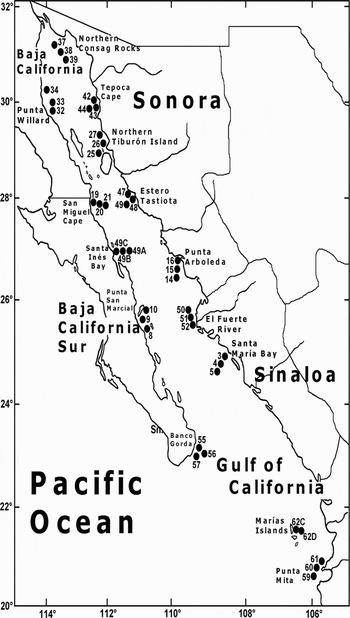
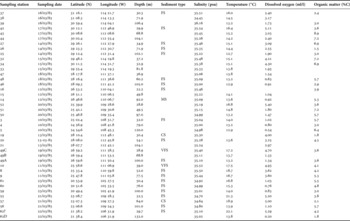
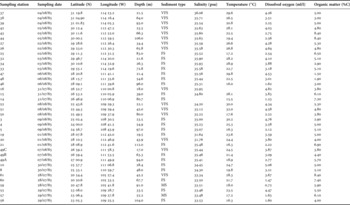
The polychaete fauna examined in this study was collected on board the RV ‘El Puma’ (UNAM, México) during the oceanographic expeditions ‘CORTES 2’ (March 1985) and ‘CORTES 3’ (July–August 1985). Forty-one stations were sampled on the continental shelf of the Gulf of California from which nephtyids were found in 39, in 17 to 120 m depth (Figure 1; Tables 1 & 2). Samples were collected with a Smith–McIntyre grab (0.1 m2) and sieved through a 0.5 mm sieve. The biological material was fixed in 4% formaldehyde and preserved in 70% ethanol.
Study area showing the sampling stations.

Sampling stations from the CORTES 2 oceanographic expedition.

VFS, very fine sand; FS, fine sand; MS, medium sand; CS, coarse sand.
Sampling stations from the CORTES 3 oceanographic expedition.

VFS, very fine sand; FS, fine sand; MS, medium sand.
For each species, the number of specimens is given under ‘Material Examined’ in parentheses following the number of the sampling station. Information about the habitat data for each species is abbreviated as follows: D, depth in metres; S, salinity in psu (practical salinity units); T, temperature in °C; DO, dissolved oxygen in ml/l (determined by the Winkler method (Strickland & Parsons, Reference Strickland and Parsons1977)); OM, organic matter content in the sediments in %C (determined by the Walkley & Black (Reference Walkley and Black1934) method modified by Jackson (Reference Jackson1958)). The distribution along the continental shelf of the Gulf of California, in addition to the worldwide distribution recorded in the literature is given for each species.
The holotypes and paratypes of Aglaophamus longicirrata sp. nov. and Aglaophamus foliosa, and all nephtyids examined from the Gulf of California are deposited in the National Polychaete Collection at the Instituto de Ciencias del Mar y Limnología, Universidad Nacional Autónoma de México (CP-ICMyL). Additional paratypes are deposited in the Los Angeles County Natural History Museum (LACM), the Australian Museum (AM), and The Natural History Museum, London (BNHM).
RESULTS
For this study, 1763 specimens of the family Nephtyidae belonging to eight species from the genera Aglaophamus and Nephtys were examined. Aglaophamus longicirrata sp. nov. and Aglaophamus foliosa sp. nov. are newly described.
SYSTEMATICS
MATERIAL EXAMINED
A total of 120 specimens (CP-ICML and UNAM PO-45-002): CORTES 2: Station 39 (2), Station 33 (1), Station 14 (3), Station 51 (33), Station 50 (5), Station 4 (2), Station 10 (5), Station 49B (13), Station 49A (1); CORTES 3: Station 39 (8), Station 14 (11), Station 50 (28), Station 5 (7), Station 49B (2).
DIAGNOSIS
All examined specimens incomplete with 15–40 segments, 3–19 mm long, 0.5–2.0 mm wide. Prostomium slightly longer than wide, subrectangular, eyes absent. Proboscis with a circlet of 14 terminal bifid papillae, and 14 rows of subterminal papillae with 10 to 13 papillae per row. Interramal cirri starting on segments 8 or 9, shorter than dorsal cirri until segment 14; in the following segments fully developed and curved around segment 17.
HABITAT
In muddy and silty sediments, 37 to 440 m (Hilbig, Reference Hilbig, Blake and Hilbig1994). In this study in fine and medium sand and silty sand sediments: D = 39.0–106.4; S = 34.98–35.54; T = 12.9–21.4; DO = 0.54–4.93; and OM = 3.0–7.2.
DISTRIBUTION
Central California to western México (Hartman, Reference Hartman1968; Hilbig, Reference Hilbig, Blake and Hilbig1994). In the Mexican Pacific it has been recorded off the Pacific coast of Baja California (Hartman, Reference Hartman1950, Reference Hartman1968) and in the Gulf of California (Hernández-Alcántara & Solís-Weiss, Reference Hernández-Alcántara and Solís-Weiss1999; Hernández-Alcántara, Reference Hernández-Alcántara2002). In this study, the species was collected on the eastern coasts of the central region and northern Gulf of California.
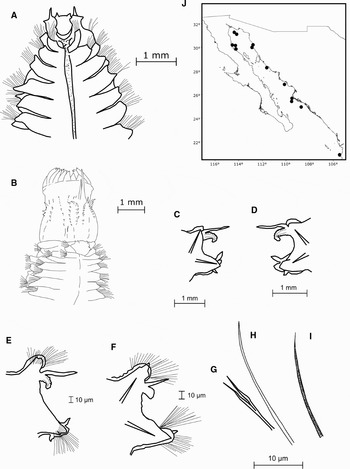
Aglaophamus longicirrata sp. nov.: (A) anterior region, dorsal view; (B) anterior region with proboscis; (C) parapodium 23, anterior view; (D) parapodium 23, posterior view; (E) parapodium 25, anterior view; (F) parapodium 35 posterior view; (G) lyrate chaetae; (H) smooth capillary chaetae; (I) cross-barred capillary chaetae; (J) distribution in the Gulf of California.

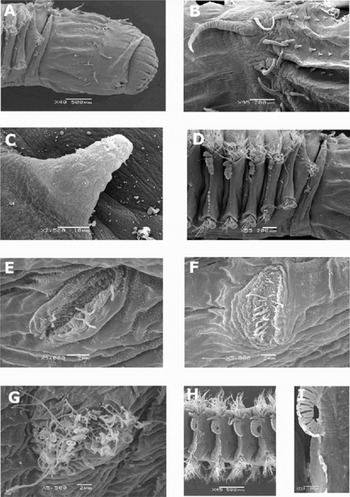
Aglaophamus longicirrata sp. nov., electronic microscopy photographs: (A) anterior end with everted proboscis; (B) middorsal and companion papillae; (C) papilla of the proboscis showing the pores; (D) anterior end and first parapodia; (E–G) ciliated organs with different lengths of the cilia; (H) median parapodia; (I) interramal cirri with band of ciliated organs.

MATERIAL EXAMINED
Holotype: El Fuerte River 25° 42.1′N 109° 30.6′W, CORTES 2, Station 51, 20 March 1985, 49.5 m (CP-ICMyL; POH-45-002).
Paratypes: 25 specimens: El Fuerte River 25° 42.1′N 109° 30.6′W, CORTES 2: Station 51, 20 March 1985, 49.5 m: 10 specimens (CP-ICMyL; POP-45-002); 5 specimens (LACM-AHF; POLY 2197); CORTÉS 2: Station 52, 25° 39.9′N 109° 28.9′W, 20 March 1985, 28.6 m: 5 specimens (BNHM 2008.964.968); Tepoca Cape 30° 12.1′N, 112° 46.9′W CORTÉS 2: Station 42, 17 March 1985, 29.9 m: 5 specimens (AM W.33715).
ADDITIONAL MATERIAL EXAMINED
A total of 68 incomplete specimens (CP-ICML; PO-45-0024): CORTES 2: Station 37 (2), Station 38 (3), Station 42 (3); Station 43 (1), Station 32 (2), Station 33 (1), Station 48 (1), Station 15 (2), Station 52 (14), Station 51 (3), Station 4 (2), Station 61 (3); CORTES 3: Station 37 (1), Station 43 (3), Station 32 (3), Station 15 (3), Station 52 (12), Station 51 (7), Station 61 (2).
DESCRIPTION
Description based on holotype unless specified otherwise. The specimen is 20.4 mm long and 2.1 mm wide. Prostomium rectangular, slightly longer than wide, with two pairs of cirriform antennae similar in length; a pair of nuchal organs at posterior margin of prostomium (Figure 2A). Proboscis bearing 16 rows of subterminal papillae with 3–7 papillae per row (Figure 2B), very short in proximal region of proboscis and increasing gradually in length towards distal region (Figure 3A, B); pore-like grooves on surface of the proboscideal papillae (Figure 3C). Three rows of papillae with seven papillae each in regular arrangement on dorsal side of the proboscis; in median and ventral rows, distribution and number of papillae not homogeneous varying in number from three to five papillae per row (Figure 3A, B). Middorsal papillae very long and conical without grooves, with one companion papilla in basal position, somewhat shorter, thin and cirriform (Figures 2B & 3A, B). Twenty-two bifid terminal papillae (Figures 2B & 3A); midventral papilla absent. First parapodium short, directed forward; subsequent parapodia directed laterally (Figure 2B). Dorsum with dark medial line widening around segments 6–14 (Figure 2A). Involute interramal cirri thick, starting on fourth segment. Median and posterior parapodia with well separated rami (Figures 2E & 3D). Notopodium with rounded prechaetal lobe and orbicular longer postchaetal lobe (Figure 2C, D); lobes decreasing in size towards posterior end of body (Figure 2E, F). Notopodial lamella short, foliaceous, extending along notopodium. Neuropodial lamella shorter than notopodial, extending beyond postchaetal lobe. Dorsal cirri short in first parapodia, digitiform, inserted on superior base of interramal cirri, increasing in length to medial region of body, well developed around segment 25, reaching approximately twice length of gill (Figures 2E, F & 3D, H). Ventral cirri digitiform, similar in length to gill (Figure 2C–F). Ciliary bands distributed in oval groups present on dorsal side of each interramal cirrus (Figure 3H, I) and extending on the body wall to the base of the neuropodia; cilia without heads (sensory hairs). Bands showing sensorial organs difficult to observe with light microscopy, possibly contractile, cilia showing different lengths along body (Figure 3E–G). Chaetae including smooth capillaries (Figure 2H), cross-barred capillaries (Figure 2I) and lyrate chaetae (Figure 2G) in noto- and neuropodia.
REMARKS
Aglaophamus longicirrata sp. nov. is a species included within a group characterized by the interramal cirrus starting on the third or fourth segment. In the Tropical East Pacific region this group is only represented by Aglaophamus peruana (Hartman, Reference Hartman1940) from Perú coasts and by the two species described in this study: A. longicirrata sp. nov. and A. foliosa sp. nov. The species included in this group can be basically separated by the shape of the dorsal cirri: A. longicirrata sp. nov. has very long and cirriform dorsal cirri, while both A. foliosa sp. nov. (see below) and A. peruana bear foliaceous dorsal cirri. Taking into account the very long dorsal cirri, a characteristic morphological structure of this new species, A. longicirrata sp. nov. is only similar to Aglaophamus lyrochaeta (Fauvel, Reference Fauvel1902) distributed in Morocco, Congo, Gulf Beach and South Africa (Hartman, Reference Hartman1950). Both species have lyrate chaetae and very long dorsal cirri. However, A. lyrochaeta bears 14 rows of subterminal papillae and only one middorsal papilla on the proboscis, while A. longicirrata sp. nov. bears 16 rows of subterminal papillae and one very long middorsal papilla with one companion papilla in basal position. In addition, the pore on the surface of the proboscideal papillae detected in A. longicirrata is a morphological characteristic that has not been observed in other nephtyids yet.
The scanning electron microscopy (SEM) observations of the parapodia of A. longicirrata sp. nov. clearly show ciliary structures (Figure 3D–I). Those structures constitute a morphological feature which has seldom been observed in the Nephtyidae family. They were studied in some detail by Coonfield (Reference Coonfield1931, Reference Coonfield1934) on Nephtys bucera Ehlers, Reference Ehlers1868. Physiological tests performed by this author indicate that the cilia are grouped into small tufts and each ciliated cell is independent of the nervous system, regulating its own activity. ‘The beating of the cilia causes a current of water to flow on each side of the worm posteriorly in the groove formed by the division of each parapodium into a neuropodium and a notopodium’ (Coonfield, Reference Coonfield1931). In this study, we cannot give a definite status of taxonomic value to the ciliary structures since it is possible that it has been overlooked in other species. Ciliary bands have also been described in organisms from other polychaete families such as the terebellid Lanice conchilega (Pallas, Reference Pallas1766) (Heimler, Reference Heimler1983), syllids of the genus Paraehlersia and Autolytus (San Martín, Reference San Martín, Ramos, Alba, Bellés, Gosálbez, Guerra, Mcpherson, Martín, Serrano and Templado2003), and Syllis or spionids as Pygospio elegans Claparède, Reference Claparède1863 (Schlötzer-Schrehardt, Reference Schlötzer-Schrehardt1991). It has been observed that the ciliated organs may be of different kinds, but not all of them are sensory: for example, in some spionids the organs probably play a role in sperm transfer (Schlötzer-Schrehardt, Reference Schlötzer-Schrehardt1991).
ETYMOLOGY
The name of the species indicates the presence of very long dorsal cirri, here found mainly on the midbody region.
HABITAT
In fine sands, silty sands, silts, muds and sands: D = 28.6–79.0; S = 34.92–45.54; T = 13.2–16.8; DO = 0.63–5.40; OM = 2.4–8.9.
DISTRIBUTION
Widely distributed on the continental shelf of the Gulf of California: in the central region, mainly on the eastern coasts; in the northern region, on both sides of the coast (Figure 2J).
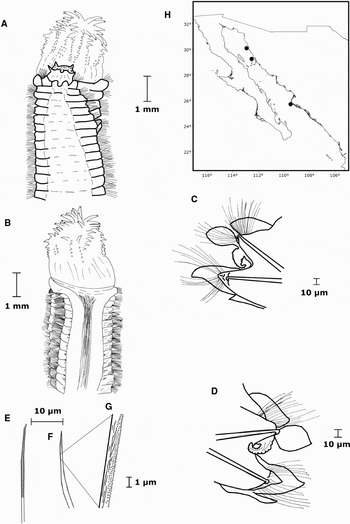
Aglaophamus foliosa sp. nov.: (A) anterior region, dorsal view; (B) anterior region, ventral view; (C) parapodium 20, anterior view; (D) parapodium 30, posterior view; (E) cross-barred chaetae; (F) serrated chaetae; (G) margin of the serrate chaetae (1000x); (H) distribution in the Gulf of California.

MATERIAL EXAMINED
Holotype: Northern Tiburón Island 29° 11.3′N 112° 31.5′W, CORTES 3 Station 25 2 August 1985, 83 m (CP-ICMyL; POH-45-001).
Paratypes: (CP-ICMyL; POP-45-001) 1 specimen from CORTÉS 3: Station 52, 25° 43.6′N 109° 29.3′W, 8 August 1985, 22.1 m; (BNHM 2008.964.969) 1 specimen from CORTÉS 3: Station 44, 30° 00.5′N 112° 59.5′W 5 August 1985, 106.0 m.
DESCRIPTION
Description based on holotype unless specified otherwise. Complete specimen 31.0 mm long, 4.0 mm wide, 61 segments. Prostomium rounded, brownish, iridescent after fixation, darker on anterior margin. Two pairs of cirriform antennae similar in length; a pair of rounded nuchal organs at posterior margin of prostomium. Proboscis with 22 bifid terminal papillae, proximal region with smooth surface; 16 rows of subterminal papillae with numerous papillae per row (Figure 4A, B): 5 papillae on lateral and ventral rows, and 15 small papillae on dorsal rows. Dorsal rows with 7–10 small digitiform papillae at the proximal end of the row and thick, long curved papillae on the distal region of the proboscis (Figure 4A). First parapodium directed forward with thick and long ventral cirrus; subsequent parapodia directed laterally. Involute interramal cirri starting at segment 4, almost straight; fully developed around segment 10, strongly curved; decreasing gradually in size around segment 60 until end of body to papilliform appendix. Dorsum with thick median iridescent line, extending to end of body (Figure 4A). Ventral region showing dark brownish spot on ventral median line of body (Figure 4B). Parapodia similar in shape from segment 4. Notopodia with conical acicular lobes, rounded pre-acicular lamellae and foliaceous post-acicular lamellae extending around notopodial margin. Dorsal cirri foliaceous, long, almost length of gill, inserted at base of gill. Neuropodia with conical acicular lobes with small incision, rounded pre-acicular lamellae short; post-acicular lamellae foliaceous, very long, approximately 1.5 times length of gill; without an erected lobe on the upper edge. Ventral cirri digitiform, slightly shorter than dorsal, elongated at base and with wide median region, directed downwards; aciculae in both rami yellow, emerging out of acicular lobe and curving backwards (Figure 4C, D). Noto- and neurochaetae similar in shape: pre-acicular capillaries cross-barred and short, widely serrated chaetae; post-acicular chaetae serrated, wide and short, and thin and long (Figure 4E–G). Lyrate chaetae absent.
REMARKS
The presence of foliaceous dorsal cirri in A. foliosa sp. nov. allow us to include it in a group which presently includes seven species, all collected in the Pacific Ocean. Within this group, we can separate the species based on the neuropodia with an erected lobe on the upper edge, the number of rows of subterminal papillae on the proboscis and the first segment with interramal cirri, so that two subgroups can be formed: the first, characterized by the presence of neuropodia with an erected lobe on the upper edge, which includes four species: A. sinensis (Fauvel, Reference Fauvel1932), distributed in China, Vietnam and Japan, which bears 22 rows of subterminal papillae and interramal cirri from the segment 2 (Fauchald, Reference Fauchald1968); A. dicirroides Fauchald, Reference Fauchald1968, from Vietnam, also with 22 rows of subterminal papillae, but with interramal cirri starting at segment 3; A. lutreus (Baird, Reference Baird1873), distributed in Patagonia, South America, bears 14 rows of subterminal papillae and interramal cirri starting at segment 5; the fourth species, A. mirasetis (Hoagland, Reference Hoagland1920) recorded from the Philippines, bears neuropodia with an erected lobe on the upper edge, but was described from a single individual, and according to Hartman (Reference Hartman1950) presumably has many subterminal rows with 8 in a row at the sides and only 5 medially, and the origin of interramal cirri is not known.
The second subgroup is formed by three species, which bear neuropodia without an erected lobe on the upper edge: A. peruana (Hartman, Reference Hartman1940) registered in Perú and A. macroura (Schmarda, Reference Schmarda1861) distributed in all Antarctic regions, but also in southern South America to the La Plata River, and in deep waters off Maine (Hartman, Reference Hartman1950), have 22 rows of subterminal papillae and the interramal cirri are first present from the third, or not until the fourth segment; the third species, A. orientalis Fauchald, Reference Fauchald1968, recorded from China, bears 14 rows of subterminal papillae and interramal cirri from segment 3. Aglaophamus foliosa sp. nov. is included in this latter subgroup, but it differs from the above mentioned species in having 16 rows of subterminal papillae and in having interramal cirri from segment 4.
The emergent aciculae observed in the types of A. foliosa could be a result of the constriction of the musculature in the parapodia at the time of fixation. For this reason, we cannot at this point decide on its status as a valid taxonomic character. However, we observed that in the specimens examined, this character is consistent along the body, while in the specimens from other species of Nephtyidae found in the same sampling stations, and thus treated similarly, we did not observe this character. That is why, pending confirmation, we believe that the emergent aciculae could be typical of this species.
ETYMOLOGY
The name is derived from the shape of the dorsal cirri, the morphological structure characteristic of this species.
HABITAT
In very fine and fine sands: D = 22.1–106.0; S = 34.20–35.63; T = 17.2–30.0; DO = 2.54–4-34; and OM = 5.30–8.40.
DISTRIBUTION
Northern Tiburón Island, Tepoca Cape and El Fuerte River (Sonora, México) on the north-eastern coast of the Gulf (Figure 4H).
MATERIAL EXAMINED
A total of 1001 specimens (CP-ICML; UNAM PO-45-012): CORTES 2: Station 37 (40), Station 38 (4), Station 39 (5), Station 42 (14), Station 43 (1), Station 44 (1), Station 27 (30), Station 26 (17), Station 32 (7), Station 34 (1), Station 47 (14), Station 48 (14), Station 16 (78), Station 15 (13), Station 14 (5), Station 52 (40), Station 51 (25), Station 3 (16), Station 10 (5), Station 20 (6), Station 49C (9), Station 49B (14), Station 49A (9), Station 61 (1); CORTES 3: Station 37 (42), Station 38 (9), Station 39 (6), Station 42 (72), Station 43 (1), Station 44 (7), Station 27 (64), Station 26 (15), Station 32 (106), Station 34 (6), Station 47 (48), Station 48 (11), Station 16 (64), Station 15 (19), Station 14 (3), Station 52 (23), Station 51 (8), Station 3 (21), Station 4 (5), Station 5 (1), Station 10 (13), Station 49C (73), Station 49B (10), Station 49A (5).
DIAGNOSIS
One hundred and fifty-five complete specimens with 27–94 segments, 6.0–41.0 mm long, 0.25–3.0 mm wide; the rest are anterior segments with 16–83 segments, 3.0–39.0 mm long, 0.25–2.5 mm wide. Prostomium slightly longer than wide, rectangular, with a pair of small eyes in posterior middle of prostomium. Proboscis cylindrical, strongly muscular in distal region, with 22 papillae and 22 rows of subterminal papillae with 3–9 papillae per row. Middorsal papillae usually absent. Interramal cirri involute, first present on segments 5–9. Accessory cirri short, rounded, located just below the dorsal ones and separated from them by a deep incision.
HABITAT
Intertidal to 200 m; sandy, muddy sands, sands mixed with shell fragments and silty clays; estuarine (Taylor, Reference Taylor, Uebelacker and Johnson1984; Hilbig, Reference Hilbig, Blake and Hilbig1994). In depths of 20–72 m, in sand and muddy sands, 26–30°C and sediments with 0.17–0.28% organic carbon (González-Ortiz, Reference González-Ortiz1994). In this study in fine to medium sands, silty sands and sandy silts: D = 17.0–120.0 m; S = 34.20–36.06; T = 12.9–32.2; DO = 0.54–6.45; and OM = 1.5–8.9.
DISTRIBUTION
Temperate and subtropical waters from the western Atlantic Ocean and northern Gulf of México (Taylor, Reference Taylor, Uebelacker and Johnson1984). California to Panamá, Maryland to Georgia, New Zealand, Australia, Japan and India (Hilbig, Reference Hilbig, Blake and Hilbig1994). In the Mexican Pacific, it has been recorded on the eastern coasts from Baja California peninsula (De León-González, Reference de León-González1994), Gulf of California (Hernández-Alcántara & Solís-Weiss, Reference Hernández-Alcántara and Solís-Weiss1999; Hernández-Alcántara, Reference Hernández-Alcántara2002) and Gulf of Tehuantepec (González-Ortiz, Reference González-Ortiz1994). In this study, this species was collected practically on the whole continental shelf of the Gulf of California where it is very abundant.
MATERIAL EXAMINED
A total of 42 specimens (CP-ICML; UNAM PO-45-021): CORTES 2: Station 27(9), Station 25 (2); CORTES 3: Station 3 (19), Station 5 (9), Station 8 (2), Station 57 (1).
DIAGNOSIS
Specimens incomplete with 20–48 segments; 3.5–14.0 mm long, 0.75–1.0 mm wide. Prostomium rounded to trapezoidal, depending whether proboscis is retracted or everted. Proboscis with 22 long bifid terminal papillae and 22 rows of subterminal papillae with three to five papillae per row; proximal surface smooth, with one middorsal long papilla and one short midventral papilla. Prostomium and first few parapodia with a brownish pigmentation pattern. Interramal cirri recurved, starting on segment 4 and continuing nearly to the end of the body. Noto- and neuropodium with a short pre-acicular lamella.
HABITAT
Common in muddy sands and eelgrass flats (Hartman, Reference Hartman1938). Typical intertidal species found in sheltered beaches; in 50–110 m depth in sands, sands mixed with silt and silts (Hilbig, Reference Hilbig, Blake and Hilbig1994). At 30 m depth, muddy sand, 30°C, sediments with 0.20% organic carbon (González-Ortiz, Reference González-Ortiz1994). In this study, in fine sands: D = 32.0–120.0; S = 34.48–35.50; T = 12.7–19.9; DO = 0.54–16.30; and OM = 2.1–6.9.
DISTRIBUTION
California, Washington (Hartman, Reference Hartman1938). Western México to British Columbia (Hilbig, Reference Hilbig, Blake and Hilbig1994), Gulf of California (Hernández-Alcántara & Solís-Weiss, Reference Hernández-Alcántara and Solís-Weiss1999; Hernández-Alcántara, Reference Hernández-Alcántara2002) and Gulf of Tehuantepec (González-Ortiz, Reference González-Ortiz1994). In this study, it was collected in front of the north-eastern coasts of the Gulf of California and at the southern end of the Baja California peninsula.
MATERIAL EXAMINED
A total of 135 specimens (CP-ICML; UNAM PO-45-004): CORTES 2: Station 27 (2), Station 26 (1), Station 25 (3), Station 32 (4), Station 33 (1), Station 46 (1), Station 52 (4), Station 3 (14), Station 10 (1), Station 8 (1), Station 19 (7), Station 20 (19), Station 49A (2), Station 62C (2); CORTES 3: Station 37 (3), Station 39 (2), Station 42 (2), Station 27 (1), Station 47 (21), Station 46 (1), Station 16 (13), Station 52 (3), Station 3 (4), Station 5 (9), Station 10 (1), Station 8 (1), Station 19 (8), Station 20 (2), Station 21 (2).
DIAGNOSIS
Specimens incomplete with 16–145 segments, 5.0–67.0 mm long, 1.0–3.0 mm wide. Prostomium rounded anteriorly, trapezoidal, with a dark coloured ‘spreadeagle’ pattern at the posterior half. Proboscis with 22 bifid terminal papillae and 22 rows of subterminal papillae with 6–8 papillae per row; no papilla in clear middorsal position. Interramal cirri recurved, starting on segment 3 and continuing until end of body.
HABITAT
Intertidal to 330 m; on exposed sandy beaches (Hartman, Reference Hartman1968; Hilbig, Reference Hilbig, Blake and Hilbig1994). In this study in fine to coarse sands and silty sands: D = 18.0–120.0; S = 31.64–36.06; T = 12.7–30.2; DO = 0.54–5.29; and OM = 1.5–7.2.
DISTRIBUTION
Central and southern California (Hartman, Reference Hartman1968). Western México to California, Gulf of México, Yellow Sea, Japan (Hilbig, Reference Hilbig, Blake and Hilbig1994). Widely distributed in the Gulf of California (Hartman, Reference Hartman1940; Hernández-Alcántara & Solís-Weiss, Reference Hernández-Alcántara and Solís-Weiss1999; Hernández-Alcántara, Reference Hernández-Alcántara2002). In this study, it was recorded from the whole continental shelf of the Gulf of California, although it is more abundant in the central region.
MATERIAL EXAMINED
A total of 350 specimens (CP-ICML; UNAM PO-45-013): CORTES 2: Station 37 (17), Station 38 (7), Station 27 (3), Station 48 (1), Station 16 (139), Station 52 (27), Station 3 (6), Station 9 (2), Station 19 (6), Station 49C (4), Station 61 (8), Station 60 (2); CORTES 3: Station 39 (1), Station 27 (7), Station 26 (10), Station 32 (4), Station 47 (1), Station 48 (4), Station 16 (47), Station 14 (1), Station 52 (3), Station 3 (4), Station 4 (4), Station 10 (4), Station 8 (3), Station 19 (1), Station 20 (1), Station 49C (5), Station 49B (20), Station 49A (2), Station 61 (4), Station 60 (2).
DIAGNOSIS
All specimens incomplete with 3–88 segments, 3.0–53.0 mm long, 0.25–2.5 mm wide. Prostomium rectangular with two pairs of antennae. Proboscis with 22 rows of subterminal papillae and one middorsal papilla; proximal surface smooth. Interramal cirri recurved starting on segment 3 and continuing to end of body. Prechaetal lobes wide, oval, and comparatively shorter than postchaetal.
HABITAT
Intertidal to 60 m (Hartman, Reference Hartman1968). In this study on fine to coarse sands and silty sands: D = 31.64–35.95; S = 31.64–35.95; T = 13.2–30.2; DO = 0.63–5.40; and OM = 1.5–8.4.
DISTRIBUTION
Panamá (Hartman, Reference Hartman1940), Gulf of California (Hartman, Reference Hartman1940, Reference Hartman1950; Kudenov, Reference Kudenov and Brusca1980; Hernández-Alcántara & Solís-Weiss, Reference Hernández-Alcántara and Solís-Weiss1999; Hernández-Alcántara, Reference Hernández-Alcántara2002). In this study, it was recorded on the whole continental shelf of the Gulf of California; it is more abundant in the central eastern region.
MATERIAL EXAMINED
A total of 18 specimens (CP-ICML; UNAM PO-45-015): CORTES 3 Station 39 (3), Station 47 (15).
DIAGNOSIS
Specimens incomplete with 13–42 segments, 12.0–32.0 mm long, 0.75–2.25 mm wide. Prostomium with anterior margin convex, thin, spatulate; lateral margins irregularly rounded; single red eyespot in central dorsal region; posterior margin with long, narrow, V-shaped, middorsal projection extending to near posterior end of segment 1. Proboscis with 22 rows of subterminal papillae, 4–8 papillae per row, very short proximally and gradually increasing in size through distal region; 22 bifid terminal papillae at distal region. Interramal cirri recurved, starting on segment 3.
REMARKS
Perkins (Reference Perkins1980) showed that the Nephtys simoni specimens from the Pacific Ocean bear a pair of eyes located on segment 2 or segment 3 in juvenile individuals and on the first segment in most specimens when the proboscis is retracted. However, in all specimens found in the Gulf of California these eyes are absent.
HABITAT
Intertidal to 189 m depth; in coarse to very fine sands, silty clays, silts and sandy-clay sediments (Hartman, Reference Hartman1950; Taylor, Reference Taylor, Uebelacker and Johnson1984; Hilbig, Reference Hilbig, Blake and Hilbig1994). In this study in fine sands: D = 21.4–93.0; S = 35.54–35.56; T = 20.8–29.8; DO = 2.25–4.53; and OM = 1.5–5.0.
DISTRIBUTION
Florida, North Carolina, California (Perkins, Reference Perkins1980). Southern California to the Strait of Magellan; Colombia and Venezuela (Hartman, Reference Hartman1950; Hilbig, Reference Hilbig, Blake and Hilbig1994). In temperate and subtropical waters from the western Atlantic Ocean, Gulf of México (Taylor, Reference Taylor, Uebelacker and Johnson1984). In this study, it was recorded on the north-eastern region of the Gulf of California.
KEY TO SPECIES OF NEPHTYIDAE FROM THE GULF OF CALIFORNIA
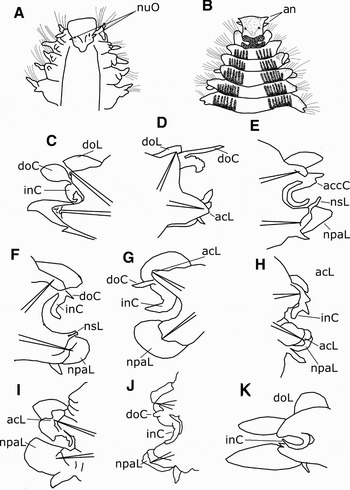
1. One pair of antennae (anterolateral absent) difficult to observe in dorsal view (Figure 5A); proboscis without papillae… … … … … … … … Inermonephtys inermis
_ Two pairs of antennae (Figure 5B); proboscis with terminal and subterminal papillae … … … … … … … … 2
2. Interramal cirri involute (curved inwards) (Figure 5C): genus Aglaophamus … … … … … … … … … … …3
_ Interramal cirri recurved (curved outwards) (Figure 5F, G): genus Nephtys … … … … … … … … … … … … 7
3. Interramal cirri on segment 4 … … … … … … … … 4
_ Interramal cirri starting after segment 5 … … … … …6
4. Notopodia with dorsal cirri foliaceous, long, similar in length to the interramal cirri (Figure 5C) … … … … … … … … … … … … . . Aglaophamus foliosa sp. nov.
_Notopodia with dorsal cirri cirriform (Figure 5G) … … … … … … … … … … … … … … … … … … . 5
5. Dorsal cirri very long, twice as long as interramal cirri (Figure 5D); 16 rows of subterminal papillae and two long middorsal papillae . … … … … … … … … … … … … … … … . . . Aglaophamus longicirrata sp. nov.
_Dorsal cirri shorter than long of interramal cirri (Figure 5F); 14 rows of subterminal papillae and one long middorsal papilla… … … … …Aglaophamus dibranchis
6. Prostomium with two minute but conspicuous black eyes in posterior half; interramal cirri starting on segments 5–8; with lyrate chaetae … … … … … . Aglaophamus verrilli
_ Prostomium without eyes; interramal cirri first present on segments 8–9; lyrate chaetae setae absent … … … … … … … … … … … … … … … . . Aglaophamus erectans
7. Notopodia with dorsal lamellae imbricated, broad and foliaceous, lying flat over the dorsum, scalelike expansions of the dorsal edge of the notopodia (Figure 5K) … … … … … … … … … … … … … … . .Nephtys squamosa
_Notopodia without dorsal lamellae without imbricated lappets … … … … … … … … … … … … … … .8
8. Interramal cirri short, wide, straight to weakly curved (Figure 5H); prostomium with a single red spot on its central region in juveniles … … … … … Nephtys simoni
_Interramal cirri clearly recurved (Figure 5G, K); prostomium without red spot . … … … … … … … … … . 9
9. Neuropodia on anterior segments with one or two lobes at superior margin (Figure 5E, F)… … … … … … … . 10
_ Neuropodia without lobes at superior margin (Figure 5G, J) … … … … … … … … … … … … … … … … . 11
10. Neuropodia with one single erected lobe at superior margin, well developed at segments 8–15 as digitiform projection (Figure 5E) … … … … …Nephtys singularis
_Neuropodium with two lobes at superior margin, well developed at segment 20 as conical projections (Figure 5F) . … … … … … … … . Nephtys bilobatus
11. Acicular lobes conical (Figure 5G); the aciculum projects from the distalmost part of the lobe … … … … … … … … … … … … … . .Nephtys panamensis
_Acicular lobes incised or bilobed (Figure 5I) at least in some region of the body; the tip of the aciculum projects from the lobe at its deepest part … … … … … … 12
12. Anterior end of body pigmented … … … … … … . 13
_Anterior end of body unpigmented … … … … … 15
13. Dorsal anterior region with transverse bar shaped pigmentation (Figure 5B); interramal cirri first present on segment 3; anterior region with acicular lobes bilobed (Figure 5I), posterior region with acicular lobes conical (Figure 5G); . . … … … … … … …Nephtys ferruginea
_ With variable pigmentation on prostomium and first few segments (no bars); interramal cirri starting on segment 4 . … … … … … … … … … … … … . 14
14. Acicular lobes broad and short (Figure 5H) with a slight incision where the aciculum emerge; interramal cirri with accessory cirri separated from dorsal cirri (Figure 5E) … … … … … … … … … Nephtys picta
_Acicular lobes in middle parapodia bilobed (Figure 5H, I); interramal cirri without accessory cirri … …… … … … … … … … … … … … … . Nephtys caecoides
15. Middle segments with neuropodial post-acicular lamellae low and broadly rounded (Figure 5H)… … … … … … …… … … … … … … … . . Nephtys californiensis
_Middle segments with neuropodial post-acicular lamellae long (Figure 5E) … … … … … … … … … … . . . 16
16. Interramal cirri starting on segment 3; prostomium with a pair of deeply embedded black eyespots on the posterior half … … … … … … … … … . Nephtys magellanica
_Interramal cirri starting on segment 6; eyespots absent … … … … … … … … … … … …Nephtys assignis
Representative figures associated with the taxonomic key of Nephtyidae: (A, B) anterior end of polychaetes, dorsal view; (C–K) types of parapodia, anterior view. an, antennae; accC, accessory cirrus; acL, acicular lobe; doC, dorsal cirrus; doL, dorsal lamellae; inC, interramal cirrus; npaL, neuropodial acicular lamellae; nsL, neuropodial superior lobe; nuO, nuchal organs.

ACKNOWLEDGEMENTS
Thanks are due to the director of the ICML for the financial support for this study, to Yolanda Hornelas for the electronic microscope photographs and to Adriana Barbosa López for the review of some material. The two anonymous referees are also thanked for their comments.