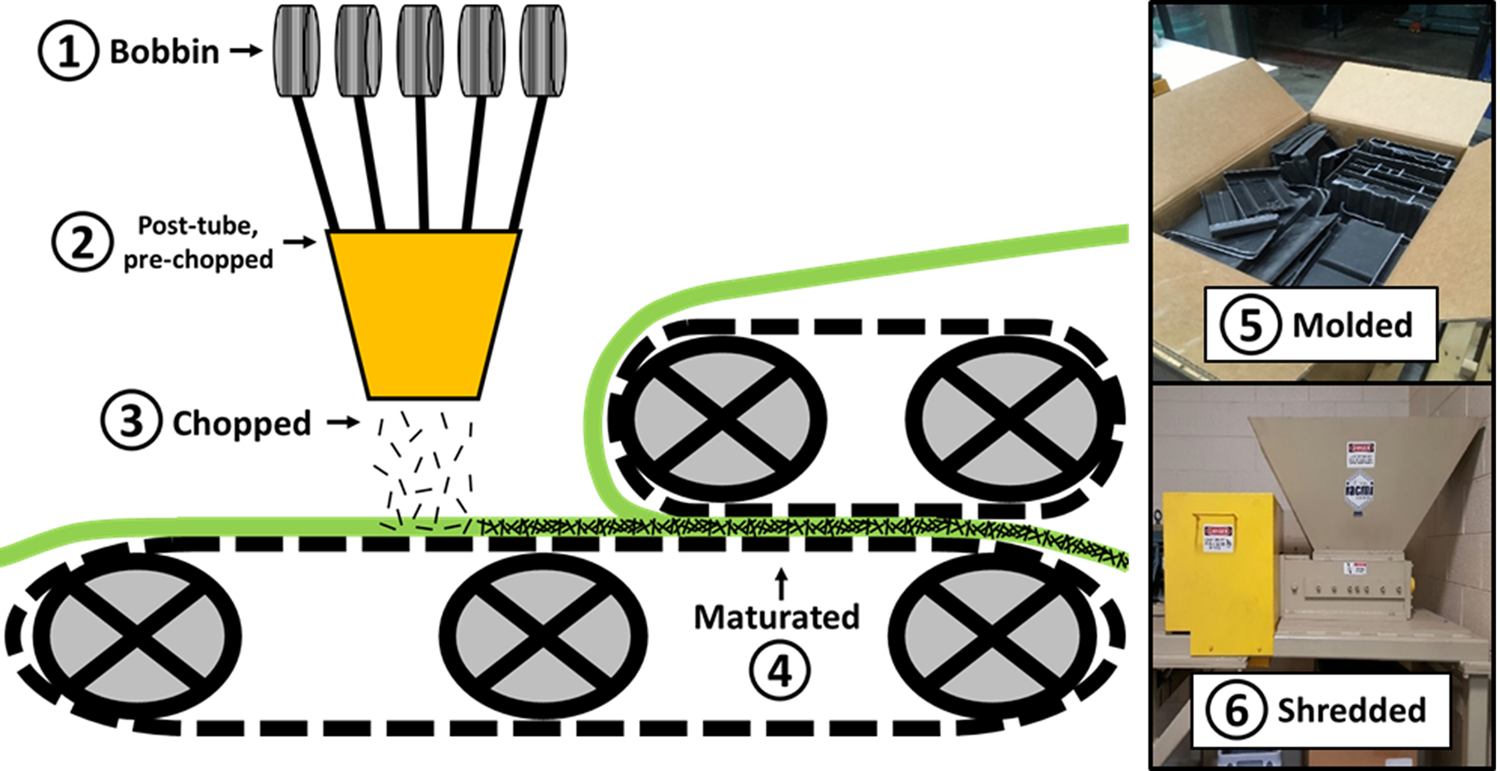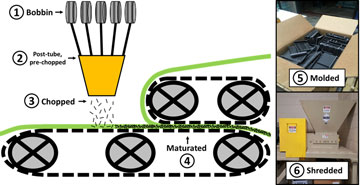

The promise of high mechanical performance in a lightweight form factor continues to drive growing demand for composite materials in transportation and infrastructure. For example, recent data available from the American Composites Manufacturers Association (ACMA) indicates that approximately 2 million tons of composite materials are consumed by automotive sector applications annually.[1] While many different composite material types exist, the global market is monolithically dominated by glass fiber-reinforced polymers.[Reference Thomason, Jenkins and Yang2] To illustrate this point, the glass fiber market for composites in 2017 was estimated to be about 5.2 million tons globally, while the carbon fiber market clocked in at 82.6 thousand tons.[1] Within the automotive sector, one of the more heavily used forms of input glass fiber composite material is sheet molding compound (SMC). SMC is formed in Fig. 1 when virgin E-glass fiber is unwound from a bobbin and fed through a series of tubes into a high speed chopper. The chopped fiber is then allowed to fall onto a conveyor carrying a layer of thickened, but uncured, thermoset resin (e.g., polyester, vinyl ester, and epoxy) forming a random mat. The second layer of resin is then brought down over the glass fibers, the glass fiber-resin sandwich structure is compressed together by a series of rollers, and the resulting SMC layer is rolled up for storage (i.e., maturation). The SMC can then be cut and compression molded into various automotive components, such as body panels and pickup box components, for lightweighting vehicles and improving fuel economy.
Schematic illustrating the various stages glass fiber moves through during the lifetime of an SMC material: (1) virgin E-glass fiber on bobbin from the original manufacturer, (2) fiber after having been pulled through a network of tubes into a chamber for chopping, (3) fiber after high-speed chopping, (4) fiber after having been compressed and maturated into SMC laminate, (5) fiber after having been compressed molded into automotive parts, and (6) fiber after molded parts have been shredded for disposal. Fibers are accessible for characterization at each stage except within the molded part (5).

While the attractive potential for increased energy efficiency has helped drive increasing composite materials market penetration in sectors like automotive, increasing consumption has raised long-term concerns about regulatory and financial issues on end-of-life treatment. Unlike competing materials, such as aluminum, no established method for recycling glass fiber-reinforced composites exists, resulting in virtually all such material being destined for size reduction (i.e., shredding) and landfilling. This problem has driven significant research interest in the development of pyrolysis-based recycling in which any polymer-matrix material is thermally removed leaving behind fiber for reuse in recycled composites.[Reference Ginder and Ozcan3] While the temperatures used during pyrolysis are known to be capable of significantly degrading the tensile strength of glass fiber, research into the optimization of pyrolysis recycling for SMC scrap indicates that recoverable fiber quality can instead be limited by pre-existing damage already present in the shredded input material.[Reference Ginder and Ozcan3–Reference Cunliffe and Williams5] Fibers in first lifecycle composites are generally assumed to have mechanical properties near those of the input virgin fiber, although some minor damage is expected. However, the presence of noticeable pre-existing fiber damage in previously measured samples suggests that mechanical property degradation can be more significant depending on manufacturing process configuration and in-service conditions. Therefore, glass fiber filaments were collected at various stages from the original SMC production process, where possible, shown in Fig. 1 and combined with previous pyrolysis-based recycling results to create a complete timeline of fiber degradation. It is important to note that due to the proprietary, varying exact configurations of SMC manufacturer setups (e.g., different input tubing configurations and chopping mechanisms), the presented case study data may not universally apply to all SMC production lines equally. To remove any resin from the maturated SMC sample, the sample was placed in propylene glycol methyl ether acetate (PGMEA) and agitated to loosen the fibers. The fibers were then rinsed with additional PGMEA, rinsed twice with acetone, and finally dried at 50 °C for 18 h.
The full details of single filament tension testing and curve fitting can be found elsewhere,[Reference Ginder and Ozcan3] but, in brief, testing was based upon ASTM C1557-14 using paper template-mounted filaments (12.7 mm gauge length) with filament diameters measured optically (Olympus BX50 optical microscope) and Young's modulus corrected for system compliance. Filament tensile strength results were fitted to a two-parameter Weibull distribution yielding a characteristic Weibull strength, that represents the stress at which theoretically 63% of fibers will have failed, and Weibull modulus, a measure of the spread in the distribution of failure stresses.
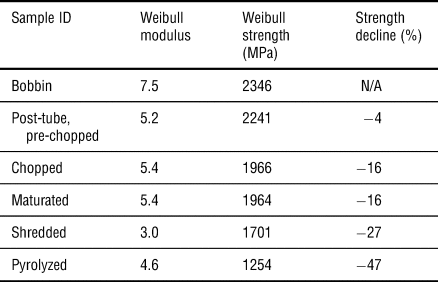
From the data in Table I, a progressive decline in measured fiber strength is detected. However, not all steps appear to impart the same degree of strength loss, with more significant bursts between the post-tube, pre-chopped and chopped stages, and the maturated and shredded molded part stages. In fact, as indicated in Table I, there appears to be no strength shift at all between the chopping and maturation processes. Interestingly, the widening fiber strength distribution (i.e., smaller Weibull modulus) and measurable strength reduction indicate noticeable fiber damage simply from running the virgin material through the input tubing. Altogether, these results indicate that shredding prior to part disposal is only partially responsible for previously measured pre-existing damage in fibers before recycling. They also indicate the potential for improved output glass fiber properties in the original composite manufacturing process, which should, in turn, increase the ability to absorb fiber damage during pyrolysis recycling.
Tabulated two-parameter Weibull fit parameters for single filament tensile strength results.

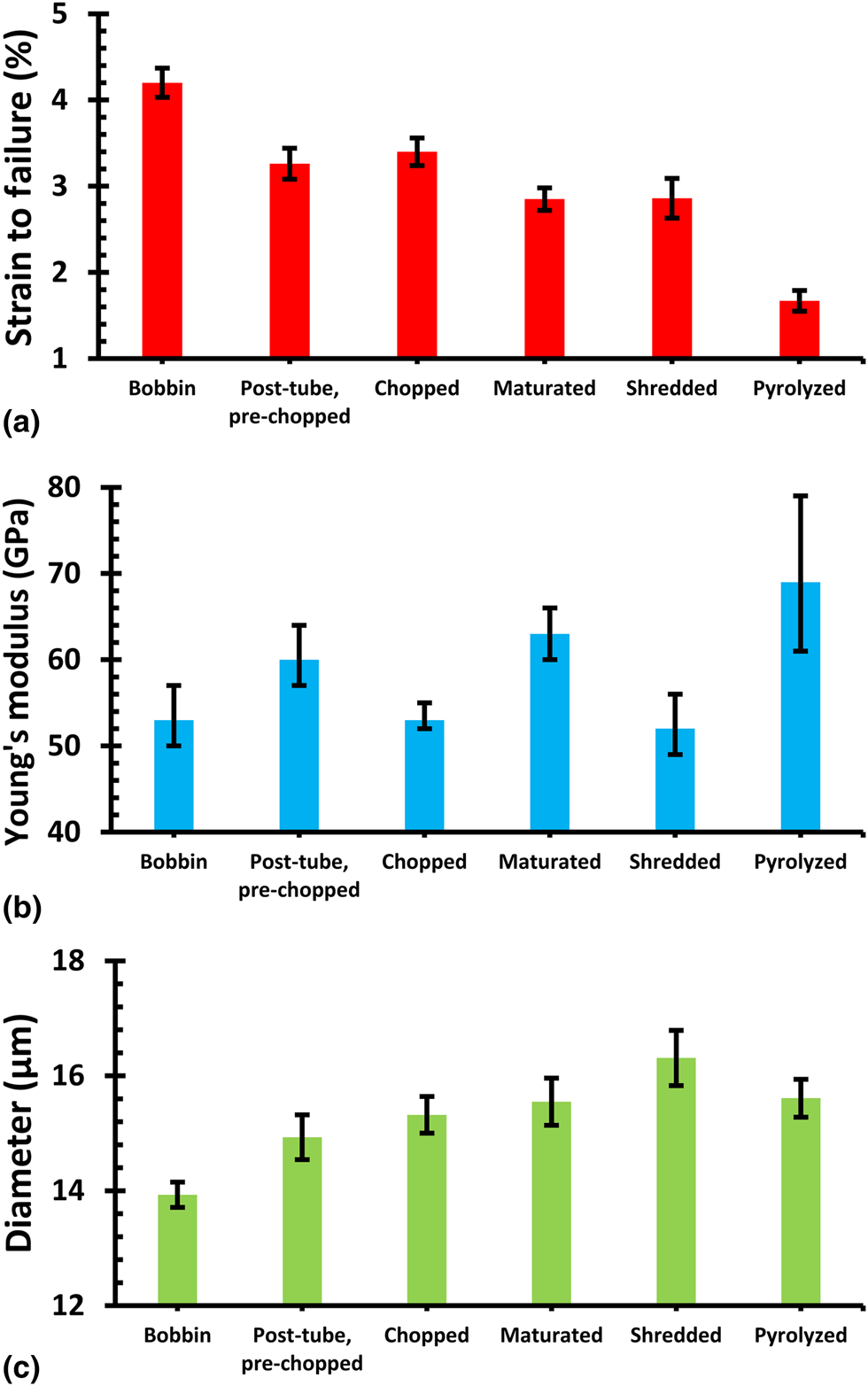
Figure 2(a) indicates an accompanying reduction in fiber failure strain as failure stress declines, as would be expected of a nominally linear elastic material. Young's modulus, however, does not follow this trend as Fig. 2(b) appears to show an almost oscillatory behavior. In effect, Young's modulus appears to be slightly increased in samples taken from steps involving fiber stretching and surface abrasion (e.g., post-tube, pre-chopped, and maturated) before returning to values comparable to the original fiber after steps involving violent cutting action (e.g., chopped and shredded). This naturally raises the question of what is behind the observed decline in fiber performance. It is well established that the fracture of glass materials is governed by Griffith's criterion:
 $$\sigma _{\rm f} = \sqrt {\displaystyle{{2\gamma E} \over {\pi a}}}, $$
where σ f is failure stress, E is Young's modulus, a is the size of a high eccentricity elliptical, internal flaw (modifiable for different shapes and internal versus surface flaw location by a constant), and γ is fracture surface energy density.[Reference Griffith6] Past studies on E-glass fracture behavior have shown that, for the high aspect ratio geometry of fibers, fracture initiates at the filament surface, meaning internal flaws can be discounted.[Reference Cunliffe and Williams5,Reference Feih, Mouritz and Case7] As such, the observed decline in failure stress can only be driven by materials property changes (i.e., glass structural changes), accumulation of surface flaw damage, or both.
Single filament tension testing results ± standard error: (a) corrected failure strain, (b) corrected Young's modulus, and (c) average diameter.
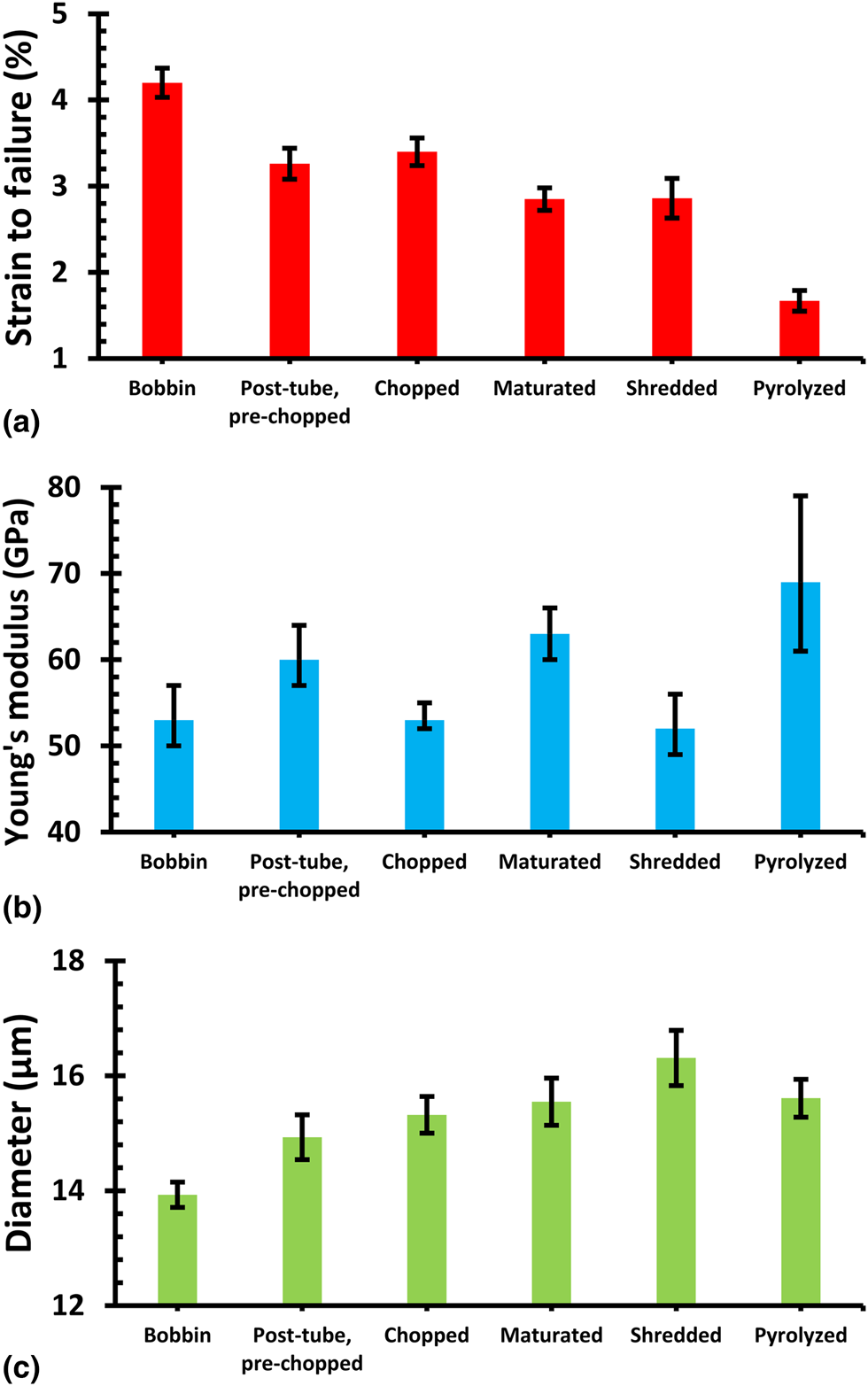
Some evidence of structural change does exist. Aside from the small shifts in Young's modulus, Fig. 2(c) shows a clear change in filament diameter with processing. Between the bobbin, post-tube, pre-chopped, and shredded stages, there appears to be an upward trend in fiber diameter. While less statistically significant, this trend seems to hold across all stages of production up to shredding. This behavior could suggest that a relaxation of the fiber draw ratio, imparted during original virgin filament production, from the recoil of the fiber after stretching or cutting loads are rapidly removed. The decrease in diameter and increase in Young's modulus of the pyrolyzed fiber is tied to thermally induced densification of E-glass, common at temperatures relevant to pyrolysis.[Reference Thomason, Jenkins and Yang2] The minor fluctuations in modulus and diameter, however, are insufficient to explain the observed large total decline in fiber strength.
Therefore, the decrease in fiber mechanical performance must be coming from SMC processing induced surface damage (i.e., flaw growth). Assessing this through direct experimentation though can be quite challenging. Optical micrographs of the fiber surfaces (Supplementary Fig. S3) show no significant visual distinction associated with increased surface damage. In fact, to the authors' knowledge, there is no established method for direct determination of the flaw site responsible for fiber failure prior to fracture.[Reference Thomason, Jenkins and Yang2,Reference Feih, Mouritz and Case7] To circumvent this, an experiment based on fiber–matrix interfacial adhesion was employed. Virgin E-glass fiber is typically surface coated in a thin layer of sizing agents that protect the fiber during production and later enhance adhesion between the hydrophilic fiber and hydrophobic thermoset composite resin. Any significant damage to this surface layer should begin to change the degree of adhesion between the matrix and fiber. To test this, individual glass filaments were embedded in polyamide-6 (BASF) and their apparent interfacial shear strength measured through fiber pullout tests. Testing was conducted using the recently developed FIMATEST system from Textechno H. Stein GmbH & Co. KG (Mönchengladbach, North Rhine-Westphalia, Germany). In this process, the thermoplastic resin is melted in a small crucible, an individual filament is driven into the molten resin to a nominally preset depth, and the resin is allowed to cool and set around the fiber. The embedded specimen is then fixed in a test frame that grips the crucible and fiber to measure load and displacement as the fiber is pulled clean from the resin at 0.2 mm/min. Interfacial shear strength measurements in Fig. 3(a) were calculated using the following relation:
 $$\tau = \displaystyle{{F_{{\rm max}}} \over {\pi \times d_{\rm f} \times l_{\rm e}}},$$
where τ is the calculated apparent interfacial shear strength, F max is the maximum applied load during testing, d f is the filament diameter [here, the averages in Fig. 2(c) were used], and l e is the measured embedded fiber length.[Reference Drzal and Madhukar8] Testing focused only on the changes in post-tube, pre-chopped and chopped steps from the original bobbin fiber, as these are the only steps in the SMC process in which the sole damage vector is mechanical surface impact and where a significant portion of the fiber damage appears to occur.
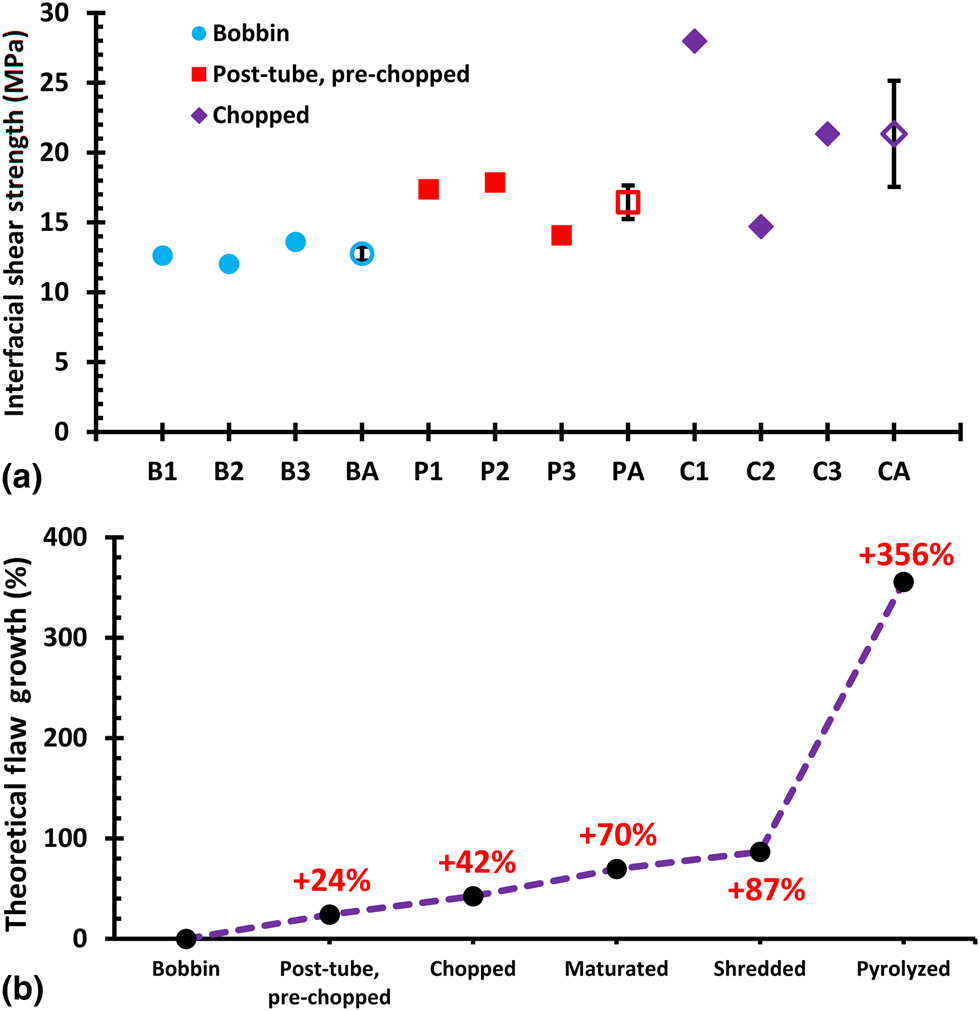
Assessment of glass fiber surface damage during SMC production: (a) interfacial shear strength results of single fiber pullout tests; individual measurements designated B#, bobbin; P#, post-tube, pre-chopped; C#, chopped; last unfilled data point of each set designated #A, sample average ± standard error and (b) Eq. (1) calculated cumulative relative increase in theoretical flaw size a responsible for fiber fracture.

The results in Fig. 3(a) indicate that apparent interfacial shear strength progressively increases with mechanical processing. This change in behavior likely occurs because, as the fiber surface is damaged removing the hydrophobic surface sizing and exposing a roughened hydrophilic glass surface, the hydrophilic nylon resin is better able to grip the fiber. The apparent spread in individual filament interface strengths also increases with processing as one would expect from a randomized, cumulative damage process, further supporting the earlier theoretical assertion that fiber strength loss is being driven by surface damage. Equation (1) can then be used with relative changes in Weibull failure stress and Young's modulus to project the estimated relative growth in fiber surface flaw size present in Fig. 3(b). For this estimate fracture surface energy is assumed constant, which is reasonable given that there are no chemical or large structural changes in the glass fibers. The trend in Fig. 3(b) shows that each step in the process contributes, on average, an ~22% growth in surface flaw size, give or take 3–5%, up until pyrolysis recycling. This suggests reducing mechanical abrasion as much as possible during each step of SMC production could significantly improve the quality of fiber in SMC materials. While any increase in the performance of the reinforcing material is obviously desirable, it is important to note though that SMCs are complex systems containing several other components (e.g., mineral fillers and thermoplastic additives) in largely varying quantities. The complexity of how all these components and their interfaces interact mean further experimentation will be required to assess how improvements in fiber strength translate to final SMC performance for any given product formulation. That being said, previous research into pyrolysis recycling of glass fiber indicated that basic optimization of time–temperature parameters can reduce cumulative flaw growth from +356% to +246%.[Reference Ginder and Ozcan3] If this reduction in pyrolysis damage could be coupled with a reduction in the input damage level of the original fiber, the cumulative increase in recovered fiber performance could greatly aid the value proposition of recycled glass fiber.
In conclusion, the detected reduction in tensile strength of glass fibers taken from SMC virgin bobbin and shredded final parts indicates that pre-recycling fiber damage accumulates throughout the SMC production process rather than solely through size reduction during disposal. This can inherently limit both the recoverable quality of E-glass fiber from composite recycling and the maximum potential mechanical reinforcement of the fibers within the first-generation material. The measured SMC process filament strength degradation appears driven by mechanical abrasion and fracturing of the fiber surface, embedding progressively larger surface flaws in the fiber surface with each production step. Improvements in fiber property retention could benefit the performance of both virgin and recycled composites. However, more work is needed to identify and implement such process improvements and understand their net effect on the final performance of complex, multi-component composite material systems.
Supplementary material
The supplementary material for this article can be found at https://doi.org/10.1557/mrc.2019.145.
Acknowledgments
The authors thank the American Composites Manufacturers Association (ACMA) and its members for their input and support of this work and especially David Krug at Continental Structural Plastics for helpful research feedback and discussion.