1. Introduction
Combinatory logic is a model of computation introduced by Schönfinkel (Reference Schönfinkel1924) and developed by Curry (Reference Curry1930) with the objective to abstain from the need of bound variables specific to the
 $\lambda$
-calculus. Its combinatorial heart is formed by terms, which are binary trees with labeled leaves, and rules to compute a result from a term, which are rewrite relations on trees (Baader and Nipkow Reference Baader and Nipkow1998; Bezem et al. Reference Bezem, Klop and de Vrijer2003) (clear and complete modern references about combinatory logic are Barendregt Reference Barendregt1981; Hindley and Seldin Reference Hindley and Seldin2008; Bimbo 2011; Wolfram Reference Wolfram2021). An important instance of combinatory logic is the system containing the basic combinators
 ${\mathbf{K}}$
and
 ${\mathbf{S}}$
together with the two rewrite rules

In this system, we have for instance the sequence of computation

obtained by performing at each step one rewrite according to the previous rules. This system is important because it is combinatorially complete: each
 $\lambda$
-term can be translated, by so-called bracket abstraction algorithms (Schönfinkel Reference Schönfinkel1924; Curry and Feys Reference Curry and Feys1958), into a term over
 ${\mathbf{K}}$
and
 ${\mathbf{S}}$
emulating it.
A lot of other basic combinators with their own rewrite rules have been introduced by Smullyan in Smullyan (Reference Smullyan1985) after – now widely used – bird names, forming the enchanted forest of combinator birds. For instance,
 ${\mathbf{K}}$
is the Kestrel and
 ${\mathbf{S}}$
is the Starling. Usual computer science-oriented questions consist in considering a fragment of combinatory logic, that is a finite set of combinators with their rewrite rules which is not necessarily combinatorially complete, and ask for the following questions:
-
(a) Given two terms
 $\mathfrak{t}$
and
$\mathfrak{t}'$
, can we decide if
$\mathfrak{t}$
and
$\mathfrak{t}'$
can be rewritten eventually in a same term? This is known as the word problem (Baader and Nipkow Reference Baader and Nipkow1998; Statman Reference Statman2000). This question admits a positive answer for some basic combinators like among others the Lark (Sprenger and Wymann-Böni Reference Sprenger and Wymann-Böni1993; Statman Reference Statman1989) and the Warbler (Sprenger and Wymann-Böni Reference Sprenger and Wymann-Böni1993) but it still open for the Starling (Barendregt et al. Reference Barendregt, Endrullis, Klop and Waldmann2017);
-
(b) Given a term
$\mathfrak{t}$
, can we decide if all rewrite sequences starting from
$\mathfrak{t}$
are finite? This is known as the strong normalization problem. This question admits a positive answer for, among others, the Starling (Waldmann Reference Waldmann2000) and the Jay (Probst and Studer Reference Probst and Studer2001). Related to this, see also David et al. (Reference David, Grygiel, Kozik, Raffalli, Theyssier and Zaionc2013), Bendkowski et al. (Reference Bendkowski, Grygiel and Zaionc2017) for a probabilistic and asymptotic study of strong normalizing terms.


Here, we decide to pursue this study in a different direction by asking questions from a combinatorial point of view, including the study of order theoretic structures and adopting an enumerative approach. In particular, by denoting by
 $\preccurlyeq$
(resp. by
 $\equiv$
) the reflexive and transitive (resp. reflexive, symmetric, and transitive) closure of the rewrite relation, we ask the following questions:
-
(a) Determine if
$\preccurlyeq$
is a partial order relation; -
(b) In this case, determine if each interval of this poset is a lattice;
-
(c) Enumerate the
$\equiv$
-equivalence classes of terms w.r.t. the minimal degrees of their terms.


This work fits in this general project consisting in mixing combinatory logic with combinatorics. These enumerative questions, including the enumeration w.r.t. some size notions (like the height or the number of basic combinators of the terms) of some particular terms of a system (like its normal forms or the minimal or maximal elements of its partial order), lead to density properties of the counted terms among the terms of the same size. This gives information about the probability for a term of a given size generated uniformly at random to satisfy some property. Besides, some of the mentioned questions can be addressed by working with rewrite graphs, that are graphs labeled by terms and where there is a directed edge between two terms if the first can be obtained from the second by a rewriting step. Such graphs appear naturally in the study of term rewrite systems (Berry and é 1979). Some different graphs have been considered in the literature, where vertices are no longer terms but rather sequences of rewriting steps (see for instance Berry and é 1979; Venturini Zilli Reference Venturini Zilli1984 and Barendregt Reference Barendregt1981, Exercise 12.4.2.). These graphs, as well as some of their semilattice properties Berry and é (1979), Theorem 2.3.1., have no direct links with the present work.
We choose here to start this project by studying the system made of a single combinator, the combinator
 ${{\mathbf{M}}}$
, known as the Mockingbird (Smullyan Reference Smullyan1985) or as the little omega. This combinator is a very simple and an important one (see for instance Statman Reference Statman2011; Statman Reference Statman2017). By drawing the portions of the rewrite graph starting from terms on
 ${{\mathbf{M}}}$
, the first properties that stand out are that the graph does not contain any nontrivial loops and that its connected components are finite and have exactly one minimal and one maximal element. At this stage, driven by computer exploration, we conjecture that the relation
 $\preccurlyeq$
on the terms on
 ${{\mathbf{M}}}$
is a partial order relation and that each
 $\equiv$
-equivalence class is a lattice w.r.t. this partial order relation. This lattice property is for us a good clue for the fact that this system contains rather rich combinatorial properties.
To prove this last property, we introduce new lattices on duplicative forests, that are kinds of treelike structures, and show that each maximal interval from any term on
 ${{\mathbf{M}}}$
is isomorphic as a poset to a maximal interval of a lattice of duplicative forests (Theorem 4). We define the Mockingbird lattice of order
 $d \geqslant0$
as the lattice
 $\mathrm{M}(d)$
consisting in the closed terms on
 ${{\mathbf{M}}}$
equal as or greater than the right comb closed term on
 ${{\mathbf{M}}}$
of degree d. We prove that each interval of the poset of duplicative forests is contained as an interval in
 $\mathrm{M}(d)$
for a certain
 $d \geqslant 0$
(Theorem 3.3.5). Since any closed term on
 ${{\mathbf{M}}}$
can be seen as a binary tree, this provides a new lattice structure on these objects. A lot of similar lattices have been studied on binary trees such as, among others the very famous Tamari lattice (Tamari Reference Tamari1962), the Kreweras lattice (Kreweras Reference Kreweras1972), the Stanley lattice (Stanley Reference Stanley1975), the phagocyte lattice (Baril and Pallo Reference Baril and Pallo2006), and the pruning-grafting lattice (Baril and Pallo Reference Baril and Pallo2008). However, unlike these lattices having for each order
 $d \geqslant 0$
a cardinality equal to the d-th Catalan number, the lattices
 $\mathrm{M}(d)$
are enumerated by a different integer sequence. To obtain enumerative results about the Mockingbird lattices and all the posets of terms on
 ${{\mathbf{M}}}$
in general, we use formal power series on terms and on duplicative forests, and several products on these. In this way, we enumerate the minimal and maximal elements of the infinite poset of the closed terms on
 ${{\mathbf{M}}}$
(Propositions 4.2.1 and 4.2.2), the lengths of the shortest and longest saturated chains of
 $\mathrm{M}(d)$
(Proposition 4.3.1), the cardinality of
 $\mathrm{M}(d)$
(Proposition 4.4.3), the number of edges of the Hasse diagram of
 $\mathrm{M}(d)$
(Proposition 4.4.6), and the number of intervals of
 $\mathrm{M}(d)$
(Proposition 4.4.10). We also provide general results for systems of combinatory logic: we give in particular a necessary condition on the rewrite rules in order to have only finite connected components in the rewrite graph (Proposition 2.2.2). This relies on a combinatorial property on basic combinators, called the hierarchical property. We also discuss some consequences of this fact in order to construct models for systems having this property. These are in fact the algebras over a certain abstract clone (Taylor Reference Taylor1993) defined from the system. When the relation
 $\preccurlyeq$
is a partial order relation, such models have a potential nice algorithmic computational complexity.
This paper is organized as follows. Section 2 contains the preliminary notions and definitions about terms, rewrite relations, and combinatory logic systems. We show here some general properties of these systems. In Section 3, we study the combinatory logic system on
 ${{\mathbf{M}}}$
and the Mockingbird lattices. Finally, Section 4 contains our enumerative results about Mockingbird lattices. This text ends with the presentation of some open questions raised by this work.
This paper is an extended version of Giraudo (Reference Giraudo2022), announcing the main results without any proofs. The present version contains all proofs of the stated results, more examples, and presents new results as discussions about some models of the combinatory logic system on
 ${{\mathbf{M}}}$
and the enumeration of isolated elements of the poset of the closed terms on
 ${{\mathbf{M}}}$
. This version uses also the formalism of abstract clones in order to work with terms and rewrite systems.
General notations and conventions
If S is a finite set
 $\# S$
is the cardinality of S. For any integers i and j,
 $[i,j]$
denotes the set
 $\{i, i + 1, \dots, j\}$
. For any integer i, [i] denotes the set [1, i] and
 denotes the set [0, i]. For any set A,
 $A^*$
is the set of all words on A. For any
 $w \in A^*$
,
 $\ell(w)$
is the length of w, for any
 $i \in[\ell(w)]$
, w(i) is the i-th letter of w, and
 $|w|_a$
is the number of occurrences of the letter
 $a \in A$
in w. The only word of length 0 is the empty word
 $\epsilon$
. For any statement P, the Iverson bracket
 $\pmb{\left[\right.}P\pmb{\left.\right]}$
takes 1 as value if P is true and 0 otherwise.
2. Terms, Rewrite Relations, and Combinatory Logic Systems
In this preliminary part, we set the main definitions and notations used in the sequel. We introduce also the central notion of combinatory logic systems, which are defined from special kinds of rewrite relations. We show also some general properties of these systems.
2.1 Terms, compositions, and rewrite relations
Let us start by presenting here the notions of terms, composition, and rewrite relations.
2.1.1 Terms
An  is a finite set
 $\mathfrak{G}$
. Its elements are called
 or
 . Any element of the set
 $\mathbb{X} := \bigcup_{n \geqslant 1}\mathbb{X}_n$
, where
 $\mathbb{X}_n := \left\{\mathsf{x}_1, \dots, \mathsf{x}_n\right\}$
, is a
 . The set
 $\mathfrak{T}(\mathfrak{G})$
of
 (or simply
 when the context is clear) is so that any variable of
 $\mathbb{X}$
is a
 $\mathfrak{G}$
-term, any constant of
 $\mathfrak{G}$
is a
 $\mathfrak{G}$
-term, and if
 $\mathfrak{t}_1$
and
 $\mathfrak{t}_2$
are two
 $\mathfrak{G}$
-terms, then
 $\left(\mathfrak{t}_1 {\star}\mathfrak{t}_2\right)$
is a
 $\mathfrak{G}$
-term. For any
 $n \geqslant 0$
, we denote by
 $\mathfrak{T}_n(\mathfrak{G})$
the set of
 $\mathfrak{G}$
-terms
 $\mathfrak{t}$
having all variables belonging to
 $\mathbb{X}_n$
.
From this definition, any term is a rooted planar binary tree where leaves are decorated by variables or by constants. We shall express terms concisely by removing superfluous parentheses by considering that
 ${\star}$
associates to the left and also by removing the symbols
 ${\star}$
(see the example given in (2.1.1), (2.1.2), and (2.1.3)).
Let
 $\mathfrak{t}$
be a
 $\mathfrak{G}$
-term. The

 $\mathrm{deg}(\mathfrak{t})$
of
 $\mathfrak{t}$
is the number of internal nodes (the nodes decorated by
 ${\star}$
) of
 $\mathfrak{t}$
seen as a binary tree. For any
 $a \in \mathbb{X} \cup \mathfrak{G}$
,
 $\mathrm{deg}_a(\mathfrak{t})$
is the number of nodes labeled by a in
 $\mathfrak{t}$
. The
 of a node u of
 $\mathfrak{t}$
is the number of internal nodes in the path connecting the root of
 $\mathfrak{t}$
and u. The

 $\mathrm{ht}(\mathfrak{t})$
of
 $\mathfrak{t}$
is the maximal depth among all the nodes of
 $\mathfrak{t}$
. The
 of
 $\mathfrak{t}$
is the sequence of all the variables appearing in
 $\mathfrak{t}$
from the left to the right. The term
 $\mathfrak{t}$
is
 if its frontier is of the form
 $\mathsf{x}_1 \mathsf{x}_2 \dots \mathsf{x}_n$
where
 $n \geqslant 0$
. The term
 $\mathfrak{t}$
is
 if there are no multiple occurrences of the same variable in its frontier. A
 or
 is a term of
 $\mathfrak{T}_0(\mathfrak{G})$
having thus no occurrence of any variable.
For instance, by setting
 $\mathfrak{G} := \left\{{\mathbf{A}}, {\mathbf{B}}\right\}$
, the
 $\mathfrak{G}$
-term
 \begin{equation} \mathfrak{t} := \left(\left(\left({\mathbf{A}} {\star} \mathsf{x}_3\right) {\star} \left({\mathbf{B}} {\star} \left(\left(\mathsf{x}_1 {\star} \mathsf{x}_3\right) {\star} \mathsf{x}_1\right)\right)\right) {\star} \left({\mathbf{A}} {\star} {\mathbf{A}}\right)\right)\end{equation}
draws as the binary tree

and expresses concisely as
 \begin{equation} \mathfrak{t} = \left({\mathbf{A}} \mathsf{x}_3\right) \left({\mathbf{B}} \left(\mathsf{x}_1 \mathsf{x}_3 \mathsf{x}_1\right)\right) \left({\mathbf{A}} {\mathbf{A}}\right).\end{equation}
Its degree is 7, its height is 5, its frontier is
 $\mathsf{x}_3 \mathsf{x}_1 \mathsf{x}_3 \mathsf{x}_1$
and is an element
 $\mathfrak{T}_n(\mathfrak{G})$
for any
 $n \geqslant 3$
.
2.1.2 Compositions of terms and clones
Let
 $\mathfrak{t}$
and
 $\mathfrak{t}'_1$
, …,
 $\mathfrak{t}'_n$
,
 $n \geqslant 0$
be
 $\mathfrak{G}$
-terms. The
 of
 $\mathfrak{t}$
with
 $\mathfrak{t}'_1$
, …,
 $\mathfrak{t}'_n$
is the
 $\mathfrak{G}$
-term
 $\mathfrak{t} \left[\mathfrak{t}'_1, \dots, \mathfrak{t}'_n\right]$
obtained by simultaneously replacing for all
 $i \in [n]$
all occurrences of the variables
 $\mathsf{x}_i$
in
 $\mathfrak{t}$
by
 $\mathfrak{t}'_i$
. For instance,
 \begin{equation} {\mathbf{A}} \left(\mathsf{x}_3 \mathsf{x}_1\right) \mathsf{x}_3 \left[\mathsf{x}_1 \mathsf{x}_4, \mathsf{x}_1 \mathsf{x}_1 \mathsf{x}_2, {\mathbf{A}} \left({\mathbf{A}} \mathsf{x}_1\right)\right] = {\mathbf{A}} \left({\mathbf{A}} \left({\mathbf{A}} \mathsf{x}_1\right) \left(\mathsf{x}_1 \mathsf{x}_4\right)\right) \left({\mathbf{A}} \left({\mathbf{A}} \mathsf{x}_1\right)\right).\end{equation}
Given two
 $\mathfrak{G}$
-terms
 $\mathfrak{t}$
and
 $\mathfrak{s}$
,
 $\mathfrak{s}$
is a
 of
 $\mathfrak{t}$
if
 \begin{equation} \mathfrak{t} = \mathfrak{t}' \left[\mathfrak{s}_1, \dots, \mathfrak{s}_{i - 1}, \mathfrak{s}, \mathfrak{s}_{i + 1}, \dots, \mathfrak{s}_n\right] \left[\mathfrak{r}_1, \dots, \mathfrak{r}_m\right]\end{equation}
for some integers
 $n, m \geqslant 0$
and
 $\mathfrak{G}$
-terms
 $\mathfrak{t}'$
,
 $\mathfrak{s}_1$
, …,
 $\mathfrak{s}_{i - 1}$
,
 $\mathfrak{s}_{i + 1}$
, …,
 $\mathfrak{s}_n$
,
 $\mathfrak{r}_1$
, …,
 $\mathfrak{r}_m$
, where
 $\mathsf{x}_i$
appears in
 $\mathfrak{t}'$
. When this property does not hold,
 $\mathfrak{t}$

 $\mathfrak{s}$
. When in (2.1.5), for all
 $i \in [m]$
the
 $\mathfrak{r}_i$
are variables,
 $\mathfrak{s}$
is a
 of
 $\mathfrak{t}$
. When this property does not hold,
 $\mathfrak{t}$

 $\mathfrak{s}$
. For instance, the term defined in (2.1.3) admits
 ${\mathbf{B}} \left(\mathsf{x}_1 \mathsf{x}_2\right)$
as factor,
 $\mathsf{x}_1 \mathsf{x}_2 \mathsf{x}_3$
as suffix, but suffix-avoids
 $\mathsf{x}_1 \mathsf{x}_1 \mathsf{x}_1$
.
Observe that we have, for any
 $n, m \geqslant 0$
,
 $i \in [n]$
, and
 $\mathfrak{t}, \mathfrak{s}_1, \dots,\mathfrak{s}_n, \mathfrak{r}_1, \dots, \mathfrak{r}_m \in \mathfrak{T}(\mathfrak{G})$
,
 \begin{equation} \mathsf{x}_i \left[\mathfrak{t}_1, \dots, \mathfrak{t}_n\right] = \mathfrak{t}_i,\end{equation}
 \begin{equation} \mathfrak{t} \left[\mathsf{x}_1, \dots \mathsf{x}_n\right] = \mathfrak{t},\end{equation}
 \begin{equation} \mathfrak{t} \left[\mathfrak{s}_1, \dots, \mathfrak{s}_n\right] \left[\mathfrak{r}_1, \dots, \mathfrak{r}_m\right] = \mathfrak{t} \left[\mathfrak{s}_1 \left[\mathfrak{r}_1, \dots, \mathfrak{r}_m\right], \dots, \mathfrak{s}_n \left[\mathfrak{r}_1, \dots, \mathfrak{r}_m\right]\right].\end{equation}
These three relations imply that the set
 $\mathfrak{T}(\mathfrak{G})$
together with the composition operation is an abstract clone (Taylor Reference Taylor1993). This is in fact the free abstract clone generated by
 $\mathfrak{G} \sqcup \textit{\{}{\star}\textit{\}}$
where
 ${\star}$
is a binary generator.
2.1.3 Rewrite relations
A  on
 $\mathfrak{T}(\mathfrak{G})$
is a binary relation
 $\to$
on
 $\mathfrak{T}(\mathfrak{G})$
. The
 of
 $\to$
is the binary relation
 $\Rightarrow$
on
 $\mathfrak{T}(\mathfrak{G})$
satisfying
 \begin{equation} \mathfrak{t} \left[\mathfrak{s}_1, \dots, \mathfrak{s}_i, \dots, \mathfrak{s}_n\right] \left[\mathfrak{r}_1, \dots, \mathfrak{r}_m\right] \Rightarrow \mathfrak{t} \left[\mathfrak{s}_1, \dots, \mathfrak{s}_i', \dots, \mathfrak{s}_n\right] \left[\mathfrak{r}_1, \dots, \mathfrak{r}_m\right]\end{equation}
where
 $\mathfrak{t}$
is a planar
 $\mathfrak{G}$
-term,
 $\mathsf{x}_i$
appears in
 $\mathfrak{t}$
, and
 $\mathfrak{s}_1$
, …,
 $\mathfrak{s}_i$
,
 $\mathfrak{s}_i'$
, …,
 $\mathfrak{s}_n$
,
 $n \geqslant 1$
,
 $i \in [n]$
, and
 $\mathfrak{r}_1$
, …,
 $\mathfrak{r}_m$
,
 $m \geqslant 0$
, are
 $\mathfrak{G}$
-terms, and
 $\mathfrak{s}_i \to\mathfrak{s}_i'$
. Intuitively,
 $\mathfrak{t} \Rightarrow \mathfrak{t}'$
if
 $\mathfrak{t}'$
can be obtained from
 $\mathfrak{t}$
by replacing a factor
 $\mathfrak{s}$
of
 $\mathfrak{t}$
by
 $\mathfrak{s}'$
and by identifying variables with terms in a coherent way, whenever
 $\mathfrak{s} \to \mathfrak{s}'$
. For instance, for
 $\mathfrak{G} := \left\{{\mathbf{A}}, {\mathbf{B}}, {\mathbf{C}}\right\}$
and the rewrite relation
 $\to$
satisfying
 $ \mathsf{x}_1 \left({\mathbf{A}} \mathsf{x}_1\right) \to \mathsf{x}_1 \mathsf{x}_2,$
we have
 \begin{equation} \mathsf{x}_3 {\mathbf{B}} \left({\mathbf{A}} \left(\mathsf{x}_3 {\mathbf{B}}\right)\right) \left(\mathsf{x}_4 {\mathbf{A}}\right) \Rightarrow \mathsf{x}_3 {\mathbf{B}} {\mathbf{C}} \left(\mathsf{x}_4 {\mathbf{A}}\right)\end{equation}
because
 \begin{equation} \mathsf{x}_3 {\mathbf{B}} \left({\mathbf{A}} \left(\mathsf{x}_3 {\mathbf{B}}\right)\right) \left(\mathsf{x}_4 {\mathbf{A}}\right) = \mathsf{x}_1 \left(\mathsf{x}_2 {\mathbf{A}}\right) \ \left[\mathsf{x}_1 \left({\mathbf{A}} \mathsf{x}_1\right), \mathsf{x}_4\right] \ \left[\mathsf{x}_3 {\mathbf{B}}, {\mathbf{C}}, \mathsf{x}_3, \mathsf{x}_4\right]\end{equation}
and
 \begin{equation} \mathsf{x}_3 {\mathbf{B}} {\mathbf{C}} \left(\mathsf{x}_4 {\mathbf{A}}\right) = \mathsf{x}_1 \left(\mathsf{x}_2 {\mathbf{A}}\right) \ \left[\mathsf{x}_1 \mathsf{x}_2, \mathsf{x}_4\right] \ \left[\mathsf{x}_3 {\mathbf{B}}, {\mathbf{C}}, \mathsf{x}_3, \mathsf{x}_4\right].\end{equation}
Observe in this example that the variable
 $\mathsf{x}_2$
occurs in the right member of
 $\to$
and not in the left member. For this reason, this variable can be replaced by any term in the context closure of
 $\to$
(it is replaced by
 ${\mathbf{C}}$
in the example).
2.1.4 Applicative term rewrite systems
An  (or
 for short) is a pair
 $(\mathfrak{G}, \to)$
such that
 $\mathfrak{G}$
is an alphabet and
 $\to$
is a rewrite relation on
 $\mathfrak{T}(\mathfrak{G})$
. Let
 $\mathcal{T} := (\mathfrak{G}, \to)$
be an ATRS. We denote by
 $\preccurlyeq$
the reflexive and transitive closure of
 $\Rightarrow$
. This relation
 $\preccurlyeq$
is by construction a preorder. We denote by
 $\equiv$
the reflexive, symmetric, and transitive closure of
 $\Rightarrow$
and by
 $\left[\mathfrak{t}\right]_\equiv$
the
 $\equiv$
-equivalence class of
 $\mathfrak{t} \in \mathfrak{T}(\mathfrak{G})$
. This relation
 $\equiv$
is by construction an equivalence relation. The

 $\mathrm{G}_\mathcal{T}$
of
 $\mathcal{T}$
is the digraph on the set
 $\mathfrak{T}(\mathfrak{G})$
of vertices where there is an arc from
 $\mathfrak{t} \in\mathfrak{T}(\mathfrak{G})$
to
 $\mathfrak{t}' \in \mathfrak{T}(\mathfrak{G})$
if
 $\mathfrak{t} \Rightarrow\mathfrak{t}'$
. For any
 $\mathfrak{t} \in \mathfrak{T}(\mathfrak{G})$
, we also denote by
 $\mathrm{G}_\mathcal{T}(\mathfrak{t})$
the subgraph of
 $\mathrm{G}_\mathcal{T}$
restrained on the set
 $ \left\{\mathfrak{t}' \in \mathfrak{T}(\mathfrak{G}) : \mathfrak{t} \preccurlyeq \mathfrak{t}'\right\}$
of vertices. The ATRS
 $\mathcal{T}$
is
 if for any term
 $\mathfrak{t}$
,
 $\left[\mathfrak{t}\right]_{\equiv}$
is finite. This is equivalent to the fact that all the connected components of
 $\mathrm{G}_\mathcal{T}$
are finite. A
 $\mathfrak{G}$
-term
 $\mathfrak{t}$
is a

 of
 $\mathcal{T}$
if there is no arc of source
 $\mathfrak{t}$
in
 $\mathrm{G}_\mathcal{T}$
. We say that
 $\mathfrak{t}$
is
 if there is at least one normal form in
 $\mathrm{G}_\mathcal{T}(\mathfrak{t})$
and that
 $\mathfrak{t}$
is
 if
 $\mathrm{G}_\mathcal{T}(\mathfrak{t})$
is finite and acyclic. When all the
 $\mathfrak{G}$
-terms are strongly normalizing,
 $\mathcal{T}$
is
 . Besides, if for any
 $\mathfrak{t}, \mathfrak{s}_1,\mathfrak{s}_2 \in \mathfrak{T}(\mathfrak{G})$
,
 $\mathfrak{t} \preccurlyeq \mathfrak{s}_1$
and
 $\mathfrak{t} \preccurlyeq \mathfrak{s}_2$
implies the existence of
 $\mathfrak{t}' \in \mathfrak{T}(\mathfrak{G})$
such that
 $\mathfrak{s}_1 \preccurlyeq\mathfrak{t}'$
and
 $\mathfrak{s}_2 \preccurlyeq \mathfrak{t}'$
, then
 $\mathcal{T}$
is
 .
2.1.5 Partial orders
When
 $\mathcal{T} := (\mathfrak{G}, \to)$
is an ATRS such that
 $\preccurlyeq$
is antisymmetric,
 $\preccurlyeq$
is a partial order relation. In this case,
 $\mathcal{T}$
has the
 and we shall denote by
 $\mathcal{P}_\mathcal{T}$
the poset
 $\left(\mathfrak{T}(\mathfrak{G}), \preccurlyeq\right)$
. For any
 $\mathfrak{t}\in \mathfrak{T}(\mathfrak{G})$
, let
 $\mathcal{P}_\mathcal{T}(\mathfrak{t})$
be the subposet of
 $\mathcal{P}_\mathcal{T}$
having
 $\mathfrak{t}$
as least element. Again in this case, a
 $\mathfrak{G}$
-term
 $\mathfrak{t}$
is
 (resp.
 ) if
 $\mathfrak{t}$
is a minimal (resp. maximal) element of
 $\mathcal{P}_\mathcal{T}$
. Observe that any normal form is maximal but the converse is false because a maximal element
 $\mathfrak{t}$
could satisfy
 $\mathfrak{t} \Rightarrow \mathfrak{t}$
. A
 $\mathfrak{G}$
-term
 $\mathfrak{t}$
is
 if
 $\mathfrak{t}$
is both minimal and maximal. When
 $\mathcal{T}$
has the poset property,
 $\mathcal{T}$
is
 if for any term
 $\mathfrak{t}$
, the subposet
 $\left[\mathfrak{t}\right]_{\equiv}$
of
 $\mathcal{P}_\mathcal{T}$
has a unique minimal element. Finally,
 $\mathcal{T}$
has the
 if
 $\mathcal{T}$
has the poset property and for all
 $\mathfrak{t} \in\mathfrak{T}(\mathfrak{G})$
, all posets
 $\mathcal{P}_\mathcal{T}(\mathfrak{t})$
are lattices.
2.2 Combinatory logic systems
We begin by defining combinatory logic systems as particular ATRS and present some consequence of nonerasing and hierarchical combinatory logic systems (notions defined thereafter). We explain some of the consequences of the local finiteness, the poset property, and the lattice property on the models of combinatory logic systems.
2.2.1 Main definitions
A  (or
 for short) is an ATRS
 $\mathcal{C} :=(\mathfrak{G}, \to)$
such that for each constant
 ${\mathbf{X}}$
of
 $\mathfrak{G}$
, there is exactly one rewrite rule where
 ${\mathbf{X}}$
appears, and this rule is of the form
 \begin{equation} {\mathbf{X}} \mathsf{x}_1 \dots \mathsf{x}_n \to \mathfrak{t}_{{\mathbf{X}}}\end{equation}
where
 $n \geqslant 1$
and
 $\mathfrak{t}_{{\mathbf{X}}}$
is a term having no constants and having all variables in
 $\mathbb{X}_n$
. Moreover, all rewrite rules of
 $\mathcal{C}$
must be of the form (2.2.1). The integer n is the
 of
 ${\mathbf{X}}$
in
 $\mathcal{C}$
. Some well-known terms
 $\mathfrak{t}_{{\mathbf{X}}}$
appearing among others in Smullyan (Reference Smullyan1985) are,
-
• with order 1,
$\mathfrak{t}_{{\mathbf{I}}} := \mathsf{x}_1$
,
$\mathfrak{t}_{{\mathbf{M}}} := \mathsf{x}_1 \mathsf{x}_1$
; -
• with order 2,
$\mathfrak{t}_{{\mathbf{K}}} := \mathsf{x}_1$
,
$\mathfrak{t}_{{\mathbf{T}}} := \mathsf{x}_2 \mathsf{x}_1$
,
$\mathfrak{t}_{{\mathbf{M_1}}} := \mathsf{x}_1 \mathsf{x}_1 \mathsf{x}_2$
,
$\mathfrak{t}_{{\mathbf{W}}} := \mathsf{x}_1 \mathsf{x}_1 \mathsf{x}_2$
,
$\mathfrak{t}_{{\mathbf{L}}} := \mathsf{x}_1 \left(\mathsf{x}_2 \mathsf{x}_2\right)$
,
$\mathfrak{t}_{{\mathbf{O}}} := \mathsf{x}_2 \left(\mathsf{x}_1 \mathsf{x}_2\right)$
,
$\mathfrak{t}_{{\mathbf{U}}} := \mathsf{x}_2 \left(\mathsf{x}_1 \mathsf{x}_1 \mathsf{x}_2\right)$
(
); -
• with order 3,
$\mathfrak{t}_{{\mathbf{C}}} := \mathsf{x}_1 \mathsf{x}_3 \mathsf{x}_2$
,
$\mathfrak{t}_{{\mathbf{V}}} := \mathsf{x}_3 \mathsf{x}_1 \mathsf{x}_2$
,
$\mathfrak{t}_{{\mathbf{B}}} := \mathsf{x}_1 \left(\mathsf{x}_2 \mathsf{x}_3\right)$
,
$\mathfrak{t}_{{\mathbf{S}}} := \mathsf{x}_1 \mathsf{x}_3 \left(\mathsf{x}_2 \mathsf{x}_3\right)$
; -
• with order 4,
$\mathfrak{t}_{{\mathbf{J}}} := \mathsf{x}_1 \mathsf{x}_2 \left(\mathsf{x}_1 \mathsf{x}_4 \mathsf{x}_3\right)$
.

 ,

 ;

 ,

 ,

 ,

 ,

 ,

 ,


 );

 ,

 ,

 ,

 ;

 .
The constant
 ${\mathbf{X}}$
is
 if
 $\mathfrak{t}_{{\mathbf{X}}}$
contains at least one occurrence of each variable
 $\mathsf{x}_i$
for any
 $i \in [n]$
. The constant
 ${\mathbf{X}}$
is
 if for any
 $i \in [n]$
,
 $\mathsf{x}_i$
appears in
 $\mathfrak{t}_{{\mathbf{X}}}$
at depth
 $n + 1 - i$
. For instance, the terms
 $\mathfrak{t}_{{\mathbf{X}}}$
such that
 ${\mathbf{X}}$
are hierarchical and of order 3 or less are
 \begin{equation} \mathsf{x}_1 \mathsf{x}_1, \enspace \mathsf{x}_1 \mathsf{x}_1 \mathsf{x}_2, \enspace \mathsf{x}_2 \left(\mathsf{x}_1 \mathsf{x}_1\right), \enspace \mathsf{x}_1 \mathsf{x}_1 \mathsf{x}_2 \mathsf{x}_3, \enspace \mathsf{x}_2 \left(\mathsf{x}_1 \mathsf{x}_1\right) \mathsf{x}_3, \enspace \mathsf{x}_3 \left(\mathsf{x}_1 \mathsf{x}_1 \mathsf{x}_2\right), \enspace \mathsf{x}_3 \left(\mathsf{x}_2 \left(\mathsf{x}_1 \mathsf{x}_1\right)\right).\end{equation}
In particular, if
 ${\mathbf{X}}$
is hierarchical, then
 ${\mathbf{X}}$
is nonerasing. We say that
 $\mathcal{C}$
is
 (resp.
 ) if all constants of
 $\mathfrak{G}$
are nonerasing (resp. hierarchical). Other interesting properties of basic combinators are introduced in Bimbo (2011) but they do not intervene directly in this work.
Consider for instance the CLS
 $\mathcal{C} := (\mathfrak{G}, \to)$
where
 $\mathfrak{G}$
contains only the constant
 ${\mathbf{I}}$
where
 $\mathfrak{t}_{{\mathbf{I}}}$
is defined above. It is straightforward to show that
 $\mathcal{C}$
has the poset property. Nevertheless,
 $\mathcal{C}$
has not the lattice property, as suggested by the Hasse diagram shown in Figure 1A. On the other side, the CLS
 $\mathcal{C} := (\mathfrak{G}, \to)$
where
 $\mathfrak{G}$
contains only the constants
 ${\mathbf{K}}$
and
 ${\mathbf{S}}$
where
 $\mathfrak{t}_{{\mathbf{K}}}$
and
 $\mathfrak{t}_{{\mathbf{S}}}$
are defined above does not have the poset property. Indeed,
 $\preccurlyeq$
is not antisymmetric because by setting
 $ \mathfrak{t} := \mathbf{S} (\mathbf{S} (\mathbf{K} \mathbf{S}) (\mathbf{K} (\mathbf{S} \mathbf{K} \mathbf{K}))) (\mathbf{K} (\mathbf{S} \mathbf{K} \mathbf{K})),$
we have
 $\mathfrak{s} \preccurlyeq \mathfrak{s}'$
and
 $\mathfrak{s}' \preccurlyeq \mathfrak{s}$
where
 $\mathfrak{s} := \mathfrak{t} \mathfrak{t}(\mathfrak{t} \mathfrak{t} \mathfrak{t})$
and
 $\mathfrak{s}' := \mathfrak{t} \mathfrak{t} \mathfrak{t} (\mathfrak{t} \mathfrak{t} \mathfrak{t})$
. This can be seen by noticing that
 $\mathfrak{t} \, \mathsf{x}_1 \mathsf{x}_2 \preccurlyeq \mathsf{x}_2 \mathsf{x}_2$
. Figure 1B shows a part of the rewrite graph of
 $\mathcal{C}$
.
Some subgraphs of rewrite graphs of some CLS.

2.2.2 Properties of CLS
Let us state some properties of CLS related to their properties of confluence, termination, and local finiteness.
Proposition 2.2.1. Any CLS is confluent.
Proof. By definition, the underlying ATRS of any CLS is orthogonal Baader and Nipkow (Reference Baader and Nipkow1998), Chapter 6. The statement follows from the fact that all orthogonal rewrite systems are confluent (Rosen Reference Rosen1973). 
Lemma 2.2.2. Let
 $\mathcal{C} := (\mathfrak{G}, \to)$
be a CLS. If
 $\mathcal{C}$
is nonerasing, then for any
 $n \geqslant 0$
and
 $\mathfrak{t} \in \mathfrak{T}_n(\mathfrak{G})$
,
 $\left[\mathfrak{t}\right]_\equiv \subseteq \mathfrak{T}_n(\mathfrak{G})$
.
Proof. Assume that
 $\mathfrak{t}$
and
 $\mathfrak{t}'$
are two
 $\mathfrak{G}$
-terms such that
 $\mathfrak{t} \Rightarrow \mathfrak{t}'$
. From the definition of
 $\Rightarrow$
from
 $\to$
provided by (2.1.7), the fact that all constants of
 $\mathfrak{G}$
are nonerasing implies that for any
 $\mathsf{x}_i \in \mathbb{X}$
,
 $\mathrm{deg}_{\mathsf{x}_i}(\mathfrak{t}) \geqslant 1$
if and only if
 $\mathrm{deg}_{\mathsf{x}_i}\left(\mathfrak{t}'\right) \geqslant 1$
. Therefore, both
 $\mathfrak{t}$
and
 $\mathfrak{t}'$
belong to
 $\mathfrak{T}_n(\mathfrak{G})$
where n is an integer nonsmaller than the greatest index of the variables appearing in
 $\mathfrak{t}$
and
 $\mathfrak{t}'$
. Since
 $\equiv$
is the reflexive, symmetric, and transitive closure of
 $\Rightarrow$
, the result follows.
Proposition 2.2.3. Let
 $\mathcal{C} := (\mathfrak{G}, \to)$
be a CLS. If
 $\mathcal{C}$
is hierarchical, then
 $\mathcal{C}$
is locally finite and all the
 $\mathfrak{G}$
-terms of a same connected component of
 $\mathrm{G}_\mathcal{C}$
have the same height.
Proof. Assume that
 $\mathfrak{t}$
and
 $\mathfrak{t}'$
are two
 $\mathfrak{G}$
-terms such that
 $\mathfrak{t} \Rightarrow \mathfrak{t}'$
. From the definition of
 $\Rightarrow$
from
 $\to$
provided by (2.1.7), the fact that all constants of
 $\mathfrak{G}$
are hierarchical implies that
 $\mathrm{ht}(\mathfrak{t}) = \mathrm{ht}\left(\mathfrak{t}'\right)$
. Moreover, since
 $\mathcal{C}$
is also nonerasing, by Lemma 2.2.2, for any
 $\mathsf{x}_i \in \mathbb{X}$
,
 $\mathrm{deg}_{\mathsf{x}_i}(\mathfrak{t}) \geqslant 1$
if and only if
 $\mathrm{deg}_{\mathsf{x}_i}\left(\mathfrak{t}'\right) \geqslant 1$
. Observe moreover that for any
 $n \geqslant 0$
, the number of terms of the same height in
 $\mathfrak{T}_n(\mathfrak{G})$
is finite. Since
 $\equiv$
is the reflexive, symmetric, and transitive closure of
 $\Rightarrow$
, and since two terms
 $\mathfrak{t}$
and
 $\mathfrak{t}'$
are
 $\equiv$
-equivalent if and only if
 $\mathfrak{t}$
and
 $\mathfrak{t}'$
belong to the same connected component of
 $\mathrm{G}(\mathcal{C})$
, the result follows.
Let us use these results to state some properties of a CLS
 $\mathcal{C}$
. By Proposition 2.2.1 and Bezem et al. (Reference Bezem, Klop and de Vrijer2003, Theorem 1.2.2), each
 $\equiv$
-equivalence class of terms of
 $\mathcal{C}$
admits at most one normal form. If
 $\mathcal{C}$
is hierarchical and has the poset property, it follows by Proposition 2.2.3 that for each term
 $\mathfrak{t}$
of
 $\mathcal{C}$
, the subposet on
 $\left[\mathfrak{t}\right]_\equiv$
of
 $\mathcal{P}_\mathcal{C}$
admits exactly one maximal element. If additionally
 $\mathcal{C}$
is rooted, then for each term of
 $\mathcal{C}$
, the subposet on
 $\left[\mathfrak{t}\right]_\equiv$
of
 $\mathcal{P}_\mathcal{C}$
admits exactly one minimal element. In this case, there is a one-to-one correspondence between the set of the minimal terms and the set of the maximal terms of
 $\mathcal{C}$
and this correspondence preserves the
 $\equiv$
-equivalence classes.
2.2.3 Models
Let
 $\mathcal{C} := (\mathfrak{G}, \to)$
be a CLS. A
 of
 $\mathcal{C}$
is an algebra over the abstract clone defined as the quotient of
 $\mathfrak{T}(\mathfrak{G})$
by the clone congruence
 $\equiv$
(see for instance Taylor Reference Taylor1993 for a general description of algebras over abstract clones). In more concrete terms, for this particular case of abstract clone, this is the data of a magma
 $(\mathcal{M}, {\star})$
such that
 $\mathfrak{G} \subseteq \mathcal{M}$
and, for each rule
 ${\mathbf{X}} \mathsf{x}_1 \dots \mathsf{x}_n \to \mathfrak{t}_{{\mathbf{X}}}$
, the axiom
 $ \left(\dots \left(\left({\mathbf{X}} {\star} \mathsf{x}_1\right) {\star} \mathsf{x}_2\right) \dots\right) {\star} \mathsf{x}_n = e_{{\mathbf{X}}}$
holds, where
 $e_{{\mathbf{X}}}$
is the expression having
 $\mathfrak{t}_{{\mathbf{X}}}$
as syntax tree. For instance, a model of the CLS on the constants
 ${\mathbf{K}}$
and
 ${\mathbf{S}}$
is a set
 $\mathcal{M}$
containing
 ${\mathbf{K}}$
and
 ${\mathbf{S}}$
, and endowed with an operation
 ${\star} : \mathcal{M}^2 \to \mathcal{M}$
satisfying
 $\left({\mathbf{K}}{\star} \mathsf{x}_1\right) {\star} \mathsf{x}_2 = \mathsf{x}_1$
and
 $ \left(\left({\mathbf{S}} {\star} \mathsf{x}_1\right) {\star} \mathsf{x}_2\right) {\star} \mathsf{x}_3 = \left(\mathsf{x}_1 {\star} \mathsf{x}_3\right) {\star} \left(\mathsf{x}_2 {\star} \mathsf{x}_3\right).$
Such structures are known as
 (Hindley and Seldin Reference Hindley and Seldin2008).
The  ) of
 $\mathcal{C}$
is the magma
 $(\mathcal{M}, {\star})$
where
 $\mathcal{M}$
is the set
 $\mathfrak{T}(\mathfrak{G})/_\equiv$
and, for any
 $\left[\mathfrak{t}_1\right]_\equiv,\left[\mathfrak{t}_2\right]_\equiv \in \mathcal{M}$
,
 $\left[\mathfrak{t}_1\right]_\equiv {\star} \left[\mathfrak{t}_2\right]_\equiv$
is the
 $\equiv$
-equivalence class of
 $\mathfrak{t}_1 \mathfrak{t}_2$
where
 $\mathfrak{t}_1$
is any element of
 $\left[\mathfrak{t}_1\right]_\equiv$
and
 $\mathfrak{t}_2$
is any element of
 $\left[\mathfrak{t}_2\right]_\equiv$
. Moreover, when
 $\mathcal{C}$
is nonerasing, for any
 $n \geqslant 0$
, the

 of
 $\mathcal{C}$
is the trivial model restrained to
 $\equiv$
-equivalence classes of terms of
 $\mathfrak{T}_n(\mathfrak{G})$
. Thanks to Lemma 2.2.2, the n-trivial model is well-defined.
When
 $\mathcal{C}$
is hierarchical and has the poset property, as already noticed, each
 $\equiv$
-equivalence class contains exactly one maximal element. Therefore, the set
 $\mathcal{M}^{\mathrm{max}}$
of the maximal terms of
 $\mathfrak{T}(\mathfrak{G})$
is a set of representatives of the set of the
 $\equiv$
-equivalence classes and forms a model of
 $\mathcal{C}$
isomorphic to the trivial model. When additionally
 $\mathcal{C}$
is rooted, as already noticed, each
 $\equiv$
-equivalence class contains exactly one minimal element. For this reason, the set
 $\mathcal{M}^{\mathrm{min}}$
of the minimal terms of
 $\mathfrak{T}(\mathfrak{G})$
is a set of representatives of the set of the
 $\equiv$
-equivalence classes and forms a model of
 $\mathcal{C}$
isomorphic to the previous ones. Here also, for any
 $n \geqslant 0$
, we define the model
 $\mathcal{M}^{\mathrm{max}}_n$
(resp.
 $\mathcal{M}^{\mathrm{min}}_n$
) as the restriction of
 $\mathcal{M}^{\mathrm{max}}$
(resp.
 $\mathcal{M}^{\mathrm{min}}$
) on
 $\mathfrak{T}_n(\mathfrak{G})$
. The interest of these two models
 $\mathcal{M}^{\mathrm{max}}$
and
 $\mathcal{M}^{\mathrm{min}}$
relies on considerations about algorithmic complexity for the computation of the product
 $\mathfrak{t}_1 {\star} \mathfrak{t}_2$
where
 $\mathfrak{t}_1$
and
 $\mathfrak{t}_2$
are two terms of the models.
3. The Mockingbird Lattice
This central section of this work concerns the study of the poset associated with the CLS containing the basic combinator
 ${{\mathbf{M}}}$
. We shall prove that this CLS has the poset property, is rooted, and has also the lattice property by introducing new lattices on some kind of treelike structures, called duplicative forests.
3.1 The combinator
${{\mathbf{M}}}$
and its poset

Let the CLS
 $\mathcal{C} := (\mathfrak{G}, \to)$
such that
 $\mathfrak{G} := \{{{\mathbf{M}}}\}$
and
 $\mathfrak{t}_{{{\mathbf{M}}}} = \mathsf{x}_1 \mathsf{x}_1$
. Since
 ${{\mathbf{M}}}$
is the Mockingbird basic combinator, we call
 $\mathcal{C}$
the
 . Observe that
 ${{\mathbf{M}}}$
is hierarchical so that
 $\mathcal{C}$
satisfies the properties stated by Proposition 2.2.3 and is in particular locally finite. From now, we shall simply write G instead of
 $\mathrm{G}_\mathcal{C}$
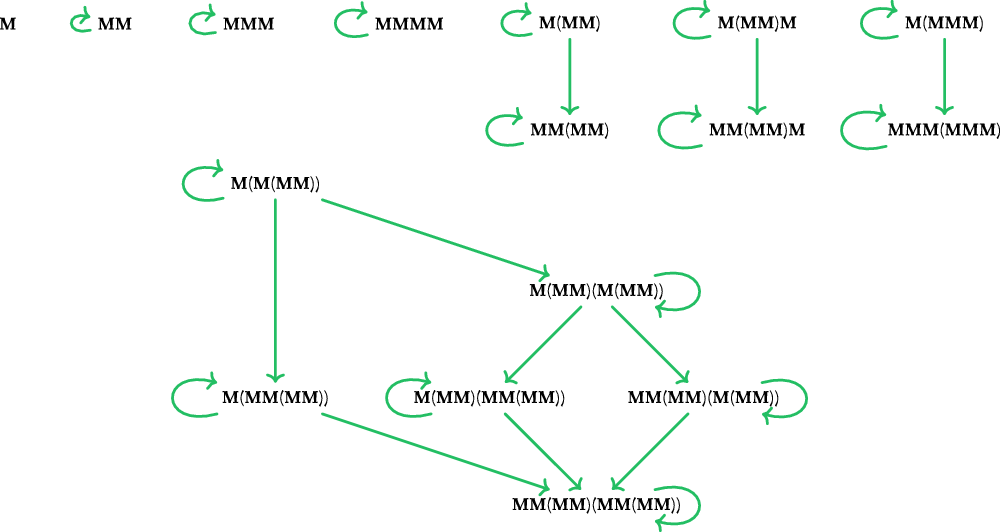
. Figure 2 provides an example of a fragment of G.
The fragment of the rewrite graph of
 $\mathcal{C}$
restrained to the terms reachable from closed terms of degrees 3 or less.

3.1.1 First properties
Let us present some first properties of
 $\mathcal{C}$
. We begin by providing a recursive description of the rewrite relation
 $\Rightarrow$
.
Lemma 3.1.1. For any
 $\mathfrak{t}, \mathfrak{t}' \in \mathfrak{T}(\mathfrak{G})$
, we have
 $\mathfrak{t} \Rightarrow \mathfrak{t}'$
if and only if
 $\mathfrak{t} = \mathfrak{t}_1 \mathfrak{t}_2$
,
 $\mathfrak{t}' = \mathfrak{t}_1' \mathfrak{t}_2'$
with
 $\mathfrak{t}_1, \mathfrak{t}_2, \mathfrak{t}_1', \mathfrak{t}_2' \in \mathfrak{T}(\mathfrak{G})$
, and at least one of the following assertions holds:
-
(i)
$\mathfrak{t}_1 \Rightarrow \mathfrak{t}_1'$
and
$\mathfrak{t}_2 = \mathfrak{t}_2'$
; -
(ii)
$\mathfrak{t}_2 \Rightarrow \mathfrak{t}_2'$
and
$\mathfrak{t}_1 = \mathfrak{t}_1'$
; -
(iii)
$\mathfrak{t}_1 = {{\mathbf{M}}}$
and
$\mathfrak{t}_2 = \mathfrak{t}_1' = \mathfrak{t}_2'$
.


Proof. This is a direct consequence of the definitions of the context closure
 $\Rightarrow$
from the rewrite relation
 $\to$
and of the term
 $\mathfrak{t}_{{{\mathbf{M}}}}$
.
Proposition 3.1.2. The CLS
 $\mathcal{C}$
-
(i) is locally finite;
-
(ii) has the poset property;
-
(iii) is rooted.
Proof. First, since
 ${{\mathbf{M}}}$
is hierarchical, by Proposition 2.2.3,
 $\mathcal{C}$
is locally finite. Therefore, (i) holds.
Let us prove that
 $\mathcal{C}$
has the poset property. For this, let
 $\theta : \mathfrak{T}(\mathfrak{G}) \to \mathbb{Z}^2$
be the map defined for any
 $\mathfrak{t} \in \mathfrak{T}(\mathfrak{G})$
by
 $ \theta(\mathfrak{t}) := \left(\mathrm{deg}(\mathfrak{t}), - \mathrm{deg}_{{{\mathbf{M}}}}(\mathfrak{t})\right). $
We denote by
 $\leqslant$
the lexicographic order on
 $\mathbb{Z}^2$
and by
 $\dot{+}$
the pointwise addition on
 $\mathbb{Z}^2$
. Let us prove by structural induction on
 $\mathfrak{T}(\mathfrak{G})$
that for any
 $\mathfrak{G}$
-terms
 $\mathfrak{t}$
and
 $\mathfrak{t}'$
,
 $\mathfrak{t} \ne \mathfrak{t}'$
and
 $\mathfrak{t} \Rightarrow \mathfrak{t}'$
implies
 $\theta(\mathfrak{t}) < \theta\left(\mathfrak{t}'\right)$
. By Lemma 3.1.1, we have
 $\mathfrak{t} = \mathfrak{t}_1 \mathfrak{t}_2$
and
 $\mathfrak{t}' = \mathfrak{t}_1' \mathfrak{t}_2'$
for some
 $\mathfrak{G}$
-terms
 $\mathfrak{t}_1$
,
 $\mathfrak{t}_2$
,
 $\mathfrak{t}_1'$
, and
 $\mathfrak{t}_2'$
, and we have the three following cases. First, if
 $\mathfrak{t}_1 \Rightarrow \mathfrak{t}_1'$
and
 $\mathfrak{t}_2 = \mathfrak{t}_2'$
, then
 $ \theta(\mathfrak{t}) = \theta\left(\mathfrak{t}_1\right) \dot{+} \theta\left(\mathfrak{t}_2\right) \dot{+} (1, 0) $
and
 $ \theta\left(\mathfrak{t}'\right) = \theta\left(\mathfrak{t}_1'\right) \dot{+} \theta\left(\mathfrak{t}_2\right) \dot{+} (1, 0). $
Since, by induction hypothesis,
 $\theta\left(\mathfrak{t}_1\right) < \theta\left(\mathfrak{t}_1'\right)$
, we have
 $\theta(\mathfrak{t}) < \theta\left(\mathfrak{t}'\right)$
. Second, if
 $\mathfrak{t}_2 \Rightarrow \mathfrak{t}_2'$
and
 $\mathfrak{t}_1 = \mathfrak{t}_1'$
, the same arguments as the previous ones (by interchanging the indices 1 and 2 in the concerned terms) apply. Finally, if
 $\mathfrak{t}_1 = {{\mathbf{M}}}$
and
 $\mathfrak{t}_2 = \mathfrak{t}_1' = \mathfrak{t}_2'$
, then
 $ \theta(\mathfrak{t}) = \theta\left(\mathfrak{t}_2\right) \dot{+} (1, -1) $
and
 $ \theta\left(\mathfrak{t}'\right) = \theta\left(\mathfrak{t}_2\right) \dot{+} \theta\left(\mathfrak{t}_2\right) \dot{+} (1, 0). $
Since
 $\mathfrak{t} \ne \mathfrak{t}'$
, we have
 $\mathfrak{t}_2 \ne {{\mathbf{M}}}$
so that
 $\theta(\mathfrak{t}) < \theta\left(\mathfrak{t}'\right)$
. This implies that
 $\preccurlyeq$
is antisymmetric, so that (ii) holds.
To prove that
 $\mathcal{C}$
is rooted, we consider the rewrite relation
 $\to'$
obtained by inverting
 $\to$
. Thus,
 $\to'$
satisfies
 $\mathsf{x}_1 \mathsf{x}_1 \to' {{\mathbf{M}}} \mathsf{x}_1$
. This ATRS
 $\left(\mathfrak{T}(\mathfrak{G}), \to'\right)$
does not admit any overlapping term (see Bezem et al. Reference Bezem, Klop and de Vrijer2003, Chapter 2). Therefore, it is confluent. A consequence of (i), is that this ATRS has only finite
 $\equiv'$
-equivalence classes. By using additionally Bezem et al. (Reference Bezem, Klop and de Vrijer2003), Theorem 1.2.2, each
 $\equiv'$
-equivalence class admits exactly one term
 $\mathfrak{t}$
such that for any
 $\mathfrak{t}' \in \left[\mathfrak{t}\right]_{\equiv'}$
,
 $\mathfrak{t}' \preccurlyeq' \mathfrak{t}$
. This implies that in
 $\mathcal{C}$
, each
 $\equiv$
-equivalence class admits exactly one minimal term. Therefore, (iii) holds.
By Proposition 3.1.2,
 $\mathcal{P}_\mathcal{C}$
is a well-defined poset, called
 . From now, we shall simply write
 $\mathcal{P}$
instead of
 $\mathcal{P}_\mathcal{C}$
. We have the following recursive description of
 $\preccurlyeq$
.
Lemma 3.1.3. For any
 $\mathfrak{t}, \mathfrak{t}' \in \mathfrak{T}(\mathfrak{G})$
, we have
 $\mathfrak{t} \preccurlyeq \mathfrak{t}'$
if and only if at least one of the following assertions holds:
-
(i)
$\mathfrak{t} = {{\mathbf{M}}} = \mathfrak{t}'$
; -
(ii)
$\mathfrak{t} = \mathsf{x}_i = \mathfrak{t}'$
for an
$\mathsf{x}_i \in \mathbb{X}$
; -
(iii)
$\mathfrak{t} = \mathfrak{t}_1 \mathfrak{t}_2$
,
$\mathfrak{t}' = \mathfrak{t}_1' \mathfrak{t}_2'$
,
$\mathfrak{t}_1 \preccurlyeq \mathfrak{t}_1'$
, and
$\mathfrak{t}_2 \preccurlyeq \mathfrak{t}_2'$
where
$\mathfrak{t}_1, \mathfrak{t}_1', \mathfrak{t}_2, \mathfrak{t}_2' \in \mathfrak{T}(\mathfrak{G})$
; -
(iv)
$\mathfrak{t} = {{\mathbf{M}}} \mathfrak{t}_2$
,
$\mathfrak{t}' = \mathfrak{t}_1' \mathfrak{t}_2'$
,
$\mathfrak{t}_2 \preccurlyeq \mathfrak{t}_1'$
, and
$\mathfrak{t}_2 \preccurlyeq \mathfrak{t}_2'$
where
$\mathfrak{t}_1', \mathfrak{t}_2, \mathfrak{t}_2' \in \mathfrak{T}(\mathfrak{G})$
.


Proof. This is a direct consequence of Lemma 3.1.1 and of the fact that
 $\preccurlyeq$
is the reflexive and transitive closure of
 $\Rightarrow$
.
Proposition 3.1.4. Let
 $\mathfrak{t} \in \mathfrak{T}(\mathfrak{G})$
.
-
(i) The term
$\mathfrak{t}$
is a maximal element of
$\mathcal{P}$
if and only if
$\mathfrak{t}$
avoids
${{\mathbf{M}}} \left(\mathsf{x}_1 \mathsf{x}_2\right)$
and suffix-avoids
${{\mathbf{M}}} \mathsf{x}_1$
. -
(ii) The term
$\mathfrak{t}$
is a minimal element of
$\mathcal{P}$
if and only if
$\mathfrak{t}$
avoids
$\left(\mathsf{x}_1 \mathsf{x}_2\right) \left(\mathsf{x}_1 \mathsf{x}_2\right)$
and suffix-avoids
$\mathsf{x}_1 \mathsf{x}_1$
.


Proof. The term
 $\mathfrak{t}$
is maximal in
 $\mathcal{P}$
if and only if
 $\mathfrak{t} \Rightarrow \mathfrak{t}'$
implies that
 $\mathfrak{t}' = \mathfrak{t}$
. By Lemma 3.1.1, this is equivalent to the fact
 $\mathfrak{t}$
is maximal in
 $\mathcal{P}$
if and only if when
 $\mathfrak{t}$
has an internal node having
 ${{\mathbf{M}}}$
as left subtree, this internal node admits necessarily
 ${{\mathbf{M}}}$
as right subtree. Therefore, (i) holds.
The term
 $\mathfrak{t}$
is minimal in
 $\mathcal{P}$
if and only if
 $\mathfrak{t}' \Rightarrow \mathfrak{t}$
implies that
 $\mathfrak{t}' = \mathfrak{t}$
. By Lemma 3.1.1, this is equivalent to the fact
 $\mathfrak{t}$
is minimal in
 $\mathcal{P}$
if and only if when
 $\mathfrak{t}$
has an internal node such that its two children are equal, these two children are necessarily equal to
 ${{\mathbf{M}}}$
. Therefore, (ii) holds.
3.1.2 Some models
We begin this discussion about models of
 $\mathcal{C}$
by a very simple observation: any idempotent monoid
 $(\mathcal{M}, \cdot, e)$
is a model of
 $\mathcal{C}$
. Indeed, by identifying
 ${{\mathbf{M}}}$
with e (the unit of
 $\mathcal{M}$
) and by identifying
 ${\star}$
with
 $\cdot$
, we have for any
 $x \in \mathcal{M}$
,
 $ {{\mathbf{M}}} {\star} x = e \cdot x = x = x \cdot x = x {\star} x.$
Besides, since
 $\mathcal{C}$
is hierarchical and has, by Proposition 3.1.2, the poset property, this CLS admits the model
 $\mathcal{M}^{\mathrm{max}}$
described in Section 2.2.3. More specifically, this model is such that
 $\mathcal{M}^{\mathrm{max}}$
is the set of the maximal elements of
 $\mathcal{P}$
, and, by Proposition 3.1.4, for any
 $\mathfrak{t}_1, \mathfrak{t}_2 \in \mathcal{M}^{\mathrm{max}}$
,
 \begin{equation} \mathfrak{t}_1 {\star} \mathfrak{t}_2 = \begin{cases} \mathfrak{t}_2 \mathfrak{t}_2 & \mbox{ if }\; \mathfrak{t}_1 = {{\mathbf{M}}}, \\ \mathfrak{t}_1 \mathfrak{t}_2 & \mbox{otherwise}. \end{cases}\end{equation}
Since by Proposition 3.1.2,
 $\mathcal{C}$
is also rooted,
 $\mathcal{C}$
admits the model
 $\mathcal{M}^{\mathrm{min}}$
described in Section 2.2.3. This model is such that
 $\mathcal{M}^{\mathrm{min}}$
is the set of the minimal elements of
 $\mathcal{P}$
, and, by Proposition 3.1.4, for any
 $\mathfrak{t}_1, \mathfrak{t}_2 \in \mathcal{M}^{\mathrm{min}}$
,
 \begin{equation} \mathfrak{t}_1 {\star} \mathfrak{t}_2 = \begin{cases} {{\mathbf{M}}} \mathfrak{t}_2 & \mbox{ if }\; \mathfrak{t}_1 = \mathfrak{t}_2, \\ \mathfrak{t}_1 \mathfrak{t}_2 & \mbox{otherwise}. \end{cases}\end{equation}
By representing
 $\mathfrak{G}$
-terms directly has binary trees, the computations in
 $\mathcal{M}^{\mathrm{max}}$
have a better time complexity than in
 $\mathcal{M}^{\mathrm{min}}$
because to compute
 $\mathfrak{t}_1{\star} \mathfrak{t}_2$
in
 $\mathcal{M}^{\mathrm{min}}$
, we need to decide if
 $\mathfrak{t}_1$
and
 $\mathfrak{t}_2$
are equal. Nevertheless, in return, the term
 $\mathfrak{t}_1 {\star} \mathfrak{t}_2$
produced by a computation in
 $\mathcal{M}^{\mathrm{min}}$
has a number of internal nodes equal as or smaller than the analogous computation in
 $\mathcal{M}^{\mathrm{max}}$
.
3.2 Duplicative lattices
We introduce here duplicative forests and a partial order relation on these objects. We show that this partial relation endow all intervals of this poset with lattice structures.
3.2.1 Duplicative forests
A  is a planar rooted tree such that each internal node is either a
 or a
 . A
 is a word
 $\mathfrak{f} = \mathfrak{f}(1) \dots \mathfrak{f}(\ell)$
,
 $\ell \geqslant 0$
, of duplicative trees. In particular, the empty word
 $\epsilon$
is the
 . We denote by
 $\mathcal{D}$
(resp.
 $\mathcal{D}^*$
) the set of such trees (resp. forests). The

 $\mathrm{ht}(\mathfrak{f})$
of
 $\mathfrak{f}$
is the number of internal nodes in a longest path following edges connecting a node to one of its child. In the sequel, we shall write expressions using some occurrences of
 : each such expression denotes the two expressions obtained by replacing simultaneously all
 either by
 or by
 . The
 is the unary operation
 on
 $\mathcal{D}^*$
such that for any
 $\mathfrak{f} \in\mathcal{D}^*$
,
 is the duplicative tree obtained by grafting the roots of the duplicative trees of
 $\mathfrak{f}$
on a common root node
 . The
 is the binary operation
 ${\centerdot}$
on
 $\mathcal{D}^*$
such that for any
 $\mathfrak{f}_1, \mathfrak{f}_2 \in\mathcal{D}^*$
,
 $\mathfrak{f}_1 {\centerdot} \mathfrak{f}_2$
is the duplicative forest made of the trees of
 $\mathfrak{f}_1$
and then of the trees of
 $\mathfrak{f}_2$
.
3.2.2 A poset on duplicative forests
Let  be the binary relation on
 $\mathcal{D}^*$
defined recursively as follows. For any
 $\mathfrak{f}, \mathfrak{f}' \in \mathcal{D}^*$
, we have
 if
 $\mathfrak{f}$
and
 $\mathfrak{f}'$
have the same length
 $\ell \geqslant 1$
and
-
• either
$\ell = 1$
, and where
$\mathfrak{g} \in \mathcal{D}^*$
; -
• or
$\ell = 1$
, , where
$\mathfrak{g}, \mathfrak{g}' \in \mathcal{D}^*$
and ; -
• or
$\ell \geqslant 2$
and there is a
$j \in [\ell]$
such that , and for all
$i \in [\ell] \setminus \{\,j\}$
,
$\mathfrak{f}(i) = \mathfrak{f}'(i)$
.

 and
 where


 ,
 where

 ;


 , and for all


We observe that  if and only if
 $\mathfrak{f}'$
can be obtained from
 $\mathfrak{f}$
by selecting a white node of
 $\mathfrak{f}$
, by turning it into black, and by duplicating its sequence of descendants. For instance, we have

Observe also that in this case, there are more black nodes in
 $\mathfrak{f}'$
than in
 $\mathfrak{f}$
. Hence, the reflexive and transitive closure
 $\ll$
of
 is antisymmetric so that
 $(\mathcal{D}^*, \ll)$
is a poset. We call this poset the
 . For any
 $\mathfrak{f} \in\mathcal{D}^*$
, we denote by
 $\mathcal{D}^*(\mathfrak{f})$
the subposet of the duplicative forest poset on the set
 $\left\{\mathfrak{f}' \in \mathcal{D}^* : \mathfrak{f}\ll \mathfrak{f}'\right\}$
. Figure 3 shows the Hasse diagram of the poset
 $\mathcal{D}^*(\mathfrak{f})$
where
 $\mathfrak{f}$
is a certain duplicative forest. According to this Hasse diagram, the duplicative forest poset is not graded. We have the following recursive description of
 $\ll$
.
The Hasse diagram of a maximal interval of the duplicative forest poset.

Lemma 3.2.1. For any two duplicative forests
 $\mathfrak{f}$
and
 $\mathfrak{f}'$
, we have
 $\mathfrak{f} \ll \mathfrak{f}'$
if and only if
 $\mathfrak{f}$
and
 $\mathfrak{f}'$
have the same length
 $\ell \geqslant 0$
and one of the following assertions holds:
-
(i)
$\ell = 0$
; -
(ii)
$\ell = 1$
, and where
$\mathfrak{g}, \mathfrak{g}', \mathfrak{g}'' \in \mathcal{D}^*$
,
$\mathfrak{g} \ll \mathfrak{g}'$
, and
$\mathfrak{g} \ll \mathfrak{g}''$
; -
(iii)
$\ell = 1$
, , where
$\mathfrak{g}, \mathfrak{g}' \in \mathcal{D}^*$
and
$\mathfrak{g} \ll \mathfrak{g}'$
; -
(iv)
$\ell \geqslant 2$
and
$\mathfrak{f}(i) \ll \mathfrak{f}'(i)$
for all
$i \in [\ell]$
.


 and
 where


 ,
 where


Proof. This is a direct consequence of the definitions of  and of
 $\ll$
.
A first consequence of Lemma 3.2.1 is that for any
 $\mathfrak{f}, \mathfrak{f}' \in \mathcal{D}^*$
,
 $\mathfrak{f} \ll \mathfrak{f}'$
implies
 $\mathrm{ht}(\mathfrak{f}) = \mathrm{ht}\left(\mathfrak{f}'\right)$
.
3.2.3 Lattices on duplicative forests
We use in the sequel the usual notions and notations about lattices (see for instance Stanley Reference Stanley2011). Let
 $\wedge$
and
 $\vee$
be the two binary, commutative, and associative partial operations on
 $\mathcal{D}^*$
defined recursively, for any
 $\ell \geqslant 0$
,
 $\mathfrak{f}_1, \dots, \mathfrak{f}_\ell \in \mathcal{D}$
,
 $\mathfrak{f}_1',\dots, \mathfrak{f}_\ell' \in \mathcal{D}$
, and
 $\mathfrak{f}, \mathfrak{f}', \mathfrak{f}'' \in\mathcal{D}^*$
, by
 \begin{equation} \mathfrak{f}_1 {\centerdot} \dots {\centerdot} \mathfrak{f}_\ell \wedge \mathfrak{f}_1' {\centerdot} \dots {\centerdot} \mathfrak{f}_\ell' := \left(\mathfrak{f}_1 \wedge \mathfrak{f}_1'\right) {\centerdot} \dots {\centerdot} \left(\mathfrak{f}_\ell \wedge \mathfrak{f}_\ell'\right),\end{equation}


and
 \begin{equation} \mathfrak{f}_1 {\centerdot} \dots {\centerdot} \mathfrak{f}_\ell \vee \mathfrak{f}_1' {\centerdot} \dots {\centerdot} \mathfrak{f}_\ell' := \left(\mathfrak{f}_1 \vee \mathfrak{f}_1'\right) {\centerdot} \dots {\centerdot} \left(\mathfrak{f}_\ell \vee \mathfrak{f}_\ell'\right),\end{equation}


Proposition 3.2.2. Given a duplicative forest
 $\mathfrak{f}$
, the poset
 $\mathcal{D}^*(\mathfrak{f})$
is a lattice for the operations
 $\wedge$
and
 $\vee$
.
Proof. This follows by structural induction on
 $\mathfrak{f}$
by establishing the fact that for any
 $\mathfrak{f}', \mathfrak{f}'' \in \mathcal{D}^*(\mathfrak{f})$
, the duplicative forest
 $\mathfrak{f}' \wedge \mathfrak{f}''$
(resp.
 $\mathfrak{f}' \vee \mathfrak{f}''$
) is well-defined and is the meet (resp. the join) of
 $\mathfrak{f}'$
and
 $\mathfrak{f}''$
. This uses Lemma 3.2.1 in order to describe
 $\mathfrak{f}'$
and
 $\mathfrak{f}''$
from
 $\mathfrak{f}$
knowing that
 $\mathfrak{f} \ll \mathfrak{f}'$
and
 $\mathfrak{f} \ll \mathfrak{f}''$
.
By Proposition 3.2.2, for any
 $\mathfrak{f} \in\mathcal{D}^*$
, each poset
 $\mathcal{D}^*(\mathfrak{f})$
is a lattice. We call it the

 of
 $\mathfrak{f}$
.
Let
 $\texttt{pr} : \mathcal{D}^* \to \mathcal{D}^*$
be the map defined recursively, for any
 $\ell \geqslant 0$
,
 $\mathfrak{f}_1, \dots, \mathfrak{f}_\ell \in\mathcal{D}^*$
, and
 $\mathfrak{f} \in \mathcal{D}^*$
, by
 \begin{equation} \texttt{pr}\left(\mathfrak{f}_1 {\centerdot} \dots {\centerdot} \mathfrak{f}_\ell\right) := \texttt{pr}\left(\mathfrak{f}_1\right) {\centerdot} \dots {\centerdot} \texttt{pr}\left(\mathfrak{f}_\ell\right),\end{equation}


The duplicative forest
 $\texttt{pr}(\mathfrak{f})$
is the
 of
 $\mathfrak{f}$
. This forest has by construction no occurrence of any
 . For instance,

Lemma 3.2.3. For any
 $\mathfrak{f} \in \mathcal{D}^*$
, the posets
 $\mathcal{D}^*(\mathfrak{f})$
and
 $\mathcal{D}^*(\texttt{pr}(\mathfrak{f}))$
are isomorphic.
Proof. This follows by structural induction on
 $\mathfrak{f}$
by establishing the fact that
 $\texttt{pr}$
is a one-to-one correspondence between the sets
 $\mathcal{D}^*(\mathfrak{f})$
and
 $\mathcal{D}^*(\texttt{pr}(\mathfrak{f}))$
and that
 $\texttt{pr}$
is an order isomorphism. This uses Lemma 3.2.1 in order to have a recursive description of the order relation
 $\ll$
.
For any
 $d \geqslant 0$
, the
 is the duplicative forest
 $\mathfrak{l}_d$
defined recursively by
 $\mathfrak{l}_0 := \epsilon$
and, for any
 $d \geqslant 1$
, by
 . Let also
 \begin{equation} \mathcal{L} := \bigcup_{d \geqslant 0} \mathcal{D}^*\left(\mathfrak{l}_d\right).\end{equation}
By definition,
 $\mathcal{L}$
is the set of the duplicative forests that are equal as or greater than a d-ladder for a
 $d \geqslant 0$
.
Lemma 3.2.4. For any
 $\mathfrak{f} \in \mathcal{D}^*$
, there exists
 $\mathfrak{g} \in \mathcal{L}$
such that
 $\texttt{pr}(\mathfrak{f}) = \texttt{pr}(\mathfrak{g})$
.
Proof. This follows by structural induction on
 $\mathfrak{f}$
by showing that there is a
 $d \geqslant 0$
such that
 $\mathfrak{l}_d \ll \mathfrak{g}$
and
 $\texttt{pr}(\mathfrak{f}) = \texttt{pr}(\mathfrak{g})$
. This uses Lemma 3.2.1.
An important consequence of Lemmas 3.2.3 and 3.2.4 is that for any
 $\mathfrak{f} \in \mathcal{D}^*$
, there exists
 $d \geqslant 0$
such that
 $\mathcal{D}^*(\mathfrak{f})$
is isomorphic as a poset to a maximal interval of
 $\mathcal{D}^* \left(\mathfrak{l}_d\right)$
.
3.3 Mockingbird lattices
We show here that each subposet
 $\mathcal{P}(\mathfrak{t})$
,
 $\mathfrak{t} \in \mathfrak{T}(\mathfrak{G})$
, of
 $\mathcal{P}$
is a lattice. This is based on a poset isomorphism between
 $\mathcal{P}(\mathfrak{t})$
and an interval of a lattice of duplicative forests. We also define for each
 $d \geqslant 0$
the Mockingbird lattice of order d as a particular maximal interval of
 $\mathcal{P}$
.
3.3.1 From terms to duplicative forests
Let
 $\texttt{fr} : \mathfrak{T}(\mathfrak{G}) \to \mathcal{D}^*$
be the map defined recursively, for any
 $\mathsf{x}_i \in \mathbb{X}$
and
 $\mathfrak{t}, \mathfrak{t}' \in\mathfrak{T}(\mathfrak{G})$
, by
 \begin{equation} \texttt{fr}\left(\mathsf{x}_i\right) := \epsilon,\end{equation}
 \begin{equation} \texttt{fr}({{\mathbf{M}}}) := \epsilon,\end{equation}

For instance,

Intuitively,
 $\texttt{fr}(\mathfrak{t})$
is the duplicative forest obtained from
 $\mathfrak{t}$
by the following process: replace each internal node of
 $\mathfrak{t}$
having
 ${{\mathbf{M}}}$
as left child and having a right child different from
 ${{\mathbf{M}}}$
by a
 , replace each other internal node of
 $\mathfrak{t}$
by a
 , and remove all the leaves. Immediately from the definition, we observe that this map is not injective. Moreover, again directly from the definition, any duplicative forest
 $\mathfrak{f}$
in the image of
 $\texttt{fr}$
is such that each white node of
 $\mathfrak{f}$
has no more than one child.
Lemma 3.3.1. For any
 $\mathfrak{t} \in \mathfrak{T}(\mathfrak{G})$
, the restriction of the map
 $\texttt{fr}$
on the domain
 $\mathcal{P}(\mathfrak{t})$
is injective.
Proof. This follows by structural induction on
 $\mathfrak{t}$
by establishing the fact that for any
 $\mathfrak{s}, \mathfrak{s}' \in \mathcal{P}(\mathfrak{t})$
,
 $\texttt{fr}(\mathfrak{s}) = \texttt{fr}\left(\mathfrak{s}'\right)$
implies
 $\mathfrak{s} = \mathfrak{s}'$
. This uses in particular Lemma 3.1.3 in order to describe
 $\mathfrak{s}$
and
 $\mathfrak{s}'$
from
 $\mathfrak{t}$
knowing that
 $\mathfrak{t} \preccurlyeq \mathfrak{s}$
and
 $\mathfrak{t} \preccurlyeq \mathfrak{s}'$
.
Lemma 3.3.2. Let
 $\mathfrak{t} \in \mathfrak{T}(\mathfrak{G})$
and
 $\mathfrak{s}, \mathfrak{s}' \in \mathfrak{T}(\mathfrak{t})$
such that
 $\mathfrak{s} \ne \mathfrak{s}'$
. We have
 $\mathfrak{s} \Rightarrow \mathfrak{s}'$
if and only if
 .
Proof. This follows by structural induction on
 $\mathfrak{t}$
. This uses in particular the definition of the binary relation
 on
 $\mathcal{D}^*$
, Lemma 3.1.3 in order to describe
 $\mathfrak{s}$
and
 $\mathfrak{s}'$
from
 $\mathfrak{t}$
knowing that
 $\mathfrak{t} \preccurlyeq \mathfrak{s}$
and
 $\mathfrak{t} \preccurlyeq \mathfrak{s}'$
, and Lemma 3.1.1 in order to describe
 $\mathfrak{s}'$
from
 $\mathfrak{s}$
knowing that
 $\mathfrak{s} \ne \mathfrak{s}'$
and
 $\mathfrak{s} \Rightarrow \mathfrak{s}'$
.
Proposition 3.3.3. For any
 $\mathfrak{t} \in \mathfrak{T}(\mathfrak{G})$
, the posets
 $\mathcal{P}(\mathfrak{t})$
and
 $\mathcal{D}^*(\texttt{fr}(\mathfrak{t}))$
are isomorphic.
Proof. Let
 $D := \left\{\texttt{fr}(\mathfrak{t}) : \mathfrak{t} \in \mathcal{P}(\mathfrak{t})\right\}$
. By Lemma 3.3.1, the sets
 $\mathcal{P}(\mathfrak{t})$
and D are in one-to-one correspondence. Moreover, by Lemma 3.3.2, we have that
 $D = \mathcal{D}^*(\texttt{fr}(\mathfrak{t}))$
and that
 $\texttt{fr}$
is an order isomorphism between
 $\mathcal{P}(\mathfrak{t})$
and
 $\mathcal{D}^*(\texttt{fr}(\mathfrak{t}))$
.
Figure 4 shows the poset
 $\mathcal{P}(\mathfrak{t})$
for a
 $\mathfrak{G}$
-term
 $\mathfrak{t}$
and the isomorphic poset
 $\mathcal{D}^*(\texttt{fr}(\mathfrak{t}))$
.
A maximal interval of the Mockingbird poset from the term
 $\mathfrak{t} := {{\mathbf{M}}} \left(\mathsf{x}_1 \left({{\mathbf{M}}} \mathsf{x}_2\right)\right) \left({{\mathbf{M}}} {{\mathbf{M}}}\right)$
and its realization as a maximal interval in the duplicative forest poset.

Theorem 3.3.4. For any
 $\mathfrak{t} \in \mathfrak{T}(\mathfrak{G})$
, the poset
 $\mathcal{P}(\mathfrak{t})$
is a finite lattice.
Proof. By Proposition 3.3.3,
 $\mathcal{P}(\mathfrak{t})$
is isomorphic as a poset to
 $\mathcal{D}^*(\texttt{fr}(\mathfrak{t}))$
. Hence, and since by Proposition 3.2.2,
 $\mathcal{D}^*(\texttt{fr}(\mathfrak{t}))$
is a lattice,
 $\mathcal{P}(\mathfrak{t})$
also is. The finiteness of
 $\mathcal{P}(\mathfrak{t})$
is a consequence of the fact that by Proposition 3.1.2,
 $\mathcal{C}$
is locally finite.
The  of order
 $d \geqslant 0$
is the lattice
 $\mathrm{M}(d) :=\mathcal{P}\left(\mathfrak{r}_d\right)$
where
 $\mathfrak{r}_d$
is the term recursively defined by
 $\mathfrak{r}_0 := {{\mathbf{M}}}$
and, for any
 $d \geqslant 1$
, by
 $\mathfrak{r}_d := {{\mathbf{M}}} \mathfrak{r}_{d - 1}$
. Figure 5 shows the Hasse diagrams of the first Mockingbird lattices.
The Hasse diagrams of the Mockingbird lattices
 $\mathrm{M}(d)$
for
 .

Theorem 3.3.5. For any
 $\mathfrak{f} \in \mathcal{D}^*$
, the poset
 $\mathcal{D}^*(\mathfrak{f})$
is isomorphic to a maximal interval of a Mockingbird lattice.
Proof. By Lemmas 3.2.3 and 3.2.4, the poset
 $\mathcal{D}^*(\mathfrak{f})$
is isomorphic to a maximal interval of
 $\mathcal{D}^* \left(\mathfrak{l}_d\right)$
for a
 $d \geqslant 0$
. Since
 $\texttt{pr}\left(\texttt{fr} \left(\mathfrak{r}_{d + 1}\right)\right) = \mathfrak{l}_d$
, and since by Proposition 3.3.3, the poset
 $\mathcal{P} \left(\mathfrak{r}_{d + 1}\right) = \mathrm{M}(d + 1)$
is isomorphic to
 $\mathcal{D}^* \left(\mathfrak{l}_d\right)$
, the poset
 $\mathcal{D}^*(\mathfrak{f})$
is isomorphic to a maximal interval of
 $\mathrm{M}(d + 1)$
.
3.3.5 justifies the fact that the study of the Mockingbird lattices is universal enough because these lattices contain as maximal interval all duplicative forest lattices.
The Mockingbird lattices are not graded and not self-dual. Since they are not graded, they are not distributive neither. Moreover, they are not semi-distributive. For instance, in
 $\mathrm{M}(3)$
, by setting
 $\mathfrak{t}_1 := {{\mathbf{M}}}({{\mathbf{M}}}{{\mathbf{M}}}({{\mathbf{M}}}{{\mathbf{M}}}))$
,
 $\mathfrak{t}_2 :={{\mathbf{M}}}{{\mathbf{M}}}({{\mathbf{M}}}{{\mathbf{M}}})({{\mathbf{M}}}({{\mathbf{M}}}{{\mathbf{M}}}))$
, and
 $\mathfrak{t}_3 := {{\mathbf{M}}}({{\mathbf{M}}}{{\mathbf{M}}})({{\mathbf{M}}}{{\mathbf{M}}}({{\mathbf{M}}}{{\mathbf{M}}}))$
, we have
 $\mathfrak{t}_1 \wedge\mathfrak{t}_2 = \mathfrak{t}_1 \wedge \mathfrak{t}_3$
but
 $\mathfrak{t}_1 \wedge \left(\mathfrak{t}_2 \vee \mathfrak{t}_3\right) \ne\mathfrak{t}_1 \wedge \mathfrak{t}_2$
, contradicting one of the required relations to have this property.
4. Enumerative Properties
In this last central part of this work, we present some enumerative results concerning the Mockingbird poset and lattices
 $\mathrm{M}(d)$
,
 $d \geqslant 0$
. We enumerate the maximal and minimal elements of the Mockingbird poset by degree and by height, the length of the shortest and longest saturated chains in
 $\mathrm{M}(d)$
, the number of elements in
 $\mathrm{M}(d)$
, the number of edges in the Hasse diagram of
 $\mathrm{M}(d)$
, and the number of intervals of
 $\mathrm{M}(d)$
. All this use the lattice isomorphism between the Mockingbird lattices and the duplicative forest lattices introduced in the previous sections and formal series on terms and on duplicative forests.
4.1 Formal power series
We set here some notions about formal power series and generating series. For the rest of the text,
 $\mathbb{K}$
is any field of characteristic zero (as
 $\mathbb{Q}$
for instance).
4.1.1 Formal power series over sets
For any set X, let
 $\mathbb{K} \left\langle X\right\rangle$
be the linear span of X. The dual space of
 $\mathbb{K}\left\langle X\right\rangle$
is denoted by
 $\mathbb{K} \left\langle\left\langle X\right\rangle\right\rangle$
and is by definition the space of the maps
 $\mathbf{F} : X \to \mathbb{K}$
, called
 . The coefficient
 $\mathbf{F}(x)$
of any
 $x \in X$
is denoted by
 $\left\langle x, \mathbf{F}\right\rangle$
. The
 of
 $\mathbf{F}$
is the set
 $\mathrm{Supp}(\mathbf{F}) := \left\{x \in X : \left\langle x, \mathbf{F}\right\rangle \ne 0\right\}$
. The

 of any subset X’ of X is the series
 $\mathbf{c}\left(X'\right)$
having X’ as support and such that the coefficient of each
 $x \in X'$
is 1. For any
 $k \geqslant 0$
,
 ${{\mathrm T}^{k}} \mathbb{K} \left\langle\left\langle X\right\rangle\right\rangle$
is the k-th tensor power of
 $\mathbb{K} \left\langle\left\langle X\right\rangle\right\rangle$
. Elements of this space are possibly infinite linear combinations of tensors
 $x_1 \otimes \dots \otimes x_k$
, where for any
 $i \in [k]$
,
 $x_i \in X$
. The
 of
 $\mathbb{K} \left\langle\left\langle X\right\rangle\right\rangle$
is the space
 \begin{equation} {{\mathrm T}^{*}} \mathbb{K} \left\langle\left\langle X\right\rangle\right\rangle := \bigoplus_{k \geqslant 0} {{\mathrm T}^{k}} \mathbb{K} \left\langle\left\langle X\right\rangle\right\rangle.\end{equation}
This space is endowed with the tensor product
 $\otimes$
so that
 $\left({{\mathrm T}^{*}} \mathbb{K} \left\langle\left\langle X\right\rangle\right\rangle,\otimes\right)$
is a unital associative algebra, admitting
 $1 \in \mathbb{K}$
as unit.
A linear map
 $\phi : {{\mathrm T}^{k_1}} \mathbb{K} \left\langle\left\langle X\right\rangle\right\rangle \to {{\mathrm T}^{k_2}} \mathbb{K} \left\langle\left\langle X\right\rangle\right\rangle$
,
 $k_1, k_2 \geqslant 0$
, is a
 on
 $\mathbb{K} \left\langle\left\langle X\right\rangle\right\rangle$
. To lighten the notation, when
 $\phi$
is a (2, 1)-operation on
 $\mathbb{K} \left\langle\left\langle X\right\rangle\right\rangle$
, we shall sometimes use
 $\phi$
as an infix operation by writing
 $\mathbf{F}_1 \, \phi \, \mathbf{F}_2$
instead of
 $\phi\left(\mathbf{F}_1\otimes \mathbf{F}_2\right)$
for any
 $\mathbf{F}_1, \mathbf{F}_2 \in \mathbb{K} \left\langle\left\langle X\right\rangle\right\rangle$
. The

 is the (1, 2)-operation
 $\Delta$
on
 $\mathbb{K} \left\langle\left\langle X\right\rangle\right\rangle$
satisfying
 $\Delta(x) = x\otimes x$
for any
 $x \in X$
. When X is endowed with an n-ary operation
 ${\bullet} : X^n\to X$
,
 $n \geqslant 0$
, for any
 $k \geqslant 0$
, the
 of
 ${\bullet}$
is the
 $(nk, k)$
-operation
 ${{{\bullet}}^{\otimes_{k}}}$
on
 $\mathbb{K} \left\langle\left\langle X\right\rangle\right\rangle$
satisfying
 \begin{equation} {{{\bullet}}^{\otimes_{k}}} \left( x_{1, 1} \otimes \dots \otimes x_{1, k} \otimes \dots \otimes x_{n, 1} \otimes \dots \otimes x_{n, k}\right) = {\bullet}\left(x_{1, 1}, \dots, x_{n, 1}\right) \otimes \dots \otimes {\bullet}\left(x_{k, 1}, \dots, x_{n, k}\right)\end{equation}
for any
 $x_{i, j} \in X$
,
 $i \in [n]$
, and
 $j \in [k]$
. To lighten the notation, we shall write
 ${{{\bullet}}^{\otimes_{}}}$
for
 ${{{\bullet}}^{\otimes_{1}}}$
.
4.1.2 Generating series
The space of the usual power series on the formal parameter
 $\mathsf{z}$
is denoted by
 $\mathbb{K}\left\langle\left\langle\mathsf{z}\right\rangle\right\rangle$
. For any
 $F, F' \in \mathbb{K} \left\langle\left\langle\mathsf{z}\right\rangle\right\rangle$
,
 $F\left[\mathsf{z} := F'\right]$
is the series of
 $\mathbb{K} \left\langle\left\langle\mathsf{z}\right\rangle\right\rangle$
obtained by substituting F’ for
 $\mathsf{z}$
in F. The

 is the binary operation
 ${\boxtimes}$
on
 $\mathbb{K} \left\langle\left\langle\mathsf{z}\right\rangle\right\rangle$
defined linearly for any
 $n_1, n_2 \geqslant 0$
by
 \begin{equation} \mathsf{z}^{n_1} {\boxtimes} \mathsf{z}^{n_2} := \pmb{\left[\right.}n_1 = n_2\pmb{\left.\right]} \, z^{n_1}.\end{equation}
The  is the binary operation
 ${\uparrow}$
on
 $\mathbb{K} \left\langle\left\langle\mathsf{z}\right\rangle\right\rangle$
defined linearly for any
 $n_1, n_2 \geqslant 0$
by
 $\mathsf{z}^{n_1} {\uparrow} \mathsf{z}^{n_2} := \mathsf{z}^{\max\left\{n_1, n_2\right\}}$
. Observe that for any
 $F \in \mathbb{K} \left\langle\left\langle\mathsf{z}\right\rangle\right\rangle$
and
 $n \geqslant 0$
,
 \begin{equation} \left\langle\mathsf{z}^n, F {\uparrow} F\right\rangle = \left\langle\mathsf{z}^n, F\right\rangle^2 + 2 \left\langle\mathsf{z}^n, F\right\rangle \sum_{i \in [n]} \left\langle\mathsf{z}^{i - 1}, F\right\rangle.\end{equation}
4.1.3 Formal power series and enumeration
If X is endowed with a map
 $\omega : X \to \mathbb{N}$
, the
 is the partial map
 $\mathrm{en}_\omega : {{\mathrm T}^{*}} \mathbb{K} \left\langle\left\langle X\right\rangle\right\rangle \to \mathbb{K} \left\langle\left\langle\mathsf{z}\right\rangle\right\rangle$
defined linearly for any
 $k \geqslant 1$
and
 $x_1, \dots, x_k \in X$
by
 \begin{equation} \mathrm{en}_\omega\left(x_1 \otimes \dots \otimes x_k\right) := \mathsf{z}^{\omega\left(x_1\right)} {\uparrow} \dots {\uparrow} \mathsf{z}^{\omega\left(x_k\right)}.\end{equation}
For any
 $\mathbf{F} \in {{\mathrm T}^{*}} \mathbb{K} \left\langle\left\langle X\right\rangle\right\rangle$
, the generating series
 $\mathrm{en}_\omega(\mathbf{F})$
is the
 of
 $\mathbf{F}$
.
In the sequel, we shall use the following strategy to enumerate a set X w.r.t. such a map
 $\omega$
: we shall provide a description of
 $\mathbf{c}(X)$
, then deduce a description of
 $\mathrm{en}_\omega(\mathbf{c}(X))$
, and finally deduce from this a formula to compute the coefficients
 $\left\langle\mathsf{z}^n,\mathrm{en}_\omega(\mathbf{c}(X))\right\rangle$
,
 $n \geqslant 0$
.
4.2 Maximal, minimal, and isolated terms
We use here series on terms and some operations on these in order to enumerate the closed maximal, closed minimal, and closed isolated elements of the poset
 $\mathcal{P}$
w.r.t. their degrees or their heights. These enumerative results can be used to establish the probabilities for a term
 $\mathfrak{t}$
of a given degree or of a given height generated uniformly at random to have one of these properties. In particular, the number of maximal (resp. minimal, isolated) closed terms gives information to compute the probability for the fact that
 $\mathfrak{t}$
cannot be rewritten into a different term (resp. no term different from
 $\mathfrak{t}$
rewrites into
 $\mathfrak{t}$
, any sequence of rewriting steps involving
 $\mathfrak{t}$
does not involve different other terms).
4.2.1 Series of terms and operations
Recall that
 ${\star}$
is the binary operation on
 $\mathfrak{T}(\mathfrak{G})$
such that for any
 $\mathfrak{t}_1, \mathfrak{t}_2 \in \mathfrak{T}(\mathfrak{G})$
,
 $\mathfrak{t}_1 {\star} \mathfrak{t}_2$
is the
 $\mathfrak{G}$
-term
 $\mathfrak{t}_1 \mathfrak{t}_2$
having
 $\mathfrak{t}_1$
as left subtree and
 $\mathfrak{t}_2$
as right subtree. Observe that for any
 $\mathbf{F}_1, \mathbf{F}_2 \in \mathbb{K}\left\langle\left\langle\mathfrak{T}(\mathfrak{G})\right\rangle\right\rangle$
,
 \begin{equation} \mathrm{en}_\mathrm{deg} \left(\mathbf{F}_1 {{{\star}}^{\otimes_{}}} \mathbf{F}_2\right) = \mathsf{z} \, \mathrm{en}_\mathrm{deg}\left(\mathbf{F}_1\right) \, \mathrm{en}_\mathrm{deg}\left(\mathbf{F}_2\right)\end{equation}
and
 \begin{equation} \mathrm{en}_\mathrm{ht} \left(\mathbf{F}_1 {{{\star}}^{\otimes_{}}} \mathbf{F}_2\right) = \mathsf{z} \, \left( \mathrm{en}_\mathrm{ht} \left(\mathbf{F}_1\right) {\uparrow} \mathrm{en}_\mathrm{ht} \left(\mathbf{F}_2\right)\right).\end{equation}
Observe also that for any
 $\mathbf{F} \in \mathbb{K} \left\langle\left\langle\mathfrak{T}(\mathfrak{G})\right\rangle\right\rangle$
,
 \begin{equation} \mathrm{en}_\mathrm{deg} \left({{{\star}}^{\otimes_{}}}(\Delta(\mathbf{F}))\right) = \mathsf{z} \, \left(\mathrm{en}_\mathrm{deg}(\mathbf{F})\left[\mathsf{z} := \mathsf{z}^2\right]\right)\end{equation}
and
 \begin{equation} \mathrm{en}_{\mathrm{ht}} \left({{{\star}}^{\otimes_{}}}(\Delta(\mathbf{F}))\right) = \mathsf{z} \, \mathrm{en}_{\mathrm{ht}}(\mathbf{F}).\end{equation}
4.2.2 Three series of terms
In order to achieve the objectives described above, we begin by providing equations satisfied by the characteristic series
 $\mathbf{F}_{\max}$
of the closed maximal terms of
 $\mathcal{P}$
, the characteristic series
 $\mathbf{F}_{\min}$
of the closed minimal terms of
 $\mathcal{P}$
, and the characteristic series
 $\mathbf{F}_{\mathrm{iso}}$
of the closed isolated terms of
 $\mathcal{P}$
.
Proposition 4.2.1. The characteristic series
 $\mathbf{F}_{\max}$
satisfies
 \begin{equation} \mathbf{F}_{\max} = {{\mathbf{M}}} + {{\mathbf{M}}} {{\mathbf{M}}} + \mathbf{F}_{\max} {{{\star}}^{\otimes_{}}} \mathbf{F}_{\max} - {{\mathbf{M}}} {{{\star}}^{\otimes_{}}} \mathbf{F}_{\max}. \end{equation}
Proof. By using the description of Proposition 3.1.4 for the set S of closed maximal elements of
 $\mathcal{P}$
, we have
 \begin{equation} \mathbf{F}_{\max} = {{\mathbf{M}}} + \sum_{\mathfrak{s}_1, \mathfrak{s}_2 \in S} \mathfrak{s}_1 \mathfrak{s}_2 - \sum_{\mathfrak{s}_3 \in S \setminus \{{{\mathbf{M}}}\}} {{\mathbf{M}}} \mathfrak{s}_3 = {{\mathbf{M}}} + \mathbf{F}_{\max} {{{\star}}^{\otimes_{}}} \mathbf{F}_{\max} - {{\mathbf{M}}} {{{\star}}^{\otimes_{}}} \left(\mathbf{F}_{\max} - {{\mathbf{M}}}\right). \end{equation}
This leads to (4.2.5).
Proposition 4.2.2. The characteristic series
 $\mathbf{F}_{\min}$
satisfies
 \begin{equation} \mathbf{F}_{\min} = {{\mathbf{M}}} + {{\mathbf{M}}} {{\mathbf{M}}} + \mathbf{F}_{\min} {{{\star}}^{\otimes_{}}} \mathbf{F}_{\min} - {{{\star}}^{\otimes_{}}}\left(\Delta(\mathbf{F}_{\min})\right). \end{equation}
Proof. By using the description of Proposition 3.1.4 for the set S of closed minimal elements of
 $\mathcal{P}$
, we have
 \begin{equation} \mathbf{F}_{\min} = {{\mathbf{M}}} + \sum_{\mathfrak{s}_1, \mathfrak{s}_2 \in S} \mathfrak{s}_1 \mathfrak{s}_2 - \sum_{\mathfrak{s}_3 \in S \setminus \{{{\mathbf{M}}}\}} \mathfrak{s}_3 \mathfrak{s}_3 = {{\mathbf{M}}} + \mathbf{F}_{\min} {{{\star}}^{\otimes_{}}} \mathbf{F}_{\min} - {{{\star}}^{\otimes_{}}}\left(\Delta\left(\mathbf{F}_{\min} - {{\mathbf{M}}}\right)\right). \end{equation}
This leads to (4.2.7).
Proposition 4.2.3. The characteristic series
 $\mathbf{F}_{\mathrm{iso}}$
satisfies
 \begin{equation} \mathbf{F}_{\mathrm{iso}} = {{\mathbf{M}}} + 2 {{\mathbf{M}}} {{\mathbf{M}}} + \mathbf{F}_{\mathrm{iso}} {{{\star}}^{\otimes_{}}} \mathbf{F}_{\mathrm{iso}} - {{\mathbf{M}}} {{{\star}}^{\otimes_{}}} \mathbf{F}_{\mathrm{iso}} - {{{\star}}^{\otimes_{}}}\left(\Delta\left(\mathbf{F}_{\mathrm{iso}}\right)\right). \end{equation}
Proof. By using the description of Proposition 3.1.4 for the set
 $S_1$
(resp.
 $S_2$
) of the closed maximal (resp. minimal) elements of
 $\mathcal{P}$
, the set of the closed isolated elements of
 $\mathcal{P}$
is the set
 $S = S_1 \cap S_2$
and we have
 \begin{equation} \begin{split} \mathbf{F}_{\mathrm{iso}} & = {{\mathbf{M}}} + \sum_{\mathfrak{s}_1, \mathfrak{s}_2 \in S} \mathfrak{s}_1 \mathfrak{s}_2 - \sum_{\mathfrak{s}_3 \in S \setminus \{{{\mathbf{M}}}\}} {{\mathbf{M}}} \mathfrak{s}_3 - \sum_{\mathfrak{s}_4 \in S \setminus \{{{\mathbf{M}}}\}} \mathfrak{s}_4 \mathfrak{s}_4 \\ & = {{\mathbf{M}}} + \mathbf{F}_{\mathrm{iso}} {{{\star}}^{\otimes_{}}} \mathbf{F}_{\mathrm{iso}} - {{\mathbf{M}}} {{{\star}}^{\otimes_{}}} \left(\mathbf{F}_{\mathrm{iso}} - {{\mathbf{M}}}\right) - {{{\star}}^{\otimes_{}}}\left(\Delta\left(\mathbf{F}_{\mathrm{iso}} - {{\mathbf{M}}}\right)\right). \end{split} \end{equation}
This leads to (4.2.9).
4.2.3 deg-enumerations
A consequence of Proposition 4.2.1 and of (4.2.1) is that the deg-enumeration
 $\mathsf{D}_{\max}$
of
 $\mathbf{F}_{\max}$
, enumerating the closed maximal elements of
 $\mathcal{P}$
w.r.t. their degrees, satisfies
 \begin{equation} \mathsf{D}_{\max} = 1 + \mathsf{z} + \mathsf{z} \mathsf{D}_{\max}^2 - \mathsf{z} \mathsf{D}_{\max}.\end{equation}
We deduce from this that the number of these terms of degree
 $d \geqslant 0$
is
 $\mathbf{d}_{\max}(d)$
where
 $\mathbf{d}_{\max}$
is the integer sequence satisfying
 $\mathbf{d}_{\max}(0) = \mathbf{d}_{\max}(1) = 1$
and, for any
 $d \geqslant 2$
,

The first numbers are
 \begin{equation} 1, 1, 1, 2, 4, 9, 21, 51,\end{equation}
form Sequence  of Sloane (https://oeis.org/), and are Motzkin numbers. A
 is a planar rooted tree made of nodes of arity 0, 1, or 2. It is well-known that the sets of these trees having exactly
 $d \geqslant 1$
nodes are enumerated by Motzkin numbers (see Dulucq and Penaud Reference Dulucq and Penaud2002 for instance). Given a closed maximal term
 $\mathfrak{t}$
, it is easy to see that
 $\texttt{fr}(\mathfrak{t})$
contains only black nodes and that it is a Motzkin tree. It is also easy to check that
 $\texttt{fr}$
is a bijection between the set of the closed maximal terms of degree
 $d \geqslant 1$
and the set of the Motzkin trees with d nodes.
Besides, a consequence of Proposition 4.2.2, (4.2.1), and (4.2.3) is that the deg-enumeration
 $\mathsf{D}_{\min}$
of
 $\mathbf{F}_{\min}$
, enumerating the closed minimal elements of
 $\mathcal{P}$
w.r.t. their degrees, satisfies
 \begin{equation} \mathsf{D}_{\min} = 1 + \mathsf{z} + \mathsf{z} \mathsf{D}_{\min}^2 - \mathsf{z} \left(\mathsf{D}_{\min}\left[\mathsf{z} := \mathsf{z}^2\right]\right).\end{equation}
We deduce from this that the number of these terms of degree
 $d \geqslant 0$
is
 $\mathbf{d}_{\min}(d)$
where
 $\mathbf{d}_{\min}$
is the integer sequence satisfying
 $\mathbf{d}_{\min}(0) = \mathbf{d}_{\min}(1) = 1$
and, for any
 $d \geqslant 2$
,

The first numbers are
 \begin{equation} 1, 1, 2, 4, 12, 34, 108, 344\end{equation}
and form Sequence  of Sloane (https://oeis.org/). A
 is a binary tree having no subtrees that are brother and equal, unless they are leaves. It is known that the sets of these trees having exactly
 $d \geqslant 0$
internal nodes are enumerated by the previous sequence. It is immediate to see that the identity map is a bijection between the set of the closed minimal terms of degree
 $d \geqslant 0$
and the set of the semi-identity trees with exactly d internal nodes.
Besides, a consequence of Proposition 4.2.2, (4.2.1), and (4.2.3) is that the deg-enumeration
 $\mathsf{D}_{\mathrm{iso}}$
of
 $\mathbf{F}_{\mathrm{iso}}$
, enumerating the closed isolated elements of
 $\mathcal{P}$
w.r.t. their degrees, satisfies
 \begin{equation} \mathsf{D}_{\mathrm{iso}} = 1 + 2\mathsf{z} + \mathsf{z} \mathsf{D}_{\mathrm{iso}}^2 - \mathsf{z} \mathsf{D}_{\mathrm{iso}} - \mathsf{z} \left(\mathsf{D}_{\mathrm{iso}}\left[\mathsf{z} := \mathsf{z}^2\right]\right).\end{equation}
We deduce from this that the number of these terms of degree
 $d \geqslant 0$
is
 $\mathbf{d}_{\mathrm{iso}}(d)$
where
 $\mathbf{d}_{\mathrm{iso}}$
is the integer sequence satisfying
 $\mathbf{d}_{\mathrm{iso}}(0) = \mathbf{d}_{\mathrm{iso}}(1) = 1$
and, for any
 $d \geqslant 2$
,

The first numbers are
 \begin{equation} 1, 1, 1, 1, 3, 5, 13, 29, 71, 171, 427, 1067, 2709.\end{equation}
This sequence does not appear in Sloane (https://oeis.org/) for the time being.
4.2.4 ht-enumerations
Due to the fact that
 $\mathcal{C}$
is hierarchical and, by Proposition 3.1.2,
 $\mathcal{P}$
is rooted, Proposition 2.2.3 implies that
 $\mathcal{P}$
satisfies the properties exposed at the very end of Section 2.2.2. In particular, in each
 $\equiv$
-equivalence class of closed terms, there is exactly one closed maximal term, exactly one closed minimal term, and these terms have the same height. For this reason, the ht-enumerations of
 $\mathbf{F}_{\max}$
and
 $\mathbf{F}_{\min}$
are equal and enumerate also the
 $\equiv$
-equivalence classes of closed terms w.r.t. the heights of their elements. By denoting by
 $\mathsf{H}_{\mathrm{mm}}$
this generating series, by Propositions 4.2.1 and 4.2.2,
 $\mathsf{H}_{\mathrm{mm}}$
satisfies
 \begin{equation} \mathsf{H}_{\mathrm{mm}} = 1 + \mathsf{z} + \mathsf{z} \left(\mathsf{H}_{\mathrm{mm}} {\uparrow} \mathsf{H}_{\mathrm{mm}}\right) - \mathsf{z} \mathsf{H}_{\mathrm{mm}}.\end{equation}
We deduce from this and (4.1.4) that the number of these
 $\equiv$
-equivalence classes of terms of height
 $h \geqslant 0$
is
 $\mathbf{h}_{\mathrm{mm}}(h)$
where
 $\mathbf{h}_{\mathrm{mm}}$
is the integer sequence satisfying
 $\mathbf{h}_{\mathrm{mm}}(0) =\mathbf{h}_{\mathrm{mm}}(1) = 1$
and, for any
 $h \geqslant 2$
,
 \begin{equation} \mathbf{h}_{\mathrm{mm}}(h) = \mathbf{h}_{\mathrm{mm}}(h - 1)^2 - \mathbf{h}_{\mathrm{mm}}(h - 1) + 2 \mathbf{h}_{\mathrm{mm}}(h - 1) \sum_{i \in [h - 1]} \mathbf{h}_{\mathrm{mm}}(i - 1).\end{equation}
The first numbers are
 \begin{equation} 1, 1, 2, 10, 170, 33490, 1133870930, 1285739648704587610\end{equation}
and form Sequence  of Sloane (https://oeis.org/).
Besides, a consequence of Proposition 4.2.3, (4.2.2), and (4.2.4) is that the ht-enumeration
 $\mathsf{H}_{\mathrm{iso}}$
of
 $\mathbf{F}_{\mathrm{iso}}$
, enumerating the closed isolated elements of
 $\mathcal{P}$
w.r.t. their heights, satisfies
 \begin{equation} \mathsf{H}_{\mathrm{iso}} = 1 + 2 z + z \left(\mathsf{H}_{\mathrm{iso}} {\uparrow} \mathsf{H}_{\mathrm{iso}}\right) - 2z \mathsf{H}_{\mathrm{iso}}.\end{equation}
We deduce from this and (4.1.4) that the number of these terms of height
 $h \geqslant 0$
is
 $\mathbf{h}_{\mathrm{iso}}(h)$
where
 $\mathbf{h}_{\mathrm{iso}}$
is the integer sequence satisfying
 $\mathbf{h}_{\mathrm{iso}}(0) = \mathbf{h}_{\mathrm{iso}}(1) = 1$
and, for any
 $h\geqslant 2$
,
 \begin{equation} \mathbf{h}_{\mathrm{iso}}(h) = \mathbf{h}_{\mathrm{iso}}(h - 1)^2 - 2 \mathbf{h}_{\mathrm{iso}}(h - 1) + 2 \mathbf{h}_{\mathrm{iso}}(h - 1) \sum_{i \in [h - 1]} \mathbf{h}_{\mathrm{iso}}(i - 1).\end{equation}
The first numbers are
 \begin{equation} 1, 1, 1, 3, 21, 651, 457653, 210065930571\end{equation}
and form Sequence  of Sloane (https://oeis.org/), which enumerates binary trees w.r.t. the height (but with a shift). Therefore, there is a one-to-one correspondence between the set of the closed isolated elements of
 $\mathcal{P}$
of height
 $h \geqslant 1$
and the set of the binary trees of height
 $h - 1$
.
4.3 Shortest and longest saturated chains
Let
 $\texttt{ml} : \mathcal{D}^* \to \mathbb{N}$
be the statistics defined for any
 $\ell\geqslant 0$
,
 $\mathfrak{f}_1, \dots, \mathfrak{f}_\ell \in \mathcal{D}^*$
, and
 $\mathfrak{f} \in\mathcal{D}^*$
by
 \begin{equation} \texttt{ml}\left(\mathfrak{f}_1 {\centerdot} \dots {\centerdot} \mathfrak{f}_\ell\right) := 1 - \ell + \sum_{i \in [\ell]} \texttt{ml} \left(\mathfrak{f}_i\right),\end{equation}


For instance, we have

where the integer decoration of each node refers to the image by
 $\texttt{ml}$
of the duplicative tree rooted at this node.
Proposition 4.3.1. For any
 $\mathfrak{t} \in \mathfrak{T}_0(\mathfrak{G})$
,
-
(i) a shortest saturated chain from
$\mathfrak{t}$
to the maximal element of
$\mathcal{P}(\mathfrak{t})$
has as length the number of in
$\texttt{fr}(\mathfrak{t})$
; -
(ii) a longest saturated chain from
$\mathfrak{t}$
to the maximal element of
$\mathcal{P}(\mathfrak{t})$
has length
$\texttt{ml}(\texttt{fr}(\mathfrak{t}))$
.


 in


Proof. Let
 $\mathfrak{f} := \texttt{fr}(\mathfrak{t})$
. By Proposition 3.3.3, the posets
 $\mathcal{P}(\mathfrak{t})$
and
 $\mathcal{D}^*(\mathfrak{f})$
are isomorphic. Therefore, to prove the statement, we consider the lengths of the shortest and longest saturated chains in
 $\mathcal{D}^*(\mathfrak{f})$
from
 $\mathfrak{f}$
to
 $\mathfrak{g}$
where
 $\mathfrak{g}$
is the maximal element of
 $\mathcal{D}^*(\mathfrak{f})$
.
First, immediately from the definition of
 $\ll$
, a shortest saturated chain from
 $\mathfrak{f}$
to
 $\mathfrak{g}$
consists in selecting at each step a white node that has no white nodes as descendants and turn it into black. This establishes (i).
Let us prove (ii) by structural induction on
 $\mathfrak{f}$
. We use Lemma 3.2.1 in order to exhibit a longest saturated chain from
 $\mathfrak{f}$
to
 $\mathfrak{g}$
. If
 $\mathfrak{f} = \mathfrak{f}_1 {\centerdot} \dots {\centerdot} \mathfrak{f}_\ell$
,
 $\ell \geqslant 0$
, a longest saturated chain from
 $\mathfrak{f}$
passes through the duplicative forest
 $\mathfrak{f}_1' {\centerdot} \mathfrak{f}_2 {\centerdot} \dots {\centerdot} \mathfrak{f}_\ell$
and then passes through
 $\mathfrak{f}_1' {\centerdot} \mathfrak{f}_2' {\centerdot} \dots {\centerdot} \mathfrak{f}_\ell$
, …, and ends at
 $\mathfrak{f}_1' {\centerdot} \mathfrak{f}_2' {\centerdot} \dots {\centerdot} \mathfrak{f}_\ell' = \mathfrak{g}$
, where for any
 $i \in [\ell]$
,
 $\mathfrak{f}_i'$
is the greatest element of
 $\mathcal{D}^*\left(\mathfrak{f}_i\right)$
. By induction hypothesis,
 $\texttt{ml}\left(\mathfrak{f}_i\right)$
is the length of a longest saturated chain from
 $\mathfrak{f}_i$
to
 $\mathfrak{f}_i'$
. We deduce that the length of the former chain from
 $\mathfrak{f}$
to
 $\mathfrak{g}$
is
 $1 + \sum_{i \in [\ell]} \left(\texttt{ml}\left(\mathfrak{f}_i\right) - 1\right)$
. Therefore, (4.3.1a) is consistent. If
 ,
 $\mathfrak{f}' \in \mathcal{D}^*$
, a longest saturated saturated chain from
 $\mathfrak{f}$
to
 $\mathfrak{g}$
has the same length as a longest saturated chain from
 $\mathfrak{f}'$
to
 $\mathfrak{g}'$
where
 $\mathfrak{g}'$
is the greatest element of
 $\mathcal{D}^*\left(\mathfrak{f}'\right)$
. Hence, by induction hypothesis,
 $\texttt{ml}(\mathfrak{f})$
is consistent with (4.3.1b). If
 ,
 $\mathfrak{f}' \in \mathcal{D}^*$
, a longest saturated chain from
 $\mathfrak{f}$
to
 $\mathfrak{g}$
passes through the covering
 of
 $\mathfrak{f}$
. Therefore, by induction hypothesis and by (4.3.1b) and (4.3.1a), a longest saturated chain from
 $\mathfrak{f}$
to
 $\mathfrak{g}$
has length
 , which is consistent with (4.3.1c).
By Proposition 4.3.1, for any
 $d \geqslant 1$
, in
 $\mathrm{M}(d)$
, shortest saturated chains are of length d and longest saturated chains are of length
 $2^{d - 1}$
.
4.4 Elements, covering pairs, and intervals
We use here series on duplicative forests and a palette of operations on these to enumerate the elements, covering pairs, and intervals of the Mockingbird lattices. We obtain for these three recursive formulas leading to expressions for the generating series of these numbers. These enumerative results can be used to establish the probability for a pair
 $\left(\mathfrak{t}_1, \mathfrak{t}_2\right)$
of terms both of a given height and generated uniformly at random to have one of these properties. In particular, the number of covering pairs (resp. of intervals) gives information to compute the probability for the fact that
 $\mathfrak{t}_1$
can be rewritten in one step (resp. in any number of steps) into
 $\mathfrak{t}_2$
.
4.4.1 Series of duplicative forests and operations
We shall consider in the sequel the k-linearization
 ${{{\centerdot}}^{\otimes_{k}}}$
,
 $k \geqslant0$
, of the concatenation product
 ${\centerdot}$
of duplicative forests. Observe that for any
 $\mathbf{F}_1, \mathbf{F}_2 \in \mathbb{K}\left\langle\left\langle\mathcal{D}^*\right\rangle\right\rangle$
, we have in particular
 \begin{equation} \mathrm{en}_{\mathrm{ht}}\left(\mathbf{F}_1 {{{\centerdot}}^{\otimes_{}}} \mathbf{F}_2\right) = \mathrm{en}_{\mathrm{ht}} \left(\mathbf{F}_1\right) {\uparrow} \mathrm{en}_{\mathrm{ht}} \left(\mathbf{F}_2\right).\end{equation}
We shall also consider the k-linearization  ,
 $k \geqslant 0$
of the grafting product
 . Observe that for any
 $\mathbf{F} \in\mathbb{K} \left\langle\left\langle\mathcal{D}^*\right\rangle\right\rangle$
, we have in particular

For any
 $k \geqslant 1$
and
 , the
 is the
 -operation
 $\mathrm{mg}_u$
on
 $\mathbb{K}\left\langle\left\langle\mathcal{D}^*\right\rangle\right\rangle$
satisfying, for any
 ,


where  . For instance, with
 $k = 3$
,

Intuitively, this product consists in grafting a  onto one forest or a
 onto a forest and its right neighbor following the letters of u. Observe that for any
 and
 , we have
 \begin{equation} \mathrm{en}_{\mathrm{ht}}\left(\mathrm{mg}_u(\mathbf{F})\right) = \mathsf{z} \, \mathrm{en}_{\mathrm{ht}}(\mathbf{F}).\end{equation}
Let us finally define the  as the
 $\mathcal{D}^*$
-series

Observe that

4.4.2 Number of elements
Let
 $\mathbf{gr}$
be the (1, 1)-operation on
 $\mathbb{K} \left\langle\left\langle\mathcal{D}^*\right\rangle\right\rangle$
satisfying, for any
 $\mathfrak{f} \in \mathcal{D}^*$
,
 \begin{equation} \mathbf{gr}(\mathfrak{f}) = \sum_{\mathfrak{f}' \in \mathcal{D}^*(\mathfrak{f})} \mathfrak{f}'.\end{equation}
By definition,
 $\mathbf{gr}(\mathfrak{f})$
is the characteristic series of
 $\mathcal{D}^*(\mathfrak{f})$
and is therefore also the formal sum of all duplicative forests
 $\mathfrak{f}'$
such that
 $\mathfrak{f} \ll \mathfrak{f}'$
. For instance,

Proposition 4.4.1. For any
 $\ell \geqslant 0$
,
 $\mathfrak{f}_1, \dots, \mathfrak{f}_\ell \in \mathcal{D}^*$
, and
 $\mathfrak{f} \in \mathcal{D}^*$
,
 \begin{equation} \mathbf{gr} \left( \mathfrak{f}_1 {\centerdot} \dots {\centerdot} \mathfrak{f}_\ell\right) = \mathbf{gr} \left(\mathfrak{f}_1\right) {{{\centerdot}}^{\otimes_{}}} \dots {{{\centerdot}}^{\otimes_{}}} \mathbf{gr}\left(\mathfrak{f}_\ell\right), \end{equation}


Proof. This follows by structural induction on duplicative forests and is a consequence of Lemma 3.2.1 describing a necessary and sufficient condition for the fact that a duplicative forest
 $\mathfrak{f}'$
belong to
 $\mathcal{D}^*(\mathfrak{f})$
and the definitions of the operations
 ${{{\centerdot}}^{\otimes_{}}}$
,
 , and
 on
 $\mathcal{D}^*$
-series.
Observe that
 $\mathbf{gr}(\mathbf{ld})$
is the characteristic series of the set
 $\mathcal{L}$
(defined in Section 3.2.3). Moreover, since for any
 $h \geqslant 0$
, all elements of
 $\mathcal{D}^*\left(\mathfrak{l}_h\right)$
have h as height, we have
 \begin{equation} \mathrm{en}_\mathrm{ht}(\mathbf{gr}(\mathbf{ld})) = \sum_{h \geqslant 0} \# \mathcal{D}^*\left(\mathfrak{l}_h\right) \mathsf{z}^h,\end{equation}
so that
 $\mathrm{en}_\mathrm{ht}(\mathbf{gr}(\mathbf{ld}))$
is the generating series of the cardinalities of the lattices
 $\mathcal{D}^*\left(\mathfrak{l}_h\right)$
, enumerated w.r.t.
 $h \geqslant 0$
.
Theorem 4.4.2. The series
 $\mathbf{gr}(\mathbf{ld})$
satisfies

Proof. By (4.4.7) and by Relation (4.4.10c) of Proposition 4.4.1, we have

and the relation of the statement follows.
Proposition 4.4.3. The ht-enumeration
 $\mathsf{H}_{\mathrm{gr}}$
of
 $\mathbf{gr}(\mathbf{ld})$
satisfies
 \begin{equation} \mathsf{H}_{\mathrm{gr}} = 1 + \mathsf{z} \mathsf{H}_{\mathrm{gr}} + \mathsf{z} \left( \mathsf{H}_{\mathrm{gr}} {\boxtimes} \mathsf{H}_{\mathrm{gr}}\right). \end{equation}
Proof. By (4.4.1) and by Relation (4.4.10a) of Proposition 4.4.1, we have
 \begin{equation} \begin{split} \mathrm{en}_{\mathrm{ht}}(\mathbf{gr}({{{\centerdot}}^{\otimes_{}}} (\Delta(\mathbf{ld})))) & = \sum_{h \geqslant 0} \mathrm{en}_{\mathrm{ht}}\left( \mathbf{gr}\left(\mathfrak{l}_h {\centerdot} \mathfrak{l}_h\right)\right) \\ & = \sum_{h \geqslant 0} \mathrm{en}_{\mathrm{ht}}\left( \mathbf{gr}\left(\mathfrak{l}_h\right) {{{\centerdot}}^{\otimes_{}}} \mathbf{gr}\left(\mathfrak{l}_h\right)\right) \\ & = \sum_{h \geqslant 0} \left( \mathrm{en}_{\mathrm{ht}}\left(\mathbf{gr}\left(\mathfrak{l}_h\right)\right) {\uparrow} \mathrm{en}_{\mathrm{ht}}\left(\mathbf{gr}\left(\mathfrak{l}_h\right)\right)\right). \end{split} \end{equation}
Since for any
 $h \geqslant 0$
, all the duplicative forests appearing in
 $\mathbf{gr}\left(\mathfrak{l}_h\right)$
have h as height, the last member of (4.4.15) is equal to
 $\mathsf{H}_{\mathrm{gr}} {\boxtimes} \mathsf{H}_{\mathrm{gr}}$
. Now, by using this identity together with (4.4.2) and Theorem 4.4.2, we obtain the stated expression for
 $\mathsf{H}_{\mathrm{gr}}$
.
By Proposition 3.3.3, for any
 $d \geqslant 1$
, the cardinality of
 $\mathrm{M}(d)$
is
 $ \mathbf{h}_{\mathrm{gr}}(h) := \left\langle\mathsf{z}^h, \mathsf{H}_{\mathrm{gr}})\right\rangle$
where
 $h = d - 1$
. By Proposition 4.4.3,
 $\mathbf{h}_{\mathrm{gr}}$
is the integer sequence satisfying
 $\mathbf{h}_{\mathrm{gr}}(0) = 1$
and, for any
 $h \geqslant 1$
,
 \begin{equation} \mathbf{h}_{\mathrm{gr}}(h) = \mathbf{h}_{\mathrm{gr}}(h - 1) + \mathbf{h}_{\mathrm{gr}}(h - 1)^2.\end{equation}
The sequence of the cardinalities of
 $\mathrm{M}(d)$
,
 $d \geqslant 0$
, starts by
 \begin{equation} 1, 1, 2, 6, 42, 1806, 3263442, 10650056950806\end{equation}
and forms Sequence  of Sloane (https://oeis.org/). It is known that the sets of the planar rooted trees
 $\mathfrak{s}$
made of nodes of arity 0, 1, or 2 and such that any path connecting the root of
 $\mathfrak{s}$
to any leaf of
 $\mathfrak{s}$
consists in
 $d \geqslant 1$
nodes are enumerated by the previous sequence. Let
 $\phi$
be the map sending any such planar rooted tree
 $\mathfrak{s}$
to the duplicative tree obtained by replacing each node of
 $\mathfrak{s}$
having a single child (resp. two children) by a white (resp. black) node and by removing all nodes which have no children. It is easy to see that
 $\phi$
is a bijection between the set of the planar rooted trees described above and
 $\mathcal{D}^*\left(\mathfrak{l}_h\right)$
where
 $h = d- 1$
.
4.4.3 Number of covering pairs
Let
 $\mathbf{cv}$
be the (1, 1)-operation on
 $\mathbb{K} \left\langle\left\langle\mathcal{D}^*\right\rangle\right\rangle$
satisfying, for any
 $\mathfrak{f} \in \mathcal{D}^*$
,

Immediately from the definition of the covering relation  of
 $\ll$
, it follows that for any
 $\ell \geqslant 0$
,
 $\mathfrak{f}_1, \dots, \mathfrak{f}_\ell\in \mathcal{D}^*$
, and
 $\mathfrak{f} \in \mathcal{D}^*$
,
 \begin{equation} \mathbf{cv}\left(\mathfrak{f}_1 {\centerdot} \dots {\centerdot} \mathfrak{f}_\ell\right) = \sum_{i \in [\ell]} \mathfrak{f}_1 {\centerdot} \dots {\centerdot} \mathfrak{f}_{i - 1} {{{\centerdot}}^{\otimes_{}}} \mathbf{cv}\left(\mathfrak{f}_i\right) {{{\centerdot}}^{\otimes_{}}} \mathfrak{f}_{i + 1} {\centerdot} \dots {\centerdot} \mathfrak{f}_\ell,\end{equation}


Let
 $\mathbf{ni}$
be the (1, 1)-operation on
 $\mathbb{K} \left\langle\left\langle\mathcal{D}^*\right\rangle\right\rangle$
satisfying, for any
 $\mathfrak{f} \in \mathcal{D}^*$
,
 \begin{equation} \mathbf{ni}(\mathfrak{f}) = \mathbf{cv}(\mathbf{gr}(\mathfrak{f})).\end{equation}
By a straightforward computation, we obtain

so that the coefficient of each
 $\mathfrak{f}' \in \mathcal{D}^*(\mathfrak{f})$
in
 $\mathbf{ni}(\mathfrak{f})$
is the number of duplicative forests admitting
 $\mathfrak{f}'$
as covering in
 $\mathcal{D}^*(\mathfrak{f})$
. For instance (see at the same time Figure 3),

Proposition 4.4.4. For any
 $\ell \geqslant 0$
,
 $\mathfrak{f}_1, \dots, \mathfrak{f}_\ell \in \mathcal{D}^*$
, and
 $\mathfrak{f} \in \mathcal{D}^*$
,
 \begin{equation} \mathbf{ni}\left( \mathfrak{f}_1 {\centerdot} \dots {\centerdot} \mathfrak{f}_\ell\right) = \sum_{i \in [\ell]} \mathbf{gr}\left( \mathfrak{f}_1 {\centerdot} \dots {\centerdot} \mathfrak{f}_{i - 1}\right) {{{\centerdot}}^{\otimes_{}}} \mathbf{ni}\left(\mathfrak{f}_i\right) {{{\centerdot}}^{\otimes_{}}} \mathbf{gr}\left( \mathfrak{f}_{i + 1} {\centerdot} \dots {\centerdot} \mathfrak{f}_\ell\right), \end{equation}


Proof. Relations (4.4.23a) and (4.4.23b) are direct consequences of Relations (4.4.19a) and (4.4.19b), and of Proposition 4.4.1. By Proposition 4.4.1 and Relations (4.4.19b) and (4.4.19c), we have

This establishes (4.4.23c).
Observe that
 \begin{equation} \mathrm{Supp}(\mathbf{ni}(\mathbf{ld})) = \mathcal{L} \setminus \left\{\mathfrak{l}_h : h \geqslant 0\right\}\end{equation}
and that the coefficient of each duplicative forest
 $\mathfrak{f}$
of this set is the number of duplicative forests of this same set covered by
 $\mathfrak{f}$
. Moreover, since for any
 $h \geqslant0$
, all elements of
 $\mathcal{D}^*\left(\mathfrak{l}_h\right)$
have h as height,

so that
 $\mathrm{en}_{\mathrm{ht}}(\mathbf{ni}(\mathbf{ld}))$
is the generating series of the number of edges of the Hasse diagrams of the lattices
 $\mathcal{D}^*\left(\mathfrak{l}_h\right)$
, enumerated w.r.t.
 $h \geqslant 0$
.
Theorem 4.4.5. The series
 $\mathbf{ni}(\mathbf{ld})$
satisfies

Proof. By (4.4.7) and by Relation (4.4.23c) of Proposition 4.4.4, we have

and the relation of the statement follows.
Proposition 4.4.6. The ht-enumeration
 $\mathsf{H}_{\mathrm{ni}}$
of
 $\mathbf{ni}(\mathbf{ld})$
satisfies
 \begin{equation} \mathsf{H}_{\mathrm{ni}} = \mathsf{z} \mathsf{H}_{\mathrm{ni}} + \mathsf{z} \mathsf{H}_{\mathrm{gr}} + 2 \mathsf{z} \left(\mathsf{H}_{\mathrm{ni}} {\boxtimes} \mathsf{H}_{\mathrm{gr}}\right). \end{equation}
Proof. Observe first that we have
 \begin{equation} \begin{split} \mathrm{en}_{\mathrm{ht}}\left({{{\centerdot}}^{\otimes_{}}} (\Delta(\mathbf{gr}(\mathbf{ld})))\right) & = \sum_{h \geqslant 0} \sum_{\mathfrak{f} \in \mathcal{D}^*\left(\mathfrak{l}_h\right)} \mathrm{en}_{\mathrm{ht}}(\mathfrak{f} {\centerdot} \mathfrak{f}) \\ & = \sum_{h \geqslant 0} \sum_{\mathfrak{f} \in \mathcal{D}^*\left(\mathfrak{l}_h\right)} \mathrm{en}_{\mathrm{ht}}(\mathfrak{f}) \\ & = \mathsf{H}_{\mathrm{gr}}. \end{split} \end{equation}
Moreover, by (4.4.1) and by Relation (4.4.23a) of Proposition 4.4.4, we have
 \begin{equation} \begin{split} \mathrm{en}_{\mathrm{ht}}\left(\mathbf{ni}\left({{{\centerdot}}^{\otimes_{}}}\left( \Delta\left(\mathbf{ld}\right)\right)\right)\right) & = \sum_{h \geqslant 0} \mathrm{en}_{\mathrm{ht}}\left(\mathbf{ni}\left( \mathfrak{l}_h {\centerdot} \mathfrak{l}_h\right)\right) \\ & = \sum_{h \geqslant 0} \mathrm{en}_{\mathrm{ht}}\left( \mathbf{gr}\left(\mathfrak{l}_h\right) {{{\centerdot}}^{\otimes_{}}} \mathbf{ni}\left(\mathfrak{l}_h\right) + \mathbf{ni}\left(\mathfrak{l}_h\right) {{{\centerdot}}^{\otimes_{}}} \mathbf{gr}\left(\mathfrak{l}_h\right)\right) \\ & = \sum_{h \geqslant 0} \left( \mathrm{en}_{\mathrm{ht}}\left(\mathbf{gr}\left(\mathfrak{l}_h\right)\right) {\uparrow} \mathrm{en}_{\mathrm{ht}}\left(\mathbf{ni}\left(\mathfrak{l}_h\right)\right) + \mathrm{en}_{\mathrm{ht}}\left(\mathbf{ni}\left(\mathfrak{l}_h\right)\right) {\uparrow} \mathrm{en}_{\mathrm{ht}}\left(\mathbf{gr}\left(\mathfrak{l}_h\right)\right)\right). \end{split} \end{equation}
Since for any
 $h \geqslant 0$
, all duplicative forests appearing in
 $\mathbf{gr}\left(\mathfrak{l}_h\right)$
and in
 $\mathbf{ni}\left(\mathfrak{l}_h\right)$
have h as height, the last member of (4.4.31) is equal to
 $ \mathsf{H}_{\mathrm{gr}} {\boxtimes} \mathsf{H}_{\mathrm{ni}} + \mathsf{H}_{\mathrm{ni}} {\boxtimes} \mathsf{H}_{\mathrm{gr}}. $
Now by using this identity together with (4.4.30), (4.4.2), and Theorem 4.4.5, we obtain the stated expression for
 $\mathsf{H}_{\mathrm{ni}}$
.
By Proposition 3.3.3, for any
 $d \geqslant 1$
, the number of edges in the Hasse diagram of
 $\mathrm{M}(d)$
is
 $ \mathbf{h}_{\mathrm{ni}}(h) := \left\langle\mathsf{z}^h, \mathsf{H}_{\mathrm{ni}}\right\rangle$
where
 $h = d - 1$
. By Proposition 4.4.6,
 $\mathbf{h}_{\mathrm{ni}}$
is the integer sequence satisfying
 $\mathbf{h}_{\mathrm{ni}}(0) = 0$
and, for any
 $h \geqslant 1$
,
 \begin{equation} \mathbf{h}_{\mathrm{ni}}(h) = \mathbf{h}_{\mathrm{ni}}(h - 1) + \mathbf{h}_{\mathrm{gr}}(h - 1) + 2 \mathbf{h}_{\mathrm{ni}}(h - 1) \, \mathbf{h}_{\mathrm{gr}}(h - 1),\end{equation}
where
 $\mathbf{h}_{\mathrm{gr}}$
is the integer sequence defined in Section 4.4.2. The sequence of the number of edges of the Hasse diagram of
 $\mathrm{M}(d)$
,
 $d \geqslant 0$
, starts by
 \begin{equation} 0, 0, 1, 7, 97, 8287, 29942737, 195432804247687.\end{equation}
This sequence does not appear in Sloane (https://oeis.org/) for the time being.
4.4.4 Number of intervals
Let
 $\mathbf{ns}$
be the (1, 1)-operation on
 $\mathbb{K} \left\langle\left\langle\mathcal{D}^*\right\rangle\right\rangle$
satisfying, for any
 $\mathfrak{f} \in \mathcal{D}^*$
,
 \begin{equation} \mathbf{ns}(\mathfrak{f}) = \mathbf{gr}(\mathbf{gr}(\mathfrak{f})).\end{equation}
By a straightforward computation, we obtain
 \begin{equation} \mathbf{ns}(\mathfrak{f}) = \sum_{\mathfrak{f}' \in \mathcal{D}^*(\mathfrak{f})} \# \left[\mathfrak{f}, \mathfrak{f}'\right] \mathfrak{f}',\end{equation}
so that the coefficient of each
 $\mathfrak{f}' \in \mathcal{D}^*(\mathfrak{f})$
in
 $\mathbf{ns}(\mathfrak{f})$
is the number of duplicative forests smaller than or equal as
 $\mathfrak{f}'$
in
 $\mathcal{D}^*(\mathfrak{f})$
. For instance (see at the same time Figure 3),

Contrary to what we have undertaken in Sections 4.4.2 and 4.4.3 where we have provided direct recursive expressions to compute
 $\mathbf{gr}(\mathfrak{f})$
and
 $\mathbf{ni}(\mathfrak{f})$
, we fail to provide similar expressions for
 $\mathbf{ns}(\mathfrak{f})$
. The trick here consists in considering first a slightly different series depending on a parameter
 $k \geqslant 1$
which can be seen as a catalytic parameter. With this in mind, let for any
 $k \geqslant 1$
,
 $\mathbf{md}_k$
be the (1, k)-operation on
 $\mathbb{K} \left\langle\left\langle \mathcal{D}^*\right\rangle\right\rangle$
satisfying, for any
 $\mathfrak{f} \in \mathcal{D}^*$
,
 \begin{equation} \mathbf{md}_k(\mathfrak{f}) = \sum_{\substack{ \mathfrak{g}_1, \dots, \mathfrak{g}_k \in \mathcal{D}^*(\mathfrak{f}) \\ \mathfrak{g}_1 \wedge \dots \wedge \mathfrak{g}_k = \mathfrak{f} }} \mathfrak{g}_1 \otimes \dots \otimes \mathfrak{g}_k,\end{equation}
where
 $\wedge$
is the meet operation of the duplicative forest lattices introduced in Section 3.2.3. We call
 $\mathbf{md}_k(\mathfrak{f})$
the
 of
 $\mathfrak{f}$
. Observe that
 $\mathbf{md}_1$
is the identity map.
Lemma 4.4.7. For any
 $k \geqslant 1$
and
 $\mathfrak{f} \in \mathcal{D}^*$
,
 \begin{equation} \mathbf{md}_k \left(\mathbf{ns}(\mathfrak{f})\right) = \sum_{\substack{ \mathfrak{f}' \in \mathcal{D}^*(\mathfrak{f}) \\ \mathfrak{g}_1, \dots, \mathfrak{g}_k \in \mathcal{D}^*\left(\mathfrak{f}'\right) }} \mathfrak{g}_1 \otimes \dots \otimes \mathfrak{g}_k. \end{equation}
Proof. We have
 \begin{equation} \begin{split} \mathbf{md}_k \left(\mathbf{ns}(\mathfrak{f})\right) & = \sum_{\substack{ \mathfrak{f}' \in \mathcal{D}^*(\mathfrak{f}) \\ \mathfrak{f}'' \in \mathcal{D}^* \left(\mathfrak{f}'\right) }} \sum_{\substack{ \mathfrak{g}_1, \dots, \mathfrak{g}_k \in \mathcal{D}^*\left(\mathfrak{f}\right) \\ \mathfrak{g}_1 \wedge \dots \wedge \mathfrak{g}_k = \mathfrak{f}'' }} \mathfrak{g}_1 \otimes \dots \otimes \mathfrak{g}_k \\ & = \sum_{\mathfrak{f}' \in \mathcal{D}^*(\mathfrak{f})} \sum_{\substack{ \mathfrak{g}_1, \dots, \mathfrak{g}_k \in \mathcal{D}^*\left(\mathfrak{f}\right) \\ \mathfrak{g}_1 \wedge \dots \wedge \mathfrak{g}_k = \mathfrak{f}' }} \# \left[\mathfrak{f}, \mathfrak{f}'\right] \mathfrak{g}_1 \otimes \dots \otimes \mathfrak{g}_k \\ & = \sum_{\mathfrak{g}_1, \dots, \mathfrak{g}_k \in \mathcal{D}^*(\mathfrak{f})} \# \left[\mathfrak{f}, \mathfrak{g}_1 \wedge \dots \wedge \mathfrak{g}_k\right] \mathfrak{g}_1 \otimes \dots \otimes \mathfrak{g}_k \\ & = \sum_{\mathfrak{g}_1, \dots, \mathfrak{g}_k \in \mathcal{D}^*(\mathfrak{f})} \sum_{\substack{ \mathfrak{f}' \in \mathcal{D}^*(\mathfrak{f}) \\ \mathfrak{f}' \ll \mathfrak{g}_1, \dots, \mathfrak{f}' \ll \mathfrak{g}_k }} \mathfrak{g}_1 \otimes \dots \otimes \mathfrak{g}_k, \end{split} \end{equation}
showing the stated identity.
Proposition 4.4.8. For any
 $k \geqslant 1$
,
 $\ell \geqslant 0$
,
 $\mathfrak{f}_1, \dots, \mathfrak{f}_\ell \in \mathcal{D}^*$
, and
 $\mathfrak{f} \in \mathcal{D}^*$
,
 \begin{equation} \mathbf{md}_k\left(\mathbf{ns}\left( \mathfrak{f}_1 {\centerdot} \dots {\centerdot} \mathfrak{f}_\ell\right)\right) = \mathbf{md}_k\left(\mathbf{ns}\left(\mathfrak{f}_1\right)\right) {{{\centerdot}}^{\otimes_{k}}} \dots {{{\centerdot}}^{\otimes_{k}}} \mathbf{md}_k\left(\mathbf{ns}\left(\mathfrak{f}_\ell\right)\right), \end{equation}


Proof. Relations (4.4.40a) and (4.4.40b) are direct consequences of Lemmas 3.2.1 and 4.4.7. By Lemmas 3.2.1 and 4.4.7,

where for any duplicative forest
 $\mathfrak{f}$
,
 $\mathrm{rts}(\mathfrak{f})$
is the word on
 containing from left to right the roots of the trees forming
 $\mathfrak{f}$
. This shows (4.4.40c).
Observe that
 $\mathrm{Supp}\left(\mathbf{ns}(\mathbf{ld})\right) = \mathcal{L}$
and that the coefficient of each duplicative forest
 $\mathfrak{f}$
of this set is the number of duplicative forests of this same set smaller than or equal as
 $\mathfrak{f}$
. Moreover, since for any
 $h\geqslant 0$
, all elements of
 $\mathcal{D}^*\left(\mathfrak{l}_h\right)$
have h as height,
 \begin{equation} \mathrm{en}_{\mathrm{ht}}(\mathbf{ns}(\mathbf{ld})) = \sum_{h \geqslant 0} \sum_{\mathfrak{f} \in \mathcal{D}^*\left(\mathfrak{l}_h\right)} \# \left[\mathfrak{l}_h, \mathfrak{f}\right] \, \mathsf{z}^h,\end{equation}
so that
 $\mathrm{en}_{\mathrm{ht}}(\mathbf{ns}(\mathbf{ld}))$
is the generating series of the number of intervals of the lattices
 $\mathcal{D}^*\left(\mathfrak{l}_h\right)$
, enumerated w.r.t.
 $h \geqslant 0$
.
Theorem 4.4.9. The series
 $\mathbf{ns}(\mathbf{ld})$
satisfies
 $\mathbf{ns}(\mathbf{ld}) = \mathbf{md}_1(\mathbf{ns}(\mathbf{ld}))$
where, for any
 $k \geqslant 1$
, the series
 $\mathbf{md}_k(\mathbf{ns}(\mathbf{ld}))$
satisfies

Proof. First, the relation
 $\mathbf{ns}(\mathbf{ld}) = \mathbf{md}_1(\mathbf{ns}(\mathbf{ld}))$
holds since
 $\mathbf{md}_1$
is the identity map. By (4.4.7) and by Proposition 4.4.8, we have

and the relation of the statement follows.
Proposition 4.4.10. The ht-enumeration
 $\mathsf{H}_{\mathrm{ns}}$
of
 $\mathbf{ns}(\mathbf{ld})$
satisfies
 $\mathsf{H}_{\mathrm{ns}} = \mathsf{H}_{\mathrm{ns}}^{(1)}$
where, for any
 $k \geqslant 1$
,
 $\mathsf{H}_{\mathrm{ns}}^{(k)}$
is the ht-enumeration of
 $\mathbf{md}_k(\mathbf{ns}(\mathbf{ld}))$
which satisfies

Proof. By Relation (4.4.40a) of Proposition 4.4.8, we have
 \begin{equation} \begin{split} \mathrm{en}_{\mathrm{ht}} \left(\mathbf{md}_k\left(\mathbf{ns}\left({{{\centerdot}}^{\otimes_{}}} \left(\Delta\left(\mathbf{ld}\right)\right)\right)\right)\right) & = \sum_{h \geqslant 0} \mathrm{en}_{\mathrm{ht}}\left( \mathbf{md}_k\left(\mathbf{ns}\left( \mathfrak{l}_h {\centerdot} \mathfrak{l}_h\right)\right)\right) \\ & = \sum_{h \geqslant 0} \mathrm{en}_{\mathrm{ht}}\left( \mathbf{md}_k\left(\mathbf{ns}\left(\mathfrak{l}_h\right)\right) {{{\centerdot}}^{\otimes_{k}}} \mathbf{md}_k\left(\mathbf{ns}\left(\mathfrak{l}_h\right)\right) \right) \\ & = \sum_{h \geqslant 0} \left(\mathrm{en}_{\mathrm{ht}}\left( \mathbf{md}_k\left(\mathbf{ns}\left(\mathfrak{l}_h\right)\right)\right) {\uparrow} \mathrm{en}_{\mathrm{ht}}\left( \mathbf{md}_k\left(\mathbf{ns}\left(\mathfrak{l}_h\right)\right)\right)\right). \end{split} \end{equation}
Since for any
 $h \geqslant 0$
, all the duplicative forests of the tensors
 $\mathfrak{f}_1 \otimes \dots \otimes \mathfrak{f}_k$
appearing in
 $\mathbf{md}_k\left(\mathbf{ns}\left(\mathfrak{l}_h\right)\right)$
have h as height, the last member of (4.4.46) is equal to
 $\mathsf{H}_{\mathrm{ns}}^{(k)} {\boxtimes} \mathsf{H}_{\mathrm{ns}}^{(k)}$
. Moreover, by (4.4.5), for any
 ,

Now, by using these two identities together with Theorem 4.4.9, and by the fact that the number of words of length k on  having exactly
 occurrences of
 is
 $\binom{k}{i}$
, we obtain the stated expression for
 $\mathsf{H}_{\mathrm{ns}}^{(k)}$
. Finally, we have
 $\mathsf{H}_{\mathrm{ns}} = \mathsf{H}_{\mathrm{ns}}^{(1)}$
since
 $\mathbf{ns}(\mathbf{ld}) = \mathbf{md}_1(\mathbf{ns}(\mathbf{ld}))$
.
By Proposition 3.3.3, for any
 $d \geqslant 1$
, the number of intervals in
 $\mathrm{M}(d)$
is
 $ \mathbf{h}_{\mathrm{ns}}^{(1)}(h) := \left\langle\mathsf{z}^h, \mathsf{H}_{\mathrm{ns}}\right\rangle$
where
 $h = d - 1$
. By Proposition 4.4.10, for any
 $k \geqslant 1$
,
 $\mathbf{h}_{\mathrm{ns}}^{(k)}$
is the integer sequence satisfying
 $\mathbf{h}_{\mathrm{ns}}^{(k)}(0) =1$
and, for any
 $h \geqslant 1$
,

The sequence of the cardinalities of
 $\mathrm{M}(d)$
,
 $d \geqslant 0$
, starts by
 \begin{equation} 1, 1, 3, 17, 371, 144513, 20932611523, 438176621806663544657.\end{equation}
This sequence does not appear in Sloane (https://oeis.org/) for the time being.
5. Open Questions and Future Work
We have studied in this work a CLS having a lot of rich combinatorial properties despite its simplicity. This can be considered as the prototypical example for this kind of investigation. We could expect to have also similar combinatorial properties (related to poset and lattice properties, and quantitative data) for more complex CLS. In addition to the obvious possible future investigations consisting in studying in a similar fashion some other CLS, we describe here three open questions raised by this work.
The description of minimal and maximal elements of
 $\mathcal{P}$
uses a notion of pattern avoidance in terms (see Proposition 3.1.4). This is a general fact: when a CLS
 $(\mathfrak{G}, \to)$
has the poset property, its minimal (resp. maximal) elements are the terms avoiding some terms deduced from the ones appearing as right-hand (resp. left-hand) members of
 $\to$
. Such an enumerative problem has been considered in Khoroshkin and Piontkovski (Reference Khoroshkin and Piontkovski2015), Giraudo (Reference Giraudo2020) for the particular case of linear terms. The question here concerns the general enumeration of terms avoiding a set of other terms wherein multiple occurrences of a same variable are allowed.
We have shown that the Mockingbird CLS has the poset property and is rooted (Proposition 3.1.2), and has the lattice property (3.3.4) by employing some specific reasoning from the definition of the Mockingbird basic combinator
 ${{\mathbf{M}}}$
. A question here concerns the existence of a general criterion to decide if a CLS has the poset (resp. lattice) property and if it is rooted. All this seems independent from the property of a CLS to be hierarchical because, among others, the CLS containing a basic combinator
 ${\mathbf{X}}$
such that
 ${\mathbf{X}}$
has order 3 and
 $\mathfrak{t}_{{\mathbf{X}}} := \mathsf{x}_3 \left(\mathsf{x}_1 \mathsf{x}_1\mathsf{x}_2\right)$
has not the poset property because we have
 $\mathfrak{t} \Rightarrow \mathfrak{t}'$
and
 $\mathfrak{t}' \Rightarrow \mathfrak{t}$
with
 $ \mathfrak{t} := {\mathbf{X}}{\mathbf{X}}{\mathbf{X}} \left({\mathbf{X}}{\mathbf{X}}\left({\mathbf{X}}{\mathbf{X}}\right)\right)$
and
 $ \mathfrak{t}' := {\mathbf{X}} {\mathbf{X}} \left({\mathbf{X}}{\mathbf{X}}\right) \left({\mathbf{X}}{\mathbf{X}}{\mathbf{X}}\right)$
while
 ${\mathbf{X}}$
is hierarchical.
Finally, in Proposition 2.2.3, we have shown that being hierarchical is a sufficient condition for a CLS
 $\mathcal{C}$
to be locally finite. The question in this context consists in obtaining a necessary and sufficient condition for this last property. Observe that being nonerasing is necessary because, by assuming that
 $\mathcal{C}$
contains a basic combinator
 ${\mathbf{X}}$
such that
 ${\mathbf{X}}$
has order
 $n \geqslant 2$
and that there is
 $i \in [n]$
such that
 $\mathsf{x}_i$
does not appear in
 $\mathfrak{t}_{{\mathbf{X}}}$
, we have
 $ {\mathbf{X}} \mathsf{x}_1 \dots \mathsf{x}_{i - 1} \mathfrak{s} \mathsf{x}_{i + 1} \dots \mathsf{x}_n \Rightarrow \mathfrak{t}_{{\mathbf{X}}}$
for any term
 $\mathfrak{s}$
, showing that the connected component of
 $\mathfrak{t}_{{\mathbf{X}}}$
in
 $\mathrm{G}_\mathcal{C}$
is infinite.