This section is intended for occasional contributions from on-the-ground practitioners in Geneva and national capitals. Our hope is that this category will inspire other practitioners to submit notes and articles – typically in the range of 2,000 to 10,000 words – to the World Trade Review. As with all notes and articles submitted to the World Trade Review, manuscripts in this category will be reviewed by independent referees. However, the focus is intended to be practice oriented and at least one of the two referees will be a fellow practitioner.
Much of the negotiation process is a contest of partisans trying to establish the dominant frame of reference.
(John Odell and Susan Sell)1. IntroductionFootnote 1
The GATTFootnote 2 was an extremely successful negotiating forum. In almost 50 years of existence it contributed to the exponential growth of trade and the world's economy. It also incorporated substantial disciplines in the conduct of trade, which have expanded from some general rules on the trade of industrial goods, to the establishment of specific rules for agriculture, various services sectors and even trade-related aspects of intellectual property rights as well as a sophisticated dispute settlement mechanism.
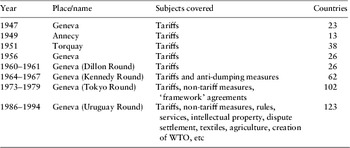
Furthermore, over eight rounds of negotiations, its membership grew from 23 (1947, the first Geneva Round) to 123 (1995, when the WTO was created), making it a truly multilateral institution. By the time this article was written, this number had grown to 151.
Notwithstanding all its successes, the GATT/WTO system has experienced many setbacks. GATT's very birth was the result of a failure.Footnote 3 In fact, as more Members participate in negotiations, as the trade agenda expands and becomes more intrusive, as domestic constituencies and multinational non-governmental organizations become more active in their WTO-related activities and as more Members are required to take tough political decisions to comply with the rulings and recommendations of the organization's Dispute Settlement Body, achieving consensusFootnote 4 becomes more and more difficult and the negotiating rounds take more and more time.Footnote 5
Throughout history, negotiating strategies have evolved according to Members' specific weight and, in successive rounds, have become more sophisticated and complex. The current negotiating processes require not only a thorough examination of the proposals, but also of their implications – both systemic and economic – their relationships with the current rules and the case law, and the political costs and benefits of supporting or opposing them. Among these negotiating strategies, Members have increasingly resorted to creating negotiating coalitions. Enjoying the active support of as many other Members as possible is essential to advance one's positions at the negotiating table and increases the possibility of obtaining consensus with respect to a specific proposal.
Today, it can be safely said that it is no longer correct to portray discussions in the organization as a ‘North–South’ debate, with the US and the EC at the head of the one side and developing countries on the other. Coalitions in the WTO are unique in that they are pragmatic in nature, often disassociated from other geopolitical objectives of its constituents. Coalitions that have an important weight in other fora, like the G-77,Footnote 6 play no practical role in the multilateral trading system.
Since no two WTO Members have identical interests across-the-board, coalitions are commonly established on a topical basis. This allows Members to work together with some countries on one front and with others on other fronts in order to maximize their gains in the negotiation.
Coalitions in the WTO are a relatively new phenomenon, and the literature scarce. While some serious studies have been made,Footnote 7 the Doha Round has seen the rise of an important number of new coalitions, about which little or nothing has been said.
The objective of this work is three-fold: (i) to provide a general overview of the current state of play in the negotiations, putting it within its proper historical context; (ii) to analyze the most evident costs and benefits of coalition building; and (iii) to demonstrate the pragmatic nature of coalitions in the WTO – often dissociated from any other geopolitical strategies of their constituents.
2. What is a coalition?
The term ‘coalition’ designates various types of cooperation and reciprocity. In this respect, the definition given by Amrita Narlikar will be used, i.e. that a coalition refers to ‘any group of decision-makers participating in … a negotiation and who agree to act in concert to achieve a common end’.Footnote 8 Under this definition, members of a group are aware that they are acting collectively or in a coordinated manner with others.
Coalitions are built to offset limited or inexistent bargaining power in the negotiations. Bargaining power can be seen as ‘the ability to bring the opposing party to the negotiating table and exchange concessions that are the least unacceptable to both parties’.Footnote 9
Coalitions may be created without a specific life-span in mind and, in many cases, cease to exist as soon as the round ends, while in others they may mutate and evolve to adapt to new realities. Sometimes, pre-existing political alliances may push some countries into joining forces with others. However, if these alliances are not backed by their economic realities, they cannot possibly serve a practical purpose in the long run.
There are two basic types of coalitions:
Alliances: coalitions of self-interested governments who come together for instrumental reasons in response to a specific threat. Once the threat is gone, the coalition loses its rationale and disbands.Footnote 10 Examples of alliances are the G-20,Footnote 11 Friends of FishFootnote 12 and the multiple groups of ‘friends’ who have submitted collective requests in the services negotiations.
Bloc: like-minded governments that utilize the constructivist method for cementing members into a coalition. Coalitions may begin as alliances and later develop a collective identity or can utilize pre-existing similarities.Footnote 13 As a rule, they are not issue-specific and outlive the original task for which they were created. Examples of blocs are the European Union, the African Group, and the Group of least-developed countries (LDC Group).Footnote 14
From the point of view of the WTO as a negotiating forum, coalitions contribute to facilitate negotiations in three respects at least: first, by either balancing the power or tilting the scales, the existence of coalitions makes it easier to determine whether an emerging consensus exists; second, in most cases, it reduces the number of interlocutors, since group leaders often speak on behalf of their constituents in smaller sessions, thus facilitating the task of Chairs and of counterparts; third, as a result of their decision-making processes, positions presented by coalitions will normally already have the more cumbersome components of their proposals resolved, such as steering a Member's radical position towards a more centred approach.
As mentioned above, coalitions in the WTO do not necessarily follow a particular pattern and political coalitions coexist side-by-side with issue-specific technical coalitions. Some will seek short-term results or will act as a group only in a limited number of areas, while others will belong to a coalition as part of a greater geo-economic strategy. However, trade negotiations do not grant more relevance to some types of coalitions over others. For purposes of each negotiating table, a point made by a trading-bloc like the European Union is as valid as that made by a single-issue coalition and consensus is achieved not only when there is no coalition in a position to reject a particular decision but, in fact, when no single WTO Member is. More importantly, with the always notable exception of the EC which has a common trade policy, the more limited the task of the coalition, the more likely it is to maintain cohesion among its constituents and to push harder towards a particular goal.
3. Historical backgroundFootnote 15
The origins of the GATT/WTO date back to the attempts to create the International Trade Organization (ITO) at a UN Conference on Trade and Employment in Havana, Cuba in 1947. This organization was intended to be in charge of handling the trade side of international economic cooperation, joining the two ‘Bretton Woods’ institutions: the World Bank and the International Monetary Fund. The original charter (known as the ‘Havana Charter’) was the subject of negotiations among over 50 countries, and its disciplines included rules on employment, commodity agreements, restrictive business practices, international investment, and services. However, ratification as an international treaty in the US Congress could not be obtained and, by 1950, the United States government announced that it would no longer seek Congressional ratification of the Havana Charter. Meanwhile, 15 countries had begun talks in December 1945 to reduce and bind customs tariffs, with the aim of avoiding the protectionist measures which remained in place from the early 1930s. The final agreement comprised 23 contracting partiesFootnote 16 and covered a package of basic trade rules and 45,000 tariff concessions affecting $10 billion of trade – about one fifth of the world's total in those days.
During the first four rounds of negotiations, countries would only negotiate tariff concessions on specific products with potential in specific markets. The gains obtained through these negotiations were extended to all countries by virtue of the most-favoured-nation (MFN) clause.Footnote 17 In those days, while decisions were taken by all contracting parties, negotiations were carried out mainly by the main trading powers – i.e. the United States and some European countries. Developing country participation was limited. Besides, negotiations based on a request–offer basis, covering product by product did not provide incentives for the creation of coalitions, since it provided limited value-added in a context where finding common interests was virtually impossible.
As of the Kennedy Round (1964–1967), but more importantly in the Tokyo Round (1973–1979), new disciplines began to appear on the negotiating agenda. However, it was only in the Uruguay Round (1986–1994) that developing countries started to build coalitions to negotiate trade and, for the first time, signals of cooperation between developed and developing countries were seen.
A ministerial meeting was held in 1982, developing a work programme that was to be the basis of the 1986 ‘Punta del Este Declaration’,Footnote 18 which kick-started the Uruguay Round. This declaration was positive from many angles: first, it contained a commitment to a standstill and to the rollback of GATT-inconsistent measures; second, the drafting of the language was a masterpiece of ‘creative ambiguity’ since it addressed sectors of interest of developing countries, such as agriculture and textiles, while at the same time containing the embryo of what would become the GATS and the TRIPS – issues which developing countries first opposed on the basis that they did not belong in the GATT (an agreement dealing with trade in goods).
The process leading to the launching of the Uruguay Round and the round itself constituted the first major test to the so-called ‘developing country solidarity’ and provided for the first time the opportunity to build North–South coalitions, such as the Cairns GroupFootnote 19 and the ‘Café au Lait’ Group,Footnote 20 the latter contributing significantly to the demise of the G-10,Footnote 21 the leading developing-country coalition in the early eighties.
During the Uruguay Round, positions of developing countries evolved towards a more open acceptance of the services agenda, which eventually allowed them to negotiate more favourable conditions for themselves. This change of position can be attributed to the long ‘eye-opening process’ undertaken before the round, which had shown that developing countries, too, stood to gain from the round,Footnote 22 but also because some developing countries – Mexico in particular– were already liberalizing trade in services on a regional basis, which reduced the burdens of reaching a deal at the multilateral stage.
4. The current state of play
The Doha Round (or ‘Doha Development Agenda’ or ‘DDA’), like its predecessors, carried an important baggage of ‘unfinished business’ in the areas of agriculture and services, together with a number of ‘implementation issues’ (i.e. problems developing countries face in implementing the current Uruguay Round Agreements). After several discussions (including one failed attempt to launch the negotiating round in Seattle in 1999), Ministers finally agreed in November 2001 at Doha, Qatar to begin the round of negotiations. The two documents that largely constituted the negotiating framework are:Footnote 23
The Doha Declaration Footnote 24 is a rich negotiating compromise, which includes agriculture, services, non-agricultural market access, intellectual property, trade and investment, trade and competition policy, government procurement, trade facilitation, WTO rules, dispute settlement, trade and environment, e-commerce, special and differential treatment, trade, debt and finance, trade and transfer of technology, and also addresses concerns of small economies and least developed countries (LDCs) and established principles of technical cooperation.
The decision on implementation Footnote 25 includes commitments to re-examine issues of the Uruguay Round for which implementation has not been possible or practicable, with respect to the following agreements: GATT 1994, agriculture, sanitary and phitosanitory measures (SPS), textiles, technical barriers, trade-related investment measures (TRIMs), article VI of GATT (anti-dumping), article VII of GATT (customs valuation), rules of origin, subsidies and countervailing measures, intellectual property (TRIPS),Footnote 26 and deals with some cross-cutting issues.
However, the Doha Round is negotiated in a very different world than its predecessors. The following are some observations concerning the environment and the differences with past exercises:
1. By 2001, when the round was initiated, the WTO was already a highly visible and unpopular organization.Footnote 27 During the previous Ministerial Conference, held in Seattle in 1999, massive protests were held with the intention of preventing the launch of a negotiating round alleging that it would diminish standards of living everywhere. Hundreds of non-governmental organizations work hard to criticize the WTO either for not respecting labour or environmental standards, serving the interests of multinationals, and even accusing it of ‘killing farmers’.Footnote 28 Other eloquent expressions of misunderstandings about the WTO portray it as an autonomous entity that takes its own decisions (generally in favour of multinationals and against the legitimate interests of the poor) instead of a forum where governments of developed and developing countries are equally represented.
2. The number of Members has gone beyond 150, with a higher representation of the developing world, since most of the countries that have acceded to GATT-WTO after the launch of the Uruguay Round are developing countries.Footnote 29
3. The Doha Round is being negotiated by countries that are much more aware of their relative weight in the decision-making process of the WTO than before. In fact, an important cause of the failure to start negotiations in Seattle in 1999 was precisely because developed and developing countries clashed on the inclusion of disciplines on trade and labour or trade and environment.
4. Partly as a result of the previous round, partly as a result of free-trade agreements and partly as a result of autonomous liberalization, many developing countries had established freer trade regimes for goods and services, placing them in a more favourable position to put forward their own interests in the negotiating agenda and to reduce domestic opposition to negotiating areas where they had had defensive interests in the past – such as NAMA and services. Besides, the United States and the EC markets – which had been the traditional destinations for developing countries' exports – have been surpassed by other markets in developing countries, such as India, China, Mexico and others, making ‘South–South’ trade a real alternative.
5. By the time the round was initiated, almost seven years of experience in dispute settlement had accumulated. Developing countries had already tested the rigor of a more legalistic system, which complemented the already superior bargaining power of developed countries. At the same time, developing countries had also learned that they could use the dispute settlement mechanism to compel other Members to honour the commitments made at the Uruguay Round. All this is to say that Members – developed and developing alike – became more aware of the value and rigour of a legally binding text.
All these changes have been reflected in Members' attitudes towards the negotiating process. The fact that reaching consensus has become more complicated has forced countries to fight for every inch of the deal.
Moreover, the traditional distinction of the ‘North’ (i.e. developed countries) vs. the ‘South’ (i.e. developing countries) has become blurred. By 2001, when the round began, around two-thirds of the membership was already well acquainted with the system and many developing countries had already set solid markets and attracted important amounts of foreign direct investment. Under these circumstances, developing and developed countries can share interests and work jointly in setting the agenda and modifying the terms of the negotiations as the round evolves. Nowadays, with the exception of a limited number of negotiating fronts, coalitions that comprise both developed and developing countries are common. Most negotiating groups have examined proposals by ‘North–South’ coalitions.Footnote 30
The current negotiating agenda has not been imposed by developed countries on to developing countries. In fact, the agenda is the result of unfruitful efforts to achieve results in the agricultural and services negotiations, which started in 2000, but which, for lack of an overall balance in the representation of interests, did not yield results. The text of the Doha Declaration contains a mixture of negotiating mandates, some of which respond to developed countries' interests (e.g. the ‘Singapore issues’), some respond to developing countries' interests (e.g. special and differential treatment, implementation), but most reflect interests of developed and developing countries alike, as is the case for agriculture (where countries such as Argentina and Australia have an equally offensive agenda), services (of which many developing countries' economies highly depend on), anti-dumping (an area where both developed and developing countries are equally affected by abuses to the system), or geographical indications (where developed and developing countries participate on both sides of the discussion).
In agriculture – the most controversial negotiation so far – the most aggressive stance by developing countries has taken place: by demanding the elimination of export subsidies, without prejudging the outcome (Doha Ministerial Declaration), by later ensuring this commitment (July framework), and by establishing a date for its elimination (Hong Kong Declaration). This has only been possible through the cooperation of developing countries with high ambitions – such as Brazil and Argentina – with the backing of other important developing countries – such as Mexico, India, and China – and working in close cooperation with developed countries that have strong agricultural lobbies – such as Australia and New Zealand. The issue of market access in agriculture has had a number of developed countries aggressively demanding substantial reductions in tariffs, supported by some developing countries, which, while agreeing to these demands, also require some protection for themselves. Domestic subsidies should also be subject to substantial reductions thanks to the unity of developing countries.
Discussions on NAMA are also the subject of unorthodox geopolitical variables. For example, developing countries that have liberalized their own trade for industrial goods are stuck between developed countries – which not only demand ambitious general tariff reductions, but also for complete market opening in specific sectors of their own interest – and other developing countries. Some of these countries, while having liberalized unilaterally, will only move proportionately to what is achieved in agriculture;Footnote 31 others demand special treatment, either because they are ‘small and vulnerable’, or because they believe they deserve to be compensated for the erosion of the preferences they have traditionally enjoyed courtesy of the European Union, or because they have bound a small portion of their tariff lines or because they acceded the WTO too recently.Footnote 32 In fact, it has been in this forum where division among developing countries has become more evident, with a number of developing countries from South East Asia and Latin America proposing tariff reductions which go more in line with those demanded by developed countries than other developing countries in their own regions.
Similarly, negotiations on market access for services are being performed on the basis of a ‘plurilateral process’ where the entire negotiation depends on groups of ‘friends’. This means that both developed and developing countries with specific interest in a particular service submit joint requests to other groups of countries because they form part of the ‘critical mass’ required to have a meaningful outcome. The benefits obtained by these groups of countries will, eventually, benefit the entire membership.
The rules negotiations are not only complex because of the developed/developing country cooperation mix. They also happen to be in the ‘all others’ basket. Probably the most visible area of this negotiating group is anti-dumping. On the extremely ambitious side stand the Friends of Anti-dumping Negotiations (FANs, by its initials) – a coalition of developed and developing country Members, some of which have been victims of anti-dumping measures, some of which have a fundamental problem with anti-dumping per se, and some of which, while being users of anti-dumping themselves, are ready to pay the price of strengthening the rules in exchange for having the major powers' hands tied up. At the other extreme, we have the fiercest defender of anti-dumping – the United States – working in close cooperation with – of all countries – Egypt, while in between stands ‘the Middle Group’ – a group of countries coordinated by the EC, which seek to improve rules but do not intend to make it much more burdensome to carry out anti-dumping investigations in the future. In fact, some of the FANs members also belong to the middle group. Among the ‘all others’ basket, the issue of fisheries subsidies is also outstanding. The discussions in the rules negotiations also relate to subsidies and countervailing measures and with regional trade agreements.
Trade facilitation is the area where cooperation among developed and developing countries has been most surprising. Having been the subject of adamant rejection in the past – particularly in the Cancun Ministerial Conference (2003) – it has now been the most enthusiastic of negotiations.Footnote 33 Dealing with improving the rules on customs administration – which are almost 60 years old – as well as improving transparency and due process, it is not difficult to encounter common concerns among developed and developing countries.
Discussions on trade and development and trade and environment are, for different reasons, the only areas where a classic North–South debate exists. In trade and development, 88 proposals have been submitted, so far (none after 2003) all of them dealing with the concept of ‘special and differential treatment’. However, most of these proposals are either unrealistic – e.g. because they constitute a blank check to continue to distort trade – or unnecessary – because in practice they would not make a significant difference. Only five proposals in favour of LDCs have been agreed so far.Footnote 34 What has been more meaningful about these negotiations are the informal offers by developed Members to smaller developing countries to grant more favourable conditions if they ensure that these will not have to be extended to larger developing countries – or emerging economies, as the OECD calls them (tactic commonly known as ‘divide and conquer’). This promise has resulted in a number of developing country-led initiatives to demonstrate that they deserve this more favourable treatment without agreeing on objective parameters as to which countries should enjoy what benefits, promoting further cracks among the heterogeneous group called the developing countries, a group where countries like Kenya and Bahrain are treated alike. Negotiations in these areas have given rise, to initiatives to ‘graduate’ developing countries,Footnote 35 to establish a ‘situational approach’Footnote 36 or to simply create sub-categories of developing countries, such as the ‘small economies’Footnote 37 or the ACP countries demanding compensation for their preference-erosion.Footnote 38 Discussions on trade and environment have traditionally been a developed-country concern, and few developing countries have shown interest in pursuing an agreement in this area. Proposals in this area deal – inter alia – with the establishment of a list of ‘environmental goods’, which would be subject to additional tariff reductions. While most developed countries have submitted their list, the majority of developing countries still question the pertinence of discussing lists and no agreement has been reached in this respect.
Other areas of negotiations deal with TRIPS and dispute settlement. In TRIPS, the division is a more ‘Old-World vs. New World’ type of debate on a registry for geographical indications, with European countries on one side, seeking enhanced protection for their wines, spirits and agricultural products, and the American Continent working together with Oceania and a good deal of Asia to prevent the establishment of a burdensome registration mechanism. In dispute settlement, developed and developing countries are already well aware that at any given day they could be on any side of a dispute. This is why they have approached these negotiations from a more systemic perspective – with no success for ten years.
To complicate things further, while not part of the negotiations, there is an important number of ‘implementation issues’, which are being examined by the regular committees and councils of the WTO with no major achievements.
Additionally, as the negotiation has evolved, the terms of reference of the negotiation have changed and new coalitions had to appear. While the Doha Declaration may have emphasized some areas, such as implementation, the July framework (middle of the road package) eliminated some of the negotiating areas – three out of four Singapore issues – and gave a clearer direction in the areas of negotiation. The Hong Kong Ministerial Declaration further elaborated on the details of many negotiating areas and reached some agreements – the five LDC proposals contained in Annex F. If an agreement is reached on the modalities for agriculture and NAMA, the emphasis of the negotiation may shift to other areas, such as rules – particularly on antidumping and countervailing measures – or services.
Under these circumstances, and taking into account, as will be explained below, that decisions have to be taken by consensus on all areas at the same time, Members have to decide and adapt their agendas on a case-by-case basis. With the exception of the European Union – and arguably the African Group and LDC Group in limited areas – no two countries have identical positions in all areas of the negotiation throughout the entire process. Combinations between offensive and defensive interests are vast. In order to maximize the benefits from the round, countries have chosen pragmatic yet sophisticated negotiating tactics, among which participation in coalitions has been fundamental.
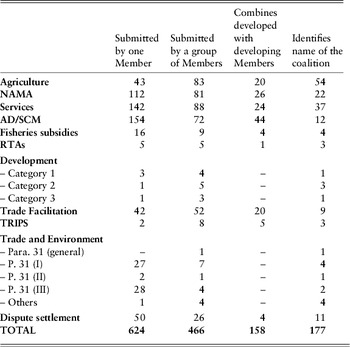
There is a much larger number of coalitions in this round than in the previous ones. These days, talking about the ‘G-something’, or the ‘friends of so and so’ has become common in WTO jargon. While some of these groups pre-date the round (such as the Cairns Group and the Like-Minded Group), most were established to meet a specific objective, and may cease to be active after the negotiation. Annex A contains a list of all the negotiating coalitions active today. Annex B contains a table describing the number of negotiating proposals submitted until June 2006, making a clear distinction between those that were submitted by a single Member from those that were submitted by a group of them.
The next sections will address the main benefits and costs of coalition building, as part of the rationale behind this radical increase in coalitions from previous rounds.
5. Benefits of coalition building
There are, at least, three main benefits for participating in coalitions: (i) working in groups increases the possibility of advancing one's position; (ii) it helps resource pooling; and (iii) it increases the possibility of being represented in ‘green room’-type processes.
Working in groups increases the possibility of advancing one's position
Whether the objective is to obtain consensus on a particular point or to block a purported agreement, the maximization of possibilities to advance one's position is the quintessential reason for building coalitions.
As mentioned above, decisions in the WTO are taken by consensus.Footnote 39 While the concept of consensus is defined in precise terms in the ‘Agreement Establishing the WTO’, the common joke among trade negotiators is that consensus means ‘an agreement where all parties are equally dissatisfied’. This definition reflects one of the most tragic aspects of the multilateral trading system: negotiations are slow, inefficient, and the result is often an ambiguous text which all players will be able to live with though no-one will be 100% satisfied.Footnote 40 Nevertheless, decisions to which no single Member is in a position to oppose are, by that very fact, legitimized multilaterally.
As the organization has evolved, achieving consensus has become a more complex task. To begin with, the number of players has increased from an initial 23 to 151 today. When the previous round began, only 92 players were involved.Footnote 41 While the creation of the European Union and its consecutive accessions has reduced the number of positions to one – with the Commission as the sole spokesperson of all member states – voices and positions in the developing world have multiplied, since most Members that have acceded the WTO after the launch of the Uruguay Round belong to the developing world. Furthermore, the concept of ‘single undertaking’, which was first established in the Uruguay Round, has taken the consensus rule to its utmost consequences. All Members have to be able to live with each agreement reached and at the same time ensure that the overall balance has to be positive for all. Lastly, negotiating tasks have not only multiplied, but have also begun to touch on more sensitive areas, not exclusively related to trade – for instance, environment. This fact has complicated the domestic debates, since deciding whether a specific policy is environmentally and economically sound involves more actors and wider considerations than simply deciding tariff cuts for a given universe of products.
In this context, the granting of concessions and the establishment of new rules can have serious economic and social implications for Members. Therefore, the agendas are established with extreme care, requiring endless hours of consultations and discussions in Geneva, while at the same time, consulting with government at home in order to achieve the best possible balance between responding to domestic needs and promoting the multilateral trading system. Members may have domestic pressure to submit potentially unpopular proposals, either because they have a strong protectionist lobby at home, or because they are far too ambitious. The Geneva response to a particular proposal requires Members to consult back to look for additional flexibilities or to refine the negotiating strategy. Domestic requirements affect the Geneva process and vice-versa.
In this respect, submitting proposals together with other Members may have important benefits: (i) the proposal is perceived as having greater legitimacy if presented by an important number of Members or by a sector of the membership viewed as particularly vulnerable; and (ii) builds pressure on the other side to either accept the proposal in question, scale down its own demands to change such proposal, or to grant additional concessions elsewhere in exchange of rejecting the proposal in question. A vivid example of the former is the ‘multilateralization’ of the G-8 understanding to grant free access to all goods exported by least developed countries (LDCs).Footnote 42 The issue of building pressure on the other side has been fundamental in many development-related aspects of this round, where large Members, such as the EC, have sided with some developing countries with the aim of establishing different levels of commitments between developing countries. One clear example lies in the various expressions of support to compensate ACP countriesFootnote 43 with respect to the loss of their longstanding preferences granted unilaterally by the EC,Footnote 44 even with fierce opposition from other developing countries, especially in Latin America.
Some developing countries have been extremely successful in pursuing a defensive agenda in the negotiations, where far-reaching proposals by the developed countries have met with sheer rejection from some developing countries that have grouped for that purpose. This union has resulted, for example, in dropping three of the four so-called ‘Singapore issues’ from the round.Footnote 45 Countries' participation in the agenda-setting process is also an element in considering the number or strength of defensive coalitions. This may also have to do with the fact that the consensus rule makes it much easier for a proposal not to be agreed on than to actually succeed.
While cooperation among countries has been generally fruitful in these negotiations, there are two examples of this cooperation that merit a closer look: the negotiation of the agreement on TRIPS and public health and the G-20. These are the clearest examples of how developing countries have been able to use their moral superiority (in the case of TRIPS and public health) or impeccable coordination with a clear objective – the opposition to the EU–US proposal on agriculture in the Cancun Ministerial in 2003.
Negotiations on TRIPS and public health
6 December 2005 was an historical date for the WTO: for the first time after more than ten years, an agreement was reached to amend a legally binding agreement. The decision was memorable in many respects: first, because the decision to modify the TRIPS AgreementFootnote 46 was aimed at securing that poor countries would have better access to medicines to fight AIDS, malaria, and tuberculosis, thus proving that the WTO had a ‘human face’; second, because – unlike all other decisions taken after the end of the Uruguay Round – this was not a simple declaration with no legal effects, it implied a modification to Members' rights and obligations; and, third, because it brought to an end an extremely complicated negotiation, which had its origins in 1999, with the organization of a symposium jointly hosted by the WTO and the WHO.
Encouraged by this symposium, Zimbabwe, on behalf of the African Group, requested a special discussion on the issue of intellectual property and access to medicines in the WTO's TRIPS Council.
Having arrived at the Doha Ministerial Conference in November 2001, discussions led to a confrontation between developing countries, represented by the African Group, Brazil, and India on the one side, and the United States, Japan, and Switzerland on the other. Nevertheless, adequate management allowed the facilitator for this issue to announce an early agreement.Footnote 47
On 14 November 2001, ministers of 142 WTO Members adopted the ‘Declaration on the TRIPS agreement and public health’, an agreement that sought to strike a delicate balance between the need to ensure adequate access to medicines and the respect for intellectual property rights.Footnote 48
During 2002, intense discussions were held, but no consensus could be obtained. The solution was finally agreed upon in August 2003, a few days before the Cancun Ministerial.Footnote 49 This solution consisted of a mechanism establishing flexibilities allowing for trade of generic medicines to be later incorporated as an amendment to the TRIPS Agreement. Finally, on 6 December 2005, the decision to amend such agreement was adopted by the General Council and around 15 WTO Members (including the EC) have amended their domestic legislation to implement these changes.
The solution found as a result of these negotiations has been subject to many criticisms: some say that the system agreed to is so cumbersome that it eliminates the possibility to use it in practise; others have stated that this decision solves only a small part of the problem; and others have criticized the WTO for engaging in a lengthy negotiation that eventually resulted in the solution proposed eight months earlier, but combined with a controversial statement, the legal status of which remains inconclusive.Footnote 50 However, in terms of joint action by developing countries, the result is unsurpassed. The negotiations leading to the agreement on TRIPS and public health represent one of the most vivid examples of how even the most important economic power in the world, the United States, yields to countries whose economies combined do not represent even one fifth of its GDP,Footnote 51 feeling forced to join the consensus on an amendment. Finally, these negotiations have created important side products.
Apart from global initiatives – such as the availability of medicines for HIV and programmes to fight AIDS, malaria, tuberculosis and other infectious diseases – countries which are in a better position, both economically and in terms of the population infected, have also received medicines with substantial discounts.
In sum, as imperfect as the result may be, the joint effort by a number of developing countries – mainly the African group, together with Brazil, India, and others – has provided a tangible contribution to an urgent humanitarian cause.
The G-20Footnote 52
The G-20 is perhaps the most vivid example of how developing countries have been able to overcome their own differences and have established a common front against the two world's major trading powerhouses – the US and the European Union.Footnote 53
Brazil sought the support of other developing countries to create an all-developing coalition, which had a common interest in achieving a reduction of agricultural subsidies in the world, while emphasising the principle that developing countries should be required to pay less than the developed ones in agriculture. This diverse coalition includes countries such as Brazil and Argentina, which are also Members of the Cairns Group and important agricultural exporters, as well as some others whose exports are modest, but are important political allies in the developing world, such as India and China.Footnote 54
Once the G-20 was set up, another battle began at Cancun,Footnote 55 as some developed countries attempted to divide the group and to create difficulties in its relations with other groups in the WTO. In particular, Central American and Andean countries left the group in order to be able to continue the negotiation of a free-trade agreement with the United States.
In spite of the failure of the Ministerial Conference of Cancun, the G-20 was soon perceived as a strong group. This also contributed to the creation of the Non-Group-5,Footnote 56 and, later, to the G-6,Footnote 57 both of which intended to build bridges between developed and developing countries in the agricultural negotiations. Since then, the G-20 has been one of the leading forces in the agricultural negotiations and has submitted proposals on virtually every issue on the table.
What has made the G-20 so successful? The G-20 itself states that the group's legitimacy stems from: (a) its importance in agricultural production and trade, as it represents almost 60% of the world's population, 70% of world's rural population, and 26% of world's agricultural exports; (b) its capacity to translate a vast range of developing countries' interests into concrete proposals; and (c) its ability to coordinate its members and to interact with other groups in the WTO. However, notwithstanding the legitimacy of the G-20, its success has depended, to a certain extent, on the fact that it is a single-issue coalition consisting of developing countries that have varying interests in NAMA, services, rules, and other tasks, but which are able to stand together on agriculture.
Working in groups helps resource pooling
While the main objective of coalitions is to advance one's position, an important side benefit is the optimisation of resources, either in monetary terms, or with respect to the division of labour, or assistance to meetings. Participation in trade negotiations is extremely time and resource-consuming. As negotiations become more intense or technical, the pooling of resources becomes more relevant, and many delegations are not in a position to react timely and effectively to every single proposal that is tabled, precisely because of their limited resources. For example, the Mission of Panama has only two delegates, and others, like Djibouti or Guinea Bissau have only one; while some delegations have to divide their time between the WTO and other international organizations, such as the Dominican Republic.
It is unlikely that most Members can be active on all negotiating fronts. Besides, in issues as technically complex as electronic commerce, telecommunication services, or intellectual property, lack of an adequate counterpart in capital becomes an important handicap. Under these circumstances, joining a group, even if it requires to somewhat compromise one's position, is an option.
Maintenance of a coalition requires an adequate capacity to present proposals or react to others, while at the same time being able to participate in internal coordination meetings. For countries that do not have sufficient staff or have inadequate facilities, reliance on other countries is essential. For groups such as the African Group or the Small and Vulnerable Economies, resource pooling may be the difference between active participation in a negotiation or no participation at all.
However, the issue of resource pooling is not only a matter of extremely poor countries. Participating in a coalition may allow a country to be more active in issues in which its interest may not be that fundamental, but is important enough to keep an eye on. This has allowed countries to make joint proposals in cases where they probably would not have done so had they been required to act on their own.
Other resource-related benefit of participating in coalitions refers to information gathering and drafting of proposals. Since the WTO Secretariat is small – other international organizations, such as the OECD, which serves a considerably smaller number of delegations has a greater number of staff membersFootnote 58 – in practice means that a good part of the research has to be performed by Members themselves. Given these constraints, participating in a group where Members are able to gather useful information, draft proposals and statements, organize meetings, and contact the WTO Secretariat becomes a valuable asset. While in some cases, the information required to advance a particular position may be publicly available, finding it is not always easy. Besides, drafting proposals may require some sort of legal revision, which only missions with lawyers or outside counsels are able to undertake. The importance of presenting legally sound proposals can be central to achieve success.
Participating in a coalition also increases the possibility of obtaining technical assistance on the part of the WTO Secretariat, other international and regional organizations, like the World Bank and the regional development banks, or even by development-oriented non-governmental organizations and the international cooperation agencies of developed countries. Below are two examples that highlight the importance of resource pooling in the WTO.
Friends of anti-dumping negotiations (FANs)
Developed and developing countries alike have suffered from antidumping measures, and many of them believe that the system has been abused, either by stretching the rules too far or by simply disregarding the Anti-dumping Agreement. Japan has been among the largest targets of antidumping and has challenged specific measures on several occasions. Other countries have also expressed concern by the repeated abuses and lax interpretation of the rules, either because they have also been victims of antidumping or because of the perceived danger of undue trade distortions caused. This uneasiness prompted some developed and developing countries in the late 90's to start discussing possible ways to improve the rules or, at least to agree on interpretations that do not give too much leeway to investigating authorities. In the beginning, discussions were informal with like-minded delegates at a technical level gathering regularly with no specific goal in mind. Later on, the idea to push for the inclusion of anti-dumping in the negotiating agenda of a new round became central to their discussions and the group started also to meet at a senior level, and named themselves ‘Friends of Antidumping Negotiations’.
Since the Doha Declaration was adopted, the group held numerous technical meetings with the aim of establishing a universe of issues to which they would be submitting proposals for amendment.Footnote 59 To date, the FANs are among the most active coalitions in terms of submission of proposals in the entire Doha negotiation.Footnote 60 Members of this group are also very diverse. It includes countries that perceive themselves as victims of abusive antidumping measures – such as Japan, Thailand, Hong Kong or Norway; as well as countries like Turkey, Brazil and Mexico, which while having been subject to antidumping duties themselves, are also active users of the instrument. With such diverse membership, FANs are, at the same time, a vivid example of a North–South type of coalition.
Coalitions in dispute-settlement cases
The usefulness of forming blocs is not limited to negotiations. Another example where resource pooling can be helpful is in the context of WTO disputes, where lawyers' fees, evidence-gathering, drafting of submissions and preparation for hearings can require vast amounts of resources. Joint participation in disputes can be useful, not only in the adjudicating phase – i.e. the proceedings before the panel and the Appellate Body – but, even in the case where countries do not coordinate their legal argument, they can exercise joint action in pressing the Member concerned in ensuring adequate compliance.Footnote 61 In fact, merging panels is also helpful for the WTO as an institution, since this allows the Secretariat to save resources in terms of legal advisors, drafting of reference documents, issuance of reports and logistical arrangements, such as reservations of rooms for hearings, plane tickets for panellists, etc.
A compelling example of how resources can be saved through cooperation in a dispute is the ‘Byrd Amendment’ case where 11 co-complainants participated in the dispute, but some of them simply adhered to the EC or Japan's submissions, while others only presented arguments to complement or add to the claims of these countries. In the ‘bananas’ dispute, all parties presented a joint written submission to rebut the EC argument. Even more, Guatemala and Honduras shared a consultant and also presented their first submission jointly. Cooperation among the five complainantsFootnote 62 in this case (later joined by Panama) continued during the entire implementation period, in the examination of the legal merits of the new banana regime established by the EC, and afterwards when new complaints were launched by several Latin American countries.
A less demanding – yet still effective – degree of cooperation is the participation of countries as third parties in disputes. This type of cooperation has been helpful in building a more compelling case to show that a certain challenged measure does not only affect some, but a larger group of Members. Since the WTO was established, panels have heard 5.5 third parties on average. In larger cases, they have heard up to 24 third parties. There have only been six cases with no third parties at all.Footnote 63
Perhaps the most compelling example of resource pooling in the context of dispute settlement – as in many others – is the representation of the European Commission in all disputes where the Union or member states are involved, and where first-class advice is provided in order to defend European interests.
Working in groups increases the possibility of being represented in a ‘green room’-type of process
Traditionally denied and with no official paper trail to prove its existence, the ‘green room’Footnote 64 has been a central tool for achieving results in negotiations and its mere existence has reached mythical proportions. Not only is the room no longer green, but also the expression no longer qualifies as a single geographical place. It has evolved into a concept. The ‘green room’ is, for all intents and purposes, the Director General's conference room; a room of about 40 m2 where he and some ‘key’ Ambassadors get together to discuss important matters before taking them to a wider audience. The process is so effective, that ‘green-room’ types of meetings are held in the form of informal ministerial meetings or ‘mini-ministerials’Footnote 65 and even in formal sessions of the Ministerial Conference. As mentioned by the Consultative Board on the future of the WTO, ‘(s)uch meetings are necessary and appropriate in forging the basis for wider consensus in negotiations’.Footnote 66
In the past, WTO officials would deny the existence of the green room, for it carried all the negative sensation of deals being struck behind closed doors and later imposed on all Members. Nowadays, it can be said that it constitutes one of WTO's worst kept secrets. During the Hong Kong Ministerial, it was semi-officially called the ‘Chairman's Consultative Group’Footnote 67 or ‘the core consultations’,Footnote 68 while Geneva-based delegates kept on calling it ‘the green room’.
The function of the green room at present is usually to ‘test the waters’ of possible ways forward in the negotiations and hear the reactions of ‘key Ambassadors’ or ‘key Ministers’ for that matter. If whatever is tested is well received by the green room, it will be discussed with the wider audience (normally informal plenary meetings of heads of delegations) and, where relevant, later taken for a formal decision. Discussions in the green room can be either procedural or substantive.
Discussions in the green room can be useful, because they allow for a more frank and relaxed discussion, which allows ideas to flow and people to say things they would normally not say in formal meetings. This is beneficial because it allows Members to be creative in situations in which they cannot afford to be seen compromising, either because they have important domestic pressure or because it would be misinterpreted by the public at large. Ambassadors or Ministers participating in the green room are able to hint what their bottom line is, whereas in a plenary meeting they might be forced to either accept or bluntly reject a proposal.
Also, discussions held in the green room can be useful as a distiller of potentially troublesome ideas or concepts, which may lead to exhausting and unproductive talks at the plenary.
Most, if not all delegations, want to be in the green room, either physically or at least represented by like-minded delegations, especially if what is being discussed is a substantive proposal on which they have an essential interest.
However, the WTO has 151 Members and the green room cannot hold more than about 30 individuals. Thus, the selection of Members who are invited to the green room is crucial. Everybody who represents a significant constituency goes there. The two big trading powers are always present as are some other important mid-size developed countries and larger developing countries, either in terms of participation in international trade or in terms of population. Another criterion to be invited to the green room is by being the coordinator of a group representing countries that may not be important in terms of international trade or may not have large populations, but are part of the overall composition of the WTO Membership or a regional grouping (such is the case of the small and vulnerable economies, for example); other criteria for being invited are if one has a substantial interest in the issue to be discussed (for example, it would be unthinkable to hold a discussion on the issue of interest of the least-developed countries without inviting at least some representative countries of that group); and, lastly another reason is to exercise a credible protest diplomacy, simply because it is better to hear a negative reaction in a friendlier, more informal atmosphere, than in front of 150 representatives.
Coalitions have worked wonders for small developing countries or LDCs – a particularly underprivileged group in terms of resources, with limited participation in world trade and a reduced negotiating agenda, but with specific weight in a number of decisions – either because they represent 32 WTO Members or because they can easily build cases of ‘hawk vs. dove’ before the public opinion. The LDC group may be insignificant in terms of world trade – in particular, it is not expected to make any significant contribution to the round – but is essential to assert the WTO's legitimacy and relevance as a multilateral institution.
Duty-free quota-free access for LDC's
A revealing example of the benefits of bargaining in groups was during the Hong Kong Ministerial Conference in 2005, when – thanks to the participation of Zambian minister Dipak Patel in the green room – the LDC group was able to finally pocket the promise of obtaining duty-free/quota-free market access quasi-universally. Patel represented 32 countries in the green roomFootnote 69 with one simple, yet ambitious objective: optimal conditions for all exports of LDCs. While the proposal faced reservations, especially because some LDC's – such as Bangladesh and Cambodia – are competitive in the textiles and clothing sector, among the most sensitive in world industrial trade, Patel showed determination and perseverance and achieved the best possible deal – duty-free/quota-free access on a lasting basis for at least 97% of their products to be phased-in until complete liberalization.Footnote 70
6. Costs of coalition building
First, it is assumed, as a working hypothesis, that Members have an interest in pursuing their proposals successfully. It is further assumed that no decision is subject to vote, as it has been the common practice in the WTO. Consensus, thus, constitutes the constraint and Members want to maximize their total benefit towards meeting it. Based on these assumptions, Members will naturally seek support by as many other Members as possible, since the greatest support possible normally: (i) contributes to the perception of legitimacy of a particular position and (ii) increases the costs of opposing it. Taken to the extreme, Members would form a coalition with all other WTO Members-minus one to pursue a particular proposal. However, presenting proposals that enjoy immediate consensus is not common and efforts must be made to convince other Members to support a proposal or, at least, not to oppose it. In this respect, Members will have at least some degree of inclination to form a coalition.
Different Members in a coalition usually do not see a proposal with the same degree of enthusiasm, either because they do not all have the same particular trade interest in this matter, because their energies are being devoted to some other area of the negotiations, where they might have more pressing issues, or because the problem that the proposal in question seeks to address is not equally pressing to all. By the same token, Members may view the solution from different angles: some may view it as an imperfect way of solving the problem, while others may want to add other components of their own interest to complement the proposal.
Under these circumstances, the original proponent will be forced to make concessions and modify its original position for the sake of maintaining the coalition. More importantly, as more Members join the coalition, chances are that the original proponent will have to make more concessions and this trend will continue to the point where outreach is no longer sustainable. In fact, chances are that the first Members to be approached would be the ones which are most like-minded to the original proponent and, as the circle expands, the group would increasingly become ideologically heterogeneous. Graphically, this situation could be explained with a curve relating marginal benefits and the number of Members. In this curve, the willingness to form or maintain a coalition decreases as the number of Members increases and either: (i) descends to a point X where X+1 yields a negative result (thereby decreasing the total benefit) or (ii) descends to a certain point Y where the size of the group has contributed to its legitimacy so significantly that Y+1 would find no constraints and would even be willing to belong to that group (see endnote for graphic explanation).Footnote 71
Participating in a coalition may also have political costs. Such is the case of supporting unpopular proposals – e.g. a proposal submitted jointly by a developed and a developing country, where it is clear that it is only in the developed country's interest to pursue this goal and that the developing country's support is linked to some political concession elsewhere. This type of situation can arise where the debate is clearly between the North and the South. Other situations where political costs exceed the benefits of coalition building is where a country has little credibility because of continued unsupported threats of blocking consensus in a particular area or because its position is completely out of tune with the rest of the membership. These costs relate more to the image of the other Members participating in this coalition and in most cases may be marginal.
A third cost to consider, especially for smaller delegations with limited interests in the negotiations, relates to the logistics of participating in a coalition. While less frequent, this cost can become problematic in coalitions that are extremely active, such as the G-20 or the FANs. These groups often require active participation and meet many times a week. Delegations may have interest in advancing one or two points in the agenda of such coalitions, but are not interested in pursuing other goals of the group. In these situations, the Member in question will either seek to participate only in the meetings in which the area of interest is being discussed or simply not participate in the coalition at all.
7. Reasons not to participate in a coalition
Members in a coalition may have views similar to those of countries participating in it. In this respect, it is in the formers' interest to invite the latter to join the coalition – with the reservations expressed above. However, is it in the latter Member's interest to join the coalition? It may depend on the level of importance it attaches to the specific proposals submitted by the group or by the level of importance it attaches to the group itself as a negotiating force or as potential ally to other positions this Member may have and for which it would welcome support.
If neither the proposal nor the coalition in question is extremely important for the country in question, a natural reaction would be not to join the coalition, let them pay the political price, support them where relevant, and leave one's options open. This liberty allows this country either to continue the entire negotiation as a free-rider on the agenda of the coalition or to trade its support in exchange for a benefit somewhere else.
8. Can cross-disciplinary trade-offs be performed by coalitions?
In the section where the current state of play is discussed, it is mentioned that – with clearly limited exceptions – no single coalition can function across the board, since no two WTO Members have identical agendas. Political coalitions, like the African or the ACP Group are active only on a few negotiating fronts, while most coalitions are topical. In this respect, coalitions usually serve as interlocutors in specific areas of the negotiation. It would serve no purpose, for example, to try to obtain a G-20 position on geographical indications, since the internal debate would – in the best case – be a waste of time and – in the worst case – harm the cohesion of the group.
However, discussions at the political level require Ministers – or Senior officials for that matter – to be able to perform cross-disciplinary trade-offs. So far, only few examples to this effect have occurred.Footnote 72 In fact, discussions at that level are structured by issue. Ministers discuss agriculture, then NAMA, then services, and so on, instead of talking about horizontal tasks, such as market access, rules, and development. This format of discussion has forced high officials to wear different hats at different points in the discussion, reducing the possibility of foreseeing cross-disciplinary trade-offs. These trade-offs have had to be second-guessed by the Chairman of the meeting in proposing a draft declaration, which is evaluated by delegations individually and – time permitting – taken to the respective negotiating groups for discussion.
Given the mainly topical nature of coalitions, it is virtually impossible for a group of Members to exchange concessions in agriculture for improved rules in antidumping or to accept a certain degree of ambition in services in exchange of full liberalization of their agricultural goods. What this means is that coalitions work more effectively at a technical level, while political decisions are suggested by the Chairman – or facilitator – of the meeting for further analysis by each delegation.
Whether this is a good or a bad thing may be the subject of a completely different paper. Suffice it to say that the usefulness of coalitions is limited; that bold political decisions are taken by each and every Minister and that unless massive political will supersede the economic interests of countries – which in turn would require a certain degree of acquiescence on the part of domestic constituencies – this cannot change.
By way of a final remark, it might be useful to mention that the interaction between (topical) coalitions and the political level is one of mutual influence. Domestic policies or political agreements determine whether Members are fit for this or that coalition; and, at the same time, the importance that Members attach to certain coalitions will affect their decisions in the green room or at the plenary.
9. Concluding remarks
The WTO is highly unpopular and highly misunderstood. To the less informed, it has to be pointed out that negotiations are not about enterprises like Shell or Wal-mart dictating instructions to their governments and imposing them on developing countries to perpetuate the lowering of standards of living and increasing the gap between the rich and the poor. To the more educated, suffice it to explain that developed countries do not have a common position on developing countries and vice-versa.
The WTO is a negotiating forum where sovereign governments discuss multilateral rules on trade, as well as reduction of tariffs and non-tariff barriers; where decisions are taken by consensus; and its results are commonly ratified by national legislative branches and incorporated into the national legislations of over 150 countries.
What began as an agreement of some basic rules on trade and an exchange of tariff concessions among 23 countries has evolved into a sophisticated system with many technically complex and politically sensitive and enforceable rules that affect the economies of billions of human beings.
The complexity of WTO negotiations is not only evident because of the variety of factors within one single negotiating front, but also because the rule of the single undertaking makes it necessary to evaluate the overall outcome and decide that results are positive in each area, as well as a whole.
In this light, Members have sought to have as many of their interests reflected in the negotiating agenda and, more importantly, in the final agreement. For that purpose, it has become necessary to gain leverage in advancing proposals by all means possible, in particular by building coalitions. While traditional theories of power suggest a disproportion between the major players and smaller delegations, the consensus rule of the WTO makes it necessary to seek a delicate balance which leaves all delegations equally unsatisfied but with no possibility to block consensus.
Participation in coalitions has many advantages: it increases the possibilities to advance a particular position; it promotes resource pooling; and it increases the possibilities of participating in ‘green-room’ type processes.
The main costs of participating in coalitions stem from either being required to make excessive concessions within the group; from losing credibility when joining a bandwagon with more powerful countries; or from excessive coordination requirements.
Coalitions in the WTO are based on pragmatic approaches and political coalitions co-exist side by side with single-tasked ones. There is no need to establish a common policy in all fronts, since the actors are not the same and, therefore, trade-offs are not made among identical interlocutors.
That developed countries act together on one side and developing countries on the other is a myth. In fact, developed and developing countries can – and often do – work together in a single coalition, and with the exception of the negotiations in trade and development and trade and environment, developed and developing countries do work together towards common ends.
Besides, both developed and developing countries often hold positions against each other, given the offensive positions of some and the defensive positions of the others.
Annex A: List of coalitions

These groups have been inactive in the current round of negotiations.
Annex B. Table of negotiating proposalsFootnote 73