Henry Howard Molyneux Herbert, fourth Earl of Carnarvon (1831–1890), had the distinction of serving in all the Conservative ministries between 1858 and 1886, and was a member of Cabinets in three of them, under the fourteenth Earl of Derby, Disraeli, and Salisbury. What is equally remarkable is the fact that, although he resigned on two occasions, he was appointed a third time, in 1885. Throughout this time he kept a journal, in which he provided keen observations of his colleagues and comments on political happenings.
Carnarvon was the eldest son of Henry John George Herbert, third Earl (1800–1849) and his wife, Henrietta Anne (1804–1876), who was the eldest daughter of Henry Molyneux Howard, brother of the twelfth Duke of Norfolk. A sensitive man of a romantic and adventurous nature, the third Earl was the author of books based on his travels. His last important journey, which he undertook with his wife, his eldest daughter, Eveline, and the seven-year-old Carnarvon, then Viscount Porchester, was to Asia Minor. This plan was thrown into disarray by the boy's illness of Asiatic ’flu at Constantinople, which was so serious that the doctors ordered the family to return to England if he was to live. On the way there, his sister contracted fever, and both his nurse and his governess died in Italy. Thirty years later, in homage to his father, Carnarvon published the diaries of part of the journey, Reminiscences of Athens and the Morea in 1839.Footnote 1 In adult life, he too became a keen traveller. In 1860, together with his college friend Lord Sandon, he toured Asia Minor, visiting Babylon and Damascus. His love of antiquities was transmitted to his son, George, the fifth Earl, who, as patron of Howard Carter, was associated with the discovery of the tomb of Tutankhamun in November 1922.Footnote 2
Porchester also followed his father in a liking for politics. The third Earl, before inheriting the title in 1833, had sat briefly in the Commons as MP for Wootton Bassett, Wiltshire, in March 1831, taking up his position three days before Lord John Russell introduced the first Reform Bill. After making a speech on the second reading, ten days after Porchester's birth, he was offered a post in the ministry but refused.Footnote 3 As a Whig, he opposed the ‘great and doubtful experiment’, as Carnarvon was also to do. Carnarvon always admired his father's intellectual and literary powers and was saddened by the death of the third Earl in 1849 at the age of forty-nine.
Porchester showed early signs of precociousness. At the age of six, he delivered a speech to the Dulverton Troop of Yeomanry,Footnote 4 and at nine and a half he appeared with his father in London at a public meeting on behalf of the Royal Society for the Protection of Animals.Footnote 5 He was reading Greek and Latin authors before he went to Eton, where he took with him his private tutor, John Kent, who became a lifelong friend. He had been at Christ Church, Oxford, for only three months when he succeeded to the earldom at the age of eighteen, on the death of his invalid father. He graduated in 1852, being awarded a first class in Greats, though he admitted that laziness had almost threatened a ‘very premature termination’ in his first year.Footnote 6
Early years in politics
Since his Oxford days Carnarvon had been interested in politics. His first opportunity on the wider stage came in January 1854, when Lord Aberdeen, the Prime Minister of a coalition government, requested him to move the Address in Answer to the Queen's Speech. Although flattered by the proposal, Carnarvon anxiously replied to the offer, an action which became typical of his later political dealings. Admitting that he had not so far heard a single speech in the House of Lords, Carnarvon asked for an interview with Aberdeen on the Government's intention to enlarge the franchise ‘for the upper classes of the operatives’. He wrote to Aberdeen after the interview, ‘having very distinctly impressed on my mind your Lordship's previous emphatic avowal was distinctly Conservative I did not enter upon the point so fully as I now wish I had done’.Footnote 7 Aberdeen testily replied that
from my desire to afford you all the satisfaction in my power, I entered into an explanation of details which was not at all necessary to do for the purpose of the Address [. . .]. All therefore which is required from any person moving the Address is a general assent to the proposition that it is desirable to consider some measure of Parliamentary Reform.Footnote 8
Carnarvon, now satisfied that he could undertake the task ‘consistent with my own principles’, moved the Address on 31 January. In his speech, which was well received, he spelled out his belief in a strong British Empire with the colonies living in harmony with their mother country. He wrote to John Kent the following day, ‘Lord Aberdeen told me that it was one of the most successful first speeches.’Footnote 9
Carnarvon's temperament was the subject of amusement for many of his Cabinet colleagues later in his career. Disraeli and others referred to him as ‘Twitters’ in their correspondence. His excitability at one stage of the Near East crisis in 1877 led Salisbury to send his colleague a quotation from Shakespeare's Henry VIII, ‘Be advis'd; Heat not a furnace for your foes so that / it does not singe yourself.’Footnote 10 Sir Henry Ponsonby, Queen Victoria's private secretary, described him as a man ‘with a nervous manner and a most distressing little cough which always attacks him when you ask him a question’.Footnote 11 Carnarvon himself believed that his personality was a family characteristic. He once confessed to an old family friend:
You are, I am afraid, right as to my restlessness, and also in a great measure as to its cause. At the same time you must remember that I have always had this ‘restless’ temper, from School days till now, and that it has been, to a great degree not least, a secret of whatever little success I have won. If it wearies me, it also prevents my rusting, which is a contingency I dread much more. Eveline [his sister] has a good deal of the same quality, but she makes excellent use of it. Auberon [his brother] has it largely and unfortunately in excess.Footnote 12
Carnarvon's maiden speech, the Address in Answer to the Queen's Speech, took place while the Crimean War was in progress.Footnote 13 His brother-in-law described Carnarvon as ‘not one of those who strike the popular imagination. He was not tall, nor capable of vigorous expression and his extreme refinement possibly gave to those who did not know him well an impression of weakness which was increased by his short-sightedness and a thin voice in public speaking.’Footnote 14 With the ending of the war, Carnarvon toured the battlefields with an acquaintance, Admiral Lord Lyons. They sailed to Constantinople, where he visited the capital of Turkey for the third time. He was disillusioned with the state of the country. Giving an address the following year, Carnarvon stated:
Without absolutely saying that the Turkish Government is wantonly cruel, it is not too much to assert that it has been singularly unfortunate in its internal administration [. . .]. In war, continual barbarities and massacres and the violation of all faiths: and in peace, systematic family murders, misrule, irresponsibility and extortion.Footnote 15
Nor did he believe that civilization was the policy or property of Russia. A British presence in the East was probably the answer.
By 1857, Carnarvon noted that he had made ‘considerable progress and certainly had greater confidence’ since his maiden speech. He spent several days with Sir Edward Bulwer Lytton, whom he found very agreeable, and noted that Lord Stanley, later fifteenth Earl of Derby, ‘sought me out – for his character is so peculiar that I have always feared to be the first to make advances – this summer in London to propose various plans of foreign travel together’.Footnote 16 The unexpected fall of Palmerston's ministry in February 1858 brought Derby into office. Within three days, Carnarvon received a call from the new Prime Minister, offering him the post of Under-Secretary at the Colonial Office. At their meeting, Carnarvon typically asked for reassurances, before accepting office, that Palmerston's Conspiracy Bill would not be proceeded with.
The Colonial Secretary was Lord Stanley, whom Carnarvon considered a conscientious and efficient head of office. When, after a short while, Stanley became Secretary of State for India, Bulwer Lytton succeeded him, and Carnarvon was pleased to be given more responsibility henceforth than was the case under Stanley. While being a good speaker on colonial matters, Lytton's powers of administration were poor and he had little capacity for business. He was frequently absent from the office, and Carnarvon was often left to make decisions and to sign Lytton's letters for him.Footnote 17 Lytton told Carnarvon, ‘I would much rather trust your signature than that of any other Secretaries of State [. . .]. As to Patronage I leave you carte blanche.’Footnote 18
There was unrest at the time in the Ionian Islands, which was an independent state but under British protection, and a Special Commissioner was required to investigate the state of affairs there. It was Carnarvon who suggested that William Gladstone should be sent out for this purpose. At the same time, Carnarvon was also responsible for introducing two large measures in the Lords: the Medical Practitioners Bill to regulate the qualifications of doctors and surgeons, and a Local Government Bill. In addition, he was the instigator of a Jewish Oaths Bill, which would have admitted Jews to the House of Commons.Footnote 19
The years out of office, 1859–1866
After eighteen months in office, the Derby government fell in 1859. For the next seven years Carnarvon was content to follow some of his non-political interests. He was delighted to be appointed High Steward of Oxford University in October 1859, and he travelled around Europe and the Middle East. In September 1861, he married Lady Evelyn Stanhope, the only daughter of the sixth Earl of Chesterfield. Algernon West described her as a person ‘who had hardly emerged from girlhood to womanhood, fascinated with her almost mature beauty and charmed with her talents the men and women of an older generation’.Footnote 20 There were four children: one boy, George Edward, later fifth Earl; and three daughters, Winifred, Margaret, and Victoria. Meanwhile, Highclere Castle, Hampshire, near Newbury, became more than a domestic dwelling: Carnarvon made it a meeting place for politicians, from both Britain and overseas, throughout the rest of his life. Indeed, it was widely remarked that Carnarvon was the first Colonial Secretary to entertain ministers and other leading figures from the colonies in his home on such a scale.Footnote 21
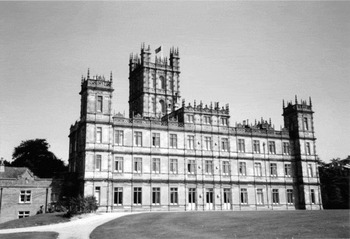
Highclere Castle from the south-east, restored by Sir Charles Barry and completed in 1842.

The original Georgian house was set in a spectacular park landscaped by Capability Brown in 1770–1771. When the third Earl took up residence at Highclere, he called on the services of Charles Barry to transform the building into something more exotic. While retaining the inner core, the outside now resembles in many ways Barry's other best-known building, the Houses of Parliament, with its system of grid-like encrusted decoration with a Gothic feel.Footnote 22 The design was approved by the Earl and the foundation stone of the new great central tower was laid by the eleven-year-old Porchester. The latter completed the interiors in an Italian style, thus adding to the mixture of styles in the building. One of the many visitors, Disraeli, on seeing the front of the house for the first time exclaimed, ‘How scenical! how scenical!’Footnote 23
One of Carnarvon's lifelong interests was the relationship between penal policy and prison administration, he believing, like many of his contemporaries, that there was a need for a move from the penitential and reformatory ideal towards one of punishment and deterrence. A Select Committee of the House of Lords that he chaired on the subject, reporting in 1863, recommended that ‘during short sentences or the earlier stages of a long confinement, the prisoner should be made to dispense with the use of a mattress, and should sleep upon planks’.Footnote 24 He was appointed chairman of the Judicial Committee of Quarter Sessions in February 1860 at the age of just twenty-nine, and, at a local level, he took part in the deliberations at the Winchester Assizes. He also served on several Parliamentary Commissions on aspects of the penal system, and spoke as an authority on the subject in the Lords, introducing legislation such as the Reformatory Schools Bill in 1857.Footnote 25
Derby's 1866 government and the second Reform Bill
When Lord Derby formed his new administration in July 1866, Carnarvon was once more appointed to the Colonial Office, though now as Secretary of State, with a seat in the Cabinet.Footnote 26 One outstanding issue that needed to be settled was the future constitution of Canada. The policy of confederation, announced in 1848 by Sir Edmund Head, Governor-General of British North America, involved the unification of Canada – including the United Provinces of Canada, Nova Scotia, and New Brunswick – and the creation of its own parliament. The seat of government was to be Ottawa. Not all Canadian politicians were in favour of this move: some from the Maritime Provinces preferred their own parliament and, more worryingly, the United States of America showed a lively interest in impeding the establishment of such a confederation.
Carnarvon was an advocate of a union of colonies, as he was later to attempt in South Africa and in Ireland. In a speech to the Canadian delegates the following year he stated his philosophy:
Once in the history of England it so happened that we parted from some of our great Colonies with a bad spirit and in a misunderstanding [. . .]. It taught us that conciliation is better than coercion; that if we give our confidence, it will be repaid us a hundredfold. It has taught us – and it taught the Colonies also – that their interests properly understood are not separate and distinct; but that the more prosperous the Colonies are, the greater the strength they confer on the Mother Country.Footnote 27
At a formal meeting of delegates in London on 26 January 1867, Carnarvon and Lord Monck, the Governor-General of Canada, discussed the British North American Bill. By the time it received Royal Assent in July, Carnarvon, the architect of the measure, was out of office over a different issue. Looking back on this achievement a year later, he told Monck, ‘This is after all the last chance for the great country which belongs to us in North America, but whatever the result I can see no ground for regretting the course taken in providing the Union of the Provinces.’Footnote 28
Like his father, Carnarvon disliked the attempts by successive governments to bring about the reform of the franchise, though in this he was moving against the tide of general public feeling, and the Hyde Park Riots in July 1866 stimulated politicians to speed up the process. The Derby government came into office on 2 July, mainly owing to a group of Whigs known as the Adullamites – Liberal MPs led by such figures as Robert Lowe. By their actions, the Russell–Gladstone ministry fell. The minority government of Derby was not in a position to resist Reform but was reluctant to expedite legislation. Derby argued that the process could be slowed down by proceeding by resolutions in Parliament, which would be discussed in detail by a Royal Commission and might serve as the basis for future legislation. This approach was eventually agreed to by Disraeli, then Leader of the House, and after much discussion in Cabinet he introduced the resolutions in the Commons on 12 February 1867. However, without Cabinet approval, Disraeli pledged that a bill would be immediately introduced.
Carnarvon, together with his old friend Lord Cranborne, then Secretary of State for India, was dismayed at Disraeli's willingness to pacify Gladstone. They decided to take drastic action together. On 25 February, shortly before a Cabinet meeting to be held at midday, Cranborne wrote to Derby, pointing out that Disraeli's scheme was unacceptable, a view which was shared by Carnarvon. At the Cabinet meeting, the two men, along with General Jonathan Peel, Secretary of State for War, were the only members to express their dissent.Footnote 29 In a desperate attempt to save the situation, Disraeli introduced a Ten Minute Bill in the Commons, which was unpopular with both Conservatives and Liberals. At the Cabinet meeting on 2 March, when it was agreed to proceed with household suffrage, the three men resigned. At this, as Carnarvon noted in his diary, ‘Lord Derby closed a red box with a heavy sigh and said, “The Party is ruined,” and Disraeli added rather cynically, “Poor Tory Party!”’ The third reading of the Reform Bill was passed without division and became law in August. The ‘leap in the dark’ had been made.Footnote 30
‘I am convinced that we are in a very critical position’, Carnarvon wrote to the Duke of Richmond a few days later. ‘Household suffrage may be good or bad: but it is a revolution.’Footnote 31 And to his former guardian and friend Sir William Heathcote he added, ‘I hardly see now how we can avoid a great break in the Party.’Footnote 32 Carnarvon had no doubt as to who was to blame for the ‘painful scenes in which we have been engaged during the last two or three weeks [. . .]. The truth is that the Government is Disraeli and he is dragging them through their present discredit.’Footnote 33 In reply, Heathcote admitted that Disraeli ‘probably looked forward with satisfaction to getting rid of you by the strong dose of democracy which I have no doubt he has determined from the beginning’, but considered that this was not a deliberate Government plot.Footnote 34 When the three ‘renegades’, as the Queen called them, returned their seals of office, she was so furious that she refused to shake hands with them.
Out of office: Carnarvon's non-political pursuits
Carnarvon was gloomy about his own future. ‘I am sadly out of heart’, he confessed, ‘and I am thinking of giving up all Politics as far as possible, and dividing my time between turnips and literature.’Footnote 35 He was anxious, however, not to appear disloyal to the Government. He wrote to Earl Grey towards the end of the year,
I find that my presence in the House is a cause of dire irritation and I see no reason why I should not allow this feeling to cool down by a temporary absence. It will show at all events that I am not looking out for an opportunity to annoy them.Footnote 36
Throughout his public life, Carnarvon often, in times of personal distress, turned to his great love, the classics. Thanking a fellow classicist, the fifteenth Earl of Derby, for his criticisms of a translation he had made of the Agamemnon, Carnarvon replied, ‘It has been an amusement and an interest to me in the intervals of business: and there is, I think, a certain satisfaction in turning to some account the work on which so large a part of one's early life was spent.’Footnote 37 During a severe illness the following year he translated the fifth and eleventh books of the Odyssey, which he had privately published for his friends. A more ambitious project was a complete translation of the first twelve books of the same work, which he undertook shortly after resigning as Lord Lieutenant of Ireland in 1886. While at work on the book, he wrote to Sandon, ‘I am personally well pleased to have shuffled off the coil of English politics and to get in exchange Dante and Aristotle and my best beloved Homer, which every day grow more wonderful to me.’Footnote 38
Towards the end of his life, he turned once more to discovering more about his own ancestors. The result was a book, The Herberts of Highclere, written in 1887 but published twenty years later, a first-hand account of his father, grandfather, and great-grandfather, with some interesting comments on their activities. He then undertook a project which was to be his final work. The letters of Philip Dormer Stanhope, fourth Earl of Chesterfield (1694–1773), to his natural son, written daily from 1737 onwards concerning the education of a young man, and published by the Earl's wife in 1774, had long been considered a classic in the corpus of English literature. Carnarvon's first wife, Evelyn, was a Stanhope. Her father, the sixth Earl of Chesterfield, had given Carnarvon no fewer than 236 letters written subsequently by the fourth Earl to an illegitimate godson. Carnarvon had put them to one side and many years later he rediscovered them at the Chesterfields’ home at Bretby. The letters, edited by Carnarvon, were published under the title Lord Chesterfield's Letters to his Godson in December 1889. In his introduction Carnarvon stated, ‘I can honestly say that I began my task with little interest, perhaps with prejudice, and ended with strong interest, sympathy and appreciation.’ The 550 copies printed on large quarto by the Clarendon Press immediately sold out.Footnote 39 A second edition was published in 1890.
The Library at Highclere well reflected Carnarvon's tastes. Besides the books written by previous Herberts, many of whom were prolific authors, there are works of Italian, French, English, and classical literature, history, biography, travel, and theology. The oldest book is by the poet Ariosto, from 1538. The books, which were catalogued on behalf of Carnarvon in 1888, then consisted of over 5,600 volumes.Footnote 40 His favourite work was Holy Living and Holy Dying, published in 1650–1651 and written by Jeremy Taylor, who was chaplain to Archbishop Laud and Charles I. The book dealt with ‘the duties and specimen of the devotions of a Christian’.Footnote 41 In 1880, he also prepared a catalogue of pictures at Highclere, based on an inventory drawn up by his mother, the third Countess, in the 1860s. Among the 142 listed are portraits of Anne Sophia, first Countess of Carnarvon, by Van Dyck; Henry, first Earl by Romney; and the second Earl by both Beechey and Reynolds.Footnote 42
Highclere and his London home were meeting places for the entertainment of many eminent literary figures.Footnote 43 Robert Browning was often a welcome visitor at Highclere. As a member of a shooting party there in 1873, he was able to claim in a single day's sport 218 pheasants, 40 hares, 20 rabbits, and 1 partridge.Footnote 44 In 1883, Browning confided to Carnarvon that he was very much disturbed at the peerage recently bestowed on Tennyson, ‘the very name of which has the sound of a bugle, apart from all other attractions’.Footnote 45 Henry James visited Lady Carnarvon at Highclere after her husband's death ‘in memory of your kindness to me at Highclere and of Lord Carnarvon's in times that seem already far away’.Footnote 46 Carnarvon was also praised by others for his political ability and firm principles. On his setting out on one of his early Middle Eastern expeditions, he received a letter from Charles Kingsley urging, ‘For God's sake take care of yourself. We have not so many young men of promise in England that we can afford to spare you from public life.’Footnote 47 Walter Bagehot, another old friend, congratulated Carnarvon on becoming Colonial Secretary in 1874,Footnote 48 and Thomas Carlyle praised him for ‘his fair and upright conduct befitting an English gentleman and statesman’.Footnote 49 Thomas Hughes, the author of Tom Brown's School Days, ‘although only an acquaintance and on the other side in politics’, congratulated Carnarvon on his resignation over the Eastern Question in 1878.Footnote 50
Carnarvon's greatest pleasure, however, was discussing literary matters with distinguished authors. That he was well considered in this field can be seen in a letter from Matthew Arnold written shortly before the poet's death, when he stated that ‘since the Agamemnon we have claims on you’.Footnote 51 Carnarvon had first been introduced to Alfred, Lord Tennyson in March 1877. He wrote in his diary afterwards, ‘I naturally wish to know him and he was good enough to say that he wished to know me. On the whole I think we were mutually satisfied.’Footnote 52 They subsequently met on a number of occasions and the two men enjoyed each other's company. Two years later, Carnarvon described a further meeting where foreign affairs as well as other matters were discussed: ‘He seemed to me to have recovered in some degree from his fit of jingoism of last summer. He deplored the Cape War, the Afghan War and the chance of a Burmah war, but he was curiously inconsistent on some points.’Footnote 53 Most memorably, in 1888 Carnarvon and his wife were invited to spend three nights with Tennyson at his house at Aldworth, near Haslemere in Surrey. Carnarvon was impressed with the intellectual powers of the eighty-year-old poet, and he described Tennyson's readings from his own works, particularly the recently composed Locksley Hall Sixty Years After (1886), and his criticism of Milton's L'allegro et penseroso. Footnote 54 Carnarvon was less impressed with George Eliot, whom he met at a dinner party: ‘She is older than I expected,’ he wrote, ‘very different in appearance and less brilliant.’Footnote 55
As a scholar, Carnarvon took a great interest in the promotion of education. Only three years after leaving Oxford, he became an examiner in Greek, Latin, and Divinity for the Newcastle Scholarship,Footnote 56 and was made Doctor of Civil Law on being appointed High Steward of the University. He was an active governor of King's College, London, Newbury Grammar School, and Repton School. When a new headmaster was to be appointed at Repton in 1874, Carnarvon was a member of the selection committee. One applicant on the short list, T.B. Rowe of Uppingham, was disqualified, as Carnarvon wrote approvingly in his Diary, ‘on account of the Darwinianism of his opinion’.Footnote 57 The successful candidate, Henry Robert Huckin, a Doctor of Divinity, urged parents to keep their sons at school, where they could belong to ‘a society with a moral and religious basis’.Footnote 58 On the whole, though, his views on the curriculum were forward-looking. While agreeing that the classics were valuable because of their humanizing qualities, he believed there was also a need for science to be taught in order to give a balanced education. He was in great sympathy with the enlightened headmaster of Uppingham, Edward Thring, who encouraged a wider curriculum than did most other public schools. There was a thriving modern side, with such subjects as music and handwork, and less emphasis on athletic prowess. After a visit to the school to present prizes in 1882, Carnarvon commented on Thring's energy, his clear-sightedness of purpose, and his good relationship with pupils. Remembering his own school days at Eton, where four previous generations of his family had attended, Carnarvon noted, ‘The system I cannot doubt is for the educating of boys a far safer and more wholesome one than the great and overgrown accumulations of Eton, and, I suspect, Harrow. The former exists very much by and on her traditions.’Footnote 59
Nevertheless, like many other Conservative politicians, he bitterly opposed the establishment of board schools created by the Elementary Education Act of 1870. The legislation allowed school boards to be elected by districts where there was a deficiency in the accommodation provided by voluntary effort. As a firm believer in religious education forming the basis of a sound education, Carnarvon was greatly disturbed by the conscience clause in the Act, which stated that no religious catechism distinctive of any religious denomination should be taught. He wrote to his Somerset agent in 1872, ‘A denominational school means, in this Parish, a religious and a Church of England School; and a School-Board School, meaning the exact opposite of this, is one to which I will not contribute one shilling.’Footnote 60 He subsequently closely observed cases of possible injustice to Church schools and raised such instances in Parliament, as at Willesden in 1882, where a school board was to be imposed.Footnote 61 He was equally opposed to the Endowed School Commission, established in 1869 by a Liberal government, whose task it was to make sweeping reforms in matters of charitable endowments and to frame new schemes for schools. Together with Salisbury, he played a leading part after the return of a Conservative government in 1874 in dismantling and transferring most of the powers of the Commission to the Charity Commission.Footnote 62
Carnarvon also took an interest in all aspects of adult education. He gave many addresses on the topic to such bodies as the Birkbeck Schools, literary institutes, and the National Association for the Promotion of Social Science, as well as writing articles on the subject. In 1871, Oxford University was approached by four bodies requesting the university to supply teachers to present a series of lectures in different towns for non-university audiences. (It later became known as extension education and achieved widespread popularity. Some of the areas that benefited from this movement were Nottingham, Derby, and Leicester, where three lecturers circulated between these towns.) At the inaugural meeting at Nottingham in October 1873, Carnarvon presided. As a result of this movement, a University College was established there four years later, and he was present at the foundation ceremony.Footnote 63 It was an association that continued for the rest of his life.Footnote 64 Carnarvon also urged the provision of higher education for women, especially in connection with the Church of England, as at King's College, London.Footnote 65
Carnarvon had been appointed Constable of Carnarvon Castle, North Wales, in 1856, and was surprised at its dilapidated state.Footnote 66 In 1870, after spending some time surveying the castle, he embarked on a programme of restoration. He ordered the removal of trees growing in the walls and the removal of excessive ivy from the Ivy Tower. The moat was cleared and intrusive houses below the Eagle Tower removed. Iron rails were put in place and a number of passages roofed.Footnote 67
Two important political measures – an Irish Church Bill in 1868 and a Land Bill in 1870 – occupied much of Carnarvon's time. Although he was often regarded as a High Churchman, his early contact with his uncle's brother, Edward Bouverie Pusey, the Tractarian, made him an intermediary between the conflicting schools of Evangelical and High Church opinion on the Irish Church Bill. He believed that the disestablishment of the Irish Church was inevitable, and, when Gladstone introduced the bill in March 1869 after the return of a Liberal government, Carnarvon made his own position clear. At a meeting of Conservative peers on 5 June at Derby's house, ‘Lord Derby made a very vigorous speech in his old manner, denouncing the bill in the strongest language and looking almost pointedly at me said there was anyhow no individual who did not dislike and protest against every part of the bill and regard it as revolutionary and abominable.’Footnote 68 Nevertheless, in a speech in the Lords nine days later, much to the annoyance of his colleagues, Carnarvon declared that he was unable to oppose the bill.Footnote 69 At a further meeting of Conservative peers at Derby's house to prepare further opposition to the bill, Carnarvon was the only one to speak ‘in a semi-dissentient sense’.Footnote 70 During the later stages of the bill, Carnarvon called on Derby at St James's Square, to discuss the University Tests Bill. It was the first time he had visited the Prime Minister since his resignation. Carnarvon noticed that Derby was gravely ill, and at the end expressed the hope that they were still friends. Derby agreed. Carnarvon had written to him a few days before, ‘Everyone of course must be free to hold his own opinion, but whatever happens, I shall not forget that I owed my first introduction to Office to you.’Footnote 71 This was the last time they met: Derby died on 23 October that year.
Gladstone's Irish Land Bill, which was introduced into the Commons on 15 February 1870, was supported by Carnarvon on the grounds that it would help pacify Ireland and benefit landlords.Footnote 72 At this time the question of the leadership of the House of Lords arose with the relinquishing of the position by Cairns. He preferred Salisbury as a successor, but the latter had vowed that he would not take the leadership while Disraeli remained leader in the Commons. Carnarvon acted as an intermediary, attempting unsuccessfully to persuade Stanley, Salisbury, and Richmond in turn to take the post. In a subsequent conversation with Gathorne Hardy, it was suggested that Carnarvon himself should fill the post of leadership. But the Reform Bill crisis and the attitude of former colleagues still rankled. ‘I told him’, wrote Carnarvon in his diary,
that the Party in the House of Lords had behaved to me with so much injustice and unkindness that though I had forgiven it I should not forget it and that whilst I would do as I was doing every real service in my power, I was not inclined to undertake the lead.Footnote 73
Hardy afterwards wrote to Cairns, ‘I thought you would like to know something of my talk with Carnarvon. I suppose his leading would not do. Indeed, in turn I do not think health or nerve would allow his taking it.’Footnote 74 At a meeting of peers at the Carlton on 26 February, Richmond agreed to be Leader.Footnote 75 Carnarvon was once again in the counsels of the Party and had promised to rejoin the front Opposition bench, to use his favourite phrase, ‘with some rather curious feelings’. His sense of grievance was never much below the surface. After taking his seat on 28 February, he declared, ‘Three years ago I deliberately resigned my seat on the bench, or at least on the Treasury bench. Since then I have been in exile below the gangway, always an object of dislike, sometimes attack, with many opponents and few friends.’Footnote 76 Salisbury, who had also sworn not to rejoin the front bench because of his dislike of Disraeli, also resumed his old position.
A family tragedy occurred shortly afterwards. Carnarvon's favourite cousin, Edward Charles Herbert, who was Secretary to the British Legation in Athens, together with three companions had set off for an expedition to Marathon. On 11 April, the men were seized by a gang of brigands, who demanded a ransom of £25,000, with a threat to kill if it were not forthcoming. Carnarvon on hearing the news informed his mother, ‘We have been obliged to undertake for the whole sum if necessary [. . .]. It is a very serious matter and it may cripple me for several years to come, but I see no alternative.’Footnote 77 Carnarvon did not consider Herbert's life to be in danger, but was worried that he was not strong ‘or fitted for much roughing’.Footnote 78 Meanwhile, Herbert had written a long letter to Carnarvon headed ‘A Brigand Encampment near Oropos, 19 April 1870’. In it, he mentioned that the brigands demanded an amnesty as well as a ransom for their release, but had warned the hostages that they would resort to extreme measures if their terms were not agreed. He went on,
I told the captain on Saturday I wished to visit the Acropolis of Oropos, and consequently he took us up there, and it was a very strange sight to see all the Brigands doing a wild dance on the top and singing most monotonous Khept ditties. Next day Easter [Greek Palm Sunday] we marched into the village to Church, which seemed curious, but our band are very religious and I am sure would think it necessary to cross themselves very often before murdering us.Footnote 79
The letter was never delivered, as the party were put to death two days later; the bloodstained letter was found in Herbert's pocket. The brigands had panicked when some of the Greek soldiers who surrounded them attempted to capture the group. It was rumoured that there was a connection between the Greek ‘political men’ and the tragedy, but this was not proven.Footnote 80 Carnarvon, who feared that this would be the outcome, wrote to a friend, ‘This is a terrible story but hope that there was comparatively little suffering.’Footnote 81 Carnarvon arranged for the body to be brought back to England, accompanied by his friend Frederick Vyner. Carnarvon met the boat at Southampton on 16 May, and Herbert was buried at Burghclere, the parish church of the Highclere estate.Footnote 82 It had been a taxing time for Carnarvon: in late May, he told Lytton, ‘I can hardly tell you [. . .] how greatly I have suffered during the last month. Even now I can scarcely bear to dwell upon the terrible picture of cruelty, treachery and suffering [. . .] it has been great pain, for poor Edward was to me like a younger brother.’Footnote 83
Carnarvon's constitution was never strong and he suffered frequent breakdowns throughout his political career. In 1872, he had a severe illness from which he only slowly recovered. During his convalescence, he reflected on the nature of life and death as well as on his own religious beliefs in a book, The Shadows of the Sick Room, published in 1873.
Freemasonry had played an important part in Carnarvon's life since he was a youth. He was initiated in February 1856 into the Westminster Keystone Lodge, which was intended as a London base for Oxford University Masons.Footnote 84 At that time, there was some friction between the Canadian Lodges, who wished to form their own Grand Lodge, and the Grand Lodge in London. Carnarvon was criticized for heading a faction in favour of giving the Canadian Lodges their independence and in reforming the Grand Lodge administration.Footnote 85 He became Provincial Grand Master of Somerset in a ceremony at Bath in 1869 and was made Deputy Grand Master of the United Grand Lodge of England in 1870. Four years later, he was installed as Pro Grand Master at the Albert Hall, and was given the honour of installing the Prince of Wales, later Edward VII, as Grand Master at the Royal Albert Hall in April 1875.Footnote 86
Apart from attending ceremonies and presiding at Masonic meetings, Carnarvon had routine work to do, which could be heavy at times. In proposing the division of responsibilities between the Prince, himself, and Lord Skelmersdale, the Deputy Pro Grand Master, Carnarvon offered to take the main burden.Footnote 87 A matter that had caused Carnarvon much worry was that the Grand Orient of France had eliminated one of its fundamental rules, which formerly maintained a belief in God and immortality of the soul. A resolution by British lodges deploring this move came before the Council, over which Carnarvon presided.Footnote 88 The case was referred to a committee of inquiry, which led to a complete separation of the French lodges from those in England.
Another difficult situation had arisen in Australia. When Carnarvon visited that country in 1887–1888, he found that there were no fewer than four different rival Masonic constitutions in New South Wales. After consultation with the Prince of Wales, Carnarvon drew up a plan to conciliate the parties. Subsequently, the lodges agreed to become a single body, the United Grand Lodge of New South Wales.Footnote 89 Towards the end of his life, he obtained immense pleasure from presiding at the Great Meeting at the Albert Hall, when he presented an address to Queen Victoria on her Golden Jubilee, with the Prince of Wales in attendance. ‘It was a really magnificent sight,’ Carnarvon recorded in his diary, ‘crowded as it was, with the masses of colour, the orchestra, the organ and the great gathering.’Footnote 90
Colonial Secretary, 1874–1878
In March 1873, Gladstone failed to secure the passing of the Irish University Bill, which seriously undermined his administration. Carnarvon was congratulated by Disraeli for his fierce opposition to another piece of legislation, the Judicature Bill. ‘I was in your House a good deal during the fatal events’, he wrote, ‘and more than once thought your eloquence and energy would have triumphed.’Footnote 91 In the general election of February 1874, the Conservatives were returned to office. Sir William Heathcote had received a letter from Disraeli stating, ‘You and Carnarvon are the only two persons for whose political judgment I care.’ In transmitting this surprising message to Carnarvon, Heathcote added, ‘N.B. remember this when any little passing cloud leads you to doubt his high regard for a high opinion of you.’Footnote 92
While Carnarvon was being urged by his friends to join Disraeli's government, Salisbury was reluctant to follow.Footnote 93 It was seven years since the two men had resigned from Disraeli's Cabinet, vowing never to work with him again. Lady Derby, Salisbury's stepmother, acted as an intermediary in enticing him back. Salisbury reported to her on 8 February,
This morning Carnarvon appeared. We had a very long talk. He decidedly leans towards taking office. I tried to persuade him that we were not in the same boat, and that my refusing would not involve him doing the same. He pressed on me strongly that if I remained outside, I should be a perfect cipher – which is entirely true.Footnote 94
The large Conservative majority at the general election meant that further opposition to Disraeli was useless. Carnarvon wrote to a fellow sympathizer at the time, ‘I feel the helplessness to which one would be reduced outside the Government if one thought it right to criticise.’Footnote 95 By 19 February, Salisbury had rejoined the Government, along with Carnarvon. Both returned to the posts that they had held in the previous administration: Salisbury to the India Office and Carnarvon to the Colonial Office. With similar political tasks, Carnarvon and Salisbury frequently communicated with each other. Carnarvon wrote to Salisbury in August, ‘You are very good to me to let me talk to you as I do, often urging disagreeable things and making idle criticisms. But it is the privilege of our long friendship and if it seems sometimes unnecessarily capricious it really proceeds from my affection and admiration for you.’Footnote 96
Shortly before taking office, Carnarvon received a reassuring note from his cousin Sir Robert Herbert, Permanent Under-Secretary at the Colonial Office:
I think I can guarantee that you shall not be overburdened by the work. You should not, I think, attempt to look at every little detail, as Lord Kimberley does, but you must adopt the more Granvillian system of giving the necessary amount of attention to the really important matters, and letting the Parliamentary and Under-Secretaries deal with the trivial ones.Footnote 97
This advice was not easy to follow in practice. By September, Carnarvon was complaining, ‘Work follows me about everywhere, almost every moment of time is occupied. It is indeed almost a wonder to me how I get through 24 hours.’Footnote 98
The Earl of Kimberley, his Liberal predecessor, had authorized a reduction in the size of the Colonial Office staff, and there was friction between Carnarvon and the Treasury over staffing and other questions. Sir Henry Ponsonby, after a discussion with Carnarvon at Balmoral, wrote to his wife,
He seems to be at perpetual war with the Treasury, which he says is controlled by two or three very inferior clerks – and he is proud of his triumph in making the stamp office disgorge some thousands which they had got out of Colonial Governors for stamps on Commissions which he, Carnarvon, discovered was illegal.Footnote 99
Carnarvon was popular with his staff and was wholly dedicated to the conduct of colonial affairs. He was given a fairly free hand in deciding colonial policy by Disraeli, whose main interest lay in the wider field of foreign affairs.Footnote 100 Two of Carnarvon's objectives were imperial expansion and federation, and he urged his Cabinet colleagues to re-establish imperial garrisons in the larger colonies. He made a number of errors in his judgements, much to the Cabinet's irritation, but his successes were praised by the public; it has been suggested that Disraeli was jealous of his Colonial Secretary's triumphs.Footnote 101 As he once wrote to Lady Bradford, ‘I am extremely amused that, while all the Government are attacked in the metropolitan papers for their blundering, etc., little Carnarvon, who feeds the Radical press, is always spared, and really he is the only one who has made mistakes, and committed a series of blunders.’Footnote 102 Carnarvon claimed that Disraeli rarely read colonial material that he had dispatched, and that the Colonial Secretary was expected to ‘make bricks without straw’.Footnote 103 Nevertheless, the Prime Minister generously praised Carnarvon for his involvement in his work. Disraeli wrote to the Queen in 1875,
Lord Carnarvon was the first Colonial Secretary who opened his house and his castles to Your Majesty's Colonial subjects. They knew when they were in England they had a chief on whom they could rely as a friend, and his hospitality and courtesy effected immense good in Your Majesty's Colonial Empire.Footnote 104
Carnarvon pursued a policy that encouraged closer ties between the colonies,Footnote 105 which, while retaining control of their internal affairs, at the same time had a good relationship with the imperial government and parliament. One of the unsolved problems presented to the new Colonial Secretary was the future of South Africa. There have been many interpretations of Carnarvon's South African policy: some writers have stressed the humanitarian aspect, others a search for a uniform native policy; it has also been seen as a strategy to protect the route between Britain and India;Footnote 106 and yet another view interprets it as a desire to develop a modern capitalist society following the discovery of diamonds there in 1867.Footnote 107 The annexation of the recently discovered diamond fields in Griqualand West highlighted the rivalry between English and Dutch settlers. In April 1875, Carnarvon ordered troops from Cape Town to quell a serious disturbance there. There were further difficulties with the Governor of the Cape and the High Commissioner of South Africa, Sir Henry Barkly, who lacked leadership in diplomatic dealings with the Orange Free State. Carnarvon had much sympathy for the native peoples of Cape Colony, Natal, and Griqualand West, because of their harsh treatment by the English colonists. In a move to pacify them, he reversed a sentence for high treason passed on a Kaffir chief, Langalibalele. Benjamin Pine, Governor of Natal, who had presided at the court, was subsequently recalled. Lord Derby at the Foreign Office had earlier written to Carnarvon, ‘I have no doubt that the Chief with the long name ought to be detained for the present.’Footnote 108 In October 1874, Carnarvon requested Cairns, who was in attendance at Balmoral, to inform the Queen about ‘the important subject of the abolition of West African slavery [. . .]. It has cost me a good deal of labour and some anxiety, but I am sanguine of success.’Footnote 109
Carnarvon had criticized a federal solution in South Africa in 1859,Footnote 110 but now in office his attitude changed. The historian James Anthony Froude had, five years earlier in his rectorial address at St Andrews, proclaimed himself an imperialist. In 1874, Carnarvon sent him to South Africa (ostensibly on a health cure) to report back on the feasibility of such a scheme. In June the following year, Froude – who was not the most discreet of men – was sent as an official emissary of the British Government. His visit coincided with the receipt by the Cape Legislative Assembly of Carnarvon's despatch on Federation. The Assembly, in a defiant mood, turned down Carnarvon's proposals, which were greeted with ironic laughter.Footnote 111 Carnarvon withdrew his scheme in October 1875; a South African conference, held in London the following year with Carnarvon in the chair, was also a failure. ‘Matters are moving faster in South Africa than most people here know’, wrote Derby to Carnarvon at this time; ‘The Dutch States – particularly the Trans Vaal – are seeking to enlarge their borders, and if possible to get down to the sea coast and under existing circumstances this would be extremely inconvenient’. Carnarvon suggested that ‘we assert English sovereignty [. . .] the quicker the thing can be done the better’.Footnote 112
Carnarvon believed that pursuing a more aggressive policy, with further annexation, would help to achieve federation. After the defeat of the Boers in 1876, Sir Theophilus Shepstone, Secretary for Native Affairs in Natal – a man in whom Carnarvon had the highest confidence – was dispatched to the Transvaal by the Earl. Shepstone was backed up by troops with the order to bring about annexation.Footnote 113 Carnarvon also told Heathcote, ‘I really begin to hope that I may be able to annexe the Transvaal Republic before the meeting of Parliament.’Footnote 114 Sir Bartle Frere was dispatched as Governor of the Cape in March 1877 (with the hope that he would be the first Governor-General of a united South Africa), to find that Shepstone had already annexed the Transvaal. This move did not, however, bring about Carnarvon's original intentions. By August, the Cape Frontier War had broken out and the Zulus were now fighting the British rather than the Dutch. Lieutenant-General Sir William Butler, who participated in this campaign, later declared that ‘these little movements [Shepstone and Frere's appointments], unknown and unnoticed at the moment of their occurrence, were in reality the spring-heads of the stream of events destined to plunge South Africa into a state of intermittent war for 26 years.’Footnote 115
Carnarvon justified another annexation, that of Fiji in October 1874, superficially because of its need for ‘an English government’ but in reality for strategic reasons – the safeguarding of communications between Sydney and North America.Footnote 116 Meanwhile, when governors overstepped their jurisdiction, Carnarvon asserted his authority quickly and decisively. Such an example was that of Sir William Jervois, who was appointed to the Straits Settlements in February 1875. In December of that year, Carnarvon informed the Queen of his ‘disapproval of the wholly rash and insupportable act on Sir W. Jervois's part in the annexation of Barak’.Footnote 117 This had led to the assassination of the British resident and a native revolt. On Carnarvon's insistence, Jervois's policy was reversed.Footnote 118
At the end of 1874, Carnarvon's wife, Evelyn, had given birth to their fourth child, but then became desperately ill. She died on 25 January 1875. A family friend, Lord Ronald Gower, wrote in his diary, ‘Yesterday died Lady Carnarvon, in every sense a grand dame; her death a terrible loss to the poor husband.’Footnote 119 The effect on him was considerable. Derby, after dining with him, noted,
I was struck with a change in him which I can scarcely describe. He talked incessantly in a rapid excited way which is new to him, except that he has done the same once or twice in cabinet. Lady Derby was impressed as I was by his manner; it seems as if since his loss he had thrown himself into work with a feverish activity, not quite healthy or natural.Footnote 120
The Queen had expressed a wish to be godmother to the baby, who bore her name, and was represented at the christening by a lady-in-waiting, Lady Ely, bringing with her a locket with the Queen's picture in it.Footnote 121
In November of that year, Disraeli offered Carnarvon the post of Viceroy of India, which Lord Northbrook wished to relinquish. As was often Carnarvon's practice on such an occasion, he drew up a lengthy memorandum listing the pros and cons of the proposition.Footnote 122 Disraeli informed Lady Chesterfield of the outcome: ‘Carnarvon after three days meditation has refused the greater I [India]. It was the children and that only which prevented him.’Footnote 123 Disraeli omitted to mention that the post had already been turned down by Lord Powis and Lord John Manners. Another offer was made to Carnarvon eleven days later to replace the incompetent Ward Hunt at the Admiralty. After a considerable talk with Disraeli, Carnarvon told the Prime Minister ‘that affairs at the Colonial Office were such and so critical that it would be very unfortunate now to remove me’.Footnote 124
One piece of legislation in which Carnarvon was concerned was that relating to vivisection, on which he had strong views. As the only member of the Cabinet who showed an interest in experimental science and who was also an anti-vivisectionist, he introduced the second reading of the Cruelty to Animals Bill in May 1876.Footnote 125 He admitted the difficulties of the subject: ‘On the one side there is a strong sentiment of humanity: on the other, there are the claims of modern science.’Footnote 126 Although strongly opposed by sections of the medical profession, the bill received Royal Assent in August, giving some form of regulation of vivisection.Footnote 127
There was a further burden for Carnarvon to carry that he could not have anticipated when taking office. In October 1876, Disraeli had requested Salisbury to attend, as plenipotentiary, a conference in Constantinople of the signatory powers convened to deal with the relations between the Sultan and his Christian subjects. Carnarvon was asked to supervise the work of the India Office in Salisbury's absence, as well as his own departmental work. Salisbury had anticipated that the India Office commitment would involve little more than the signing of despatches once a week. In fact, the worsening famine in southern India presented many unforeseen problems. Carnarvon wrote to the retiring Viceroy, Lord Northbrook,
I am not in a very easy position for I have fallen on evil times without warning or preparation and in necessary ignorance of all the details on which any Minister would have had time to learn. It is also not a sinecure to carry on two such Offices as the Colonial and the Indian.Footnote 128
Carnarvon calculated that this extra work, which included presiding over the Indian Council, involved an extra four to five hours each day.Footnote 129
Although Disraeli's health had been stable during 1875, when he returned to London in the second week of January 1876 he suffered an acute seizure. Writing to Lady Bradford after chairing a Cabinet meeting on 18 January, he complained, ‘I have been, and am a great sufferer. I have had the illness of a month crammed and compressed into 8 and 40 hours.’Footnote 130 The same evening, Carnarvon dined with Sandon, and they discussed the question of the Duke of Richmond becoming Prime Minister in the event of Disraeli resigning on account of ill health. Sandon, then Vice-President of the Committee of the Council on Education, who had been in bitter conflict with Richmond over educational legislation, recorded their conversation in a memorandum:
We both agreed, notwithstanding personal regard for the person in question that such an appointment would be fatal to the Conservative Party, as he has no knowledge of the feeling of the Party, or sympathy with the people, or anything approaching to intellectual grasp, but we both agreed the danger of his having the position was a real one as H.M. may be favourable, and Lord Derby in the Lords to be afraid of the responsibility of the leadership. The Lord Chancellor [Cairns] is a sworn friend of the Duke of Richmond being of the same narrow political intellect or rather having the same want of it in political matters (not legal or oratorical in which the latter is no mean master) and it may be difficult in the House of Commons to decide between the pretensions of Cross and Northcote. The latter we both agreed was clearly pointed out for the lead.Footnote 131
The Russo-Turkish War of 1877–1878 and Carnarvon's second resignation
By this time, events in Eastern Europe were beginning to overshadow other issues. A revolt in European Turkey, starting in Herzegovina, had broken out in the summer of 1875, and there were fears for the Christian population of the region. A much larger uprising in Bulgaria began in May 1876, resulting in many thousands of people, mainly Christians, being massacred. There was great concern in England that the Christian population of Constantinople was now in danger; as a result, the Cabinet sent a British squadron of ships to Besika Bay. Carnarvon's main worries, expressed in a later memorandum, were the irresolute attitude of Derby, the Foreign Secretary, and the pro-Turkish stance being taken by Disraeli, who in August moved to the House of Lords, taking the title of the Earl of Beaconsfield. Carnarvon claimed that Disraeli ‘disliked the Christian cause from his Jewish sympathies,Footnote 132 and also in part from a political point of view and from the influence which the Court was now beginning to exercise upon him in the matter’.Footnote 133 Meanwhile, Gladstone roused public opinion by his pamphlet on the Bulgarian atrocities, stating that it was necessary to support Russia in the Christian cause. In a long private letter to Derby, written in 1876 but never sent, Carnarvon admitted, ‘You know that my personal feeling is probably more anti-Turkish and pro-provincial (if I may coin the word) than possibly some of our colleagues.’Footnote 134 He was anxious not to push the country into going to war on the matter. He told his friend Lord Bath, ‘Anything publicly said or done which seems to give support to Russia as against our Government (and unless the greatest care is taken this will be the appearance which any support is likely to have) will seriously cripple our power of negotiation and indirectly tend to war.’Footnote 135 He was disappointed that the conference at Constantinople failed to settle the Russo-Turkish dispute.
On the night of Salisbury's return, the two men dined alone. Salisbury, Carnarvon noted, ‘appeared in talking over with me all that had passed, to have but one feeling – viz. a rooted belief in Disraeli's untrustworthiness, and a dread of the policy which he thought Disraeli intended to pursue’.Footnote 136 By 23 March 1877, Disraeli was attacking Carnarvon and Salisbury in Cabinet, accusing them of disloyalty. However, during the spring and summer, Carnarvon observed that Salisbury's relationship with Disraeli was changing and was more antagonistic towards Derby, who, like Carnarvon, was becoming alarmed at Disraeli's warlike language. Further, it seemed to Carnarvon that obvious pressure was being exercised by the Queen on Disraeli and individual members of the Cabinet. Even more alarming was Salisbury's support of the view now being put forward by members of the Cabinet that the fleet should be sent to Constantinople in the event of an attempted occupation of the city by the Russians. By July, the Cabinet was in disarray, with members changing their minds on the issue and threats of resignation. Carnarvon had formed an alliance with Derby on future action by the end of the month.Footnote 137 At the Cabinet on 15 August, the question again arose of possible action in the event of the Russians once more threatening to occupy Constantinople. During the subsequent discussion, Carnarvon dissented three times, against the rest of the Cabinet, on taking any action which would ally Britain with Turkey.Footnote 138 Adding to the difficulties was Disraeli's obvious physical deterioration. It was for this reason that he had left the Commons the previous August to sit in the House of Lords. Carnarvon observed in his diary for the 28 June, ‘Disraeli in the House of Lords this evening looked like a corpse – his face drawn, his breath laboured, his arms and hands rigid, his whole appearance and attitude ghastly. Can he possibly last? And how will this extraordinary tragedy end?’
In October 1877, Disraeli met Lady Derby at Woburn and told her that ‘he had six parties in the Cabinet – how could they be reconciled?’Footnote 139 Although this claim was somewhat exaggerated,Footnote 140 Lord Derby summed up the situation after the Cabinet meeting on 5 October: ‘On the whole I class my colleagues as follows: For war: Beaconsfield, J. Manners, Beach, Cairns and Richmond. Against: Salisbury, Carnarvon, and in general, Derby. Undecided: Northcote, Hardy, Cross and Smith.’ Following the defeat of the Turks at Plevna on 10 December, Disraeli proposed four days later to the Cabinet to place the armed forces on full alert and augment their number, to summon Parliament immediately, and to encourage mediation between the powers. The Cabinet met again on Monday 17 December. During the weekend, the Queen, in a remarkable public display of support for Disraeli, had paid a visit to Hughenden. The next Cabinet failed to make progress and Disraeli offered his resignation. The Queen wrote to the Prime Minister stating that she would never accept it.
Standing in the way of the Cabinet coming to an agreement was the opposition of Salisbury, Derby, and Carnarvon. After the meeting, it was later reported that Salisbury had changed his disposition towards Disraeli. Salisbury defused the situation by proposing that the Cabinet should meet the next day before any further action was taken. Subsequently, it was agreed as a compromise that the Cabinet should meet on 3 January 1878 and that Parliament would reassemble a fortnight later. Derby, too, sought appeasement. He requested a meeting with Disraeli before the Cabinet meeting of 18 December in the hope of arriving at a compromise. At the Cabinet meeting, Disraeli announced the change of heart of two of the three colleagues. Carnarvon now found himself in a minority, in judging that the occupation of Constantinople would be a casus belli. According to Disraeli, Carnarvon, ‘who had hitherto been silent, screamed out that although he accepted these resolutions, begged it to be understood that their acceptance, on his part, involved no assent to any expedition to any part of the Turkish Empire or any alliance with the Porte’.Footnote 141 Disraeli wrote gleefully to Lady Bradford after the last Cabinet meeting two days later, ‘The great struggle is over, and I have triumphed.’Footnote 142 His actions against the three reluctant peers had been successful, though it was Carnarvon's departure from the Cabinet that would remove the main obstacle to progress.
Before the meeting of the Cabinet in the New Year, Carnarvon received a South African commercial deputation at Highclere. He chose this occasion to announce his view that peace was of paramount importance, and that a repeat of the Crimean War would be insane. His speech was widely reported in the national press. On receiving a copy of it, Gladstone declared, ‘Lord Carnarvon has manhood as well as integrity.’Footnote 143 Disraeli's reaction was somewhat different. He informed the Queen
He has heard nothing yet of his disloyal colleague. Lord Beaconsfield would at once accept his resignation, if offered. Lord Carnarvon [. . .] was in his castle in the country, surrounded by a circle of literary parasites, chiefly contributors to the Liberal press [. . .]. Without consulting a single colleague, he delivers himself of all the fine phrases at Highclere, whereas, had he remained in London, like myself, and seen men and things, his speech might have been duller, but it would have been wiser.
At the Cabinet meeting, Disraeli delivered a blistering attack on Carnarvon, who attempted to defend himself and then offered his resignation. Disraeli, who requested the Queen to invite Carnarvon for an audience, ‘as a personal favour to myself’, telegraphed her immediately after the meeting, ‘He (C.) has departed for Osborne, much excited.’Footnote 144 And Ponsonby, who privately sided with Carnarvon, reported the same day to the Queen, ‘He evidently did not think that his speech would have been considered in an antagonistic light by the Government.’Footnote 145 At the interview, the Queen gave ‘that foolish misguided and yet in his own department very able Lord C. [. . .] such a dressing down’.Footnote 146 The following day, having read the speech, she wrote to him, ‘The Queen cannot refrain from now expressing her deep concern that Lord Carnarvon should have allowed his personal feelings (which she is bound to say SHE cannot understand) to find vent in a speech to a Commercial Delegation [. . .]. It is (the Queen must speak strongly) lamentable.’Footnote 147
Allies in the Cabinet were few. Derby, while disagreeing with Disraeli, was at the same time busy revealing Cabinet secrets to the Russian ambassador, Shuvalov. Carnarvon had become increasingly suspicious of Salisbury's attitude; he wrote to him after the Cabinet meeting of 3 January, ‘I not only do not wish you to leave me – if it comes to this – but I doubt whether it is wise for you to do so. The point is quite sufficient for one person to stand upon; but perhaps not large enough for three.’Footnote 148 To the relief of the rest of the Cabinet, Carnarvon withdrew his resignation, comforted by the knowledge that, privately, other members shared his view that Disraeli was determined to form an alliance with Turkey and to go to war with Russia. This suspicion was made manifest at the Cabinet meeting of 9 January to discuss the Queen's Speech, when Disraeli took a strong pro-Turkish line. Carnarvon noted in his memorandum that this was the last occasion when Salisbury acted openly with Derby and himself. Three days later at the Cabinet, a letter from the Queen was read, urging them to stand by the principle ‘which we have declared that any advance on Constantinople would free us from neutrality’. Only Carnarvon and Derby opposed an expedition to Gallipoli, either with or without the consent of the Sultan.
Carnarvon's standing with his colleagues became increasingly precarious. After the speech to the South African delegation, which had been widely reported, he was seen as the leader of the peace party. His health deteriorated at this time, and he carried on business with difficulty. Derby, too, was ill with overwork and nervous exhaustion, and missed the two Cabinets of 14 and 15 January.Footnote 149 After the latter meeting, where it was unanimously agreed (except for Carnarvon) that the fleet should be ordered to Gallipoli if the co-operation of Austria could be obtained, Carnarvon returned home, and wrote to Disraeli with his resignation, to take effect when the order to the fleet would be given. At the next day's Cabinet, it was stated that the Government had been assured by Russia that their troops would not occupy Gallipoli, and on 18 January Disraeli replied to Carnarvon's letter, assuring him that the differences between them were bridgeable. Three days later in Cabinet, when the question of a defensive alliance with Austria was once more proposed, only Carnarvon and Derby opposed it. The order to the fleet to proceed to Constantinople was then drafted, and, on the following morning (23 January), Carnarvon's final letter of resignation was despatched: that same evening, Disraeli replied, accepting it.
Derby had spoken to Carnarvon after the Cabinet meeting, begging him to withhold his letter until the following day, while he wrote his own letter of resignation. On 25 January, orders were sent to the fleet to countermand the previous instructions. While Carnarvon had been outmanoeuvred by Disraeli, overtures were made to Derby in the form of offers of other government posts to persuade him to stay in office: the Prime Minister announced to the Cabinet on 27 January that Derby had withdrawn his resignation. This ploy was, for the time being, successful. ‘I am not disappointed at Derby having failed at the last hurdle’, Carnarvon wrote to his sister; ‘I always knew that he would not take the leap. I told everyone else so.’Footnote 150 Interestingly, two years later, Salisbury told his nephew Arthur Balfour that he was puzzled at Carnarvon's resignation with Derby as ‘they were the two members of the Cabinet who got on least well together. At one time (so the Lord Chancellor told me) Lord Carnarvon used to complain bitterly that Lord Derby was using every means of thwarting his policy and undermining his influence.’Footnote 151 On 4 February, Derby announced in the Lords that an armistice had been concluded. It was not until 27 March that he actually resigned. Cross wrote of Derby's speech, that it was ‘very different from the tone in which Lord Carnarvon had announced his own resignation some weeks before’.Footnote 152
Carnarvon later maintained that had he known that the counter order to the fleet would be given: ‘I do not think it would have altered my decision.’ Sensitive as ever about his public image, he continued, ‘I was utterly weary of the oscillations of purpose, and very fearful that this prolonged and extremely unequal conflict would lead me into a position in which I would find myself seriously compromised and perhaps damaged in public character.’Footnote 153 The day after he resigned, Carnarvon made a personal explanation in the House of Lords. Derby considered that it was ‘rather too long, and he unwisely brought into it his quarrel with Lord Beaconsfield three weeks ago, which betrayed personal feeling’.Footnote 154 The speech was not well received by his former colleagues. Carnarvon wrote to Sir William Heathcote, ‘There is much discomfort but there is also great relief in having escaped the “net of the fowler.”’Footnote 155 The following day, he met his successor, Sir Michael Hicks Beach, to discuss outstanding colonial matters, and then left for Highclere. His future political career, it seemed, was uncertain.
The reaction to his resignation, which was seen by many of his colleagues as an act of treachery, was soon manifest. On the day that he handed over his office to Hicks Beach, Carnarvon told his sister,
it is curious to see how almost without exception all London Society is against me. All Conservatives – and many Whigs – and generally ‘society’. This however really makes very little difference to me. I am older by many years than when ten years ago I took the step of resigning Office. I have passed through tumbles by the gate, of which any of those social and personal annoyances count as nothing.Footnote 156
In February, Gladstone told a mutual friend, Sir Robert Phillimore, that he was anxious to meet Carnarvon. This took place on 14 February at Phillimore's house, both feeling that, if seen together, suspicions would be aroused. Phillimore's daughter wrote, ‘I shut them up in R's room. Mr Gladstone entered saying, “Nicodemus by day [. . .]”. They discussed the situation for nearly an hour.’Footnote 157 In May, Gladstone had a remarkable conversation with Carnarvon in which the latter, talking of his former colleagues, stated that he had ‘lost faith in the words of many men’.Footnote 158 A few days earlier Carnarvon noted in his diary, ‘Levée, the Prince of Wales there, curt but cold.’Footnote 159 In early June, he told Heathcote that ‘the Cabinet had patched up their quarrels and the anger and violence of the Party finds a vent in much abuse of Derby and me. In the Clubs no words I hear are too bad for us.’Footnote 160
Carnarvon was despondent at the animosity that was displayed. ‘Old intimacies and even friendships will not stand the strain’, he wrote to Bath; ‘scarcely any one has the true courage of his opinions or faith in the ultimate triumph of what is right [. . .]. Isolation is one of the most difficult of all to bear philosophically.’Footnote 161 There are some indications that Carnarvon was actively considering his own political position. Lord Acton, a Liberal, who became one of his friends, believed that ‘Soon after his resignation, Carnarvon certainly wished to come over.’Footnote 162 The situation was hardly made more tolerable after Disraeli returned from the Congress of Berlin in July, bringing with him ‘Peace and Honour’.Footnote 163 Nevertheless, Carnarvon was convinced that he had taken the correct course, and trusted that he would be judged by events.Footnote 164 He was suspicious when he was offered the governor-generalship of Canada in late February 1878, believing it to be ‘some sort of trap’. Derby, on the other hand, was told by Disraeli of the offer and believed that it ‘illustrates strongly one of the Premier's great merits, the entire absence of vindictiveness’.Footnote 165
A return to extra-parliamentary pursuits
Carnarvon was able to find satisfaction in attending to other public and private duties. He had been elected a Fellow of the Society of Antiquaries in 1876, though his only published archaeological work in this field was his presidential address to the British Archaeological Association.Footnote 166 In April 1878, the Society reverted to the tradition of having a peer as President with the election of Carnarvon. He immediately proposed an ambitious programme of action. This included an archaeological survey of each county; a corpus of English charters; a new edition of Dugdale's Monasticon; editions of the pipe rolls, subsidy, and episcopal registers; lives of saints; town histories; and a complete catalogue of English seals.Footnote 167 This programme proved to be overambitious, but there were successes in other fields. An immediate problem was the controversial restoration of St Albans Abbey, especially the destruction of the nave roof. Carnarvon corresponded with the Earl of Verulam, chairman of the St Albans building committee, which resulted in modifications to the restoration.Footnote 168
No legislative machinery then existed in Britain for the conservation of monuments dating from prehistoric times onwards. Sir John Lubbock, a Liberal MP, had introduced a bill in the Commons in 1877 to provide such safeguards. In the face of fierce opposition from landowners, the bill made slow progress in a reluctant House. A special meeting of the Society's Council was called on 17 June 1879 to expedite matters. Carnarvon announced that he consented to take charge of the Monuments Bill in the Lords, and was able to steer it through successfully. On 18 August 1882, the Ancient Monuments Protection Act became law. Meanwhile, although Carnarvon's proposed county-by-county archaeological survey by the Society was never realized, nevertheless it led to the establishment of an independent body, the Historical Monuments Commission, to carry out this task.Footnote 169 Carnarvon attended many of the Fellows’ lectures, showing a keen interest in many topics. One lecturer who did not make a particular impression on him was Heinrich Schliemann, whose excavations at Mycenae between 1874 and 1876 had excited much public interest. A lecture on the topic was delivered by C.T. Newton, Keeper of Antiquities at the British Museum, at a meeting in May 1877, at which Schliemann was present; Carnarvon was not satisfied with Schliemann's explanations on many points that were raised.Footnote 170 Having served his full seven years as President, Carnarvon retired from the post in 1885.
On 31 October 1878, on his way to Edinburgh to give a lecture on imperial administration, he decided to call in at his mother's former home at Greystoke Castle, Cumberland. There he met his aunt and one of her daughters, Elisabeth Catherine, known as Elsie. He was instantly captivated by the beauty and intelligence of his twenty-two-year-old cousin, who was less than half his age. Despite some misgivings on the part of her mother, Elsie was consulted and agreed to marry Carnarvon. Exactly eight weeks later, on 26 December, Carnarvon and Elsie were married in Greystoke church.Footnote 171 The union produced two sons, Aubrey and Mervyn. Carnarvon wrote in his diary on New Year's Eve, ‘I end this long eventful year as I never dreamt to close it, married for the first time for – what shall I say? – many years – enjoying a sense of repose and quiet.’ But, always the pessimist, he added, ‘How long will it last? What will be the next cloud?’Footnote 172
Carnarvon as landowner
One of Carnarvon's tasks as a conscientious landlord was the administration and supervision of his considerable estates. In 1883, he held a total of 35,583 acres, consisting of 13,247 in Nottinghamshire, 12,800 in Somerset, 9,340 in Hampshire, 120 in Derbyshire, 68 in Devon, and 8 in Wiltshire (Bateman placed Carnarvon in the ‘richest’ category of landowners).Footnote 173 His great-grandfather, the first Earl, had inherited the principal seat, Highclere, from an uncle, Robert Sawyer Herbert. Pixton, in Somerset, an Acland family seat, was brought to the Herberts by the second Countess. Carnarvon's first wife, Evelyn, as heir to the sixth Earl of Chesterfield, added several large estates, including Bretby in Derbyshire, and Shelford in Nottinghamshire. Teversal, Kneeton, and Wellow, in Nottinghamshire, were acquired through the third Earl's marriage to Henrietta, daughter of Lord Henry Thomas Molyneux Howard; Teversal later became Elsie's home as lady dowager.Footnote 174 Christian Malford in Wiltshire, was purchased with the dowry of the first Countess.Footnote 175
The income yielded by 1883 was £37,211 gross rental. This was not only agricultural land: the collieries in Nottinghamshire yielded over £23,000 a year in the 1870s. In 1888, Carnarvon recorded a visit with his wife to Bretby Colliery, where over 700 miners were employed.Footnote 176 A firm but fair landlord, he made improvements to the villages on his estates and undertook an extensive programme of church restoration after inspecting their condition. One striking example was in Nottinghamshire. He recorded in his diary:
I went over to Nottingham to meet Wright [William Wright, agent, Teversal] there, visited the churches of Gedling, Burton Joyce, Carlton and Netherfield. Those at Burton Joyce, Carlton and Shelford are certainly among the best record of my reign on these properties and I never see them without satisfaction. They have been done and Burton Joyce is a little gem of its kind. Of all the churches I have built – and practically it was rebuilt – it is to my mind the prettiest, not excepting Highclere.Footnote 177
At Bretby, he threw open the Park on Wednesdays and Saturdays: ‘The privilege seems to be appreciated and I have heard of no case of abuse.’Footnote 178
By far the greatest worry for Carnarvon, as for many other landlords (particularly in the arable parts of south and south-east England), was the agricultural depression that transformed the rural economy from the 1870s. This came about by a combination of factors. The demand from the new urban areas for bread saw a spectacular rise in imports of cheap wheat from Canada and the United States, leading to the closing of many farms. A series of wet summers resulted in poor harvests, the worst one being in 1879. Writing at the beginning of that year, Carnarvon was unable to be optimistic about the future. He told Bath that even a remission of rents of 20 to 25 per cent would not save the situation. The high cost of labour was another important factor, increasingly so as villagers sought and gained employment in towns, where there were many opportunities.Footnote 179 Carnarvon believed that, unless some relief was forthcoming, large farms would not be able to go on, and that England was ‘on the eve of a very great and bloodless revolution’.Footnote 180 In March, he calculated that some 3,000 acres of his land in Hampshire were in trouble and that they would be returning to grass. Four months later, he gave the figure as nearly 4,000 acres.Footnote 181 The picture was different in different counties: by September 1879, rents in Hampshire had been reduced by a quarter, while, in Somerset, Carnarvon reported that not only were there no requests for rent reductions but that there was still competition for some of his farms.Footnote 182 After one meeting with his principal tenants at Bingham, Nottinghamshire, in September 1879, Carnarvon rejected a permanent reduction of rent but agreed to double the amount of the current year's allowance, which represented 20 per cent of income. ‘I hardly know how I shall be able to carry on matters in the future’, he wrote in his diary. He found it easier to deal with his Nottinghamshire tenants than those in Hampshire ‘who are terrible complainers for less cause’.Footnote 183 By October, Carnarvon calculated that at least a third of all agricultural rents were lost.Footnote 184
It was also necessary to look for economies in managing domestic affairs. On being asked to contribute to a memorial for John Ruskin, Carnarvon replied, ‘At this moment and amid falling rents and bankrupt tenants and large farms on hand, claims multiply upon me so greatly that I had better draw within the narrowest limits at least any contributions to statues and memorials’.Footnote 185 One widely adopted solution to such financial problems was for owners to close or rent their country seats, either temporarily or permanently, or to take up residence abroad. In 1888, Carnarvon contemplated renting out Bretby on a short-term lease. He admitted ‘that with three country homes [Highclere, Pixton, and Bretby] I felt the difficulty of doing justice to the different properties’.Footnote 186 However, as the future began to look more optimistic, he was not obliged to take this step.
Carnavon was aware, throughout the period of the agricultural depression, of the need for landowners to create a feeling of trust between themselves, their tenants, and their workers. In two articles that were published in the National Review in 1884 and 1885, Carnarvon, though anonymously, set out his views on the subject. In the first, entitled ‘A word to country gentlemen by one of themselves’, Carnarvon discussed the new political climate that existed following the Reform Act of the previous year, which had enfranchised most of the agricultural workers. He acknowledged that it had led to a changed relationship between the classes, but that old obligations remained. He pointed out that there was less likely to be civil unrest ‘where the Squire and Parson had, in the past, done their duty by the people’ and that, where there was severe distress among the agricultural labourers, the landlord should help out with wage reviews and provide cottage property. In the other article, ‘Letters by Ruricola’, the argument is described by an imaginary dialogue with a friend, Mr Miles Mannering of Durlestone Chase, a product of Oxford and a Tory MP. Obviously a thinly disguised mouthpiece for his own views, Mannering recommended that his squire, by judicious economies, would be able to provide for the cultivation of farms: for example, by a reduction in spending on the household, the library, and the stables, including his ‘favourite four in hand’, he would be able to provide funds for the cultivation of farms. He also recommended that the labourers should be entertained once a year, when the squire would ‘address them in homely language with great good sense and kindness’.Footnote 187
Another theme that ran through both articles was the need to counter the radical propaganda being spread by Joseph Arch, the champion of the agricultural workers, which was causing disaffection in urging them to support Liberal Party candidates and in encouraging unionization.Footnote 188 Carnarvon pointed out that ‘The aristocracy of England are not the luxurious and selfish aristocracy of Rome [. . .] they can best discharge its duties in the interests of the nation, and not a class.’Footnote 189 He suggested that each parish and county should set up its own association or committee and provide speakers to point out the folly of their opponents. In the ‘Letters by Ruricola’, Miles Mannering gives a fictitious account of a visit to his village by Arch's supporters, who were given short shrift. Carnarvon sympathized with the labourers, who were ‘sometimes out of heart’ at the ‘downward and dangerous tendencies of the times [. . .] but I cannot easily believe in any real antagonism of classes in England’.Footnote 190 He was fair-minded, too, at election times. When an enquiry was made whether his Somerset tenants could be canvassed by the Liberal candidate, Carnarvon assented, stating, ‘I have never sought to put the slightest pressure on my tenants in Somersetshire or elsewhere.’Footnote 191 Nevertheless, Carnarvon was much exercised by the ‘socialistic doctrines’ that found ready acceptance among many of his workers.
Political isolation and rehabilitation
In politics, Carnarvon's reputation was not helped by his speech in the Lords on 26 July 1878, when he bitterly attacked the terms agreed to by Disraeli at the Congress of Berlin. The outcome of the Congress, which was to bring peace to Turkey and Russia, was widely regarded as a triumph and Disraeli was feted by the public on his return. Now stung by Carnarvon's criticisms, the Prime Minister was reported by The Times (29 July) as having complained to Cabinet colleagues that Derby and Carnarvon, after accepting Cabinet policy, failed in their responsibility to carry it out. In fact, Carnarvon hesitated to display any outward sign of disloyalty to the Party. In November 1879, he advised Derby to remain on the Government's side in the House of Lords, at least for the time being.Footnote 192
At the end of the year, Carnarvon reviewed his own position in a long entry in his diary. He referred to the ‘extreme bitterness’ displayed towards him by Cabinet members, excepting Hicks Beach, Sir Stafford Northcote, and Sandon: ‘All intercourse has ceased and hardly a letter ever passes.’ He also doubted their political judgement and convictions. As London society and politicians had isolated him, he owed nothing to them and was free to consider his own course of action. Carnarvon then addressed a difficult question: his position should the Liberals regain office. While eschewing the radical element, he felt differently towards the Whigs, except on Church questions: ‘Socially and intellectually, there are many bonds of union and much personal kindness has been shown to me by many of them.’ As for Gladstone, Carnarvon had no apprehensions: ‘There are things I regret and in which I disagree, but I have far more in common with him than with most living statesmen and I am perfectly convinced that the very Radical schemes with which he is credited are wilful misrepresentations, or absolute delusions.’Footnote 193 Carnarvon had one reservation about Gladstone returning as Prime Minister: he wrote in the margin of a letter in December 1878, ‘Gladstone may possibly return but only for a time. This is the only point on which I doubt.’ Weighing up all the arguments, he decided for the time being to remain on the Conservative benches.Footnote 194 When both Parties declared their policy a year later, he felt free to act ‘as I may think best; politically I believe there is a road open to me in either direction’.Footnote 195
Rumours of Disraeli's intention to retire after the next general election became stronger, and there was a likelihood of a Gladstone ministry being formed. In January 1880, Lord Granville sent Carnarvon a note inviting him to a parliamentary dinner, which he declined;Footnote 196 the offer was repeated in May, but again refused.Footnote 197 On the latter occasion, Carnarvon wrote, in reply to Granville, ‘I wish you and the Government collectively well but I see no good reason for thinking I should do any good by changing my seat, which dining with you on the 19th would mean.’ However, two events made the need for a firm decision urgent. On 7 March 1880, the dissolution of Parliament was announced, and Derby, as Carnarvon had anticipated, left the Party and joined the Liberals. Carnarvon, in the absence of a rebellion of the Conservatives against their leaders, decided to lend his support to what he believed would be best for the country, ‘without regard to old political relationships’.Footnote 198
Gladstone formed his new ministry, and it is possible that Carnarvon's decision to stay with the Conservatives was governed by his failure to be offered a post by Gladstone. Edward Hamilton, Gladstone's principal private secretary, later reported a conversation with Bath: ‘He tells me he knows for certain that Lord Carnarvon was disappointed at not being asked to join the Government when it was formed [. . .]. His disappointment, has subsequently turned into very open bitterness against the Government.’Footnote 199 A month after Gladstone had taken office, putting a brave face on the matter, Carnarvon wrote to Heathcote, ‘I assure you I am honestly and truly relieved and glad at the decision come to as to myself. I only feared that such a proposal might be made to me.’Footnote 200
Carnarvon had seen little of Disraeli since leaving the Colonial Office, apart from a chance meeting at Lady Derby's, where he ‘met the old gentleman on the stairs, shook hands with him as if he were a dear friend, and escaped’.Footnote 201 Nevertheless, he was invited to join the meeting of peers, over which Disraeli presided, at Bridgewater House on 19 May. After a long discursive speech by the Leader, Carnarvon spoke and was, in his own opinion, ‘extremely well received and cheered [. . .]. My old position in the Party appears to have come back.’ He had told Lady Derby before the meeting that he felt it his duty to attend: ‘My only wish is to do what moderate amount of good there is to be done and as far as possible not to lose any old friend who may yet remain.’Footnote 202 A further step to reconciliation was taken by Disraeli in August. Carnarvon wrote,
Whilst in the House, D. wrote on a slip of paper the following: ‘Do you think you could meet a few of our friends tomorrow morning at 11 o'clock at No. 1 Seamore Place? Beaconsfield.’ I nodded assent, and so in this brief fashion I once more returned to the counsels of the Party.Footnote 203
This move did not come as a complete surprise to Carnarvon. Only a few days earlier, he had received a letter from Montagu Corry, Disraeli's principal private secretary, giving details of the proposed Conservative-front-bench tactics in Parliament in dealing with the Employers Liability Bill, due for its second reading. Corry commented, ‘Lord B. writes me to say that he counts much on your presence and your aid in examining a Bill as difficult and important.’Footnote 204
Carnarvon, shortly before this, had suffered a severe attack of what was diagnosed as gout. Accompanied by his family, he recuperated for over five months in Madeira. On his return, as the ship approached Plymouth on 9 April 1881, Carnarvon learned that Disraeli was dangerously ill. He died two days later. Carnarvon's tribute to him, contained in a letter to Cairns, was a somewhat muted one:
It is the close of a strange and most remarkable career – the strangest of any in our time in England – and I doubt much if there is any one living who combines all the conditions for a faithful description and analysis of so singular a life and character. It is most probable I think that he will go down to posterity as a curious theme of speculation and controversy – such in a great measure as he has been doing in his life.Footnote 205
Salisbury was appointed leader in the Lords and Northcote in the Commons. The choice of Salisbury, Heathcote reported to Carnarvon, depressed Northcote, who had preferred the Duke of Richmond.Footnote 206 Richmond meanwhile ‘had pressed [me] personally and in a friendly way to return to the front Opposition bench and have done so’.Footnote 207 Pleased to be once more involved in the day-to-day detail of political life, Carnarvon took an increasing part in the Party's deliberations. Writing to Hardy (now first Earl Cranbrook) some three years later, he remarked, ‘Cairns has been a good deal away and Salisbury and myself have been the only two survivors of the old Cabinet on the front Bench.’Footnote 208
Carnarvon's rehabilitation to public life had recommenced when Disraeli offered him the chairmanship of the Royal Commission on Agricultural Distress in July 1879. It was certainly a subject close to his heart, though he approached the offer with his usual caution, sounding out five different people – Spencer Walpole, the Duke of Somerset, Frederick Townsend, Gladstone, and Granville. After deciding to accept the post, he objected to the large size of the Commission (sixteen in all) and the calibre of the ‘mediocrities of whom for the most part the list was made up’, mainly tenant farmers and politically lightweight landowners.Footnote 209 Looking for deeper reasons for being offered the post, Carnarvon surmised to Granville, ‘The chances of making a success of it were but small and in the event of failure the temptation to make a scapegoat of me would have been irresistible.’Footnote 210 Carnarvon's objections were resisted in the Cabinet and the post was given to Richmond. At the same time, Carnarvon received a letter from Hicks Beach offering him the chairmanship of another royal commission, on Colonial Defence, with the remit ‘to inquire into the State of Defences of the most important Colonial Ports and Naval Stations, and the best mode of placing them in a thoroughly secure condition’.
Carnarvon had raised the matter of colonial defence in the House of Lords as early as 1862.Footnote 211 By the time Disraeli took office, imperial ports were largely undefended and no systematic plan existed for their defence by either the naval or military branches of the forces. When Carnarvon met Sir Gavan Duffy, recently prime minister of Victoria, Australia, at Highclere in late September 1874, they discussed the matter extensively, with a view to persuading self-governing colonies to co-operate in a joint scheme of military defence.Footnote 212 By 1879, the threats to security, especially from Russia and Germany, aroused fresh fears of military and naval unpreparedness, and in September a Royal Commission was appointed to examine the current situation. Carnarvon readily accepted the chairmanship and took a close interest in the composition of the body. The secretary was Captain Herbert Jekyll, Carnarvon's previous private secretary at the Colonial Office; there were three politicians – Hugh Childers, Sir Henry Holland, and Sir Thomas Brassey; the remaining places were filled by Sir Alexander Milne, General Sir John Simmons, and Robert Hamilton. Childers and Carnarvon were initially surprised at the large scope of the enquiry. All the evidence that was taken and the subsequent reports were strictly confidential and for the use of the Cabinet only. Carnarvon took great pains with the details of the enquiry, even supervising the appointment of a secure shorthand writer and the arrangements for printing.Footnote 213
With the general election in April 1880 and the return of a Liberal government, several Cabinet ministers expressed their concern about the continuance of the Commission. Gladstone believed it to be ‘the most singular delegation of the duty and discretion of Government that I at the moment can remember’. Northbrook at the Admiralty pointed out the ‘delicate and confidential arrangements in view of war’ that were disclosed in evidence. The Duke of Argyll, the Lord Privy Seal, considered the Commission to be ‘a dangerous Body and Lord Carnarvon's demand that it must have the support of Government makes it more formidable still’. Kimberley, the new Colonial Secretary, agreed and promised to see Carnarvon, with a view to reconsidering the instructions to the Commission.Footnote 214 When Kimberley met Carnarvon, he mentioned that the Government now wished to limit the inquiry to discussing with the colonies the arrangements for their homeland defence, leaving to the Government the larger questions of the defence of shipping routes, protection for the East, and the provision of coaling depots. Kimberley wrote to Gladstone after the interview,
I saw Carnarvon. He showed himself averse to any limitation [. . .]. He told me that it was contemplated by himself and I suppose his brother Commissioners that their report, which we may expect next year, will recommend considerable expenditure. The question is whether we can interfere with the Commission. I am afraid we cannot.Footnote 215
Gladstone suggested, hopefully, ‘that we should give the Commission its tether, let it take its time and perhaps make itself harmless’.Footnote 216
In fact, under Carnarvon's chairmanship, the Commission pursued its enquiries with great vigour. Carnarvon had undertaken visits to some of the naval fortifications around Britain from the time of the Commission's inception. By October 1880, a large amount of important evidence had been amassed,Footnote 217 which showed much disturbing information on the state of military preparedness.Footnote 218 One of the members, Milne, an experienced naval man who had twice been First Sea Lord, told Carnarvon after almost two years’ work, ‘How the First Lord of the Admiralty is to give satisfactory replies to the questions which will have to be put to him is beyond my comprehension, for we really have no Navy to match the requirements of a Naval War.’Footnote 219 The first report, thirty-two pages in length, was ready by September 1881, and Carnarvon sent a copy to Kimberley, adding, ‘It deserves I think your attention, as it treats of serious and in every case urgent questions.’Footnote 220 The report dealt mainly with the Cape of Good Hope and troops in British Honduras. A second report followed two months later; it expressed concerns at the state of readiness of the Navy and the defence requirements of the Australian colonies. The third and last report, in July 1882, dealt with the defence of the major trade routes. The Commission concluded that direct communication should be maintained by British ships with all important parts of the empire; and, having observed the obsolete nature of the fortifications, it recommended that the United Kingdom and the colonies should work out a scheme to strengthen defences. Local garrisons were to be raised, in view of difficulties in providing sufficient British troops.Footnote 221 Four months later the Commission was wound up.
The papers and the reports were never published in full, and the records of the Commission were deposited at the Colonial Office. Jekyll, the secretary, told Carnarvon, ‘The volume of 700 pages which you will shortly receive, though bulky, hardly conveys an idea of the labour it has cost.’Footnote 222 In pointing out to the Government the usefulness of the information and evidence that the Commission had gathered and the recommendations that it had made, Carnarvon proffered one further piece of advice: the need to establish a permanent central point of communication for the Colonial Office, the War Office, and the Admiralty. He wrote to Kimberley,
I feel satisfied from my experience, both as a Minister and as Chairman of this Commission, that some such body – but permanent and probably fewer in number – would be of great public value. I believe indeed that it is, taking into account the working capacity of the departments and the character of the business concerned very necessary.Footnote 223
Gladstone, however, failed to follow up the recommendations of the Commission. Carnarvon was bitterly disappointed. He observed in a speech in the Lords in the following year that the Reports had been ‘consigned to the pigeon-hole’.Footnote 224 Salisbury established a Colonial Defence Committee in 1885 but it was allowed to lapse.Footnote 225
The Franchise Bill of 1884
By the 1880s, the question of the extension of the franchise to rural labourers needed to be settled. Gladstone had introduced a Franchise Bill in the Commons on 29 February 1884 that would have given the vote to two million more people. A great weakness of the bill was that it made no provision for the redistribution of seats. As matters stood, Salisbury argued, the Liberals would have had the gift of forty-seven seats in the Commons. Although the Franchise Bill was approved by a large majority, it was strongly attacked in the Lords during its second reading on 8 July. Carnarvon, in an hour-long speech, argued that the Commons would become less and less ‘a true mirror of the people in all its varied interests’.Footnote 226 Gladstone withdrew the bill, but warned that it would be reintroduced in the autumn. Its subsequent history and complex manoeuvrings can be traced in detail in the diaries, where it becomes clear that Carnarvon's part in the negotiations was a more substantial one than is normally believed.
Two days after Gladstone announced that Parliament would be wound up until the autumn session, Carnarvon visited Salisbury at his house in Arlington Street to discuss tactics. One suggestion was that a bargain should be made with the Government, allowing a franchise bill to be passed if, at the same time, a distribution bill was introduced.Footnote 227 Carnarvon, like a number of other Conservative peers, was becoming increasingly impatient at Salisbury's uncompromising attitude towards franchise legislation. Much to Carnarvon's annoyance, Salisbury rejected any hope of reconciliation with Gladstone at a meeting of Conservative peers on 15 July, and there was growing unease in the Party. Carnarvon confided to his diary, ‘Salisbury has not the confidence of those who follow him or who are supposed to be his colleagues and advisers. The first he alarms by his supposed rashness. The latter he alienates by seeming to distrust them.’Footnote 228
There were moves behind the scenes to expedite matters. In August, the Liberals appointed a Cabinet committee, consisting of Lord Hartington, Sir Charles Dilke, and Joseph Chamberlain, to produce a draft redistribution bill. The sudden appearance in the Standard on 10 October of a Government scheme for redistribution was construed as a willingness to seek conciliation. On 22 October, G.C.T. Bartley at the Conservative Central Office showed Carnarvon his own draft redistribution scheme, ‘which proceeds on a distinct principle and has no Party taint about it’. Carnarvon believed that it could be a basis for further action. However, after a meeting at Northcote's, at which Salisbury and he were the only peers, Salisbury told Carnarvon that he was much opposed to Bartley's scheme.Footnote 229
Carnarvon believed it was now necessary publicly to air his own views in order to break the apparent impasse. At a Conservative demonstration at Shoreditch Town Hall on 21 October, he put forward a plan to refer a distribution scheme to ‘three or four impartial men who had the confidence of both parties’; the aim would be to produce a scheme free from any party bias and acceptable throughout the country.Footnote 230 There were a number of reasons why a settlement was becoming urgent. In Birmingham, Chamberlain had made speeches attacking the House of Lords for their ‘arrogant and monstrous pretensions’ in opposing the Franchise Bill, accusing that body of attempting to place the Commons in an inferior position. There had also been riots at Aston on 13 October, when a Conservative meeting was invaded by Liberal supporters and Randolph Churchill and Northcote had to run for their lives.Footnote 231 The Queen, too, was alarmed by Salisbury's ‘momentous practical inquiry’ whether, if the Lords were swept away, ‘the Monarchy isolated and laid bare’ would survive.Footnote 232
Returning to Portman Square after the meeting at Northcote's house, Carnarvon was visited by Sir Henry Ponsonby on behalf of the Queen. Ponsonby had come to London to find some way out of the difficulties, because the Queen was ‘extremely anxious about it’. She had already consulted Richmond and Cairns, as well as Salisbury, who ‘had given no hope of compromise on his part’.Footnote 233 Ponsonby was attracted by Carnarvon's suggestion to set up a small inter-party group to examine the question and asked for the best way to proceed. Carnarvon advised him to contact Northcote and, if the latter was agreeable, then to confer with Salisbury. Carnarvon added that his own name should not be mentioned to any of the parties. Ponsonby then telegraphed this information to the Queen. On 23 October, when Parliament assembled, the Queen's Speech briefly mentioned that a bill to extend the parliamentary franchise would be introduced. During the next few days, Carnarvon was active in sounding out some of the leading figures. He saw Richmond, who considered a joint understanding on the redistribution to be impracticable, and Hicks Beach, who, after initial scepticism, agreed.Footnote 234 Two days later, he wrote to Salisbury stating that he believed Gladstone was disposed to agree with his (Carnarvon's) plan and requesting that the letter should be shown to Northcote. The following day, 27 October, Carnarvon received a letter from Lord Norton, who acted as an intermediary, enclosing another letter from Gladstone, which ‘appeared to invite some overture from us’.Footnote 235 Carnarvon then left Highclere for London that evening, after writing to Salisbury, Northcote, Hicks Beach, and Ponsonby to arrange a meeting.
The next day, he conferred with Northcote, after which the two men called on Salisbury, who agreed that Carnarvon should see Erskine May, the distinguished constitutional jurist; Carnarvon was anxious to know ‘if Gladstone's letter meant business’. When Carnarvon called on May, the Earl offered to see Gladstone himself, but the Prime Minister replied that ‘it was more prudent we should have no verbal communication which would be sure to be noticed’.Footnote 236 In the end, however, Carnarvon admitted that negotiations had not been advanced. Ponsonby, on being informed of this, wrote to his friend Lord Spencer:
There are so many cooks engaged in bringing about an agreement that I am rather out of it. I hope they will succeed. Lorne, the Duke of Argyll, Peel, Lord Norton, Lord Carnarvon, etc, etc. H.M.'s last plan is that the two chiefs should meet and settle distribution between them. But imagine Mr G. and Lord S. being locked up together: nothing would be found but a beard and a pair of collars next morning.Footnote 237
Salisbury's uncompromising attitude was causing Carnarvon much concern. In the Commons on 7 November, the Franchise Bill received its second reading: a confrontation with the Lords seemed inevitable. Talking with Northcote on the state of affairs that day, Carnarvon reiterated the widespread belief ‘that Salisbury is “riding for a fall” and is quite reckless as to the destruction of the House of Lords’.Footnote 238 At a meeting at Salisbury's house on 12 November, the day after the Franchise Bill had received its third reading, Salisbury was in favour of forcing a dissolution and of not assisting in any redistribution scheme. Only Lord John Manners and Rowland Winn agreed with him, Smith, Sandon (since 1882 the third Earl of Harrowby), Northcote, and Carnarvon dissenting.Footnote 239 Cairns, who arrived back from Balmoral too late for the meeting, would have sided with the majority. He told Carnarvon that the Queen was extremely anxious about the situation and had sent him a letter emphasizing both the importance of bringing about a meeting of leaders of both sides and also the risk of dissolution. Carnarvon wrote in his diary,
We are undoubtedly in the midst of a very serious crisis; but assuming that we do not show too much anxiety to deal, which would probably induce Gladstone to raise his terms, I think we ought to settle the matter. Richmond, Cairns and I, reinforced as we now are by Sandon, are I think strong enough for the purpose.Footnote 240
Suddenly, there was a new development. On the following day, the newspapers announced that the Government would make some statement on the franchise and distribution question. A meeting of Conservative peers at Salisbury's was called at midday. Carnarvon had surmised that their numbers would be limited; instead, it consisted of any who had held office in Disraeli's last administration. He was suspicious that this had been arranged in order to outnumber him and any other colleagues who were in favour of compromise. In the afternoon, Granville's statement in the Lords that the Government were willing to introduce a redistribution bill quickly changed the situation. Immediately after the House rose, there was a further meeting of Conservative peers, this time at the Carlton. Salisbury was still hostile to the proposals until Arthur Balfour interrupted the meeting with a memorandum from Gladstone setting out his own views. Carnarvon wrote, ‘This, as Salisbury said, altered the case greatly, and we broke up.’Footnote 241 A Redistribution Bill was introduced into the Commons on 1 December and the Franchise Bill received the Royal Assent on 6 December. Carnarvon was pleased that his original proposal for the two leaders to begin consultations, together with a small committee of the House of Commons representatives to keep them in touch with the negotiations, was adopted.
One aspect of the franchise question that Carnarvon believed that the Government had ignored, as he remarked in an adjournment debate in the Lords in July, was the question of female suffrage. He pointed out that many of the two million men now given the vote were ‘illiterate, ignorant, and of very questionable character’, but to exclude from enfranchisement a small sector of persons who were intelligent and possessed property was indefensible.Footnote 242 Carnarvon was congratulated on his speech by Lydia Becker, party agent of the National Society for Women's Suffrage, promising him that his stand would be reported in the Women's Suffragette Journal.Footnote 243 Shortly before the Franchise Bill passed through Committee in the Lords, Carnarvon once again spoke in favour of the vote for qualified women. Although the House agreed to the motion, no further action was taken.Footnote 244 Later that day, he was interviewed by Lilias Sophia Ashworth Hallett, who, together with Millicent Fawcett, had previously put forward an enfranchisement bill for unmarried women and widows. Hallett was accompanied by Lydia Becker, whom Carnarvon described as ‘a rather grim and bespectacled lady of middle or any age’.Footnote 245 After being pressed by the two women to introduce a separate franchise bill in the Lords, he sought Salisbury's views on the matter. Salisbury, while remarking that women's suffrage ‘was not in any sense a party question’, offered only lukewarm support, and Carnarvon agreed that such a bill should originate in the House of Commons.Footnote 246 For his part, Carnarvon was cautious about the consequences of unlimited rights for women. At a house party at Canford Manor in Dorset, he described one fellow guest, ‘a Miss Wentworth, a rather terrible specimen of the young lady of the present day, hardened into all the coarseness of a man's making speeches at Primrose (League) meetings, using very questionable language, etc etc. May Heaven protect us from these petticoat imitations of the other sex!’Footnote 247
On 10 December, Carnarvon and Elsie were summoned to Windsor, together with Cairns and his wife, for dinner with the Queen. ‘It is evidence’, Carnarvon noted, ‘of a reconciliation on her part after nearly six years of absolute silence.’Footnote 248 After dinner, the Queen talked with frankness to Carnarvon about his part in the franchise question:
She said something to the effect that she was aware that I had done my best to help matters to this conclusion [. . .]. It was a real personal pleasure to me to feel that the Queen was completely reconciled to me; for the alienation after so much kindness to me in former years pained me.Footnote 249
Lord Lieutenant of Ireland
The many problems that Ireland had presented to successive British governments for many years had remained unsettled. Gladstone had been moving towards the notion of a measure of home rule as a means of restoring peace to the country. His Lord Lieutenant in Ireland, Lord Spencer, had come to the same conclusion. Writing in September 1884, Spencer had stated, ‘Simple repression is not sufficient. We must win the people over to our side [. . .] have begun with the Land Act, we go on with the Franchise, we must carry a large and wide measure of Local Government.’Footnote 250 The hated Land Act was due for renewal and the Franchise Act had tripled the number of male voters in Ireland. One stumbling block was the demand of Charles Parnell, the leader of the National League, for an independent Irish parliament.
Carnarvon's own views differed from those of the majority of his Conservative colleagues in favouring an experiment of home rule. He told Derby as early as October 1879 that the Irish crisis was a result of enormous misgovernment: ‘It is not really reasonable that good intentions and so somewhat tardy application of good government can remove the accumulated evils of a detestable system of administration extending over many generations.’Footnote 251 Drawing on his own experience at the Colonial Office, he pointed out to Heathcote ‘that there always remained in store the alternative of governing by a more despotic Crown Colony system than had been tried for many generations. This is possible but it could not be permanent: we could not hold Ireland as an English Poland.’ Prophetically, he added, ‘the policy of repression would be certainly followed by a terrible reaction in the opposite direction’.Footnote 252
When Gladstone's ministry was defeated by a combination of Parnellites and Conservatives in June 1885, Salisbury accepted office but with a minority administration. In February of that year, Sir Charles Gavan Duffy, the Irish nationalist and colonial politician, had published an article in the National Review outlining procedures necessary for securing a peaceful settlement in Ireland. Carnarvon wrote enthusiastically to Salisbury supporting the scheme: ‘For my own part [. . .] our best and almost only hope is to come to some fair and reasonable arrangements for Home Rule.’Footnote 253 Salisbury replied that he found Carnarvon's letter most interesting, but added, ‘I am not hopeful, for I have been unable to think of any provisions which would answer the above requirements.’Footnote 254
Three days after the fall of Gladstone's government, Northcote was sent by Salisbury to sound out Carnarvon on his opinion of Irish affairs. The latter was convinced that the settlement of the question would be central to the new government's actions. Carnarvon advised that thoughts of a coercion bill should be abandoned: if there was a renewal of outrages, then martial law should be introduced. He suggested that a military man should be sent as Lord Lieutenant, with General Wolseley as a possible candidate.Footnote 255 On the following day, Salisbury travelled to Balmoral and recommended to the Queen that Carnarvon should be appointed Lord Lieutenant of Ireland, stating that ‘he was very clever and conciliatory, and popular wherever he went’.Footnote 256 No mention was made of this move at a meeting of the ex-Cabinet at Arlington Street on 15 June but, on the following day, Carnarvon was called by Salisbury and offered the Lord Lieutenancy with a seat in the Cabinet. According to Carnarvon, Salisbury said ‘that there really was no one to whom he could look but myself’.Footnote 257 Carnarvon promised to consider the offer and, after consultation, accepted the post later that evening. His reluctance stemmed mainly from health reasons: ‘The climate is particularly adverse’, he wrote, and added, ‘as a provisional and temporary appointment however, I would take and keep Office till after the next general election and the meeting of the new Parliament’.Footnote 258 He was congratulated on his appointment by a friend, who also warned, ‘Accepting Ireland is really walking up the valley from a sense of duty only [. . .]. I trust you will escape all enemies, but you will come out of it with your hair white and your heart harder.’Footnote 259
On 24 June, Carnarvon kissed hands with the Queen at Windsor. He was already involved in talks with many Irish officials in London, attended the first Cabinet on 26 June, and, on the following day, had an ‘important conversation with Salisbury on Irish matters. I told him my ideas of dealing with different parties in Ireland, and he agreed.’Footnote 260 Accompanied by Elsie, Sir William Hart Dyke (the new Chief Secretary), and Jekyll, his private secretary, he arrived to a good reception in Dublin on 29 June. He was sworn in the following day. Carnarvon's first landing on Irish soil had occurred two years earlier, when he visited Canada. On the way, the boat stopped at Loch Foyle to pick up the mails. ‘I cannot say that I was much attracted by what little I saw’, he wrote. ‘Very bad one storied cottages, poor farming in many parts, the police everywhere, armed and going about together in twos, a general look of poverty.’Footnote 261 He was pleased to learn from Sir Bernard Burke, the Ulster-born editor of Peerages, that he, Carnarvon, ‘was the fifteenth Viceroy of Ireland of my own family, counting both sides’.Footnote 262
The routine of a Lord Lieutenant was a hectic one. After being sworn in, Carnarvon returned for a Cabinet meeting in London – the first of many – on Friday 3 July, returning for his public entry on the following Tuesday. Domestic arrangements had to be settled. Eager to continue to live a normal life, Carnarvon surprised the household staff by bringing his children and establishment to Dublin before the outgoing Lord Lieutenant, Spencer, had managed to remove his own baggage and personal belongings.Footnote 263 His health was a continual worry, with attacks of gout that debilitated him. Shortly before leaving for Ireland, Carnarvon had been corresponding with his medical adviser, Dr Michael Grabham, on possible courses of treatment. Visits to spas and an opportunity to take the waters were now out of the question. Grabham remarked, ‘I should not be dismayed to find that your recovery must be affected, even serving the causes and work and office.’Footnote 264 By September, Carnarvon was also suffering from kidney problems.
The expenses involved in accepting the post were formidable. Lord Spencer was warned before setting off for Ireland that the £20,000 salary would prove to be insufficient.Footnote 265 Carnarvon had hardly taken up the reins of government when he became personally involved in a serious crisis in the banking world. The Munster Bank, in which many farmers and tradesmen were shareholders and depositors, suddenly collapsed, causing widespread panic. The much larger Hibernian Bank was also involved and it was feared that the National Bank might be a similar victim if there were a second collapse. Carnarvon pleaded with the Government that they should intervene but the Cabinet refused to do so, instead sending out the Conservative banker Sir George Kellner to report back on the situation. It was customary for Lord Lieutenants to use the bank. Only four days before it suspended payments, Carnarvon had placed a large sum of money in his account there. Describing the situation to Harrowby, he stated, ‘As to money matters, I believe we shall come out half ruined!! I am afraid that a great deal of my money in this wretched bank is gone!!!!’Footnote 266 Matters settled down after Carnarvon had interviewed a deputation of shareholders, and a reconstruction of the bank was attempted. Nevertheless, he was forced to sell his claims to a realization of assets of the company, at a loss of 25 per cent.Footnote 267
A much larger issue, however, had occupied Carnarvon since taking office. Joseph Chamberlain, President of the Board of Trade in Gladstone's government, had earlier in the year put forward a plan for the extensive reorganization of the system of Irish local government, based on county boards and culminating in a central board (though not a parliament). The intention was to pacify the moderates in Ireland, isolate the extremists, and appeal to Irish voters in Great Britain, who were expected to hold the balance between the two parties in many constituencies.Footnote 268 Parnell's own plan for local government was sent to Chamberlain on 13 January. Although it went further than Chamberlain's, the latter did not dismiss it, as he considered it to be a possible basis for moving forward. The Liberal Party was divided on the local government plan and it was rejected by Gladstone's Cabinet on 9 May. Chamberlain's central board scheme was discussed at the first meeting of Salisbury's Cabinet on 26 June, but was held over ‘for more knowledge’. (Strangely, Ireland was not mentioned by Carnarvon in his diary for that day.) On 4 July, at a meeting of the Cabinet, Carnarvon and the new Irish Lord Chancellor, Lord Ashbourne, had advised that renewing the Crimes Act was untenable, an opinion that was endorsed. Two days later, Carnarvon had ‘a most important and private interview’ with Justin McCarthy, the Parnellite leader, at the house of Howard Vincent, the first director of the CID and Conservative parliamentary candidate for Sheffield. In a previous conversation with Vincent, Carnarvon had expressed a wish for a meeting to be arranged with Parnell, indicating that he ‘was anxious to go as far as I could go’, though adding that he did not necessarily speak for the rest of his party.Footnote 269
McCarthy believed that Parnell was in favour of a large measure of self-government ‘not quite equal to that enjoyed by a State in the United States Union’, and that he would prefer a gradual development in order the better to educate the people. Carnarvon pressed McCarthy about security against confiscation and for property, and was assured there would be no obstacle on the part of Parnell. The two men agreed that a face-to-face meeting between Carnarvon and Parnell would be useful.Footnote 270 That same afternoon, Carnarvon saw Salisbury, informing him of all that had happened. Salisbury, after stating that he was prepared to agree to provincial councils in Ireland but not a central one, remarked, ‘I must stand aside, but you could carry it out.’ Carnarvon replied, ‘That, my dear Salisbury, is not practical. I can do nothing of the sort’. Carnarvon then asked, ‘If we had not had this conversation would you still have wished me to undertake this task?’ ‘Yes,’ replied Salisbury, ‘because no one else could have undertaken it on [sic] in all the same way.’ Carnarvon said, ‘Very well, remember you pressed it upon me: but we must not have any divergences, and we must be perfectly frank with each other and have a complete understanding.’Footnote 271 Relieved at the outcome of the meeting, Carnarvon spoke in the Lords later that day, announcing that the Crimes Act would not be renewed and that a Land Purchase Bill would be introduced giving favourable terms to Irish landlords. He also hinted that moves towards home rule would be explored.Footnote 272 Carnarvon was aware of the views of the majority of his colleagues in the House: his statement ‘was listened to with the deepest attention, but I do not think our Irish peers or for that matter most of our supporters really liked it’, adding, ‘It was hardly likely, I fear, they should.’Footnote 273
By the following day, McCarthy confirmed that Parnell was willing for the meeting to take place. Carnarvon asked Ashbourne to sound out Salisbury's views on the situation. Ashbourne, the author of the Land Purchase Act, reported that the Prime Minister advised Carnarvon to do ‘the minimum of writing’ in fixing the meeting. Ashbourne left for Ireland after the Cabinet of 24 July, and discussed with Carnarvon both the future of Ireland and the proposed interview with Parnell.Footnote 274 Three days later, on the death of Lady Chesterfield, Carnarvon was summoned to England. At the same time, he telegraphed Salisbury that he wished the meeting to be held without witnesses, adding, ‘I have spoken to Gibson [Lord Ashbourne] on the matter and he is in agreement with me.’Footnote 275 In the light of subsequent events, this change of plan was probably an error of judgement.Footnote 276
Parnell proposed that the meeting should take place at Carnarvon's Portman Square house, while Carnarvon suggested that it should be at Vincent's residence, at 1 Grosvenor Square. In the end it was agreed that it should be held in a deserted Mayfair house, 15 Hill Street, at noon on 1 August. The meeting lasted just over an hour, after which Carnarvon drew up a memorandum to take to Salisbury at Hatfield, as previously arranged. A wide range of topics had been discussed: the protection of property, the possibility of a central board, the removal of Irish Members from the House of Commons if an Irish parliament were established, the question of a Land Purchase Bill, and the improvement of industrial resources.Footnote 277 Carnarvon assured Salisbury that no promises had been made to Parnell during the interview, and the Prime Minister was satisfied with Carnarvon's handling of the meeting ‘apart from the question of its expediency’.Footnote 278 Two days later, a Cabinet meeting was held, which Salisbury had specifically requested Carnarvon to attend. To the latter's annoyance, no mention was made of Ireland. It had been agreed beforehand that the interview with Parnell was to be kept secret; Salisbury also decided not to inform the Queen of the meeting. Carnarvon then returned to Ireland.
From the start Carnarvon had adopted a policy of openness in his Irish dealings. Unlike his predecessor, Lord Spencer, he refused to have guards and escorts, and was confident of his acceptability to the Irish people. Carnarvon had talked with Edward Jenkinson, Under-Secretary for Crime, Ireland, on the matter, probably shortly after taking office. Jenkinson was ‘of opinion that I may dispense with them [an escort of soldiers and possibly even mounted police]. This corresponds with my own wishes, for I feel that the effect of an open trust will probably be good.’Footnote 279 Carnarvon's sympathy with the poverty of the people was shown by his desire to help them in practical ways. In the summer, he made a tour of the west coast of Ireland, beginning at Galway and ending at Sligo, during which he met a wide section of the population. In the autumn, he made a visit to the north, starting at Belfast. He was saddened by ‘the most flagrant discreditable, and cruel disregard of the commonest duties of property’.Footnote 280 It particularly pained him that landlords in all parts of the country treated him with suspicion. Carnarvon wrote despondently, ‘For once they had a Lord-Lieutenant – born and bred a landlord and full of landlord instincts and traditions, and who stood between them and their opponents – and yet they did their best to thwart him.’Footnote 281 He believed that this was largely due to his sympathetic attitude towards the Roman Catholic hierarchy, particularly in the field of education. One of his initiatives was the creation of a system of industrial schools run by clergy and nuns, which rescued many children from crime and poverty. He also encouraged the growth of much-needed technical education. On his western tour, Carnarvon realized the potential for a flourishing fishing industry, setting up a private subscription for the purchase of boats and equipment. He raised in Cabinet, as well as with Hicks Beach, the Chancellor of the Exchequer, the question of funding the various enterprises. Carnarvon blamed the lack of progress in stimulating these initiatives on Hicks Beach's parsimonious attitude. He noted, after one discussion with Hicks Beach on Treasury matters, ‘A long and rather disagreeable talk with Beach, who is simply odious to do business with.’Footnote 282
Overshadowing many of these restorative measures was the growth in strength of the National League and the high level of agrarian crime. Boycotting, murder, and the prevalence of secret courts were sponsored and encouraged by the League. Carnarvon believed that Spencer had missed an opportunity when the Land League was suppressed by allowing its successor to flourish. He calculated that, when he took office, the League had over 1,000 branches: by the time he left office, the number had grown to more than 1,250.Footnote 283 Another urgent problem that needed immediate attention was the reorganization of the police force. Its head, Colonel Robert Bruce, was persuaded by Carnarvon to retire, and the mode of selecting and appointing resident magistrates was changed, in order to counter cases of jobbing and patronage.
Apart from meetings with clergy, politicians, and officials, and receptions of deputations, there were many ceremonial and other duties. These included visits to schools, shipyards, and exhibitions. Carnarvon was expected to deliver many speeches: for instance, on his visit to Galway in August, at the first stop he received four addresses and he made four speeches.Footnote 284 Fortunately he was a fluent speaker, having no need to use notes, so this presented few problems.Footnote 285 However, his already weak constitution was undermined by the heavy burden of his day-to-day work. Lady Carnarvon informed Harrowby during the Munster Bank affair, ‘Carnarvon has been very nearly crushed with all the business of this banking crisis.’Footnote 286 By 11 August, overwork had resulted in attacks of lumbago and rheumatism. Carnarvon was so ill that he was unable to walk and had to be carried upstairs to his bedroom.Footnote 287 He was also deeply anxious about the state of the country, as he told Cranbrook in September:
Irish matters are the first and last and middle thought of every day. Little as I ever dreamt of coming here, now that I am in Ireland I can think of nothing else, and my whole mind seems to me divided with deep pity for what I see on every side and anxiety as to the future. It is a most unhappy country, dowered – as in a fairy tale – with great gifts and great misfortunes. Very little is known or understood in England.Footnote 288
In addition to his Irish responsibilities, Carnarvon's membership of the Cabinet entailed much travelling. For instance, on 7 October, Carnarvon received a message from the Queen requesting him to go to Balmoral after the Cabinet. He left Dublin with Ashbourne the following day, attended the meeting in London, and left the next day for Balmoral immediately afterwards. He returned to Dublin on 12 October.Footnote 289 He was doubtful about the value of attending Cabinet meetings: ‘The attendance there matters one atom in 99 out of 100 cases and it is a long journey to undertake for so little.’Footnote 290 One of his main grievances was that, when he accepted the post, he was assured of the fullest support from Salisbury and the Cabinet: this promise was never kept. He later recorded,
I was left entirely to my own resources and I could never obtain what I considered essential without a wrangle and often my own personal presence in London. The Treasury treated every application, though I wrote with my own hand explaining that the question was one involving the efficiency of the whole police force or the support of the Roman Catholic bishops, or the contentment of a disaffected district, just as if I were an inexperienced clerk in a Government Office.
Much of this animosity was directed at Hicks Beach himself:
He was the very embodiment of red tape, and had not even the personal courtesy which I have found in every other Chancellor of the Exchequer with whom I have had to deal. An honourable and upright man, as I believe, he was one of the most disagreeable whom it has ever been my fortune to meet in business.Footnote 291
Carnarvon reserved his main criticisms for the attitude of his Cabinet colleagues towards Ireland. The evidence clearly shows that on several occasions he requested that a full discussion of Irish policy should be held, but was frustrated to find that this was not granted.Footnote 292 No doubt this was largely due to Carnarvon's well-known views on home rule, which found little sympathy.
One of the colleagues to be the cause of much trouble was Randolph Churchill, Hicks Beach's friend. When Salisbury was forming his 1885 ministry, Churchill made it a condition of joining as Secretary of State for India that Northcote should no longer be Leader of the Commons and should be elevated to the Lords. He also wished to exclude Carnarvon as representing the old guard, but Salisbury had insisted on his own choice. Carnarvon's endeavours in Ireland were initially hampered by the behaviour of Churchill and Hicks Beach, arising out of the Maamtrasna murder case. In the previous year, Myles Joyce had been found guilty along with three others and hanged, through the evidence supplied by a fellow prisoner. Although there was some doubt about the verdict, Gladstone rejected all demands for an enquiry. When Salisbury's Cabinet subsequently endorsed Gladstone's decision, it seemed that the matter was closed. However, on 17 July, Churchill, Hicks Beach, and Sir John Gorst – all of whom had been members of the Fourth Party – strongly supported Parnell's motion censuring Spencer's actions. Most Conservatives, including Carnarvon, condemned this defiance of party policy.
By the middle of May, Churchill had established a rapport with Parnell. The former opposed the reintroduction of coercion in Ireland, favoured a system of local government similar to England, and called for an unarmed police force.Footnote 293 He differed from Carnarvon in opposing the notion of home rule to solve the country's problems. Churchill's closest Irish friend was Gerald Fitzgibbon, an outstandingly gifted and acerbic lawyer. They were of one mind on Ireland and had drafted an Educational Endowments Bill as part of Churchill's campaign for educational reform.Footnote 294 Fitzgibbon gleefully supplied Churchill with unflattering accounts of Carnarvon and his dealings with leading Irishmen. Referring to Carnarvon's recent visit to the north, Fitzgibbon wrote:
The sunny climate of the West has been exchanged for wetter dullness by Lord Carnarvon, without any apparent loss of gushing power [. . .]. You saw that he promised when next he met his ‘Royal Mistress’ to tell her that his head ‘thrilled with emotion’ on hearing God Save the Queen in one room and for God Bless the Prince of Wales in another at St Enoch's Presbyterian National School.Footnote 295
Carnarvon erroneously believed that Churchill was a supportive colleague. When he made his visit to the north, Churchill gave him useful advice on the state of the area.Footnote 296 Hearing of Churchill's intention to stay with Fitzgibbon at his home at Howth, Carnarvon invited the former to the Vice Regal Lodge; he arrived there on 1 October, Carnarvon finding him very amiable. During the course of a long discussion, Carnarvon stated his belief in home rule. At dinner, Churchill described to Lady Carnarvon his part in Northcote's departure as Leader of the Commons, and his joy at having ousted him. ‘Indeed,’ she wrote in her diary, ‘his hatreds are not few or weak.’ Churchill, however, praised Carnarvon ‘and said the state of Ireland was quite marvellous to anyone who had seen it in former days’.Footnote 297 His real views differed markedly from Carnarvon's. He wrote from the Vice Regal Lodge the same day, ‘I trust it will not be [. . .] necessary to show our hand about local government too much or to allude to Home Rule at all [. . .]. The Nationalists [. . .] do not want us to do so.’Footnote 298
Carnarvon appeared blissfully unaware of Churchill's machinations. The boycotting was widespread by the autumn and the National League had increased in power; with the fall in prices, the economic situation was causing concern. Carnarvon was seeking Cabinet support for home rule as a possible solution but this was not forthcoming. On 20 November, he had an important conversation with Salisbury. The latter expressed the fear that if Carnarvon retired now it would probably break up the Party. At the meeting, Carnarvon produced a memorandum of the alternatives available for settling the Irish question after the next general election.Footnote 299 He saw the Queen on 26 November, when he discussed the situation with her. She gave him a copy of Gladstone's memorandum on Ireland, which he had drawn up in May, and asked Carnarvon for his opinion. While he was guarded in his comments, she pointed out that there was great danger in delaying finally dealing with the question, stating that ‘a measure of self-government might now be given’.Footnote 300 Carnarvon incurred Salisbury's wrath for expressing his own views to the Queen before the Cabinet had pronounced on home rule.Footnote 301
About this time, Churchill had learned, much to his astonishment, of Carnarvon's secret meeting with Parnell in August. After consulting Hicks Beach and Smith, and considering Carnarvon's memorandum, Churchill wrote to Salisbury that the Party should remain opposed to home rule: ‘If that blessed man sets the signal for concession our party will go to pieces [. . .]. Lord Carnarvon has it once more in his power, as on two former occasions, to disintegrate, demoralise and shatter.’Footnote 302
At the final Cabinet meetings of the year, on 14 and 15 December, Carnarvon's memorandum on home rule for Ireland was once more discussed: only Ashbourne supported him. Carnarvon, for his part, produced another memorandum for the Cabinet, setting out the terms for the conditions of his remaining Lord Lieutenant. The formidable list included setting up a joint committee of both Houses to consider the future government of Ireland, a working towards local self-government, and a free hand for the Lord Lieutenant in dealing with the Treasury. These proposals were rejected by the Cabinet.Footnote 303 At the last meeting, he declared his wish to be relieved of his post but he was urged to stay on for the sake of Party unity.Footnote 304 The understanding was that he should be able to resign at the end of January. If the Government stayed in office after the general election (which had begun on 23 November), Carnarvon would continue to hold a Cabinet seat without portfolio.Footnote 305 When the results of the election were declared, the Liberals had 335 seats, the Conservatives 249, and the Irish Nationalists 86; Salisbury and the Parnellites together held the same number of seats as the Liberals, and the Conservatives could stay in office if they could rely on Irish support. The urgency for action was increased by the publication of the so-called Hawarden Kite leak (17–18 December), which was widely interpreted as a sign of Gladstone's conversion to home rule.Footnote 306
Carnarvon had few regrets on the prospect of giving up the post. In October, he had told Sir John Macdonald, the Canadian premier, ‘I certainly had no desire to come here. My affections were wholly given to my old Office, and there is at the moment so much Colonially that is deeply interesting to me.’Footnote 307 He was also worried about his wife's deteriorating health: ‘She has not been well since she came here’, Carnarvon informed Salisbury on 17 December.Footnote 308 Looking beyond the immediate present, Carnarvon had contacted his cousin at the Colonial Office, Sir Robert Herbert, to investigate the possibility of undertaking some ‘important foreign mission’. Herbert advised that such a move would weaken Carnarvon's claim for a future return to office.Footnote 309
The question of his successor as Lord Lieutenant now arose. Salisbury suggested Wolseley, a soldier much admired by Carnarvon, but the latter believed that such an appointment would be viewed by the Irish as a declaration of war: ‘I doubt whether his employment to oppress Arabs and to reduce the Zulus would make his reception a warm one.’Footnote 310 In a letter to Carnarvon headed ‘Measures for meeting rebellion in Ireland’, Wolseley declared, ‘Myself I don't believe in rebellion. Formerly Irish discontent was led by gentlemen of fighting families; now it is led by pork butchers and green grocers who will murder the country, but will never endanger their necks by an appeal to arms.’Footnote 311 In fact, Cranbrook was offered the post on 15 January.Footnote 312 On the following evening, Sir William Hart Dyke, Carnarvon's Irish Secretary, who had served him loyally, suddenly resigned. Salisbury then offered the post to W.H. Smith, mentioning that Hart Dyke had claimed ‘that Carnarvon had never let him know anything that was going on’.Footnote 313 This was in contrast with Smith's relationship with his chief, noted five months later: ‘Give me the opportunity some time and I shall be very glad to show how closely we were as colleagues and as friends.’Footnote 314
The post of Irish Secretary was a crucial one because, as Salisbury pointed out, ‘It is possible to go without a Viceroy by the help of justices, but it is not possible to go without the help of an Irish Secretary.’ Churchill saw this as an opportunity to exert his influence on Irish affairs. He wrote to Salisbury about the Secretaryship, ‘I think there are three men in the Government who would answer to the requirement of the position – Lord Cranbrook, Mr Smith and (please don't be shocked) myself.’Footnote 315 Subsequently, Smith accepted the post: the Lord Lieutenancy, meanwhile, remained unfilled for the remainder of the ministry.
Carnarvon missed the first two Cabinets of the New Year (9 and 12 January) because of illness. On arriving in London soon afterwards, he was surprised to read a leading article in the Standard announcing his retirement later in the month, a fact that had obviously been leaked by an unknown person.Footnote 316
One of the Cabinet's immediate tasks was to draft paragraphs on Ireland for the Queen's Speech. These included the introduction of a bill for the suppression of the National League, and a Land Bill. Carnarvon warned the Cabinet that legislation against the League would not be effective without a Crimes Bill. A sweeping Coercion Bill introduced by the new Irish Secretary, Smith, was planned for 28 January. However, the day before this, the Government were beaten in the Commons, following an amendment proposed by Jesse Collings regretting the omission in the Queen's Speech of benefits to rural labourers. Salisbury resigned the following day.
Despite Carnarvon's claims that his Lord Lieutenancy had been a successful one, there were many indications to the contrary. The Liberal MP Anthony John Mundella had visited Ireland the previous December and wrote to Lord Spencer, ‘Since you left Dublin everything has fallen into chaos. There is no Government. [Sir Antony] McDonnell writes this morning that so far from the Government governing, Hamlet is left out of the play altogether.’Footnote 317 It was also observed that Carnarvon's trust in negotiations with Irish politicians and clergy was somewhat naïve, and that he lacked firmness in the administration of the country. Carnarvon, on the other hand, reflecting on his time in Ireland shortly before his death, defended himself in a bitter letter to Salisbury. In it he stated that his task had been an ‘almost hopelessly difficult one. You had given up the Purchase Act and left me no adequate criminal law on which to depend – it was in truth requiring me to make bricks without straw.’Footnote 318
The main legislation put forward by Gladstone was a Home Rule Bill, introduced on 8 April. It was more radical than that proposed by Carnarvon, who wished to challenge the Liberal leader, but he was bound by silence to Salisbury. By now, rumours were circulating in London about Carnarvon's meeting with Parnell the previous year. Carnarvon himself was probably one of the culprits, as he freely discussed Irish affairs with a number of friends and colleagues. On 6 June, for example, he disclosed his conversation with Parnell to W.H. Smith. In the closing hours of the debate on the Home Rule Bill, Parnell had revealed that he had had an offer from a minister in the last Conservative government of a statutory parliament in Ireland. Two days later, Carnarvon read in the Pall Mall Gazette that he was named as the minister who had made the offer. He consulted Harrowby, who, like Smith, urged him to remain silent. After a further article appeared, this time in the Daily News, Carnarvon telegraphed Salisbury of his intention to make a statement in the Lords that night. At a hastily arranged meeting between the two men, Salisbury reluctantly agreed that Carnarvon should speak, on condition that he took all the responsibility on himself for the Parnell meeting, and added, ‘“Pray make it [the statement] as dry as possible and without any sentiment,” to which I replied that “I should be very short and simple but that I always eat my bread with butter”: and so we parted.’Footnote 319 The speech was a plain account of the meeting, omitting any mention of Salisbury's prior knowledge, and Carnarvon disagreed with Gladstone's suggested solution for settling the Irish question. He recorded in his diary,
It was listened to with the utmost attention, but with a frigidity on the part of my late colleagues that was curious. Not one of them said a word; nor when I sat down and remained sitting on the same bench for an hour and a half afterwards did anyone of them say a syllable to me.Footnote 320
Gladstone had been defeated because of the defection of 94 members of his Party, voting with the Conservatives on the second reading of the Home Rule Bill on 8 June; Parliament was dissolved on the same day as Carnarvon's statement. Thenceforward, debate on the Parnell incident was conducted by newspaper correspondence. Letters from both Gladstone and Parnell alleging Salisbury's involvement appeared in the press. There was also correspondence between Carnarvon and Salisbury, the former anxious to clear his name, the latter cold and unfriendly in his replies. Finally, on 29 June, Salisbury reluctantly agreed that some sort of statement should be made and, in a speech that night to the Constitutional Union, he repudiated Parnell's claims. Two days later, Salisbury and Carnarvon met to discuss the contents and wording. Salisbury, who seemed friendly, had drafted the statement and invited Carnarvon's comments. It mentioned the differences between them as to home rule, and the fact that neither the existence nor contents of the meeting were subsequently disclosed to the Cabinet. It also confirmed that no action was taken as a result of it, and that Carnarvon had not resigned after any disagreement of opinion with his colleagues, but that he had from the outset indicated his intention to relinquish the post of Lord Lieutenant after the next general election. On the meeting itself, the phrasing was a little ambiguous. Even though Carnarvon had the opportunity to make amendments to the draft, there was no mention that Salisbury had approved of the meeting in the first instance, the document simply stating, ‘In August, Lord Carnarvon gave me an account of his interview with Parnell.’ Accounts of Salisbury's speech appeared in the press the following day, but the matter of the responsibility for the Parnell meeting was never publicly settled.
Politics from the sidelines
The general election resulted in an easy victory for the Unionists, with a majority of 118, the new parliament consisting of 316 Conservative seats and 78 Liberal Unionists as against 191 Gladstonian Liberals and 85 Irish Nationalists. On 20 July, Gladstone resigned. While the election campaign was still under way, Carnarvon had a long discussion with Sir Robert Herbert about the possibility of being offered a post by Salisbury in the event of his party being returned to power. Carnarvon was uncertain as to the wisdom of once more resuming his career: ‘To accept would cure the seeming differences of opinion for the time: but if a break were afterwards to come it would be impossible ever again to mend the broken china.’ On the other hand, he dreaded taking office again after having been in four governments and three Cabinets, preferring the freedom to pursue his own interests.Footnote 321 In a further discussion with Herbert it was agreed that it would be wiser to refuse.
Salisbury had also shown reluctance in resuming office. He twice approached Lord Hartington in the hope that he would head a joint Unionist government but without success. On 25 July, Salisbury wrote to Carnarvon from Osborne, stating that their differences on Irish matters would make it difficult for Carnarvon to be in a Cabinet that was largely resistant to that country's aspirations, adding, ‘The country does not understand such nuances’.Footnote 322 Salisbury asked Carnarvon, though no longer in the Government, to continue his support. The same day, Carnarvon received a telegram announcing a meeting of the Party at the Carlton. He spoke briefly, expressing a wish that a strong Conservative government should be formed, and that, apart from the Irish question, he would remain loyal to the Government. The speech was received in a friendly ‘but not cordial’ manner, according to Carnarvon, by the audience.Footnote 323
An important change in the new Salisbury administration was the deposition of Hicks Beach as Leader of the Commons and the elevation of Randolph Churchill to the post. To Carnarvon, this news was unwelcome. He noted in his diary,
I cannot forget my last conversation with R. Churchill, which was on his side as mad a one as I ever listened to from mortal lips and I am glad not to be tied to him as a colleague. Humanly speaking, I cannot see much probability of my being again in Office.Footnote 324
This forecast proved to be correct.
Carnarvon was not impressed with the make-up of the new Government. He believed the replacement of Hicks Beach (now Chief Secretary of Ireland) as Leader of the Commons by Churchill to be an intriguing one. ‘Randolph is as likely to make peace as to war when responsibility is put on him’, he told Harrowby. ‘Beach is happily relegated to a place where his rather unamiable qualities will do very well.’Footnote 325 Churchill's dramatic resignation from the Government four months later came as little surprise to Carnarvon.
One way in which he was able to show his continuing loyalty to the Party was by participating in the activities of the Primrose League. The League was the brainchild of Churchill and members of the Fourth Party who, from 1883, envisaged it as a vehicle for influencing Conservative Party organization. It was hoped to recruit a younger, active, and more democratic membership than hitherto; but, at the same time, the underlying motive was to strengthen Churchill's own position on the National Union Council.Footnote 326 Salisbury and Northcote reluctantly accepted the League. The Corrupt Electoral Practices Act of 1883 restricted the number of paid political helpers in constituencies at election time. However, by setting up a network of habitations throughout the country, each with a ruling councillor, assisted by knights and dames, the League could operate effectively. Two interesting features were the recruitment of women as well as men to spread the message, and the inclusion of a large working-class force by means of associate membership. Meetings were frequently held on the estates of large country houses and were addressed by leading League members. There was also the incentive of a range of entertainments, from dancing and magic lantern displays to lectures, theatricals, and exhibitions.Footnote 327
On 17 January 1884, Carnarvon had had a long talk with Northcote about Churchill and the state of Party organization at Conservative headquarters. Northcote was suspicious of Churchill's motives in supporting the League, having suffered from the manoeuvrings of the Fourth Party. Carnarvon, however, urged considerable changes in the organization as soon as possible. Northcote also showed him some papers concerning the new Primrose League ‘which I think may have a great boom in some of the large towns’.Footnote 328 Clearly, the League's aims – ‘to embrace all classes and creeds except atheists and enemies of the British Empire [and] the maintenance of religion and of the Constitution of the realm and the Imperial ascendancy of Great Britain’ – appealed to Carnarvon.
He registered as a member of the Primrose League in November 1884,Footnote 329 and the Highclere Primrose Habitation held its first meeting on 1 June 1885. Carnarvon took the chair and his wife was elected as ruling councillor. Associates were to pay sixpence.Footnote 330 Lady Carnarvon recorded in her diary the same day, ‘The first meeting of the habitation (which began at five) was interminable and lasted till after seven.’Footnote 331 Large-scale meetings were held in the grounds at Highclere, where a range of events were usually organized. Carnarvon described one such occasion:
We had a Primrose Meeting of the Highclere and Burghclere Habitations, and a very successful one too. About five hundred members attended for the tea. The Highland Band played, the day cleared up from the showers of the morning, and after tea we all marched round to the east side of the Castle and then we made a few speeches after which we had a display of fireworks which gave the greatest pleasure. Many if not most of those present had never seen such a thing as a rocket or a squib [. . .]. Altogether it was a great success. There was not a single hitch or difficulty, first to last.Footnote 332
Carnarvon's speeches were a central feature of these gatherings, and were widely reported. At a meeting the following year, he described one local feature, Beacon Hill, the prehistoric hill fort within Highclere Park, where Britons had supposedly resisted the attacks of a wild horde of barbarians. Drawing an analogy with political opponents, Carnarvon urged Primrose League members to defend the English Constitution against ‘all those who would bring desolation on the prosperity and honour of our common country (hear, hear)’.Footnote 333
Carnarvon's real estate and investments
By the 1880s, with increasing ill health, Carnarvon was conscious of the need to put his affairs in order. His London properties had proved profitable. The house at 66 Grosvenor Square had been sold by him in 1872 for £14,500; in the following year he bought 16 Bruton Street (Lord Granville's house) for £29,000, ‘a heavy sum but as houses go, not so very heavy’.Footnote 334 With a growing family, more space was needed, and house-hunting was resumed in 1881. ‘The most absurd prices are constantly asked’, he wrote.Footnote 335 They had hoped to buy Lord Suffield's house at 16 Grosvenor Street, but the negotiations had fallen through. Finally, in February 1882, they purchased 43 Portman Square, the residence of Lady Cardigan, for £17,000. The price was fairly modest as there was only a thirty-five-year lease, ‘a considerable, very considerable, saving on the Bruton Street one’.Footnote 336 In addition, Carnarvon owned a property in St James's Square, which was worth some £50,000 by 1889.Footnote 337
Taking into account the capital improvements that he had made on his country properties, particularly at Highclere and Pixton, the latter of which he practically rebuilt, Carnarvon calculated that his capital and income from his estates and overseas investments totalled about £273,000.Footnote 338 His pessimism about the political situation in England in 1884, particularly the growing radicalism in agricultural areas, the possibility of further franchise legislation, and other measures of the Liberal government, led him to draw up a memorandum for the guidance of Lady Carnarvon ‘in the event of any serious trouble in coming times’. The extent of his fears for the collapse of institutions can be seen in his statement ‘all the investments in Australia, Canada and the United States, such as Massachusetts Bonds, are, as you know, intended as a nest egg against troublesome times and out of England’.Footnote 339 He also mentioned the contingency of his wife's need to ‘flee across the seas’.Footnote 340 By the time of his death, he was in a more optimistic frame of mind about his finances.
The sale of Christian Malford for £190,000 had earlier given Carnarvon the opportunity to purchase property in Australia, which had great potential for investment. In August 1882, he had purchased 2,560 acres of land near Lake Macquarie in the county of Northumberland, New South Wales,Footnote 341 and he continued to look for further opportunities. The following April, Sir Robert Herbert told his cousin of an important proposition just made to him by Sir Julius Vogel, a former premier of New Zealand, and a colleague, the chairman of Messrs Wallis Landholding Company, to buy a block of one hundred square miles of land in West Australia at 2s. 6d. per acre. There were several blocks to be disposed of and Herbert suggested that he should buy one block and Carnarvon another for £8,000. On 23 April, Carnarvon decided to proceed with the purchase.Footnote 342 Within four months, the Legislative Council of West Australia had given Vogel a concession for the construction of a railway from Perth to a remote township, Eucla, six miles from the West Australian boundary with South Australia. The new line would pass very near the blocks purchased by them, and thus their value would be enhanced. Vogel's ambitious plan was for the establishment of a town on 3,000 acres of land given up by block-holders for this purpose. Trustees would be empowered to select sites for the town, which would be the property of the block-holders, who would thus be enriched.Footnote 343 Carnarvon bought a further one-tenth share in two more blocks, but he was uneasy, expressing ‘perhaps unreasonable suspicion of Vogel's speculations’.Footnote 344 The capital sum to be raised was in the region of £300,000, and the aims of the Company were set out in the prospectus. The Company would also receive 12,000 acres of good land from the Government for every mile of railway constructed. One newspaper stated that Carnarvon was head of the syndicate and that a portion of the land was to be placed at the disposal of future immigrants who would settle and cultivate it.
Carnarvon's suspicions proved to be correct. The route chosen crossed long stretches of desert and difficult terrain; even more serious was the report of a mining engineer, C.P. Lempriere, who was employed to survey the proposed line. He pointed out that the lack of water in the area was a major problem. Accordingly, the project soon collapsed. The extent of Carnarvon's financial losses is not known. A note that he wrote on the correspondence relating to the negotiations simply states, ‘These papers are now of no importance. They refer to a property, Eucla, bought in Western Australia but soon sold again.’Footnote 345
It is not surprising that, at a time when investment in Australia was being sought, there were inevitably many instances of sharp practice. Carnarvon was involved five years later in another fiasco. In November 1888, a Sydney newspaper announced ‘among the men in distinct England who have selected Sydney as the spot for their investments are Lord Carnarvon, Lord Hindlip and Lord Rosebery, and one or two other prominent capitalists’. It claimed that the North Shore Company had purchased a thousand acres of North Sydney land, with an enormous frontage to the deep-water bays of Middle Harbour, which would be sub-divided into blocks. A suspension bridge for tramway and passenger purposes would span the bay; it would be built at a cost of £27,000 and would be the longest of its kind in Australia. English capital amounting to between three and five million pounds would be secured at 4 per cent and used to develop North Sydney.Footnote 346 Carnarvon had already purchased property in Sydney,Footnote 347 which was being managed by the local law firm of W.W. Billyard. His London lawyer subsequently wrote to Carnarvon that Billyard ‘not only without your knowledge but really in the teeth of your instructions to the contrary, has used your credit and name to bolster up his Company in which he has speculated to a very large extent’.Footnote 348 Rosebery, too, was unaware of his involvement. Carnarvon accordingly ordered Billyard to remove his name from the list of shareholders.Footnote 349
A more successful enterprise were his extensive property purchases in Perth, much of it in the centre of the growing city.Footnote 350 On hearing of Carnarvon's death in 1890, the Hon. John Forrest, an official at Government House, Adelaide, wrote to the new Earl that he had acted as a friend rather than a man of business in advising Carnarvon, ‘as I believe the fact of his investing would do good for this Colony and I was anxious he should invest his money well’. Forrest had invested £18,500, producing rents amounting to £935 per annum.Footnote 351 Carnarvon had also been active in New Zealand, investing up to £25,000 in housing development and land speculation in Christchurch in 1883–1884.Footnote 352
A home in Italy
Carnarvon's medical advisers recommended a warmer climate both for his health and as an escape from politics. While on holiday on the French Riviera and in Italy in early 1882, the Carnarvons found a suitable site at the fishing village of Portofino, on the Gulf of Genoa, near to that city. Now a well-known resort, it overlooks the Mediterranean with the Appenines to the north. Over the doorway of the house were carved the words Reddens Deo gratias et redditurus, ‘the motto of my present and my future life’.Footnote 353 The house was completed after three years and named Altachiara, ‘Highclere’ in Italian. Carnarvon and his family took up residence for the first time in January 1885: it was there that he learned of the death of General Gordon at Khartoum. He corresponded regularly with a wide range of colleagues and, with a well-stocked library, found it an ideal place to write articles and books. It was there in April 1890, for example, that he finished the translation of Prometheus. Carnarvon once noted in his diary that he had read, inter alia, four large volumes of Hodgkin's Invasion of Italy, some Dante, and a quantity of other books. He was also able to revise his translation of the first twelve books of the Odyssey.Footnote 354
A fortnight after arriving back in London after relinquishing the Lord Lieutenancy of Ireland in 1886, Carnarvon started out for Portofino.Footnote 355 His firm views on Ireland and his enthusiasm for granting a greater degree of self-government were still an embarrassment for the Conservatives. This was increased in April after Gladstone introduced his Home Rule Bill, the Land Purchase Bill following just eight days later. Carnarvon was set to return to England towards the end of the month, but the receipt of two letters made him delay his departure. One was from Harrowby, who ‘wrote strongly urging me not to return if possible till the Home Rule bill was disposed of’, a sentiment which Salisbury also asked Harrowby to convey. The other, from Sir Robert Herbert, stated more directly that ‘it would be a good thing if I were not in London just now with party spirit running so high’.Footnote 356
In February 1887, the Carnarvons experienced a rare but severe earthquake, lasting four days, when there was panic and heavy loss of life, with widespread destruction. It began on Ash Wednesday, 23 February, when the family were awoken in the early hours of the morning; the whole house shook violently for one and a half minutes, and that was followed by several other shocks.
Perhaps the most worrying aspect of Portofino was the effect that the climate was having on Carnarvon's health. Herbert felt obliged to tell his cousin, ‘Porto Fino is not the best place for you with an ailing throat, indicating that the fortress of the body is not impregnable to fever; and I shall be glad if you move northward rather sooner than you at present contemplate doing.’Footnote 357 Travelling to Portofino by train across Europe, sometimes with a family party of as many as twelve, was a major undertaking. There was, too, always the possibility that the holiday could be interrupted unexpectedly. One such occasion was in January 1889, when Carnarvon was called back on urgent county council business.
Colonial tours
Carnarvon had long wished to visit some of the colonies in order to be better informed on imperial questions. The pressure of work while he was in office had made this impracticable. In August 1883, he made a brief tour of Canada. He was able once again to make the acquaintance of Sir John Macdonald, the premier, and observe how the Canadian parliament was operating. Apart from the obligatory sight-seeing, Carnarvon attended to Masonic business, as well as informing himself of his Canadian investments.Footnote 358 Once out of office, a much more ambitious programme was undertaken in August 1887, with visits to South Africa and Australia. At Cape Town, where he arrived after a stormy passage, he met Sir Hercules Robinson, the Governor of New South Wales, who had negotiated the cession of Fiji in 1874, and travelled to Kimberley to see the diamond mines and attend a Masonic meeting. His last function in Cape Town was to be installed as Chancellor of the University on 29 September. He noted the vast unclaimed territories to the north of Transvaal, and believed that Britain should extend the British Protectorate to this area before other European powers took over the region.Footnote 359
The brief South African visit was followed by a more extensive one to Australia, with a five-month tour during which Carnarvon was accompanied by Elsie. Starting at Hobart, he was greeted by Sir Robert Hamilton, his former Permanent Under-Secretary in Ireland, who was now Governor of Tasmania. He visited the colony's Houses of Parliament and, after receiving a vote of both Houses, followed the debate in the Council Chamber from a seat especially placed on the floor of the House.Footnote 360 Comparing the different Australian states, Carnarvon remarked, ‘In South Australia it is a middle state between Tasmania and Victoria, less energy, intellect and movement than in Victoria, more than in Tasmania. I could not live in Tasmania satisfactorily, but I might, I think, find sufficient pabulum in South Australia.’Footnote 361 They next travelled to Queensland and Western Australia to see many of the famous beauty spots, and were back in Sydney on 24 January 1888 to witness the widespread celebrations for the centenary of the first English settlement. Carnarvon also attended an inter-colonial gathering of Australian governors.Footnote 362 Not the least important business was the meeting with the New South Wales Masonic members to settle the differences between the lodges.
Remaining political concerns
Stopping in Italy on his return journey in March 1888, Carnarvon read in the Italian papers an account of a Local Government Bill that had recently been introduced in the Commons and had been warmly welcomed by the Liberal press. Carnarvon wrote immediately to Harrowby, ‘I am afraid it means such a revolution of the existing system and is far more in accordance with the views of some of our Radical allies than with our own traditions. The destruction of our Quarter Sessions system ought not to come from our side.’Footnote 363 The bill provided for a reconstruction of local government, with elected councils exercising the functions so far undertaken by magistrates in Quarter Sessions. These included the management of county finances and the making and assessment of rates. Too late, many Conservative peers on the right of the Party bitterly complained of this revolutionary measure. Carnarvon spoke ‘very strongly’ against it on its second reading in the Lords on 31 July, deploring the destruction of tried and valuable institutions. He warned that ‘it distinctly paved the way at no distant day, for a demand by the London County Council for the control of the Metropolitan Police’.Footnote 364 As ever, he was disappointed at the lack of support from his colleagues. He noted afterwards, ‘The feeling of all or almost all on the Conservative side was evidently with me, but no one (as I expected) had the courage to follow in the same line.’Footnote 365
For the first time, the electoral register contained the names of peers of the realm who were eligible to vote by virtue of being ratepayers. They were also eligible to stand for election as councillors and aldermen. Carnarvon was torn between the call of duty to stand for the Hampshire County Council and the need to preserve his failing energy. He had been appointed the Lord Lieutenant of the county in July 1887 and thus, he considered, he should put himself forward. However, there was, initially, a problem. As he wrote in his diary, ‘One cannot canvass, one ought not to be opposed, one must not be beaten.’ In October 1888, Carnarvon sought the advice of his predecessor in Ireland, Lord Spencer, who became chairman of the Northamptonshire County Council after standing as a councillor. Carnarvon, who was still wavering, did not believe that it was necessary for him to become chairman ‘but as an outsider of all parties one may be of use as amicus curiae [disinterested adviser] in giving the first start to the Council’.Footnote 366 A week later, at a meeting of the Winchester Quarter Sessions, he announced his intention of standing for the new Council.
At Portofino in the new year he received letters from old colleagues urging him to return to advise on future Council tactics. ‘There appears to be no one at this moment’, he wrote, ‘to take much lead or give much guidance.’Footnote 367 Although unwell, Carnarvon left Italy for England alone four days later, to chair (as Lord Lieutenant of the county) a preliminary meeting of the new Council, but was too ill to attend. He was co-opted as an alderman at the first formal meeting of the body on 1 April but was saddened to observe how different in character it was from the old Quarter Sessions:
The ‘outsiders’ behaved well and showed no disposition to give trouble [. . .]. Many of the old members of the Court were there but a different spirit was moving the as yet not very articulate body; the elective and the representative idea has come and one felt oneself in contact with an entirely new creation.Footnote 368
Carnarvon's views on the question of the reform of the House of Lords were somewhat different. While upholding the principle of a second chamber, he believed that some change was long overdue. When Rosebery issued a circular on the subject in December 1884, Carnarvon was the only member of the Conservative front bench to whom it was sent and he approved of its contents.Footnote 369 With the Conservatives once more in office, Salisbury half-heartedly took up the issue by promoting two bills: a Life Peers Bill and the Discontinuation of Writs Bill, the latter to give powers to expel so-called ‘black sheep’ from the House. Carnarvon was critical of the latter bill, calling the method whereby expulsion from the House was to be carried out ‘quite the most clumsy that parliamentary wit ever devised’.Footnote 370 In an earlier motion on 11 March calling for a Select Committee, Rosebery had dismissed the provision for allowing a maximum of five new life peers a year as creating ‘a mere zoological collection of abstract celebrities’.Footnote 371 The Life Peers Bill was dramatically withdrawn on its second reading on 10 July, shortly followed by the ‘black sheep bill’: ‘I said a few words’, wrote Carnarvon, ‘in a sort of protest against this second bill being thus immolated and so matters came to an end.’Footnote 372
The matter was revived early in the following year, on Carnarvon's initiative. Salisbury was at first ‘a little nettled’ that the question of the suspension or removal of black sheep from the Lords should once more be raised. He declined to bring in a bill but offered to support Carnarvon if he wished to do so. Accordingly, on 4 March, Carnarvon told Salisbury of his intention to introduce legislation. Carnarvon was suspicious of Salisbury's apparent interest, recording, ‘If I were to follow his advice [it] would probably go some way towards wrecking its chances.’Footnote 373 The debate on the second reading took place in a full House on 21 March. It provoked a lively discussion with Salisbury, who ended the debate by attacking it. Carnarvon refused to be deterred and insisted that the Lords should divide. The bill was lost by 73 to 14. Salisbury's actions were a disappointment to Carnarvon, even though they came as no surprise – ‘another curious illustration of his falsity and untruthfulness. He is as false as he can be.’Footnote 374
The relationship between Rosebery and Carnarvon, as mentioned above, had been a close one over their overseas financial initiatives. At a previous private meeting on 4 February 1889, the two men had had a long talk, first about New South Wales property matters, then about politics in general.Footnote 375 They were in agreement on the proposed reform of the House of Lords and also shared a strong belief in imperialism.Footnote 376 Rosebery became chairman of the Imperial Federation League, a non-political organization founded in November 1884, whose aim was to act as the focal point for imperial sentiment in Great Britain and to preserve and strengthen the unity of the empire on federal principles. Carnarvon became a leading member, together with other Conservatives such as W.H. Smith and Sir Henry Holland, and attended many of its meetings.Footnote 377
Carnarvon's concern over Ireland did not diminish out of office. With the accession of Balfour to the post of Irish Chief Secretary, which led to a series of repressive legislative measures and the Plan of Campaign in retaliation, the chances of a peaceful settlement remained far away. Carnarvon was therefore pleasantly surprised when, in April 1889, he was approached by Fitzgibbon, on the prompting of Randolph Churchill, to discuss aspects of Irish self-government. This led to a meeting with Churchill himself three days later. Since his dramatic resignation from the Salisbury administration at the end of 1887, Churchill had been in the political wilderness; he now wished to re-establish a power base from which he could challenge Balfour's hard-line policy. The 7 April meeting proved to be a fruitful one. Churchill suggested that they make a joint move in both Houses to highlight the state of Ireland and to recruit sympathizers. A memorandum was to be drawn up by them to be presented to Salisbury, stating their position. Carnarvon was sympathetic to this action but preferred initially to seek out the views of Hartington, now an influential and leading Liberal Unionist, and he offered to make the approach. Churchill, whose attitude towards Ireland had softened, told Carnarvon that ‘he was willing to give everything short of a Parliament’.Footnote 378 Carnarvon was flattered by Churchill's attention, even postponing a planned visit to Germany to take the waters,Footnote 379 but at their next meeting was a little more cautious. He frankly told Churchill that his (Churchill's) unpopularity with the Government would be worse if he took over action either in Parliament or at public meetings and could be construed as jealousy of Balfour. Carnarvon counselled patience and the sounding out of possible supporters.Footnote 380 He was ill with a severe attack of gout for most of the remainder of April and was thus out of action. In mid-May, after a further discussion with Churchill, he helped to draw up a ten-point memorandum, listing the changes necessary in Ireland. They included the extension of local government, the need to develop Irish resources, and the gradual relaxation of control of the police, with responsibility being gradually handed over to the Irish authorities. The memorandum also pointed out the impossibility of maintaining the enforcement of the law under the existing system.Footnote 381
Carnarvon arranged a meeting with Hartington on 24 May. As a former Chief Secretary of Ireland, Hartington listened sympathetically to the proposals. He did not give an immediate answer on the question of raising the issues in the Lords but, a week later, after consulting Chamberlain, he advised against the expediency of such action. At the same time, he agreed to help in recruiting friends ‘privately and unofficially on active and conciliatory policy’.Footnote 382 Carnarvon informed Churchill of the outcome and it was agreed to follow Hartington's advice for the time being.Footnote 383 Churchill was away fishing in Norway and was later in France. They met at Highclere on 14 July, where they had a long conversation on European politics and the possibility of war between France and Italy. The main concern, however, was Churchill's forthcoming speeches at Walsall and Birmingham at the end of the month, when ‘he intended to speak out, telling his audience that he could not speak freely in the House of Commons. I urged him to be very careful as to this, because he would have the House of Commons to deal with anyhow for another two years and that it was of no use to get quite angry with them.’Footnote 384 At Birmingham on 30 July, Churchill spoke out about Irish policy as agreed, but the impact was lost because of the lack of detail. Carnarvon wrote to Churchill congratulating him on the speech and agreeing with its content, ‘with an occasional subtraction here and an addition there’, though he voiced substantial differences with Churchill on his attitude towards Egypt.Footnote 385 Nevertheless, Carnarvon was aware of Churchill's capacity to use people for his own ends and his ability to flatter where necessary. In July, he summed up Churchill as follows:
He is very clever – it is impossible to doubt this – and he has a very considerable attraction when he desires to put it out [. . .]. I fancy that he is so cut off from his old party and friends that he is really glad of a friend, though probably he would throw the friend over without much remorse if circumstances seemed to require it.Footnote 386
In November, Churchill consulted Carnarvon regarding the offer of the post of ambassador to St Petersburg, which he hoped to receive from Salisbury. Carnarvon advised him to take it. By this time, the prospect of a working alliance between them on Ireland had faded, and there were no further serious political contacts with Churchill during the remainder of Carnarvon's life.
Carnarvon and the press
Carnarvon, like many of his political colleagues, was aware of the importance of the press in opinion formation. He kept in contact with some of the leading journal and newspaper editors, a tactic that roused some suspicions in the Conservative ranks. Disraeli's private secretary, Algernon Turnor, wrote to Ponsonby shortly after Carnarnvon's resignation in 1878, expressing the Prime Minister's concern at events in the Cape: ‘The troubles commenced by Lord Carnarvon, who, he says, lived mainly in a coterie of Editors of Liberal papers who praise him and drink his claret.’Footnote 387 While this is an overstatement of the case, it is true that Carnarvon was not always as discreet as he might have been. Invitations for weekends at Highclere were common; among the guests were J.T. Delane, editor of The Times, John Walter, the paper's proprietor, and Frederick Greenwood of the St James's Gazette. Carnarvon's correspondence also contains many acknowledgments from grateful editors, such as that from Edwin Arnold of the Daily Telegraph for the receipt of game and haunches of venison.Footnote 388 When W.T. Stead, editor of the Pall Mall Gazette, requested sight of a copy of the secret Colonial Defence Committee's recommendations, Carnarvon replied that he could not wholly refuse, finally capitulated, and sent the information.Footnote 389 Furthermore, the contents of confidential telegrams giving the news of the Turkish defeat near Bayazid during the Eastern Crisis were leaked to Delane.Footnote 390
There was also pressure from editors to influence politicians’ attitudes. During the crisis over the Franchise Bill in 1884, Stead asked for an interview with Carnarvon. ‘He came’, Carnarvon wrote afterwards in his diary, ‘as far as I could judge mainly to urge on me the policy of some compromise as to the Franchise bill difficulty.’Footnote 391 On the other hand, when Carnarvon requested the editor of the Standard to advance a policy in a leader column he received a snub.Footnote 392 Shortly before Disraeli's death, Alfred Austin, then a leader writer for the Standard and later Poet Laureate, had a conversation with him, during which the idea emerged of starting a monthly journal that could promote various aspects of Conservative sentiment and opinion. Austin also suggested the creation of a club called the Cecil, after Salisbury, which was to be the nursery of the magazine. In June of that year W.H. Smith told Carnarvon that he had been
endeavouring during the last two months to induce two of three business men possessing Capital to embark on an enterprise of a weekly penny newspaper, upholding Conservative principles for the classes who read Lloyds, Reynolds and the Referee [. . .]. I have failed to persuade any one man to attempt the work.Footnote 393
This was not Carnarvon's first involvement in such an enterprise. In 1866, he had approached Derby, then Prime Minister, with a scheme for ‘a first class Conservative daily Paper’ under the editorship of William Howard Russell, the editor of the Army and Navy Gazette. Derby was not in favour and the subject was dropped.Footnote 394 Salisbury was not enthusiastic either. He had for many years contributed to the Quarterly Review, where the basic assumption underlying the editorial policy was always Conservative.Footnote 395
Nevertheless, in 1882 Salisbury agreed to Carnarvon's proposal to establish a Literary Committee as part of the Conservative organization; Northcote also gave his blessing. Austin and W.J. Courthope, the latter the author of a book on Alexander Pope, were appointed joint editors.Footnote 396 On 27 October, a meeting (with Carnarvon in the chair) was held at the Junior Carlton to launch the new Conservative monthly magazine and the Club. There were about forty people in the audience, including Hardy, Arthur Balfour, Lytton, and a good number of men of letters. Carnarvon urged that all Conservative clubs should be recommended to purchase it. Contributors were to be paid for their articles but not the editors.Footnote 397 The first issue of the new journal, named the National Review, appeared in March 1883. Its opening two articles were by Austin, on the history and principles of the journal, and by Carnarvon, entitled ‘The First of March 1711’, which compared the Spectator with the National Review.
Carnarvon became heavily involved in the running of the journal. In January 1883, he noted in his diary,
Austin writes to me every day on the fortunes of the new periodical and my correspondence has consequently been largely increased by this. Having begun with the avowed intention of helping to launch the undertaking by presiding at the meeting last summer, I find myself more engaged in it than anyone else, except the two editors. I can only hope that it will succeed.Footnote 398
After six months, the average monthly sale was about 1,300 copies, a reasonable start in the face of strong competition from other journals.Footnote 399 However, it had begun with little capital, and more funds were required. Carnarvon wrote in January 1883 to Lytton, ‘There is remarkable apathy even amongst those who attended the meeting. Their promises are melting into air.’Footnote 400 At a meeting between Carnarvon and Balfour in June 1884 it was agreed to approach twenty-five people to guarantee £50 each for three years: only Salisbury, Jersey, Percy, Cadogan, W.H. Smith, Balfour, and Carnarvon were subscribers.Footnote 401
The range of topics and quality of contributions was impressive, however: by the end of the first year, there had been articles by Balfour, Hardy, Northcote, Henry Raikes, Salisbury, and Carnarvon. The last, finishing an article for the Review on the last day of 1883, noted that this was his fourth piece for the journal that year. Between March 1883 and July 1885, Carnarvon's writings appeared in no fewer than eleven issues.Footnote 402 Writing to Cranbrook in December 1884, he stated,
I am confident that in a political point of view the Review is well worth this little risk [of a guarantee] – and much more. It is a standing contradiction to the calumny that the Party is too stupid to have a high Review. It is drawing in a good deal of young talent; it is educating those who need education.Footnote 403
The Review continued to be published until 1960.
The final year
Carnarvon was surprised to receive a request from the Cape Government in March 1889 to accept the vacant governorship, if only on a temporary basis. Both Elsie and Robert Herbert were doubtful as to the wisdom of accepting it: Carnarvon's health was still precarious and there were some difficult problems confronting the incoming office-holder. His main concern, however, was that he could not count on the support of his former colleagues. ‘If I were to be involved in difficulties, as very likely would be the case,’ he wrote, ‘Salisbury would, I imagine, be well placed to draw the net tighter round me.’Footnote 404 Carnarvon refused the offer, though the Cape Government made a further approach to him in June of the same year. Ill health had laid him up since January. On 6 May, he once more resumed his many activities.Footnote 405 He had been persuaded, with some reluctance, to accept the chairmanship of one of the two Standing Committees of the House of Lords. Farrer Herschell, the Lord Chancellor in Gladstone's last two governments, had been elected chairman of the Law Committee, while Carnarvon took on the General Bills Committee. The work of the latter was onerous, spanning many different topics, such as the drink traffic in Africa, indecent advertisements, the sale of horseflesh, and smoke nuisance.
Carnarvon's spells of illness became increasingly frequent. At the end of 1880, when he was forty-nine, he had written, after a lengthy consultation with his physician, Dr Grabham, ‘It seems to me as if I were hanging in a sort of borderland between health and confirmed valetudinarianism and if that is so and I were to become a real invalid, I doubt whether I should last very long.’Footnote 406 He tried various cures, including galvanism, courses of colchicum, resting in Portofino, taking the waters at Strathpeffer in Scotland, and driving in the country. On one occasion, he and Elsie made a rural ride to Hendon, Kilburn, and then Maida Vale.Footnote 407 Sudden attacks of gout were accompanied by heavy coughing and bouts of rheumatism. Even when he was pronounced fit to resume work, Carnarvon was pessimistic. As early as April 1881 he had remarked, ‘I have a sort of warning, a Socratic demon in me, that my old strength is much altered.’Footnote 408 On a visit to Greystoke in September 1889, he was unable to move because of what he called his corpus vile.
The influenza epidemic of 1890 affected Carnarvon, Elsie, two of his sons (Aubrey and Mervyn), and most of the rest of the household, and a planned holiday to Portofino had to be postponed until March.Footnote 409 He contracted influenza once more while abroad and was still unwell when the family returned to England in May. On 14 May, he described his condition: ‘I have had a really terrible time since Sunday – rheumatic gout, or rather gouty neuralgia – in one knee – pains in one side of my body everywhere – hopeless torment at night, unable to sleep’.Footnote 410 A fortnight later, he told Sir Henry Acland, ‘I have suffered more than I have ever suffered in my life.’Footnote 411 Although he had been generally unwell since the beginning of the year, Carnarvon planned to undertake a number of engagements. In February he agreed to act as chairman of the Archaeological Congress at Oxford in July, while in May he attended his last Standing Committee on General Bills. He dined with the Jeunes on 6 May; Randolph Churchill was a fellow diner and they had a ‘very friendly’ discussion on politics. Two days later, Carnarvon had a fainting attack and from then on was confined to his London house. A welcome visitor on more than one occasion was Gladstone. The conversation on 15 May centred round the sale of Lord Acton's library – consisting of some 80,000 books – following his bankruptcy. Carnarvon wrote after the visit, ‘He [Gladstone] is extremely interested in the matter and threw himself with the intense earnestness of his whole nature into it – as if he had nothing else to think of.’Footnote 412
Thirty years later, Carnarvon's medical consultant, E. B. Turner, gave an account to Elsie of her husband's discussions with him during his final weeks. When Turner broke the news that he was suffering from
a disease to which there could be only one ending [. . .] [i]n no case have I ever been more impressed by the calm, steadfast courage, the resolution and perfect faith shown by one who, being practically under sentence of death, knew and thoroughly realised that fact [. . .] his only care and concern was for others.Footnote 413
The daughter of one of his oldest friends, Sir Robert Phillimore, visited him on 29 June. ‘Dear Lord Carnarvon,’ she wrote
quite prepared, waiting for the will of God, desirous to be of rest, happy in himself, saying at intervals, ‘I am so happy.’ Lady Portsmouth told all this to me [. . .]. He was not in pain but sinking and at 8 p.m. came a Telegram from poor dear Margaret that her father had passed away peacefully at 5.30 p.m.Footnote 414
Conclusion
When Carnarvon was appointed as Colonial Secretary in Derby's government in January 1858, an anonymous leading politician wrote at the time:
A laborious student, and a finished scholar, his acquirements, to a great extent, made up for his want of originality, while a desire of success may compensate the absence of any striking ability. On the whole, he is a good average Minister, though his early succession to the peerage, and a shy supercilious demeanour, will prevent his achieving the foremost rank or becoming a party leader.Footnote 415
His High Toryism was tempered by a strong conscience, which led to some of his more unfortunate political judgements. Lady Gwendolen Cecil, Salisbury's daughter, praised his character:
All that was not rare and delicate seemed to have been excluded from its composition. He appeared as the embodiment of the traditional knightly virtues; the polish of manner, the perfect courtesy, the scrupulous standard of honour were there; loyalty and courage, chivalry and generosity were salient characteristics. He was even fastidious on the point of honour – uncompromising in his condemnation of failure to reach the standard set.Footnote 416
Carnarvon's two resignations from office when he was a member of the Cabinet were one manifestation of his independence of spirit, though Robert Blake's dismissal of Carnarvon as ‘a priggish Puseyite much addicted to resignation’ is not totally fair.Footnote 417 On leaving the Government in 1878, he told Salisbury, ‘You know me of old and that once I have made up my mind on a question like this I am what friends will call obstinate and my opponents perhaps something worse.’Footnote 418 Queen Victoria, on hearing of Carnarvon's death, commented in her Journal, ‘though not a good politician, he was a very clever, good and accomplished man’.Footnote 419
Although Carnarvon's political manoeuvres made many of his colleagues wary of him, nevertheless he established a good relationship with a select few. Sandon, who had been at Oxford with him and had shared his adventures in the Middle East, was perhaps the one in whom Carnarvon could most readily confide. Northcote, too, was often in sympathy with his views, and Carnarvon's affection for him is clear in his Times obituary that followed Northcote's death in January 1887. While finding Ashbourne an admirable colleague as Irish Chancellor, he was unimpressed with his capacity to conduct official business.Footnote 420 From the time of his first meeting with Cross at Knowsley in December 1872, Carnarvon and he became political allies.Footnote 421 With time, however, the bond weakened. Similarly, Salisbury and Carnarvon were the staunchest of allies in the 1860s; by the end of Carnarvon's life, however, Salisbury had become an object of great bitterness. When, in 1876, the possibility of Disraeli's resignation seemed likely because of his ill health, Carnarvon discussed with Sandon some possible successors as Prime Minister. Both Cairns, the Lord Chancellor, and Richmond, the Lord President, were mentioned. Carnarvon agreed with Salisbury's description of Cairns, a self-made man, as ‘the great spider’,Footnote 422 though at the same time he admired Cairns's legal and oratorical skills; Richmond was described as ‘being of the same narrow political intellect or rather having the same want of it in political matters’. Both were dismissed as unsuitable.Footnote 423 Hicks Beach, especially during Carnarvon's Irish viceroyalty was ‘ungracious and ungenial and during my last tenure in office he was a thorn in my side’. At the same time Carnarvon admitted that ‘with all his angularities and roughness of temper, I think he was upright and truthful’.Footnote 424 Carnarvon's dealings with Cranbrook had been cordial up to 1885, after which they deteriorated, much to Cranbrook's puzzlement.Footnote 425
Carnarvon was complimentary about a number of leading Liberal members. As Colonial Secretary in 1858, he had appointed Gladstone to head a mission to the Ionian Islands; as the decades passed the two men, with many shared literary interests, became closer. In 1888 Carnarvon remarked, after dining with the G.O.M., ‘I never remember to have seen him in greater form and not as sometimes used to be the didactic and monopolising the conversation, but giving and taking, and in fact very versatile and agreeable.’Footnote 426 He defended the judgement of Dufferin, the Liberal Governor-General of Canada, for his actions in 1874, stating, ‘I am naturally disposed to see his merits rather than any past defects.’Footnote 427 He also admired Hartington ‘for his straightforwardness and, in spite of his Cavendish taciturnity, a sense of humour’.Footnote 428 More surprisingly, he was able to record, following a long conversation he had had with his implacable enemy, John Bright, shortly before the latter's death, that ‘I felt glad that I could agree so well with the old man’.Footnote 429 When Lord Ripon, President of the Council in Gladstone's 1868 ministry, and a fellow Mason, was received into the Catholic Church in 1874, Carnarvon wrote him a supportive letter: ‘Our relations as in everything else have been so steady and agreeable that you might, independent of all other reasons, depend on me.’Footnote 430 Farrer Herschell was also described as ‘agreeable and reliable, and I am glad to know him better’.Footnote 431 Carnarvon met Chamberlain on only two occasions; in their public speeches they had often been critical of one another. After their second meeting, in 1886, Carnarvon noted that Chamberlain had been friendly but considered that ‘there is an undercurrent, as it were, in the conversation or perhaps in the pronunciation which is a little vulgar: other wise there is not much to complain of so far as externals go’.Footnote 432
In office, Carnarvon was probably overzealous in his anxiety to deal satisfactorily with the many problems facing a Colonial Secretary. Disraeli, who did not welcome involvement in the detail of colonial policy, complained to Lady Bradford at the end of 1875, ‘Carnarvon is in Somersetshire and worries me to death with telegrams of four pages [on Perak]: he is a very clever fellow but the greatest fidget in the world.’Footnote 433 During Carnarvon's temporary oversight of the India Office in 1876 (due to Salisbury's mission to Constantinople), Lord George Hamilton, the Under-Secretary, was provided with first-hand experience of Carnarvon's working methods:
There happened to be a good many questions that required prompt decision and, accustomed as we were to Salisbury's virile and prompt intellect, we were driven distracted by the endless queries, alterations and alternatives that beset every important proposition put before him. He was a high-minded and lovable gentleman with strong moral ideals, but not the stamp of man to deal with a crisis or to fall into the team work necessitated by our party system.Footnote 434
The contradictions in his personality were well described by his friend, Lady St Helier: ‘He was too chivalrous a man for the hurly-burly of public life, but with a certain gentleness of character combined with great firmness and absolute adherence to his own opinion.’Footnote 435 On the other hand, he was influenced in his political judgements by the opinion of both his first and second wives, who were strong personalities. Lady Dorothy Nevill remembered Lord Ellenborough saying to her of Evelyn, after Carnarvon had made a particularly brilliant speech, ‘She did it! She did it!’Footnote 436 Stanley, shortly to succeed as fifteenth Earl of Derby, wrote in his diary in July 1868, ‘Another wrangle in the Lords [. . .] Carnarvon, the most bitter and vehement, though not very effective against ministers: it is said his wife pushes him on, being ambitious both of political and fashionable distinction.’Footnote 437
Carnarvon's political views were those of an aristocratic Whig more than a party man, and they remained consistent throughout his career. A Vanity Fair portrait of him appeared in 1869, which, while exaggerated, is recognizably accurate:
Lord Carnarvon is one of those honourable and impractical statesmen, whose honesty stands like a shining beacon to warn the political mariner off the fatal rocks upon which it is built. He believes in the original Tory creed which teaches the maintenance of the prescriptive privileges of the intelligent and propertied few as the best method of governing the poor and unintelligent many, and now that the creed has been solemnly buried by informed professors, he walks like a good and dignified political ghost among a backsliding generation.Footnote 438
His views on Toryism were set out in a speech in 1882, in which he claimed, ‘Three-fourths of the literary and four-fifths of the intellectual ability of the country are with us.’Footnote 439 Another observer believed that his disposition ‘as a man of fine taste and ready sympathy, and naturally given to ideals [. . .] affected to some degree the quality of his statesmanship’.Footnote 440
Among Carnarvon's main achievements was the establishment of a federal constitution for Canada, though he was frustrated at its failure in South Africa. Discussing South African matters with Shepstone in 1883, when in opposition, he observed, ‘It is really sad to see how my whole policy, which, in spite of faction and opposition, was gradually ripening to a conclusion, has been torn up by its roots and destroyed.’Footnote 441 As a reasonably successful Colonial Secretary, Carnarvon was sad to observe towards the end of his life what he considered to be the failure of his successors in the Office, particularly Hicks Beach (‘priggish officialism’), Stanley (‘let everything go’), and Holland (‘incredibly weak’).Footnote 442 Reluctantly accepting the poisoned chalice of the Irish viceroyalty, he made himself unpopular with his colleagues while being welcomed in Ireland. His greatest disappointment was his failure to find a successful solution for Ireland. As one Irish contemporary stated, ‘He was supposed to be that contradiction in terms “a Tory Home Ruler”, but he was only a high minded gentleman who made a genuine attempt to deal with the Irish problem’.Footnote 443
His two resignations from office weakened his credibility within the Party, although he remained loyal when there were Liberal overtures to switch sides. Probably his greatest blunder was to resign over the Russo-Turkish conflict in 1878, though his value to the Party was recognized during the following years, when he returned to the Front Bench. Carnarvon, however, remained convinced that his actions were justifiable. He told Lord Grey five years later, ‘I regret and always shall regret the mistake which, I think, Lord Beaconsfield made when I left the Government, for independently of the right or wrong of his policy it broke up the possibilities of a sober Conservative policy in home matters and it practically brought Gladstone into power.’Footnote 444The Times neatly summed up Carnarvon's political life in its obituary of him:
He was not born to lead in troubled times, but he was born to fill a prominent place in our complex society and to keep in touch with many and diverse interests; and now that he has gone the worst that can be said of him is that he was too conscientious for partisanship and too scrupulous for political success.Footnote 445