INTRODUCTION
Reference assignment
There are many words whose meanings are radically under-determined and so rely on further cues in order to be fully understood. This study concerns itself with how children make use of such cues to arrive at full interpretations for elements that are under-specified in terms of their semantics. A prototypical example of an under-specified term is a pronoun, which depends upon another fully specified term for its interpretation. This fully specified term is called an antecedent. It enables an addressee to resolve the pronoun's reference. If (1), for example, is read in isolation, we cannot determine who the pronoun she refers to.
-
(1) She poured the water.
Morphological information (third person singular, feminine, nominative) indicates that the agent of the verb is a singular female but, in the absence of an antecedent, the pronoun's full reference cannot be resolved, leaving our understanding of the sentence deficient. Antecedents can occur within the same sentence or outside the sentence, and these are termed linguistic or discourse antecedents, as in (2) and (3), respectively.
-
(2) Luna boiled the kettle and then she poured the water.
-
(3) Luna boiled the kettle. She poured the water.
On the basis of these antecedents, the reader can reasonably expect the pronoun to refer to Luna in both examples. The readings are not obligatory, however. In principle, the pronoun could refer to an unmentioned female (e.g. Hermione), even if, in the absence of further context, the reading in which the pronoun refers to Luna is highly preferable. In this respect, pronouns are different from reflexives, which are also under-specified, but receive their reference from a designated antecedent. In (4), for example, the reflexive must refer to Luna, and provision of an alternative linguistic or discourse antecedent, as in (5a, b), cannot alter this obligatory relation, as illustrated by the indices.
-
(4) Luna1 admired herself1.
-
(5) a. Hermione2 stood in front of the mirror and then Luna1 admired herself1/*2.
b. Hermione2 stood in front of the mirror. Luna1 admired herself1/*2.
An important question with respect to children's pragmatic development is how they develop the ability to use the discourse to resolve reference in under-specified circumstances. One challenge is to distinguish between terms that have linguistic antecedents from those that have discourse antecedents, as in (1) and (4), respectively. Then for discourse-mediated terms, children need to identify a potential referent from the discourse and to situate that referent into the interpretation, using the shared knowledge created between the speaker and addressee – what pragmaticists often call ‘common ground’ (Grice, Reference Grice1989; Grundy, Reference Grundy2000; Lewis, Reference Lewis1969; Schiffer, Reference Schiffer1972). There has been a lot of work on reflexives, which has shown that children understand the obligatory relation between a reflexive and its antecedent by about four years of age (see Guasti, Reference Guasti2004, for a review). Work on discourse-mediated pronouns has focused on children's attention to discourse cues when interpreting these under-specified terms, demonstrating that, from as early as five, children distinguish between terms whose references are resolved pragmatically and those that are not (see Cohen Sherman & Lust, Reference Cohen Sherman, Lust and Lust1987, to which we will return below). However, there are more complex cases of reference resolution, which have been omitted from this picture. These include so-called null subjects, which in English, occur in non-finite clauses. Unlike reflexives and pronouns, null subjects have no phonetic matrix, so, of themselves, they offer no clue as to their interpretations. Examples (6) and (7) illustrate two different types of null-subject constructions, and, for each, the reader should consider who the agent of the verb in the bracketed non-finite clause can be. (6) illustrates a null subject that permits only one interpretation, and in this respect it can be likened to the reflexive above; (7a, b) demonstrate a null subject that permits several interpretations, so in this respect bears similarities to the pronoun above. A conventional term for null elements generally, but also null subjects, is ‘empty category’ (ec), and this is the notation adopted here.
-
(6) [Luna1 persuaded Harry2 [ec 2/*1 to stir the potion]].
Who stirred the potion?
-
(7) a. [Ron1 said to Hermione2 [that [ec 1/2/3 pouring the water quickly] was a big mistake]].
Who poured the water?
b. [[ec 1/2 Pouring the water quickly] made Harry1 wet].
Who poured the water?
In (6), the non-finite clause is the complement of the main clause verb (persuade) and within this complement, the ec is the subject of the infinitive verb (stir). The only licit interpretation for the ec is one that links it to the main clause object. Thus, Harry is interpreted as the agent of stir and is said to control the interpretation of the ec. Because this interpretative relation is obligatory, this type of construction is called ‘obligatory control’ (see Hornstein, Reference Hornstein2001; Landau, Reference Landau2000; Williams, Reference Williams1980).Footnote 1 The examples in (7) also contain a non-finite clause, as denoted by the brackets, but, in both cases, the non-finite clause is not a complement but is itself the subject of a tensed clause, and this property distinguishes these sentences from (6) in terms of their interpretative possibilities. In (7a), the clause that houses the ec subject is the subject of the tensed complement headed by that. For this reason, the ec is not controlled in the same way that (6) is.Footnote 2 As the indices show, the ec could refer to the main clause object (Hermione), the main clause subject (Ron), or a character outside the sentence, i.e. a sentence-external referent. Because the ec can in principle skip the most local potential antecedent (i.e. the object), this subtype of control is called ‘long-distance control’ [LDC]. The sentence in (7b) also admits variable reference – the ec is again a subject of a non-finite clause, and this non-finite clause is the subject of a tensed clause. In this instance, however, there is only one potential sentence-internal referent choice, namely Harry, but, like (7a), the ec could take a sentence-external referent as its antecedent. (7b) is called a controlled verbal-gerund subject [VGS], where ‘verbal gerund’ is the label for this particular type of non-finite clause.
Both the examples of control in (7) fall under the so-called ‘non-obligatory control’ category – although their ecs are also under-specified and their interpretations controlled, they permit a number of antecedents, and, as we shall see, contextual cues narrow these possibilities down.Footnote 3 These two examples demonstrate the eclectic nature of sentences that fall under non-obligatory control [NOC]. The LDC example will focus on how several sentence-internal contenders can compete for reference, whereas the VGS one illustrates how one sentence-internal referent can contend with a sentence-external one. This paper tracks children's development of reference assignment in these two constructions, which together represent a good example of the complexities that children must contend with when learning to assign reference in NOC constructions. By employing a so-called ‘pragmatic-lead paradigm’, in which the critical constructions are preceded by a discourse that cues a particular interpretation (see Cohen Sherman & Lust, Reference Lust1987, p. 286, and Cohen Sherman & Lust, Reference Cohen Sherman and Lust1993), children's referent choices will be monitored. The paradigm will pinpoint their baseline interpretations of the constructions, before examining the degree of context necessary for their interpretations to change from this baseline. Age trends will also be examined and responses compared with a group of adults.
The results will not only help us gain a better understanding of the nature of NOC, a label used for a heterogeneous group of constructions, but also provide an important dimension to the growing profile of children's development of pragmatically regulated reference assignment. There is a wealth of rich literature on overt discourse-mediated elements (see Arnold, Brown-Schmidt & Trueswell, Reference Arnold, Brown-Schmidt and Trueswell2007; Graf & Davies, Reference Graf, Davies and Matthews2014; Pyykkönen, Matthews & Järvikivi, Reference Pyykkönen, Matthews and Järvikivi2010), but far less on phonetically silent ones, and it is not clear that children progress with reference assignment on these more complex elements in the same way that they do with overt ones. Given the many constructions that involve pragmatically regulated null elements, furthering our understanding of how children resolve reference when encountering them is essential for a more rounded picture of their overall development in this area. The next two sections illustrate how pragmatic lead-ins have been used to monitor reference assignment, and provide a brief background of the relevant literature so as to situate the present study.
Pragmatic leads
Having narrowed down our focus to two examples of control, namely LDC and VGS, we can turn to how pragmatic leads (i.e. discourse contexts, as per the references above) have been employed to test whether children distinguish between items whose references are context-dependent and those that are not. Once it is clear how this paradigm works in constructions that do not involve null subjects, we can see how it provides the means of making the same demarcation between different types of control constructions.
Cohen Sherman and Lust (Reference Lust1987) employed pragmatic leads when testing children aged three to seven on their interpretation of pronouns in tensed complements such as in (8; Cohen Sherman & Lust's (4b)).
-
(8) a. This is a story about Big Bird. Big Bird tells Ernie that he will bump the block.
b. This is a story about Ernie. Big Bird tells Ernie that he will bump the block.
They found that children gave more subject responses for the pronoun's referent when the pragmatic lead introduced the subject of the critical sentence, as in (8a), and more object responses when the lead introduced the object, as in (8b). Importantly, children's referent choices remained constant when pragmatic leads cueing the subject or object preceded sentences whose interpretations are restricted to one designated antecedent, as with coordination in (9; adapted from Cohen Sherman & Lust's (5)).
-
(9) This is a story about the turtle. The skunk pats the turtle and kicks the car.
Who kicked the car?
Returning to our two samples of NOC, their own discourse-dependent nature can be illustrated by preceding them with similar pragmatic leads. The strength of leads can also be staggered so as to cater for the possibility that these two rather different subtypes of NOC differ in terms of how amenable they are to interpretive shift.
In (10), the sentence preceding the VGS sentence promises to make Luna the topic of the subsequent discourse (see Bresnan, Reference Bresnan1982, and Janke, Reference Janke, Scott and Waughtal2016) and this weakly established topic, which for ease of exposition is termed a ‘weak pragmatic lead’, makes a sentence-external referent reading much more felicitous than it was previously.
-
(10) Let me tell you something about Luna. ec Pouring the water quickly made Harry wet.
However, if a much stronger pragmatic lead is provided, as in (11), the interpretation shifts almost definitively. The sentences preceding this example first introduce a topic, and then make that topic familiar by continuing with a relevant narrative (see Erteschik-Shir, Reference Erteschik-Shir1993; Janke & Bailey, Reference Janke and Bailey2017; Neeleman, Titov, Van de Koot & Vermeulen, Reference Neeleman, Titov, van de Koot, Vermeulen and van Craenenbroeck2009). This strongly established topic, which we can call a ‘strong pragmatic lead’, makes the preference for the external reading very strong.
-
(11) Luna is making a potion. Luna lifts the jug clumsily. ec Pouring the water quickly made Harry wet.
Note that these leads work only on types of control that are pragmatically regulated. Compare the sentences in (12) and (13), for example. In (12), despite the strong pragmatic lead to the subject, the ec can only be related to the object. Pragmatics seems not to permeate this sentence, which, as an example of obligatory control, is classified as a syntactically regulated construction. However, the LDC example in (13), which, like (12), also has a subject and an object in the main clause, does permit a subject reading of the ec, as is predicted on the basis of its pragmatically regulated status.
-
(12) Luna1 is making a potion. Luna1 lifts the jug clumsily. Luna1 ordered Harry2 [ec *1/2 to pour the water].
-
(13) Luna1 is testing her broom. Luna1 takes off in the air. Luna1 shouted to Harry2 that ec 1/2 flying the broom upside down was a great trick.
These intuitive judgements have been confirmed empirically by studies on children (Cohen Sherman & Lust, Reference Lust1987; Janke & Perovic, Reference Janke, Perovic and Naigles2016) and adults (Janke & Bailey, Reference Janke and Bailey2017). Participants attend to the topics selectively, ignoring them for constructions whose interpretations are set grammatically and consulting them for those regulated pragmatically (see also Cohen Sherman & Lust, Reference Cohen Sherman and Lust1993).
We can turn now to the paradigm on which the current task is based, one that builds directly on a previous study reported in Janke (Reference Janke, Scott and Waughtal2016, Reference Jankein press). This study used a forced-choice picture-selection task to examine seventy-six children's (aged 6;9 to 11;8) interpretations of obligatory control, which, as we have just seen above, is obligatorily object-oriented:
-
(14) Ron1 persuaded Hermione2 [ec 2 to kick the ball].
It tested whether children's referent choices would be altered by a pragmatic lead geared towards the subject referent. Sentences were presented in three conditions. In the first, the critical sentence occurred in isolation, as in (15). In the second, the critical sentence was preceded by a weak pragmatic lead cueing the subject, as in (16). In the third, it was preceded by a strong pragmatic lead cueing the subject, as in (17).
-
(15) Ron persuaded Hermione to kick the ball.
-
(16) Let me tell you something about Ron. Ron persuaded Hermione to kick the ball.
-
(17) Ron is learning a new game. Ron aims at the goal post. Ron persuaded Hermione to kick the ball.
Children across the five age groups chose the object nearly uniformly across all three conditions: of the total 1368 datapoints, 97% were correct, object responses. This showed that, from the age of 6;9, children did not consult infelicitous weak or strong pragmatic leads, and that a relation that is restricted to one referent choice in adult grammar was also treated as such by the children.Footnote 4
The current paper looks at these same children's attention to pragmatic leads in the NOC structures we began with, namely LDC and VGS. It is crucial that these are the same children because, by ignoring the leads in obligatory control, each of them has demonstrated that they know that pragmatic leads are not used with null subjects whose interpretations are determined syntactically. Their attested correct performance on obligatory control also means that we can be sure that the syntax underlying these constructions is in place, and that any patterns we see in NOC do not stem from syntactic struggles but are indicative of their pragmatic development instead. The next section discusses the studies on NOC that have informed the present one.
Children's referent choices in non-obligatory control
As noted above, work on VGS in children is quite rare. What has been reported is that young children exhibit a so-called ‘external-referent bias’, which means that they show a strong propensity to bypass the sentence-internal referent in favour of a sentence-external referent. Goodluck (Reference Goodluck and Lust1987) reported on an act-out task, which tested two sets of twelve children, aged 5;0–5;11 and 6;0–6;11. Faced with sentences such as (18) to act out, the children preferred a reading in which someone other than the pirate was the agent of jump.
-
(18) ec Jumping quickly over the fence scares the pirate. (Goodluck, Reference Goodluck and Lust1987; p. 250)
Specifically, five-year-olds chose the internal referent only 36% of the time, and for six-year olds this choice decreased to 17% (Goodluck, Reference Goodluck and Lust1987, p. 253). This is an interesting finding because it is sharply at odds with adults, who demonstrate a strong internal-referent preference (Janke & Bailey, Reference Janke and Bailey2017). Goodluck's (Reference Goodluck and Lust1987) suggestion for these results is that young children prefer to avoid backward co-reference (i.e. when an anaphoric element – the ec in this instance – occurs prior to its antecedent), and so opt for an unmentioned doll to act out the sentence. More recently, Adler (Reference Adler2006) tested thirty still younger children divided into three age groups (3;7, 4;5, 5;5), using a truth-value-judgement task on VGS (and absolutive adjunctsFootnote 5 ), as in (19; Adler's, Reference Adler2006, (15), p. 29).
-
(19) ec Racing the unicorn made Shrek nervous.
Adler found that, from the four trials administered for VGS, twenty-four children produced external-referent responses on either 4/4 or 3/4 occasions, whereas the remaining six opted for the external referent on either 2/4 or 1/4 trials. No child chose the internal referent uniformly, and she found no evidence of age effects. On this basis, Adler suggested that children of this age had not yet mastered the adult pragmatic rule in which reference assignment in pragmatic control is governed by topic-hood. In (19), for example, where this is no pragmatic lead, Shrek is the sentence topic and so is the preferred antecedent choice in adults. Young children, however, might not distinguish between sentence and discourse topics, and so bypass the sentence-internal referent, opting instead for the external one, which, in a truth-value task as used here, would have been mentioned in the preceding discourse.
To my knowledge, the only research on this construction on children above six is Janke and Perovic (Reference Janke, Perovic and Naigles2016), which tested fourteen typically developing children, aged 5;7–13;8 (M = 9·66), who were serving as controls to high-functioning children with autism, which meant that they were dispersed unevenly in terms of their age. It employed the aforementioned picture-selection task, where each picture showed two characters, and either the sentence-internal referent or a sentence-external one was depicted as the agent of the verbal gerund. These children, however, did not show an external-referent bias for VGS such as (7b) above and (20) below.
-
(20) [[ec Rowing the boat clumsily] made Luna seasick].
Specifically, 72% of responses from a total of eighty-four trials (14 TD children each undertaking six trials) were internal-referent responses. A very similar result was found by Agostinho, Santos, and Duarte (Reference Agostinho, Santos, Duarte, Santos and Gonçalvesforthcoming). Employing an elicited reference judgement task, they tested sixty-four children aged three to five years on obligatory and non-obligatory control contexts in Portuguese. One of their aims was to see if children distinguished between grammatically restricted and free interpretations of sentences, as here. The other was to see if young children had an internal-referent bias in control environments generally, which might be one reason for young children performing well on obligatory control. In this study, too, they found that children distinguished between restricted and free interpretations, allowing external-referent readings only in the latter. Interestingly, although the children permitted external-referent readings in free environments, internal-referent readings were more popular, patterning with Janke and Perovic (Reference Janke, Perovic and Naigles2016). The discrepancy between these studies’ results warrants replication on a larger number of children with a wider age span so as to identify any developmental trends that might reconcile these different findings. Once the children's baseline preferences are established, we can also test how these choices are affected by two different strengths of pragmatic lead. This will allow us to monitor how strong a lead needs to be before the child consults it.
Turning to LDC, aside from the aforementioned Janke and Perovic (Reference Janke, Perovic and Naigles2016) study, there is no child literature on this construction. The same children were tested on LDC sentences such as (21), where the choice of antecedent for the ec was between the subject or the object of the main clause. A baseline preference for the object was clear: 73% of the eighty-four trials were object-oriented.Footnote 6
-
(21) [Harry shouted to Luna that [[ec flying the broom upside down] was a great trick]].
The current study will seek to replicate this smaller study with a much larger group of children who are evenly dispersed in terms of their age, but it will also assess the effects of two different strengths of pragmatic leads, specifically monitoring the strength of discourse cue necessary for interpretations of the ec to change. As we have seen, LDC is a rather different construction to VGS, and the factors potentially affecting referent choice are not the same. In particular, the two possible antecedents provided in this example of LDC are both within the sentence and they both precede the ec. The subject is in a structurally superior position to the ec and is also, by virtue of its subject status, arguably the preferred topic of the sentence (see Reinhart, Reference Reinhart1981; Samek-Lodovici, Reference Samek-Lodovici1996), which might afford it an advantage over the object in terms antecedent choice (see Kawasaki, Reference Kawasaki1993). However, the object is linearly more local to the ec,Footnote 7 which is an additional influential factor when there is competition, as is the case here (see Ariel, Reference Ariel1988, Reference Ariel2004; Gibson, Reference Gibson, Miyashita, Marantz and O'Neil2000; Janke & Bailey, Reference Janke and Bailey2017; Lewis & Vasishth, Reference Lewis and Vasishth2005). In VGS, the potential antecedents diverge from each other in rather different ways: one is sentence-internal and follows the ec whereas the other is not mentioned within the sentence at all. Once pragmatic leads are introduced, the competition between the candidates in the two constructions is also not the same. In LDC, the pragmatic lead is cueing one of two linguistic antecedents (subject or object), whereas in VGS, the pragmatic lead cues either a discourse antecedent or the linguistic one. Application of two different strengths of pragmatic lead caters for the possibility that the two constructions are not equally susceptible to interpretation shift.
The current study
To examine the effects of two different strengths of pragmatic lead on children's interpretation of the ecs in these two subtypes of NOC, the children's preferred choice of referent in three picture-selection tasks was measured. The first task ascertained their baseline interpretations of the ec, where the children were presented with the critical sentences in isolation, i.e. with no pragmatic lead. The research questions and predictions were as follows:
-
(I) For VGS, it was asked whether children would demonstrate a baseline preference for the sentence-internal referent or the external referent.
-
(II) With respect to LDC, it was predicted that the children would demonstrate a baseline preference for the linearly more local object. This would be supported if there was a higher consensus for object choices.
The second task preceded the two critical sentence sets from task one with a weak pragmatic lead in the form of a weakly established topic. For the VGS constructions, there was a condition in which the lead was directed towards the internal referent and a condition in which the lead was directed towards the external referent. For the LDC constructions, there was a condition in which the lead was directed towards the subject and a condition in which it was directed towards the object. On the basis of their different structural complexities, and the different positioning of their ecs relative to potential antecedents, the following hypothesis was formulated:
-
(III) The weak pragmatic lead will have a greater effect on VGS interpretations than on LDC interpretations, which will manifest as a larger shift to the cued elements in VGS than in LDC relative to the baseline choices.
In the third task, the critical sentences were preceded by a strong pragmatic lead in the form of a strongly established topic, where again for VGS, the leads were directed towards the internal or external referent, and for LDC, towards the subject or object. The children's referential choices were compared with those in the no lead / weak lead conditions against the following hypothesis:
-
(IV) For both constructions, the strong pragmatic lead will have a stronger effect than the weak lead, so the number of referent choices matching the argument to which the lead is directed will increase relative to those made in the baseline / weak lead conditions.
Finally, a question was posed in relation to the children's development:
-
(V) For both constructions, would any age trends be visible in terms of the degree to which children consulted the pragmatic leads when making their referential choice?
METHOD
Participants
Seventy-six children (34 girls and 42 boys) aged 6;9 to 11;8 (81 to 140 months; M = 112·19) from five year groups from four different state primary schools in the southeast of England took part. Criteria for inclusion were that none had any hearing impairments, neurological, or genetic deficits, and that they were monolingual native English speakers. All were reported to be typically developing by their respective schools’ head teachers. Fifteen adults from the same geographical region also undertook the tasks.
Materials
A two-choice picture-selection task used in Janke (Reference Janke, Scott and Waughtal2016) and Janke and Perovic (Reference Janke, Perovic and Naigles2016) was employed.Footnote 8 For each trial, children saw two pictures and selected the one that best matched the accompanying sentence. This appeared at the bottom of the screen in addition to being presented auditorily through headphones. Sentences were recorded using a native-speaking female independent researcher, who maintained a nuclear stress throughout. Item presentation was randomized automatically for each child, and location of the correct picture was balanced throughout (left or right). Task demands were reduced by employing four characters familiar from the Harry Potter series (Harry, Ron, Hermione, and Luna). In addition to the two critical sentence sets, five control conditions were included. The first was a simple SVO sentence, the second an SVO embedded sentence, the third tested comprehension of outcome in ‘The water made X wet’ type constructions, the fourth provided a weak pragmatic lead to an incorrect interpretation of an SVO sentence, and the fifth provided a strong pragmatic lead to an incorrect interpretation of an SVO sentence. There were six trials in each condition. This meant that with two critical sentence types occurring in five different conditions (no lead (VGS and LDC), weak lead to the internal referent (VGS), weak lead to the external referent (VGS), weak lead to the subject (LDC), weak lead to the object (LDC), strong lead to the internal referent (VGS), strong lead to the external referent (VGS), strong lead to the subject (LDC), strong lead to the object (LDC)), and five control conditions, there was a total of ninety trials for each participant.
Sentence types
This section illustrates one example of each of the critical sentences with no lead, a weak lead, and a strong lead, starting with VGS. For expository purposes, the examples illustrate the conditions in which the leads cue the external referent. However, these sentences also appeared in a condition in which the leads cued the internal referent. The reader is referred to ‘Appendix 1’ for the complete set.
-
(22) Controlled verbal-gerund subjects
a. No lead:
Pouring the water quickly made Luna wet.
b. Weak lead:
Let me tell you something about Harry. Pouring the water quickly made Luna wet.
c. Strong lead:
Harry is making a potion. Harry lifts the jug clumsily. Pouring the water quickly made Luna wet.
Each verb (pour, row, and read) was used twice. The picture corresponding to the internal-referent reading of the ec showed the internal referent engaged in the relevant action, while a character either not mentioned at all (i.e. in the no lead condition) or mentioned in the preceding discourse (in the weak and strong lead conditions) stood by. The alternative showed the external referent engaging in the action, while the internal referent stood by. Using the example sentence above, the picture depicting the internal referent as the antecedent of the ec showed Luna pouring and spilling water on herself, with Harry standing next to her, whereas the picture corresponding to the external referent reading showed Harry pouring the water and spilling it on Luna.
For LDC, the matrix verbs were tell, say to, and shouted to. Again, for expository purposes, the examples illustrate the conditions in which the leads cue the subject. However, these sentences also appeared in a condition in which the leads cued the object, as illustrated in ‘Appendix 1’.
-
(23) Long-distance control
a. No lead:
Harry shouted to Luna that flying the broom upside down was a great trick.
b. Weak Lead:
Let me tell you something about Harry. Harry shouted to Luna that flying the broom upside down was a great trick.
c. Strong lead:
Harry is testing his broom. Harry takes off in the air. Harry shouted to Luna that flying the broom upside down was a great trick.
The picture corresponding to a subject interpretation of the ec depicted the main clause subject engaged in the action, while the main clause object stood by. The alternative depicted the main clause object engaging in the action while the main clause subject stood by. For the example sentence above, the picture aligned with a subject interpretation showed Harry flying the broom and Luna standing near to him, and the picture aligned with an object interpretation showed Luna flying the broom with Harry standing near to her.
We can now turn to the five control (i.e. unambiguous) conditions, where an example of each is provided below, and the reader is once again referred to ‘Appendix 1’ for the complete set.
-
(24) SVO sentence
Harry is mixing the flour.
The corresponding picture showed the subject engaged in the activity while another unmentioned character stood by, whereas the foil depicted the unmentioned character as the agent with the subject standing by. In the example above, the correct picture showed Harry mixing the flour with Hermione standing next to him, and the foil showed the reverse.
-
(25) SVO embedded sentence
Ron said that Hermione is waving the wand.
The corresponding picture showed the embedded clause subject engaged in the activity depicted by the verb in the embedded clause, whereas the foil showed the main clause subject as the agent of that verb. In the example above, the correct picture showed Hermione waving the wand with Ron standing next to her, whereas in the foil the opposite was shown.
-
(26) Outcome
The potion made Luna wet.
The correct picture showed liquid spilling over the sole sentential argument, namely Luna, with another unmentioned pictorially represented character (i.e. Harry) standing next to her, whereas the foil showed liquid spilling over the unmentioned referent (i.e. Harry), with Luna standing by.
-
(27) Weak lead (SVO embedded)
a. Let me tell you something about Hermione. Hermione said that Ron is drinking the potion.
In the target picture, Ron is depicted drinking the potion with Hermione standing passively next to him. In the foil, Hermione is drinking the potion and Ron is standing passively next to her.
-
(28) Strong lead (SVO)
a. Ron is looking after the birds for the day. Ron puts the food into the bowl. Hermione is feeding the owl.
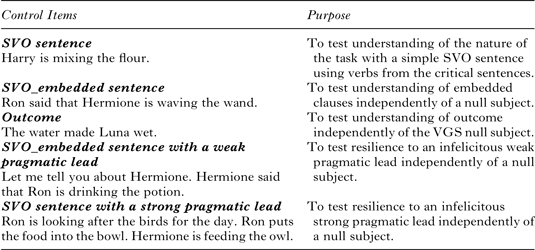
In the correct picture, Hermione is feeding the owl, with Ron standing nearby, and in the foil, the reverse occurs.Footnote 9 Table 1 demonstrates the logic behind each of the control items, summarizing which aspect of the critical sentences they relate to.
Rationale for the control items

Procedure
Testing occurred over three sessions, where the stimuli were separated into three tasks, with a gap of seven to ten days between each one. Each session lasted between 20 and 30 minutes.Footnote 10 The stimuli within each of the tasks were presented on a laptop and randomized by computer software. Prior to the first test session, children were familiarized with the characters and shown pictures of them engaged in various activities. They were then asked to point to each of the characters the experimenter named and to distinguish activities occurring in the pictures, for example, “Show me ‘Luna is popping the balloon’”. Having succeeded with this phase, they were told that they would see two pictures and see and hear a sentence describing the pictures. After the sentence had finished playing, they needed to choose the picture they thought went best with the sentence. They made their choices by clicking on one of the large tabs by each picture, which only became available once the sentence had played. This prevented them from making a decision prematurely. All children completed all tasks. The children received a book of their choice as a ‘thank you’ for participating.
RESULTS
The data for test items were analyzed as binary data, where the value of one interpretation was arbitrarily selected as 0 and the value of the other as 1. For VGS, the choice of the internal referent was coded as 1 and choice of the external referent was coded as 0. For LDC, the choice of object was coded as 1 and choice of subject was coded as 0. The VGS and LDC items were subjected to separate analyses. For each construction, adult and child choices were initially analyzed separately to determine the popularity of choices to each lead. This was followed by an analysis of age trends which combined the child and adult data. Each statistical analysis was a Generalized Linear Mixed Model [GLMM] using a logit link function to accommodate the binary data (Gelman & Hill, Reference Gelman and Hill2007; Stroup, Reference Stroup2012). The analyses were conducted using the GLIMMIX procedure in the SAS™ statistical package (SAS for Windows, 2011). The advantages of using mixed regression models over repeated measures analyses of variance to analyze psycholinguistic data have been outlined by Jaeger (Reference Jaeger2008) and Quené and van den Bergh (Reference Quene and van den Bergh2008). In each of the analyses reported here, Participant, Verb, and their interaction were treated as random effects. All post-hoc comparisons were corrected for multiplicity using the Sidak correction. The section will start by examining the children's and adults’ performance on the control items. Having established their understanding of the task and their competence with elements of the test sentences independently of the null subjects, it will proceed to an analysis of the critical items, each time presenting the adults' data first.
Adults' and children's results on the control items
Fifteen adults undertook these tasks. Their scores on the control conditions (SVO; SVO-embedded; outcome; weak lead SVO; strong lead SVO), each consisting of six trials, were at ceiling (SVO = 100%; SVO-embedded = 100%; outcome = 100%; weak lead SVO = 100%; strong lead SVO = 100%) The children's overall performance on these conditions was also excellent (SVO = 99%; SVO-embedded = 99%; outcome = 99%; weak lead SVO = 99%; strong lead SVO = 98%), indicating that the children ignored pragmatic leads when presented with unambiguous items.
Adults' results on controlled verbal-gerund subjects (VGS)
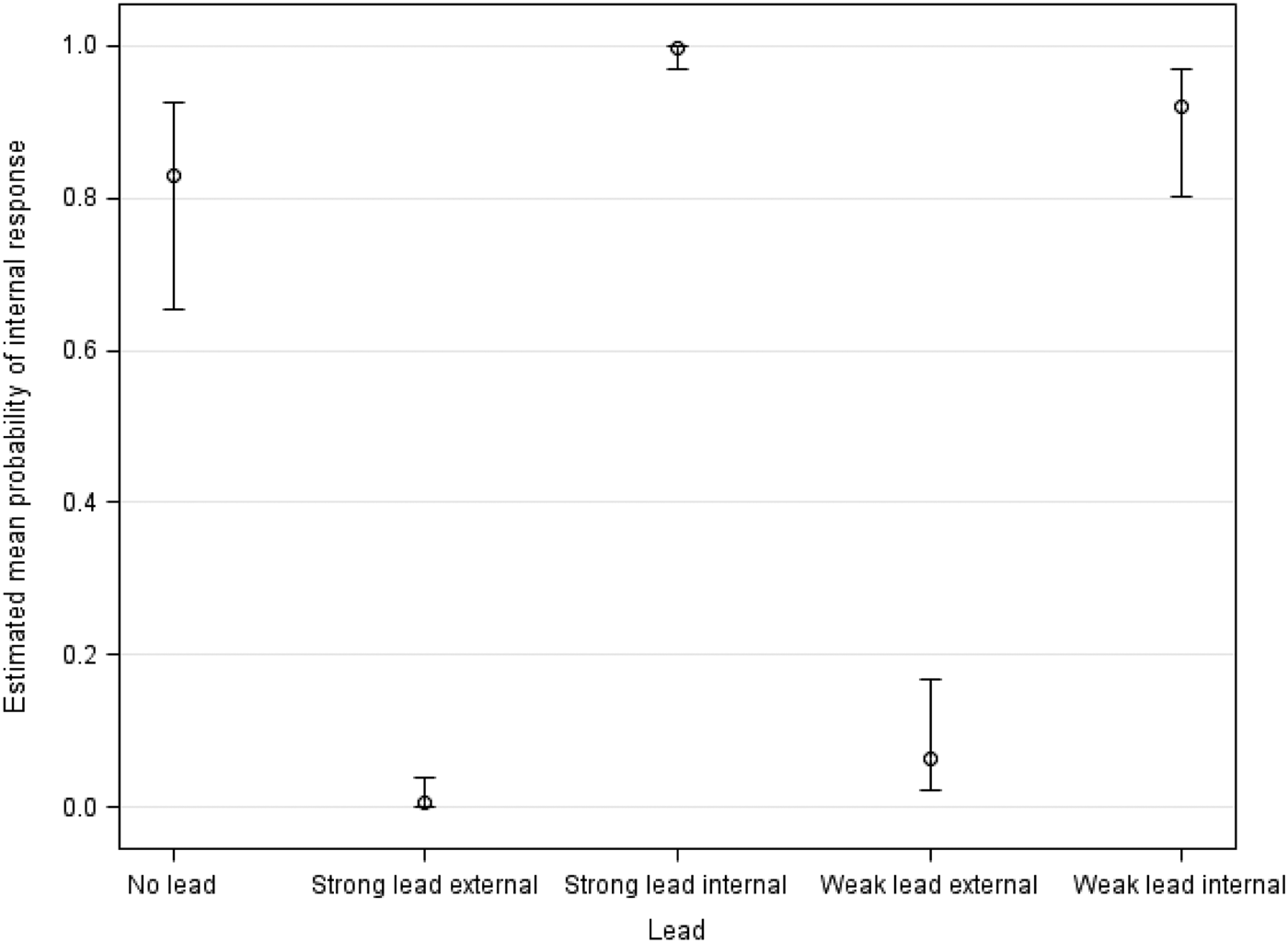
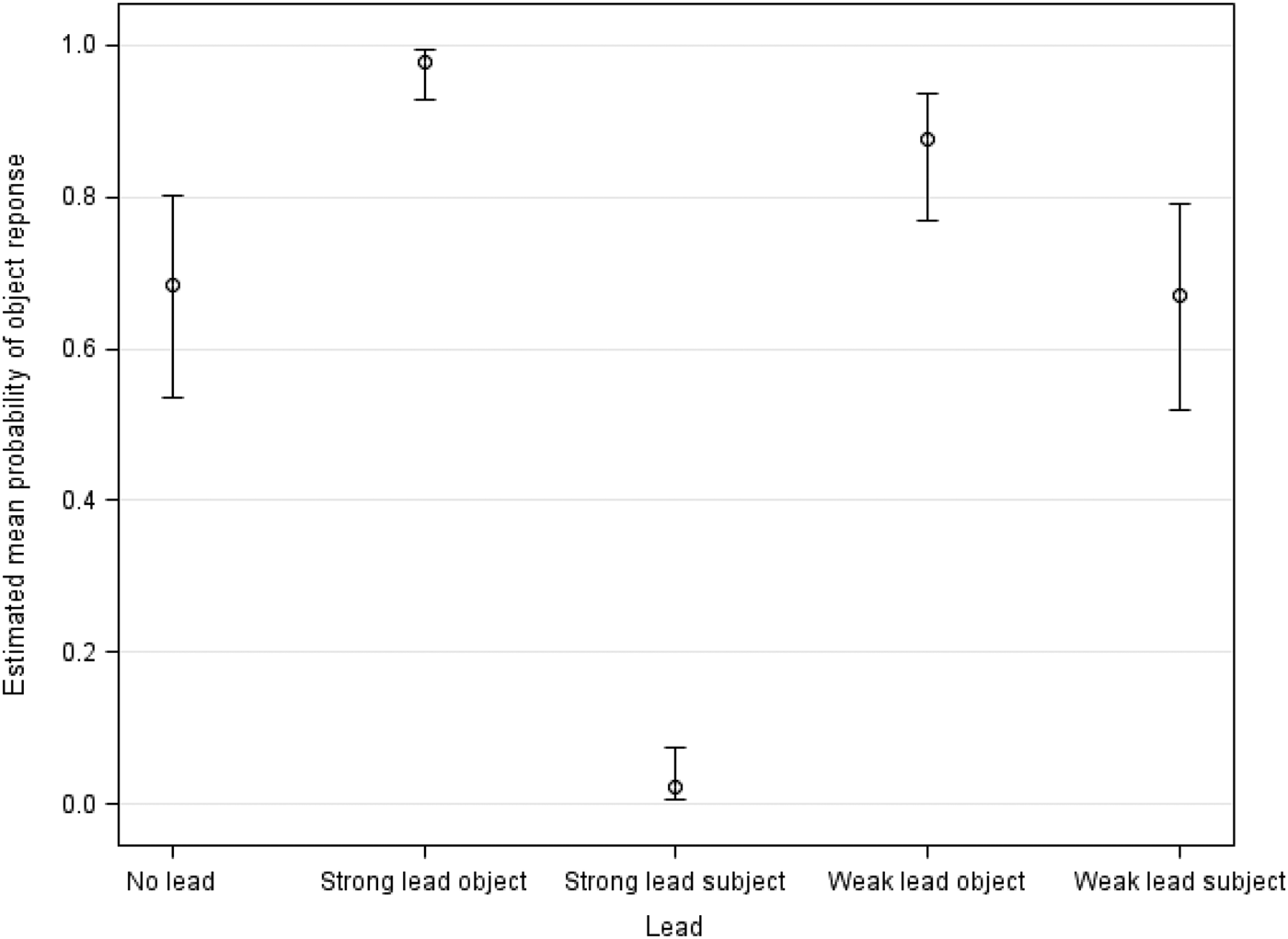
Adults' responses to VGS were analyzed in a generalized linear mixed model with one fixed factor, Lead, which had five levels (no lead, strong lead to external referent, strong lead to internal referent, weak lead to external referent, and weak lead to internal referent), and three random factors, namely, Participant, Verb, and the interaction of Participant and Verb. The effect of Lead was significant (F = 19·82, df = 4, 401, p < ·001). The mean probabilities of the internal referent responses for each lead are shown in Figure 1.
Mean probability of adults' internal referent responses in VGS across all conditions (No Lead; Strong Lead to the External Referent; Strong Lead to the Internal Referent; Weak Lead to the External Referent; and Weak Lead to the Internal Referent).

Of particular note is that the adults showed a strong preference for the internal referent when there was no lead (mean probability = 0·83; s.e. = 0·07). In the strong lead conditions, the confidence intervals are very small, indicating highest consensus when faced with strong leads than with no or weak leads. There was a significant difference between the strong lead to the external referent condition and the no lead condition, where choices for the internal referent decreased dramatically under the influence of this lead (t = 6·68, df = 401, p = < ·001). There was also a significant difference between the strong lead to internal referent condition and the no lead condition, where choices for the internal referent increased (t = 3·69, df = 401, p = ·0026). Turning to the weak leads, Figure 1 shows a large degree of overlap between the confidence intervals in the no lead condition and the weak lead to internal referent condition; this is expected, given the strong preference for the internal referent already in the no lead condition. The difference between these conditions was not significant (t = 1·93, df = 401, p = ·43), whereas the difference between the no lead condition and the weak lead to the external referent condition was significant (t = 6·99, df = 401, p < ·001). Finally, we can compare the weak lead conditions with the strong lead conditions. The difference between the weak and strong leads to the external referent was marginally significant (t = 2·69, df = 401, p = ·07) and the difference between the weak and strong leads to the internal referent was significant (t = 2·95, df = 401, p = 0·03). These results suggest that a weak lead does result in less consensus over the choice of referent than when a strong lead is provided. However, the difference is not large: the strong leads result in practically ceiling performance; the weak leads result in less than perfect consensus but are still close to ceiling.
To summarize, the adults' results demonstrated (a) a strong baseline preference for the internal referent, (b) that they consult both levels of lead when determining their referent choice, and (c) that the strong leads have a greater effect than the weak leads. With these in mind, we can now turn to how the children's responses patterned on this construction.
Children's results on controlled verbal-gerund subjects (VGS)
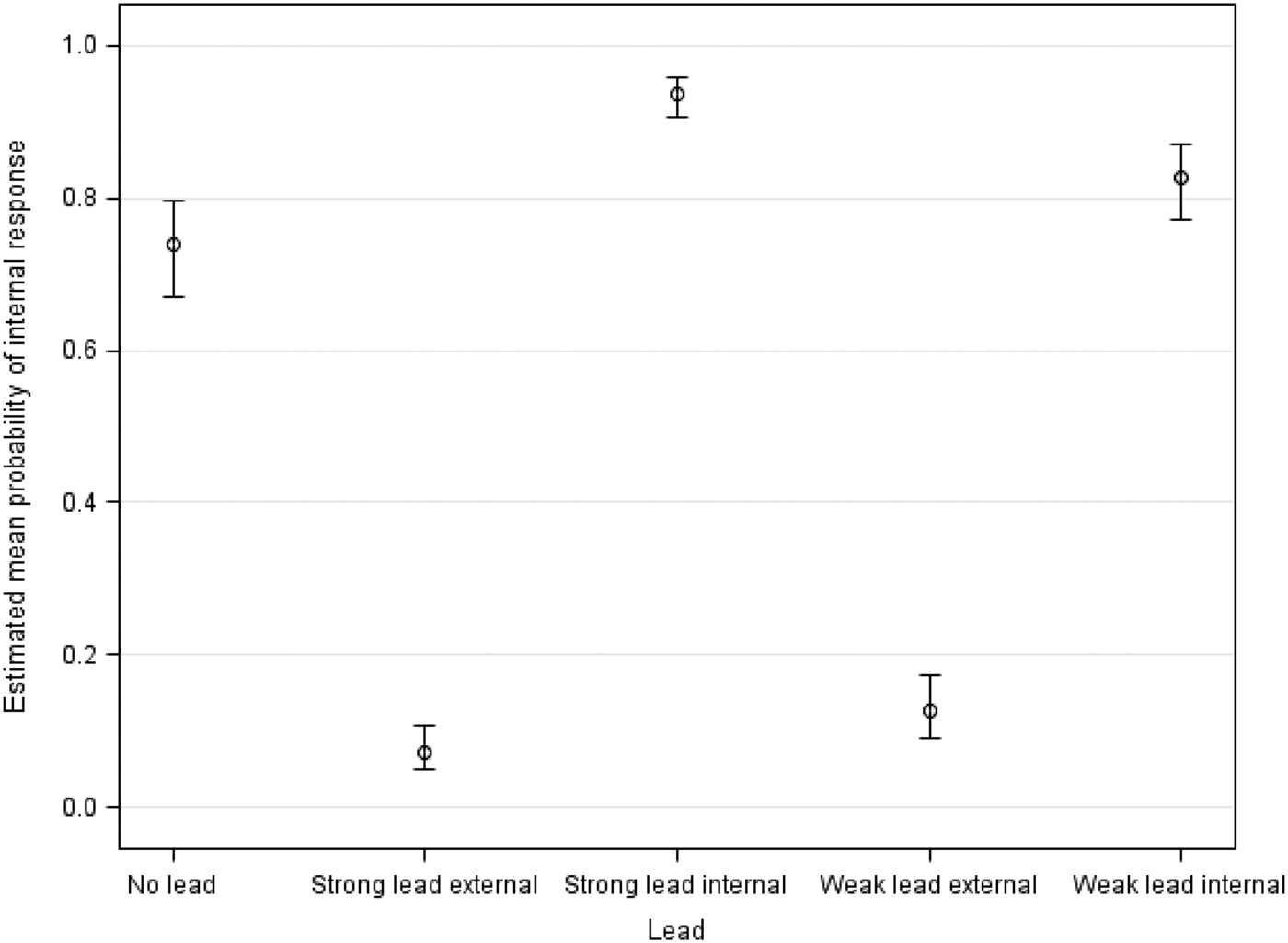
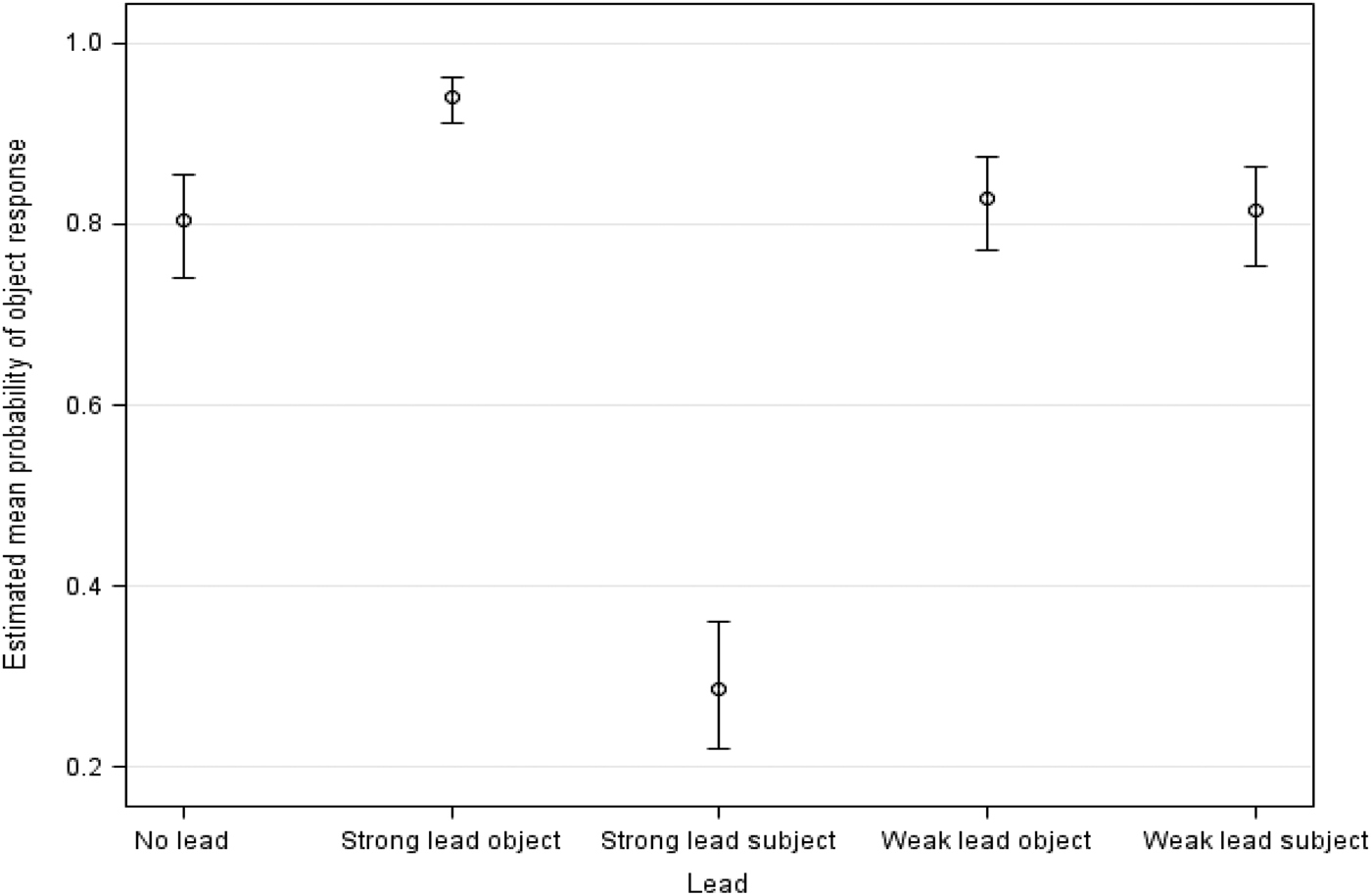
As with the adults, the results were analyzed using a generalized linear mixed model with one fixed factor, Lead. There was a main effect of Lead (F = 138·99, df = 4, 2048, p < ·0001). Figure 2 illustrates the estimated mean probability of choosing the internal referent.
Mean probability of children's internal referent responses in VGS across all conditions (No Lead; Strong Lead to the External Referent; Strong Lead to the Internal Referent; Weak Lead to the External Referent; Weak Lead to the Internal Referent).

The first datapoint illustrates the strong preference for the internal referent when there is no lead (mean probability 0·74; s.e. 0·04). The second and third datapoints illustrate the strong lead conditions. There is a significant difference between the no lead condition and the strong lead to external referent condition, where the proportion of internal referent choices decreases dramatically under the influence of the strong lead (t = 16·08, df = 2048, p < ·001). The difference between the no lead condition and the strong lead to internal referent condition is also significant (t = 7·67, df = 2048, p < ·0001), where, in this case, the consensus for the internal referent increases. The final two datapoints represent internal referent choices in the weak lead conditions. When the weak lead cued the external referent, there was an increase in consensus for the external referent relative to the no lead condition (t = 15·09, df = 2048, p < ·0001), and when the weak lead cued the internal referent, there was also an increase in consensus for the internal referent relative to the no lead condition (t = 3·15, df = 2048, p = 0·01). Last, we can also compare the weak and strong lead conditions, where the increase in external referent choices between the weak and strong leads to the external referent was not significant (t = 2·40, df = 2048, p = 0·15), but the increase in internal referent choices between the weak and strong leads to the internal referent was significant (t = 4·88, df = 2048, p < ·001).
Overall, this provides support for (a) children having a baseline preference for the internal referent, just as was found for adults, (b) children consulting both strengths of lead, as seen for adults, and (c) the effect of the strong lead being greater than the effect of the weak lead (significant for the internal referent; marginal for the external referent), again patterning with the adults.
Analysis of VGS data with children and adults combined
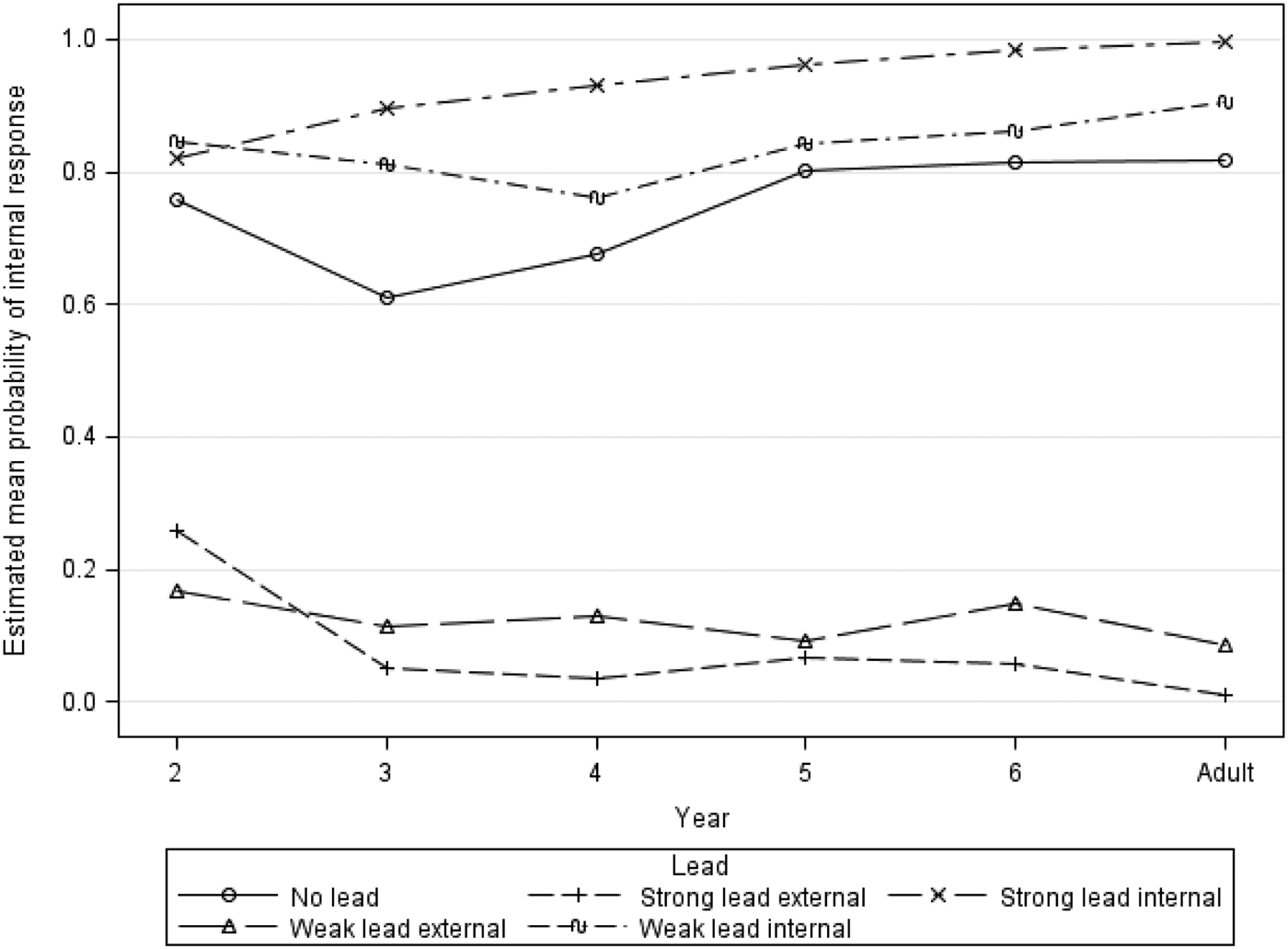
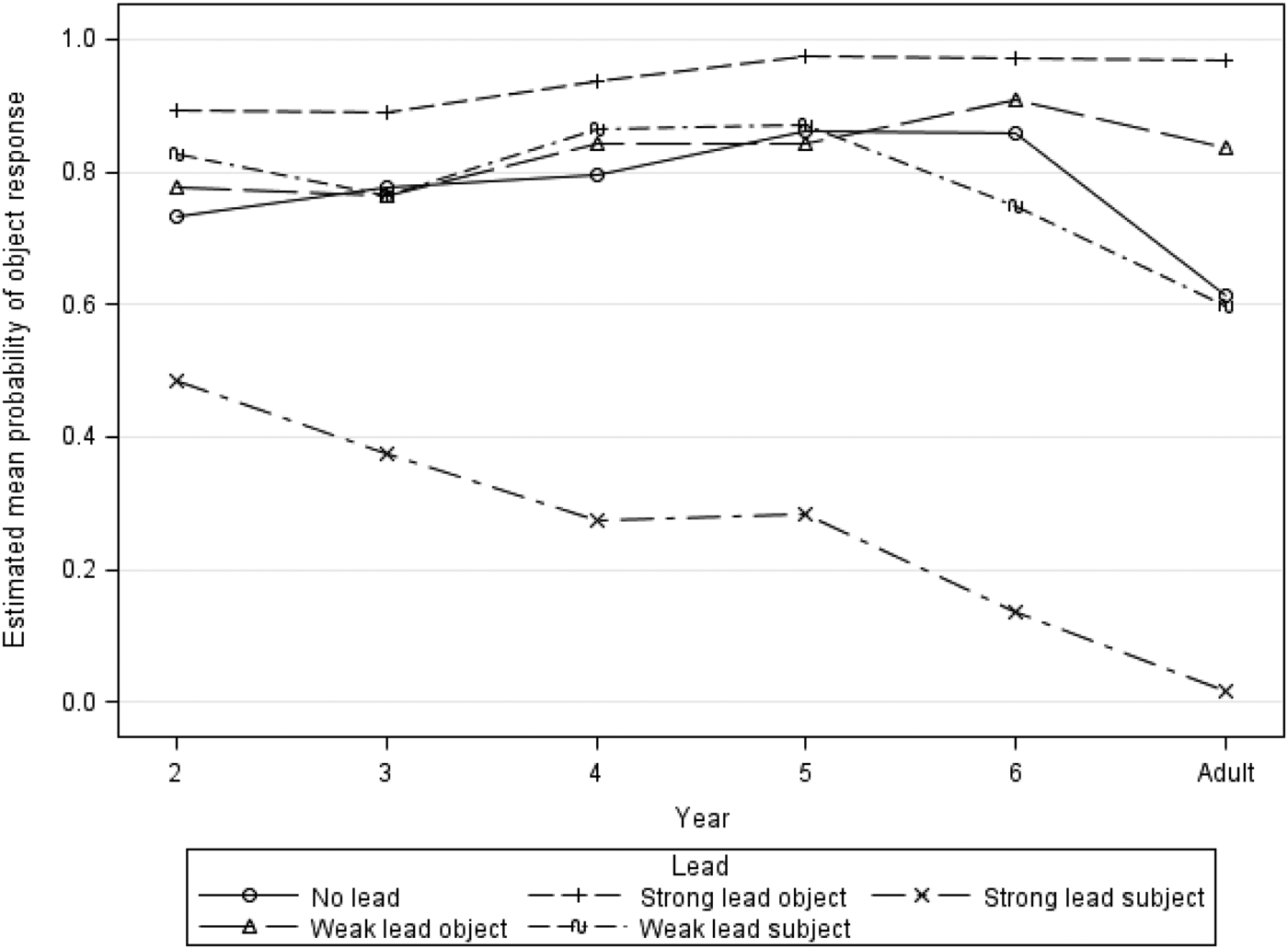
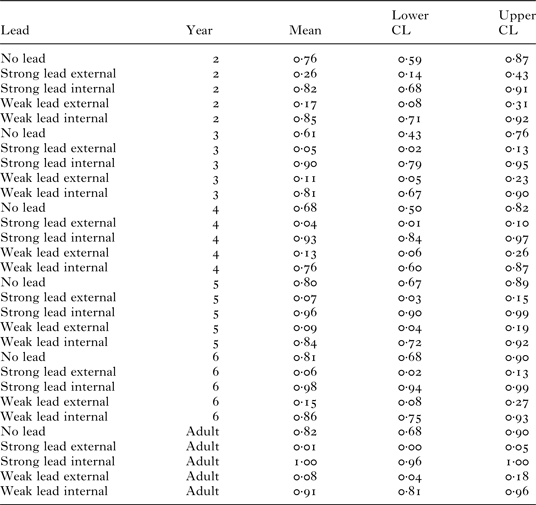
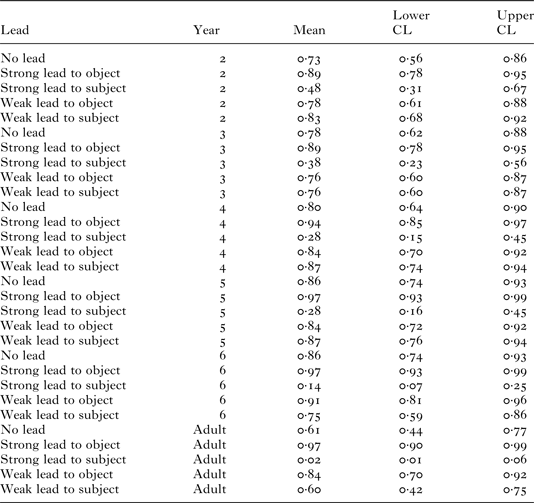
In order to analyze developmental trends, the child and adult data were combined and a 2-way GLMM analysis was conducted. Figure 3 illustrates the estimated mean probability of internal referent responses for all age groups (Years 2, 3, 4, 5, 6, Adult) across the five conditions. To aid the graph's readability, the 95% confidence limits have been put in Table A1 in ‘Appendix 2’. There was a main effect of Lead (F = 143·02, df = 4, 2433, p < ·001), but not Year (F = 0·94, df = 5, 2433, p = ·46). Importantly, the non-significant effect of Year is expected due to the opposing trends for the choice of internal referent when cued by the internal and external leads. It is the interaction between Lead and Year that can best indicate developmental trends. The Lead*Year interaction was significant (F = 3·50, df = 20, 2433, p < 0·001). Figure 3 illustrates the divergent trends for the two sets of leads, namely the set in which the internal referent is the most popular choice (i.e. No Lead, Strong Lead to Internal Referent, and Weak Lead to Internal Referent), and the set in which the external referent choice is the most popular (Strong Lead to External Referent, and Weak Lead to External Referent).
Mean probability of each group's (Years 2, 3, 4, 5, 6, Adult) internal referent responses in VGS across all conditions (No Lead; Weak Lead to the External Referent; Strong Lead to the External Referent; Weak Lead to the Internal Referent; and Strong Lead to the Internal Referent).

In order to detect monotonic trends over Year, linear polynomial contrasts were conducted on the means within each lead. There was a significant trend in the strong lead to the internal referent condition, indicating increasing choice of the internal referent when the lead cued that referent (t = 4·12, df = 2433, p < ·0001), as well as a significant trend in the strong lead to external referent condition, indicating decreasing choice of the internal referent when the lead cued the external referent (t = 3·42, df = 2433, p = ·0006). Although these results do indicate age differences, it is important to note that even the youngest children showed quite high agreement with the adults' choices, with 80% of responses being in agreement in all conditions.
Adults' results on long-distance control (LDC)
The adults' LDC responses were also analyzed using GLIMMIX. The fixed factor was Lead with five levels (no lead, weak lead to the subject, weak lead to the object, strong lead to the subject, and strong lead to the object). As before, Participant, Verb, and the interaction between Participant and Verb were treated as random effects. There was a main effect of Lead (F = 21·01, df = 4, 401, p < ·001).
Figure 4 indicates that the adults displayed a preference for the object when there was no lead. When the subject and object were cued by the strong leads, a large consensus for the discourse prompted element is clear. When the strong lead cued the subject, the choice of the subject became more popular relative to the no lead condition (t = 6·93, df = 401, p < 0·001), and when it cued the object, the same degree of consensus is visible for object choices (t = 4·82, df = 401, p < 0·001). The effects of the weak leads were far less pronounced. When the weak lead cued the subject, the responses were not significantly different from the no lead condition (t = 0·18, df = 401, p = ·99). However, when it cued the object, the consensus for the object increased significantly (t = 2·95, df = 401, p = ·03).
Mean probability of adults' object responses in LDC across conditions (No Lead; Strong Lead to the Object; Strong Lead to the Subject; Weak Lead to Object; Weak Lead to the Subject).

To summarise, the adults' results show (a) a baseline preference for an object interpretation, (b) that the weak lead to the object significantly affected referent choices but that the weak lead to the subject did not, and (c) that the strong leads to the object and to the subject significantly altered referent choices in the predicted directions. With these generalizations in mind, we can analyze this construction vis-à-vis the children.
Children's results on Long-Distance Control (LDC)
The results for LDC were analyzed using the same model. Fixed factor was Lead (no lead, weak lead to the subject, weak lead to the object, strong lead to the subject, strong lead to the object). The effect of Lead was significant (F = 82·41, df = 4, 2048, p < ·001). Figure 5 illustrates the estimated mean probability of choosing the object.
Mean probability of children's object responses to LDC across all conditions (No Lead; Strong Lead to the Object; Strong Lead to the Subject; Weak Lead to the Object; and Weak Lead to the Subject).

In the no lead condition, we can see a strong preference for the object. When the strong lead cued the object, there was an increase in consensus for the object relative to the no lead condition (t = 6·26, df = 2048, p < ·001), and when the strong lead cued the subject, there was a significant shift towards the subject relative to the no lead condition (t = 12·84, df = 2048, p < ·001). In contrast, the weak leads were not persuasive. When the weak lead cued the object, there was no significant increase in consensus for the object relative to that seen in the no lead condition (t = 0·87, df = 2048 p = 0·99), nor was there a significant shift towards the subject when the weak lead cued the subject (t = 0·26, df = 2048, p > 0·99). This demonstrates (a) a baseline preference for the object, as was the case for adults, (b) that neither of the weak leads significantly altered referent choices, differing slightly from the adults, since the weak lead to the object did raise their object responses, and (c) that the strong leads did significantly alter referent choices in the predicted directions, patterning with the adults.
Analysis of LDC data with children and adults combined
To analyze developmental trends, the child and adult data were combined and a 2-way GLMM analysis was conducted. There was a main effect of Lead (F = 95·77, df = 4, 2433, p < 0·001), but not Year (F = 0·71, df = 5, 2433, p = ·61). Once again, the lack of a significant effect of Year is expected, given the opposing trends for the choice of object when cued by the subject and object leads. It is the interaction between Lead and Year that we must examine in order to check for developmental trends. There was a Lead*Year interaction (F = 4·07, df = 20, 2433, p < ·001). Figure 6 shows the estimated mean probability of object responses for all year groups (2, 3, 4, 5, 6, Adult) for each Lead, where the divergent trends for the two sets of leads (i.e. leads to the object and leads to the subject) can be seen. To aid the graph's readability, the 95% confidence limits have been placed in Table A2 in ‘Appendix 2’.
Mean probability of each group's (Years 2, 3, 4, 5, 6, Adult) object responses in LDC across conditions (No Lead; Weak Lead to the Object; Strong Lead to the Object; Weak Pragmatic Lead to the Subject; and Strong Lead to the Subject).

Linear polynomial contrasts were applied to the Year means for each Lead in order to identify significant monotonic trends in response over age. There was a significant increasing trend where the weak lead cued the object (t = 2·03, df = 2433, p = ·04). When the strong lead cued the object, there was also a significant increasing trend (t = 3·05, df = 2433, p = ·002), and by referring back to Figure 6, this can be seen to be due mainly to the younger groups (Years 2, 3, 4) versus the older groups (Years 5, 6, and Adult). When the strong lead cued the subject, there was a significant decreasing trend (t = 5·59, df = 2433, p < .001).
DISCUSSION
Seventy-six children between the ages of 6;9 and 11;8, who had already proven that they ignored pragmatic leads for obligatory control in Janke (Reference Janke, Scott and Waughtal2016, Reference Jankein press), were tested on two examples of non-obligatory control. The first example was controlled verbal gerund subjects (VGS), which previous literature on younger children had reported as being strongly susceptible to a sentence-external referent bias. The second example was long-distance control (LDC) for which no literature (bar one smaller-scale study by the author) existed, and, as we saw, although also an example of NOC, is a rather different construction to VGS, meaning that together, these two subtypes provide a good indication of the issues a child acquiring pragmatically regulated control must grapple with. The main questions approached were (a) whether the current large group of children would show a preference for the internal referent in VGS and for the object in LDC; (b) whether both strengths of pragmatic lead would be effective in guiding children's referent choices in both constructions; and (c), whether any age trends could be detected. The answer to (a) was that all children showed a baseline preference for the internal referent in VGS and for the object in LDC; the answer to (b) was that whereas referent choices in VGS were strongly influenced by both strengths of pragmatic lead, LDC proved much more resilient, showing substantial changes only under the pressure of the strong pragmatic lead; the answer to (c) was that there was a significant age trend for the strong lead in both constructions. A very similar pattern was exhibited by a group of fifteen adults. After confirming the children's ceiling performance on the control (i.e. unambiguous) items, this ‘Discussion’ summarizes the most important points of the VGS and LDC pattern of results. It then considers the impact of the different strengths of pragmatic lead relative to the preferred antecedent's linear proximity to the ec, proposing a scale that can capture the order of influence found for these independent factors for both constructions. Finally, the steady age trend will be discussed, as this novel finding has important repercussions for our understanding of when children take note of context when assigning reference to discourse-mediated terms occurring in syntactically complex constructions.
First, children performed excellently on the control items. These tested comprehension of simple and embedded SVO structures, understanding of outcome (relevant to VGS), and also whether they would ignore pragmatic leads for SVO sentences. Recall that these same children had also been tested on obligatory control under the influence of the same three strengths of lead in Janke (Reference Janke, Scott and Waughtal2016), where they had also ignored them. Thus we have examples of two grammatically regulated constructions in which children knew that reference assignment was not discourse-mediated. This makes their selective use of the leads in NOC more interesting. Essentially, it means that we can probe children's proficiency of pragmatically regulated constructions, knowing that they are able to discern between terms whose references are regulated syntactically and terms whose reference require attention to the context for their resolution. If the children were persuaded by the topics in infelicitous circumstances (i.e. in obligatory control), then their liberal use of them in pragmatically regulated constructions would be less informative. If, however, they are ignoring topics when they are irrelevant, we have a clearer window through which to examine their pragmatic development. The VGS construction is considered first.
Of first note is that the children did not exhibit the previously reported bias for an external referent found in younger children (Adler, Reference Adler2006; Goodluck Reference Goodluck and Lust1987). In fact, in the absence of a lead, 69% of children's trials resulted in internal referent choices, and this overall percentage is representative of a strong preference for the internal referent within each year group (Yr2 = 70%; Yr3 = 59%; Yr4 = 63%; Yr5 = 75%, and Yr6 = 75%). The children's response pattern in this condition is strikingly similar to the fifteen adults tested, who opted for the internal referent in 74% of ninety trials. However, the task used in the current study was different to that of the previous ones discussed in the ‘Introduction’, which relied on act-out tasks (Goodluck, Reference Goodluck and Lust1987) and truth-value judgement tasks (Adler, Reference Adler2006). It could be that the nature of these tasks is such that they make the sentence-external referent more salient to the children, as also discussed by Goodluck (Reference Goodluck and Lust1987). In act-out tasks, for example, she notes that the number of potential props from which the child can choose impacts upon their propensity to choose characters external to the sentence, where the fewer the props provided, the less likely it is that the child chooses a sentence-external referent. Pre-training on the use of sentence-external referents also correlates positively with children's external-referent decisions (see Goodluck, Reference Goodluck and Lust1987, p. 258). Relatedly, in a truth-value judgement [TVJ] task, the external referent is explicitly mentioned in the preceding story, whereas in the baseline condition of the picture selection task, the internal referent is the sentence topic and the external referent is not mentioned at all, only depicted visually alongside the internal referent. This difference might give the external referent an advantage in the TVJ task. An alternative reason for the bifurcation of the results is that young children's pragmatic development has not yet reached the stage at which they can discern between sentence and discourse level topics, as suggested in Adler (Reference Adler2006). This would account for them neglecting the sentence topic, namely the internal referent, and for their overly liberal referent decisions. The oldest child tested in Adler (Reference Adler2006) was aged 5;5, and the oldest one in Goodluck (Reference Goodluck and Lust1987) was 6;11. In contrast, the age of the youngest child in the present study was 6;9. However, the fact that Agostinho et al. (forthcoming) tested children aged three to five years on an elicited reference judgement task, and found data consistent with the present study, points to the task based explanation as being more likely. Children in this latter study were presented with a story acted out by animals, and subsequently had to choose a referent upon hearing a test sentence that concluded the story. They not only drew a distinction between syntactically and pragmatically regulated sentences; for pragmatically regulated ones, their more popular choice was the internal referent. These results are consonant with children's decisions on these constructions being accurately topic-led. Together, these studies suggest that this pragmatic phenomenon might not in fact be developing late after all and can be shown to be understood by children at a younger age than previously thought, if examined with the appropriate experimental apparatus. They also suggest that in VGS, children do not avoid backward anaphoric relations. That is, they readily permit the antecedent in this construction to control the ec despite that antecedent following the ec linearly. This is a finding that seems to set the discourse mediated ec apart from discourse mediated overt pronouns, for which children have been shown repeatedly to avoid backward anaphoric relations (see Lust, Reference Lust and Tavakolian1981; Solan, Reference Solan and Tavakolian1981; Tavakolian, Reference Tavakolian, Goodluck and Solan1978).
The second point of interest is that, across all age groups, children were enormously influenced by the weak lead. This was most evident from each year group's shift from an internal referent when there was no lead to the external referent when this was cued. Eighty-two percent of the children's trials when the weak lead cued the external referent resulted in external-referent responses, compared with only 31% when there was no lead, illustrating the decisive influence of this pragmatic lead. When the weak lead cued the internal referent, children's overall responses also shifted towards this referent (77%), but the shift was less visible because of their already overarching preference for an internal referent in the baseline condition. As a group, the children's responses were again strikingly similar to those of the adults, who opted for the external referent in 87% of trials when this referent was cued, and for the internal referent in 84% of trials when this referent was cued. This again shows a strong influence of the weak lead, a result supporting the results of the larger study by Janke and Bailey (Reference Janke and Bailey2017) on seventy adults, where the same pattern was found. Importantly, the children are demonstrating that they can accommodate a shift in topic.
Finally, the children's performance under the pressure of the strong pragmatic lead is most important, as it reveals a clear age trend in the children's consultation of this more complex discourse cue. When this lead was directed towards the external referent, the percentage of external referent responses rose to 87%. In contrast, when the lead led to the internal referent, the percentage of internal referent responses rose to 88%. Although significant, the effect of this stronger lead was less salient because of the already substantial effect of the weak lead. The trend analysis demonstrated a significant age trend for these leads, and we saw that the youngest year group in particular was significantly less responsive to the strong lead in both instances. A subsequent longitudinal study following the development of children's attention to these discourse cues could help confirm these age trends. At this point, however, we have seen that six to seven seems to mark a turning point, where children start to show more consensus under the influence of this more elaborate pragmatic lead. From seven, their responses become more similar to those of adults, who gave 98% external referent choices when the strong lead led towards this referent, and 99% internal referent choices when the lead led towards this referent. Again, we saw that it was the two oldest year groups who patterned most closely with the adults. This age trend will be returned to once the main findings of LDC have been discussed, to which we turn next.
In LDC, a rather different overall pattern emerges. The adults demonstrated a baseline preference for the object. The children did too, as evidenced by 74% of their trials resulting in object choices. However, this was somewhat higher than the adults, whose object choices totalled 64% of trials in this condition. The adults' slightly lower percentage of object choices helps makes sense of the results in the weak lead condition, where the children's choices did not shift significantly for either lead while the adults' did, but only when the lead was directed towards the object. Starting from a lower number of object choices, the influence of the lead would not be masked for adults in the way it might have been for the children. In LDC, it was only the strong lead that had a decisive influence on everyone's interpretations. In this condition, adults' responses changed as a function of the lead: 96% were object choices when the lead cued the object and only 4% were object choices when the lead cued the subject. Children's responses as a group also demonstrated an effect of this lead, if not quite as strongly, where 89% were object choices when the lead cued the object, a figure which dropped to 33% when the lead cued the subject. However, these overall percentages mask the differences we saw in Figure 6 between year groups. In particular, recall that the youngest year groups had a slightly different pattern. Year 2 children (aged 6) gave more object responses when the pragmatic lead was directed towards the subject than any other age group. In addition, Year 2 and Year 3 children gave fewer object responses when the lead was geared towards the object than any other age group. Thus, although the degree to which children attended to the leads is different between LDC and VGS, there is an age pattern visible in both constructions – children between six and seven were again more reluctant to consult the more elaborate lead than the older children, whose results were again much more like those of the adults. The trend analysis confirmed this developmental trend in terms of the youngest children's consultation of the strong lead.
The results displayed by the older children and adults in this study corroborate the aforementioned Janke and Perovic (Reference Janke, Perovic and Naigles2016) study conducted on a smaller sample, lending force to the generalization that VGS is influenced more easily by discourse topics than LDC. The question that remains is why. Earlier, it was suggested that linear proximity is important in pragmatically regulated control relations. In LDC, the two competing arguments precede the ec. However, the object is linearly more local to it than the subject. Once other factors come in to play, such as the weakly or strongly established topics introduced here, there is competition between topic-hood and linear distance, a competition that the strongly established topic wins. The children, and especially the youngest ones, appear more reluctant to abandon their initial, linear-distance-influenced preference, a reluctance which is removed only under pressure from the strong lead. This might explain the contrast between VGS and LDC responses in the condition employing the weak lead, as in (29) and (30), respectively. In VGS, the ec is encountered immediately after the weakly established topic, namely Harry, so this potential antecedent both precedes and is linearly closer to the ec than the internal-referent choice (i.e. Luna). In contrast, in (30), the object of the main clause in LDC (i.e. Luna) is the last referential candidate that the child encounters prior to the ec, and this linear proximity between the ec and the object has a stronger influence than the weakly established topic (i.e. Harry).
-
(29) Let me tell you something about Harry. ec Pouring the water quickly made Luna wet.
-
(30) Let me tell you something about Harry. Harry told Luna that ec pouring the water quickly was a mistake.
However, given the decisive influence of the strongly established topic on reference assignment for both LDC and VGS, where choice of referent alters as a function of the lead, it would seem that the strongly established topic has a greater influence than does linear distance. Thus, the scale proposed in Janke and Bailey (Reference Janke and Bailey2017) for adults, which ranks the influence of these (underlying different) factors for both constructions, can be extended to the children. The independent factor of linear distance is situated between the two strengths of topic:
-
(31) Strongly established topic > linear distance > weakly established topic
An important caveat, however, as mentioned at the outset, is that LDC also permits external-referent readings. The current picture selection task, limited to two choices as it was for parity in terms of task demands between the two constructions, did not test the effect that weak and strong leads cueing an external referent could have on LDC interpretations, such as in (32) and (33).
-
(32) Let me tell you something about Ron. Harry said to Hermione that ec ? pouring the water quickly was a big mistake.
-
(33) Ron is making a potion. Ron holds the cup awkwardly. Harry said to Hermione that ec ? pouring the water quickly was a big mistake.
If the scale proposed for NOC in (31) is on the right track, under the pressure of the weak lead, as in (32), participants should still prefer a linguistic antecedent, yet under the pressure of the strong lead, as in (33), we should find increasing consensus for the discourse-cued element. A future study could test whether children and adults conform to this prediction.
What this comparative study on these novel constructions has suggested, however, is that children's consultation of strong pragmatic leads does increase gradually over time, although contrary to areas of pragmatic production, where they are often viewed as egocentric communicators, in which, for example, they provide insufficient information in ambiguous circumstances (see Deutch & Pechman, Reference Deutsch and Pechman1982; Epley, Morewedge & Keysar, Reference Epley, Morewedge and Keysar2004), the pragmatic inferences they have drawn here are more remarkable for the extent to which they pattern with those of adults. Of particular interest is the six to seven age bracket, which seems to mark a turning point, where they are completing their acquisition of the distinction between null subjects whose referents cannot be decided by the discourse and those that can. It could be that for a short while after their overly liberal use of pragmatic cues is curtailed, they become overly conservative in their pragmatically based reference assignment strategies, a possibility that a longitudinal study might now, on the basis of the current results, test.
SUMMARY
This study focused on a group of typically developing children aged 6;9 to 11;3, who had already shown that they would ignore pragmatic leads when making syntactically based referent assignment decisions. Use of this same group was important as the children had demonstrated that the syntactic knowledge underlying control constructions was fully developed, enabling us to be confident that the tasks were tapping into pragmatic phenomena. Reference assignment choices in two subtypes of non-obligatory control were compared for the first time in order to gain insight into how children at this stage of development make these complex decisions that are known to be pragmatically regulated in adults. With respect to VGS, it was found that all the children had a strong baseline preference for the sentence topic, namely the internal referent. Both weak and strong pragmatic leads influenced children's judgements heavily, indicating that children were sufficiently flexible to accommodate a change to the discourse topic. However, although also influenced by the leads, the youngest two year groups (aged 6–8 years) consulted the strong, more elaborate, lead less than the three older year groups (aged 8–11 years), and there was a clear age trend visible in terms of this lead's influence. LDC proved much more resilient to pragmatic influence for all participants, who showed a strong initial preference for the object, which remained constant under influence of the weak lead. Under pressure of the strong lead, however, all children's responses moved in the direction of the discourse topic, although once again, the youngest two year groups were less influenced by it than the older groups. As with VGS, there was a significant age trend for the strong leads, where children's attention to the leads increased with age. On the basis of the parallels we have seen, I have suggested that the same scale proposed for adults' judgement patterns on these rather different examples of NOC can capture children's choices, too. Although these two subtypes represent the heterogeneity of NOC well, it would be interesting to see if this ranking generalizes to more examples. As a last point, it seems that children as a group are only becoming reliably robust in their ability to consistently ignore pragmatic leads in syntactically regulated control from around the age of six onwards. The results of the current study suggest that there is an overlap between this milestone and that of learning to employ pragmatic leads appropriately in pragmatically regulated control. The evidence for this overlap comes from the age differences found here, where the youngest children attended to pragmatic leads less consistently than their older peers, whose flexibility was largely adult-like.
Appendix 1: Critical sentences and control (i.e. unambiguous) sentences
1. SENTENCES WITH NO PRAGMATIC LEAD
-
Verbal gerund subject test sentences
-
Pouring the water quickly made Luna wet.
-
Pouring the water quickly made Harry wet.
-
Rowing the boat clumsily made Ron seasick.
-
Rowing the boat clumsily made Luna seasick.
-
Reading the book slowly made Hermione sleepy.
-
Reading the book slowly made Ron sleepy.
-
Long-distance control test sentences
-
Ron told Hermione that waving the wand slowly was the best way.
-
Hermione told Ron that waving the wand slowly was the best way.
-
Harry shouted to Luna that flying the broom upside down was a great trick.
-
Luna shouted to Harry that flying the broom upside down was a great trick.
-
Hermione said to Harry that pouring the water quickly was a big mistake.
-
Harry said to Hermione that pouring the water quickly was a big mistake.
-
SVO control sentences
-
Hermione is feeding the owl.
-
Harry is lifting the book.
-
Hermione is kicking the ball.
-
Ron is rowing the boat.
-
Harry is mixing the flour.
-
Luna is kissing the owl.
-
SVO embedded control sentences
-
Hermione said that Ron is feeding the owl.
-
Ron said that Hermione is feeding the owl.
-
Harry shouted that Luna is kicking the ball.
-
Luna shouted that Harry is kicking the ball.
-
Ron said that Hermione is popping the balloon.
-
Hermione said that Ron is popping the balloon.
-
Outcome control sentences
-
The book made Ron sleepy.
-
The book made Hermione sleepy.
-
The potion made Harry wet.
-
The potion made Hermione wet.
-
The boat made Ron seasick.
-
The boat made Luna seasick.
2. SENTENCES WITH WEAK PRAGMATIC LEAD
-
Verbal gerund subject test sentences
-
Let me tell you something about Luna/Harry. Pouring the water quickly made Harry wet.
-
Let me tell you something about Luna/Harry. Pouring the water quickly made Luna wet.
-
Let me tell you something about Ron/Hermione. Reading the book slowly made Ron sleepy.
-
Let me tell you something about Ron/Hermione. Reading the book slowly made Hermione sleepy.
-
Let me tell you something about Ron/Luna. Rowing the boat clumsily made Luna seasick.
-
Let me tell you something about Ron/Luna. Rowing the boat clumsily made Ron seasick.
-
Long-distance control test sentences
-
Let me tell you something about Harry/Hermione. Harry told Hermione that pouring the water quickly was a big mistake.
-
Let me tell you something about Harry/Hermione. Hermione told Harry that pouring the water quickly was a big mistake.
-
Let me tell you something about Luna/Ron. Ron said to Luna that waving the wand slowly was the best way.
-
Let me tell you something about Luna/Ron. Luna said to Ron that waving the wand slowly was the best way.
-
Let me tell you something about Harry/Luna. Luna shouted to Harry that flying upside down was a great trick.
-
Let me tell you something about Harry/Luna. Harry shouted to Luna that flying upside down was a great trick.
-
SVO embedded control sentences
-
Let me tell you something about Ron. Ron said that Hermione is feeding the owl.
-
Let me tell you something about Luna. Luna said that Harry is waving the wand.
-
Let me tell you something about Harry. Harry said that Luna is pouring the water.
-
Let me tell you something about Hermione. Hermione said that Harry is mixing the flour.
-
Let me tell you something about Ron. Ron said that Luna is rowing the boat.
-
Let me tell you something about Hermione. Hermione said that Ron is drinking the potion.
3. SENTENCES WITH STRONG PRAGMATIC LEAD
-
Verbal gerund subject test sentences
-
Ron/Hermione is looking up a spell. Ron/Hermione says each word carefully. Reading the book slowly made Ron sleepy.
-
Ron/Hermione is looking up a spell. Ron/Hermione says each word carefully. Reading the book slowly made Hermione sleepy.
-
Hermione/Harry is making a potion. Hermione/Harry holds the cup clumsily. Pouring the water quickly made Hermione wet.
-
Hermione/Harry is making a potion. Hermione/Harry holds the cup clumsily. Pouring the water quickly made Harry wet.
-
Luna/Ron is going out on the lake. Luna/Ron takes the oars awkwardly. Rowing the boat clumsily made Ron seasick.
-
Luna/Ron is going out on the lake. Luna/Ron takes the oars awkwardly. Rowing the boat clumsily made Luna seasick.
-
Long-distance control test sentences
-
Harry/Hermione is making a potion. Harry/Hermione holds the cup awkwardly. Harry told Hermione that pouring the water quickly was a big mistake.
-
Harry/Hermione is making a potion. Harry/Hermione holds the cup awkwardly. Hermione told Harry that pouring the water quickly was a big mistake.
-
Ron/Luna is practising magic. Ron/Luna tries a difficult spell. Ron said to Luna that waving the wand slowly was the best way.
-
Ron/Luna is practising magic. Ron/Luna tries a difficult spell. Luna said to Ron that waving the wand slowly was the best way.
-
Harry/Luna is testing his/her broom. Harry/Luna takes off in the air. Harry shouted to Luna that flying the broom upside down was a great trick.
-
Harry/Luna is testing his/her broom. Harry/Luna takes off in the air. Luna shouted to Harry that flying the broom upside down was a great trick.
-
SVO control sentences
-
Ron is looking after the birds for the day. Ron puts the food into the bowl. Hermione is feeding the owl.
-
Luna is learning a difficult spell for a class test. Luna says the magic words slowly. Harry is waving the wand.
-
Harry is making a magic potion for the whole class. Harry lifts up the yellow cup. Luna is pouring the water.
-
Hermione is inviting the class to a birthday party. Hermione prepares a beautiful chocolate cake. Harry is mixing the flour.
-
Ron is taking a trip out onto Hogwarts lake. Ron takes hold of the wooden oars. Luna is rowing the boat.
-
Hermione is mixing the ingredients for a spell. Hermione holds up the small blue goblet. Ron is drinking the potion.