Borderline personality disorder (BPD) is a disorder marked by unstable moods, impulsivity, and chaotic, stormy relationships, among other difficult symptoms (American Psychiatric Association, 2013). Borderline individuals frequent various inpatient and outpatient mental health settings, presenting with self-injurious and suicidal behaviors (Harvard Health Publications, 2010). It is estimated that between 10% and 20% of individuals using mental health services have a borderline diagnosis (Crawford, Cohen, Chen, Anglin, & Ehrensaft, Reference Crawford, Cohen, Chen, Anglin and Ehrensaft2009). Many professionals in mental health settings find working with this population to be difficult, and they have less optimism for the recovery of such patients (Westwood & Baker, Reference Westwood and Baker2010).
There are several theories and models that attempt to explain and understand BPD (Bezirganian, Cohen, & Brook, Reference Bezirganian, Cohen and Brook1993; Bleiberg, Reference Bleiberg1994; Carlson, Egeland, & Sroufe, Reference Carlson, Egeland and Sroufe2009; Cheavens et al., Reference Cheavens, Rosenthal, Daughters, Nowak, Kosson and Lynch2005; Fruzzetti, Shenk, & Hoffman, Reference Fruzzetti, Shenk and Hoffman2005; Golomb et al., Reference Golomb, Ludolph, Westen, Block, Maurer and Wiss1994; Links, Reference Links and Links1990), but the lack of research on concrete etiology is apparent. Consistent with a developmental psychopathology perspective, the presumption is that the adult manifestation of BPD is likely preceded by BPD features or symptoms in childhood or adolescence (Winsper, Zanarini, & Wolke, Reference Winsper, Zanarini and Wolke2012). Although there is some controversy over the appropriateness of diagnosing children with BPD (Bleiberg, Reference Bleiberg1994), studies have shown that BPD features can exist in childhood (Crick et al., Reference Crick, Murray-Close and Woods2005), and there is interest in the childhood predictors of the disorder (Goodman et al., Reference Goodman, Patil, Triebwasser, Diamond, Hiller and Hoffman2010; Zelkowitz et al., Reference Zelkowitz, Paris, Guzder, Feldman, Roy and Rosval2007). These studies make a compelling argument: because personality is said to develop in the early years and stages of life, more research on the etiology of BPD needs to involve childhood precursors (Crick et al., Reference Crick, Murray-Close and Woods2005; Goodman et al., Reference Goodman, Patil, Triebwasser, Diamond, Hiller and Hoffman2010). If researchers are able to identify the developmental pathways in children that lead to BPD, treatment options may be made available much sooner and be better aimed at alleviating the problem (Rogosch & Cicchetti, Reference Rogosch and Cicchetti2005). Early treatment options would be a significant contribution to the clinical field, considering the nature and pervasiveness of BPD.
At its core, the current study aimed to better understand how early parenting experiences (both positive and negative) and early engagement in aggression, particularly relational aggression, may serve as precursors to the development of BPD features in children and adolescents. In pursuing this topic, several predominant themes of Nicki Crick's prior work are combined to address these central questions, among others. First, Crick et al. (Reference Crick, Murray-Close and Woods2005) were the first to propose that relational aggression might be a potentially prominent factor in a developmental psychopathology approach to the underpinnings of BPD. This study continues to probe these associations. Second, physical and relational aggression are considered together, parallel with Crick's persistent desire to establish the unique effects or correlates of relational aggression, despite considerable correlation with physically aggressive behaviors.
Third, consistent with a developmental psychopathology approach, Crick has published a number of short-term longitudinal studies and advocated for more longitudinal work. This study considers a decade span from preschool to early adolescence, which also allows for an assessment of the stability of relational aggression over this period. Fourth, Nelson and Crick (Reference Nelson, Crick and Barber2002) produced one of the first studies to probe how forms of parenting might be differentially associated with relational and physical forms of aggression. This study considers parenting influences, both positive and negative, as they connect with both forms of aggression (in preschool and adolescence) as well as borderline personality features (in adolescence). Fifth, Crick encouraged cross-cultural explorations of relational aggression, with her most recent focus being on Asian groups (e.g., Kawabata & Crick, Reference Kawabata and Crick2013). This is the first study to simultaneously explore parenting, relational aggression, and borderline personality features in a Russian sample. Sixth, Crick, Woods, Murray-Close, and Han (Reference Crick, Woods, Murray-Close, Han, Freeman and Reinecke2007) considered both normative and clinical samples to be relevant to the study of the development of BPD. This study focuses on a normative, community sample of preschoolers and their parents.
Childhood Precursors of BPD: The Case for Relational Aggression
In a series of empirical and conceptual elaborations, Crick and her colleagues argued that relational aggression may be a developmental precursor of BPD. In contrast with physical aggression, relational aggression focuses on behaviors in which individuals seek to manipulate or damage relationships (Crick & Grotpeter, Reference Crick and Grotpeter1995). Examples of these behaviors include gossip, rumors, social exclusion, silent treatment, and threatening to abruptly end relationships. All seem to have some kinship with the turbulent strategies employed by borderline individuals in their relationships. The common correlates of relational aggression are also consistent with the childhood indicators, or features, of BPD, which include (a) hostile, paranoid worldview; (b) intense, unstable, inappropriate emotion; (c) overly close, enmeshed relationships; (d) impulsivity; and (e) lack of a sense of self. These difficulties may represent inadequate responses to developmentally salient challenges faced in childhood (Crick et al., Reference Crick, Woods, Murray-Close, Han, Freeman and Reinecke2007).
For example, research suggests that a hostile and paranoid worldview can take root in a child when the child lacks social information processing skills. Temperament may combine with environmental experiences (e.g., exposure to harsh parenting or peers who are aggressive) to influence a child's negative thoughts and feelings about his/her environment (Geiger & Crick, Reference Geiger, Crick, Ingram and Price2010). In the literature on aggression, this is referred to as hostile attribution bias, in which an individual shows a preference for hostile attributions even when existing social information may not support such an interpretation (Crick & Dodge, Reference Crick and Dodge1994). This bias is frequently associated with high levels of relational or physical aggression (e.g., Mathieson et al., Reference Mathieson, Murray-Close, Crick, Woods, Zimmer-Gembeck and Geiger2011). Intense negative emotion and the inability to properly regulate such emotion is also commonly associated with aggressive behaviors. Faults in the caregiving experience (i.e., insecure attachments) during infancy may presage these developmental issues. Children may also have biological predispositions that decrease their emotion regulation abilities; this may combine with environmental influences to create this precursor to BPD (Geiger & Crick, Reference Geiger, Crick, Ingram and Price2010).
The relationally aggressive child may also exhibit significant relationship instability and enmeshment in current relationships. These children are often hypersensitive within the context of their relationships and prefer to be in relationships marked by exclusivity (Geiger & Crick, Reference Geiger, Crick, Ingram and Price2010; Ostrov, Hart, Kamper, & Godleski, Reference Ostrov, Hart, Kamper and Godleski2011). Relationship stability may understandably be undermined by impulsivity, which is another hallmark feature of BPD. Whereas children may not evidence the adult manifestations of impulsivity (e.g., lack of self-control in regard to sexual behavior, shopping habits, or self-injurious behavior), attention problems and lack of self-control in regard to aggressive behavior can be evident. These problems may potently interact with other risk factors to place the child at risk for personality disorder (Geiger & Crick, Reference Geiger, Crick, Ingram and Price2010).
Finally, an impaired sense of self may begin as early as infancy, in the context of insecure attachments with the primary caregiver (Geiger & Crick, Reference Geiger, Crick, Ingram and Price2010). Childhood abuse, in particular, is a potent source of a disturbed sense of self, which can include seeing the self only in terms of extremes (i.e., all good or all bad). This risk factor combines with others to produce significant social, emotional, and cognitive challenges for the child who struggles with relational aggression and who may be at risk for BPD further down the developmental pathway.
Given the significant conceptual and theoretical overlap, it is not surprising that research to date has generally verified Crick's original hypothesis: relational aggression is significantly associated with BPD features in samples of children, adolescents, and adults (Crick et al., Reference Crick, Murray-Close and Woods2005; Ostrov et al., Reference Ostrov, Hart, Kamper and Godleski2011; Ostrov & Houston, Reference Ostrov and Houston2008; Tackett & Ostrov, Reference Tackett and Ostrov2010). However, additional refinement is needed to better understand the relative influence of risk factors, including relational aggression, in the eventual emergence of borderline pathology. In particular, longitudinal studies may help elucidate the potential mechanisms at work. For example, it may be that child temperament traits or parenting experiences are common foundations for both relational aggression and borderline personality features (or the eventual disorder). In this case, relational aggression might not be necessarily considered a precursor of BPD later in life; rather, they may both be products of earlier difficulties. In this scenario, borderline personality features may actually emerge prior to the consistent enactment of relational aggression.
However, it is also plausible that engaging in high levels of relational aggression at a young age may interfere with normative social and emotional development, which in turn may increase the likelihood of borderline pathology in later years. The current study considers the association between preschool relational aggression and adolescent borderline features, while also controlling for preschool parenting as a potential predictor. This allows for assessment of whether early aggression or parenting proves to be a better predictor of later borderline features. Because we also have measures of adolescent relational aggression, we can assess the unique or common preschool parenting correlates of later relational aggression and borderline features.
In this study, we also examine associations between borderline pathology and physical aggression as a point of potential contrast. A number of studies have shown clear associations between physical aggression and BPD (e.g., Burnette & Reppucci, Reference Burnette and Reppucci2009; McCloskey et al., Reference McCloskey, New, Siever, Goodman, Koenigsberg and Flory2009; Windle & Windle, Reference Windle and Windle1995). This is not surprising because many of the common correlates of physical aggression are also consistent with borderline personality features (e.g., impulsivity and low emotion regulation; see Coyne, Nelson, & Underwood, Reference Coyne, Nelson, Underwood, Smith and Hart2010). However, BPD may be more strongly related to relational as opposed to physical forms of aggression, given that many childhood precursors are more strongly tied to relational aggression. For example, relational aggression and borderline features are both more common in enmeshed relationships, where exclusivity is emphasized. Therefore, we test potential associations by examining both physical and relational aggression as precursors or concurrent correlates of borderline pathology in the current study.
Parental Precursors to BPD
There is also evidence that childhood parenting experiences may contribute to the development of BPD in later life. Research on parental precursors to BPD has pointed to childhood trauma as a significant etiological factor in the development of this disorder, particularly the trauma of significant abuse and neglect (Links, Reference Links and Links1990; Rogosch & Cicchetti, Reference Rogosch and Cicchetti2005; Spatz-Widom, Czaja, & Paris, Reference Spatz-Widom, Czaja and Paris2009). Childhood sexual abuse, for example, is a significant predictor of adult BPD (Machizawa-Summers, Reference Machizawa-Summers2007; Zanarini, Williams, Lewis, & Reich, Reference Zanarini, Williams, Lewis and Reich1997). Researchers have also considered other kinds of childhood trauma in the lives of borderline individuals, such as loss of or separation from a close family member (particularly the mother; Crawford et al., Reference Crawford, Cohen, Chen, Anglin and Ehrensaft2009). Whereas early research focused largely on the relationship between the borderline individual and his/her mother (Bezirganian et al, Reference Bezirganian, Cohen and Brook1993; Crawford et al., Reference Crawford, Cohen, Chen, Anglin and Ehrensaft2009; Golomb et al., Reference Golomb, Ludolph, Westen, Block, Maurer and Wiss1994), later research has shifted to a broader focus on the family environment and its impact on the development of BPD (Fruzzetti et al., Reference Fruzzetti, Shenk and Hoffman2005; Links, Reference Links and Links1990). Assessment of the influence of fathers, in particular, is increasingly emphasized.
One critique of these family studies is that many rely extensively on retrospective self-reports of borderline individuals. Due to the very nature of the disorder, it is quite difficult to confirm the validity of self-report measures. Borderline individuals might distort their answers or have impaired memories because of their labile affective states (Crawford et al., Reference Crawford, Cohen, Chen, Anglin and Ehrensaft2009). Therefore, research has increasingly focused on prospective associations between negative aspects of family environment and offspring BPD (Johnson, Cohen, Brown, Smailes, & Bernstein, Reference Johnson, Cohen, Brown, Smailes and Bernstein1999; Johnson et al., Reference Johnson, Cohen, Smailes, Skodol, Brown and Oldham2001; Johnson, Smailes, Cohen, Brown, & Bernstein, Reference Johnson, Smailes, Cohen, Brown and Bernstein2000; Rogosch & Cicchetti, Reference Rogosch and Cicchetti2005; Spatz-Widom et al., Reference Spatz-Widom, Czaja and Paris2009; Winsper et al., Reference Winsper, Zanarini and Wolke2012). These prospective studies have successfully identified abuse and neglect as significant predictors of BPD, consistent with retrospective accounts.
In addition to trauma and abuse, research has also highlighted some of the more normative parental characteristics and qualities that have been shown to potentially impact the development of BPD (Fruzzetti et al., Reference Fruzzetti, Shenk and Hoffman2005). Several studies have observed nonabusive yet aversive qualities found in the parenting of borderline individuals. Johnson, Cohen, Chen, Kasen, and Brook (Reference Johnson, Cohen, Chen, Kasen and Brook2006) refer to such problematic parenting as “the more common childhood adversities” that may influence the course of personality disorders (p. 580). These studies have largely found that individuals with BPD perceive their parents as being more intrusive and overprotective as well as uncaring (Bandelow et al., Reference Bandelow, Krause, Wedekind, Broocks, Hajak and Rüther2005; Goldberg, Mann, Wise, & Segall, Reference Goldberg, Mann, Wise and Segall1985; Johnson et al., Reference Johnson, Cohen, Chen, Kasen and Brook2006; Laporte & Guttman, Reference Laporte and Guttman2007; Nickell, Waudby, & Trull, Reference Nickell, Waudby and Trull2002; Zweig-Frank & Paris, Reference Zweig-Frank and Paris1991). Maternal invalidation and perceived parental criticism are also associated with BPD (Cheavens et al., Reference Cheavens, Rosenthal, Daughters, Nowak, Kosson and Lynch2005; Sturrock, Francis, & Carr, Reference Sturrock, Francis and Carr2009). In some cases, assessments of parenting have included direct parental assessments in order to avoid potential biases associated with self-reports of individuals with BPD. For example, Golomb et al. (Reference Golomb, Ludolph, Westen, Block, Maurer and Wiss1994) focused on lack of maternal empathy as a significant predictor of BPD. These researchers utilized semistructured interviews with the BPD patients' mothers to assess maternal empathy.
Similar to studies of childhood abuse and trauma, a number of these problematic parenting studies are prospective in nature. One of the first, by Bezirganian et al. (Reference Bezirganian, Cohen and Brook1993), focused on maternal inconsistency as a significant predictor of later BPD. Carlson et al. (Reference Carlson, Egeland and Sroufe2009) found that maternal hostility, maternal life stress, and parent–child relationship disturbance were significantly related to adult borderline symptoms. The most thorough treatment of this topic is provided by Johnson et al. (Reference Johnson, Cohen, Chen, Kasen and Brook2006), who assessed a broad range of parenting behaviors. They found that harsh punishment, guilt induction, inconsistent enforcement of rules, poor supervision, low affection and time with child, and poor parent–child communication were all factors by age 16 that significantly predicted offspring personality disorder (including BPD) later in adulthood (at 22 or 33 years of age). Significant factors varied somewhat for mothers versus fathers. Moreover, risk for offspring personality disorders increased as a function of the number of pronounced problematic behaviors in any given family.
In a recent meta-analytic review, Kawabata, Alink, Tseng, van IJzendoorn, and Crick (Reference Kawabata, Alink, Tseng, van IJzendoorn and Crick2011) established four clusters of parenting that generally serve as either risk or protective factors for child outcomes. These four clusters capture most of the forms of normative parenting assessed in prior BPD research. Three of the four clusters of parenting are aversive parenting: negative/harsh parenting, uninvolved parenting, and psychological control. Positive parenting, in contrast, is the fourth parenting cluster, which may serve as a buffer. In this paper, we consider how markers of each cluster in preschool parenting might be associated with the development of borderline personality features a decade later. Early childhood is a most formative time for the development of relationships, particularly with parents. We expected that each of the four preschool parenting clusters might correspond with the emergence of the childhood indicators of BPD, which then intensify over time.
In this study, the marker we use for harsh/negative parenting is a composite of authoritarian parenting strategies, which include corporal punishment, verbal hostility, and nonreasoning and punitive methods. These practices are frequently predictive of negative outcomes for children. It is likely that engagement in these hostile practices symbolically represents parental rejection or invalidation to many children, and this may spur a number of borderline personality features in early childhood. For example, a child may come to embrace a hostile, paranoid worldview as she increasingly learns that hostility and poor communication are common elements of the parent–child relationship. The impatient parent may react to child behavior with inappropriate attributions regarding child behavior, and the child may increasingly adopt this bias with peers. A child may also internalize the intense, unstable, inappropriate emotion that frequently pervades interactions with the parent. It is unlikely that a healthy sense of self can be gained in relationships that are so inherently invalidating.
Within the realm of uninvolved parenting, we focus on aspects of permissive parenting. This form of parenting, though not as thoroughly researched as authoritarian tactics, is also the focus of important studies of child development over the past couple of decades (e.g., Sandstrom, Reference Sandstrom2007). Permissive parenting is frequently marked by warmth but a lack of boundaries and rules (Maccoby & Martin, Reference Maccoby, Martin and Hetherington1983). Permissive parents may inadvertently send the message that boundaries are much less important than the pursuit of a close relationship. This viewpoint may be transferred to the child's interpersonal relationships, where they may struggle to understand the normative boundaries of relationships. Jealousy, clinginess, and neediness (all features of BPD) may result when a full appreciation of interpersonal boundaries is lacking. The children of permissive parents also tend to be impulsive, a consistent indicator of the borderline personality.
Psychological control is another form of parenting that has received far less attention in normative child development and BPD studies. Johnson et al. (Reference Johnson, Cohen, Chen, Kasen and Brook2006) did assess how BPD was related to parental guilt induction, which may be considered one important element of psychological control (Barber, Reference Barber1996). Other BPD studies mention the idea of overprotective and intrusive parenting behaviors, which may be consistent with the idea of psychological control, at least to a degree. For the purposes of this study, we use Barber's (Reference Barber1996) definition of psychological control as our guide. In particular, he described different dimensions of parenting behavior that are indicators of psychological control, including love withdrawal (e.g., giving the child the silent treatment or other nonverbal expressions of disapproval), guilt induction, erratic emotional behavior, personal attack (e.g., bringing up the child's past mistakes and blaming the child for family problems), constraining verbal expressions (e.g., speaking for and lecturing the child), and invalidating child feelings. The nature of these parenting dimensions speak to the manipulative, insidious nature of psychological control.
Much like dimensions of authoritarian parenting, it is easy to imagine how these behaviors might promote the emergence of childhood borderline personality features. Love withdrawal and invalidation of child feelings are consistent with the on-again, off-again nature of relationships that borderline individuals tend to form. Unsettled by the prospects of ongoing relationship difficulty, the child may seek to compensate by favoring a close, enmeshed relationship, at least when relationships are in positive mode. Personal attack and guilt induction may also destabilize the child's developing sense of self because the child feels attacked and rejected.
It is quite evident that the focus of most studies is on parenting as a risk factor for personality disorders. More recently, however, Johnson, Liu, and Cohen (Reference Johnson, Liu and Cohen2011) have considered positive parenting behaviors as a protection against personality disorder problems. Using the same data set as in the Johnson et al. (Reference Johnson, Cohen, Chen, Kasen and Brook2006) study, they found that a large number of positive parenting behaviors prospectively predicted more personality resiliency and less personality disorder traits over time. Predictive parenting factors (mostly consistent for both mothers and fathers) included high affection, low punishment, speaking kindly to the child, a calm demeanor, good communication, a positive attitude, attentive/dedicated parenting, and significant time and enjoyable activities with the child. Being a good role model was also important.
Consistent with this recent focus, we also examined whether positive parenting might be a protective factor against the development of borderline personality features. Positive parenting is frequently referred to as authoritative parenting in the literature, and our measure focuses on characteristic provision of warmth and involvement, as well as consistent use of reasoning and induction with the child (Baumrind, Reference Baumrind2012; Hart, Newell, & Olsen, Reference Hart, Newell, Olsen, Greene and Burleson2003). In the parent–child relationship, parents may model appropriate interaction styles that may then influence several features of BPD. For example, one hallmark BPD feature is the instability of relationships, identified by intense interactions that are marked by neediness, mistrust, and anxiety (Gunderson, Weinberg, & Choi-Kain, Reference Gunderson, Weinberg and Choi-Kain2013). Authoritative parents model the exact opposite, wherein the parent–child relationship is marked by trust, love, and warmth. These parents also model appropriate relationship boundaries. Authoritative parenting also models empathy, where parents respect and validate their children's feelings while teaching them ways to regulate their emotions in a variety of settings. Therefore, children should be less likely to struggle with insufficient empathy or emotional instability, common features of BPD. We had no reason to expect that these associations would be any different in a non-Western sample.
Parenting and Aggression Subtypes
We also note that the structure of our study allows us to compare how borderline features, relational aggression, and physical aggression might be similarly or differentially predicted by earlier parenting. Prior research has similarly considered overlapping and unique associations between parenting and both relational and physical forms of aggression. The associations have been tested across various cultures, including the United States, Russia, China, and Belgium (Hart, Nelson, Robinson, Olsen, & McNeilly-Choque, Reference Hart, Nelson, Robinson, Olsen and McNeilly-Choque1998; Kuppens, Grietens, Onghena, & Michiels, Reference Kuppens, Grietens, Onghena and Michiels2009; Nelson & Crick, Reference Nelson, Crick and Barber2002; Nelson, Hart, Yang, Olsen, & Jin, Reference Nelson, Hart, Yang, Olsen and Jin2006). Most studies have observed a generalized association between aversive parenting and childhood aggression, regardless of type (cf., Kuppens et al., Reference Kuppens, Grietens, Onghena and Michiels2009). Various mechanisms have been suggested to explain these associations (Kuppens et al., Reference Kuppens, Grietens, Onghena and Michiels2009; Nelson & Coyne, Reference Nelson and Coyne2009; Nelson, Yang, Coyne, Olsen, & Hart, Reference Nelson, Yang, Coyne, Olsen and Hart2013; Soenens, Vansteenkiste, Goossens, Duriez, & Niemiec, Reference Soenens, Vansteenkiste, Goossens, Duriez and Niemiec2008).
We also consider parenting styles that have received less frequent attention. For example, few studies have found a link between permissive parenting and relational aggression (e.g., Sandstrom, Reference Sandstrom2007). Children of permissive parents may feel entitled and use relationally aggressive means to get their way in peer interactions. Authoritative parenting also deserves more attention. In a prior study with a Russian sample, Hart et al. (Reference Hart, Nelson, Robinson, Olsen and McNeilly-Choque1998, Reference Hart, Nelson, Robinson, Olsen, McNeilly-Choque, Porter, Kerns, Contreras and Neal-Barnett2000) found that both maternal and paternal responsiveness were associated with lower levels of physical and relational aggression. This study uniquely provides an opportunity to identify potentially long-lasting effects of preschool parenting on adolescent aggression and borderline personality features.
Considering Culture: Russia
Given the Russian cultural context of the present study, it is appropriate to outline some of the key aspects of this unique sample. Russia has not been a focus of many studies to date, yet there is a relatively long history of attention, albeit sporadic, to the experience of childhood in the first communist country in the world. Consistent with his ecological systems theory, Bronfenbrenner (Reference Bronfenbrenner1970) was among the first to pay attention to different socialization influences in US and Russian societies. In the midst of the Cold War, Bronfenbrenner found differing perspectives over individualism and collectivism in the broader society that underscored cultural variation in family and peer-group experiences.
Since Bronfenbrenner's early work, a number of studies have assessed aspects of Russian family life and child development, all in the midst of a collapse of communism and the emergence of capitalist and democratic reforms (Nelson, Hart, Keister, & Piassetskaia, Reference Nelson, Hart, Keister, Piassetskaia and Bornstein2010). In both the pre- and post-Soviet periods, attention to mental health disorders has been particularly limited. Nonetheless, given the close connection to relational aggression, we had reason to expect that features of BPD might be adequately assessed in Russian adolescents. Specifically, prior research shows that relational aggression is a prominent feature of Russian children's peer interactions and is tied in expected ways to parenting practices (Hart et al., Reference Hart, Nelson, Robinson, Olsen and McNeilly-Choque1998; Nelson et al., Reference Nelson, Yang, Coyne, Olsen and Hart2013). Despite considerable differences in the political, economic, and social structures of US and Russian societies, there appear to be some universal features of aggression and family life that can be observed (see also Nelson, Nelson, Hart, Yang, & Jin, Reference Nelson, Nelson, Hart, Yang, Jin, Chen, French and Schneider2006). This study may therefore not only expand our understanding of Russian family life and peer interaction but also provide broader understanding of how relational aggression and borderline features may develop over time.
Considering Gender
Since the advent of relational aggression research, gender has been an important consideration in defining aggression and probing correlates of any aggressive behavior. In particular, relational aggression is a prominent feature of interaction among females, and it bears significant influence on how relationships are experienced and interpreted by females (Coyne et al., Reference Coyne, Nelson, Underwood, Smith and Hart2010). In contrast, physical aggression predominantly remains within the realm of aggressive behaviors endorsed by males. There is also evidence that borderline personality is a more common manifestation in females (Gunderson, Zanarini, & Kiesel, Reference Gunderson, Zanarini and Kiesel1991), and it may reflect how gender expectations in our culture differentially impact the emergence of key personality variables. Within parenting research, a traditional focus on maternal influence has gradually given way to more consistent inclusion of fathering effects. Mothers and fathers may parent in different ways and potentially bring about different responses to their parenting with boys and girls (Nelson et al., Reference Nelson, Yang, Coyne, Olsen and Hart2013). With all of this in mind, we probe in the current study for potential gender differences in mean levels of aggression, borderline personality features, and the experience of parenting (by mothers and fathers). In addition, our statistical model analyzes whether gender of child may be an important moderator in the effects obtained.
Summary and Hypotheses
The above summary has noted not only promising research but also a significant number of limitations in the study of the etiology of BPD. Prospective studies of contributors to the etiology of BPD are fairly limited, particularly those that consider parenting or aggressive behavior. Considering multiple influences at once will also provide important insights. In addition, much of the research on BPD has focused on maternal parenting behaviors. If measures of paternal influence are included, they are not often provided by fathers themselves (Johnson et al., Reference Johnson, Liu and Cohen2011). Including mother and father self-reports helps determine the potentially unique influences of both. More work is also needed to assess the prospective association between relational aggression and borderline personality features. The cross-cultural scope and potential generalizability of findings may be better assessed with samples like this one.
This study aimed to address these limitations and to bring a more complete picture of the etiology of BPD by utilizing a prospective study design and by using a nonclinical sample of children followed into adolescence. In comparison with physical aggression, we expected that preschool relational aggression would be more strongly associated with features of BPD in early adolescence. We also expected that adolescents with high levels of borderline personality features would be more likely to self-report higher levels of concurrent relational aggression. In regard to parenting issues, we expected aversive forms of preschool parenting to be predictive of borderline features as well as forms of aggression in early adolescence. Given the general associations in prior studies between parenting and aggression or BPD, we had no reason to expect that there would be substantial differentiation in the predictive associations that emerged. We generally expected aversive parenting to serve as a risk factor and authoritative parenting to serve a protective function over time. We did expect these associations to be more prevalent for girls than for boys, given the greater sensitivity of girls to relationship disturbance and the greater likelihood of borderline features in girls. We also explore how these associations may differ across gendered parent–child dyads (although we offer no firm hypotheses in this regard, because prior evidence is mixed). The bivariate associations will provide some accounting for the above hypotheses. However, we also desired to use a multivariate model to explore how our preschool parenting and aggression predictors may work in tandem. The purposes of the multivariate model will be elaborated in the Methods section.
Methods
Setting
The participants in this particular study live in Voronezh, Russia, a city of approximately 1,000,000 inhabitants. The city is situated about 280 miles south of Moscow, and it is considered a provincial city with a truly Russian character. Until the collapse of the Soviet Union, foreigners were denied access to the city, because it was a major center of technology. Consistent with this history, this sample is entirely composed of children and parents who are ethnic Russians.
Participants and procedures
Initial data collection (Time 1) occurred in the summer of 1995, just a couple of years after the collapse of the Soviet Union. The Time 1 data collection was fairly extensive, with parents responding to a broad range of measures of parenting and family life. Teachers completed social behavior ratings of all participating children. The children and their parents were invited to participate from three nursery schools (15 classrooms), and a total of 207 parents (out of 255 eligible families, 81.2%) agreed to participate in the study. Our analyses consider child correlates of parenting by biological mothers and fathers in intact families. Therefore, we exclude from further analysis 33 single-mother households and 6 stepfamily households. Of the original 207 families, 168 mothers and 161 fathers completed the primary parenting questionnaire in this study. The discrepancy between the number of mothers and fathers in these households reflects 7 fathers who did not participate for one reason or another.
In these 168 households, there were 84 boys and 84 girls who ranged in age from 45 to 75 months (M = 59.87, SD = 7.99). The age of these mothers ranged from 21 to 56 years (M = 30.67, SD = 5.50). Fathers who participated ranged in age from 22 to 62 years (M = 32.60, SD = 7.05). The education level of parents ranged from 9 to 17 years (9 years = ninth grade, 17 = bachelors level college degree). The average for mothers was 14.95 years (SD = 2.30) and the average for fathers was 14.52 years (SD = 2.40).
Parents attended group meetings where they were given information about the study and were able to ask questions about the measures they or the teachers would complete. Parents also received information regarding confidentiality and were informed that they could choose to be removed (along with their children) from participation in the study at any time. Parents who agreed to participate were given questionnaire packets to take home and return. Parents and teachers received monetary reimbursement for their participation in the study.
At Time 2, a full decade later, 155 of the original 207 children involved in the original study (74.9%) were found and received parental consent to participate in a follow-up study (data were not collected from the parents during Time 2). There were a total of 119 adolescents who were in the 168 dual-parent households at Time 1 who completed the assessments of borderline personality features and aggression at Time 2 (70.8%). These adolescents ranged in age from 13 to 16 years of age (M = 14.6, SD = 0.72). Male participants totaled 54 (45.4%), and the number of females was 65 (54.6%). The adolescents completed the questionnaires during after-school group meetings, and each signed an assent form before beginning the questionnaire packet. The adolescents were given monetary reimbursement for their time.
Instrumentation
In prelude to the description of the various measures employed in the current study, it is important to acknowledge that forward translation and backtranslation of each measure was completed by Russian linguists who were fluent in both English and Russian. Lead investigators consulted with translators for any items that were deemed more difficult to directly translate word-for-word.
Preschool parenting dimensions
Mothers and fathers independently completed a self-report parenting questionnaire composed of a broad array of items representing Baumrind's typologies of authoritative, authoritarian, and permissive parenting (Robinson, Mandleco, Olsen, & Hart, Reference Robinson, Mandleco, Olsen, Hart, Perlmutter, Touliatos and Holden2001) as well as psychologically controlling parenting (see Barber, Reference Barber1996; Nelson & Crick, Reference Nelson, Crick and Barber2002). Parents rated how frequently they engaged in various parenting behaviors with their preschooler, using a 5-point Likert-type scale (1 = never, 5 = always). The authoritative dimension was composed of seven items that focused on parental warmth and responsiveness (e.g., “I show sympathy when our child is hurt or frustrated”) as well as reasoning/induction (e.g., “I emphasize the reasons for rules”). The authoritarian dimension was composed of seven items that represented physical punishment (e.g., “I use physical punishment as a way of disciplining my child”), verbal hostility (e.g., “I yell or shout when my child misbehaves”), and nonreasoning/punitive strategies (e.g., “I guide our child by punishment more than by reason”).
The permissive dimension was composed of 10 items reflecting parental lack of disciplinary strategies or follow-through (e.g., “I find it difficult to discipline my child”; “I threaten my child with punishment more often than actually giving it”). The psychological control dimension was composed of 8 items (e.g., “I am less friendly with our child if our child does not see things my way”; “I make our child feel guilty when our child does not meet our expectations”). The items in the psychological control scale represent a number of different dimensions of such control (i.e., love withdrawal, guilt induction, erratic emotional behavior, personal attack, and constraining verbal expressions; see Barber, Reference Barber1996). Consistent with previous research, the parenting scales were generally found to be adequately reliable, with Cronbach α values of 0.68, 0.63, 0.56, and 0.66 for mothers' authoritative, authoritarian, permissive, and psychological control scales, respectively, and 0.65, 0.68, 0.66, and 0.72 for fathers' authoritative, authoritarian, permissive, and psychological control scales, respectively.
Preschool teacher ratings of children's relational and physical aggression
Measurement of preschool aggression was based on teacher ratings of each participating preschool child. Items were developed and successfully used in a study with North American preschoolers conducted by McNeilly-Choque, Hart, Robinson, Nelson, and Olsen (Reference McNeilly-Choque, Hart, Robinson, Nelson and Olsen1996). The measure has been shown to have good factor validity and internal reliability, even in non-Western cultural samples (Hart et al., Reference Hart, Nelson, Robinson, Olsen and McNeilly-Choque1998). Items are anchored on a 3-point scale (0 = never, 1 = sometimes, and 2 = often). The relational aggression scale (α = 0.89) was composed of four typical items (e.g., “Says to peers, ‘I won't be your friend if you don't do things my way’” and “Tells a peer that she won't play with them if the peer doesn't do what is asked”). The physical aggression scale (α = 0.87) was also composed of four typical items (e.g., “Hits, kicks, or pushes to get something he wants” and “Throws things at other children when she doesn't get her own way”).
Adolescent self-reported relational and physical aggression
We used the Peer and Romantic Relations Inventory—Self-Report (Nelson, Reference Nelson2005) to assess a broad range of peer-group behaviors (e.g., subtypes of aggression and victimization, sociability, prosocial behavior, and humor) in the larger study. This self-report inventory is primarily composed of items adopted from a number of existing measures, including the Self-Report of Aggression and Social Behavior Measure (Morales & Crick, Reference Morales and Crick1998) and the Romantic Relational Aggression Questionnaire (Linder, Crick, & Collins, Reference Linder, Crick and Collins2002), as well as newly created items for each dimension. Peer-directed (rather than romantic) relational and physical aggression items were specifically selected for inclusion in the present study.
The relational aggression scale was composed of six items (e.g., “I spread rumors about a person just to be mean” and “When I want something from a friend, I act ‘cold’ or indifferent toward that friend until I get what I want”). The physical aggression scale was composed of three items (e.g., “I hit, kick, or punch others” and “I push and shove others around in order to get things that I want”). Participants were asked to read each statement and to indicate, using a 5-point Likert scale (1 = never true, 5 = almost always true), how true each statement was in describing their current behavior with peers. Given that the use of this measure is relatively new, we conducted a separate confirmatory factor analysis to demonstrate discriminant validity and gender invariance of the items. Results of the baseline confirmatory factor analysis analysis (no constraints imposed) showed adequate fit (χ2 = 73.32, df = 52, p = .03; comparative fit index = 0.94, Tucker–Lewis index = 0.92, root mean square error of approximation = 0.08). Furthermore, an additional model in which factor loadings were constrained to be equal across gender of adolescent showed no difference in model fit (χ2 diff = 1.80, df diff = 7). Therefore, all items were invariant across gender.
Adolescent assessment of borderline personality features
This assessment was made with Crick's Borderline Personality Features Scale for Children (Crick et al., Reference Crick, Murray-Close and Woods2005). This scale is a 24-item instrument designed to observe the prevalence of borderline personality features in children ages 9 and older. Adolescents rated themselves by using a 5-point Likert-type scale (1 = not at all true of me, 5 = always true of me) on items measuring four domains: affective instability (e.g., “My feelings are very strong”), identity problems (e.g., “I feel that there is something important missing about me, but I don't know what it is”), negative relationships (e.g., “I've picked friends who have treated me badly”), and self-harm (e.g., “I get into trouble because I do things without thinking”). Consistent with prior research (Crick et al., Reference Crick, Murray-Close and Woods2005), all 24 items were summed to provide an overall borderline features scale. Construct validity for this instrument has been established by Crick et al. (Reference Crick, Murray-Close and Woods2005), and reliability in the current study was similarly demonstrated with a Cronbach α of 0.81.
Results
Descriptive statistics and intercorrelations
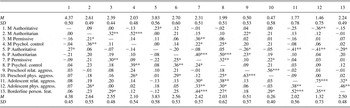
Descriptive statistics for all variables included in this study are presented in Table 1. Some general observations are worthy of note. The relatively modest correlations between most parenting dimensions (both within and across parent gender) speaks to the conceptual distinctiveness of the parenting constructs. Generally, the aversive forms of parenting (authoritarian, permissive, and psychological control) were modestly yet significantly correlated. Regarding the associations between parenting and child behavior, there were differential associations by gender of child and within or across time. There were associations evident for children of either gender. For boys, preschool authoritarian parenting (by both mothers and fathers) was concurrently and positively associated with levels of preschool relational aggression. Fathers' authoritativeness also negatively correlated with concurrent relational aggression in the child. In regard to associations with concurrent physical aggression, only paternal permissive parenting was positively associated for boys. For girls, in contrast, no forms of preschool parenting were concurrently associated with relational aggression. However, paternal authoritarian parenting as well as psychological control (by either parent) were positively associated with concurrent physical aggression in girls.
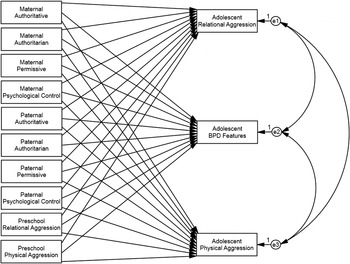
Graphic representation of the planned structural equation modeling multiple-group multiple regression: the relations of preschool parenting and aggression to adolescent aggression and borderline personality features.

Descriptive statistics and correlations by gender of child

Note: Descriptive statistics and correlations for boys are above the diagonal, and descriptive statistics and correlations for girls are below the diagonal. M, Maternal; P, paternal.
*p < .05. **p < .01. ***p < .001.
The longitudinal pattern of results differed considerably by gender. For boys, preschool authoritative parenting was associated with less relational and physical aggression in adolescence (for both mothers and fathers). Paternal authoritative parenting in preschool was also correlated with lower levels of borderline personality features in adolescence. Therefore, the correlational findings for boys focused on authoritative parenting as a protective feature. For girls, however, the associations between preschool parenting and adolescent relational aggression and borderline features were focused on the aversive forms of parenting (as risk factors). Correlations emerged between fathers' permissive or psychologically controlling parenting and adolescent physical and relational aggression in girls. Maternal authoritarian parenting (in preschool) also correlated with adolescent physical aggression in girls. Girls' adolescent borderline personality features were associated with permissive parenting by both fathers and mothers, as well as paternal psychological control.
Associations between preschool aggression and adolescent aggression or borderline personality features differed somewhat by gender of child. Preschool aggression and adolescent aggression were not significantly correlated for either boys or girls. For girls alone, preschool physical aggression was modestly correlated with adolescent borderline personality features. In adolescence, relational and physical aggression and borderline features were all significantly correlated.
Preliminary analyses (one-way analyses of variance) also assessed whether any gender differences existed in the mean levels of parenting received, relational or physical aggression, or borderline features for the children in this sample (see Table 1 for associated means and standard deviations). For maternal permissiveness, a significant result, F (1, 166) = 5.03, p < .05, showed that mothers reported more permissiveness with girls. In regard to preschool physical aggression, boys were perceived by teachers to engage in significantly higher levels over girls, F (1, 166) = 7.33, p < .01. Adolescent girls self-reported significantly more relational aggression than boys, F (1, 117) = 3.82, p = .05. Finally, the borderline personality features variable showed girls to have significantly higher scores, on average, F (1, 117) = 8.82, p < .01.
Structural equation modeling multiple-group multiple regression
A multivariate multiple-group multiple regression was conducted in structural equation modeling with the Mplus software (version 7.11; Muthén & Muthén, Reference Muthén and Muthén1998–2012). The regression was run using robust maximum likelihood estimation in order to account for missing data and to improve robustness to nonnormality of some of the aggression variables. The purpose of this regression model was fivefold: (a) to assess which preschool parenting patterns would prove most predictive in a multivariate context (in the company of competing parenting constructs as well as preschool aggression); (b) to assess whether there are differential or consistent associations between preschool parenting and later borderline personality features or aggression; (c) to assess whether maternal or paternal parenting patterns might be of greater relevance in the multivariate context; (d) to assess associations between preschool aggression and adolescent aggression or borderline personality features in the multivariate context, particularly in the company of the preschool parenting variables; and (e) to test moderation of the effects by gender of child.
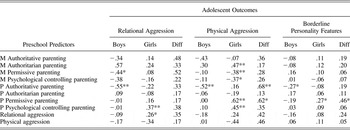
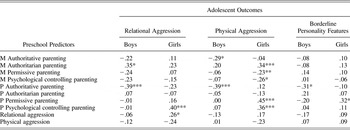
The initial statistical model is pictured in Figure 1 for reference purposes. Figure 1 does not depict the intercorrelations between exogenous variables, but they are included in the tested model. Given the complexity of the model, the resulting unstandardized and standardized estimates are placed in tabular format for greater readability (see Tables 2 and 3). Given that this is a fully saturated model, fit statistics are not reported. This model reflects the exploratory nature of our study; we had no theoretical reasons to constrain any paths to be equal to zero.
Unstandardized estimates and test of gender differences emerging from the structural equation modeling multiple-group multiple regression analysis

Note: M, Maternal; P, paternal.
*p < .05. **p < .01.
Standardized estimates emerging from the structural equation modeling multiple-group multiple regression analysis

Note: M, Maternal; P, paternal.
*p < .05. **p < .01. ***p < .001.
First, we address gender of child as a potential moderator. Results of the structural model showed that few paths (10%) evidenced gender moderation (Table 2 shows the unstandardized estimates and the respective differences). Specifically, differences by child gender emerged for the effect of paternal authoritative parenting (in preschool) on adolescent physical aggression, the effect of paternal permissive parenting (in preschool) on adolescent physical aggression, and the effect of paternal permissive parenting on adolescent borderline personality features.
Second, Table 3 shows the standardized estimates by gender of child for the structural model. Results showed that preschool relational aggression emerged predictive of adolescent relational aggression for girls, even though this association did not reach significance at the bivariate level. Preschool physical aggression yielded no predictive associations. Thus, in the context of preschool physical aggression and parenting variables, preschool relational aggression (teacher report) is relevant for predicting self-reports of relational aggression in adolescence. Consistent with the bivariate findings, the majority of findings emerged for preschool parenting as a predictor of adolescent functioning. These findings differed considerably by gender of child.
For boys, authoritative parenting during preschool was predictive of lower adolescent relational aggression (fathers), as well as lower adolescent physical aggression (fathers and mothers) and borderline personality features (fathers). In addition, maternal authoritarian parenting emerged as a significant predictor of greater relational aggression for adolescent males.
For girls, paternal permissiveness was associated with higher levels of adolescent physical aggression and borderline features. Paternal psychological control also predicted increased adolescent relational and physical aggression. Maternal authoritarian parenting was predictive of increased physical aggression in adolescence. Two suppressor effects were also present in the model results for girls (change in sign and magnitude from the bivariate associations for maternal permissive parenting and psychological control).
Discussion
The purpose of this study was to examine early aggressive behavior and parenting as predictors of BPD features and aggression subtypes (including relational aggression) in adolescence. Aggression in preschool generally did not predict BPD features in adolescence, particularly at the multivariate level. One exception existed at the bivariate level, with preschool physical aggression in girls associated with adolescent borderline features. It may be that early childhood aggression may not be among the most promising early indicators of BPD. Future research may clarify that assessment of aggression in middle childhood and may prove more predictive. It is possible that aggression is not fully settled as a traitlike phenomenon this early in peer group experience. Conversely, we found moderately strong concurrent associations between aggression and BPD features for both boys and girls. This confirms a growing body of research confirming a concurrent link between both physical and relational aggression and BPD (Crick et al., Reference Crick, Murray-Close and Woods2005; Ostrov et al., Reference Ostrov, Hart, Kamper and Godleski2011; Ostrov & Houston, Reference Ostrov and Houston2008; Tackett & Ostrov, Reference Tackett and Ostrov2010). In addition, these findings highlight the importance of continuing to examine both relational and physical forms of aggression as predictors of BPD.
We also assessed stability of both forms of aggression (preschool teacher ratings predicting adolescent self-reports) and found that relational aggression was stable across a 10-year period for Russian girls, at least when preschool parenting is simultaneously taken into account. To our knowledge, this is the first study to show stability of relational aggression from early childhood to adolescence. This highlights the importance of early intervention by teachers and parents to reduce aggression during the preschool years. It also suggests that, even though research generally suggests a relatively small mean difference between boys and girls in their practice of relational aggression (Card, Stucky, Sawalani, & Little, Reference Card, Stucky, Sawalani and Little2008), individual patterns are more stable in girls and may therefore deserve extra attention. It will be interesting to explore whether this finding is replicable, regardless of the informants employed at each time point.
In contrast with early aggression, we found that early parenting was predictive of BPD features in adolescence. Specifically, preschool parenting was predictive above and beyond the influence of preschool aggression. To our knowledge, this is the first longitudinal study to show that early parenting can influence the development of BPD features in adolescence. The results differed substantially based on combinations of child and parent gender. For boys, paternal authoritative parenting in preschool was associated with lower levels of adolescent BPD features (both at the bivariate and multivariate levels). Maladaptive parenting strategies, such as authoritarian, permissive, and psychological control, were not associated with BPD features in boys over time. Therefore, early authoritative parenting may be central in acting as a protective factor for Russian boys. Children's first relationships are with their parents; by using authoritative parenting to model appropriate behavior in relationships, parents may reduce the likelihood that their children may develop certain features related to BPD over time.
In contrast, paternal permissive parenting was associated with higher levels of borderline personality features in girls. At the bivariate level, maternal permissive and paternal psychological control were associated with BPD features as well, but they were no longer significant in the multivariate context. The inability of a parent to provide appropriate regulation of child behavior (permissiveness) may therefore lead to more impulsive and disruptive behavior, elements which may serve as precursors to borderline pathology.
It is notable that early paternal but not maternal parenting was predictive of BPD features in adolescence (at least at the multivariate level). This highlights the importance of examining early father behaviors in the development of BPD, in a field that has primarily focused on the mother/child relationship (e.g., Bezirganian et al., Reference Bezirganian, Cohen and Brook1993; Carlson et al., Reference Carlson, Egeland and Sroufe2009). The evidence here further reinforces what fatherhood researchers have been saying for a long time: fathers are vital contributors to child well-being (Amato & Rivera, Reference Amato and Rivera1999; Lamb, Reference Lamb2004; MacDonald & Parke, Reference MacDonald and Parke1984). A number of studies have found that fathers seem to be more influential than mothers in some domains for a variety of child outcomes (e.g., Carson & Parke, Reference Carson and Parke1996; Hart, DeWolf, Woznia, & Burts, Reference Hart, DeWolf, Wozniak and Burts1992; Hart et al., Reference Hart, Nelson, Robinson, Olsen and McNeilly-Choque1998; Nelson & Coyne, Reference Nelson and Coyne2009). This study is also valuable in that it not only considers the parenting influence of fathers but also includes father self-reports, rather than maternal or child reports of fathers' parenting. Fathers should be ideally allowed to speak for themselves in any studies assessing familial influences as either risk or protective factors for BPD.
It is interesting that, at least with this sample, paternal parenting seems to act as a protective factor in the development of BPD for boys, but as a risk factor for girls. The reasons for this gender differentiation are not entirely clear. Both social learning and gender socialization theories would suggest that fathers may have a greater influence on their sons than their daughters, particularly in terms of social expectations (e.g., Harris & Morgan, Reference Harris and Morgan1991; Morgan, Lye, & Condran, Reference Morgan, Lye and Condran1988). Fathers may spend more time with their sons than with their daughters and may be more involved in their son's upbringing (e.g., Harris & Morgan, Reference Harris and Morgan1991). In this case, positive parenting may be particularly influential as fathers model appropriate interpersonal interaction for their sons and especially establish warm, supportive relationships with their sons. It is less clear why aversive parenting is not a significant risk factor for Russian boys, however.
Research has also found that fathers are important to daughters, especially in terms of their relationships with men (e.g., Freeman & Almond, Reference Freeman and Almond2010). Yet gender socialization and social learning theories would suggest that daughters would be more likely to model their mother's as opposed to their father's positive behavior. In the case of girls, who may not enjoy as much of their fathers' attention, it appears most important that fathers limit their engagement in aversive parenting. Given the inclusion of relational aggression in this study, it is important to note that prior studies of parenting and relational aggression find that aversive parenting by fathers is often related to the engagement of girls in relational aggression, across developmental periods as well as cultures (Nelson & Crick, Reference Nelson, Crick and Barber2002; Nelson et al., Reference Nelson, Yang, Coyne, Olsen and Hart2013; Yang et al., Reference Yang, Hart, Nelson, Porter, Olsen, Robinson, Day and Lamb2004). Girls appear to be reactive to the maladaptive parenting of their fathers.
Because previous studies linked BPD with parenting behaviors such as intrusiveness, invalidation, criticism, and lack of empathy, which are also included within the constructs of authoritarian or psychologically controlling parenting (Bandelow et al., Reference Bandelow, Krause, Wedekind, Broocks, Hajak and Rüther2005; Cheavens et al., Reference Cheavens, Rosenthal, Daughters, Nowak, Kosson and Lynch2005; Goldberg, et al., Reference Goldberg, Mann, Wise and Segall1985; Golomb et al., Reference Golomb, Ludolph, Westen, Block, Maurer and Wiss1994; Laporte & Guttman, Reference Laporte and Guttman2007; Nickell et al., Reference Nickell, Waudby and Trull2002; Sturrock et al., Reference Sturrock, Francis and Carr2009; Zweig-Frank & Paris, Reference Zweig-Frank and Paris1991), we believed that we would obtain similar results. For girls, permissive and psychological control did emerge as significant correlates of borderline pathology. No findings emerged for boys. The modest findings may be partially explained by the lack of variability for adolescents' BPD features. There were probably no adolescents in the sample who would actually warrant a BPD diagnosis. By extension, a larger sample may have yielded greater variability that may have influenced the pattern of results.
In our model, we have not considered potential control variables. For example, the literature suggests that childhood trauma and abuse are related to the development of BPD (Crawford et al., Reference Crawford, Cohen, Chen, Anglin and Ehrensaft2009; Machizawa-Summers, Reference Machizawa-Summers2007; Rogosch & Cicchetti, Reference Rogosch and Cicchetti2005; Spatz-Widom et al., Reference Spatz-Widom, Czaja and Paris2009; Zanarini et al., Reference Zanarini, Williams, Lewis and Reich1997). However, our measurement of more normative forms of parenting may to some degree reflect overlap with more extreme forms of aversive parenting for some families. In addition, other variables, such as the child's genetics or personality traits/temperament, can also be related to BPD features (Crick et al., Reference Crick, Murray-Close and Woods2005), and future studies may take those into account in the context of parenting assessments.
Although our study suggests that early parenting may be influential in the development of BPD features in adolescence, parent–child relationships are reciprocal in nature (Carson & Parke, Reference Carson and Parke1996). Though BPD is not routinely diagnosed in early childhood, the markers of BPD, such as emotional instability, aggression, and impulsiveness, may be manifest in early childhood (Crick et al., Reference Crick, Murray-Close and Woods2005). Parents may find it more difficult to use authoritative parenting to counter such tendencies, and they may resort to more maladaptive parenting strategies. We did not measure BPD features in preschool, so the implied directionality of our findings should be viewed cautiously.
Associations were also found between early parenting and aggression in adolescence, and these varied for boys and for girls. Given that self-reports of aggression and borderline personality features were moderately to highly correlated, it is not surprising that some of the findings here are parallel with those obtained for borderline personality features. Generally, positive parenting acted as a protective factor against aggression in boys, while negative parenting acted as a risk factor for girls. In particular, authoritative parenting by both mothers and fathers in preschool appeared to act as a protective factor for both physical (fathers only) and relational aggression in adolescence for boys. This is the first study to demonstrate this association over time for relational aggression, particularly when controlling for earlier manifestations of the same. Through their parenting, authoritative parents may teach their children to be more empathetic, compassionate, and self-regulatory, all characteristics which have been shown to decrease aggression in childhood and adolescence (e.g., Coyne et al., Reference Coyne, Nelson, Underwood, Smith and Hart2010; Olsen, Lopez-Duran, Lunkenheimer, Change, & Sameroff, Reference Olsen, Lopez-Duran, Lunkenheimer, Change and Sameroff2011; Van der Graaff, Branje, De Wied, & Meeus, Reference Van der Graaff, Branje, De Wied and Meeus2012). Future research should examine the specific mechanisms by which early authoritative parenting decreases the chances of later relational aggression in the child.
Maternal authoritarian parenting did predict boys' relational aggression over time. Yet maladaptive parenting strategies in preschool were predominantly associated with increased adolescent aggression for girls. Specifically, maternal authoritarian parenting was associated with increased physical aggression. Paternal psychological control was associated with increased relational and physical aggression, while paternal permissiveness was related to physical aggression. Our findings confirm a growing body of research showing that negative forms of parenting in preschool can act as a concurrent risk factor for multiple forms of aggressive behavior (e.g., Hart et al., Reference Hart, Nelson, Robinson, Olsen and McNeilly-Choque1998, Reference Hart, Nelson, Robinson, Olsen, McNeilly-Choque, Porter, Kerns, Contreras and Neal-Barnett2000; Nelson, Hart, et al., 2006), and this study further demonstrates that the influence can span a decade. Parents may model aggression in their own behavior or may also inadvertently teach children maladaptive ways of coping with peers.
It is also worth noting that the concurrent (bivariate) associations between preschool parenting and aggression are consistent with the findings of several studies (e.g., Hart et al., Reference Hart, Nelson, Robinson, Olsen and McNeilly-Choque1998; Nelson, Hart, et al., 2006). For boys, maternal and paternal authoritarian parenting were positively associated with relational aggression. Authoritative parenting by fathers was also associated with lower levels of relational aggression. Paternal permissiveness was associated with higher physical aggression. For girls, there were no concurrent associations between parenting and relational aggression, but paternal authoritarian control and psychological control (by mothers and fathers) were all positively associated with levels of physical aggression.
However, there are a number of gender differences in our results that demonstrate the need for ongoing research. For example, why would maternal authoritarian parenting predict aggression while paternal does not? Why would maternal authoritarian parenting predict physical aggression for girls, but relational aggression for boys? It is also the case that paternal parenting emerged as the most significant predictor of adolescent outcomes (both aggression and borderline pathology). When there was evidence of moderation by gender of child, it was always for the paternal parenting effects (authoritative and permissive parenting). It is not rare for one parent's behavior to predict child outcomes while the other parent's behavior does not (e.g., Gryczkowski, Jordan, & Mercer, Reference Gryczkowski, Jordan and Mercer2010; Hart et al., Reference Hart, Nelson, Robinson, Olsen and McNeilly-Choque1998; McKinney, Donnelly, & Renk, Reference McKinney, Donnelly and Renk2008; McKinney & Renk, Reference McKinney and Renk2008; Nelson & Coyne, Reference Nelson and Coyne2009; Nelson, Hart, et al., 2006; Paulson & Sputa, Reference Paulson and Sputa1996; Phares, Fields, & Kamboukos, Reference Phares, Fields and Kamboukos2009; Yang et al., Reference Yang, Hart, Nelson, Porter, Olsen, Robinson, Day and Lamb2004). Such gender differences become so complicated that recent research has suggested researchers shy away from examining general parenting trends and instead examine maternal and paternal parenting practices separately for boys and for girls, particularly in adolescence (e.g., McKinney & Renk, Reference McKinney and Renk2008; Paulson & Sputa, Reference Paulson and Sputa1996; Phares et al., Reference Phares, Fields and Kamboukos2009). Mothers and fathers do parent their children differently depending on the sex of the child (e.g., Gryczkowski et al., Reference Gryczkowski, Jordan and Mercer2010). Therefore, we choose not to speculate too much on the many gender differences in our results. Instead, we encourage researchers to continue to examine maternal and paternal parenting separately for boys and for girls. Perhaps, with time, some consistency will emerge across studies and inform our theoretical understanding of how gender of parent and child may combine in various ways in the prediction of child outcomes. It is more important that we encourage mental health professionals to include both parents in therapy, bringing in an understanding of these complex gender issues and that parenting should not be examined in simplistic terms.
Although this study had many strengths, a number of limitations are evident. First, the insights derived from a Russian sample may have limited generalizability. Second, the validity of the parenting assessments may be enhanced with partner reports of parenting (e.g., Yang et al., Reference Yang, Hart, Nelson, Porter, Olsen, Robinson, Day and Lamb2004). Third, several of the parenting scales had only moderate reliability, though this is not uncommon in the parenting literature. It nonetheless suggests that additional refinement of parenting measures is needed. Fourth, it may be considered a limitation in the current data set that adolescents self-reported both their levels of aggression and their borderline personality features. We see some value in this, however, because it does allow us to assess the self-perceptions of those who struggle with features of BPD. It is clear that the more often individuals report BPD features, the more likely it is that they will see themselves engaging in aggressive behaviors at higher levels. Particularly in studying the more subtle forms of relational aggression in adolescence, such as indirectly yet intentionally excluding others, self-reports may give unique insights into the associations of relational aggression with other variables.
Despite these limitations, this study has a number of important implications for parents, teachers, and mental health professionals. Collectively, these results paint a picture regarding aggression, parenting, and BPD. When examining the etiology of BPD, the majority of studies focus on neurophysiological and genetic predictors of BPD (Gundersen et al., 2013; Leichsenring, Leibing, Kruse, New, & Leweke, Reference Leichsenring, Leibing, Kruse, New and Leweke2013). However, our results show that parental factors are also important in understanding both the development of BPD and aggression, a key correlate of BPD. These findings have important implications for the treatment of BPD. It may be difficult to modify physiological or genetic markers for BPD. In contrast, mothers and fathers have the power to change their parenting. Therefore, therapists could focus on teaching parents to use authoritative strategies as opposed to more maladaptive forms. Our results suggest that early intervention may be particularly important, given that parenting in early childhood is predictive of both BPD and aggression a decade later.
In conclusion, although the findings of this study were not fully what we expected, the strength of the associations between preschool parenting and adolescent outcomes a full decade later is quite impressive. Though the influence of physiological and genetic predictors are paramount in our understanding of the development of BPD (e.g., Gunderson et al., Reference Gunderson, Weinberg and Choi-Kain2013), we hope that future research continues to examine family predictors as also important to the etiology of BPD features in adolescence. It may well be that parenting in the early childhood years, when neurological malleability is considered to be greatest, leaves an enduring imprint on the child's development.