Introduction
In October 2006, the United Kingdom (UK) government introduced employment regulations that prohibit age discrimination in the workplace. The Employment Equality (Age) Regulations 2006 (SI 2006/1031) (hereafter referred to as the Age Regulations) cover a range of workplace issues including pay, benefits, recruitment and redundancy. These regulations implemented the age-equality aspects of European Community Directive 2000/78/EC that sets a general framework for equal treatment in employment and occupation. While drafting the Age Regulations, one of the most difficult tasks faced by the Department of Trade and Industry (DTI; now the Department for Business Innovation and Skills) was whether or not to allow employers to set a mandatory retirement age. In the end, the government accepted the employers' case and opted for a ‘default retirement age’ of 65 years. While employers can lawfully dismiss employees on reaching that age, the regulations also specify a ‘duty to consider’ requests to remain in work beyond 65. When an employer informs an employee of its intent to retire her or him, the employee has the right to request to continue in work, to meet a manager of the organisation to discuss the request, and to appeal if (s)he is dissatisfied with the outcome (DTI 2005: para. 6.3.5). So long as the employer follows the procedure set out in the Age Regulations for informing and consulting the employee on the decision to retire, it can compulsorily retire the employee without needing to justify its decision.
It has been suggested that retirement is ‘both the leading form of age discrimination and the driving force behind the wider development of ageism in modern societies’ (Walker Reference Walker and McEwen1990: 59). Retirement is particularly ‘ageist’ because an employee can be dismissed solely on the basis of her or his age. There appears to be a contradiction between the principal aim of the Age Regulations (to eliminate age discrimination at the workplace) and the default retirement age. Governments across the developed world have taken various approaches to regulating mandatory retirement (i.e. the age at which an employee is compelled to leave work). In the European Union (EU), Ireland, Denmark and France have default retirement ages of 65 years, while in Sweden and Norway it is 67 years. Employment protection laws, state pension rules and sector-level collective agreements also either restrict or create heavy disincentives for people to stay in work beyond age 65 in Germany, France and some Eastern European countries. The United States of America (USA) and Canada have abolished mandatory retirement for the most part, although in the USA it is still permitted for some occupations, and in Canada it still applies in some provinces (Organisation for Economic Cooperation and Development (OECD) Reference Meadows2006).
The business case approach to the regulation of retirement
The hallmark of the UK government's approach to mandatory retirement is a ‘business case strategy’ approach (Bunt et al. Reference Bunt, Adams, Carter and Hopkins2005; IRS Management Review 2001; Riley, Metcalf and Forth Reference Riley, Metcalf and Forth2007). This relies on employers accepting that extended employment brings benefits such as improved retention, performance, productivity or service delivery and employee loyalty. In fact, although equal opportunity policies have been shown to have positive effects on workplace morale (McIntyre et al. Reference McIntyre, Bartle, Landis and Dansby2002), the impact on organisational performance is uncertain (Riley, Metcalf and Forth Reference Riley, Metcalf and Forth2007). Some have argued that retaining older workers has business advantages in addressing skills and labour shortages, giving flexibility in workforce planning, and retaining useful skills and knowledge (Bunt et al. Reference Bunt, Adams, Carter and Hopkins2005; IRS Management Review 2001). When introducing the default retirement age and the right to request, the government stated that it ‘wants to move away from a culture that retires people without regard to the contribution that they can still make to the labour market’ (DTI 2005: para. 6.3.1).
The ‘business case’ strategy has been described as a ‘privatised approach’ to retirement regulation because it leaves implementation of the measures to employers (Dickens Reference Dickens2006), and because they are likely to be guided primarily by short-term market pressures, long-term equality goals may be neglected (Colling Reference Colling1997; Wainwright Trust 1997). The business case approach makes the pursuit of age-equality goals secondary to business performance (Duncan Reference Duncan2003, Reference Duncan2008; Forbes Reference Forbes, Lovenduski and Norris1996). When labour market conditions are perceived to be compelling, employers are likely to make retention decisions that run counter to the equality goals, so the government's approach appears paradoxical. On the one hand, its goal is to change the ‘culture’ of retirement; that is, how employers manage their employees' retirements, but on the other hand, it is exceptionally ‘light touch’ (DTI 2005: para. 6.3.3.), although there was a commitment in the draft regulations to review the default retirement age by 2011 ‘with a view towards abolishing it’ (DTI 2005: para. 1.13), and that has subsequently been brought forward to 2010 (Department for Work and Pensions 2009).
Although the ‘duty to consider’ as a regulatory instrument is unique to the UK, the business case approach is not. Several countries have left the initiative to raise actual retirement ages to employers' decisions. The Japanese 2004 amendment to the Stabilisation Laws, for example, gives employers the option of developing programmes for post-retirement work as an alternative to abolishing or raising company retirement ages (Williamson and Higo Reference Williamson and Higo2007). National implementations of the EC Equality (Age) Directive mostly leave the regulation of work after 65 to either employers or collective agreements (Sargeant Reference Sargeant2008). Further, voluntary regulations concerning flexible work, gender equality and disability have been or are being adopted by many countries. Because the ‘duty to consider’ is central to the business case approach to age equality and extending working ages, there are both academic and public policy reasons for considering its effectiveness.
Employment after 65 years
There have been intense debates in the European Commission (EC) and among the EU member states about employers' practices regarding retirement. Partly in response to a target to raise the economic activity rate of those aged 55–64 years, and the comparatively high levels of early retirement throughout Europe, most of the recent literature has focused on employers' practices that lead to retirement before age 65, but there is a significant difference between working before and after a mandatory (or default) retirement age. Because retirement is in itself a justification for dismissal, working beyond 65 is contingent. As Taylor and Walker (Reference Taylor and Walker1998) observed, the UK State Pension Age (SPA) can be seen as a form of ‘institutional ageism’ since it provides an effective marker at which people are normally required to leave the labour market irrespective of capability or performance.
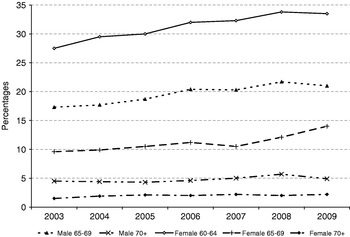
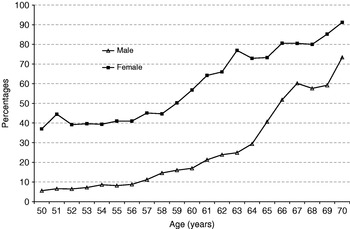
Two studies commissioned by the Department for Work and Pensions (DWP) cast light on the characteristics of the UK workforce aged more than 65 years. One was a review of national surveys and showed that eight per cent of people aged over the SPA are in work, and among them that one-third of men and 56 per cent of women work part-time (Smeaton and McKay Reference Smeaton and McKay2003). It also revealed that the vast majority of people who continue to work after 65 remain in their previous jobs rather than take ‘bridge employment’ (Smeaton and McKay Reference Smeaton and McKay2003: 27). Data from the 2009 UK Labour Force Survey (LFS) show that the profile of the over-SPA workforce has not greatly changed with the introduction of the Age Regulations, although there has been slight growth. In 2003, 17 per cent of men aged 65–69 years were in work, whereas in 2009 the percentage was 21. A similar rise can be seen amongst women aged 60–64 years (they are older than the female SPA but below the default retirement age). The rise in the over-SPA workforce reflects more general trends, however, and is not directly attributable to the Age Regulations (Figure 1). The relative shift from full-time to part-time work begins for women in their mid-fifties: the percentage in part-time work nearly doubles between the ages of 56 and 63 (Figure 2). For men, the sharpest rise begins at 64 years. It is not possible to determine from LFS data the degree to which workers switch to part-time work when they reach 65 years, or to which full-time workers disproportionately leave the workforce.
Percentage of older age–sex groups in employment, UK, 2003–09.

Percentage of employees in part-time work by gender, UK, 2009.

The second DWP-commissioned study suggested that the post-SPA workforce could be divided into three groups: ‘Entrepreneurs’, ‘Professionals and Creatives’ and ‘Workers’ (Barnes, Parry and Taylor Reference Barnes, Parry and Taylor2004). The defining characteristics of the three groups primarily centred on their labour-market positions. Entrepreneurs were mainly self-employed people whose ownership of their businesses gave them flexibility in their retirement. Professionals and Creatives tended to be highly skilled and in a strong bargaining position with their employers. They stayed in work because they enjoyed its intrinsic satisfactions. Workers tended to have low skills, to be in low wage, insecure jobs, and to need to continue for financial reasons. The authors suggested that the Workers were the most vulnerable of the three groups, as many had been made redundant late in life. Professionals and Creatives, by contrast, enjoyed ‘a fairly high degree of choice, flexibility and autonomy’ (Barnes, Parry and Taylor Reference Barnes, Parry and Taylor2004: 18). It is apparent that post-65 workers in low-skilled jobs have the most need for the job security that would follow from abolishing mandatory retirement. Unlike the Professionals and Creatives, they lack the rare skills that employers are most likely to want to retain. This is not to say that Workers are incapable of continued working, but they are more likely to be replaceable.
Three conclusions can be drawn from the DWP-commissioned studies and recent LFS data. First, unlike in the Asian countries with high retirement ages (Doling, Finer and Maltby Reference Doling, Finer and Maltby2005), reaching normal retirement age does not mark a new career stage for those who choose to stay in work. In the UK, most who work beyond age 65 stay in the same post for the same employer. Their working hours may change (or full-time workers may disproportionately drop out of the labour market), but the job description and employer does not. Second, because the employment contract changes, the segmentation of the older workforce increases among those aged 65 or more years. Some workers are able to continue selling marketable skills to their employers, but the majority are not. This segmentation is associated with qualifications and job status. Third, the impact of the current recession has not yet hit the post-65 workforce. This could perhaps reflect employers' willingness to retain older workers on a contingent basis during the current period of economic uncertainty.
Employers' retirement policies
Prior to the Age Regulations, only a minority of British employers had mandatory retirement ages. A survey of employers commissioned by the DWP found that 37 per cent stipulated a mandatory age in employees' contracts (although they employed one-half of the UK workforce) (Metcalf and Meadows Reference Metcalf and Meadows2006). Those with a set retirement age tended to be relatively large and were more likely to be in the public than the private sector. Several reasons were given for the fixed retirement age. Many employers were guided by the ages of eligibility to occupational and state pensions, and some believed that younger workers are more productive or deserving of work placements (Meadows Reference Meadows2004). Arguably, the UK government tacitly supported the principle of ‘making way for younger workers’ when it argued that ‘a significant number of employers use a set retirement age as a necessary part of their workforce planning’ (DTI 2005: para. 6.1.14). A strong motivation of a specified retirement age has been concern about how older workers with declining capabilities can be managed out of the workplace (Robertson and Tracy Reference Robertson and Tracy1998). During the consultation process for the Age Regulations, the debate centred on whether employers' human resources (HR) management systems had the capability to deal with the exit of older workers without the aid of a mandatory retirement age. The Chartered Institute for Personnel Development (CIPD), the two main older people's age lobby organisations (Help the Aged and Age Concern), and the Trades Union Congress (TUC) led a campaign to abolish mandatory retirement ages completely, so that employers would be restricted to dismissing individuals only for reasons of performance, conduct or redundancy. Employers' groups, led by the Confederation of British Industry (CBI), on the other hand, campaigned strongly to retain mandatory retirement, seeing this aspect of HR policy as critical for employers' ability to manage their workforce.
Perceptions of older workers also play a strong role in retirement practices. There is evidence that age discrimination at the workplace is widespread in the UK, particularly against older workers (Duncan, Loretto and White Reference Duncan, Loretto and White2000; McNair and Flynn Reference McNair and Flynn2005; Sargeant Reference Sargeant1999). It has been noted that employers have both positive and negative stereotypes of older workers (Itzin, Phillipson and Laczko Reference Itzin, Phillipson and Laczko1993; Loretto and White Reference Loretto and White2005; Taylor and Walker Reference Taylor and Walker1998). Positive stereotypes include perceptions that older workers are more reliable and perhaps more loyal than younger employees. Negative stereotypes include perceived inflexibility and inability to learn new skills. The perceptions of older workers' ability and willingness to learn translate into reduced training opportunities (Taylor and Urwin Reference Taylor and Urwin2001). Further, a sense of loyalty probably leads employers to be less rigorous in performance managing older workers, especially if they are close to or past retirement age (McNair and Flynn Reference McNair and Flynn2005), but they also perceive older workers to have declining performance and appear to be less willing to invest in older than younger workers to keep their skills up to date (Chiu et al. Reference Chiu, Chan, Snape and Redman2001; Loretto and White Reference Loretto and White2006). According to the DWP survey, most British employers with a mandatory retirement age prior to the Age Regulations were willing to consider requests from employees to delay retirement (Metcalf and Meadows Reference Metcalf and Meadows2006). Only seven per cent (employing 11% of the UK workforce) said that employees would not be allowed to stay in work in any circumstances. A large majority (76%), however, gave line managers discretion in deciding whether or not to delay an employee's retirement and said that they would only permit such an arrangement, ‘where there is a business need which would be difficult to otherwise meet’.
Overall, the literature provides some insight into how employers might approach the ‘duty to consider’ requests to delay retirement. First, research on the experience of post-SPA workers suggests that retention of key skills may be a particularly powerful incentive for employers to allow people to stay in work (Barnes, Parry and Taylor Reference Barnes, Parry and Taylor2004; McNair and Flynn Reference McNair and Flynn2005; Taylor and Walker Reference Taylor and Walker1998). It is also a key factor in persuading employers to provide flexible working arrangements and training which can help older employees stay active, but employers are less willing to invest in training older workers, in part because of preconceptions that older people are unwilling to participate in learning activities or that the organisational benefits from investing in training an older worker will not be realised before the employee retires (Itzin, Phillipson and Laczko Reference Itzin, Phillipson and Laczko1993). Second, British employer and government policies have historically reflected the treatment of older workers as a ‘reserve army of labour’ (Phillipson Reference Phillipson and Cohen1987; Riach Reference Riach2006; Taylor Reference Taylor2002) that is brought in and dispensed with as the need for labour fluctuates. During previous recessions, the UK government and employers have provided incentives for older workers to leave the labour market early (Kohli et al. Reference Kohli, Rein, Guillemard and Gunsteren1991). More recent rises in older worker activity have been attributed to skills needs in certain regions of the country and specific sectors (Taylor Reference Taylor2003; Taylor and Walker Reference Taylor and Walker1994). Even in retailing, which has trumpeted its strategies for recruiting older applicants, job opportunities are mainly in routine front-line posts that require little training and for which flexible work arrangements are easy to arrange (McNair and Flynn Reference McNair and Flynn2005; Taylor and Walker Reference Taylor and Walker1994).
Finally, it should be recognised that employers' practices in relation to retirement may not be fully reflected in their published or revealed HR policies. Metcalf and Meadows (Reference Metcalf and Meadows2006) suggested that only a minority of employers have explicit mandatory retirement ages. It is not clear, however, whether employers without such policies allow older people to stay in work. Small employers, in particular, may retire people when they reach a certain age (commonly the SPA), even if not a declared policy (Arrowsmith and McGoldrick Reference Arrowsmith and McGoldrick1997). Although most employers that have formal retirement ages have been willing to consider requests from employees to delay retirement, a large majority only did so when there were compelling business reasons.
Aims and design of the new study
The aim of the study reported in this paper was to establish how UK employers were adapting to the Age Regulations, in particular the ‘duty to consider’ requests to stay in work beyond the default age (McNair, Flynn and Dutton Reference McNair, Flynn and Dutton2007). It was conducted in 2007 for the DWP and focused on the impact of the Age Regulations on employer practices that impact on older workers' employability, including retirement. HR policies, their implementation and the practical outcomes were of interest. The focus of this paper is on not just the retirement policies which employers are adopting, but also their implementation, dissemination to workplace level, and impact on organisation culture. A useful framework for analysing the impact of government policy on employers' management of older workers has been formulated by Taylor and Walker (Reference Taylor and Walker1998). This framework has been used extensively in previous studies on HR policies relating to age (e.g. Vickerstaff, Cox and Keen Reference Vickerstaff, Cox and Keen2003; Coupland, Tempest and Barnatt Reference Coupland, Tempest and Barnatt2008; Snape and Redman Reference Snape and Redman2003). Taylor and Walker identified four key features of employers' treatment of older workers and these guided the design of the interviews:
• Orientation. Whether or not there is a perceived need for policy, and whether the policy is based on the integration or exclusion of older people.
• Depth of commitment. Whether employers' commitment to retaining older workers is strong or weak; and the degree to which policies are formalised.
• Scope and coverage. The extent to which HR policies relating to older workers cover the entire workforce versus the targeting of specific groups; and the degree to which age management policies are generalised or older worker specific.
• Implementation. Whether senior management is active or passive in implementing HR policies toward older workers; and the extent to which policy implementation is partial or extensive.
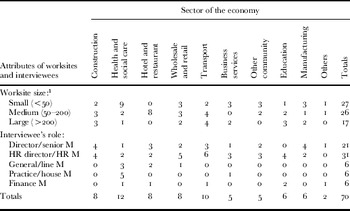
As Table 1 details, 70 interviews were conducted in 2007 of managers in nine UK Standard Industrial Classification sectors: business services (a disparate sector that includes information technology, accounting, legal services and real estate services); charities (other community, social and personal activities); construction; education; health and social care; hotels and restaurants; manufacturing; wholesale and retail; and transport (for the classification seeNational Statistics 2002). The main excluded sectors were agriculture; fishing; and mining (because of the special organisational features of enterprises in these sectors); electricity, gas and water supply (because of the small number of employers in the sector); and public administration and defence (as the DWP had commissioned a separate review of age management practices in the UK civil service). The respondents were recruited from a database of British organisations to ensure representation of organisations not only by sector, but also size and geographical region.
Distribution of the interviewees by sector of the economy and job description

Notes: M: manager. 1. Number of employees.
The respondents were senior-level managers (either HR professionals or other directors) and lower-level managers. In terms of management level, sampling was purposive for understanding the development of HR policies and their implementation at the workplace level. All three groups of managers were interviewed in all the included sectors. Single interviews were conducted in each organisation. Case studies of age management practices in particular organisations were also conducted and have been reported elsewhere (McNair and Flynn Reference McNair and Flynn2005). The respondents were asked a series of questions about the economic and labour market environments of their organisations, about their attitudes towards employing workers aged 50 or more years, and the organisation's human resource policies, including retirement and the management of requests from employees to stay in work beyond retirement age. Interviews were semi-structured and took between 60 and 90 minutes. The aim was to bridge the gap between policy and practice. The interviews were taped, transcribed and coded using MaxQDA software (see http://www.maxqda.com/). The coding system was based on the interview guide. The transcripts were double coded and cross-checked by members of the research team commissioned by the DWP. In preparation for this article, I re-read the interviews coding on the basis of the Taylor and Walker framework. Full details of the methodology, including the interview schedule, are available in the DWP research paper (McNair, Flynn and Dutton Reference McNair, Flynn and Dutton2007).
Employer practices: findings
Retirement ages and retirement policies
Employers' practices regarding a set retirement age varied greatly, and many had recently changed their rules. Many organisations in all sectors, particularly small firms, had set a mandatory retirement age at 65 years. A few employers were abolishing their retirement ages, either because they expected the UK government eventually to abolish mandatory retirement, or because the employer had never enforced company policy. Contrary to the government's objectives (seeDTI 2005: para. 6.1.20), some managers had interpreted the Age Regulations as requiring employers to set retirement ages. A trade association representing small and micro firms recommended to its members that they establish written retirement policies which include retirement ages. As its representative said during the interview:
What we are recommending now is [that] they have a proper age and retirement policy. It should be the national 65 and that is when you retire, but now we have had to advise them that they must have a proper retirement policy.
A small business owner said that his firm had not had a mandatory retirement age before the new law, but had set one in response to the regulations because he was afraid that he would not be able to dismiss older employees whose performance was declining. Should he need to dismiss an older worker, the business owner did not have confidence that his performance management system was robust enough to compile the evidence to justify a dismissal. Setting a mandatory retirement age was therefore seen as an expedient by which to maintain established practice. By contrast, a married couple running a small manufacturing firm decided to abolish their company's retirement age after they turned 65 and found that they were as able to work as they had before. When asked how they had gone about abolishing the retirement age, the interviewee said, ‘We looked at it and thought, well we are not retiring. We couldn't see that it would be an issue for us’.
Some managers said that their employers had retirement ages of 65 because it was believed that this age was the only point at which workers could be compulsorily retired. One proprietor of a medium-size transport firm expressed surprise that retirement ages could be set higher. He had interpreted the regulations as permitting an employer only to dismiss an employee at her or his 65th birthday, after which the employee would be entitled to remain in work in perpetuity. Several respondents in organisations that had a retirement age of 65 noted that requests from employees to work longer were normally considered. Examples were given of employees who had been allowed to stay on after reaching the normal retirement age, although most were instances of individual accommodation based on the manager–employee relationship. Specific examples were described, but it was clear that these were exceptional individual cases and not the general rule.
Processes for considering requests
Some managers said that they or other managers had some experience of considering requests from employees who wanted to stay in work beyond retirement age. Those with payrolls dominated by manual workers, notably construction firms, said they had no such experience. One respondent from a large manufacturer noted that when one of the employees was directed to the firm's HR department to make such a request, the personnel manager reacted with surprise that any employee would wish to remain in work. The firm offered a generous pension scheme, and s/he believed that given the absence of financial need, there was no incentive for an employee to stay in work. With the exception of the large public-sector organisations, where requests to extend had been considered, the process was informal and usually handled by the employee's immediate line manager. Some small business owners said that prior to the new regulations their practice was automatically to allow employees to continue in work. One personnel manager, for example, noted that while preparing for the introduction of the Age Regulations, she was surprised to find that three members of staff had already passed 65 years of age. Another said that his organisation had never considered whether past retirees would have liked to stay in work longer, but that it could have benefited from doing so, for example by retaining older workers' skills and experience.
An HR manager for a printer said that his organisation's practice was to let people ‘carry on’, but that the regulations had compelled the organisation to institute a formal retirement process. He felt that this change in policy was beneficial to both the organisation and the employee since it impelled a conversation about how work routines could be modified (for example by reducing working hours) in ways that could help the employee stay active longer. He continued:
In the past, I think if nobody gave them a clock at 65, I think they just carried on really. So, we are probably very lax in not formally saying, ‘you are now working beyond retirement age which is why I have got to do something’.
Both prior to and after the introduction of the Age Regulations, line managers played instrumental roles in deciding whether an employee could delay retirement. Many respondents, particularly among HR staff, said that line managers are in the best position to assess the individual worker's performance and the organisation's need for their skills and experience. None of the respondents described a process which did not include line managers, although in large organisations senior managers were also involved. In one organisation, for example, the chief executive signed off any extension of employment contract because requests to delay retirement were unusual. The respondent managers, particularly those in small organisations, said that after the Age Regulations came into effect, their employers' policies on considering requests had been formalised. Retirement policies, which had hitherto not existed, were being written and disseminated. In both large firms and public-sector organisations, these tended to be written by HR practitioners. Small organisations relied on model retirement policies drafted by the Advisory, Conciliation and Arbitration Service (an independent agency largely funded by the government) and the Chartered Institute for Personnel Development.
The impact of the Age Regulations on retirement policies was not universally welcomed, with some managers describing the process prescribed in the regulations as ‘bureaucratic’ or a ‘paper exercise’, but their arrival had led some organisations, especially in the public sector, to introduce new ways of handling requests. A respondent from a university HR department said, for example, that they had appointed ‘age ambassadors’ who would advise line managers on phased retirement options because ‘managers don't always know that they can offer people shorter working hours or flexible working. Our job is to lay out all the options for them’. In a public-sector transport authority, at the time of the interview the HR department was intervening in line managers' discussions over retirement, and developing guidelines for managers on handling requests from employees, because ‘best practice necessitates a consistent approach to line managers’ decisions throughout the organisation'.
Interventions from HR departments were not universally considered positive. A local authority line manager responsible for running care homes described her experience managing a group of post-65-year-old workers who delivered meals to house-bound clients. She said that the local authority enforced a strict policy of retiring employees at 65 years, but noted that after she had retired an employee at 65, invariably the employee returned to work the next week as a volunteer. Believing this practice unfair, she decided not to retire employees who did not want to leave work and confided that she had managed to avoid informing her organisation's HR department that she was retaining employees older than 65. The respondents were asked how appeals against decisions were handled. In small or medium-sized organisations, a line manager would normally be responsible for handling both the initial request to delay retirement and subsequent appeals. In large organisations, the HR department would normally intervene if an employee appealed. HR practitioners would intervene to ensure that formal policies were being followed; to ensure employees felt that decisions were being made fairly; and to identify work opportunities for employees who wanted to delay retirement.
Factors which are taken into consideration
The respondents were asked to describe the factors that were taken into consideration when deciding whether or not to allow an employee to delay retirement. Business reasons tended to dominate. Managers felt that allowing employees to stay in work beyond retirement age would require managerial effort, such as crafting a part-time job for an employee who wanted to phase their retirement. Opportunities to stay in work beyond retirement age tended to depend on the availability of jobs that met the employee's needs. In some organisations in which flexible working was common (especially in health-care and social-care and the retail and hotel and restaurant sectors), the respondents said that managers generally assumed that employees were allowed to remain in work, especially in circumstances in which the older worker wanted to continue part-time. Work routines, job specifications and working hours were flexible enough to organise work to enable an older worker to stay employed. As one interviewee said, ‘most care workers work flexibly, so if someone wanted to stay but work less, we can usually accommodate them’.
Respondents from the retail sector also felt that flexibility in workforce planning allows line managers to permit employees to stay in work for as long as the employee wishes. The high turnover in the retail sector also favoured the retention of post-65 workers. Managers from the business services sector, manufacturing, construction and education tended to be more restrictive, but were willing to keep older employees in work as long as there was an operational need. In the business sector, for example, managers said that they allowed older workers to delay retirement to complete projects, but did not normally allow people to start new projects. One university manager expressed enthusiasm for academics to stay in work, but only so long as they teach specialist subjects or bring in new research contracts.
Workforce planning was an important consideration for employers whose workers were skilled, and was a concern for managers of small firms with limited career development opportunities for young workers. Some managers were concerned that increases in the older workforce would squeeze out younger recruits. A manager of a small workplace said that a decision to retain an older worker would take up one of the few opportunities for younger people's promotion. He noted that an older worker had voluntarily retired, even though the she wanted to work longer, to ‘make way’ for younger colleagues. Several managers expressed similar views of older workers' perceived duty to younger workers to retire if job opportunities are limited. Although small employers had limited available positions, some tried to find opportunities for older workers to work in partner organisations. For example, it was noted that health-care organisations share an intranet site that advertises internal vacancies. An HR manager of an independent primary health-care centre noted that if there were no local opportunities, she encouraged staff who wanted to work past the normal retirement age to seek work in local hospitals. Many respondents felt that where job opportunities are limited, workers older than 65 would be asked to retire in order to make way for younger colleagues. As one manager argued:
My inclination [for a redundancy] is for somebody aged 67 as opposed to age 27, not because one is better than the other, but because one has a pension and the other … will probably have a mortgage.
For managers in several sectors, the business-need issue focused on shortages in specific occupations. Such jobs, however, tended to be low-skilled and hard to fill. One respondent at a local school cited hard-to-fill cleaning jobs that older workers could take, while another described his company's use of older workers to fill posts with unpopular working hours:
We have a requirement to get the post on people's desks by 9.30 in the morning. This means at the moment that we have to employ people for two or three hours. … This work has proven attractive to people who have retired.
An interesting example of a firm using older workers to fill vacancies was found in a department store. The HR manager had previously worked for the store's town centre rival, and was aware that his former employer had a mandatory retirement age of 65 years. When he had vacancies to fill, the manager would telephone former subordinates who had formally retired, and ask them to work for his new employer.
Experiential knowledge retention was sometimes mentioned as an important factor that is taken into consideration. An HR manager for a construction firm said that having appropriate work experience was important to his firm. He noted that many of the basic skills needed in the construction industry have been ‘pretty much the same since the Roman viaducts were built’, so that older workers' potential for passing knowledge onto younger colleagues was highly valued. Both his firm and another large construction firm used post-65-year-old employees' skills in training apprentices. In the education sector, older workers with workplace experience and knowledge have opportunities to extend their working lives. A respondent from a university noted that a few academics aged 65 or more with a strong track record in gaining research grants were working on research projects that covered their salaries, and lecturers in some specialist subjects were encouraged to continue. It was noted, for example, that one of the university's schools had put considerable effort into trying to persuade a Professor of Shamanic Studies to continue in work beyond his pension age, because the university was unable to find a replacement with equivalent knowledge – an exceptional example of skills that cannot easily be replaced.
The employment relationship
The respondents were asked about the level of job security of employees aged over 65 years, and the impact of the regulations on the employer–employee relationship. One HR manager in the retail sector said that prior to the regulations, an employee would be retained only on a half-year fixed-term contract, but since their introduction the employer had kept post-65-year-old employees on their existing contracts of employment, with offers to remain in work year-by-year and an annual review of performance and business need. Under the Age Regulations, fixed-term contracts were no longer considered necessary. She described the new policy as administratively less onerous because her department no longer needed to draw up replacement employment contracts. She continued:
So that in itself made life a little bit easier, actually. We don't have to go through the process every six months and they don't have to think, have I been good, do I get another six months? So it's stopped that.
Importantly, however, the continuation of post-retirement employees in work was contingent, since the employer retained the right to dismiss when an employment contract came up for annual review. The regulations provided enough flexibility for the employer to dismiss older employees without retaining a fixed-term contractual regime. Contingent employment regimes were prevalent and sector specific. In the health-care and social-care sector, for example, employers frequently offered older nurses and social-care staff the opportunity to work as locums. Locum work was thought to be attractive to retired nurses who wanted to work occasionally. This enabled cover for staff absences and training and allowed retired staff to maintain contact without committing themselves to permanent work. An HR manager for a primary health-care centre noted that she had a large number of older nurses in locum posts, and noted that they participated in in-house training and staff meetings to coordinate with other workers.
Retail managers said that their employers offer retired employees contracts that do not guarantee the employee a fixed number of hours of work per week. This employment relationship is also intended to use older staff to cover short-term demands. While some respondents from large retailers had abolished the retirement age altogether, smaller ones tended to allow post-retirement staff to work only as-and-when required. Respondents from a few large manufacturers and business service employers said that retired employees have the opportunity to work as consultants, but that such work was generally reserved for highly skilled employees who attracted premium rates of pay.
They take their package, which is nice, and then come back, and they can work when they want to, far more flexibly of course. They don't have to work as many hours if they don't want to, or for so long, and they are earning much more, and they haven't got all the pressure as well as being an employee to do with politics.
While some employers expected to offer fixed-term or casual employment to post-65 employees, most managers said that in most cases continued employment was through extensions of existing contracts. This was partly to avoid falling foul of the Age Regulations. Managers also felt that the Age Regulations affords them the means to employ post-65 workers in flexible ways without relying on fixed-term contractual arrangements.
The employers' attitudes
The respondents were asked for their views on whether people aged over 65 years are capable of continuing in work past the normal retirement age. The managers' views were influenced by considerations of both experience and capability. Some thought that employees' capabilities decline as they age, and many believed that 65 years is a threshold past which performance declines too much for retention, although some respondents mentioned higher ages. An HR manager for a primary health-care centre, for example, said that her experience in delaying retirement for a receptionist has dissuaded her from granting more extensions. She noted that, after 68 years of age, the employee had slowed in her performance, taking more time to respond to patients and doctors. This manager felt that the employee's declining performance was inevitable. The employer did not intervene or address the employee's problems (as with training or job redesign). Importantly, the health-care centre was a private practice. Respondents in National Health Service (NHS) facilities referred to the performance management systems that are rigorously enforced by the responsible NHS trust, which they saw as constraining the influence of line managers' personal biases.
Discussion
When the UK government introduced the default retirement age and the duty on employers to consider requests from employees to work beyond 65 years of age in terms of ‘the business case’, it sought to change the established ‘culture of retirement’. Its impact on management practices is discussed using the Taylor and Walker (Reference Taylor and Walker1998) framework.
Orientation
Most of the interviewed managers saw a strong case for considering requests from employees to delay retirement, but few felt that people aged 65 or more years should have an automatic right to stay in work. Only a few organisations surveyed had abolished their retirement ages in response to the age discrimination regulations. The exceptions were two small firms whose owners were themselves older, and a large retail firm with high staff turnover. While some respondents felt that in the long term there might be such high demand for labour that it would be necessary to encourage older workers to delay retirement, ‘the duty to consider’ was thought to give managers enough flexibility to meet both short- and long-term business demands. In other words, by explicitly allowing employers to choose whether or not to retain older workers, the regulations have removed any pressure employers might have faced to change their retirement policies. If in the future skills demands necessitate retaining older workers, employers expected that they would grant more requests to delay retirement. While employers spoke positively about their post-65 employees, they were generally framed as different from the core workforce. Managers described a willingness to allow people to stay in work to finish specific projects and, more generally, to allow an employee to punctuate the end of their careers. In other words, the conventional wisdom was that people who request to delay retirement would indeed retire in the short term. Practice was framed accordingly, and it was common for managers to expect to review decisions annually.
Implementation
All of the surveyed workplaces gave line managers at least some responsibility; and some employers gave line managers full discretion. Although the weight of responsibility fell on line managers to make the decisions, few HR managers provided guidance on handling requests to delay retirement. The heavy responsibility of line managers is a critical factor in assessing the contribution to workplace equality of the business case approach to the timing of retirement. The strategy purported to link equality goals with long-term business needs. As the DTI Secretary of State, Alan Johnson, said, ‘We cannot afford to cast on the scrapheap some of our most experienced, skilled and valuable people on grounds of prejudice’ (DTI 2005: 4). But as line rather than senior managers are making the bulk of the decisions, most are likely to be based on individual circumstances. The fact that few senior managers are directing (or at least encouraging) line managers to allow subordinates to delay retirement suggests that the business case has not fully been made to employers.
Depth of commitment
Laughlin (Reference Laughlin1991) argued that employers react to external shocks which affect HR practices by seeking an equilibrium which returns the organisation to the status quo. This phenomenon can be seen with regards to the introduction of the ‘duty to consider’. Managers discussed establishing a mandatory retirement age where one had not previously existed, and a trade association recommended this response. Managers spoke positively about older workers but were also loathe to give up the discretion of mandatorily dismissing employees that had reached the customary retirement age, and policy and practice changes generally protected that option. With the exception of two large public-sector organisations, no employer represented in the study had formalised the process of considering requests to delay retirement. Line managers had significant discretion in deciding whether to allow older workers to stay, but few HR managers offered guidance. Perhaps more importantly, although managers discussed age-related effects on performance, this was usually used as justification for mandatory retirement rather than the identification of barriers to overcome.
Scope and coverage
Managers spoke favourably about older workers, and it was uncommon during the interviews to hear resistance to retaining employees older than 65 years. Nonetheless, only a few of the surveyed organisations had abolished their retirement ages, and many retained discretion over which employees would be permitted to continue beyond the default retirement age. Human capital was an important influence over a worker's ability to delay retirement. Human capital theory would distinguish general and company-specific attributes (Maxwell and D'Amico Reference Maxwell and D'Amico1986). Employers seemed to be more amenable to allowing those with the latter forms of human capital to remain in work. For example, one construction firm manager spoke of the importance of passing experiential knowledge from older to younger workers; and managers in health and business services described instances of retaining older administrative staff who had good knowledge of how the business was run. One important reason for this disposition is the uniqueness of company-specific knowledge. Some employers were amenable to allowing older workers to stay, at least for a limited period, while a replacement was found or a specific task completed. For these employees, employers consider retention to be more cost effective than replacement. This finding contradicts Lyon, Hallier and Glover (Reference Lyon, Hallier and Glover1998) who suggested that employers are resistant to retaining older workers. Business service, retail and to a lesser extent hospitality employers were willing to recruit post-65 employees to fill positions with atypical working hours or contractual arrangements.
As noted earlier, the segmented workforce is associated with differential access to paid work after the default retirement age. Those with high levels of human capital (skills, social capital and company knowledge) have opportunities for rewarding and lucrative work; while those without are confined to low-skilled and low-waged employment. Arguably, this dimension of the contemporary retirement culture is reinforced rather than challenged by the duty to consider. Because employers are encouraged to see the post-65 workforce as a means to flexibility, it remains contingent labour. Compared with policy and practice in other OECD countries, the UK approach to regulating retirement should be considered ‘low barrier’ or ‘light touch’. Unlike in other EU countries, there are no State Pension barriers to remaining in work after 65 (and in fact a worker can defer his pension and be entitled to augmentation), but the right to work beyond age 65 years does not yet exist. By contrast in Sweden and Norway, which have legislated the right to work until the age of 67, the level of participation in paid work among 65–67-year-olds is higher. This suggests that a regulatory framework which gives people the ‘right’ to work longer (even for a limited period) is more likely to achieve the UK government's intended outcome of changing the retirement culture.
In summary, therefore, the UK experience suggests that the business case approach to retirement has had limited impact on employers' practices and is a weak instrument for changing the culture of retirement. The evidence suggests that employers have been more inclined to protect existing HR practices than to establish new ones. Employers tend to allow people to delay retirement only in circumstances of business advantage, which supports earlier criticisms that the business case approach confuses equality objectives with unrelated other goals. One of the questions most frequently asked about ‘the duty to consider’ is whether the recent economic downturn will result in more employers refusing delayed retirement. The collected evidence gives no clear answer: on the one hand, employers are likely to take advantage of the flexibility at their disposal in managing exits to address short-term job attrition. Indeed, figures from the Labour Force Survey for the first quarter of 2009 indicate that the post-65 workforce is stable. On the other hand, employers also recognise the advantage of retaining employees with skills where retention is a more cost-effective solution than recruiting and training new people. Therefore, while in general few business cases for retaining post-65 workers are likely to succeed, in special circumstances the number may increase. Altogether, the evidence suggests that a consolidation rather than transformation of the established retirement culture has occurred.