

Introduction
Bioactive peptides are specific protein fragments that have a positive influence on body functions and health. Over the past decade, there has been growing interest in the use of these peptides as component of poultry diets. Bioactive peptides have been identified in many food ingredients, of both animal and plant origins, and normally comprise of 3-20 amino acids residues (Clare et al., Reference Clare, Catignani and Swaisgood2003). Bioactive peptides can be produced from a variety of food ingredients by microbial fermentation and, enzymatic, alkali or acid hydrolysis (Muir et al., Reference Muir, Lynch, Williamson and Cowieson2013). These peptides that are produced during protein hydrolysis contain different amino acid profiles and deliver an array of functional properties (Alashi et al., Reference Alashi, Blanchard, Mailer and Agboola2013).
Some peptides are capable of affecting a range of physiological and metabolic processes, through antioxidative, hypocholesterolemic, antimicrobial, antihypertensive, antiobesity, cytomodulatory and immunomodulatory activities (Yang et al., Reference Yang, Gu, Zhang, Wang and Xu2009; He et al., Reference He, Girgih, Malomo, Ju and Aluko2013; Singh et al., Reference Singh, Vij and Hati2014). Their role as antimicrobial agents can be through interacting with microbial host invaders or by suppressing or stimulating certain immune responses (Hancock and Sahl, Reference Hancock and Sahl2006). Details regarding the effect of dietary plant bioactives on health and productivity of birds can be found in the comprehensive review of Wallace et al. (Reference Wallace, Oleszek, Franz, Hahn, Baser, Mathe and Teichmann2010). In broiler chickens, the influence of bioactive peptides from canola (Karimzadeh et al., Reference Karimzadeh, Rezaei and Teimouri Yansari2016), meat and bone meal (Muir et al., Reference Muir, Lynch, Williamson and Cowieson2013), hydrolysed porcine mucosa (Frikha et al., Reference Frikha, Mirzaie, Irandoust, Mohiti-Asli, Chetrit and Mateos2011, Reference Frikha, Mohiti-Asli, Chetrit and Mateos2014; Mateos et al., Reference Mateos, Mohiti-Asli, Borda, Mirzaie and Frikha2014) and soybean (Feng et al., Reference Feng, Liu, Xu, Wang and Liu2007; Abdollahi et al., Reference Abdollahi, Zaefarian, Gu, Xiao, Jia and Ravindran2017) have been studied.
Among different types of bioactive peptides, soybean is economically the most important source, as they are abundant (360–566 g/kg) and relatively inexpensive. The nutritional value of soy protein is comparable to that of animal proteins, with a high biological value (Singh et al., Reference Singh, Vij and Hati2014). Wynstra (Reference Wynstra1986) stated that soy proteins have antihypertensive, anticholesterolemic, antioxidative and anticancer activities. They reported that glycinin and ß-conglycinin are the most abundant soy proteins and precursors of most of the isolated peptides from soy proteins. Aglycin, a natural bioactive peptide isolated from soybeans, is refractory to digestive enzymes and has an antidiabetic potential (Lu et al., Reference Lu, Zeng, Hou, Zhang, Li, Luo, Xi, Chen and Xiang2012). Oral administration of soy aglycin has been shown to reduce or prevent hyperglycaemia in diabetic mice (Lu et al., Reference Lu, Zeng, Hou, Zhang, Li, Luo, Xi, Chen and Xiang2012).
The positive effect of soybean bioactive peptides (SBP) on small intestinal morphology of broiler chickens has been reported recently (Abdollahi et al., Reference Abdollahi, Zaefarian, Gu, Xiao, Jia and Ravindran2017). These researchers found that birds fed the diet without SBP numerically had the lowest and the birds with SBP inclusion at 3.0 and 6.0 g/kg of feed showed the greatest villus height. SBP inclusion resulted in 5.7 and 6.3% increases in the apparent ileal digestibility of dry matter and nitrogen (N), respectively (Abdollahi et al., Reference Abdollahi, Zaefarian, Gu, Xiao, Jia and Ravindran2017). The improvements in nutrient digestibility and retention with SBP have been attributed to the modulation of gut environment (Feng et al., Reference Feng, Liu, Xu, Wang and Liu2007), increased digestive enzyme activities (Feng et al., Reference Feng, Liu, Xu, Wang and Liu2007), improvement of beneficial intestinal microbial balance (Kiers et al., Reference Kiers, Meijer, Nout, Rombouts, Nabuurs and Van der Meulen2003), improved intestinal morphology (Abdollahi et al., Reference Abdollahi, Zaefarian, Gu, Xiao, Jia and Ravindran2017) and/or possible stimulation of the mucosal immune system.
Although it is documented that bioactive peptides may affect physiological and metabolic processes, information on the use of these peptides as functional ingredients in broiler nutrition is limited. The purpose of the present study was to evaluate the effects of different inclusion levels of a bioactive peptide, produced by enzymatic hydrolysis of soy protein, on the performance, foot pad lesions and carcass characteristics in broilers fed maize-soybean meal-based diets.
Materials and methods
A total of 840, one-day-old male broilers (Ross 308), obtained from a local hatchery, were individually weighed and allocated to 42 pens, so that the average initial bird weights per pen were similar. Each of the seven dietary treatments was randomly assigned to six pens, each housing 20 birds. The floor pens were housed in an environmentally controlled room with 20 h of fluorescent illumination per day. The temperature was maintained at 32°C during the first week and gradually decreased to 22°C by the end of the third week.
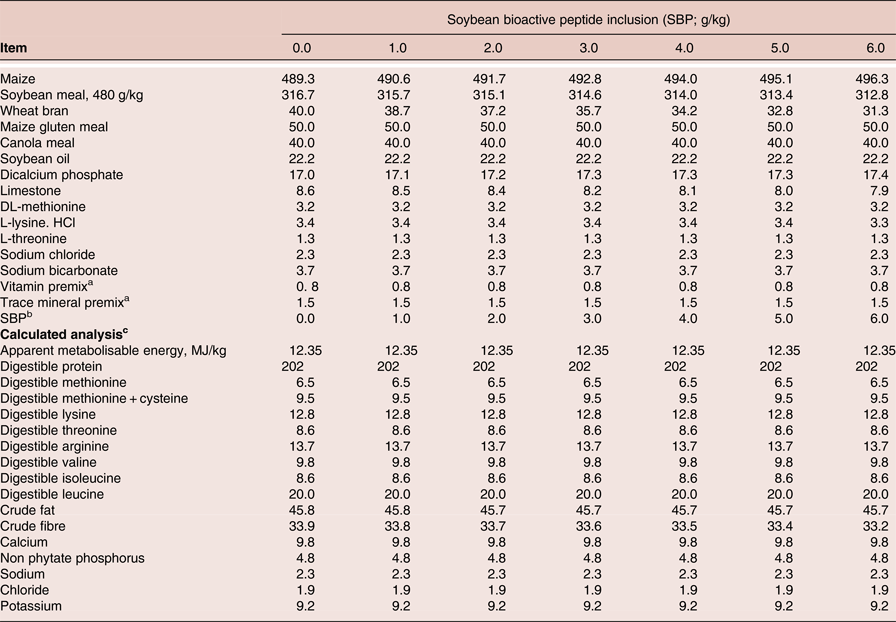
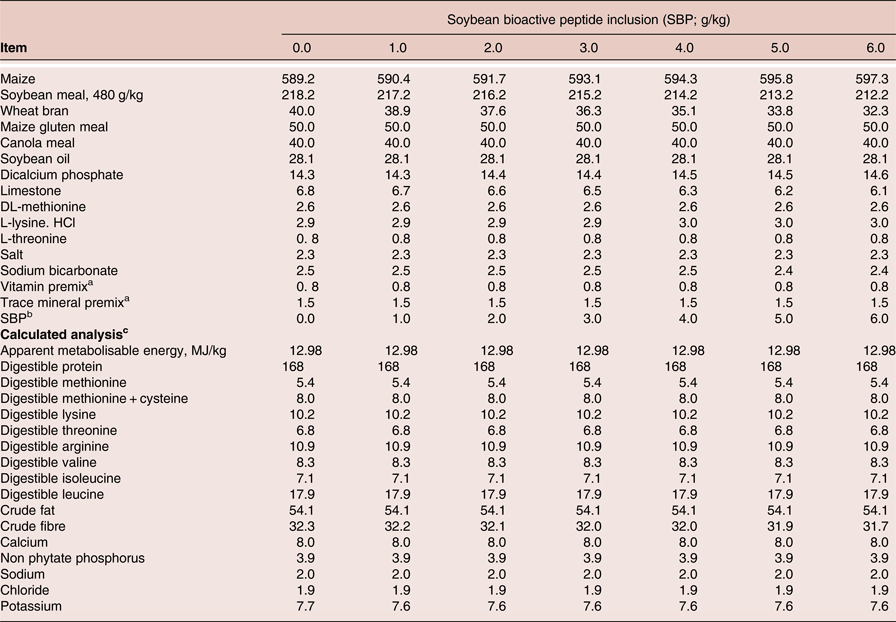
A two-phase feeding programme (starter and finisher) was used. The starter and finisher diets were offered from d 1 to 21 and 22 to 42, respectively. Seven diets, based on maize and soybean meal including a control (without SBP) and six diets containing different levels (1.0, 2.0, 3.0, 4.0, 5.0, and 6.0 g/kg; Tables 1 and 2) of a commercial bioactive peptide (Fortide, Chengdu Mytech Biotech Co. Ltd., Chengdu, Sichuan, China) were formulated to contain the same levels of apparent metabolisable energy (AME), amino acids and other nutrients (Tables 1 and 2). SBP was in powder from and contained biologically active peptides derived from soybean by enzymatic hydrolysis. Diets were mixed in a single-screw paddle mixer (Bonser Engineering Co. Pty. Ltd., Merrylands, Australia). Following mixing, all diets were steam-conditioned at 70°C for 30 seconds and pelleted using a pellet mill (Model Orbit 15; Richard Sizer Ltd., Kingston-upon-Hull, UK) capable of manufacturing 180 kg of feed/h and equipped with a die ring with 3 mm holes and 35 mm thickness.
Composition and analysis (g/kg as fed) of the starter diets (1–21 d).

a Supplied per kilogram of diet: antioxidant, 100 mg; biotin, 0.2 mg; calcium pantothenate, 12.8 mg; cholecalciferol, 60 µg; cyanocobalamin, 0.017 mg; folic acid, 5.2 mg; menadione, 4 mg; niacin, 35 mg; pyridoxine, 10 mg; trans-retinol, 3.33 mg; riboflavin, 12 mg; thiamine, 3.0 mg; dl-α-tocopheryl acetate, 60 mg; choline chloride, 638 mg; Co, 0.3 mg; Cu, 3.0 mg; Fe, 25 mg; I, 1 mg; Mn, 125 mg; Mo, 0.5 mg; Se, 200 µg; Zn, 60 mg.
b Fortide, Chengdu Mytech Biotech Co. Ltd., Chengdu, Sichuan, China. c NRC (1994) feed ingredient tables were used for calculation, except for digestible amino acid values. Bryden et al. (2009) feedstuffs digestibility values were used for calculation of digestible amino acids. The following values (g/kg) were used for calculation of digestible amino acids and other components for SBP: protein, 411; arginine, 36.4; cysteine, 5.8; isoleucine, 13.0; leucine, 21.9; lysine, 24.6; methionine, 6.4; threonine, 11.4; valine, 15.6; calcium, 30.9; phosphorus, 9.4; crude fat, 23.4 and crude fibre, 65.0.
Composition and analysis (g/kg as fed) of the finisher diets (22–42 d).

a Supplied per kilogram of diet: antioxidant, 100 mg; biotin, 0.2 mg; calcium pantothenate, 12.8 mg; cholecalciferol, 60 µg; cyanocobalamin, 0.017 mg; folic acid, 5.2 mg; menadione, 4 mg; niacin, 35 mg; pyridoxine, 10 mg; trans-retinol, 3.33 mg; riboflavin, 12 mg; thiamine, 3.0 mg; dl-α-tocopheryl acetate, 60 mg; choline chloride, 638 mg; Co, 0.3 mg; Cu, 3.0 mg; Fe, 25 mg; I, 1 mg; Mn, 125 mg; Mo, 0.5 mg; Se, 200 µg; Zn, 60 mg.
b Fortide, Chengdu Mytech Biotech Co. Ltd., Chengdu, Sichuan, China. c NRC (1994) feed ingredient tables were used for calculation, except for digestible amino acid values. Bryden et al. (2009) feedstuffs digestibility values were used for calculation of digestible amino acids. The following values (g/kg) were used for calculation of digestible amino acids and other components for SBP: protein, 411; arginine, 36.4; cysteine, 5.8; isoleucine, 13.0; leucine, 21.9; lysine, 24.6; methionine, 6.4; threonine, 11.4; valine, 15.6; calcium, 30.9; phosphorus, 9.4; crude fat, 23.4 and crude fibre, 65.0.
Diets were offered ad libitum, and water was freely available throughout the 42-d trial. Body weight and feed intake were recorded on days 0, 21 and 42. Mortality was recorded daily. FCR values were corrected for the body weight of any bird that died or culled during the course of the experiment. On day 42, foot pad and hock burns lesions were visually scored using a four-point scale from 0 to 4 (0 = no lesions; 1 = initial lesions; 2 = initial lesions with necrotic areas; 3 = lesions with pronounced necrotic areas; 4 = necrotic area covering the whole foot pad) as described by Martins et al. (Reference Martins, Mendes, Martins, Almeida Paz, Fernandes and Bresne2011). The data were expressed as percentage of birds with foot pad lesions in each category.
On day 42, carcass data were collected from two randomly selected birds, per pen (those closest to the mean pen weight). The birds were fasted overnight, individually weighed, exsanguinated and the carcasses were plucked and eviscerated by removing the internal organs, the head, and the shank. The weights of eviscerated carcass, breast meat, legs (thighs and drumsticks), and abdominal fat pad were recorded.
Experimental procedures were in accordance with the Massey University Animal Ethics Committee guidelines. For statistical analysis, pen means served as the experimental unit for all the parameters. The data were analysed by a one-way ANOVA using the General Linear Models procedure of the SAS Institute Inc. (2004) in a completely randomised design. Significant differences between means were separated by the Least Significant Difference test. Differences were considered to be significant at P < 0.05.
Results
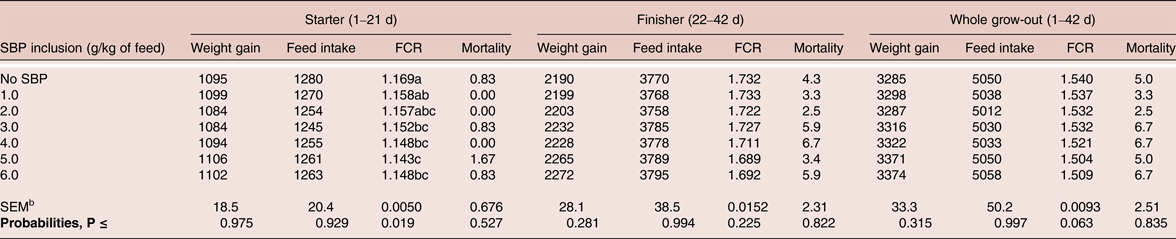
Influence of different inclusion rates of SBP on the performance of broiler starters (1–21 d), finisher (22–42 d) and whole grow-out (1–42 d) period is summarised in Table 3. Average mortality during the whole grow-out (1–42 d) period was 5.1% and the deaths were not associated with any specific dietary treatment. During the starter period, there was no significant (P > 0.05) effect of SBP on weight gain and feed intake. A significant (P < 0.05) effect of SBP was observed for the FCR of birds. SBP inclusion of 3.0 g/kg of feed and above resulted in lower (P < 0.05) FCR compared to the diet with no SBP.
Influence of different inclusion rate of soybean bioactive peptide (SBP) on the weight gain (g/bird), feed intake (g/bird), FCR (g feed/g gain) and mortality (%) of broilers during starter (1–21 d), finisher (22–42 d) and whole grow-out (1–42 d) perioda.

a Each value represents the mean of six replicates (20 birds per replicate).
b Pooled standard error of mean.
None of the performance parameters were influenced (P > 0.05) by SBP inclusion during the finisher period. Over the whole trial period, there was no significant (P > 0.05) effect of SBP on weight gain and feed intake. However, SBP inclusion tended (P = 0.063) to influence the FCR of birds. Increasing SBP inclusion level resulted in a gradual decrease in FCR values, with SBP inclusions at 5.0 and 6.0 g/kg showing lower FCR values compared to the diet with no SBP.
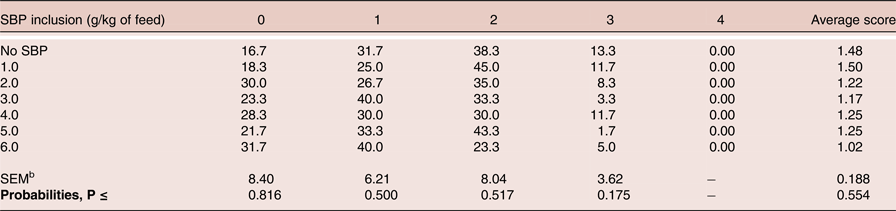
The influence of SBP on foot pad lesion scores of broilers is shown in Table 4. There was no significant (P > 0.05) effect of SBP level on foot pad lesion scores. However, the average lesion scale decreased from 1.48 in diets without SBP to 1.02 at 6.0 g/kg SBP inclusion. None of the birds exhibited any hock burn lesions.
Influence of different inclusion rate of soybean bioactive peptide (SBP) on the foot pad lesion scores (percentage of birds with foot pad lesions in each category) and average score of 42-d old broilersa

a Each value represents the mean of six replicates.
b Pooled standard error of mean.
Foot pad lesions were visually scored using a four-point scale from 0 to 4 (0 = no lesion; 1 = initial lesion; 2 = initial lesion with necrotic areas; 3 = lesions with pronounced necrotic areas; 4 = necrotic area covering the whole foot pad).
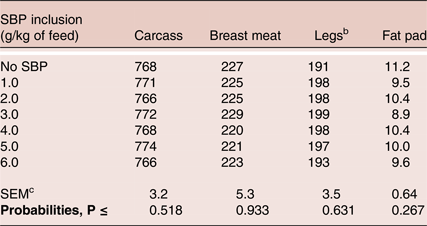
The effect of different inclusion rate of SBP on carcass characteristics of broilers is shown in Table 5. There was no significant (P > 0.05) effect of SBP on the relative weights of carcass, breast meat, legs, and abdominal fat pad.
Influence of different inclusion rate of soybean bioactive peptide (SBP) on the carcass, breast meat, legs and abdominal fat pad weight (g per kg bodyweight)a

a Each value represents the mean of six replicates (two birds per pen).
b Legs = thighs and drumsticks.
c Pooled standard error of mean.
Discussion
During the manufacture process of soybean meal and its protein concentrate, anti-nutritional substances in soybeans are largely eliminated. However, these products still contain significant amounts of protein-type allergens, such as glycinin and β-conglycinin and considerable quantities of phytic acid, lectins, oligosaccharides and steroid glycosides (Hou et al., Reference Hou, Wu, Dai, Wang and Wu2017). Enzymatic hydrolysis of soybeans may eliminate some of the adverse effects of these allergens on animal growth. The end products of protein hydrolysis process are oligopeptides, smaller peptides, and free amino acids (Kamnerdpetch et al., Reference Kamnerdpetch, Weiss, Kasper and Scheper2007). Peptides which are produced during the hydrolysis process generally contain between three and 20 amino acid residues. Such peptides contain different length and different amino acid residue compositions and deliver a variety of functional properties (Dziuba et al., Reference Dziuba, Minkiewicz and Nalecz1999; Pihlanto-Leppälä, Reference Pihlanto-Leppälä2001; Alashi et al., Reference Alashi, Blanchard, Mailer and Agboola2013). The reasons for the contradictory results in the literature regarding the benefits of hydrolysed protein sources in the diet are not clear, but may include differences in characteristics and inclusion rates of the test product, species (fish, pigs or broilers) and age of the animals (Mateos et al., Reference Mateos, Mohiti-Asli, Borda, Mirzaie and Frikha2014).
Results from the present study showed that diet supplementation with different levels of SBP had no effect on weight gain and feed intake, but improved the FCR of birds during the starter and over the whole trial period. These results are consistent with a previous study (Abdollahi et al., Reference Abdollahi, Zaefarian, Gu, Xiao, Jia and Ravindran2017), showing that 5.0 and 6.0 g/kg SBP inclusion in broiler diets (aged 1 to 21 d) resulted in significantly lower FCR compared to those fed the diet with no SBP. Previously, Frikha et al. (Reference Frikha, Mirzaie, Irandoust, Mohiti-Asli, Chetrit and Mateos2011) reported that the inclusion of 25 g/kg hydrolysed porcine mucosa, as a peptide source, in the diet improved weight gain and FCR of broilers, mostly during the first 7 d of life. In subsequent study, Frikha et al. (Reference Frikha, Mohiti-Asli, Chetrit and Mateos2014) reported that the inclusion of hydrolysed porcine mucosa in broiler diets increased growth performance during the starter period, with effects being more pronounced during the first 14 d of life. Similar results have been observed by Wang (Reference Wang2005), Wang et al. (Reference Wang, Liua, Songa, Qin and Ma2011) and Mateos et al. (Reference Mateos, Mohiti-Asli, Borda, Mirzaie and Frikha2014), who reported that the dietary supplementation of bioactive peptides resulted in higher weight gain and enhanced feed efficiency in broilers. Better feed efficiency in broilers fed bioactive peptides may be related to the increased intestinal enzyme activities (Feng et al., Reference Feng, Liu, Xu, Wang and Liu2007; Karimzadeh et al., Reference Karimzadeh, Rezaei and Teimouri Yansari2016) and higher absorptive capacity of the gut characterised by longer villi (Abdollahi et al., Reference Abdollahi, Zaefarian, Gu, Xiao, Jia and Ravindran2017). It is likely that by feeding bioactive peptides, a limited, but physiologically significant, amount of peptides are absorbed intact into the bloodstream and enterocytes (Gardner and Wood, Reference Gardner and Wood1989). These peptides can exert their physiological and regulatory actions at the intestinal level, and the intestinally-generated signals can be transmitted to the brain, the immune and endocrine system to positively impact the whole body (Hou et al., Reference Hou, Wu, Dai, Wang and Wu2017).
In the current study, SBP supplementation above 2.0 g/kg reduced average foot pad lesion scores. An array of factors can affect the incidence of foot pad lesions in commercial poultry flocks, including those relating to litter, nutrition and the bird (Shepherd and Fairchild, Reference Shepherd and Fairchild2010). Among the nutritional factors, level and source of dietary protein, and amino acid balance are potential factors. Nagaraj et al. (Reference Nagaraj, Wilson, Hess and Bilgili2007) reported that the incidence and severity of foot pad lesions is affected by the protein level and source. The inclusion of bioactive peptides in the diet can be expected to improve nutrient digestibility and intestinal mucosa morphology as most protein moieties in these products are present as free amino acids or small peptides (Gilbert et al., Reference Gilbert, Wong and Webb2008). Abdollahi et al. (Reference Abdollahi, Zaefarian, Gu, Xiao, Jia and Ravindran2017) reported that inclusion of SBP in broiler feed, increased N digestibility by 6.3%. Furthermore, it has been reported by Feng et al. (Reference Feng, Liu, Xu, Wang and Liu2007) that feeding birds with fermented soybean meal (at 270–295 g/kg) increased the intestinal trypsin, lipase and protease activities during the starter period, and enhanced protease activity during the grower period. From the current results, along with previous work (Abdollahi et al., Reference Abdollahi, Zaefarian, Gu, Xiao, Jia and Ravindran2017), it may be speculated that birds supplemented with SBP digested and utilised N more efficiently and their excreta contained less N, resulting in a better litter condition, less ammonia and subsequently less foot pad lesions. However, it is acknowledged that the improvements in N digestibility by SBP alone may not be sufficient to explain the lower average foot pad lesion scores.
SBP inclusion did not affect the relative weights of eviscerated carcass, breast meat, legs (thighs and drumsticks), and abdominal fat pad. The authors are unaware of any previous report on the effects of SBP inclusion on carcass characteristics of broilers.
In general, the improvements in feed efficiency may be attributed to one or more of the following mechanisms, as proposed by Hou et al. (Reference Hou, Wu, Dai, Wang and Wu2017): i) better absorption of small peptides compared with an equivalent amount of free amino acids; ii) lower catabolism of small peptides by intestinal microbiota compared with an equivalent amount of free amino acids; iii) more balanced amino acids entering the portal vein by the intestinal transport of small peptides compared with individual amino acids; vi) more functional amino acids (e.g. glycine, arginine, glutamine, glutamate, proline, and taurine) available to increase anti-oxidative reactions and muscle protein synthesis; and v) some peptides being capable of improving the morphology and functionality of the gut (e.g. secretion, motility, and anti-inflammatory reactions) and endocrine status compared with an equivalent amount of free amino acids.
The findings of the current work support the necessity of further studies to investigate the effect of SBP on nutrient absorption, Immunomodulatory functions and antimicrobial and antioxidative activities, litter N level and welfare indicators in broilers. There is a need to identify the specific bioactive proteins/peptides or other biologic agents in soybeans.
Conclusions
In this trial, broilers showed significant improvement in feed efficiency with inclusion of SBP in the diet, which had an impact on other aspects, including reducing foot pad lesions, attributed to improved N digestion and reduced excretion, affecting litter quality. Further research is warranted to define the biological characteristics and mode of action(s) of SBP. The current data suggest that soybean bioactive peptides/protein hydrolysate may be used as a novel functional protein in poultry diets.
Declaration of interest
Y. Gu, W. Xiao and J. Jia are employees of Chengdu Mytech Biotech Co. Ltd, China.
Acknowledgments
The authors would like to thank Chengdu Mytech Biotech Co. Ltd, China for their financial support of this research