

People working in human service positions are more likely to experience mental health problems compared to those working in other jobs (Ashforth & Humphrey, Reference Ashforth and Humphrey1995; Cox & Leiter, Reference Cox and Leiter1992; Harker, Pidgeon, Klaassen, & King, Reference Harker, Pidgeon, Klaassen and King2016; Ogino, Takigasaki, & Inaki, Reference Ogino, Takigasaki and Inaki2004; Semmer, Reference Semmer, Schabracq, Winnubst and Cooper1996). Numerous studies have been conducted on occupations that involve substantial psychological relationships with other people, such as social work (Nakajima & Haratani, Reference Nakajima and Haratani2005; Sato & Nakajima, Reference Sato and Nakajima1995; Sawada, Reference Sawada2007), teaching (Yoshitake, Reference Yoshitake2018), counselling (Kiyota & Nezu, Reference Kiyota and Nezu2015), physical medicine (Sera & Yamazaki, Reference Sera and Yamazaki2016) and nursing (Sunami & Yaeda, Reference Sunami and Yaeda2010), on topics such as burnout syndrome (Freudenberger, Reference Freudenberger1974), emotional labour (Hochschild, Reference Hochschild1983) and compassion fatigue in service recipients or families (Stebnicki, Reference Stebnicki2000). What we can learn is that occupational stress in human service professionals may vary, and each professional should know what they can do to prevent burnout and compassion fatigue.
In the practice of vocational rehabilitation (VR), service personnel may experience burnout (Bloom, Buhrke, & Scott, Reference Bloom, Buhrke and Scott1988; Boy & Pine, Reference Boy and Pine1980; Emener, Reference Emener1982; Florian & Zernicky-Shurka, Reference Florian and Zernicky-Shurka1986; Layne, Hohenshil, & Singh, Reference Layne, Hohenshil and Singh2004; Marini, Pell, & Black, Reference Marini, Pell and Black1992; Stevens & Pfost, Reference Stevens and Pfost1983; Templeton & Satcher, Reference Templeton and Satcher2007) for which preventive measures are helpful to counteract it. Burnout refers to a ‘syndrome of physical and emotional exhaustion, involving the development of negative self-concept, negative job attitudes, and loss of concern and feelings for clients’ (Pines & Maslach, Reference Pines and Maslach1978, p. 224). Work-related stress refers to the ‘response that occurs when demands and pressures exceed the knowledge, capabilities, and more generally, the resources of workers needed to meet those demands’ (Tabaj, Pastirk, Bitenc, & Masten, Reference Tabaj, Pastirk, Bitenc and Masten2015, p. 114). VR service personnel tend to experience such burnout or work-related stress, which manifests as compassion fatigue from working with service users and families (Stebnicki, Reference Stebnicki2000).
Recently, in Japan, more and more individuals with intellectual disabilities and psychiatric disabilities have become VR service recipients. One of the reasons for this is the change in the traditional legal employment system. Prior to March 2018, individuals with psychiatric disabilities were not counted in the employment quota system (2.0% then, and 2.2% now, for the case of private companies). Now, employers must provide sufficient reasonable accommodations at the workplace, and Japanese VR service personnel face more clients with psychiatric disabilities, while having to maintain the quality of service. This may increase their occupational stress considerably, in addition to the following unique aspects of the occupational environment. First, there are only about 450 VR counsellors certified by the Japan Organization for Employment of the Elderly, Persons with Disabilities and Job Seekers (JEED), without sufficient pre-service graduate training as in the US, Canada and Australia, yet this limited number of professionals must provide VR services, including vocational evaluation, vocational counselling, support for job development, job placement, work retention, return to work coordination, case management and professional consultation. They are expected to supervise hundreds of job coaches who need professional assistance, as Japanese job coaches are insufficiently trained to perform the aforementioned roles and functions (Yaeda, Kundu, & Nishimura, Reference Yaeda, Kundu and Nishimura2013).
According to the results of the Fact-Finding Survey on Personnel Resources Supporting General Job Placement of People with Disabilities, staff felt that their basic knowledge of job placement support was insufficient, despite having had enough opportunities to acquire basic knowledge of job placement (Ministry of Health, Labour and Welfare, 2008). The findings of a recent study imply that Japanese job coaches need to learn more about the systematic placement technique, because their overall average score (1.82) on the Self-Assessment for Students or Counsellors was below 3.0, suggesting the need to take a course on job placement (Yaeda et al., Reference Yaeda, Kundu and Nishimura2013). Their skills in job placement must be updated through more in-service training, to avoid occupational stress and burnout.
Regarding the occupational stress of VR service personnel such as job coaches in Japan, Ishihara and Yaeda (Reference Ishihara and Yaeda2011) reported that service personnel had significantly higher levels of stress on the General Occupational Stress Scale than did other average workers (Kawakami, Reference Kawakami2010). However, their more specific work stress is unknown because the original scale developed by Ishihara and Yaeda (Reference Ishihara and Yaeda2009) had the limitation of assessing the occupational stress unique to VR service personnel in Japan. Therefore, the purpose of the current study was to identify the underlying factors of occupational stress in Japanese VR service personnel, as measured by the Vocational Rehabilitation Service-Related Stress Scale (VRSS), and to validate the scale with a sample of VR service personnel in Japan. The research questions of the present study were as follows:
(1) What are the underlying factors of occupational stress specific to VR service personnel in Japan?
(2) Is the VRSS a valid measure of occupational stress in VR service personnel in Japan?
Method
Participants
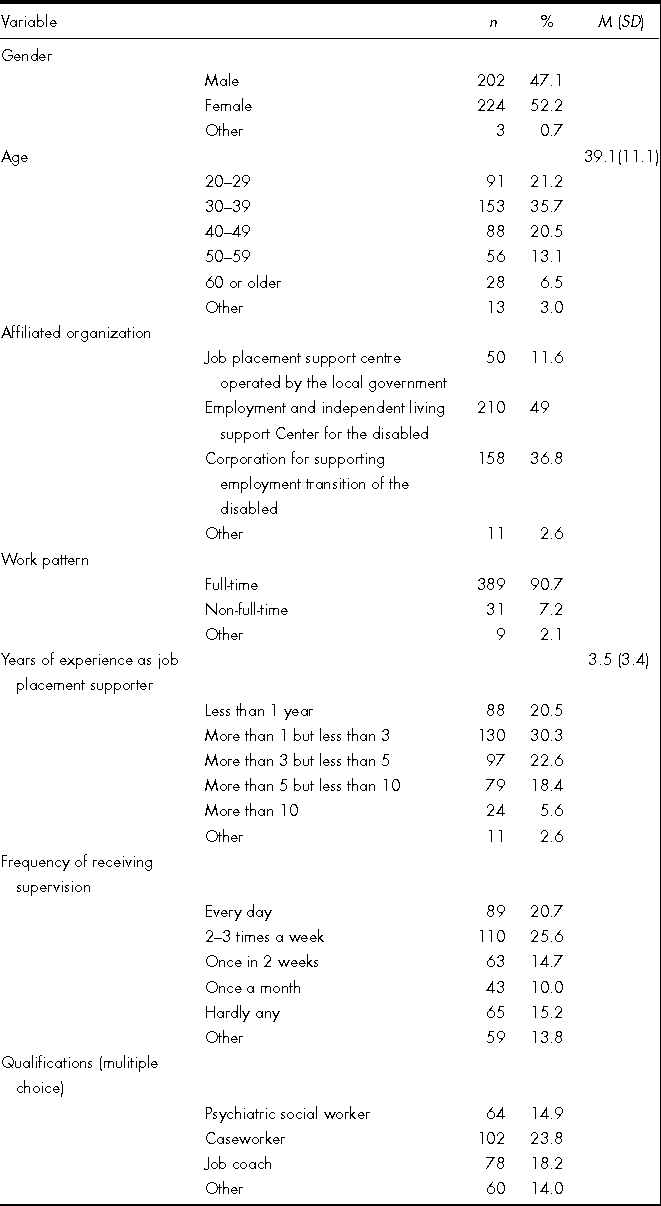
Two VR service personnel were recruited from each of the 879 VR agencies in Japan (N = 1,758). These 879 VR agencies included 308 Employment and Independent Living Support Centers for People with Disabilities, 460 Corporations for Supporting Employment Transition of People with Disabilities randomly selected from 2,556 agencies listed in the WAMNET (http://www.wam.go.jp/), and 111 Job Placement Support Centers operated by local governments (see Table 1).
Demographic Characteristics of the Participants (N=429)

Measures
The VRSS. The original scale was developed by Ishihara and Yaeda (Reference Ishihara and Yaeda2009) and had 16 items under three factors (Cronbach's alphas of .74, .65 and .58) intended to measure the degree of stress of VR personnel in Japan. Items were selected based on the results of a brainstorming session of two VR service personnel with at least five years of work experience, a VR researcher, and a VR specialist. The original VRSS did not have adequate reliability; therefore, 13 items were newly developed based on the responses of eight VR workers to a semi-structured interview in the present study. We added the 13 items to the original 16 items of the VRSS, resulting in a total of 29 items. Each item is rated on a four-point Likert-type scale, where 1 = do not agree at all and 4 = totally agree.
Sample items from the VRSS are as follows: ‘I do not know how to support the job placement of people according to the characteristics of their disability’, ‘Too many cases to handle’ and ‘I cannot coordinate well with government agencies’. The new 29-item VRSS had a Cronbach's α of .90 and a Spearman–Brown reliability coefficient of .84.
Procedure
This study was approved by the Institutional Review Board of the affiliated university of the principal investigator. Participants volunteered to participate and completed the survey anonymously. The mail survey was conducted from the end of August 2012 to early October 2012. The following materials were sent by mail to the head of each agency: two self-administered questionnaires, a letter requesting permission from the head of the agency, a consent form for the head of the agency, and a letter requesting the participation of VR service personnel. Of the 1,758 people contacted, responses from 435 participants were obtained (return rate 24.7%). Six participants who did not answer the questions regarding stress were excluded from the analyses. Finally, responses from 429 (24.4%) participants were used for the analyses.
Data Analysis
An exploratory factor analysis (EFA) with Promax rotation was performed to examine the construct of occupational stress specific to VR service personnel in Japan. Item loadings of 0.35 or less were eliminated. The factor structure with the highest possible validity was adopted, and the internal consistency reliability was evaluated using Cronbach's alpha coefficient. Next, confirmatory factor analysis (CFA) was performed to ensure factorial validity. Criterion-related validity was evaluated by correlating the VRSS with the Brief Job Stress Questionnaire (BJSQ), a comprehensive job stress scale for general workers (Kawakami, Reference Kawakami2010).
Results
An EFA of the 29-item VRSS was performed using the principal factors method of extraction and Promax rotation. Promax rotation was performed as the factors were expected to be correlated. The Bartlett's test of sphericity was significant, χ 2 = 3775.09, df = 406, p < .001, indicating that it was appropriate to use a factor analytic model on the dataset. The Kaiser–Meyer–Olkin measure of sampling adequacy indicated the strength of the relationships among variables (KMO = .88); thus, it was acceptable to proceed with the analysis.
Kaiser–Guttman's eigenvalues greater than one and Cattell's scree test were used to determine the number of factors to retain. After performing a series of factor analyses, 10 items with factor loadings of 0.35 or lower were eliminated, resulting in four factors that were the most interpretable solution in terms of the factorial structure.
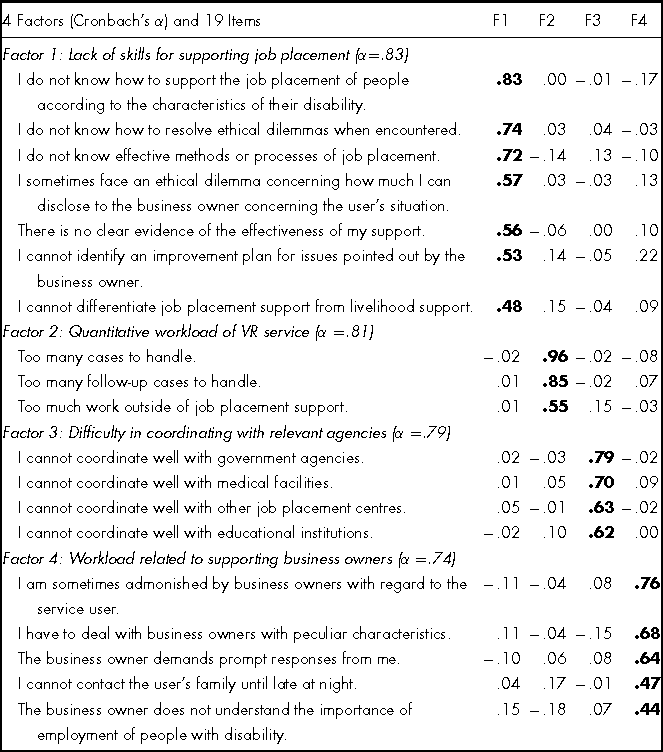
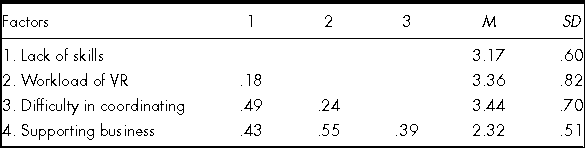
The first factor comprised seven items regarding lack of skills for supporting job placement, such as ‘I do not know how to support the job placement of people according to the characteristics of their disability’, and this factor was named ‘Lack of Skills for Supporting Job Placement’. The second factor comprised three items regarding the quantitative workload of VR services, such as ‘Too many cases to handle’, and it was named ‘Quantitative Workload of VR Services’. The third factor comprised four items regarding difficulty coordinating with relevant agencies, such as ‘I cannot coordinate well with government agencies’, and it was named ‘Difficulty in Coordinating with Relevant Agencies’. The fourth factor comprised five items related to difficulty with supporting business owners, such as ‘Sometimes, I am admonished by business owners regarding service users’, and it was named ‘Workload Related to Supporting Business Owners’. Table 2 shows the factor loadings of the 19 items and Table 3 shows the correlations, means and standard deviations of the four factors.
Factor Loadings of Exploratory Factor Analysis with Promax Rotation of the VR-service-related Stress Scale (VRSS)

Note. Factor loadings >.35 are in boldface. Extraction method: principal factor method.
Correlations, Means and Standard Deviations of the Four Factors of VR-Service-Related Stress Scale (VRSS)

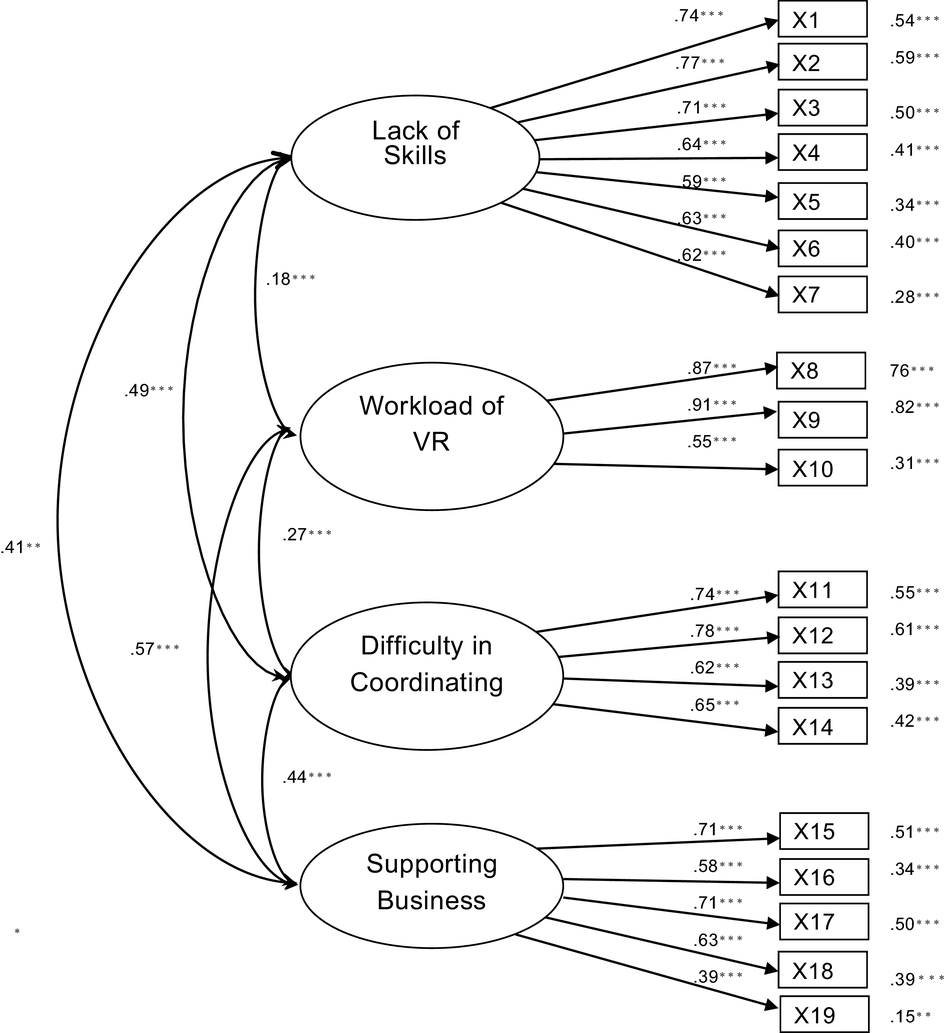
To cross-validate the four-factor structure of the VRSS, a CFA was performed using SPSS AMOS statistical software version 25.0 (see Figure 1). The fit indices of the four-factor model were as follows: χ 2 = 393.84, df = 146, p < .001, GFI = .91, AGFI = .88, CFI = .92, RMSEA = .06 and AIC = 481.84. Because the chi-square statistic is highly sensitive to sample size, the model is likely to be rejected (Asano, Suzuki, & Kojima, Reference Asano, Suzuki and Kojima2005), which was the case in this study. Thus, other model fit indices were applied as alternatives to the chi-square statistic to assess the model fit, including the following: goodness of fit index (GFI) greater than .95, adjusted goodness of fit index (AGFI) greater than .95, comparative fit index (CFI) greater than .95, a root mean square of approximation (RMSEA) less than .08, and Akaike Information Criterion (AIC) (Asano et al., Reference Asano, Suzuki and Kojima2005; Weston, Gore, Chan, & Catalano, Reference Weston, Gore, Chan and Catalano2008). As the sample size of the present study was considered to be large (N = 429), the model would likely be rejected. However, the fit indices indicated a relatively favourable fit between the model and the data.
Results of confirmatory factor analysis of VRSS Fit indices for this model are as follows: χ2 (146, N=429)=393.84, p<.001, goodness of fit index =.91, adjusted goodness of fit index =.88, comparative fit index=.92, root-mean-square error of approximation=.06, Akaike Information Criterion=.481.84. **p<.01. ***p<.001.

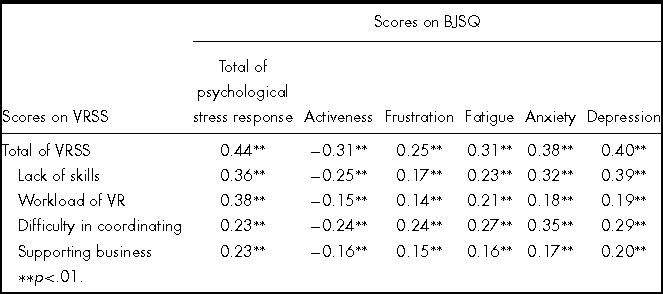
Table 4 shows the results of the evaluation of criterion-related validity. The VRSS demonstrated a modest significant correlation with the BJSQ.
Correlations Between Scores on VR-Service-Related Stress Scale (VRSS) and Scores on Brief Job Stress Questionnaire (BJSQ)

Discussion
The resulting four factors, Lack of Skills for Supporting Job Placement, Quantitative Workload of VR Services, Difficulty in Coordinating with Relevant Agencies and Workload Related to Supporting Business Owners, refer to the following practical issues that VR professionals currently face in Japan.
First, Lack of Skills for Supporting Job Placement reflects service providers’ limited experience as job coaches. Although the majority of social welfare agencies now provide work support services since the enactment of the Independent Support Law of 2006, they have limited practical experience of VR in Japan. The results of the present study showed that half of the survey respondents had less than three years of such work support experience.
Most of those social welfare agencies have long been providing multiple services such as institutional care for individuals with severe disabilities and the elderly with care needs. Less experienced work supporters used to provide such welfare-oriented services, and many of them are in the process of learning to perform their new role as a job coach. To address the lack of skills for supporting job placement, more in-service training programs specifically designed to provide work support must be developed, while utilizing available professional consultation from VR professionals such as VR counsellors for individuals with disabilities.
Second, Quantitative Workload of VR Services might be due to the combination of a shortage of professionals and the increasing trend of employment of individuals with disabilities in recent years in Japan. Previous studies show that the amount of paperwork and heavy caseload management of VR services continue to be major sources of work stress (Arnold & Seekins, Reference Arnold and Seekins1997; Bloom et al., Reference Bloom, Buhrke and Scott1988; Cranswick, Reference Cranswick1997; Garske, Reference Garske1999). While the number of employees with disabilities keeps increasing in Japan (Ministry of Health, Labour and Welfare, 2017), the shortage of VR professionals is becoming more apparent as these management tasks increase. Currently, there are only about 450 VR counsellors certified by the JEED, and there are 9.4 million individuals with disabilities. As the number of employees with on-going support increases, more follow-up cases also increase. Workload stress should be avoided, and one of the strategies is to develop a natural support system at the workplace. Wakabayashi and Yaeda (Reference Wakabayashi and Yaeda2016) found that one of the factors that enabled natural support at the workplace was the frequency of face-to-face interactions among employees.
The third factor, Difficulty in Coordinating with Relevant Agencies, implies that rehabilitation teamwork is not being achieved easily among multiple professionals, such as vocational counsellors, job coaches, social workers, and paramedical professionals at different types of service agencies. It is often the case that the quality of interagency collaboration among these rehabilitation professionals depends on the organization's policies and values (Lee, Yaeda, & Okuno, Reference Lee, Yaeda and Okuno2008; Nonaka, Reference Nonaka2014; Yaeda, Reference Yaeda2006, Reference Yaeda, Sawamura and Okuno2009).
If natural support does not function well at places of work, Workload for Supporting Business Owners, the fourth factor, becomes another big concern. The results of this study showed that supporting business owners was a source of work stress for VR professionals. One of the unique roles of VR professionals is providing professional consultation on disability management to business owners. Hiring employees with disabilities requires business owners to understand disability and how to provide reasonable accommodations.
VR professionals must be able to meet the needs of businesses and respond to issues in a timely manner, while suggesting the best job matches and appropriate job development plans to business owners. VR service personnel should have enough knowledge of both disability and business to assess the competitive working skills of the client and reasonable accommodations of the employment site, thereby providing tailored VR services to meet the needs of both parties.
Study Limitations
The low response rate (24.4%) in this study limits the generalizability of the results. The possible reason for the low response rate could be the number of questionnaire items. Future studies could use fewer questionnaire items or develop a short version of the VRSS to avoid time consumption for daily practitioners. Another limitation is that the sample only consisted of VR service personnel such as job coaches at local job placement offices and employment support centres in Japan. Future studies should include VR counsellors certified by the JEED, who are the key players in community-based VR in Japan.
Conclusion
VR service personnel need to have enough knowledge of both disability and business to assess the competitive working skills of the client and reasonable accommodations of the workplace, thereby providing customized VR services to meet the needs of both parties. In Japan, the importance of rehabilitation administration seems to be somewhat undervalued (Ishihara & Yaeda, in press); therefore, adequate pre-service and in-service training, such as human resource management, is necessary. The present study validated the VRSS as an assessment tool to measure the underlying stress factors specific to VR professionals in Japan. The VRSS can be used by VR staff and researchers to further investigate if any managerial action, such as supervision and in-service training, would alleviate the occupational stress of VR service personnel. The VRSS can also be used to assess service-related stress in VR service personnel to identify and prevent burnout. Future studies should consider verifying the construct of the VRSS to see if it is applicable to VR personnel in other countries.
Declaration of Conflicting Interests
The authors declare they have no potential conflicts of interest with respect to research, authorship or publication of this article.
Acknowledgements
The authors would like to thank the study participants from the Employment and Independent Living Support Center for People with Disabilities, Corporation for Supporting Employment Transition of People with Disabilities, and Job Placement Support Center in Japan. We would like to thank Editage (www.editage.jp) for English language editing.
Funding
No financial support was received for the research, authorship or publication of this article.