





1. Introduction
Among European countries adopting a National Health Service (NHS) model, England and Italy are the largest systems in terms of population coverage. In both cases, healthcare is predominantly financed through general taxation and is intended to guarantee all residents access to a comprehensive package of healthcare services, largely free at the point of delivery. The majority of healthcare facilities are owned and directly managed by the NHS, and most healthcare professionals are public sector employees (Lunt et al., Reference Lunt, Exworthy, Hanefeld and Smith2015; Suzuki et al, Reference Suzuki, Paris, Joshi and Dedet2025; Toth, Reference Toth and Palley2023).
Both healthcare systems are facing increasing financial pressures arising from population ageing, the growing burden of chronic and non-communicable diseases, and persistent budgetary constraints. The Covid-19 pandemic accelerated ongoing processes of transformation by driving patients towards private providers – including virtual consultations and mental health services – while exposing structural weaknesses in public healthcare systems as waiting lists lengthened.
Over recent decades, collaboration and hybridisation between public and private actors have expanded in response to these pressures, driven not only by policy reforms but also by changing patient demand. Consequently, the boundary between the public and private sectors has become progressively blurred. At the same time, new forms of private activity have emerged through regulatory gaps, giving rise to new ownership structures and processes of financial engineering (Nijboer et al., Reference Nijboer, Kuijper, White, Rowland, Linthorst, Waring and Wallenburg2026).
A variety of terms have been employed to describe these evolving public–private relationships, including privatisation, marketisation, corporatisation and commodification. Whilst interlinked, these terms are often used interchangeably by academics and policymakers, often with limited conceptual clarity, which contributes to confusion in debates.
More recent developments, particularly financialisation and assetisation, further stretch the explanatory scope of existing frameworks by introducing new actors, investment logics, and ownership arrangements (Berardi et al., Reference Berardi, Hellowell and Varkevisser2026; Cordilha, Reference Cordilha2023; Nijboer et al., Reference Nijboer, Kuijper, White, Rowland, Linthorst, Waring and Wallenburg2026). Understanding contemporary healthcare systems therefore requires analytical frameworks capable of capturing multiple and overlapping forms of privatisation, rather than reducing them to changes in ownership, financing, or provision alone.
Existing frameworks have provided important insights into dimensions of privatisation. However, they are less well equipped to capture how these different dynamics coexist and interact within contemporary NHS systems. In shifting our attention to complex forms of ownership, activity, and delivery, the challenge is one of wrestling with diverse, potentially fragmented, empirical materials to better grasp the contemporary landscape.
In this article, we seek to bring greater conceptual clarity to debates on healthcare privatisation. We first identify and conceptualise seven distinct ‘trajectories of privatisation’, each reflecting a different mode of interaction between public and private actors (including financial investors). We then apply this analytical framework through a detailed comparative case analysis of recent experiences in the Italian and EnglishFootnote 1 healthcare systems. These two health care systems show a close similarity so different trajectories (and outcomes) would generate useful evidence of the nature and extent of privatisation.
2. Blurred boundaries: seven privatisation trajectories
In the healthcare sector (and other spheres of the public sector), the term ‘privatisation’ is inherently ambiguous, as it may refer to a variety of different processes and dynamics (Maarse, Reference Maarse2006; Powell and Miller, Reference Powell and Miller2014; Starr, Reference Starr1988).
Definitions range from one-dimensional asset transfer and changes in ownership (Powell and Miller, Reference Powell and Miller2014) to broader forms of individualisation and responsibilisation (Sheaff et al., Reference Sheaff, Ellis-Paine, Exworthy, Hardwick and Smith2024). From a state perspective, privatisation may occur through reduced public provision, subsidy, or regulation (Heald, Reference Heald1984; Le Grand and Robinson, Reference Le Grand, Robinson, Le Grand and Robinson1984; Lundqvist, Reference Lundqvist1988). Subsequent frameworks progressively broadened the concept by incorporating different combinations of financing, provision, regulation, and consumption. Powell and Miller (Reference Powell and Miller2014), for example, review frameworks including the Mixed Economy of Welfare and Publicness, while the Wheels of Welfare analyses provision, finance, and decision-making, highlighting privatisation as both the locus of production and forms of consumption (Burchardt et al., Reference Burchardt, Hills and Propper1999; Goodair, Reference Goodair2023; Guy, Reference Guy2019).
Taken together, these contributions established privatisation as a multidimensional phenomenon rather than simply a transfer of ownership. However, most of these frameworks pre-date the more recent transformations associated with financialisation and assetisation, which have reshaped relationships between public and private actors. Complexity in private investor ownership, out-of-pocket payments, and private insurance fits less easily within these earlier frameworks (Berardi et al., Reference Berardi, Hellowell and Varkevisser2026; Hedden et al., Reference Hedden, Spencer, Allin, Contandriopoulos, Gavin, Grudniewicz, Lavergne, Leaver, Lexchin, McKay, Mathews, McCracken, McGrail, Palmer, Poitras, Rudoler, Spithoff and Vanstone2023). Likewise, emerging forms of entrepreneurialism challenge traditional distinctions between public and private organisations. More fundamentally, focusing primarily on financing and provision constrains our understanding of privatisation as a process driven not only by public policy but also by corporate investors, healthcare professionals, and patients (André et al., Reference André, Batifoulier and Jansen-Ferreira2016; Maarse, Reference Maarse2006; Starr, Reference Starr1988).
On the provider side, these developments are reflected in changing ownership models, notably venture capital and private equity (Berardi et al., Reference Berardi, Hellowell and Varkevisser2026). Financialisation shifts the objectives of healthcare organisations from producing treatments for patients towards ‘the extractive production of wealth for financial firms and corporate managers’ (Fuse Brown & Rooke-Ley, Reference Fuse Brown and Rooke-Ley2026), driven by short-term returns and growth. Healthcare therefore becomes embedded within new institutional logics of value creation and organisational purpose. Beyond ownership, assetisation represents ‘not merely an extension of markets but a reorientation and reconfiguration of value itself’ (Nijboer et al., Reference Nijboer, Kuijper, White, Rowland, Linthorst, Waring and Wallenburg2026, 4).
A corresponding demand-side hybridity is reflected in changing patient attitudes, behaviours, and identities towards private healthcare. The patient-consumer hybrid highlights different strategies for obtaining previously publicly funded healthcare (Tritter et al., Reference Tritter, Koivusalo, Ollila and Dorfman2005), including the growing acceptance of privately purchased care in response to waiting times and service availability. These developments give rise to hybrid healthcare identities that increasingly blur the distinction between public and private healthcare use.
A distinct contribution of this article is to bring the debate up to date by incorporating these more recent configurations of publicness and privateness. Building on this literature, we argue that longstanding forms of privatisation should be understood alongside newer dynamics associated with financialisation, assetisation, and changing patterns of patient and professional behaviour. We therefore seek to bring greater analytical order to this debate by distinguishing seven different meanings of privatisation in healthcare, at least with reference to NHS-type systems. Each corresponds to a distinct trajectory of privatisation, cutting across – and in some cases reconfiguring – the boundaries between the public and private sectors. We do not suggest an inevitable progression from one trajectory to another. Rather, different trajectories may coexist and interact within the same healthcare system.
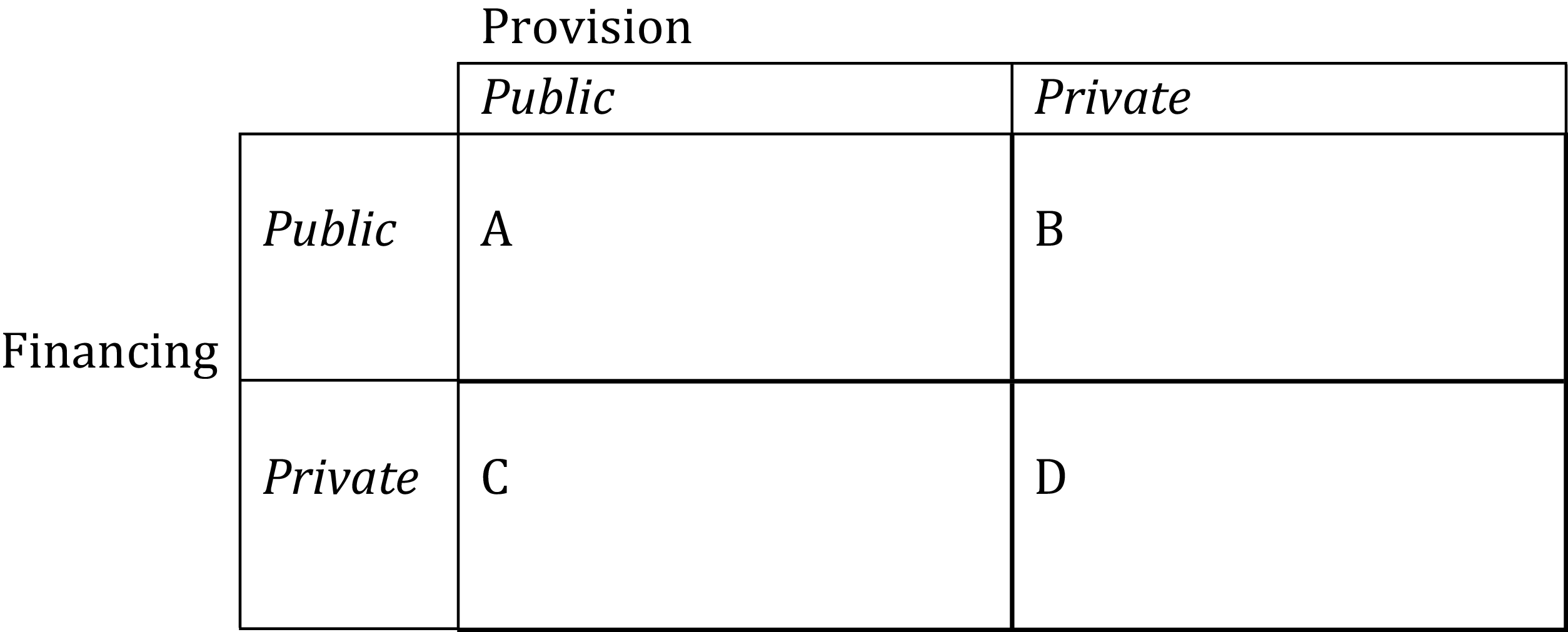
To introduce these trajectories, we begin with Diagram 1, which represents the traditional framework derived from the intersection of financing (public versus private expenditure) and provision (public versus private providers) of healthcare services.
The public-private matrix.

The intersection of financing and provision represents the conventional way of conceptualising and mapping the boundary between the public and private sectors. As discussed above, the traditional 2 × 2 framework provides a useful starting point but no longer captures the full range of privatisation dynamics currently underway. Assessing financing and provision as being either public or private is increasingly problematic when developments have elements of both. As we will discuss, public-private partnerships (PPPs) have hybrid forms of financing and service provision that makes a strict public-private distinction problematic. Categories of private and public are themselves nuanced, assessing private equity and employee ownership as similarly ‘private’ for example overlooks a great deal in terms of mission and logic. There is therefore value in moving beyond the parsimony of financing and provision to incorporate additional processes and activities – a multidimensionality – that reflects the more complex nature of privatisation.
Among multidimensional approaches, Maarse’s (Reference Maarse2006) framework provides the most useful point of departure because it conceptualises privatisation as a process that may occur simultaneously through financing and provision but also management and investment. Financing examines the private fraction of health care spending and looks for decreases in the public fraction in health care spending as evidence of privatisation. Such public and private financing (including out-of-pocket spending) may be distributed unevenly across different healthcare services. Ownership, focused on hospital care, examines moves from public to private organisations and which operates on a for-profit basis. Third, he identifies the emergence of a private businesslike management style within health care that he labels ‘cultural privatization’, Fourth, that countries are experiencing the entry of private investors in health care.
As Maarse argued, there is ‘no single public–private boundary … [rather] multiple boundaries leading to different public and private mixes’ (Maarse, Reference Maarse2006, 986). His framework therefore shifts attention from a single public-private divide to multiple dimensions of privatisation evolving at different speeds. Central to his argument is the importance of acknowledging grey areas between public and private but also ‘the evolutionary character of privatization’ (p. 988). However, important developments since the mid-2000s require extending this framework. First, the intensification of entrepreneurialism within public healthcare organisations has gone beyond Maarse’s notion of cultural privatisation where ‘style’ may cede ground to broader mission or logic. Second, alongside organisational change, shifting patient expectations and behaviours have introduced new forms of demand-side marketisation. Third, Maarse distinguished financing, provision and investment, and noted a ‘new but still small-scale phenomenon [in] the advent of a few investor-owned private clinics (e.g., eye clinics)’. However, the steady emergence of financialisation and assetisation have transformed ownership structures, investment logics, and relationships between public and private actors, moving into a wide range of healthcare settings.
Our framework therefore builds directly on the pragmatic approach taken by Maarse rather than replacing it. We retain his multidimensional understanding of privatisation while extending it to incorporate more recent developments identified in the literature, particularly financialisation, entrepreneurialism and changing patient behaviour.
In adopting a broad framework, we are mindful of its limitations (particularly the trade-off between breadth and depth) but also of its analytical value. Viewing privatisation through both production and consumption lenses, remaining alert to forms of economic, cultural, and social marketisation, and exploring the interplay between agency (choice and identities) and structures (health organisations, policy and regulation) provide a richer understanding of contemporary healthcare systems. This perspective also sensitises us to boundary shifts that generate new forms of healthcare hybridisation, including commercial motives within public organisations, financialisation, public entrepreneurship, changing professional behaviour and emerging patient-consumer identities (Fulop, Reference Fulop2012; Sartirana and Giacomelli, Reference Sartirana and Giacomelli2024; Shackley and Ryan, Reference Shackley and Ryan1994).
Our seven trajectories were derived inductively from a detailed, although non-systematic, review of the privatisation literature, with particular emphasis on Maarse’s framework. This was combined with policy and delivery literature from the English and Italian healthcare systems, including primary studies, secondary reviews, and key stakeholder evidence. Iterative refinement of the framework in light of this evidence contributed to the final categorisation. Used transparently, such inductive iteration contributes to causal knowledge in comparative analytic narratives (Yom, Reference Yom2015). We therefore move beyond parallel descriptions of two health systems by applying a common analytical framework to generate broader theoretical insights (Marmor et al., Reference Marmor, Freeman and Okma2005).
2.1. First trajectory: ‘hard’ privatisation
The first trajectory of privatisation entails a shift from publicly funded and publicly provided NHS services to healthcare purchased on the private market, paid for directly by users and delivered by private providers. This occurs when the public system no longer guarantees certain services, which citizens must therefore obtain privately. In Diagram 1, this trajectory is a transition from cell A to cell D. It can be referred to as ‘hard’ privatisation, manifested in an increase in private healthcare expenditure (at the expense of the public component) and in the volume of activity carried out by private providers.
2.2. Second trajectory: contracting out
A second trajectory, strongly promoted by New Public Management reforms, is contracting out (Maarse, Reference Maarse2006; Osborne and Gaebler, Reference Osborne and Gaebler1992; Simonet, Reference Simonet2015). This trajectory must be clearly distinguished from ‘hard’ privatisation, since contracting out involves private provision while public funding is retained. In terms of Diagram 1, this implies a move from cell A to cell B.
Under this arrangement, an NHS strategically decides which services to deliver in-house and which to commission from external private providers. An NHS remains the purchaser and commissioner of these services. It is the public buyer – rather than individual citizens – who determines which services are outsourced and selects the private providers to be contracted. Contracting out does not increase individuals’ private healthcare expenditure, as outsourced services continue to be delivered to users under the same conditions as public provision.
2.3. Third trajectory: managerialisation
The reforms of the 1990s, particularly those promoting the model of ‘internal markets’, also triggered a third trajectory, commonly described as managerialisation. Unlike the previous trajectories, this dynamic does not entail a shift in healthcare expenditure from the public to the private sector, nor does it alter the public–private balance in service provision.
Managerialisation is an internal dynamic of the NHS. Using Diagram 1, it can be said to take place entirely within cell A. It involves both a cultural transformation and a change in the way public organisations are managed. From this perspective, public resources are increasingly governed through procedures, instruments, and managerial approaches derived from market competition and private-sector management (Bartlett and Le Grand, Reference Bartlett, Le Grand, Le Grand and Bartlett1993; Osborne and Gaebler, Reference Osborne and Gaebler1992). Managerialisation encourages public administrations to operate more like private companies.
2.4. Fourth trajectory: public–private partnerships (PPPs)
A fourth dynamic of privatisation in NHS-type systems is represented by public–private partnerships (Torchia et al., Reference Torchia, Calabrò and Morner2015). A public–private partnership is a form of cooperation between public and private actors aimed at financing, building, and operating infrastructure or at delivering services of public interest. In many NHS countries, PPP arrangements have been widely used to construct or upgrade hospital facilities (Barlow et al., Reference Barlow, Roehrich and Wright2013; McKee et al., Reference McKee, Edwards and Atun2006). The emergence of PPPs challenges the 2 × 2 diagram employed above. PPPs involve hybrid forms of financing where private finance is used upfront and the investment repaid by public funds over a contracted period. Typically, there is return on investment rather than profit from services delivered directly to patients. However, diverse models of management and delivery responsibility can be contracted, making a strict public-private distinction increasingly untenable and suggesting a continuum rather than a dichotomy. This contributes to making the boundaries between the public and private sectors even more blurred and fluid.
The four trajectories of privatisation outlined so far are well known in the healthcare policy literature and have been the subject of extensive empirical research and critical debate (Burchardt et al., Reference Burchardt, Hills and Propper1999; Powell and Miller, Reference Powell and Miller2014). By contrast, some more recent privatisation dynamics have received far less scholarly attention. We identify three such ‘emerging’ trajectories of privatisation. Although elements of these trajectories existed previously, they have recently become more prominent.
2.5. Fifth trajectory: financialisation
The financialisation of the healthcare sector has generated intense debate in recent years (Hunter and Murray, Reference Hunter and Murray2019), raising concerns even in countries that do not adopt the NHS model and are therefore traditionally more accustomed to private initiative (Fox, Reference Fox2025; Suzuki et al., Reference Suzuki, Paris, Joshi and Dedet2025). Financialisation refers to the growing role of financial motives and financial actors in the management of the healthcare system (Cordilha, Reference Cordilha2023). Investments that were previously undertaken by the state or by private entrepreneurs with a direct focus on healthcare (such as hospital owners, pharmaceutical companies, and biomedical industries) are increasingly driven by entities such as pension funds, hedge funds, investment banks, private equity and venture capital funds (Berardi et al., Reference Berardi, Hellowell and Varkevisser2026).
Unlike earlier trajectories, financialisation changes not only who owns or provides healthcare but also the financial logics through which healthcare assets are valued and governed. It does not necessarily entail an expansion of the private component of healthcare, but it fundamentally alters the nature and underlying logic of private investment. This may encourage the entry of new private actors, with potential repercussions for NHS governance (Berardi et al., Reference Berardi, Hellowell and Varkevisser2026) and the public-private mix in healthcare. Financialisation also interacts with other trajectories of privatisation. Consumer demand for new private services may stimulate assetisation and financialisation, while financial models developed in one area of care may spread to others (Schuurmans et al., Reference Schuurmans, De Brabandere, Castelli, Wimmer and Denis2026).
2.6. Sixth trajectory: entrepreneurialism in public facilities
The NPM doctrine and a series of reforms introduced since the 1990s have encouraged public agencies to operate, at least in part, like private companies (Osborne and Gaebler, Reference Osborne and Gaebler1992; Powell and Miller, Reference Powell and Miller2014). In many countries, public hospitals have been transformed into public companies, endowed with substantial autonomy in the management of human resources and assets, as well as with the ability to engage in revenue-generating activities, even in competition with private entities. In some NHS systems, pressures on health authorities to pursue entrepreneurial activities have intensified in recent times (Lunt et al., Reference Lunt, Exworthy, Hanefeld and Smith2015; Toth, Reference Toth and Palley2023).
Public organizations are increasingly expected to comply with market rules, attract private funding and compete with private providers to generate additional revenues beyond public funding. Returning to Diagram 1, this entrepreneurial dynamic corresponds to a shift from cell A to cell C. Public service providers actively seek private sources of funding, including private investors and individuals paying market prices for services delivered by NHS employees.
2.7. Seventh trajectory: agency staffing arrangements
A recent trend in NHS-type systems is the use of external, non-permanent ‘on-demand’ personnel to address staffing shortages in public healthcare facilities (Ferguson et al., Reference Ferguson, Stringer, Walshe, Allen, Grigoroglou, Ashcroft and Kontopantelis2024). Unlike ‘traditional’ contracting out, the NHS does not outsource the entire service but procures labour from the market, while clinical and organisational responsibility remains with the public provider. By contrast, traditional outsourcing entails the provision of specific services on behalf of the NHS in private settings, such as external clinics or facilities. Under agency staffing arrangements, external staff work alongside NHS employees within public facilities, making it difficult for patients to distinguish between public and private personnel. This contributes to the hybridisation of NHS organisations and further blurs the boundaries between the public and private sectors.
The seven trajectories are taken in turn and used to interrogate developments in Italian and English healthcare. We draw on data and published materials to populate the trajectories, offering a better understanding of privatisation’s evolution within and across the two systems.
3. The comparative turn
We compare healthcare in England and Italy to analyse the evolution of privatisation. These countries were selected because they share the defining characteristics of Beveridge-type health systems while displaying important institutional differences. Both systems are founded on universalism, solidarity, comprehensive coverage, financing through general taxation, and the gatekeeping role of GPs. At the same time, they differ in important respects, most notably the high degree of regionalisation of the Italian NHS compared with the more centralised organisation of the English system (see Figure 1).Footnote 2
Comparison of NHS systems in Italy and England. Data: OECD (2025).

Comparative analysis of healthcare systems has become increasingly common owing to improved data availability and greater opportunities for policy learning (Rose, Reference Rose1991). However, policy transfer remains constrained by national institutions, historical legacies and path dependency (Wilsford, Reference Wilsford1994). For this reason, comparisons between institutionally similar health systems provide a particularly useful basis for understanding the drivers of policy change while controlling for broader differences in system design.
Methodologically, we adopt a comparative policy review. The seven trajectories of privatisation identified in the previous section provide the common analytical framework through which the two healthcare systems are examined. We analyse key policy documents and secondary literature relating to privatisation in both countries (Dalglish et al., Reference Dalglish, Khalid and McMahon2020; Freeman and Maybin, Reference Freeman and Maybin2011; Shaw et al., Reference Shaw, Elston and Abbott2004).
4. The Italian case
4.1. The debate on the privatisation of the Italian NHS and its future sustainability
Italy allocates only 6.2% of GDP to the NHS (MEF, 2024), well below most European NHS systems (OECD, 2025; Toth, Reference Toth2021). Persistent underfunding, staff shortages, and long waiting lists have intensified concerns about the long-term sustainability of the Italian NHS and fuelled debate over its alleged ‘silent’ or ‘creeping’ privatisation (Giarelli, Reference Giarelli, Gabe, Cardano and Genova2020; Pavolini and Vicarelli, Reference Pavolini, Vicarelli, Pavolini and Guillén2013; Toth and Lizzi, Reference Toth and Lizzi2019). The following sections assess this claim by examining each of the seven trajectories of privatisation.
4.2. ‘Hard privatisation’: out-of-pocket expenses and private health insurance
In Italy, private healthcare expenditure accounts for approximately 2.2% of GDP and 26% of total healthcare expenditure (OECD, 2025). This share has remained broadly stable over the past two decades, indicating little change in the overall public-private spending ratio (OECD, 2025). Nevertheless, many Italians perceive their out-of-pocket costs to have increased in recent years. The bulk of private health expenditure in Italy takes the form of out-of-pocket payments (around 87%), while only a small share is devoted to private health insurance (13%). Out-of-pocket expenditure has remained stable at about 23% of total health expenditure over the past twenty years (OECD, 2025). By contrast, spending on private health insurance has increased from 0.9% of total health expenditure in 2003 to over 3% in 2024 (OECD, 2025).
Private spending mainly covers two categories: services not included in the National Health Service’s Essential Levels of Care – notably dental care, outpatient physiotherapy and long-term care – and services formally covered by the NHS but increasingly purchased from private providers, particularly pharmaceuticals and outpatient specialist care (GIMBE, 2025). Supplementary private health insurance has also expanded, covering around 30% of the population in 2024 compared with 8% in 2004 (Brenna, Reference Brenna2025; Maietti et al., Reference Maietti, Sanmarchi, Toth, de Pietro, Fantini and Golinelli2023). Most policies primarily reimburse specialist consultations and diagnostic tests.
4.3. Contracting out
Since its inception, the Italian NHS relied extensively on private providers (Toth, Reference Toth2016). Approximately one third of the NHS budget is outsourced to external providers delivering services on behalf of the public system. These services remain publicly funded, and patients incur no additional costs compared with treatment provided directly by public facilities. Contracted providers include GPs, private hospitals, outpatient specialists, and pharmacies. In 2023, 32.3% of total NHS expenditure was allocated to contracted providers, compared with around 36% in 2014 (MEF, 2024), indicating a slight decline in their share of public health expenditure over the past decade.
4.4. Managerialism
The main impetus for the managerialisation of the Italian NHS stemmed from the 1992–93 reform (Toth, Reference Toth2016). This transformed Local Health Units into Local Health Authorities (ASL) and major hospitals into autonomous Hospital Trusts (Aziende Ospedaliere), granting them substantial managerial autonomy and encouraging the adoption of private-sector management tools. Governance was centralised under monocratic general managers appointed by regional governments and held accountable for performance outcomes.
The reform also introduced a purchaser–provider split between territorial authorities (ASL), responsible for commissioning services, and hospital trusts, responsible for service delivery. Financing mechanisms were differentiated accordingly: ASL were funded on a per capita basis, while hospital trusts were reimbursed based on activity levels, thereby fostering competition among providers.
4.5. Public-private partnerships
In Italy, public-private partnerships in the healthcare sector remain relatively limited. A small number of hospitals – typically highly specialised facilities – operate as mixed-ownership entities established through collaboration between public authorities and private actors. PPPs have mainly been used to attract private capital for the construction of new hospital infrastructure (Torchia and Calabrò, Reference Torchia and Calabrò2018). Many public hospitals, particularly in Veneto, Lombardy, and Tuscany, were built through private finance initiatives (PFIs). While this approach was prevalent in the late 1990s and early 2000s, it has not increased over the last 10–15 years (Vecchi et al., Reference Vecchi, Casalini, Cusumano and Leone2020).
4.6. Financialisation
In Italy, there is virtually no public debate on the financialisation of healthcare. Nevertheless, the sector is attracting growing interest from banks, insurance companies, pension funds, private equity, venture capital and other financial investors. Much of this interest is concentrated in the private health insurance market. Although most policies are formally issued by non-profit insurers, many of these organisations operate through reinsurance arrangements with large for-profit insurance groups. As a result, the private health insurance market is effectively dominated by a small number of large banking and insurance groups (IVASS, 2025; Toth, Reference Toth and Palley2023).
Financial investors are also acquiring or investing in private clinics, pharmacies, diagnostic centres, nursing homes, and digital health companies, including telemedicine providers. Although comprehensive official data are lacking, multiple indicators suggest that a gradual process of financialisation is underway across the Italian healthcare sector (Singh et al., Reference Singh, Reddy, Papanicolas and Scheffler2026).
4.7. The entrepreneurial activity of public facilities
Since the 1990s, local health authorities and hospital trusts have been allowed to promote entrepreneurial initiatives to increase their revenues. The main entrepreneurial activity remains the private practice of NHS doctors within public hospitals.
Doctors employed by the Italian NHS may undertake private practice outside their regular working hours. They can do so either within the public hospital where they are employed (intramoenia) or in private facilities (extramoenia). In 2015, 44% of NHS doctors undertook intramoenia practice; this figure declined to 38% in 2023 (Ministero della Salute, Reference della Salute2025).
Intramoenia also generates revenue for public providers, as doctors pay hospitals for the use of premises and equipment. According to the latest data from the Ministry of Health, Italians spend approximately €1.3 billion annually on intramoenia medical services (Ministero della Salute, Reference della Salute2025). This corresponds to a per capita expenditure of 22 euros per year. This figure has remained broadly stable over the past decade (Toth, Reference Toth2014). Overall, entrepreneurial activity remains a relatively modest trajectory of privatisation. Although intramoenia generates substantial revenues, it accounts for only around 1% of the overall budget of the Italian NHS and has shown little expansion over the past decade.
4.8. Agency staffing arrangements: the phenomenon of ‘on-demand’ doctors
Italian NHS providers face persistent workforce shortages and increasingly rely on external agencies supplying healthcare professionals on an as-needed basis. Although this model also involves nurses and other staff, public debate has focused primarily on locum doctors. Agency staff are particularly common in emergency departments and during nights, weekends, and public holidays.
The use of on-demand doctors has attracted considerable public criticism. Locum doctors are paid much more than NHS-employed doctors, they often work prolonged shifts (increasing the risk of fatigue-related errors), and they are often poorly qualified for the tasks they are required to perform (Gabanelli and Ravizza, Reference Gabanelli and Ravizza2024). The use of locum doctors is a rapidly growing phenomenon, especially in the years following Covid: compared to before the pandemic (year 2019), the use of on-demand doctors has more than tripled in recent years (ANAC, 2024). In December 2024, the Minister of Health issued new guidelines aimed at limiting and more tightly regulating agency staffing. It remains unclear whether these measures have reduced reliance on locum professionals.
5. The English case
5.1. The debate on the privatisation of the English NHS and its future sustainability
Since 1948, NHS has had an ambivalent attitude to the private sector. For example, primary care doctors (general practitioners; GPs) negotiated a status as ‘independent contractors’, though with their income primarily coming from the NHS. Hospital consultants were able to work in the state sector and the private sector and along with the NHS pay beds were part of a compromise that underpinned the foundations of the NHS.
There remains broad public consensus on the NHS model of funding (general taxation, open to all, free at point of delivery), apart from some right-wing think tanks and politicians (Keith et al., Reference Keith, Lawless, Ewbank, Boshari and Gardner2024). The NHS remains a popular institution and key election battleground where political parties vie to promise more NHS funding (and increasingly, more effective use of that funding). The NHS budget has risen each year but often not consistent with health care inflation (rising demand from an ageing population with more comorbidities and from technological advances).
5.2. ‘Hard privatisation’: out-of-pocket expenses and private health insurance
In real growth terms, from 2010 to 2019, private health spending grew 11.3% per year. Despite this growth in private spending, government spending made up a higher share of total UK health care spending in 2023 (81.9%) than it did in 2013 (79.0%) (Dayan et al., Reference Dayan, Gainsbury and Bagri2024; Keith et al., Reference Keith, Lawless, Ewbank, Boshari and Gardner2024). There is cross-party agreement to protect NHS spending, and post-Covid saw commitment to reducing record waiting lists with greater service investment.
Growth in UK private health spending is uneven with out-of-pocket expenditure the largest component of private health spending. In 2022, almost 40% of out-of-pocket payments were spent on long-term care (including social care spending), medical goods (33.2%). General outpatient (3.3%) and inpatient (2.5%) are much lower in comparison to other components (Keith et al., Reference Keith, Lawless, Ewbank, Boshari and Gardner2024) but receive significant news media coverage. Privately funded elective inpatient care was 8.3% of all acute elective inpatient activity in England (2022/23) rising from 7.4% in 2019/20 (Keith et al., Reference Keith, Lawless, Ewbank, Boshari and Gardner2024). Privately funded elective inpatient care is still a small proportion of total elective activity and activity is not uniform across treatments.
LaingBuisson (2025) data shows high increases of private medical cover, with over 8.06 million people, or 11.8% of the UK population, now covered by private medical insurance plans. The majority are employer-provided medical insurance, and policies allow varying access to preventive, diagnostic, and treatment services arranged by insurers.
For private dental coverage, LaingBuisson (2024)) suggests private dental coverage (insurance and dental plans) is on the rise. The number of dental insurance subscribers grew by 23% in 2021 and 22% in 2022, with more than 1.1 million people insured. Capitation plan subscriptions (where patients pay a monthly fee for treatments covered directly under a plan) also increased by 4.6% in 2021 and 7.7% in 2022, with 2.7 million people covered (Dentistry, 2024). Increasingly, dentists have been terminating their NHS contracts as the reimbursement has, they claim, been insufficient (Lunt and Exworthy, Reference Lunt and Exworthy2024).
A ‘basket’ of NHS services has never been defined. Whilst some services (e.g. GP consultation, elective surgery) are clearly seen within that basket – waiting lists notwithstanding – patients may choose to purchase such services privately. However, several services may be perceived as less central to the traditional core NHS offer, including lower-level mental health support and physiotherapy. There is growing demand for NHS counselling and support services for mental health – waiting lists were at 1 million in 2024 (Hansard, 2024).
5.3. Contracting out
Policy efforts since the 1980s have sought to involve the private sector in provision (Thomas and Tunney, Reference Thomas and Tunney2023). The high electoral popularity of the NHS meant that a series of policy measures sought to preserve the perception of the NHS as a core public service but introduced forms of marketisation through contracting out of ‘ancillary’ services (e.g. catering, laundry, cleaning), and through a purchaser/provider split (Sheaff et al., Reference Sheaff, Chambers, Charles, Exworthy, Mahon, Byng and Mannion2013). Patient Choice from the 1990s/2000s offered patients (requiring elective care) a choice of hospitals, one of which had to be an independent provider (Ferlie et al., Reference Ferlie, Freeman, McDonnell, Petsoulas and Rundle-Smith2006).
In the post-Covid recovery plan (DHSC, 2023), the independent sector is contracted to offer additional elective capacity and there has been significant growth in the amount English NHS trusts spend on private sector care. The proportion of planned admissions made up by NHS patients treated in private hospitals grew from 5.6% before the pandemic to 7.5% in 2022/23 (Dayan et al., Reference Dayan, Gainsbury and Bagri2024). The NHS is now spending a record amount (£15 billion) on private hospitals (December 2024 figures show a 12% increase on the previous year).
5.4. Managerialism
The managerialisation of the English NHS began in the 1980s and intensified with the reforms introduced by the Thatcher government. A key turning point was the 1990 National Health Service and Community Care Act, which introduced the internal market by separating purchasers and providers of healthcare services. Health authorities and GP fundholders were assigned responsibility for commissioning care, while hospitals were reorganised as autonomous NHS trusts responsible for service provision. These trusts were granted greater financial and managerial autonomy and were expected to operate according to performance-oriented and efficiency-driven criteria. The reforms also strengthened the role of professional managers within the NHS, reducing the influence of collective decision-making bodies and embedding private-sector management techniques, such as contracting, performance measurement, and quasi-market competition, within the public healthcare system. Over the past two decades in England, and more recently, there has been an intensification of managerialisation, including a return of league tables to show relative trust performance (e.g. NHS Oversight Framework) and the continued search for greater financial efficiencies (NHS England 10 Year Plan, 2025). Sometimes, this has been directed to NHS organisations but increasingly in the mixed economy of funding and provision, it has also involved the private sector. As a result, it can appear that there has been a lack of a grand narrative of reform but instead there has been the ‘natural’ evolution of new public management, originating 40 years earlier. This is perhaps most apparent in entrepreneurialism (Exworthy et al., Reference Exworthy, Lunt, Tuck and Mistry2024).
5.5. Public-private partnerships
PFI involved the introduction of private sector finance into the NHS through the design, build, finance and operation of facilities, mainly hospitals. The private sector companies would lease the facility to the NHS over a period of 25–30 years avoiding the need for new taxes or borrowing to fund the construction. Forty-one schemes were completed between 1997 and 2003 (Health Foundation, n.d.). The National Audit Office (2018) assessment of PFI projects highlighted delays and greater costs. Criticisms are also made on the poor-value risk transfer and the lack of flexibility (Timmins, Reference Timmins2024).
Many of the initial PFI projects are now completed, and the 2018 Budget announced that no new projects would be approved. However, PFI has maintained its policy relevance not least given continued leasing commitmentsFootnote 3 (Barron, Reference Barron2025; Jones and Barron, Reference Jones and Barron2024) and the autumn 2025 UK budget outlined plans for public-private partnerships – with the intention to ‘learn lessons from past and current PPP models’ – to build new NHS Neighbourhood Health Centres.
Alternative versions of public-private partnerships include the NHS entering several joint ventures, including Christie Private Care (after 2010) (in Manchester), a limited liability partnership between The Christie NHS Foundation Trust and HCA International Limited. Similarly, the Harborne Hospital (established 2024) is a partnership with University Hospitals Birmingham NHS Foundation Trust and HCA where the Trust leases most of the beds.
5.6. Financialisation
There is increasing evidence of financialisation relating to the NHS and to healthcare more widely and a discourse of growth, leverage, appreciation, and acquisition. Examples of investor-owned healthcare groups include hospital chains Spire Healthcare and Circle Health Group (the UK’s largest independent operator of hospitals) which in 2023 was acquired by PureHealth, the Abu Dhabi-based holding company. Investor-owned groups include care providers like Care UK and specialised firms such as Practice Plus Group and Primary Health Properties (2026). The latter aims ‘to create progressive returns to shareholders through a combination of earnings growth and capital appreciation… invest[ing] in healthcare real estate let on long-term leases, backed by secure underlying covenants where the majority of rental income is funded directly or indirectly by a government body’.
Bayliss (Reference Bayliss2022) reviews the ways in which health care delivery has ‘become a financial asset, with ownerships traded as part of global portfolios’. This includes how private equity within health and mental health provision undertakes ‘aggressive form of value extraction’, involving restructuring, leverage, and high debt levels (also Berardi et al., Reference Berardi, Hellowell and Varkevisser2026). Bayliss concludes that public resources ‘are sustaining an extensive, global financial architecture, including real estate, and reaching through a complex corporate web into global circuits of finance capital’ (Reference Bayliss2022, 483). Also, the incursion of private equity is moving beyond physical infrastructure and increasingly into staffing too (Hyde, Reference Hyde, McDermott, Hyde, Avgar and Fitzgerald2024).
5.7. The entrepreneurial activity of public facilities
New public management from 1980s introduced private and commercial logics into the English NHS. An HM Treasury document (2002) sought to encourage Government departments, agencies, and public bodies (including NHS ones) to better utilise their physical and non-physical assets by engaging in commercial services based on them, where appropriate. The private boundary shifted somewhat when the 2012 Act enabled up to 49% of an NHS organisation’s income to come from non-NHS sources (i.e. private). This created entrepreneurial incentive to exploit commercial opportunities including clinical services (e.g. private patient units, international medical patients), and income from commercial partnerships (e.g. collaboration with pharmaceutical businesses, IP agreements, retail), and commercial ventures (e.g. wholly owned enterprises, clinical trials). In 2017, 9.2% of NHS income came from non-NHS sources (Exworthy and Lafonde, Reference Exworthy and Lafond2020). Following the Covid pandemic, NHS England (NHS, 2022) expects Trusts ‘to actively explore and develop opportunities to recover and, where appropriate, grow their external (non-NHS) income. Partnering with private sector actors is one way NHS providers increase their own capacity for treating private patients.
5.8. Agency staffing arrangements: the phenomenon of ‘on-demand’ doctors
The UK is seeing continued attempts to fill workforce gaps via non-permanent recruitment of nursing staff and a rising use of locum doctors (Ferguson et al., Reference Ferguson, Stringer, Walshe, Allen, Grigoroglou, Ashcroft and Kontopantelis2024). Between 2018/19 and 2021/22, spending on internal NHS-run ‘bank’ staff and external private agency staff increased by 51% to £5.2 billion and by 23% to £2.96 billion respectively (Garratt et al., Reference Garratt, Kirk-Wade, Harker and Mirza-Davies2024). Staff may have several motivations for undertaking bank and agency work, including flexibility and work-life balance. The government has sought to discourage the use of private agencies wherever possible and to encourage staff back into substantive roles and NHS banks (Devereux, Reference Devereux2024). In November 2024 NHS hospitals were ordered to reduce their spend on agency staff by 30% in the short term and to reduce the use of NHS banks.
6. Similarities and differences between the Italian and English cases
In this section, we seek to identify and highlight the similarities and differences between the English and Italian NHSs regarding the various trajectories of privatisation identified above.
We begin by examining the financing arrangements of the two systems, and in particular the relationship between public and private healthcare expenditure. From this perspective, England and Italy – despite starting from different initial conditions – appear to be following broadly similar trajectories. Private expenditure (calculated in relation to overall health expenditure), as well as out-of-pocket expenditure, have not significantly increased in recent years. So, if the shifting public/private boundary is defined in terms of ‘hard’ privatisation – as the transfer from cell A (public-public) to cell D (private-private) – one could conclude that ‘there is nothing to see’. However, there is an issue of perception on the part of citizens, because private spending, in absolute terms, is growing (just as public spending is also growing). Individual households therefore feel that they are paying more out of their own pockets than in the past.
In both countries, over the last decade, there has been a significant increase in the percentage of citizens with private insurance coverage. Most of this private health coverage is employer-based (or in any case linked to the employment contract). Private insurance cover is both supplementary and complementary to the treatment provided by the NHS. In Italy, some categories of treatment, such as dental care, lower-level mental health support, and physiotherapy, have always been largely excluded from the ‘essential levels of care’ guaranteed by the NHS. In England, these services are part of a ‘grey area’ of non-core services that fall within the remit of the NHS. Recently, however, due to the shortcomings of the public service, more English patients are paying privately for these services.
Although they started from different institutional configurations, England and Italy display similar dynamics regarding contracting out. The Italian NHS has long relied extensively on contracted private providers; however, the overall volume of outsourced activities has remained broadly stable over recent decades. By contrast, the English NHS has traditionally made more limited use of independent contractors, but its reliance on contracting out has increased over time. From this perspective, the English NHS appears to be gradually converging towards a model that more closely resembles the Italian one.
The pandemic appears to have had a particularly significant impact on the use of on-demand staff. In the aftermath of the pandemic, the English NHS has increasingly relied on external recruitment agencies to address staffing shortages. Similarly, in Italy the use of locum doctors has risen sharply in recent years. In response to these developments, both the UK and Italian governments have recently introduced measures aimed at curbing the growing reliance on recruitment agencies and staffing banks.
Several similarities between England and Italy can also be identified regarding managerialisation. In both countries, the major reforms that promoted a profound managerialisation of the NHS date back to the early 1990s. The current institutional architecture of the two NHS systems still largely reflects the design and principles introduced by those reforms. Over the past two decades, however, neither England nor Italy has experienced a particularly strong push towards further managerialisation of NHS organisations.
More pronounced differences between the two cases emerge in relation to entrepreneurialism, understood here as the diffusion of ‘commercial’ discourse and practices within public healthcare organisations. In England, the drive towards entrepreneurial activity within public providers has historically been stronger and has intensified over time, with a notable expansion of prior commitments to revenue generation and innovation from within the NHS (private patients, international patients, joint ventures, commercial activities).
By contrast, entrepreneurial activity remains much more limited in Italy, where it is largely confined to the intramoenia activities of NHS-employed physicians.
Notable differences between the two countries also emerge regarding private investment in the healthcare sector. In Italy, private hospital care has traditionally been highly developed, to a significantly greater extent than in England, and has long represented an area of sustained interest for private entrepreneurs. By contrast, PPPs have been far more prominent in England than in Italy over the past decades. The English healthcare system has made extensive use of PPP schemes – particularly in hospital construction, infrastructure development, and ancillary services – to mobilise private capital in support of publicly funded healthcare delivery. In Italy, while PPP initiatives do exist, they have generally played a more limited role.
In both countries, financial investors are becoming increasingly active across healthcare provision, insurance, and related sectors, suggesting an ongoing process of financialisation.
This trend points to a growing role of financial logics, investment strategies, and profit-oriented governance mechanisms within healthcare provision and related industries, potentially reshaping the organisation, priorities, and accountability structures of national health systems.
7. Conclusion
In this article, we identified seven distinct trajectories of privatisation as a framework for analysing contemporary healthcare systems. Building on earlier multidimensional approaches, our framework extends existing conceptualisations by incorporating more recent developments associated with financialisation, assetisation and changing forms of hybridisation. We applied this framework to the NHS in England and Italy, but it may also inform analyses of other healthcare systems. Emerging trajectories of privatisation (financialisation, entrepreneurialism) are evident across many settings; however, the reporting and monitoring remain insufficient (Exworthy et al., Reference Exworthy, Lunt, Tuck and Mistry2024; Suzuki et al., Reference Suzuki, Paris, Joshi and Dedet2025, 10). Limited information combined with diverse privatisation trajectories risks diluting our understanding of the extent and impacts of privatisation on health systems.
In addition to the points discussed in the previous section, the comparison between England and Italy revealed further cross-cutting insights, summarised below.
7.1. Increasingly blurred public–private boundaries
The ongoing privatisation dynamics in both the Italian and English healthcare systems are redefining and blurring the boundaries between public and private provision. In both countries, the NHS relies substantially on contracting out, maintaining public financing while creating a mixed service provision system. Experiences with public–private partnerships and the increasing use of on-demand staff have further blurred these boundaries, making it difficult for citizens to distinguish what is truly public from what is not. Processes of managerialisation and entrepreneurialism are encouraging public agencies to operate according to private-sector logics. This represents a subtler form of privatisation that can disorient both users and healthcare staff and may undermine the foundational principles of the NHS. It is also likely that ongoing financialisation will alter traditional private-sector dynamics, influence interactions with public services (Suzuki et al., Reference Suzuki, Paris, Joshi and Dedet2025) and raise pressing regulatory questions (Schuurmans et al., Reference Schuurmans, De Brabandere, Castelli, Wimmer and Denis2026; Tracey et al., Reference Tracey, Schulmann, Tille, Rice, Mercille, Timans, Allin, Dottin, Syrjälä, Sotamaa, Keskimäki and Rechel2025). Our comparative analysis confirms that public–private boundaries are increasingly mobile and less distinct than they were even a few decades ago (Saltman, Reference Saltman2003) with the ‘public’ ever more variegated and diffuse. There is some national variation with processes ‘non linear and unidirectional [and] commodifying and market-constraining logics commingle and co-evolve as a result of healthcare reforms (Filc et al., Reference Filc, Rasooly and Davidovitch2020). On the one hand penetration of market imperatives may give rise to recurrent practices including financial instruments and value extraction which are then localised (e.g. Cordilha, Reference Cordilha2023; Fox, Reference Fox2025). On the other, investors will invest differentially in parts of the health care system and with ‘different routes to market’ (Nijboer et al., Reference Nijboer, Kuijper, White, Rowland, Linthorst, Waring and Wallenburg2026). Financialisation at system and provider level set in train further blurring, for example with healthcare professionals experiencing potential conflicts of professional priorities, autonomy, and financial imperatives (Marchandot and Morel, Reference Marchandot and Morel2025). There is interplay between demand-driven privatisation with consumer preferences first met by sole and small practices but later prey to forms of financial engineering and assetisation. Conversely, supply-driven privatisation – whereby professionals retreat to private practice – will offer its own opportunities for new forms of financial grafting and extraction.
7.2. Perceived privatisation
Another shared feature in both countries concerns the public perception of health care privatisation. Citizens in England and Italy often perceive an inexorable and pervasive process of privatisation. However, aggregate data suggest that a ‘hard’ privatisation (a shift from public-public to private-private) is not occurring. As noted by Maarse (Reference Maarse2006), there exists a ‘privatisation illusion’, whereby private growth is concentrated in specific sectors – in his case outpatient care. Looking at more recent English experience, these sectors include diagnostics, testing, mental health support, and some limited hospital services. Similarly, in Italy, private expenditure is concentrated in specialised outpatient care, physiotherapy, and psychological services. Patients who access these private services tend to choose less costly treatments compared with most hospital care, which may give them the impression of a strongly privatised system. Citizens are often unaware of the substantial costs of both routine and expensive hospital treatments – such as organ transplants, rare disease therapies, and innovative interventions – which are covered by the NHS. Therefore, for the majority of patients, perceived privatisation is shaped by direct, tangible experiences of care and out-of-pocket spending, rather than by the overall financing of the health system. Longer wait lists for mental health lead to purchase of private therapies and insurance but what is less clear is whether such behaviours irreversibly transform patients into private consumers (Punton et al., Reference Punton, Dodd and McNeill2022). Relatedly, how patients perceive waiting times and differential responses towards hospital, dental, and specialist services (including those outside a ‘standard basket’ of services such as cosmetic surgery, new forms of treatment, e.g. fertility, and services unaffiliated to traditional hospital or ancillary healthcare) require further interrogation (Fogarty and Cronin, Reference Fogarty and Cronin2008; Frank et al., Reference Frank, Cruden and Crane2024).
7.3. Implicit and ‘by-default’ privatisation
While in the past the promotion of ‘private logics’ was emphasised rhetorically at the political level, recent years have seen a more implicit shift in public–private boundaries, driven by necessity rather than ideological choice. This reflects what Starr (Reference Starr1988) calls ‘implicit privatisation’: governments do not openly declare that certain treatments or services are no longer guaranteed by the public health system, yet they are increasingly difficult to access. Long waiting lists and staff shortages push citizens (particularly those who can afford it) toward the private sector. In this sense, the shift is by necessity and by default: seeking private care is not a free choice, but a response to gaps in public provision. More widely, there is continued interest in what drives privatisation and how neoliberalism gives rise to variegated responses from policy design and reform by stealth (De Costa and Johannson, Reference De Costa and Johannson2011; Monasterio and Eaqub, Reference Monasterio and Eaqub2026). Financialisation and assetisation add further complexity, with investor roles and processes of assetisation shaping new trajectories.
Unlike the reforms of previous decades (especially in England, but to a lesser extent also in Italy), the current privatisation dynamics are mainly driven by the behaviour of professionals, investors, and patients rather than by policies. Clinical roles shape privatisation, through dual practice which arises from a desire for income maximisation, autonomy, or flexibility (Russo et al., Reference Russo, Fronteira, Jesus and Buchan2018; Socha and Bech, Reference Socha and Bech2011). In some sectors, professionals are increasingly abandoning public healthcare (moving wholly into the private sector or opting for agency or bank working) (Leary et al., Reference Leary, Maxwell, Myers and Punshon2024; Onyejesi et al., Reference Onyejesi, James and Kharicha2026). This represents a shift towards the private sector that can be described as ‘bottom-up’, in contrast to the policy-driven reforms emphasised by earlier privatisation literature (Maarse, Reference Maarse2006; Starr, Reference Starr1988). However, these developments are not simply the aggregation of individual choices. They are increasingly shaped by corporate actors, financial intermediaries, and investment strategies that create new incentives and opportunities for patients, professionals, and healthcare organisations alike. The interaction between bottom-up and policy-driven privatisation therefore becomes increasingly blurred as financial actors actively shape the institutional and regulatory environments within which these choices are made.
Acknowledgements
An earlier version of this paper was presented at the European Health Policy Group European-Americas Meeting Cross-National Evidence on the Role of the Private Sector in Healthcare: Profit, Policy, and Patient Welfare (Columbia University, May 6-7, 2025)
We thank organisers, participants and discussants for their helpful and supportive comments. Reviewer and editor comments improved subsequent drafts immeasurably.
Financial support
None.
Competing interests
The authors declare there are no competing interests.


 Open access

