Scholars, religious leaders, and even politicians have long been interested in the growth and decline of religious organizations (e.g., Stark and Glock, Reference Stark and Glock1968; Hoge and Roozen, Reference Hoge and Roozen1979; Newport, Reference Newport1979; Greeley, Reference Greeley1989; Roof, Reference Roof1999; Kruse, Reference Kruse2015). Within the American religious landscape, we have observed rapid changes over the past several decades, as some religious groups grow and thrive while others appear to be dying off (Perrin et al., Reference Perrin, Kennedy and Miller1997; Putnam and Campbell, Reference Putnam and Campbell2010; Pew Research Center, 2015; Burge, Reference Burge2021). Indeed, some individual congregationsFootnote 1 and entire religious families are better suited to compete in the religious marketplace, while Americans have increasing choice as to where and whether they want to attend religious services (Kosmin and Keysar, Reference Kosmin and Keysar2006; Wuthnow, Reference Wuthnow2007; Audette and Weaver, Reference Audette and Weaver2016). They appear to be exercising that choice, as religious switching and disaffiliation are increasingly common (Putnam and Campbell, Reference Putnam and Campbell2010; Sherkat, Reference Sherkat2014; Pew Research Center, 2015).
These religious choices, of course, have political implications. There is a lengthy literature on the ways that religion influences individuals' politics, from direct influences like sermons and religious messages or direct mobilization to indirect influences like the development of civic skills, mobilization from co-religionists, religious teachings, and serving as an environment for identity formation (Wald et al., Reference Wald, Owen and Hill1988; McDaniel, Reference McDaniel2008; Smidt et al., Reference Smidt, den Dulk, Penning, Monsma and Koopman2008; Djupe and Gilbert, Reference Djupe and Gilbert2009; Putnam and Campbell, Reference Putnam and Campbell2010; Boussalis et al., Reference Boussalis, Coan and Holman2020). The specific religious family and congregation that an individual chooses to attend may impact their political values, their likelihood of participating in politics, and the manner in which they engage politically, among other effects. However, recent advances in the scientific study of religion have found that the relationship between religion and politics is more reciprocal: that politics also influences religious organizations and individuals (Hout and Fischer, Reference Hout and Fischer2002, Reference Hout and Fischer2014; Patrikios, Reference Patrikios2008; Audette and Weaver, Reference Audette and Weaver2016; Campbell et al., Reference Campbell, Layman, Green and Sumaktoyo2018, Reference Campbell, Layman and Green2021; Djupe et al., Reference Djupe, Neiheisel and Sokey2018b; Margolis, Reference Margolis2018, Reference Margolis2022; Miles, Reference Miles2019). At an individual level, some go even further to suggest that religion and politics reflect similar latent biological traits (e.g., Friesen and Ksiazkiewicz, Reference Friesen and Ksiazkiewicz2015; Hatemi and McDermott, Reference Hatemi and McDermott2016). Thus, it seems plausible, at a minimum, that politics could influence religion. Indeed, research suggests that politics has a significant influence on religious affiliation and organizations.
Studies on secularization have demonstrated that the increasing politicization of religion, particularly the association between conservative politics and religion, as evidenced in the Christian Right, has driven some out of religion entirely (Hout and Fischer, Reference Hout and Fischer2002, Reference Hout and Fischer2014; Patrikios, Reference Patrikios2008; Vargas, Reference Vargas2012; Djupe et al., Reference Djupe, Neiheisel and Conger2018a; Campbell et al., Reference Campbell, Layman and Green2021). The logic suggests that when individuals face cross-pressures between their religious faith and their political attitudes, they increasingly choose their politics over their religion to reconcile the cognitive dissonance, viewing the church as not a place for people “like me” (Hout and Fischer, Reference Hout and Fischer2002; Putnam and Campbell, Reference Putnam and Campbell2010; Margolis, Reference Margolis2018; Campbell et al., Reference Campbell, Layman and Green2021), particularly when salient political values contradict church teachings (Vargas, Reference Vargas2012). On the other hand, those who remain may seek out political churches as part of a politically motivated niche market, desiring a church where they can live out their political values (e.g., Audette and Weaver, Reference Audette and Weaver2016). The close link between religion and politics continues to alter the religiopolitical landscape.
Theories of politics impacting religion are most common at the aggregate level, demonstrating broad effects of political changes on religious denominations (Hout and Fischer, Reference Hout and Fischer2002; Putnam and Campbell, Reference Putnam and Campbell2010; Sherkat, Reference Sherkat2014; Djupe et al., Reference Djupe, Neiheisel and Conger2018a; Miles, Reference Miles2019; Burge, Reference Burge2021). Fewer studies focus on the congregational level and how politicization impacts a congregation's members (Audette and Weaver, Reference Audette and Weaver2016; Djupe et al., Reference Djupe, Neiheisel and Sokey2018b). A number focus on individual-level correlates, with panel and experimental studies on religious switching and apostasy providing rich data to track religious decision making (Patrikios, Reference Patrikios2008; Vargas, Reference Vargas2012; Hout and Fischer, Reference Hout and Fischer2014; Campbell et al., Reference Campbell, Layman, Green and Sumaktoyo2018, Reference Campbell, Layman and Green2021; Djupe et al., Reference Djupe, Neiheisel and Sokey2018b; Margolis, Reference Margolis2018). While these methodological approaches allow us to examine church shopping from different levels, this study takes a different approach to examining the impact of politics on religion: we ask people directly about their church shopping habits and how they may be impacted by politics. Moreover, we seek to examine the individual-level factors that contribute specifically to politics influencing religious decisions. In doing so, we provide a unique look at how religious choices are influenced by politics in terms of where people choose to attend or affiliate.
In previous eras, it may have been nearly heretical to cite politics as a reason for leaving or choosing a church. Indeed, most studies in this vein have found little direct evidence for the influence of politics (e.g., Gremillion and Castelli, Reference Gremillion and Castelli1987; Leege, Reference Leege1989). Using an original survey of the American adult population, we argue that the religious marketplace has changed and find evidence that a substantial portion of the population readily admits that politics is a deciding factor in their religious choice. We find high degrees of church shopping, particularly among Evangelical Protestants, frequent church attenders, and the politically interested. Furthermore, we find evidence that Democrats and those who are interested in politics are more likely to cite politics as a factor in their decision to stop attending a religious congregation.
We conclude by arguing that this evidence of religiopolitical sorting may have negative consequences for both politics and religion. As religious adherents increasingly find themselves in a political “bubble,” we can expect to maintain the current high rates of polarization. Although religious congregations have previously served as a source of cross-cutting political messages (Putnam and Campbell, Reference Putnam and Campbell2010), this seems less likely as churches cater to a smaller subset of those who agree with them religiously and politically. Additionally, churches may continue to feel the effect of secularization due to their involvement in politics. As such, we suggest that it is useful to continue examining the reciprocal relationship between religion and politics and its effects on tolerance, attitude, and behavior changes, and other life choices.
Church shopping and religious switching
One persistent debate within the scientific study of religion is the extent to which U.S. society is undergoing a process of secularization, particularly as those who have traditionally identified as religious are increasingly not reporting an affiliation with any religious tradition (e.g., Stark, Reference Stark1999; Gill, Reference Gill2001; Bruce, Reference Bruce2002; Finke and Stark, Reference Finke and Stark2005; Schwadel, Reference Schwadel2010; Burge, Reference Burge2021). Rates of religious non-affiliation have accelerated since the 1990s, with the unaffiliated or “nones” growing at a rate that vastly exceeds most Christian denominations (Burge, Reference Burge2021; Campbell et al., Reference Campbell, Layman and Green2021). The growth of the nonreligious has largely come at the expense of Mainline Protestantism, while the U.S. Catholic Church has maintained roughly stable numbers only because of immigration and its increasing Hispanic population (e.g., Roof and McKinney, Reference Roof and McKinney1987; Green and Guth, Reference Green, Guth, Leege and Kellstedt1993; Finke and Stark, Reference Finke and Stark2005; Putnam and Campbell, Reference Putnam and Campbell2010; Matovina, Reference Matovina2012; Schwadel, Reference Schwadel2012). This is often attributed to the rise of the conservative Religious Right and the subsequent backlash that pushed moderate and liberal-leaning adherents out of religion. On the other hand, most Evangelical Protestant traditions have had more stable numbers or have even grown in number, leading to a polarizing effect—or “God gap”—between religious conservatives and nonreligious liberals (Roof and McKinney, Reference Roof and McKinney1987; Green and Guth, Reference Green, Guth, Leege and Kellstedt1993; Perrin et al., Reference Perrin, Kennedy and Miller1997; Finke and Stark, Reference Finke and Stark2005; Schwadel, Reference Schwadel2012; Claassen, Reference Claassen2015). Indeed, the religiously unaffiliated are now the largest religious voting group in the Democratic Party as Evangelical Protestants claim a significant role in the Republican Party and support of candidates such as Donald Trump (Margolis, Reference Margolis2020; Whitehead and Perry, Reference Whitehead and Perry2020; Campbell et al., Reference Campbell, Layman and Green2021).
While American religious switching may in fact—arguably—be at a historical high point (Newport, Reference Newport1979; Pew Research Center, 2015; Sikkink and Emerson, Reference Sikkink and Emerson2020), the American religious marketplace has long been characterized by its dynamism. Some scholars have even likened church shopping and the vast number of religious options to a religious marketplace (e.g., Iannaccone, Reference Iannaccone1994; Finke and Stark, Reference Finke and Stark2005; Kosmin and Keysar, Reference Kosmin and Keysar2006). In order to gain and retain members, churches must effectively “sell” their products. Religious commodities and services may be viewed primarily as spiritual in nature (to save one's soul), but may also include material support when one is in need, social benefits, or other personal reasons that one may choose to attend a church (Audette and Weaver, Reference Audette and Weaver2016). As such, churches may try to fill a particular niche that congregants are looking for (Ammerman, Reference Ammerman1997; Audette and Weaver, Reference Audette and Weaver2016) or to market their “brand” in order to be successful when competing with other congregations (Kosmin and Keysar, Reference Kosmin and Keysar2006; Einstein, Reference Einstein2008). Moreover, this opens up a host of different rationale that individuals may provide for choosing a new religious “home.”
With a plethora of religious options, Americans must narrow down what factors are important when selecting a religious congregation. Statistically speaking, among the most important is the denominational family in which one was raised. While some reports suggest that one-third to almost one-half of adults in the United States have switched their original religious affiliation (Loveland, Reference Loveland2003; Pew Research Center, 2015), this indicates that at least a majority have only selected from among congregations within their childhood religion. This is especially true for the highly religious (e.g., Hadaway, Reference Hadaway1980; Hadaway and Marler, Reference Hadaway and Marler1993). Some have even switched religious traditions multiple times (Roof, Reference Roof1989). Apart from denomination, other key factors include the church's worship style and emphasis (e.g., Roof and McKinney, Reference Roof and McKinney1987; Wald et al., Reference Wald, Owen and Hill1988; Leege, Reference Leege1989), along with the distance from one's home or other personal factors such as switching due to marriage (Greeley, Reference Greeley1989; Musick and Wilson, Reference Musick and Wilson1995; Putnam and Campbell, Reference Putnam and Campbell2010; Pew Research Center, 2018; Burge, Reference Burge2021), desire for particular services (Stonebraker, Reference Stonebraker1993), social ties (Pew Research Center, 2018; Sikkink and Emerson, Reference Sikkink and Emerson2020), or the style of the pastor or minister of the church (Leege, Reference Leege1989). Those who have stopped attending a congregation cite that they have not found a congregation they like, that they do not like the sermons, that they do not feel welcome or do not have time, that they have poor health, the location of churches, and unbelief in God (Pew Research Center, 2018).
As is evident in the nature of some of the personal factors—marriage, health, time, moving to a new location, etc.—these factors vary based on one's life cycle. These may include changes in childhood, adolescence, young adulthood, and younger and older adulthood. From the beginning of one's life, some research suggests that raising children to be religious can lead to a lower likelihood of switching (Sherkat and Wilson, Reference Sherkat and Wilson1995; Smith and Sikkink, Reference Smith and Sikkink2003), as does formally joining a church as a child (Loveland, Reference Loveland2003). However, formal religious training such as Sunday school has been shown not to have a strong effect on religious switching (Sherkat, Reference Sherkat1991; Loveland, Reference Loveland2003). Adolescence and young adulthood are signified by a lack of religiosity, whether it be directly rebelling or simply being more likely to be on the edges of religion. The early adulthood stage is generally where people make the decision to return to religion or not, which can be impacted by moving, marriage, and raising children, which all lead adults to make more concrete religious decisions (e.g., Wilson and Sherkat, Reference Wilson and Sherkat1994; Wuthnow, Reference Wuthnow2007; Margolis, Reference Margolis2018). By the later stage of adulthood, religious identification is typically more stable. These life-cycle factors are further affected by one's identity characteristics, such as education, gender, race, and ethnicity (Smith and Sikkink, Reference Smith and Sikkink2003).
To return to the secularization debate, another external factor that has been proposed as being critical to one's religious decision is that of politics. If indeed secularization is driven by perceptions of the political alliances of churches, this suggests that politics has either directly or indirectly entered the calculus of decision making. Politics and polarization have touched civic and lifestyle choices in a variety of ways, up to and including assessments of non-political, inanimate objects (e.g., Banda et al., Reference Banda, Carsey and Severenchuk2020; Hiaeshutter-Rice et al., Reference Hiaeshutter-Rice, Neuner and Sorokaforthcoming), so it is not a stretch to think that politics could impact religious choices. However, early studies on church shopping have, in fact, not pointed to politics as a meaningful factor. For example, the 1980s Notre Dame Study on Catholic Parish Life, one of the largest social scientific studies that included questions of religious choice, found little evidence that politics or opportunities to participate in community service played any role in why parishioners selected a particular congregation (Gremillion and Castelli, Reference Gremillion and Castelli1987). This may be due in part to the lower rates of polarization during the 1980s, as well as possible social desirability bias against admitting that politics would impact one's religion. There has been a dearth of sources directly focusing on congregational and religious choice at the individual level since then, but that politics would play a critical role in one's religious decision is perhaps intuitive and even unsurprising given recent developments in our understanding of the nature of religion and politics.
Reciprocal relationship between religion and politics
When scholars discuss religion and politics, it has historically been done so in that order; that is, the causal arrow has historically suggested that religion affects one's politics and not the other way around. For example, a wealth of studies have discussed the influence of religion on political participation, vote choice, and social and political attitudes, among other impacts (Wald et al., Reference Wald, Owen and Hill1988; Layman, Reference Layman2001; McDaniel, Reference McDaniel2008; Smidt et al., Reference Smidt, den Dulk, Penning, Monsma and Koopman2008; Putnam and Campbell, Reference Putnam and Campbell2010). While this is no doubt the case, a rapidly growing literature is reconsidering the traditional order of the causal arrow and suggests that the relationship between religion and politics now appears to be more reciprocal, with politics influencing religion as well (Hout and Fischer, Reference Hout and Fischer2002, Reference Hout and Fischer2014; Patrikios, Reference Patrikios2008; Audette and Weaver, Reference Audette and Weaver2016; Djupe et al., Reference Djupe, Neiheisel and Sokey2018b; Margolis, Reference Margolis2018, Reference Margolis2022; Miles, Reference Miles2019; Campbell et al., Reference Campbell, Layman and Green2021), or in fact operating in tandem (Friesen and Ksiazkiewicz, Reference Friesen and Ksiazkiewicz2015).
Particularly in times of heated polarization, politics have influenced religious discourse and the way that churches operate. For example, religious pastors have increasingly embraced or expressed opposition to Q-Anon conspiracy theories and Christian nationalism, even in the context of religious ceremonies (e.g., Whitehead and Perry, Reference Whitehead and Perry2020). While there is a tradition of political candidates making appeals to religious organizations, some churches have expressed an openness to skirting tax laws and endorsing political candidates, perhaps as an appeal to individuals interested in blending religion and politics (e.g., Audette and Weaver, Reference Audette and Weaver2016). Among the most notable and longest established effects of politics on religion, however, is that of religious and congregational affiliation.
Among the earliest to propose a relationship between politics and religion is the groundbreaking study of Hout and Fischer (Reference Hout and Fischer2002), who demonstrate that politics led to a decline in religious affiliation, particularly among Mainline Protestants. This opened the door for a number of subsequent studies that look at the broad-scale effect of politics on affiliation and secularization, largely confirming Hout and Fischer's original thesis (e.g., Putnam and Campbell, Reference Putnam and Campbell2010; Hout and Fischer, Reference Hout and Fischer2014; Campbell et al., Reference Campbell, Layman, Green and Sumaktoyo2018, Reference Campbell, Layman and Green2021; Djupe et al., Reference Djupe, Neiheisel and Conger2018a; Burge, Reference Burge2021). While these mass changes in affiliation represent significant changes for society, such as differences among generational, life cycle, and period effects, they may also potentially mask religious switching happening at the individual level. For example, if one individual switches their identification from Evangelical to nonreligious and another from nonreligious to Evangelical, their religious switching may not register in analyses of large, cross-sectional data.
To alleviate these concerns, a select number of studies have examined changes using panel data, confirming that, indeed, politics has caused individuals to change their religious affiliation over even short spans of time (Campbell et al., Reference Campbell, Layman, Green and Sumaktoyo2018; Reference Campbell, Layman and Green2021; Djupe et al., Reference Djupe, Neiheisel and Sokey2018b; Margolis, Reference Margolis2018). To expand beyond the effect of politics on mass affiliation, even a few studies have tracked changes at the congregational level, measuring religious switching within religious traditions, such as one who attends a Southern Baptist Evangelical church after leaving a non-denominational Evangelical church (Audette and Weaver, Reference Audette and Weaver2016; Djupe et al., Reference Djupe, Neiheisel and Sokey2018b). Due to the nature of religious affiliation, an even smaller subset have used experimental methods to attempt to tease out the causal effect of politics on religion (Campbell et al., Reference Campbell, Layman, Green and Sumaktoyo2018, Reference Campbell, Layman and Green2021; Margolis, Reference Margolis2018). Even in experimental work, however, respondents are rarely asked directly about the potential political mechanisms for leaving or joining certain religious congregations, especially as it pertains to politics (Pew Research Center, 2018).
As such, evidence of religious and even congregational switching has largely relied on less direct aggregate-level data, measuring changes in mass affiliation and theorizing about the psychological causal mechanism.Footnote 2 In this article we attempt to more directly assess the role of politics in making religious decisions, returning to questions popular in the earlier literature on church shopping that asked people directly about why they choose to attend a particular congregation (e.g., Gremillion and Castelli, Reference Gremillion and Castelli1987; Leege, Reference Leege1989). Given the aforementioned changes to the religious and political environment in the United States, we expect to see responses about the effect of politics on religion that differ substantially from previous eras. Moreover, we view this as an important step in establishing the causal mechanism between politics and religious switching: allowing respondents to speak directly about the reasons they select a place of worship.
Data and methods
To examine church shopping directly, we embedded questions about church shopping on an omnibus online survey conducted through the YouGov panel in July of 2017.Footnote 3 The survey took approximately 15 minutes to complete. To ensure that the sample closely represented the adult U.S. population, YouGov matched the sample based on 11 variables from the 2010 American Community Survey, 2010 Current Population Survey, and 2007 Pew Religious Life Survey, yielding 2000 respondents. The matched cases are also weighted to the sampling frame using propensity scores, and all results reported below employ these weights. As such, we can be reasonably confident that the data accurately represent the degree of church shopping in the United States.
The first question about church shopping posed to respondents was: “Some people have searched for a new house of worship and some people haven't. Have you ever searched for the right house of worship—that is, gone to different ones to compare and decide which one you wanted to attend?” This introduces the concept to respondents and establishes a baseline of whether they have engaged in this behavior. If respondents answered that they had (by not selecting “Never” or “Don't know”), they were asked this follow up question: “When you searched for the right house of worship, was it all within one particular denomination, mostly within one particular denomination, or did you consider churches from many denominations?” This allows us to see if, for example, Catholics who church shopped were only considering different Catholic parishes or if they considered a Lutheran church as well. Ultimately, we can then determine the demographics of who engages in church shopping and whether respondents of a particular religious tradition and political party are more likely to search and compare churches.
In addition to asking whether respondents church shopped, we were also interested in whether politics would play a role in their decision making. To determine this, we asked the question: “Have you ever left or considered leaving a house of worship because of political differences?” Notably, this question intentionally offers a conservative estimate, as respondents may interpret this as having joined a congregation before leaving it, as leaving during a service, or may not be willing to share that politics was part of their decision making. We wanted to learn whether politics was a serious part of peoples' decision making. Moreover, we asked whether respondents believe that religious leaders should express their views on politics or keep out of politics to gather a sense of how the respondent viewed political churches.
Apart from our church shopping measures, we gathered a variety of standard demographic data from respondents that the literature shows are related to church shopping. We divide respondents into religious traditions using their affiliation and self-identification as born again for white Evangelical Protestants.Footnote 4 Given the ongoing debate over secularization and the role of conservative politics in pushing people away from religion (Hout and Fischer, Reference Hout and Fischer2002; Patrikios, Reference Patrikios2008; Margolis, Reference Margolis2018; Campbell et al., Reference Campbell, Layman and Green2021), we expect to see that partisan affiliation and interest in politics will be important predictors in the decision to leave a church because of its politics.
Results
Descriptive statistics
First, we asked whether respondents have ever gone to different places of worship to compare and decide which to attend. Nearly 52% of the sample said that they have done so, with 13.8% saying they have done it once, 34.6% saying they have done it a few times, and 3.6% saying that they have done so frequently. Among those who said that they have church shopped, 28.1% said they did so all within a single religious denomination, 29.2% said that they did so mostly in one denomination, and 42.7% said that they church shopped among many religious denominations. This suggests that a fairly substantial portion of the population engages in church shopping behaviors, although perhaps irregularly, and that most are relatively open to joining other religious traditions. These numbers are slightly higher than the overall switching figure presented by the Pew Research Center (2015), which may account for increasing switching, particularly among those who shop within a single denomination. Those who do shop within a single denomination are often excluded from religious switching figures since a change in religion, rather than a change in congregation, has not been documented.
Next, we asked whether respondents ever considered leaving their house of worship because of political reasons. In total, 75% said that they had never considered leaving for political reasons. However, this suggests that a full quarter of respondents have considered leaving for political reasons, with 7% saying they “seriously considered” and 11.1% saying they left their church due to political reasons. This offers strong evidence that respondents are willing to admit the importance of politics in making their religious calculations. Moreover, as noted previously, this may be a conservative estimate of the impact of politics on church shopping, since there may be residual social desirability bias against admitting that one makes religious choices based on politics.
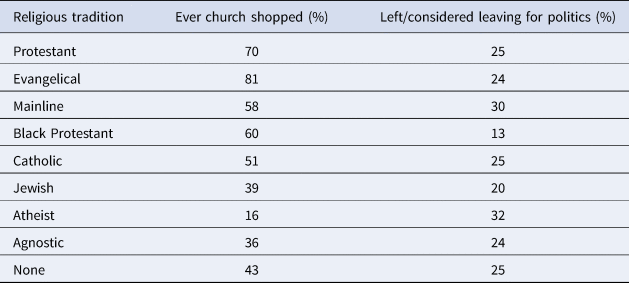
To further narrow down who has engaged in church shopping, including for political reasons, we examined the effect of religious tradition on church shopping. Table 1 reports the percentage of respondents from each religious tradition who have church shopped, and, among those who have, those who have left or considered leaving for political reasons.
Church shopping by religious tradition

Entries are rounded to the nearest percentage point. Data are weighted.
Of note, church shopping is most common among Protestant traditions, especially Evangelical Protestants. This finding makes sense, given the dispersion of Protestant Christian groups and the comparatively similar theology among different Christian churches. A slim majority of Roman Catholics also reported church shopping, as well as fairly sizeable numbers of the less religiously committed, Agnostics and those whose religion is “nothing in particular.” This demonstrates that church shopping is a fairly common phenomenon in the American religious marketplace (consistent with Putnam and Campbell, Reference Putnam and Campbell2010; Sherkat, Reference Sherkat2014).
This does not necessarily suggest that all those who engage in church shopping are comparing vastly different religious traditions. For example, a respondent may not be comparing among Evangelical Protestantism, Buddhism, Islam, and Catholicism. Rather, many may be shopping within their own religious denominations or families. In fact, we find, for example, that 44% of Roman Catholics that church shopped did so only among Roman Catholic churches, while 29% considered churches from many denominations. Among the religious traditions in the sample, Catholics are the most likely to shop within their own religious tradition. On the other hand, Atheists, Agnostics, and the Nones are more likely to shop among many traditions (58, 70, and 54%, respectively). Evangelical, Mainline, and Black Protestants also shop among many traditions at high rates (41, 39, and 55%, respectively). This makes sense as the nonaffiliated are less likely to identify with a particular religious tradition and because there may be lower barriers to entry among various Protestant churches, which are more theologically similar.
Among those who have left or considered leaving their church for political reasons, we see the highest percentage agreeing with the prompt among Atheists and Mainline Protestants. This is consistent with the literature that shows politicized religion has pushed people out of religion, particularly moderate and liberal traditions found in Mainline Protestantism (Hout and Fischer, Reference Hout and Fischer2002, Reference Hout and Fischer2014; Putnam and Campbell, Reference Putnam and Campbell2010; Margolis, Reference Margolis2018). However, discomfort with the politics of one's church is relatively common across traditions, perhaps with the exception of Black Protestantism, which has historically been recognized as a more politically active religious tradition (e.g., Harris, Reference Harris2001; McDaniel, Reference McDaniel2008). In general, the numbers suggest that politics may be a consideration for religious adherents of many traditions when deciding whether to stay at their place of worship or find a new religious home.
Multivariate models
After examining which respondents church shopped, we next want to see which demographic variables predict church shopping and using politics as a consideration in their religious choices. We thus turn to multivariate logistic regression models to parse out what factors have a greater statistical impact on these religious decisions.
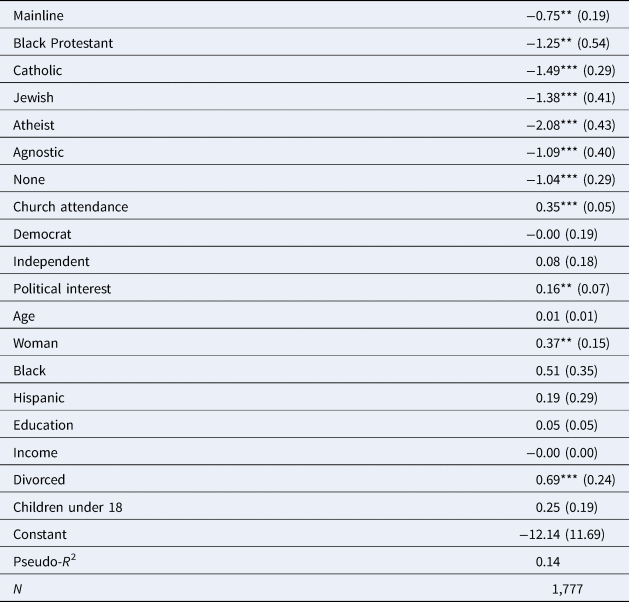
In our first model, summarized in Table 2, we include a number of different religious, political, and demographic factors, informed by the literature on church shopping, to determine the characteristics of respondents who report church shopping. Looking first at religious tradition, we see that Evangelical Protestants, the comparison category, are statistically more likely to church shop than any other religious tradition (76%). This confirms our descriptive findings. Examining the predicted probabilities for the various traditions, we can see that this is higher than the other two Protestant groups, Mainliners (62%) and Black Protestants (51%), as well as religious Nones (55%), Agnostics (54%), Jews (48%), Catholics (46%), and Atheists (33%). These findings make sense when considering broad trends in religious affiliation; the nonreligious may have church shopped and not found a religious “home,” while Catholics may have fewer options within their religious denomination and positively identified Atheists are less likely to desire a religious affiliation. Church attendance was also a significant predictor, with the gap in predicted probability percentages between those who attend church more than once a week being 81% and those who never attend being 34%. This is unsurprising, as those more active and engaged are more likely to have a reason to switch, whereas someone who rarely attends may find switching unnecessary due to their low involvement.Footnote 5 When adding these findings about church shopping to those studies of political disaffiliation or deidentification, this suggests that those who are involved will church shop and find a new congregation while those who are least involved may disaffiliate altogether (e.g., Djupe et al., Reference Djupe, Neiheisel and Sokey2018b; Higgins and Djupe, Reference Higgins and Djupe2022).
Predictors of church shopping

Logistic regression coefficients with robust standard errors in parentheses. “Other” religions are included in the model but omitted from the table.
***p < 0.01; **p < 0.05; *p < 0.10.
Of note, we find that political affiliation is not a significant predictor of church shopping; Republicans, Democrats, and Independents alike engage in church shopping.Footnote 6 This departs somewhat from previous studies, which hypothesize that Democrats and Independents may be more likely to change their religious affiliation (e.g., Hout and Fischer, Reference Hout and Fischer2002, but see Vargas, Reference Vargas2012). An important feature of our study is that we are able to capture individual-level congregational choices that are made separate from solely political considerations, which we address in Table 3. On the other hand, political interest does drive church shopping behavior, as 48% of those with the least political interest reported church shopping while 60% of those with the most political interest reported shopping for a church. In addition to a political effect, his may also serve as a latent measure of general interest in societal issues. Furthermore, we find that women are 7% more likely to church shop than men, consistent with findings that women tend to be more religiously committed (Trzebiatowska and Bruce, Reference Trzebiatowska and Bruce2012; Audette et al., Reference Audette, Kwakwa and Weaver2018) and that divorced individuals are 14% more likely to have church shopped than those who are married, likely reflecting the religious decision making following the dissolution of a relationship.
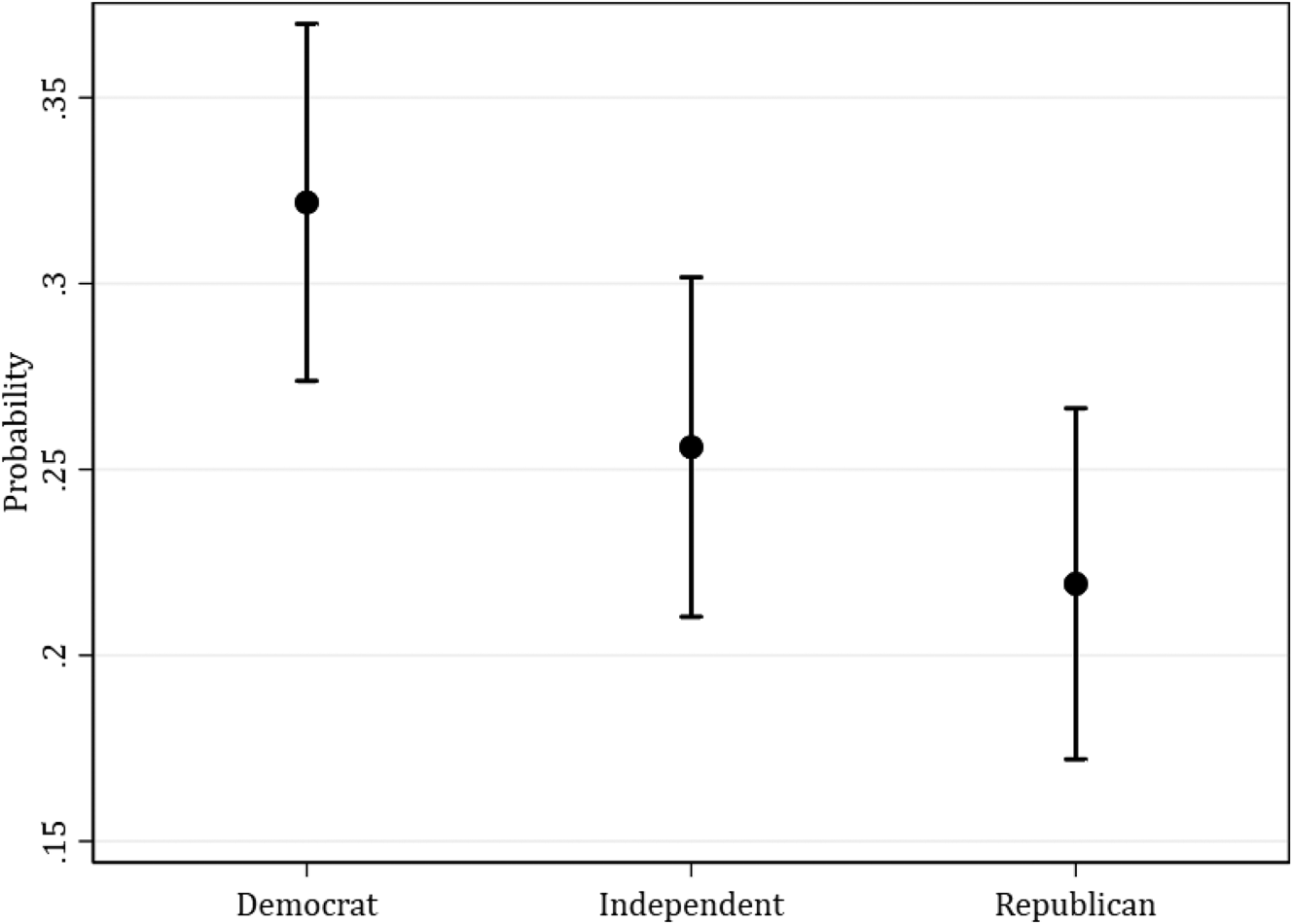
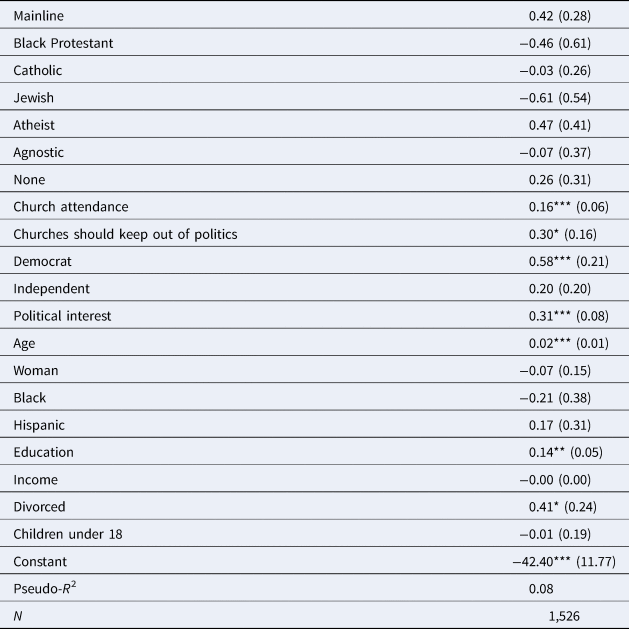
Next, we turn to predictors of leaving or considering leaving a church specifically due to politics, as shown in Table 3.Footnote 7 When bringing politics into the equation, here we do find an effect for partisan affiliation: Democrats are 10% more likely than Republicans to say that they have left or considered leaving due to a church's politics. This offers reinforcement for the literature that suggests the association of religion with conservative politics drives down religious adherence (Hout and Fischer, Reference Hout and Fischer2002, Reference Hout and Fischer2014; Patrikios, Reference Patrikios2008; Vargas, Reference Vargas2012; Margolis, Reference Margolis2018; Campbell et al., Reference Campbell, Layman and Green2021). It seems that Democrats are likely seeking out other churches that fit their beliefs and where they can find a more like-minded social group. Unsurprisingly, political interest becomes an even more significant predictor than church shopping generally. Those who are most interested in politics are 24% more likely to cite politics as a reason for (considering) leaving a church than those who are the least politically interested. Additionally, we add in a variable to test whether those who think that churches should be politically active or those who feel that churches should stay out of politics are likely to cite politics as a factor in determining which religious congregation to attend. Intuitively, those who believe churches should stay out of politics are more likely to cite politics as a reason to leave (Figure 1).
(Considered) leaving for political reasons by partisanship.

Predictors of (considering) leaving for political reasons

Logistic regression coefficients with robust standard errors in parentheses. “Other” religions are included in the model but omitted from the table.
***p < 0.01; **p < 0.05; *p < 0.10.
In addition to expressly political characteristics, we see other demographic factors that lead one to consider politics when deciding where to attend. Those who are older, and likely who have attended a church for a longer time, are more likely to cite politics as a factor. As with church shopping generally, the divorced are also more likely to have left or considered leaving for political reasons. The more well-educated and religiously active (in terms of church attendance) are likewise more likely to be sensitive to a church's politics, perhaps because they have a greater sense of the political leanings of the institution and of other congregants.
Across our models, we find strong evidence that a sizable portion of the population has engaged in church shopping and that politics is emerging as a formidable reason to do so. Our results are consistent with findings that Democrats, in particular, are disenchanted with the association of religion with conservative politics, which may lead them to disaffiliate altogether (Hout and Fischer, Reference Hout and Fischer2002, Reference Hout and Fischer2014; Patrikios, Reference Patrikios2008; Vargas, Reference Vargas2012; Margolis, Reference Margolis2018; Campbell et al., Reference Campbell, Layman and Green2021). Moreover, we suspect that these numbers underestimate the amount of movement in American religion and that politics is influencing choices in ways that our respondents may not know or may not admit. Nonetheless, it is significant that people are more willing to admit shopping around for a church and using politics as a deciding factor in their religious lives.
Conclusion
One broad takeaway from these findings is that scholars of religion and politics would do well to engage more direct resources to study the causes and effects of church shopping. As it becomes a common occurrence in the lives of Americans, understanding the important life choices of conversion and disaffiliation is a fruitful avenue to explore the nature of the relationship between religion and politics. The two may not be competing, but rather consistent ideologies, reinforced by churches as political spaces.
On the other hand, religion is ostensibly about one's fundamental values and worldview, answering questions about the purpose of life and, for some religions, the eternal destination of one's immortal soul. This seems to raise the stakes in the decision of if and where to attend worship services. From a religious perspective, to base religious choices on a human ideological system may be seen by some as heretical. For many years, religion played a preeminent role in society and individual life choices. Thus, the stated importance of politics in religious switching reveals how Americans negotiate occasionally competing ideologies and how institutions and organizations must respond to the increasing prominence of politics in directing social relationships. Of the many considerations that individuals make when determining which congregation to attend, we find congregation shopping on the basis of politics to be of particular interest, as both claim a broader organization of one's basic beliefs about the world (e.g., Converse, Reference Converse and Apter1964; Moyser, Reference Moyser and Moyser1991).
On a methodological note, we also view it as important to hear from people themselves about how they make these tough decisions about whether and where to attend church. Apart from the (useful) aggregate trends that have defined the literature thus far, we can learn from surveys such as these that ask people about their religious choices. Another type of less common data in this area is qualitative research. Deep learning about the process of religious switching and the influence of politics on church shopping would be a natural next step in this research area. There may also be room for experimental work to assess how people process and respond to political messages from their congregation. Finally, one limitation of our study is that we have captured data on church shopping from a single cross section of our respondents' lives; additional quantitative panel data or qualitative interviews would help to further dig into the complex nature of church shopping over time.
Ultimately, the results of our study also speak to important trends in American democracy. The religiopolitical sorting we describe here is one small part of the growing partisan divide in the country. Americans increasingly find themselves in echo chambers in the media, their social environments, and, as we show, in their churches (see also Putnam and Campbell, Reference Putnam and Campbell2010). This has potentially deleterious effects on democracy, as there are fewer social locations where people may be exposed to other political views, a role that some churches arguably used to play (Smidt et al., Reference Smidt, den Dulk, Penning, Monsma and Koopman2008; Putnam and Campbell, Reference Putnam and Campbell2010). There may be further negative effects on religious and political tolerance as these identities become more intertwined (Mason, Reference Mason2016; Perry, Reference Perry2022). However, noting that some congregations may benefit from serving a politically motivated niche market (e.g., Audette and Weaver, Reference Audette and Weaver2016), it seems unlikely that religious leaders will significantly change their present strategy without a disruption to the American religious ecosystem. As such, we find it all the more important to continue to monitor trends related to religiopolitical sorting and the role that religion plays in politics and vice versa.
Acknowledgments
This research was funded by the Faculty Research Support Program of the University of Notre Dame. The authors especially thank David Campbell for his support of the data collection for this project.
Conflict of interest
The authors declare none.
Shay R. Hafner is a senior at Monmouth College, studying political science and data science. His research interests include political behavior and public opinion, especially in regard to polarization.
Andre P. Audette is an assistant professor of political science at Monmouth College. He researches and teaches courses about religion and politics, law, identity politics, and political behavior.