Introduction
In 2000, Ghana and 189 other countries adopted the UN Millennium Declaration, which identified eight Millennium Development Goals (MDGs) to achieve by 2015. Improving maternal and child health is central to the MDGs. Goal 4 is to reduce child mortality by two-thirds from its 1990 rate, and Goal 5 is to reduce the maternal mortality ratio by three-quarters from its 1990 rate. Policymakers forecast that in Ghana, where an estimated 120 children per 1000 births die before their fifth birthday and 450 mothers per 100,000 live births die from pregnancy-related causes, achieving the maternal and child health MDGs is unlikely (United Nations, 2010).
Most maternal and child deaths can be averted through preventive care or early and effective medical treatment from a skilled practitioner when needed (Mavalankar & Rosenfield, Reference Mavalankar and Rosenfield2005). Though some researchers have been sceptical of a link between the use of health services and lower risk of maternal and child mortality in developing contexts, several studies support the conclusion that utilization of maternal and child health services is key to improving survival in these settings (LeVine & Rowe, Reference LeVine and Rowe2009). But even after recent increases in the availability of health services in Ghana, use of maternal and child health services remains at low levels (Addai, Reference Addai2000). Because of the central role that health care plays in reducing maternal and child mortality, women's use of health services during pregnancy, childbirth and the early years of childhood must increase for maternal and child survival to improve in Ghana.
Mothers' years of formal education is one of the most frequently found determinants of use of maternal and child health services, net of other dimensions of socioeconomic status (Nuwaha & Amooti-Kaguna, Reference Nuwaha and Amooti-Kaguna2004; Onah et al., Reference Onah, Ikeako and Iloabachie2006; Stephenson et al., Reference Stephenson, Baschieri, Clements, Hennink and Madise2006; Fotso et al., Reference Fotso, Ezeh, Madise, Ziraba and Ogollah2009; LeVine & Rowe, Reference LeVine and Rowe2009). In spite of the shared conclusion that maternal education is associated with increased use of maternal and child health services, there remains a need to clarify the mechanisms that explain the association (Obermeyer, Reference Obermeyer1993; LeVine & Rowe, Reference LeVine and Rowe2009). Even with an imperfect understanding of how mothers' education increases women's use of health services, girls' school enrolment remains central to international policies and programmes that intend to improve women's and children's health in sub-Saharan Africa (UN, 1994; Gakidou et al., Reference Gakidou, Cowling, Lozano and Murray2010). For instance, in Ghana, where almost a quarter of primary-school-aged girls remain out of primary school, policymakers cite low levels of women's education as a paramount reason for the lack of improvement in maternal and child health (United Nations, 2010). Understanding the underlying mechanisms of the association between maternal education and use of health services may inform educational programmes that can improve maternal and child health outside of the formal school setting.
Health knowledge features prominently in the literature as a potential mechanism by which education is associated with higher use of health services (Schultz et al., Reference Schultz, Steketee, Chitsulo, Macheso, Nyasulu and Ettling1994; LeVine & Rowe, Reference LeVine and Rowe2009). While health knowledge is commonly discussed as theoretically important, there are relatively few studies that specifically examine health knowledge in African contexts (Agyepong & Manderson, Reference Agyepong and Manderson1999; Glewwe, Reference Glewwe1999; Katz & Nare, Reference Katz and Nare2002; Andrzejewski et al., Reference Andrzejewski, Reed and White2009). Of the even fewer studies that consider the role of health knowledge in the association between formal education and use of health services, evidence is mixed. Some studies suggest that health knowledge is a key mechanism underlying the association between formal education and health-related outcomes (Glewwe, Reference Glewwe1999; Frost et al., Reference Frost, Forste and Haas2005) while other studies imply that it is not (Lindenbaum et al., Reference Lindenbaum, Chakraborty, Elias, Caldwell and Santow1989; Agyepong & Manderson, Reference Agyepong and Manderson1999).
The inconclusiveness of this literature may, in part, be due to the indicators used to assess health knowledge, which often focus on whether women have ever ‘heard of’ an illness (Frost et al., Reference Frost, Forste and Haas2005). To address this possibility, the current study extends the literature by measuring health knowledge using fifteen indicators of women's understanding of AIDS, tuberculosis and awareness of contraception (Glewwe, Reference Glewwe1999; Andrzejewski et al., Reference Andrzejewski, Reed and White2009). Using nationally representative data from the 2008 Ghana Demographic and Health Survey, the study first addresses whether mothers' formal education is associated with health knowledge. The analyses then determine if health knowledge mediates the association between education and mothers' use of three specific health services: antenatal care, giving birth supervised by a trained medical professional and complete child vaccination. The final model includes controls for a set of demographic, socioeconomic and community indicators to determine whether women's health knowledge is a robust indicator of women's use of health services. The study concludes with a discussion of the implications of the results for efforts to improve women's and children's health in Ghana and other sub-Saharan African countries.
Mothers' formal education and use of health services: the search for pathways
A number of studies spanning the globe show a positive linear association between women's years of formal education and use of maternal and child health services, net of other dimensions of socioeconomic status (Ware, Reference Ware1984; Cleland & Van Ginneken, Reference Cleland and Van Ginneken1988; Obermeyer, Reference Obermeyer1993; Addai, Reference Addai2000; D'Souza, Reference D'Souza2003; LeVine & Rowe, Reference LeVine and Rowe2009). The uniform association between mothers' education and health behaviours across multiple contexts has motivated researchers to attempt to explain the nature of the association further (Baker et al., Reference Baker, Leon, Smith Greenaway, Collins and Movit2011).
Some sociological theories conceptualize formal education as an experience that transforms women's attitudes and influences their adoption of ‘modern’ ideas. Researchers hypothesize that going to school changes a woman's attitudes about traditional gender roles, allowing her to achieve greater decision-making autonomy within the household (Caldwell, Reference Caldwell1979; Jejeebhoy, Reference Jejeebhoy1995). A woman's increased authority to make decisions enables her to move about her community more freely and to actively seek maternal and child health services as needed (Hobcraft et al., Reference Hobcraft1993).
Researchers also hypothesize that the content of formal education challenges traditional beliefs about sickness and health and promotes ideologies that align with the use of modern health care (Cleland & Van Ginneken, Reference Cleland and Van Ginneken1988; Obermeyer, Reference Obermeyer1993). In Ghana, maternal and child health services co-exist with an alternative health system. The adoption of ‘modern’ health beliefs does not mean that more educated women completely transfer allegiance from ‘traditional’ to ‘modern’ medicine. In fact, there is anthropological research suggesting that different frameworks for disease classification and treatment co-exist (Cleland & Van Ginneken, Reference Cleland and Van Ginneken1988). Research shows that in Ghana, while education does not align with one particular framework of disease causation, women with more formal schooling are more likely to attribute various illnesses to natural causes versus uneducated women who most commonly attribute illnesses to supernatural causes (Fosu, Reference Fosu1981). From this perspective, less educated women who hold only traditional beliefs about diseases are less likely to be confident in the preventive and curative advice that modern health care workers provide, but formally educated women's biomedical beliefs about natural causes of illness are likely to increase their confidence in services offered by the health care workers in the medical system (Fosu, Reference Fosu1981).
Beyond the adoption of beliefs about health that promote use of modern health services, some researchers hypothesize that acquisition of health knowledge through formal education explains mothers' subsequent use of health services (Frenzen & Hogan, Reference Frenzen and Hogan1982; Cleland & Van Ginneken, Reference Cleland and Van Ginneken1988; Defo, Reference Defo1997; LeVine & Rowe, Reference LeVine and Rowe2009). This perspective posits that formal education increases women's health knowledge in one of two ways. First, formal education may directly expose women to school curriculum about biology, germ theory and disease classification (Ross & Mirowsky, Reference Ross and Mirowsky1999; Nayga, Reference Nayga2001). This is commonly referred to as the ‘information-transfer hypothesis’ (Baker et al., Reference Baker, Leon and Collins2010). Second, formal education may indirectly increase knowledge through the literacy skills women acquire in school (Streatfield et al., Reference Streatfield, Singarimbun and Diamond1990; Glewwe, Reference Glewwe1999; LeVine et al., Reference LeVine, LeVine, Rowe and Schnell-Anzola2004; LeVine & Rowe, Reference LeVine and Rowe2009). Literate mothers can read newspapers, banners, brochures and billboards and can better comprehend health messages (LeVine et al., Reference LeVine, LeVine, Rowe and Schnell-Anzola2004), each of which provide them with endless opportunities to expand health knowledge.
There is some empirical evidence that formal education, even at low levels, is associated with specific health knowledge such as the importance of washing hands, boiling water and oral rehydration therapy (Boerma et al., Reference Boerma, Sommerfelt and Rutstein1991; Bhuiya & Mostafa, Reference Bhuiya and Mostafa1993). A study by Rowe et al. (Reference Rowe, Thapa, Levine, Levine and Tuladhar2005) demonstrates a strong association between mothers' formal education and a composite measure of women's health knowledge, net of other dimensions of socioeconomic status.
In line with this evidence, research also shows that health knowledge helps to explain the association between formal education and health-related outcomes. Rowe et al.'s (Reference Rowe, Thapa, Levine, Levine and Tuladhar2005) study mentioned above further demonstrates that mothers' health knowledge is significantly associated with a wide range of health behaviours, including use of health services (i.e. antenatal care, iron tablets during pregnancy, birth at a hospital). Similarly, Frost et al.'s (Reference Frost, Forste and Haas2005) study shows that health knowledge explains a portion of the association between maternal education and child nutrition in Bolivia. Furthermore, Glewwe's (Reference Glewwe1999) work in Morocco suggests that health knowledge obtained using literacy skills acquired in school explains the association between maternal education and child nutrition. Building on these studies, recent research shows that the neurological and cognitive benefits of reasoning and decision-making acquired in school explain the relationship between formal education and health knowledge (Gottfredson & Deary, Reference Gottfredson and Deary2004; Peters et al., Reference Peters, Baker, Dieckmann, Leon and Collins2010; Baker et al., Reference Baker, Leon, Smith Greenaway, Collins and Movit2011, Reference Baker, Salinas and Eslinger2012).
Other studies find less evidentiary support that health knowledge is linked to formal education. For instance, some research shows that formally educated women's knowledge of prevention, causes and treatment of illness is not significantly different from that of women with no formal schooling (Cleland & Van Ginneken, Reference Cleland and Van Ginneken1988; Agyepong & Manderson, Reference Agyepong and Manderson1999). Furthermore, it is also not clear whether health knowledge translates into consistent changes in health behaviour. A prominent example is that more educated individuals in Ghana, who are presumed to ‘know more’ about HIV/AIDS, are more likely to participate in risky behaviours and to become infected with HIV (Fortson, Reference Fortson2008). Taken together, this evidence has led some researchers to be sceptical of the importance of health knowledge for encouraging women to consistently utilize health services.
Some of these conflicting findings about the effects of health knowledge on use of health services may stem from inconsistent measurement of women's health knowledge. Some studies take a one-dimensional approach to measuring health knowledge. For instance, in Frost et al.'s (Reference Frost, Forste and Haas2005) investigation of child nutrition, mothers' health knowledge is measured by whether mothers have ‘heard of’ such health-related issues as oral rehydration therapy, contraception or AIDS. Having heard of illnesses may be necessary but not sufficient to ensure mothers' consistent use of health services. While mere awareness of illnesses may be important, it is likely to have less influence on behaviour than women's specific understanding about particular health topics. For instance, even if a mother has heard of an illness through her social networks or through a public health campaign, she may still lack comprehension of ways to prevent, detect or treat the particular health concern.
Other research takes a multi-dimensional approach to studying women's health knowledge. Glewwe (Reference Glewwe1999) measures health knowledge by using a set of questions pertaining to women's understanding of vaccination, potable water, preventing infection and how to respond to child diarrhoea. Assessing women's understanding of multiple health topics, rather than only focusing on what they have ‘heard of’, offers an arguably more comprehensive and accurate measure of women's knowledge. Similar to Glewwe's (Reference Glewwe1999) study, recent work on how community context shapes health knowledge in Ghana measures individual's knowledge of particular diseases by evaluating their understanding of contagions, related hygiene and prevention (Andrzejewski et al., Reference Andrzejewski, Reed and White2009).
The current study follows suit and assumes a more comprehensive and multi-dimensional approach to measuring women's knowledge. More specifically, in the current study, women's health knowledge is measured using indicators of the ability to identify both correct and incorrect facts pertaining to AIDS and tuberculosis, and to list, without prompting, forms of contraception. To gain a better understanding of the role of women's health knowledge in Ghana, the current study first determines if years of formal education is associated with greater health knowledge. The analyses then determine if health knowledge helps to explain the association between maternal education and use of maternal and child health services, and finally, if health knowledge is a robust predictor of the use of maternal and child health services.
Methods
Data and sample
Data for this study come from the 2008 Ghanaian Demographic and Health Survey (GDHS-8), which uses a probability sampling framework. The GDHS-8 uses a multistage stratified random sample to represent the population of Ghana. Within the sampling framework, ‘clusters’ are the primary sampling unit. Clusters are based on enumeration areas taken from the population census. In each selected cluster, the DHS uses a household listing operation to randomly select a fixed sample-take per cluster. A total of 11,778 households were sampled, yielding a household response rate of 99%.
Within each sampled household, the GDHS-8 interviews women of reproductive age (15–49 years) and collects information on their reproductive histories. The women provide detailed data on each live birth. A total of 5096 eligible women were identified, and interviews were completed for 4916 women, yielding a response rate of 97%. Of these sampled women, 2147 were mothers; these mothers had given birth to a total of 2794 children between 2003 and the time of the survey in 2008.
There are three reasons why some respondents are excluded from the current study. First, because of the current study's focus on mothers' use of health services extending into the child's early months and years, and because such data are unavailable for deceased children, 61 women whose children are no longer alive are omitted from the sample. Second, because prior research identifies that women's decision-making autonomy is a prominent explanation for mothers' use of health services (Sharma et al., Reference Sharma, Sawangdee and Sirirassamee2007), and because information on decision-making is only collected from married or cohabiting women, the sample is restricted to these 1852 women. Third, a total of 72 women (approximately 3.8% of the sample) are missing data on explanatory variables, and as a result, are excluded from the analytic sample. Listwise deletion is an acceptable strategy for handling such a small percentage of cases (Von Hippel, Reference Von Hippel2007). Supplementary analyses (available upon request) confirm that listwise deletion did not systematically exclude children with a particular socio-demographic profile. The final analytic sample includes information on 2449 children who were born to 1780 mothers from 2003 to 2008.
Measurements
The dependent variable is mothers' report of use of three types of health services. Because antenatal care is consistently associated with maternal and neonatal health, the first measure is a binary indicator for antenatal care. Women were asked, ‘Did you see anyone for antenatal care for this pregnancy?’ If women answered yes, they were asked the follow-up question: ‘Whom did you see?’ The indicator was coded 1 if the mother received care from a trained health professional. The second measure is whether the childbirth was supervised by a trained medical professional, which is associated with lower risk of maternal mortality and neonatal mortality compared with home births (Ronsmans et al., Reference Ronsmans, Etard, Walraven, Høj, Dumont, Bernis and Kodio2003). Women were asked, ‘Who assisted with the delivery of [child's name]?’ The indicator was coded 1 if a trained medical professional provided assistance. The third measure is created with information on child vaccination, because full, on-time vaccination is critical to preventing child morbidity and mortality (Jones et al., Reference Jones, Steketee, Black, Bhutta and Morris2003). A binary measure indicates whether the child was fully vaccinated according to the World Health Organization's recommendations for the child's specific age group. Children who have received all recommended vaccinations for their age are considered fully vaccinated (coded as 1). The dependent measure in the current study is modelled after one used in research on health care utilization in Guatemala (Pebley et al., Reference Pebley, Goldman and Rodriguez1996).
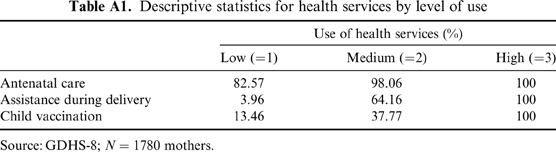
A summed scale of maternal use of health services is created for each of the mothers' live births. Because some mothers in the dataset gave birth to multiple children between 2003 and 2008, the minimum value is taken to reflect the level of mothers' use of health services. Supplementary analyses (available upon request) estimated all models using the mean value and maximum value of use of health services to ensure that the coding of this variable did not bias results. Results were consistent regardless of the coding of use of health services. Supplementary analyses (available upon request) also estimated all models separately for antenatal care, assistance during childbirth and child vaccination. Because the results were consistent across each outcome, for parsimony, a summed scale of use of health services was created. Appendix Table A1 provides additional information on the distribution of antenatal care, childbirth assisted by a trained professional and child vaccination at each level of use of health services.
The GDHS-8 asks respondents how many years of formal education they completed. Years of maternal education are continuously coded, ranging from 0 to 19.
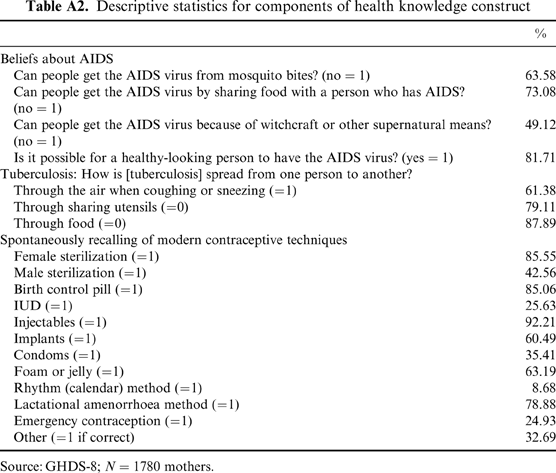
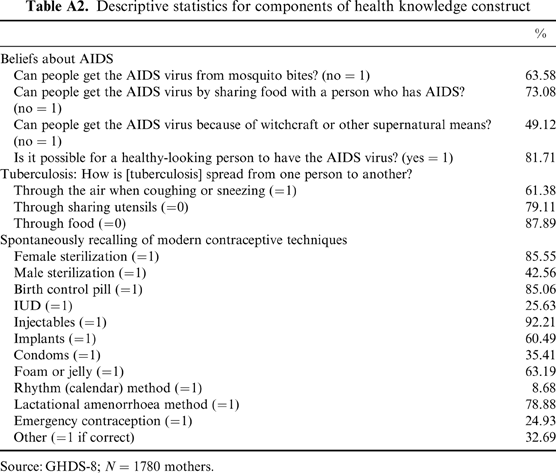
A latent construct based on questions pertaining to AIDS, tuberculosis and contraception is used to measure women's health knowledge. The first set of measures indicates whether mothers could identify correctly four common myths about HIV and three common misunderstandings about transmission of tuberculosis. In some instances, women had never heard of HIV or tuberculosis. These women are categorized as having not identified the myth or misunderstanding (=0). The next set of measures indicates whether women could list up to seven forms of modern contraception with the interviewer. The measure also includes an indicator of whether the mother is literate (47.62%). The factor loading (eigenvalue=1.452) supports the construction of a single construct. The factor explains 36% of the variance of these indicators and yields an acceptable Kaiser-Meyer-Olkin Test (KMO) reliability score of 0.594. A similar measurement has been shown to be related to education (Baker et al., Reference Baker, Leon and Collins2010). Appendix Table A2 provides additional information on the health items used to create the measure.
Statistical controls
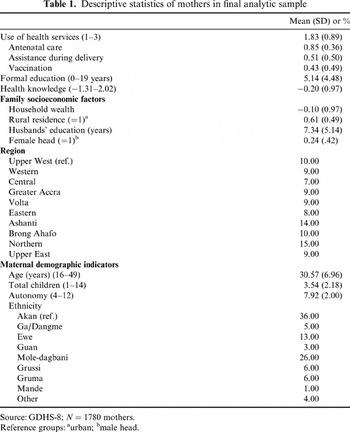
The analyses account for other factors in the household and community that are likely to influence mothers' formal education, health knowledge and use of health services. The dwelling conditions and consumption patterns of the home where the mother and child live are controlled to account for socioeconomic status. Socioeconomic status is also accounted for by controlling for rural residence, husbands' education and whether the home is headed by a woman. Beyond socioeconomic factors, the region within Ghana is also controlled for to account for regional disparities in access to services. Based on prior findings, the following maternal demographic indicators are also controlled: mothers' age, total number of children, autonomy within the household and ethnicity. Table 1 presents characteristics of the final analytic sample.
Descriptive statistics of mothers in final analytic sample

Reference groups:aurban; bmale head.
Analytic approach
The analyses begin with the bivariate association between mothers' formal education and health knowledge. This analysis will show whether mothers' formal education is independently associated with health knowledge. The next analyses include a series of ordered probit regression models that provide the observed associations between mothers' formal education, health knowledge and use of health services. The ordered probit model for a normal latent variable estimates the inverse of the cumulative standard normal distribution function. These models show the bivariate association between use of health services and mothers' formal education (Model 1) and health knowledge (Model 2). The next model estimates the association between use of health services, mothers' formal education and health knowledge (Model 3), and the last model follows up the previous model by including all statistical controls to evaluate the robustness of the observed associations (Model 4). All models are estimated in Stata 11.
Interpreting coefficients is less straightforward in probit regression than in linear or logistic regression because the increase in the probability of the outcome attributed to a one-unit increase in the predictor is dependent on both the values of the other predictors and on the starting values of the other predictors. For this reason, the coefficients indicate whether the independent variables are associated with an increase or decrease in predicted probabilities for the respective outcome.
Results
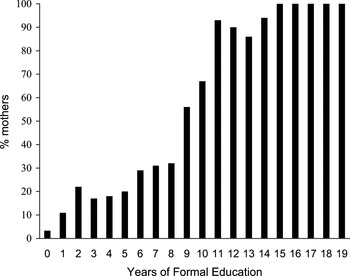
Figure 1 presents the association between formal education and health knowledge. For parsimony, the results focus on the percentage of women who score 2 standard deviations above the mean of the continuous measure for health knowledge. Corroborating prior research, the results show that with each year of education, there is a linear increase in the percentage of women who display greater health knowledge (Rowe et al., Reference Rowe, Thapa, Levine, Levine and Tuladhar2005). Only 3.3% of mothers who have never attended formal education displayed high health knowledge, whereas 100% of all women who have fifteen and more years of education display high health knowledge. These findings indicate that formal education and health knowledge are closely related.
Percentage of mothers with ‘high’ health knowledge, by years of formal education.

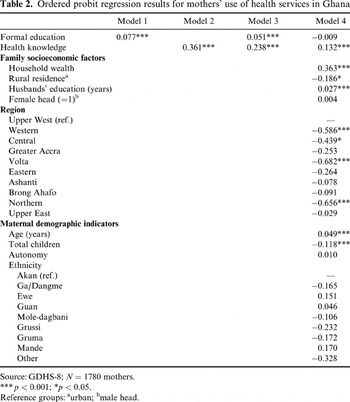
Table 2 presents estimates for the ordered probit regression models in order to determine the role of formal education and health knowledge for understanding maternal use of health services. Corroborating findings from past studies, Model 1 shows that formal education is significantly associated with mothers' use of health services. Each year of mothers' formal education significantly increases the predicted probability of use of health services by 0.077 (p<0.001).
Ordered probit regression results for mothers' use of health services in Ghana

***p<0.001; *p<0.05.
Reference groups:aurban; bmale head.
Model 2 estimates the association between use of health services and women's health knowledge. The results show that each increase in the factor score for women's health knowledge corresponds with an increase in the predicted probability of use of health services. With a one-unit increase in the factor score for women's health knowledge, the predicted probability of use of health services increases by 0.361 (p<0.001).
When the associations between use of health services and formal education and health knowledge are estimated together in Model 3, the results show that mothers' years of formal education and health knowledge are both independently associated with an increase in use of health services. However, the size of the association between formal education and use of health services is significantly reduced when women's health knowledge is included in the model. This suggests that health knowledge helps to explain a proportion of the association between mothers' education and use of health services.
Model 4 extends Model 3 to include demographic and socioeconomic controls. With the inclusion of controls, the association between mothers' formal education and use of health services becomes non-significant, illustrating that the statistical confounders help to fully account for the association. Net of confounders, mothers' health knowledge continues to be independently associated with an increase in the predicted probability of the use of health services (p<0.001). This illustrates that health knowledge, which is strongly associated with years of formal education, plays an important role in increasing women's use of health services.
As shown in Model 4, the inclusion of health knowledge does not explain the associations between household wealth and husbands' education and women's use of health services. Instead, household wealth and husbands' education continue to be strongly associated with women's higher use of health services. In other words, while a woman's health knowledge explains the impact of her formal education, it does not explain the influence of household wealth or husband's education on her use of health services. Prior research recognizes that household wealth and husbands' education are close proxies for women's access to material and financial resources (Hobcraft, Reference Hobcraft1993). Thus, the strong impact of household wealth and husbands' education on women's use of health services suggests that a lack of resources is inhibiting some Ghanaian women from utilizing health services. This finding supports the perspective that poorer families' inability to afford health services is a principal reason for the socioeconomic gradient in maternal and child health (Wagstaff, Reference Wagstaff2002).
To confirm that the directionality of the relationship between health knowledge and use of health services is correctly specified in Model 4, competing models estimated if the use of health services is predictive of health knowledge. Supplementary models (available upon request) confirm that the use of health services has a non-significant association with health knowledge, confirming that the initial conceptualization of the nature of the association between health knowledge and use of health services is correct.
Apart from formal education, research shows that another potential source of health knowledge in Ghana is mass media, particularly the radio (Benefo, Reference Benefo2004). Based on prior work, supplementary models evaluated whether the access to, frequency of, and/or the type of media exposure (i.e. radio, television and newspaper) influence the results shown here. Supplementary models (available upon request) confirm that indicators for women's access to mass media (i.e. radio, television and newspaper) and frequency of media exposure, as well as a composite measure of total media exposure, are not associated with use of health services. Furthermore, inclusion of these variables does not change the size or significance of the associations shown here, implying that the source of health knowledge does not explain its influence on women's use of health services in Ghana.
Discussion
The purpose of this study was to examine the importance of health knowledge for mothers' use of three specific health services in Ghana: antenatal care, giving birth with the supervision of a trained medical professional and complete child vaccination. The study also evaluates whether health knowledge is an underlying mechanism in the association between formal education and use of health services, and whether observed associations between women's health knowledge and women's use of health services is robust to a set of demographic controls.
The study brings new evidence to the decades of research on how education increases women's use of maternal and child health services and offers support for health knowledge as an important factor. The results, corroborating a prior study (Rowe et al., Reference Rowe, Thapa, Levine, Levine and Tuladhar2005), show that formal education increases mothers' understanding of multiple dimensions of health and that this comprehension of health translates into a greater use of maternal and child health services. Furthermore, the association between health knowledge and use of health services is robust to a stringent set of confounders. This implies that the accumulation of accurate information about a broad range of health topics is a principal way in which going to school is associated with greater use of maternal and child health services.
The central importance of health knowledge for increasing women's use of health services suggests that health knowledge may also help to explain the association between education and a wide range of health behaviours. The current body of research that explicitly focuses on health knowledge in Africa is relatively small (Agyepong & Manderson, Reference Agyepong and Manderson1999; Glewwe, Reference Glewwe1999; Katz & Nare, Reference Katz and Nare2002; Andrzejewski et al., Reference Andrzejewski, Reed and White2009), and there are even fewer studies that explicitly consider the role of health knowledge for use of maternal and child health services (e.g. Glewwe, Reference Glewwe1999). Future research that replicates the current findings from Ghana in other African contexts will advance our understanding of the role of health knowledge in the association between maternal education and use of health services in critical ways.
The results also point to the value of measuring a woman's broader awareness of health topics as an approximation of her health knowledge, as compared with relying on one-dimensional measures such as whether she has ‘heard of’ particular illnesses. Though mere awareness of illnesses may be important, it is likely to have less influence on health behaviours than women's broader understanding of, and knowledge about, multiple health topics. The results shown here suggest that when considering women's knowledge multi-dimensionally, it becomes clear that comprehension of health information can powerfully inform health behaviours.
The central role of health knowledge found in this study may also be informative for educational policies in Ghana and other contexts where formal education is not universal. In Ghana, where large proportions of primary- and secondary-school-aged girls remain out of school, educational interventions intended to increase health knowledge of girls who are not attending school may help to improve use of maternal and child health services. Such interventions may help to reduce the educational barrier to utilizing maternal and child health services, and in turn, can help to promote women's and children's health in Ghana and sub-Saharan Africa more broadly.
Acknowledgments
The authors are indebted to two anonymous reviewers for their helpful comments on an earlier draft. Emily Smith Greenaway acknowledges the support of the Predoctoral Traineeship in Family Demography (No. T-32HD 007514) by the Eunice Kennedy Shriver National Institute of Child Health and Human Development to the Pennsylvania State University Population Research Institute.
Appendix
Descriptive statistics for health services by level of use
Descriptive statistics for components of health knowledge construct