Introduction
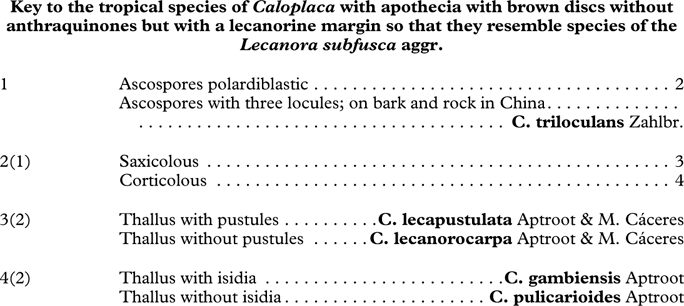
Caloplaca in the wide sense is one of the most speciose lichen genera. Species are known from almost all substrata and habitats where lichens occur, but they are generally abundant and speciose only on calcareous rock, such as limestone or concrete, and in eutrophicated situations such as on trees below bark wounds, seashores, or on walls used by dogs (Arup et al. Reference Arup, Søchting and Frödén2013). The group is, so far, much more speciose in subtropical to arctic regions than in tropical regions.
Around 600 accepted species have been described in the genus. It has recently been the subject of phylogenetic studies and, as a result, numerous segregate genera have been proposed, for example 31 by Arup et al. (Reference Arup, Søchting and Frödén2013) and a dozen more by Kondratyuk et al. (Reference Kondratyuk, Jeong, Yu, Kärnefelt, Thell, Elix, Kim, Kondratyuk and Hur2014). Less than half of the currently accepted species have been reassigned to these segregates, which leaves the genus Caloplaca with anything between 12 species, viz. the number listed by Arup et al. (Reference Arup, Søchting and Frödén2013), and c. 250, the approximate number of accepted Caloplaca species that have not been repositioned.
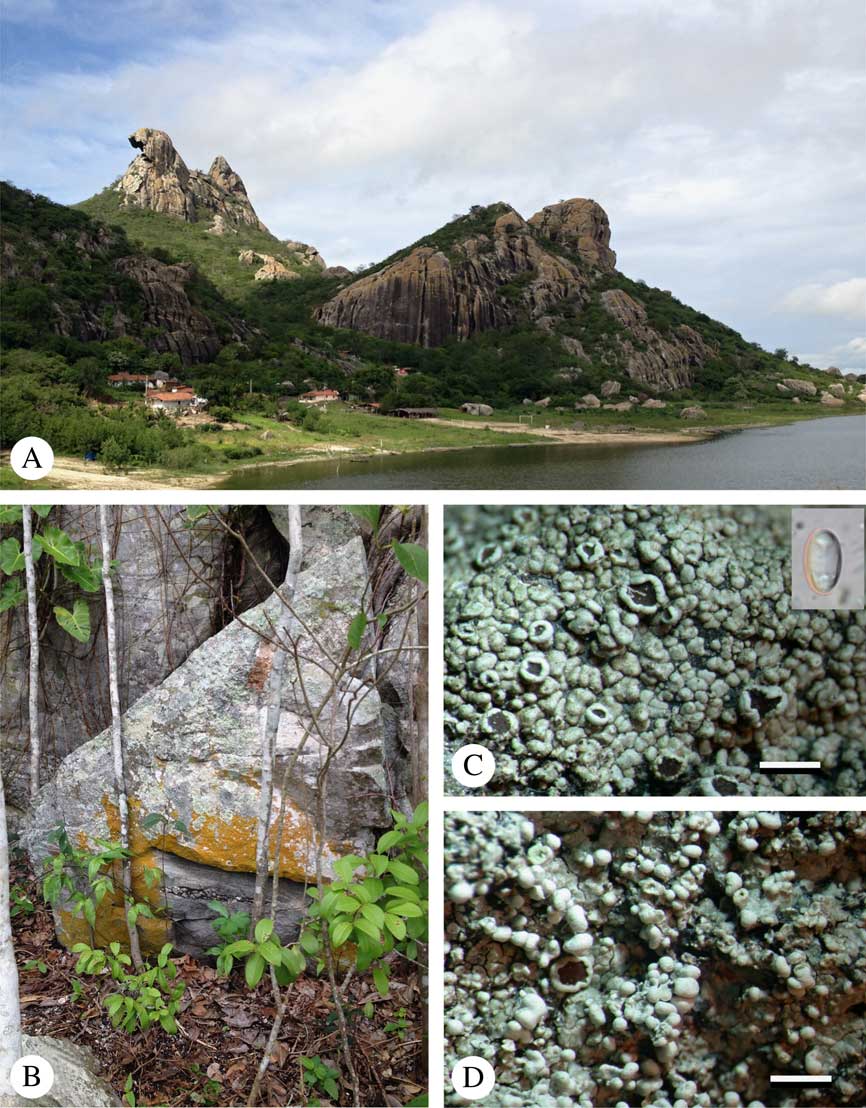
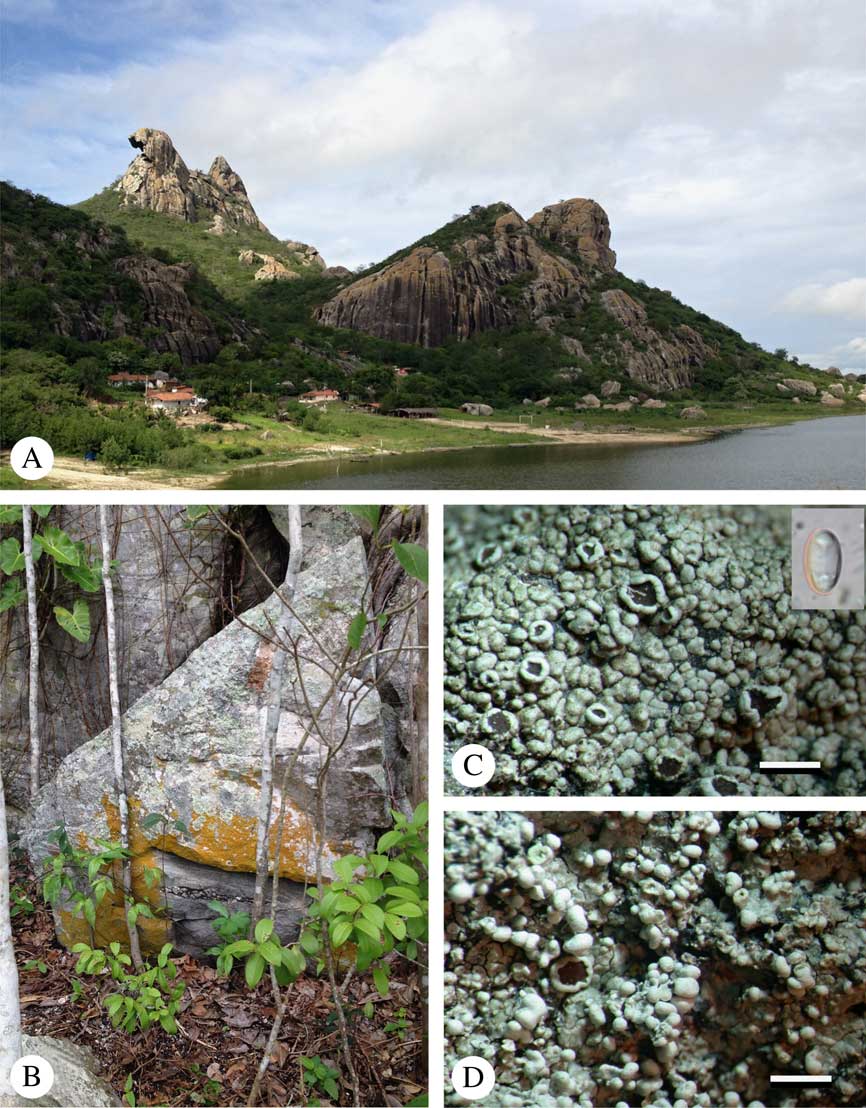
The lichen flora of equatorial Brazil is still largely unknown. This is especially true for the semi-arid Caatinga region in Ceará, where so far only corticolous lichens have been investigated (e.g. Menezes et al. Reference Menezes, Xavier-Leite, de Jesus, Aptroot and Cáceres2013, Reference Menezes, Xavier-Leite, Aptroot, Lücking and Cáceres2015; Alves et al. Reference Alves, Aptroot, Lacerda and Cáceres2014a , Reference Alves, Aptroot, Lacerda and Cáceres b ). During a mycological expedition to this region, the authors noticed that caloplacoid lichens are the dominant organisms on the inselbergs. When seen from a distance of up to 1 km, the rock outcrops are largely yellow (Fig. 1A & B). This is true for many of these rock outcrops, even including tourist attractions such as the Pedra da Galinha (“Chicken Rock”). These inselbergs are built up from a crystalline gneiss, without any trace of calcium. The other common lichen groups on these rocks are Peltulaceae (on places with run-off), and Physciaceae (mainly Physcia and Pyxine species).
Closer examination of these inselbergs revealed not only an abundance of caloplacoid lichens (Fig. 1B), but also species diversity. Among the dominant yellow species is probably Caloplaca ochraceofulva (Müll. Arg.) Jatta. Especially noteworthy is that a large proportion of the caloplacoid species found were not yellow, so that much of the grey colour is equally attributable to caloplacoid lichens. These grey species include the predominantly Caribbean C. diplacia (Ach.) Riddle s. lat. in several morphs, the unusual C. araguana Poelt & Hafellner (probably, so far known only from Venezuela, cf. Hafellner & Poelt Reference Hafellner and Poelt1979) with 3-loculate ascospores, and two apparently undescribed Caloplaca species (Fig. 1C & D) that in the field have the features of a Lecanora of the subfusca-aggregate. Caloplaca species with such an appearance, with a grey thallus and thalline apothecial margin, and dark brown discs, all without any anthraquinones, are relatively rare. They are generally not collected by Teloschistaceae specialists, and discarded by Lecanora specialists, so they end up being recognized and described by less specialized lichenolgists. They seem to be largely restricted to the tropics, and the species of this group with polardiblastic ascospores have so far been exclusively known from corticolous habitats (Aptroot & Seaward Reference Aptroot and Seaward1999; Aptroot Reference Aptroot2001). None of the lecanoroid Caloplaca species have been phylogenetically studied. Therefore we had to sequence the two new species to find out whether or not they are related to the core group of Caloplaca.
The purpose of this paper is to formally describe these two lecanoroid Caloplaca species. A key is presented to all lecanoroid Caloplaca species.
Material and Methods
Identification and descriptive work was carried out in Itabaiana, Universidade Federal de Sergipe, using a Leica EZ4 stereomicroscope and a Leica DM500 compound microscope, and also in Soest using an Olympus SZX7 stereomicroscope and an Olympus BX50 compound microscope with interference contrast, connected to a Nikon Coolpix digital camera. Sections were mounted in tap water, in which all measurements were also taken. The specimens from this study are preserved in ISE and ABL. The chemistry of the type specimen was investigated by thin-layer chromatography (TLC) using solvent A (Orange et al. Reference Orange, James and White2001).
DNA extraction, amplification and sequencing
Total DNA was extracted from dry specimens employing a modification of Murray & Thompson’s (Reference Murray and Thompson1980) protocol. A portion was blended with the aid of a micropestle in 600 µl CTAB buffer (CTAB 2%, NaCl 1·4 M, EDTA (pH 8·0) 20 mM, Tris-HCl (pH 8·0) 100 mM). The resulting mixture was incubated for 15 min at 65 °C. A similar volume of chloroform: isoamilalcohol (24:1) was added and carefully mixed with the samples until their emulsion. It was then centrifuged for 10 min at 13 000 g, and the DNA in the supernatant was precipitated with a volume of isopropanol. After a new centrifugation of 15 min at the same speed, the pellet was washed in 70% cold ethanol, centrifuged again for 2 min and dried. It was finally resuspended in 200 µl of ddH2O. PCR amplification was carried out with the ITS1F and ITS4 primers (White et al. Reference White, Bruns, Lee and Taylor1990; Gardes & Bruns Reference Gardes and Bruns1993) for ITS. PCR reactions were performed using a protocol consisting of a hot start at 95 °C for 5 min, followed by 35 cycles at 94 °C, 54 °C and 72 °C (for 45, 30 and 45 s, respectively) and a final 72 °C step for 10 min. PCR products were checked in 1% agarose gels, and positive reactions were sequenced with primer ITS4. Chromatograms were checked searching for putative reading errors, and these were corrected.
Phylogenetic analyses
Sequences selected for alignment came mainly from Šoun et al. (Reference Šoun, Vondrák, Søchting, Hrouzek, Khodosovtsev and Arup2011), Arup et al. (Reference Arup, Søchting and Frödén2013), and Kondratyuk et al. (Reference Kondratyuk, Jeong, Yu, Kärnefelt, Thell, Elix, Kim, Kondratyuk and Hur2014). Sequences were first aligned in MEGA 5.0 (Tamura et al. Reference Tamura, Peterson, Peterson, Stecher, Nei and Kumar2011) software with its Clustal W application and then corrected manually. Gblocks 0.91b (http://molevol.cmima.csic.es/castresana/Gblocks_server.html) was used to eliminate poorly aligned positions with the less stringent options available. The resulting alignment was loaded in PAUP* 4.0b10 (Swofford Reference Swofford2001) and subjected to MrModeltest 2.3 (Nylander Reference Nylander2004). Model GTR+Γ was selected and implemented in MrBayes 3.1 (Ronquist & Huelsenbeck Reference Ronquist and Huelsenbeck2003), where a Bayesian analysis was performed (two simultaneous runs, six chains, temperature set to 0·2, sampling every 100th generation) until convergence parameters were met after c. 4 960 000 generations, standard deviation having fallen below 0·01. Finally a full search for the best-scoring maximum likelihood tree was performed in RAxML (Stamatakis Reference Stamatakis2006) using the standard search algorithm (2000 bootstrap replications). Significance threshold was set above 0·95 for posterior probability (PP) and 70% bootstrap proportion (BP).
Results
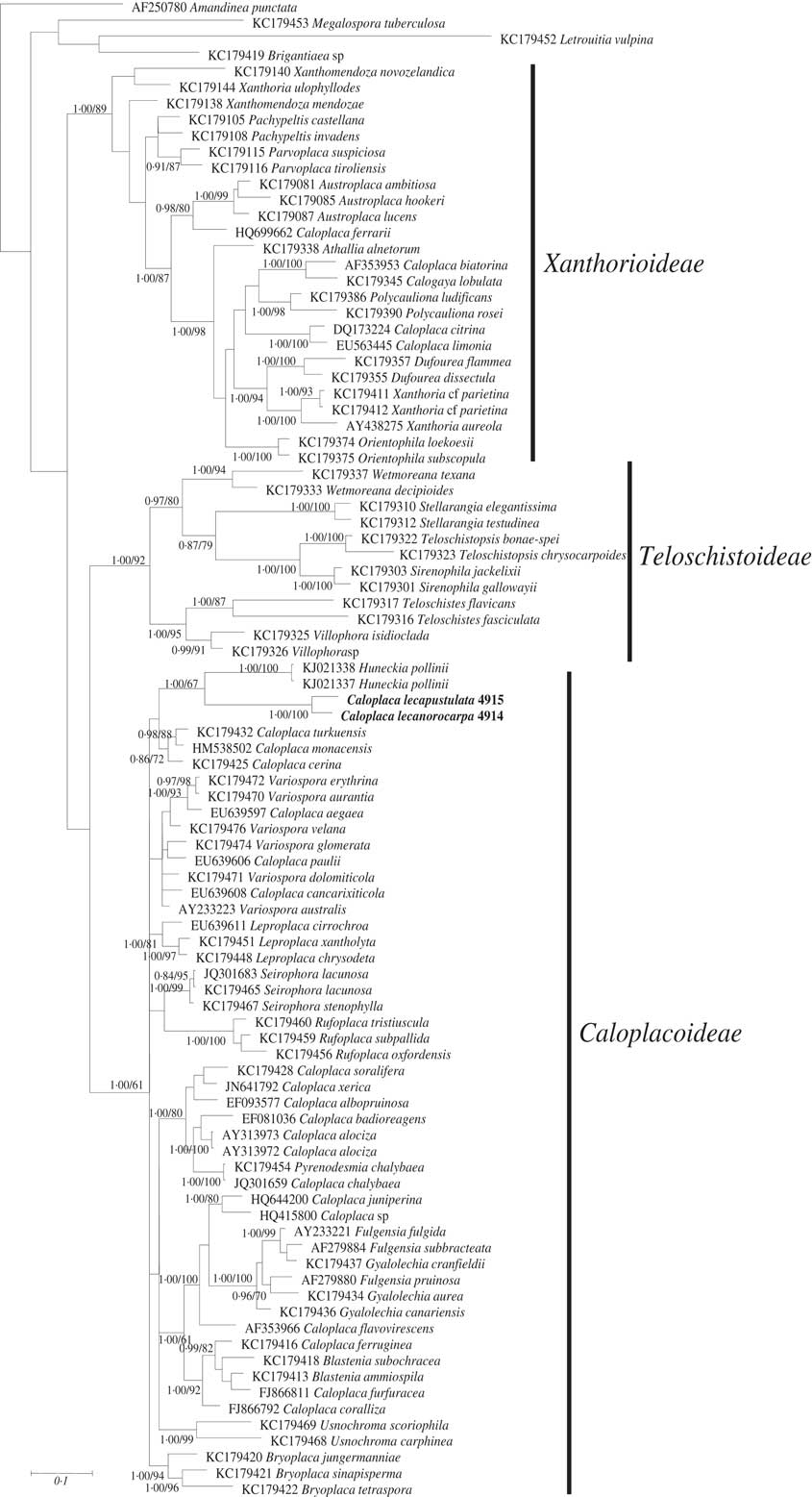
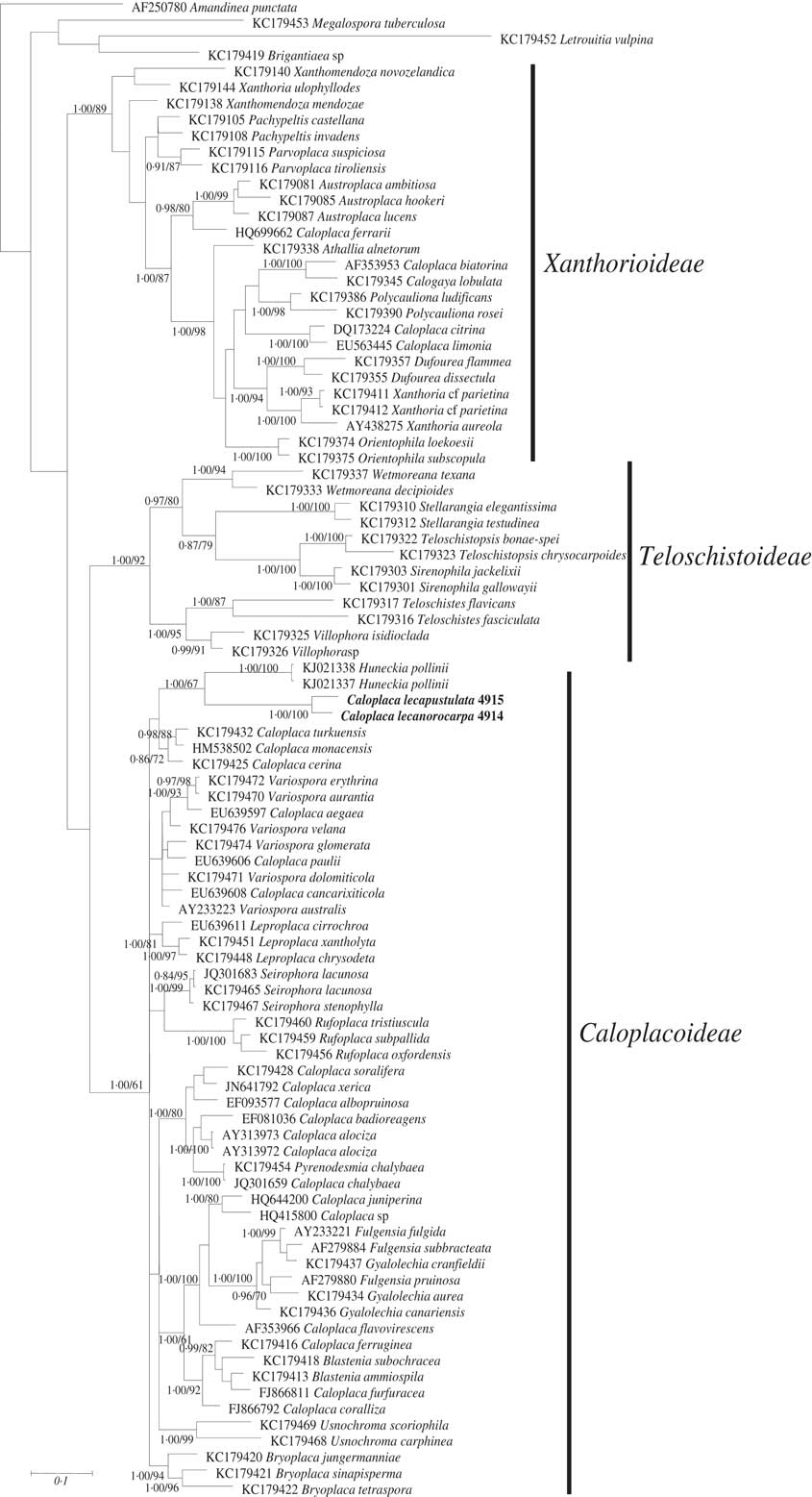
Sequences were obtained from both new species. Caloplaca lecanorocarpa, (isotype) is 4914, GenBank no KU257734; C. lecapustulata, (isotype) is 4915, GenBank no KU257735. For the construction of a phylogenetic tree (Fig. 2), all ITS sequences of Caloplacoideae from Arup et al. (Reference Arup, Søchting and Frödén2013: fig. 5) were downloaded, as well as many others from the other subfamilies of the Teloschistaceae, from the sources mentioned in the Materials section above. Subfamilies Xanthorioideae and Teloschistoideae were significantly supported by both Bayesian and ML methods. The new species were significantly related to subfamily Caloplacoideae by Bayesian analysis, but only subsignificantly by ML analysis (BP=61). We hypothesize here that the new species belong to Caloplacoideae until a more detailed phylogenetic study involving additional DNA markers is conducted. Samples were also significantly related to Huneckia pollinii sequences from Kondratyuk et al. (Reference Kondratyuk, Jeong, Yu, Kärnefelt, Thell, Elix, Kim, Kondratyuk and Hur2014) in the Bayesian analysis, but only subsignificantly (BP=67) using the ML criterion.
The sequences produced are placed together on a rather long branch (Fig. 2). We were therefore presented with a choice between either describing a new genus for this group or describing the two new species in the genus Caloplaca. As only one gene was investigated, we are presenting a gene tree and not a statistically supported phylogeny; so for the moment we have chosen the more conservative option. This means that the two new lecanoroid species have been assigned to the genus Caloplaca. Incidentally, neither pustules nor lecanoroid apothecia with brown discs were reported for any of the caloplacoid genera accepted by Arup et al. (Reference Arup, Søchting and Frödén2013).
Caloplaca lecanorocarpa Aptroot & M. Cáceres sp. nov.
MycoBank No.: MB 815343
Saxicolous Caloplaca with a grey areolate bullate thallus on a black prothallus, grey thalline apothecium margin, sessile apothecia with a glossy dark brown disc, and ascospores of 10–12×5·0–5·5 μm, with a 5·0–5·5 μm thick septum.
Type: Brazil, Ceará, Açude Cedro, trilha da Pedra da Galinha, 4°58'S, 39°03'W, on gneiss inselberg in Caatinga, c. 250 m alt., 31 March 2014, A. Aptroot & M. E. S. Cáceres 21364 (ISE—holotype; ABL—isotype).
(Fig. 1D)
Thallus crustose, corticate, slightly shiny, grey, areolate with bullate to somewhat flattened or slightly folded, round to angular areoles of c. 0·2–1·0 mm diam. on a black hypothallus. Thallus c. 100–220 μm thick; medulla hyphal, rather lax; cortex paraplectenchymatous, filled with tiny crystals (atranorin), c. 10–18 μm thick; algae chlorococcoid, cells c. 6–11 μm diam. Vegetative propagules absent.
Apothecia numerous, dispersed, sessile, round, 0·4–1·0 mm diam., 0·3–0·7 mm high; disc concave, chocolate brown, glossy; margin grey, glossy, incurved, with some incisions, c. 0·2 mm wide, much raised above the disc. Cortex of the apothecium margin paraplectenchymatous, filled with tiny crystals (atranorin), c. 10–15 μm thick; medulla of the apothecium margin with algae. Excipulum colourless. Hymenium not inspersed, c. 75–95 μm high; subhymenium hyaline, c. 50–75 μm high; epihymenium brown, c. 7–12 μm high; colour unchanged in KOH; paraphyses c. 2·0–2·5 μm thick, sparingly branched only at the tips; terminal cells widened to c. 3·0–3·5 μm and often with flattened tips. Ascospores 8 per ascus, hyaline, ellipsoid, polardiblastic, 10·0–12·0(–12·5)×5·0–5·5 μm, around twice as long as wide, with a 5·0–5·5 μm thick septum that occupies around half of the ascospore length.
Pycnidia not observed.
Chemistry. Thallus and apothecium margin KOH+ yellow. TLC: atranorin and a terpenoid at Rf 6 in solvent A.
Ecology and distribution. On vertical gneiss face on inselberg in Caatinga forest. Known only from Brazil. Accompanying species include Buellia dejungens, B. halonia, B. mamillana, Caloplaca diplacia, C. leptozona, C. ochraceofulva, C. subsoluta, C. cf araguana, Dirinaria applanata, Flavoplaca citrina aggr. sp., Heterodermia tremulans, Lecanora subimmergens, L. sulfurescens, Parmotrema praesorediosum, Physcia sorediosa, Pyxine minuta, P. petricola and Thelenella brasiliensis.
Discussion. The new species is only close to the following species, but differs from it by the absence of pustules and possibly by slightly smaller ascospores. In the field it can be mistaken for a Lecanora of the subfusca-aggregate, for instance L. pseudistera Nyl.
Additional specimens seen. Brazil: same locality: several specimens are filed under the names of one of the accompanying species in ABL and ISE.
Caloplaca lecapustulata Aptroot & M. Cáceres sp. nov.
MycoBank No.: MB 815344
Saxicolous Caloplaca with a grey rimose thallus with irregularly mushroom-shaped pustules on a black prothallus, grey thalline apothecium margin, sessile apothecia with a glossy dark brown disc, and ascospores of 11–13×6–7 μm, with a 5·5–6·5 μm thick septum.
Type: Brazil, Ceará, Açude Cedro, trilha da Pedra da Galinha, 4°58'S, 39°03'W, on gneiss inselberg in Caatinga, c. 250 m alt., 31 March 2014, A. Aptroot & M. E. S. Cáceres 21383 (ISE—holotype; ABL—isotype).
New lecanoroid Caloplaca. A & B, type locality, Pedra da Galinha gneiss inselberg coloured yellow by caloplacoid lichens; C & D, habitus, C, C. lecanorocarpa, isotype (inset: ascospore); D, C. lecapustulata, isotype. Scales=0·5 mm. In colour online.
(Fig. 1E)
Thallus crustose, corticate, slightly shiny, grey, rimose with flattened patches of c. 0·2–1·0 mm diam. on a black hypothallus. Thallus c. 100–250 μm thick; medulla hyphal, rather lax; cortex paraplectenchymatous, filled with tiny crystals (atranorin), c. 10–15 μm thick; algae chlorococcoid, cells c. 7–10 μm diam. Pustules abundant, solitary to densely clustered, up to 1·2 mm diam. and 1·0 mm high, initially globose but soon stalked, irregularly mushroom-shaped, lobate to folded and caved in, whitish grey, not corticate, irregularly breaking open to reveal greenish grey soredia. Pustule wall c. 10–20 μm thick; pustule medulla hyphal, very lax, with algae.
Apothecia numerous, dispersed, sessile, round, 0·4–1·3 mm diam., 0·3–0·7 mm high; disc concave, chocolate brown, glossy; margin grey, glossy, incurved, with some incisions, c. 0·2 mm wide, much raised above the disc. Cortex of the apothecium margin paraplectenchymatous, filled with tiny crystals (atranorin), c. 12–16 μm thick; medulla of the apothecium margin with algae. Excipulum colourless. Hymenium not inspersed, c. 80–95 μm high; subhymenium hyaline, c. 60–75 μm high; epihymenium brown, c. 7–13 μm high; colour unchanged in KOH; paraphyses c. 2·0–2·5 μm thick, sparingly branched only at the tips; terminal cells widened to c. 3–4 μm. Ascospores 8 per ascus, hyaline, ellipsoid, polardiblastic, 11–13×6–7 μm, around twice as long as wide, with a 5·5–6·5 μm thick septum that occupies around half of the ascospore length.
Pycnidia not observed.
Chemistry. Thallus and apothecium margin KOH+ yellow. TLC: atranorin and a terpenoid at Rf 6 in TDA.
Ecology and distribution. On vertical gneiss face on inselberg in Caatinga forest. Known only from Brazil. See previous record for accompanying species.
Discussion. The new species is only close to the previous species, but differs from it by the presence of pustules and possibly by slightly larger ascospores. It cannot be mistaken for any other known lichen and was already recognized in the field as an undescribed species, as there is not a single saxicolous lichen known anywhere in the world with Lecanora-like apothecia with chocolate brown discs and large pustules.
Additional specimens seen. Brazil: same locality: several specimens are filed under the names of one of the accompanying species in ABL and ISE.
Phylogenetic relationships within the family Teloschistaceae based on Maximum Likelihood and Bayesian analyses using the ITS locus. The support values ≥0.95 posterior probability and ≥70% bootstrap proportion appear on the branches. New species are in bold.
Dr Pablo Alvarado is warmly thanked for carrying out the molecular studies. MESC thanks CNPq (Conselho Nacional de Desenvolvimento Científico e Tecnológico) for a research grant (Processo 311706/2012-6) and for funding the field trip to Ceará (PPBio Semiárido/Processo 457476/2012-5). AA thanks the Stichting Hugo de Vries-fonds for a travel grant.