In the course of becoming one of the most frequently and widely performed operas of the late nineteenth and early twentieth centuries, Gounod's Faust generated an exceptionally large number of reception documents.Footnote 1 Of these, many are in the familiar form of reviews in daily newspapers and periodicals. Journalistic coverage multiplied with every new manifestation of the work, from its recasting as a (more-or-less) grand opéra to its subsequent rapid spread across Europe to America and beyond.Footnote 2 Reviews remain, in general, an essential resource for understanding what a work meant in the theatre. But now that reception studies tend no longer to confine themselves to snapshots of critical reaction taken at premieres and ticket receipts over the first run, the historian needs other means of measuring the significance of operas as cultural objects – other terminology, perhaps, in some especially celebrated cases, for what they have become outside the theatre. A more comprehensive Faust-file would contain materials much less commonly cited by musicologists. For example, a number of contemporary accounts of the opera's pre-eminent place in the repertory are to be found in novels by Maupassant, Leroux, Wharton and others.Footnote 3 Although the scholarly credentials of these accounts as evidence of actual performances may be questionable, as assessments of the opera's fortunes more broadly they may be regarded as no less historically grounded, and perhaps no less informative – even factually accurate – than reviews.
One aspect of Faust's reception that these documents capture in an especially nuanced way is the sense that, for successive generations either side of the turn of the century, the work's indefatigable popularity (or, depending on one's point of view, its tiresome ubiquity) had given it a somewhat conflicted valency. From time to time critics referred to this status, unique even among the weary warhorses of grand opéra, acknowledging it as an important factor in the work's ongoing reception. Shaw famously joked that he and his colleagues had to spend about ten years out of every twelve at performances of Faust.Footnote 4 But novelists went beyond the ‘opera-you-love-to-hate’ cliché to say something more profound about Faust's place in culture. In Wharton's The Age of Innocence, for instance, published in 1920 but set in the early 1870s, Gounod's opera can be understood as nothing less than the symbol of an entire conservative worldview: just as society will always be the same, Faust will always be on at New York's old Academy of Music.Footnote 5 That Faust endured while the Academy of Music did not would have added a nice irony for Wharton's readers, one obviously beyond the reach of journalists in the 1870s.Footnote 6 It also hints at the different histories – social, cultural, institutional – that fiction encompasses, as well as the critical possibilities of what might be called ‘nested’ reception, in which works of art, as well as generating their own reception, play an important part in representing – hence reflecting and propagating – the reception of others.
Even leaving aside the questions of ontology surrounding reception data for performances that may or may not have actually taken place, or those of historiographical methodology raised by the special temporal perspective available to fiction, any attempt to understand the impact of one work of art through another risks distortion by the taste and understanding of a single, and possibly highly idiosyncratic, creative consciousness. But rather than rendering these personal, touched-up portraits of opera valueless to reception studies, this is precisely what makes them so interesting. The nesting of opera within fiction represents the harnessing of opera's cultural potential – its emotive power, its mores, its important place in society and so on – in the service of a medium that is much more sensitive to that potential, and much more capable, in turn, of throwing it into expressive relief, than criticism is. As, over time, the novels containing representations of opera accrue their own significance, this mutual valorisation only increases. The validity of reception studies is, of course, supposed to lie precisely in its capacity to identify collective responses and thereby to illuminate the broad mentalité of the contexts in question. Some fictional accounts of the afterlife of opera, however – that of Faust seemingly more than any other – have become so widely disseminated that they have, as it were, created cultural potential in the form of their own consensus. One such is Le Fantôme de l'Opéra, which features several scenes set against the backdrop of Faust, and which has spread throughout the world and been adapted many times over; for the musical stage, of course, but also for numerous films.Footnote 7 Another, Anna Karenina (which, like The Age of Innocence, refers to historically identifiable performances of Gounod's opera featuring Christine Nilsson), has been reworked only slightly less often.Footnote 8
Rather than these para-operatic forms, or the literary or popular fiction from which they are derived, I want to look at the reception of Faust using materials that are even less familiar to the musicologist. For perhaps the best illustration of that opera's persistent – and insistent – presence in twentieth-century culture is to be found in a context that is not ‘high-art’, at least in the Anglophone scholarly tradition, and not predominantly textual or musical either. I refer, of course, to Georges Remi's bande dessinée (comic strip), which ran from 1929 until his death in 1983, Les Aventures de Tintin.Footnote 9 If the strip, published over the course of more than half a century in a succession of magazines and latterly in simultaneous French and Flemish editions, was already significant in terms of its sustained and growing presence in European culture, its impact became truly global thanks to the publication and translation of the re-drawn colour album versions of the stories.Footnote 10 And if the performance statistics of Faust are impressive – numbering many hundreds at most of the major houses and approaching 3,000 at the OpéraFootnote 11 – they pale somewhat in comparison with the dissemination of Remi's oeuvre: by 2010 the Tintin albums had been translated into sixty languages and achieved worldwide sales in excess of two hundred million.Footnote 12
The Valency of Opera in Tintin
The contribution to opera reception studies of Remi, better known as Hergé,Footnote 13 lies in his creation of one of the best-loved sopranos in history, Bianca Castafiore. La Castafiore, or ‘the Milanese nightingale’, was a recurring character in Les Aventures de Tintin from 1938 onwards and appeared increasingly frequently in the last few albums.Footnote 14 After the main characters, Tintin (a young newspaper reporter) and Milou (his dog, Snowy in the English translations), and their sidekicks Captain Haddock (a merchant seaman) and Professor Tournesol (a deaf inventor, Calculus in the translations), she is one of the most important figures – and the only significant female presence – in the series.Footnote 15 Castafiore is a caricature of an Italian diva, and suitably extravagant in her manner, although outrageousness in her behaviour seems to be limited to angry refusal to eat pasta that is not cooked al dente,Footnote 16 an inability to remember Captain Haddock's name correctly, and a habit of bursting into song at inopportune moments. It is what she sings that is significant here, though: while it is clear in the albums that she is understood by all the other characters to be the pre-eminent soprano of the age, and although the names of various composers whose works might plausibly have been performed by a mid-twentieth-century soprano are mentioned, Castafiore only ever sings one aria, the ‘Jewel Song’ (‘Ah! je ris de me voir / Si belle en ce miroir’) from Act III of Faust. What she may appear to lack in breadth of repertory she makes up for in geographical reach: she turns up in the most unlikely places, from a fancy-dress ball on a luxury yacht cruising the Red Sea to a prison in a South American dictatorship. Like Shaw, the long-suffering Captain Haddock feels he cannot escape Gounod's Faust even if (unlike Shaw) he travels to the ends of the earth to do so.
This outline, though bare, gives an idea of the complexities of Hergé's depiction of Castafiore and the ‘Jewel Song’, and of the issues it raises for reception studies. Within the Tintin universe, the work functions as a reflection of the extraordinarily wide dissemination of Faust in the culture in which its author lived, and, as in the novels already mentioned, of the vague but widely shared sense that the opera was somehow embarrassing or unworthy: a sentimental Goethe travesty, of which over-exposure had tarnished even the merits. At the same time, Faust is used by Hergé as a repository for popular clichés about singers and opera in general. The expression of these ideas of Faust – in themselves unexceptionable reception data, no doubt – is naturally filtered through other, more specifically authorial concerns, both critical and psychological. According to Remi's biographer, Harry Thompson, the Faust episodes in Tintin represent a transparent working-out of elements of Hergé's own personality: not so much a dislike of opera as a dislike of fuss and commotion (always associated with Castafiore and her entourage in the albums) and a desire (expressed repeatedly by his alter ego Haddock) for peace and quiet.Footnote 17 A slightly deeper source for Castafiore is Hergé's interest in concepts of artifice, falseness and reproduction, which were to have been more explicitly explored in Tintin et l'Alph-Art (published posthumously in 1986): his final, unfinished strip is an investigation into forgery in the modern art world.Footnote 18
Although he certainly mocks Castafiore's monogamous attachment to her party-piece, which becomes more manically comic as the series continues, Hergé does not seem to be suggesting that she is not a real opera singer.Footnote 19 As will be considered in more detail below, it is rather the realness of opera as a medium that is in question. Indeed, what follows here will be all about degrees of realness, in one way or another, as I trace what happened to Faust after the opera's extraordinary popularity had become the object first of critical commonplace and then of fiction. However Hergé rationalised to himself that passage into fiction, in effect he was working with a number of sometimes conflicting sources: the nineteenth-century rising popularity of the opera and its twentieth-century wane; the legacy of condescending novelistic writing about Faust, after Modernism, and a general intellectual prejudice against the established operatic repertory. His work was, it seems, worth underlining, in a medium that necessarily subjected opera to further denaturing – further fictionalisation, as it were – by representing its sound not even as descriptive text, but merely as lines in a drawing. Whatever the precise historical relationship between Hergé's artistic philosophy, the operatic leitmotifs in his works, the clichés upon which they drew or that they helped to establish, and the ‘real’ performance history of Faust, what is clear from the outset is that his ‘Jewel Song’ is a perfect example of nested reception: it not only reflects but also inflects the reception of Gounod's original.
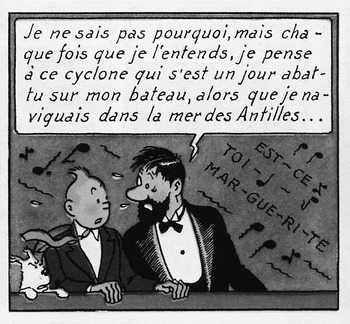
One cliché that predated Castafiore, but that is central to how she represents opera, is that of the soprano whose voice is powerful enough to break glass; there is no doubt that her performance of the ‘Jewel Song’, far from the poised suppleness of recent performance practice, has an altogether more robust quality.Footnote 20 Castafiore's first appearance in the series, in Le Sceptre d'Ottokar (1939), is in Syldavia, a fictional Balkan state, when she gives Tintin a lift as he hurries to reach the capital Klow in time to prevent a national disaster.Footnote 21 Needing little encouragement to give him an impromptu recital there and then in the back seat of the car, Castafiore produces a rendering of the ‘Jewel Song’ so loud that Tintin's first reaction is to be thankful that the car windows are made of safety glass. (His second reaction, when she offers to sing him something else, is to make an excuse and get out of the car, even at the risk of capture by the murderous spies pursuing him.) In Les 7 Boules de cristal (1948), Captain Haddock, his hair blown back by the force of Castafiore's performance, tells Tintin that her singing evokes for him his experience of natural disaster (see Fig. 1).
Tintin, Captain Haddock and Milou listen from a box in a Music Hall, presumably in Brussels, to La Castafiore singing the ‘Jewel Song’: ‘Je ne sais pas pourquoi, mais chaque fois que je l'entends, je pense à ce cyclone qui s'est un jour abattu sur mon bateau, alors que je naviguais dans la mer des Antilles…’ [‘I don't know why, but whenever I hear her it reminds me of a hurricane that hit my ship – when I was sailing in the West Indies some years ago…’]. Les 7 Boules de cristal [The Seven Crystal Balls], 11.

The general notion of sound as destructive runs through subsequent albums, guiding, for instance, the whole plot of L'Affaire Tournesol (1956), in which Professor Tournesol is in the process of perfecting an ultrasound device capable of demolishing buildings at some distance; the early pages of the album are full of glass mysteriously broken in the course of his secret tests.Footnote 22
Although the popular notion that an operatic voice can easily do the same may actually have originated with a tenor, Caruso, in the second half of the twentieth century and since then it has more often been associated with sopranos in the Castafiore mould – that is, well built.Footnote 23 (Castafiore, although she does not look especially overweight, at least not by twenty-first-century standards of obesity, has withheld from representatives of Tempo di Roma her otherwise generous attentions to the press because the celebrity magazine has dared to give her weight as ‘nearly a hundred kilograms’.Footnote 24) But, like her powerful physique and her powerful personality, Castafiore's powerful voice is not represented positively. Indeed, Hergé's depiction of her singing is perfectly suited to the boy-scout gynophobia of Tintin's world: a sound to be avoided at all costs, just as women are.Footnote 25 In Coke en stock (1958), when Tintin and the Captain are at last rescued from a raft drifting on the Red Sea only to find that Castafiore is one of the passengers on the yacht that has picked them up, the Captain suggests getting back onto the raft, even though they have no fresh water and the sea around them is infested with sharks.Footnote 26 And despite being shown as something like a force of nature, Castafiore's voice is categorically unnatural. It has an especially deleterious effect on the environment, represented by the inanimate objects it displaces (even the ones, like microphones, designed to contain it), and, above all, by animals.Footnote 27 Often it is also explicitly dehumanised, delivered via technological means that switch themselves on unexpectedly.Footnote 28
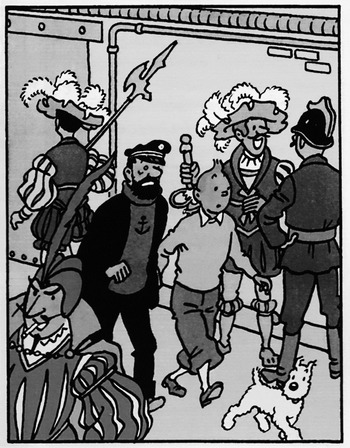
The clearest evidence of the unnaturalness of the operatic soprano voice, though, lies in its seeming not to be found so by everyone. It is anathema to our plucky heroes, but not to other, less obviously positive characters. While Castafiore's performance broadcast on Syldavian radio in Le Sceptre d'Ottokar causes consternation even among the orchestra, her private recital for the king and his courtiers a few pages later is received calmly.Footnote 29 In fact, her voice is particularly appreciated by senior members of the fascist regime in Borduria, Syldavia's neighbour, and their treacherous Syldavian sympathisers: Colonel Sponsz of the Bordurian secret police not only attends a performance in the capital, Szohôd, and goes backstage afterwards to offer Castafiore his personal homage, but he also invites her to be the guest of honour at a reception given by his wife.Footnote 30 The Szohôd performance of Faust is important for the present purposes because it is the one occasion on which Tintin and the Captain enter an opera house: when, fleeing their secret police captors, they try to blend in with the crowd there. On the face of it this ought to be difficult because they are dressed very differently from everyone else – they wear their trademark clothes, light-blue sweater and brown plus-fours for Tintin and navy-blue roll-neck sweater and captain's uniform for Haddock, while their fellow audience-members are in furs, monocles, dinner jackets and so on – and because the Captain falls asleep. In the event, they get away with no more than a disapproving look from the woman in the next seat.Footnote 31 Nevertheless, what may be deduced from their reactions every time they hear Castafiore, and what is confirmed visually in this scene, is that Tintin and the Captain clearly belong to a different world from that of opera – even if opera does make regular incursions into theirs, and even if they can (as a last resort, as in this scene) enter its realm too. Just as obvious is that the villains genuinely like opera.Footnote 32 What is unclear is whether the rest of the audience does, or whether it is behaving in an unnatural way, motivated by social snobbery.
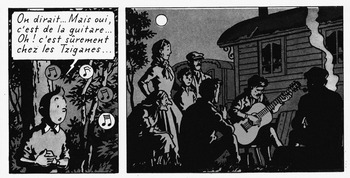
When Baxter, head of the moon exploration project in Objectif Lune (1953), tells Haddock he is glad that one of the first men to walk on the moon will be a sailor and the latter replies that it would have been all the same to him if a piccolo-player had gone, it might seem that the Captain is defining himself as something like the opposite of a musician. But there is evidence elsewhere to suggest that Hergé did not want his readers to think that his heroes' attitudes towards opera resulted simply from their insensitivity to music; if anything it is opera that he constructs as unmusical. When, in Les Bijoux de la Castafiore (1963), Tintin goes out at night to have a look at the nearby gypsy encampment, he hears music. He stops to listen, something he does nowhere else in his adventures, and what he hears is represented visually by coloured notes, something not seen in any of the other albums (Fig. 2). The implication is clear: the gypsy music is compelling because it is somehow real, authentic, where opera is not. A whole host of familiar signifiers point to its realness: the gypsies' proximity to nature and their emphasis on honesty, the family nature of the occasion, even, perhaps, the wordlessness of the music.Footnote 33 Significantly, authenticity is here linked with otherness; opera, though socially exotic, is depicted as culturally domesticated – above all in this particular album, where Castafiore takes up residence with Tintin and the Captain – just as Faust was, in its late nineteenth-century reception. Everything about opera as a social practice, at any rate, testifies to its falseness: its practitioners are capricious, happy to consort with the baddies as much as with the goodies, and positively thrive in the context of empty social functions.
Tintin hears a distinctly non-operatic kind of music, represented in the original illustration by red, yellow and green notes: ‘On dirait… Mais oui, c'est de la guitare… Oh! c'est sûrement chez les Tziganes…’ [‘That sounds like… yes, it's a guitar… it must be the gipsies…’]. Les Bijoux de la Castafiore [The Castafiore Emerald], 40.

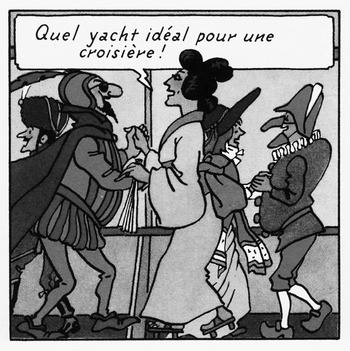
On the other hand, Hergé did not represent the opera in question as frivolous or irrelevant. Far from it: for him Faust seems to have uncanny, positively Mephistophelean power. It spreads out into other genres and social milieux: Tintin is surprised to see Castafiore on the music-hall stage in Les 7 Boules de cristal.Footnote 34 Even where she herself cannot surprise them, Tintin and the Captain are frequently ambushed by her singing of the ‘Jewel Song’. Even when they are scaling the foothills of the Himalayas in Tintin au Tibet (1960), her voice comes at them suddenly from a hidden radio – although the Captain is initially quite prepared to believe that she has followed them in person.Footnote 35 And when Tintin needs something to put on the record-player in Tintin et les Picaros to mask what he is saying to the Captain (because the apartment is bugged), there is never any doubt which LP will be to hand.Footnote 36 The influence of Faust is also visual: when our heroes give the secret police the slip at the Szohôd opera house in L'Affaire Tournesol by going backstage, we see the Méphistophélès costume close-to – and by the next album, Coke en stock, it has migrated to the fancy-dress ball given by the Marquis di Gorgonzola (Figs. 3a and 3b).
The Méphistophélès costume. L'Affaire Tournesol [The Calculus Affair], 53.

The Méphistophélès costume, worn by the genuinely diabolical Marquis di Gorgonzola, alias Rastapopolous: ‘Quel yacht idéal pour une croisière!’ [‘What an ideal yacht for a cruise!’]. Coke en stock [The Red Sea Sharks], 36.

This is, of course, appropriate because Gorgonzola is none other than Tintin's evil nemesis Rastapopolous in disguise; in this passage he even says things such as ‘By Lucifer!’, ‘Fire and brimstone!’ and ‘Diavolo!’ To complete the uneasy, almost supernatural sense that Faust is everywhere, the publication order of the translations (listed in the Appendix) means that the English reader hears Tintin referring to the fancy-dress-ball episode in Les 7 Boules de cristal, that is, ten years before the episode actually ‘happened’.Footnote 37
Faust in Tintinology
Castafiore's performance, always the same, is therefore a metaphor for the petrification of the opera repertory: for its homogeneity as a cultural object across the world, and for its irritating predictability. Moreover, her affectation and self-centredness, combined with her stand-and-deliver, grand-diva singing style, the text of the libretto and (for those who know the opera, whom Hergé obviously assumed would be his entire adult readership) Marguerite's girlish posing in the scene in question, amply express the vain superficiality (as Hergé sees it) of the entire artform.Footnote 38 Her old-fashioned performance practice notwithstanding, Castafiore's function in Les Aventures de Tintin is not simply to stay trapped in a moment of time (plausibly somewhere in the mid-1930s), like certain other elements of the Tintin universe.Footnote 39 That she repeats herself over and over serves, rather, to get across a sense of cumulative reiteration, of a repertory that is becoming ever more restricted and, in particular, of a work that is becoming exaggeratedly, hilariously, difficult to avoid – even if, by the time the albums featuring Castafiore were published, the popularity of Faust was actually in decline. But, at least for Hergé's adult readers, insofar as Castafiore represents a threat to the blissfully unchanging, pre-sexual existence of Tintin and the Captain, the characters are involved in a seemingly eternal round of pursuit and flight. Just as our heroes always eventually catch up with the baddies but never defeat them definitively (Rastapopolous in particular surfaces again and again), Castafiore has no trouble catching up with Tintin and the Captain but can never initiate them fully. The furthest she gets is in Les Bijoux de la Castafiore when she is, erroneously as it turns out, reported to have become engaged to the Captain.Footnote 40
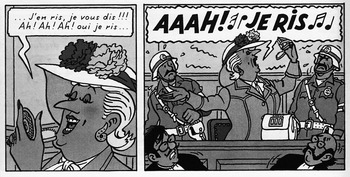
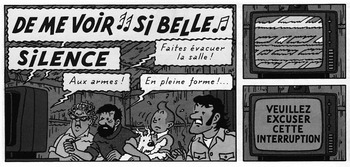
Faust is key to this economy of chase and ambush. As outlined above, the opera is always there in the background, ready to jump out at Tintin and the Captain. Its presence is at once predictable and always surprising. Moreover, as with the examples of the Méphistophélès costume and the music-hall performance (an artist from La Scala in a Brussels music hall?), it aggressively colonises unexpected areas of Tintin's and the Captain's world. And once it is centre stage, it is irrepressible, as in the scene from Tintin et les Picaros where Castafiore is being tried on a trumped-up charge of conspiracy in the dictatorship of San Theodoros (Fig. 4).Footnote 41 But even where the opera does not manage, as it were, to become part of the main story, to move, as in this case, from background to foreground, it is always disruptive.Footnote 42 Castafiore singing Faust is not just unnatural, it is literally not part of the natural order of things. Although the superficial (but perhaps meaningful) result is often simply that the Captain spills his whisky, it is an intrusion into the narrative sequence that threatens sense in every way.
The televised trial of La Castafiore in Los Dopicos, San Theodoros: ‘… J'en ris, je vous dis!!! Ah! Ah! Ah! oui je ris… AAAH ! JE RIS DE ME VOIR SI BELLE’ / ‘SILENCE’ / ‘Faites évacuer la salle !’ / ‘Aux armes !’ / ‘En pleine forme!…’ / ‘Veuillez excusez cette interruption’ [‘Your little joke!! I laugh! Ah! ha! ha! Aaah! Aaah! Aaah! Aaah! MY BEAUTY PAST COMPARE’ / ‘Clear the court!’ / ‘SILENCE’ / ‘Guards!’ / ‘Thar she blows!’ / ‘Do not adjust your set’.] Tintin et les Picaros [Tintin and the Picaros], 48.


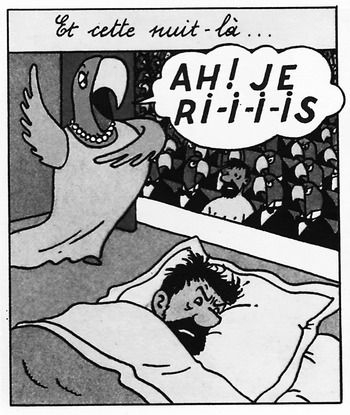
The irruption of Faust, indeed, is both a warning of catastrophe and a catastrophe itself. In a revealing pun from a scene in Objectif Lune, the sound of the Captain imitating Castafiore is mistaken by the hard-of-hearing Tournesol as that of an alarm siren, and in an almost identical situation in Les Bijoux de la Castafiore, he thinks it is the sound of ‘a storm brewing’.Footnote 43 Her voice is not just a sound that threatens to break glass, but a shattering in its own right – of calm, of meaning, of the inhibitions that govern the social structure of the Tintin adventures. For the Captain, whatever the repressed desires Castafiore's voice threatens to liberate, it is that threat, as much as the violently unpleasant experience of hearing her sing, that disturbs him. The most significant illustration of this is in the matrix of compulsion and shame represented by the Captain's troubled dream about Castafiore, the annoying and repetitive parrot she has given him to be his ‘constant companion’, and seeing Faust again at the opera (Fig. 5).Footnote 44 In an oneiric reversal of the scene at the Szohôd theatre seven or eight years earlier, the Captain is awake when he should be asleep and, instead of being wrongly dressed, is completely undressed. Rather than deliberately taking refuge in the opera house and remaining more or less unremarked, in his dream he is there unwillingly, the object of disapproving looks from everyone else, and acutely self-conscious about not fitting in. In this compulsive representation of the Captain's anxieties, it is clear that compulsion itself is high on the list: the repetition associated with the voice of the parrot, its being repeated in the visual composition, and, above all, the constant and inevitable repetition of the first lines of Gounod's aria.
The Captain's dream: ‘Et cette nuit-là…’ ‘AH ! JE R-I-I-I-I-S’ [‘That night…’] Les Bijoux de la Castafiore [The Castafiore Emerald], 14.

With the arrested development of its hero (the ageless ‘boy reporter’), its occasionally blatant staging of sexual repression, and its use of bizarre dream sequences,Footnote 45Les Aventures de Tintin cries out for psychoanalytic commentary. Sure enough, the extensive critical literature comes mostly from the post-Freudian, post-structuralist tradition.Footnote 46 It is easy to conclude that Hergé must have been keenly interested in Freudian ideas, in spite of his deliberately straightforward and innocent comments about his creation – and in spite of the efforts of his biographer to defend Tintin against the unwonted attentions of academic interpreters.Footnote 47 At the very least, it seems that critical approaches to Hergé – and by extension to bande dessinée as a whole, given his pioneering position in the development of the genre – evolved hand in hand with the different ideas about literature in general that were being disseminated in Francophone intellectual circles during the second half of his life. As for Faust as represented in the Tintin universe, the apparent concern with the formation of identity in the ‘Jewel Song’ (‘Si belle en ce miroir […] Est-ce toi?’, i.e., literally, ‘So beautiful in this mirror […] Is it you?’) sounds specifically, even jokingly, Lacanian. Most analyses of Tintin cannot resist referring to this, to the Freudian possibilities of Marguerite's situation in Act III, or to the meaning of Bianca Castafiore's name (literally, though suggestively ungrammatically, ‘white, chaste flower’), among similar details.Footnote 48
But although this linguistic play is engrossing, and effortlessly productive, the broader historical picture reveals more than the mutual compatibility of Hergé's mature works and the critical systems used to decode them. As I have suggested here, there is a traceable continuity from critical reception of Faust in the late nineteenth century through contemporary fiction to Hergé, one in which the opera's enduring and expanding presence on the stage is the object of reflection more than the opera itself is.Footnote 49 In Les Aventures de Tintin, this reflexivity is the inspiration not only for a recurring theme, but also for a principal character, Castafiore, and arguably for a whole narrative technique based on interruptions: more or less identical, if progressively more extravagant and amusing, and most often operatic. Furthermore, these unwanted (indeed feared) intrusions of Faust into everyday life, their strong (but masked) associations with sexuality, and, perhaps above all, their compulsive repetitiveness make the opera's constant presence look like nothing less than a metaphor for the unconscious. Although Castafiore does not appear in every album, this structural element is a prominent feature of what (in spite of Anglophone snobbery regarding bande dessinée) must be regarded as an important corpus of fiction – one regularly compared with that of Balzac.Footnote 50 Put all this together with the enormously wide dissemination of that fiction, and Faust in Tintin would appear by any standard to represent a substantial new chapter in the reception history of Gounod's opera.
It could be countered that historical musicology is not necessarily the best method of calculating the more comprehensive measures of operatic impact required by the impressive geographical distribution and historical longevity of Faust and its penetration into other forms of art and culture. To put this another way: are the echoes of Faust any longer intelligible to us, or indeed worth listening for in the first place, once the work has become a running joke in a comic strip? Furthermore, although classic qualitative reception studies, based more narrowly on critical reaction, may be prone to investing with disproportionate significance the bons mots of the most readable individual reviewers or to mapping the history of musical works unconcernedly onto that of society as a whole,Footnote 51 do broader approaches risk exchanging interesting (if not always accurately representative) responses to artistic stimulus for cliché, for lowest-common-denominator or career-average data about particular works? In sum, might more comprehensive measures actually prove proportionally more reductive?
The origins of cliché, however, are precisely the province of reception studies, whether they lie in the history of performance practices or in what might be called the psychohistory of popular works. And cliché has certainly been central to the work of a generation of opera studies concerned with perceptions of women as revealed in the texts of librettos, the remarks of critics, the iconography of works and the biographies of singers – why not in comic strips? Catherine Clément, for one, hardly distinguished between Castafiore and her other abused divas.Footnote 52 Although the Tintin critical literature sometimes focuses on the more or less buried neuroses of its author,Footnote 53 it more often shows those neuroses as playing out in the literary mentalité at large.Footnote 54 On one level, Faust is only one of countless tropes in Les Aventures de Tintin, ranging from alcoholism and deafness to space travel, which carry with them representational reception histories of their own, to be decoded in both psychoanalytical and historical terms simultaneously, and thereby prolonged. On another level, Faust is special because, unlike those other objects, its representation seems to go beyond parody into meaningfully deliberate falsification. Hergé's attention to detail and his concern for couleur locale were extraordinary, famously even extending to the surface of the moon (on which, when Objectif Lune was published, no human had yet set foot).Footnote 55 But his ‘Jewel Song’, whatever insights it may afford into Castafiore, her fellow characters, Hergé himself or cultural attitudes to women and to opera, is a more-than-comic exaggeration: a crowded fictional space containing an imperious but fundamentally warm-hearted diva, a text about surface versus essential identity, and an opéra that may have become grand but is nonetheless thoroughly domesticated.Footnote 56 It also contains a snatch of coloratura (the initial trill and semiquaver run b′ to g-sharp″), an impression of a typically French vocal idiom and, at the same time, a voice of more-than-Wagnerian proportions singing at full volume.
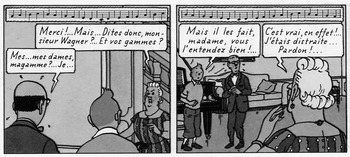
Far from straightforward mocking of opera by someone who found its voices overpowering and its practitioners comic, Hergé's ‘Jewel Song’ is an eminently multilayered (and apparently multiphonic) object. But, though richly suggestive of the capacity of fiction to reflect and/or inflect different kinds of experience, the aria's recurrence obviously also draws attention to how it is precisely the limitations of bande dessinée that make Castafiore so interesting as a means of representing opera and opera reception. In the work that is considered his masterpiece, Les Bijoux de la Castafiore, Hergé explicitly makes a joke out of the disjunction between what is depicted visually and what is supposed to be audible. Castafiore's accompanist, whom she has ordered to practise scales all day, has secretly made a tape-recording that will provide aural cover for him as he sneaks down to the village to indulge his passion for betting on horseracing; as my final example shows, it is a surprisingly effective ruse (Fig. 6).
Igor Wagner, La Castafiore's accompanist, is almost caught red-handed by her as he returns from a clandestine visit to the village bookmaker: ‘Merci!… Mais… Dites donc, monsieur Wagner?… Et vos gammes?’ / ‘Mes… mes dames, magamme?’ / ‘Mais il les fait, madame, vous l'entendez bien!’ / ‘C'est vrai, en effet! J'étais distraite… Pardon!…’ [‘Thank you… But… Well, Mr. Wagner, what about your scales?’ / ‘My s-s-scales, s-s-signora?’ / ‘But he's playing them, signora… as you can hear’ / ‘Of course… so he is… I wasn't thinking, forgive me!’]. Les Bijoux de la Castafiore [The Castafiore Emerald], 52.

This disjunction has been the object of considerable semiotic analysis by scholars of bande dessinée,Footnote 57 but, joking apart, it has something to offer to those who work on opera, too: it reminds us that the conventions of the medium itself, in some cases independently of the prejudices that have wormed their way into it from outside (here, for example, that in comic bande dessinée sopranos can readily be understood not to be very quick-witted), condition the recovery of sound in particular ways – not simply by inhibiting it, but rather by reshaping it. The representation of sound in the bande dessinée medium is clearly an interesting aesthetic (as well as technical) question, one summed up by Hergé himself when he reported that a young girl had written to him complaining that the voice of Captain Haddock in the 1961 film version was different from the one in her books.Footnote 58 Similar questions hover over all representations of opera that are not opera itself (including, perhaps, audio recordings, which distort balance and focus in different ways depending on whether they are old or new). Those representations that subsist only as text – novels, but equally contemporary reports in the press and articles in modern scholarly journals – naturally require more conventions, more codes, if they are to render sound to the reader.
If this almost-Barthesian conclusion seems a bit vieux jeu, it is surely still instructive to reflect on how much the phenomenon of writing into a work of art the mediated, inflected presence of another resembles criticism, journalistic or musicological. Implicitly or explicitly, we set great store by the historical, recuperative work inherent in opera reception studies, but what do we think we are recuperating? In literary criticism, from which we often borrow, reception studies these days sometimes seems embattled, precisely because in so many of its other fields of enquiry there is a now-irresistible continuity between almost every different sort of material; it is all susceptible to analysis, all expressive – all just text. We think of operas in that way too, as texts that are constantly rewritten, literally and figuratively, but a lot of the work we do seems implicitly to rely on concepts of historical trajectory that in turn imply a more or less determinate object, travelling on through time and creating ripples of signification that are formed in its image but distorted as they spread out into culture – as well as a more or less tangible (and decidedly pre-Barthesian) mass of culture through which to travel and in which to make ripples. A sheaf of reception documents such as those by Hergé, with an imagined Faust bundled together with the adventures of an imaginary reporter, shows how fictional reception, or real reception nested within fiction, or even reception that makes no distinction between reality and fiction and recognises only texts – whether on the page, the stage, or sitting shiftily in the auditorium in the guise of flesh-and-blood spectators – may enrich our understanding of the work, but perhaps it is our understanding of the critical mechanisms of reception itself that needs enriching.
Appendix: Publication Dates of Les Aventures de Tintin