The process of legalization that has characterized world politics in the past decades constitutes a major development in the organization of international relations.Footnote 1 Although a significant amount of international regulations qualifies as merely soft law, countries have increasingly strengthened their legal commitments in many policy areas.Footnote 2 As part of this process, states have delegated authority to international institutions that look into and formally decide whether countries behave in accordance with international law to improve compliance with these rules. The creation of such court-like institutions represents a significant step toward strengthening the rule of law in numerous policy fields such as trade, human rights, or peace and security. Examples are the International Court of Justice (ICJ), the European Court of Justice (ECJ), or the large variety of dispute settlement procedures specified in bilateral and regional trade and investment agreements, such as the North American Free Trade Agreement (NAFTA) or the International Centre for Settlement of Investment Disputes (ICSID).
Among the different policy areas, the multilateral trading system with the Dispute Settlement Understanding (DSU) of the World Trade Organization (WTO) stands out as a prime example for the stronger legalization and delegation of authority observable in international politics.Footnote 3 The DSU provides a formal procedure to resolve disputes about the legitimacy of trade barriers. The possibility to request the establishment of a panel—an independent expert commission that rules over a dispute if the conflict parties are unable to settle the conflict through bilateral negotiations—lies at the core of the DSU. This institution can induce cooperative behavior through different channels. For instance, if parties disagree on the meaning of the trading rules that they subscribed to, a panel ruling helps to clarify the obligations and rights of the trading partners and may impose normative pressure on the discriminating country to end illegitimate trade policies.Footnote 4
Previous research, however, calls into question whether the WTO's dispute settlement mechanism fully lives up to these expectations. Many countries find it difficult to participate in WTO litigation because they lack the necessary legal capacity or fear retaliation if they initiate a dispute against a more powerful country.Footnote 5 Therefore, although WTO litigation may function well as a settlement device between those mostly large and rich countries that decide to take legal steps within the WTO, it may remain unable to serve the needs of those smaller and poorer countries that refrain from proactively filing a formal complaint in the WTO. This questions the usefulness of WTO litigation for those who could potentially benefit the most, simply because they lack the legal and power resources to participate in costly international trade disputes.
These concerns raise two important questions. First, to what extent does the delegation of sovereignty to international courts generate outcomes that discriminate against less powerful members of an institution? Second, do legal institutions affect state behavior in ways such that the wider international community also benefits? Although the direct economic effects of international adjudication have been established for important examples of international interactions, for example, international investment or territorial conflict,Footnote 6 we know little about their impact on countries that are not formal plaintiffs or defendants. We therefore examine the distributive consequences of litigation in the WTO beyond the immediate effects that it has on the main disputants. These side effects are important because the ability of hard law systems to mitigate power asymmetries is crucial for their legitimacy and the long-term success of these institutions. Only if states can expect international courts to improve their chances of realizing a fairer outcome than without a costly trial will they turn to this institution to settle disputes in the future.Footnote 7 And the institution will receive the type of sustained support necessary for its long-term survival only if settlements do not systematically come at the costs of other, possibly weaker members.
To explore the value of international litigation, this article examines the effects of WTO dispute settlement on countries' bilateral trade relations. We argue that third-party status in the WTO litigation process provides a valuable opportunity to benefit from other countries' legal efforts that result in a verdict declaring trade barriers by the defendant country as illegal. According to the logic of Olson's “exploitation of the great by the small,” the country that expects the largest net gains from a panel ruling will file a formal complaint as a principal party. Other countries can subsequently join the dispute as third parties. This functions as a signal to the defendant country and the WTO community as a whole that its trade barriers hurt a variety of countries' exports, as third parties are formally heard by the WTO panel. At the same time, they do not have to proactively take legal action as a principal party, which is not only costly in terms of legal efforts, but could also provoke painful retaliatory measures by the defendant. If a country decides not to file a formal complaint in the WTO even though it is affected by the defendant's trade barriers, this reduces public pressure thereby decreasing international audience costs to the defendant country.
Although principal-complainant countries should generally gain from WTO litigation, we argue that other countries that join a dispute as a complainant third party will also benefit, although they do not carry the considerable costs of proactively filing a complaint in the WTO. Using a matching approach, we find that participation in WTO litigation provides noteworthy benefits in terms of trade growth. Sectoral exports from a complainant country to a defendant country increase by about $7.7 billion on average in the three years after a panel ruling compared with observably similar country pairs that did not experience a ruling. At the same time, the export-stimulating effect of a panel ruling is not restricted to principal parties since third parties do not benefit less than principal parties. Consistent with our theoretical argument we also find that third parties who take sides with the complainant country experience an increase in sectoral exports worth about $6 billion on average in the three years after a ruling compared with observably similar parties that remain neutral. Procomplainant third parties gain more than prodefendant third parties. These findings suggest that WTO litigation offers an economically valuable possibility for judicial free-riding and provides an institutional opportunity for strategic interaction between states in international trade relations. It may thereby alleviate the extent to which the distribution of trade gains reflects the distribution of power among countries.
This study contributes to the literature on WTO dispute settlement, research on the redistributive effects of international institutions, and the broader literature on international legalization. First, although many agree that the expected benefits of an international institution determine its long-term fate, we still lack knowledge about the WTO's distributive consequences.Footnote 8 We provide an estimate of these economic effects and evaluate how they vary across countries that have different roles in WTO litigation. Second, we not only show that the economic benefits of WTO litigation are considerable, but also that dispute settlement generates positive spillover effects because the gains also accrue to the wider WTO community. Previous work has theorized about the existence and desirability of such side effects, but they have not yet been examined.Footnote 9 Third, by distinguishing between principal and third parties, our study complements previous research on the role of third parties in WTO litigation and confirms its findings.Footnote 10 Finally, we analyze all cases that have entered the WTO dispute settlement mechanism and thereby go beyond important work by Davis, which is most closely related to our study, though it exclusively examines cases in which the United States appeared as a potential complainant.Footnote 11
Dispute Settlement in the International Trade System
Nations of the world have struggled to harness the gains from globalization. Although liberals highlight the welfare improvements arising from free trade, they acknowledge that self-interested behavior can adversely affect the prospects of intensifying international economic exchange and may even jeopardize existing trade relations. The development and implementation of trade rules since the World War II therefore has aimed at inducing cooperation among states that act under anarchic conditions. The General Agreement on Tariffs and Trade (GATT) system and its successor, the WTO, provide rules that serve as benchmarks for what constitutes legitimate state behavior in international trade. Moreover, the WTO monitors state behavior, provides information about other states' trade policies, and aims at upholding international trading rules to facilitate the development of international trade relations. Empirical studies suggest that participants in the GATT and WTO systems trade substantially more than nonparticipants and less frequently impose discriminatory trade policies against other WTO member states than against nonmember states.Footnote 12
The WTO's DSU plays an important role in this context. It provides a formalized procedure to resolve disputes about the legitimacy of specific trade barriers. Countries that suspect a country's trade policy violates international trade law can request bilateral consultations to settle the dispute. If conflicting parties fail to solve the conflict at the consultation stage, the WTO dispute settlement mechanism offers the possibility to request the establishment of a panel that consists of independent experts who will rule over the case.Footnote 13 The DSU has been widely used by governments to resolve disagreements over trade policies with 454 dispute initiations until the end of 2012.Footnote 14
Despite its complex institutional apparatus, WTO litigation suffers from a number of apparent weaknesses. First and probably most important, the power of WTO panels to enforce rulings in practice remains limited. Although the WTO has been classified as an institution with high enforcement power,Footnote 15 this refers more to its de jure and less to its de facto power. De jure enforcement power appears high in the sense that panel rulings are legally binding and the institution can review and judge the defendant's implementation of the ruling upon request from the complainant. If the panel finds that a defendant fails to comply with a ruling, it can also authorize retaliatory measures against the discriminating country. However, because the WTO remains a member-driven institution that does not have its own resources to sanction violators, a member's ability to retaliate crucially affects its ability to induce compliance with panel rulings. Specifically, the complainant does not receive any additional institutional support beyond a mere declaration of trade restrictions to be illegal when trying to pressure the defendant to comply with a panel ruling. Consequently, powerful states de facto may have better means to enforce rulings.
Consistent with this expectation, previous research has documented defendants as being more likely to comply with a panel ruling if the retaliatory power of the opponent country increases.Footnote 16 Recent work also shows that economically powerful countries initiate a disproportionately large number of disputes that further nurtures this skepticism.Footnote 17 Several studies argue that the lack of legal capacity and power asymmetries explain the unequal use of WTO dispute settlement, which would work against the least-developed and developing countries when having to decide whether or not to initiate a dispute, since poor countries often lack the expertise to follow through with a long-lasting and costly dispute in a highly sophisticated legal system.Footnote 18 Similarly, smaller states resemble relatively easy targets for retaliatory measures when litigating against a large trading partner because they depend more strongly on exports to rich and large markets. This adds to existing concerns about the effectiveness of the WTO dispute settlement procedure in that it may fail to enable disadvantaged countries to effectively proceed against a discriminating trading partner and achieve the removal of illegal trade barriers.
Given these concerns, the benefits of WTO litigation for the WTO community have been subject to intense debate. Most research analyzes the correlates of dispute initiation and its effects on trading relations between the principal disputants. Building on this literature, we examine if and to what extent WTO litigation has an effect on the broader trading system that goes beyond the bilateral relations between principal parties that directly engage in the WTO's dispute settlement mechanism. We argue that international judicial systems such as the WTO's dispute settlement mechanism should have a sizeable economic impact on third parties that do not proactively litigate, but who have a substantial interest in a particular conflict. If such positive externalities exist, the potential power bias of WTO litigation would appear less severe than previous studies suggest.
WTO Litigation and Bilateral Trade Relations
Since a WTO panel does not have the means to sanction defendants that fail to comply with a panel ruling, some have argued that “its rulings at best can have only a modest direct influence on dispute outcomes.”Footnote 19 But WTO litigation may affect state behavior through other, indirect channels of the dispute settlement mechanism.Footnote 20 The widespread consensus in this literature is that WTO dispute settlement can still help to promote international trade despite its institutional limitations, at least for those who are able to participate in WTO litigation. Based on the available literature on international courts and dispute settlement we can identify several mechanisms through which dispute settlement may affect trade policy and trade relations.
First, litigation in the WTO has important informational effects by clarifying the obligations of members and by reducing uncertainty about the exact nature of other members' policies.Footnote 21 If parties disagree on the meaning of the trading rules, a panel ruling can provide a binding interpretation of WTO law.Footnote 22 Ideally, the ruling provides an objective interpretation of the WTO regulations that all conflict parties accept and defines a benchmark for future interactions among trading partners around which their expectations converge. Moreover, when countries can only imperfectly observe other countries' trade barriers, the WTO prevents policy-makers from mistakenly choosing too high or too low levels of retaliation.Footnote 23 Policy-makers can also play trigger strategies to punish countries that have established a trade barrier by imposing explicit tariffs. Here, WTO litigation lowers informational uncertainty about foreign barriers to trade and thereby enables policy-makers to choose more efficient punishment levels.
Second, WTO dispute settlement imposes political pressure on countries that do not comply with the trade rules that they subscribed to.Footnote 24 If a government consciously and consistently violates WTO rules, a panel verdict against the violator increases both international- and national-level political pressure to remove the illegal trade restriction. Failure to comply with a WTO panel verdict hurts the government's international reputation because it reveals that the government does not live up to the standards of the international trading system that countries have agreed upon.Footnote 25 Such a reputation loss can weaken the government's bargaining position in later disputes or in WTO trade negotiations. At the domestic level, the verdicts of WTO panels reveal information about their government's trade policy to subnational actors, which is often costly to collect.Footnote 26 As a consequence, the incumbents may suffer significant domestic audience costs if the public learns that their government does not meet its international obligations.Footnote 27 Finally, for cases in which the defendant refuses to adhere to the panel ruling, WTO litigation also provides the legal foundation for retaliatory measures by the complainant.
Overall, rulings within the framework of the WTO dispute settlement mechanism should lead trade relations to develop differently between the conflict parties compared with how they would have developed if the conflict had not been brought to the WTO.Footnote 28 If the arguments brought forward in the theoretical literature are valid and WTO dispute settlement indeed helps to remove illegal trade barriers that hamper the complainant's exports to the defendant country's market, rulings in the settlement mechanism should increase trade flows from the complainant to the defendant country.
Spillover Effects of WTO Litigation
Our argument about the spillover effects of WTO litigation builds on recent work that has advanced our understanding of the role of so-called third parties.Footnote 29 A third party in a WTO dispute can be any country that has a substantial interest in the conflict. Although third parties are formally heard by the WTO panel, they do not proactively take legal action against the defendant, and therefore, incur significantly lower litigation costs. We argue that countries decide to become a third party because they expect that the outcome of the dispute will positively affect their own trading relations with the defendant country. Such indirect effects may have noteworthy implications for the general working of the global trade system: smaller and poorer countries that find it difficult to use the WTO settlement procedure to their advantage could benefit indirectly when a larger power takes the lead and initiates a dispute as a principal party.
Several theoretical arguments suggest that the dispute settlement proceedings affect trade relations beyond those of the principal disputants. First, a proceeding generally increases the defendant's costs to uphold illegal trade barriers vis-à-vis other, noncomplainant countries. When an international court formally investigates a country's foreign economic policy, this not only builds pressure on the defendant to change its trade policy toward the complainant, but to remove the trade barrier itself. More specifically, if a WTO panel finds that a trade policy violates WTO regulations, this is a general verdict about the trade barrier that refers not only to the restrictions on imports from the complainant country. According to the most-favored nation (MFN) principle, a panel ruling should produce positive externalities for all other countries whose exports have suffered from the same illegal trade barrier by the defendant. As Bown points out, “an economically successful resolution to the disputes under investigation involves a respondent country removing a WTO-inconsistent policy on an MFN basis, so that any formal litigants' efforts generate positive externalities.”Footnote 30
Second, although the WTO does not allow the use of precedent,Footnote 31 an existing panel ruling can significantly reduce the costs associated with a subsequent dispute launched by a third party. These costs arise from building a specific legal case and the more general investments into bureaucratic and legal capacity. The large differences in the size of countries' delegations at the WTO suggest that this capacity varies significantly across member states.Footnote 32 Not all countries have sufficient permanent staff at the WTO and access to legal expertise allowing them to become a principal party in a legal case that has not been dealt with before. Therefore, although the WTO generally does not allow the explicit use of precedent, a follow-up dispute by a third party will be less costly. The legal costs for later complainants decrease because they can rely on the legal reasoning provided by formal complainants in previous disputes if they want to put forward their own case. In fact, countries tend to use information from previous disputes and rulings when deciding which trade barriers to file a formal complaint against in the WTO.Footnote 33
Third, prior proceedings in a related case affect third parties' expected utilities of a dispute against the defendant through the information revealed during a proceeding. The expected utility of the third party increases when the defendant lifts the disputed trade restrictions during consultations or after a panel ruling. In this case, chances increase that the defendant would do the same in response to a dispute initiated by the third party. The defendant could continue to uphold the restrictions toward the third party and risk another WTO proceeding, but this is associated with further international and domestic political costs. Since the defendant country already has revealed that it cares about those costs, it will be reluctant to risk paying these costs again in a follow-up dispute. The defendant therefore should be willing to grant the same concessions to third parties even without a formal dispute when the third parties request to be treated in the same manner as the principal complainant. Anecdotal evidence supports the idea that positive spillover effects on third parties exist. As Johns and Pelc point out, apple producers in New Zealand were expecting to benefit from a settlement agreement between the United States and Japan in a dispute over Japanese import restrictions on apples in 2002, despite the fact that New Zealand was not a principal disputant. It had only third-party status in the dispute.Footnote 34
This argument suggests that third parties can reap positive spillover benefits from WTO litigation by joining existing trade disputes initiated by other countries. Since the benefits of WTO litigation seem at least partly nonexcludable, this raises the question of why some countries would be willing to pay the costs of becoming a principal party instead of trying to free-ride on the litigation investments of other countries. The international relations literature suggests that international public goods can be provided when one or a few countries have a disproportionate interest in providing them.Footnote 35 This logic also applies to WTO litigation. Although WTO panel rulings may resemble a public good from which countries can benefit without having to bear the costs of taking legal measures against protectionist policies, the theory of collective action suggests that a public good may be provided by an actor who expects the highest net benefits from the good's provision.Footnote 36 Thus, large states likely decide to take on the costs of litigation because they expect particularly high net gains from removing barriers to trade. This implies that, even if the gains from restoring free trade are the same for principal- and third-party complainants, large countries may still have higher net gains because for them the required legal expertise to succeed in complicated and often long-lasting WTO cases poses lower relative costs. This is consistent with the finding that rich and large complainant countries tend to dominate dispute settlement.Footnote 37
When examining the effect of the DSB on third parties, we need to take into account that third parties can take on different roles depending on whether they align with the complainant, the defendant, or decide to remain neutral.Footnote 38 Countries can join a conflict as third parties with different motivations. They can take sides with the complainant or with the defendant, or can opt to remain neutral. If they align with the defendant, they typically help to justify the trade restriction that the complainant country challenges before the WTO. If a third party takes sides with the complainant, it puts forward arguments that support those by the complainant country. Neutral countries either do not submit a statement to the WTO panel or explicitly state that they do not take sides with either of the parties. One potential explanation for why a country decides to remain neutral is that third-party status still offers a country direct access to all relevant information concerning the dispute. This provides a neutral third-party country with knowledge about both the legal interpretation of WTO law and the terms of settlement negotiated by the principal conflict parties. Such information enables policy-makers to form more precise expectations about the likely consequences of a violation of WTO law and the likely concessions they can expect from other countries in case of a trade dispute. Our argument obviously applies to procomplainant third parties because they should be negatively affected by the defendant's trade barrier. Distinguishing between different types of third parties (procomplainant, prodefendant, neutral) therefore presents a valuable opportunity to evaluate the empirical validity of our argument in more detail in the subsequent analysis.Footnote 39
Even though defendant countries may enjoy some leeway with respect to the concessions that they make to other affected countries after a negative verdict, third parties should not face massive disadvantages compared with principal complainants when dealing with countries that have violated international trade law after a panel ruling. They can credibly threaten to initiate a successful dispute themselves if the defendant lifts the illegitimate trade barrier on imports from the complainant, but not on imports from the third party. Defendants should anticipate this and treat third parties similar to complainants in that they abolish the disputed trade barrier.
Based on this reasoning we can derive the following predictions. First, we expect that complainant parties generally benefit from WTO litigation in that their sectoral exports to the defendant increase after a panel ruling. Second, the theory suggests that WTO litigation gives rise to positive spillover effects: Third parties should not gain less from a panel ruling than principal parties.
Estimating the Effects of WTO Litigation
We use matching techniques to explore the economic value of WTO litigation.Footnote 40 Matching allows us to explicitly address the nonrandom selection of countries into third- or principal-party status. Our aim is to compare the evolution of trade relations between third parties that experienced a panel ruling with trade relations of observably similar principal parties that experienced a panel ruling. The control units should be comparable with respect to factors that influence both whether a country decides to file a complaint (principal party) proactively and bilateral trade relations between the conflict parties. By adjusting for these differences in potentially confounding observables, matching allows us to nonparametrically estimate the effects of principal-party versus third-party status on sectoral trade relations. In other words, we can consistently estimate the relationship between third-party status (and related treatments of interest) and trade without making distributional or functional-form assumptions. However, a causal interpretation of the results still crucially hinges on the assumption of selection on observables. This means that after having conditioned on the observable factors that determine whether a country joins a dispute as a principal or a third party, we have to assume that assignment to a country's formal status in WTO litigation is essentially random.
Measurement, Treatment, and Outcome Variable
To analyze how WTO litigation affects bilateral trade relations between conflict parties, we code WTO panel reports to collect information about WTO trade disputes that resulted in a panel ruling.Footnote 41 We consider the period from 1995 to 2006 the longest period for which we have reliable data on all relevant variables, in particular information about sector-specific, bilateral trading volume. Trade disputes have a dyadic structure (complainant-defendant) to which we add bilateral, annual trading volume in the sector affected by the dispute. One observation is a triple of the form complainant-defendant-sector in a given year.Footnote 42
In 104 of the 508 dispute dyads we examine the complainant country is a principal party; in the remaining 404 dispute dyads the complainant country is a third party.Footnote 43 Since many initial rulings are appealed, we examine only final rulings, that is, the verdict following an appeal or the initial ruling if it is not appealed.Footnote 44
Our interest is in estimating the effect of third-party status on a country's sectoral exports to the defendant country. Thus, for each dispute dyad, we collect data on the annual level of exports from the complainant to the defendant in the disputed sector. We identify the one-digit Standard International Trade Classification (SITC) tariff lines of the product under dispute and use the sectoral import/export data from the UN Conference on Trade and Development's (UNCTAD) COMTRADE database to obtain measures of sector exports for the relevant industries and years. The one-digit SITC has ten categories: food/live animals (0), beverages/tobacco (1), crude materials/inedible (2), mineral fuels/lubricants (3), animal/vegetable oils/fats/waxes (4), chemicals/related products (5) manufactured goods (6), machinery/transport equipment (7), miscellaneous manufactured articles (8), and commodities/transactions not classified elsewhere (9).Footnote 45
Although we would have liked to perform the analysis at a lower level of aggregation, using more fine-grained tariff lines would have decreased the number of dispute dyads in a sector to an extent that makes estimation impossible. This is because estimating the economic effects of panel rulings and third-party status in a given dispute requires information about trade volume in the sector under dispute for each country dyad involved in a dispute. This information has to be complete in both the four years before and the four years after a ruling, that is, a period of eight consecutive years.Footnote 46 We have invested considerable time and effort to collect these data, but unfortunately, most countries for which we would need the data do not report their exports to individual countries at this level of aggregation. Second, using a less disaggregated outcome variable may actually lead to more conservative results. This is because to detect significant effects, the treatment has to have such a pronounced impact on trading volume in highly specialized industries that it also affects the larger economic sector the industry belongs to. Third, neither our theory nor the available empirical literature suggests that product-level confounding factors exist at, for example, the six-digit level, that would imply that a dispute concerning “carcasses and half-carcasses of lamb, fresh or chilled” (HS6 code 020410) is fundamentally different from a dispute on “carcasses and half-carcasses” (HS6 code 020421) in terms of how panel rulings and third-party status affect trade in these sectors.
To reduce case heterogeneity we consider only disputes that involve one product category and restrict our analysis to the four years after a panel ruling, since our interest lies in isolating the effect of the panel ruling as such on bilateral trade relations.Footnote 47 From this perspective, sectoral trading volume before a ruling resembles a pretreatment variable on which we should match to ensure that our treatment and control observations are comparable at baseline, but it does not qualify as an outcome variable.
One might object that we ignore the content of a ruling and that this could contaminate our estimates. We avoid this complication by exclusively analyzing dispute dyads in which the WTO panel ruled in favor of the complainant. This restriction does not only appear advisable to limit case heterogeneity. We actually lack an empirical basis for analyzing cases won by the defendant country since in all 508 dispute dyads that we can analyze given the existing data availability limitations—note that we need bilateral, sectoral trading volume for all dyads in the years before and after a ruling to use them in the empirical analysis—the WTO panel ruled in favor of the complainant.Footnote 48 Given the prevalence of cases won by the complainant country, analyzing these observations seems also more relevant empirically.
Matching Strategy and Confounding Variables
We first explore whether countries that join a dispute as a third party gain less from a panel ruling than more active and typically more powerful principal parties that formally file a complaint in the WTO. Our treatment variable therefore is a binary indicator that is 1 for third parties and 0 for principal parties. Using a propensity score matching strategy within an event time setting we define the average treatment effect for the treated (ATT) as:
 $$\hat \alpha _\tau = \displaystyle{1 \over {N_1 }}\sum\limits_{n_1 = 1}^{N_1 } {\left({Y_{1i\comma \tau } - Y_{0j\lpar i\rpar \comma \tau } } \right)} \comma \;$$
where n, ..., N 1 indexes treated units, Y 1i,τ is sectoral trading volume τ = 1, ..., 4 years after a WTO ruling, and Y 0 j(i) denotes the outcome of the control unit closest to i in terms of Euclidian distance of its propensity score P i . The propensity score measures the conditional probability of being treated, that is, having third-party as opposed to principal-party status given the covariates X.Footnote 49 By first estimating the probability of third-party versus principal-party complainant as a function of the covariates X and subsequently constructing pairs of treatment (third party) and control (principal party) units that are comparable with respect to the treatment propensity, we remove potential imbalances between treated and control units in our sample.Footnote 50
Matching enables us to estimate the effect of third-party versus principal-party status on sectoral trade relations depending on the assumption that after having conditioned on the relevant observable covariates assignment to third-party status (as opposed to principal-party status) is as good as random. Therefore, we have to carefully select the covariates used to estimate the propensity score. We let theoretical considerations, the empirical literature on WTO dispute initiation, and our own preestimation analyses of the data guide the choice of covariates. In the robustness section we also apply nearest-neighbor matching. This technique matches directly on potentially confounding variables (instead of matching only on the propensity score). In addition, we present detailed balance plots in the online appendix that document how the covariate balance improves after our matching.Footnote 51
Economic Power
Previous work has demonstrated that economic power is a strong predictor of participation in the WTO dispute settlement mechanism.Footnote 52 For example, less-developed countries that are richer tend to file more complaints in the WTO.Footnote 53 To explore whether economic power also helps predict which cases are paneled and which are not in our data, we have estimated a probit regression in which we model a panel ruling as a function of the conflict parties' gross domestic product (GDP).Footnote 54 We find that economic power indeed helps predicting whether a dispute dyad experiences a ruling or not. In other words, dispute dyads that are paneled systematically differ from dyads that are not paneled.
Although this suggests that we should match on a country's GDP, as in many other fields of international relations, economic power is an inherently relative concept in the context of trade disputes. A complainant country has to be more powerful than its opponent to make filing a complaint in the WTO an optimal choice. To adjust for the potential impact of a country's relative economic power on the evolution of potential trade conflicts within the WTO, and countries' capacity to retaliate if a panel allows sanctions, we match on the complainant and the defendant country's level of GDP.Footnote 55 We collect data on the complainant country's (C ) and the defendant country's (D) gross domestic product, GDP(C) and GDP(D). This approach seems more advisable than matching on the ratio of or the difference between the complainant's and the defendant's GDP because this would imply making an assumption about the functional form that maps power differences into outcomes. By matching on both variables separately, we make no such functional-form assumption. The data are from the Penn World Table.Footnote 56
Conflict Intensity
The theoretical literature on multiperiod bargaining processes argues that conflicts involving many actors are more difficult to resolve, since multiple actors increase both the heterogeneity of preferences and transaction costs arising from diplomatic efforts to strike a deal that is acceptable to all actors.Footnote 57 In the context of the WTO dispute settlement, Busch and Pelc have shown that the probability of a defendant making concessions at the consultation stage decreases significantly as conflict intensity, measured by the number of complainants involved in a dispute, increases.Footnote 58 Therefore, higher conflict intensity decreases the chances of an early settlement and thereby raises the probability of a dispute proceeding to the panel stage. Conflict intensity may also matter for a country's decision to join a dispute as a third party. Given the theoretical and empirical importance of conflict intensity for the initiation and evolution of WTO disputes, we match on this covariate in our empirical analysis. We follow previous research and use the number of complainants involved in a dispute as a measure of conflict intensity.
Joint Democracy
A large literature has argued that democracies enjoy more peaceful relations with one another because democratically elected governments have stronger electoral and political incentives to not fight other democratic countries.Footnote 59 The democratic peace argument has also inspired several studies to explore how economic interdependencies between democracies differ from those between nondemocratic and democratic systems. In an important study, Morrow and colleagues argue that democracies are less responsive to domestic protectionist demands and that firms prefer to trade with democratic systems because of their stronger commitment to the rule of law that reduces investment risk.Footnote 60 Empirically, trade flows between a democratic dyad tend to be twice as high as trade flows between a pair of nondemocratic countries on average.Footnote 61 When it comes to trade conflicts, previous research shows that joint democracy significantly increases the probability of a WTO trade dispute.Footnote 62 Democracies are more likely to resort to legalized dispute resolution through international judicial institutions because interest group pressure limits the possibility of finding informal solutions to conflicts over trade. Initiation of a formal dispute allows a government to signal to domestic audiences that it gives priority to their concerns. This suggests that joint democracy also matters for a country's decision to file a complaint proactively as a principal party or to merely join an existing conflict as a third party. Therefore, we include a measure of joint democracy in our set of matching variables.
Preruling Sectoral Trade Flows
Several authors have argued that the probability of experiencing a WTO conflict also depends on a country's exposure to international trade. For example, Guzman and Simmons show that the probability of a trade dispute proceeding to a panel is significantly correlated with the complainant country's exports to the defendant country.Footnote 63 Busch reports that more economically open economies have a higher risk of proceeding from the consultation to the panel stage.Footnote 64
This suggests that we should also match on a measure of sectoral trade flows in our empirical analysis, since higher (lower) trade flows will increase (decrease) a government's incentive to (not) proactively file a complaint in the WTO. Moreover, matching on sectoral exports from the complainant to the defendant country before the ruling is also advisable for a methodological reason. Accounting for pretreatment differences in our outcome variable lends credibility to any postruling differences in sectoral exports, since this adjustment ensures that our cases are comparable at baseline with respect to the outcome variable. In other words, this rules out that any differences in sectoral exports between principal and third parties after a ruling did not already exist before the ruling.
Policy Measures and Economic Sector
We also adjust for differences between third and principal parties that relate to the policy measures used for protectionist purposes and the economic sectors affected by the trade barriers. This seems advisable for several reasons. First, Sattler, Spilker, and Bernauer have argued that some protectionist policy measures may be more risky than others with respect to provoking a trade dispute, which would affect a country's decision to become a principal as opposed to a third party.Footnote 65 Second, to explore whether dispute dyads that experience a ruling systematically differ from those that are not paneled in terms of the nature of protectionism being challenged, we estimated a probit model in which we regress the occurrence of a panel ruling on several dummy variables that discriminate between different types of instruments.Footnote 66 We find that the probability of a dispute escalating to the panel stage depends significantly on the type of trade barriers the defendant uses. Therefore, when estimating the propensity score we also account for the type of protectionism being challenged (distinguishing between safeguards, subsidies, and other protectionist policy instruments). Finally, there are differences in the probability of experiencing a trade conflict across economic sectors.Footnote 67 Since this affects WTO dispute initiation and a panel ruling that might follow, we distinguish between agriculture, resource processing and simple manufacturing, complex manufacturing, and services sectors.
Do Third Parties Gain Less?
Principal parties proactively file a formal complaint against the trade policy of another WTO member. Third parties merely join an existing WTO dispute. According to the theoretical argument, we expect that third parties do not gain significantly less than principal parties in terms of sectoral export increases to the defendant country after a ruling has been made. We estimate the propensity score using the full set of covariates we identified earlier and compute the average difference in sectoral exports between third and principal parties in the four years after a ruling. We inspect the distribution of the propensity scoreFootnote 68 and find that there is enough overlap between the distribution of the propensity score in the treatment (third parties) and the control group (principal parties) that we can proceed to estimate the average treatment effect.
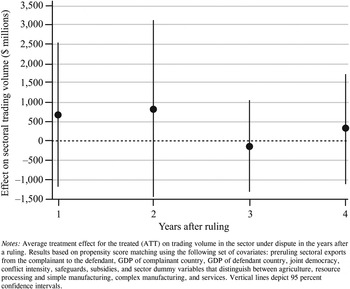
Figure 1 plots the results from our main analysis. On average, third parties' sectoral exports do not evolve differently than exports from principal parties to the defendant after a WTO panel has ruled over the case. In all four years after a panel has delivered its verdict in favor of the complainant, the average difference between third and principal parties remains indistinguishable from zero. This suggests that principal parties do not gain more in terms of export increases to the defendant party compared with third parties.
WTO panel rulings: The effect of third-party status (third parties versus principal parties)

One might argue, however, that this shows merely that third parties do not gain less than principal parties. In fact, we do not yet know whether, overall, principal parties really tend to gain from a panel ruling. This question lies at the core of a large literature that has highlighted the importance of legal institutions in facilitating international economic exchange.
Do Complainants Really Gain?
To answer whether complainant parties really enjoy economic gains from panel rulings, we would need to estimate the effect of experiencing a panel ruling on a complainant's exports to the defendant country. Ideally, we would compare trade flows between countries that have a WTO trade dispute and participate in WTO litigation with countries that have a potential WTO trade dispute but do not participate in WTO litigation. However, there is no convincing and implementable algorithm to identify the latter set of cases for all potential WTO disputes. Therefore, we decided to use all WTO member dyads that are not involved in a trade dispute as a pool of potential control units. Thus, our approach implies that we estimate the effect of a combined treatment that consists of having a WTO trade dispute and experiencing a panel ruling.
Because of the extremely large pool of potential control units (N = 483,994), applying the matching technique directly to this sample of potential controls is overly demanding in terms of computational power and time. We address this problem by using a nonparametric bootstrap with 1,000 resamples. Each time we draw a random sample of 1,500 potential control observations from the pool of WTO member dyads-sector observations, match these with our treated units on the set of potentially confounding covariates, and compute the treatment effect. Since all dispute-specific variables are necessarily missing for WTO dyads that have not experienced a trade dispute, we cannot match on these covariates. We instead match on the variables that have been shown to be the most powerful predictors of having a trade dispute. This selection of covariates is based on the existing literature and our analysis of the data.
More specifically, we estimated several probit models in which we regressed the occurrence of a dispute between a country dyad on several economic and political covariates.Footnote 69 We find that economic power again is a significant predictor of experiencing a dispute. Based on this analysis, we match on the complainant country's and the defendant country's level of GDP, and sectoral exports from the complainant to the defendant country in the year prior to the ruling.Footnote 70 We then estimate the effect of WTO litigation on a complainant country's exports to the defendant country in the four years after a ruling by computing the average difference between exports in the four years after a panel ruling.Footnote 71 We repeat this procedure 1,000 times and construct 95 percent confidence intervals.
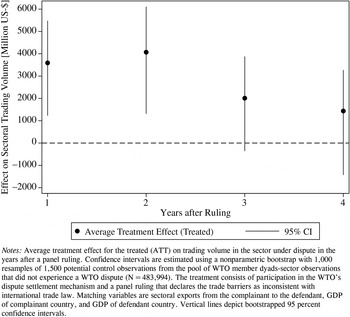
Figure 2 presents the results from our analysis. We find pronounced and persistent positive effects of panel rulings on a complainant's sectoral exports to the defendant country. On average, exports from the complainant to the defendant country in the sector under dispute increase by about $3.6 billion in the first and $4.1 billion in the second year after a panel ruling. The effect reaches statistical significance in all three years after a ruling. How substantively sizeable are these estimates? If we compare the effects with average bilateral trading volume in the four years before a ruling, exports from the complainant to the defendant country increase by about 11 percent in the first and 12 percent in the second year after a ruling. In total, sectoral exports from complainants to defendants increase by about $7.7 billion in the three years after a ruling. This represents an increase in sectoral trade flows from the complainant to the defendant country in the order of about 23 percent if compared with average exports in the four years before a ruling. Overall, this suggests that WTO litigation appears to succeed in removing barriers to trade, thereby facilitating economic exchange and providing countries with considerable gains from exports.
The effect of WTO litigation

A noteworthy feature of our results is the gradual return of sectoral trade volume to its preruling level (Figure 2). The effect of dispute resolution on trade peaks in the second year after ruling. Such a pattern appears plausible because it reflects a gradual adjustment process after a shock (in this case a ruling) that is a typical characteristic of dynamic processes. Trade returns to its long-term equilibrium after the dispute has been settled, the trade barrier in question has been removed, and trade resumes. Moreover, other determinants of countries' trade relations will arguably dominate the export-import dynamics several years after a WTO panel ruling.
Comparing Procomplainant and Neutral Third Parties
So far, the results suggest that third parties do not gain less, on average, than their far more active counterparts. However, in contrast to neutral third parties, countries that decide to join a WTO dispute as a procomplainant third party should do so in expectation of benefiting from a panel ruling against the defendant in terms of higher exports to the principal defendant country. Therefore, compared with neutral third parties, procomplainant third parties' exports to the complainant should increase after a panel ruling that declares the defendant's barriers to trade to conflict with international trade law. For prodefendant third parties, we would not expect to see this effect.
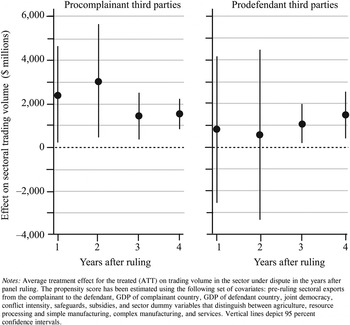
To explore the differential impact of WTO panel rulings on third parties, we distinguish between procomplainant, prodefendant, and neutral third parties.Footnote 72 We code whether a third party has filed written submissions or made oral statements in which it supported the position of the complainant party, the defendant party, or decided to remain neutral.Footnote 73 We then repeat our propensity matching procedure, again conditioning on the full set of potential confounders. Figure 3 shows the results. We find the expected pattern. As the left panel in Figure 3 suggests, a procomplainant third party's exports to the defendant increase significantly in the years after a panel ruling compared with observably similar neutral third-party dispute dyads. The effect on sectoral exports to the defendant country is positive in the first year after the ruling, and gains momentum in the second year after the ruling. The point estimates are sizeable: trading volume increases by about $2.3 billion in the first year and $3 billion in the second year after a ruling compared with exports from observably comparable neutral third-party/defendant-country pairs. These effects equal a 7 percent in the first year and 9 percent increase in the second year relative to sectoral exports in the four years before a ruling. We have also reestimated the results using a nearest-neighbor matching and the results remain unchanged.Footnote 74
WTO panel rulings: Procomplainant and prodefendant versus neutral third parties (propensity score matching)

These estimates represent average effects of procomplainant third-party status compared with neutral third parties in WTO disputes. But how do these gains look in specific examples? To illustrate the economic benefits, consider, for example, the trade dispute between India, Malaysia, Pakistan, and Thailand versus the United States over bans on shrimp imports into the US market. Among other countries, Nigeria joined the dispute as a procomplainant third party. The WTO panel ruled against the United States. In the year after the ruling, sectoral exports from Nigeria to the United States experienced a sizeable 25 percent increase compared with the year preceding the ruling and by about 30 percent compared with an observably neutral third-party country. Another example where the economic gains are smaller, but still noteworthy is the dispute between the United States and Korea over discriminatory taxation of alcoholic beverages by the Korean Liquor Tax Law and Education Tax Law. Mexico joined the dispute as a third party taking side with the complainant. One year after the final ruling in 1998, exports in the beverages sector from Mexico to Korea increased from $1.5 billion in 1997 to $1.7 billion in 1999 (a 13 percent increase) and actually doubled compared with exports from a neutral third party that has the same underlying probability of becoming a procomplainant party.
We would not expect to see such a pronounced positive effect for third parties that have decided to support the defendant. As the right panel in Figure 3 shows, this is indeed the case. We find only a positive, yet, small effect in the third and fourth year after a ruling. Moreover, as additional robustness tests show,Footnote 75 these results are not very robust because the point estimate for year three becomes insignificant once we use a nearest-neighbor matching approach. The results for procomplainant third parties, however, remain robust against using this alternative method.
Conclusion
Many perceive the increasing legalization of international trade as a significant step toward an environment in which power relations among states play a smaller role in international relations. Judicial institutions, such as the WTO's dispute settlement mechanism, can potentially help to reduce the role of economic power in harnessing the gains from trade because an independent tribunal of experts decides whether countries' policies are consistent with international law. However, many of these courts lack the power to effectively sanction member states that have violated the rules of the institution, and not all affected groups or countries have the resources to proactively file costly formal complaints to defend themselves against illegal policies. This casts doubts on whether international judicial institutions can really fulfill the institutionalist promise.
This article examines the impact of one of the most advanced litigation processes to shed light on the distributive effects of judicial institutions. We look into how WTO litigation affects sectoral exports from principal-complainant and third-party countries to the defendant. Such a comparison of formal complainants and third parties uncovers the extent to which legal proceedings against a country that violates trade regulations has spillover effects on economic relations of legally far-less-active countries. The potential spillover effects of WTO litigation on trading relations between defendants and third parties indicate that international institutions can alleviate discrimination among states beyond the immediate cases that they are dealing with.
Our results suggest that such positive spillover effects exist. Sectoral exports from the complainant to the defendant increase substantially after a panel ruling. At the same time, third parties that are also negatively affected by the disputed trade barrier do not gain less economically than principal-complainant countries that have carried the main costs of litigation. Moreover, our results suggest that third parties that align with the complainant gain considerably more than third parties that remain neutral.
These results directly add to our understanding of the consequences of international adjudication in two ways. First, they support previous findings that document disputes in other areas of international relations to have significant distributive effects. For example, and in line with our results, previous research shows that disputes at the International Centre for Settlement of Investment Disputes (ICSID) affect international investment flows to targeted countries.Footnote 76 Similarly, international law helps some states to gain better terms in the settlement of territorial disputes than others.Footnote 77 We provide systematic evidence that a similar logic applies to adjudication in the multilateral trading system.
Second, we find that the effects of adjudication are not limited to the formal litigants, which has been the focus of most previous studies on the effects of international litigation. Instead, adjudication appears to produce benefits that accrue to the wider international community because the litigation process provides important information to third parties, which they can exploit in their own interaction with the defendant state. After observing a legal proceeding, nonparticipating governments can more easily evaluate the strength of the case, rely on the plaintiff’s legal argumentation, and assess the willingness of the defendant to comply with the ruling. A ruling against the defendant therefore increases third parties' expected utilities and reduces their costs of filing their own dispute in the same matter. This is the case whenever another possibly stronger and less vulnerable country takes on the issue and brings the case to the international court. Our study thus contributes to research on the direct and indirect benefits of international institutions and governance efforts that involve the creation of judicial institutions.Footnote 78
We can imagine that similar externalities also exist in other judicial systems. If arbitration of international investment disputes has negative effects on a country's future foreign direct investment inflows, this means that we probably can observe higher investment inflows to other countries.Footnote 79 Future research may consider such potential spillover effects on actors other than the principal parties involved in a dispute. For example, although contentious decisions by the ICJ typically concern security-related issues, our results motivate theorizing about the potential spillover effects of these rulings on parties that decided against becoming formal complainants or defendants in a dispute. After all, the resolution of territorial disputes may have considerable effects on a region's political and economic stability—even countries not directly involved in a territorial dispute may benefit from its resolution.Footnote 80 As a final example of the potential spillover effects of international adjudication, recent work documents that European Court of Human Rights rulings on lesbian, gay, bisexual, and transgender issues affect national policy choices of countries that are not formally involved in the dispute.Footnote 81
In general, such externalities seem particularly plausible when a policy affects multiple states, even though legal proceedings remain essentially bilateral in nature. Focusing exclusively on the relations between principal disputants in such situations may miss an interesting and important part of the effects of judicial institutions. At the same time, realizing these externalities still requires that another country expects large enough benefits to outweigh the costs of litigation. Therefore, even if we accept that judicial institutions may reduce the importance of power in international politics, some power-based distortions will likely remain.
Although exploring the spillover effects of legalization in world politics will add to a more nuanced understanding of these institutions with potentially far-reaching consequences for the scholarly assessment of their performance, studying the consequences of international judicial institutions continues to pose formidable methodological challenges because countries self-select into institutions. Therefore, analyzing how participation in an international institution affects states requires great care in establishing the counterfactual, that is, how state behavior would have evolved if the country had not joined the institution.Footnote 82 The matching strategy we employ addresses this problem by comparing the evolution of trade relations between third parties that experienced a WTO panel ruling with trade relations of observably similar principal parties that experienced a panel ruling.Footnote 83 Although this approach has advantages over more standard estimation strategies such as regression, it still relies on the assumption that conditioning on observable variables will make the two groups comparable.
The estimation strategy employed in this study may be fruitfully applied to other international legal systems and beyond international economic affairs, such as security-related disputes. For example, subsequent research could analyze events-based measures of the hostility between countries, such as those provided by the Penn State Events Data System,Footnote 84 to learn about the impact of ICJ decisions on conflict. As another example, researchers may explore the economic effects of bilateral security agreements and settlement procedures based on a comparison of the conflict region with observably similar, neighboring regions that are not affected by the conflict.Footnote 85 Future work might use the matching techniques employed here as well as other causal inference methods to produce a large variety of hopefully informative analyses of the direct and indirect effects of international (judicial) institutions within and across various policy fields.Footnote 86
Supplementary Material
Replication data and an online appendix are available at https://thedata.harvard.edu/dvn/dv/bechtelsattler.