A nation's politics is importantly shaped by the attributes of its population, including the demographic, and racial and ethnic diversity (or homogeneity), of its citizens. The impact of such diversity is additionally affected by the status of, and the political relations between, various groups in the society. American politics developed in the context of a history of institutionalized and severe legal, social, and political disadvantage for African Americans as a group, which only began to be alleviated with the Civil Rights legislation of the 1960s. Various political opportunities made possible in the post-Civil Rights era led groups advocating for Blacks to expand and regularize their efforts to influence government at all levels of the American federal system. The civil rights impulse stimulated increased political awareness and involvement of other racial/ethnic groups as well. And the dramatic growth in the size of certain minority populations in recent decades has made their political visibility and potential influence important topics in themselves, and specifically, the growth of the Latino population over the last generation has made Latinos' relations with Blacks a salient question at both local and national levels of the political system.
The Hispanic/Latino and Asian populations have been growing rapidly, while the Black and the White populations are increasing modestly by comparison. Latinos comprise about 15 percent of the nation's population, surpassing Blacks (who are about 11–12 percent) several years ago. In some U.S. states—including the nation's two largest, California and Texas—there are now “majority-minority” populations, with Latinos as the plurality minority group. The broader trends are well recognized, yet various implications of these and related questions have been studied little and some not at all.
The present inquiry considers important dimensions of these evolving relationships between the two largest minority groups. What might the changes toward an increasingly multi-ethnic society mean for the future of American politics and its ostensible political pluralism more broadly? Political coalitions between groups are often deemed central to influence.Footnote 1 What is the nature of the political relationships between minority groups; what are the likely foundations for coalition formation, i.e., cooperation or conflict between minority groups, specifically Latinos and Blacks? What are the groups' policy concerns and preferred policy outcomes of each; and how much and in what ways do these mesh?
Despite much popular discussion and considerable speculation about multi-ethnic, multi-racial politics and the asserted need to “move beyond a ‘Black/White’ paradigm” in understanding American politics, very few research efforts have considered this set of issues directly, particularly regarding national-level institutions.Footnote 2 There have, however, been numerous studies at the urban or school board level and at the mass level.Footnote 3 These studies often conclude that Black-Latino relations are characterized by conflict. As the findings developed here indicate, the patterns at the national level are quite different than those at the urban level, and among the masses as well. The “scope of conflict” and associated consequences for the policy issues addressed at the national versus local levels provides an important backdrop.Footnote 4 National-level policy issues may decouple the immediate mass-based perceptions of competition with elite advocacy group behavior in a variety of ways. First, the nature of the policies themselves (civil rights and affirmative action) are more ideologically oriented with more equitably distributed benefits as opposed to local interest-based conflicts (such as competition over jobs or election of co-ethnic candidates). National-level policies may be, or are perceived to be, less zero-sum than many urban-level policies and conditions that are presumably the basis of mass-level perceptions of conflict.Footnote 5 The potential for long-term coalitions and need for future coalitional partners at the national level could also act as a counterforce to strict ties between mass and elite opinion. And finally, as Strolovitch argues, elite advocacy groups, and particularly in the national arena, may be reflecting preferences of specific portions of their constituency that do not reflect the mass-level's preferences to a great degree.Footnote 6 In any of these scenarios, we would expect not only the ideological and interest basis of inter-group relations to diverge between local and national arenas, but also a different orientation between mass and elite behavior. The point is that there are ample reasons to expect that the accepted characterization of conflict at the urban level does not translate to the national level political arena.
How might we begin to sort out and make sense of the central theoretical and substantive questions delineated above? We offer an analytical framework, then identify and systematically analyze several aspects of relations between Latinos and Blacks, focusing on the activities of and between minority advocacy (or “interest”) groups and assessing the similarities and/or differences in policy positions of Black and Latino advocacy groups as demonstrated in efforts to influence national level institutions. This analysis provides an important addition to, as well as advancement of, a body of research that has heretofore centered heavily on the urban politics arena and has, by extension, tended to emphasize different policy issues. Because the “scope” and associated substance of policies generally varies in different arenas of the American federal system analysis in the broader national setting may shed a unique light on Black/Latino relations.Footnote 7 Hence, this study adds distinct theoretical insights and nuance as well as unique empirical evidence to the existing research.
Groups advocating on behalf of minorities play a role in defining, re-defining, and pursuing interests and policies. As part of their role, advocacy groups seek to influence various aspects and stages of the policy process, including introduction and formulation of legislation, as well as decisions made by the courts (among other activities). Efforts of this nature include seeking to influence accountability of members of Congress through examining, rating and comparing legislators' voting records, as well as through the presentation of congressional testimony. In another institutional venue, the courts, the filing of amicus curiae (friend of the court) briefs is a common activity used to influence decisions. To be sure, groups pursue other methods and venues but these are important with respect to the particular questions of interest in this paper and the broader body of research on racial/ethnic group interrelations which are part of more general processes in America's politics.
Despite an upsurge in relevant political science research, many issues concerning Latino politics and minority groups generally remain understudied, including the nature and extent of “advocacy” or interest groups' activities. Advancing this research agenda, then, this article examines the salience and policy positions of advocacy organizations as evidenced, first, in their activities in the Congressional arena through the identification of policy issues, i.e., votes in Congress, deemed most important, as well as the congruence or overlap of these issues in the groups' agendas; and also in the congressional testimony in which the groups participate in seeking to shape legislation. Secondly, we consider similarities and differences in groups' participation and expressed preferences in the legal arena through their filings of “friends of the court” briefs. To assess these dimensions, we examine evidence on the activities of a set of organizations that are representative of Latino/Hispanic and Black/African American advocacy groups. While varying by analysis, the groups include the National Council of La Raza (NCLR), the National Hispanic Leadership Agenda (NHLA), the League of United Latin American Citizens (LULAC), the Mexican American Legal Defense Fund (MALDEF), the National Association for the Advancement of Colored People (NAACP), and the National Urban League.Footnote 8 The nature and the breadth of policy concerns represented by these groups' activities has manifest and important implications for understanding groups and group interrelations, as developed below. Though some studies have addressed social movement history relevant to understanding the contemporary situation,Footnote 9 to the best of our knowledge, this article represents the first effort of its kind in raising and, in turn, in examining these particular questions with this specific analytical approach regarding national minority advocacy groups.
The behavior of groups that act in behalf of minority concerns, specifically those of Blacks and Latinos, is the central question, and the grounds or bases for the (potential) pursuit of common goals are at the core of the inquiry. Most of the previous research on minority group relations has been cast in terms of conflict/competition or cooperation and, again, focused on urban politics. But it is quite possible that other types of relationships between Blacks and Latinos may occur and may well vary by the scope of the issue area and the level of government in which these groups act.Footnote 10 That is, advocacy group behavior and inter-group relations more generally are probably more complex than developed in previous studies. Our analysis reveals that rather than this simple dichotomy, advocacy activities are characterized predominately by tacit non-cooperation, and secondarily by cooperation. Conflict is scarce if not non-existent. We draw on previous theory to explore this premise.
Theoretical Background
It is commonly argued that core factors affecting minority group coalitions are “interests” and “ideology”; group policy orientations and interrelations may be more or less similar based on their divergence or convergence on interests and ideology.Footnote 11 Following the implications of such dimensions, but also cognizant that in actual practice interest and ideology may blur or be otherwise ambiguous to some extent, four broad relational possibilities can be identified. We label these four types of relations as cooperation, conflict, tacit non-cooperation, and negotiation. Delineating other possibilities hardly means that conflict and cooperation are not important; it simply suggests something beyond a “dichotomous,” either/or (conflict or cooperation) perspective exists, presenting additional possibilities associated with the complexities of racial/ethnic politics.
When there is a convergence or agreement between groups on both ideology and interests, cooperation would be expected. Conversely, conflict would be highest when there are differences or disagreements in terms of both ideology and interest. Apart from these rather clear-cut circumstances, the nature of other relations is murkier but probably no less important. The murkiness results from the complexity and ambiguity of the concepts of interests and ideology in practice, because these are not always easy to clearly isolate, much less disentangle, in actual politics. Thus, whether the specific relationships—and possibly non-relationships—between groups on various issues are due primarily to interest or ideological divergence is not simple to ascertain. We would expect that interest divergence is more common than ideological divergence between Blacks and Latinos because to some extent there is a broad consensus around strong concerns and particular support for civil rights, equality—both racial/ethnic and economic—and related values. How those values are actually applied or allocated across groups, i.e., interests, can be a source of tension; but the ideological agreement tempers the tension and may help channel it away from overtly conflicting outcomes.
Where there is basic agreement of ideology but difference of interests tacit non-cooperation or independence may be possible.Footnote 12 Thus, groups may not be in direct conflict and simply “go their own way” under such circumstances. On-going discussion seeking to establish mutually acceptable policies is likely. This may lead to distributive politics where the substantive differences are not fully resolved, and to policy positions where there's a little something for everyone. Symbolic or recognition politics may also take place. These circumstances help explain why, when policy changes do occur (in a way consistent with the preference of a minority group/s), they can often be characterized by “reform by addition,” with modest policy changes (“side-payments”) to mollify those with reservations about policies. Reform and social change occur within a larger economic and social structure that typically moves incrementally, constraining the advancement of Black and Latino policy orientations and affecting inter-group relations as well.
Finally, negotiation possibly occurs where there is ideological disagreement and interest concerns diverge or are not clearly at stake. Again, the assumption is that there are relatively few instances of ideological divergence because minority advocacy groups most often (though not always) share broader “purposive” goals. Latinos and Blacks have been seen as parts of “liberal” coalitions in urban politics and, similarly, part of Democratic and liberal coalitions in state politics.Footnote 13 Furthermore, both groups (with notable exceptions) strongly support Democratic candidates in congressional and presidential elections and both groups are also liberal on economic policy. Thus, closer attention is given here to tacit non-cooperation/independence than cases of ideological divergence.
Along with the importance of ideology and interest dimensions and the types of policy, conventional interest-based theories of advocacy group coalition formation are potential explanations as well. Generally, policy subsystems are occupied by competing coalitions within specialized policy areas. For minority advocacy groups, this means that groups are participants in, and exert influence on, issues of particular importance to them. Coalitional membership is primarily based on group preferences, be they purposive (e.g., civil rights) or material benefits.Footnote 14 Jenkins-Smith, St. Clair, and Woods found that the tendency to maintain coalitional membership varies to some degree across purposive and material groups, with purposive groups tending to maintain policy positions (and thus are less likely to change coalitions) than material groups.Footnote 15 Hojnacki shows that groups with broad political agendas are more likely to join coalitions as their interests are more likely to overlap with other groups across a variety issues.Footnote 16 Given minority advocacy groups' orientations to civil rights broadly, they may be more likely to engage in coalitional activities when broad civil rights issues are at stake. When policies are oriented toward material benefits, coalitional or cooperative activity may be curtailed as groups seek to maximize policy outcomes for the benefit of their particular group. These theories parallel the conflict-cooperation dichotomy, and also suggest shifting allegiances and advocacy conflict across groups.
Two related theories also suggest that few coalitions across policy areas will form, and thus outside of particular policy sub-systems the interaction of groups is unlikely. “Niche theory” suggests one potential impact on coalition formation and the degree to which interest groups compete or cooperate.Footnote 17 Here, niches, or policy spaces, are occupied by particular groups that dominate the policies within their “ecology” by capturing expertise and resources that create extremely high entry costs for new groups. The impact on advocacy coalition formation is that very little interaction will take place across policy sub-systems. Related to this is the general impact of resource constraints which suggests that advocacy group sub-systems are relatively stable, since the development of expertise, information, and established reputations with policymakers are costly. All of these traits make multiple issue coalitions hard to maintain as groups would need to expend the resources necessary to compete for influence with already established groups. In short, groups considering entering into a new policy sub-system face high costs, and unless there are clear material advantages or disadvantages that justify the costs of delving into new fields, the costs of entry leave only stable sub-system coalitions.
The difficulty of applying these theories to racial and ethnic minority groups is the specification of their niche or policy sub-system. Black and Latino groups operate in many sub-systems (such as education, civil rights, health, immigration), and the point of competition or cooperation is hard to define given these varied interests, both across policies and in terms of material or purposive motivations for group advocacy. This breadth of policy concerns also leads to the groups' need to be active in various venues, to the degree possible, given the nature and extent of their policy concerns. Moreover, organizations focused on social justice, civil rights, and the like, which are groups based more on purposive than material incentives may likely to be somewhat different than other “interest groups.”Footnote 18 Nonetheless, the several theories discussed above offer guidance in what we expect regarding the nature and extent of minority advocacy group interrelations, or non-relations; they may help us understand not only conflict/cooperation but interesting cases where we would expect cooperation, but do not find it. We would need to revisit our expectations if the assumptions seem plausible and then find ways to assess these cases, these “dogs that don't bark.” A comprehensive assessment requires attention to policy-making institutions and the policy goals sought from those institutions. Whether and how Black and Latino advocacy groups interact on these goals and through these national institutions is the subject of what follows.
Policy Salience in the Congressional Arena
As part of their efforts to influence policy, many minority advocacy groups have developed scorecards that “rate” how members of Congress (MCs) vote on a number of issues selected by the groups. The NAACP, NHLA, and others are among the many groups that regularly produce such scorecards. The scorecards typically include a number of votes identified by the advocacy group from a congressional session, the group's preferred position on those votes, a record of how MCs actually voted on each, and the overall score that is assigned to each MC. (The groups also commonly indicate the outcome, passage or non-passage, of each piece of legislation.) These groups' scorecards can be taken as indicating their most salient policy concerns and their stated preferences on those policy positions. Together these reflect efforts by minority advocacy groups to make elected officials and institutions attentive and accountable. We begin by considering the question of policy salience.
Regarding policy concerns or saliency, the question is what types of issues concern minority advocacy groups and the extent to which the different advocacy groups identify similar policy issues as the salient or major concerns, specifically, the frequency with which the groups place issues on scorecards and the extent they do so for the same issues or cases. The degree of activity and overlap in policy issues on which groups engage can thus be determined. Secondly, policy congruence follows evidence of saliency and considers whether the groups take the same positions on the issues they have in common on their scorecards. That is, do the groups have congruent views on the shared salient issue's (un)desirability? Specifically, do they agree or disagree on the preference for a “yes” or a “no” vote. What are the aggregate patterns, and what do they suggest? Delineating the frequency and the substantive policies or issue areas of the groups' involvement suggest ostensible coalitions and networks and provide a starting point for understanding how ideology and interests affect cooperation or other forms of inter-group relations.
We begin by evaluating the types of issues that are salient to minority advocacy groups and the degree of congruence across groups by examining the votes included in the congressional scorecards of the NAACP and the National Hispanic Leadership Agenda (NHLA) since these are the two major interest groups representing the largest racial/ethnic minority groups in the nation. The data are compiled for the 105th through the 108th Congresses (1997–2004) since we are seeking comparisons, and the NHLA began distributing scorecards in the 105th. Figure 1 presents the frequency distribution of votes categorized by policy topic.
Salient votes by topic: Counts of votes included on NAACP and NHLA scorecards (105th–108th Congresses: 1997–2004)

Several aspects of the distribution are notable. First, votes included in the scorecards of both groups are distributed across a variety of topics, confirming that while these groups serve specific constituencies, policies salient to minority interests are rather diverse and perhaps beyond what would traditionally qualify as a policy subsystem or policy niche. Second, while variation exists, there are topics that take up larger portions of the groups' agendas. The four topics most frequently addressed in NAACP scorecards during this period were Education (22.89 percent of the votes), Crime (7.23 percent), Civil Rights (7.23 percent) and Health Care policy (7.23 percent). Together these topics accounted for about 45 percent of the NAACP's scorecard items. The NHLA's top topics shared two issue areas, Education and Civil Rights, with the NAACP's top topics. The most frequent topic included in NHLA scorecards was Education (26.77 percent of the votes), Civil Rights (14.17 percent), Economic Mobility (11.81 percent), and Immigration (10.24 percent). Together, these four policy areas accounted for 63 percent of the NHLA scorecard votes. In terms of overall salience, the scorecards reveal that while broader issue concerns were shared between the groups, the major focus of the groups do diverge. Education and Civil Rights, both issues that have immediate effects on the two groups' interests, maintained high levels of salience over the period examined, while more specific problems faced by their respective constituencies—particularly Crime, AIDS, Gun Control, and Health Care for the NAACP and Immigration and Economic Mobility for the NHLA—demonstrate some divergence in policy focus. While votes in these areas tended to distinguish the groups in terms of policy areas of interest, the overriding story of the salience analysis is that there was a wide array of policies represented by the votes of each group, and in most cases major topics were included by both advocacy groups even if specific votes did not overlap.
While there are indeed differences in policy salience, some overlap does occur. Considering the extent to which votes were salient, and if these groups shared the same position (congruence) on these mutually salient issues is the next step in the analysis. Overall, as figure 1 highlights, there are relatively few votes included in both NAACP and NHLA scorecards. Of the 293 total votes included in the groups' scorecards, only 28 (less than 10 percent) were shared by both groups. Table 1 displays the number of votes in each scorecard and the number of shared votes (shared salience) by Congress. The degree of sharing fluctuates as does the percentage of one group's scorecards that overlap with the other. But in general, neither group had votes that overlapped to the point that they made up much more than about one-third of the total votes. However, where the groups did share the same votes, they were entirely congruent in their position—on 100 percent of the votes that both groups deemed salient, the groups agreed on the preferred outcome. As figure 1 demonstrates, shared salience and congruence were most likely observed in votes regarding Affirmative Action (100 percent of votes on this topic were congruent), Civil Rights (20 percent of votes on this topic were congruent) and Labor (18 percent of votes in this area were congruent). The remaining shared votes were spread across a number of topics. The evidence thus suggests that contrary to ideological expectations of broad consensus and cooperation, there is relatively little obvious cooperation in the process of identifying pertinent roll call votes. Groups tend more often to engage in non-cooperation by pursuing very different sets of priorities (e.g., Immigration vs. AIDS), but also engage in similar policy areas but identify different key decision points as salient. When they do identify the same sets of votes as priority issues, there is a complete lack of competition or position divergence.
Policy salience and congruence of minority advocacy groups' agendas (number of cases included in Congressional scorecards and degree of salience and congruence)

Congressional Testimony
Our second form of analysis of the legislative arena examines the salience of minority advocacy groups through the lens of testimony in Congressional hearings. Due to a wider set of available data, we base our analysis on the activities of five groups that represent either Black or Latino constituencies. The groups are the NAACP, the Urban League, the NCLR, MALDEF, and LULAC. To identify hearings at which these groups testified, a search of Lexis-Nexus' Congressional Universe for hearing testifiers based on the full name or acronym of each group from 1970 to 2000 was employed. The hearings identified by this process were then merged through Congressional Information Service hearing identification numbers to Baumgartner and Jones' Policy Agendas congressional hearings database in order to code topics and subtopics for each hearing.Footnote 19 Overall, we were able to identify a total of 781 unique hearings that could be placed in the mutually exclusive categories of Black advocacy groups testified, Latino advocacy groups testified, or both groups testified.
Hearing testimony is not coded for direction or position. It is difficult to determine whether a group supports or opposes a piece of legislation; it is particularly difficult to code direction of the testimony when a hearing does not address a specific piece of proposed legislation and instead is aimed at fact-finding or the gathering of broad opinions from stakeholders. Thus, we only present evidence regarding the types of issues for which minority advocacy groups provide testimony, and the types of issues over which they tend to testify at the same hearing. We cannot make any valid inferences about the extent of congruence, but can identify issues where Black or Latino groups testify by themselves and thus neither compete nor cooperate directly. We should also note that testifying in a Congressional hearing is not entirely indicative of minority advocacy groups being “proactive” on these issues, nor which ones they find, or, perhaps do not find, salient. Congressional actors invite those who testify, often doing so to have inclusion of relevant stakeholders, rather than responding to all requests to testify. Thus, there is the ever-present possibility of selection bias in gauging the issues that groups find salient through their propensity to testify. These caveats notwithstanding, the evidence provides useful and at least suggestive information.
The frequency distributions of hearings by major topic for each of the advocacy groups compared to the distribution of all hearings are instructive (the full table is available from the authors). Each groups' testimony does depart from the overall distribution of Congressional hearings, as confirmed by statistically significant chi-square tests (p < .000). The pattern that emerges is not surprising. With the exception of the Urban League, each group tended to testify at hearings on the topics of 1) Civil Rights, Minority Rights, and Civil Liberties, and 2) Government Operations (which includes appointments and nominations). Latino groups also tended to testify at hearings which addressed topics of Labor, Employment, and Immigration to a greater extent than the NAACP and the Urban League. The distribution of these groups' hearings is also notable in light of the overall distribution of hearings. Of all hearings from 1970 to 2000, only 2.24 percent were on the topic of Civil Rights, Minority Rights, and Civil Liberties. Yet, the NAACP (29 percent), the Urban League (8.2 percent), LULAC (18.1 percent), MALDEF (31.9 percent) and the NCLR (17.6 percent) all tended to have much higher percentages of hearings in which they testified devoted to that issue.
By collapsing the categories into Black (NAACP and Urban League), Latino (LULAC, MALDEF and NCLR) and Black and Latino groups testifying, which are not mutually exclusive categories, a general sense of what types of issues are most salient to each type of group, as well as the distribution of topics for which both types of groups testified confirms the overall pattern of the individual groups (data are available from the authors on request). The grouped pattern is generally similar to that found for each individual group and, once again, the chi-square tests for each category relative to all hearings indicate that the pattern significantly diverges from the overall congressional hearing pattern (p < .000). Civil Rights and Government Operations are the most frequent topics for hearings where Black or Latino groups testified at the same hearing. This suggests that at the very least, those who hold Congressional hearings tend to ask both groups to testify at about the same frequency on the specific topics addressed in these hearings.
To examine how issues influence the propensity of each type of group to testify, and to testify at the same or different hearings, table 2 presents the percentage of cases within each major topic for the mutually exclusive categories of only Black groups testifying, only Latino groups testifying and when both groups testify. In this way, the impact of issue type on advocacy can be examined to assess how it is affected by interests or ideology. If ideology is shared across all groups, and thus cooperation on any particular issue is based on common ideology, then the distribution of individual advocacy and inter-racial/ethnic group joint testimony should remain fairly constant across issues/topics. As table 2 reveals, this is hardly the case as indicated by statistically significant divergence in hearings topics across individual group salience and joint saliency (χ2 = 124, p < .000). The rate of shared salience in testimony is much higher in Civil Rights, Minority Rights, and Civil Liberties than the remaining categories. Government Operations and Law, Crime, and Family Issues also proved to be topics where there was some, but limited, representation from Black and Latino groups at Congressional hearings. Other topics revealed a distinction between Black and Latino groups. Health care issues tended to be the subject of Black testimony to a greater extent than overall percentages would suggest. This is also the case for Macroeconomics; Law, Crime, and Family; and Community Development and Domestic Commerce. Latino groups' testimony tended to be more frequent for hearings on Education and Labor, Employment, and Immigration. Other categories had such few cases where either a Black or Latino group testified that even tentative conclusions seem ill-advised. There is, then, a good deal of variation across issues in the propensity of Black and Latino groups to testify at specific hearings, suggesting that the interests and expertise of these groups may be as important a factor than an underlying ideological orientation toward civil and minority rights.
Distribution of Congressional hearings testimony, percentage and (cases), within major topics by black, Latino, and black and Latino groups testifying, 1970–2000

χ2 = 124, p < 0.000
To further examine whether variation in minority group advocacy is to some extent driven by the interests of the respective constituencies of Black and Latino advocacy groups, a purposive sample of more specific illustrative sub-topics is presented in table 3. Since a general orientation toward Congressional testimony on topics of civil rights could be explained by either interest or ideational orientations, the sub-topics provide more detailed evidence regarding the issues on which Black and Latino groups testify. The table presents the within subtopic variation in the propensity to testify alone or with groups from other racial/ethnic groups for seven topics. The cell entries in bold indicate that the within-subtopic percentage of cases is higher than the overall percentage of cases falling in one of the three mutually-exclusive categories. This gives a rough indication of whether the subtopic tended to be one of black interest, Latino interest, or one that both groups shared (i.e., both testified at the same hearing). The cross-tabulation is significant (χ2 = 70, p < .000). The lambda coefficient suggests that the categories explain about 23 percent of the variation in patterns of testimony.Footnote 20
Distribution of hearings, percentage and (cases), within selected subtopics by black, Latino, and Black and Latino groups testifying, 1970–2000

χ2 = 70 (p < 0.000); Cramer's V = .35; Lambda = .23
Note: Bold indicates within percentage for the subtopic is notably above within percentage of all topics.
The relationships between issues and the propensity for Black and Latino groups to testify alone or at the same hearing suggests that the specific interests of groups tend to lead to diverging areas of salience. Two subtopics, Ethnic Minority and Racial Group Discrimination and Nominations and Appointments, tended to have a high degree of individual and combined group testimony, indicating that both groups may be broadly interested in these topics. But at the same time, the groups do not overwhelmingly advocate via testimony through one particular strategy. General Civil Rights and Voting Rights and Issues, however, tend to elicit testimony by both Black and Latino groups at the same hearings, with over 35 percent of hearings on these issues having both Black and Latino groups testify, compared to the overall average of 10.6 percent of these subtopic hearings where both groups testified. A few subtopics are prominent in that they are more likely to have either a Black or Latino advocacy group testify, but not both, relative to other categories. Latino groups are more likely to testify by themselves at hearings on Census issues and Immigration and Refugee Issues. Relative to hearings on other issues, these are not startling findings, but the lack of Black advocacy group participation, particularly in Immigration issues does suggest that broad Black-Latino coalitions do not simply emerge because of common underlying ideological orientations.
A similar type of pattern of group-specific testimony is found in District of Columbia issues for black groups. While only nine hearings on District of Columbia issues were identified between 1970 and 2000 where one or both types of groups testified, seven of those hearings, or about 78 percent had only Black advocacy groups testify. This is not surprising given the large concentration of Black residents and thus Black advocacy group constituents. But the high incidence of Black testimony at these types of hearings does underline the point that not all issues are equal when it comes to group decisions to testify, or more likely, of Congressional recognition of important stakeholders.
The analysis of Congressional testimony highlights some important aspects of inter-group minority advocacy (some data limitations notwithstanding). The results suggest there is a considerable degree of variation in the types of issues on which minority advocacy groups testify. If a reasonable measure of issue salience for these groups is the degree to which their testimony is spread across issues, then we can say that these groups tend to find civil rights and minority rights, which are broader or more universal issues, the most salient relative to other topics. However, they also vary in this salience to some degree. Issues that are more ostensibly specific to Black or Latino concerns in fact tend to receive a higher degree of attention than the broader civil rights issues. It is important to note, however, that we cannot evaluate issue congruence, or the taking of the same position, simply from the fact that Black and Latino groups testified at the same hearing. What can be said is that when testimony is dominated by one group or the other, the groups are participating in policy discussions on their own, without direct cooperation or conflict. Finally, because testifying at congressional hearings is not wholly a proactive undertaking, a reasonably conservative interpretation is that congressional actors recognize that these types of groups are interested in, and salient to, particular issues, which is of no small importance and indicates the relevance of each group to the advocacy of their constituents' issues and the broader representational process.
Minority Advocacy Group Activities in the Legal Arena—Supreme Court Amicus Briefs
Participation in judicial advocacy is a longstanding method for minority advocacy groups to both signal their policy positions as well as seek to influence public policy, particularly when other spheres are adverse or non-responsive to minority interests. The 1954 Brown v. Board of Education case is perhaps the most obvious example, yet numerous other cases at all levels of the judicial process hold broad implications for minority groups throughout the country. Below, we examine a set of these potential points of influence by focusing on cases filed with the Supreme Court from 1974 to 2004 for which amicus briefs were filed by major Black and Latino advocacy groups. Black advocacy groups include the NAACP and the Urban League. Latino advocacy groups included the NCLR, LULAC and MALDEF. We identified these cases through a Lexis-Nexus search of amicus briefs using the full names of the groups and their acronyms as the search terms. The search for amicus briefs yielded 270 cases where these five groups, individually or jointly, filed briefs. There are 147 cases where at least one Black advocacy group signed on to a brief, 80 cases where at least one Latino group submitted a brief, and 43 cases where both Black and Latino groups filed briefs. Note that the above totals are not mutually exclusive. In all, 184 unique cases fell into the mutually exclusive categories of Black advocacy group amicus cases, Latino advocacy group amicus cases, or Black and Latino advocacy group amicus cases. The latter category included any case where at least one Black and one Latino group filed a brief.
To identify the issues represented by these briefs, we use the coding framework from Spaeth's Supreme Court Database.Footnote 21 While the groups varied in the number of overall briefs filed, ranging from 12 from LULAC to 143 from the NAACP, there is a good amount of consistency in the types of cases for which the groups filed amicus briefs. The most frequent issue for each group fell in the category of Civil Rights. Even with the most cases, and not surprisingly the broadest set of issues addressed, the NAACP filed more than 57 percent of its briefs for cases within the Civil Rights category. The remainder of the minority advocacy groups filed an even larger percentage of their briefs within this category. In terms of broad categories, then, this initial slice of evidence suggests that minority advocacy groups share a general orientation toward intervention in Supreme Court cases on issues of civil rights. This is hardly a surprising finding, but it does confirm a general consistency in the type of issues in which minority advocacy groups engage in the judicial process. Moreover, only the Urban League's distribution was significantly different from the set of cases included in the sample (υ2 = 25.7, p < .012). In short, the groups tended to submit briefs on the same types of issues (the full distributions for each group are available upon request).
While minority advocacy groups tend to be involved in the judicial process on the same types of issues, the secondary question of cooperation, competition, or non-cooperation remains. If groups identify the same types of issues as important, are they more likely to cooperate, compete against each other by taking opposing positions, or simply pursue different cases on their own, and thus neither cooperate nor compete? Given the variation in the number of cases in which groups filed amicus briefs, we focus the remainder of the analysis of Supreme Court briefs on the mutually exclusive Black, Latino, and both Latino and Black amicus categories described above.
Filing a brief for the same case is not necessarily evidence of cooperation. Our unit of analysis is the case, and thus Black and Latino groups might be regularly filing briefs on opposing sides of the case. To evaluate the degree to which Black and Latino groups cooperate or compete in the same case, for each case and each group, we coded whether the brief was filed on behalf of the respondent or on behalf of the petitioner. This coding permits us to evaluate the degree to which activity on the same case is cooperative or not. As in the findings on Congressional scorecards (described earlier), there were no instances of Black and Latino groups supporting opposing sides; in short, there is no evidence of competition. When Black and Latino groups file amicus briefs for the same case, they are always engaging in at least parallel or minimally cooperative activities. This key finding suggests that in the realm of Supreme Court advocacy, minority groups either cooperate (submit briefs for the same side) or pursue their own cases. There are, however, no indications of competition or conflict.
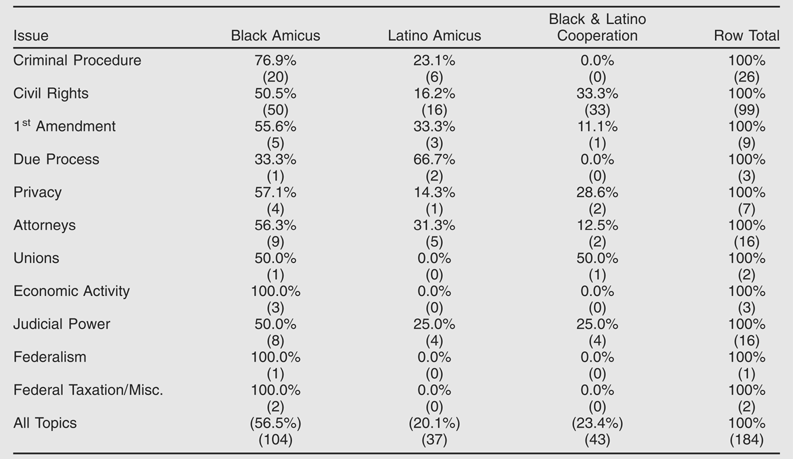
The next question is the extent to which different issues elicit more cooperative activity. To do so, we return to the mutually exclusive categories of Black, Latino or both groups filing briefs and examine the within topic variation in cooperation when at least one group filed a brief. Table 4 presents these results for all issue categories. There were 104 cases of Black groups submitting amicus briefs without a Latino group also submitting a brief. Latino groups submitted briefs on their own for 37 cases. There were 43 cases in which at least one Black and one Latino group submitted amicus briefs. Thus, about 23.4 percent of the cases for which at least one Black or one Latino group submitted amicus briefs are points of cross-racial/ethnic cooperation. While we have no general comparison from which to judge the magnitude of this degree of cooperation, this finding does appear to undermine the claims of some who suggest that the potential for multi-racial/ethnic coalitions are extremely rare.
Distribution of amicus curiae briefs, percentage and (cases) within major issues by black, Latino, and Black and Latino filings, 1974–2004
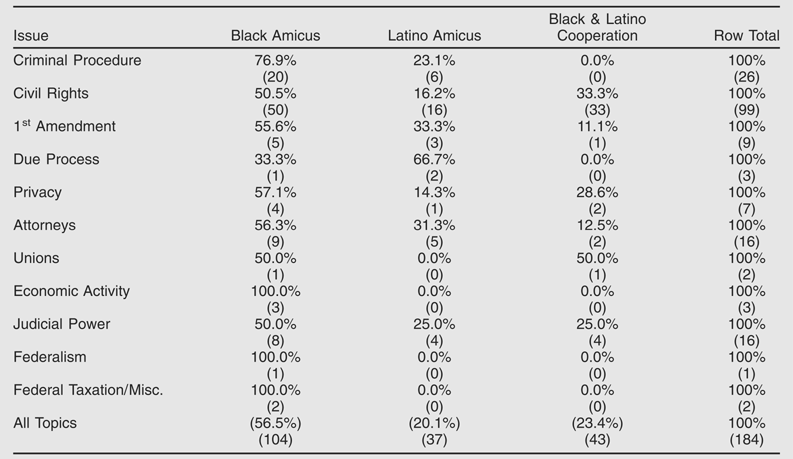
χ2 = 27.26 (p < 0.202)
Does the degree of inter-racial/ethnic minority advocacy group cooperation vary by topic? By comparing the percentage of cooperative cases within each major issue category (see table 4), it is clear that some issues lend themselves to cooperation more than do others. Civil Rights, Privacy, Unions, and Judicial Power all have higher than average percentages of cases that exhibit cooperative behavior. However, given the relatively low number of cases falling outside of civil rights cases, it is not feasible to infer any real degree of independent versus cooperative dispositions in these realms, and indeed, a chi square test indicates that the differences are not statistically significant. At the same time, it can be noted that among Criminal Procedure cases, there were no incidences of Black and Latino cooperation, suggesting that on these types of cases advocacy groups tend toward tacit non-cooperation rather than cooperative advocacy.
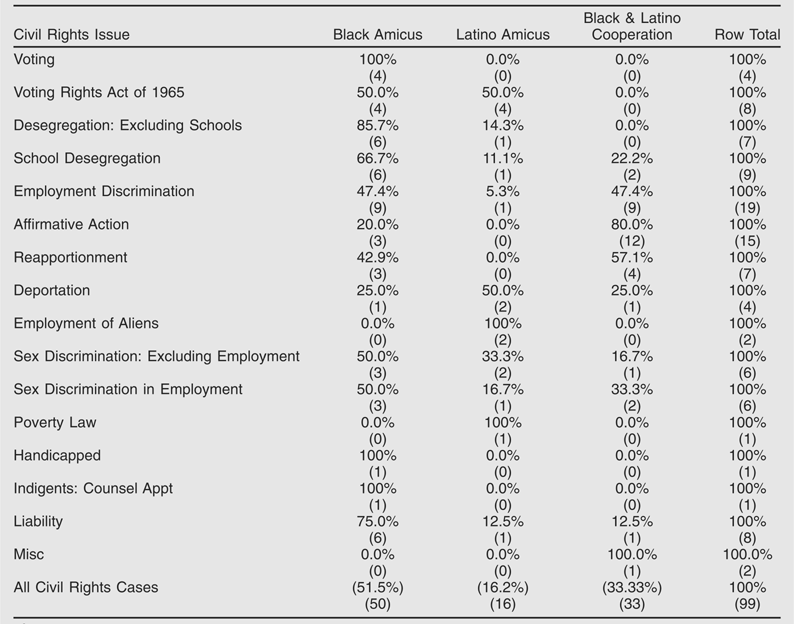
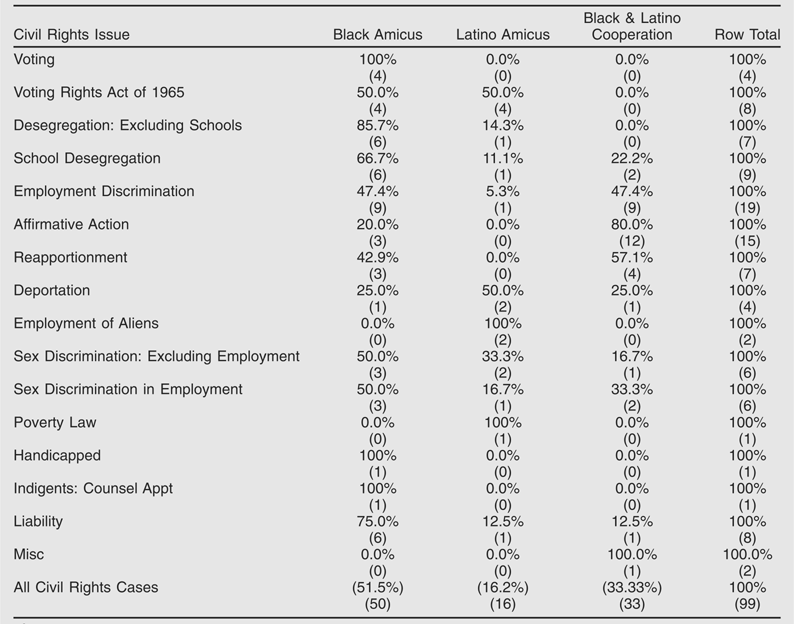
To further examine this issue in amicus filings, the analysis turns to the sub-issues within the Civil Rights categories. If an underlying ideological orientation toward civil rights drives minority advocacy group activities, we expect to see a relatively uniform distribution of cooperative activity across the sub-categories of civil rights cases. If there are distinct differences in cooperative behavior that emerge around issues that are at the heart of Black and Latino interests, but few instances of cooperation otherwise, we may conclude that at least some of the activity is driven by group-specific interests. Table 5 provides the within-Civil Rights sub-issue percentages of Black amicus, Latino amicus, and Black and Latino cooperation cases. The variation across sub-issues is significant (χ2 = 6.382, p < .000). The sub-issues that are most likely to elicit cooperative activity are Affirmative Action (80.00 percent of cases had amicus curiae briefs filed by both Black and Latino groups), Reapportionment (57.14 percent of cases had amicus curiae briefs filed by both Black and Latino groups) and Employment Discrimination (47.37 percent of cases had amicus curiae briefs filed by both Black and Latino groups). It is also important to note that an exceptionally small percentage of cases in each of these categories are characterized by “going it alone” behavior, where Black or Latino groups filed briefs, but not both. In fact, in none of the Reapportionment or Affirmative Action cases did Latino groups file amicus briefs without a Black group also filing a brief. And, in only 20 percent of cases regarding Affirmative Action did Black advocacy groups file briefs without Latino groups also filing a brief for the case. The points of cooperation, in many ways, seem to be points where both ideology and interests overlap.
Distribution of amicus curiae briefs, percentage and (cases), within civil rights issues by black, Latino, and black and Latino filings, 1974–2004
χ2 = 63.82 (p < 0.000); Cramer's V = .57
These results, however, are only meaningful when compared to the rate of cooperation for other sub-issues. Overall, while the incidence of cases in other sub-issues is fairly small, and thus caution is essential in drawing inferences, the rate of cooperation is relatively lower in all other sub-issues. In the fifty-eight Civil Rights cases falling outside the sub-issues of employment discrimination, affirmative action, and reapportionment, only seven, or 12 percent, had amicus briefs filed on their behalf by both Latino and Black advocacy groups. This rate of cooperation is much lower than that of the overall rate of 33.3 percent for all civil rights cases. A few notable instances that point to interest-oriented, or at least group-specific, behavior are that only Latino groups filed amicus briefs for Employment of Aliens cases; 85.71 percent of the Desegregation: excluding schools cases had amicus briefs filed only by Black groups; and a majority of cases addressing School Desegregation were filed by Black groups.
Other factors besides a simple pursuit of interests may explain the variation in rates of cooperation. One such factor may be the timing of the cases and the asymmetrical distribution of resources available to the groups during the time period that key sub-issues were decided by the court. For instance, Latino groups, other than MALDEF, were not as involved early in our sample period as was the NAACP, and thus cases of School Desegregation, which were prominent in the 1970s and 1980s, may simply not have been addressed by Latino groups due to a lack of available resources. Nevertheless, MALDEF was very active during this period, and since desegregation orders generally dealt with Black students, it is not unreasonable that Black interests (and a lack of Latino interests) led to cooperation rates that were somewhat lower in these cases relative to Affirmative Action cases.Footnote 22 Other evidence, such as the absence of any Black groups filing an amicus brief on Employment of Aliens cases, also suggests that interests tend not to be overridden by broad ideological orientations or membership in civil rights coalitions (or that there may be group specialization and/or resource constraints). Nevertheless, to assess the possibility of time dependence in cooperative activity, a cross-tabulation of the Black, Latino or Both amicus brief filings categories (used above) and a pre-1990 and post-1990 categorical variable was analyzed. The former time category included 87 of the cases and the latter category included 97 cases. There was no significant difference in the distribution across these time periods (χ2 = 1.58, p < .45).Footnote 23 In short, while there may be some differences in issues that emerge over time, there seems to be little difference in the propensity of Black and Latino racial/ethnic minority advocacy groups to cooperate in amicus filings for particular issue areas.
Conclusion
This article identified and addressed new issues and brought new evidence to bear on a continuing scholarly effort to explain relations between the largest minority groups in the U.S. Specifically, we examined when and why minority advocacy (interest) groups compete, cooperate, or engage in what we call tacit non-cooperation or negotiation in the processes of attempting to influence national policymaking. This extends theoretical understanding and also advances the research by examining minority advocacy interactions with Congress and the Supreme Court.
Our findings highlight several points, which often contrast with those of previous research focused on urban politics and the perception of group conflict, or cooperation, common in much scholarly as well as popular discourse. The Congressional scorecard data analysis indicated modest levels of overlap among the issues identified by the Latino and Black advocacy groups; i.e., issue salience differs considerably between the groups. This may come as a surprise to some or many observers but our theories suggested this possibility and reasons for a reasonable lack of mutually salient issues. At the same time, we found no evidence of conflict in the positions taken by the groups. Not a single instance was observed where the NAACP and the NHLA supported different outcomes on their significant Congressional votes.
The analysis of Congressional testimony produced the highest degree of independence in advocacy group activities examined in this study. Almost 90 percent of the hearings identified from 1970 to 2000, that either major Black, Latino or both types of advocacy groups testified, only Black or Latino groups testified, but not both. This pattern held across decades for the bulk of the hearings on selected major sub-topics. As discussed above, this lower level of shared salience is likely a function of the nature of the process of participation in Congressional hearings. That is, unlike proactively identifying key votes, or filing briefs with the court, congressional testimony is invited, which probably makes it rather different from other evidence concerning organizations' agendas and activities. Committees' perceptions of who are stakeholders thus acts as a constraint on the level of advocacy and the degree to which groups share issue salience in this particular access point.Footnote 24 While congruence was not confirmed, yet should be given attention in future research, the key finding remains—independence or tacit non-cooperation was the norm.
In the area of legal advocacy, the analysis of amicus curiae briefs affirms that there is very little if any outright competition or conflict between Black and Latino advocacy groups. In none of the cases examined from 1974 to 2004 did Black and Latino groups included in the analysis file amicus briefs on opposing sides. Instead, groups signed on to amicus briefs together, or submitted separate briefs for the same side of the case 23.4 percent of the time, about the proportion of cooperative behavior we found in the Congressional scorecard data. The remainder of the time, Black and Latino groups simply filed briefs for separate cases, without cooperation or conflict, suggesting another avenue for group advocacy that fits the description of tacit non-cooperation.
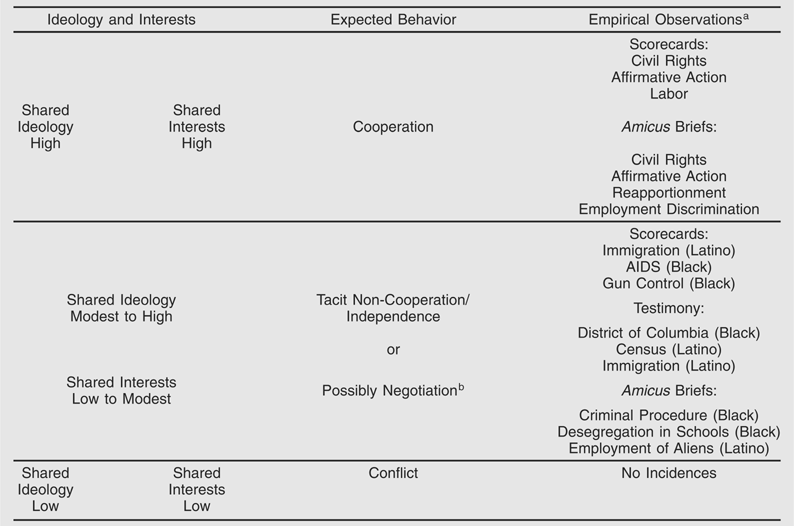
The analyses of both scorecards and amicus filings revealed that independence versus cooperation varies by issue as well as by institution. Table 6 summarizes the findings with respect to our expectations, given the degree to which these groups share ideologies and interests to more or less degrees. Broad Civil Rights issues, Affirmative Action, Labor, Reapportionment, and Employment Discrimination are issues that reflect both a shared ideological orientation to equality (political or economic), and shared benefits or interests across racial/ethnic groups. In short, this nexus of shared ideology and interests is where we would expect cooperation to emerge. In other issue areas, where ideology or interests diverge, tacit non-cooperation or independence in advocacy activities is expected, and, to a lesser degree, negotiation. Table 6 highlights some of the most prominent issue areas where there was little or no overlap in policy salience. For Latino groups, tacit non-cooperation was observed for issues of immigration (including employment of aliens) and the Census. Given the potential for immigration to conflict with Black groups' interests, particularly the interests of poorer low-skilled workers, lack of conflict on this topic is striking unless an underlying shared ideology motivates non-cooperation.Footnote 25 For Black groups, independence emerges around AIDS, Gun Control, Desegregation in Schools, and testimony on the District of Columbia. While some of these policies have clear implications for the African American community (District of Columbia), others might be considered to be within the realm of concerns for Latinos as well. Here, we may see divergent priorities driving tacit non-cooperation. The most striking finding, as mentioned earlier, is that there were simply no incidences of complete conflict observed in the data on scorecards and amicus filings, even when there is potential conflict of interests (e.g., immigration). Rather than the cooperation versus conflict dichotomy, we find examples of only tacit non-cooperation and cooperation. In short, we show that while it seems that conflict is rather limited, if not non-existent, saliency and congruence are in part determined by the particular interests of the groups' constituencies.
Summary of empirical findings with respect to the analytical framework
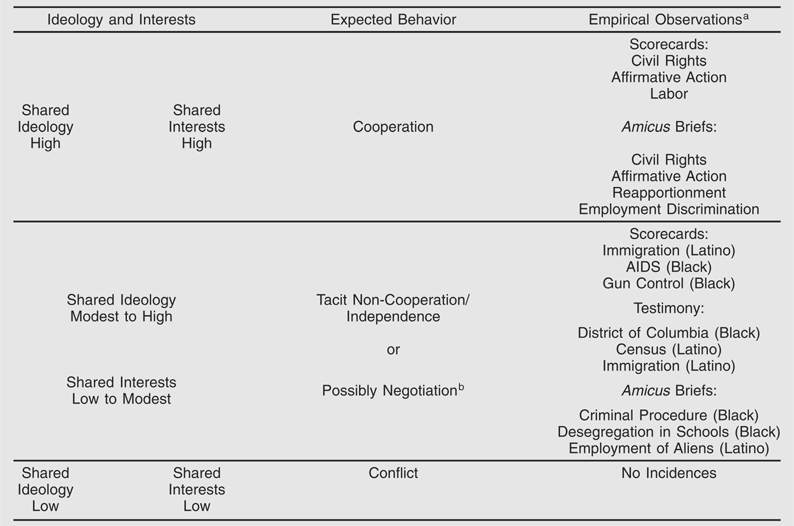
a Observations from the Congressional Testimony data are provided only for the non-cooperation examples to highlight specific issues that are unique to each type of advocacy group. Congruence or conflict could not be determined for these data.
b It is possible for negotiation and tacit non-cooperation to lead to the same empirical observations, and thus we include both behaviors and observations in the same cells. We expect that this is not the case, as discussed in the text of the paper.
Are major alternative explanations consistent with these patterns? Several theories of minority group activity suggest that groups might cooperate or act similarly based entirely on their ideological orientation toward civil rights and their constituencies' general experience with discrimination. In some respects, our evidence suggests that this is the case, albeit limited to civil rights policy generally and affirmative action and discrimination specifically. In addition, the lack of evidence of outward conflict in the identification of key Congressional votes and Supreme Court briefs suggests that there is at least a level of reluctance to publicly, and officially in terms of the groups' positions, take an adversarial stance against other minority groups. Yet, the variation in the amount of cooperative behavior across issues and sub-issues implies that there is not universal cooperation such that groups expend resources on issues that are not predominant concerns to them simply for the sake of maintaining a unified pan-racial/ethnic coalition. Given different priorities and resource constraints, it may be understood that by not directly opposing each other, there is some degree of intentional cooperation underlying the extensive degree of tacit non-cooperation found. However, the evidence of fairly obvious interest-based advocacy suggests that if this is the case, it is rare. In short, while the motivations for cooperation and tacit non-cooperation may still vary, the lack of conflict suggests that some degree of cooperation may exist even when issue positions potentially diverge. Contrary to what are common findings of group conflict in other studies of Black/Latino relations and at different levels of interaction, we do not find direct overt conflict.Footnote 26 This lack of conflict and to a lesser degree, the extent of non-cooperation found in our analyses are intriguing “non-relations” seldom studied and not well understood in the existing literature.
A further question that remains is how groups come to non-cooperative strategies and the factors that foster cooperative strategies. This may be explained in part by more conventional interest group theories based on the rational use of scare resources. Cooperation occurs where interests overlap. Where interests do not overlap, then groups lacking an interest or stake in the policy do not participate; that this interest divergence has not been manifested in conflict between the national advocacy groups is telling. Thus, minority advocacy groups may not engage in universal cooperation at the national level because they do not universally share the same constituencies, and subsequently diverge in terms of salient interests. The counterpoint to this interpretation is that if groups do generally follow their interests, then why are there no instances of conflict? It seems highly unlikely that two sets of groups would never encounter a case in which their interests diverge. Again, more complete information on congressional testimony will facilitate a broader understanding of the lack of conflict. But even as it stands, the absence of conflict in the legal arena and in key Congressional votes is striking and departs to some extent from the expectations of conventional interest group theory.
Does niche theory explain these findings? It is hard to tell. If a niche forms around a particular minority group, then again one might expect some conflict between advocacy groups that represent different niches. If a niche is defined more along policy issues, such as civil rights, it is improbable that such a diverse set of issues would be addressed by these groups in amicus filings, Congressional votes, and Congressional testimony that lie outside of civil rights; and that the amount of cooperation or non-cooperation between groups would vary to such an extent across issues. In short, if niche theory does speak to racial/ethnic minority group activities, it suggests only that a few groups will emerge that represent particular minority groups, but it does not seem to offer much leverage in terms of the evidence presented here.
Ultimately, we found instances of inter-group cooperation and tacit non-cooperation, but no instances of conflict. Tacit non-cooperation occurs where ideological orientations do not diverge, while cooperation occurs when interests and ideology both converge. It is the lack of conflict that is perplexing, and suggests some important questions for future research. Are there underlying strategic considerations that explain the variation in cooperative behavior? Do advocacy groups that represent racial/ethnic minorities intentionally avoid conflict? If so, is this behavior due to the sharing of an underlying ideological orientation or a more strategic motivation aimed at maintaining the possibility of future cooperative activities, or both? Or, are these behaviors based on a broader set of policy types (i.e., redistributive versus distributive) and underlying motivations (ideology and interests)?
A final point should be noted. The absence of conflict between the groups that we found may also be partly explained by a structural feature of the American political system. That is, federalism plays a major role in affecting what issues are addressed and to a degree how they are framed in different governmental institutions. In short, the scope of the policies addressed affects the type of interaction in which groups engage. Our study has focused on the national-level policy process, although some examples of local issues emerging in national institutions such as specific cases addressed in Supreme Court briefs, do reflect local policy concerns. There is reason to expect that when issues such as civil rights, racial/ethnic equality, and the like are considered, and, further, are considered in this larger arena, the broader “scope of conflict” lends itself to more abstract, detached, and universal, purposive ideas and attendant political processes, which in turn tempers political competition.Footnote 27 A related consequence is that the national minority advocacy groups may thus be freer and more readily positioned to address issues in a way that moderates differences, that provide more opportunities to engage in tacit non-cooperative behavior, and the outcomes we described above support this perspective. On the other hand, in urban contexts the situation is different in that issues of equality have a more directly material, proximate, intense, “concrete” (in both a figurative and literal sense), even zero-sum character; there, conflict is more likely. And while our evidence cannot directly say much about the presence or absence of antagonistic attitudes and priorities among Blacks and Latinos at the mass level, we suspect that factors broadly similar to those that differentiate national from urban politics—i.e., the interplay and immediacy of “ideas” and “interests,” of purposive versus material concerns, as shaped by the scope of conflict and the types of policy issues—are relevant to these phenomena as well.Footnote 28
On the whole, the dynamics of ideology and interests, the insights of incentive and niche theories as explanations of group behavior within the broader context of the scope of politics help us understand the interrelations of minority advocacy groups and the varied and complex nature of those relations. Our findings point to a future research agenda that will need to further engage the impacts of demographics creating an increasingly racially and ethnically diverse society, as those are channeled through various institutions across and within arenas of the political system, and an array of possible implications for American democracy that follows.