Latin America has recently witnessed a proliferation of regional cooperation initiatives. The creation of the Bolivarian Alliance for the Peoples of Our America (ALBA, 2004), the Union of South American Nations (UNASUR, 2008), the Community of Latin American and Caribbean States (CELAC, 2011), and the Pacific Alliance (2011) have added to the proverbial “alphabet soup” of existing schemes (Fawcett Reference Fawcett2005, 39). They have also provoked debate about the effects of overlapping memberships and mandates (Malamud and Gardini Reference Malamud and Gardini2012; Weiffen et al. Reference Weiffen, Wehner and Nolte2013; Nolte Reference Nolte2014; Gómez-Mera Reference Gómez-Mera2015).
There is broad agreement among scholars that Latin American regionalism has entered a new phase. Interpretations of the development, however, are sharply divided (Legler Reference Legler2013; Carranza Reference Carranza2014). For some scholars, the layering of weak institutions has rendered regional cooperation increasingly dysfunctional. As Malamud and Gardini maintain, “the presence of segmented and overlapping regionalist projects is not a manifestation of successful integration but, on the contrary, signals the exhaustion of its potential” (2012, 117). Because the agenda is dominated by chief executives unwilling to pool sovereignty, regional initiatives remain volatile and shallow (see Malamud Reference Malamud2003).
For other observers, it marks the onset of “defensive” (Tussie Reference Tussie2009), “postliberal” (Sanahuja Reference Sanahuja2012), or “posthegemonic” regionalism (Riggirozzi and Tussie Reference Riggirozzi, Tussie, Riggirozzi and Tussie2012b), characterized by a “repolitization” of regional cooperation and a shift from economic and security concerns to the provision of public goods, such as infrastructure and health (Dabène Reference Dabène, Riggirozzi and Tussie2012a; Riggirozzi and Tussie Reference Riggirozzi, Tussie, Riggirozzi and Tussie2012b; Riggirozzi and Grugel Reference Riggirozzi and Grugel2015; Bianculli Reference Bianculli2016, 158–59, 164–65). Importantly, this has resulted in increased civil society participation (Riggirozzi and Tussie Reference Riggirozzi, Tussie, Riggirozzi and Tussie2012b, 3).
Thus far, the literature has primarily focused on the effects of the “new wave.” Despite disagreement about its implications, both “skeptics” and “optimists” seem to agree on the causes of this shift (Legler Reference Legler2013, 327). One alleged cause is the “pink tide,” the rise of numerous left-leaning progressive governments in the late 1990s and early 2000s. These governments prioritized the expansion of social spending instead of the free market policies and austerity measures of the Washington Consensus. In addition, these governments, most notably that of Hugo Chávez in Venezuela, often took a critical if not openly hostile stance toward the United States. The exclusion of the United States enabled the transformation of regional cooperation from a concern with security and free trade to a much wider project (Riggirozzi and Tussie Reference Riggirozzi, Tussie, Riggirozzi and Tussie2012b, 10; Riggirozzi and Tussie Reference Riggirozzi and Tussie2017, 21; Bianculli Reference Bianculli2016, 165–66).
This article challenges both causal claims by situating the new wave in a longer historical context. First, it argues that the “new” agenda of posthegemonic regionalism is, in fact, much older. We explain that regionalism in Latin America has long been intertwined with the issue of state capacity, defined as the ability of states to intervene in societies. We share the common understanding of state capacity as “infrastructural power” by means of a consolidated bureaucracy capable of effectively providing public goods (Mann Reference Mann1984, 189; see also Soifer and vom Hau Reference Soifer and vom Hau2008, 220; Altman and Luna Reference Altman and Luna2012; Kurtz Reference Kurtz2013, 9–11). However, we also emphasize a second component; namely, the importance of consensus. The development of capacity in a particular area rests on a domestic consensus about the role of the state (Loveman Reference Loveman2005; Vom Hau Reference Vom Hau2012, 14–16).
Regionalism reinforces the legitimacy of states in two ways. By acknowledging and being acknowledged by their peers, states can use regional cooperation initiatives to bolster their right to rule. In this sense, regionalism can be instrumental for opposing foreign interference and gaining access to external support and markets. Regionalism can also have an important domestic function as a tool for legitimizing state activities in specific domains. This article shows that regionalism has been important not only for accruing international legitimacy but also for bolstering the domestic agendas of Latin American governments.
Concerns over legitimacy and state consolidation were central to early regionalist initiatives following independence in the nineteenth century. They were also crucial to the Pan-American movement. Pan-Americanism has often been treated as a mere political instrument of the United States, but more recent scholarship on interamerican relations demonstrates that Pan-Americanism also provided a venue to negotiate and balance U.S. hegemonic aspirations (see Darnton Reference Darnton2013; Friedman and Long Reference Friedman and Long2015; Scarfi Reference Scarfi2016). We show that it also entailed a “social” component—addressing public health, education, and labor, among other issues—as early as the 1900s. Importantly, civil society actor participation was central to expanding the Pan-American agenda. The “social agenda” of the interamerican system faded into the background only with the “securitization” of that system during the Cold War.
The second feature of the historical context is that while the exclusion of the United States has shaped the newest wave of regionalism, it was not necessary for a shift in the regional agenda. A review of the history of regionalism will demonstrate that questions of state capacity were addressed regionally in a “hegemonic” context, especially during times of progressive ideological consensus, as in the aftermath of the Great Depression and after the Cold War. Furthermore, we maintain that the reluctance of states to pool sovereignty does not render regional cooperation ineffective. Latin American governments have used regionalism to boost their domestic agendas even without creating institutions capable of providing public goods at the regional level. Thus, skeptics’ focus on lax implementation overlooks the fact that regionalism can provide legitimacy to political projects at home.
The key, then, is not implementation or strong institutions, but setting the regional agenda. We argue that this process has been based on a minimum consensus about the role of the state in society. Shifts in cooperation reflect a different understanding of this relationship. In this sense, our discussion adds an international, regional dimension to debates on state capacity in Latin America, which tend to emphasize either domestic processes (Kurtz Reference Kurtz2013; Soifer Reference Soifer2015) or international conflict (Centeno Reference Centeno2002; Thies Reference Thies2005).Footnote 1
This article demonstrates the argument as follows. The next section reviews existing explanations of successive “waves” of regionalism in the Americas and develops the theoretical argument of the study. The discussion then focuses on the emergence of regional initiatives in the nineteenth century and how these dealt with problems of legitimacy and state capacity. The following section explains how the “social question” came to be addressed within the framework of Pan-Americanism and demonstrates that the social agenda, including the participation of civil society organizations, dates back more than a century. The “hard case” of hemispheric cooperation after World War II shows that even with the “securitization” of the regional agenda during the Cold War, interstate cooperation served as an instrument of legitimization. The final section discusses the implications of the findings for the study of regionalism.
Explaining the Changing Agenda for Regional Cooperation
Regionalism is an elusive concept. For Hurrell, it can take many forms, ranging from societal processes that transcend the state to state-led integration that may eventually coalesce into supranational organizations (Hurrell Reference Hurrell1995, 39; Hettne Reference Hettne2005). This study applies a narrower conception, defining regionalism as cooperation for the realization of common political or economic aims among states in a given geographic area (Payne and Gamble Reference Payne and Gamble1996, 2).
Regionalism can lead to the creation of regional institutions. It may also lead to regional integration—the reduction of barriers to movement of trade, capital, and people; the European Union is the most advanced example. But not all cooperation schemes necessarily follow the European model; the content and form of regional cooperation depend on the objectives and policy preferences of the actors who drive the process.
In the Americas, governments that dominate interstate cooperation have historically been reluctant to delegate authority and pool sovereignty at the regional level (Malamud Reference Malamud2003, 67; Abbott Reference Abbott2007; Domínguez Reference Domínguez2007, 94–97; Rivarola Puntigliano and Briceño-Ruiz Reference Rivarola Puntigliano and Briceño-Ruiz2013). We propose that these governments have used regionalism to bolster their agendas for domestic reform rather than to create institutions to provide public goods at the regional level.
Existing accounts identify a series of waves—periods in which states create or redefine institutions according to shared ideas—that have defined the agenda for regional cooperation (Rosenthal Reference Rosenthal1991; Dabène Reference Dabène2012b; Malamud and Gardini Reference Malamud and Gardini2012, 118–21; Saltalamacchia Ziccardi Reference Saltalamacchia Ziccardi2014; Bianculli Reference Bianculli2016). Dabène (Reference Dabène2012b) observes three features that determine a wave’s nature and duration. Each wave is path-dependent, in the sense that it builds on and is constrained by previous waves. Waves are characterized by the diffusion of ideas, resulting in broad consensus among a group of states and shaping their interests. Waves also are influenced by external actors who advocate specific models of cooperation and provide incentives.
Despite disagreement about the number and timing of these waves (De Lombaerde Reference De Lombaerde2016), most scholars accept that the first one began in the early 1950s and lasted until the late 1960s. During that period, Latin American states pursued developmentalist policies through import substitution industrialization. The turbulent international economic environment and domestic political disruptions in the 1970s complicated integration schemes, leading to more flexible arrangements, such as the Latin American Integration Association (LAIA) (Dabène Reference Dabène2012b, 4).
Following the debt crises of the 1980s, another wave took place under the Washington Consensus that saw the promotion of free trade and a sharp decline in state interference in economic and social affairs. For some researchers, this shift marks a critical separation between the “old regionalism” and a “new” version that was deliberately “open” and nonexclusive (see Phillips Reference Phillips2003; Bianculli Reference Bianculli2016, 156–58). MERCOSUR was launched in this context. Meanwhile, the United States promoted a neoliberal agenda, establishing the North American Free Trade Agreement (NAFTA) in 1994 and pushing negotiations for a hemispherewide Free Trade Area of the Americas (FTAA) (Carranza Reference Carranza2003, 77; Gómez-Mera Reference Gómez-Mera2013, 25–26). Economic crises in the late 1990s and early 2000s led to strident domestic opposition to these plans, exhausting neoliberalism and “repoliticizing” regional cooperation in the process (Dabène Reference Dabène, Riggirozzi and Tussie2012a).
The new wave has been characterized in multiple ways: “defensive” (Tussie Reference Tussie2009), “postliberal” (Sanahuja Reference Sanahuja2012), or “posthegemonic” (Riggirozzi and Tussie Reference Riggirozzi and Tussie2012a). Dabène (Reference Dabène2012b, 23) cites the 2003 relaunch of MERCOSUR as a “paradigm shift” away from a focus on trade and toward social welfare and civil society participation (see also Briceño-Ruiz and Morales Reference Briceño-Ruiz and Morales2017, 6). Furthering this trend, Venezuela launched ALBA in 2004, and governments throughout South America rejected the original proposal for a “South American NAFTA” in favor of UNASUR’s wider policy focus (Briceño-Ruiz Reference Briceño-Ruiz2010; Briceño-Ruiz and Hoffmann Reference Briceño-Ruiz and Hoffmann2015; Riggirozzi and Grugel Reference Riggirozzi and Grugel2015). Another development indicating a paradigm shift is the establishment of sectoral committees, such as the South American Heath Council (CSS, for its Spanish acronym) and the South American Council of Infrastructure and Planning (COSIPLAN) (Palestini and Agostinis Reference Palestini and Agostinis2015).
One key feature of this “postliberal” moment has been, according to Sanahuja (Reference Sanahuja2012, 7), the “return of the State to politics, particularly in foreign relations and economic and social development,” which contrasts with both “old” and “new regionalism.” Riggirozzi and Tussie (Reference Riggirozzi, Tussie, Riggirozzi and Tussie2012b, 12), in turn, emphasize the emergence of a new mode of governance: “regional structures characterized by hybrid practices as a result of a partial displacement of dominant forms of U.S.-led neoliberal governance.” As a consequence of this shift, “agenda-setting capacities have been set free” (Riggirozzi and Tussie Reference Riggirozzi, Tussie, Riggirozzi and Tussie2012b, 10; see also Riggirozzi and Tussie Reference Riggirozzi and Tussie2017, 21).
In line with Dabène (Reference Dabène2012b), most authors agree that an important “external” factor shaped this new wave. For Sanahuja, Washington’s neglect of the region after 2001, together with the continuation of its neoliberal policies, “created both the necessary conditions and incentives to encourage the search for greater autonomy, specifically for South American countries with progressive governments” (2012, 6). Similarly, Riggirozzi and Tussie (Reference Riggirozzi, Tussie, Riggirozzi and Tussie2012b, 6) point to the destabilization of U.S. hegemony as a precondition for regionalism’s widening agenda. In this sense, posthegemonic means “[not] U.S. and market-led” (Riggirozzi and Tussie Reference Riggirozzi, Tussie, Riggirozzi and Tussie2012b, 6). It does not, however, mean the absence of legitimate leadership. The initial impetus for ALBA came from Venezuela with explicitly anti-U.S. rhetoric. Similarly, Brazil promoted UNASUR as part of its global leadership ambitions.
Equally important is the apparent ideological consensus of the so-called pink tide (see Levitsky and Roberts Reference Levitsky and Roberts2011). Starting with Hugo Chávez’s election in 1998, left-leaning progressive governments that rejected neoliberalism and U.S. involvement in Latin American affairs came to power. According to the proponents of posthegemonic regionalism, these governments used existing and new institutions to expand the provision of public goods on a regional scale. They also channeled the demands of social movements, establishing a regional social space that empowered these groups (Riggirozzi Reference Riggirozzi2014; Riggirozzi and Grugel Reference Riggirozzi and Grugel2015; Bianculli and Ribeiro Hoffmann Reference Bianculli2016). With the creation of the Pacific Alliance in 2011 and the ebb of the “pink tide,” this literature has shifted focus to the more heterodox nature of regionalism and the absence of a “hegemonic model” of cooperation (Briceño-Ruiz and Hoffmann Reference Briceño-Ruiz and Hoffmann2015, 49; Riggirozzi and Tussie Reference Riggirozzi and Tussie2017).
Critics of the posthegemonic perspective do not dispute the existence of a new wave. Instead, they are skeptical about the utility of layering new institutions on top of old ones (Weiffen et al. Reference Weiffen, Wehner and Nolte2013; Gómez-Mera Reference Gómez-Mera2015; for a discussion, see Nolte Reference Nolte2014). According to Malamud and Gardini (Reference Malamud and Gardini2012, 125), “regionalism in Latin America has reached a peak beyond which it will be unable to progress.” For Malamud (Reference Malamud2003, 66), “interpresidentialism,” an “extreme type” of intergovernmentalism, characterizes Latin American regionalism. Because Latin American states jealously guard their sovereign prerogatives, and because Latin American constitutions give presidents sweeping powers to dominate the foreign policy agenda, regional cooperation schemes tend to be volatile (Malamud and Gardini Reference Malamud and Gardini2012, 124).
This implies that civil society actors do not shape the regional agenda independently of the interests of governments. Instead, state officials “capture” civil society demands and formulate policies from the “top down” (Serbin Reference Serbin, Riggirozzi and Tussie2012, 147). The result is an increasingly fragmented and shallow regionalism as states participate in different arrangements with overlapping, if not competing aims. An “implementation gap” between the stated aims of cooperation and the actual results is proof of its ineffectiveness (Malamud and Gardini Reference Malamud and Gardini2012, 129; see also Abbott Reference Abbott2007; Domínguez Reference Domínguez2007, 94–97; Arnold Reference Arnold2016).
Everything Old Is New Again?
Latin America’s regionalism does emphasize intergovernmentalism, and its regional institutions do lack the capacity to provide public goods, yet these characteristics do not render it ineffectual. Malamud’s argument derives from MERCOSUR’s failure to live up to its original aim of emulating the European Common Market. We argue, however, that the focus on implementation overlooks the way that regional schemes can serve other purposes. In particular, they can help to legitimize domestic policy agendas, a point that becomes clearer with a broader historical perspective.
The literature discussed above generally uses historical precedent to highlight the “newness” of the most recent wave. Authors tend to contrast “old” forms of economic regionalism with the widened agenda of the newest wave. The fact that this agenda has long been diverse is rarely discussed. For instance, it is telling that longstanding institutions, such as the Pan-American Health Organization (created in 1902), are treated only in passing, while the programmatic novelty of the UNASUR sectorial councils is emphasized (e.g., Riggirozzi and Grugel Reference Riggirozzi and Grugel2015, 789). In this sense, as Rivarola Puntigliano and Briceño-Ruiz (Reference Rivarola Puntigliano and Briceño-Ruiz2013, 4) argue, the current literature is ahistorical and suffers from a “presentist bias” without due regard for the causes of past waves.
This bias is accentuated because regional cooperation of the early twentieth century happened largely within a Pan-American framework and the interamerican system, which is seen as distinct from the regional dynamics among Latin American states (but see Herz Reference Herz2011; Weiffen et al. Reference Weiffen, Wehner and Nolte2013). Furthermore, focusing on the post-1945 period has led to a narrow understanding of the agenda of interamerican cooperation. Instead of exclusively addressing security cooperation and U.S. economic interests, Pan-Americanism was also a form of regional cooperation in which Latin American governments could further their domestic interests.
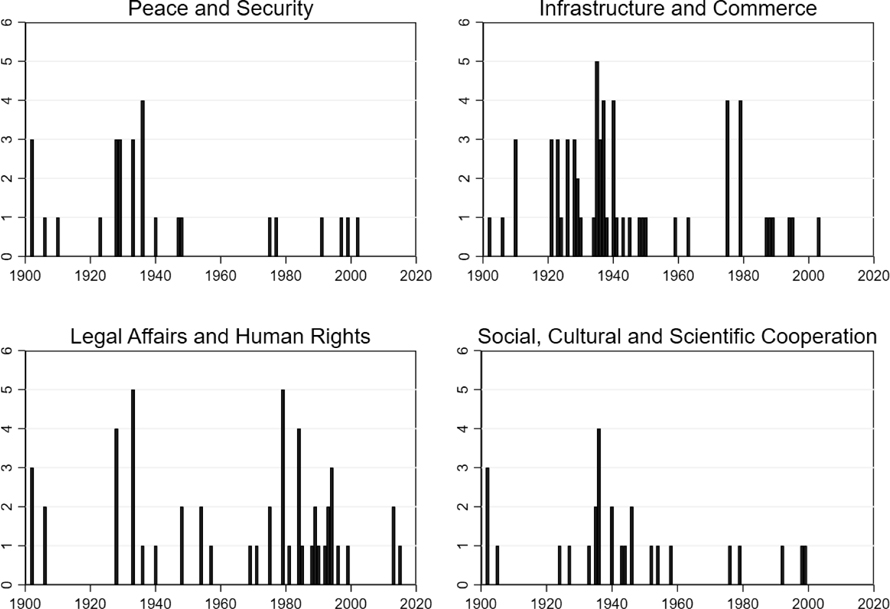
A look at the various treaties signed since 1902 confirms the diversity of regional cooperation, even under the interamerican system. Figure 1 shows the evolution of the interamerican treaty system from 1902 to 2015 and classifies 167 (out of a total of 174) agreements concluded in that time into four broad subject areas.Footnote 2
Distribution of Interamerican Treaties Since 1900

While the signing of a treaty is no guarantee that it will be implemented, it is a strong indicator of successful agenda setting.Footnote 3 As figure 1 shows, the first category, peace and security—typically considered the backbone of the interamerican system—did not monopolize the agenda. Cooperation on economic development (captured by the second category, infrastructure and commerce), legal matters, and—important for the purposes of our argument—social, cultural, and scientific issues also features prominently.
Of course, many treaties cut across issue areas, which makes them difficult to classify. For instance, while the purpose of the “technical” agreements on infrastructure and communication of the 1930s was primarily commercial, these treaties nonetheless strengthened the role of the state in the provision of public goods. Noteworthy is the relative absence of treaties on infrastructure and commerce during much of the Cold War. This decline is due partly to the securitization of interamerican cooperation and partly to the fact the Latin American states (unsuccessfully) pursued economic integration through alternative schemes. It should also be noted that legal cooperation, including human rights, has been a particularly active field.Footnote 4
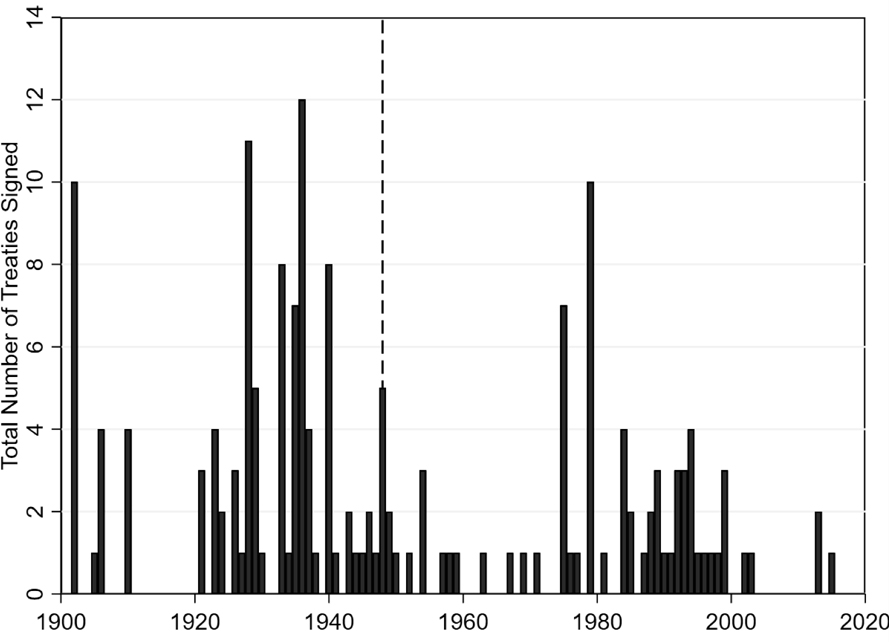
Mapping all 174 interamerican agreements, figure 2 illustrates a broad longitudinal pattern, as treaties tend to cluster in the first decade, again during the 1920s and 1930s, and then again in the late 1970s, with a final, smaller, but sustained cluster throughout the 1990s. The vertical line indicates the creation of the Organization of American States (OAS) in 1948. The activism during the 1990s is well understood and generally attributed to the “hemispheric consensus among elites surrounding liberal political and economic ideas” (Legler Reference Legler2014, 319). Less understood are previous periods of agenda setting, although a similar explanation may apply, especially during the height of the “social question” discussed below.
Evolution of the Inter-American Treaty System

The signing of treaties says little about the relative importance of individual agreements. Some were clearly more consequential than others; compare, for example, the Rio Pact (1947) on collective security and the Inter-American Amateur Radio Service Convention (1987). Yet this dataset emphasizes that regional cooperation has long had a more diverse agenda than the recent literature on “posthegemonic” regionalism suggests.
Legitimizing Domestic Reform
The data clearly show shifts in the regional agenda, and this demands explanation. Unlike European integration, in which intergovernmental negotiations, in combination with strong institutions, drive the regional agenda, Latin American governments have been reluctant to cede control. Despite a long history of attempted cooperation and a recurring rhetoric of regional unity that led to the creation of common institutions, governments have avoided pooling sovereignty in them. The interamerican system, for example, reflects what Abbott (Reference Abbott2007, 243) calls a “goldilocks design,” whereby Latin American states sought to bind the United States while maintaining their own freedom of action. Skeptics point to the absence of strong institutions with the authority to bind governments and enforce implementation as evidence of regionalism’s failure (Malamud and Gardini Reference Malamud and Gardini2012).
Yet even weak institutions can be instrumental in shaping domestic politics. International political economists have convincingly argued that international institutions can shift domestic political alliances and entrench policy preferences over the long term (Goldstein Reference Goldstein1996; Martin and Simmons Reference Martin and Simmons2012, 342–43). Thus understood, the effects of these institutions may be independent of the degree to which they pool sovereignty and enforce implementation. Scholars have also shown that regional institutions can play an important role in providing legitimacy, as they, for example, have contributed to the consolidation of democracy (Kelley Reference Kelley2009, 59; Gardini Reference Gardini2010). Pevehouse (Reference Pevehouse2003, 613, 623) maintains that intergovernmental institutions can serve as credible signals of commitment to domestic reform. On the other side of the coin, Söderbaum (Reference Söderbaum2004, 96–103) argues that regionalism—in his case, in South Africa—serves to protect neopatrimonial regimes from change by performing a legitimizing function. The goal of international summits and treaties in South Africa is not implementation but “regime boosting.”Footnote 5 Furthermore, as Dabène (Reference Dabène2009, 109) notes, there may be “symbolic incentives” to raise an issue at the regional level.
Cooperation is not necessarily about creating effective mechanisms for the provision of public goods at the regional level, but can be used by governments to gather information and legitimize their agendas both internationally and domestically. Since states generally have recognized authority in conducting international relations, this arena can be useful for extending authority into other administrative domains. By building regional support for their agendas, governments can bolster the legitimacy of domestic political projects.
The long history of Latin American regionalism, to which we now turn, bears this out. In nineteenth-century Latin America, regional initiatives were instrumental in consolidating new states’ right to rule. Later, in the context of Pan-Americanism, cooperation served the function of legitimizing the state’s intervention in domestic societies. The United States provided leadership in this regard, which highlights the fact that its involvement was not an impediment to an expanded agenda for regional cooperation.
State Consolidation and the Origins of Regional Cooperation
Rivarola Puntigliano and Briceño-Ruiz (Reference Rivarola Puntigliano and Briceño-Ruiz2013) argue that Latin American regionalism since independence has been motivated by a search for autonomy from external influences, economic development, and a shared sense of common cultural identity. Yet the relative salience of these broad objectives has not been constant, due in part to the practice of setting regional agendas to legitimize the state and its role in society. This practice has roots that reach far into the nineteenth century. Regional cooperation that aimed to secure independence and foreign credit for postindependence state-building projects gradually gave way to efforts to guarantee state sovereignty and strengthen the state’s role in national development.
The new states claiming sovereignty in the crumbling Spanish and Portuguese American empires faced the vexing issues of legitimacy and state capacity in the 1820s. Ongoing royalist and regionalist mobilization, tenuous state presence in frontier areas, and unsettled debates over the nature of the state challenged claims to legitimate rule. Internationally, recognition of sovereignty proved elusive, especially given Spain’s refusal to accept its colonies’ independence. Brazil, which emerged from a less protracted but still violent independence with a monarchy, also found European audiences hesitant to accept its state as a sovereign equal.
These challenges had direct implications for consolidating state capacity. In particular, they complicated negotiation of debts incurred during independence and access to additional foreign capital and credit to fund reconstruction, national consolidation, and development. Despite early loans from British investors, Latin American states remained weak, and political upheaval persisted. Economic growth recovered but remained modest (see Prados de la Escosura Reference Prados de la Escosura2009). By the end of the 1820s, most of the British loans were in default (Dawson Reference Dawson1990), and damage to the life and property of foreigners during civil conflict led to European interventions, occasionally with force. Intervention perpetuated instability and undermined Latin American states’ claims to sovereignty (Schulz Reference Schulz2014).
Searching for a solution to this vicious cycle, some governments turned to international law and regional cooperation. Latin American states could not rely on an international normative framework that protected the sovereignty of weakly consolidated states; indeed, Latin Americans had to invent and negotiate that very framework. Meanwhile, Simón Bolívar’s government in Gran Colombia called for a regional congress to meet in Panama in 1826. The congress was an opportunity to coordinate defense against the threat of Spanish reconquest and to legitimize independence. Bolívar’s government invited several European powers to observe the discussions, which touched on security, jurisdiction, and trade regulation. The congress accomplished few tangible results, however; only a handful of states participated, and only Gran Colombia ratified the resulting treaty. Despite its sobering outcome, the congress set a precedent for regional cooperation.
Attempts at cooperation in the decades that followed also failed to produce enduring agreements, but the strategy of using regionalism to bolster the state’s legitimacy and arguments for greater capacity persisted. Chile’s government, for example, encouraged regional cooperation in trade deals and congresses. The oficio mayor of Chile’s Foreign Relations Department, Andrés Bello, believed that domestic and international order were interdependent (Fawcett Reference Fawcett2005, 32). He argued that regionalism’s aim was not to create regional institutions but to fortify national republican institutions via the diffusion of information and goods (Bello Reference Bello1997, 213–17). He hoped that cooperation might bring stability, legitimacy, and ultimately, civilization to the region and its nation-states (Obregón Reference Obregón2006).
The relationship between state consolidation and regional cooperation deepened as many Latin American states overcame the immediate postindependence instability. Although sporadic challenges to central state authority continued, states consolidated their boundaries and their ability to provide public goods. Regional cooperation reflected these changes. Concern over European and, increasingly, U.S. intervention loomed large, but was not the only issue raised at the venues. In 1856, for example, a regional congress at Santiago de Chile produced agreements to facilitate postal services and unify regulation of the “liberal professions” (doctors, lawyers, engineers, and others). Within 20 years, intergovernmental negotiations among the Platine powers established patterns of cooperation in fluvial navigation and sanitation (Chaves Reference Chaves2013; Preuss Reference Preuss2016, 99–104). By signing international agreements on river traffic, port maintenance, and other issues, national governments bolstered their authority over provincial and local governments.
These attempts ran parallel to similar initiatives in Europe that created institutions to regulate communications and navigation. Latin America closely followed European trends but remained peripheral to them (Schulz Reference Schulz2017). For example, the region’s governments were not part of the International Telegraphic Union (neither was the United States), and only Costa Rica and Ecuador attended the Paris Postal Congress of 1863. This lack of participation was partly exclusion; with few exceptions, such as the 1881 International Sanitary Conference in Washington, Latin American governments were not invited (Howard-Jones Reference Howard-Jones1978, 43).
Yet Latin American governments also hesitated to join incipient efforts at “global governance.” Their own regional and subregional cooperation provided opportunities not only to pursue geopolitical objectives but also to demonstrate the state’s role in providing public goods and regulating society through private international law (e.g., the Montevideo Congress of 1888). Unlike European efforts, these regional initiatives minimized the pooling of hard-earned sovereignty. International agreements had symbolic value but often required little commitment, especially if, as in most cases, national legislative bodies failed to ratify them. Institutionalization of regionalism came later, with the intervention of civil society internationalism and the United States.
Pan-Americanism and the “Social Question”
When Washington launched a project of hemispheric cooperation in the 1880s under the label Pan-Americanism, it entered an arena already populated by multiple overlapping regionalisms. In the next 50 years, however, Pan-Americanism came to dominate that arena. The rise of U.S. hegemony in the Western Hemisphere and the desire of Latin American governments to negotiate that hegemony by keeping Washington engaged in cooperation partly explains this change. Yet Pan-Americanism also provided a framework in which Latin American governments continued established patterns of regional cooperation. Ruling elites—in and out of government—used “technical” hemispheric cooperation to legitimize the state’s role in addressing civil society’s anxiety over a wide range of social issues. Convergence over that role helps to explain the interwar surge in shallow institutions and treaties, as illustrated in figure 1.
From its beginning in the early 1880s, Pan-Americanism was closely linked to U.S. hegemonic designs in the hemisphere, the “friendly face of U.S. imperialism” (Sheinin Reference Sheinin2000, 1). While the “hegemonic presumption” (Lowenthal Reference Lowenthal1976) of the United States was crucial, it was not the only defining feature of Pan-American cooperation. As more recent historiographical work demonstrates, Pan-American cooperation became increasingly multidimensional (Sheinin Reference Sheinin2000; Petersen Reference Petersen2016).
Originally, Pan-Americanism involved a hemispheric customs union and a regional commitment to arbitration of interstate disputes. These goals, which dominated the agenda at the First International Conference of American States (hereafter Inter-American Conference) in Washington (1889–90), met with mixed reaction from Latin America. Latin American governments generally chafed at the idea of impeding European trade—important to the success of the export-led growth model that dominated the region—and split in their positions toward arbitration.Footnote 6 Moreover, many Latin American policymakers recognized the U.S. hegemonic intentions. Despite their reservations, however, almost all Latin American governments agreed to participate.
Like other nineteenth-century efforts at cooperation in the Americas, the conference in Washington produced few enduring results. Though no treaties were signed, the delegates discussed several resolutions, agreed to convene a conference on monetary policy in 1891, and established the Commercial Bureau of American Republics, initially envisaged as an information clearing house run by the United States. In the decade that followed, Pan-Americanism faltered while regional cooperation continued in other forms, including a series of scientific congresses launched by the Argentine Scientific Society in 1898 and sponsored by the Argentine government. The scientific congresses, which gradually gained a more official diplomatic character in the 1900s, succeeded in part because they became sites for discussion of ongoing changes in Latin American societies (Fernos Reference Fernos2003).
Pan-Americanism revived at the turn of the twentieth century, partly through the persistence of an increasingly interventionist U.S. government, and most Latin American governments eventually accepted it as a legitimate form of intergovernmental cooperation. In 1910, the establishment of the Pan American Union (PAU) strengthened Pan-Americanism’s place within the sphere of regional cooperation. Located in Washington and managed by a director with ties to the State Department, the PAU’s structure was nonetheless more multilateral than the Commercial Bureau’s. Latin American governments saw benefits in this development but remained wary of strong institutions. They celebrated Pan-Americanism and the PAU in public statements, yet frequently failed to implement agreements and lapsed in paying their required PAU dues. As Chilean diplomat Darío Ovalle remarked in a confidential note in 1915, the PAU was perceived as important by many South Americans but was “simply decorative” (cited in Petersen Reference Petersen2016, 120). Pan-American cooperation, in sum, provided “symbolic incentives.”
Latin American governments participated in Pan-Americanism for a number of reasons. One was to manage or even compete with U.S. hegemony (Sheinin Reference Sheinin1998; Petersen Reference Petersen2016). Another was the flexibility of its agenda. The Inter-American Conferences between 1901 and 1948 discussed a wide variety of domestic issues. In addition, smaller-scale technical conferences became a regular facet of Pan-American cooperation. Meetings to discuss sanitation and coordinate the prevention of epidemics were among the earliest and most frequent, leading to ten sanitary congresses between 1902 and 1938. Conferences convened to discuss other topics related to regulation and public goods: public health services, civil aviation, banking practices, telecommunications, and infrastructure. By the 1930s, the “different faces” of Pan-Americanism, as an Argentine diplomat called it (Saavedra Lamas Reference Saavedra Lamas1934, 25), included a diverse social, political, and economic agenda, leading to a growing number of international agreements.
An expanded agenda was not solely the work of government actors. Civil society groups also found in Pan-American cooperation a framework for pursuing their own agendas. Women’s rights activists in several Latin American countries worked with counterparts in the United States to organize conferences on children’s and women’s issues, starting in the 1910s (Miller Reference Miller1986; Guy Reference Guy1998; Pernet Reference Pernet2000; Threlkeld Reference Threlkeld2014). Amateur aviators in the Southern Cone hosted Pan-American aviation conventions (Newton Reference Newton1978). The Uruguayan Society of Architects launched a series of Pan-American architecture congresses in 1920 to discuss city planning and urban development (Gutiérrez et al. Reference Gutiérrez, Tartarini and Stagno2007). Meetings such as these were not examples of “top-down” planning and existed largely outside of the PAU’s institutional orbit. Nevertheless, these civil society actors drew heavily on the support of national governments and state institutions.
For Latin American politicians and bureaucrats, these initiatives offered an opportunity to address the “social question,” a set of social, economic, and political challenges that arose from industrialization and rapid urbanization. Central to this question was anxiety over organized labor—a small but significant sector in various Latin American countries (Bergquist Reference Bergquist1986). Many politicians and diplomats in the region feared the potential radicalization of the working classes as a threat to entrenched political and economic interests.
The social question forced the renegotiation of state-society relations in many Latin American countries, leading to domestic reform and the incorporation of new actors into the state (see, e.g., Collier and Collier Reference Collier and Collier1991). As governments of the 1910s and 1920s experimented with reform agendas, they faced considerable opposition. Labor groups demanded more radical change, while some conservative elites rejected the need for state action beyond military repression of labor agitation. In this context, regional cooperation represented a venue to legitimize the domestic agenda.
Indeed, cooperation became a tool for addressing social challenges and attracting legitimacy to reform programs without committing governments to one set of actions. This practice began as early as 1902. The Second Inter-American Conference (1901–2) discussed threats to social order and produced a Treaty for the Extradition of Criminals and for Protection Against Anarchism. Few states actually ratified it; those that did, all in Central America, had small (if any) organized labor movements at the time. As the social question persisted and labor militancy escalated in the 1910s, social issues gained a more prominent place on the regional agenda. Civil society groups frequently acted as catalysts: social scientists encouraged regional agreements on labor conditions; medical doctors called for hemispheric approaches to infant mortality; and architects urged governments to address the lack of affordable housing.
This pressure, combined with the emergence of new mass political movements, changed regionalism. Governments channeled civil society’s demands into the existing intergovernmental framework. At the Fifth Inter-American Conference in 1923, discussion of various social issues, including alcoholism, led to an agreement to include such questions on future conference agendas. By the 1930s, discussion of social questions had mostly shifted to technical conferences, though some issues—education, labor laws, affordable housing, and migration, for example—remained on the agenda of major summits. The practice of creating “social space” for civil society actors and channeling civil society demands into the regional arena, seen in more recent iterations of regionalism, thus has a precedent in this earlier period.
By allowing reformers in Latin America’s governing elite to search for models for state intervention in society while also enhancing their legitimacy with domestic and international audiences, Pan-American cooperation was parallel to transatlantic discussions on progressivism (Rodgers Reference Rodgers1998). Like those debates, Pan-American cooperation occasionally had a direct impact on social legislation: a Pan-American Sanitary Code (1924), for example, helped to shape emerging public health structures in a number of countries (Birn Reference Birn2006; Cueto Reference Cueto2006, 50–52). Discussion of children’s issues led to increased child welfare provisions in 1919 (Guy Reference Guy1998, 277). Interamerican partnerships between state and nonstate actors, such as the Rockefeller Foundation, provided knowledge and funds to enhance state presence in rural Latin America and state capacity to confront public health and infrastructural challenges (Cueto Reference Cueto1995). In general, however, most discussions of social issues resulted in nonbinding resolutions and recommendations rather than in structures of regional governance. Latin American governments preferred to protect their freedom of action on internal affairs.
Initiatives in this period set enduring patterns of regional cooperation, including institutionalization. Besides the PAU, which eventually added divisions for education and social issues, other significant institutions included the Pan American Sanitary Bureau (PASB; after 1958, the Pan American Health Organization); the International High Commission, an institution that coordinated monetary and finance policy reform; the Inter-American Commission of Women (ICW); the Pan American Institute of Geography and History; and the Inter-American Commission on Commercial Aviation. These institutions facilitated regional discussion and helped develop relationships with broader international efforts dedicated to similar topics, particularly through the League of Nations. Ultimately, they provided a foundation for continuity in hemispheric cooperation; indeed, many remain in operation today.
Pan-American institutions were shallow, generally restricted to gathering information and offering policy suggestions. Most were based in Washington and frequently reflected U.S. hegemonic visions, especially in their leadership (Castle Reference Castle2000; Salvatore Reference Salvatore2006). They were generally small and lacked resources; the PASB, for example, had no permanent staff beyond its chairman until the 1920s (Howard-Jones Reference Howard-Jones1980, 12). In that decade, governments in the hemisphere agreed to expand institutional mandates while maintaining a fundamentally intergovernmental format. They agreed to gradually increase the PASB’s budget, expand its purview to broader public health initiatives, and enhance Latin American participation.
Latin American actors also led the effort in 1927 to establish the Inter-American Children’s Institute (IIN, for its acronym in Spanish), which remains largely under Latin American leadership. Occasional attempts to reform PAU, however, faltered. Uruguay, for example, proposed to replace it with a League of American Nations in the early 1920s. Later proposals included rotating PAU leadership and allowing the organization to pass binding decisions. These suggestions were eventually dismissed, partly because of Latin American opposition to pooling sovereignty in a politicized and empowered PAU.
Despite its weaknesses, the institutionalization of Pan-Americanism provided a means to manage the power asymmetries in the Western Hemisphere and served to strengthen the role of the state domestically. These patterns carried into the 1930s, as the financial realities of the Great Depression and pressure from Latin American states pushed the United States toward the Good Neighbor Policy. Washington formally accepted nonintervention in 1933, giving way to a period of ideological convergence, especially on the question of the state’s role in securing social welfare. Improved relations between the New Deal government in the United States and the revolutionary regime in Mexico are one example (Knight Reference Knight1987).
Convergence on issues such as the need for state regulation of labor appeared at the Seventh Inter-American Conference in 1933. Mexico, Argentina, and Chile independently submitted projects for an Inter-American Labor Office. Although the proposal failed, delegates approved recommendations for labor legislation. In 1936, the Chilean government convened a Pan-American Labor Conference with the support of the International Labor Organization. Santiago hoped to use the conference not only to discuss common problems but also to garner international praise for its existing labor legislation and to mend fences with labor organizations (Plata-Stenger Reference Plata-Stenger2015, 101; see also Ferreras Reference Ferreras2015).
The ideological consensus explains the surge in treaties of the 1930s. That said, ratification rates varied widely (see the online appendix). The lack of ratification and enforcement might suggest that much of Pan-American cooperation had little meaning. Yet that assumption simplifies the participants’ motives. As this discussion has argued, hemispheric cooperation was part of negotiating the state’s response to emerging social questions. Far from being hindered by U.S. hegemony, the Latin American states encouraged Washington’s role in building consensus and encouraging “practical” or “constructive” cooperation. Ultimately, this cooperation served broader strategic objectives in the “goldilocks design.” By keeping Washington engaged in cooperation through weak institutions, Latin American governments could pressure the United States without compromising their freedom of action. Similarly, by discussing social issues and agreeing to nonbinding resolutions, Latin American governments could address internal issues while remaining flexible. As Argentina’s delegate to the Sixth Inter-American Conference, Felipe Espil (Reference Espil1928, 86) candidly admitted, nonratification was a strategic policy choice in light of infeasible propositions.
The early twentieth-century history of regional cooperation in the Americas, then, demonstrates that social agendas and civil society participation have a long history in Latin American regional cooperation. In the past, as now, this has been facilitated by ideological convergence. Rather than being an obstacle to an expanded regionalist agenda, Washington’s leadership promoted and institutionalized these efforts. By providing a framework for internationalism and encouraging cooperation that included the United States, Pan-Americanism normalized a negotiated U.S. hegemony in the hemisphere. At the same time, regionalism helped to channel civil society demands into reform agendas that made the state an important, if not central actor, legitimizing statist responses to social issues.
The “Securitization” of Interamerican Cooperation
During World War II and the Cold War, as U.S. hegemony in the Americas consolidated, interamerican cooperation increasingly focused on security and marginalized other issues of the regional agenda. This period could, then, be a “hard case” for our arguments. As recent historical scholarship has noted, however, Latin American actors were adept at using the Cold War framework, including the interamerican system, to advance their own domestic and foreign objectives (Harmer Reference Harmer2011; Brands Reference Brands2012; Darnton Reference Darnton2013). “Securitization” altered the priorities of interamerican cooperation, but it neither eliminated the broader agenda of regionalism nor reduced the use of regionalism to legitimize domestic agendas. The postwar period produced fewer hemispheric treaties, but diversity in the agenda remained.
As World War II erupted in Europe, Washington accelerated efforts at collective security. Despite the misgivings of several Latin American governments, closer security cooperation emerged via multiple agreements in 1939 and 1940. When the United States entered the war in 1941, much of the hemisphere followed suit. Whereas major regional actors had remained neutral during World War I, all Latin American states eventually declared war on the Axis powers in World War II. Latin American governments leveraged security concerns for greater U.S. support of other objectives, including emerging state-managed development projects. Volta Redonda, the Brazilian steel mill begun in 1941 and the pride of Getúlio Vargas’s Estado Novo (1937–45), was one of the earliest and most notable results.
Several achievements after World War II consolidated collective security as a major feature in interamerican regional cooperation. In 1947, efforts at hemispheric defense under U.S. leadership culminated in the Inter-American Treaty of Reciprocal Assistance (the “Rio Pact”). A year later, the reorganization of the PAU into the OAS created a more comprehensive and multilateral institutional framework for interamerican cooperation. Many existing institutions, including the IIN and the ICW, integrated into the OAS as Specialized Organizations.
While responsive to U.S. interests and headquartered in Washington, the interamerican system also allowed Latin Americans to pursue their own agenda. They successfully pushed for an American Declaration of the Rights and Duties of Man, fortifying a normative regime of international law and social rights. This achievement was an outgrowth of Latin America’s longstanding legalist tradition and a result of new mass political movements in some countries (Sikkink Reference Sikkink2014). Given the dissonance between rights rhetoric and reality under many Latin American regimes (Engstrom Reference Engstrom2016, 214), the Inter-American Human Rights System (IAHRS) served a legitimizing role. Governments could extol the ideals of human rights and democracy in regionalism while restricting them at home. Chile offers one striking example: while, in 1948, it helped to usher in hemispheric commitments to democracy, it also outlawed the Communist Party and excluded its members from political participation. Because the IAHRS lacked mechanisms to protect against abuses by member states, it became a tool for legitimizing antidemocratic and repressive regimes throughout the Cold War (Engstrom Reference Engstrom2016).
Through the prism of Cold War logic, Washington sought to further focus the interamerican system on a security and anticommunist agenda. On the one hand, this reorientation gradually undermined the system’s credibility in the eyes of Latin American governments, leading many to seek alternatives through revived Latin Americanism or cooperation with other nations of the Global South. New regional initiatives—such as the Latin American Free Trade Association (LAFTA)—emerged, facilitated by ideological convergence on statist developmentalism (Helleiner Reference Helleiner2014). On the other hand, interamerican securitization offered an opportunity. The fear of communism helped garner hemispheric support for other statist development agendas, thereby legitimizing them to upper- and middle-class audiences in Latin America and the United States. Brazilian President Juscelino Kubitschek’s Operation Pan America, launched in 1958, best exemplified this strategy (Darnton Reference Darnton2012; Ioris Reference Ioris2014; Long Reference Long2015).
Partly because of the securitization of interamerican relations, then, development issues gained ground on the regional agenda. The Alliance for Progress, which emerged in 1961 as a U.S. policy to deal with the “root causes” of communism, confirmed this trend. The Alliance was not entirely novel. While it signaled a shift toward a focus on development financing, it also championed the idea of state provision of public goods and services, a variation of older traditions of regionalism. Despite the convergence over development as a security question, the Alliance ended in failure by the end of the 1960s, due to differing conceptions of development (Taffet Reference Taffet2007) and traditional Latin American preferences for loose international commitments.
This was not the end of the broader social and developmental agenda of interamerican cooperation, however. The PASB expanded its operations in large-scale eradication campaigns of diseases such as malaria and yaws. The PASB changed its name to the Pan-American Health Organization (PAHO) and established a working relationship with the World Health Organization. PAHO’s visible achievements made it attractive to governments seeking to legitimize their broader domestic agendas (Cueto Reference Cueto2006, 90). For its part, the United States continued to see the organization as a vehicle for U.S.-defined modernization and thus, U.S. influence.
In other cases, new institutions were created. The Inter-American Economic and Social Council (IA-ECOSOC), established in 1950, provided a significant arena for discussing social and economic development issues. In 1967, Latin American delegates to the council pushed through, over U.S. objections, an amendment to establish a Special Committee for Consultation and Negotiation (CECON). This body became a vehicle for “bloc confrontation” between Latin America and the United States (Atkins Reference Atkins1997, 256).
Interamerican cooperation on tourism, highways, communications, education, agriculture, and other issues continued through conferences and new forums, such as the Inter-American Institute for Cooperation on Agriculture, the Inter-American Telecommunications Commission, and the Inter-American Committee on Ports. As in previous periods, civil society actors participated, but intergovernmentalism remained fundamental. Many of the new institutions aimed to congregate government ministers in particular policy areas, not unlike the sectorial councils of UNASUR.
Securitization under U.S. hegemony after World War II, therefore, undoubtedly changed the interamerican system but did not render the patterns seen in the early twentieth century obsolete. Social and economic elements of the regional agenda, while marginalized, persisted. Latin American governments continued to use the regional stage and regional discourse—on rights and democracy, for example—to legitimize domestic agendas, though the focus had shifted to internal security and statist developmentalism. Regional cooperation—inside and outside the interamerican system—remained a means to negotiate the U.S. role in Latin America with minimal pooling of sovereignty.
Conclusions
The new phase of “posthegemonic” Latin American regionalism, therefore, should be situated in a longer history of regional cooperation. Unfortunately, the existing explanations for the most recent wave and the scholars who criticize its results have frequently missed important lessons from older efforts at regional cooperation. Most important, intergovernmental cooperation has long been a tool for legitimizing the state and the domestic agendas of national governments. Even in periods of aggressive U.S. hegemony, Latin American governments have set the regional agenda to advance their own aims.
Proponents of “posthegemonic” regionalism argue that the absence of the United States and the presence of left-leaning progressive governments (until recently) have opened a space for collaboration on a wider agenda and civil society participation. A closer examination of historical regionalism, however, demonstrates that the social agenda and the role of civil society is not entirely new, nor has the United States been an impediment to similar initiatives in the past. Instead of breaking with historical patterns, the “new agenda” is in line with attempts by governments to use regionalism to bolster domestic reforms. This is particularly evident in the early twentieth century, a period of heightened concern for the social question. Governments, responding to the pressure of transnational civil society initiatives, turned to regionalism to gather models and garner legitimacy for an increasingly state-centered set of solutions.
These observations help explain why Latin American governments participate in regional cooperation, even when that cooperation is ineffective in providing public goods at the regional level or when the participating governments seem unable or unwilling to implement the stated aims. In this light, the “implementation gap” identified by Malamud and Gardini (Reference Malamud and Gardini2012) and others remains a problem, but does not render cooperation ineffective.
The motives by which we can measure the effectiveness of Latin American cooperation differ from those of European integration, partly because they derive from different traditions and historical contexts. Latin American governments have long eschewed strong regional institutions and pooled sovereignty, using intergovernmental cooperation instead to build an argument for greater state capacity and to negotiate hegemonic systems. Shifts in the regional agenda are best explained as periods of ideological convergence. Although the regional agenda has shifted from period to period, the logic and methods of regional cooperation have demonstrated considerable continuity. There is reason to believe, then, that this logic will endure despite changes to regional politics, including the ebb of the “pink tide.”
Supplementary Material
To view supplementary material for this article, please visit https://doi.org/10.1017/lap.2017.4.