


1. INTRODUCTION
The field of laser–plasma interaction dynamics is a highly motivating area of research. When a laser pulse propagates through uniform plasma embedded in a uniform magnetic field, the plasma electron motion is modified due to the magnetic field (Tajima & Dawson, Reference Tajima and Dawson1979a ; Reference Tajima and Dawson1979b ; Ashour-Abdalla et al., Reference Ashour-Abdalla, Leboeuf, Tajima, Dawson and Kennel1981; Joshi et al., Reference Joshi, Tajima, Dawson, Baldis and Ebrahim1981; Sullivan & Godfrey, Reference Sullivan and Godfrey1981; Katsouleas & Dawson, Reference Katsouleas and Dawson1983; Lawson, Reference Lawson1983; Joshi et al., Reference Joshi, Mori, Katsouleas, Dawson, Kindel and Forslund1984; Tang et al., Reference Tang, Sprangle and Sudan1984; Reference Tang, Sprangle and Sudan1985; Horton & Tajima, Reference Horton and Tajima1985; Fuchs et al., Reference Fuchs, Malka, Adam, Amiranoff, Baton, Blanchot, Heron, Laval, Miquel, Mora, Pépin and Rousseaux1998; Najmudin et al., Reference Najmudin, Tatarakis, Pukhov, Clark, Clarke, Dangor, Faure, Malka, Neely, Santala and Krushelnick2001) and gives rise to changes in the dispersion of the laser beam, non-linear effects such as self-modulation (Antonsen et al., Reference Antonsen and Mora1992; Andreev et al., Reference Andreev, Krisanov and Gorbunov1995), self-focusing (Sun et al., Reference Sun, Ott, Lee and Guzdar1987; Jha et al., Reference Jha, Wadhwani, Raj and Upadhyaya2004a ; Reference Jha, Wadhwani, Upadhyaya and Raj2004b ), Raman scattering, and various parametric instabilities (Drake et al., Reference Drake, Kaw, Lee, Schmidt, Liu and Rosenbluth1974; Jha et al., Reference Jha, Wadhwani, Raj and Upadhyaya2004a ; Reference Jha, Wadhwani, Upadhyaya and Raj2004b ). These processes govern experiments in inertial confinement fusion (ICF) (Deutsch et al., Reference Deutsch, Furukawa, Mima, Murakami and Nishihara1996; Borghesi et al., Reference Borghesi, Mackinnon, Gaillard, Willi, Pukhov and Meyer-ter-Vehn1998; Regan et al., Reference Regan, Bradley, Chirokikh, Craxton, Meyerhofer, Seka, Short, Simon, Town and Yaakobi1999), x-ray lasers (Burnett & Corkum, Reference Burnett and Corkum1989; Amendt et al., Reference Amendt, Eder and Wilks1991; Wilks et al., Reference Wilks, Kruer, Tabak and Langdon1992), optical harmonic generation (Sprangle et al., Reference Sprangle, Esarey and Ting1990; Lin et al., Reference Lin, Ming Chen and Kieffer2002), and laser-driven accelerators (Hegelich et al., Reference Hegelich, Karsch, Pretzler, Habs, Witte, Guenther, Allen, Blazevic, Fuchs, Gauthier, Geissel, Audebert, Cowan and Roth2002; Gorbunov et al., Reference Gorbunov, Mora and Solodov2003). It is believed that the self-focusing appear as a genuinely non-linear phenomena arising out of non-linear response of material leading to the modification in refractive index (Max et al., Reference Max, Arons and Langdon1974; Sprangle et al., Reference Sprangle, Tang and Esarey1987; Sun et al., Reference Sun, Ott, Lee and Guzdar1987). Specifically in laser–plasma interaction, the generic process of self-focusing of the laser beam has been focus of attention as it affects many other non-linear phenomena. In non-linearity induced by ponderomotive force, electrons are expelled from the region of high-intensity laser field, on the other hand self-focusing results from the effect of quiver motion leading to reduced local frequency. The self-focusing is counter balanced by the tendency of the beam to spread because of diffraction. In the absence of non-linearity, the beam will spread substantially within the Rayleigh length. The propagational characteristics of an intense laser pulse is completely determined by the degree of diffraction, non-linear defocusing, and self-focusing suffered by the beam as it traverses through the plasma. In the classical rigime, laser self-focusing effects have been studied in homogeneous and inhomogeneous plasmas by many researchers (Upadhyay et al., Reference Upadhyay, Tripathi, Sharma and Pant2002; Varshney et al., Reference Varshney, Qureshi and Varshney2006; Kaur & Sharma, Reference Kaur and Sharma2009; Sharma & Kourakis, Reference Sharma and Kourakis2010).
Recently, studies of plasma systems where the quantum effects are important have gained momentum due to their relevance to astrophysical plasma and cosmological environment, nanotechnology, quantum dots, laser–solid interaction, X ray, free electron laser (FEL), etc. (Barnes et al., Reference Barnes, Dereux and Ebbesen2003; Shpatakovskaya, Reference Shpatakovskaya2006; Stenflo et al., Reference Stenflo, Shukla and Marklund2006; Shukla & Eliasson, Reference Shukla and Eliasson2007; Reference Shukla and Eliasson2010; Wei & Wang, Reference Wei and Wang2007). In the quantum plasma, Fermi–Dirac statistical distribution is employed rather than widely used Boltzmann–Maxwell distribution in a classical plasma. In the present work, we focus on the recently developed quantum hydrodynamic (QHD) model (Gardner & Ringhofer, Reference Gardner and Ringhofer1996; Shukla & Eliasson, Reference Shukla and Eliasson2006; Reference Shukla and Eliasson2010). The QHD model consists of a set of equations describing the transport of charge, momentum, and energy in a charged particle system interacting through a self-consistent electrostatic potential (Tyshetskiy et al., Reference Tyshetskiy, Vladimirov and Kompaneets2011). Within the quantum hydrodynamical descripion, quantum effects are elgantly modeled by the Bohm potenital, Fermi pressure, and electron −1/2 spin.
In Section 2, the formulation of the non-paraxial wave equation having linear and non-linear source terms, which include contributions due to the ponderomotive force under the influence of quantum effects and perturbations due to the presence of uniform magnetic field for quantum plasma is presented. In Section 3, an envelope equation for laser radiation has been set up using the source-dependent expansion (SDE) technique. Further, the evolution of spot size and the effect of density perturbations on the process of self-focusing are studied. Section 4 is devoted to the summary and discussion.
2. LASER–PLASMA INTERACTION
Consider a linearly polarized laser beam represented by the electric vector
 $\vec E(r,t) = \hat e_xE_{\rm 0}(r,t)\cos \,(k_{\rm 0}z - {\rm \omega} _{\rm 0}t)$
(
 $\hat e_x$
is the unit vector of polarization), propagating in uniform high-density quantum plasma. The plasma is embedded in a constant magnetic field
 $\vec b = \hat e_yb$
. The laser beam is propagating in a direction perpendicular to the electric field, which is perpendicular to the applied magnetic field. The
 $\vec v \times \vec B$
force causes another velocity component and the beam becomes partially longitudinal and partially transverse. The electric vector traces out an ellipse in the x–y plane. In the high-frequency limit (as in the case of high-density quantum plasmas), the beam becomes fully linearly polarized (Goldston & Rutherford, Reference Goldston and Rutherford1995; Bastin, Reference Bastin2005; Bittencourt, Reference Bittencourt2008; Chen, Reference Chen2008). The set of QHD equations governing the interaction dynamics are (Misra et al., Reference Misra, Brodin, Marklund and Shukla2010)
 $$\eqalign{ \displaystyle{{\partial \vec v} \over {\partial t}} & = - \displaystyle{e \over m}\left[ {\vec E + \displaystyle{1 \over c}({\mathop v\limits^ {\rightharpoonup}} \times \vec B)} \right] \cr & \quad - \displaystyle{{v_{\rm F}^2} \over {n_0^2}} \displaystyle{{\vec \nabla n^3} \over n} + \displaystyle{{\hbar ^2} \over {2m^2}} {\mathop {\nabla}\limits^ {\rightharpoonup}} \left( {\displaystyle{1 \over {\sqrt n}} {\vec \nabla} ^2\sqrt n} \right) + \displaystyle{{2{\rm \mu}} \over {m\hbar}} \vec S.\vec \nabla B,} $$
 $$\left( {\displaystyle{\partial \over {\partial t}} + \vec v.\nabla} \right)\vec S = - \left( {\displaystyle{{2{\rm \mu}} \over \hbar}} \right)(\vec B \times \vec S),$$
 $$\displaystyle{{\partial n} \over {\partial t}} + \vec \nabla. (n\vec v) = 0,$$
where m is the electron's rest mass,
 $\hbar $
is the Planck's constant divided by 2π, v
F is the Fermi velocity, S is the spin angular momentum with
 $\left\vert {S_{\rm 0}} \right\vert = \hbar /2$
, μ = (−g/2)μB and
 ${\rm \mu} _{\rm B} = e\hbar /2mc$
being the Bohr magneton. The second term on the right-hand side of Eq. (1) denotes the Fermi electron pressure. The third term is the quantum Bohm force and is due to the quantum corrections in the density fluctuation. The fourth term is the spin magnetic moment under the influence of the applied magnetic field. The above equations are applicable even when different spin states (with up and down) are well represented by a macroscopic average. We will focus on the regimes of strong magnetic fields and high-density plasmas. The ponderomotive force of the high-frequency laser pulse drives longitudinal waves with a frequency much smaller than ω0. The ions form a neutralizing background in dense plasma. Perturbatively expanding Eqs. (1)–(3) for first order of the electromagnetic (EM) field, we get
 $$\eqalign{\displaystyle{{\partial {\vec v}^{\;(1)}} \over {\partial t}} & = - \displaystyle{e \over m}{\vec E}^{\;(1)} - \displaystyle{{v_{\rm F}^2} \over {n_0}}\vec \nabla. n^{(1)} + \displaystyle{{\hbar ^2} \over {4m^2n_0}}\vec \nabla ({\vec \nabla} ^2n^{(1)}) + \displaystyle{{2{\rm \mu}} \over {m\hbar}} {\vec S}_0.(\vec \nabla B^{(1)}),} $$
 $$\eqalign{\displaystyle{{\partial {\vec S}^{\;(1)}} \over {\partial t}} & = - \displaystyle{{2{\rm \mu}} \over \hbar} ({\vec B}^{\;(1)} \times {\vec S}_0), \quad\displaystyle{{\partial n^{(1)}} \over {\partial t}} + (n_0\vec \nabla. {\vec v}^{\;(1)} + {\vec v}^{\;(1)}.\vec \nabla n_0) = 0,} $$
where n
0 and n
(1) are the ambient and first-order perturbed plasma densities, respectively,
 $\vec v^{\,\,(1)}$
is the quiver velocity and
 $\vec S^{(1)}$
is the first-order perturbed spin-angular momentum. Solution of the above equation gives the first-order quantities as,
 $$\vec v^{\;(1)} = \left[ \matrix{\displaystyle{{eE_0} \over {m{\rm \omega} _0}}\sin (k_0z - {\rm \omega} _0t) + \displaystyle{{2{\rm \mu} S_0k{}_0} \over {m\hbar {\rm \omega} _0}} \hfill \cos (k_0z - {\rm \omega} _0t) + 2({X}{}_{\rm q})n^{(1)} \hfill} \right],$$
 $$\eqalign{n^{(1)} & = \displaystyle{{n_0k{}_0E_0} \over {m{\rm \omega} _0^2 (1 - (2X_{\rm q}n_0k_0/{\rm \omega} _0))}} \cr & \quad \times\left\{ {e.\sin (k_0z - {\rm \omega} _0t) + \displaystyle{{2{\rm \mu} S_0k_0} \over \hbar} \cos (k_0z - {\rm \omega} _0t)} \right\},} $$
 $$\vec S^{\;(1)} = \displaystyle{{2{\rm \mu} S_0} \over {\hbar {\rm \omega} _0}}E_0\sin (k_0z - {\rm \omega} _0t),$$
where
 $${X}_{\rm q} = \displaystyle{{ik_0} \over {n_0{\rm \omega} _0}}\left\{ {\displaystyle{{k_0^2 \hbar ^2} \over {4m^2}} + v_{\rm F}^2} \right\}.$$
Following the similar procedure we get the second- and third-order perturbed quantities and thereby first- and third-order source current densities are defined as:
 $$\eqalign{{\vec J}^{\;(1)} & = {\vec J}_{\rm c} + \vec J_{\rm S}^{\,{\rm (1)}} \cr & = \displaystyle{{e^2n_0} \over m}\left[ {\left\{ { - \displaystyle{1 \over {{\rm \omega}_0}} - \displaystyle{{2X_{\rm q}n_0k_0} \over {{\rm \omega}_0^2 (1 - (2X_{\rm q}n_0k_0/{\rm \omega}_0))}} - \displaystyle{{4{\rm \mu}^2S_0^2 k_0^3 } \over {e^2{\rm \omega}_0^2 \hbar ^2}}} \right\}} \right. \cr & \quad \times E_0\sin (k_0z - {\rm \omega}_0t) + \left\{ {\displaystyle{{4{\rm \mu}S_0X_{\rm q}k_0^2 n_0} \over {e\hbar {\rm \omega}_{\rm 0}^2 (1 - (2X_{\rm q}n_0k_0/{\rm \omega}_0))}}} \right. \cr & \quad \left. { - \displaystyle{{2{\rm \mu}S_0k_0} \over {e\hbar {\rm \omega}_0}} + \displaystyle{{4{\rm \mu}^2S_0k_0m} \over {e^2\hbar ^2{\rm \omega}_0}} + \displaystyle{{2{\rm \mu}} \over \hbar }\displaystyle{{S_0k_0^2 } \over {e{\rm \omega}_0^2 (1 - (2\Omega _{\rm q}n_0k_0/{\rm \omega}_0))}}} \right\} \cr & \quad \times E_0\cos (k_0z - {\rm \omega}_0t) \Bigg]}$$
and
 $$\eqalign{{\vec J}^{\,(3)} & = \vec J_{\rm C}^{\,{\rm (3)}} + \vec J_{\rm S}^{\,{\rm (3)}} \cr & = \displaystyle{{e^2n_0} \over m}\left[ {{\rm \chi} _5 + \displaystyle{{2{\rm \mu}} \over \hbar} \left( {{\rm \chi} _7 + {\rm \chi} _9 + k_0S_0{\rm \chi} _3 + \displaystyle{{{\rm \chi} _1k_0^2 S_0{\rm \mu}} \over {2\hbar {\rm \omega} _0^2}}} \right)} \right] \cr & \quad\times E_0^3 \sin (k_0z - {\rm \omega} _0t) \cr & \quad + \displaystyle{{e^2n_0} \over m}\left[ {{\rm \chi} _6 + \displaystyle{{2{\rm \mu}} \over \hbar} \left( {{\rm \chi} _8 + {\rm \chi} _{10} - \displaystyle{{{\rm \alpha} _2k_0^2 S_0{\rm \mu}} \over {\hbar {\rm \omega} _0^2}} - k_0S_0{\rm \chi} _4} \right)} \right] \cr & \quad\times E_0^3 \cos (k_0z - {\rm \omega} _0t),} $$
where
 ${J} {\rightharpoonup}_{\!\!\rm C}\;( = \!- ne\vec v\,)$
is the free conventional current source term and
 $\vec J_{\rm S}( = (2{\rm \mu} /\hbar )\vec \nabla \times (n\vec S))$
is the current due to the spin magnetic moment. The plasma current density has contributions from ponderomotive force, quantum effects, and perturbations due to the presence of uniform magnetic field, respectively. The other quantities substituted in the source current equations are,
 $${\rm \chi} _{\rm r} = \displaystyle{1 \over {mc{\rm \omega} _0^2}} \left\{ {\displaystyle{1 \over {n_0}} + \displaystyle{{k_0{X}_{\rm q}} \over {{\rm \omega} _0(1 - (2{X}_{\rm q}n_0k_0/{\rm \omega} _0))}}} \right\},$$
 $${\rm \chi} _{\rm s} = \left\{ {\displaystyle{{2{\rm \mu} k_0^2 S_0{X}_{\rm q}} \over {emc\hbar {\rm \omega} _0^3 (1 - (2{X}_{\rm q}n_0k_0/{\rm \omega} _0))}}} \right\},$$
 $${\rm \chi} _1 = \left[ {\displaystyle{{m{\rm \chi} _{\rm s}} \over {2e^2}} + \displaystyle{1 \over {(1 - (2{\rm X}_{\rm q}n_0k_0/{\rm \omega} _0))}}} \left\{ {\displaystyle{{{\rm \mu} S_0k_0^2} \over {em\hbar {\rm \omega} _0^3}} + \displaystyle{{4{\rm X}_{\rm q}} \over {(1 - (2{\rm X}_{\rm q}n_0k_0/{\rm \omega} _0))}}\displaystyle{{k_0^3 {\rm \mu} S_0n_0} \over {em\hbar {\rm \omega} _0^4}} + \displaystyle{{{\rm \mu} S_0k_0^2} \over {em\hbar {\rm \omega} _0^3}}} \right\} \right],$$
 $${\rm \chi}_2 = \left[ - \displaystyle{m{\rm \chi}_{\rm r} \over {2.e^2}} - \displaystyle{k_0 \over m{\rm \omega}_0^3 (1 - (2{\rm X}_{\rm q}n_0k_0/{\rm \omega}_0))} \left\{ \displaystyle{1 \over 2} + \displaystyle{X_{\rm q} \over (1 - (2{\rm X}_{\rm q}n_0k_0/{\rm \omega}_0))} \left\{ \displaystyle{k_0n_0 \over {\rm \omega}_0} - \displaystyle{4{\rm \mu}^2S_0^2 k_0n_0 \over {\rm \omega}_0\hbar } - \displaystyle{4{\rm \mu}^3S_0^3 k_0^3 \over m{\rm \omega}_0e^2\hbar ^3} \right\} \right\} \right],$$
 $${\rm \chi}_3 = - \displaystyle{k_0n_0 \over m{\rm \omega}_0^3} \left[ \matrix{\displaystyle{e \over 2}\left( \displaystyle{{\rm \chi}_2k_0 \over n_0} + \displaystyle{2b^2{\rm \chi}_{\rm r}{\rm \omega}_0 \over E_0^2 c} + \displaystyle{k_0{\rm \chi}_{\rm r} \over 2} \right) + \displaystyle{{\rm X}_{\rm q}k_0^2 \over {\rm \omega}_0(1 - (2{\rm X}_{\rm q}n_0k_0/{\rm \omega}_0))} \, \left\{ e{\rm \chi}_2 - \displaystyle{2{\rm \chi}_1{\rm \mu}S_0k_0 \over \hbar } \right\}} + \displaystyle{2{\rm \mu}S_0k_0 \over \hbar } \right],$$
 $${\rm \chi}_4 = - \displaystyle{1 \over {\rm \omega}_0} \left[ \left\{ \displaystyle{{\rm \chi}_{\rm s} \over 2} + \displaystyle{b^2{\rm \chi}_{\rm s} \over {E_0^2}} \right\} + \displaystyle{n_0k_0 \over m{\rm \omega}_0^3 (1 - (2{\rm X}_{\rm q}n_0k_0/{\rm \omega}_0))} \left\{ \displaystyle{{\rm \mu} S_0k_0(3{\rm \chi}_{\rm r} + {\rm \chi}_{\rm s}) \over 2\hbar} - \displaystyle{e{\rm \chi}_{\rm s} \over 4} - \displaystyle{1 \over (1 - (2{\rm X}_{\rm q}n_0k_0/{\rm \omega}_0))} \times \displaystyle{{\rm \chi}_1k_0 \over {n_0}} \displaystyle{{\rm \mu} S_0k_0 \over \hbar} - \displaystyle{2{\rm X}_{\rm q}{\rm \mu} S_0k_0^3 {\rm \chi}_1 \over m{\rm \omega}_0\hbar} \right\} \right], $$
 $${\rm \chi}_5 = - \displaystyle{1 \over {{\rm \omega} _0c}}\left\{ {\displaystyle{{{\rm \chi} _{\rm r}} \over 2} + \displaystyle{{b^2{\rm \chi} _{\rm r}} \over {E_0^2}}} \right\} - \displaystyle{1 \over {(1 - (2{\rm X}_{\rm q}n_0k_0/{\rm \omega} _0))}} \left\{ {\displaystyle{{k_0} \over {{\rm \omega} _0^2}} \left\{ {\displaystyle{{{\rm \chi} _{\rm r}} \over 2} - \displaystyle{{{\rm X}_{\rm q}{\rm \chi} _{\rm 1}} \over {{\rm \omega} _0}}} \right\} - \displaystyle{{k_0^2 {\rm \mu} S_0{\rm \chi} _{\rm 2}{\rm X}_{\rm q}} \over {e\hbar {\rm \omega} _0}} + \displaystyle{{k_0{\rm \chi} _{\rm s}S_0{\rm \mu} n_0} \over {e\hbar}} \displaystyle{{{\rm \chi} _1} \over {2n_0}}} - {\displaystyle{{k_0{\rm X}_{\rm q}{\rm \mu} S_0{\rm \chi} _2} \over {e\hbar}}} \right\},$$
 $${\rm \chi} _6 = - \left\{ \displaystyle{{\rm \chi} _{\rm r}m \over 4en_0} + \displaystyle{{\rm \chi}_{\rm s}mb^2 \over en_0E_0^2} \right\} - \displaystyle{1 \over (1 - (2{\rm X}_{\rm q}n_0k_0/{\rm \omega} _0))} \left\{ \displaystyle{k_0 \over {\rm \omega} _0^2} \left\{ \displaystyle{{\rm \chi} _{\rm s} \over 4} - \displaystyle{{\rm \mu} S_0k_0{\rm \chi} _{\rm r} \over {\rm \omega} _0} - \displaystyle{k_0{\rm \mu} S_0{\rm \chi} _1 \over en_0 \hbar ^2} - \displaystyle{2k_0{\rm \mu} S_0{\rm \chi} _1{\rm X}_{\rm q} \over e\hbar {\rm \omega} _0} - k_0{\rm X}_{\rm q}{\rm \alpha} _2 \right\} \right\},$$
 $${\rm \chi} _7 = - \displaystyle{{{\rm \mu} ^2k_0S_0} \over {\hbar ^2{\rm \omega} _0^2}} \left[ {\displaystyle{{{\rm X}_{\rm q}} \over {(1 - (2{\rm X}_{\rm q}n_0k_0/{\rm \omega} _0))}}} {\left\{ { - \displaystyle{{k_0^4} \over {m{\rm \omega} _0^3 e}} - \displaystyle{{{\rm X}_{\rm q}} \over {(1 - (2{\rm X}_{\rm q}n_0k_0/{\rm \omega} _0))}}\displaystyle{{k_0^5 n_0} \over {m{\rm \omega} _0^5 e^2}}} \right\} + \displaystyle{{2{\rm \mu} m} \over {e^2n_0{\rm \omega} _{\rm 0}}} - \displaystyle{{k_0^2 n_0} \over {e^2{\rm \omega} _0^3}}} \right],$$
 $${\rm \chi} _8 = - \displaystyle{{{\rm \mu} k_0^3} \over {2\hbar {\rm \omega} _0^3}} \left[ \matrix{\displaystyle{1 \over {m{\rm \omega} _0}} + \displaystyle{{{\rm X}_{\rm q}} \over {{\rm \omega} _0^2 (1 - (2{\rm X}_{\rm q}n_0k_0/{\rm \omega} _0))}} \left\{ { - \displaystyle{{n_0{\rm \mu}} \over {2\hbar e}} - \displaystyle{{{\rm X}_{\rm q}} \over {(1 - (2{\rm X}_{\rm q}n_0k_0/{\rm \omega} _0))}}\left\{ {\displaystyle{{k^2n_0^2} \over {em{\rm \omega} _0^2}} - \displaystyle{{4{\rm \mu} ^2S_0^2 k_0^4 n_0^2} \over {e^2m{\rm \omega} _0\hbar ^2}}} \right\}} \right\}} { + \displaystyle{{\rm \mu} \over {e\hbar {\rm \omega} _0k_0}}} \right],$$
 $${\rm \chi} _9 = - \displaystyle{{{\rm X}_{\rm q}} \over {{(1 - (2{\rm X}_{\rm q}n_0k_0/{\rm \omega} _0))}^2}} \left[ {\displaystyle{{k_0^4 n_0{\rm \mu}} \over {2{\rm \omega} _0^6 m\hbar}} - \displaystyle{{3k_0^5 {\rm \mu} ^2S_0n_0} \over {2{\rm \omega} _0^6 \hbar ^2em}} - \displaystyle{{k_0^5 {\rm \mu} ^2S_0n_0} \over {{\rm \omega} _0^6 e^2\hbar ^2m}}} {+ \displaystyle{{k_0^3 {\rm \mu} ^2S_0} \over {{\rm \omega} _0^4 e^2\hbar ^2(1 - (2{\rm X}_{\rm q}n_0k_0/{\rm \omega} _0))}}\left( {{\rm \mu} S_0 - \displaystyle{{ek_0} \over {2m}}} \right)} \right],$$
and
 $${\rm \chi} _{10} = - \displaystyle{{\rm X}_{\rm q} \over (1 - 2{\rm X}_{\rm q}n_0k_0/{\rm \omega} _0)^2} \left[ \displaystyle{2k_0^6 n_0S_0^2 {\rm \mu} ^3 \over e^2{\rm \omega}_0^6 m\hbar ^4} + \displaystyle{3k_0^4 {\rm \mu} n_0 \over 4{\rm \omega} _0^6 \hbar em} - \displaystyle{k_0^6 n_0S_0^2 {\rm \mu} ^3 \over 2e^2{\rm \omega} _0^5 \hbar ^3} + \left( 1 - \displaystyle{2{\rm X}_{\rm q}n_0k_0 \over {\rm \omega} _0} \right)\left( {\rm \mu} {\rm S}_0 - \displaystyle{ek_0 \over 2m} \right) \times \left\{ \displaystyle{k_0^2 {\rm \mu} \over {\rm X}_{\rm q}{\rm \omega} _0^4 e\hbar} - \displaystyle{2k_0^3 {\rm \mu} ^2S_0 \over {\rm \omega}_0^4 e^2\hbar ^2{\rm X}_{\rm q}} + \displaystyle{k_0^2 {\rm \mu} \over 2e{\rm X}_{\rm q}{\rm \omega} _0^4 e\hbar} \right\} \right].$$
The wave equation describing the propagation of the laser pulse through uniform quantum plasma in the presence of linear and non-linear source terms is,
 $$\left( {{\vec \nabla} ^2 - \displaystyle{1 \over {c^2}}\displaystyle{{\partial ^2} \over {\partial t^2}}} \right)\vec E(r,t) = \displaystyle{{4{\rm \pi}} \over {c^2}}\left[ {\displaystyle{{\partial {\vec J}^{\,(1)}(r,t)} \over {\partial t}} + \displaystyle{{\partial {\vec J}^{\,(3)}(r,t)} \over {\partial t}}} \right].$$
Now, considering only the first-order (linear) source term in wave equation [Eq. (9)] and taking its Fourier transform, we get
 $$\left[ {{\vec \nabla }^2 + \displaystyle{4 \over {r_0^2 }} + \displaystyle{{{\rm \omega}^2} \over {c^2}} {\rm \eta}_L^2 ({\rm \omega})} \right]\hat E_0(\vec r,\;{\rm \omega} - {\rm \omega}_0)\exp (ik_0z) = 0, $$
where
 $\hat E_0(\vec r,\;{\rm \omega} - {\rm \omega} _0)$
is the Fourier transform of the slowly varying laser field amplitude
 $E_0\left( {\vec r,\;t} \right),$
r
0 is the constant minimum spot size,
 $$\eqalign{{\rm \eta} _{\rm L}({\rm \omega} ) & = \left[ {1 - \left( {\displaystyle{{4c^2} \over {{\rm \omega} ^2r_0^2}}} \right) - \left( {\displaystyle{{{\rm \omega} _{\rm p}^{\rm 2}} \over {{\rm \omega} ^2}}} \right)} \right. \cr&\quad\times \left. {\left\{ {1 + \displaystyle{{2{\rm X}_{\rm q}n_0k_0} \over {{\rm \omega} (1 - 2{\rm X}_{\rm q}n_0k_0/{\rm \omega} _0)}} + \displaystyle{{4{\rm \mu} ^2S_0k_0^3} \over {e^2\hbar ^2{\rm \omega}}}} \right\}} \right]^{1/2}} $$
is the linear refractive index having contributions from bound atomic electrons, free plasma electrons, and finite spot size of the laser radiation with ωp = (4πe 2 n 0/m)1/2 being the plasma frequency. Defining, β(ω) = ωη L (ω)/c the mode propagation constant, Eq. (10) can now be rewritten as
 $$\eqalign{& \left[ {{\vec \nabla} ^2 + 2k_0\left( {i\displaystyle{\partial \over {\partial z}} + \displaystyle{{{\rm \beta} ^2({\rm \omega} ) - k_0^2} \over {2k_0}} + \displaystyle{2 \over {k_0r_0^2}}} \right)} \right] \cr & \times {\hat E}_0(\vec r,\;{\rm \omega} - {\rm \omega} _0)\exp (ik_0z) = 0.} $$
In the limit that the mode propagation constant is close to the unperturbed wave number (k
0), we can write
 $({\rm \beta} ^2({\rm \omega} ) - k_0^2 )/ 2k_0 \approx {\rm \beta} ({\rm \omega} ) - k_0$
. Substituting the Taylor series expansion of β(ω) about ω0 (in terms of various orders of dispersion parameters) into Eq. (11) and taking its inverse Fourier transform, we obtain
 $$\eqalign{& \left[ {{\vec \nabla} ^2 + 2k_0\left( {i\displaystyle{\partial \over {\partial z}} + {\rm \beta} _0 - k_0 + \displaystyle{2 \over {k_0r_0^2}} + i{\rm \beta} _1\displaystyle{\partial \over {\partial t}} - \displaystyle{{{\rm \beta} _2} \over 2}\displaystyle{{\partial ^2} \over {\partial t^2}}} \right)} \right] E_0(\vec r,t) = 0,} $$
where
 $\left\vert {{\rm \beta} _2} \right\vert = - (1/4)[1 + {\rm \omega} _{\rm p}^{\rm 2} r_0^2 /4c^2]$
is the group velocity dispersion (GVD) parameter having contributions from plasma electrons and finite spot size effect. Now substituting time derivative of current density in Eq. (12), the non-paraxial non-linear wave equation for laser beam propagating in uniform high-dense quantum plasma is given by,
 $$\eqalign{& \left[ {{\vec \nabla} ^2 + 2k_0\left( {i\displaystyle{\partial \over {\partial z}} + {\rm \beta} _0 - k_0 + \displaystyle{2 \over {k_0r_0^2}} + i{\rm \beta} _1\displaystyle{\partial \over {\partial t}} - \displaystyle{{{\rm \beta} _2} \over 2}\displaystyle{{\partial ^2} \over {\partial t^2}}} \right)} \right] a(\vec r,t) \cr & \quad= - \displaystyle{{{\rm \omega} _{\rm p}^{\rm 2} {\rm \omega} _0} \over {4c^2}}\left( {\displaystyle{{mc{\rm \omega} _0} \over e}} \right)^2\left[ {4{\rm \chi} _5 + \displaystyle{{8{\rm \mu}} \over \hbar} \left( {{\rm \chi} _7} \right.} \right. \left. {\left. { + {\rm \chi} _9 + \displaystyle{{{\rm \chi} _1k_0^2 S_0{\rm \mu}} \over {2\hbar {\rm \omega} _0^2}} + k_0S_0{\rm \chi} _3} \right)} \right] \cr &\qquad \times \left \vert {a(\vec r,t)} \right \vert ^2a(\vec r,t),}$$
where
 $a(\vec r,t)\left[ { = \!\left\vert e \right\vert E_0(\vec r,t)/mc{\rm \omega} _0} \right]$
is the normalized electric field amplitude.
3. SPOT SIZE
The spot size of the laser pulse inside the plasma is evaluated by taking transformation from spatial and temporal coordinates (z, t) in laboratory frame to coordinates (z, ζ) in the pulse frame, where ζ = z − v g t and v g is the group velocity. Equation (13) reduces to
 $$\eqalign{& \left[ {\vec \nabla _ \bot ^2 + 2k_0\left( {i\displaystyle{\partial \over {\partial z}} + \displaystyle{2 \over {k_0r_0^2}} - \displaystyle{{{\rm \beta} _2v_{\rm g}^{\rm 2}} \over 2}\displaystyle{{\partial ^2} \over {\partial {\rm \zeta} ^2}}} \right)} \right]a(r,z,{\rm \zeta} ) \cr & \quad= - \displaystyle{{{\rm \omega} _{\rm p}^{\rm 2} {\rm \omega} _0} \over {4c^2}}\left( {\displaystyle{{mc{\rm \omega} _0} \over e}} \right)^2\left[ {4{\rm \chi} _5 + \displaystyle{{8{\rm \mu}} \over \hbar} \left( {{\rm \chi} _7 + {\rm \chi} _9} \right.} \right. \left. {\left. {+ \displaystyle{{{\rm \chi} _1k_0^2 S_0{\rm \mu}} \over {2\hbar {\rm \omega} _0^2}} + k_0S_0{\rm \chi} _3} \right)} \right] \cr & \quad\quad\times \left \vert {a(r,z,{\rm \zeta} )} \right \vert ^2a(r,z,{\rm \zeta} ).} $$
The potential
 $a(r,z,{\rm \zeta} )( = a_{\rm s}(z,{\rm \zeta} )e^{i{\rm \psi} - [1 - i{\rm \varphi} ]r^2/r{}_{\rm s}^{\rm 2}} )$
represents the Gaussian beam profile of the laser with amplitude, phase, wavefront curvature, and spot size given by a
s, ψ, φ, and r
s, respectively. Introducing the source term in the above equation, we get
 $$\left[ {\vec \nabla _ \bot ^2 + 2ik_0\displaystyle{\partial \over {\partial z}}} \right]a(r,z,{\rm \zeta} ) = S(r,z,{\rm \zeta} ),$$
where the source term
 $S(r,z,{\rm \zeta} ) = [ - 4/r_0^2 - {\rm \sigma} ^2\left\vert {a(r,z,{\rm \zeta} )} \right\vert^2] \left\vert {a(r,z,{\rm \zeta} )} \right\vert$
has contributions from finite spot size and non-linear effects, and
 $$\eqalign{{\rm \sigma} ^2 & = - \displaystyle{{{\rm \omega} _{\rm p}^{\rm 2} {\rm \omega} _0} \over {4c^2}}\left( {\displaystyle{{mc{\rm \omega} _0} \over e}} \right)^2 \cr & \quad\times \left[ {4{\rm \chi} _5 + \displaystyle{{8{\rm \mu}} \over \hbar} \left( {{\rm \chi} _7 + {\rm \chi} _9 + \displaystyle{{{\rm \chi} _1k_0^2 S_0{\rm \mu}} \over {2\hbar {\rm \omega} _0^2}} + k_0S_0{\rm \chi} _3} \right)} \right].} $$
In the SDE method, we can describe the optical beam by four-coupled first-order differential equation for the beam parameter as function of the variable z, which are
 $$\displaystyle{{\partial \ln [a_{\rm s}(z,{\rm \zeta} )r_{\rm s}(z,{\rm \zeta} )]} \over {\partial z}} = (F)_{\rm I},$$
 $$\displaystyle{{\partial {\rm \phi}} \over {\partial z}} + \displaystyle{{(1 + {\rm \varphi} ^2)} \over {k_0r_{\rm s}^2}} - \displaystyle{{\rm \varphi} \over {r_{\rm s}}}\displaystyle{{\partial r_{\rm s}} \over {\partial z}} + \displaystyle{1 \over 2}\displaystyle{{\partial {\rm \varphi}} \over {\partial z}} = (F)_{{\rm R}},$$
 $$\displaystyle{{\partial r_{\rm s}} \over {\partial z}} - \displaystyle{{2{\rm \varphi}} \over {k_0r_{\rm s}}} = - r_{\rm s}(H)_{{\rm I}},$$
 $$\displaystyle{{\partial {\rm \varphi}} \over {\partial z}} - 2\displaystyle{{(1 + {\rm \varphi} ^2)} \over {k_0r_{\rm s}^2}} = 2(H)_{\rm R} - 2{\rm \varphi} (H)_{{\rm I}},$$
with
 $$F(z,{\rm \zeta} ) = \displaystyle{{e^{ - i{\rm \phi}}} \over {2k_0a_{\rm s}}}\int\limits_o^\infty {{\rm d{\rm \varepsilon}}. S(} {\rm \varepsilon}, z,{\rm \zeta} )e^{ - (1 + i{\rm \varphi} ){\rm \varepsilon} /2},$$
 $$H(z,{\rm \zeta} ) = \displaystyle{{e^{ - i{\rm \phi}}} \over {2k_0a_{\rm s}}}\int\limits_o^\infty {{\rm d{\rm \varepsilon}}. S(} {\rm \varepsilon}, z,{\rm \zeta} )(1 - {\rm \varepsilon} )e^{ - (1 + i{\rm \varphi} ){\rm \varepsilon} /2}.$$
Using the above equations the envelope equation is given by,
 $$\eqalign{& \displaystyle{{\partial ^2r_{\rm s}} \over {\partial z^2}} = \displaystyle{4 \over {k_0r_{\rm s}^{\rm 2}}} \left[ {1 - \displaystyle{{{\rm \omega} _0} \over 2}{\left( {\displaystyle{{{\rm \omega} _{\rm p}} \over {4c}}} \right)}^2} \right. \cr &\quad\times \left. {\left\{ {4{\rm \chi} _5 + \displaystyle{{8{\rm \mu}} \over \hbar} \left( {{\rm \chi} _7 + {\rm \chi} _9 + \displaystyle{{{\rm \chi} _1k_0^2 S_0{\rm \mu}} \over {2\hbar {\rm \omega} _0^2}} + k_0S_0{\rm \chi} _3} \right)} \right\} {\left( {\displaystyle{{mc{\rm \omega} _0} \over e}} \right)}^2a_{\rm s}^{\rm 2} r_{\rm s}^{\rm 2}} \right].}$$
The terms on the right-hand side are the contributions to the envelope evolution from diffraction, ponderomotive effects and new contributions due to perturbed plasma density and quantum effects, respectively.
For a laser beam in the long pulse limit, a(z, ζ)r s(z, ζ) = a s0 r 0, where a s0 and r 0 are the amplitude and minimum spot size, respectively. Now Eq. (22) can be solved to give the spot size evolution in uniform magnetized quantum plasma as,
 $$\eqalign{r_{\rm s}^{\rm 2} & = r_0^2 \left[ {1 + \left\{ {1 - \displaystyle{{{\rm \omega} _0} \over 2}{\left( {\displaystyle{{{\rm \omega} _{\rm p}} \over {4c}}} \right)}^2} \right.} \right. \cr &\quad\times \left\{ {4{\rm \chi} _5 + \displaystyle{{8{\rm \mu}} \over \hbar} \left( {{\rm \chi} _7 + {\rm \chi} _9 + \displaystyle{{{\rm \chi} _1k_0^2 S_0{\rm \mu}} \over {2\hbar {\rm \omega} _0^2}} + k_0S_0{\rm \chi} _3} \right)} \right\}\, \cr&\quad\times \left( {\displaystyle{{mc{\rm \omega} _0} \over e}} \right)^2 \left. {\left. {a_{{\rm s0}}^2 r_0^2} \right\}\displaystyle{{z^2} \over {Z_{{\rm R0}}^2}}} \right],} $$
where
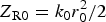 $Z_{{\rm R0}} = k_0r_0^2 /2$
is the Rayleigh length associated with the spot size r
0. Using Eq. (23) we obtain the power for non-linear focusing under the present model.
 $$\eqalign{P_0 & = \left( {\displaystyle{1 \over 8}} \right)\left( {\displaystyle{{{\rm \omega} _0{\rm \omega} {}_{\rm p}^{\rm 2}} \over {4c^2}}} \right)\left[ {\left\{ {4{\rm \chi} _5 + \displaystyle{{8{\rm \mu}} \over \hbar} \left( {{\rm \chi} _7 + {\rm \chi} _9 + \displaystyle{{{\rm \chi} _1k_0^2 S_0{\rm \mu}} \over {2\hbar {\rm \omega} _0^2}} + k_0S_0{\rm \chi} _3} \right)} \right\}} \right. \cr & \left. {\quad {\left( {\displaystyle{{mc{\rm \omega} _0} \over e}} \right)}^2} \right]a_{{\rm s0}}^2 r_0^2,} $$
where P 0 is the total critical power for non-linear focusing in uniform quantum plasma. The critical power can be much greater than unity and scales with laser frequency and plasma density. It may be noted that in the absence of magnetic field and the quantum terms, Eq. (24) reduces to the critical power required for self-focusing of a laser beam in a unmagnetized classical plasma (Esarey et al., Reference Esarey, Sprangle, Krall and Ting1997). The total critical power P 0 is plotted against ωc/ω0 in Figure 1. It may be noted that an increase in magnetic field leads to a significant increase in power. Equation (23) may be simplified to give,
 $$r_{\rm s}^{\rm 2} = r_0^2 \left[ {1 + \left\{ {1 - P_0} \right\}\displaystyle{{z^2} \over {Z_{{\rm R0}}^{\rm 2}}}} \right].$$
For P 0 <1, the laser beam diffract with an effective Rayleigh length given by (1 − P 0)−1/2 Z R0. For P 0 = 1, diffractive spreading balances non-linear focusing and a matched self-guided beam is obtained; however, small deviation from P 0 = 1 results in loss of equilibrium. For P 0 >1, the laser beam self-focuses.
Variation in total critical power P 0 with ωc/ω0 for a s0 = 0.271, ωp/ω0 = 0.8, and n 0 = 1028 cm−3.

The variation of the spot size (r s/r 0) with propagation length is shown in Figure 2 for n 0 = 1028 cm−3, ωc/ωo = 0.3, ωp/ω0 = 0.8, and a s0 = 0.271. The variation has been studied for ponderomotive non-linearity, which tends to decrease the spot size (catastrophic focusing), while the laser beam traverses the interaction region for P 0 >1 and for P 0 <1 the beam diffracts. The ponderomotive non-linear effects cause the beam to focus when laser power is greater than the critical power or total critical power is greater than unity, which is counter balanced by natural diffraction.
Variation in spot size r s/r 0 with z/Z R0 for ωc/ω0 = 0.3, ωp/ω0 = 0.8, a s0 = 0.271, and for n 0 = 1028 cm−3.

To study the influence of the external magnetic field, the variation of the spot size with ωc/ω0 is shown in Figure 3. The increase in magnetization gradually reduces the spot size and contributes to focusing of the beam. The variation of spot size with the total critical power P 0 has been plotted in Figure 4. The spot size reduces with an increase in the total critical power. The variation of spot size with propagation length is in agreement with Figure 2. The value of total critical power for which the beam is fully focused decreases with increase in propagation length.
Variation in r s/r 0 with ωc/ω0 for P 0 = 1.7, a s0 = 0.271, ωp/ω0 = 0.8, and n 0 = 1028 cm−3.

Variation in r s/r 0 with total critical power P 0 for ωc/ω0 = 0.3, a s0 = 0.271, ωp/ω0 = 0.8, n 0 = 1028 cm−3; and (a) z/Z R0 = 3, (b) z/Z R0 = 2, and (c) z/Z R0 = 1.

4. SUMMARY AND DISCUSSION
The ponderomotive force of the laser beam that is slightly more intense along the axis, pushes the electrons away from the axis leaving behind a region of lowered electron density. Since, the refractive index of a plasma depends on the local electron density, the depletion of electrons from the axial region raises the refractive index on the axis. This reduces the phase velocity and causes the wavefronts to curve. As a result the beam is focused toward the axis resulting in ponderomotive self-focusing.
In this paper, the effect of ponderomotive non-linearities on propagation of a linearly polarized laser beam through a uniform high-density ionized quantum plasma embedded in a constant magnetic field has been studied using the QHD model. The combined source for the wave equation is a superposition of linear, non-linear (ponderomotive), and perturbed (due to magnetic field) current densities. It is found that the laser beam traversing through high-density quantum plasma acquires an additional focusing tendency due to the perturbation induced in the plasma density. The ponderomotive force non-linearities cause the beam to focus and the quantum effects contribute in focusing. The ponderomotive non-linearity decreases the spot size (catastrophic focusing), while the laser beam traverses the interaction region for total critical power of the beam being greater than unity. The transverse magnetization of quantum plasma enhances the self-focusing and increase in magnetic field decreases the spot size. The transverse magnetic field also significantly enhances the total critical power for non-linear focusing. The influence of the quantum terms on the refractive index results in a stronger pinching effect as a consequence of which the laser self-focusing in quantum plasma becomes stronger than it is in classical plasma. In fact, after initial focusing of the laser, the quantum effects will be more pronounced in the region of increasing plasma density. The self-focusing length for quantum plasma decreases by about 37% and minimum laser spot size is reduced by about 21% than the classical plasma (in the limit
 $\hbar = 0$
). If this focusing due to ponderomotive non-linearity, quantum effects, and defocusing due natural diffraction are properly balanced, then a self-guided laser pulse can be formed and propagated over extended distance.
The present study will be useful in understanding the propagation of high-frequency EM waves in dense quantum plasmas existing in astrophysical objects such as magnetars, white dwarfs, neutron stars, etc., as well as in the next generation of intense laser–high-density plasma interaction experiments, FELs, and ICF experiments.
ACKNOWLEDGMENTS
This work was performed under the financial assistance from the UGC India, under fellowship award letter no. F.4-1/2006(BSR)/2007 (BSR) dated 22 October, 2013.



