Introduction
The Legal Services Act 2007 (LSA 2007) was intended to precipitate a revolution in the regulation of legal services in England and Wales. The main purpose of the Act was to achieve deregulation and liberalisation of the legal services market. Its signal policy was to recognise organisations allowing non-lawyer investment and management. This created a legal services market regarded as ‘one of the most liberalised in the world’,Footnote 1 but also demonstrated an intention that large corporations rather than small firms of lawyers should provide mainstream legal services to ordinary consumers. The deregulatory process was furthered by ending the regulatory role of professional bodies and completely reconfiguring the regulatory infrastructure. Various agencies created under the Act promoted a specific kind of regulation used in the financial services industry. The Act seeks to shift regulatory focus, from rules to risks, and uses management responsibility to affect business organisation, governance and strategy.Footnote 2 The LSA 2007 formed part of a wider process of public and private sector reform, designed to bring legal services within the ambit of the regulatory stateFootnote 3 by establishing ‘responsive regulation’: arrangements geared to symbiotic relationships between state regulation and private orderings.Footnote 4 This paper explores what impact neoliberal regulatory methods had on lawyers’ disciplinary systems, a key part of a professionalised legal services market.
The influence of regulation on individual behaviour is a theme of Foucault's work on the transition in criminal sanctions from physical punishment to confinement.Footnote 5 He observed that the introduction of the prison provided the opportunity to use novel technologies of surveillance.Footnote 6 He argued that the techniques of hierarchical observation, normalising judgment and their combination in assessment procedures, which he called ‘the examination’,Footnote 7 pervade social institutions aiming to affect individual subjectivity. Foucault's theory of governmentality proposes that the self-regulation of the subject using such techniques, aims to negate the need for external regulation. Their manifestation in both state regulation and attempts to instil self-government on the populationFootnote 8 is particularly marked in initiatives across liberal and neoliberal economies. Institutions aim to normalise conduct conducive to enterprise, thereby affecting individual self-identity and subjectivity.Footnote 9 Foucault argued that three factors determine the character of systems of social discipline: the system's underlying purposes, its social institutions, and the available technology of regulation;Footnote 10 this is particularly relevant to the regulation of what was, until 2007, a professionalised legal services market.
The LSA 2007 effected fundamental change in the first two of Foucault's three factors, philosophy and institution. The philosophy was set out in the first section of the Act declaring, inter alia, the regulatory objectives of promoting competition and the consumer interest. The institutional changes made by the LSA 2007 were intended to reflect a deregulatory agenda. The central thrust was abolition of the regulatory role of professional self-regulating organisations (SRO) for admissions, practice and discipline. A number of new regulatory institutions were therefore created. These included a Legal Ombudsman (LeO) to receive complaints against all regulated lawyersFootnote 11 and a government agency, the Legal Services Board (LSB), answerable to government for achieving the Act's regulatory objectives. The levers of changes to practice regulation were in the hands of new ‘front line regulators’ constituted independently of the professional bodies. A key mechanism of change was the LSB's oversight of and influence over these institutions. Those responsible for the three main areas of regulation for solicitors, the largest legal profession in England and Wales, were the Solicitors Regulation Authority (SRA) and the Solicitors Disciplinary Tribunal (SDT). The SDT was constituted as a professional institution in 1974 to hear misconduct allegations against individual practitioners. It changed little after the LSA 2007, being relatively insulated from the LSB's influence. Its raison d'etre is, however, potentially at odds with the rationale of the LSA 2007 and the regulatory direction taken by the SRA. This increasingly reflects a changing logic of regulation.
Freidson identified three regulatory logics and their complementary mechanisms: professionalism (collegial control of markets in a spirit of public service), perfect competition (a free market with minimal regulation) and corporate bureaucracy (maximising the advantages of effective management).Footnote 12 The SRA's regulatory strategy has gradually moved away from the policies of professionalism towards those promoting competition and corporate bureaucracy.Footnote 13 In terms of practice regulation, however, the forum for the ‘modernisation’ of legal services regulation is the modern law firm. The main focus has been on a process of ratcheting up the responsibility of law firms for regulation, exemplified by a rule book that addresses the employing organisation rather than the individual lawyer. This development was anticipated by a strand of the legal ethics literature which advocated building the ‘ethical infrastructure’ of conventional law firms as a way of addressing lawyer misconduct.Footnote 14 The legal office is also viewed as a site of control of the individual in the organisational theory literature, where more subtle mechanisms of control are described.Footnote 15
Brown and Lewis argue that processes of observation, normalisation and examination, processes identified by Foucault as features of modern disciplinary systems, are particularly effective in legal workplaces.Footnote 16 Routines such as time recording potentially define the identity of workers even in sectors, such as the professions, characterised by collegiality and relatively autonomous work places. Through the process of normalisation the individual accepts subjection to their work role and consequent limitations on their autonomy. In this approach to regulation ‘[d]isciplinary power is not, or not just sporadic and spectacular, but regular and monotonous… the mundane, everyday, repeated patterns of activity which characterize processes of (self) organizing’.Footnote 17 The ability of institutions to perform a disciplinary function by affecting the behaviour of the individual employee depends on their capacity to provide more effective surveillance and control of regulated populations. The legal services market in England and Wales comprises different spheres of solicitors’ practice. A broad division between corporate and ‘private plight’ clients, recognised in the literature,Footnote 18 is the basis of very different firm structures. Sole practitioners and small firm tend to operate in the private plight sphere and their partners are over-represented in the SDT. This is a challenge to a system of regulation based on theories of governmentality.
This paper explores the development of the regulatory system of solicitors following the LSA 2007. Our account begins by describing the evolution of the regulatory system following the Act. We argue that the shift in the SRA's regulatory strategy towards corporate bureaucracy presents different concepts of discipline in the post- LSA 2007 regulatory regime. The themes of regulation and governmentality are examined using empirical data on the role of the SRA as a practice regulator and prosecuting authority and that of the SDT as adjudicator. In conclusion we consider how the nature of risk associated with particular activities of the regulated population might determine tools of governance.Footnote 19 We also consider whether the SDT, in some ways a surprising survivor of the LSA 2007 revolution, performs a necessary function. As a remnant of a professional regime representing the physical, public and ceremonial dimensions of discipline, it arguably sits uneasily in a system based on neoliberal theories of regulation.
1. Methodology
Our data derives from material published by the SRA and material provided to us on the overall disposition of investigated cases during 2015. We also read the full published summaries of all 105 cases heard by the SDT in 2015,Footnote 20 yielding data on 132 solicitor respondents.Footnote 21 While such records provide ‘an underutilised window’ on lawyer misconduct,Footnote 22 their form, and hence their usefulness, can vary greatly.Footnote 23 Hence, gaps remain in different aspects of the study.Footnote 24 The Statistical Package for Social Scientists was used to analyse data from the transcripts. Each line of the database represented one SDT case against one respondent and contained variables such as age, sex, the charges, mitigation and outcome of the hearing. Quantitative and qualitative data from the SDT records provide both an overview of the process and insight into how the tribunal approached cases.Footnote 25 In addition to these two main sources of data, we used web searches on the fate of the firms from which respondents before the SDT cameFootnote 26 and other demographic data.Footnote 27
2. The post-LSA 2007 regulatory system
(a) Regulatory framework
In 2007 the Law Society established the SRA as the independent regulator for solicitors, responsible for developing the system of practice regulation; in Foucault's terms the ‘technology’ of discipline. As practice regulator the SRA is responsible for admissions (including educational requirements), the conduct framework and the prosecution of misconduct. The LSA 2007 specifically provided that the SRA must not allow the Law Society to influence its regulatory strategy, which must be geared to supporting the eight regulatory objectives of the LSA 2007.Footnote 28 These included conventional objectives of the professional regulation of lawyers, such as supporting the rule of law and promoting and maintaining adherence to professional principles, but made explicit the need to protect and promote the interests of consumers and competition in the provision of services. Otherwise, regulators were required to promote regulatory activity that was transparent, accountable, proportionate, consistent and targeted only at cases in which action was needed.Footnote 29
The SDT was originally established under the Solicitors Act 1974 ‘at the [Law] Society's request and in the public interest’.Footnote 30 It was introduced at the same time as the Law Society acquired power to make disciplinary rules and investigate their breach,Footnote 31 make account rulesFootnote 32 and intervene in solicitors’ practices.Footnote 33 The 1974 Act arguably marked the height of an age in which the ideology of professionalism prevailed. Even 20 years later Sir Thomas Bingham MR, canvassing reasons for striking a solicitor from the Roll in Bolton v The Law Society,Footnote 34 identified ‘the most fundamental of all: to maintain the reputation of the solicitors' profession as one in which every member, of whatever standing, may be trusted to the ends of the earth’.Footnote 35 The role of the SDT did not change following the LSA 2007. Its power to strike respondents from the Roll of solicitors, arguably the essential professional power,Footnote 36 was traditionally exercised when it was necessary to protect the integrity of the professional body. Inevitably, such exclusion often came long after harm had been suffered by consumers or others. The philosophy of regulation represented by such tribunals therefore appears to be at odds with the consumer-orientated objectives of the LSA 2007 and with the broader interest of the state in ‘markets which are fair, efficient, orderly and clean’.Footnote 37
The LSA 2007 enhanced the powers of both the SDT and the SRA, but in a way that made them potential competitors for jurisdiction. The Act removed a restriction on the upper limit of fine the SDT could imposeFootnote 38 but gave the SRA new powers to issue written rebukes and impose fines of up to £2,000 on individual practitioners. These new powers of sanction, albeit minor, potentially deflected cases from the SDT. This may have been relatively unproblematic had the LSA 2007 not also given the SRA rights to fine new entities created by the LSA 2007, Alternative Business Structures (ABS), up to £250 million and individuals working in them up to £50 million. The discrepancy in the power to fine solicitor practitioners and entities and their employees appeared illogical, spurring the SRA to seek to extend its power to fine solicitors on the grounds of consistency.Footnote 39 If it were to be successful the SDT would effectively be left with striking off and suspension as its exclusive powers. The incremental extension of the SRA's powers therefore poses an existential threat to the SDT.
(b) Regulatory policy
The SRA promised a regulatory regime placing public and consumer interests at its heart.Footnote 40 It would overhaul regulatory practice and forge a new relationship with regulated parties, adopt risk-based strategies, a more proactive and preventative approach and ‘focus resources on problem firms’.Footnote 41A significant step in the evolution of the new regime, publication of a new regulatory rulebook, occurred in 2011. The SRA Handbook retained six core duties from the previous code and added a further four primarily focused on running legal businesses. It presented these as ten mandatory principles defining ‘the fundamental ethical and professional standards that we expect of all firms (including owners who may not be lawyers) and individuals when providing legal services’.Footnote 42 As part of the Handbook, a new code of conduct reframed the rules in the previous code as ‘Outcomes’ to be achieved and ‘Indicative Behaviours’, examples of how they might be. The format represented a radical departure from the Solicitors Code of Conduct 2007, which was based on more conventional rules. This introduced some ambiguity in the behaviour expected of professionals since, in theory, there were various possible ways of achieving Outcomes.
The SRA Handbook resulted from several pressures. Prior to the LSA 2007 the Law Society had asked consultants to advise on regulation; both advocated a form of ‘principles based regulation’, the system used to regulate the financial industry.Footnote 43 Further, the oversight regulator, the LSB, specified that licensing authorities for ABS companies potentially owned and run by non-lawyers, should also use that system. The Law Society had reservations about the SRA proposal to use the system as a framework for regulating ABS and individual solicitors. It argued that under rule-based systems:
… solicitors are able to rely without hesitation upon uniformity of practice across the profession where it comes to issues such as conflict, confidentiality and undertakings. This enables routine commercial transactions to proceed smoothly and economically. This requires a set of quickly and easily enforceable obligations that sanction any failure to adhere to professional obligations… [T]he proposed rules as they currently stand contain a myriad of reporting requirements. We are concerned that this will mean that the SRA will be overwhelmed with reports under the various different rules as solicitors either misinterpret the requirements or take a risk averse approach to reporting.Footnote 44
Despite these reservations the SRA went ahead. Thus, traditional solicitors’ firms, even sole practitioners, were required to appoint a Head of Legal Practice and a Head of Finance,Footnote 45 compliance posts required by the LSA 2007 for ABS.
The SRA's system imposed significant new responsibilities on firms for regulating the conduct of the solicitors they employed. One of the ten principles was that ‘[you] comply with your legal and regulatory obligations and deal with your regulators and ombudsmen in an open, timely and co-operative manner’.Footnote 46 A new chapter, ‘You and Your Regulator’, appeared in the Handbook's Code of Conduct.Footnote 47 This included sub-rules from the previous codeFootnote 48 requiring regulated parties to notify the SRA promptly of serious financial difficulty or failure to comply with or achieve the principles and other requirements of the HandbookFootnote 49 and to inform the SRA of serious misconduct.Footnote 50
The subtle shift in regulatory method could be seen as a move from the regulatory logic of professionalism towards corporate bureaucracy. This, theoretically at least, offers regulators a range of different disciplinary technologies aimed at increasing employee commitment, motivation, performance and behaviour.Footnote 51 Within firms the possibilities include conventional methods such as hierarchical management and surveillance, but might also include incentives.Footnote 52 These techniques can be seen as part of a process of ‘responsibilisation’, an aspect of governmentality whereby regulated populations are encouraged to rationally choose new ways of conducting themselves.Footnote 53 External regulation increasingly assumes and builds on the responsibility of the regulated population. We see examples of this in requirements that entrants assess their own suitability to enter the profession, assess and confirm their own training needs and form their own continuing professional development programme.Footnote 54
The changes outlined could be interpreted as a refinement of professional methodology, but proposals for education and training of solicitors suggest a decisive change in regulatory strategy. Professionalism uses an intensive and common initial phase of education and training to both select suitable individuals and socialise them into a collegial social group.Footnote 55 Individual discipline largely depends on personal self-regulation, group identification and peer pressure. Formal discipline, as represented by the SDT, is directed at irredeemable failures of the socialisation process. The SRA is adopting policies that incrementally move away from the collegial strategies of professionalism. Perhaps the most fundamental of these is the proposal that prospective solicitors need only pass a Solicitors Qualifying Examination (SQE). One of the espoused advantages of removing requirements to take prescribed undergraduate and vocational coursesFootnote 56 is that future solicitors will begin their careers, not in traditional law firms, having taken law degrees, but in corporate employment or as beneficiaries of corporate patronage, having an undergraduate degree or equivalent experience.Footnote 57 This continues a development already seen in the form of bespoke, firm-sponsored vocational courses.Footnote 58 It potentially replaces the professional ideal of a common educational experience with induction into the culture of a specific organisation.
(c) Disciplinary tribunal references and alternative disposals
In terms of practice regulation, references to the SDT are the tip of a much larger framework. Unlike many lawyer discipline systems,Footnote 59 the solicitors' system does not deal with consumer complaints, which are the province of the LeO. Nevertheless, in 2015/16 the SRA received around 11,000 reports about solicitors and businesses it regulates.Footnote 60 Approximately 9.6% (1,079) of these were referred to LeO,Footnote 61 but the remainder were assessed in order to decide whether or not there should be further investigation, usually by examination of the practice files and accounts, by the SRA's Forensic Investigation Unit (FIU).Footnote 62
Although the Law Society had used a power to impose conditions on practising certificates as a way of dealing with some cases of misconduct, the new powers to rebuke or fine extended its options. From 2007 the SRA also made more extensive use of regulatory settlement agreements (RSAs) under which solicitors could even agree to being struck off, denying them their livelihood. In 2015 restrictions were imposed on practising certificates in 24 cases.Footnote 63 Additionally, the SRA upheld 286 allegations, resulting in 140 letters of advice, 26 warnings, 43 rebukes or reprimands and 16 fines.Footnote 64 A further 199 allegations were referred to the SRA's legal directorate with the intention that disciplinary proceedings should be issued. The fact that these referrals resulted in only 105 cases is explained by the fact that some were rescinded, or led to a RSA, or that multiple investigations led to just one hearing.Footnote 65
The SRA claims to draw upon a wide range of sources in identifying risks to regulatory outcomes, ‘including reports we receive, intelligence-gathering while supervising firms, contacting consumers directly and monitoring markets and the economy’.Footnote 66 The majority of reports the SRA received for the year November 2015 to October 2016 came from members of the public and, at 56.2% (n 6,337), was almost double that received from the profession (23.1%, n 2,602).Footnote 67 The SRA's internal sources made up 11.6% (n 1,304) of referrals, half of that received from the profession, and the balance (circa 10%) comprised reports from institutions, the main provider being the LeO (3.4% of the overall total).Footnote 68 The record of SDT cases indicates four main ways in which respondents came to attention. First, in 35 of the 105 cases prosecution followed investigatory audits of accounts and files by the FIU. It was not always clear what prompted these investigations, but they could have resulted from solicitors’ failure to comply with regulatory requirements such as providing information or filing accounts. Second, in 31 cases the matter was referred by the firm or by the party guilty of misconduct. Third, in 17 cases the matter was reported by clients (for example, mortgage lenders) insurers, opponents, other solicitors or the LeO. Finally, there were 15 cases involving criminal convictions where the SRA may have been alerted by news reports or judicial referral.
Auditing and self/firm reporting could provide evidence of the success of the SRA's regulatory strategy, such as the 35 cases (33%) where prosecution followed investigatory audits of accounts and files by FIU. While in most cases it was unclear what triggered the audits, they could be prompted by failure to comply with new information requirements.Footnote 69 These were introduced to enable the SRA to assess risks, identify failure to meet the outcomesFootnote 70 and deal with instability or financial failure, fraud and dishonesty.Footnote 71 A clearer example of success is provided by the 31 (29.5%) cases in which misconduct was reported by the firm, or their reporting accountants,Footnote 72 or by the guilty party. These are arguably evidence of the success of the introduction of compliance posts and reporting requirements.
(d) Prosecution
Although consumers can bring cases to the SDT, they cannot obtain compensation. This, combined with the difficulty of bringing a case, is probably why nearly all cases are prosecuted and presented by the SRA. In 2015/16 over 5,500Footnote 73 cases sent for investigation by the SRA's Risk Centre Assessment TeamFootnote 74 resulted in only 129 referrals by the SRA to the SDT.Footnote 75 Referring only 2.3% of investigated cases might manifest excessive concern about the risk of losing.Footnote 76 In 2015 the SRA succeeded in all but two of the cases it prosecuted before the SDTFootnote 77 and in criminal matters moderate levels of dismissal are taken as signifying that appropriate risks are taken.Footnote 78 A second explanation of the large gap between reports and cases, and the general long-term decline in the caseload of the SDT,Footnote 79 is that the SRA made appropriate use of its disciplinary powers to make alternative disposals.
(e) Misconduct
In 2015, 66 of the 105 cases (62.9%) presented to the SDT involved financial impropriety. These cases could be broadly divided into cases where the solicitor acted against the client's interests and cases where the solicitor was implicated, deliberately or not, in a client fraud. Of the 25 cases involving fraud in our sample, 19 involved solicitor fraud on clients. Actions against the best interests of clients may also involve a breach of the Solicitors’ Accounts Rules (SAR). Of the 66 cases of financial impropriety, 40 (60.6%) were simply breaches of the SAR. This preponderance of cases is probably because SAR offences were generally strict liability and the easiest to prove using accounting records. The SAR required that all client money was held in a separate client account until it could be legitimately transferred to the solicitor's office account on delivery of a bill.Footnote 80
Using client money to pay office expenses or to fund another client's matter, a practice known in bookkeeping as ‘teeming and lading’, occurred in several cases, generally when firms suffered cash flow problems.Footnote 81 Such conduct showed reckless disregard of the risk of losing the client's money if, eventually, the firm collapsed. Accordingly, withdrawal from client account for any purpose other than payment of a delivered bill or to return it to a client, was treated as a serious breach. Nevertheless, the SRA dealt with some breaches of the SAR in which there was no dishonesty under a RSA rather than by reference to the SDT.Footnote 82
There were only six cases in which the respondent was implicated in their client's fraud. In four of these the respondents acted knowingly, but in the further two they were ignorant of their clients’ intentions. These relatively small numbers fail to highlight significant concern regarding active solicitor involvement in money laundering. In one notorious case a sole practitioner was caught in the Financial Conduct Authority's Operation Cotton, which examined the activities of land banking companies.Footnote 83 Other examples occurred when solicitors apparently allowed their client account to be used as a bank, that is, without there being an underlying transaction. In such cases there may be a suspicion of money laundering but no clear proof of illegal activity.Footnote 84Although the SDT identified this issue in 2002Footnote 85 the code of conduct only specifically addressed it 2011.Footnote 86
Another relatively large category of case indirectly involved firms unable to secure professional indemnity insurance (PII). This followed from the SRA's 2011 decision to close the Assigned Risks Pool, the safety net for solicitors’ firms unable to obtain client liability insurance on the open market.Footnote 87 Eight of the 105 cases, involving 13 respondents, concerned solicitors charged with PII connected offences: making false insurance declarations,Footnote 88 failing to obtain insurance, failing to notify the SRA of the firm entering into an extended indemnity period or failing to close their businesses within the specified cessation period.Footnote 89
The balance of the SDT's 2015 caseload comprised cases in which respondents were convicted of criminal offences prior to the SDT hearing. These cases involved a disparate range of offences, but one category seemed reasonably clear: misleading others about mistakes. Cases included those against partners who had concealed mistakes from clients by, for example, faking emails to the court having failed to list a case,Footnote 90 or misled them about the stage their case had reached.Footnote 91 In similar cases involving associate solicitors, failure to register a charge,Footnote 92 missed court deadlinesFootnote 93 or forged letters and medical reports,Footnote 94 the respondents also concealed mistakes from their firm. Another small category of case involved solicitors conspiring to assist illegal immigrationFootnote 95 and misleading the court in litigation proceedings.Footnote 96
It has been seen that the misconduct considered by the SDT in 2015 largely involved financial impropriety, from fraud to inadequate book-keeping, which may or may not involve dishonesty. A smaller category of cases potentially involved other kinds of dishonesty, such as misleading clients or the courts. Finally, a residue involved a breach of the requirement for professional indemnity insurance, which may or may not involve dishonesty. In considering whether these kinds of cases are due to regulatory failings, and if so the nature of such failings, it is helpful to consider the offender profile.
(f) Respondent profiles
The profile of respondents appearing in 2015 supports some generalisations regarding risk factors.
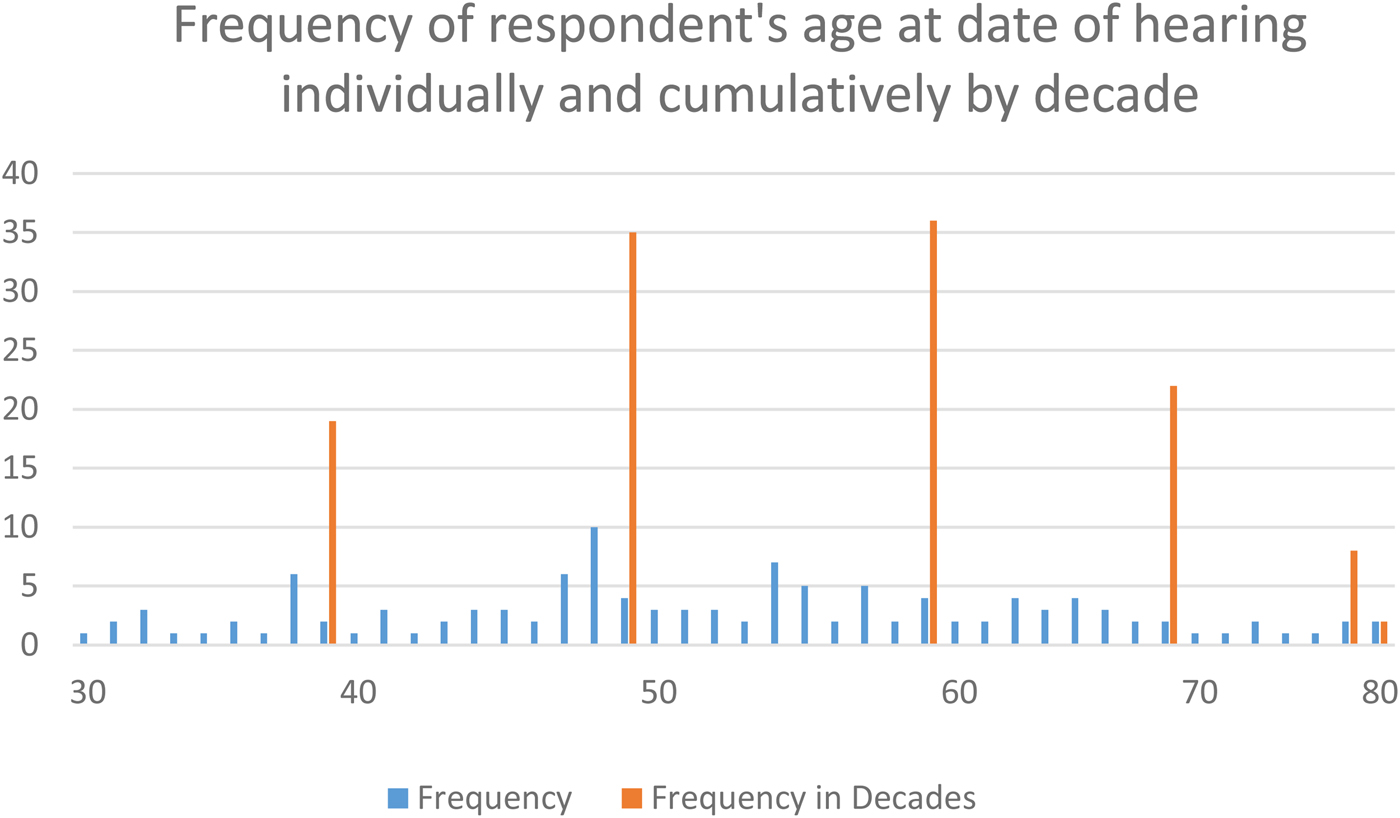
Graph 1below, depicting the age of the 132 respondents before the SDT, suggests that the likelihood of appearance before the SDT peaks in middle age. It is important to note that this impression can be misleading for two reasons. The first is that offences can occur many years before misconduct is discovered. In 34 cases, over a quarter of the whole, the date of the first act of misconduct recorded in the transcript, what we have called the first infraction date (FID), occurred within the first ten years of practice and in a further 31 cases within 11 to 20 years from qualification. The second reason concerns late admission. The current mean age for first admission to the Roll is 29.5Footnote 97 but large numbers of respondents were admitted late: 21 (17.5%) when they were aged between 30 and 39; 14 (11.7%) when they were between 40 and 49; and three (2.5%) when they were 50 or over.
Graph 1

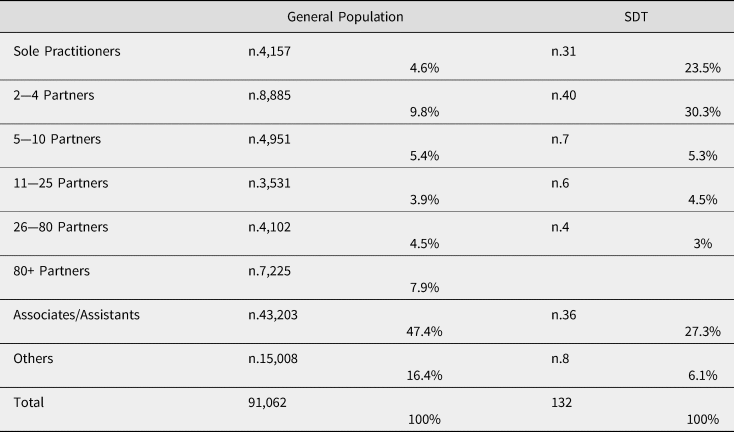
In the majority of cases we were able to identify the practices that respondents came from.Footnote 98 The largest organisation at which a respondent worked consisted of 60 partners,Footnote 99 but this was exceptional. Over 70% of SDT cases were against respondents from sole or small practices, those with four partners or fewer. Table 1 appears to support the contention that principals, sole practitioners and partners are disproportionately engaged in misconduct compared to their number in the general population of solicitors. In 2015 partners or their equivalentFootnote 100 comprised 43% (n 57) of respondents but only 31.5% of the total population of practising solicitors, and sole practitioners 23.5% of SDT respondents (n 31) but only 4.6% of the population of practising solicitors. These data suggest a negative association between the size of firm in which respondents were employed and appearance before the SDT.
Respondents’ employment status compared with number with that status in the general populationFootnote 101

In 19 cases of the 105 cases in our sample, more than one member of staff was involved in alleged misconduct: one case involved six co-respondents from the same firm,Footnote 102 one involved five (one of which was a recognised body), three involved three and 14 cases involved two. In two of these cases employers were held responsible for failing to ensure staff complied with the code of conduct.Footnote 103 A follow-up search of firms established that nearly 62% (n 58) of the 105 firms associated with respondents in 2015 became defunct.Footnote 104 The cause of this high figure may be that appearance before the SDT was either a symptom of practice breakdown or resulted in key personnel being struck off.
An explanation of why disciplined lawyers come from small firms is that they are targeted by regulators and do not respond adequately.Footnote 105 While there is limited evidence of bias against small units, reviews by or for the SRA lend credence to this hypothesis. In 2008 an independent review found probable institutional racism in the selection of black and minority ethnic (BAME) solicitors for disciplinary prosecutions.Footnote 106 In 2014, the John report suggested non-discriminatory reasons why BAME solicitors were more likely to appear in disciplinary cases.Footnote 107 Whereas, on average, white solicitors set up on their own after 19 years of practice, BAME solicitors, motivated by frustration, lack of career opportunities or a desire to serve their community, went solo six years after qualification.Footnote 108 The report suggested that these kinds of sole practices were more likely to be monitored by the SRAFootnote 109 and not to have the resources to ‘ensure best practice and insulate themselves against litigation’.Footnote 110 Moreover, the lack of experience of the principals meant that, once challenged, they were more likely to come into conflict with the SRA. John found disproportionate treatment of BAME solicitors at three stages of the regulatory process. They were more likely to have cases raised or complaints registered against them, to be investigated, and be severely sanctioned (on which see below), when compared to white solicitors.Footnote 111 The report warned against jumping to conclusions of institutional racism, citing complex ‘socio-economic and political factors’ as contributors to disproportionality.Footnote 112
One aspect of these findings, an absence of resources to ensure best practice and insulate against litigation, applies to many solo and small firm lawyers. However, it might be argued that these factors only call into question selection for prosecution decisions where dishonesty is not involved. Lack of resources may be relevant in some types of SDT case, for example, those where there is ‘borrowing’ from client account to pay office expenses or failure to obtain professional indemnity insurance. As we have seen, some of these cases, particularly, use of client money, can be labelled dishonest when motivation is difficult to determine.
Another factor that may be relevant in solo and small firm transgression is opportunity.Footnote 113 Junior lawyers and women are, it is said, under-represented because of structural position rather than propensity.Footnote 114 An important dimension is lack of oversight, a theory that explains the persistence of the generalisation that older males from small firmsFootnote 115 or solo practicesFootnote 116 are the subjects of lawyer discipline. On this view, offending is promoted by the nature of solo and small practice: lawyers with control of office finances, clients with whom lawyers have no continuing relationship and little incentive to serve diligently,Footnote 117 low pay, low levels of finance, inadequate staffing and sporadic supervision. These conditions provide motive, opportunity and classic conditions for white collar crime.Footnote 118 Health and dependency problems, often linked to depression or stress,Footnote 119 may also play a part. These are factors which lack of adequate workplace support probably exacerbate.Footnote 120
The fact that a large population of active practitioners continues to produce relatively few disciplinary cases is consistent with earlier studies.Footnote 121 Indeed, our data suggests a long-term reduction in SDT cases since the change of regulator. The fact that only a third of potential misconduct cases reached the SDT may, however, be misleading. The evidence suggests that the many matters not referred to the SDT are now being processed and dealt with by alternative disposals rather than simply abandoned. Despite this, the high success rate at the SDT, similar to that of SROs, may suggest that the SRA is over-cautious in making prosecution decisions. This is a particular concern given the risk that those SDT cases in which solicitors were involved in client fraud could be the tip of a much larger iceberg.
The possibility of undetected fraud could lead to unexpected and large claims on the compensation fund maintained for victims of solicitors’ fraud.Footnote 122 It could also lead to costly interventions by the SRA. In 2013 the SRA had to intervene in 47 practices.Footnote 123 Because there was no other source of funding, the cost of intervention, around £17 million, fell on the compensation fund.Footnote 124 Since 2013 there has been a downward trend in the number of SRA interventions and thus savings to the compensation fund. In 2015/16 the authority intervened in 37 practicesFootnote 125 with a cost to the compensation fund of £10.3m.Footnote 126 This may justify a more intensive focus on some parts of the market.Footnote 127 Our data suggests that size of firm is most consistently linked with misconduct cases before the SDT.Footnote 128 It is not known whether detection and investigation strategies in relation to small units are adequate or sufficiently proactive. At present, it appears that the only regulatory strategies that might target such problems are increased monitoring and increased information requirements on firms. Details are difficult to find and it may be that the techniques may not detect well-organised fraudsters. Despite the apparent success of the reporting requirements we found little evidence in the transcripts of new or improved monitoring by the SRA.
Our assessment of the SRA's broad regulatory strategy suggests that it is ill-suited to the most salient problems of regulation. It is geared to organisations with significant infrastructure, not to the solo and small practices comprising the majority of organisations in which solicitors work. One solution would therefore to be to require a minimum size of practice, but this could severely restrict access to legal services, particularly in areas of low population density. Because of the difficulty of making private practice conform to its regulatory model, the SRA must also rely on the disciplinary apparatus inherited from the Law Society. This system, based on monitoring and investigation, was geared to the use of specific professional rules of conduct. The abandonment of a conventional rule book causes difficulty both in prosecuting cases and in adjudicating on cases brought to the SDT.
3. Adjudication
(a) Jurisdiction
While the LSA 2007 ended the connection between the Law Society and the SDT, it did not change the disciplinary process itself or the structure and role of the tribunal. The advice of a preliminary report – that the professions’ systems worked reasonably well and could be left to operate broadly as they wereFootnote 129 – was heeded. The SDT therefore continues to be comprised of solicitors with at least ten years’ experience and lay members appointed by a senior judge, the Master of the Rolls.Footnote 130 Panels of three members hear charges against solicitors, recognised bodies, registered European lawyers or registered foreign lawyers. Also, employers can be joined in applications against non-solicitor employees. Nearly all the cases the tribunal hears are against solicitors.Footnote 131 The LSA 2007 required that the SDT be reconstituted as a company limited by guarantee, independent of, but funded by, The Law Society.Footnote 132 It was also relatively free from control by the oversight regulator, the LSB; its only power in relation to the SDT was to approve rule changes proposed by the tribunalFootnote 133 or to make orders enabling the tribunal to carry out its role more effectively or efficiently.Footnote 134 It could give directions only where the tribunal failed to perform its functions to an adequate standard, or at all.Footnote 135
(b) Charges
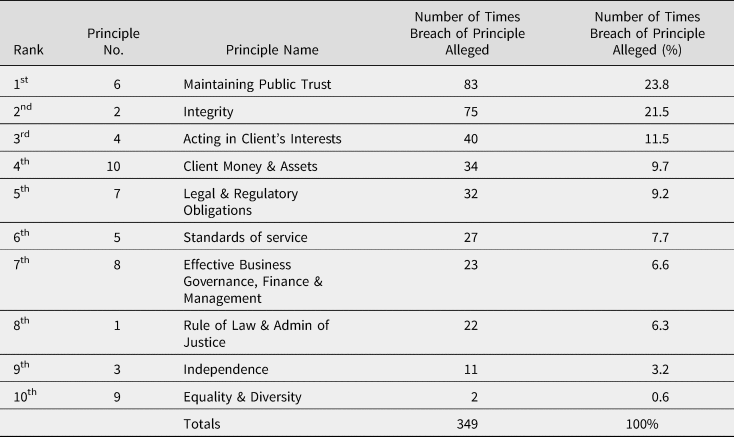
The SDT's decisions refer to charges formulated by the SRA. These are based on breaches of rules current at the time that offences are committed. Therefore, respondents potentially face different charges covering different periods of regulation.Footnote 136 Practice prior to the creation of the SRA Code of Conduct 2011 was to charge respondents with a breach of one of six core duties in the preamble to the Solicitors Practice Rules 1990, or the Solicitors Code of Conduct 2007, and with breaches of detailed rules in the code. After adoption of the 2011 Code, and the shift from rules to outcomes, specific charges were only laid where there were breaches of the SAR or, for offences predating 2011, the old code of conduct. Where no rules applied, respondents were charged with a breach of the SRA Principles.Footnote 137 As seen in Table 2, the most frequent charges based on the Principles were reducing public trust in the profession and failing to act with integrity. The least used charge was failure to run a practice so as to encourage equality and diversity.
Allegations of Breach of SRA Principles in 2015

One of the difficulties with using Principles as a basis for misconduct charges is that despite their generality, they sometimes do not appear to cover specific misconduct. This problem is marked where respondents incur criminal convictions for offences having nothing to do with practice. In one case a respondent convicted of falsely nominating another driver for a speeding offence was charged with failing to uphold the rule of law and proper administration of justice (Principle 1).Footnote 138
The difficulty in framing charges may have been caused because of a decision to omit a flexible ‘catch all’ charge from the Principles. This function was previously served by a duty to preserve the good repute of the legal profession. This was the core of the Bingham dictum in Bolton and one of five fundamental principles attached to the Solicitors Practice Rules 1990. The Solicitors Code of Conduct 2007 adopted a reformulated principle; that solicitors should not behave in a way ‘likely to diminish the trust the public places in you or the profession’, the phraseology adopted in the SRA Principles 2011. Diminishing trust is less apposite than preserving reputation in cases where solicitors have been convicted of offences. Thus, charges of acting without integrity or failing to maintain public trust are not suitable in many cases involving convictions. Cases of drunken driving,Footnote 139 making false claims for refunds on train tickets for train delays and cancellationsFootnote 140 and making indecent photographs of childrenFootnote 141 are only a few examples of cases in which undermining public trust did not seem to accurately cover specific conduct.
While professional repute is no longer a Principle, the courts continue to maintain Lord Bingham's assertion in Bolton that maintaining the reputation of the solicitors’ profession is the raison d'etre of professional discipline.Footnote 142 The SDT also frequently refers to the reputation of the profession.Footnote 143 In one decision it was considered the decisive factor.Footnote 144 Problems in matching the Principles to specific misconduct were not limited to cases involving convictions. In a case in which a solicitor had purchased an elderly client's house at less than market value, the SRA dropped a charge of lack of integrity before the hearing.Footnote 145 The prosecution was only saved because the alleged offence had occurred when earlier rules, stating that a solicitor must not take unfair advantage for himself or a third party, applied.Footnote 146
Considerable difficulty has been caused by the absence of a Principle demanding honesty, the dishonesty of a respondent being the most significant conclusion the SDT reaches. Respondents accused of dishonesty are therefore charged with a breach of the Principle requiring integrity. The SDT has applied a judicial definition that states ‘… a person lacks integrity if he/she acts in a way which, although falling short of dishonesty, lacks moral soundness, rectitude and steady adherence to an ethical code’.Footnote 147 Before 2011, the SRA's practice was to attach an allegation of dishonesty or recklessness to specific charges. Post 2011 the practice was to charge potentially dishonest respondents with lack of integrity while alleging dishonesty in relation to specific factual allegations, for example, dishonest use of client money.Footnote 148 Such allegations were accompanied by the observation that it was not necessary to establish dishonesty to prove lack of integrity. In dishonesty cases the SDT applied the two-stage test set out by the House of Lords in Twinsectra v Yardley.Footnote 149 This involved asking whether conduct was dishonest according to the ordinary standards of reasonable and honest people and, if so, whether the respondent should have realised that his conduct was dishonest by those standards. Respondents cleared of dishonesty could still be found guilty of lack of integrity, which is generally treated as having only an objective element.Footnote 150 This potentially caused confusion because a finding of lack of integrity without dishonesty is regarded as a lesser offence.
In 2017 the proposition that solicitors might display lack of integrity without being dishonest was doubted in an appeal to the Administrative Court.Footnote 151 Mostyn J stated that lack of integrity inevitably involved dishonesty and argued that the SRA should not be able to ‘side-step the requirement of proving the subjective element of dishonesty in any case by the simple expedient of charging the same facts as want of integrity’.Footnote 152 The Divisional Court's decision temporarily threw into doubt a distinction recognised since Bolton where a solicitor who had been reckless with client money was found not to have been dishonest. Perhaps fortunately, another Divisional Court, led by Sir Brian Leveson, confirmed that lack of integrity is indeed a lesser standard than dishonesty and simply a failure to reach the high standards demanded of a solicitor.Footnote 153
The simple expedient of adding a requirement for honesty to the list of principles would not answer a deeper question: does charging solicitors with breaches of very broad principles satisfy their human right to a fair trial? The most obvious requirement of a fair trial that current practice could offend is ‘to be informed promptly, in a language which he understands and in detail, of the nature and cause of the accusation against him’.Footnote 154 This wording does not explicitly require that charges be made clear, but it is arguable that, unlike in criminal trials, solicitors may often have little idea of the specific offence they have committed. The current situation arguably over relies on the SDT knowing misconduct when it sees it.
(c) Proof
One of the difficulties created by the SRA's new sanctions is the articulation of the two disciplinary systems. In relation to the standard of proof for misconduct, for example, the SRA applies the civil standard of proof, the balance of probabilities, when deciding whether to rebuke or fine. The SDT uses the higher, criminal standard, beyond a reasonable doubt, in considering new cases and when reviewing SRA decisions on appeal. The fact that respondents can have a higher standard applied to the facts of their case encourages appeals and increases their chances of reversing an SRA decision. Historic support from the courts for the SDT's use of the criminal standardFootnote 155 has ebbed away following an SRA campaign for the SDT to use the civil standard in appeals and in disciplinary proceedings. This drew official approval,Footnote 156 then government support.Footnote 157 Finally, an influential bench in the High Court endorsed use of the civil standard across the board.Footnote 158 No doubt as a result of this pressure, and in the light of a similar proposal by the Bar, the SDT has decided to adopt the civil standard of proof.Footnote 159
(d) Intention
It may be that one reason for the SDT's insistence on the criminal standard of proof was that much of its caseload comprised dishonesty cases. Guidance from the courts suggests that a tribunal faced with a solicitor of ‘anything less than complete integrity, probity and trustworthiness… [should] almost invariably, no matter how strong the mitigation… [result in an] order that the solicitor be struck off’.Footnote 160 Possibly because of the severity of the sanction a previous study of the SDT's approach to dishonesty found that the SDT ‘… demonstrate[d] a practice of negotiating reality in which the dishonesty rule is circumvented by applying a different label’.Footnote 161
Our sample contained several cases in which the SDT might have found dishonesty but did not. In one of these the tribunal doubted the respondent's evidence but refused to make a finding of dishonesty because dishonesty was not alleged in the charges.Footnote 162 In another, a respondent who had transferred money from client account to office account, knowing that this would leave a shortfall, was found to have been reckless but not dishonest.Footnote 163 In yet another case, the dishonesty of a respondent who had persuaded someone to accept his speeding points was excused because it was ‘of short duration’.Footnote 164 In a case where a respondent created a false email trail to conceal a failure to list a case for hearing, the SDT accepted that he thought he was recreating emails that had existed.Footnote 165 Applying the subjective limb of the Twinsectra formula it found that he had not realised that ordinary people would regard this behaviour as dishonest. The SDT also accepted medical evidence negating dishonest intent.Footnote 166 In one such case it accepted a regulatory settlement proposed by the SRA because medical evidence called into question whether there was ‘dishonesty to the level of proof required’.Footnote 167
In cases involving women the SDT's generous interpretation of behaviour suggests the possibility of chivalry bias; in this context a failure to treat women the same as men in relation to similar offences.Footnote 168 One woman charged with a dishonest accounts rule breaches was found not to be dishonest, or lacking integrity, but guilty of ‘sloppiness and misunderstandings’.Footnote 169 In another case a respondent had got behind in a number of personal injury files. She made false time recordings, forged letters and medical reports, and made an ‘interim payment’ and supplemented damages out of other clients’ funds to prevent complaints.Footnote 170 The SDT found that the SRA had not established beyond reasonable doubt that her conduct was dishonest, being convinced by her ‘… truly compelling and exceptional mitigation [it concluded that she] …had not been thinking rationally at the time and had not given any thought at all to the question of dishonesty. She had simply been trying to keep her head above water in extremely difficult circumstances’.Footnote 171 In a case in which a woman respondent failed to warn a mortgage lender client of possible mortgage fraud the transcript noted that the ‘tribunal had the benefit of hearing [her] give lengthy oral evidence clearly under considerable stress’.Footnote 172
Although lack of integrity could be seen as a lesser charge, findings of lack of integrity were not lightly made. In one case the SDT decided respondents involved in numerous deliberate breaches were only ‘reckless to the point of lacking integrity’ because they believed that monies withdrawn from client account were covered by monies due.Footnote 173 In another, a family lawyer, dabbling in a purchase for a conveyancing client, failed to alert the mortgage lender for whom he was also acting of a risk of mortgage fraud.Footnote 174 The SDT felt that he was a grossly incompetent conveyancer and did not have sufficient awareness of practice in the area for the conduct to lack integrity. The misconduct predated the SRA Principles 2011 and this was another case where the respondent was found guilty of breaches of the relevant code, the Solicitors Code of Conduct 2007.
Appeals by the SRA to the High Court perhaps suggest that it does not accept the SDT's standards. A decision of the SDT not to strike a dishonest solicitor from the Roll was reversed by the Court of Appeal with the admonition that striking off should follow all but minor findings of dishonesty.Footnote 175 In two recent cases involving alleged dishonest use of client money the SRA obtained rulings from the High Court quashing some or all of SDT decisions favourable to respondents.Footnote 176 Of the 105 cases in 2015, seven were subject to appeal, four by the respondents and three by the SRA. All of the respondents’ appeals were dismissedFootnote 177 whereas the SRA succeeded in one of its appeals,Footnote 178 had another dismissedFootnote 179 and partially succeeded in the third.Footnote 180
(e) Sanctions
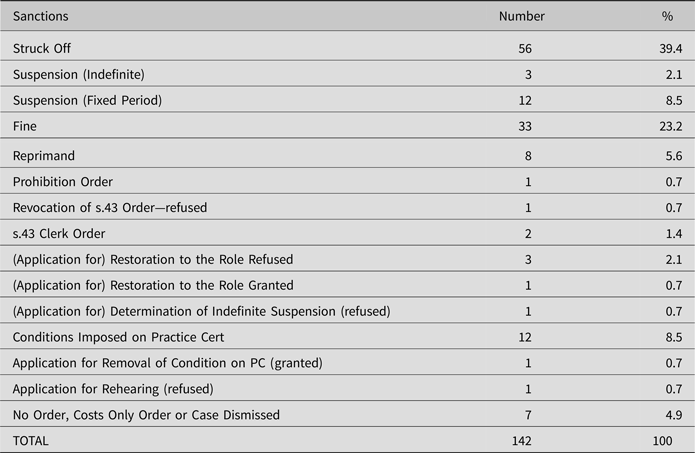
The SDT tended not to impose multiple sanctions. Thus, while one respondent received a fine and a prohibition order,Footnote 181 as shown in Table 3, the total number of sanctions imposed matched the number of respondents. As the Table also shows, striking off and suspension accounted for nearly 55% of SDT actions.
SDT Cases 2015 Total SanctionsFootnote 182

In the sample considered the most likely circumstances for striking off occurred when solicitors were found to have dishonestly used client funds, particularly substantial sums.Footnote 183 A few respondents found to lack integrity were struck off without a finding of dishonesty.Footnote 184 In one of these a solicitor involved in misapplying investment funds was found to have been ‘duped’ by a client,Footnote 185 and may not have appreciated that she was facilitating a fraud, but was nevertheless struck off.Footnote 186 Deliberately ‘borrowing’ client money, even without a finding of dishonesty, also led to striking off.Footnote 187 In general, however, a finding that a solicitor lacked integrity but was not dishonest led to a lesser sanction.
The second group most likely to be struck off were those convicted by courts of serious criminal offences. In one of the most egregious examples a respondent had ferried messages from suspected drug dealers under arrest and a suspect still at large.Footnote 188 He was convicted at Crown Court on three counts of possession of cocaine and attempting to pervert the course of justice. Another respondent was struck off for dishonesty convictions acquired before embarking on a legal career – claiming refunds on five train tickets for which a court had fined her £711.11.Footnote 189 Another had not had a practising certificate since 2009, but was struck off following conviction of drunk driving and other offences, including claiming false expenses from the Law Society.Footnote 190
The conclusion that striking off was the most serious sanction was not true in all cases. The removal of the cap on the SDT's fining powers made a fine the most appropriate sanction in some circumstances. This was demonstrated in Harvie.Footnote 191 Since the respondent had retired from practice, striking off or suspension was potentially a less significant sanction than the £305,000 fine imposed; the difference between the respondent's outlay and the probate value of the deceased client's house he had purchased. Additionally, the order to pay £37,016 costs ensured he was substantially out of pocket. At the other end of the scale a solicitor who called another solicitor ‘a complete plonker’ was reprimanded and ordered to pay costs of £2,600.Footnote 192 This was only slightly more than the SRA's maximum fine, but the SDT declared the proceedings justified because of other factors.Footnote 193 This decision reflected the fact that respondents who admitted all or some of the charges against them and demonstrated what the SDT called ‘genuine insight’,Footnote 194 a recognition of failings combined with remorse, were likely to benefit from a more positive interpretation of conduct and less onerous sanctions.
Banning solicitors from practice contributed 55% of the SDT's disposals and fines a further 25%. The maximum fine imposed was £305,000 and the minimum £500. Fines to a total value of £521,500 were imposed in 33 cases, an average of nearly £16,000 per case. Costs orders were invariably made against respondents. Although the SRA could be ordered to pay costs, it was protected by the tribunal's propensity to recognise a public interest in encouraging prosecution. The total value of costs awarded over the period was £1,742,530, imposed against 115 respondents; an average per case of £15,152. These figures suggest that further increasing the SRA's power to fine, even to £20,000, would reduce the SDT's caseload without a significant loss in terms of solicitors’ rights. Indeed, many would be saved from paying costs almost as severe as the average fine. The cases of failure to obtain PII are good examples of this. Most of the cases resulted from impecuniosity and in only two were the respondents' failure part of a larger and more serious allegation.Footnote 195 In these cases one respondent was struck off and the other was suspended and fined.Footnote 196 In the PII cases where no dishonesty was involved, respondents were fined (five cases), reprimanded (two cases) or suspended (two cases). In some of these cases the SDT expressed doubt about the decision to refer the case to it.Footnote 197
It is not possible to provide any definitive statistical analysis on the SDT's treatment of BAME respondents in our 2015 sample.Footnote 198 However, the John ReportFootnote 199 found significant differences in the imposition of sanctions on BAME solicitors compared to their white counterparts. This was demonstrated most starkly in relation to sanctions imposed for breaches of the SAR. Here, white solicitors (47.8%) were more likely to be reprimanded than BAME solicitors (21.2%).Footnote 200 The most frequent sanction against BAME respondents for SAR breaches was a fine (26.3%).Footnote 201 Where a solicitor was suspended for breach of account rules, that solicitor was almost five times more likely to be of BAME origin (21%) than white (4%).Footnote 202 Overall, the greatest variation in the use of sanctions generally was in relation to the imposition of conditions on practice certificates, at 20% for BAME and 7.5% for whites.Footnote 203 The report called for the SDT to monitor its outcomes by respondents’ ethnicity and gender but the outcome has not been reported.Footnote 204
Conclusion
The LSA 2007 began a phase of deregulation in the legal services market which has not yet concluded. One of its most dramatic impacts was to end professional self-regulation. The result has been a gradual erosion of other indicators of professionalism. In November 2019 the SRA's new regulations will allow solicitors to do unreserved work in unregulated entities, subject to the code of conduct but not necessarily offering other protections such as insurance.Footnote 205 In response the Law Society asks whether solicitors will use this opportunity to set themselves up as unregulated providers because of the benefits of operating without regulation.Footnote 206 One implication is that solicitors struck from the Roll will reappear as owners or workers in a burgeoning alternative legal sector. The LSB has declared that the deregulatory steps facilitated by the Act will soon reach the limits of the current legislative framework, calling for ‘more fundamental revision’.Footnote 207 It claims that the incremental impact of deregulatory initiatives represents a huge shift away from old ways of working towards a better regulated system that is focused on managing risks and delivering better outcomes for all consumers.Footnote 208
In a deregulated legal services sector, it would make perfect sense to place more responsibility for the conduct of lawyers on their employers. Data from the regulatory system throw some light on whether such a shift in direction might be successful. The decreased number of cases reaching the SDT could be evidence of a decline in serious misconduct or that the SRA is operating a so-called ‘regulatory funnel’, like professional SROs, and filtering out the cases before they reach disciplinary hearings.Footnote 209 Both of these notions are countered by the large number of alternative disposals. Many of these presumably involve less serious cases which may not previously have involved a disciplinary sanction. The fact that they now do can be claimed as evidence of the additional reach of the new system. Proportionality in handling these cases could be claimed as evidence of more effective regulation; reinforcing governmentality by heightening the sense of surveillance. Similarly, we speculate that the large proportion of the cases that appear to result from self and firm referrals (31 of the 105 cases or 30%) may be due to the new compliance posts and reporting regulations in the SRA Handbook.Footnote 210 This may be claimed as a benefit of a new culture of managerial responsibility and management of the self. It can also be seen as evidence of an element of governmentality; what Foucault called ‘the conduct of conduct’.Footnote 211
Our data also highlights the limits of governmentality achieved through the logic of corporate bureaucracy, which relies on organisational structure to control behaviour. In 2015, over 4,000 sole practices, and 8,885 2–4 partner firms employed over 30% of all practitioners.Footnote 212 Around 80% of respondents before the SDT in that period were from such firms. When they were from larger firms, more than one member of the firm was often involved in misconduct. Regulation dependent on organisational structure is constrained in dealing with this reality. There is not much point insisting on a compliance officer for conduct if that person is the one involved in wrongdoing. One obvious solution, prescribing a larger minimum size of firm, would ensure a chance of establishing an ethical infrastructure. Another, preventing small units operating in areas handling large sums of client money, would minimise risk. Both of these may exacerbate a problem of access to legal servicesFootnote 213 impeding the regulatory objectives of promoting competition and the consumer interest. They could also be detrimental to diversity in the legal profession as it is predominantly BAME solicitors who populate small firms.Footnote 214 The alternative being urged by government and their regulators is further deregulation. The evidence points to a contrary conclusion; there is arguably a need for the SRA to increase its use of random audits as a means of improving risk identification, controlling lawyer misconduct and closing down firms who fail to comply with the rules.Footnote 215 Random audits may also have a ‘ripple effect’ on lawyer compliance behaviour.Footnote 216
The final step in the decline of the ideology of professionalism in legal services regulation would involve eliminating the SDT. This is the predictable consequence of the growth in the numbers of solicitors. In the decade before Bolton v The Law Society, in which Bingham MR expressed reverence for the reputation of the profession, the number of practising solicitors in England and Wales grew by a little over 28%, from 45,732 to 63,628.Footnote 217 In 2015, there were over 133,000 practitioners, nearly 80% working in 9,403 solicitors’ firms.Footnote 218 The difficult task of regulating such a large group across so many sites is compounded by the diversity of the modes, styles and sizes of solicitors’ practices. The preparation and presentation of cases to the SDT compound the resource problems in confronting these difficulties.
The shrinking number of cases the SDT handles, and the fact that around 70% of the sums paid by respondents comprised costs and only 30% fines, raises the issue of whether it offers a proportional response to the problem of solicitor misconduct. If the SDT did not exist, however, there would still need to be a system for excluding solicitors guilty of serious misconduct. One solution would be for the SRA to deal with low level misconduct, leaving dishonesty offences to be tried by the courts.Footnote 219 An arguably more efficient system would enable the SRA to take all disciplinary actions, including striking off, subject to the protection of an appeals system. Such a step was recently recommended in a Treasury report alongside a recommendation that the criminal standard of proof be abandoned.Footnote 220
There are several counter arguments to further de-regulation. Rule of law and fair trial principles support the use of independent tribunals in hearing cases against lawyers. The risk of increasing the level of state involvement in the practice and discipline aspects of regulation was illustrated recently by a high-profile prosecution of members of a leading human rights firm presenting compensation claims arising from alleged abuse by armed forces in Iraq.Footnote 221 The respondents were acquitted amid claims that the decision to prosecute was influenced by government pressure.Footnote 222 As a result, the SRA has published its new enforcement strategy clarifying when and why it brings proceedings.Footnote 223 This may not have followed had it been the sole arbiter of misconduct. Another consideration is that the SDT may be better able to deal effectively with financial misconduct than courts. This is because the strict requirements of the SAR impose a higher standard than might be enforced using criminal law.Footnote 224 A final consideration is that the tribunal process publicly exposes possible failings in practice regulation. These may not come to light where the regulator is the sole judge of misconduct.
One option that will undoubtedly be considered in the next wave of legal services reform is the creation of a single tribunal to hear misconduct cases against all regulated lawyers. Such a body could be established independently but given a remit clarifying the regulatory standards and methods to be promoted.Footnote 225 This would be an opportunity to explore a different procedural basis for hearings, including replacing the current adversarial format with an inquisitorial approach.Footnote 226 It should enable re-examination of the central priorities of discipline, whether consumer interests, professional reputation or public trust.Footnote 227 It is also possible that the next review will lead to further steps towards competition as the dominant logic of regulation.Footnote 228 In that case, the LSA 2007 will be seen to have actually served a hidden purpose; to act as a bridge to the de-professionalisation of the legal services market.