




No CrossRef data available.
Article contents
Deviancy training and association with deviant peers in young children: Occurrence and contribution to early-onset conduct problems
Published online by Cambridge University Press: 12 May 2005
Abstract
The relationships of deviant talk and role taking during peer interaction, association with deviant peers, and growth in overt and covert conduct problems during kindergarten and first grade were examined in a community sample of 267 boys and girls. At entry to kindergarten, high levels of overt and covert conduct problems predicted association with deviant peers, and deviant peer association predicted deviant talk and role taking during peer interaction during kindergarten. Association with deviant peers, and deviant talk and role taking predicted growth in overt and covert conduct problems on the playground, in the classroom, and at home during kindergarten and first grade. Peer processes associated with growth in conduct problems that escalate rapidly during late childhood and adolescence appear to occur in earlier childhood. These peer processes may play a central role in the evolution of conduct problems to include covert as well as overt forms.
This research was supported by National Institute of Health Grant MH57342.
Information
- Type
- Research Article
- Information
- Copyright
- © 2005 Cambridge University Press
Research suggests that peers play a strong role in the emergence and maintenance of early-onset, life-course persistent antisocial behavior (Moffitt, Rutter, & Silva, 2001; Snyder, 2002). Peers' contribution to risk for antisocial behavior is often described in terms of two developmental processes that are sequentially linked as children move through childhood into adolescence (Hinshaw & Lee, 2003). The first process, occurring during the elementary school years, entails a pattern of coercive interaction with peers that is often accompanied by peer rejection. These peer experiences maintain and exacerbate children's oppositional and aggressive behavior first developed at home (Shaw, Owens, Giovannelli, & Winslow, 2001), and diminish opportunities for the acquisition of social skills and supportive peer relationships.
The second process, selective peer affiliation, occurs during adolescence as adult monitoring is reduced and children have increasing access to a broad set of peers. Children who are highly aggressive are likely to select as friends and close affiliates peers who are similarly aggressive and antisocial (Cairns, Cairns, Neckerman, Gest, & Gariepy, 1988). Given increased opportunities for unsupervised activities (Osgood, Wilson, Bachman, O'Malley, & Johnson, 1996), the mutual affiliation of aggressive, antisocial adolescents provides a rich “training ground” for deviant behavior. This training entails talk about and social endorsement of deviant activities during social conversation (Dishion, Spraklen, Andrews, & Patterson, 1996), and active collusion and coparticipation in deviant acts (Laird, Jordan, Dodge, Pettit, & Bates, 2001). Selective peer affiliation, talk about and endorsement of deviant activities, and coparticipation in deviant acts are important sources for the rapid growth in conduct problems during adolescence, including delinquency, drug use, and sexual activity (Patterson, Dishion, & Yoerger, 2000).
These two sequential peer processes may contribute differentially to covert and overt conduct problems (Hinshaw & Lee, 2003). Earlier peer coercion and rejection facilitate the persistent display of overt, aggressive behavior. Deviant peer affiliation and peer deviancy training in later development support the acquisition and shaping of conduct problems that are more surreptitious in expression, such as stealing, drug use, vandalism, and truancy (Loeber & Stouthamer–Loeber, 1998; Reid & Eddy, 1997). Early-onset and persisting antisocial trajectories entail a developmental course in which later onset, covert forms are layered on earlier appearing and persistent overt forms. The combination of overt and covert conduct problems during childhood increases risk for early and multiple arrests and a variety of other negative outcomes during adolescence and early adulthood (Patterson & Yoerger, 1999).
Overt and covert forms of conduct problems, although correlated, are distinguishable in terms of genetic loading (Edelbrock, Rende, Plomin, & Thompson, 1995), age of initiation, developmental course and stability, and sequellae (Loeber & Stouthamer–Loeber, 1998). Overt forms appear during the preschool years and normatively diminish during the elementary school years. Covert forms, by contrast, appear during the early elementary school years and normatively increase during adolescence (Loeber, DeLamatre, Keenan, & Zhang, 1998). Individual differences in covert conduct problems are clearly discernable by age 10 (Patterson & Yoerger, 1999), and earlier prototypes can be reliably ascertained by 5 years of age (Loeber et al., 1998). Temporal stability in covert conduct problems is discernable as early as 5 years and increases with age (Verhulst, Koot, & Berden, 1990). Early initiation into covert conduct problems is associated with progression to more serious, persistent, and generalized antisocial behavior (Patterson & Yoerger, 2002).
Data concerning the contribution of peers to the initiation and growth in covert conduct problems during early elementary school are sparse and indirect. Snyder, West, Stockemer, Gibbons, and Almquist–Parks (1996) demonstrated that young children's selection of preferred peer affiliates is tied to the relative rates of positive social responses provided during peer interaction, similar to selective peer affiliation and its underlying social processes identified during later childhood and adolescence (Conger & Kileen, 1974; Hops, Alpert, & Davis, 1997). Peer affiliates and friends serve a number of positive social functions. They provide sources of information, influence, and social support that enhance social competence (Rubin, Bukowski, & Parker, 1998). However, they may also foster problem behavior. Snyder, Horsch, and Childs (1997), for example, found that young children selectively affiliate with peers similar to themselves in aggression. Selective affiliation with aggressive peers, in turn, predicted changes in observed and teacher-rated aggression over a subsequent 3-month period. These data provide preliminary support for the hypothesis that affiliation with deviant peers increments risk for conduct problems during earlier childhood in a manner comparable to that occurring in later childhood and adolescence.
“Deviancy training” refers to social processes occurring during peer interaction that shape and encourage the subsequent performance of antisocial behavior (Dishion et al., 1996). This training occurs when children talk about deviant topics, engage in role taking that imitates norm-violating activities observed in family and neighborhood settings and in the media, and when peers respond in a manner that indicates approval or endorsement of such talk and imitation. Deviant talk and role taking during peer interaction create and elaborate scripts (Hayes & Wu, 1998) that guide the performance of rule-breaking behavior in other settings, and that designate when and where such behavior may be performed to gain reinforcement and avoid adult surveillance and punishment. As such, deviancy training may be particularly involved in shaping surreptitious, covert conduct problems. Once established, these scripts may take on rule-governed properties that actually reduce sensitivity to natural environmental contingencies that typically accrue to and discourage antisocial behavior (Riegler & Baer, 1989).
Deviancy training has been observed during the social interaction of adolescent friends (Dishion et al., 1996), and predicts growth in delinquency, early drug use, and early sexual intercourse (Patterson et al., 2000). It is unclear whether peer deviancy training occurs prior to adolescence. Antisocial adolescents have substantial opportunity to locate and affiliate with peers similar to themselves, and have large amounts of unsupervised time to talk about and practice deviant activities (Stoolmiller, 1994). In contrast, younger children have access to a more limited array of peers, primarily classmates and neighborhood children, and are more closely supervised by adults (Snyder, Reid, & Patterson, 2003). However, young children have the opportunity to engage in deviant talk and imitation of norm-violating behavior during peer interaction and play in schoolyards and backyards where adult supervision is minimal (Snyder, Brooker, Patrick, Snyder, Schrepferman, & Stoolmiller, 2003).
Association with deviant peers and peer deviancy training are likely to co-occur and to conjointly facilitate growth in conduct problems. Precocious knowledge about drugs and drug use, sex, aggression, and other deviant activities, and a willingness to talk about and imitate such activities during play are likely to be salient social stimuli in young children's peer groups. This knowledge and talk may then be used to identify like-minded peers and to provide a venue around which to organize social interaction and to gain approval. Although deviant peer association and deviancy training are interrelated, each may make independent contributions to growth in conduct problems, and may more powerfully increment growth in covert than overt conduct problems.
In summary, the following hypotheses were tested: (a) deviant peer association and peer deviancy training occur as early as kindergarten; (b) high levels of overt and covert conduct problems at the transition to kindergarten promote association with deviant peers and involvement in peer deviancy training; and (c) deviant peer association and peer deviancy training facilitate the development of conduct problems during the early elementary school period, and make a more powerful contribution to growth in covert than in overt forms of those problems.
Method
Participants
The participants were 133 girls and 134 boys whose mean age was 5.3 years at the initial data collection point (entry to kindergarten) and 7.2 years at the last data collection point (exit from first grade). A community sample was obtained by using a recruiting strategy targeting three cohorts of kindergarten children (n = 352) who enrolled in one elementary school in each of 3 consecutive years. Informed parental consent and child assent were obtained for 76% of the pool of potential participants. Participants were reimbursed for their involvement at an approximate rate of $10/hr. The target school served a low socioeconomic neighborhood in a metropolitan area with a population of 350,000. Seventy-one percent of the children were European American, 19% African American, 5% Hispanic/Latino, and 3% Native American, and 2% were Asian American. At kindergarten entry, 43% of children lived in intact families with two biological parents, 28% in single-parent (predominantly mother head of household) families, 21% in blended family households, and 7% in other family configurations. The median per capita family income was $8,300; 28% of the children lived in families with incomes below the poverty line. Forty-six percent of the parents completed high school, 34% had education beyond high school, and 20% had less than a high school education. Seventy-five percent of two-parent families were composed of dual wage earners, and 9% of the families were without any employed adult at the time of recruitment.
Data collection was continued after participants made school or residential moves during kindergarten and first grade. At least partial data were available for the 267 children first assessed in the fall of kindergarten as follows: 97.3% in the spring of kindergarten, and 96.9% in both the fall and spring of first grade. Data availability for the various measures as a percent of the total sample were peer deviancy training at 94%; playground observations at 97% in spring kindergarten and fall first grade, and 90% in spring of first grade; parent reports of child behavior at 92% in spring kindergarten, and 89 and 87% in fall and spring of first grade, respectively; teacher reports of child behavior and affiliation with deviant peers at 97% in spring kindergarten, 94% in fall first grade, and 88% in spring first grade. Parameters were estimated in AMOS 4.0 (Arbuckle & Wothke, 1999) using the full information at maximum likelihood (FIML) estimation method. FIML does not delete cases missing from one or more waves of data collection, nor does it delete cases missing one or more variables within a wave of data collection. This procedure avoids biased parameter estimates that are likely to occur if pairwise or listwise deletion procedures are used to compensate for missing data (Arbuckle & Wothke, 1999; Wothke, 2000).
Measures
Peer deviancy training
A construct for peer deviancy training was derived from videotapes of peer interaction of each of the participating children obtained during the kindergarten year. Each child was assigned as the target child on three occasions (once in the early fall, one in midyear, and once in the later spring), and as a nontargeted coparticipating classmate on a minimum of six occasions. Combinations of same-gender classmates were sampled in a semirandom fashion across occasions; such semirandom sampling was needed to accommodate children's availability during the school day.
On each occasion, the target child and his/her same gender classmates were engaged in two tasks. During the first 15 min, the children played one of several structured age-appropriate interactive games at a table. During the second 15 min, the children engaged in free play on an 8 × 12 ft rug, using an array of play materials such as “dress-up” clothes, Barbie dolls, action figures, Lego's, trucks and cars, a Fisher–Price farm set, and so forth. These samples of peer interaction were obtained during the school day, as the children were accessible during noon break, recess, and nonacademic periods. Interaction was videotaped using a wide-angle lens from a distance of approximately 15 ft, with a sensitive microphone placed adjacent to the play area.
These multioccasion samples of peer interaction (total = 90 min for each child as target) were coded using the Antisocial Content Code (ACC; Oeser & Schrepferman, 2002), an age-appropriate modification of the Topic Code developed by Poe, Dishion, Griesler, and Andrews (1990). The focus of the ACC is on the content of children's talk and role taking during play. The ACC provides a real-time interval coding of the occurrence of normative talk and play and each of six different forms of talk and role taking with deviant content according to the following rank-order hierarchy: sex, alcohol and tobacco, sneaky actions (stealing, cheating, or lying), aggression and swearing, authority defiance, and “gross” body functions. The ACC also codes the response of each nontarget peer to each display of deviant talk and role taking by the target child. These responses are coded dichotomously as positive (agreement, laughter, reciprocation of deviant talk, and role taking, or other forms of positive attention) or as not positive (ignoring, nonreciprocal play and conversation, distress, complaints, dismay, correction, disapproval, threats to tell an adult). The occurrence of each of the categories is described by rate per minute, and peer responses as a percent of positive responses.
The topography for each of the categories for deviant talk and role enactment in terms of relevance for young children was iteratively defined by four experienced observers of child playground interaction (all graduate students or postdoctoral trainees) on the basis of watching videotapes of 20 children whose interaction with peers had been globally rated as demonstrating a high frequency of “deviant” talk and role enactment. Each observer transcribed verbal behavior or described role taking that they construed as deviant or “norm violating” for young children. The observers then worked collectively to define specific coding categories for deviant talk and role taking and for positive peer responses. This continued until consensus was reached on categorizing child talk and role taking for several hours of peer interaction, and resulted in a coding manual with descriptions and exemplars for each coding category.
Coders were then trained to a criterion of 65% agreement on a code by code level (discriminating among the various forms of deviant talk and role taking, and ensuing peer responses) and to 80% agreement on discrimination of deviant from normative talk and role taking (collapsing across the deviant categories). Weekly recalibration meetings were held to minimize observer drift and to maintain coder reliability. Ongoing coder agreement was estimated in a quasirandom fashion for 230 (32%) of the total 723 occasions. Percent agreement and kappa indices of coder reliability for the occurrence/nonoccurrence of deviant talk/role taking were 91.2% and .73, respectively. Percent agreement and kappa coder reliability for positive peer responses to deviant talk or enactment were 77.1% and .60, respectively.
Three indicators were derived from this coding: one from early fall interaction, one from midyear interaction, and one from late spring interaction. The indicator for each assessment point was the observed rate per minute with which a target child engaged in the six different classes of deviant talk or role enactment. These indicators were fit to a growth model for child deviant talk and role taking during the kindergarten year.
Deviant peer association
A construct for children's association with deviant peers during kindergarten was defined using eight indicators. Two indicators, one each obtained in the fall and spring of kindergarten, were defined by a single item from the Teacher Report Form (TRF; Achenbach, 1991), “hangs around with children who get in trouble.” Two additional indicators, one each obtained in the fall and spring of kindergarten, were defined by the single comparable item from the parent's Child Behavior Checklist (Achenbach, 1991). Two indicators, one each obtained in the fall and spring of kindergarten, were defined by the mean externalizing scale score on the TRF for three peers whom a child nominated as his or her best friends. Finally, two indicators, one each obtained in the fall and spring of kindergarten, were defined by the mean externalizing scale score on the parent Child Behavior Checklist for the three peers whom a child nominated as his or her best friends.
Child overt and covert conduct problems
Child overt and covert conduct problems were assessed in each of three social ecologies (home, classroom, and school playground) on each of four occasions (fall and spring of kindergarten, and fall and spring of first grade). These data were used to estimate six linear growth models, reflecting overt and covert conduct problems in each of the three social ecologies.
Overt and covert conduct problems on the playground
An adaptation of the behavior observation system described by Weiss, Dodge, Bates, and Pettit (1992) was used to code children's behavior on the playground. This interval coding system classifies child behavior into one of several mutually exclusive and collectively exhaustive categories every 10 s; the category used in current research ascertained the rate per minute with which a target child was physically aggressive toward peers. The behavior of participating children was observed on the school playground on six separate occasions in the fall (Sept.–Oct.) and in the spring (April–May) of the kindergarten year (mean child ages = 5.3 and 5.9 years, respectively), and on four separate occasions in the fall (Sept.–Oct.) and in the spring (April–May) of the first grade year (mean child ages = 6.3 and 6.9 years, respectively). On each occasion, the behavior of each child was observed and coded for 5 min (i.e., 30 consecutive 10-s intervals). The mean cross-occasion rate per minute at which children were observed to direct physical aggression toward peers at each developmental point was calculated, and used as indicators in the growth model for overt conduct problems on the playground.
Coders also made a series of 5-point Likert item ratings at the end of each 5-min observation occasion to assess low base-rate behaviors. One item, “the child engaged in sneaky behavior” (e.g., lying to an adult, blaming others for one's own misbehavior, talk with deviant content), was used to assess covert conduct problems on the playground. The mean of the Likert ratings for this item across occasions was calculated at each developmental point, and these means were used as indicators in the growth model for covert conduct problems on the playground.
Coders were trained to a minimum kappa agreement of .70 prior to data collection for each of the developmental points at which playground observations were obtained. Observer agreement was assessed on 10% of all occasions. Interval by interval coder agreement on physical aggression ranged from 65 to 69%. Intraclass correlations of the rate per minute of physical aggression and mean ratings of sneaky behavior generated by independent coder pairs ranged from .60 to .84 (all ps < .001). There were no statistically reliable variations in coder agreement by child gender, coder, or developmental assessment point.
Children were observed during free play periods on the school playground. Coders located themselves at a distance and perspective to see and hear social exchanges between children. When a child was not visible or relatively proximal to the coder, observation was interrupted until proximal contact could be reestablished. Children's reactivity was minimized by exposure to practice coding, nonresponsiveness of coders to child behavior, and by discontinued observation when sustained behavioral reactivity was apparent. Peer interaction on the playground was relatively free of adult constraints and largely determined by the natural interests and affiliations of the children. Detailed information about the strategies and methods employed for making playground observations is available in Snyder, Brooker, et al. (2003).
Overt and covert conduct problems at home
Parents' ratings of overt and covert child conduct problems were obtained in the fall and spring of kindergarten and first grade, using the Child Behavior Checklist (Achenbach, 1991). The scale for overt conduct problems consisted of 23 items, such as argues, disobedient, fights, and tantrums. Internal reliability of the overt scale was α > .90 at each developmental point. The scale for covert conduct problems consisted of nine items, such as lies, steals, doesn't feel guilty, and runs away from home. Internal reliability of the covert scale was α > .70 at each developmental point. These data were used to estimate linear growth models for overt and covert conduct problems during kindergarten and first grade.
Overt and covert conduct problems in the classroom
Teachers' ratings of overt and covert child conduct problems were obtained in the fall and spring of kindergarten and first grade, using the TRF (Achenbach, 1991). The scale for overt conduct problems consisted of 26 items, such as argues, cruel/bullies, disobedient, teases, and tantrums. Internal reliability of the overt scale was α > .93 at each developmental point. The scale for covert conduct problems consisted of seven items, such as lies, steals, and does not feel guilty. Internal reliability of the covert scale was α > .60 at each developmental point. These data were used to estimate linear growth models for overt and covert conduct problems in the classroom during kindergarten and first grade.
Results
Analytic approach
The analyses were carried out in a series of steps. All variates were first screened for outliers and for normality. No transformations were used. Basic descriptive statistics for each indicator were calculated and are described below. Prior to testing the models representing the central hypotheses, simpler components of these complex models were tested. These simpler models included a latent construct for deviant peer association, and latent growth models for peer deviancy training and for overt and covert conduct problems on the playground, at home, and in the classroom. In the last step, the various growth models and the peer deviancy training construct were combined to evaluate support for hypotheses 2 and 3. All structural equation and latent growth models were tested using AMOS 4.0 (Arbuckle & Wothke, 1999).
Descriptive information and preliminary analyses
Peer deviancy training
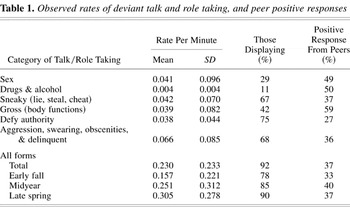
A central issue concerns how often young children actually engage in talk about deviant topics, engage in role taking with deviant content, and obtain positive responses from peers for doing so. The rate per minute at which children were observed to engage in each of the six categories of deviant talk and role taking (alternately referred to more simply as deviancy training), and the conditional probability of positive peer responses to such talk and role taking (aggregated across categories) are shown in Table 1. Kindergarten children engaged in deviancy training about once every 5 min, on the average. Nearly every child was observed to engage in some form of deviant talk/role taking at least once during the total 1.5 hr of observation, and over 75% of the children displayed some form of deviant talk/role taking on each half-hour occasion for which (s)he was the target of coding (see bottom three rows, Table 1). The various categories of deviancy training occurred at roughly equivalent rates (about once every 10–15 min) with the exception of drugs and alcohol. However, there was substantial between-individual variability in the rates and the incidence of deviancy training. Deviant talk and role taking engendered positive peer responses 37% of the time, with some variation according to the type of deviant content.
Observed rates of deviant talk and role taking, and peer positive responses

Rates of deviancy training appeared to increase during the kindergarten year, as shown in the bottom portion of Table 1, from about once every 7 min in the early fall to about once every 3 min in the late spring. As a result, rates of deviancy training were fit to a linear growth model, with the intercept set at midyear to reflect chronic levels of deviancy training across the kindergarten year. The model fit the data quite well, χ2 (2, 266) = 1.56, p = .458, comparative fit index (CFI) = .999, root mean square error analysis (RMSEA) = 0.001. The mean (0.235) and between-individual variance (0.036) for chronic levels of deviancy training during kindergarten were significant (p < .001 for both). On average, deviancy training increased over time (positive slope mean; 0.076, p < .001), with significant between-individual variation (slope variance = 0.016, p < .01) in growth over time.
Deviant peer association
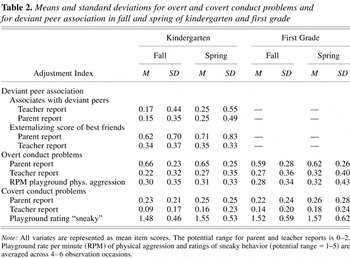
The item-level means and standard deviations for the eight measures of deviant peer association in the fall and spring of the kindergarten year are shown in the top of Table 2. Teachers' and parents' ratings of children's association with deviant peers were small in size (means = 0.15–0.25 on a 0–2 scale). Teacher and parent reports of the externalizing behavior problems of children's self-reported best friends were larger (means = 0.34–0.71 on a 0–2 scale). A construct for deviant peer association defined by these eight indicators was tested, including a priori correlations between fall and spring error terms for common parent- and teacher-reported indices of deviant peer association. The model fit the data adequately, χ2 (23, 266) = 36.99, p = .046, CFI = .987, RMSEA = 0.059, and all of the indicators loaded significantly on the construct (p < .01).
Means and standard deviations for overt and covert conduct problems and for deviant peer association in fall and spring of kindergarten and first grade

Overt and covert conduct problems
The means and standard deviations for overt and covert conduct problems at home, in the classroom and on the playground at each of the four developmental points are shown in the lower portion of Table 2. With the exception of parent reports of child conduct problems at home, all other measures showed increasing means and variances across the four assessment points from the beginning of kindergarten to the end of first grade. Previous analyses indicated that the children in this sample displayed a full range of overt and covert conduct problems, and that mean levels of conduct problems exceeded those derived from normative samples (Snyder, Brooker, et al., 2003).
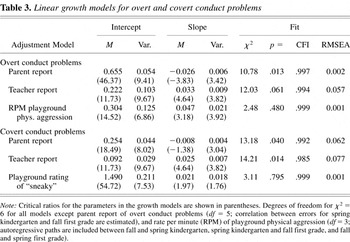
Linear growth models with intercepts set at fall kindergarten were fit to each of the six variable sets for overt and covert conduct problems shown in the bottom portion of Table 2. As shown in the right-hand portion of Table 3, linear growth models for each of the trajectories fit the data adequately (all ps > .01, all CFIs > .980, all RMSEAs < 0.08). The group means and between-individual variation (intercept means and variances) for fall kindergarten conduct problems were significant for all six trajectories. The slope means were positive and significant for teacher-reported overt and covert conduct problems, and for playground observation of physical aggression and sneaky behavior; children, on average, showed increases in each of these forms of conduct problems from fall kindergarten to spring of first grade. In contrast, parent-reported overt and covert conduct problems showed mean declines over time, significant for overt but not for covert forms.
Linear growth models for overt and covert conduct problems

More critical for hypothesis testing, individual differences in change in conduct problems during the kindergarten-first grade period (slope variance) were significant for six of the seven trajectories, and marginally significant for the remaining trajectory for sneaky behavior on the playground. The reasonable fit of linear growth models and reliable individual differences in conduct problems in fall kindergarten and in change in conduct problems over time provide the conditions requisite to using the growth models to test the hypotheses.
Tests of hypothesized models
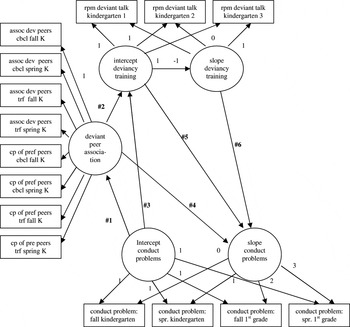
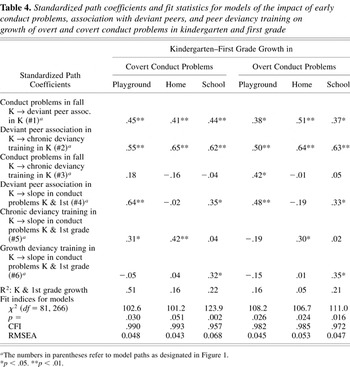
Two sets of models were fit to the data. The first set of models examined the relationship of deviant peer association and peer deviancy training to growth in covert conduct problems on the playground, at home, and in the classroom. The second set of models examined the relationship of deviant peer association and peer deviancy training to growth in overt conduct problems on the school playground, at home, and in the classroom. A generic representation of these models is shown in Figure 1, and the results of tests of the models are shown in Table 4. All parameters for the paths shown in Table 4 and described below in their standardized form.

A generic model of the impact of early conduct problems, association with deviant peers, and peer deviancy training on growth of overt and covert conduct problems in kindergarten and first grade.
Standardized path coefficients and fit statistics for models of the impact of early conduct problems, association with deviant peers, and peer deviancy training on growth of overt and covert conduct problems in kindergarten and first grade

Models predicting growth in covert conduct problems
The results for the models of covert conduct problems are shown in the left portion of Table 4. Greater levels of deviancy training during kindergarten were predicted by higher levels of deviant peer association in kindergarten in models for covert conduct problems on the playground (second row, left column, Table 4; b = .55, p < .01), at home (second row, second column; b = .65, p < .01), and in the classroom (second row, third column from left; b = .62, p < .01). Higher levels of deviant peer association during the kindergarten year were predicted by higher levels of covert conduct problems at kindergarten entry on the playground (b = .45, p < .01), at home (b = .41, p < .01) and in the classroom (b = .44, p < .01) as shown in the first row in Table 4, first to third columns, respectively. The display of early covert conduct problems facilitates deviant peer association, and more association with deviant peers increments displays of deviant talk and role enactment.
The status of deviant peer association during kindergarten as a mediator between covert conduct problems at kindergarten entry and chronic rates of deviancy training was tested. The direct path from covert conduct problems in fall kindergarten to deviancy training during the kindergarten year in the absence of deviant peer association (with paths involving deviant peer association set to 0; not shown in Figure 1 or Table 4) was positive and significant for observed sneaky behavior on the playground (b = .50, p < .001), and for parent- (b = .20, p < .05) and teacher-reported (b = .35, p < .01) covert conduct problems. Given the nonsignificant and small parameter values for these same direct paths when deviant peer association is included in the model (as just described and shown in the third row, three left-hand columns, Table 4), deviant peer association appears to mediate the relationship between covert conduct problems at kindergarten entry and involvement in deviancy training during the ensuing kindergarten year. Neither covert conduct problems at kindergarten entry nor deviant peer association during the kindergarten year predicted slope in deviant talk and role enactment during kindergarten.1
We have shown in other published research that the intercept and slope of deviant talk and role taking is predicted by the relative rates at which such behavior engenders positive peer responses.
Greater growth of covert conduct problems during kindergarten and first grade was predicted by higher levels of deviant peer association, greater chronic rates of deviancy training, or by growth in deviancy training during the kindergarten year. More specifically, higher levels of deviant peer association (b = .64, p < .01) and greater chronic rates of deviancy training (b = .31, p < .05) predicted increases in sneaky behavior on the playground during kindergarten and first grade, and accounted for 51% of the variance (see rows four, five, and seven, first column, Table 4). Higher chronic levels of deviancy training (b = .42, p < .01) reliably predicted increases in parent-reported covert conduct problems during kindergarten and first grade, accounting for 16% of the variance (see rows five and seven, second column, Table 4). Higher levels of deviant peer association (b = .35, p < .05) and growth in rates of deviancy training (b = .32, p < .05) during kindergarten reliably predicted increases in teacher reported covert conduct problems during kindergarten and first grade, and accounted for 22% of the variance (see rows four, six, and seven, third column, Table 4).2
Correlations between contemporaneous error terms for teacher ratings of deviant peer association and child conduct problems, and parent ratings of deviant peer association and child conduct problems were included in the models. These correlated errors were planned a priori, and reflect the shared source variance in the indicators for the two constructs. The resulting correlations were small (range = −.08–.33) and only about half were significant at p < .05.
Models predicting growth in overt conduct problems
The results for the models for overt conduct problems are shown in the right portion of Table 4. Higher chronic levels of deviancy training during kindergarten was predicted by high levels of deviant peer association in kindergarten in models for overt conduct problems on the playground (second row, fourth column, Table 4; b = .50, p < .01), at home (second row, fifth column; b = .64, p < .01), and in the classroom (second row, sixth column; b = .63, p < .01). High levels of deviant peer association during the kindergarten year were predicted by high levels of overt conduct problems on the playground at kindergarten entry (first row, fourth column, Table 4; b = .38, p < .05), at home (first row, fifth column; b = .51, p < .01), and in the classroom (first row, sixth column; b = .37, p < .05). High levels of early overt conduct problems facilitate deviant peer association, and high levels of association with deviant peers increment rates of deviant talk and role enactment.
The status of deviant peer association as a mediator between overt conduct problems at kindergarten entry and chronic rates of deviancy training was tested. The direct path from overt conduct problems in fall kindergarten to chronic levels of deviancy training during the kindergarten year (with paths involving deviant peer association set to 0; not shown in Figure 1 or Table 4) was positive and significant in models for observed rates of physical aggression on the playground (b = .64, p < .001), and for parent- (b = .29, p < .01) and teacher-reported (b = .31, p < .05) overt conduct problems. Given the nonsignificant parameters for these same direct paths when deviant peer association were included in the models for overt conduct problems at home and in the classroom (as just described and shown in row three, columns five and six, Table 4), deviant peer association appears to mediate the relationship between parent- and teacher-reported overt conduct problems at kindergarten entry and involvement in deviancy training during the ensuing kindergarten year. Deviant peer association appears to provide an additional linkage between playground physical aggression and deviancy training rather than serving as a mediator as the path remained significant (b = .42, p < .05) after deviant peer association was added as a potential mediator (see third row, fourth column, Table 4). Neither overt conduct problems at kindergarten entry nor deviant peer association during the kindergarten year predicted slope in deviancy training during kindergarten.
Increases in overt conduct problems during kindergarten and first grade were predicted by high levels of deviant peer association, high chronic rates of deviancy training, or by growth in deviancy training during the kindergarten year. More specifically, high levels of deviant peer association (b = .48, p < .01) reliably predicted increases in observed rates of physical aggression on the playground during kindergarten and first grade, and accounted for 16% of the variance (see fourth and seventh row, fourth column, Table 4). High chronic rates of deviancy training (b = .30, p < .05) reliably predicted increases in parent-reported overt conduct problems during kindergarten and first grade, but only accounted for 5% of the variance (see the fifth and seventh rows, column five, Table 4). High levels of deviant peer association (b = .33, p < .05) and growth in rates of deviancy training (b = .35, p < .05) during kindergarten predicted increases in teacher-reported overt conduct problems during kindergarten and first grade, and accounted for 21% of the variance (see fourth, sixth, and seventh rows, sixth column, Table 4).
Discussion
Individual differences in overt and covert conduct problems, peer deviancy training, and deviant peer association were all apparent as early as the fall of the kindergarten year in this at-risk community sample of young children. It appears that developmental trajectories for covert as well as overt conduct problems and processes involving association with deviant peers and peer deviancy training typically construed as characterizing later childhood and adolescence (Dishion, Patterson, & Griesler, 1994) originate and evolve during the earlier childhood. These processes may provide a complementary mechanism to the empirically well-established role of peer coercion and rejection (e.g., Laird et al., 2001) in the development of antisocial behavior.
The observed individual differences in growth of covert conduct problems at home, on the playground, and in the classroom in these data are consistent with previous research indicating that covert conduct problems are acquired and shaped during early childhood, well before their more substantial growth in later childhood and adolescence (Loeber et al., 1998; Verhulst et al., 1990). However, the absolute levels of early appearing covert conduct problems are modest, and their topographical expression is limited in range. The degree to which initiation and growth in covert conduct problems during early elementary school are harbingers of progression to more serious deviant behavior during adolescence (Jessor & Jessor, 1977; Patterson, Forgatch, Yoerger, & Stoolmiller, 1998) over and above the risk engendered by early, persisting overt conduct problems remains to be established. If such continuity is found, the transition to elementary school may serve as a sensitive period during which efforts can be made to reduce risk for covert conduct problems when they may be relatively more accessible and malleable than in later development.
Deviant talk and imitation of norm-violating behaviors were displayed in a variety of forms during the peer interaction and play of the kindergarten children in this sample. Deviant talk and role taking/imitation also evidenced substantial growth during the kindergarten year, nearly doubling in rate. Peers responded favorably to deviant talk/imitation, and these favorable responses may serve to maintain and amplify its expression over time (Snyder, Stoolmiller, Patterson, Schrepferman, Oeser, Johnson, & Soetaert, 2004). Peer deviancy training previously described as occurring among adolescent friends (Dishion et al., 1996) occurs during the interaction of younger children in social ecologies like the school playground where adult monitoring and contingencies are diminished. Data indicating that selective association with deviant peers occurs as early as kindergarten is consistent with previous research (Snyder, West, Stockemer, Gibbons, & Almquist–Parks, 1996; Vitaro, Gagnon, & Tremblay, 1992). However, the occurrence of selective peer association on the basis of covert as well as overt conduct problems during earlier childhood (Snyder et al., 1997) is a more novel finding.
Covert as well as overt conduct problems, deviancy training, and deviant peer association in early elementary school may represent an interlocking set of risk factors and processes that contribute to risk for early-onset antisocial development. Children who engage in high rates of aggressive and stealthy behavior at kindergarten entry appear to locate and associate with one another, either as the result of behavioral compatibility or exclusion from other relationships in the larger peer group. Differential involvement with deviant peers, in turn, increments rates of children's deviant talk and role taking during the kindergarten. Association with deviant peers as early as kindergarten provides a venue in which children locate like-minded peers with whom to engage in precocious talk about deviant topics and imitation of norm-violating activities. Thus, selection and shaping processes appear to operate quite powerfully in the early peer ecology to foster covert as well as overt forms of antisocial behavior. These peer deviancy processes are facilitated by child conduct problems shaped in family interaction prior to school entry (Reid & Eddy, 1997).
Deviant peer association at school may have more powerful proximal effects on conduct problems displayed in the school setting. Deviant peer association by itself does not appear to promote child conduct problems at home, and suggest limited, same-setting (in contrast to generalized, cross-setting) effects at this stage in development. Children who hang out with peers who get in trouble are at increasing and persisting risk for getting into trouble themselves when they are in immediate proximity to those peers, implying the operation of contagion-like processes (Patterson, Littman, & Bricker, 1967).
Children's talk about and imitation of deviant activities are sufficiently powerful that they impact child behavior in the distal home setting. What children “learn” during peer interaction in kindergarten is apparent in the parents' perceptions of behavior problems of their children, and the negative impact of these lessons on behavior in the home persists into the first grade. In fact, deviant talk and role taking (and not deviant peer association) were the only reliable predictors of change in children's conduct problems at home. The nonnormative values and attitudes that are reflected or engendered by deviant talk and role taking may be central to generalization of peer deviancy training processes across settings, consistent with the rule-governed formulation offered by Hayes and Wu (1998) and Riegler and Baer (1989).
Growth in deviant talk and role taking and high levels of deviant peer association in kindergarten were reliably related to changes in teacher-reported overt and covert conduct problems during the first 2 years of elementary school. Children's choice of peer associates at school and their sensitivity to peer influence affects their classroom adjustment. Association with deviant peers may reflect coparticipation or coinstigation of disruptive and surreptitious behavior, and growth in deviant talk and imitation may reflect the evolution of negative values and attitudes toward teachers, rules, and academic tasks beginning in early elementary school.
Deviant peer association and peer deviancy training accounted for three times more between-child variation in growth of covert than overt conduct problems on the playground and at home. As such, these processes may be central to the emergence and growth of covert behavior problems. Association with deviant peers and peer deviancy training were not more powerfully related to covert than overt behavior problems in the classroom, perhaps reflecting the more uniform and consistent monitoring of child behavior in that setting. Reduced tracking of child behavior and increased peer influence do not occur de novo in later childhood and adolescence, but rather evolve gradually as children make the transition to elementary school. Reductions in the immediacy of contingencies and intensity of adult tracking co-occur with exposure to an array of peers at elementary school entry. Each child in a kindergarten classroom brings exposure to varying levels and different kinds of deviant activities and attitudes prior to school entry. This knowledge is then pooled during peer interaction. Such pooled knowledge appears to be a potentially important source for initiation and growth of covert conduct problems (Snyder, Reid, et al., 2003). The tandem impact of peer deviancy training and deviant peer association on covert conduct problems may accelerate and converge as adult supervision declines and as a wider range of peers become increasingly available during late childhood and adolescence (Dishion et al., 1996; Patterson et al., 2000; Snyder, Reid, et al., 2003).
The additive contribution of deviant peer association and peer deviancy training to early antisocial development can be inferred with some confidence. As measured in this report, the two constructs shared no measurement source variance. In addition, deviancy training was assessed during interaction with a random selection of same gender classmates rather than best friends. This stands in contrast to previous research (Dishion et al., 1996) in which peer deviancy training has been assessed in friendship dyads, an approach that confounds deviant peer association and peer deviancy training. These data indicate that peer deviancy training is a risk process that occurs independent of deviant peer affiliation rather than simply indexing a process by which deviant friends influence on another. Even lower risk children may be negatively affected by persistent exposure to and involvement in deviant talk and role taking during interaction in the broader peer group.
Going to elementary school entails the experience of a new and challenging environment that requires multiple adaptations. Those adaptations invoke risk as well as opportunity. Past research has established the early elementary school peer ecology as a powerful source of risk for overt conduct problems (Kellam, Ling, Merisca, Brown, & Ialongo, 1998; Snyder et al., 1997) and of risk accruing to chronic victimization (Kochenderfer–Ladd & Ladd, 1996; Snyder, Brooker, et al., 2003). The data in this report suggest that this risk extends to covert conduct problems as well.
The considerable power of peers to instigate and amplify problem behavior, and the potential iatrogenic effects of educational placements or intervention groups that systematically increase children's exposure to deviant peers and deviancy training are increasingly well documented (e.g., Dishion, McCord, & Poulin, 1999). The data in this report are even more worrisome in that these pathogenic peer processes appear to operate as early as entry to elementary school. However, the data on peer influence also provide clues about how such negative influence may be minimized and about how the power of the peer group may be harnessed to promote adaptive behavior.
First, it is important to recognize the clear need to actively manage school and other peer ecologies during early and middle childhood to promote skills development and to reduce negative peer influence. Second, there are some data about how to go about doing this. Playground, classroom, and schoolwide interventions using positive behavior interventions and support (PBIS; Kellam, Rebok, Ialongo, & Meyer, 1994; Stoolmiller, Eddy, & Reid, 2000; Sugai & Horner, 1999) have demonstrated effectiveness in promoting cooperation and in diminishing disruptive behavior, aggression, and victimization. Children's talk and play that involves deviant content as well as their aggressive and disruptive behavior are potentially important additional targets of intervention. Young children's deviant talk and play are observable and appear to be sensitive to peer contingencies (Snyder et al., 2004). As a consequence, PBIS-like interventions that systematically alter peer contingencies, such as the good behavior game, might usefully be extended to the management of peer deviancy training and to mitigating the early development of covert as well as overt conduct problems.
Another tactic entails the proactive management of peer association to reduce affiliation among deviant children and its negative sequellae. Some recent research indicates that interventions that purposefully arrange the affiliation of young, at-risk children with three or four prosocial peers may influence at-risk probands in a positive way without deleterious impact on the behavior of low-risk peer associates (Vitaro, 2004).
With the exception of the overlap between parent and teacher reports of deviant peer affiliation and conduct problems, the constructs for the models tested in this report were derived from indicators without overlapping source variance. The models accounted for moderate to substantial amounts of variance in growth in conduct problems (except for overt conduct problems in the home), and were specified in prospective manner in a longitudinal measurement framework. The sample represents a relatively full range of child adjustment and family characteristics. As such, the validity and replicability of these findings may be inferred with some increased confidence.
However, causal inferences drawn from these data remain tentative. The linkage of peer processes and conduct problems may reflect third variables such as child temperament or socioeconomic status. The models presented here are incomplete, and fail to represent a number of other causal variables such as parent and teacher discipline and monitoring (Patterson, 1982), child characteristics such as daring and reward dependence (Lahey & Waldman, 2003), and group processes such as behavioral contagion. Finally, the degree to which the findings derived from this single-school community sample generalize to children, families, schools, and communities with a broader range of characteristics is unknown.
References
REFERENCES
Achenbach, T. M.
(1991).
Integrative guide for the 1991 CBCL/4–18, YSR and TRF
profiles.
Burlington, VT:
University of Vermont Department of Psychiatry.
Arbuckle, J. L., &
Wothke, W.
(1999).
AMOS 4.0 user's guide.
Chicago:
SmallWaters.
Cairns, R. B.,
Cairns, B. D.,
Neckerman, H. J.,
Gest, S. D., &
Gariepy, J. L.
(1988).
Social networks and aggressive behavior: Peer support or
rejection.
Developmental Psychology
24,
815–823.Google Scholar
Conger, R. D., &
Kileen, P.
(1974).
Use of concurrent operants in small group research: A
demonstration.
Pacific Sociological Review
17,
399–416.Google Scholar
Dishion, T. J.,
McCord, J., &
Poulin, F.
(1999).
When interventions harm: Per groups and problem behavior.
American Psychologist
54,
755–764.Google Scholar
Dishion, T. J.,
Patterson, G. R., &
Griesler, P. C.
(1994).
Peer adaptation in the development of antisocial behavior: A
confluence model. In
L. R. Heusmann (Ed.),
Current perspectives on aggressive behavior (pp.
61–95).
New York:
Plenum Press.
Dishion, T. J.,
Spraklen, K. M.,
Andrews, D. W., &
Patterson, G. R.
(1996).
Deviancy training in male adolescent friendships.
Behavior Therapy
27,
373–390.Google Scholar
Edelbrock, C.,
Rende, R.,
Plomin, R., &
Thompson, L. A.
(1995).
A twin study of competence and problem behavior in childhood and
early adolescence.
Journal of Child Psychology and Psychiatry
36,
775–785.Google Scholar
Hayes, S. N., &
Wu, W.
(1998).
The applied implications of rule-governed behavior. In
W. O'Donohue (Ed.),
Learning and behavior therapy (pp.
374–391).
Needham Heights, MA:
Allyn & Bacon.
Hinshaw, S. P., &
Lee, S. S.
(2003).
Conduct and oppositional defiant disorders. In
E. J. Mash &
R. A. Barkley (Eds.),
Child psychopathology
(2nd ed., pp.
144–198).
New York:
Guilford Press.
Hops, H.,
Alpert, A., &
Davis, B.
(1997).
The development of same- and opposite-sex relations among
adolescents: An analogue study.
Social Development
6,
143–167.Google Scholar
Jessor, R., &
Jessor, S. L.
(1977).
Problem behavior and psychological development: A longitudinal study
of youth.
New York:
Academic Press.
Kellam, S. G.,
Ling, X.,
Merisca, R.,
Brown, C. H., &
Ialongo, N.
(1998).
The effect of the level of aggression in the first grade classroom
on the course and malleability of aggressive behavior in middle
school.
Development and Psychopathology
10,
165–185.Google Scholar
Kellam, S. G.,
Rebok, G. W.,
Ialongo, N., &
Meyer, L. S.
(1994).
The course and malleability of aggressive behavior from early first
grade into middle schools: Results of a developmental epidemiologically
based prevention trial.
The Journal of Child Psychology and Psychiatry
35,
359–382.Google Scholar
Kochenderfer–Ladd, B. J., &
Ladd, G.
(1996).
Peer victimization: Manifestations and relations to school
adjustment in kindergarten.
Journal of School Psychology
34,
267–283.Google Scholar
Lahey, B. B., &
Waldman, I. D.
(2003).
A developmental propensity model of the origins of conduct problems
during childhood and adolescence. In
B. Lahey,
T. Moffitt, &
A. Caspi (Eds.),
Causes of conduct disorder and juvenile delinquency (pp.
76–117).
New York:
Guilford Press.
Laird, R. D.,
Jordan, K. Y.,
Dodge, K. A.,
Pettit, G. S., &
Bates, J. E.
(2001).
Peer rejection in childhood, involvement with antisocial peers in
early adolescence, and the development of externalizing behavior
problems.
Development and Psychopathology
13,
337–354.Google Scholar
Loeber, R.,
DeLamatre, M. S.,
Keenan, K., &
Zhang, Q.
(1998).
A prospective replication of developmental pathways in disruptive
and delinquent behavior. In
R. B. Cairns,
L. R. Bergman, &
J. Kagan (Eds.),
Methods and models for studying the individual (pp.
185–216).
Thousand Oaks, CA:
Sage.
Loeber, R., &
Stouthamer–Loeber, M.
(1998).
Development of juvenile aggression and violence: Some common
misconceptions and controversies.
American Psychologist
53,
242–259.Google Scholar
Moffitt, T. E.,
Rutter, M., &
Silva, P. A.
(2001).
Sex differences in antisocial behaviour: Conduct disorder,
delinquency and violence in the Dunedin Longitudinal Study.
Cambridge:
Cambridge University Press.
Oeser, J., &
Schrepferman, L.
(2002).
Antisocial Content Code.
Unpublished manuscript,
Wichita State University, Department of Psychology.
Osgood, D. W.,
Wilson, J. K.,
Bachman, J. G.,
O'Malley, P. M., &
Johnson, L. D.
(1996).
Routine activities and individual deviant behavior.
American Sociological Review
61,
635–655.Google Scholar
Patterson, G. R.
(1982).
Coercive family process.
Eugene, OR:
Castalia.
Patterson, G. R.,
Dishion, T. J., &
Yoerger, K.
(2000).
Adolescent growth in new forms of problem behavior: Macro- and
micro-peer dynamics.
Prevention Science
1,
3–13.Google Scholar
Patterson, G. R.,
Forgatch, M. S.,
Yoerger, K., &
Stoolmiller, M.
(1998).
Variables that initiate and maintain early-onset trajectory for
juvenile offending.
Development and Psychopathology
10,
541–547.Google Scholar
Patterson, G. R.,
Littman, R. A., &
Bricker, W.
(1967).
Assertive behavior in children: A step toward a theory of
aggression.
Monographs for the Society for Research in Child Development
32(5),
1–43.Google Scholar
Patterson, G. R., &
Yoerger, K.
(1999).
Intra-individual growth in covert antisocial behavior: A necessary
precursor to chronic juvenile and adult arrests?
Criminal Behavior and Mental Health
9,
24–38.Google Scholar
Patterson, G. R., &
Yoerger, K.
(2002).
A developmental model for early- and late-onset delinquency.
In
J. B. Reid,
G. R. Patterson, &
J. Snyder (Eds.),
Antisocial behavior in children and adolescents: A developmental
analysis and model for intervention (pp.
147–172).
Washington, DC:
American Psychological Association.
Poe, J.,
Dishion, T. J.,
Griesler, P., &
Andrews, D.
(1990)
Topic code.
Unpublished manuscript,
Oregon Social Learning Center.
Reid, J. B., &
Eddy, J. M.
(1997).
The prevention of antisocial behavior: Some considerations in the
search for effective interventions. In
D. M. Stoff,
J. Breiling, &
J. D. Maser (Eds.),
Handbook of antisocial behavior (pp.
343–356).
New York:
Wiley.
Riegler, H. C., &
Baer, D. M.
(1989).
A developmental analysis of rule following.
Advances in Child Development
21,
191–219.Google Scholar
Rubin, K. H.,
Bukowski, W., &
Parker, J. G.
(1998).
Peer interactions, relationships, and groups. In
N. Eisenberg (Ed.),
Handbook of child psychology: Vol. 3. Social, emotional and
personality development
(5th ed., pp.
619–700).
New York:
Wiley.
Shaw, D. S.,
Owens, F. B.,
Giovannelli, J., &
Winslow, E. B.
(2001).
Infant and toddler pathways leading to early externalizing
disorders.
Journal of the American Academy of Child and Adolescent
Psychiatry
40,
36–43.Google Scholar
Snyder, J.
(2002).
Reinforcement and coercion mechanisms in the development of
antisocial behavior: Peer relationships. In
J. B. Reid,
G. R. Patterson, &
J. Snyder (Eds.),
Antisocial behavior in children and adolescents: A developmental
analysis and model for intervention (pp.
101–122).
Washington, DC:
APA Press.
Snyder, J.,
Brooker, M.,
Patrick, M. R.,
Snyder, A.,
Schrepferman, L., &
Stoolmiller, M.
(2003).
Observed peer victimization during early elementary school:
Continuity, growth, and relation to risk for child antisocial and
depressive behavior.
Child Development
74,
1–18.Google Scholar
Snyder, J.,
Horsch, E., &
Childs, J.
(1997).
Peer relationships of young children: Affiliative choices and the
shaping of aggressive behavior.
Journal of Clinical Child Psychology
26,
145–156.Google Scholar
Snyder, J.,
Reid, J. B., &
Patterson, G. R.
(2003).
A social learning model of child and adolescent antisocial
behavior. In
B. Lahey,
T. Moffitt, &
A. Caspi (Eds.),
Causes of conduct disorder and juvenile delinquency (pp.
27–48).
New York:
Guilford Press.
Snyder, J.,
Stoolmiller, M.,
Patterson, G. R.,
Schrepferman, L.,
Oeser, J.,
Johnson, K., &
Soetaert, D.
(2004).
The application of response allocation matching to understanding
risk mechanisms in development: The case of young children's deviant
talk and play, and risk for early onset antisocial behavior.
Behavior Analyst Today
4,
335–344.Google Scholar
Snyder, J.,
West, L.,
Stockemer, V.,
Gibbons, S., &
Almquist–Parks, L.
(1996).
A social learning model of peer choice in the natural
environment.
Journal of Applied Developmental Psychology
17,
215–237.Google Scholar
Stoolmiller, M.
(1994).
Antisocial behavior, delinquent peer association, and unsupervised
wandering for boys: Growth and change from childhood to early
adolescence.
Multivariate Behavioral Research
29,
263–288.Google Scholar
Stoolmiller, M.,
Eddy, J. M., &
Reid, J. B.
(2000).
Detecting and describing preventive intervention effects in a
universal school-based randomized trial targeting delinquent and violent
behavior.
Journal of Consulting and Clinical Psychology
68,
296–306.Google Scholar
Sugai, G., &
Horner, R. H.
(1999).
Discipline and behavioral support: Preferred processes and
practices.
Effective School Practices
17,
10–22.Google Scholar
Verhulst, F. C.,
Koot, H. M., &
Berden, G. F.
(1990).
Four year follow-up of an epidemiological sample.
Journal of the American Academy of Child and Adolescent
Psychiatry
29,
440–448.Google Scholar
Vitaro, F.
(2004, May).
Social contexts for preventive interventions targeting conduct
problems in young children. In
J. Snyder (Chair), Social contexts for preventive interventions
targeting conduct problems in young children. Symposium conducted at the
annual meeting of the Society for Prevention Research, Quebec City,
Canada.
Vitaro, F.,
Gagnon, C., &
Tremblay, R. E.
(1992).
Friendship and social functioning in rejected children.
Enfance
46,
113–127.Google Scholar
Weiss, B.,
Dodge, K. A.,
Bates, J. E., &
Pettit, G.
(1992).
Some consequences of early harsh discipline and a maladaptive social
information processing style.
Child Development
63,
1321–1335.Google Scholar
Wothke, W.
(2000).
Longitudinal and multi-group modeling with missing data. In
T. D. Little,
K. U. Shnabel, &
J. Baumert (Eds.),
Modeling longitudinal and multilevel data: Practical issues, applied
approaches, and specific examples (pp.
219–240).
Mahwah, NJ:
Erlbaum.
Observed rates of deviant talk and role taking, and peer positive responses
Means and standard deviations for overt and covert conduct problems and for deviant peer association in fall and spring of kindergarten and first grade
Linear growth models for overt and covert conduct problems
A generic model of the impact of early conduct problems, association with deviant peers, and peer deviancy training on growth of overt and covert conduct problems in kindergarten and first grade.
Standardized path coefficients and fit statistics for models of the impact of early conduct problems, association with deviant peers, and peer deviancy training on growth of overt and covert conduct problems in kindergarten and first grade
 You have
Access
- 136
- Cited by