Introduction
Despite talk about ‘broken limits to life expectancy’ (Oeppen and Vaupel Reference Oeppen and Vaupel2002) and the evidence that suggests improvements in some dimensions of health in later life, including the years immediately prior to death (Liao et al. Reference Liao, McGee, Cao and Cooper2000; Parker and Thorslund Reference Parker and Thorslund2007), the last year of life remains a particularly important and difficult period for the near-deceased as well as for their families and health-care professionals (seeRomoren Reference Romoren2003 for a comprehensive account). The year prior to death has been shown to be characterised by large increases in the propensity to experience significant cognitive and functional decline, which constitutes a huge challenge to next-of-kin and professionals providing end-of-life care (Covinsky et al. Reference Covinsky, Eng, Lui, Sands and Yaffe2003; Heyland et al. Reference Heyland, Dodek, Rocker, Groll, Gafni, Pichora, Shortt, Tranmer, Lazar, Kutsogiannis and Lam2006; Imhof and Kaskie Reference Imhof and Kaskie2008; Lunney et al. Reference Lunney, Lynn, Foley, Lipson and Guralnik2003).
Over the past two decades, considerable evidence has been collected that sheds light on various facets of older Americans' last year of life, particularly on morbidity and disability (for early studies seeBortz Reference Bortz1990; Guralnik et al. Reference Guralnik, LaCroix, Branch, Kasl and Wallace1991; Lentzner et al. Reference Lentzner, Pamuk, Rhodenhiser, Rothenberg and Powell-Griner1992), and with investigations of patterns of religious practice and belief (Idler, Kasl and Hays Reference Idler, Kasl and Hays2001). In Europe, however, the number of studies of the life circumstances of the near-deceased remains few (seeBickel Reference Bickel1998 for Germany; Cartwright Reference Cartwright1992; Zhao et al. Reference Zhao, Barclay, Farquhar, Kinmonth, Brayne and Fleming2010 for Great Britain; Costantini et al. Reference Costantini, Beccaro and Merlo2005 for Italy; Jakobsson et al. Reference Jakobsson, Johnsson, Persson and Gaston-Johansson2006 for Sweden). Moreover, to our knowledge, no end-of-life research with a cross-national perspective has been conducted. This would be particularly interesting, though, because previous research has identified significant variation in older people's living conditions across Europe, which one might also expect to see in the year prior to death (seeBörsch-Supan et al. Reference Börsch-Supan, Brugiavini, Jürges, Mackenbach, Siegrist and Weber2005 for a comprehensive overview).
The focus of this paper is on regional variations in older people's functional limitations in performing the activities of daily living (ADLs), in sources of support (family versus non-kin), and in places of death. These issues are very relevant not only for the individuals concerned but also for welfare states, which face the increasing costs of (health) care in ageing populations (Hogan et al. Reference Hogan, Lunney, Gabel and Lynn2001; Rice and Fineman Reference Rice and Fineman2004). Based on unique data from the Survey of Health, Ageing and Retirement in Europe (SHARE), where the second wave in 2006–07 included an end-of-life (or ‘exit’) interview about the first-wave respondents who had died since the baseline data collection in 2004–05, we follow the lives of older people from 11 continental European countries until the time of their death.Footnote 1
Previous research
Previous studies have indicated considerable cross-country variation in older Europeans' physical health (including functional limitations) as well as in the provision of help by family members and non-kin. In addition to the socio-economic health gradient observed in all countries, there is clear evidence of a north–south health gradient, in that older people in Southern Europe are more likely to suffer from physical health problems than their Northern European counterparts, despite the higher life expectancy in the Mediterranean countries (Huisman, Kunst and Mackenbach Reference Huisman, Kunst and Mackenbach2003; Jürges Reference Jürges2010; Mackenbach et al. Reference Mackenbach, Avendano, Andersen-Ranberg, Aro, Börsch-Supan, Brugiavini, Jürges, Mackenbach, Siegrist and Weber2005). These findings have been further substantiated by a recent analysis of cross-national differences in older Europeans' grip strength, which is known to be a strong predictor of disability (Andersen-Ranberg et al. Reference Andersen-Ranberg, Petersen, Frederiksen, Mackenbach and Christensen2009).
A north–south gradient was also found in patterns of support for older people. These are shaped by the complex interplay between the family and welfare-state services (Brandt, Haberkern and Szydlik Reference Brandt, Haberkern and Szydlik2009; Glaser, Tomassini and Grundy Reference Glaser, Tomassini and Grundy2004; Motel-Klingebiel, Tesch-Römer and von Kondratowitz Reference Motel-Klingebiel, Tesch-Römer and von Kondratowitz2005). Although family support plays an important role everywhere, the role of the family is more exclusive in the Mediterranean countries, whereas in Northern Europe help provided by the family is often complemented by professional services. This is also reflected in higher proportions of older people from Northern countries living in institutional households, such as retirement homes or long-term care facilities (Gaymu et al. Reference Gaymu, Delbès, Springer, Binet, Désesquelles, Kalogirou and Ziegler2006; Tomassini et al. Reference Tomassini, Glaser, Wolf, Broese van Groenou and Grundy2004). Moreover, older Southern Europeans less often report exchanges of informal help with friends, neighbours, colleagues or other acquaintances than their Northern counterparts (cf. Kohli, Hank and Künemund Reference Kohli, Hank and Künemund2009).
No research has yet been conducted that addresseses the geography of functional limitations and sources of support in the last year of life of older Europeans. We do know, however, that several socio-demographic characteristics are closely correlated with the likelihood of functional limitations prior to death. In particular, age and sex are strong predictors of disability, with older individuals and women exhibiting the highest risks of functional limitations (Guralnik et al. Reference Guralnik, LaCroix, Branch, Kasl and Wallace1991; Liao et al. Reference Liao, McGee, Cao and Cooper2000). Moreover, socio-economic differences in the health of near-deceased people have been found (Cartwright Reference Cartwright1992; Palmore and Burchett Reference Palmore and Burchett1997). Because there is evidence for an association between marriage and health among older people (e.g. Goldman, Korenman and Weinstein Reference Goldman, Korenman and Weinstein1995), studies should also take into account individuals' marital status (Lentzner et al. Reference Lentzner, Pamuk, Rhodenhiser, Rothenberg and Powell-Griner1992). Both socio-economic and marital status are also important factors with regard to the provision of care and support in the last year of life (e.g. Broese van Groenou et al. Reference Broese van Groenou, Glaser, Tomassini and Jacobs2006; Grabbe et al. Reference Grabbe, Demi, Whittington, Jones, Branch and Lambert1995) – which includes the issue of whether older people die at home or in an institution (Klinkenberg et al. Reference Klinkenberg, Visser, Broese van Groenou, van der Wal, Deeg and Willems2005; Jakobsson et al. Reference Jakobsson, Johnsson, Persson and Gaston-Johansson2006).
Methods
The sample
The analysis presented here is of data from Wave 2 (Release 2.2.0) of the Survey of Health, Ageing and Retirement in Europe (SHARE), which were collected in 2006–07 (for a detailed description seeBörsch-Supan et al. Reference Börsch-Supan, Brugiavini, Jürges, Kapteyn, Mackenbach, Siegrist and Weber2008). The survey was modelled closely on the United States (US) Health and Retirement Study and was the first European survey to combine extensive cross-national and longitudinal information on the socio-economic status, health and family relationships of the older population. Wave 2 contains information on a representative sample of nearly 34,000 individuals aged 50 or more years living in 23,000 households in 14 countries that represent Europe's economic, social, institutional and cultural diversity – from Scandinavia to the Mediterranean. Eleven of these countries participated in the 2004–05 SHARE baseline wave, and yielded 523 end-of-life interviews (287 men and 236 women), with the national samples ranging from a maximum of 86 in Spain to a minimum of 14 in Switzerland.
Overall, the exit interviews were conducted for 83 per cent of the baseline respondents whose death had been confirmed. Information was provided by proxy respondents, 80 per cent of whom were spouses, children or children-in-law of the deceased. The remaining 20 per cent were almost equally split between other family members and non-kin. Three-quarters (75%) of the proxy respondents had daily contact with the deceased during the last year of his or her life, and 13 per cent reported contacts several times a week. Previous research has showed that proxy respondents' assessments of physical health status have a high level of reliability, thus making them not only an unavoidable source but also providers of trustworthy information (Lawrence Reference Lawrence1995).
The average interval between the decedent's death and the end of life interview was 14 months. The average age at death was 75.1 years among men and 80.8 years among women. One should bear in mind that our analysis of functional limitations and support in the last year of life is likely to be based on a somewhat positively biased sample (for details on overall survey participation and attrition in SHARE seede Luca and Peracchi Reference de Luca, Peracchi, Börsch-Supan and Jürges2005; Schröder Reference Schröder, Börsch-Supan, Brugiavini, Jürges, Kaypteyn, Mackenbach, Siegrist and Weber2008). First, almost all of the respondents were sampled from private households in 2004. Given the initial SHARE sample design, we thus miss individuals who were already living in nursing homes in 2004 (Klevmarken, Hesselius and Swensson Reference Klevmarken, Hesselius, Swensson, Börsch-Supan and Jürges2005).Footnote 2 Second, for roughly 30 per cent of the baseline respondents, confirmation of their vital status at Wave 2 is missing.Footnote 3 The fact that it was possible to confirm a respondent's death and to find a person who was able and willing to share information about a recently deceased relative, neighbour or friend implies that we may have missed information on individuals without close relatives or friends. Note, however, that a comparison of the characteristics of the respondents whose deaths were confirmed and for whom end-of-life data were obtained with the characteristics of the 17 per cent for whom no exit interviews were conducted found no evidence for this kind of bias. The latter were, on average, slightly younger, more likely to be male, and more likely to be married than the former.
The measures
We consider three outcomes in our analysis: functional status, sources of support and places of death. Functional status in the year prior to death was measured by the individual's ability to perform the ADLs without difficulty. Proxy respondents were asked to report only ADL difficulties that lasted at least three months in the decedent's last year of life. Building on the capacity to dress, walk across a room, bathe, eat, get in or out of bed, and use the toilet, we distinguished three groups: ‘fully functional’ (no limitation), ‘moderately restricted’ (limitations in one to five ADLs) and ‘severely restricted’ (limitations in all six ADLs).
If the proxy respondent reported that the decedent suffered from one or more ADL limitations, a follow-up question asked for information about the main sources of support with ADLs. We collapsed the original answer categories into three groups of helpers: ‘family only’ (spouse, children, other relatives), ‘non-kin only’ (professionals, volunteers, friends or neighbours) and ‘family and non-kin’. One should note that multiple answers were allowed. Finally, we exploited information on the decedent's place of death, where we distinguished three settings: ‘outside of an institution’ (usually at one's own home), ‘hospital or hospice’, and ‘nursing home’ (including residential homes or sheltered housing).
In the multivariate analysis, we included a set of standard socio-demographic control variables (all measured at baseline): age (50–74, 75–84 and 85 years or older), sex, the highest educational attainment (‘low’ lower secondary level of education or less; ‘medium’ upper secondary or post-secondary, non-tertiary level of education; and ‘high’ first stage of tertiary education or higher) and marital status. The primary interest, however, was in regional variations across Europe. Because of the yet relatively small sample of decedents in the SHARE study, countries were grouped into three regions to maintain sufficiently large numbers of observations for the analysis: the North (Denmark, Sweden and The Netherlands), Central (Austria, Belgium, France, Germany and Switzerland), and the South (Greece, Italy and Spain). These clusters correspond well to a variety of ‘regime’ typologies that are common in the research literature, as for welfare states and family forms (cf. Kohli et al. Reference Kohli, Hank and Künemund2009: 330).
The analysis
In addition to cross-tabulations of the three outcome measures by region, we estimated ordered and multinomial logit models (using STATA 10.0), controlling for the socio-demographic variables described above and the three regions. The results of the multivariate models are presented as odds ratios. Note that we applied effect coding to highlight each region's deviation from the grand mean of all regions in the sample. ‘Effect coding’ uses contrast weights that result in tests of deviations of group means from the intercept coefficient, which inherits the value of the grand mean (e.g. Wendorf Reference Wendorf2004: 54ff.). It is different from dummy coding, where coefficients indicate deviations from the omitted reference group. The coefficients of the k country indicators in the model specify each country's deviation from the grand mean of all observations. In ‘effect coding’, the reference group receives a value of −1 on all between-group vectors; the regression coefficient of this group is eventually calculated as the sum of all k−1 regression coefficients with their signs reversed.
Results
The descriptive findings
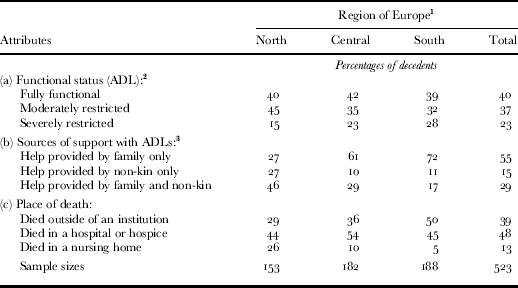
On average, and with barely any regional variation, 40 per cent of the deceased SHARE baseline respondents were fully functional (in terms of ADL limitations) during their last year of life (see Table 1a). Moderate restrictions were reported as of a similar order of magnitude, but with greater regional differences: in the Northern countries, 45 per cent of the deceased suffered from up to five ADL limitations in the year prior to their death, whereas only 32 per cent of their Southern European counterparts experienced moderate restrictions. When turning to ‘severe restrictions’, we observe an inverse north–south gradient: compared to the Scandinavian countries and The Netherlands (15%), nearly twice as many decedents in Greece, Italy and Spain were limited in six (or more) ADLs.
Regional variations in decedents' functional status, sources of support, and place of death, three regions of Europe, 2005–06

Notes: ADL: activity of daily living. 1. North: Denmark, The Netherlands and Sweden; Central: Austria, Belgium, France, Germany and Switzerland; South: Greece, Italy and Spain. 2. Pearson χ2 (4 degrees of freedom (df))=10.76*. 3. Pearson χ2 (4 df)=43.95**. 4. Pearson χ2 (4 df)=42.10**.
Significance levels: * p<0.05, ** p<0.01.
Source: SHARE Wave 2 (Release 2.2.0), authors' calculations. For details see text.
Almost all decedents (97%) who suffered from functional limitations received help with ADLs from at least one person. Overall, the most frequently named providers of help were family members, children in particular (details not shown), but many family members were supported by non-kin helpers (especially professionals) (see Table 1b). In Northern Europe, only one in four decedents who received help with ADLs relied on family support only, whereas almost half received support from family members and non-kin helpers. Exclusive family support was much more widespread in the Mediterranean countries (72%), and to a lesser degree in the ‘Central’ region (61%), but even here, the role of non-kin helpers was substantial and the proportion of near-deceased relying on non-kin as the only source of support with ADLs (10–11%) was considerable.
About half of the sample of deceased respondents died in a hospital or hospice (see Table 1c). Regional differences in people's place of death were mainly shown when comparing the proportions of decedents who died outside of an institution or in a nursing home, respectively. In Northern Europe, almost equally large shares of people died at home (29%) or in a nursing home (26%). In the South, however, 50 per cent of the respondents died at home, whereas only 5 per cent died in a nursing home. With regard to the distribution of deaths across different locations, the ‘Central’ countries – Austria, Belgium, France, Germany and Switzerland – had an intermediate position.
Multivariate results
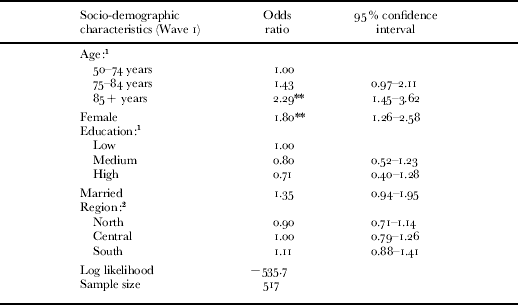
The results of the ordered logit model for decedents' functional status (see Table 2) confirmed the findings of previous research by indicating significant effects of age and sex on the probability of suffering from ADL limitations during the last year of life, most particularly the oldest old and women had a high risk of being moderately or severely restricted. Education and marital status, however, did not have statistically significant associations with functional status during the year prior to death. The same was true for the three regions, whose coefficients did not indicate any significant variations from the grand mean.
Ordered logit model for functional status (ADL) in decedents' last year of life

Notes: ADL: activity of daily living. Functional status was measured in three categories: fully functional (base category), moderately restricted, severely restricted. 1. Reference category. 2. Effect coding.
Significance level: ** p<0.01.
Source: SHARE Waves 1 and 2 (Release 2.2.0), authors' calculations.
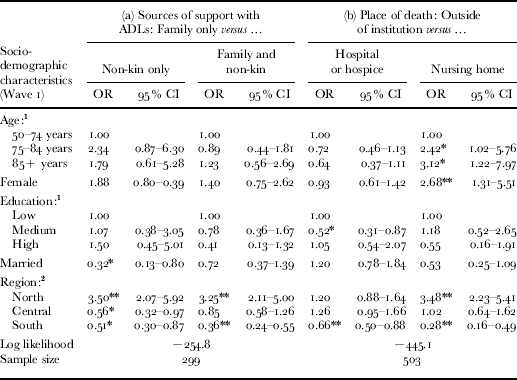
Turning to the multinomial logit model for sources of support, we found no evidence of differences in the main sources of help with ADLs by socio-demographic characteristics (the lower risk of married decedents relying exclusively on non-kin support being the only exception) (see Table 3a). The region, however, did play a major role in determining whether family, non-kin or both provided help during the last year of life. Compared to the grand mean, Northern Europeans were significantly more likely to have received support from non-kin only or to be helped jointly by family and non-kin, whereas the reverse was true for Southern Europeans. In the ‘Central’ region, the odds ratio of receiving exclusive non-kin support as compared to exclusive family support was similar as in the Mediterranean region, whereas the probability of being helped by family and non-kin together was not significantly different from the grand mean.
Multinomial logit models for (a) sources of support with activities of daily living (ADLs) during the last year of life and (b) place of death

Notes: OR: odds ratio. 95% CI: 95% confidence interval. 1. Reference category. 2. Effect coding.
Significance levels: * p<0.05, ** p<0.01.
Source: SHARE Waves 1 and 2 (Release 2.2.0), authors' calculations.
Regarding the decedents' places of death, we found that the baseline respondents who died at the age of 75 or more years and women were the most likely to die in a nursing home (see Table 3b). The probability of dying in a hospital (as compared to at home), however, did not vary systematically by the socio-demographic characteristics, although again there were significant regional differences, with above-average odds of dying in a nursing home among the respondents from Denmark, Sweden and The Netherlands, whereas Greeks, Italians and Spaniards were the least likely to have died in an institution.
Discussion
This study has provided an initial account of the life circumstances of older Europeans in the year prior to their death, and has focused on regional variations in functional limitations and sources of support. Exploiting information from ‘exit’ interviews with proxy reporters for deceased baseline respondents of the Survey of Health, Ageing and Retirement in Europe, the analysis has shown a high prevalence of moderate or severe ADL limitations during the last year of life. Nearly all decedents who had functional limitations received support by family and/or non-kin helpers. A multivariate analysis confirmed the findings of previous studies about the associations between age and sex and the functional status of the near-deceased. The oldest-old and women were not only the most likely to suffer from ADL limitations, they also exhibited the highest risks of dying in a nursing home. While the prevalence of functional limitations was fairly consistent across three regions of continental Europe (North, Central and South), we observed significant regional differences in the main sources of support for the respondents in their last year of life and in their places of death (even after having controlled for differences in socio-demographic characteristics). Northern Europeans were least likely to receive help with ADLs by their family only and most likely to be supported by non-kin (with or without additional help by family members). They also exhibited the highest risk of dying in a nursing home. The reverse was true in the Mediterranean countries, where the dominant patterns were of exclusive family support and dying at home.
These findings are consistent with other European research that has suggested the existence of different ‘regimes’ of help and care across the continent as well as a ‘mixed responsibility’ of families and welfare states as providers of support for older people (cf. Brandt, Haberkern and Szydlik Reference Brandt, Haberkern and Szydlik2009; Motel-Klingebiel, Tesch-Römer and von Kondratowitz Reference Motel-Klingebiel, Tesch-Römer and von Kondratowitz2005). They also have implications for public policies. Although long-term care needs may not parallel demographic projections (Parker and Thorslund Reference Parker and Thorslund2007), the coming decades will impose further demands on both families and formal care systems as an increasing number of older people approach the end of their lives. To master these challenges, joint forces are necessary. The experience of the Danish home care policy, for example, provides evidence that community-based services can aid family care-givers, enable frail older people to live in the setting of their choice, and be cost-effective from a public policy perspective (Stuart and Hansen Reference Stuart and Hansen2006; for related evidence from the United States of America seeGrabbe et al. Reference Grabbe, Demi, Whittington, Jones, Branch and Lambert1995).
Although the home seems to be the preferred place of death for the majority of elders (e.g. Beccaro et al. Reference Beccaro, Costantini, Rossi, Miccinesi, Grimaldi and Bruzzi2006), there is some evidence of a shift in people's places of death from the community to institutions, especially in association with the rising number of the oldest-old, both women and men (Ahmad and O'Mahony Reference Ahmad and O'Mahony2005). Meeting the growing end-of-life needs in hospitals and nursing homes that are likely to result from such a trend poses a particular challenge to Southern European countries. In contrast with the Northern European ‘weak-family societies’, Mediterranean societies still have a tradition of ‘strong’ families and thus seem least prepared – in terms of their institutional infrastructure – for the consequences of population ageing (seeReher Reference Reher1998).
While this analysis of SHARE exit interviews already provides new insights into the geography of functional status and sources of support in Continental Europe, its scope is limited in several ways. First, because of the initial SHARE sampling design, the analysis missed individuals who were living in nursing homes at baseline. Future waves of SHARE, however, will provide such data and enable investigations of the end-of-life experiences of nursing home residents, along the lines of recent US research (e.g. Munn et al. Reference Munn, Dobbs, Meier, Williams, Biola and Zimmerman2008; Wetle et al. Reference Wetle, Shield, Teno, Miller and Welch2005). Second, the small number of observations precluded a full investigation of national differences in the life circumstances of the near-deceased. This will change, however, once further waves of SHARE become available (cf. Börsch-Supan et al. Reference Börsch-Supan, Hank, Jürges, Schröder, Harkness, Pennell, Mohler, Johnson, Lyberg, Edwards, Smith and Braun2010). These will provide not only a greater number of exit interviews, but also more opportunities to link the end-of-life experiences with detailed information from previous interviews. Only then will the research potential introduced in this article fully unfold.