1. Introduction
Participatory forest management (PFM) has been introduced in Tanzania, either as joint forest management (JFM) in government-owned forests, or as community-based forest management (CBFM) in village-owned forests. In JFM ‘preservation’ forests, which are particularly important for ecosystem services such as biodiversity protection, all collection of forest resources is banned permanently (Robinson and Lokina, Reference Robinson and Lokina2009). In JFM ‘production’ forests, limited collection of forest products may be allowed. In CBFM forests, villagers own and manage the forests and set rules and regulations over the collection of forest resources (MNRT, 1998, 2002a, b).
A number of key features of JFM and CBFM in Tanzania inform our paper. First, most PFM initiatives were introduced less than 10 years ago and those where the collection of forest resources is permitted (JFM production and CBFM) are still under temporary moratoria that prevent all or most collection of forest resources until the forest has had a chance to regenerate. Issues of resource protection and enforcement of access restrictions are therefore important, for all the forest types (Clarke et al., Reference Clarke, Reed and Shrestha1993). Second, village committees are responsible for enforcing harvest restrictions within the protected forests. Enforcement typically comprises groups of villagers patrolling the forest, confiscating illegally extracted goods and fining the perpetrators. These villagers are members of committees variously known as ‘Village environmental/forest/natural resource committees’ – which we refer to as VECs in this paper. In almost all the 30 villages in Tanzania's Tanga and Morogoro regions where we collected data at both the village and individual household level, these patrols are unpaid and those who undertake the patrols are considered volunteers. Yet in practice these village patrollers are not volunteering per se, as they almost always have a financial stake in catching those undertaking illegal activities. This stake may be explicit, inasmuch as in some villages the patrollers are entitled to a share of the fine revenue generated. But it may also be implicit where the patrollers take a bribe – a form of petty corruption (Wilson and Damania, Reference Wilson and Damania2005) – rather than report the illegal activity through formal channels.Footnote 1
The small number of illegal activities recorded in the villages suggests one of three scenarios: enforcement is highly effective in deterring illegal extraction; patrollers are not putting any effort into enforcement; or patrollers are taking bribes rather than reporting illegal activities. Determining what is actually happening is tricky. No one on the VECs will admit to bribe taking, and little if any information is available about the extent of illegal activities.
Few data are available concerning the level of illegal extraction from the various PFM forests and whether people are caught and punished. However, we did find different arrangements for sharing the fine revenue collected from those caught extracting illegally, with the VEC patrollers, the village and the government variously receiving a share. Given that patrolling is an unpaid activity and no funds have been made available from the government or other agencies to pay the patrollers, allowing such revenue sharing provides the VEC patrollers with an incentive to undertake enforcement activities. However, as we demonstrate, it has a number of consequences not sufficiently thought through by policy makers.
In this paper, we use these various sharing arrangements to inform a model of optimal enforcement to explore how the structure of rewards and monitoring activities influences the effectiveness of these VEC patrols through the effort that they put into enforcement, opportunities for bribes, and fine revenues. In particular we address the tradeoffs between the incentives created by allowing village patrollers to keep some or all of the fine money, the village revenue generated from fines and the scope for bribe taking. Village patrollers themselves face an important tradeoff because enforcement effort has a feedback effect. If patrollers put little effort into enforcement they will catch few villagers and get little revenue whether from fines or bribes. But if they put too much effort into enforcement they will deter illegal activity, and similarly get little revenue. Full deterrence is therefore particularly difficult without an external budget and with the inherent problem that it is almost impossible to monitor enforcement effort. Forest managers must typically face tradeoffs between enforcement effort, reducing bribe taking, village revenue and forest protection.
The paper is arranged in the following way. In section 2 we look in more detail at the literature that addresses optimal enforcement, enforcement incentives and bribe taking. In section 3 we provide more detailed empirical motivation for the paper. In section 4 we develop a game-theoretic model of optimal enforcement, effort and bribes. Section 5 presents key findings and in section 6 we discuss the policy implications of these findings.-6pt
2. Literature and theoretical underpinnings
The Becker (Reference Becker1968) optimal enforcement framework is a natural starting point to analyse issues of enforcement, effort and bribe taking. Becker recognizes that enforcement is costly and so it might not be optimal to prevent all illegal activities. Enforcement effectiveness – and therefore implicitly enforcement effort – is a function of the amount spent on enforcement and the problem of moral hazard, i.e., that those responsible for enforcement do not choose how much effort to put into enforcement and so cannot influence the probability that someone is caught through their own efforts, is not addressed. Such an assumption may be appropriate for a camera that detects motorists speeding. However, it is far from appropriate for rangers protecting tropical forests who might put their effort into avoiding being attacked while on patrol or might simply minimize effort expended on patrols, rather than into detecting or deterring illegal activity.
In reality, it is those who are responsible for undertaking the enforcement activities who decide how much effort to put into enforcement and therefore the enforcement effectiveness. General economic theory would suggest that enforcement effort is likely to be a function of the rewards patrollers face: highest in situations in which the patrollers get all the revenue from the illegal activities themselves, and lowest in situations in which they get no share. In this respect enforcement effort can be addressed in a similar way to issues of sharecropping and moral hazard (Braverman and Stiglitz, Reference Braverman and Stiglitz1986).Footnote 2 Yet few papers address enforcement in this way. A key exception is Mookerjee and Png (Reference Mookherjee and Png1995) who focus on officials taking bribes instead of imposing official fines and conclude that although the opportunity for bribe taking increases the effort put into enforcement, it is better to eliminate bribe taking through increased monitoring of the enforcement agents.
Corruption, such as in the form of bribe taking, is more comprehensively covered in the literature. Burlando and Motta (Reference Burlando and Motta2007) find that governments characterized by high administrative costs in administrating fines, or by a low ability to spot and prosecute corruption, may prefer to let corruption happen. Klerman and Garoupa (Reference Klerman and Garoupa2002) compare public and private law enforcement and the motivations behind a rent-seeking government. They find that whether the government's enforcement efforts are more or less aggressive than a social-welfare-maximizing government depends on the wealth of offenders and the severity of the crime. Macho-Stadler and Pérez-Castrillo (Reference Macho-Stadler and Pérez-Castrillo2006) find that, without a very high monitoring budget, when firms have different characteristics and the enforcement agency wants to minimize the level of emissions, firms are likely to cheat by not complying with the environmental objective. Therefore, those with limited enforcement budgets should focus on the easiest-to-monitor firms.
The distinction between petty (or administrative) corruption by junior bureaucrats – the focus of our paper – and grand (or state capture) corruption in forestry is addressed explicitly by Callister (Reference Callister1999) and Wilson and Damania (Reference Wilson and Damania2005). Callister identifies a broad range of activities that can be classed as corruption including payments to receive timber concessions (grand corruption) and payments to local officials for logging more than has been authorized (petty corruption).
3. Empirical motivation
We collected data from 30 villages where either CBFM or JFM has been introduced in the Tanga and Morogoro regions of Tanzania, including village-level focus group interviews with VEC members, other villagers and women's groups. In each of these villages the VEC is responsible for enforcing extraction restrictions in the protected forest. The protection strategies were similar in each village. The VEC members typically patrol several times a week in small groups, have little if any equipment, only patrol in the daytime and rarely have an explicit strategy concerning where in the forest they patrol. Although these patrols are described in almost all cases as voluntary, the VEC committee members may be formally rewarded with all or a share of the fine revenues that they collect.
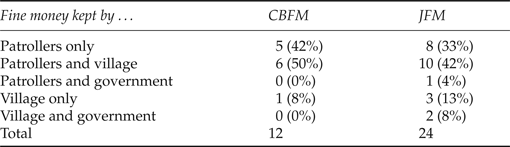
Table 1 provides detail of the different fine revenue sharing arrangements that we found. Although the sample size is small, we find a variety of sharing arrangements, from the patrollers getting none of the fine revenue (six out of 36 observations) to the patrollers getting all of the fine revenue (13 observations). The most common arrangement is for the patrollers to get all the fine revenue or share with the village, and this is true for both JFM and CBFM forests. Other sharing arrangements involve the village and the government with no share being allocated to the VEC patrollers – implying true voluntarism by the patrollers. For those circumstances where the fine revenue is shared, the share going to each party is almost always 50%.
Share of fine revenue going to each group
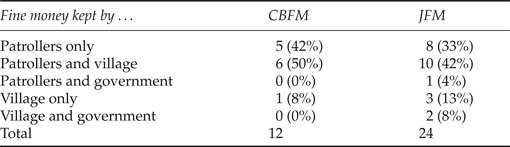
Source: Authors' data, 2008.
CBFM and JFM are very different management concepts applied to different categories of forests, and other factors may influence patrollers depending on whether they are protecting a village forest with CBFM or a government forest with JFM. Therefore, though our theoretical model can been seen as being most appropriate for the JFM forest, the share of fine revenue that goes to the patrollers is likely to influence both effort and honesty in reporting whichever type of forest is being protected.Footnote 3
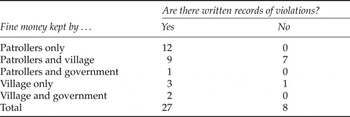
We found that written records of violations are far from adequate. In some villages there were no written records; in others VEC members were reticent in showing us the data. In the records that we saw, few violations were recorded. In one village we were told that ‘only two violations were recorded back in 2006 and nothing since then’; and in another that ‘only two cases of cutting poles have been detected and punished in the past eight years’. In one village the committee members told us that they had detected hundreds of cases of illegal activity but only one person had been caught in the act and brought before the village for formal punishment in the past five years. In several villages we were told that no one had been caught in the past five years. Again, we recognize that the sample size is small, but we do find that written records are more likely if the patrollers keep all the fine revenue (table 2).
Whether villagers keep written records

Source: Authors' data, 2008.
We suspect that the official data do not reflect the number of people caught undertaking illegal activities. Rather, bribes are sometimes exchanged between those collecting illegally and the VEC patrollers. Our interpretation is consistent with observations from India (Robinson et al., Reference Robinson, Kumar and Albers2010).
Our fieldwork observations highlight a key problem that we and others face when undertaking this type of research into illegal activities – in our case both the illegal collection of forest resources from PFM forests and the illegal taking of bribes by the VEC patrollers responsible for enforcing resource collection restrictions: it is very difficult to get data on what is really happening. We do not know and cannot determine the effort that individual rangers put into patrolling. If we see very few arrests and fines we cannot be sure: whether no one is choosing to enter the PFM forest because alternative resources are available; whether the rangers are deterring people from coming into the PFM forest; whether the rangers are not putting in any effort and so the illegal activity is going on unchecked; or whether people are being caught but paying bribes rather than formal fines.Footnote 4 However, recognizing that patrollers can choose both the effort that they put into enforcement and whether or not they take bribes rather than go through formal channels, by using an optimal enforcement model we can explore the likely consequences of the different fine revenue sharing mechanisms that have been implemented in the different PFM forests.
4. The model
Our model employs a one-village two-forest setting. The first forest, closest to the village, is the protected forest where PFM has been introduced. The second forest, further from the village, is unprotected and so de facto open access. We develop the model to represent the key elements of PFM enforcement strategies and villager forest resource harvesting that we have observed in practice. The Forest Management Committee (FMC) sets the enforcement strategy in the PFM forest, namely what share if any of the fine revenue the ‘volunteer’ VEC patroller keeps. A representative VEC patroller, knowing this share, chooses how much effort to put into patrolling and what proportion of illegal activity he reports and therefore collects a fine for, and what proportion he does not report but instead takes a bribe from people caught extracting illegally. Villagers, knowing the VEC's incentive structure, choose whether to collect illegally from the PFM forest or to collect from a more distant forest instead. In this game it is the VEC patroller who decides whether or not to punish the villager with a bribe rather than a formal fine. That is, a villager caught collecting illegally does not make the ‘to bribe or not to bribe’ decision but rather takes whichever punishment the VEC patroller chooses.
As such, the model is game theoretic with a Stackelberg interaction, in common with most of the optimal enforcement literature, and consistent with our empirical observations. However, in contrast to much of the literature, we have three sets of players (FMC, VEC and villagers), rather than the typical two, the enforcement agent and the perpetrator. If the VEC patroller chooses to take a bribe from rather than officially fine the villager, the bribe is lower than the official fine and villagers always agree to pay the bribe. We do not introduce the additional complication that villagers and patrollers can negotiate over the size of the bribe; rather, the size of the bribe is exogenous. Nor do we allow for villagers choosing to refuse to pay a bribe and rather insisting on paying the higher formal fine. In keeping with what we find in practice, we also assume a fixed enforcement strategy in terms of the number and length of patrols and the size of the fine if an individual is caught.Footnote 5
4.1. Representative villager's optimization
In our model, following Robinson et al. (Reference Robinson, Williams and Albers2002),  villagers with opportunity costs of labour uniformly distributed between w min and w max each collect a fixed quantity of non-timber forest product (NTFP) of value Q, either from the protected forest, distance D 1, or from a more distant but unprotected forest, distance D 2 (D 2 > D 1). Villagers take into account the distance costs of getting to the forest, the value of the NTFP collected, and the probability of being caught.Footnote 6 A representative risk-neutral villager with opportunity cost of time w i chooses to collect from the PFM forest (and risk being caught and the NTFP confiscated and a fine or bribe imposed) rather than collecting from the more distant unprotected forest if the expected returns to the former are greater than the certain returns to the latter. That is, if:

which implies she collects from the PFM forest if w i > w* where:

Villagers with opportunity costs of labour higher than w* collect from the PFM forest; those with lower opportunity costs of labour collect from the more distant unprotected forest. If we think of the opportunity cost of labour as being a proxy for a villager's relative poverty, then, perhaps counter-intuitively, our paper suggests that it is the richer villagers – those whose time is more valuable – who are more likely to participate in illegal NTFP collection.
The number of villagers N collecting from the PFM forest can be written:
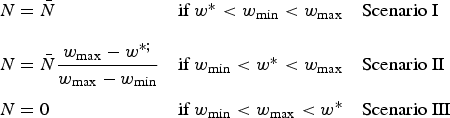
In Scenario I, all the villagers choose to collect from the protected PFM forest, such that marginal changes in enforcement effort do not affect the number collecting. In Scenario II, the number of villagers collecting from the PFM forest (and therefore the scope for bribe and fine collection) varies as a function of the probability of being caught. Finally, in Scenario III, no villager enters the PFM forest. Naturally the applicable scenario is endogenous to the specific model parameters. The above equations provide us with the appropriate representative villager's reaction function, depending on the relevant endogenously determined scenario, that becomes the input into the VEC patroller's decision.
The villagers' collection of NTFPs can be modelled in many ways. Moreover, how villagers react to the VEC patrols is likely to depend on the role that the NTFP plays in their livelihoods, on whether they have alternative sources of the NTFP, and on whether they use markets as a substitute. In Tanzania villagers typically have close to a fixed requirement for fuelwood and those living near to forests rarely sell to or buy from the market. In contrast, villagers who sell NTFPs such as weaving and building materials are more likely to make a marginal decision over how much to collect, based on their access to markets and the opportunity cost of labour. Although we assume a fixed NTFP requirement that can be collected from one of two forests, the key element of our model is that in some circumstances greater enforcement effort has little impact on the extent of illegal activity undertaken in a particular PFM forest (such as if villagers have very low opportunity costs of labour, low elasticities of demand or if no nearby alternatives are available), and in some circumstances a greater enforcement effort has a relatively large impact on the extent of illegal activity in the PFM forest (as villagers substitute other resources, cut down on their use of the forests, or switch to alternate sources or alternate income generating activities if available). The mechanism through which we get a response in terms of the extent of illegal activity in this paper is through the switching of a proportion of the villagers from the protected to the unprotected forest in response to enforcement. The three scenarios allow for these possibilities without requiring a large (and arguably tedious) number of different model formulations to be solved.
4.2. Representative VEC patroller's optimization
Given the villagers' reaction functions above, we next explore the VEC patroller's equilibrium enforcement strategy (his reaction function to the FMC's strategy, which takes into account the villager's reaction function). The VEC patroller maximizes his expected returns to patrolling, V, as a function of the official share of the fine revenue that he receives s (0 ≤ s ≤ 1). His choice variables are the effort, e (0 ≤ e ≤ 1), he puts into enforcement, and the proportion of those he catches that he chooses to report, r (0 ≤ r ≤ 1). The probability p that the VEC patroller catches a villager is a function of the effort the VEC puts into enforcement, p = p(e), 0 ≤ p(e) ≤ 1. Villagers who are caught must either pay an exogenous fine F that the VEC patroller reports, or an exogenous bribe B (0 ≤ B ≤ F).Footnote 7 It is the VEC patroller who chooses whether the villager must pay the fine or the bribe. Taking bribes carries some risk for the VEC patroller (but not the villager who always takes a bribe if it is offered) because he might himself be caught by the FMC and punished. If the VEC patroller is caught taking a bribe, with probability q (where q is a function of the number of bribes the VEC patroller takes) he himself must pay a fine L. The VEC patroller therefore maximizes the following:

The solution to (4) depends on the endogenously determined scenario for the particular parameterization. For scenario I,  (in which all the villagers choose to collect from the closer protected PFM forest, even though they risk being caught and punished, rather than the more distant unprotected forest). The relevant first order condition is:
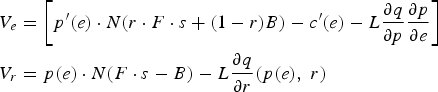
If we assume some relatively simple but appropriate functional forms: p(e) = e α, c(e) = e β and q(e,r) = (e αN(1 − r))γ we can derive analytical solutions for scenario I. The optimization becomes:

And the respective first order conditions are:

For an interior solution:

From (7), if F · s > B it is always better to fine the villager and take the official share of the fine revenue rather than take a bribe. That is, if s > B/F then r* = 1 and 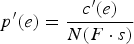 ; naturally, the greater the share the patroller receives the greater his effort.
For small  the VEC patroller may not find it optimal to report any illegal activity, r = 0, and so over this range of shares the VEC patroller effort is constant. The optimization becomes:

The first order condition is simply  from which the optimal effort can be determined. Between these two extremes, for intermediate shares, the VEC patroller fines and reports a proportion of those he catches undertaking the illegal activity and takes a bribe from the remainder. In this Scenario I, villagers continue to collect illegally from the protected forest even after enforcement is introduced. However, the VEC patrollers' effort depends on the share of fine revenue that they are formally allocated.
In Scenario II, a proportion of the villagers switch from the nearby protected PFM forest to the unprotected forest in response to changes in the probability of being caught. N, the number of villagers collecting from the PFM, is a function of the share of illegal activity that the VEC patrollers report and is written:

Equation (9) is derived by replacing w* in (3) with the function derived in (2). The VEC therefore optimizes the following:

For clarity, we let H = (w max − w min)(D 2 − D 1) and K = w max (D 2 − D 1) in which case we can rewrite the optimization as:

Equation (10) is derived from (4). The first term on the right-hand side is the revenue that the VEC patroller gets. This is a product of the probability that the VEC patroller catches a villager, the number of villagers who enter the PFM forest, the proportion of those caught who must pay a bribe, and the revenue the VEC patroller gets from catching and fining or bribing the villagers. The second term is the cost of the VEC patroller's enforcement effort. And the third term is the VEC patroller's expected cost of being caught and punished for taking bribes from villagers rather than imposing a fine. Finally in Scenario III, where villagers have particularly low opportunity costs of labour, N = 0. No villagers enter the protected PFM forest and so this forest is undegraded.
4.3. Forest management committee's policy
The forest management committee chooses what share of fine revenue, s, goes to the VEC patrollers and what share goes to the villagers. It is not obvious what, in practice, or from a modelling perspective, the forest management committee's objective function is, or should be. The objective could variously be to minimize the level of illegal activity, to maximize fine revenue, to maximize villagers' wellbeing, or, if the VEC patrollers also determine the forest management rules, to maximize their own revenues from patrolling. In the latter case there would to all intents be just two sets of players, the VEC and the villagers. Moreover, the social optimum is unlikely to be relevant under these circumstances. Therefore, rather than choosing one specific revenue-sharing policy, we reflect the variety of sharing arrangements found in practice by undertaking a series of comparative statics exercises. These show the impact of the FMC's choice of share of revenue on enforcement effort and therefore on deterrence, the revenue collected by the VEC patrollers, the revenue collected by the village, and the extent of illegal activity – both illegal collection of NTFPs and bribes taken.Footnote 8
5. Results
The above analysis shows how the number of villagers,  , the share of fine revenue the VEC patrollers are given, s, the probability of a villager being caught collecting illegally, q, and the fine a VEC patroller faces if caught taking a bribe, L, all interact to determine the VEC patroller effort and proportion of bribes vs. fines that he imposes, and the number of villagers who collect from the protected PFM forest.
In this section, using the model above, we illustrate explicitly the tradeoffs facing forest departments that must set enforcement policy with little if any access to external funds. We explore a number of situations that characterize what we find in Tanzania and what would be common elsewhere. We focus particularly on two parameters: the share of fine revenue, s, which goes to the VEC patroller – the forest manager's choice variable; and the distance between the two forests, D 2 − D 1, which turns out to be a key driver of our findings.
5.1. Interaction of distance and share revenue
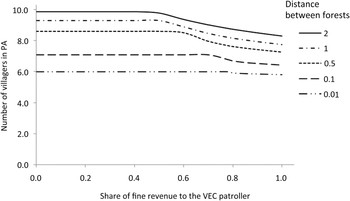
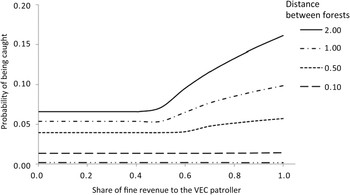
In figure 1, we illustrate the relationship between the share of fine revenue going to the VEC patroller, s, the distance between the protected and unprotected forest, D 2 − D 1, and the number of villagers collecting from the protected PFM forest, N, which proxies for the extent of degradation there.Footnote 9 Varying the share s between 0 and 0.4, whatever the distance between the two forests, the number of villagers in the forest remains the same because at low shares, the VEC patroller does not report any illegal activity and so the share does not influence his choice of effort. At higher shares, as the share is increased above 0.4, an increasing number of villagers switch to the more distant forest. This switch reflects the fact that the share of the fines is now large enough for the VEC patroller to fine a proportion those he catches collecting forest resources illegally (rather than only taking bribes). The larger the share, the greater the proportion of villagers the VEC fines rather than takes a bribe from, which also leads to an increasing probability that the villagers will be caught (figure 2).
Relationship between share of fine revenue, number of villagers in PA and distance between forests.

Relationship between share of fine revenue, probability of being caught and distance between forests.

We explain the impact of parametrically changing D 2 − D 1 in the following way. When the forests are far apart (D 2 − D 1 = 2), virtually all the villagers collect from the PFM forest because the distance cost of switching forests is high. When the forests are closer, some villagers collect from the more distant and costly to reach forest, even when the VEC patroller receives no official share of the fine revenue (s = 0, but p > 0) because he still has an incentive to put effort into patrolling to collect bribes from those caught. The proportion of villagers collecting from each forest does not change for small s between 0 to 0.4. The patroller does not change the effort that he puts into patrolling (refer back to equation (8)) because he prefers not to report any illegal activity but rather to take bribes from all the villagers that he catches. We can recall from (2) that:

where p is driven by the VEC patroller's optimization.
A larger w* implies a smaller number of villagers collecting from the protected PFM forest and a larger number of villagers collecting from the more distant unprotected forest (from equation (3)). Equation (2) confirms that fewer villagers collect from the PFM forest if the probability of being caught is greater, if the effectiveness of the bribe is greater and if the unprotected forest is closer. This is not surprising. However, the impact on the VEC strategy of villagers being able to switch forests, and the tradeoffs faced by the FMC is less clear simply from looking at the equations. A key parameter is the distance between the protected and unprotected forests, D 2 − D 1, and so this is our focus. Though we consider two forests and the distance between them, this distance could also proxy for the ease of accessing alternative sources of NTFPs – the greater distance being equivalent to more costly access, such as more distant markets, or a greater opportunity cost of a villager planting trees on her own land. At the extreme, D 2 − D 1 = ∞, in which case scenario I always prevails.
Focusing on the key metric, D 2 − D 1, also allows us to use the model to explore issues of leakage. This is an increasingly important topic for forest management in tropical countries given the possibility of funding to protect forests and livelihoods through REDD (Reduced Emissions from Deforestation and forest Degradation) initiatives. In an explicitly spatial landscape framework, the protected PFM forest is the forest where REDD is introduced, and leakage is represented by the amount of forest resource collection that occurs in the unprotected non-REDD forest because the nearby forest is protected. Naturally with a sufficiently large D 2 − D 1 no leakage occurs (Scenario I) because there is nowhere for the villagers to displace their resource collection into (and our assumption of a fixed resource that can only be collected from the forest). But for smaller differential distances between the two forests leakage can occur, undermining the REDD efforts.
A growing literature addresses enforcement and community forest management (e.g., Agrawal, Reference Agrawal, Gibson, McKean and Ostrom2000; Somanathan et al., Reference Somanathan, Prabhakar and Mehta2002; Agrawal et al., Reference Agrawal, Chhatre and Hardin2008). Chhatre and Agrawal (Reference Chhatre and Agrawal2008) provide evidence on the importance of enforcement for forest outcomes. Using a nine-country data set, they find that higher levels of local enforcement have a strong relationship to an increased probability of forest regeneration and a lower probability of forest degradation. Our paper suggests that compensation of the individuals responsible for local enforcement and the presence of alternative forests from which villagers can collect forest resources may also influence the relationship between local enforcement and forest degradation.
5.2. Eliminating villagers from the protected PFM is difficult
In Tanzania, forest managers are obligated to prevent all collection of forest resources from JFM preservation forests – in our model this implies ensuring that no villagers choose to enter the protected PFM forest. Yet our model suggests that this is actually difficult in an environment where patrollers choose how much effort to put into enforcement and are rewarded – if at all – based on the number of people they catch and fine (a relatively easily measured metric) rather than how much forest degradation is avoided (a more difficult to measure metric). As we would expect, the greater the distance between the two forests, the greater the number of villagers who continue to collect from the protected area, whatever the formal share the VEC patroller receives (figures 1 and 2). However, the share at which villagers start switching to the unprotected forest – implying a reduction in degradation in the protected PFM forest – is lower, the greater the distance. When D 2 − D 1 is large (in our model, a distance of 2 or more), almost no switching between forests occurs, however large a share of fine revenue is given to the VEC patrollers as an incentive.
Moreover, even if the unprotected forest is only marginally further from the village than the protected forest (D 2 − D 1 = 0.01), it is very difficult to eliminate villagers from the protected PFM forest, whatever the share of fine revenue offered to the VEC patroller. Greater enforcement effort by the VEC patroller simply induces more switching by villagers to the unprotected forest because switching imposes only a very small time cost on the villagers. Therefore the benefit to the VEC patroller of the increased probability of catching villagers is almost completely offset by the smaller number of villagers in the protected forest. So although a nearby unprotected forest relieves pressure on the protected forest, for this calibration, even if the unprotected forest is just 1 per cent further than the protected forest, over half of villagers will continue to collect in the protected forest and the probability of being caught is negligible. In contrast, when the forests are far apart, almost no switching by villagers occurs. Therefore, when the VECs get a greater incentive through a greater share of the fine revenue, they increase their enforcement effort, and the probability of a villager being caught increases substantially (figure 2).
Even with nearby alternative forests from which to collect, our model demonstrates that without external funds for enforcement, it is very difficult to significantly reduce the number of villagers collecting from the protected PFM forest. This finding suggests that even the provision of seedlings for villagers to plant on their own land – which can proxy for reducing the distance cost – might not have the anticipated impact in terms of reducing pressure on the protected PFM forest, and reaffirms the need for external funding to protect forests.
5.3. The Forest Management Committee faces revenue-protection tradeoffs
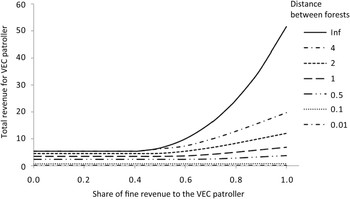
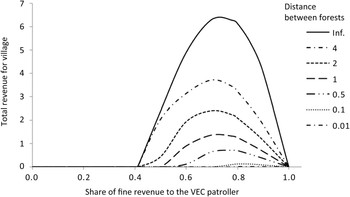
The greater the share of fine revenue going to the VEC patroller, the greater his revenue, but the villager's revenue peaks around 0.5 < s < 0.9 depending on the distance between the two forests (figures 3 and 4). The potential for the village to raise revenues through the collection of fines is greatest for intermediate shares, and is reduced when villagers have alternate forests into which they switch their collection.
VEC patroller revenue as a function of share of fine revenue and distance between forests.

Village revenue as a function of share of fine revenue and distance of the unprotected forest.

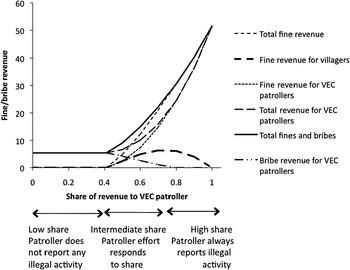
The community faces clear tradeoffs when choosing the share of fine revenues that goes to the VEC patrollers (figure 5). If the VEC patrollers are offered a small share, the patroller does not report any illegal activity and only collects bribes. Overall effort is low, the village gets no revenue, and no instances of individuals being caught undertaking illegal resource extraction are recorded. Above a threshold share, the VEC patroller starts to report a proportion (but not all) of people caught for illegal activity. In this case he receives some bribe revenue and some formal share of the fine revenue. As the formal share offered increases, so does his effort, and so does the proportion of offenders reported. When the patroller receives all the fine money, he puts maximum effort into enforcement and consequently receives maximum income. This has the greatest deterrence effect, but the village community receives no fine revenue. The optimal share of fine revenue to the VEC patroller therefore varies, depending on whether the forest manager wants to maximize enforcement effort, in which case the FMC simply lets the patrollers keep all the fine revenues, or to maximize fine revenue for the village, in which case the patroller only gets a share of the fine revenue, puts in less effort, and more illegal activity occurs.
Revenue–enforcement tradeoffs faced by the FMC.

6. Policy implications and discussion
Forests can rarely be protected perfectly, even when external budgets are available. In our paper we show that without the ability to monitor effort, the forest management committee must face tradeoffs between providing the patrollers with incentives, thereby reducing the level of degradation in the forest, and its own revenue generation. In this respect, our model and its findings are similar to other models that incorporate elements of moral hazard, such as sharecropping. The choices that the forest management committee makes concerning the share of fine revenue that the VEC patrollers keep and the effort that the committee expends on monitoring influences strongly the effort that the VEC patrollers put into enforcement and therefore the success of the PFM venture in terms of protecting the specific forest. It also influences the scope for funding enforcement and monitoring effort through fine revenues, because the formal share of fine revenue influences the extent to which, if at all, the VEC patrollers report the fines that they collect.
In a more involved model we could assume that the funds available for monitoring the VEC patrollers are also endogenous to the model – for example, fine revenues could fund monitoring efforts. Such a setup is likely simply to reduce the incentives further for VEC patrollers not to report any illegal activities and to reduce the effort they put into enforcement, thereby reducing the monitoring funds available and possibly reducing enforcement effectiveness. We could also allow the level of the bribe to depend on the bargaining power of each of the agents, the VEC patroller and the villager. This could be done either by parametrically varying the size of the bribe within our modelling framework, or by using a Nash Bargaining model such as that found in Delacote (Reference Delacote2008), which addresses corruption in the allocation of forest concessions to logging firms and the role of lobbying.
If the key concern is to protect the PFM forest as best as possible, then, without external funding, the solution is to let the VEC patrollers keep all the fine revenue. Such an approach, which would de facto represent full privatization of enforcement, could result in more or less enforcement than is socially optimal (Landes and Posner, Reference Landes and Posner1975; Polinsky, Reference Polinsky1980; Garoupa, Reference Garoupa1997). But issues of forest management in poor countries are more complicated because of the traditional reliance of local communities on forest resources. And simply letting the VEC committee take control of enforcement and keep all enforcement revenues leads to a lack of transparency. For example, we found some villages not bothering to keep records of illegal activity, examples of elite capture, and favouritism by the VEC committee towards particular groups in the village. Moreover, the village does not get any direct benefits in terms of fine revenues from forest protection because all the fine revenue goes to a small group of villagers who have a de facto monopoly over enforcement. If the forest manager requires income for additional conservation efforts such as maintaining forest boundaries, the fine revenue that the FMC and village receive becomes important. The FMC might therefore want to maximize fine revenue, in which case he must balance between providing incentives for patrollers to collect fines rather than bribes, and to put effort into patrolling. The fine revenue that is collected could also be used to compensate villagers for lost access to forest resources. And so again, the fine is more than simply a transfer, as is assumed in much of the optimal enforcement literature (Robinson et al., Reference Robinson, Kumar and Albers2010). Of course, much of this discussion does raise the question of whether policy makers thought about the incentives for villagers to participate in JFM, in particular where few obvious benefits for villagers are evident. Before the introduction of JFM these villagers typically had de facto open access to forest resources, albeit often somewhat degraded, and after the introduction of JFM they are asked not only not to collect from the JFM forest but also to undertake the costs of protecting it.
Not surprisingly, our model predicts very different outcomes in terms of the numbers of villagers deterred from undertaking illegal activities, the number caught and fined and therefore the total level of degradation, depending on the incentives provided for the VEC patrollers in terms of the share of fine revenue that they receive. The predictions of our model are in keeping with the very varied reports from the villages in terms of the number of people recorded as being caught undertaking illegal activities in the PFM forest.
The options open to the forest management committee both to improve forest protection and reduce corruption are relatively limited. Increasing the formal fine has the potential to bring in more revenue. But the higher the official fine the greater the bribe can be. Increasing efforts to monitor the VEC patrollers (proxied in this paper by the parameter  , can increase the level of reporting. But this will also reduce the effort VEC patrollers put into enforcement and therefore the scope for revenue generation. It also requires funding to pay for the monitoring activities, funding that is not at present available. Legalizing the collection of some resources that have the least negative impact on the ecosystem services provided by the PFM forest and selling permits to collect these resources is one approach to increasing funding for enforcement which is independent of the number of people caught collecting illegally. It can also reduce conflict between villagers and those involved in enforcement activities because villagers continue to have access to the forest resources, albeit at a price (Robinson, Reference Robinson2008).
 but we allow fractions.