Introduction
Obesity, a serious problem in Japan, has been linked to chronic diseases such as cardiovascular diseases, diabetes and cancer (Jakicic et al., Reference Jakicic, Marcus, Gallagher, Napolitano and Lang2003). The 2004 report of the National Health and Nutrition Survey found an alarming increase in the percentage of the Japanese population diagnosed with metabolic syndrome – a condition common in obese individuals in their forties – in men and women with waist measurements of 85 and 90 cm, respectively (Ministry of Health Labour and Welfare, 2006). In response, in 2008, the Japanese government passed a law requiring both companies and municipalities to conduct health examinations of workers and their family members (Ministry of Health Labour and Welfare, 2007).
Behavioural scientists in the West have addressed the problem of obesity in great detail (Lodenstock, Reference Lodenstock1974; Becker & Mainman, Reference Becker and Mainman1975; Fishbein & Ajazen, Reference Fishbein and Ajazen1975; Bandura, Reference Bandura1986; Prochaska & Velicer, Reference Prochaska and Velicer1997; Sallis & Owen, Reference Sallis and Owen1998). Unfortunately, their methods and models have often failed to take into account the nature of various diseases that cause obesity; further, the question of how to maintain a healthy way of life remains unresolved (Mae & Boersma, Reference Mae, Boersma, Sutton, Baum and Johnston2005).
In the field of economics, a preference is considered stable if it remains fixed throughout a given period of time. However, in behavioural economics, it is assumed that one's preferences change according to not only one's situation but also one's perspective. In addition, they may be influenced by two preference parameters – time discounting and risk aversion – that introduce a mediating variable. Time discounting, associated with impatience, is defined as the perception that an only-moderately desirable near-future benefit is more desirable than one located in the more distant future although this latter one is, in fact, more desirable (Mitchell, Reference Mitchell1999; Odem et al., Reference Odem, Madden and Bickel2002). For example, ask the question ‘Receiving what sum of money in a month's time would be, for you, the equivalent of receiving 100,000 yen now?’ If the answer is 110,000 yen, then the time-discounting rate is 10%. The greater the value that a person assigns to timeliness – i.e. the more impatient, or shortsighted, a person is – the higher is the time-discounting rate (Goto et al., Reference Goto, Takahashi, Nishimura and Ida2009).
On the other hand, risk aversion, associated with a distinct preference for the avoidance of certain risks, is defined as the following tendency: when one is presented with a choice between two deals, one is more tempted by the choice that offers a guaranteed payoff rather than the one that offers a greater payoff, but without any guarantee that it will, in fact, be realized (Cramer et al., Reference Cramer, Hartog, Jonker and Van Praag2002). For example, a risk aversion question is: ‘If there is a 50–50 chance of winning a lottery offering prize money of 50,000 yen, how much would you pay as the price of the lottery to try your luck at it?’ The greater the respondent's risk aversion – in other words, the value placed on certainty – the lower the price of lottery would have to be.
Recently, there has been considerable debate concerning the existence of a correlation between tobacco use and obesity and, if so, whether these two preference parameters – time discounting and risk aversion – are involved factors (Cutler et al., Reference Cutler, Gleaser and Shapiro2003; Reynolds et al., Reference Reynolds, Richards, Horn and Karraker2004; Ohmura et al., Reference Ohmura, Takahashi and Kitamura2005; Borghans & Golsteyn, Reference Borghans and Golsteyn2006; Goto et al., Reference Goto, Nishimura and Ida2007, Reference Goto, Takahashi, Nishimura and Ida2009). In the case of weight loss, there is evidence that a strong sense of commitment permits a person to exercise self-control, which in turn outweighs any pre-existing tendency toward time discounting. The same new found capacity for self-control leads to a modification of the daily habits that caused the obesity and guaranteed the failure of previous weight-loss efforts (Frank, Reference Frank1988; Kan, Reference Kan2007). In fact, a direct correlation between time discounting and BMI (body mass index) among women and black and Hispanic persons has been found (Komlos et al., Reference Komlos, Smith and Bogin2004; Smith et al., Reference Smith, Bogin and Bishai2005; Weller et al., Reference Weller, Cook, Avsar and Cox2008).
Therefore, it is hypothesized not only that study participants with a strong sense of commitment would be relatively successful in achieving their weight-loss goal, but also that this weight loss would be accompanied by a decrease in time discounting and an increase in risk aversion. It follows that a sense of commitment – inspiring a person to exercise self-control – permits a person to avoid obesity altogether and maintain a healthy weight instead. To complement such a sense of personal commitment, it is also essential that simple and inexpensive obesity-prevention measures be developed (Kan, Reference Kan2007). It is with this goal in mind that a randomized, controlled study – the first of its kind – of the influence, if any, of time discounting and risk aversion on weight-loss efforts was conducted.
The objectives were as follows: (1) To evaluate the effectiveness of the intervention on the commitment involved. The intervention consisted of support by public-health nurses via telephone and mails to encourage the participants to reduce their calorie intake and exercise more. For this purpose, measurements were planned for time discounting and risk aversion, physiological and biochemical indices and psychological factors. (2) To clarify the correlation between the personal commitment and time discounting and risk aversion.
Methods
Participants
Over the course of 24 weeks, from 22nd October 2006 to 31st March 2007, a randomized controlled trial comparing two groups of obese but otherwise healthy men and women between the ages of 20 and 70 – all members of a community club who registered for a health promotion scheme for citizens – was conducted in Kyoto, Japan. Participants had to meet at least one of these three criteria: a BMI over 25 (recognized by the Japan Society of the Study of Obesity); a BMI under 25 but a waist circumference over 85 and 90 cm for men and women, respectively (Ministry of Health Labour and Welfare, 2006) or a weight increase of more than 10% during the previous 20 years (Nakajima & Fujita, Reference Nakajima and Fujita2006). The criteria for exclusion were as follows: obesity caused by drugs prescribed to treat a chronic disease; any disease for which medicine was prescribed; coronary heart disease; type 1 or type 2 diabetes; chronic renal, liver or respiratory diseases; pregnancy; restrictions on exercise; and/or a doctor's prohibition on participation (Truby et al., Reference Truby, Baic, deLooy, Fox, Livingstone and Logan2006). After obtaining informed consent and screening, individual participants were randomized by using STATA10 (Stata Corp., College Station, Texas, USA), stratified by gender, age and BMI group, and allocated into two groups by an individual external to this study. The order of allocation was concealed until the end of the allocation. Since volunteers had been solicited by means of advertisements, the criteria for a blind study could not be met. None of the participants was paid or rewarded for participation in the study, because the company that managed their club was funded by the government. All club members were Japanese and with ethnic characteristics similar to the general Japanese population.
Intervention
The transtheoretical model (TTM) provides a useful framework for understanding the role of motivation in regard to an individual's attempts to change unhealthy habits; it has been applied to a wide range of personal problems, but chiefly to psychological distress, smoking and obesity. The TTM comprises five core constructs as follows: stages of change, processes of change, decisional balance, self-efficacy and temptation (Prochaska et al., Reference Prochaska, Norcross and Diclemente1994; Prochaska & Velicer, Reference Prochaska and Velicer1997). The TTM stipulates that the first stage of change must be a regimen of physical exercise, and that the minimum duration of each of these stages must be 24 weeks: hence the 24-week span of the study (Sarkin et al., Reference Sarkin, Johnson, Prochaska and Prochaska2001). All of the participants received TTM-based booklets concerning nutrition and exercise prepared by the Osaka Medical Centre for Health Science and Promotion. Tele-care – i.e. telephone and mail support conducted by a public-health nurse – was chosen as the intervention because its validity, reliability and safety had previously been proved (Cameron et al., Reference Cameron, MacDonald, Schlegal, Young, Fisher and Killen1990; Hellerstedt & Jerrery, Reference Hellerstedt and Jerrery1997; Sherwood et al., Reference Sherwood, Jeferry, Pronk, Boucher, Hanson and Boyle2006). The participants were provided with personalized weight-loss programmes, based on information provided by the initial health exam and subsequent medical checkups (Prochaska et al., Reference Prochaska, Norcross and Diclemente1994; Gambling & Long, Reference Gambling and Long2006).
The participants' daily routine included recording their weight and, by means of a pedometer, the distance they had walked by the end of each day. For the first three days of the study, the mails in which the participants reported what they had chosen to eat were examined, and a referral form for each participant was prepared accordingly. Next, equipped with this referral form, the public-health nurse telephoned and mailed the participants in the tele-care group to help them decrease their calorie intake as well as increase their physical exercise, in order to strengthen their commitment to weight loss and thereby prevent setbacks before the end of the 24-week period (Frank, Reference Frank1988; Kan, Reference Kan2007). In order to prevent any variations in the level of the quality of support, only one nurse was appointed for all subjects. The nurse corresponded once or twice a week with all the individuals in the tele-care group in order to ensure that they were adhering to the protocol: recording their weight and their pedometer reading on a daily basis, making improvements in their diet, and attending individual counselling sessions designed to help them set personalized goals. The nurse also noted any weight-loss-related changes – physical or mental – that they reported experiencing (King et al., Reference King, Haskell, Taylor, Kraemer and DeBusk1991; Lombard & Lombard, Reference Lombard and Lombard1995). In contrast, the self-help group was to try to achieve weight loss without any such resources: only the booklet provided at the start of the study and self-control, inspired by a sense of commitment to this goal.
Meetings were held with each of the two groups four times: first, immediately after the study had begun (screening for eligibility); at the time of the first health exam (the baseline); and at 8 and 16 weeks. At each meeting, the need to decrease the calorie intake and increase physical exercise was reiterated. At 8 weeks, the problem of whether the programme was unsuitable for any of the participants was considered. At the end of the entire 24-week period, the participants were mailed final questionnaires, with a request to respond promptly.
Outcomes: three measurements
Physical and biochemical outcomes
The primary outcome was change in body weight, which was measured on a digital scale (TANITA BWB-810). Height was measured using a wall-mounted stadiometer (TTM), and blood pressure was measured at the resting state using an auto sphygmomanometer (Nihon Korin BP103i). Serum triglycerides, serum glucose and serum total cholesterol levels were measured under fasting conditions at the baseline and at 8 and 16 weeks.
Psychological outcomes
The total volume of weight lost was used as a proxy variable for the effectiveness of commitment, which depends on the exercise of self-control, regardless of the presence or absence of outside support. Self-control is a matter of developing the correct attitude toward diagnosis and treatment and then eliminating bad habits and replacing them with good ones (Leventhal et al., Reference Leventhal, Halm, Horowitz, Leventhal, Ozakinci, Sutton, Baum and Johnston2005; Mae & Boersma, Reference Mae, Boersma, Sutton, Baum and Johnston2005). A questionnaire was used to measure the degree of self-efficacy, the decisional balance for exercise and the Health-related Quality of Life (HQOL) in general – at the baseline and at 8 and 24 weeks each.
Self-efficacy – the capacity to organize and execute a certain series of actions necessary to manage prospective situations (Bandura, Reference Bandura1977) – was measured by means of the General Self-Efficacy Scale (GSES), which breaks down this concept into three elements as follows: activeness in behaviour, anxiety on failure, and social locus of ability, i.e. the degree to which behaviour is active, whether failure generates anxiety, and whether success is a function of social factors, respectively (Sakano & Toujo, Reference Sakano and Toujo1986; Sakano, Reference Sakano1989; Marcus & Simkin, Reference Marcus and Simkin1994). The GSES has a test–retest reliability of r=0.89, an internal consistency between 0.72 and 0.80, and convergent validity of r=0.66–0.77 when correlated with measurements of these three factors.
It has been hypothesized that while physical exercise increases self-efficacy, its negative as well as its positive points determine whether, and how much, adults decide to undertake it (Sallis & Owen, Reference Sallis and Owen1998). The decisional balance for exercise, which is composed of merits (pros) and demerits (cons), was assessed (Marcus & Simkin, Reference Marcus and Simkin1994; Oka et al., Reference Oka, Hirai and Tsutsumi2003). The decisional balance for exercise has a test–retest reliability of r=0.77–0.80, internal consistency of alpha=0.84 each, and convergent validity of r=0.93–0.94 when correlated with measurement of these two factors, i.e. the pros and cons.
At the same time, it is generally agreed that the main purpose of health care is to contribute to an improvement in the overall HQOL (Sallis & Owen, Reference Sallis and Owen1998). In the present study, the HQOL was evaluated using the Short Form-8 Health Survey (Fukuhara & Suzukamo, Reference Fukuhara and Suzukamo2004). The Short Form-8 Health Survey, composed of a physical component summary (PCS) and a mental component summary (MCS), was used to rate eight elements: general health, physical functioning, role physical (ability to undertake a range of daily activities such as office work and housework), bodily pain, vitality, social functioning, mental health and the role of emotions.
Economic outcomes
Time discounting and risk aversion were measured by means of the questionnaire at the baseline and at 24 weeks (Fig.1). Time discounting is defined by means of the following formula, the elements of which are defined below (Benzion et al., Reference Benzion, Rapport and Yagil1989):
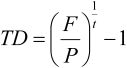
where TD is the rate of time discounting (expresses the degree of impatience); F is the sum of money to be received in the future if the respondent is willing to wait; P is the sum of money to be received immediately if the respondent is unwilling to wait; and t is the length of time that the respondent is willing to wait before receiving the reward.
Questions about time discounting and risk aversion. Answers pertaining to time discounting are T1 (P as 100,000 yen) and T2 (20,000 yen), and those pertaining to risk aversion are R1 (50% and 50,000 yen as a and Z) and R2 (10% and 50,000 yen). Questionnaire was assessed at the baseline and 24 weeks.

Two questions related to a hypothetical choice between two rewards were posed (the two elements of the choice are given the labels T1 and T2): T1 has a P of 100,000 yen; T2 has a P of 20,000 yen. The participants would answer ‘F’ as they wished. In both cases, t was 1 month. The participants were also provided with an estimate of the interest as F that could be made on P during a month (see Fig. 1).
Risk aversion is defined by means of the following formula, the elements of which are defined below (Cramer et al., Reference Cramer, Hartog, Jonker and Van Praag2002):
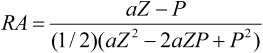
where RA is the rate of risk aversion; a is the probability of winning prize money (in a lottery); Z is the prize money; P is the subjective value of the prize money (the value that the respondent, in the role of a lottery player, places on it).
Two questions regarding risk aversion were posed; in R1, a was 50% and Z was 50,000 yen; and in R2, a was 10% and Z was 50,000 yen.
Adapting the above-mentioned questions to measure time discounting and risk aversion requires the following points to be noted. First, the open-ended questions that enquire about the amount of money impose a cognitive load upon respondents. Moreover, answering questions based upon an amount of money is no easier than answering questions similar to daily choices (Goto et al., Reference Goto, Takahashi, Nishimura and Ida2009). However, previous studies have shown that hypothetical monetary amounts produce results comparable to those obtained with real monetary amounts (Benzion et al., Reference Benzion, Rapport and Yagil1989) and that the subjects' responses reflected individual utilities rather than merely an interest rate (Johnson & Bickel, Reference Johnson and Bikel2002).
Statistical analyses
The following was hypothesized: by the end of the trial, the mean weight lost by the participants belonging to the interventional, i.e. tele-care, group would be 3.0 kg more than the mean weight lost by the control group (Womble et al., Reference Womble, Wadden, McGuckin, Sargent, Rothman and Krauthamer-Ewing2004). Using an alpha value of 0.05 and a power of 80%, a sample size of 19.7 persons per group was chosen to detect this difference. An allowance was made for an estimated dropout rate of 25% (Truby et al., Reference Truby, Baic, deLooy, Fox, Livingstone and Logan2006) after assuming a dropout and attrition rate of 20%, as mentioned in a recent review of long-term weight-loss studies in obese adults (range, 30–60%) (Douketis et al., Reference Douketis, Macie, Thabane and Williamson2005). Accordingly, the calculations for taking excess attrition into account were adjusted to the maximum, and it was estimated that each of the two groups would comprise 60 participants.
Overall, the number of participants was estimated considering the typical prevalence rate (48.0%) of health checkups (Ministry of Health Labour and Welfare, 2005), assuming which the total number of participants was then estimated to be 250. The primary analysis was based on an intention to treat. Baseline differences in continuous variables between the groups were tested by analysis of variance (ANOVA), followed by post-hoc Tukey's B analysis. Categorical variables were described using percentages, and demographic characters were described using descriptive statistics. A two-sample t-test was used to examine the differences between the groups at the baseline and at the end of the trial. The effectiveness of intervention between the groups was assessed by using paired t-tests and Wilcoxon's rank sum tests. Differences between proportions were evaluated using the Chi-squared test and Fisher's exact test. General linear model (GLM) repeated measure ANOVA was used to assess the trend of change from the baseline to 8 and then to 16 (24) weeks using values of different continuous outcome variables (the time and group effects). Outliers were excluded from the analysis. The size of each effect was presented with Cohen's d and r (Cohen, Reference Cohen1988, Reference Cohen1992). The median time discounting and risk aversion (range: 25–75%) and skewness were simultaneously estimated. Since the indices associated with behavioural economics may be asymmetrically distributed, the skewness of the indices was measured.
In order to assess the effectiveness of commitment towards weight loss, the participants were divided and compared into the time-discounting–loss and no-time-discounting–loss, and risk-aversion–gain and no-risk-aversion–gain groups. Many studies have found that time discounting and risk preference are associated with gender, BMI, income and property (Sobal & Stunkard, Reference Sobal and Stunkard1989; Hedley et al., Reference Hedley, Ogden, Johnson, Carroll, Curtin and Flegal2004; Smith et al., Reference Smith, Bogin and Bishai2005). Since several confounding factors were supposed in this study, multiple regression analysis was performed to investigate the relationships of the preference parameters of time discounting and risk aversion to age, initial BMI, job status, educational experience, marital status, income and property after gender stratification. Residual diagnostics were performed to confirm the appropriateness of model assumptions. All the analyses were conducted using SPSS version 15.0 (SPSS Inc, Chicago, IL, USA). The significant levels were p=0.05 for a two-sided test.
All applicable institutional regulations concerning the ethical treatment of human volunteers were followed during the research. Furthermore, this trial was executed under the approval of the ethics committee of the Graduate School of Medicine, Kyoto University.
Results
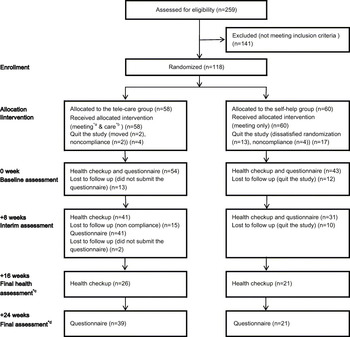
Of the 259 participants screened for eligibility, 118 (45.6%) were eligible, had provided written informed consent and were randomized (Fig. 2). Ninety-seven (32 males and 65 females) of the 118 participants were eventually included in the analysis since 21 participants were excluded, leaving a total of 54 in the tele-care group and 43 in the self-help group.
Flowchart of participation in the study for weight loss in Kyoto, Japan 2006–2007. *aMeeting: motivation with the reduction of calories and the increase of exercise and distribution of the programme outline and booklet. (Note that meetings were held with each of the groups four times: immediately after the study had begun [screening for eligibility], at baseline assessment, at 8 and 16 weeks.) *bCare: telephone and mail to assist the participants by the public-health nurse in reducing calorie intake and increasing exercise in order to ensure strong commitment towards weight loss and avoid set backs. *cA health checkup was conducted in the 16th week only. *dFinal questionnaire was administered in the 24th week only.

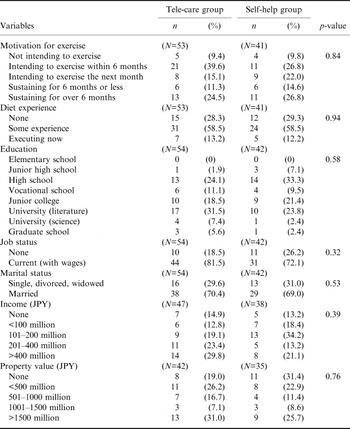
No statistically significant differences in physiological characteristics were detected at the baseline between the groups (Table 1). Most of the participants were not in the habit of exercising regularly prior to the study, and only a few of them (13/54 [24.1%] of the tele-care group and 11/43 [25.6%] of the self-help group) had ever exercised regularly for a period of 6 months or more (Vallis et al., Reference Vallis, Rossi, Ruggiero, Edwards, Greene and Rossi2003). Moreover, a small minority in each group had been attending a weight-loss programme for individuals (7/54 [13.0%] of the tele-care group and 5/43 [11.6%] of the self-help group) (Table 2).
Baseline physiological characteristics of study participants

Values are mean (SD).
Socioeconomic characteristics of study participants

N=number of respondents.
No statistically significant differences in socioeconomic characteristics were detected at baseline between the groups (Table 2). A total of 32 members (55.1%) of the tele-care group and 39 members (65.0%) of the self-help group withdrew from the study within 16 weeks. The average weight loss for participants who discontinued within 16 weeks was 0.54 kg in the tele-care group and 0.80 kg in the self-help group at 8 weeks. No statistically significant differences were detected at the baseline between the participants who discontinued within 16 weeks and participants who continued in the study.
Based on the completed questionnaires, the final response rates were 39 out of 54 (72.2%) for the participants in the tele-care group and 21 out of 43 (48.8%) for those in the self-help group. No participant suffered an adverse event during this trial. Since this study was based on a community event for citizens under a scheme of administration, the final assessment was conducted during a health checkup at 16 weeks, and psychological assessment was conducted during a checkup at 24 weeks.
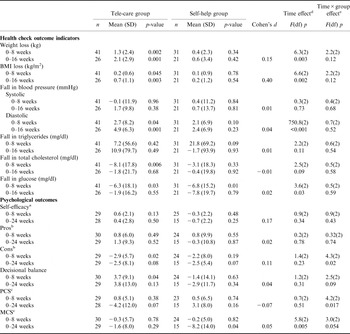
The medical, physiological and psychological outcomes of the participants are shown in Table 3. At the 16-week mark, significant differences were observed in terms of the primary outcome measure in the mean weight loss (t(1, 25)=3.71, p<0.01), BMI loss (t(1,25)=3.35, p<0.01) and the fall in the diastolic blood pressure (t(1, 25)=3.94, p<0.01) in the tele-care group in comparison with the same parameters at the baseline measurement. In contrast, no significant differences were observed in these parameters in the self-help group. Further, the two groups did not differ significantly when compared with each other (weight loss, p=0.80; BMI loss, p=0.90; fall in the diastolic blood pressure, p=0.75). A significant reduction in weight, BMI and diastolic blood pressure was noted in the entire study population at the end of 16 weeks of the intervention (the time effect). No significant differences were found in the trend of change in the health checkup outcome indicators between the groups (the time × group effect). Between-group effect sizes were trivial to small (Cohen's d=0.04 to 0.40). As for the health checkups, the differences between the two groups were insignificant; moreover, there was no significant difference in the mean psychological indices at 24 weeks.
Outcomes of participants in the tele-care and self-help groups between baseline to 8 and 16 (24) weeks

Note: change score=post-treatment score minus baseline score.
p-value: comparison between baseline and 8 weeks or 16 weeks (24 weeks).
Cohen's d: effect size between groups.
a With 16 items (at a range of 0–16). A higher score indicates a higher degree of self-efficacy.
b With 10 items (at a range of 0–50). The more merits and demerits gained, the higher the scores.
c PCS: physical component summary; MCS: mental component summary. A higher score indicates a better statement of the HQOL.
d The time effect represents the results of the GLM repeated measure analysis for the difference between baseline, 8 week and 16 week values of each variables in the entire study population.
e The time×group effect represents the results of the GLM repeated measure analysis assessing whether the trend of change in each variable differed among the groups.
At the 16-week mark, weight loss was observed in 65.4% (17/26) and 66.7% (14/21) of the subjects in the tele-care and self-help groups, respectively.
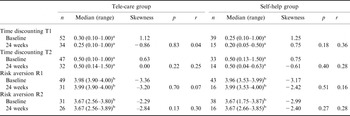
At the end of the 24-week period, time discounting and risk aversion were measured and compared with the baseline measurements. No significant differences were observed between the values at baseline and after the intervention for weight loss; moreover, no significant differences were detected between the tele-care and self-help groups, as shown in Table 4. The effect sizes of the preference parameters were trivial to small (r=0.04–0.36).
Time discounting and risk aversion indices with the intervention of the tele-care and self-help groups at baseline and 24 weeks

a Median (25–75% range).
p-value of comparison between baseline and 24 weeks.
b Median×10−5 (interquantile range×10−5).
r: effect size.
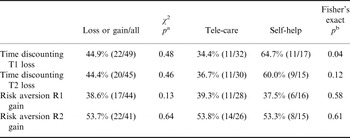
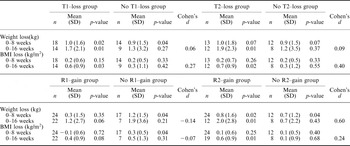
Fisher's exact tests, which compared the differences in the proportion between time-discounting–loss and no-time-discounting–loss as well as risk-aversion–gain and no-risk-aversion–gain in the groups, are applied and shown in Table 5. A significant difference between the two groups was observed: more members of the self-help group showed a decrease in the value of time discounting T1 as compared with those in the tele-care group (p=0.04). In addition, because of the absence of clear differences in the effectiveness of the weight-loss interventions between the tele-care and self-help groups, correlation between time discounting and weight loss and between risk aversion and weight loss was thoroughly examined. Initially, the time-discounting–loss group was compared with the no-time-discounting–loss group; thereafter, the risk-aversion–gain group was compared with the no-risk-aversion–gain group. The results of these comparisons indicated significant differences in the mean weight loss between individuals in the time discounting T1/T2–loss and between those in the risk aversion R2–gain group, as shown in Table 6 (time discounting T1/T2–loss group, p=0.01; risk aversion R2–gain group, p=0.01). However, the groups did not differ significantly (p>0.05).
Rate of participants in the tele-care and self-care groups with decrease in time discounting and increase in risk aversion after the intervention in the 24-week period

a p: Chi-squared test for goodness of fit.
b p: Fisher's exact test for significance.
Time discounting T1 loss:
0: {(Baseline time discounting T1)−(time discounting T1 after 24 weeks)} ≤0.
1: {(Baseline time discounting T1)−(time discounting T1 after 24 weeks) >0.
Risk aversion R1 gain:
0: {(risk aversion R1 after 24 weeks)−(baseline risk aversion R1)} ≤0.
1: {(risk aversion R1 after 24 weeks)−(baseline risk aversion R1) >0.
Health check outcomes of participants in the time-discounting–T1/T2–loss and no-time-discounting–T1/T2–loss groups, and risk-aversion–R1/R2–gain and no-risk-aversion–R1/R2–gain groups between baseline and 16 weeks

Change score=post-treatment score minus baseline score.
p-value: comparison between baseline and 8 weeks or 16 weeks.
Cohen's d: effect size between groups.
T1(T2)–loss=time discounting T1(T2) loss group.
{(Baseline time discounting T1(T2))–(time discounting T1(T2) after 24 weeks)} >0.
No-T1(T2)–loss=no time discounting T1(T2) loss group.
{(Baseline time discounting T1(T2))–(time discounting T1(T2) after 24 weeks)} ≤0.
Risk aversion R1(R2)–gain=risk aversion R1(R2) gain group.
{(risk aversion R1(R2) after 24 weeks)–(baseline risk aversion R1(R2))} >0.
No-R1(R2)–gain=no risk aversion R1(R2) gain group.
{(risk aversion R1(R2) after 24 weeks)–(baseline risk aversion R1(R2))} ≤0.
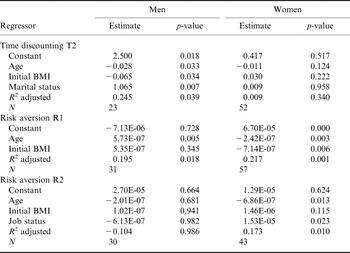
In the following analysis, gender stratification was initially adjusted according to the evidence. Moreover, to assess how the variables as the socioeconomic characteristics affect each other, time discounting and risk aversion were analysed by the variables age, initial BMI, job status, educational experience, marital status, income and property. A multiple regression analysis of time discounting (T1) and risk aversion (R1 and R2), according to gender, was performed to assess these variables (Tables 7). Among the men, as predicted, age, initial BMI and marital status were associated with time discounting, and a moderate degree of collinearity was observed between their initial BMI and age but not between their initial BMI and marital status. Among the women, age and initial BMI were associated with risk aversion R1, whereas age and job status were associated with risk aversion R2; further, no collinearity was observed between age and initial BMI.
Multiple regression analysis of time discounting and risk aversion by gender

Discussion
The aim of this randomized controlled trial was to assess the effectiveness of intervention for weight loss, wherein the amount of weight loss was used as a proxy value for assessing the effectiveness of commitment as well as estimating time and risk preferences. Intervention consisted of telephone and mail support by a nurse, the validity, reliability and safety of which has already been proven (Cameron et al., Reference Cameron, MacDonald, Schlegal, Young, Fisher and Killen1990; Hellerstedt & Jerrery, Reference Hellerstedt and Jerrery1997; Prochaska & Velicer, Reference Prochaska and Velicer1997; Gambling & Long, Reference Gambling and Long2006; Sherwood et al., Reference Sherwood, Jeferry, Pronk, Boucher, Hanson and Boyle2006). The intervention was considered to be very simple since it fell under the category of common health education. The study was conducted on the basis of the hypothesis that participants who were strongly committed to losing weight might be more successful in achieving their goal; moreover, this was supposed to decrease the value of time discounting and increase risk aversion (Frank, Reference Frank1988; Kan, Reference Kan2007). Although the mean weight loss from baseline to 16 weeks differed significantly in the tele-care group, the difference between groups was not significant. Moreover, unexpectedly, after 24 weeks of intervention, there were no significant differences in the values of time discounting, risk aversion and psychological indices between the tele-care and self-help groups. Furthermore, contrary to the expectations of the effectiveness of the intervention, the number of participants showing a decrease in the time discounting and increase in the risk aversion was greater in the self-help group than in the tele-care group. Whether the volume of weight loss correlated to a dose–response relationship between the effectiveness of commitment, the time and risk preferences, and the decrease in time discounting and increase in risk aversion was evaluated. There were significant differences in the weight loss with the time-discounting–loss and risk-aversion–gain groups. Unfortunately, it is unclear which group (i.e. tele-care or self-help group) demonstrated a stronger commitment to weight loss and whether time discounting and risk aversion and commitment might imply a specific causality. There is a possibility that a decrease in time discounting and increase in risk aversion might correlate with the weight loss or effectiveness of commitment in this trial. From the results of multiple regression analysis by gender, it was found that BMI, age, marital status and job status were confounding factors of time and risk preferences.
Typically, greater importance tends to be attached to the support of others; nevertheless, it can be concluded that participants who were strongly committed to the goal of weight loss, regardless of whether they received support from others, could succeed in achieving this goal. Not all the interventions and the participants of behaviour change might complete or succeed in attaining their objectives (Cohen et al., Reference Cohen, Halvorson and Gosselink1994; Adams & White, Reference Adams and White2005; Rhodes et al., Reference Rhodes, Plotnikoff and Courneya2008). It is believed that some participants in the tele-care group became dependent on the public-health nurse and hence did not exercise their capacity for self-control to the maximum, while others rejected the nurse's efforts at intervention and in fact exercised self-control, similar to those in the self-help group. However, participants in both the groups with a strong commitment toward achieving their weight-loss goals used, as instructed, the nurse's interventions and self-control techniques, as applicable. That some participants in the self-help group attempted to compensate for the lack of professional help is suggested by the fact that this group registered a slightly greater decrease in time discounting and a slightly greater increase in risk aversion than did the tele-care group. In other words, it was found that the intervention for the self-help group was greatly cost-effective since it was essentially based on self-control. This study suggests that intervention can help some of those who need to change their behaviour patterns, but that others, equipped with an understanding of the importance of the benefit of weight loss, need nothing more than their strong sense of commitment to this goal.
This study has several strengths. It has been reported that an understanding of the consequences of unhealthy behaviour significantly improves the success rate of preventive efforts (Kenkel, Reference Kenkel1991). Participants who preferred to avoid future risk, i.e. those with decreased time discounting and increased risk aversion, might modify their behaviour in such a way as to avoid risk and accept intervention and motivation. This study suggests that time discounting and risk aversion may be useful in anti-obesity efforts, since they are accurate criteria of behavioural patterns associated with weight problems. Another useful line of investigation is that of the two preference parameters themselves; if they could be quantified, perhaps further insights into the behaviour of participants in similar studies would follow.
The study has certain limitations. More frequent assessments – not to mention a longer trial period – would provide more in-depth and more valuable data than what this study could provide. It is altogether possible that in the absence of those constraints, significant differences would be found in the preference parameters of the two groups.
The average attrition rate in similar, short-term and free-of-charge weight-loss programmes is 21.0% (Wadden & Osei, Reference Wadden and Osei2004), while that for long-term programmes ranges from 30% to 60% (Douketis et al., Reference Douketis, Macie, Thabane and Williamson2005). It is suspected that the high attrition rate in the study was due in part to the fact that the weight loss was not more significant. Moreover, it is possible that some participants did not do their best to meet the weight-loss goal because of unwelcome allocation in this randomized controlled trial. Since participants in the study had to not only express an interest in their health but also meet certain physical criteria for inclusion, there remains a need to study persons who do not meet these criteria. Regarding the analogy between the results from the multiple regressions and a previous report (Zhang & Rashad, Reference Zhang and Rashad2008), there is undoubtedly a need for further research concerning the complex interplay among biosocial variables that influence an individual's preference parameters as well as sociodemographic variables, such as gender, ethnicity, income and education. The problem of recidivism – when the behavioural modification achieved by intervention is not successfully maintained – is among the greatest challenges facing weight-control programmes (Ash et al., Reference Ash, Reeves, Yeo, Morrison, Carey and Capra2003). Improvements are possibly needed in the relationship between a weight-loss programme's staff and its participants; if methods were not imposed but instead developed by means of discussion and modified to suit individual needs, one might see a decline in both the dropout rate and the rate of recidivism.
Moreover, the failure of recognition of individual behaviour in self-control in the trial, which forces a strong commitment toward weight loss on the participants, might lead to a failure in changing obesity-inducing habits. Therefore, it is necessary to define a cut-off point for decrease in time discounting and increase in risk aversion for evaluating the effectiveness of commitment in obesity reduction, and the correlation between preference parameters and personal character with self-control in order to identify the precise effectiveness of intervention in weight control. Thereafter, whether or not the effect of a successful intervention programme can be maintained over the long term, despite changes in the preference parameters during the course of the intervention, is a question that remains to be answered.
It has been shown that time and risk preferences are important parameters for obesity. Moreover, it is suggested that self-control problems are associated with consuming more than the optimal amount of food (Cutler et al., Reference Cutler, Gleaser and Shapiro2003). Individuals should demand self-control devices, and an individual's awareness of his/her self-control problems is indispensable when achieving the target behaviour (Kan, Reference Kan2007). The policy implications of the findings of this trial are suggested to be as follows: self-control intervention with large samples and long periods is cost-effective for an individual equipped with an understanding of the importance of the benefits of having a strong sense of commitment to weight loss. Furthermore, time and risk preference parameters are expected to be useful as the criteria for weight-loss intervention. Finally, an effective intervention for lowering time discounting and enhancing risk aversion needs to be developed for effectively enhancement of the awareness of self-control problems and risks for health in obese individuals.
Acknowledgments
This trial was supported as a community-level project by the Financial and Industrial Ministry, with funding from the fiscal 2006 budget provided to the Kyoto Integrative Medicine Empirical Research Consortium. The authors are especially grateful to all the staff members of the Kyoto Integrative Medicine Empirical Research Centre Consortium: Satoko Mitani, Faculty of the Public Health Department, Kyoto Prefectural School of Medicine; Rei Goto, Faculty of Economics, Konan University; Takahiro Higashi, Department of Epidemiology and Healthcare Research, Kyoto University School of Public Health; and Takeo Nakayama, Professor of the Department of Health Informatics, Kyoto University School of Public Health.