1 Introduction
Relativization is an important tool in computability theory. It allows us to lift a computability-theoretic property of sets to a property that describes a relation between two sets, the second treated as a Turing oracle. The algorithm is simple: we replace every use of “computable” in the definition of the property by “computable relative to the Turing oracle.” In many cases, this really means that we replace “computably enumerable (c.e.)” by “c.e. relative to the Turing oracle.” For example, the Turing jump of a set A is obtained by relativizing the halting set K, the uniform join of all c.e. sets, to the set
 $K^A$
, the uniform join of all A-c.e. sets. The usual proof that K is not computable relativizes to show that
 $K^A$
is not computable from A. For a second example, recall that a set G is
 $1$
-generic if for every c.e. set of strings W, there is an initial segment of G that is either in W or has no extension in W. The existence of a
 $\Delta ^0_2 1$
-generic set yields incomparable Turing degrees bounded by
 $\mathbf {0}_T'$
. Following the algorithm, we relativize the notion of a
 $1$
-generic set to an arbitrary oracle A: we say that G is
 $1$
-generic relative to the Turing oracle A if for every A-c.e. set
 $W\subseteq 2^{<\omega }$
there is an initial segment of G that is either in W or has no extension in W. Relativizing the existence of
 $\Delta ^0_2 1$
-generic sets yields incomparable Turing degrees in any interval of the form
 $[\mathbf {a}, \mathbf {a}']$
.
Unlike Turing reducibility, the relation “c.e. in” is not transitive. The reason is that the two sets that it relates are not treated in the same way: if A is c.e. in B, then using finitary positive and negative information from the set B we can produce positive facts about the set A. There are two ways to make the roles of the sets A and B equal. If we require that B produces full information about A, we get Turing reducibility. If we restrict the use of our oracle B, so that only positive information is used, we obtain enumeration reducibility. This approach is especially useful to model relative computation of partial functions and was considered in a short period of time by several authors, including Friedberg and Rogers [Reference Friedberg and Rogers10], Myhill [Reference Myhill25], Uspensky [Reference Uspensky29], and Selman [Reference Selman27]. The definition we give here is by Friedberg and Rogers:
Definition 1.1. A set
 $A\subseteq \omega $
is enumeration reducible to a set
 $B\subseteq \omega $
, written
 $A \leq _e B$
, if and only if there is a c.e. set
 $\Gamma $
such that
 $$\begin{align*}A = \{x \colon (\exists v)[{\left\langle{x,v}\right\rangle}\in \Gamma\ \&\ D_v\subseteq B]\}, \end{align*}$$
where
 $D_v$
is the finite set with canonical code v. In this case we write
 $A = \Gamma (B)$
. We call
 $\Gamma $
an enumeration operator and its elements axioms.
Selman [Reference Selman27] gave a characterization of enumeration reducibility that relies on the notion of relativization. He showed that
 $A\leq _e B$
if and only if for all Turing oracles X, if B is X-c.e. then A is also X-c.e. Note that Definition 1.1 can be seen as fixing an algorithm by which an enumeration of B is transformed into an enumeration of A. Selman’s result shows that the uniformity built into this definition is not necessary.
We can easily express Turing reducibility via enumeration reducibility:
Proposition 1.2.
 $A\leq _T B \Leftrightarrow A\oplus \overline A \text { is c.e. in }B \Leftrightarrow A\oplus \overline A\leq _ e B\oplus \overline B.$
Consider the degree structures that represent each reducibility:
 $\mathcal {D}_T$
is the partial order of the Turing degrees and
 $\mathcal {D}_e$
is the partial order of the enumeration degrees. The relationship above gives rise to an embedding
 $\iota \colon \mathcal {D}_T\rightarrow \mathcal {D}_e$
defined by
 $$\begin{align*}\iota(\deg_T(A)) = \deg_e(A\oplus \overline A).\end{align*}$$
This embedding preserves order and least upper bound. The range of this embedding is a structure that is isomorphic to the Turing degrees. We call its elements total enumeration degrees.
Definition 1.3. A set A is total if
 $\overline A\leq _e A$
(or equivalently if
 $A\equiv _e A\oplus \overline A$
). An enumeration degree is called total if it contains a total set.
It is not difficult to see that the total enumeration degrees do not exhaust all enumeration degrees. Medvedev [Reference Medvedev21] proved that there are quasiminimal degrees, nonzero degrees that do not bound any nonzero total enumeration degree. In fact, the enumeration degree of any
 $1$
-generic set has this property. Thus, the Turing degrees are a proper substructure of the enumeration degrees.
Relativization with respect to a Turing oracle gives rise to relations on the total degrees. In order to extend these relations to all enumeration oracles we need to extend the method of relativization. Relativizing to an enumeration oracle A is straightforward: simply replace “A-c.e.” with “enumeration reducible to A” (i.e.,
 $\leq _e A$
). From the perspective of Selman’s characterization of enumeration reducibility, relativizing to an enumeration oracle can be viewed as relativizing to a set of Turing oracles. We will use the notation
 ${\left \langle {A}\right \rangle }$
whenever we are thinking of A specifically as an enumeration oracle.
Let us consider the two examples of relativization from above. A first attempt to extend the Turing jump to enumeration oracles seems not to lead us to a useful notion: if we define
 $K^{{\left \langle {A}\right \rangle }}$
to be the uniform join of all sets that are enumeration reducible to A, then we get a set equivalent to the original:
 $K^{{\left \langle {A}\right \rangle }}\equiv _e A$
. However, looking back at the proof that K is not computable, we notice that the complement of K plays an essential role. We could have defined the Turing jump of the degree
 $\deg _T(A)$
to be the degree
 $\deg _T(\overline {K^A})$
, and it just happens that a set and its complement have the same Turing degrees. This approach lends itself to a meaningful extension of the Turing jump to all enumeration oracles: the skip of A is the set
 $A^{\diamond } = \overline {K^{{\left \langle {A}\right \rangle }}}$
. This definition is invariant under enumeration equivalence and gives rise to the skip operator mapping an enumeration degree
 $\mathbf {a}$
to
 $\mathbf {a}^{\diamond }$
. For total degrees, the skip operator agrees with the Turing jump operator: we have that
 $\iota (\mathbf {a}') = \iota (\mathbf {a})^{\diamond }$
. The skip was introduced and studied by Andrews et al. [Reference Andrews, Ganchev, Kuyper, Lempp, Miller, Soskova and Soskova1], who gave evidence that it is the natural extension of the jump operator to enumeration oracles.Footnote
1
Extending the second example above is more straightforward. A set G is
 ${\left \langle {A}\right \rangle }$
-generic if for every set
 $W\subseteq 2^{<\omega }$
that is enumeration reducible to A, there is an initial segment of G that is either in W or has no extension in W. Relativizing the proof that
 $1$
-generic sets have quasiminimal degree gives us a strong quasiminimal cover
 $\mathbf {b}$
for every enumeration degree
 $\mathbf {a}$
, i.e., every total degree bounded by
 $\mathbf {b}$
is bounded by
 $\mathbf {a}$
.
In this paper, we study the natural extension of the relation “B is PA relative to A” (or relatively-PA, for short) from Turing to enumeration oracles. Recall that a Turing oracle B is PA if B computes a member of every nonempty
 $\Pi ^0_1$
class. We say that B is PA relative to A if B computes a member of every nonempty
 $\Pi ^0_1(A)$
class. Note that this relation is invariant under Turing reducibility on both arguments, and hence induces a relation on Turing degrees. In Section 2, we recall the definition of a
 $\Pi ^0_1{\left \langle {A}\right \rangle }$
class given by Miller and Soskova [Reference Miller and Soskova24], which follows the general scheme outlined above. We use this to extend the relation relatively-PA from the Turing to the enumeration degrees. We also investigate three classes of enumeration degrees—the continuous degrees, the
 ${\left \langle {\text {self}\kern2pt}\right \rangle }$
-PA degrees, and the cototal degrees—that are interesting case studies for the extension of the relation relatively-PA.
When we extend a relation on the Turing degrees to the enumeration degrees, it is natural that some but not all properties are preserved. We can identify classes of enumeration degrees depending on whether or not they break or preserve a property. For example, the skip operator is always order preserving, but unlike the jump, it does not always map a degree to a strictly higher degree. The class on which this behavior of the jump is preserved is the cototal enumeration degrees, studied in [Reference Andrews, Ganchev, Kuyper, Lempp, Miller, Soskova and Soskova1, Reference Kihara, Ng and Pauly16, Reference McCarthy20, Reference Miller and Soskova23]. In Section 3, we explore two specific properties of the relation relatively-PA in the Turing context:
-
(1) If B is PA relative to A, then
 $B\geq _T A$
.
-
(2) There is a single
$\Pi ^0_1(A)$
class whose members are all PA relative to A.


Enumeration degrees that preserve the first property are called PA bounded and those that preserve the second property have a universal class. Ganchev et al. [Reference Ganchev, Kalimullin, Miller and Soskova11] introduced these classes and proved several relationships between them and the continuous, the cototal, and the
 ${\left \langle {\text {self}\kern2pt}\right \rangle }$
-PA degrees. We prove that the PA bounded enumeration degrees are exactly the continuous degrees. The class of enumeration oracles that have a universal class is more difficult to pin down. Nevertheless, we develop a complete analysis of where this class sits in terms of other studied classes of enumeration degrees. We introduce the low for PA enumeration degrees and prove that they are disjoint from the continuous degrees, even though both possess universal classes.
In Section 4, we discuss a collection of classes of enumeration oracles that were introduced by Kalimullin and Puzarenko [Reference Kalimullin and Puzarenko15]. They grouped oracles into classes based on whether or not the principal ideal (with respect to enumeration reducibility) that an oracle defines possesses a certain property coming from descriptive set theory or from classical computability theory. In particular, they introduced the classes of enumeration degrees with the reduction property, the separation property, and the computable extension property, as well as the degrees with a universal function. They also determined how these classes relate to each other and to the total and quasiminimal degrees. These relationships mirror those between the classes that we have been discussing so far: the continuous degrees, the
 ${\left \langle {\text {self}\kern2pt}\right \rangle }$
-PA degrees, the low for PA degrees, and the degrees with a universal class. There is a good explanation for (most of) this coincidence; we show that three of the classes from Kalimullin and Puzarenko are direct analogues of our classes, except with the
 $\Pi ^0_1{\left \langle {*}\right \rangle }$
classes in the definitions restricted to a special subcollection of
 $\Pi ^0_1{\left \langle {*}\right \rangle }$
classes, the separating classes.
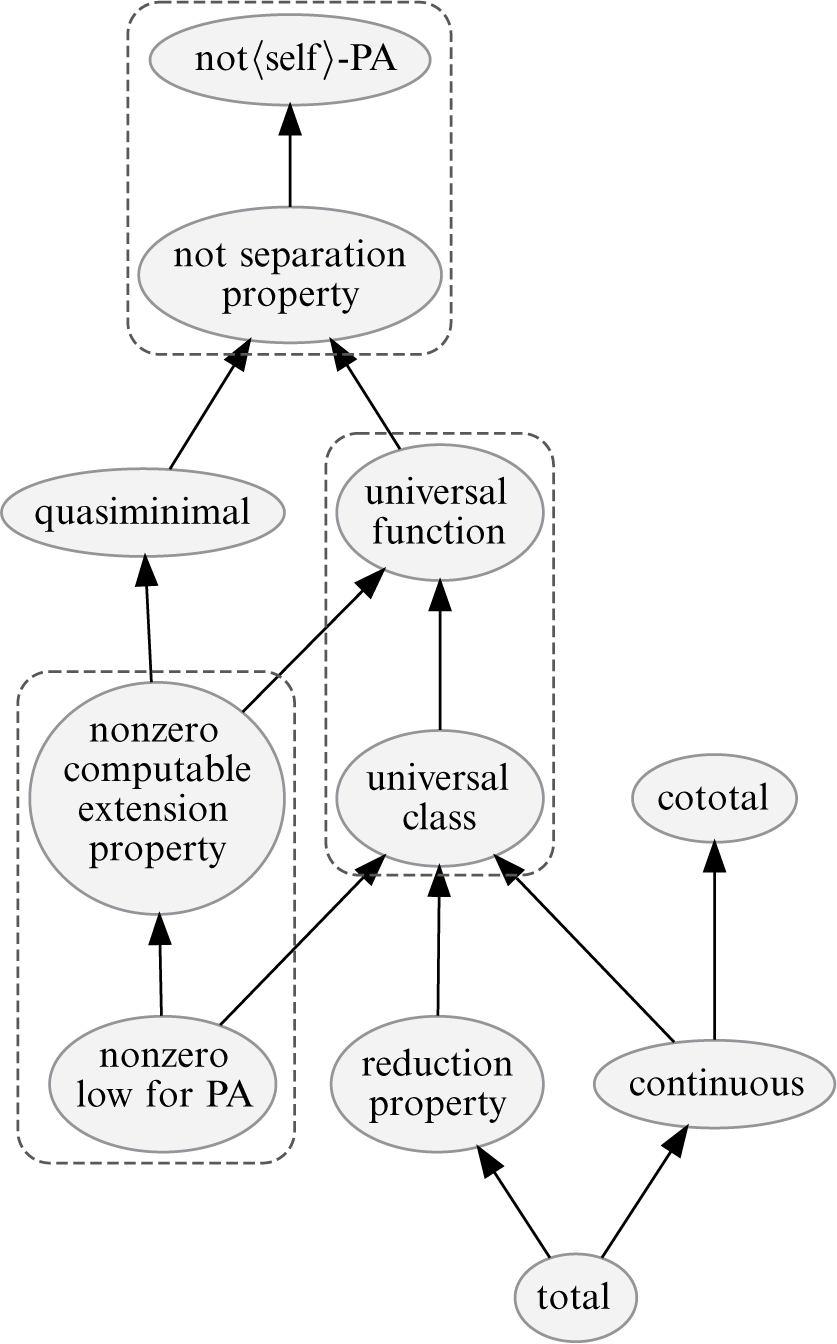
This realization automatically translates into a series of implications between several of the classes that we have been discussing. To complete the picture, we need to prove separations between specific pairs of classes. Section 5 is devoted to the forcing arguments that give us these separations, ultimately resulting in a complete analysis of the relative position of all of the classes under consideration (see Figure 3). Finally, we end with a list of open problems that arose from our work.
2 Main definition and baseline classes of enumeration degrees
Miller and Soskova [Reference Miller and Soskova24] defined the notion of a
 $\Pi ^0_1$
class relative to an enumeration oracle. They followed the simple template from the introduction, i.e., replace “c.e. in” with
 $\leq _e$
:
Definition 2.1. For each
 $\sigma \in 2^{<\omega }$
, let
 $[\sigma ] = \{X\in 2^{\omega } \colon \sigma \prec X\}$
. For each
 $W \subseteq 2^{<\omega }$
, let
 $[W] = \bigcup _{\sigma \in W} [\sigma ]$
.
-
(1)
$U\subseteq 2^{\omega }$
is a
$\Sigma ^0_1{\left \langle {A}\right \rangle }$
class if
$U = [W]$
for some
$W\subseteq 2^{<\omega }$
such that
$W\leq _e A$
. -
(2)
$V\subseteq 2^{\omega }$
is a
$\Pi ^0_1{\left \langle {A}\right \rangle }$
class if
$V = 2^{\omega }\smallsetminus U$
for some
$\Sigma ^0_1{\left \langle {A}\right \rangle }$
class U.


We think of the elements of a
 $\Pi ^0_1{\left \langle {A}\right \rangle }$
class as total objects. Intuitively, there is no way in which we can distinguish between
 $0$
s and
 $1$
s in the definition of a
 $\Pi ^0_1{\left \langle {A}\right \rangle }$
class and so it seems unnatural to assume that we can only enumerate positive information about them. Furthermore, when thinking about bounding members of every
 $\Pi ^0_1{\left \langle {A}\right \rangle }$
class, consider that we have a uniform procedure to pass between the
 $\Pi ^0_1{\left \langle {A}\right \rangle }$
class U and the
 $\Pi ^0_1{\left \langle {A}\right \rangle }$
class
 $U^{Tot} = \{X\oplus \overline X \colon X\in U\}$
. This leads us to the following natural extension of the relation relatively-PA to enumeration oracles:
Definition 2.2.
 ${\left \langle {B}\right \rangle }$
is PA relative to
 ${\left \langle {A}\right \rangle }$
if every nonempty
 $\Pi ^0_1{\left \langle {A}\right \rangle }$
class contains a path X such that
 $X\oplus \overline X\leq _e B$
. We refer to this binary relation as
 ${\left \langle {\text {relatively}}\right \rangle }$
-PA.
Note that this relation is invariant under enumeration equivalence, and hence it induces a relation on the enumeration degrees. Furthermore, we have that B is PA relative to A (in the Turing sense) if and only if
 ${\left \langle {B\oplus \overline B}\right \rangle }$
is PA relative to
 ${\left \langle {A\oplus \overline A}\right \rangle }$
, so
 ${\left \langle {\text {relatively}}\right \rangle }$
-PA extends the relation relatively-PA under the natural embedding from the Turing degrees to the enumeration degrees.
2.1 The continuous degrees
The continuous degrees were introduced by Miller [Reference Miller22] while answering an open question from computable analysis. Computable analysis gives a framework by which we can associate discrete descriptions—names—with other, often more complex, mathematical objects and thereby lift computability theoretic notions to new settings. This association of a name with an object is not bijective, as we can usually describe the same object in different ways. For example, a name for a real number r is a function
 $\lambda _r\colon \mathbb {N}\rightarrow \mathbb {Q}$
such that for every natural number n we have
 $ |r-\lambda _r(n)|<\frac {1}{2^n}$
. A name of least Turing degree for a specific object can be thought of as a measure for the algorithmic content of that object. For example, any name for a real r can compute the Turing degree of the set that codes the Dedekind cut
 $\{q\in \mathbb {Q} \colon q<r\}\oplus \{q\in \mathbb {Q} \colon q>r\}$
and vice versa, and from the Dedekind cut of a real r, we can compute a name for r. Miller answered the following question: can we assign a least Turing degree to every continuous function on the real numbers? Miller proved that it is equivalent to ask the same question about members of
 $[0,1]^{\omega }$
, the Hilbert cube. To each such element we can naturally assign an enumeration degree:
Definition 2.3. For
 $\alpha \in [0,1]^{\omega }$
, let
 $$\begin{align*}C_{\alpha} = \bigoplus_{n\in\omega}( \{q\in\mathbb{Q} \colon q< \alpha(n)\}\oplus \{q\in\mathbb{Q} \colon q> \alpha(n)\}). \end{align*}$$
An enumeration degree containing a set of the form
 $C_{\alpha }$
is called a continuous degree; we view it as the degree of
 $\alpha $
.
Miller proved that total degrees are continuous. Further, a point in
 $[0,1]^{\omega }$
has a least Turing degree name if and only if its continuous enumeration degree is total. Thus the original question can be restated as: are there non-total continuous degrees? Miller proved that the answer is positive and that, furthermore, non-total continuous degrees have a very interesting relationship to the relation relatively-PA. Recall that a Scott set is a Turing ideal such that for every member
 $\mathbf {a}$
, the ideal contains a degree
 $\mathbf {b}$
that is PA relative to
 $\mathbf {a}$
.
Theorem 2.4 (Miller [Reference Miller22]).
There are non-total continuous degrees. Furthermore:
-
• The total degrees below a non-total continuous degree form a Scott set.
-
• Every countable Scott set can be realized as the set of total degrees bounded by the degree of some non-total continuous degree.
-
• X is PA relative to Y if and only if there is a non-total continuous degree
$\mathbf {a}$
such that
$\deg _e(Y\oplus \overline Y )<_e \mathbf {a} <_e \deg _e( X\oplus \overline {X})$
.


Andrews et al. [Reference Andrews, Igusa, Miller and Soskova2] gave several characterizations of the continuous degrees, one of which showed that the continuous degrees are first order definable. Another of their characterizations will prove very useful for our purposes.
Definition 2.5. A set A is codable if there is a nonempty
 $\Pi ^0_1{\left \langle {A}\right \rangle }$
class U such that for every member X of U, A is uniformly c.e. in X.
Theorem 2.6 (Andrews et al. [Reference Andrews, Igusa, Miller and Soskova2]).
An enumeration degree is continuous if and only if it contains a codable set.
Using this characterization, we can easily derive that the continuous degrees behave well with respect to the extended relation
 ${\left \langle {\text {relatively}}\right \rangle }$
-PA. For instance, Kreisel [Reference Kreisel17] proved that there is a nonempty
 $\Pi ^0_1$
class with no computable member. Relativizing, we get that the relation relatively-PA is anti-reflexive. If A is codable and we assume that
 ${\left \langle {A}\right \rangle }$
is PA relative to
 ${\left \langle {A}\right \rangle }$
, then A would enumerate a member
 $X\oplus \overline X$
of the
 $\Pi ^0_1{\left \langle {A}\right \rangle }$
class U that witnesses its codability. But then
 $A\equiv _e X\oplus \overline X$
and hence X as a Turing oracle would be PA relative to itself, contradicting Kreisel’s theorem. This shows that for any set A of continuous degree,
 ${\left \langle {A}\right \rangle }$
is not PA relative to
 ${\left \langle {A}\right \rangle }$
.
2.2
${\left \langle {\text {self}\kern2pt}\right \rangle }$
-PA enumeration degrees

Nevertheless, this very property of the relation relatively-PA is not preserved for all enumeration oracles.
Definition 2.7. A set A is
 ${\left \langle {\text {self}\kern2pt}\right \rangle }$
-PA if
 ${\left \langle {A}\right \rangle }$
is PA relative to
 ${\left \langle {A}\right \rangle }$
.
Degrees that contain
 ${\left \langle {\text {self}\kern2pt}\right \rangle }$
-PA sets inherit the name. Miller and Soskova [Reference Miller and Soskova24] proved that
 ${\left \langle {\text {self}\kern2pt}\right \rangle }$
-PA degrees exist, and have properties that are surprisingly similar to non-total continuous degrees.
Theorem 2.8 (Miller and Soskova [Reference Miller and Soskova24]).
There are
 ${\left \langle {\text {self}\kern2pt}\right \rangle }$
-PA enumeration degrees.
-
• The total degrees below a
${\left \langle {\text {self}\kern2pt}\right \rangle }$
-PA enumeration degree form a Scott set. -
• Every countable Scott set can be realized as the set of total degrees bounded by some
${\left \langle {\text {self}\kern2pt}\right \rangle }$
-PA degree. -
• X is PA relative to Y if and only if there is a
${\left \langle {\text {self}\kern2pt}\right \rangle }$
-PA set A such that
$Y\oplus \overline Y <_e A <_e X\oplus \overline {X}$
.


Note that, in particular, no
 ${\left \langle {\text {self}\kern2pt}\right \rangle }$
-PA enumeration degree is quasiminimal. The existence of low PA degrees yields the existence of low and hence
 $\Delta ^0_2 {\left \langle {\text {self}\kern2pt}\right \rangle }$
-PA sets.
2.3 Cototal enumeration degrees
We review one additional class that plays a key role in our understanding of the enumeration degrees. The cototal enumeration degrees were introduced by Andrews et al. [Reference Andrews, Ganchev, Kuyper, Lempp, Miller, Soskova and Soskova1] motivated by a question of Jeandel [Reference Jeandel12] from symbolic dynamics.Footnote
2
Recall that a one-dimensional subshift is a topologically closed subset of Cantor space
 $2^{\omega }$
closed under the shift operator—the operator that maps
 $x = x_0x_1x_2\dots {}\in 2^{\omega }$
to
 $s(x) = x_1x_2\dots $
. A subshift V is minimal if no proper nonempty subset of V is also a subshift. Jeandel proved that a Turing degree
 $\mathbf {x}$
can compute a member of a fixed nonempty minimal subshift V if and only if
 $\mathbf {x}$
can enumerate the language of the subshift,
 $L_V$
, which consists of all finite binary sequences that appear as subwords of some member of V. Jeandel noticed that the language of a minimal subshift
 $L_V$
has an additional property:
 $L_V\leq _e \overline {L_V}$
.
Definition 2.9. A set A is cototal if
 $A\leq _e \overline A$
. A degree is cototal if it contains a cototal set.
Cototal degrees have characterizations stemming from many different parts of mathematics: they are the degrees of complements of maximal independent sets in computable graphs (Andrews et al. [Reference Andrews, Ganchev, Kuyper, Lempp, Miller, Soskova and Soskova1]); the degrees of complements of maximal antichains in
 $\omega ^{<\omega }$
(McCarthy [Reference McCarthy20]); the degrees of effectively
 $G_{\delta }$
topological spaces (Kihara, Ng, and Pauly [Reference Kihara, Ng and Pauly16]); the degrees of enumeration pointed binary trees (McCarthy [Reference McCarthy20]); the degrees of sets with good approximations (Miller and Soskova [Reference Miller and Soskova23]); and the degrees of languages of minimal subshifts (Jeandel [Reference Jeandel12] and McCarthy [Reference McCarthy20]). The characterization that we will use is a simple one. Recall that
 $K^{{\left \langle {A}\right \rangle }} = \bigoplus _{e\in \omega }\Gamma _e(A)$
, where
 $\Gamma _e$
is the e-th enumeration operator in a standard enumeration.
Theorem 2.10 (Andrews et al. [Reference Andrews, Ganchev, Kuyper, Lempp, Miller, Soskova and Soskova1]).
A has cototal degree if and only if
 $A\leq _e \overline {K^{{\left \langle {A}\right \rangle }}}$
.
Andrews et al. [Reference Andrews, Ganchev, Kuyper, Lempp, Miller, Soskova and Soskova1] proved that the cototal enumeration degrees properly contain the continuous degrees and that they are incomparable to the quasiminimal enumeration degrees. To complete the picture of the classes that we have defined so far, we need to investigate how cototal degrees relate to
 ${\left \langle {\text {self}\kern2pt}\right \rangle }$
-PA degrees. Every
 $\Sigma ^0_2$
enumeration degree is cototal [Reference Andrews, Ganchev, Kuyper, Lempp, Miller, Soskova and Soskova1] and hence, there are cototal
 ${\left \langle {\text {self}\kern2pt}\right \rangle }$
-PA degrees. We exhibit a
 ${\left \langle {\text {self}\kern2pt}\right \rangle }$
-PA degree that is not cototal:
Theorem 2.11. There exists a
 ${\left \langle {\text {self}\kern2pt}\right \rangle }$
-PA set A that does not have cototal degree.
Proof We use a forcing notion with conditions of the form
 $p = (n, X_0, \dots , X_{n-1}, D)$
, where
 $n\in \omega $
,
 $X_i\in 2^{\omega }$
, and D is a finite set. We associate with every p the set
 $A_p = (\bigoplus _{i\in \omega } X_i)\cup D$
, where
 $X_i = \emptyset $
if
 $i\geq n$
. So
 $X_i$
is the i-th column of
 $A_p$
modulo a finite set. We will say that
 $q = (m, Y_0, \dots , Y_{m-1}, E)$
extends p if
 $m\geq n$
, for all
 $i<n$
we have that
 $X_i = Y_i$
,
 $D\subseteq E$
, and if
 $x\in E\smallsetminus D$
then
 $x\in \omega ^{[\geq n]}$
, i.e.,
 $x = {\left \langle {k,z}\right \rangle }$
for some
 $k\geq n$
and
 $z\in \omega $
. We construct A as
 $\bigcup _{s\in \omega } A_{p_s}$
, where
 $\{p_{s}\}_{s\in \omega }$
is a sequence of conditions such that
 $p_{s+1}$
extends
 $p_s$
.
We denote by
 $P_e{\left \langle {A}\right \rangle }$
the
 $\Pi ^0_1{\left \langle {A}\right \rangle }$
class
 $2^{\omega }\smallsetminus [\Gamma _e(A)]$
, where
 $\{\Gamma _e\}_{e\in \omega }$
lists all enumeration operators. To ensure that A is
 ${\left \langle {\text {self}\kern2pt}\right \rangle }$
-PA, we satisfy the requirements:
 $$\begin{align*}\mathcal{P}_e: P_e{\left\langle{A}\right\rangle}\neq \emptyset\rightarrow (\exists X\in P_e{\left\langle{A}\right\rangle}) [X\oplus\overline X\leq_e A]. \end{align*}$$
To ensure that A is not cototal, we satisfy the requirements:
 $$\begin{align*}\mathcal{N}_e: A\neq \Gamma_e(\overline{K^{{\left\langle{A}\right\rangle}}}).\end{align*}$$
Start with
 $p_0 = (0, \emptyset )$
. At stage
 $s = 2e$
, we satisfy the requirement
 $\mathcal {P}_e$
. Fix
 $p_s = (n, X_0, X_1, \dots X_{n-1}, D)$
. We ask if
 $p_s$
has an extension
 $q = (n, X_0, \dots , X_{n-1}, E)$
such that
 $P_e{\left \langle {A_{q}}\right \rangle } = \emptyset $
and if so then let
 $p_{s+1} = q$
for some such q. Otherwise, it follows by compactness that
 $P = P_e{\left \langle {A_{p_s}\cup \omega ^{[\geq n]}}\right \rangle }$
is a nonempty
 $\Pi ^0_1{\left \langle {X_0\oplus \dots \oplus X_{n-1}}\right \rangle }$
class that will be a subclass of
 $P_e{\left \langle {A}\right \rangle }$
no matter how the construction of A continues. Let
 $X_n$
be some path in P and let
 $p_{s+1} = (n+2, X_0, \dots , X_n, \overline {X_n}, D)$
.
At stage
 $s= 2e+1$
, we deal with the requirement
 $\mathcal {N}_e$
. Let
 $x_e$
be the least element in
 $\omega ^{[n]}$
, whose membership in A is not determined by
 $p_s= (n, X_0, \dots , X_{n-1}, D)$
, i.e.,
 $x_e$
is least in
 $\omega ^{[ n]} \smallsetminus D$
. We first ask if
 $p_s$
has some extension q such that q forces
 $x_e\in \Gamma _e(\overline {K^{{\left \langle {A}\right \rangle }}})$
: there is some axiom
 ${\left \langle {x_e, F}\right \rangle }\in \Gamma _e$
such that for every member
 ${\left \langle {u,z}\right \rangle }\in F$
and every r extending q we have that
 $z\notin \Gamma _u(A_r)$
. If there is some such extension q, then there is one that also forces
 $x_e$
out of A, because the fewer elements in A, the more elements in
 $\overline {K^{{\left \langle {A}\right \rangle }}}$
. The extension
 $q= (m, Y_0, \dots Y_{m-1}, E)$
forces
 $x_e$
out of A if
 $m>n$
and
 $x_e \notin A_q$
. We let
 $p_{s+1} = q$
for some such q.
If there is no such extension, then for every extension q of
 $p_s$
and every axiom
 ${\left \langle {x_e,F}\right \rangle }\in \Gamma _e$
there is some member
 ${\left \langle {u,z}\right \rangle }\in F$
and some r extending q such that
 $z\in \Gamma _{u}(A_r)$
. Note that if
 $A_r\subseteq A$
, then this axiom for
 $x_e$
is not valid with respect to the oracle
 $\overline {K^{{\left \langle {A}\right \rangle }}}$
. In this case we say that
 $\mathcal {N}_e$
is persistent. We then extend to
 $p_{s+1}= (n, X_0, \dots , X_{n-1}, E)$
where E is a finite set defined so that
 $x_e\in E$
and so that for every persistent
 $\mathcal {N}_i$
, with
 $i\leq e$
, we ensure that the first s many axioms for
 $x_i$
in
 $\Gamma _i$
are invalidated. (This will be the outcome at infinitely many odd stages, so if
 $\mathcal {N}_i$
is persistent, then
 $x_i$
will be in
 $A\smallsetminus \Gamma _i(\overline {K^{{\left \langle {A}\right \rangle }}})$
and
 $\mathcal {N}_i$
will be satisfied.)
3 Two properties of the relation relatively-PA that do not persist under the extension
Ganchev et al. [Reference Ganchev, Kalimullin, Miller and Soskova11] studied the relation
 ${\left \langle {\text {relatively}}\right \rangle }$
-PA and identified two more classes of enumeration degrees. To define the first class, recall that for any Turing oracle X, we have that
 $\{X\}$
is a nonempty
 $\Pi ^0_1(X)$
class. Hence, if Y is PA relative to X, then
 $X\leq _T Y$
.
Definition 3.1. We say that
 $A\subseteq \omega $
is PA bounded if whenever
 ${\left \langle {B}\right \rangle }$
is PA relative to
 ${\left \langle {A}\right \rangle }$
we have that
 $A\leq _e B$
.
For the second class, consider the
 $\Pi ^0_1(X)$
class
 $DNC_2^X$
consisting of all
 $\{0,1\}$
-valued diagonally noncomputable functions relative to the Turing oracle X. If P is a nonempty
 $\Pi ^0_1(X)$
class and
 $\sigma \in 2^{<\omega }$
has an extension in P, then a
 $DNC_2^X$
function allows us to compute, uniformly in an index for P and
 $\sigma $
, a bit i such that
 $\sigma i$
also has an extension in P. Thus every member of
 $DNC_2^X$
is PA relative to X.
Definition 3.2. We say that
 $A\subseteq \omega $
has universal class P if P is a nonempty
 $\Pi ^0_1{\left \langle {A}\right \rangle }$
class such that, for every nonempty
 $\Pi ^0_1{\left \langle {A}\right \rangle }$
class Q, there is a fixed Turing functional
 $\Phi $
such that
 $\Phi ^X\in Q$
for all
 $X\in P$
.
We note that this definition is slightly more demanding than the one originally given in [Reference Ganchev, Kalimullin, Miller and Soskova11]. There we merely required that
 ${\left \langle {X\oplus \overline X}\right \rangle }$
is PA relative to
 ${\left \langle {A}\right \rangle }$
for every
 $X\in P$
. Here we have decided to ask for some additional uniformity. The change is motivated by the next section, in which we compare oracles with a universal class to oracles with a universal function. Note that we could have asked for even more uniformity: we could have asked that an index for
 $\Phi $
can be computed uniformly from an index for Q. It remains unclear if these choices lead to different classes of oracles (see the last section for open questions).
Both properties clearly hold for total oracles. Ganchev et al. [Reference Ganchev, Kalimullin, Miller and Soskova11] proved:
Theorem 3.3 (Ganchev et al. [Reference Ganchev, Kalimullin, Miller and Soskova11]).
-
(1) Every PA bounded degree is cototal.
-
(2) The continuous degrees are exactly the enumeration degrees that are both PA bounded and have a universal class.
-
(3) The
${\left \langle {\text {self}\kern2pt}\right \rangle }$
-PA degrees do not have universal classes.

To avoid any uncertainty that could arise from our slight change in the definition of a universal class, we reprove the fact that every continuous degree has a universal class. To add some value to this proof, we will observe one additional property: the universal class that we associate with a continuous degree has a specific form, one that will play an important role in the next section.
Definition 3.4. A
 $\Pi ^0_1{\left \langle {A}\right \rangle }$
class P is called a separating class if there are sets
 $X, Y\leq _e A$
such that
 $P = \{Z \colon X\subseteq Z\ \&\ Y\subseteq \overline Z\}$
. Elements of P are called separators. The collection of all
 $\Pi ^0_1{\left \langle {A}\right \rangle }$
separating classes will be denoted by
 $\operatorname {\mathrm {Sep}}{\left \langle {A}\right \rangle }$
.
Theorem 3.5. If A has continuous degree, then there is a universal
 $\Pi ^0_1{\left \langle {A}\right \rangle }$
class that is a separating class.
Proof Recall that every continuous degree contains a codable set (Theorem 2.6). So let A be codable and fix a nonempty
 $\Pi ^0_1{\left \langle {A}\right \rangle }$
class S and a uniform procedure that enumerates A from every member of S. We define a
 $\Pi ^0_1{\left \langle {A}\right \rangle }$
separating class as follows. For
 $i = 0,1$
, define
 ${\left \langle {e,\sigma }\right \rangle }$
to be in
 $U_i$
if and only if
 $(\forall X\in S)\; \Phi ^X_e(\sigma ) \operatorname {\mathrm {\downarrow }} = i$
. Trivially,
 $U_0$
and
 $U_1$
are disjoint. Note that
 $U_0, U_1 \leq _e A$
by compactness. Let U be the separating class for
 $U_0$
and
 $U_1$
.
We must show that U is universal. Let P be a
 $\Pi ^0_1{\left \langle {A}\right \rangle }$
class and let
 $W\leq _e A$
be a set of strings such that
 $P = 2^\omega \smallsetminus [W]$
. We define a uniform procedure to compute a path in P from a separator for
 $U_0$
and
 $U_1$
. First, define
 $\Phi ^X_e$
as follows. As long as
 $X\in S$
, we can uniformly enumerate A from X, and then from that we can uniformly enumerate W. Using this enumeration of W, let
 $\Phi ^X_e(\sigma ) \operatorname {\mathrm {\downarrow }} = i$
if and only if at some stage we see that
 $\sigma i$
has no extensions in P but
 $\sigma (1-i)$
still appears to have an extension. (We apply the same procedure to all X, whether or not they are in S, accepting that the results for
 $X\notin S$
have no particular meaning.)
Now let Z be a separator of
 $U_0$
and
 $U_1$
and assume that
 $\sigma $
is extendible in P. If
 ${\left \langle {e,\sigma }\right \rangle }\in Z$
, then
 ${\left \langle {e,\sigma }\right \rangle } \notin U_1$
. Hence there is some
 $X \in S$
such that
 $\Phi ^X_e(\sigma )\operatorname {\mathrm {\uparrow }}$
or
 $\Phi ^X_e(\sigma )\operatorname {\mathrm {\downarrow }} = 0$
. In either case, since
 $\sigma $
is extendible in P, it follows that
 $\sigma 1$
is extendible in P. Similarly, if
 ${\left \langle {e,\sigma }\right \rangle }\notin Z$
, then
 $\sigma 0$
is extendible in P. Therefore, we have a uniform procedure to compute an element of P from any
 $Z\in U$
, so U is a universal
 $\Pi ^0_1{\left \langle {A}\right \rangle }$
class.
Note that in the proof, from an index for P we could uniformly find e, and hence uniformly find the index for the functional that computes elements of P from elements of U. In other words, U is not only universal in the sense of Definition 3.2, but in the more uniform sense discussed after the definition.
3.1 Continuous is the same as PA bounded
Ganchev et al. [Reference Ganchev, Kalimullin, Miller and Soskova11] left the following questions open: Are there cototal degrees that are not PA bounded? Can a
 ${\left \langle {\text {self}\kern2pt}\right \rangle }$
-PA degree be PA bounded? Franklin, Lempp, Miller, Schweber, and Soskova answered both questions by showing that the PA bounded degrees are exactly the continuous degrees. As their result is not published anywhere else, with their permission, we give it below.
Theorem 3.6. The PA bounded enumeration degrees are the continuous degrees.
Proof One direction in this theorem was already shown to be true in [Reference Ganchev, Kalimullin, Miller and Soskova11]: every continuous degree is PA bounded. Here we prove that if A is not of continuous degree, then A is not PA bounded. So fix A that is not of continuous degree, hence by Theorem 2.6, not codable. We will build a sequence of nonempty
 $\Pi ^0_1{\left \langle {A}\right \rangle }$
classes
 $\{Q_s\}_{s\in \omega }$
so that
 $Q_s\supseteq Q_{s+1}$
. A nested intersection of nonempty compact sets is nonempty, so
 $\bigcap _{s} Q_s$
will be nonempty. The construction will ensure that if
 $Z\in \bigcap _{s} Q_s$
then
 ${\left \langle {Z}\right \rangle }$
is PA relative to
 ${\left \langle {A}\right \rangle }$
and
 $A\nleq _e Z$
. It follows that A is not PA bounded.
We start with
 $Q_0 = (2^{\omega })^{\omega }$
. In other words,
 $Q_0$
is the full
 $\Pi ^0_1$
class, but we think of it as a sequence of countably many copies of the full class. Each
 $Q_s$
will be thought of as a countable sequence of
 $\Pi ^0_1{\left \langle {A}\right \rangle }$
classes such that all but finitely many of them are
 $2^{\omega }$
. We will denote by
 $Q_s^{[i]}$
the i-th member of this sequence and call it the i-th column of
 $Q_s$
. We will keep track of an index
 $k_s$
such that for all
 $i\geq k_s$
,
 $Q_s^{[i]} = 2^{\omega }$
. Under this arrangement
 $k_0 = 0$
.
Suppose we have constructed
 $Q_s$
and identified
 $k_s$
. Consider the
 $\Pi ^0_1{\left \langle {A}\right \rangle }$
class Q defined so that for all
 $i<k_s $
we have that
 $Q^{[i]} = Q_s^{[i]}$
and for all
 $i\geq k_s$
we have
 $Q^{[i]} =\{\omega \}$
. In other words, Q is the subclass of
 $Q_s$
such that if
 $Y\in Q$
and
 $i\geq k_s$
, then
 $Y^{[i]} = \omega $
. Now since A is not codable, we can fix
 $Y\in Q$
such that
 $\Gamma _s(Y) \neq A$
, where
 $\Gamma _s$
is the s-th enumeration operator. Note that codability is defined in terms of c.e. operators, but of course, an enumeration operator is a c.e. operator. Let y be the least difference between
 $\Gamma _s(Y)$
and A. We have two possibilities:
Case 1. If
 $y\in \Gamma _s(Y)\smallsetminus A$
, let
 $D\subseteq Y$
be a finite set such that
 $y\in \Gamma _s(D)$
. We restrict
 $Q_s$
to the largest possible
 $\Pi ^0_1{\left \langle {A}\right \rangle }$
subclass R so that D is a subset of every member of R. Note that R is nonempty because it contains Y. Since D is finite the class R also has the desired form, i.e., there is some number
 $k\geq k_s$
such that
 $R^{[i]} = 2^{\omega }$
for all
 $i\geq k$
. Let k be the least such number. Furthermore, if Z is a member of R then
 $y\in \Gamma _s(Z)$
.
Case 2. If
 $y\in A\smallsetminus \Gamma _s(Y)$
, then we trim the first
 $k_s$
many columns of
 $Q_s$
to get a
 $\Pi ^0_1{\left \langle {A}\right \rangle }$
class R so that if
 $Z\in R$
, then
 $y\notin \Gamma _s(Z)$
. In more detail, we let
 $R^{[0]}, \dots , R^{[k_s-1]}$
be defined so that if Z is a member of the class with columns
 $R^{[0]}, \dots , R^{[k_s-1]}, \{\omega \}, \{\omega \},\dots $
, then
 $y\notin \Gamma _s(Z)$
. We leave the remaining columns of R full:
 $R^{[i]} = 2^{\omega }$
for all
 $i\geq k_s$
. Once again,
 $Y\in R$
guarantees that R is nonempty. Furthermore, for all
 $Z\in R$
we have that if
 $i\geq k_s$
, then
 $Z^{[i]}\subseteq \omega =Y^{[i]}$
; hence by the monotonicity of enumeration operators,
 $y\notin \Gamma _s(Z)$
. Let
 $k = k_s$
.
In each case, we have ensured that if
 $Z\in R$
then
 $\Gamma _s(Z)\neq A$
. (Note in the next paragraph that
 $Q_{s+1}\subseteq R$
.)
Now let
 $P_s{\left \langle {A}\right \rangle }$
be the s-th
 $\Pi ^0_1{\left \langle {A}\right \rangle }$
class. If
 $P_s{\left \langle {A}\right \rangle }$
is empty, let
 $Q_{s+1} = R$
and
 $k_{s+1} = k$
. Otherwise, let
 $Q_{s+1}$
be defined by setting
 $Q_{s+1}^{[i]} = R^{[i]}$
for all
 $i\neq k$
and
 $Q_{s+1}^{[k]} = \{Z\oplus \overline Z \colon Z\in P_s{\left \langle {A}\right \rangle }\}$
. We will have that
 $k_{s+1} = k+1$
. In this case, we have ensured that if
 $Z\in Q_{s+1}$
, then the k-th column of Z codes the positive and negative information about a member of
 $P_s{\left \langle {A}\right \rangle }$
.
As required, if
 $Z\in \bigcap _{s} Q_s$
, then
 ${\left \langle {Z}\right \rangle }$
is PA relative to
 ${\left \langle {A}\right \rangle }$
but does not enumerate A. It follows that A is not PA bounded.
Using the above theorem, we observe that there are cototal degrees that are not PA bounded. This follows from the fact that there are cototal degrees that are not continuous: Take, for example, a
 $\Delta ^0_2 1$
-generic set, which is quasiminimal (hence not continuous) and
 $\Sigma ^0_2$
(hence cototal [Reference Andrews, Ganchev, Kuyper, Lempp, Miller, Soskova and Soskova1]).
To show that no
 ${\left \langle {\text {self}\kern2pt}\right \rangle }$
-PA degree can be PA bounded, recall that no continuous degree is
 ${\left \langle {\text {self}\kern2pt}\right \rangle }$
-PA (see the discussion after Theorem 2.6).
3.2 Another way to have a universal class: the low for PA enumeration degrees
Theorem 3.6 brings our focus to the class of enumeration oracles that have a universal class. Could that also be a characterization of the continuous degrees? In this section, we will see that this is not the case. In fact, in terms of category, most oracles have a universal class.
Definition 3.7. An enumeration oracle
 ${\left \langle {A}\right \rangle }$
is low for PA if whenever X has PA degree and P is a nonempty
 $\Pi ^0_1{\left \langle {A}\right \rangle }$
class, then there is a
 $Y\in P$
such that
 $X\geq _T Y$
. (In other words, every set of PA degree is PA relative to
 ${\left \langle {A}\right \rangle }$
.)
If an enumeration oracle is low for PA, it actually satisfies an apparently stronger property. In the proof below we will use the universal
 $\Pi ^0_1$
-class of all
 $\{0, 1\}$
-valued diagonally non-computable functions, denoted as DNC
 $_2$
. Recall that a function f is diagonally non-computable if for every e we have
 $f(e)\neq \varphi _e(e)$
.
Theorem 3.8. An enumeration oracle
 ${\left \langle {A}\right \rangle }$
is low for PA if and only if whenever P is a nonempty
 $\Pi ^0_1{\left \langle {A}\right \rangle }$
class, there is a nonempty
 $\Pi ^0_1$
class
 $Q\subseteq P$
.
Proof (
 $\Leftarrow $
) This is obvious: if X has PA degree and a
 $\Pi ^0_1{\left \langle {A}\right \rangle }$
class P has a nonempty
 $\Pi ^0_1$
subclass Q, then X computes a member of Q and hence of P.
(
 $\Rightarrow $
) Let P be a nonempty
 $\Pi ^0_1{\left \langle {A}\right \rangle }$
class. We first claim that there is a nonempty
 $\Pi ^0_1$
class U and a Turing reduction
 $\Phi _e$
such that if
 $X\in U$
, then
 $\Phi _e^X\in P$
. Assume not. We build a sequence
 $U_0\supseteq U_1\supseteq U_2\supseteq \cdots $
of nonempty
 $\Pi ^0_1$
classes as follows. Let
 $U_0 = \text {DNC}_2$
. Say that
 $U_e$
has been defined. By assumption, there is an
 $X\in U_e$
such that
 $\Phi _e^X$
is not an element of P. This means that either
 $\Phi _e^X$
is partial or that
 $\Phi _e^X = Y$
and
 $Y\notin P$
. In the first case, suppose
 $\Phi _e^X(n)\operatorname {\mathrm {\uparrow }}$
. Let
 $U_{e+1} = \{Z\in U_e \colon \Phi _e^Z(n)\operatorname {\mathrm {\uparrow }}\}$
. In the second case, fix
 $\sigma \prec X$
such that no extension of
 $\Phi _e^{\sigma }$
is in P and let
 $U_{e+1} = \{Z\in U_e \colon \sigma \prec Z\}$
. In both cases,
 $U_{e+1}$
is a nonempty
 $\Pi ^0_1$
subclass of
 $U_e$
and if
 $Z\in U_{e+1}$
, then
 $\Phi _e^{Z}$
is not an element of P. Finally, take
 $Z \in \bigcap _{e\in \omega } U_e$
. Then Z has PA degree but does not compute any element of P, which contradicts our assumption that
 ${\left \langle {A}\right \rangle }$
is low for PA. This proves the claim.
So fix a nonempty
 $\Pi ^0_1$
class U and an e such that
 $X\in U$
implies that
 $\Phi _e^{X}\in P$
. Let
 $Q = \{Y \colon (\exists X\in U)\; \Phi _e^{X} = Y\}$
. Note that Q is a nonempty subclass of P. We claim that Q, which is the computable image of a
 $\Pi ^0_1$
class, is also a
 $\Pi ^0_1$
class. This is standard: Assume that
 $U = [T]$
, where T is a
 $\Pi ^0_1$
tree in
 $2^{<\omega }$
. Let
 $$\begin{align*}S = \{\sigma\in 2^{<\omega} \colon (\exists n)(\forall \tau\in 2^n)\; \tau\notin T\text{ or }\Phi_e^{\tau}\text{ is incompatible with }\sigma\}. \end{align*}$$
Then
 $2^{<\omega }\smallsetminus S$
is a
 $\Pi ^0_1$
tree and, by compactness,
 $Q = [2^{<\omega }\smallsetminus S]$
. Therefore, Q is a
 $\Pi ^0_1$
class.
Given the characterization above, the following are easy observations.
Proposition 3.9. Assume that an enumeration oracle
 ${\left \langle {A}\right \rangle }$
is low for PA.
-
(1) A is c.e. or has quasiminimal enumeration degree.
-
(2) The class of
$\{0, 1\}$
-valued diagonally non-computable functions DNC
$_2$
is a universal
$\Pi ^0_1{\left \langle {A}\right \rangle }$
class.


Proof For (1), assume that
 $A\geq _e Z\oplus \overline Z$
, where Z is not computable. Then
 $\{Z\}$
is a
 $\Pi ^0_1{\left \langle {A}\right \rangle }$
class. Take any PA degree X that does not compute Z; this exists by Jockusch and Soare [Reference Jockusch and Soare13, Theorem 2.5]. Then X does not compute any member of
 $\{Z\}$
, so
 ${\left \langle {A}\right \rangle }$
is not low for PA.
To see (2), recall that there is a single Turing functional that lets a DNC
 $_2$
Turing oracle compute a path in any nonempty
 $\Pi ^0_1$
class uniformly from its index, so if P is a nonempty
 $\Pi ^0_1{\left \langle {A}\right \rangle }$
class and
 $Q\subseteq P$
is a nonempty
 $\Pi ^0_1$
class then an index for Q gives a fixed functional as required in the definition.
Note that in Theorem 3.8, we do not uniformly get an index for Q from an index of P as a
 $\Pi ^0_1{\left \langle {A}\right \rangle }$
class. So we have only proved the mild uniformity required by the definition of a universal class. (See the discussion after Definition 3.2.)
We will show that not every quasiminimal degree is low for PA; however, two significant classes of quasiminimal degrees do have this property. We have already mentioned that the enumeration degrees of
 $1$
-generic sets have quasiminimal degree. There is a slightly different notion of genericity that plays better with enumeration reducibility.
Definition 3.10. A set G is enumeration
 $1$
-generic if for every c.e. set W of finite sets there is a finite set D such that either
 $D\subseteq G$
and
 $D\in W$
, or
 $D\subseteq \overline G$
and
 $D\cap E \neq \emptyset $
for every
 $E\in W$
.
Enumeration
 $1$
-genericity was introduced by Badillo and Harris [Reference Badillo, Harris, Agrawal, Cooper and Li3] and further studied by Badillo, Harris, and Soskova [Reference Badillo, Harris and Soskova4]. It is straightforward to check that every
 $1$
-generic set is enumeration
 $1$
-generic. Badillo and Harris [Reference Badillo, Harris, Agrawal, Cooper and Li3] observed that the enumeration degree of every non-c.e. enumeration
 $1$
-generic set has quasiminimal degree.
Proposition 3.11. If A is enumeration
 $1$
-generic, then
 ${\left \langle {A}\right \rangle }$
is low for PA.
Proof Assume that A is enumeration
 $1$
-generic and let
 $P{\left \langle {A}\right \rangle }$
be a nonempty
 $\Pi ^0_1{\left \langle {A}\right \rangle }$
class. Recall that a
 $\Pi ^0_1{\left \langle {A}\right \rangle }$
class is defined in terms of an enumeration operator that is applied to the oracle
 ${\left \langle {A}\right \rangle }$
. We can hence view P as an operator that maps any oracle
 ${\left \langle {X}\right \rangle }$
to a
 $\Pi ^0_1{\left \langle {X}\right \rangle }$
class. We claim that there is a prefix
 $\sigma \prec A$
such that
 $P{\left \langle {\sigma 1^\omega }\right \rangle }$
is nonempty. If so, then
 $Q = P{\left \langle {\sigma 1^\omega }\right \rangle }$
is a nonempty
 $\Pi ^0_1$
class and
 $Q\subseteq P{\left \langle {A}\right \rangle }$
; as observed in Theorem 3.8, this means that
 ${\left \langle {A}\right \rangle }$
is low for PA. So let us prove the claim. Consider the c.e. set of finite sets
 $W = \{D \colon P{\left \langle {D}\right \rangle }=\emptyset \}$
. Because
 $P{\left \langle {A}\right \rangle }$
is nonempty, there is no subset of A in W. By enumeration
 $1$
-genericity, we can fix
 $F\subseteq \overline A$
such that F intersects every member of W. Let
 $\sigma $
be the initial segment of A of length
 $\max (F)+1$
. Then
 $Q = P{\left \langle {\sigma 1^\omega }\right \rangle }$
is nonempty because no member of W is a subset of the set with characteristic function
 $\sigma 1^{\omega }$
.
The second class of degrees was introduced by Kalimullin [Reference Kalimullin14].
Definition 3.12. A pair of sets
 $\{A,B\}$
is called a Kalimullin pair (
 $\mathcal {K}$
-pair) if there is a c.e. set
 $W\subseteq \omega ^2$
such that
 $A\times B\subseteq W$
and
 $\overline A\times \overline B\subseteq \overline W.$
A pair of degrees
 $\{\mathbf {a}, \mathbf {b}\}$
is a
 $\mathcal {K}$
-pair if there are sets
 $A\in \mathbf {a}$
and
 $B\in \mathbf {b}$
, such that
 $\{A,B\}$
is a
 $\mathcal {K}$
-pair.
 $\mathcal {K}$
-pairs have many applications in first order definability results. Kalimullin [Reference Kalimullin14] proved that they have a natural structural definition as minimal pairs relative to any other enumeration degree. He then used this to prove the definability of the enumeration jump operator. Later, Cai et al. [Reference Cai, Ganchev, Lempp, Miller and Soskova6] showed that the nonzero total enumeration degrees are the joins of maximal
 $\mathcal {K}$
-pairs, thereby defining totality.
If
 $\{A, B\}$
is a nontrivial
 $\mathcal {K}$
-pair, i.e., A and B are both not c.e., then the degrees of A and B are both quasiminimal. We show that such degrees are, in fact, low for PA as well.
Proposition 3.13. If A is half of a nontrivial
 $\mathcal {K}$
-pair, then
 ${\left \langle {A}\right \rangle }$
is low for PA.
Proof Fix a set B and a c.e. set W such that A and B are a nontrivial
 $\mathcal {K}$
-pair as witnessed by W. So we have
 $A\times B\subseteq W$
and
 $\overline {A}\times \overline {B}\subseteq \overline {W}$
. Let
 $P{\left \langle {A}\right \rangle }$
be a nonempty
 $\Pi ^0_1{\left \langle {A}\right \rangle }$
class. Consider the c.e. set
 $$\begin{align*}V = \{b \colon (\exists F\subseteq\omega)\;F\text{ is finite, }F\times\{b\}\subseteq W\text{, and }P{\left\langle{F}\right\rangle}=\emptyset\}. \end{align*}$$
Say that
 $b\in V$
as witnessed by F. Since
 $P{\left \langle {F}\right \rangle }=\emptyset $
, we know that
 $F\nsubseteq A$
. Fix
 $c\in F\smallsetminus A$
. Since
 $(c,b)\in W$
, it must be the case that
 $b\in B$
. So we have that
 $V\subseteq B$
. But we assumed that A and B form a nontrivial
 $\mathcal {K}$
-pair; hence B is not c.e. Therefore, we can fix a
 $d\in B\smallsetminus V$
.
Now consider the c.e. set
 $U = \{a \colon {\left \langle {a,d}\right \rangle }\in W\}$
. Since
 $d\in B$
and
 $A\times B\subseteq W$
, we have
 $A\subseteq U$
. Therefore,
 $Q = P{\left \langle {U}\right \rangle }$
is a
 $\Pi ^0_1$
subclass of
 $P{\left \langle {A}\right \rangle }$
. All that remains is to prove that Q is nonempty. But if Q were empty, there would be some finite
 $F\subseteq U$
such that
 $P{\left \langle {F}\right \rangle }=\emptyset $
. By the definition of U, we would also have
 $F\times \{d\}\subseteq W$
. But then it would be the case that
 $d\in V$
, contradicting our choice of d.
As we promised above, we will now show that not every quasiminimal enumeration degree is low for PA. The fact that every (enumeration)
 $1$
-generic set has quasiminimal enumeration degree tells us that the collection of quasiminimal oracles is comeager, i.e., large in the sense of category. This collection is also large in the sense of measure: Lagemann [Reference Lagemann19] showed that almost every enumeration oracle has quasiminimal degree. We show below that almost every enumeration oracle is not low for PA. Hence the collection of oracles
 ${\left \langle {A}\right \rangle }$
that are quasiminimal but not low for PA has measure
 $1$
; such oracles are far from exceptional.
Recall that A is Martin-Löf random if it passes every Martin-Löf test. Here a Martin-Löf test is a uniformly c.e. sequence of
 $\Sigma ^0_1$
classes
 $\{U_e\}_e$
such that, for all e, the e-th class
 $U_e$
has measure at most
 $2^{-e}$
. A set A passes this test if
 $A\notin \bigcap _e U_e$
. It is easy to see that almost every set is Martin-Löf random.
Proposition 3.14. If A is Martin-Löf random, then
 ${\left \langle {A}\right \rangle }$
is not low for PA.
Proof Fix an effective bijection between
 $\omega $
and
 $2^{<\omega }$
. For example, associate
 $\sigma _n\in 2^{<\omega }$
with
 $n\in \omega $
if
 $1\sigma _n$
is the binary expansion of
 $n+1$
. Now define a
 $\Pi ^0_1{\left \langle {B}\right \rangle }$
class
 $P{\left \langle {B}\right \rangle }$
as follows: remove the neighborhood generated by
 $\sigma _n$
from
 $P{\left \langle {B}\right \rangle }$
if both
 $2n$
and
 $2n+1$
are in B.
Let Q be the
 $\Pi ^0_1$
class
 $\{B \colon P{\left \langle {B}\right \rangle }\neq \emptyset \}$
. We calculate the measure of Q by finding the probability that
 $P{\left \langle {B}\right \rangle }$
is nonempty, assuming that B is chosen at random. Let
 $p_k$
be the probability that the tree generating
 $P{\left \langle {B}\right \rangle }$
(i.e., the tree that avoids
 $\sigma _n$
if both
 $2n$
and
 $2n+1$
are in B) has a path of length at least k. Then
 and
 —the probability that the root is not removed and that at least one of its children has a path of length at least k. It is not hard to see that
 $\{p_k\}_{k\in \omega }$
is a decreasing sequence with limit
 $2/3$
, which is the only positive root of
 . Therefore, the measure of Q is
 .
Since A is Martin-Löf random and Q is a
 $\Pi ^0_1$
class of positive measure, a result of Kučera tells us that some tail of A is in Q [Reference Kučera, Ebbinghaus, Müller and Sacks18, Proof of Lemma 3]. Call such a tail B, so
 $P{\left \langle {B}\right \rangle }$
is a
 $\Pi ^0_1{\left \langle {A}\right \rangle }$
class.Footnote
3
Note that B is Martin-Löf random. By the randomness preservation basis theorem [Reference Downey, Hirschfeldt, Miller and Nies9, Reference Reimann and Slaman26], there is an X of PA degree such that B is Martin-Löf random relative to X. Assume, for a contradiction, that
 ${\left \langle {A}\right \rangle }$
is low for PA. So there must be a
 $Y\in P{\left \langle {B}\right \rangle }$
such that
 $Y\leq _T X$
. Since B is Martin-Löf random relative to X, it must be Martin-Löf random relative to Y. But this is clearly not the case; if
 $\sigma _n\prec Y$
, then we know that either
 $2n\notin B$
or
 $2n+1\notin B$
. So in fact, B is not even Kurtz random relative to Y: B is contained in a measure zero
 $\Pi ^0_1(Y)$
class. Therefore,
 ${\left \langle {A}\right \rangle }$
is not low for PA.
3.3 The story so far
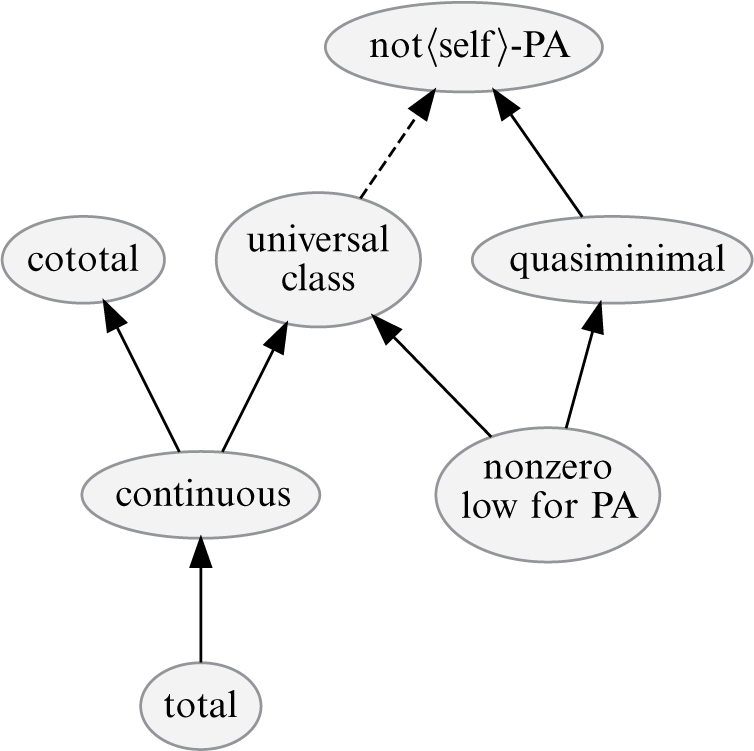
In the next section, we will turn our attention to several other classes of enumeration degrees. Before we do so, it is worth summarizing our results up to this point; see Figure 1. Solid arrows represent strict implications, and most implications that do not follow from the diagram have already been shown to be false. We discuss the exceptions below.

We have not yet seen that there are non-cototal degrees with a universal class. This is easily resolved. Andrews et al. [Reference Andrews, Ganchev, Kuyper, Lempp, Miller, Soskova and Soskova1] showed that there are both generic sets and halves of non-trivial
 $\mathcal {K}$
-pairs that do not have cototal degree, so having a universal class does not imply cototality.
We have also not yet proved that there are quasiminimal degrees without a universal class. Although we proved that the enumeration degrees of random sets are not low for PA, we do not know whether or not almost every enumeration oracle admits a universal class. However, in Section 5, we give an explicit construction of an oracle with quasiminimal degree (in fact, one with the computable extension property) that does not have a universal class. This also shows the dashed arrow to be a strict implication: it is not the case that only the
 ${\left \langle {\text {self}\kern2pt}\right \rangle }$
-PA degrees fail to have a universal class because quasiminimal degrees cannot be
 ${\left \langle {\text {self}\kern2pt}\right \rangle }$
-PA.
4 Combinatorial principles from descriptive set theory
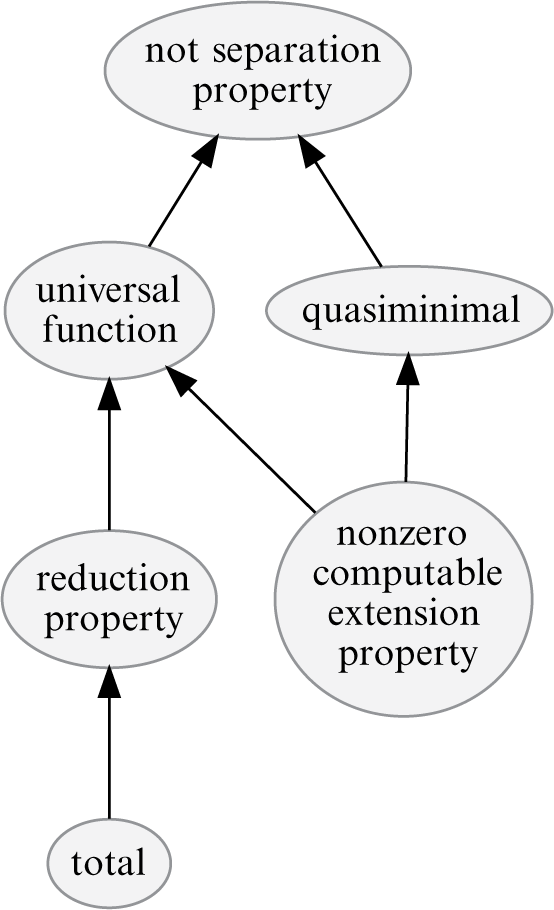
Kalimullin and Puzarenko [Reference Kalimullin and Puzarenko15] isolate a series of enumeration oracles based on properties that are satisfied by the ideal of sets enumeration reducible to them. They study the oracles that have the reduction property, oracles that have the separation property, oracles that have a universal function, and oracles that have the computable extension property. We will define each of these classes below in full detail. Here we draw the reader’s attention to a curious fact. Kalimullin and Puzarenko completely identify the relative position of these classes along with the total and the quasiminimal degrees. This relationship, illustrated in Figure 2, matches exactly the relationship that we have established between the oracles with continuous degrees,
 ${\left \langle {\text {self}\kern2pt}\right \rangle }$
-PA oracles, oracles that have a universal class, and the low for PA oracles in Figure 1. We will see that there is a good explanation for this: all but one of the properties described above can be characterized in terms of the relation
 ${\left \langle {\text {relatively}}\right \rangle }$
-PA restricted to separation classes.
Summary of the results in [Reference Kalimullin and Puzarenko15].

4.1 The reduction property
We start with the reduction property, which takes the same position as the continuous degrees in our diagram, although there is no analogy between the classes.
Definition 4.1.
 $X\subseteq \omega $
has the reduction property if for all pairs of sets
 $A, B\leq _e X$
, there are sets
 $A_0, B_0\leq _e X$
such that
 $A_0\subseteq A$
,
 $B_0\subseteq B$
,
 $A_0\cap B_0 = \emptyset $
, and
 $A_0\cup B_0 = A\cup B$
.
Kalimullin and Puzarenko [Reference Kalimullin and Puzarenko15] prove that
 $\deg _e(X)$
has the reduction property if and only if
 $\deg _e(X)$
has the uniformization property: if
 $R\leq _e X$
is a binary relation then there is a function f with graph
 $G_f\leq _e X$
such that
 $G_f\subseteq R$
and
 $dom(f) = dom(R)$
(i.e., the first projection of R).
It is straightforward to see that every total degree has the reduction property. Kalimullin and Puzarenko build a nontotal degree that also has this property. There is an easy example of a degree that has the reduction property and is not even cototal: the degree of Kleene’s O—the set of all indices of computable well orderings on
 $\omega $
. To see that
 $\deg _e(O)$
is not cototal, note that if
 $A\leq _e O$
then A is
 $\Pi ^1_1$
, because the definition of A as
 $\Gamma (O)$
for some e-operator
 $\Gamma $
is easily seen to be
 $\Pi ^1_1$
. Since
 $K^{{\left \langle {O}\right \rangle }}\leq _e O$
, it follows that
 $\overline {K^{{\left \langle {O}\right \rangle }}}$
is
 $\Sigma ^1_1$
. But if
 $O\leq _e \overline {K^{{\left \langle {O}\right \rangle }}}$
then O would be
 $\Sigma ^1_1$
as well, contradicting the fact that O is
 $\Pi ^1_1$
-complete. Note that the
 $\Pi ^1_1$
sets are exactly the sets that are enumeration reducible to O. Since
 $\Pi ^1_1$
sets have the reduction property, it follows that
 $\deg _e(O)$
does as well.
We can also observe that not every continuous degree has the reduction property. Kalimullin and Puzarenko [Reference Kalimullin and Puzarenko15] prove that if A is nontotal and has the reduction property, then the set of total degrees bounded by A is a jump ideal, i.e., an ideal closed under the jump operator. The existence of low
 $\Delta ^0_2$
continuous degrees implies that the two classes are incomparable. Nevertheless, they relate to the property of having a universal class in the same way.
Theorem 4.2. If X has the reduction property, then there is a universal
 $\Pi ^0_1{\left \langle {X}\right \rangle }$
class that is a separating class.
Proof Fix X with the reduction property. Let A consist of all
 ${\left \langle {e,\sigma }\right \rangle }$
such that
 $\sigma 0$
is not extendible in the e-th
 $\Pi ^0_1{\left \langle {X}\right \rangle }$
class
 $P_e$
. Let B be defined similarly but for
 $\sigma 1$
, not
 $\sigma 0$
. Note that
 $A,B \leq _e X$
by compactness. As defined,
 $$\begin{align*}P_e = 2^\omega \smallsetminus \left[\{\sigma0 \colon {\left\langle{e,\sigma}\right\rangle}\in A\}\cup \{\sigma1 \colon {\left\langle{e,\sigma}\right\rangle}\in B\}\right]. \end{align*}$$
Note that if
 $\sigma $
is extendible in
 $P_e$
, then
 ${\left \langle {e,\sigma }\right \rangle }\notin A\cap B$
. So a “separator” for A and B would let us choose either
 $\sigma 0$
or
 $\sigma 1$
still extendible in
 $P_e$
. But of course, A and B are not disjoint. Apply the reduction property: let
 $A_0\subseteq A$
and
 $B_0\subseteq B$
be such that
 $A_0,B_0 \leq _e X$
,
 $A_0\cap B_0 = \emptyset $
, and
 $A_0 \cup B_0 = A \cup B$
. Let U be the separating class for
 $A_0$
and
 $B_0$
, which is a nonempty
 $\Pi ^0_1{\left \langle {X}\right \rangle }$
class.
We claim that there is a uniform procedure to compute a path in the e-th
 $\Pi ^0_1{\left \langle {X}\right \rangle }$
class
 $P_e$
, assuming that it is nonempty, given a separator Z for
 $A_0$
and
 $B_0$
. If
 $\sigma $
is extendible in
 $P_e$
, check if
 ${\left \langle {e,\sigma }\right \rangle }$
lies in Z. If it does, we claim that
 $\sigma 1$
is extendible in
 $P_e$
. Otherwise,
 ${\left \langle {e,\sigma }\right \rangle } \in B \subseteq A_0 \cup B_0$
. Since
 ${\left \langle {e,\sigma }\right \rangle } \in Z$
and
 $Z \cap B_0 = \emptyset $
, it follows that
 ${\left \langle {e,\sigma }\right \rangle } \in A_0 \subseteq A$
. So
 ${\left \langle {e,\sigma }\right \rangle }\in A\cap B$
, which means that both
 $\sigma 0$
and
 $\sigma 1$
are not extendible in
 $P_e$
. This contradicts our assumption that
 $\sigma $
is extendible in
 $P_e$
. Similarly, if
 ${\left \langle {e,\sigma }\right \rangle }$
does not lie in Z, then
 $\sigma 0$
is extendible in
 $P_e$
.
4.2 The separation property
The separation property takes the same position in the diagram as
 ${\left \langle {\text {self}\kern2pt}\right \rangle }$
-PA (or rather their complements do).
Definition 4.3.
 $X\subseteq \omega $
has the separation property if whenever
 $A\leq _e X$
and
 $B\leq _e X$
are disjoint sets, there is a set C such that
 $C\oplus \overline C\leq _e X$
and
 $A\subseteq C$
and
 $B\subseteq \overline C$
.
As mentioned earlier, the set C above is called a separator for A and B. We can restate the definition of the separation property in terms of enumerating paths in separating classes:
Proposition 4.4. A set X has the separation property if and only if every
 $\operatorname {\mathrm {Sep}}{\left \langle {X}\right \rangle }$
class contains a path Y such that
 $Y\oplus \overline Y\leq _e X$
. In particular, every
 ${\left \langle {\text {self}\kern2pt}\right \rangle }$
-PA oracle has the separation property.
Proof This is immediate from our definitions. For the second part, if X is
 ${\left \langle {\text {self}\kern2pt}\right \rangle }$
-PA then every nonempty
 $\Pi ^0_1{\left \langle {X}\right \rangle }$
class, and hence every
 $\operatorname {\mathrm {Sep}}{\left \langle {X}\right \rangle }$
class, contains a path Y such that
 $Y\oplus \overline Y\leq _e X$
.
We will see in the next section that the inclusion of the
 ${\left \langle {\text {self}\kern2pt}\right \rangle }$
-PA oracles into the oracles with the separation property is strict.
The proposition above is trivial, but it holds the key to an analogy that will help us characterize the remaining two properties.
4.3 The computable extension property
The computable extension property takes the same place in the diagram as the low for PA oracles, and in fact is analogous.
Definition 4.5.
X has the computable extension property if every partial function
 $\varphi $
with
 $G_{\varphi }\leq _e X$
has a partial computable extension
 $\psi \supseteq \varphi $
.
Following the same analogy as for the separation property, we would want: X has the computable extension property if and only if
 ${\left \langle {X}\right \rangle }$
is low for PA but with respect to
 $\operatorname {\mathrm {Sep}}{\left \langle {X}\right \rangle }$
classes, i.e., every PA Turing oracle computes a path in every
 $\operatorname {\mathrm {Sep}}{\left \langle {X}\right \rangle }$
class. We prove this below. Furthermore, we exhibit a characterization of the oracles with the computable extension property that is similar to the characterization from Theorem 3.8.
Theorem 4.6. The following are equivalent:
-
(1) X has the computable extension property.
-
(2) Every
$\{0,1\}$
-valued function with graph reducible to X has a partial computable
$\{0,1\}$
-valued extension. -
(3) Every set Y with PA degree computes a member of every
$\operatorname {\mathrm {Sep}}{\left \langle {X}\right \rangle }$
class. -
(4) Every
$\operatorname {\mathrm {Sep}}{\left \langle {X}\right \rangle }$
class has a subset that is a nonempty
$\Pi ^0_1$
class. -
(5) Every
$\operatorname {\mathrm {Sep}}{\left \langle {X}\right \rangle }$
class has a subset that is a
$\Pi ^0_1$
separating class. -
(6) If
$A\leq _e X$
and
$B\leq _e X$
are disjoint then there are disjoint c.e. sets C and D such that
$A\subseteq C$
and
$B\subseteq D$
.


Proof To see that
 $(1)\Rightarrow (2)$
, we note that if
 $\psi $
is a partial computable extension of a
 $\{0,1\}$
-valued function
 $\varphi $
then the partial computable function
 $$\begin{align*}\psi^*(x) = \begin{cases} 0, & \mbox{if } \psi(x)\operatorname{\mathrm{\downarrow}} = 0,\\ 1, & \mbox{if } \psi(x)\operatorname{\mathrm{\downarrow}} \neq 0 \end{cases}\end{align*}$$
is
 $\{0,1\}$
-valued and extends
 $\varphi $
.
For
 $(2) \Rightarrow (1)$
, we use a proof from [Reference Kalimullin and Puzarenko15]. Suppose that
 $G_{\varphi }\leq _e X$
is the graph of a partial function. Consider the function
 $\varphi ^*({\left \langle {x,y}\right \rangle }) = 1$
if
 $\varphi (x) = y$
and
 $\varphi ^*({\left \langle {x,y}\right \rangle }) = 0$
if there is some
 $z\neq y$
such that
 $\varphi (x) = z$
. This is a
 $\{0,1\}$
-valued function whose graph is reducible to X, with the additional property that if
 $\varphi (x) = y$
then
 $\varphi ^*({\left \langle {x,z}\right \rangle })\operatorname {\mathrm {\downarrow }}$
for all z. If
 $\psi ^*$
is a partial computable extension of
 $\varphi ^*$
, then the function
 $\psi $
defined by
 $\psi (x) = \mu y\;[\psi ^*({\left \langle {x,y}\right \rangle }) = 1]$
is a partial computable extension of
 $\varphi $
.
 $(2)\Rightarrow (3)$
: Suppose that Y has PA degree. Consider a nonempty
 $\operatorname {\mathrm {Sep}}{\left \langle {X}\right \rangle }$
class
 $Q(A,B)$
of all separators for
 $A,B\leq _e X$
. Since A and B are disjoint,
 $A\times \{1\}\cup B\times \{0\}\leq _e X$
is the graph of a partial function. By (2), let
 $\psi $
be a partial computable
 $\{0,1\}$
-valued extension. The class of all total
 $\{0,1\}$
-valued extensions of
 $\psi $
is a nonempty
 $\Pi ^0_1$
class; hence a set Y of PA degree computes a member f of that set. The set C with characteristic function f is a separator for A and B.
 $(3)\Rightarrow (4)$
follows from the proof of Theorem 3.8. Fix a separating class
 $Q(A, B)$
relative to
 ${\left \langle {X}\right \rangle }$
. Since every PA degree computes a member of
 $Q(A,B)$
, there is a nonempty
 $\Pi ^0_1$
class U and a Turing reduction
 $\Phi _e$
such that if
 $X\in U$
, then
 $\Phi _e^{X}\in Q(A,B)$
. Then
 $Q = \{Y \colon (\exists X\in U)\; \Phi _e^{X} = Y\}$
is a nonempty
 $\Pi ^0_1$
class that is contained in
 $Q(A,B)$
.
For
 $(4)\Rightarrow (2)$
, suppose that
 $G_{\varphi }\leq _e X$
for some
 $\{0,1\}$
-valued partial function
 $\varphi $
. Let
 $A = \{x \colon \varphi (x) = 1\}$
and
 $B = \{x \colon \varphi (x) = 0\}$
. Let
 $Q(A,B)$
be the class of all sets separating A and B. By (4), let
 $P\subseteq Q(A,B)$
be a nonempty
 $\Pi ^0_1$
class. We define the
 $\{0,1\}$
-valued function
 $\psi $
by
 $\psi (x) = i$
if
 $Y(x) = i$
for all
 $Y\in P$
. By compactness,
 $\psi $
is a partial computable extension of
 $\varphi $
.
 $(5)$
is clearly a rewording of
 $(6)$
. In one direction, given a
 $\operatorname {\mathrm {Sep}}{\left \langle {X}\right \rangle }$
class
 $Q(A,B)$
, the sets A and B must be disjoint and reducible to X. If C and D are disjoint c.e. sets such that
 $A \subseteq C$
and
 $B \subseteq D$
, then the
 $\Pi ^0_1$
class of all separators of C and D is a subset of
 $Q(A,B)$
. Conversely, given disjoint sets
 $A,B \leq _e X$
, the class of all separators of A and B form a
 $\operatorname {\mathrm {Sep}}{\left \langle {X}\right \rangle }$
class
 $Q(A,B)$
. If
 $P(C,D) \subseteq Q(A,B)$
is a
 $\Pi ^0_1$
separating subclass, then C and D are disjoint c.e. sets such that
 $A \subseteq C$
and
 $B \subseteq D$
.
 $(2)\Rightarrow (6)$
: If A and B are reducible to X and disjoint, then
 $A\times \{1\}\cup B\times \{0\}$
is the graph of a partial
 $\{0,1\}$
-valued function
 $\varphi $
. If
 $\psi $
is a partial computable extension of
 $\varphi $
, then
 $C = \{x \colon \psi (x) = 1\} \supseteq A$
and
 $D = \{x \colon \psi (x) = 0\} \supseteq B$
are disjoint c.e. sets.
Finally,
 $(5)$
clearly implies
 $(4)$
.
From this characterization, we can easily conclude that every low for PA oracle has the computable extension property (part (3) is immediate from the definition of low for PA). In the next section we will see that—in contrast to the low for PA oracles—not every oracle with the computable extension property has a universal class. This, of course, implies that the low for PA oracles form a strict subclass of the oracles with the computable extension property.
4.4 Having a universal function
The final class of oracles that we consider takes the same place in the diagram as having a universal class.
Definition 4.7.
 $X\subseteq \omega $
has a universal function if there is a partial function U with
 $G_U\leq _e X$
such that if
 $\varphi $
is a partial function with
 $G_{\varphi }\leq _e X$
then for some e we have
 $\varphi = \lambda x. U(e,x)$
.
How does having a universal function relate to having a universal class? First note that it is not difficult to prove that continuous oracles have a universal function using the class that witnesses codability and a compactness argument. An essential component in this proof is uniformity: the existence of a single c.e. functional relative to which we have an enumeration of the coded set from every member of the coding class. For a similar reason, to show that every enumeration oracle with a universal class has a universal function, we again require some uniformity—exactly the uniformity that we built into our definition of a universal class. With this uniformity, our analogy persists: having a universal function is the same as having a
 $\Pi ^0_1{\left \langle {X}\right \rangle }$
class (or even a
 $\operatorname {\mathrm {Sep}}{\left \langle {X}\right \rangle }$
class) which is universal for
 $\operatorname {\mathrm {Sep}}{\left \langle {X}\right \rangle }$
classes.
Theorem 4.8. The following are equivalent:
-
(1) X has a universal function.
-
(2) There is a
$\{0,1\}$
-valued partial function U with
$G_U\leq _e X$
such that if
$\varphi $
is a
$\{0,1\}$
-valued partial function with
$G_{\varphi }\leq _e X$
, then for some e we have that
$\varphi = \lambda x. U(e,x)$
. -
(3) There is a separating
$\Pi ^0_1{\left \langle {X}\right \rangle }$
class P such that for every separating
$\Pi ^0_1{\left \langle {X}\right \rangle }$
class Q there is a Turing functional
$\Phi $
such that for all
$Y\in P$
we have that
$\Phi ^Y$
is a path in Q. -
(4) There is a
$\Pi ^0_1{\left \langle {X}\right \rangle }$
class P such that for every separating
$\Pi ^0_1{\left \langle {X}\right \rangle }$
class Q there is a Turing functional
$\Phi $
such that for all
$Y\in P$
we have that
$\Phi ^Y$
is a path in Q.


Proof The implication
 $(1)\Rightarrow (2)$
is easy: if
 $\Gamma $
is an enumeration operator such that
 $\Gamma (X)$
is the graph of a universal function for X, then define
 $$\begin{align*}\Lambda = \{{\left\langle{{\left\langle{x,0}\right\rangle},D}\right\rangle} \colon {\left\langle{{\left\langle{x,0}\right\rangle},D}\right\rangle}\in \Gamma\}\cup \{{\left\langle{{\left\langle{x,1}\right\rangle},D}\right\rangle} \colon (\exists n>0)[{\left\langle{{\left\langle{x,n}\right\rangle},D}\right\rangle}\in \Gamma]\}. \end{align*}$$
One can check that
 $\Lambda (X)$
is the graph of a universal function for the
 $\{0,1\}$
-valued partial functions whose graphs are enumeration reducible to X.
For
 $(2)\Rightarrow (1)$
, we use a familiar trick: Every function
 $\varphi \colon \omega \rightarrow \omega $
can be represented by a
 $\{0,1\}$
-valued function
 $\psi \colon \omega ^2\rightarrow \{0,1\}$
defined by
 $\psi (x,y) = 1$
if
 $\varphi (x) = y$
and
 $\psi (x, y) = 0$
if
 $\varphi (x)\operatorname {\mathrm {\downarrow }}\neq y$
. If U is universal for the
 $\{0,1\}$
-valued functions, define the function
 $\widehat {U}$
by
 $\widehat {U}(e,x) = y$
if and only if
 $U(e, {\left \langle {x,y}\right \rangle }) = 1$
and for all
 $z < y$
,
 $U(e,{\left \langle {x,z}\right \rangle }) = 0$
. Then
 $\widehat {U}$
is universal and
 $G_{\widehat {U}} \leq _e G_U$
.
For
 $(2)\Rightarrow (3)$
, suppose that U is a universal
 $\{0,1\}$
-valued function for X and
 $G_U\leq _e X$
. For every
 $\{0,1\}$
-valued
 $\varphi $
with
 $G_{\varphi }\leq _e X$
, the set of all total
 $\{0,1\}$
-valued extensions of
 $\varphi $
is a nonempty
 $\Pi ^0_1{\left \langle {X}\right \rangle }$
class. Using U we can interweave all such classes into one class P. Formally, define P to be the
 $\Pi ^0_1{\left \langle {X}\right \rangle }$
separating class for the disjoint sets
 $\{{\left \langle {e,x}\right \rangle } \colon U(e,x) = 1\}$
and
 $\{{\left \langle {e,x}\right \rangle } \colon U(e,x) = 0\}$
. Now if
 $Q(B,C)$
is a
 $\Pi ^0_1{\left \langle {X}\right \rangle }$
separating class, then
 $B\times \{1\}\cup C\times \{0\}$
is the graph of a
 $\{0,1\}$
-valued function whose graph is e-reducible to X. Fix some e such that this function is
 $\lambda x. U(e,x)$
. Then for any
 $Y\in P$
, the column
 $Y^{[e]}$
is an extension of
 $\lambda x. U(e,x)$
, and hence a separator for B and C. Note that once we have e, the reduction is uniform.
The implication
 $(3) \Rightarrow (4)$
is immediate.
Finally, to see that
 $(4)\Rightarrow (2)$
is true, let
 $\Gamma $
be an enumeration operator such that
 $P = 2^{\omega }\smallsetminus [\Gamma (X)]$
is a
 $\Pi ^0_1{\left \langle {X}\right \rangle }$
class that is universal for
 $\operatorname {\mathrm {Sep}}{\left \langle {X}\right \rangle }$
classes. We define a universal
 $\{0,1\}$
-valued function U as follows: for every pair
 ${\left \langle {e,i}\right \rangle }$
, we set
 $U({\left \langle {e,i}\right \rangle }, x) = y$
if
-
(1)
$y\leq 1$
, -
(2)
${\left \langle {x,y}\right \rangle }\in \Gamma _e(X)$
, and -
(3) there is a finite set
$D\subseteq \Gamma (X)$
and an n such that if
$\sigma \in 2^n\smallsetminus [D]$
, then
$\Phi _i^{\sigma }(x)\operatorname {\mathrm {\downarrow }} = y$
.


Here,
 $\Gamma _e$
is the e-th enumeration operator, and
 $\Phi _i$
is the i-th Turing functional. Clearly, U is a
 $\{0,1\}$
-valued function with graph that is e-reducible to X. It is also universal, because if
 $\varphi $
is a
 $\{0,1\}$
-valued function such that
 $G_{\varphi } = \Gamma _e(X)$
, we may consider the
 $\operatorname {\mathrm {Sep}}{\left \langle {X}\right \rangle }$
class of all sets which separate the disjoint sets
 $B =\{n \colon \varphi (n) = 1\}$
and
 $C =\{n \colon \varphi (n) = 0\}$
. Let i be the index of the Turing functional via which every member of P computes a separator for B and C. Then
 $\lambda x.U( {\left \langle {e,i}\right \rangle },x) = \varphi $
. Indeed, the second condition ensures that if
 $U({\left \langle {e,i}\right \rangle },x) = y$
, then
 $\varphi (x) = y$
. Conversely, if
 $\varphi (x) = y$
, then compactness and our choice of i implies that the third condition holds, so
 $U({\left \langle {e,i}\right \rangle },x) = y$
.
Corollary 4.9. Every enumeration degree that has a universal class also has a universal function.
5 Forcing separations
In this section, we consider a forcing notion that produces an enumeration oracle that has the computable extension property, but does not have a universal class (and hence, is not low for PA). By modifying this forcing notion using ideas from Theorem 2.11, we will also produce an oracle that has the separation property but is not
 ${\left \langle {\text {self}\kern2pt}\right \rangle }$
-PA.
Our forcing notion
 $\mathbb {P}$
is as follows: Let
 $f(n) = 2^n$
and define
 $f^{<\omega }$
to be the set of sequences
 $\sigma \in \omega ^{<\omega }$
such that
 $\sigma (n) < 2^n$
for all
 $n < |\sigma |$
. Our forcing conditions are of the form
 ${\left \langle {T, \varepsilon }\right \rangle }$
, where T is a finite subtree of
 $f^{<\omega }$
and
 $\varepsilon \in (0,1)$
is rational. We denote the height of T by
 $|T|$
. Let
 $f^{\leq |T|}$
be the set of sequences
 $\sigma \in f^{<\omega }$
of length less than
 $|T|$
. We define the forcing partial order by
 ${\left \langle {S, \delta }\right \rangle } \leq {\left \langle {T, \varepsilon }\right \rangle }$
if and only if:
-
•
$T = S \operatorname {\mathrm {\upharpoonright }} |T|$
, -
•
$\delta \leq \varepsilon $
, and -
• for every
$\sigma \in S$
with
$|T| \leq |\sigma | < |S|$
, at least
$\left \lceil (1-\varepsilon ) \cdot 2^{|\sigma |} \right \rceil $
of its immediate successors lie in S.


We call S an
 $\varepsilon $
-extension of T if it satisfies the first and third conditions.
Let
 $\mathcal {F}$
be a filter in
 $\mathbb {P}$
. Then the corresponding tree is
 $G = \bigcup _{{\left \langle {T,\varepsilon }\right \rangle }\in \mathcal {F}} T$
. Very little genericity is required to ensure that G is infinite. The enumeration oracle that we are building is
 $A_G = f^{<\omega }\smallsetminus G$
, which of course we can view as a subset of
 $\omega $
by fixing a computable bijection between
 $\omega $
and
 $f^{<\omega }$
. Observe that the set of infinite paths through G is a
 $\Pi ^0_1{\left \langle {A_G}\right \rangle }$
subclass of
 $f^\omega $
, where as expected,
 $f^\omega $
is the set of all
 $g \in \omega ^\omega $
such that
 $g(n) < 2^n$
for all
 $n \in \omega $
. Given a condition
 ${\left \langle {T,\varepsilon }\right \rangle }$
, we let
 $A_T = f^{\leq |T|}\smallsetminus T$
, the natural approximation to
 $A_G$
given by the condition. It follows that if
 ${\left \langle {S, \delta }\right \rangle } \leq {\left \langle {T, \varepsilon }\right \rangle }$
then
 $A_T \subseteq A_S \subseteq A_G$
.
Remark 5.1. Prior to this section, we restricted our attention to
 $\Pi ^0_1$
subclasses of
 $2^\omega $
, but now it will be convenient to consider subclasses of
 $f^\omega $
. Everything we have done generalizes easily to this case, and more generally to computably bounded classes. For example, it is not hard to see that Theorem 3.8 holds for subclasses of
 $f^\omega $
, a fact that we will use in Lemma 5.3.
For our proof of Theorem 5.7, we need to say a little more about what
 ${\left \langle {\text {self}\kern2pt}\right \rangle }$
-PA means for subclasses of
 $f^\omega $
. As usual, A is
 ${\left \langle {\text {self}\kern2pt}\right \rangle }$
-PA if every nonempty
 $\Pi ^0_1{\left \langle {A}\right \rangle }$
class Q contains a path that is enumeration below A, where the path is treated as a total object. If
 $Q\subseteq f^\omega $
, we treat a path as a subset of
 $f^{<\omega }$
instead of an element of
 $f^\omega $
(i.e., as a set of prefixes). This makes it a total object. This does not change the definition of
 ${\left \langle {\text {self}\kern2pt}\right \rangle }$
-PA: A is
 ${\left \langle {\text {self}\kern2pt}\right \rangle }$
-PA as defined in Section 2 if and only if it is
 ${\left \langle {\text {self}\kern2pt}\right \rangle }$
-PA in this modified sense.
5.1 An oracle that has the computable extension property but no universal class
We will show that if G is sufficiently generic, or more precisely, that if G is the tree corresponding to a sufficiently generic filter
 $\mathcal {F}$
, then
 $A_G$
satisfies the computable extension property and does not have a universal class.
Lemma 5.2. If G is sufficiently generic with respect to
 $\mathbb {P}$
, then
 $A_G$
has the computable extension property.
Proof We shall verify that
 $A_G$
satisfies (6) in Theorem 4.6. Let
 ${\left \langle {T, \varepsilon }\right \rangle }$
be an arbitrary condition. Consider a pair of enumeration operators
 $\Gamma _0$
and
 $\Gamma _1$
. If there is a condition
 ${\left \langle {S, \delta }\right \rangle }$
extending
 ${\left \langle {T, \varepsilon }\right \rangle }$
such that
 $\Gamma _0(A_S)$
and
 $\Gamma _1(A_S)$
intersect, then we make that extension. This ensures that
 $\Gamma _0(A_G)$
and
 $\Gamma _1(A_G)$
are not disjoint.
Now assume that we cannot force
 $\Gamma _0(A_G)$
and
 $\Gamma _1(A_G)$
to intersect. We want to extend
 ${\left \langle {T, \varepsilon }\right \rangle }$
to ensure that
 $\Gamma _0(A_G)$
and
 $\Gamma _1(A_G)$
are separated by disjoint c.e. sets. We claim that
 ${\left \langle {T, \varepsilon /2}\right \rangle }$
is such an extension. For
 $i=0,1$
, define
 $C_i$
to be the set of all n for which there is some condition
 ${\left \langle {S, \delta }\right \rangle }$
extending
 ${\left \langle {T, \varepsilon /2}\right \rangle }$
such that
 $n \in \Gamma _i(A_S)$
. It is straightforward to see that
 $C_i$
is c.e. and contains
 $\Gamma _i(A_G)$
.
Furthermore, we claim that
 $C_0$
and
 $C_1$
are disjoint. If not, fix
 $n \in \omega $
and conditions
 ${\left \langle {S_0, \delta _0}\right \rangle }$
and
 ${\left \langle {S_1, \delta _1}\right \rangle }$
extending
 ${\left \langle {T, \varepsilon /2}\right \rangle }$
that witness that
 $n \in C_0$
and
 $n \in C_1$
, respectively. Without loss of generality, we may assume that
 $|S_0| = |S_1|$
. Consider the condition
 ${\left \langle {S_0 \cap S_1, \varepsilon }\right \rangle }$
.
It is straightforward to see that
 ${\left \langle {S_0 \cap S_1, \varepsilon }\right \rangle }$
extends
 ${\left \langle {T, \varepsilon }\right \rangle }$
. In fact, for every
 $\sigma \in S_0 \cap S_1$
with
 $|T| \leq |\sigma | < |S_0|$
(
 $=|S_1|$
), at least
 $\left \lceil (1-\varepsilon /2) \cdot 2^{|\sigma |} \right \rceil $
of its immediate successors lie in
 $S_0$
and at least
 $\left \lceil (1-\varepsilon /2) \cdot 2^{|\sigma |} \right \rceil $
of its immediate successors lie in
 $S_1$
. Therefore at least
 $\left \lceil (1-\varepsilon ) \cdot 2^{|\sigma |} \right \rceil $
of its immediate successors lie in
 $S_0 \cap S_1$
.
The argument above also implies that
 $|S_0 \cap S_1| = |S_0| = |S_1|$
. So
 $A_{S_0 \cap S_1}$
contains
 $A_{S_0}$
, meaning that
 $n\in \Gamma _0(A_{S_0 \cap S_1})$
. Similarly,
 $n\in \Gamma _1(A_{S_0 \cap S_1})$
. This contradicts our assumption that there is no condition
 ${\left \langle {S, \delta }\right \rangle }$
extending
 ${\left \langle {T, \varepsilon }\right \rangle }$
such that
 $\Gamma _0(A_S)$
and
 $\Gamma _1(A_S)$
intersect. Therefore,
 $C_0$
and
 $C_1$
are disjoint c.e. sets covering
 $\Gamma _0(A_G)$
and
 $\Gamma _1(A_G)$
, respectively.
Our second goal is to prove that if G is sufficiently generic, then there is no universal
 $\Pi ^0_1{\left \langle {A_G}\right \rangle }$
class. This proof is somewhat involved, so it is worth pointing out that it is easy to show a weaker result: that
 ${\left \langle {A_G}\right \rangle }$
is not low for PA.
Lemma 5.3. If G is sufficiently generic with respect to
 $\mathbb {P}$
, then
 ${\left \langle {A_G}\right \rangle }$
is not low for PA.
Proof To show that
 ${\left \langle {A_G}\right \rangle }$
is not low for PA, note that
 $[G]$
is a nonempty
 $\Pi ^0_1{\left \langle {A_G}\right \rangle }$
class, where
 $[G]\subseteq f^\omega $
is the set of infinite paths through G. We show that it has no nonempty
 $\Pi ^0_1$
subclass. Indeed, let
 $P \subseteq f^{\omega }$
be a nonempty
 $\Pi ^0_1$
class and let
 ${\left \langle {T, \varepsilon }\right \rangle }\in \mathbb {P}$
be an arbitrary condition. Since P is nonempty, there must be some
 $\sigma \in f^{<\omega }$
of length
 $n>\max \{|T|, -\log _2(\varepsilon )+1\}$
such that
 $\sigma $
has an extension in P. For such a
 $\sigma $
, we can extend
 ${\left \langle {T, \varepsilon }\right \rangle }$
to
 ${\left \langle {S, \varepsilon }\right \rangle }$
, where S has height n and does not contain
 $\sigma $
. Then
 ${\left \langle {S, \varepsilon }\right \rangle }$
ensures that P is not a subclass of
 $[G]$
, and we have shown that such conditions are dense.
Corollary 5.4. Low for PA strictly implies the computable extension property.
Proof We pointed out after Theorem 4.6 that every low for PA oracle has the computable extension property. Strictness follows from Lemmas 5.2 and 5.3.
We now turn to the result promised above.
Lemma 5.5. If G is sufficiently generic with respect to
 $\mathbb {P}$
, then
 $A_G$
does not have a universal class.
Proof Consider an oracle
 $\Pi ^0_1{\left \langle {A_G}\right \rangle }$
class
 $P{\left \langle {A_G}\right \rangle }$
. We want to show that
 $P{\left \langle {A_G}\right \rangle }$
is not a universal
 $\Pi ^0_1{\left \langle {A_G}\right \rangle }$
class. Let
 ${\left \langle {T, \varepsilon }\right \rangle }$
be an arbitrary condition. The easy win, of course, is if there is an extension
 ${\left \langle {S,\delta }\right \rangle }$
of
 ${\left \langle {T, \varepsilon }\right \rangle }$
such that
 $P{\left \langle {A_S}\right \rangle }$
is empty. Since
 $P{\left \langle {A_G}\right \rangle }\subseteq P{\left \langle {A_S}\right \rangle }$
, this would force
 $P{\left \langle {A_G}\right \rangle }$
to be empty. So let us assume that this is not true. In other words, we are assuming that
 $$\begin{align*}{\left\langle{T, \varepsilon}\right\rangle}\Vdash P{\left\langle{A_G}\right\rangle}\text{ is nonempty}. \end{align*}$$
In this case, we will have to meet infinitely many dense sets to ensure that
 $P{\left \langle {A_G}\right \rangle }$
is not universal.
First, let
 ${\left \langle {S,\delta }\right \rangle }$
be an extension of
 ${\left \langle {T, \varepsilon }\right \rangle }$
such that
 $|S|> -\log _2(\varepsilon )+1$
, and there is a
 $\tau \in S$
of length
 $|S|-1$
such that every immediate successor of
 $\tau $
is in S. Obviously, such extensions are dense. Let
 $\sigma $
be an immediate successor of
 $\tau $
. Note that we have set things up so that
 $S\smallsetminus \{\sigma \}$
is an
 $\varepsilon $
-extension of T. Furthermore, if R is any
 $\delta $
-extension of S, then
 $R\smallsetminus [\sigma ]^\prec $
is an
 $\varepsilon $
-extension of T. Here,
 $[\sigma ]^\prec \subseteq f^{<\omega }$
is the set of all finite strings extending
 $\sigma $
. (Not to be confused with
 $[\sigma ]\subseteq f^{\omega }$
.)
This implies that
 $$\begin{align*}{\left\langle{S,\delta}\right\rangle}\Vdash P{\left\langle{A_{G\smallsetminus[\sigma]^\prec}}\right\rangle}\text{ is nonempty}. \end{align*}$$
Also note that
 ${\left \langle {S,\delta }\right \rangle }$
forces that
 $[G]\cap [\sigma ]$
is a nonempty
 $\Pi ^0_1{\left \langle {A_G}\right \rangle }$
class because every leaf of S must have a full-height extension in every
 $\delta $
-extension of S. Our goal is to prove that
 $$\begin{align*}{\left\langle{S,\delta}\right\rangle}\Vdash \left(\exists X\in P{\left\langle{A_G}\right\rangle}\right)\; X \text{ computes no member of }[G]\cap[\sigma]. \end{align*}$$
The witness X will actually be in
 $P{\left \langle {A_{G\smallsetminus [\sigma ]^\prec }}\right \rangle }$
, which is a subset of
 $P{\left \langle {A_G}\right \rangle }$
. This is the key to the argument: any choice that we make when building G above
 $\sigma $
—i.e., any choice that affects
 $[G]\cap [\sigma ]$
—has no effect on
 $P{\left \langle {A_{G\smallsetminus [\sigma ]^\prec }}\right \rangle }$
.
Now let
 ${\left \langle {R,\gamma }\right \rangle }$
be an extension of
 ${\left \langle {S,\delta }\right \rangle }$
and let
 $Q\subseteq f^\omega $
be a
 $\Pi ^0_1$
class such that
 $$\begin{align*}{\left\langle{R,\gamma}\right\rangle}\Vdash Q\cap P{\left\langle{A_{G\smallsetminus[\sigma]^\prec}}\right\rangle}\text{ is nonempty}. \end{align*}$$
Furthermore, let
 $\Phi $
be a Turing functional. We will find an extension
 ${\left \langle {R',\gamma '}\right \rangle }$
of
 ${\left \langle {R,\gamma }\right \rangle }$
and a
 $\Pi ^0_1$
subclass
 $Q'\subseteq Q$
such that
 $$ \begin{align} \begin{split} {\left\langle{R',\gamma'}\right\rangle}\Vdash &\ Q'\cap P{\left\langle{A_{G\smallsetminus[\sigma]^\prec}}\right\rangle}\text{ is nonempty and}\\ & \left(\forall X\in Q'\cap P{\left\langle{A_{G\smallsetminus[\sigma]^\prec}}\right\rangle}\right)\; \Phi^X\notin [G]\cap[\sigma]. \end{split} \end{align} $$
Fix
 $n>\max \{|R|,-\log _2(\gamma )+1\}$
. Let
 $$\begin{align*}Q^* = \{X\in Q \colon \Phi^X\operatorname{\mathrm{\upharpoonright}} n\text{ is partial or does not extend }\sigma\}. \end{align*}$$
If
 $$\begin{align*}{\left\langle{R,\gamma}\right\rangle}\Vdash Q^*\cap P{\left\langle{A_{G\smallsetminus[\sigma]^\prec}}\right\rangle}\text{ is nonempty}, \end{align*}$$
then let
 ${\left \langle {R',\gamma '}\right \rangle } = {\left \langle {R,\gamma }\right \rangle }$
and
 $Q' = Q^*$
; this satisfies (5.1).
Otherwise, let
 $R^*$
be a
 $\gamma $
-extension of R such that
 $Q^*\cap P{\left \langle {A_{R^*\smallsetminus [\sigma ]^\prec }}\right \rangle }$
is empty. In other words, for every
 $X\in Q\cap P{\left \langle {A_{R^*\smallsetminus [\sigma ]^\prec }}\right \rangle }$
, we know that
 $\Phi ^X\operatorname {\mathrm {\upharpoonright }} n$
is total and extends
 $\sigma $
. Note that we may assume that
 $R^*$
contains all extensions of
 $\sigma $
up to length
 $|R^*|$
. It will also be convenient to assume that
 $|R^*|\geq n$
.
For each
 $\tau \in f^n$
extending
 $\sigma $
, let
 $Q_\tau = \{X\in Q\cap P{\left \langle {A_{R^*\smallsetminus [\sigma ]^\prec }}\right \rangle } \colon \Phi ^X\operatorname {\mathrm {\upharpoonright }} n = \tau \}$
. Note that
 $Q_\tau $
is a
 $\Pi ^0_1$
class by our choice of
 $R^*$
. Let
 $\gamma ' = \gamma /2^n$
. We claim that for some
 $\tau \in f^n$
that extends
 $\sigma $
we have
 $$ \begin{align} {\left\langle{R^*,\gamma'}\right\rangle}\Vdash Q_\tau\cap P{\left\langle{A_{G\smallsetminus[\sigma]^\prec}}\right\rangle}\text{ is nonempty}. \end{align} $$
If this were not the case, then following the proof of Lemma 5.2, we intersect the
 $2^{n-|\sigma |}$
same height
 $\gamma '$
-extensions of
 $R^*$
that are chosen to force the emptiness of
 $Q_\tau \cap P{\left \langle {A_{G\smallsetminus [\sigma ]^\prec }}\right \rangle }$
for each
 $\tau \in f^n$
extending
 $\sigma $
. This gives us a
 $\gamma $
-extension of
 $R^*$
that witnesses the emptiness of
 $Q\cap P{\left \langle {A_{G\smallsetminus [\sigma ]^\prec }}\right \rangle }$
, which is a contradiction.
So fix a
 $\tau \in f^n$
that extends
 $\sigma $
such that (5.2) holds. Let
 $R' = R^*\smallsetminus [\tau ]^\prec $
and note that
 ${\left \langle {R',\gamma '}\right \rangle }$
extends
 ${\left \langle {R,\gamma }\right \rangle }$
, because of the choice of n, and that
 $$\begin{align*}{\left\langle{R',\gamma'}\right\rangle}\Vdash Q_\tau\cap P{\left\langle{A_{G\smallsetminus[\sigma]^\prec}}\right\rangle}\text{ is nonempty}. \end{align*}$$
This latter fact holds because, as we mentioned above, nothing we do to G above
 $\sigma $
has any effect on
 $P{\left \langle {A_{G\smallsetminus [\sigma ]^\prec }}\right \rangle }$
. Finally, having removed
 $\tau $
from
 $R'$
, we have
 $$\begin{align*}{\left\langle{R',\gamma'}\right\rangle}\Vdash \left(\forall X\in Q_\tau\cap P{\left\langle{A_{G\smallsetminus[\sigma]^\prec}}\right\rangle}\right)\; \Phi^X \notin [G]\cap[\sigma]. \end{align*}$$
Therefore, letting
 $Q'=Q_\tau $
, we have satisfied (5.1).
We are now ready to wrap up the proof that
 $$\begin{align*}{\left\langle{S,\delta}\right\rangle}\Vdash \left(\exists X\in P{\left\langle{A_G}\right\rangle}\right)\; X \text{ computes no member of }[G]\cap[\sigma]. \end{align*}$$
Let
 $\mathcal {F}\subseteq \mathbb {P}$
be a sufficiently generic filter containing
 ${\left \langle {S,\delta }\right \rangle }$
. Then by the argument above, there is a sequence of conditions
 ${\left \langle {S,\delta }\right \rangle } = {\left \langle {R_0,\gamma _0}\right \rangle } \geq {\left \langle {R_1,\gamma _1}\right \rangle } \geq {\left \langle {R_2,\gamma _2}\right \rangle } \geq \cdots $
, all of which are in
 $\mathcal {F}$
, and a sequence of
 $\Pi ^0_1$
classes
 $f^\omega = Q_0\supseteq Q_1\supseteq Q_2\supseteq \cdots $
such that, for each i,
 $$\begin{align*}{\left\langle{R_i,\gamma_i}\right\rangle}\Vdash Q_i\cap P{\left\langle{A_{G\smallsetminus[\sigma]^\prec}}\right\rangle}\text{ is nonempty}, \end{align*}$$
and for each
 $i>0$
,
 $$\begin{align*}{\left\langle{R_i,\gamma_i}\right\rangle}\Vdash \left(\forall X\in Q_i\cap P{\left\langle{A_{G\smallsetminus[\sigma]^\prec}}\right\rangle}\right)\; \Phi_{i-1}^X\notin [G]\cap[\sigma]. \end{align*}$$
Here, as you would expect,
 $\{\Phi _i\}_{i\in \omega }$
is an enumeration of the Turing functionals. So take any X in
 $\bigcap _{i\in \omega } Q_i\cap P{\left \langle {A_{G\smallsetminus [\sigma ]^\prec }}\right \rangle }$
, which must be nonempty by compactness. Then X computes no member of
 $[G]\cap [\sigma ]$
, as desired.
We have shown that for every oracle
 $\Pi ^0_1{\left \langle {A}\right \rangle }$
class
 $P{\left \langle {A}\right \rangle }$
, and every condition
 ${\left \langle {T, \varepsilon }\right \rangle }$
, there is an extension of
 ${\left \langle {T, \varepsilon }\right \rangle }$
that forces
 $P{\left \langle {A_G}\right \rangle }$
not to be a universal
 $\Pi ^0_1{\left \langle {A_G}\right \rangle }$
class (possibly by making it empty). Therefore, as long as G is sufficiently generic, there is no universal
 $\Pi ^0_1{\left \langle {A_G}\right \rangle }$
class.
We have proved:
Corollary 5.6. There is an enumeration oracle with the computable extension property that does not have a universal class.
In particular, since by [Reference Kalimullin and Puzarenko15] every oracle that has the computable extension property has a universal function, it follows that having a universal class strictly implies having a universal function.
5.2 An oracle with the separation property that is not
${\left \langle {\text {self}\kern2pt}\right \rangle }$
-PA

Finally, we prove that
 ${\left \langle {\text {self}\kern2pt}\right \rangle }$
-PA strictly implies having the separation property.
Theorem 5.7. There are degrees with the separation property that are not
 ${\left \langle {\text {self}\kern2pt}\right \rangle }$
-PA.
Proof We use a forcing notion that combines
 $\mathbb {P}$
and (a minor variant of) the forcing notion used in the proof of Theorem 2.11. Our conditions have the form
 $$\begin{align*}p = ({\left\langle{T, \varepsilon}\right\rangle}, n, X_1, \dots X_{n-1}, D), \end{align*}$$
where
-
1.
${\left \langle {T, \varepsilon }\right \rangle }\in \mathbb {P}$
, i.e., T is a finite tree in
$f^{<\omega }$
and
$\varepsilon \in (0,1)$
is rational. -
2.
$(n, X_1, \dots X_{n-1}, D)$
are almost as in Theorem 2.11:
$n\in \omega $
,
$X_1, \dots , X_{n-1}\in 2^{\omega }$
and D is a finite subset of
$\omega ^{[>0]}$
.


We associate with a condition p the set
 $$\begin{align*}A_p =\bigg( \bigoplus_{i\in\omega} Y_i\bigg) \cup D, \end{align*}$$
where
 $Y_0 = f^{\leq |T|}\smallsetminus T$
,
 $Y_{i } = X_{i}$
for
 $0< i <n$
and
 $Y_{i} = \emptyset $
for
 $i>n$
. A condition
 $q = ({\left \langle {S, \delta }\right \rangle }, m, Y_1, \dots , Y_{m-1}, E)$
extends p if:
-
•
${\left \langle {S,\delta }\right \rangle }$
extends
${\left \langle {T,\varepsilon }\right \rangle }$
(in the sense of
$\mathbb {P}$
); -
•
$m\geq n$
and
$X_1 = Y_1$
, …,
$X_{n-1} = Y_{n-1}$
; -
•
$D\subseteq E$
and
$E\smallsetminus D\subseteq \omega ^{[\geq n]}$
.


We shall build a monotone sequence
 $\{p_s\}_{s\in \omega }$
and let
 $A = \bigcup _{s}A_{p_s}$
. To ensure that A has the separation property we satisfy requirements:
 $$\begin{align*}\mathcal{S}_{i,j}: \Gamma_i(A)\cap \Gamma_j(A) = \emptyset \rightarrow (\exists C)[\Gamma_i(A)\subseteq C\ \& \ \Gamma_j(A)\subseteq \overline C\ \ \&\ C\oplus \overline C\leq_e A ]. \end{align*}$$
To ensure that A is not
 ${\left \langle {\text {self}\kern2pt}\right \rangle }$
-PA we satisfy requirements:
 $$\begin{align*}\mathcal{N}_e\colon \bigcup \Gamma_e(A) \text{ is not a path through } [f^{<\omega }\smallsetminus A^{[0]}]. \end{align*}$$
(See Remark 5.1 for a discussion of paths through subclasses of
 $f^\omega $
.) Note that
 $[f^{<\omega }\smallsetminus A^{[0]}]$
is a nonempty
 $\Pi ^0_1{\left \langle {A}\right \rangle }$
class just as in the forcing notion
 $\mathbb {P}$
that we introduced earlier in this section.
We start with
 $p_0 = ( {\left \langle {\emptyset , \frac {1}{2}}\right \rangle }, 0, \emptyset )$
. Suppose we have constructed
 $$\begin{align*}p_s =({\left\langle{T, \varepsilon}\right\rangle}, n, X_1, \dots, X_{n-1}, D)\end{align*}$$
and
 $s = 2{\left \langle {i,j}\right \rangle }$
. To satisfy
 $\mathcal {S}_{i,j}$
, we ask if
 $p_s$
has an extension of the form
 $$\begin{align*}q = ({\left\langle{S, \varepsilon}\right\rangle}, n, X_1, \dots, X_{n-1}, E) \end{align*}$$
such that
 $\Gamma _i(A_q)\cap \Gamma _j(A_q)\neq \emptyset $
. If so, then let
 $p_{s+1}$
be such an extension. In this case, we can argue that
 $\mathcal {S}_{i,j}$
is vacuously satisfied.
If there is no such extension, we define
 $p_{s+1}$
as follows. For
 $k = i,j$
, let
 $W_k$
be the set of all numbers x such that there is some
 $$\begin{align*}q = ({\left\langle{S, \varepsilon/2}\right\rangle}, n, X_1, \dots, X_{n-1}, E) \end{align*}$$
extending
 $({\left \langle {T, \varepsilon /2}\right \rangle }, n, X_1, \dots ,X_{n-1}, D)$
such that
 $x\in \Gamma _{k}(A_q)$
. We claim that
 $W_i$
and
 $W_j$
are disjoint. If not, fix
 $x \in W_i \cap W_j$
and conditions
 $$ \begin{align*} &({\left\langle{S_i,\varepsilon/2}\right\rangle}, n,X_1,\dots,X_{n-1},E_i) \\ \text{and} \quad &({\left\langle{S_j,\varepsilon/2}\right\rangle}, n,X_1,\dots,X_{n-1},E_j) \end{align*} $$
witnessing that x lies in
 $W_i$
and
 $W_j$
, respectively. Without loss of generality, we may assume that
 $|S_i| = |S_j|$
. Following the proof of Lemma 5.2, the condition
 $$\begin{align*}q = ({\left\langle{S_i \cap S_j,\varepsilon}\right\rangle},n,X_1,\dots,X_{n-1},E_i \cup E_j) \end{align*}$$
extends
 $p_s$
and satisfies
 $x \in \Gamma _i(A_q) \cap \Gamma _j(A_q)$
, which is a contradiction. This proves that
 $W_i$
and
 $W_j$
are disjoint.
Let C be an arbitrary separator for
 $W_i$
and
 $W_j$
and let
 $$\begin{align*}p_{s+1} = ({\left\langle{T, \varepsilon/2}\right\rangle}, n+2, X_1 \dots, X_{n-1}, C, \overline{C}, D). \end{align*}$$
We claim that for
 $k = i,j$
, we have
 $\Gamma _k(A) \subseteq W_k$
. If
 $x \in \Gamma _k(A)$
, there is some condition
 $q = ({\left \langle {S,\delta }\right \rangle },m,X_1,\dots ,X_{m-1},E)$
extending
 $p_{s+1}$
such that
 $x \in \Gamma _k(A_q)$
. Fix a finite set
 $F \subseteq A_q$
such that
 $x \in \Gamma _k(F)$
. Define
 $E' = D \cup (F \cap \omega ^{[\geq n]})$
. Then
 $q' = ({\left \langle {S,\varepsilon /2}\right \rangle },n,X_1,\dots ,X_{n-1},E')$
extends
 $({\left \langle {T,\varepsilon /2}\right \rangle },n,X_1,\dots ,X_{n-1},D)$
and
 $x \in \Gamma _k(A_{q'})$
. This shows that
 $x \in W_k$
, proving the claim.
It follows that A can enumerate a separator (and its complement) for
 $\Gamma _i(A)$
and
 $\Gamma _j(A)$
, by enumerating
 $A^{[n]}\oplus A^{[n+1]}$
(modulo some possible finite error).
If
 $s = 2e+1$
, we ensure that
 $\mathcal {N}_e$
is satisfied. We ask if there is a condition
 $$\begin{align*}q = ({\left\langle{S, \varepsilon/2}\right\rangle}, n, X_1, \dots ,X_{n-1}, E)\end{align*}$$
that extends
 $({\left \langle {T, \varepsilon /2}\right \rangle }, n, X_1, \dots ,X_{n-1}, D)$
(i.e.,
 $p_s$
but with
 $\varepsilon $
replaced by
 $\varepsilon /2$
) and puts some
 $\sigma $
into
 $\Gamma _e(A_q)$
, where
 $|\sigma |>\max \{|T| ,\log _2(\frac {2}{\varepsilon })+1\}$
.
If there is such a condition q and such a string
 $\sigma $
, we may assume that
 $|S| \geq |\sigma |$
. Then let
 $$\begin{align*}p_{s+1} = ({\left\langle{S\smallsetminus\{\tau \colon \tau\succeq\sigma\}, \varepsilon/2}\right\rangle}, n, X_1, \dots ,X_{n-1}, E). \end{align*}$$
Since
 ${\left \langle {S,\varepsilon /2}\right \rangle }$
extends
 ${\left \langle {T,\varepsilon /2}\right \rangle }$
and
 $|S| \geq |\sigma | \geq \max \{|T| ,\log _2(\frac {2}{\varepsilon })+1\}$
, this is a valid extension of
 $p_s$
. Furthermore, it satisfies
 $\mathcal {N}_e$
: we have
 $\sigma \in \Gamma _e(A_{p_{s+1}})$
as
 $A_{p_{s+1}}\supseteq A_q$
, yet no path in
 $ [f^{<\omega }\smallsetminus A^{[0]}]$
extends
 $\sigma $
because
 $\sigma \in A^{[0]}$
.
If there is no such q and
 $\sigma $
, then we let
 $$\begin{align*}p_{s+1} = ({\left\langle{T, \varepsilon/2}\right\rangle}, n, X_1, \dots ,X_{n-1}, D). \end{align*}$$
In this case we can argue that
 $\mathcal {N}_e$
is vacuously satisfied, as
 $\Gamma _e(A)$
does not contain any string of length larger than
 $\max \{|T| ,\log _2(\frac {2}{\varepsilon })+1\}$
.
6 Open questions
The relationships between the classes we have studied are summarized in Figure 3. All implications are strict and any implication not implied by the diagram has been shown to fail. We list the questions that are left open in this final section.
Final summary of results. Analogous classes are paired.

The relation
 ${\left \langle {\text {relatively}}\right \rangle }$
-PA can be seen as an extension of the relation relatively-PA from the total enumeration degrees to all enumeration degrees. We know that
 ${\left \langle {\text {relatively}}\right \rangle }$
-PA restricted to total enumeration degrees is first order definable in the enumeration degrees: by Miller [Reference Miller22], X is PA relative to Y if and only if there is a set A of nontotal continuous degree such that
 $Y\oplus \overline Y <_e A<_e X\oplus \overline X$
; by Andrews et al. [Reference Andrews, Igusa, Miller and Soskova2], we know that the continuous degrees are first order definable; and by Cai et al. [Reference Cai, Ganchev, Lempp, Miller and Soskova6], we know that totality and hence quasi-minimality are definable. A natural question is therefore:
Question 1. Is the relation on enumeration degrees
 ${\left \langle {\text {relatively}}\right \rangle }$
-PA first order definable in
 $\mathcal {D}_e$
? Are any of the remaining classes in the diagram definable in
 $\mathcal {D}_e$
?
Recall that when we reintroduced the definition of a universal class, we added a little uniformity. Ganchev et al. [Reference Ganchev, Kalimullin, Miller and Soskova11] gave a definition with no uniformity:
-
(1) There is a
$\Pi ^0_1{\left \langle {X}\right \rangle }$
class P such that every member of P computes a path in any nonempty
$\Pi ^0_1{\left \langle {X}\right \rangle }$
class.


And as we discussed, we could have asked for even more uniformity:
-
(2) There is a
$\Pi ^0_1{\left \langle {X}\right \rangle }$
class P such that if Q is a nonempty
$\Pi ^0_1{\left \langle {X}\right \rangle }$
class, then uniformly in an index for Q we can find an index of a Turing functional
$\Phi $
so that if
$X\in P$
then
$\Phi ^X\in Q$
.


Clearly
 $(2)$
implies having a universal class and having a universal class implies
 $(1)$
.
Question 2. Are either of these two implications strict?
In Proposition 3.14, we proved that Martin-Löf random oracles are not low for PA. It remains unclear how random oracles relate to universal classes.
Question 3. Does almost every enumeration oracle have a universal class?
The analogy that guided our work in Section 4 was to replace “all
 $\Pi ^0_1{\left \langle {X}\right \rangle }$
classes” by “all
 $\operatorname {\mathrm {Sep}}{\left \langle {X}\right \rangle }$
classes”; this allowed us to characterize all but one class from [Reference Kalimullin and Puzarenko15]. In the definition of a universal class, there are two possible places where we can make this substitution, and so we get three possible notions:
-
(1) There is a separating
$\Pi ^0_1{\left \langle {X}\right \rangle }$
class P such that for every
$\Pi ^0_1{\left \langle {X}\right \rangle }$
class Q there is a Turing functional
$\Phi $
such that for all
$Y\in P$
we have that
$\Phi ^Y$
is a path in Q. -
(2) There is a
$\Pi ^0_1{\left \langle {X}\right \rangle }$
class P such that for every separating
$\Pi ^0_1{\left \langle {X}\right \rangle }$
class Q there is a Turing functional
$\Phi $
such that for all
$Y\in P$
we have that
$\Phi ^Y$
is a path in Q. -
(3) There is a separating
$\Pi ^0_1{\left \langle {X}\right \rangle }$
class P such that for every separating
$\Pi ^0_1{\left \langle {X}\right \rangle }$
class Q there is a Turing functional
$\Phi $
such that for all
$Y\in P$
we have that
$\Phi ^Y$
is a path in Q.


In Theorem 4.8, we showed that
 $(2)$
and
 $(3)$
are both equivalent to having a universal function. So
 $(1)$
, which obviously implies having a universal class, properly implies
 $(2)$
and
 $(3)$
. We were careful in our analysis to point out situations in which we can prove that
 $(1)$
holds of an oracle: every continuous degree satisfies
 $(1)$
by Theorem 3.5, every low for PA degree clearly satisfies
 $(1)$
, and every oracle with the reduction property satisfies
 $(1)$
by Theorem 4.2. This leads us to the following natural question:
Question 4. Is having a universal class the same as
 $(1)$
? In other words, can we always take a universal
 $\Pi ^0_1{\left \langle {X}\right \rangle }$
class to be a separating class?
Finally, we describe a question that we were led to after a discussion with Julia Knight. Recall that a pair of sets A and B is effectively inseparable if there is a partial computable function
 $\psi $
such that whenever x and y are such that
 $A\subseteq W_x$
and
 $B\subseteq W_y$
are disjoint then
 $\psi (x,y)\operatorname {\mathrm {\downarrow }}\notin W_x\cup W_y$
. In other words,
 $\psi (x,y)$
witnesses that
 $W_x\neq \overline {W_y}$
. We can introduce a corresponding enumeration oracle property:
Definition 6.1.
 $X\subseteq \omega $
has the effective inseparability property if there are disjoint sets
 $A,B\leq _e X$
that are not separated by any set C such that
 $C\oplus \overline C\leq _e X$
and there is a function
 $\psi $
with graph reducible to X that witnesses this fact: whenever
 $A\subseteq \Gamma _x(X)$
and
 $B\subseteq \Gamma _y(X)$
are disjoint, then
 $\psi (x,y)\operatorname {\mathrm {\downarrow }}\notin \Gamma _x(X)\cup \Gamma _y(X)$
.
Clearly if X has the effective inseparability property, then X does not have the separation property. It is not clear, however, how this new property fits in with the others.
Question 5. Does having a universal function imply being effectively inseparable?
7 Acknowledgments
Kalimullin is supported by the program of Volga Region Mathematical Center (agreement no. 075-02-2022-882). Miller was partially supported by grants #358043 and #709803 from the Simons Foundation. Miller and Soskova were partially supported by NSF Grant No. DMS-2053848. Soskova was partially supported by NSF Grant No. DMS-1762648. The authors thank the anonymous referees for their helpful comments.