Where it began – the Titius–Bode law of planetary spacing
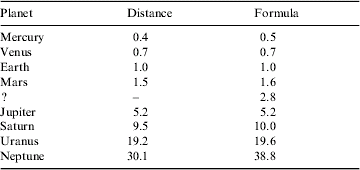
In the latter half of the 18th century, when only six major planets were known, interest was attracted to the regularity of the spacing of their orbits from the Sun. Table 1 shows the Titius–Bode law of planetary spacing, comparing actual and formula values (where n is planet/row number in the table; n=1–9). This in turn drew attention to the large gap between Mars (at 1.6 au from the Sun, where Earth is at 1.0 au) and Jupiter (at 5 au out), apparently just large enough for one additional planet with the normal spacing ratio. Today we know of tens of thousands of ‘minor planets’ or asteroids with planet-like orbits in that distance range from the Sun.
Titius–Bode law of planetary spacing. Formula: distance in au=0.4+0.3×2(n−2)

With the discovery of the second asteroid in 1802, Olbers proposed that many more asteroids would be found because the planet that belonged at that distance must have exploded (Littmann Reference Littmann1988). This marked the birth of the exploded planet hypothesis (EPH). It seemed the most reasonable explanation in 1814, when Lagrange found that the highly elongated orbits of comets could also be readily explained by such a planetary explosion (Van Flandern Reference Van Flandern1993, p. 158). That, unfortunately, challenged the prevailing theory of cometary origin of the time, the Laplacian primeval Solar nebula hypothesis. Comets were supposed to be primitive bodies left over from the Solar nebula in the outer Solar System. This challenge incited Laplace supporters to attack the EPH. Lagrange died in the same year, and support for his viewpoint died with him when no one else was willing to step into the line of fire.
In modern times, it is widely argued that Jupiter's gravity interfered with the formation of a planet in the gap between Mars and Jupiter (Miles & Peters Reference Miles and Peters1997). However, this notion is not dynamically viable. The zone near the middle of the main asteroid belt at ∼2.5–3.5 au is one of enhanced dynamical stability, not of instability. Elsewhere in the Solar System, planets and moons show a preference for the two-to-one resonance region rather than an avoidance of it. Moreover, computer simulations show that a mass ∼30 times that of present-day Jupiter is required to produce instability in the main asteroid belt. Moreover, a new asteroid belt beyond Neptune has no ‘Jupiter’ to produce instability in that region. So the ‘instability’ idea to exploded planets is no longer a credible alternative to a planet that formed in the normal way and later exploded.
Newcomb's objection – all asteroids cannot come from one planet
In the 1860s, Simon Newcomb suggested a test to distinguish the two theories of origin of the asteroids (Newcomb Reference Newcomb1860). If they came from an exploded planet, all of them should reach some common distance from the Sun, the distance at which the explosion occurred, somewhere along each orbit. However, if asteroids came from the primeval Solar nebula, then roughly circular, non-intersecting orbits ought to occur over a wide range of Solar distances between Mars and Jupiter.
Newcomb applied the test and determined that several asteroids had non-intersecting orbits. He therefore concluded that the Solar nebula hypothesis was the better model. Newcomb's basic idea was a good one. However, only a few dozen asteroids were known at the time, and Newcomb did not anticipate several confounding factors for this test. Because Newcomb did not realize how many asteroids would eventually be found, he did not appreciate the frequency of asteroid collisions, which tend (on average) to circularize orbits. He also did not appreciate that planetary perturbations, especially by Jupiter, can change the long-term average eccentricity (degree of circularity) of each asteroid's orbit. Finally, Newcomb did not consider that more than one planet might have exploded, contributing additional asteroids with some different mean distance. In Newcomb's time, no evidence existed to justify these complications.
When Newcomb's test is redone today, the result is that an explosion origin is strongly indicated for main belt asteroids. In fact, the totality of evidence indicates two exploded parent bodies associated with the main asteroid belt: one in the outer main belt at the ‘missing planet’ location, the other in the inner belt near the orbit of Mars. This paper will review that evidence.
Where did all the mass go?
Although over 10 000 asteroids have well-determined orbits, the combined mass of all asteroids smaller than the largest asteroid Ceres is not as great as that of Ceres itself. That makes the total mass of the asteroid belt only about 0.001 of the mass of the Earth. A frequently asked question is, if a major planet exploded, where is the rest of its mass?
Consider what would happen if the Earth exploded today. Surface and crustal rocks would shatter and fragment, but remain rocks. However, rocks from depths greater than about 40 km are under so much pressure at high temperature that, if suddenly released into a vacuum, such rocks would vaporize. As a consequence, over 99% of the Earth's total mass would vaporize in an explosion, with only its low-pressure crustal and upper mantle layers surviving.
The situation worsens for a larger planet, where the interior pressures and temperatures become higher more quickly with depth. In fact, all planets in our Solar System more massive than Earth (starting with Uranus at about 15 Earth masses) are gas giants with no solid surfaces, and would be expected to leave no asteroids if they exploded. Bodies smaller than Earth, such as our Moon, would leave a substantially higher percentage of their mass in the form of asteroids. However, the Moon has only about 0.01 of Earth's mass to begin with.
In short, an asteroid belt with a mass of order 0.001 Earth masses would be expected when a terrestrial-sized planet or moon explodes. Meteorites provide direct evidence for this scenario of rocks either surviving or being partially vaporized. Various chondrite meteorites (by far the most common type) show all stages of partial melting from mild to almost completely vaporized. Indeed, it is the abundant melt droplets (called ‘chondrules’) that give chondrite meteorites their name.
Modern evidence for exploded planets
Two important lines of evidence that asteroids originated in an explosion are the explosion signatures (described later in this paper), and the root-mean-square velocity among asteroids, which is as large as the laws of dynamics allow for stable orbits. In other words, the asteroid belt is certainly the residual of a larger population of bodies, many of which gravitationally escaped the Solar System or collided with the Sun or planets, leaving behind only the bodies with the most stable orbits. This is another reason why the total mass of the belt is relatively small.
Two important lines of evidence that meteoroids originated in an explosion are these. First, chondrules (melt droplets) in meteorites are known to have been formed in a sudden heating impulse, and some have reached temperatures right up to their vaporization temperature despite the fact that vaporization temperatures vary over the range 1350–1800°C, depending on composition (Liffmann Reference Liffman1992, Cohen et al. Reference Cohen, Hewins and Yu2000), while other asteroids show exposure to a heavy neutron flux, sometimes with blackening and shock (Taylor & Heymann Reference Taylor and Heymann1969). Second, the time meteoroids have been travelling in space exposed to cosmic rays is relatively short, typically millions of years. Evidence of multiple exposure-age patterns, as would happen from repeated break-ups, is generally not seen.
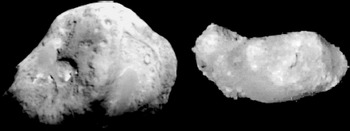
Comets are so strikingly similar to asteroids that no defining characteristic to distinguish one from the other has yet been devised (see Fig. 1). This is rather contrary to expectations of the Solar nebula hypothesis, because comets should have been formed in the cold outer Solar System far from the relatively warm main asteroid belt. However, the EPH tells us that comets are just ordinary asteroids kept far from the Sun for most of their lifetimes. This means most of their volatiles and orbiting particles have never been boiled or blown away by Solar radiation, so they still retain considerable gas and dustFootnote 1. Another factoid is that a trace-back of orbits of ‘new’ comets (that have not mixed with the planets before) indicates statistically that comets probably originated at a common place and time, 3.2 Mya (Van Flandern Reference Van Flandern1978). However, it should be noted that galactic tidal forces (shearing forces from the gravity of the entire Milky Way Galaxy) would eliminate any comets that get too far from the Sun, such as comets originating from any bodies that exploded prior to 10 Mya. Therefore, only relatively recent explosions can produce comets that could still be found anywhere in the Solar System today.
Spacecraft views of an asteroid and a comet. Which is which?

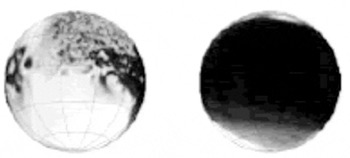
A major explosion would send a blast wave through the Solar System, blackening exposed airless surfaces in its path. Most of such Solar System surfaces are indeed blackened, even for icy satellites. A few cases, however, have such slow rotation that only a little over half of the body gets blackened. Saturn's moon Iapetus is one such case, because its rotation period is nearly 80 days long – far longer than any other natural (non-asteroidal) airless moon. Fig. 2 shows a Cassini spacecraft image of Iapetus. One side is icy bright; the other is coal black. The difference in albedo is a factor of ∼10.
The two sides of Saturn's black-and-white moon Iapetus.

The EPH is able to predict secondary properties of this albedo anomaly as well. The dark hemisphere shows radial streaks along its edges, directed away from the core of the black region. This shows that the material came from a distant source and had only grazing impacts near the edges of the dark hemisphere.
Perhaps the most basic explosion indicator is that, as an explosion occurs, all fragments of significant mass will trap smaller nearby debris from the explosion into satellite orbits. So explosions tend to form asteroids and comets with multiple ‘nuclei’ of all sizes. Collisions, by contrast, normally cannot produce fragments in orbit because any such orbit must either escape or re-collide with the surface. Moreover, if satellites are already orbiting a nucleus when a collision occurs, those satellites will tend to escape into similar Solar orbits, creating an asteroid ‘family’ (many of which are known to exist). The EPH's 1978 predictions that both asteroid and comet satellites should be numerous and commonplace (Binzel & Van Flandern Reference Binzel and Van Flandern1979; Van Flandern Reference Van Flandern1981) have been confirmed in recent years. The first spacecraft finding (by Galileo) was of moon Dactyl orbiting asteroid Ida in 1993. Other discoveries have led to the conclusion that several percent of all asteroids have satellites large enough to be discovered remotely. More recently, Hubble imagery found that Comet Hale–Bopp has at least one, and possibly three or more, secondary nuclei (Sekanina Reference Sekanina1997).
Of all the successful predictions of the EPH (and the absence of unsuccessful ones), probably the most striking was the 1999 prediction of the correct time, place and rates for the two peaks of the Leonid meteor storm that November. This prediction success continued in the following years and included outbursts in other meteor streams. To date, EPH-based predictions have continued to outperform those based on all variants of mainstream models, especially for meteor rates. Over 100 additional lines of evidence related to the EPH and the standard models it would replace are summarized in Van Flandern (Reference Van Flandern1993).
Did more than one planet explode?
Many lines of evidence suggest more than one planetary explosion in the Solar System's history. The discovery of one, and probably two, new asteroid belts orbiting the Sun beyond Neptune is especially suggestive, given that the main asteroid belt is apparently of exploded planet origin. Evidence of the ‘late heavy bombardment’ in the early Solar System is another strong indicator. These points are discussed later in this paper.
On Earth, geological boundaries are accompanied by mass extinctions at five epochs over the last billion years. Two of the most intense of these, the P/T boundary about 250 Mya and the K/T boundary (and the extinction of dinosaurs) at 65 Mya, are the most likely to be associated with the damage to the Earth's biosphere we would expect from a major planet explosion.
Meteorites provide direct evidence about their parent bodies. Yet this evidence strongly indicates at least three to four distinct parent bodies. Oxygen isotope ratios are generally similar for related planetary bodies, such as all native Earth and Moon rocks. These ratios for meteorites imply at least two distinct, unrelated parent bodies, and probably more. Cosmic-ray exposure ages of meteorites indicate how long these bodies have been exposed to space, because cosmic rays can penetrate only about a metre into a solid body. Collisional break-up can reset the exposure ages for some meteorites, and produce ‘double exposure’ or other complexities for others. The data shows clustering of exposure ages around several different primary epochs, suggesting multiple explosion epochs.
Main belt asteroids come in many types, but most of these represent sub-types of the two major types: 80% of all main belt asteroids are of type C (‘carbonaceous’), and most of the remaining 20% are of type S (‘silicaceous’). The former are found predominately in the middle and outer belts, while the latter are mostly in the inner belt, the part that lies closest to Mars. These two types are unlikely to have had the same parent body.
Finally, it should be noted that we can estimate the total mass of the body that exploded to produce all the comets seen today. (The lifetime of those comets is limited to 10 million years by galactic tidal forces and planetary perturbations.) That parent body mass is almost certainly comparable to the size of our Moon because the carbonaceous meteorites most closely associated with comets indicate a parent body too small to have been chemically differentiated by gravity (heavy elements to core, light elements to surface).
Explosion signatures in the main asteroid belt
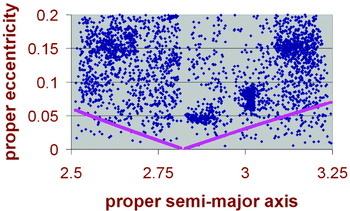
In Fig. 3, we show a scatter plot of orbital eccentricity (averaged over time, and called ‘proper eccentricity’) versus mean distance (called ‘proper semi-major axis’) for thousands of main-belt asteroids. We included the numbered asteroids having periods between one-half and one-third the period of Jupiter. If the primeval Solar nebula hypothesis were correct, numbers of asteroids with near-zero eccentricity would be roughly equal at all mean distances well away from the orbits of Mars and Jupiter. Indeed, nebular drag and collisions would ensure that orbits with zero eccentricity were preferred. By contrast, if the EPH is correct, a minimum eccentricity, increasing to either side of a mean distance of about 2.8 au, should be evident in the plot. The ‘V’-shaped line shows the theoretical minimum eccentricity according to the EPH.
Semi-major axis (mean distance from Sun) versus eccentricity for main-belt asteroids near theoretical parent planet distance, showing an explosion signature.

We see in Fig. 3 that, despite about as much Jupiter-induced scattering across the minimum line as expected (increasing towards Jupiter on the right), the densest number counts trend up and away, paralleling the V-shaped line, on both sides of the inferred exploded planet distance, 2.82 au. It is difficult to imagine this explosion-predicted low-eccentricity avoidance occurring by chance – especially since the primeval Solar nebula hypothesis predicts a preference for low eccentricity values. What we are seeing here is Newcomb's argument applied with modern knowledge and data. The expected characteristic of fragments that originated in an explosion is seen. The expected characteristic of objects present since the Solar System's beginning, even if only collisional fragments thereof, is not seen.
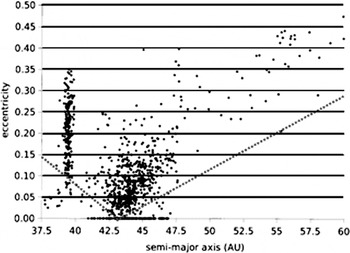
The aforementioned explosion signature has been known since the early days of the artificial satellite era, when it was first found for the orbits of artificial satellite fragments when booster rockets exploded in orbit. However, when the same signature was first noticed in asteroid orbital elements, the Trans-Neptunian Objects (TNOs) had not yet been discovered. Now that we have a significant number of those orbits, the obvious prediction of the EPH is that the same signature will be found again in the outer Solar System. Figure 4 shows the equivalent plot for those bodies (Jones et al. Reference Jones, Williams and Melita2005). Once again, as the nearest perturbing body (Neptune at 30 au) is approached, the number of bodies scattered across the boundary increases.
The same explosion signature for TNOs beyond Neptune at a semi-major axis of 30 au.

Because of the absence of an outer body setting an upper eccentricity limit, we not only see a pronounced no-low-eccentricity signature for the TNOs, but we see that it continues even for relatively large eccentricities. The almost total absence of distant TNOs with near-circular orbits is a strong confirmation of the EPH's prediction. None of the competing mainstream models made any such prediction, although ad hoc reasons for this absence of low-eccentricity orbits are still being invented. However, as Peter Lipton (Lipton Reference Lipton2005) recently noted, genuine distinguishing predictions are far better indicators of the value of any hypothesis than any number of ex post facto accommodations:
‘Suppose that Jacob, my elder son, takes his trusty bow and arrow and shoots at a target on the side of a barn, hitting the bull's-eye. We are duly impressed. Now Jonah, my younger son, steps up to a different barn, pulls back his bow, and shoots his arrow at the barn. Then he walks up to the side of his barn and paints a bull's-eye around his arrow. We would give him rather less credit, for archery anyway.’
Energy parameters for ‘new comet’ orbits
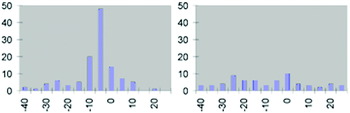
Astonishingly, a great many comets are discovered that have energy parameter values (defined as −100 000 times the reciprocal semi-major axis) close to zero, the threshold of gravitational escape. In the specified units, Earth's energy parameter is −100 000. Before mixing with the planets, a clustering of comet energy parameters near −5 exists, as shown in the left-hand side of Fig. 5. However, as these same comets recede again after mixing with the planets, the clustering property is heavily smeared out, as shown on the right-hand side of Fig. 5. The average scattering is about ±50 energy units. As a consequence, no clustering can persist into the next revolution for these comets. So the comets still having energy parameters near the clustered range from 0 to −10 at discovery must be making their first visit to the planetary part of the Solar System since their origin event. For that reason, they are called ‘new comets’.
Comet energies before (left) and after (right) passage through planetary region. The plot shows the number of comets (ordinate) versus energy parameter (abscissa).

These new comets, first noted by Oort, were not the belt of comets beyond Pluto expected by the primeval Solar nebula hypothesis. They arrive from all directions on the sky, with no tendency to be concentrated towards the plane of the planets. Also, they move in directions opposite to the planets as often as in directions consistent with the planets. Because of these traits and a mean distance of 1000 times greater than that of Pluto from the Sun, the far-away source of Oort's new comets was designated the ‘Oort cloud’.
The EPH expected something similar. A given energy parameter implies a particular period of revolution around the Sun. If a planet exploded ‘x’ years ago, then new comets returning for the first time today would arrive on orbits with period x. Comets with shorter periods would have returned in the past, mixing with the planets and eventually being eliminated (or are now in the process of being eliminated). Comets with longer periods would not yet have returned for the first time. So the EPH predicts that all new comets should have the same period x, and therefore the same energy parameter corresponding to a period of x. The centre of the spike on the left-hand side of Fig. 5 corresponds to a period of 3.2 million years, which is therefore the time since the last explosion event.
In the 1970s, astronomer E. Opik, who wrote a paper critical of the EPH (Opik Reference Opik1978), devised a test to determine if the Oort cloud really existed, or if the ‘clustering’ seen for new comets was really a spike with almost no width as predicted by the EPH (Opik, private communication). The trick was to separate smearing of the energy parameter caused by inaccurate observations from intrinsic smearing of the real new comet orbits. Fortunately, the published orbits of new comets have an orbit quality parameter that indicates which orbits ought to be very accurate because of a long observed arc with many well-distributed observations (class 1A), and which orbits ought to have higher observational errors because of short arcs and/or fewer or poorly distributed observations (classes 1B, 2A and 2B). In the standard model with an Oort cloud of comets, there is no obvious way to tell the difference between comets anywhere in the energy parameter range on the left-hand side of Fig. 5. So there is no reason for any observational class of comet to be other than randomly distributed among all the comets in that figure. If all the orbits could be improved to class 1A, the overall average appearance of the distribution ought to be unchanged.
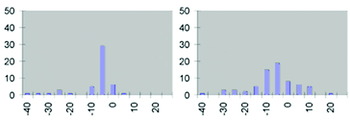
However, in the EPH, the real distribution would have all the comets in a single bin, and all the observed spread of energy parameter values would be due to observational error. So comets of observational classes 1B, 2A and 2B ought to have a broader distribution than class 1A comets because 1A comet orbits are closer to reality (less observational error). So Opik realized that EPH predicts a different (narrower) distribution for class 1A comets than for the others where observational spread dominated. Opik's test then was to separate comets of class 1A from the other classes to determine if the energy parameter distribution was significantly broader for the other classes than for class 1A (indicating the EPH is right), or essentially the same for both groups (indicating the Oort cloud is right).
The results are shown on the left-hand side of Fig. 6 for new class 1A comets and on the right-hand side of the same figure for new comets of classes 1B, 2A and 2B. (Note that these orbit quality codes are assigned by cometary astronomers using published criteria. No EPH tester had any role in determining these designations.) The left-hand side shows 2.6 times as many comets in the central spike as in the immediately adjoining bins combined. The right-hand side shows only 0.8 times as many comets in the central spike as in the two adjoining bins, and has a clearly broader distribution.
Comet energies before passage through planetary region for class 1A comets, having the most accurate orbits (left) and for classes 1B, 2A, 2B comets, having less accurate orbits (right).

The Opik test is cleanly passed by the EPH, but not by the Oort cloud model. Anyone working with the published new comet data could arrive at the same conclusion. If sceptical readers suspect that the author may have consciously or unconsciously selected the data so as to give a favourable outcome, recall that Opik, who strongly doubted the EPH when he thought of this test, came to the same conclusion even with the smaller amount of comet data available to him 20 years earlier. Moreover, new comets are continuing to be discovered. In essence, we have proved that Lagrange's instinct 200 years ago was right on target: comets apparently acquired their extremely elongated, planet-crossing orbits by ejection in an explosion that we can now date at 3.2 million years ago. New comets are the continuing rainback of debris from that explosion. This simple, basic idea leads to explanations of virtually everything we know about the physical, chemical, photometric and dynamical properties of comets without the need to introduce any ad hoc helper hypotheses (Van Flandern Reference Van Flandern1978).
Satellites of asteroids and comets
If asteroids and comets are the products of accretion from a nebula, or even from collisional break-ups, they will invariably be isolated single bodies because their gravitational fields are too weak to affect captures. For example, in a break-up event, most debris escapes, and what does not falls back onto the surface it was ejected from after one orbit. Even if it managed to barely miss the surface, tidal forces would bring it back down in short order. When asteroid satellite captures are simulated on computers, the simulations are carried out by assuming the catastrophic central break-up of a parent body with debris moving away along radial lines. That, however, is actually a model for an explosion, not a collision.
By contrast, in the EPH, nearby space is filled with debris just after the explosion. Large fragments will find lots of debris inside their gravitational spheres of influence, and these will remain in stable orbits as permanent satellites of these larger fragments. For that reason, the author presented papers at the International Astronomical Union meeting in Argentina in 1991, and the Flagstaff meeting of asteroid, comet and meteorite experts in that same year, pointing out the EPH prediction that asteroid satellites should be numerous and commonplace. Specifically, the EPH predicted that spacecraft soon to visit asteroids (or comets) should find at least one of the larger debris bodies (satellites) in orbit around the asteroid (or comet) primary nucleus. This prediction, also published in Van Flandern (Reference Van Flandern1992, Reference Van Flandern1993), was considered extremely unlikely by mainstream astronomers, one of whom made a public wager with the author that it would not happen.
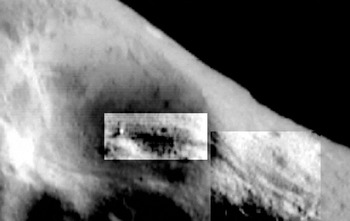
The Galileo spacecraft flew by asteroid Ida in 1993, and returned images showing a 1-km satellite (now named Dactyl) in a stable orbit around its nucleus. Since that discovery, several dozen additional discoveries of satellites of other asteroids have been made (Cowen Reference Cowen1997, Kerr Reference Kerr1999). The same has happened for TNO asteroids, where only the largest of well-separated satellites can be detected. Yet estimates are that at least 5% of all TNOs are binary. This new data supplements occultation and radar evidence of long standing, showing probable asteroid satellites. A year before the NEAR spacecraft went into orbit around asteroid Eros in February 2000, the author altered the general prediction of satellites to a more specific one: If the gravity field of an asteroid is too irregular for stable orbits to exist near the synchronous orbit (as is the case for Eros), then the debris that once orbited the nucleus would now be found as intact boulders lying on the asteroid surface (Van Flandern Reference Van Flandern1999a). These would be easy to identify because of their tangential touchdown onto the asteroid, resulting in considerable rolling from their orbital momentum. So ‘roll marks’ were the predicted identifier to show that boulders were former satellites.
The first image taken by the spacecraft from orbit around Eros is shown in Fig. 7. The two rectangles are areas where contrast was stretched for better visibility of the ‘roll mark’. The image appears to show a track starting in a random location, going up the outside wall of a crater, down the inside wall and ending in a 50-m boulder. Many additional examples of boulders, tracks and boulders at the ends of tracks can be seen in later spacecraft images.
NEAR spacecraft photo of a large crater on asteroid Eros with a trail across a crater rim, leading to an interior boulder.

In the meantime, evidence for comet satellites was mounting as well. The Giotto spacecraft was the first to approach a comet, where it found ‘brightness concentrations’ in the inner coma referred to as ‘dust spikes’ (LeDuin et al. Reference LeDuin, Levasseur-Rigourd and Renard1993). Then Hubble Space Telescope observations of Comet Hale–Bopp showed at least one, and probably three, secondary nuclei orbiting the primary comet nucleus (Sekanina Reference Sekanina1997). Although this finding was controversial, the satellite interpretation was subsequently confirmed as the most reasonable explanation by other investigators (Marchis et al. Reference Marchis, Bochnhardt, Hainaut and Le Mignant1999). The largest of these secondary bodies is a 30-km satellite of an estimated 70-km primary nucleus.
The standard models for asteroids and comets did not predict asteroid satellites. No supporter of those models credited even the reasonable possibility of asteroid or comet satellites, except perhaps by extremely unlikely fluke circumstances, until the first one was photographed. Since then, the mainstream models have struggled to accommodate the finding that asteroid satellites, at least, are numerous and commonplace, just as the EPH confidently predicted.
Comet split velocities
Another strong test distinguishing the EPH from the standard models comes from comet split-velocity data. The EPH leads to what the author calls the ‘satellite model’ as an explanation of what a comet is and how it behaves. The standard model for comets is the so-called ‘dirty snowball’ model. In the former case, comets are rocky asteroids surrounded by a debris cloud. In the latter case, they are a snow–ice mixture contaminated with dust packed into a lone nucleus that is eruptive when exposed to sunlight. It ought to be easy to distinguish these two extreme possibilities with the help of modern ground-based and spacecraft observations. Indeed, it is. One of the strongest such tests (out of many that reach a similar conclusion) will be detailed here. See Van Flandern (Reference Van Flandern1993, ch. 11) for others.
Some comets are observed to ‘split’ into two or more comets. That was unexpected behaviour in the dirty snowball model, but is explained after the fact as the breaking apart of the snowy nucleus under the action of strong jets. A different phenomenon that appears from a distance like ‘splitting’ is required by the satellite model because, as the comet approaches the Sun and its gravitational sphere of influence shrinks, some outer satellites may find themselves outside that sphere of influence. Such satellites then escape into independent Solar orbits, creating the appearance of a split.
The test of which explanation is better involves the velocity of the fragment comets relative to the original comet from which they seemed to split. In the dirty snowball model, the velocity is the result of jet action. The energy source might be entirely internal to the comet, in which case the velocity of ejection of split comet fragments will be independent of the distance from the Sun at which the split occurs. Alternatively, the energy for the split in the dirty snowball model might come from Solar light, Solar heat, Solar wind, Solar magnetism or something else associated with the Sun. In all such cases, the energy ought to decrease inversely with the square of Solar distance, and that will produce relative velocities that are inversely proportional to Solar distance to the first power. The dirty snowball model, because it does not predict such splits, is not able to be specific about which mechanism, a Solar or a non-Solar energy source, is the correct one.
By contrast, the EPH and its satellite model require gravitational escapes of satellite comets as the sphere of influence of the primary nucleus shrinks upon approach to the Sun. The laws of dynamics require that ‘split’ fragment velocities be escape velocities, which vary inversely with the square root of Solar distance. Any other observed relationship would falsify the model.
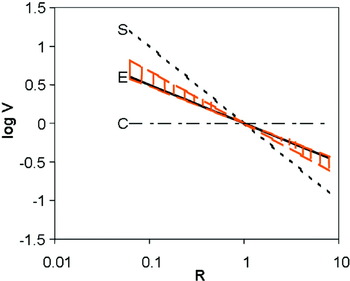
In Fig. 8, we show a plot of split-comet component relative velocities, V (in m s−1), versus Solar distance of the comet at the time of splitting, R (in au), on a log–log scale. The data from 21 split comets (not shown) and its one-sigma spread lie within the cross-hatched region, which represents the observed best-fit slope of 0.57±0.10 (Sekanina Reference Sekanina1982). For comparison, three theoretical curves are shown, labelled ‘C’, ‘S’ and ‘E’. These represent a comet-internal energy source, a Solar energy source and gravitational escape energies as predicted by the EPH, respectively (Van Flandern Reference Van Flandern1981). All curves have been shifted vertically to intersect at 1 au because only the slopes are relevant.
Comet split velocities (V) versus Solar distance (R). C=comet internal energy, S=Solar energy, E=EPH satellite model; the shaded area shows the one-sigma observational upper and lower bounds.

It is apparent that the theoretical curve predicted by the EPH model falls within the one-sigma data region, and is therefore fully in accord with the observations without further consideration. Both of the possibilities for the dirty snowball model fall well outside the data range by at least four sigma. This means the dirty snowball model is excluded as an explanation at the statistical confidence level of better than 10 000-to-1.
In summary, we see that the satellite model for the nature of comets, based on the EPH model for the origin of comets, is consistent with the observational data, whereas the standard model is strongly excluded by the data.
Salt water in meteorites and comets
An obvious corollary of the EPH, never explicitly put in writing in so many words, is that water in fragments from exploded terrestrial-type planets will be salt water. If meteorites come from the explosion of planet-sized bodies, the water from such bodies can be ocean water (as on Earth and as suspected for Jupiter's moon Europa), and would therefore be expected to contain salt from run-off of minerals from solid portions of the planet. Only recently has meteorite water been tested for salt content for the first time, with the surprising result (for mainstream models) that sodium chloride was found (Clayton Reference Clayton1999). Certain aspects of this discovery suggest that water was flowing on the parent body from which the meteorite came. ‘The existence of a water-soluble salt in this meteorite is astonishing’, wrote R. N. Clayton of the University of Chicago (Clayton Reference Cohen, Hewins and Yu1999). This is certainly true unless one had the EPH in mind, in which case it would be unsurprising.
Supplementing the idea of salt water in meteorites, the EPH does explicitly predict salt water in comets. In March, a long sodium tail was discovered in Comet Hale–Bopp. Aside from the general interest in this new type of comet tail, it was noted that the sodium ions have a half-life of just half a day, too short to survive a trip from the nucleus to the farthest parts of the tail. So the sodium must be conveyed as part of a parent molecule that is split by the Solar wind into sodium and some other ions. The significance of this for comet models is that the EPH says that comets originated in the explosion of a water-bearing planet. If that planetary water was salt water, as planetary oceans on Earth all tend to be, then water in comets would be salt water. The parent molecule for the salt escaping the comet's coma into the tail would most likely be sodium chloride (salt), and the ‘other ions’ would then be chlorine ions. The unknown parent molecule has not yet been officially discovered, but one can readily see that the discovery of chlorine in comets to accompany this discovery of sodium would make a strong case for the planetary origin scenario (Van Flandern Reference Van Flandern1997a)Footnote 2.
Meteor storms and outbursts
Esko Lyytinen of Finland (Lyytinen Reference Lyytinen1999) used the EPH as a model for understanding and predicting the behaviour of meteor storms, starting with the times and peak rates of two Leonid meteor storm events in 1999. Events of this type had never before been successfully predicted. Although nearly a dozen professional astronomer groups attempted predictions for the possible November 1999 storm, only three teams had results that were correct for the time of the event, and only Lyytinen had both the time and the peak meteor rate correct to within the stated error bars. The complete story of this prediction, the expedition and its successful conclusion are beyond the scope of this paper, but may be found in Lyytinen (Reference Lyytinen1999) and Van Flandern (Reference Van Flandern1999b).
The same technique works for other streams and even for meteor outbursts. For example, Lyytinen (Reference Lyytinen and Van Flandern2004) also predicted a short-lived outburst of the Perseid meteors in August 2004. Yet it presumes that these meteoroids escape from orbit around a comet nucleus through the inner and outer Lagrange points, which allows us to estimate the time, place, direction and speed of the escaping particles using just the law of gravity, even though we cannot see them. Other teams using the standard model were either unsuccessful, or had to use fitting to past meteor storms to empirically set their prediction parameters.
Deep Impact and Stardust mission predictions and results
The Deep Impact mission flew close to Comet Tempel 1 on 4th July 2005 and released a probe to smash into the comet's nucleus to reveal what was below the surface. The dirty snowball for comets outlined many possible scenarios that might result, making no definite, generally agreed predictions. The EPH made the following specific, unique predictions that first appeared on the Web two months before impact and in print two weeks before: (1) an impact flash because the surface (under the regolith) would be a hard asteroidal rock; (2) a dusty regolith from tidal decay of orbiting debris; (3) a small, shallow impact crater, probably just 10–20 m in diameter because of the strength-dominated surface under the regolith; (4) no new ‘jet’ from the impact because so-called comet ‘jets’ are really flashlight beams through the dusty coma caused by the opposition effect acting on high-albedo surface spots; (5) no lasting effect on the comet because of its rocky nucleus; (6) a planet-like or moon-like chemical composition; and (7) a nucleus indistinguishable from an asteroid by any observation type (Van Flandern Reference Van Flandern2005a).
These predictions are pretty much a description of the mission results, with one exception. The impact crater that would have decided between a gravity-dominated versus a strength-dominated comet nucleus was not seen because so much dust was kicked up from the regolith. The mission team concluded that the comet was probably gravity-dominated based on the behaviour of the dust, which obviously is gravity-dominated. (Dust has almost no intrinsic cohesive strength.) There is nothing compelling, however, about that interpretation. Meanwhile, the surface colours and reflectivity indicate little or no evidence for surface snow or ice, which certainly challenges the entire basis for the dirty snowball concept. Moreover, as we noted in Fig. 1, the comet nucleus was visually indistinguishable from an asteroid. Other impact craters are preserved on the surface, indicating a certain degree of cohesive strength much greater than that of dust (Van Flandern Reference Van Flandern2005b).
The Stardust mission flew through the coma of Comet Wild 2, collected dust particles and returned them to Earth for analysis. They were found to contain magnesium, olivine, calcium, aluminium and titanium, all of which have high formation temperatures in excess of 1000°C. Moreover, such minerals are usually associated with volcanic outputs from deep inside planets. The dirty snowball model, in which comets formed far from the Sun in a very cold environment and are supposed to be primitive, unprocessed bodies, is still struggling with these results. One suggestion was bipolar jets from the early Sun, reaching out to great distances and enriching the distant Solar nebula with hot minerals.
In brief, the standard model indicates that asteroids were bits of a planet that never formed, and comets are leftovers from the primeval Solar nebula. Both should be single bodies because the conditions for satellite formation are extremely unlikely to be realized. Asteroids should be mostly rock, whereas comets should be mostly water-ice and never heated above 100°C. By contrast, the EPH indicates that asteroids and comets are initially clouds of all sizes of debris orbiting a dominant rocky nucleus. Both start with volatiles, but the volatiles in asteroids get baked away by their prolonged proximity to the Sun. While both have water, it is interstitial. Also they were subjected to formation temperatures in excess of 1000°C. It is now evident that only the EPH expectations match reality.
While it seems trivial to note that creative theoreticians can come up with a model patch to explain virtually any unexpected observation, we all know instinctively that painting a bull's-eye around an arrow is not a skill deserving of much credit, in archery or in science.
Discussion points
The EPH is also consistent with a number of other observations about the Solar System. We mention these in the following six subsections, to show how far-reaching the implications of the EPH can be.
The K/T boundary event at 65 Mya
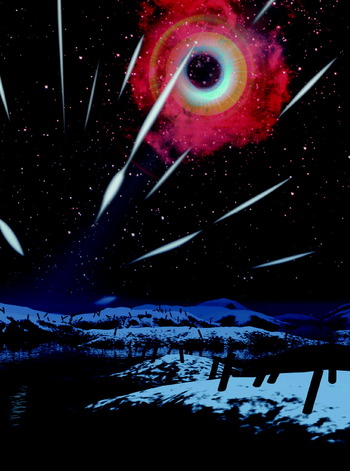
The following documented geological events at the terrestrial K/T boundary at 65 Mya can easily be associated with a planetary explosion event, most likely the explosion of hypothetical ‘Planet V’ near the present-day orbit of Mars (see the artist's concept in Fig. 9):
• two boundary layers (ash and clay) of global extent;
• 16 known major impact craters across the globe associated with that epoch;
• ‘hot zones’ of radioactivity found in Africa at the K/T boundary;
• the Deccan Traps in India – the second largest episode of volcanism in Earth history;
• changes in atmospheric and ocean composition;
• a single global fire;
• the extinction of 70% of all terrestrial species;
• the absence of corresponding layers in the Antarctic.
The K/T boundary event as a planetary explosion. Copyright © 2002 by Boris Starosta, boris@starosta.com.

This last point might need some clarification. If an event occurs at a great distance from the Earth, it would potentially affect just one hemisphere of the Earth if it is a sudden, impulse-like phenomenon. However, if it lasts for more than 12 hours, as would occur for the spread in arrival times of a blast wave from a distant planet explosion, then the Earth would rotate on its axis, exposing most parts of the planet to the event. However, because of the tilt of the Earth's axis to the mean plane of the planets, one polar region of Earth is likely to remain continuously hidden from such an event unless its duration continued over many months. For the K/T boundary event, apparently one of Earth's polar regions was shielded. This emphasizes the likelihood that the event was of distant origin and global extent, rather than terrestrial origin and concentrated mainly in one area (as for a single major impact such as the Chicxulub crater formation in the Yucatan).
One other especially striking ‘coincidence’ is evidence for a peak in cratering events on the Moon at about 65 Mya, apparently coincident with when this set of at least 16 major impacts occurred on Earth (Schultz & Posin Reference Schultz and Posin1988). A simultaneous Moon–Earth cratering episode would certainly call out for an EPH-type event as the most likely cause.
A fuller description of this event and its association with the EPH appears elsewhere (Van Flandern Reference Van Flandern2002). As discussed in the subsection ‘The original Solar System’ below, there have apparently been other EPH-type events in Solar System history, and these are likewise probably associated with mass extinction events in the geological record on Earth. Explosions of moon-sized bodies are probably associated with certain other geological boundaries and with the climate changes that would have accompanied them.
Mars may be a former moon of a now-exploded planet
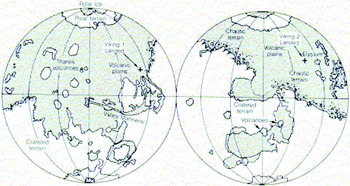
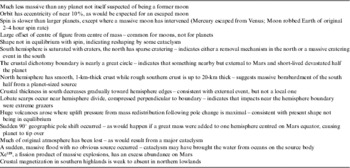
Table 2 summarizes much of the evidence consistent with the hypothesis that Mars is a former moon of its now-exploded parent ‘Planet V’ occupying that approximate orbit. Many of these points are the expected consequences of having a massive planet blow up nearby, thereby blasting the facing hemisphere and leaving the shielded hemisphere relatively unscathed. Especially significant in this regard is the fact that half of Mars is saturated with craters, and half is only sparsely cratered. Moreover, the crustal thickness has apparently been augmented over one hemisphere by up to 20 km or so, gradually tapering off near the hemisphere boundaries. This ‘crustal dichotomy’ is also readily seen in Martian elevation maps, such as the white areas in Fig. 10. Naturally, if considerable mass is added to one side of a spinning body, the body will tip over until the spin axis passes through the bulk of the added mass – something that has apparently happened to Mars.
Mars crustal dichotomy. Cratered highlands (white), lowland plains (shaded). Left: western hemisphere, 180°→0°. Right: eastern hemisphere, 360°→180°. From Christiansen & Hamblin (Reference Jewett1995).

Evidence that Mars is a former moon

The late heavy bombardment
Planetary and moon explosions are not just a recent phenomenon. There is evidence for the explosion of one or more large planets in the very early Solar System. From studies of lunar rocks it is now known that the Moon, and presumably the entire Solar System with it, underwent a ‘late heavy bombardment’ of unknown origin not long after the major planets formed. The following are relevant descriptions of the event in the standard astronomical literature (Weissman Reference Weissman, Atreya, Pollack and Matthews1989):
‘[The late heavy bombardment] occurs relatively late in the accretionary history of the terrestrial planets, at a time when the vast majority of that zone's planetesimals are already expected to have either impacted on the protoplanets, or been dynamically ejected from the inner planets region.’
‘It appears that a flux of impactors flooded the terrestrial planets region at this point in the Solar System's history, and is preserved in the cratering record of the heavily cratered terrain on each planet.’
‘An essential requirement of any explanation for the late heavy bombardment is that the impactors be ‘stored’ somewhere in the Solar System until they are suddenly unleashed about 4.0 Gyr ago.’
‘A plausible explanation for the late heavy bombardment remains something of a mystery.’
‘… it seems likely that the late heavy bombardment is not the tail-off of planetary accretion but rather is a late pulse superimposed on the tail-off. Nor is there any reason to suppose that it was the only such pulse; it may have been preceded by several others which are not easily discernible from it in the cratering record.’
In short, the late heavy bombardment, a real Solar System event, sounds like the description of one or more early planetary explosion events.
The original Solar System
Putting all this evidence together (as in Van Flandern (Reference Van Flandern1993, ch. 25)), we have abundant indicators for two original planets near what is now the main asteroid belt: hypothetical ‘Planet V’ and ‘Planet K’. These were probably small gas giants or large terrestrial planets with moons of significant size, such as Mars, before they exploded. We also have hints of two more asteroid belts, probably from the explosions of two more planets (‘Planet T’ and ‘Planet X’) beyond Neptune. Moreover, we have hints that two extra-large gas giant planets, ‘Planet A’ and ‘Planet B’, exploded back near the Solar System's beginning.
Of the existing nine major planets today, we have strong evidence that Mercury is an escaped moon of Venus (Van Flandern & Harrington Reference Van Flandern1976), Mars is an escaped moon of Planet V, and Pluto and its moon Charon are escaped moons of Neptune (Harrington & Van Flandern Reference Harrington and Van Flandern1979). If we eliminate these, then perhaps the original Solar System consisted of 12 planets arranged in six ‘twin’ pairs. Such an arrangement would be consistent with the origin of all major planets and moons by the fission process (Van Flandern Reference Van Flandern1997b). This model makes a major prediction that will soon be tested:
extra Solar planets should also arise in twin pairs, with two-to-one orbital period resonances not uncommon. If so, then many cases that now appear to be single massive planets on highly elliptical orbits will turn out, when enough observations are accumulated, to be twin resonant planets on near-circular orbits.
Panspermia
The panspermia hypothesis is the idea that the building blocks of life are found in the interstellar medium, and are spread to suitable planets by the impact of comets and meteoroids that formed from such interstellar materials. The late Fred Hoyle and his colleague Chandra Wickramasinghe have championed this idea, suggesting that life was originally brought to Earth that way, and is still being brought here in meteorites. Hoyle (Hoyle & Wickramasinghe Reference Hoyle and Wickramasinghe1979) suggested that spontaneous influenza outbreaks might be the result of meteorites depositing biogenic organisms in our atmosphere or on the surface.
However, in the light of the EPH, we see that the interstellar medium is apparently fed by the explosions of supernovas, novas and perhaps also planets. The asteroids, meteoroids and apparently all comets originated in the explosion of planets (or moons). Therefore, comets are fragments of exploded planets, not condensates of primordial clouds of gas and dust. As in the original panspermia hypothesis, comets and meteoroids are still the primary delivery vehicles for the raw materials for life (organic molecules) and for the simplest life forms (viruses and bacteria). However, under EPH premises, life itself gets nourishment, grows and reproduces on planets, and is then spread to other planets and to the interplanetary and interstellar media by explosions.
We may already have the key pieces to the jigsaw puzzle of life, but may have been placing them in the wrong sequence to solve the puzzle. The EPH guides us in that placement, opening up new opportunities to understand the whole picture of the evolution of life. Additional details of the panspermia/EPH relationship are developed in a separate paper by Jewett (Reference Jewett2007).
Planetary explosion mechanisms
The most frequently asked question about the EPH is ‘What would cause a planet to explode?’ We will mention three distinct theoretical scenarios developed over the past six decades. In reality, all three might play a role in determining which planets will explode and when.
The earliest and simplest theoretical mechanism is that of Ramsey (Reference Ramsey1950), who noted that planets must evolve through a wide range of pressures and temperatures. This is true whether they are born cold and heat up under gravitational accretion, or born hot and cool down by radiation of heat into space. During the course of this evolution, temperatures and pressures in the cores must occasionally reach a critical point, at which a phase change (like water to ice) occurs. This will be accompanied by a volume discontinuity, which must then cause an Earth-sized or smaller planet to implode or explode, depending on whether the volume decreases or increases.
The second explosion mechanism, natural fission reactors, is currently generating some excitement in the field of geology (Herndon Reference Herndon1998). A uranium mine at Oklo in the Republic of Gabon is deficient in U-235 and is accompanied by fission-produced isotopes of Nd and Sm, apparently caused by self-sustaining nuclear chain reactions about 1.8 Gyr ago. Later, other natural fission chain reactors were discovered in the region. Today, uranium ore does not have this capability because the proportion of U-235 in natural uranium is too low. However, 1.8 Gyr ago, the proportion was more than four times greater, allowing the self-sustaining neutron chain reactions. In addition, these areas also functioned as fast neutron breeder reactors, producing additional fissile material in the form of plutonium and other trans-uranic elements. Breeding fissile material results in possible reactor operation continuing long after the U-235 proportion in natural uranium would have become too low to sustain neutron chain reactions. This proves the existence of an energy source in nature able to produce more than an order of magnitude more energy than radioactive decay alone. Excess planetary heat radiation is said to be gravitational in origin because all other proposed energy sources (e.g., radioactivity, accretion and thermonuclear fusion) fall short by at least two orders of magnitude. These natural reactors, however, may be able to supply the needed energy. Indeed, nuclear fission chain reactions may provide the ignition temperature to set off thermonuclear reactions in stars (analogous to ignition of thermonuclear bombs).
The third planetary explosion mechanism holds the potential for an indefinitely large reservoir of energy for exploding even massive planets and stars. If gravitational fields are continually regenerated, as in LeSage particle models of gravity (Van Flandern Reference Van Flandern1996), then all masses are continually absorbing energy from this universal flux. Normally, bodies would reach a thermodynamic equilibrium, whereat they radiate as much heat away as they continually absorb from the graviton flux. However, something could block this heat flow and disrupt the equilibrium. For example, collapse through a change of state in a planet's core might set up an insulating layer. In that case, heat would continue to be accumulated from graviton impacts, but could not freely radiate away. This is obviously an unstable situation. The energy excess in the interior of such a planet would very quickly build indefinitely until either the insulating layer was breached or the planet blew itself apart.
Conclusion
We have covered most of the major successful predictions of the EPH mentioned in the abstract. Many additional lines of evidence throughout the Solar System were summarized in Van Flandern (Reference Van Flandern1993, ch. 11). With this documented track record, the basic correctness of the EPH is established beyond a reasonable doubt, although there is still room for argument over details such as the number of such explosions, the masses of the parent bodies, the times of the events and details of the explosion mechanisms.
Moreover, if the EPH is a major factor in Solar System evolution, it must be considered as the most probable propagation vehicle for the spread of biogenic organisms. This provides useful insight into both the plausibility and the specific mechanisms of the panspermia hypothesis.