Under what conditions will political entrepreneurs in democratic states create new political parties? This phenomenon, generally labeled “party entry,” has been tied to numerous important contemporary social and political outcomes. In Western Europe, the emergence of Green and Radical Right parties in the 1980s led to increased attention to issues such as the environment and immigration (Kitschelt Reference Kselman1995; Rydgren Reference Rydgren2004; Rydgren Reference Rydgren2005; Meguid Reference Meguid2008). Myerson (Reference Myerson1993) argues that the threat of entry by new political parties, when credible, reduces the extent to which status quo political leaders can get away with graft and political corruption. Almost by definition, new party entry increases party system volatility, which scholars, especially those studying newly emerging democracies in Latin America and Eastern Europe, have identified as a potential force for undermining processes of democratic consolidation (Roberts and Wibbels Reference Roberts and Wibbels1999; Tavits Reference Tavits2005; Powell and Tucker Reference Powell and Tucker2014). New party entry can also fundamentally reorient politics within a single country, as has been the case with the Turkish Justice and Development Party (JDP), which emerged in 2001 and profoundly changed the nature of Turkish politics and political economy (Kumbaracibaşi Reference Kumbaracibaşi2009).
At the risk of over-simplification, research on the subject is generally situated in one of the two literatures: the literature on party competition and spatial theory, which dates to Downs (Reference Downs1957), and the growing and expansive literature on party system volatility. In a recent contribution to the latter, Mainwaring, Gervasoni and España-Nájera (Reference Mainwaring, Gervasoni and España-Nájera2010) demonstrate that, in a sample of North, South, and Central American cases, new parties in the modern era have benefited from rapid developments in mass communications technology. Although not their substantive emphasis, the authors also control in their analyses for the effective number of parties competing in a party system because:
A fragmented party system indicates a permeable electoral market in which new contenders can more easily win a meaningful share of voters. Consequently, it makes it more inviting for politicians to form a new party and for voters to support it (Mainwaring, Gervasoni and España-Nájera Reference Mainwaring, Gervasoni and España-Nájera2010, 15).
They find some empirical support for the idea that more fragmented party systems should be characterized by more entry, though the statistical significance and substantive size of the regression coefficients varies somewhat from analysis to analysis.
Interestingly, the notion that new parties should be more likely to form in fairly crowded electoral markets runs somewhat counter to the central line of thinking from research on party competition and spatial models. Rather than emerging in environments where large numbers of parties currently crowd the electoral space, Downs (Reference Downs1957) argued that new parties would emerge when a substantial portion of the popular preference space is unoccupied by status quo organizations, stimulating voter demand for new representative organizations.Footnote 1 Research in American politics (Rosenstone, Behr and Lazarus Reference Rosenstone, Behr and Lazarus1996) has employed this framework to explain the emergence of third parties, suggesting that this happens when the two main parties fail to cover important portions of the political spectrum. Indeed, from the perspective of theories grounded in electoral demand, the notion that entry should be more prevalent in fragmented party systems is counterintuitive.Footnote 2
In this paper, we provide a novel supply-side explanation for new party entry, which begins by distinguishing between the office-seeking and policy-seeking motivations of potential new party leaders. The argument, which is grounded in a formal model of party entry (Kselman and Tucker 2011), provides the micro-foundations for a hypothesis that party entry should increase as the effective number of political parties in that system increases. To summarize, from the perspective of a policy-motivated political entrepreneur, in systems with small numbers of pre-existing parties the formation of a new organization will often have either a detrimental or negligible impact on policy. On the other hand, in systems with large numbers of pre-existing parties, entering often leads to an expected policy that is preferred to that which would have emerged absent the decision to enter. As such, when candidates are sufficiently concerned with actual public policy outcomes, party entry should be less likely in systems with a small number of status quo parties than in systems with larger numbers of status quo parties.
Although, on the whole, our theoretical model is thus consistent with the hypothesis cited above (Mainwaring, Gervasoni and España-Nájera Reference Mainwaring, Gervasoni and España-Nájera2010), it also suggests that this hypothesis needs to be qualified: the positive relationship between party system fragmentation and the incentives to form new parties should only exist if politicians are sufficiently policy seeking. The predicted relationship between party system size and new party entry becomes weaker, and eventually disappears, the more concerned potential new party leaders are with office holding as opposed to policy outcomes. Furthermore, our logic is based on the idea that potential new party leaders are at least somewhat constrained in terms of where along the political spectrum they could place a new political party. As potential new leaders become less constrained in this regard, we again expect the posited relationship between party system size and new party entry to disappear. In party systems where political entrepreneurs are either purely office seeking and/or unconstrained in their platform announcements, the effective number of parties should have little predictive effect on party entry.
After presenting the theoretical argument in the next section, the third section examines the relationship between the number of parties in a party system and party entry across two decades of European elections. The results are strongly consistent with theoretical expectations: in exactly the situations where policy motivations are likely to be the strongest and potential new leaders the most constrained—long-standing democracies, especially in Western Europe—entry becomes more prevalent as the status quo number of parties increases. The same is not true of situations where party leaders are more concerned with access to office, and have more flexibility in terms of where they can place their new parties across the political spectrum: newer democracies, especially in East Central Europe. The fourth section then considers a single legislative context: the Turkish Grand National Assembly (TGNA) between 1987 and 2007. These data allow us to track not only the appearance of new parties in the Turkish parliament, but also the individual-level party switching behavior of MPs during any given legislative session. Analysis of this data once again uncovers significant support for our core hypotheses. The formation of new parties by leaders for whom genuine policy commitments complement office-seeking motivations is positively correlated to status quo parliamentary fragmentation. On the other hand, the appearance of less ideologically motivated new parties bears little relationship to the effective number of parliamentary parties (ENPP).
This paper builds on previous work in the comparative study of party system change and volatility, which has featured elements of both supply and demand in its analyses. Some work in this literature has focused either on one particular type of new party (e.g., Kitschelt Reference Kselman1995; Kitschelt Reference Kselman1995) or on the formation of new parties in one particular country (e.g., Rosenstone, Behr and Lazarus Reference Rosenstone, Behr and Lazarus1996).Footnote 3 Hug (Reference King, Honaker, Joseph and Scheve2001) examines the phenomenon of new party entry in a more general cross-national setting, arguing that new parties emerge when there is both popular demand due to the appearance of new political issues and a potential supply of new parties because of permissive institutional or party system environments. In an important recent contribution that investigates aggregate systemic volatility, rather than new party entry per se, Bischoff (Reference Bischoff2012) demonstrates that supply factors seem to outweigh demand-side factors in a sample of West European cases, and in particular demonstrates that party system fragmentation has a positive effect on overall systemic volatility.Footnote 4 Tavits (Reference Tavits2006) and Tavits (Reference Tavits2008) replaces the language of supply and demand with the language of “costs, benefits, and probabilities,” finding that entry becomes more likely as the costs (benefits) of forming new parties decrease (increase), and the probability that new parties gain office increases.Footnote 5
Harmel and Robertson (Reference Hug1985) argue that an electoral system’s “permissiveness” (as measured by its proportionality) is a consistent positive predictor of party entry. Bischoff (Reference Bischoff2012) suggests that, at least with respect to aggregate volatility, this effect of electoral systems should work primarily through the effect of electoral systems on party system fragmentation (Duverger Reference Duverger1952; Cox Reference Cox1997). We address this argument directly, demonstrating, first, that the correlation between electoral rules and party system fragmentation is not nearly high enough to preclude meaningful statistical analysis; and, second, that, when confined to the portion of volatility arising from new party entry, systemic fragmentation is a far stronger predictor than are electoral institutions.
Party Entry and the Effective Number of Existing Parties
We seek to understand the extent to which party entry will vary according to the size (or “fragmentation”) of the pre-existing party system. Our primary prediction is that if (a) candidates care about policy outcomes in addition to incumbency for its own sake and (b) candidates are constrained in the range of credible policy outcomes that they can propose to the electorate, then we would expect to find more new party entry as the effective number of parties in a party system increases.Footnote 6 A policy-seeking candidate deciding whether or not to form a new party must ask the question of whether entering will lead to a policy outcome that is more-preferred than that associated with the status quo? Elsewhere, we develop a game theoretic model that addresses this question with respect to two-party systems (Kselman and Tucker 2011). The theoretical results are sufficient to identify the total policy-benefit space in any two-party system, where “policy-benefit space” refers to the range of platform positions over which a potential entrant can improve the game’s policy outcome (i.e., “pull” it closer to her ideal point) by forming a new party. The reason that we expect fewer new parties in party systems with a smaller number of effective of parties is that these policy-improving zones tend to be more prominent in systems with larger numbers of parties. Conversely, in systems with smaller numbers of parties, there are more opportunities for party entry to have an adverse effect on policy outcomes.
Before outlining this argument in more detail, let us consider two important scope conditions: that potential party leaders are sufficiently policy-seeking and that they are constrained in the range of credible campaign platforms they can adopt (i.e., where the potential new party can be placed in the policy space). First, if the entrant in question is unconstrained as to where she can place her party on an ideological spectrum, then even if smaller party systems have a narrower policy-benefit space than more fragmented party systems, the politician in question will be able to move her party to one of these beneficial spaces. Put otherwise, in a world where potential new party leaders can place their party anywhere on the political spectrum, comparing the relative size of party systems’ policy-benefit space is no longer relevant. Similarly, if a politician does not care about policy outcomes, then the risk of adversely affecting policy in smaller party systems becomes irrelevant.
The Policy-Benefit Space in Two-Party Systems
The model to which we refer (Kselman and Tucker 2011) assumes parliamentary governance in which cabinet formation results from legislative bargaining, though its implications can be extended to presidential systems. The game proceeds as follows: in the first stage a potential entrant decides whether or not to form a new party; in the second stage voters choose between all competing parties, and parliamentary seats are allocated according to the electoral rule in place; and in the third stage a cabinet is formed and adopts a policy position based on the relative strength of its members. If any single party has >50 percent of seats, it forms a single-party government. If not, coalition bargaining ensues in which a formateur is nominated probabilistically, and the likelihood of nomination is positively correlated with a party’s parliamentary seat share.
We begin by outlining the model for perfect proportional representation (PR) electoral systems, such that parties’ vote shares in stage 2 translate directly into the seat shares that define coalition bargaining in stage 3. We then relax this assumption, and demonstrate that the results hold equally in more majoritarian systems. Consider first a PR system containing two large parties: a left party L and a right party R that have roughly similar support, such that each would win an electoral plurality with roughly 50 percent probability. If only these two parties compete, the election’s outcome will thus be a single-party government of either the left or the right (the majority party forms the cabinet), leading in turn to either left-leaning or right-leaning policies. Now imagine a left-leaning political entrepreneur: what is likely to be the effect on policy if she decides to form a new political party at or near her ideal point?
Stated most generally, entry is likely to exert a negative impact on policy outcomes in such circumstances. By forming a new party on the political left, this potential party leader would effectively divide the vote share of left-leaning voters between the status quo party L and a new organization, thus leaving status quo party R as the system’s unquestioned plurality winner and dominant party. As a result, in two-party systems the entry of a new leftist party often leads to an increased likelihood of single-party government by party R; or, if nothing else, increased prominence for party R, as the overwhelming plurality winner, in any ensuing coalition formation process. In turn, forming a new party often generates an “expected policy” that is less preferred than the policy outcome of a more or less 50–50 lottery between parties L and R (i.e., the “expected policy” absent the decision to enter). A symmetric argument applies to right-leaning political entrepreneurs considering entering the political system.
The preceding discussion applies to situations in which both parties L and R have some positive probability of winning in a pairwise contest. For more lopsided situations, in which either L or R has an overwhelming likelihood of winning a pairwise contest, entering may have absolutely no impact on the election’s ultimate policy outcome. For example, if party L is expected to win 65 percent of the vote to R’s 35 percent, then potential entrants on the left will have to weigh the considerations outlined above, and in particular the risk that entering might lead to a less-preferred “expected policy” by giving R an increased influence on the government formation process. On the other hand, policy-motivated entrepreneurs on the right may be dissuaded from forming new parties if these parties would fail to upset L’s electoral majority, and thus fail to affect the game’s expected policy outcome. Thus, potential entrants in such contexts will generally be dissuaded by the fact that entry either implies dividing one’s own support and empowering ideological opponents, or has no impact at all on the game’s equilibrium policy outcome.Footnote 7
The Policy-Benefit Space in Multi-Party Systems
When we move to multi-party systems, rather than having a detrimental or negligible effect on the game’s ultimate policy outcome, entry should generally allow political entrepreneurs to “pull” expected policy outcomes closer to their own ideal points. To see this, consider once again a PR electoral system, but which is now comprised of three status quo parties: a left party L, a right party R, and a center party C, and in which electoral support is distributed in such a way that no dominant party exists.Footnote 8 Unlike the two-party case, in which the status quo election outcome will by definition be a single-party government, the outcome of an election featuring L, R, and C will be either a center-left coalition or a center-right coalition. If chosen as formateur, L would choose a center-left coalition, R would choose a center-right coalition, and C’s optimal coalition strategy depends on its relative proximity to L and R.
The first insight that emerges from the three-party model is that, generally speaking, entry has only a small effect on the relative probability that the formateur comes from the left, right, or center. As the entire process is probabilistic from the outset, the danger of dividing the vote on one’s own “side” of the political spectrum is muted as compared with two-party systems. Note also that entry has no effect on L and R’s coalition strategies; nearly by construction, these parties will always aim to form center-left and center-right governments, respectively (i.e., no optimal coalition ever contains both L and R). As it turns out, entry also tends not to have an overwhelming effect on party C’s optimal coalition strategy.Footnote 9 As entry has little effect on status quo parties’ optimal coalition strategies, nor on the likely partisan color of the formateur, the tendency in three-party cases is for entry to have only a marginal effect on the likelihood that specific coalitions will form.
Furthermore, in three-party systems entry tends to have an overall “positive” (from the point of view of the entrant) effect on the ideological position of possible coalitions. Entry on the “strong” left has little impact on the ultimate policy outcome of a coalition between R and C, as it does not greatly effect their vote shares. On the other hand, it leads to a leftward shift in any left coalition, moving it closer to the entrant’s ideal point. The same can be said for entrants on the “strong” right. This dynamic changes near the center of the ideological spectrum. If a moderate party enters just to the left or just to the right of C, this may induce a small rightward (leftward) shift in the policy outcome of a CR (CL) coalition (by weakening the bargaining power of C vis-à-vis L or R).
In summary, entry has (a) little effect on the expected identity of the eventual executive and (b) tends to move policy outcome of coalitions toward the entrant’s ideal point (except for centrists). Thus, in expectation entry tends to entail an expected policy benefit. A symmetric argument applies to potential entrants on the right.Footnote 10 The general conclusion that emerges from this theoretical exercise is that policy-benefit zones are significantly wider in three-party than they are in two-party systems. In turn, from the perspective of policy-motivated actors, the supply of motivated entrants should be higher in three-party systems than in two-party systems.
This prediction should continue to hold as the number of status quo parties increases from three to four, four to five, and so on. First of all, in more fragmented systems the process of nominating a formateur is characterized by even greater uncertainty; thus, the potential cost of taking formateur status away from a status quo party of similar ideological convictions, which may exist at the margins in three-party systems, will dissipate in larger party systems. Furthermore, as party systems become more and more fragmented, ceteris paribus new entrants will suffer less from the penalties of strategic voting and disproportionality, thus enhancing their impact on the policy outcomes of coalition formation processes. Finally, although this dynamic lies beyond the scope of our formal model, the more fragmented a party system the less its status quo organizations will be capable of colluding on formal or informal barriers to entry, which often exist in systems with only two or three relevant organizations. Put simply, the policy benefits (costs) of entry should steadily increase (diminish) with increasingly fragmented vote shares.Footnote 11
Due to both systemic disproportionality and strategic voting, majoritarian (MAJ) elections have the effect of under-representing small parties. In turn, the potential risks of dividing the electoral support of voters in one’s own ideological camp will be amplified as compared with the perfectly proportional case. In order to model MAJ systems, we can introduce a “disproportionality” parameter to relax the previous assumption that seat shares perfectly mirror vote shares. In a two-party MAJ system, potential entrants on the left not only understand that entering the party system will divide the vote on their “side” of the political spectrum, but also that this division will be particularly damaging due to the “disproportionality bonus” received by R, the system’s now clear plurality winner. Moving to three-party MAJ systems, where parties’ vote shares are already divided, the adverse consequence of further subdividing support in one’s own ideological camp will be greatly reduced, and entry will be more likely.Footnote 12 Put simply, regardless of the electoral rules in place, the fact remains that entry will tend to be disincentivized in concentrated party systems as compared with fragmented party systems.
From Theory to Data
In order to test our argument we need to operationalize situations in which potential party leaders will be both concerned with policy outcomes and constrained in where they can credibly place a new party on the ideological spectrum. Although it is of course possible to spin out hypotheses related to both of these conditions independently, for now we start with what we think is a fairly parsimonious claim: we expect potential new party leaders in countries with long-standing democratic experience to both be more constrained in where they can enter the political spectrum, and to care more about the policy consequences of doing so, than potential party leaders in newly formed democracies. Political entrepreneurs in experienced democracies often spend years advocating for particular policy positions, rooted in the country’s particular political history, thus developing both reputations and a certain level of commitment to these issue stances. In addition, they often have acceded to positions of power among constituents who care about these issues, which restricts their programmatic flexibility and induces de facto constraints on where such a leader can place a new political party. At the mass level, in long-standing democracies voters will tend to have more information about political personalities, and a more stable framework of ideological cleavages to serve as lenses for political debate and conversation. In turn, the more that is known about a politician and what he or she stands for, and the more stable a country’s political cleavage structure, the less freedom potential entrants will have in adopting policy platforms.
In contrast, party leaders in new democracies are less well known to the public, and party organizations in new democracies generally have less ideologically inclined internal cadres, and weaker mechanisms by which to hold leaders accountable (Lewis Reference Lewis2000; Markowski Reference Markowski2002). In turn, leaders tend to have much greater flexibility in announcing policy platforms in these more fluid environments.Footnote 13 Furthermore, parties in new democracies often struggle to survive, and the value of having the resources (including physical offices) that come with winning seats in the parliament is likely to be correspondingly more important (Marsh Reference Marsh2002; Tucker Reference Tucker2002) as compared with policy-seeking incentives. In a new democracy, a party that is unable to secure parliamentary representation may not continue to be a party much longer (Bugajski Reference Bugajski2002; Grzymala-Busse 2002). Thus, based on the theoretical framework we have put forward in this section, we would expect to see more new more party entry in party systems with more parties, but we would expect this relationship to be either more pronounced or perhaps even only present in countries with greater democratic experience.
We measure “democratic experience” in two ways. As a first cut, we use a simple dummy variable that distinguishes between democracies in Western Europe and those in post-communist East- and Central Europe. Appendix 1 presents quantitative evidence to support this empirical strategy. First, using two different data sources—one that relies on party manifestos and another that relies on voter placement of parties—we find remarkably similar results: on average, variation in party placement on the left-right dimension is about 30 percent higher in post-communist Eastern Europe than in Western Europe. This not only provides direct evidence that platform constraints are lower in post-communist party systems, but also indirect evidence that policy seeking is a less-important motivation for party leaders in post-communist systems.Footnote 14 Furthermore, Kitschelt and Kselman (Reference Kitschelt and Kselman2013) demonstrate that the coherence and identifiability of parties’ programmatic campaign platforms tends to be significantly higher in Western Europe than in post-communist cases. In the following section, therefore, we test our central hypothesis with data from European elections that have taken place since the collapse of communism. Relying on this set of elections has the added benefit of allowing us to contrast elections in new democracies (East Central Europe) with established democracies (Western Europe), whereas simultaneously controlling for both time and (roughly) space.
Although the difference between East Central and Western Europe serves as a useful first cut, we also acknowledge that it may mask variation that exists within the two sets of cases. For example, it is likely that politicians in the Czech Republic, where there is historical experience with elections and parliamentary government, will have greater ties to particular ideological traditions than those in places where no such experience exists. As such, we employ a variable named democratic stock as a second, continuous measure of experience. This variable comes from Gerring et al (2005), and is a cumulative Polity score index that sums a country’s Polity score dating back to its first appearance in the data set, and attaches a “discount” parameter to older scores (i.e., attaches greater weight to more recent scores).
Evidence from Two Decades of European Elections
ENP and New Party Entry in Western Europe
Our universe of cases comes from 183 European elections between 1987 and 2009. To measure party system fragmentation, we calculate the effective number of parties (hereafter ENP) that resulted from the previous election, or  $$1/\mathop{\sum}\nolimits_1^n p_{i}^{2} $$
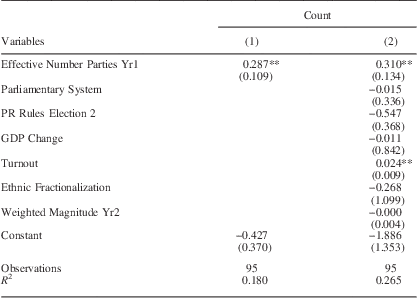
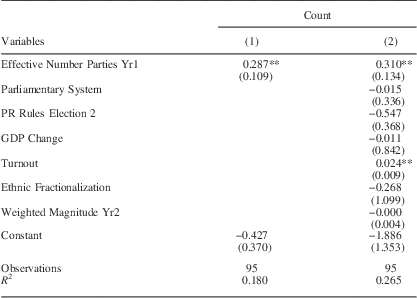
, where p i is the proportion of the vote received by each party i (Laakso and Taagepera Reference Laakso and Taagepera1979; Golosov Reference Greenberg and Shepsle2010).Footnote 15 Our goal is to see whether there is a systematic relationship between ENP at time “t−1” and the emergence of new political parties at time “t.” We begin by testing our central hypothesis in the sample of Western European cases, where we have 95 election pair observations between 1987 and 2007.Footnote 16 In Table 1, we operationalize the emergence of new political parties by simply counting the number of new parties that received at least 2 percent of the vote in that election; the results are robust to using an alternative threshold as high as 5 percent.Footnote 17
Effective Number of Parties and Count of New Parties in Western Europe, 1987–2009
Note: Standard errors clustered by country. Robust standard errors in parentheses.
PR=proportional representation.
***p<0.01, **p<0.05, *p<0.1.
In Model 1 of Table 1, we examine the bivariate relationship between ENP in the previous election and the number of new parties that competed in the current election.Footnote 18 However, in order to control for potential omitted variables, we also present results from a more fully specified multivariate model in Model 2. The first two sections of this paper point to the importance of controlling for the permissiveness of the electoral system, which we do in two ways: by using the natural log of average district magnitude in the year of the electionFootnote 19 and by including a dummy variable for proportional electoral systems.Footnote 20 Controlling for district magnitude is not only important as a measure of electoral permissiveness; more generally, the size of electoral districts is probably the most consistent way of measuring the costs of party entry, as the number of votes necessary to gain representation, and by implication the resources required, decreases as district size increases. We also control for a number of other factors that have been posited to affect electoral volatility from the demand side, including economic conditions (Roberts and Wobbles Reference Roberts and Wibbels1999; Davits Reference Tavits2005),Footnote 21 ethnic fractionalization (Madrid Reference Madrid2005; Birnir Reference Birnir2006), and electoral turnout in the current election (Bartolini and Mair Reference Bartolini and Mair1990; Madrid Reference Madrid2005). Finally, we also control for regime type with a dummy variable that isolates pure presidential systems from parliamentary systems and mixed regimes with both parliamentary and presidential features. Including the full set of controls has the added advantage of making our results more directly comparable with the existing empirical literature on new party entry discussed at the end of the Party Entry and the Effective Number of Existing Parties section.
Model 1 of Table 1 shows that across the entire West European data set, there is a clear bivariate relationship between the effective number of parties in the previous election and the number of new parties receiving at least 2 percent of the vote in the current election (p<0.05). Moreover, the size of this effect is substantively meaningful: having three to four more effective parties yields a prediction of an additional new party. Put another way, we expect on average a five to six party system to have an extra new party per election as compared with a two-party system. This finding is completely in line with the intuition developed in the previous section, and is the opposite from what a standard Downside intuition would have led us to expect. Furthermore, the finding is robust to including the control variables for alternative theoretical explanations in Model 2. Here the magnitude of the coefficient on ENP actually increases, while maintaining its statistical significance, suggesting that ENP was not simply proxying for one of these other factors, and, perhaps most crucially, that ENP is not simply picking up the permissiveness of the electoral system.
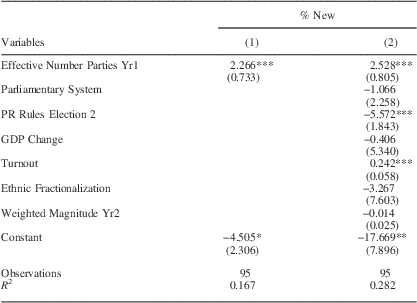
In particular, interested readers will note that in Table 1 we do not find a statistically significant effect for proportional electoral rules on new party entry; in fact the coefficient is actually in the opposite direction.Footnote 22 Similarly, we find no effect for district size (Log Weighted District Magnitude) on new party entry.Footnote 23 These findings are inconsistent with what previous studies (e.g., Harmel and Robertson Reference Hug1985) have found. Furthermore, these somewhat unexpected findings do not result from the fact that party system fragmentation is over-determined by a country’s electoral system: the bivariate correlation between PR systems and ENP in our sample of West European elections is actually weakly negative (r=−0.02), and that between ENP and a system’s logged weighted district magnitude is small (r=0.22). Should such findings hold up to further scrutiny, it would represent an important challenge to the received wisdom that more permissive electoral systems, in and of themselves, are responsible for generating incentives for party formation. For now, however, it is prudent to be cautious in interpreting these results, if for no other reason that the West European sample has 69 PR observations out of 95 total elections.
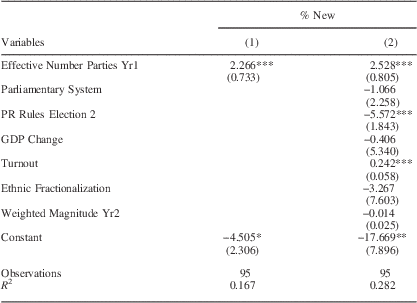
Of course, there is potential for noise in our measure of new party entry. Our intuition regarding the motivation of potential party leaders is based on the idea that they will enter parliament and affect policy outcomes. Using a threshold for inclusion as a new party as low as 2 percent opens the possibility that we are also capturing small parties that were unlikely to actually enter parliament, and thus were motivated by other concerns.Footnote 24 Somewhat problematic from our perspective is the fact that these small parties “count” as much in our measure of our dependent variable as larger parties that did go on to enter the parliament. With this in mind, we rerun our analyses using instead the total share of the vote earned by new parties as the dependent variable, effectively allowing the larger new parties to have more of an effect on the results of the analysis than smaller new parties; results are presented in Table 2.
Effective Number of Parties and Share of Vote Earned by New Parties in Western Europe, 1987–2009
Note: Standard errors clustered by country. Robust standard errors in parentheses.
PR=proportional representation.
***p<0.01, **p<0.05, *p<0.1.
Once again we see the expected relationship in both the bivariate and multivariate analyses: higher ENP is positively associated with new parties winning a large share of the vote. The effect is still substantively meaningful—an additional three to four more effective political parties leads to new parties earning 7–9 percent age points more of the vote—and, if anything, we now have even greater statistical confidence in these effects (p<0.01 in both the multivariate and bivariate analysis). District size also continues to have a similar non-statistically significant effect (although now it is negative). However, our finding regarding the effect of electoral rules is now much stronger: we get clearly fewer votes for new parties in PR systems than single-member districts (SMDs) or mixed systems once we control for the other variables in the analysis. Indeed, the size of this effect is substantively significant as well: new parties in PR systems receive approximately 6 percentage points less than those in mixed and SMD systems. Once again, the preponderance of proportional cases in the West European sample necessitates caution in interpreting these results. Finally, we also now find a statistically significant effect for turnout, with each additional 5 percent of turnout leading to an additional 1 percent of the vote for new parties.
ENP and New Party Entry in Eastern Europe
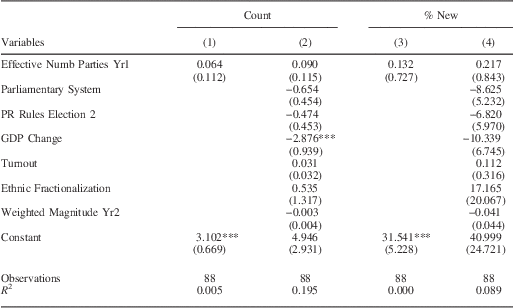
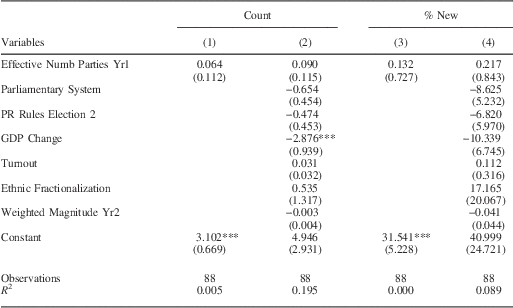
The results in the previous section suggest that the predicted positive relationship between status quo party system fragmentation and party entry emerges in exactly the subset of countries where our model suggests we should find such a relationship: the established democracies of Western Europe. However, the argument also suggests that we should be less likely to find such a relationship in newer democracies. To test this implication, we collected data on new party entry from 88 elections that took place across 21 post-communist East European countries during the same time period.Footnote 25 To be clear, we are not arguing that all potential new party leaders in post-communist systems were completely unconstrained and purely office seeking. We are, however, proposing that relative to potential new party leaders in Western Europe, they were likely to have been less constrained and more interested in office holding for the myriad of reasons we laid out previously. With these data in hand, we rerun all analyses conducted in the previous section (Table 3).Footnote 26
New Parties in Eastern Europe, 1991–2009
Note: Standard errors clustered by country. Robust standard errors in parentheses. Dummy variable for missing data omitted from Table.
PR=proportional representation.
***p<0.01, **p<0.05, *p<0.1.
The bottom line is that no matter how you slice the data, there is not any robust evidence of a statistically meaningful relationship between the effective number of political parties in a country and new party entry in the first two decades of post-communist elections. In fact, in this sample of cases only the change in growth rates seems to exert any systematic impact on the formation of new parties.Footnote 27 Therefore, we have added reason to think that the positive results in the previous section are not simply mechanical, nor are they a function of some unobserved characteristic of politics in Europe in 1990s and 2000s. Instead, we believe the findings reflect the inherent dynamic identified by our theory of new party entry: the more politicians are constrained in terms of where they can enter the political spectrum, and the more they care about the policy consequences of new party formation in relation to the benefits of office holding, the more likely we are to witness more new party entry when the effective number of parties is higher.Footnote 28
ENP, New Party Entry, and Democratic Experience
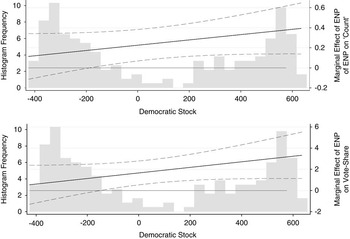
It is also possible that, by exploiting the categorical distinction between East and West Europe, we are masking variation in democratic experience that exists within the two subsets of countries. As such, in this section we test our argument using the previously described measure of democratic experience from Gerring et al (2005) which is continuous rather than categorical and varies both between and within East and West Europe. This “cumulative Polity score” ranges from a minimum of roughly −424 to a maximum of roughly 634, with a mean (SD) of 82 (374). As demonstrated in the subsequent histograms, the measure is strongly bimodal, with concentrations of both low-democratic experience and high-democratic experience cases. To test our primary hypothesis we interact democratic stock with the effective number of parties, and include all three measures in our regression analyses. These interactive specifications will allow us to examine whether, consistent with our theory, party system fragmentation has a positive impact on new party entry in long-standing democracies, but not in newer democracies. Table 4 and Figure 1 present the results.
Marginal effect of effective number of parties (ENP) at varying levels of democratic experience.

Effective Number of Parties (ENP), Democratic Experience, and Entry

Note: Standard errors clustered by country. Robust standard errors in parentheses.
PR=proportional representation.
***p<0.01, **p<0.05, *p<0.1.
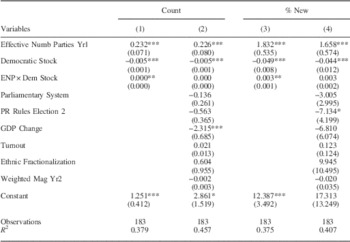
At first glance, we see a positive effect of fragmentation (ENP) and strong negative effect of democratic experience on both the count and vote share of new parties. The coefficient on the interactive term is small due to the large range of the “Stock” variable. To get a complete picture of the results’ implications, it is essential to construct full marginal effects plots that tell us the power of the effect ENP has on new party entry at different levels of democratic experience (Brambor et al., 2005). Figure 1 presents the plots associated with Models 2 and 4 from Table 4.
These plots tell the complete story, and are strongly consistent with theoretical expectations. Note first from the histograms that democratic experience is bimodally distributed, with concentrations of cases in the measures’ upper and lower ranges. Among countries with low levels of democratic experience, the effect of ENP on party entry is positive but negligible, and falls well short of statistical significance. In contrast, in countries with high levels of democratic experience, the effect of ENP on party entry is positive, and both substantively and statistically significant. Take for example a country with a democratic stock score of 456 (1 SD above the mean score of 374). For such a country, moving from 1 SD below mean fragmentation (i.e., ENP) to 1 SD above mean fragmentation leads to an expected increase of roughly two new parties in any election. Similarly, moving from 1 SD below mean fragmentation to 1 SD above mean fragmentation leads to an expected increase of roughly 15 percent in the total vote share of new parties in any election.
Although we develop no a priori execrations as to the relationship between democratic experience and new party entry (save that it should condition the effect of ENP), it is also interesting to investigate whether the effect of democratic experience varies with extant levels of party system fragmentation. Simple diagnostics suggest that the answer is affirmative. In systems with low levels of ENP, democratic stock has a strong negative effect on the formation of new parties, that is, new parties are more prevalent in younger democracies (hence the low p-value for the ENP coefficient in Table 4). However, in more fragmented party systems, the effect of democratic experience washes out. In short, not only do these interactive analyses provide strong support for this paper’s guiding theoretical claims; they also suggest that party system fragmentation has a significant enough effect on entry in long-standing democracies to nullify the differences between such democracies and new democracies.
Evidence from TURKEY
The previous section provided cross-national statistical evidence in support of our theory. We now examine the same argument in a single legislative context, using a data set on party formation in the Grand National Assembly of Turkey (TGNA). Party entry in Turkey is generally a legislative phenomenon: rather than forming outside of the legislature and competing in subsequent elections, new parties in Turkey typically emerge when prominent Members of Parliament (MPs) choose to defect from their current organization and form a new party mid-term.Footnote 29 As such, in this section we will test this paper’s core theoretical claim by investigating whether party formation in the TGNA is more prevalent when the Turkish party system is more fragmented. Turkey’s electoral system is characterized by an unusually high electoral threshold: parties receiving <10 percent of the national vote are excluded from Parliament. For this reason, between 1983 and 2007 Kurdish ethnic parties, and to a lesser extent, small right-wing parties, were excluded from the TGNA, despite winning consistent support in specific regional strongholds. More recently, parties failing to reach this threshold in one election have quickly faded from the political scene.Footnote 30 As a result, the current state of legislative fragmentation is likely to be of greater importance than the last election’s ENP when considering the consequences of forming a new party.Footnote 31 We will thus employ the Effecitve Number of Parliamentary Parties (ENPP) rather than the ENP to measure party system fragmentation, and investigate whether the formation of new parties in the TGNA is systematically related to the ENPP at the beginning of a legislative term.
With regards to our argument’s scope conditions, it is important to note that Turkish politicians and party leaders are often motivated by considerations of ideology and policy representation.Footnote 32 In addition, Turkish political entrepreneurs are often constrained in the range of credible issue-related stances they can assume on specific policy dimensions.Footnote 33 Programmatic motivations and platform constraints similarly influence processes of new party formation in the TGNA. The JDP emerged when a group of prominent MPs from within the Islamic camp formed a new party on the center-right, whose goal was to weaken secularist restrictions on Islamic expression in the public sphere, and to promote private rather than public sector development. The Republican People’s Party (RPP) was formed in 1993 by Deniz Baykal, a politician with a long history of participation in leftist parties, who was then joined by many left-leaning MPs dissatisfied with their party’s participation in a center-right coalition government.Footnote 34 Of course we make no claim that all, or even most, of the volatility that occurs within the TGNA has “policy-seeking” roots. Sayarı (Reference Sayarı2000) lists ideological/policy disputes as one of three reasons an MP might change his or her partisan affiliation during a legislative term. In addition, some MPs switch parties in order to obtain more favorable list positions in the subsequent election (office seeking), and others switch for purely material reasons (rent seeking). Not unlike the research design in the previous section, our goal here is to leverage this variation in legislative motivations to test our conditional hypothesis as to the relationship between status quo fragmentation and the propensity for new party formation.
Varieties of Legislative Volatility
The first step in implementing this research design is distinguishing between different forms of legislative volatility. In that vein, a non-negligible number of new parties that form in the TGNA never compete in a single electoral contest, and some are so fleeting as to exist for no more than a week. Thus, within the subset of new parties we will distinguish between switches to ephemeral parties, which both form and then disappear in the same legislative session, and those to genuine new parties, which form in a legislative session and then compete in the subsequent election. As already noted, volatility which results from the formation of genuine new parties is typically characterized by policy-seeking motivations and platform constraints. As such, and in keeping with the above argument, we expect the prevalence of genuinely new parties in the TGNA to be higher when status quo legislative fragmentation is higher. In contrast to volatility, which results from the formation of genuinely new parties, the appearance of ephemeral new parties is most likely a result of purely office- or rent-seeking considerations. Indeed, one can hardly imagine that a party which forms and dissolves in the span of a couple of months (or less)—and which never promotes a platform to voters in the context of a general election campaign—was created for the sake of influencing policy. Rather, as suggested below, these parties most likely serve as “holding cells” in which MPs can temporarily relocate in the hope that one of the existing parties will then offer some form of office or rent-motivated inducement to re-affiliate. Thus, again in keeping with this paper’s theoretical argument, we do not expect to uncover a positive relationship between the formation of short-lived parties and status quo fragmentation.
Many legislators also switch within the set of pre-existing parties.Footnote 35 For our present purpose, rather than explicitly investigating the determinants of this within-existing party volatility, we instead use our data on such switches to lend further credence to the evidence we find from switchers to new parties. Namely, if we can demonstrate that switches between pre-existing parties are not positively correlated with status quo legislative fragmentation, then it would provide additional support for the idea that evidence of a positive relationship between status quo fragmentation and switching to genuinely new parties is not spuriously driven by the fact that all forms of legislative volatility are positively correlated with fragmentation.
The data we use to analyze the relationship between party system fragmentation and the various forms of legislative volatility described above cover the period 1987–2007, which includes the 18th through 22nd sessions of the TGNA. It codes each time a Turkish MP formally switches his or her partisan affiliation, and records their pre- and post-switch affiliations.Footnote 36 The data set contains information on a total of 2550 Turkish legislators, individuals who served in more than one session are coded as distinct observations for each legislature in which they served. Of these 2550 legislative observations, a total of 428 switched partisan affiliation at least once during the associated legislative session (16.8 percent).Footnote 37 Cut another way, the data set contains 542 total “switch events,” a number which is padded due to the fact that some MPs switch parties more than once in a session. The following results are qualitatively identical whether we use the total number of “switches” or the total number of “switchers” as our dependent variable.Footnote 38
Of these 542 switch events, 300 represent switches to new party organizations, and the remaining 242 represent switches within the set of pre-existing parties. Switches to pre-existing parties include legislators that move within the set of current parliamentary parties, and also a small number of switches by legislators to parties who did not gain access to parliament for having fallen beneath the 10 percent threshold, but who, nonetheless, competed in the preceding general election. As already noted, within the set of switches to new party organizations, we will distinguish between truly ephemeral parties, which formed and then closed in the same legislative session without ever competing in an election, and genuine new parties which form in a session, exist at that session’s end, and then compete in the subsequent election. In total, 243 of the 300 switches to new parties are of the genuine variety, whereas 57 are of the ephemeral variety.
“Genuine” New Party Entry and the ENPP
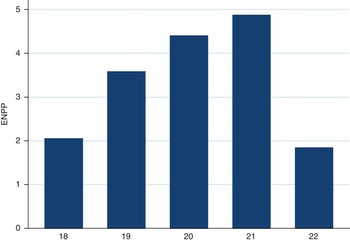
The effective number of legislative parties, our primary independent variable, varied a good bit during the time period in question. Turgut Özal’s center-right Motherland Party (MOP) held clear parliamentary majorities in the first eight years after the return to democracy in 1983.Footnote 39 The MOP’s dominant party status was thrown into doubt with the referendum of 1987, which legalized the return to politics of previously banned political leaders from the 1970s. These leaders quickly assumed control over a number of smaller pre-existing parties, and after eight years of MOP predominance the 1991 general elections yielded a more fragmented Parliament. Thus ensued a decade of fragile coalition governments and political instability, a decade which also witnessed the appearance of a variety of new party organizations, some of which were more long lived than others. Beginning in 2002 the number of legislative parties once again shrunk, with the JDP winning a single-party parliamentary majority and the RPP entering as the only opposition party. To capture this variance we will use a standard measure of the ENPP (the inverse of the sum of parties’ squared seat percentages). Figure 2 presents the initial ENPP for the five legislative sessions in question.
The effective number of parliamentary parties (ENPP) by legislative session. The number on the X-Axis refers the the legislative session of the Grand National Assembly of Turkey.

The 18th (1987–1991) and the 22nd (2002–2007) legislatures both began with an ENPP of roughly two, and both were presided over by large parties (the MOP and JDP, respectively). In contrast, the 19th, 20th, and 21st legislative sessions began in a much more fragmented fashion, opening with an ENPP of 3.58, 4.40, and 4.87, respectively.
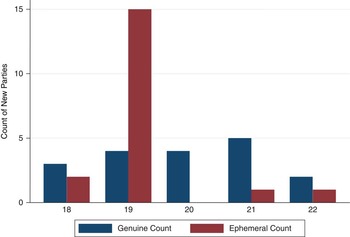
As such, we expect the formation of genuine new parties to be more prevalent in the middle three legislative sessions than in the 18th or the 22nd. On the other hand, we would not expect the formation of ephemeral new parties to co-vary with ENPP in this manner. Finally, we remain agnostic as to how switches within the set of pre-existing parties will vary according to legislative session, but if we find that they do not positively correlate with the ENPP, this will afford greater confidence in the non-spurious nature of any such correlation we find with the entry of genuine new parties. We begin by presenting a simple “count” of new parties which form in the TGNA during a legislative session, distinguishing between those that are genuine and those that are ephemeral.
The first thing to note is that, consistent with our theory, the entry of genuinely new parties is positively correlated with the ENPP, and indeed climbs in stepwise fashion with a legislature’s initial ENPP: it was lowest in the 22nd legislature (two new parties), which was also the least fragmented (ENPP=1.84), second lowest in the 18th session, which was the second-most initially fragmented (three new parties, initial ENPP=2.05), and highest (five new parties) in the 21st legislature, which was also the most fragmented (ENPP=4.87). On the other hand, and also consistent with our theory, the number of ephemeral parties that form in a session bears little relationship to the ENPP. The most noteworthy finding here is the overwhelming emergence of such parties in the 19th legislative session (15 ephemeral parties created!), with the remaining ephemeral parties spread out over the 18th, 21st, and 22nd sessions (no such parties formed in the 20th legislative session).Footnote 40
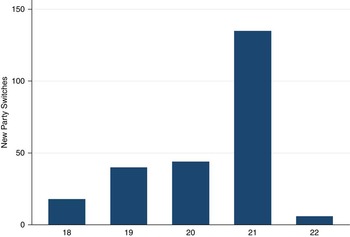
Although the count data from Figure 3 provide evidence consistent with our primary hypothesis, the total number of MPs who switch from old parties to new parties in a legislative session provides an even more appropriate measure: rather than treating large and small parties equally, it captures the overall weight of new entrants in any given parliamentary term. Figure 4 presents the total number of switches that MPs made to genuinely new parties by legislative session.
Number of new genuine and ephemeral parties by legislative session. The number on the X-Axis refers the the legislative session of the Grand National Assembly of Turkey.

Genuine new party “switches” by legislative session. The number on the X-Axis refers the the legislative session of the Grand National Assembly of Turkey.

Once again the data here is supportive of our core hypothesis, as the number of switches to genuinely new parties rises in a stepwise fashion with a legislature’s initial ENPP: it was lowest in the 22nd legislature (six total switches to new parties) which was also the least fragmented, second lowest in the 18th session which was the second-most initially fragmented (18 switches to new parties), and so on to the 21st legislature which was the most fragmented and had 135 switches to new parties. Indeed, while the initial ENPP and the number of switches to genuine new parties increase together in a stepwise fashion across legislative sessions, there is a substantial jump in the number of new party switches in this most fragmented session.Footnote 41
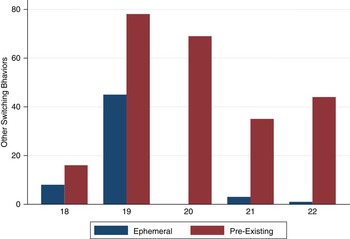
What about the other types of switching behavior, namely switches to ephemeral parties and switches which occur within the set of existing parties? Figure 5 presents the tallies, once again broken down by legislative session.
Other switching behavior (i.e., switches between existing parties or switches to new parties that do not compete in subsequent elections) by legislative session. The number on the X-Axis refers the legislative session of the Grand National Assembly of Turkey.

Figure 5 reveals that switches to short-lived new parties are not correlated with the initial ENPP, and indeed tend to be concentrated in the 19th session, with a small number also occurring in the 18th, 21st, and 22nd sessions. As for changes within the set of existing parties, these also bear no clear relationship to legislative fragmentation. The highest number occurred in the 19th session, which ranked third in initial ENPP. In addition, the 22nd session experienced a good deal of such volatility despite being the least fragmented in our data set, and in fact experienced nine more such switches than the highly fragmented 21st session (44 compared with 35). The lack of a clear relationship between such switches and initial ENPP serves as additional evidence that the positive correlation between the formation of genuine new parties and fragmentation is not the artifact of a more general relationship between fragmentation and volatility broadly conceived.
Conclusion
The previous two sections thus provide empirical evidence in favor of this paper’s core hypothesis, developed in the Party Entry and the Effective Number of Existing Parties section, that the formation of new parties should be positively correlated with the pre-existing number of political parties when politicians are sufficiently platform constrained and policy seeking. We have established this paper’s basic claim using a variety of complementary approaches. We have first provided a rigorous argument, grounded in formal logic, that when the aforementioned scope conditions are satisfied we should see a positive relationship between status quo party system fragmentation and party entry. We then presented an empirical analysis of the relationship between ENP and party entry across two decades of European elections. Finally, we complemented this with case-level data on the relationship between fragmentation and defections to new parties by individual Turkish legislators over the same two decades. Although any one of these findings alone might not be enough to convince readers, taken together we believe they offer a compelling argument that, going forward, the idea that we ought to find more new party formation in larger party systems must be part of the broader discussion.
Important opportunities clearly exist for future research based on the ideas laid out in this paper. From an empirical standpoint, it is important to note that this paper’s primary contribution is to establish the viability of supply-side arguments in studies of party entry; and to demonstrate that, when thinking about supply-side factors, it may be the party system rather than a country’s political institutions that does the brunt of the work. On the other hand, this paper should not be taken as a refutation of demand-based explanations of party entry. Although whenever possible we include controls for demand-side factors in our empirical analyses, it is beyond this paper’s scope to develop and test a more exhaustive measure of the extent to which popular preferences are “under-represented” by current parties, which is crucial for any ultimate test of the Downside hypothesis. Significant challenges of methodology and data availability exist in the development of any such measure, which would require both a precise measure of the electoral preference topology as well as parties’ respective placements in this topology. However, doing so constitutes an important next step in establishing the relative impact of supply- versus demand-side factors in the calculus of party formation.
There is also room for future research extending both the temporal and geographic scope of our large N analysis. Beyond the positive findings consistent with our supply-side argument, the results presented in our cross-national analyses are notable for the preponderance of non-findings when it comes to other factors often considered important for party entry, particularly in the post-communist sample. It will be important in future work to see not only if the current argument, but also this article’s negative findings, stand up to a larger sample of cases. In addition, although we have in this article focused entirely on whether or not a new party enters, the theoretical framework also has implications for where new parties should enter the political spectrum: in smaller party systems entry tends to occur in the center of the political spectrum, whereas in multi-party systems entry tends to occur everywhere but the range of policy positions near the electoral median. By introducing measures of party positions into our data analysis we will be able to assess whether this aspect of our argument also finds support.
Finally, it would eventually be interesting to investigate whether or not new party entry does indeed have the policy consequences we predict. When a party enters into multi-party systems, does it tend to create policy outcomes closer to its own position than those which would have emerged absent the decision to enter? Does entry in more concentrated party systems tend to “push” policy outcomes further from the entrant’s ideal point than would have otherwise been the case? These ideas for extending our current analyses highlight that, beyond presenting and then testing a novel theoretical argument about party entry, one of this paper’s primary strengths is developing a framework that can guide a wide variety of future analyses of party formation in democratic states.
Supplementary Material
To view supplementary material for this article, please visit http://dx.doi.org/10.1017/psrm.2015.22