


Our knowledge of Qu Yuan 屈原 (trad. 343–278 bce)Footnote 1 is primarily drawn from the biography attributed to Sima Qian 司馬遷 (ca. 145–ca. 86 bce), aside from certain poems in the Chu ci 楚辭 (Verses of Chu) purportedly written by Qu Yuan himself. Consequently, any scholarly endeavor to confirm or dispute Qu Yuan’s authorship of those poems inevitably hinges on the interpretation of Sima’s account. As astutely observed by Galal Walker, among the myriad questions surrounding Qu Yuan, “the Sima Qian biography of Qu Yuan and the problems of its acceptance or rejection have remained central.”Footnote 2 Unfortunately, this biography is a problematic text. It appears highly derivative, disordered, and occasionally self-contradictory.Footnote 3 Even ardent proponents of the authenticity of its image of Qu Yuan concede that this text exhibits notable inconsistencies and includes jumbled voices. In a word, it is a text with many “defects.”Footnote 4 These defects, however, have rarely been rigorously scrutinized. Previous scholars have either dismissed the biography as unreliable or attributed the inconsistencies to Sima’s oversights or later interpolations.Footnote 5 Neither of these two perspectives contributes to our understanding of the formation of the Qu Yuan story. Given that Sima highly valued Qu Yuan as his role model,Footnote 6 and in the absence of concrete evidence that Qu Yuan’s biography was heavily edited by others,Footnote 7 we must explain, or at least try to explain, why a great historian allowed so many “defects” in his portrayal of a figure he revered. I argue that these “defects” faithfully reflect the heterogeneity of Sima’s sources. Predominantly, these sources include self-revelatory pieces in the Chu ci that employ the first-person pronoun (mainly referring to the “Li sao” 離騷 [Encountering Sorrow], the “Jiu zhang” 九章 [Nine Pieces], and the “Yuan you” 遠遊 [Far Roaming]). By abandoning the conventional yet unfounded belief that all these verses were written by one person, Qu Yuan,Footnote 8 one discerns an array of distinct personae within them.Footnote 9 These different personae made their own choices while facing a common plight: being a righteous individual amidst moral decay. Sima Qian selected some of those personae and from them constructed a historical Qu Yuan figure. His version represented only a narrow slice of a much broader and more complex Qu Yuan tradition. Nevertheless, by anchoring Qu Yuan’s story in the dramatic finale of suicide, Sima’s account has exerted an overwhelming influence on the mainstream understanding of the Chu ci up until this day, overshadowing the multiplicity of voices it contains. In the analysis that follows, I begin by revealing some apparent contradictions in Qu Yuan’s biography, accentuating the enigma surrounding his demise. Subsequently, I examine the pieces in the Chu ci characterized by a strong personal voice, discerning the multiplicity of voices contained therein. I then demonstrate that among those personae, it was in Sima’s biography that the most influential Qu Yuan figure since then is highlighted. The underlying motives for Sima’s choices are manifold, a few of which will be illustrated. Finally, I discuss the consequences of Sima’s construction, both in the realm of literary composition and the interpretation of the Chu ci. To sum up, Sima’s shaping of Qu Yuan’s character can be perceived as an interpretative endeavor rooted in some parts of the Chu ci. Conversely, the established Qu Yuan biography has profoundly shaped subsequent interpretations of the Chu ci. Recognizing Sima’s instrumental role in this intricate interaction is pivotal to comprehending the evolution of the Qu Yuan story as we recognize it today.
Self-estrangement or Banishment? The Discrepancies in the Qu Yuan Biography
“The Biographies of Qu Yuan and Scholar Jia” (屈原賈生列傳) by Sima Qian presents a series of textual challenges. While certain discrepancies are minor,Footnote 10 others are of such significance that they cannot be overlooked.Footnote 11 A salient issue is the separate interpolation of two extended commentarial paragraphs within the seemingly objective account of Qu Yuan’s engagement in, or exclusion from, the state affairs of Chu. These interpolations not only disrupt the narrative flow of Qu Yuan’s story but also juxtapose two markedly contrasting contexts for Qu’s literary works:
Qu Ping loathed that the king listened but did not hear, that slanderers and flatterers obstructed perspicacious men, that the depraved had injured the upstanding, and that the upright were not tolerated. Thus filled with worry, melancholy, and dark thoughts, he composed the “Li sao” …. Qu Ping’s composition of the “Li sao” must have arisen from his resentment. “The Airs of the States” are sensual without being licentious; the “Minor Court Hymns” [express] resentment and criticism without [inspiring] disorder. “Li sao” can be said to do both at once …. His aspirations are pure: for this reason, the things he speaks of are fragrant. His actions are honest: for this reason, he was not tolerated until his death. Taking himself far [from court] to the brackish, turbid water, amid the sludge and mire, he sloughed off his cicada [shell] amid slimy filth, to drift and roam beyond the soot and dust [of society], without carrying with him the grimy blemishes of [the human] world. Bright and gleaming, he [passed through] the mud unsullied. [We can] infer from his aspirations that he could even vie for brilliance with the sun and moon.
屈平疾王聽之不聰也,讒諂之蔽明也,邪曲之害公也,方正之不容也,故憂愁幽思而作⟪離騷⟫。 … … 屈平之作⟪離騷⟫,蓋自怨生也。⟪國風⟫好色而不淫,⟪小雅⟫怨誹而不亂。若⟪離騷⟫者,可謂兼之矣。 … … 其志絜,故其稱物芳。其行廉,故死而不容。自疏濯淖汙泥之中,蟬蛻於濁穢,以浮游塵埃之外,不獲世之滋垢,皭然泥而不滓者也。推此志也,雖與日月爭光可也。Footnote 12
Qu Ping despised him (Zilan). Though exiled, he looked back with longing to Chu and was deeply attached to King Huai. He never forgot his desire to return. He hoped that his lord would suddenly awaken, and that customs would be reformed. To keep his lord alive, to revive the state, and his desire to reverse [the course of recent events]—he conveyed these aspirations three times in one scroll. Yet in the end nothing could be done, and thus he was unable to return. … Because King Huai did not know how to separate loyal subordinates [from the disloyal], he was misled from within [his court] by Zheng Xiu and deceived from without by Zhang Yi. He kept Qu Ping at a distance and trusted Grand Master Shangguan and the Premier, Zilan. His troops were subdued and his territories whittled away. He lost six commanderies and died a hostage in Qin, the laughingstock of all under Heaven. This is the calamity of not being able to recognize [the characters of] people. … If a king is not perspicacious, how could he attain good fortune?
屈平既嫉之,雖放流,睠顧楚國,繫心懷王,不忘欲反,冀幸君之一悟,俗之一改也。其存君興國而欲反覆之,一篇之中三致志焉。然終無可柰何,故不可以反 … … 懷王以不知忠臣之分,故內惑於鄭袖,外欺於張儀,疏屈平而信上官大夫、令尹子蘭。兵挫地削,亡其六郡,身客死於秦,為天下笑。此不知人之禍也。 … … 王之不明,豈足福哉!Footnote 13
These two excerpts differ markedly in both style and content. The first excerpt contains rhymed linesFootnote 14 and suggests that Qu Yuan composed the “Li sao” after being vilified by some malicious officials, leading to his estrangement from the King, presumably King Huai of Chu 楚懷 (r. 328–299 bce). In this account, Qu Yuan is depicted as choosing deliberate isolation, akin to a cicada shedding impurities, to remain untainted by a corrupt world. Contrastingly, the second excerpt is prosaic, offering an alternative account where Qu Yuan is not self-isolating but is banished by King Huai, expressing a longing to return that permeates his writings. This narrative is further complicated by a subsequent paragraph describing Qu Yuan’s expulsion under King Huai’s successor, King Qingxiang 頃襄 (r. 298–263 bce). This raises pressing questions: Were Qu Yuan’s poems inspired by imposed exile or voluntary detachment? Was he banished multiple times?Footnote 15
Critics have noted these inconsistencies and proposed various theories to reconcile them. Some scholars, in their quest to challenge the traditional understanding of Qu Yuan, interrogate the biography’s reliability. By highlighting the deficiencies of this text, some even assert that Qu Yuan might not have historically existed.Footnote 16 Such positions, while provocative, hinder a deeper understanding of the biography, which remains the earliest and most significant account of Qu Yuan. An outright dismissal prevents us from discerning the evolution of Qu Yuan’s narrative. Traditionalists, on the other hand, do not question the biography or Qu Yuan’s authenticity. They instead ascribe these discrepancies to errors on the part of Sima QianFootnote 17 or a haphazard compilation of sources.Footnote 18 While it is plausible that Sima Qian preferred to preserve original materials without significant alterations, it seems unlikely that he approached the biography with anything less than careful consideration. Tang Bingzheng 湯炳正 offers another perspective, positing that these two excerpts originated in Liu An’s 劉安 (179?–122 bce) “Li sao zhuan” 離騷傳 (Commentary on the “Li sao”),Footnote 19 and were interpolated into the biography by later people, not by Sima. This theory attempts to absolve Sima Qian of direct involvement in these inconsistencies but faces its own challenges. First, there is an absence of concrete evidence indicating that contributors other than Sima contributed to the biography’s primary content. While minor additions by later editors are conceivable, the introduction of two substantial paragraphs, constituting nearly a third of the biography, seems less plausible. Second, the stylistic and thematic divergence between the two excerpts complicates the attribution to a single source. The first excerpt enthusiastically praises Qu Yuan and his “Li sao” in a literary tradition, positioning them as the subjects of most sentences. In contrast, the latter predominantly criticizes King Huai from a political standpoint, concluding in an admonitory tone. Furthermore, the distinct contextual backdrops for Qu’s works in the two passages imply they may not reference the same poetic work. The praise in the first excerpt seem to refer to “Li sao,” portraying a figure opting for self-detachment;Footnote 20 whereas the second likely alludes to poems from “Jiu zhang,” especially given its explicit theme of banishment, absent in “Li sao” but stated straightforwardly in some “Jiu zhang” pieces. In other words, these two accounts in Sima Qian’s writing seem to be unrelated and might be referring to different personae within the Chu ci corpus.
Another controversial battlefield, which closely intertwined with the previous two different images, is the interpretations of Sima’s account of Qu Yuan’s death. Liang Qichao 梁啟超 (1873–1929) argues that any comprehensive study of Qu Yuan should commence with his death, emphasizing its critical importance.Footnote 21 Readers are prone to perceive Qu’s suicide as the climax of his life, attributing profound significance to this act.Footnote 22 Heng Du innovatively reveals the importance of Qu’s death not from the perspective of a historical persona—what she terms the “body natural”—but from that of a literary demarcation—the “body authorial.” Qu’s physical death marks “the end of Qu Yuan’s literary corpus,” and thus “separates the Chu ci compilation into the ‘core chapters’ 1–7 and the ‘imitation’ chapters 13–17.”Footnote 23 Nevertheless, the actual circumstances of Qu Yuan’s death are far from conclusively established. Questions persist about how, when, and why Qu Yuan died, and the primary sources of our knowledge about his demise. These issues are intertwined with the ambiguity over whether Qu Yuan’s withdrawal from society was a voluntary act of self-preservation or a result of enforced exile, a distinction that could dramatically affect interpretations of his final act. The narrative of voluntary self-isolation suggests a desire for self-preservation, potentially leading to seclusion, whereas forced exile implies a stripping away of political agency, which could culminate in despair and possibly suicide. These divergent scenarios reflect two distinct personae within the Chu ci corpus, each with its own narrative arc and ending. The prevailing question then becomes: how did the narrative of enforced exile and despair-induced suicide become the dominant understanding of Qu Yuan’s life and death? It was probably Sima Qian’s selections, emphasizing specific aspects and interweaving varied personae within them, that played a significant role in shaping and solidifying the image of Qu Yuan that has endured for over two thousand years.
Qu Yuan’s Suicide as a Core of Sima Qian’s Construction
The earliest known mention of Qu Yuan’s suicide by drowning in the Miluo 汨羅 River appears in Jia Yi’s 賈誼 (200–168 bce) “Diao Qu Yuan fu” 吊屈原賦 (The fu Footnote 24 mourning for Qu Yuan), which Sima later integrated into the dual biography of Qu and Jia. Jia Yi’s source for this claim remains obscure. Since Jia Yi used the term cewen 側聞 (hearsay), this account of Qu’s suicide was likely based on local oral traditions circulating around 160 bce rather than well-documented facts.Footnote 25 About seventy years later, Sima Qian not only acknowledged this narrative but further embellished it by adding the detail that Qu Yuan had clasped a stone to ensure his drowning.Footnote 26 Sima’s addition may have been inspired by “Huai sha” 懷沙 (Embracing Sands) from the “Jiu zhang” section, although the text itself offers no mention of the protagonist clutching sand or stones or intending to drown. Sima took this piece as Qu’s swan song probably because the final line of its main body alludes to a death wish and owing to his interpretation of the title. However, subsequent scholarship has suggested that Sima may have misinterpreted the title, which could alternately translate to “Yearning for Changsha 長沙 (the modern-day Hunan province’s capital).”Footnote 27 If such is the case, the dramatic final moments of Qu’s life, as depicted by Sima, might well be a literary fiction, and there is no reason for later readers to elevate such an account to the status of indisputable truth.Footnote 28
Sima Qian’s approach to Qu Yuan’s biography was not merely a collection of facts but an interpretive endeavor. Undeniably, Sima visited Qu’s presumed place of death,Footnote 29 potentially collecting oral accounts not found in extant records. However, as analyzed by Galal Walker, for much of the Qu Yuan biography, pre-existing sources can be identified, suggesting that Sima had access to the same limited pool of information available to us.Footnote 30 Sima heavily leaned on works attributed to Qu Yuan, drawing personae from them and subsequently spotlighting his own interpretation of Qu Yuan’s persona. However, significant questions arise in this approach: While the Chu ci portrays multiple Qu Yuan characters, Sima selected only a subset. Which personae did he choose? What influenced his choice?
Examining the Chu ci pieces referenced by Sima in this biography offers insights. These include “Li sao,” “Yu fu” 漁父 (The Fisherman), “Huai sha,” “Tian wen” 天問 (Asking the Sky), “Zhao hun” 招魂 (Summoning the Soul) and “Ai ying” 哀郢 (Mourning Ying). “Li sao” is mentioned first among all other works, which is repeatedly stressed in a paragraph commonly believed to be part of Liu An’s annotations to the “Li sao.” This prominence is to be expected, given that for the Han dynasty audience, “Li sao” was either Qu’s sole composition or, at the very least, his most seminal work.Footnote 31 Among the other pieces, “Yu fu” and “Huai sha” are extensively quoted, if not in their entirety, while the rest are merely alluded to by title in Sima’s concluding remarks. Setting aside “Li sao,” given its established prominence before Sima, since at least Liu An’s time around 140 bce,Footnote 32 other pieces chosen by Sima warrant further examination. What distinguishes these pieces from others, and why were they chosen?
“Tian wen” and “Zhao hun” do not belong to the self-revealing categoryFootnote 33 I will delve into below, but still, there are personal voices in them. For example, the envoi of “Zhao hun” strongly resonates with the tonality found in some “Jiu zhang” pieces.
Envoi: In the new year, as spring began, we set off for the south. … I raced with the King in the marshland to test skills. The King himself shot the arrow; the black rhinoceros was killed. The darkness yields to daylight; we cannot hold back the hour. … The eye sees a thousand miles, and springtime wounds the heart. Soul, come back! Alas for the Southern Land!
亂曰:獻歲發春兮汩吾南征, … … 與王趨夢兮課後先。君王親發兮憚青兕,朱明承夜兮時不可以淹。 … … 目極千里兮傷春心。魂兮歸來哀江南!Footnote 34
Chang Sen 常森 has demonstrated that this envoi bears a striking resemblance to a narrative from the Zhanguo ce 戰國策 (Strategies of the Warring States).Footnote 35 The principal difference in the Zhanguo ce is the identity of the protagonists: it features King Xuan of Chu 楚宣 (r. 370–340 bce) and his favorite, Lord of Anling 安陵, engaging in a grand hunt. While delving into the precise relationship between these two parallels may not be essential, it seems that the motif of a favored subordinate joining the king on a grand hunt enjoyed widespread popularity within the Chu region. The protagonist in the “Zhao hun” also reminisces about a previous hunt as he travels southward. Previously close to the king, he now finds himself on a lonely, melancholic journey, echoing the themes of solitude and wandering that prevail in many of the “Jiu Zhang” compositions.
A similar personal voice can also be seen at the end of “Tian wen.”
If I return through thunder and lightning at twilight, what worries will I have? … If I hide in a cave, what then will I have to say? … If you wake up and change your ways, what will I have to say? ... I informed him about why Du Ao’s reign was not long. How could one who killed his king to take the throne come to fame far and wide for his loyalty?
薄暮雷電,歸何憂? … … 伏匿穴處,爰何云? … … 悟過改更,我又何言? … … 吾告堵敖以不長。何試上自予,忠名彌彰?Footnote 36
This persona exhibits deep concern for the fate of Chu, portraying himself as a sagacious individual endowed with profound insights, who nevertheless remains overlooked. This characterization closely mirrors the portrayal of Qu Yuan in Sima Qian’s biography. In both depictions, Qu Yuan is presented as a wise man with foresight, whose talents and concerns for his state are not duly recognized by his contemporaries.
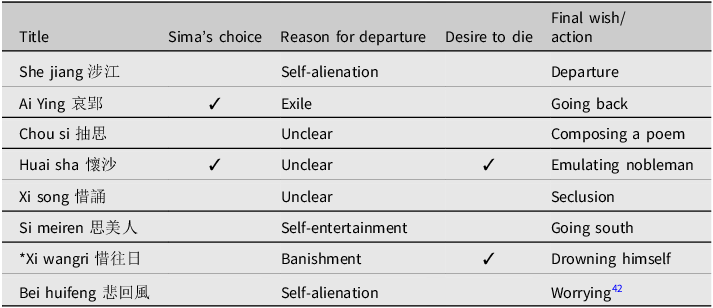
“Huai sha” and “Ai ying” are contained in the current “Jiu zhang” section. Scholarly discourse speculates on the section’s origin. Some attribute the consolidation of the nine distinct pieces under the title “Jiu zhang” to Liu An, while others argue for Liu Xiang 劉向 (77–6 bce) as the compiler.Footnote 37 During Sima’s era, these pieces were likely still circulating independently under their own titles. Even as late as the end of Western Han, Yang Xiong 揚雄 (53 bce–18 ce) refrained from viewing the nine compositions as a cohesive unit, instead opting to emulate select poems from the collection. Scholars have identified dual layers within the “Jiu zhang” compilation, suggesting that the works were composed at different times.Footnote 38 The earlier stratum encompasses “Ai ying,” “She jiang” 涉江 (Crossing the Yangtze River), “Chou si” 抽思 (Expressing the Longing), and “Huai sha.” The subsequent layer incorporates “Xi song” 惜誦 (A Painful Pleading), “Si meiren” 思美人 (Longing for the Beauty), “Xi wangri” 惜往日 (Recalling the Past Sadly), and “Bei huifeng” 悲回風 (Sorrow for the Whirlwind).Footnote 39 While these eight pieces were likely integrated into the Chu ci by early Han, and familiar to the Han audience,Footnote 40 it remains ambiguous whether Sima had access to all eight pieces, or merely the initial four. Nevertheless, this uncertainty does not detract from the ensuing argument. When further analyzing the content, there seems to be no substantive rationale for perceiving “Jiu zhang” as an integrated entity. The personae in the “Jiu zhang” exhibit a variety of attitudes and responses to their adversities, as outlined in Table 1.Footnote 41 The primary focus of this discussion lies in the differing rationale behind their journeys and their stances on mortality.
Analysis of the personae in the eight pieces in the “Jiu zhang”

Table 1 Long description
A table titled Analysis of the personae in the eight pieces in the Jiu zhang. The table has 8 rows and 5 columns. The columns are labeled Title, Sima’s choice, Reason for departure, Desire to die, and Final wish/action. The rows are labeled with the titles of the pieces and the corresponding data for each column. Row 1: She jiang, , Self-alienation, , Departure. Row 2: Ai Ying, check mark, Exile, , Going back. Row 3: Chou si, , Unclear, , Composing a poem. Row 4: Huai sha, check mark, Unclear, check mark, Emulating nobleman. Row 5: Xi song, , Unclear, , Seclusion. Row 6: Si meiren, , Self-entertainment, , Going south. Row 7: Xi wangri, , Banishment, check mark, Drowning himself. Row 8: Bei huifeng, , Self-alienation, , Worrying.
Several insights emerge upon close examination of these pieces. First, while Qu Yuan is often perceived as repetitively lamenting in a similar fashion,Footnote 43 these eight pieces reveal varied characters, each propelled by unique motivations and employing different strategies to cope with his distress. For instance, in “Ai ying,” Qu Yuan is depicted as exiled and yearning for return; in “Si meiren,” he embarks on a journey southward to alleviate his sorrow. In “Bei huifeng,” he contemplates withdrawing from a tainted world, yet remains indecisive about his future actions; and in the portrayal that Sima Qian chose, death is seen as the only resolution. Although it is possible to interpret the diverse depictions linearly as distinct stages of a singular historical figure—a method employed by many scholars in their attempts to construct a detailed chronology of Qu’s life and worksFootnote 44 —it would be more enlightening to view these as manifestations of a vibrant and varied Qu Yuan narrative tradition. Second, the traditional image of Qu Yuan, particularly his resolve towards suicidal intent via drowning, occupies only a minor part of the “Jiu Zhang” compilation. Of the eight poems, only two suggest a journey undertaken out of compulsion, and another two distinctly express an inclination towards death. “Xi wangri” is especially notable because it contains elements of both enforced exile and suicidal intent, yet it stands out by not adopting the first-person narration typical of the other “Jiu Zhang” pieces. Instead, it uses third-person pronouns, zhenchen 貞臣 (loyal subordinate) and yongjun 壅君 (benighted lord), suggesting a more detached and observational stance. Furthermore, the first half of “Xi wangri” bears a striking resemblance to Sima’s biographical portrayal of Qu Yuan, with certain details aligning closely. This resemblance raises questions about the composition sequence of this poem relative to Sima’s work. When this problematic piece is set aside, a remarkable observation emerges: Sima Qian meticulously selected the sole piece in the “Jiu zhang” explicitly referencing exile (“Ai ying”) and the only piece expressing a vehement death wish (“Huai sha”),Footnote 45 intertwining them. This selective emphasis suggests that these representations of Qu Yuan, while forming just a fraction of the broader Qu Yuan tradition and diverging considerably from the dominant narrative that existed prior to Sima’s work, were highlighted by Sima to construct a specific narrative conclusion for Qu Yuan’s life. Revisiting the second interpolated paragraph in Sima’s biography illuminates further insights. The keyword fangliu 放流 (banishment) in that excerpt undeniably resonates with “Ai ying” rather than any other poems, suggesting that Sima not only referenced “Ai Ying” in his concluding remarks but also likely drew from an unspecified commentary on it within the main narrative. To summarize, apart from “Li sao” and “Huai sha,” “Ai ying” significantly informed Sima Qian’s biographical construction of Qu Yuan’s life.Footnote 46
Transitioning to the most prominent self-revealing text, “Li sao,” the portrayal of its central persona demands reevaluation. If Qu Yuan indeed contributed directly to the Chu ci, “Li sao” is the only piece universally acknowledged as his own. While numerous scholars contend that the character in this poem has firmly resolved to embrace death,Footnote 47 I argue that this interpretation is significantly influenced by Sima’s narrative framing. Approaching “Li sao” without preconceived notions reveals a different nuance: the poem does not inherently suggest a readiness for self-destruction. Instead, it conveys a desire to withdraw from the corrupt world and seek solitude.Footnote 48 To substantiate this viewpoint, it is essential to critically address two prevailing misinterpretations of the text. For clarity, I shall first review all the lines within “Li sao” that allude to death.
For this is what my heart loves still, and I will never regret it, though made to die nine times.
Yet I would rather quickly die and vanish away, before I ever would consent to ape their behavior.
Everyone knows from birth what brings them delight. I, loving adornment alone, make it my constant. Though they dismembered my body, I would not change. How could that chasten a heart such as mine?
亦余心之所善兮,雖九死其猶未悔。Footnote 49
寧溘死以流亡兮,余不忍為此態也。Footnote 50
民生各有所樂兮,余獨好脩以為常。雖體解吾猶未變兮,豈余心之可懲。Footnote 51
Humbling one’s spirit and curbing one’s pride, bearing blame humbly and enduring insults, keeping pure and spotless and dying in righteousness: Such conduct was greatly prized by the wise men of old.
Though I stand at the pit’s mouth and death yawns before me, I still feel no regret at the course I have chosen. Straightening the handle, regardless of the socket’s shape: For that crime the good men of old were hacked in pieces.
屈心而抑志兮,忍尤而攘詬。伏清白以死直兮,固前聖之所厚。Footnote 52
阽余身而危死兮,覽余初其猶未悔。不量鑿而正枘兮,固前脩以菹醢。Footnote 53
All the references to death are exclusively confined to the first half of the poem, which is the self-revealing part. As the poem transitions into the latter half, which revolves around an imagined journey, there is a notable absence of any allusion to death. The structure of the initial three examples can be framed as: “Even if faced with death, I would not …/Death would be preferable to ….” Obviously, the essence of these statements is not a genuine contemplation of death, but rather an emphasis on the protagonist’s unwavering conviction in any circumstances.Footnote 54 The subsequent two examples invoke the legacy of ancient worthies known for their unwavering integrity, even unto death, from whom the protagonist draws inspiration. Notably, in the third and fifth examples, the type of death indicated is external deprivation of life, rather than self-infliction. Collectively, these lines underscore the protagonist’s commitment to unyielding principles, akin to those of historical paragons, rather than a direct inclination towards self-destruction.
The second misunderstanding relates not to the text’s inherent ambiguity but to the commentary by Wang Yi 王逸 (89–158), which involves a historical figure, Peng Xian 彭咸. “Li sao” mentions Peng Xian twice, with one significant reference at the end of the envoi.
I take my fashion from the good men of old, not what the vulgar wear now. Though it may not accord with present-day manners, I will follow the pattern that Peng Xian has left.
Envoi: Enough! There are no true men in the state: no one understands me. Why should I cleave to the city of my birth? Since none is worthy to work with in making good government, I shall follow Peng Xian and go where he dwelt.
謇吾法夫前脩兮,非世俗之所服。雖不周於今之人兮,願依彭咸之遺則。Footnote 55
亂曰:已矣哉,國無人莫我知兮,又何懷乎故都?既莫足與為美政兮,吾將從彭咸之所居。Footnote 56
Wang Yi claimed that Peng Xian was a worthy grandee in the Shang dynasty who drowned himself. Consequently, the concluding line of the “Li sao” has been interpreted as a declaration of suicidal intent. This interpretation, having gained significant traction, went largely uncontested for two millennia.Footnote 57 However, Lin Geng 林庚 (1910–2006) stands out as a prominent modern scholar who has cogently argued that there is no basis to link Peng Xian with suicide, not to mention drowning. His article “Who was Peng Xian?” presents a thorough reassessment based on multiple facets including references to Peng Xian in the “Jiu zhang,” the narrative logic of “Li sao,” syntactic analysis of these two sentences, and pre-Wang Yi commentaries. His analysis convincingly argues that Peng Xian was not a figure associated with suicide, but rather a hermit. This portrayal of Peng Xian as someone who chose seclusion to avoid the corruption of the world is exactly what Qu Yuan in the “Li Sao” aspires to emulate.Footnote 58 This interpretation is also consistent with Liu An’s commentary, which extols Qu for distancing himself from worldly impurities and maintaining his integrity. Apparently, Liu An also believed that this Qu Yuan persona voluntarily embarks on his journey away from the filthy world. This persona, however, strikingly contrasts with some others presented in the “Jiu zhang.”
The striking diversity among different Qu Yuan personae has prompted scholars to propose various methods for reconciling the contradictions. One common approach has been to arrange these diverse personae chronologically, attributing the variances to Qu Yuan’s evolving worldviews. However, this theory assumes that all the “early” pieces in the Chu ci emanated from a single author, a premise that is increasingly viewed as tenuous. Scholars like Galal Walker have underscored the pronounced heterogeneity in rhythms and lexicons across these poems, rendering a singular authorship theory untenable.Footnote 59 David Hawkes also criticizes this chronological arrangement approach, noting its reliance on circular reasoning: the construction of elaborate chronologies based on the questionable assumption that some or all of the “Jiu Zhang” poems are by Qu Yuan himself, where biographical “facts” are interpreted in light of the poems and vice versa.Footnote 60 Another perspective attempts to canonize one persona as the orthodox representation, while dismissing other portrayals as less authentic, envisioning Qu Yuan as a static figure rather than a dynamic one.Footnote 61 This approach raises a critical question: which persona should be privileged as most representative? The most recurrent, the earliest, or the most impactful? Rather than seeking a “superior” persona, it might be more productive to recognize the value of all these personae, as they each contribute to the rich tradition of Qu Yuan.
What factors contribute to the emergence of such diverse personae within the Chu ci corpus, despite each author’s belief that they are speaking in the manner of Qu Yuan? It may be insightful to view the Qu Yuan tradition as a dynamic crucible for individuals of different ideologies. While these personae might diverge significantly, their point of departure remains consistent: that is an upright, loyal individual suffering in his era, a predicament perennially relatable for those serving as officials, or aspiring to do so. Qu Yuan is always portrayed as a figure on the way, uncertain of his next move. This inherent ambiguity and vacillation create ample room for later writers to extrapolate and reimagine his character. Faced with divergent paths, what decisions might Qu Yuan make? From this uniform premise, authors have envisioned a range of responses: whether to leave, to ardently seek return, to confront the inevitability of death, or to find refuge in solitude.
This myriad of potential choices available to Qu Yuan is vividly illustrated in the “Bu ju” 卜居 (Divination). Unlike “Yu fu,” which depicts Qu Yuan as a resolute figure unwavering in his convictions (likely the reason for its inclusion by Sima Qian in his biography), “Bu ju” explores the various paths Qu Yuan could choose, highlighting the breadth of his imagined decisions.
Qu Yuan asked: “Should I be sincere, straightforward, and loyal, or should I endlessly engage in seeing off and inviting guests?
Should I remove the grass with a hoe and vigorously plow the field, or should I make the rounds visiting the prominent people in order to establish my name?
Should I speak with full candor and thus place myself in danger, or should I follow the customs of the rich and noble and lead a life of pleasure?
Should I preserve my integrity by keeping a lofty detachment, or should I become a trembling, false-faced toady fit only to serve women?
Should I remain honest and straight and keep myself clean, or should I become smooth talking and slippery as a leather band used to measure the thickness of columns?
… Of these alternatives, which is auspicious and which is ill-omened? Which is to be avoided and which to be followed?”
屈原曰:「吾寧悃悃款款朴以忠乎?將送往勞來斯無窮乎?
寧誅鋤草茅以力耕乎?將游大人以成名乎?
寧正言不諱以危身乎?將從俗富貴以媮生乎?
寧超然高舉以保真乎?將哫訾栗斯,喔咿儒兒以事婦人乎?
寧廉潔正直以自清乎?將突梯滑稽,如脂如韋,以潔楹乎?
… … 此孰吉孰凶?何去何從?」Footnote 62
It is widely acknowledged that the first part of each question reflects Qu Yuan’s preference. However, what often goes unnoticed is that these five favored scenarios point to distinct paths.Footnote 63 The first delineates a loyal subordinate, the second an industrious farmer, the third a candid admonisher, the fourth a hermit with a detachment from worldly concerns, and the fifth an upright individual. Some of these personae can be aggregated. For instance, Sima’s depiction of Qu Yuan amalgamates the first, third, and fifth personae. While the hermit persona of Qu Yuan is also popular, as previously illustrated, the image of Qu Yuan as a farmer may seem inconsistent with conventional perceptions.Footnote 64 This notion of “planting” appears only subtly within the current Chu ci anthology and is typically interpreted metaphorically, suggesting the cultivation of oneself or others.Footnote 65 Nevertheless, this does not imply that a literal interpretation of Qu Yuan as a farmer did not exist. We must be aware that Sima was not the first person in shaping Qu Yuan’s image. The compilers of the Chu ci also engaged in similar endeavors. The personae we recognize today are those that have survived through numerous interpretations and editorial interventions. It is plausible that many personae have faded into obscurity, including potentially the farmer persona.
While referring to an excerpt from Zhuangzi 莊子 to underscore the multifaceted representations of Qu Yuan might appear tangential,Footnote 66 the pertinence of this text within the context of Qu Yuan stories is remarkably significant.
Committing to their own intentions, exalting their own practices, isolating themselves from the world, distancing themselves from common customs, grandiloquently holding forth to criticize and disparage others, concerning themselves only with their own loftiness—this is what is to the liking of those distinguished men of the mountains and valleys who are always censuring the world, those who sit like withered trees, those who are drawn to the deep abysses.
Talking all the time about benevolence and righteousness, about loyalty and trustworthiness, about reverence and temperance, about deference and yielding, concerning themselves only with the cultivation of their characters—this is what is to the liking of those distinguished men who try to bring peaceful order to the world, those itinerant scholars who are always teaching and instructing others.
Speaking of great achievements to establish great renown, establishing proper rites for both rulers and subordinates, rectifying those of both higher and lower rank, concerning themselves only with government—this is what is to the liking of those distinguished men at the courts, who honor their lords and strengthen their states, trying to expand their achievements so that all will be absorbed into their polity.
Heading to marshes and lakes and dwelling in remote areas, going fishing in some quiet hideaway, concerning themselves only with non-doing—this is what is to the liking of those distinguished men of the rivers and seas who avoid society and live a life of leisure.
Breathing in and out with puffs and roars, spitting out the old breath to take in the new, hanging like a bear and stretching like a bird, concerning themselves only with health and long life—this is what is to the liking of those distinguished men who manipulate their vital energies, who nourish their bodies in hopes of living as long as Pengzu.
To be lofty though without committing to intentions, cultivated though without benevolence and righteousness, able to govern though without merit and fame, at leisure though without confinement to the rivers and seas, long-lived though without manipulating the vital energies, forgetting everything yet possessing everything, placidly limitless and yet trailed by every form of beauty. This is the Way of heaven and earth, the intrinsic virtuosity of sages.
刻意尚行,離世異俗,高論怨誹,為亢而已矣;此山谷之士,非世之人,枯槁赴淵者之所好也。
語仁義忠信,恭儉推讓,為脩而已矣;此平世之士,教誨之人,遊居學者之所好也。
語大功,立大名,禮君臣,正上下,為治而已矣,此朝廷之士,尊主彊國之人,致功并兼者之所好也。
就藪澤,處間曠,釣魚閒處,無為而已矣;此江海之士,避世之人,間暇者之所好也。
吹呴呼吸,吐故納新,熊經鳥申,為壽而已矣;此道引之士,養形之人,彭祖壽考者之所好也。
若夫不刻意而高,無仁義而脩,無功名而治,無江海而閒,不道引而壽,無不忘也,無不有也,澹然無極而眾美從之。此天地之道,聖人之德也。Footnote 67
Beyond the ideal type of individuals, the sages, the excerpt delineates five distinct personae, each resonating seamlessly with aspects of Qu Yuan’s character as portrayed in various texts. The first persona aligns with the commonly held perception of Qu Yuan, with the text remarkably suggesting that such individuals are destined to drown in a river. The second persona evokes a line from “Huai sha,”Footnote 68 emphasizing benevolence and righteousness, alongside the recurring theme of xiu 脩 (adornment) in the “Li sao.” The third persona, that of a proficient minister, is vividly portrayed in “Xi wangri” and in the opening of Sima’s biography.Footnote 69 The fourth persona, a hermit, appears frequently in the “Jiu zhang” pieces, as previously noted. The final representation aligns with the persona in the “Yuan you.”Footnote 70 When these diverse representations of Qu Yuan are viewed collectively, they elevate him to the status of a sage, surpassing all other character types. He becomes a sage not merely through his resilience, nobility, or talent, but through his embodiment of infinite possibilities. Although later depicted as a steadfast figure, Qu Yuan’s character is marked by its capacity for transformation. He does not represent a fixed historical fact but rather a rich tapestry of potential that allows for diverse literary contributions within established expressive conventions.
Sima Qian had seen these dynamic and heterogenous Qu Yuan personae, yet chose to emphasize only a select few in his narrative. A historical rendition of Qu Yuan crystallized, overshadowing numerous literary representations. Particularly, with Qu’s suicide canonized as his defining act, other potential narratives converged towards this singular denouement. In this context, the demise of Qu Yuan marks the genesis of Sima’s narrative construction. Only those personae that dovetailed with this tragic climax could be assimilated into the newly minted historical representation of Qu Yuan.
Reasons Behind Sima’s Choice and the Consequences of His Construction
In the preceding discussion, I have argued that Sima Qian selectively extracted a few personae from an extensive compendium to craft a historical portrayal of Qu Yuan. The ensuing question then becomes: What factors may have influenced this selection process? Why did Sima emphasize certain facets over others? While a plethora of reasons could be proposed, I will focus on two primary factors here.
First, the conventions of biography inherently demand a singular, definitive denouement for its subject.Footnote 71 Once an ending is decided, only related personae can be cohesively integrated into the narrative. Generally speaking, in ancient Chinese historiography, subjects typically exhibit one or several steady features through their lives, as exemplified in the Shi ji.Footnote 72 Such narratives contribute to the establishment of a stable persona, or at least several consistent personae. What Sima Qian was facing, however, is a corpus offering a wide variety of personae that are in some ways incompatible. Sima’s biographical framework, given its inherent constraints, could only accommodate those figures converging towards Qu’s death. While Sima’s narrative also presented Qu as a capable minister, then a hermit, in the earlier part of the biography, it is the denouement, the suicide, that anchors Qu Yuan’s character.
Second, as Michael Nylan has noted, two dominant interpretive modes characterize readings of Sima’s authorship of the Shi ji: the “social scientific” and the “lyric/romantic.” At times, Sima is praised for his scrupulous handling of sources and apparent objectivity; at others, scholars foreground his personal motivations and emotional investments.Footnote 73 In the case of the Qu Yuan biography, the romantic reading has become overwhelmingly influential. Many scholars argue that Sima’s own experiences of mistreatment and despair shaped his portrayal of Qu Yuan. This perspective suggests that Sima, resonating deeply with Qu Yuan’s plight, applied the model that a suffering worthy man writes a great work to Qu’s biography.Footnote 74 This led to the sidelining of contrasting personae, such as the one seeking immortality. However, this connection, which binds the historical figure of Sima to the biography’s authorship, is problematic in at least two aspects. First, as outside observers, we can never be certain what the Western Han Sima actually thought. If Sima valued the trope of the suffering writer and thus cast the “Li sao” as a work born of exile, he also chose to endure humiliation rather than take his own life. Why, then, would he prefer a heroic death for one of his most admired historical figures? Authorial intention cannot be reduced to a single emotion or motivation attributable to a historical individual. Second, the romantic reading has overshadowed a more distanced and analytical authorial voice. Although the author appears to “lament” (bei 悲) and “weep” (chuiti 垂涕) for Qu at the end of the text, he also, after reading Jia’s “Diao Qu Yuan fu,” notes that Qu might have sought refuge among other feudal lords and thus avoided his tragic end; and, drawing on Jia’s another fu on the owl, he further proposes that whatever choices Qu made were essentially equivalent, just as life and death, in the ultimate sense, are equal. These three attitudes all emerge from “Sima,” yet they are mutually incompatible. If one claims that Qu could have left Chu and preserved his life, then his suicide becomes unwise and unworthy; if one asserts that Qu’s choices were fundamentally indistinguishable, then one cannot at the same time argue that he ought to have departed from Chu. There is no compelling reason to privilege the author’s first emotional stance over his analytical ones. In fact, the author displays a considerable degree of critical distance, if not quite the level of objectivity seen in other Shi ji chapters, when constructing and evaluating Qu’s end. Overemphasizing Sima’s personal experience thus risks obscuring, rather than illuminating, the interpretive possibilities within the text itself. I therefore advocate for a more nuanced interpretation that distances the historical Sima from the biography’s authorship and refrains from overly psychologizing the historian. When considering authorial function, the juxtaposition of Jia Yi and Qu Yuan in the biography may have significantly shaped Sima’s choice of Qu’s ending. Given that Jia Yi’s “Diao Qu Yuan fu” emphatically addresses Qu’s suicide, Sima’s decision to incorporate this fu verbatim into his account arguably limited his portrayal options, steering the narrative towards a tragic conclusion. Additionally, the parallels between Qu’s tragic fate and Jia’s demise, which bears similarities to a self-inflicted end, are palpable. In other words, Sima’s construction of the Qu Yuan persona may have crystallized only after he elected to juxtapose Qu with Jia Yi. In this reading, Jia Yi is no longer a marginal adjunct to Qu’s story, but the crucial lens through which Sima conceptualizes Qu. Jia’s two compositions cited in this biography do not merely supplement Qu’s narrative, but effectively determine the architecture of Qu’s life. It is through Jia that Sima arrives at what Qu Yuan is allowed to become.
Even though Sima’s account has long been regarded as the authoritative narrative of Qu’s life, the theme of suicide remains largely peripheral in many texts presumed to be Han imitations within the Chu ci. An exception is the “Qi jian” 七諫 (Seven Remonstrations) attributed to Dongfang Shuo 東方朔 (ca. 161–93? bce), which exhibits a distinct preoccupation with Qu’s death. Notably, three out of the seven pieces in this collection express the protagonist’s intention to drown himself.Footnote 75 In contrast, other texts such as “Ai shi ming” 哀時命 (Mourning Time and Fate), “Jiu huai” 九懷 (Nine Regrets), “Jiu tan” 九歎 (Nine Laments) and “Jiu si” 九思 (Nine Longings) present a variety of perspectives regarding the protagonists’ future actions and ultimate fates.Footnote 76
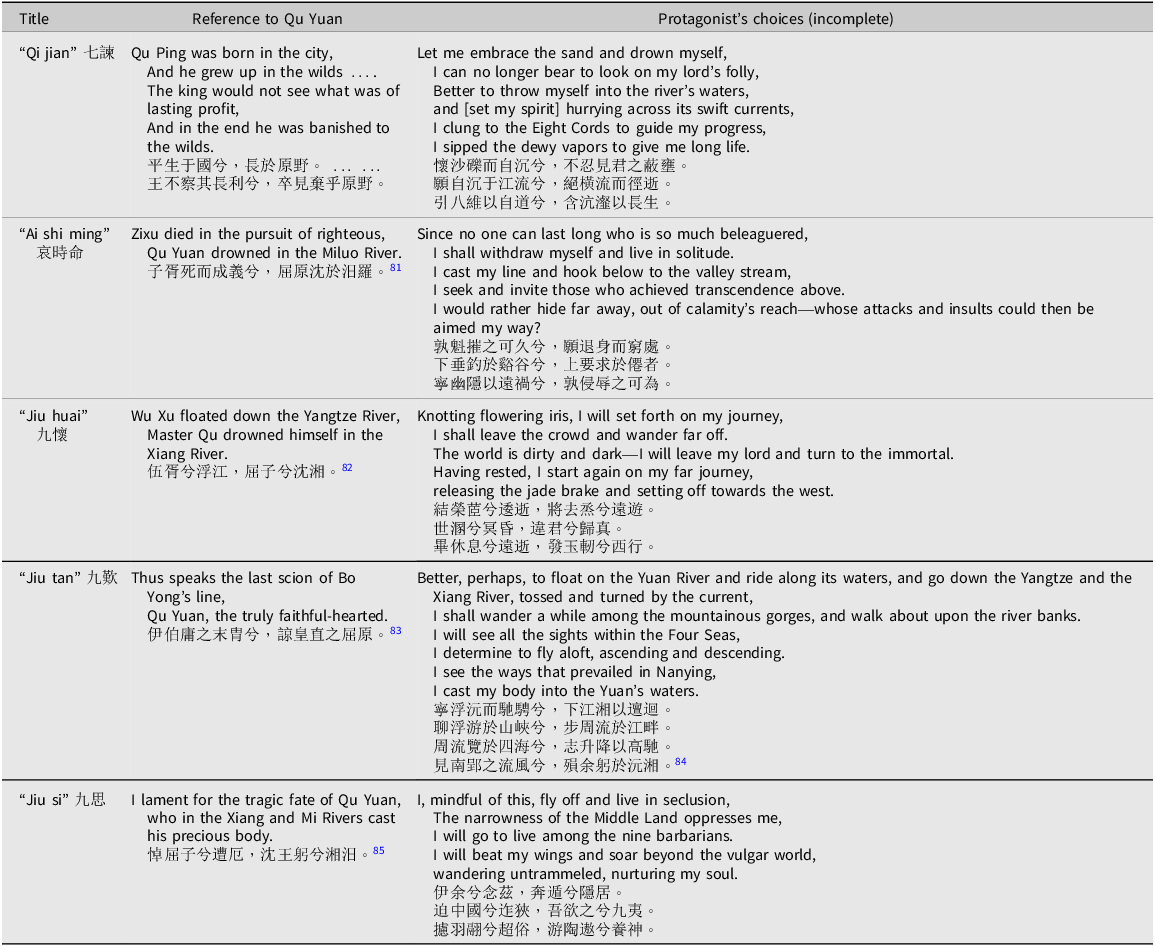
One common feature of these late imitations is their dual narrative approach: they simultaneously address Qu Yuan by name, assuming the role of his audience, and identify with the protagonist’s plight through first-person expressions. This dual approach creates a clear demarcation between two narrative angles: one that acknowledges Qu Yuan from an external viewpoint, situating him historically, and another that delves into his internal world, reflecting his thoughts and feelings from a personal standpoint. The latter perspective predominantly occupies the texts, and these two viewpoints lead to distinct expressions. On one hand, almost all acknowledge Qu’s drowning himself as a definitive historical fact, viewing it as emblematic of his identity when recounting his life. On the other hand, despite this acknowledgment, these texts continue the rich tradition of envisioning alternative choices for Qu Yuan within such circumstances.Footnote 77 For example, even in the “Qi jian,” where the protagonist frequently confirms his impending death, there remains a wish for longevity at the end of some pieces. As is evident from Table 2, the personae of the hermit and the seeker of immortality remain predominant choices for these later writers. Other than “Qi jian” and Liu Xiang’s “Jiu tan,” no writers explicitly express a desire to die when emulating Qu Yuan’s voice.
The narration of Qu’s demise and the protagonists’ choices in some Han fu pieces

Table 2 Long description
A table with four columns and five rows, including a header row. The columns are labeled ‘Title’, ‘Reference to Qu Yuan’, and ‘Protagonist’s choices (incomplete)’. The table compares different titles, references to Qu Yuan, and the choices made by protagonists in various Han fu pieces. Row 1: Title: Qi jian; Reference to Qu Yuan: Qu Ping was born in the city, And he grew up in the wilds. The king would not see what was of lasting profit, And in the end he was banished to the wilds. 平生出生國兮,長於原野。 王不察兮長利, 除臣兮棄原野。; Protagonist’s choices (incomplete): Let me embrace the sand and drown myself, I can no longer bear to look on my lord’s folly, Better to throw myself into the river’s waters, and [set my spirit] hurrying across its swift currents, I clung to the Eight Cords to guide my progress, I sipped the dewy vapors to give me long life. 憫沙塵而自沉兮,不忍見君之愚蠢。 寧流沈江津兮,絕漢流而遠逝。 引八維以自持兮,含沈流以長生。. Row 2: Title: Ai shi ming; Reference to Qu Yuan: Zixu died in the pursuit of righteous, Qu Yuan drowned in the Miluo River. 子胥死於誠兮,屈原沈於沅湘。; Protagonist’s choices (incomplete): Since no one can last long who is so much beleaguered, I shall withdraw myself and live in solitude. I cast my line and hook below to the valley stream, I seek and invite those who achieved transcendence above. I would rather hide far away, out of calamity’s reach—whose attacks and insults could then be aimed my way? 孤獨兮可久兮,遁世身而靜慮。 下垂釣於沅湘兮,上求仙而俛仰。 寧隱遁以避患兮,毁謗辱之可為。. Row 3: Title: Jiu huai; Reference to Qu Yuan: Wu Xu floated down the Yangtze River, Master Qu drowned himself in the Xiang River. 武徐浮于江河兮,屈子沈于湘湘。; Protagonist’s choices (incomplete): Knotting flowering iris, I will set forth on my journey, I shall leave the crowd and wander far off. The world is dirty and dark—I will leave my lord and turn to the immortal. Having rested, I start again on my far journey, releasing the jade brake and setting off towards the west. 結綵繩以遠遊兮,遁世身而靜慮。 世塵濁兮,遁世身而靜慮。 世塵濁兮,遁世身而靜慮。 世塵濁兮,遁世身而靜慮。. Row 4: Title: Jiu tan; Reference to Qu Yuan: Thus speaks the last scion of Bo Yong’s line, Qu Yuan, the truly faithful-hearted. 其伯偃之末孫兮,屈平直之心。; Protagonist’s choices (incomplete): Better, perhaps, to float on the Yuan River and ride along its waters, and go down the Yangtze and the Xiang River, tossed and turned by the current, I shall wander a while among the mountainous gorges, and walk about upon the river banks. I will see all the sights within the Four Seas, I determine to fly aloft, ascending and descending. I see the ways that prevailed in Nanying, I cast my body into the Yuan’s waters. 寧浮游于淵源兮,遁世身而靜慮。 世塵濁兮,遁世身而靜慮。 世塵濁兮,遁世身而靜慮。 世塵濁兮,遁世身而靜慮。. Row 5: Title: Jiu si; Reference to Qu Yuan: I lament for the tragic fate of Qu Yuan, who in the Xiang and Mi Rivers cast his precious body. 憂屈子兮沅湘。; Protagonist’s choices (incomplete): I, mindful of this, fly off and live in seclusion, The narrowness of the Middle Land oppresses me, I will go to live among the nine barbarians. I will beat my wings and soar beyond the vulgar world, wandering untrammeled, nurturing my soul. 我念兮遨遊兮,遁世身而靜慮。 中原狹兮,吾將遊于九夷。 我將翱翔兮,遊於九夷。
Several elements could elucidate this phenomenon. First, the deliberate sidestepping of Qu Yuan’s demise, especially in first-person narratives, may stem from a prevalent Han dynasty attitude towards his suicide. Influential figures from Sima Qian to Yang Xiong and Ban Gu suggested that Qu Yuan could have made other decisions, influencing the era’s literary output. Second, Qu Yuan’s enduring literary allure is rooted in his hesitation and confusion. His long journey is the source of his enduring appeal and a literary motif that later writers could emulate. An unequivocal ending such as suicide, however, leaves little space for diverse voices. Third, while Sima’s biography profoundly shaped the canonical image of Qu Yuan and earned widespread acceptance, its influence was arguably more confined to the realm of historiography than to the literary domain. Within the literary realm, the abundant tradition of developing Qu Yuan in diverse directions has left a lasting impression on the Chu ci readers and imitators. It might not be a mere coincidence that both “Qi jian” and “Jiu tan,” which explicitly express the protagonist’s wish for death, also adhere to a biographical logic in their compositions. These works systematically outline Qu’s birth, origins, name, key characteristics, significant life events, and notably, his emblematic death. Though literary tendencies seem to remain relatively impervious to historical construction at this time, when the form of a text reveals a clear intimacy with historical writings, it is no doubt influenced by their contents.
Sima’s portrayal of Qu Yuan did exert a significant influence on later interpretations of the Chu ci and historical writings, however. As Qu Yuan’s tragic demise in the Miluo River became a defining element of his story, it rivaled even his literary output, including the “Li sao.” This narrative approach is evident in the Hanshu 漢書 (History of Han).
Qu Yuan was a worthy subordinate in the state of Chu. Maligned and exiled, he penned the “Li sao” fu. Its ending goes: “Enough! There is no man in the state, no one understands me.” He then threw himself to the Yangtze River and died.
Qu Yuan jumped into the Xiang River … and the writing of the “Li sao” flourished.
Qu Yuan’s writing surpassed that of Xiangru, but in the end he was not accepted. He composed the “Li sao,” threw himself into the Yangtze River, and died.
屈原,楚賢臣也,被讒放逐,作離騷賦,其終篇曰:「已矣!國亡人,莫我知也。」遂自投江而死。Footnote 78
屈原赴湘, … … 離騷之辭興。Footnote 79
屈原文過相如,至不容,作離騷,自投江而死。Footnote 80
All the quotations above succinctly encapsulate Qu’s life into a singular sentence, retaining only two pivotal elements: the composition of “Li sao” and his suicide. To create a coherent chronology, a relationship between these two events is conceived, positioning “Li sao” as a precursor or even a manifesto of Qu’s suicidal intent. As elucidated in the prior sections, “Li sao” itself does not provide explicit textual evidence to support this interpretation, but this narrative gradually solidified as the prevailing account of Qu Yuan, subsequently influencing perceptions of “Li sao.” For example, Wang Yi’s commentary on the character Peng Xian, portraying him as a worthy person drowning himself, underscores the potency of such preconceptions. In essence, when “Li sao” is closely related to Qu’s desire to die, commentators, whether knowingly or inadvertently, incorporate this perspective into their analyses, resulting in explanatory annotations shaped by this framework. In turn, these annotations orient subsequent readers towards a similar interpretation, reinforcing the conventional image of Qu Yuan. This ongoing cycle of interpretation and reinterpretation has had a profound impact on how both Qu Yuan and “Li sao” are understood. Sima’s understanding of Qu was informed by his reading of the Chu ci, yet the narrative he constructed came to restrict the range of interpretations available for the Chu ci. In summary, the development of Qu Yuan’s persona and the interpretation of the Chu ci are deeply interwoven, each influencing and reinforcing the other in a continuous cycle. This process underscores how historical narratives can shape, and be shaped by, literary interpretation, leading to a deeply entrenched and often self-reinforcing body of commentary.