Introduction
The MCM-41 mesoporous molecular sieve is one of the newest of the M41S family molecular sieve materials which has attracted considerable interest since first synthesized by scientists from the Mobil Research & Development Corporation in the early 1990s (Beck et al. Reference Beck, Vartuli, Roth, Leonowicz, Kresge, Schmitt, Chu, Olson, Sheppard, McCullen, Higgins and Schlenker1992; Kresge et al. Reference Kresge, Leonowicz, Roth, Vartuli and Beck1992). Compared to classic zeolite materials, the MCM-41 molecular sieve has the advantages of greater specific surface area (S BET), greater thermal and hydrothermal stability, and a well-ordered hexagonal array of uniform mesopores. It has generated significant attention among researchers, therefore, and has been used widely in many fields, including fine chemical and petrochemical industries, medicine and health, environmental protection, and many others (Angelos et al. Reference Angelos, Liong, Choi and Zink2008; Ariga et al. Reference Ariga, Vinu, Yamauchi, Ji and Hill2012; Costa et al. Reference Costa, de Jesus, Santos, Mano, Romão and Paranhos2020; Firouzi et al. Reference Firouzi, Kumar, Bull, Besier, Sieger and Huo1995; He et al. Reference He, Ma, Jin, Dong, Wang and Li2009; Perathoner et al. Reference Perathoner, Lanzafame, Passalacqua, Centi, Schlögl and Su2006).
Usually, MCM-41 materials are prepared by the traditional, low-temperature hydrothermal synthesis process with the help of cooperative surfactant templating. Industrial chemicals such as tetraethoxysilane (TEOS), fumed silica, or water glass as silica sources (Luan et al. Reference Luan, Cheng, Zhou and Klinowski1995; Igarashi et al. Reference Igarashi, Koyano, Tanaka, Nakata, Hashimoto and Tatsumi2003; Amama et al. Reference Amama, Lim, Ciuparu, Pfefferle and Haller2005) are used as raw materials to form the meso-structured framework in general. The large cost and potential threat to the environment of these chemicals have limited their large-scale production and wider application in industry. In order to produce mesoporous materials cost effectively, attempts have been made to develop a new synthesis approach for MCM-41 by replacing traditional silicon sources with natural minerals; clay minerals, in particular, have large SiO2 contents and have been considered for the synthesis of ordered mesoporous materials due to their abundance in nature, low cost, environmental friendliness, and the similarity of their structural units to those of mesoporous materials (Yang et al. Reference Yang, Tang, Ouyang, Li and Mann2010). Indeed, clay minerals generally have a layered structure with the layer unit consisting of a corner-shared tetrahedral sheet and an edge-shared octahedral sheet stacked at a ratio of 1:1 or 2:1. The amorphous silica can be obtained by selective acid leaching of cations, e.g. Mg and Al, from the octahedron and the leached clay minerals used as a raw material in manufacturing mesoporous materials. Recently, MCM-41 mesoporous molecular sieves have been prepared successfully using kaolin, sepiolite, talc, montmorillonite, and palygorskite as the silicon source instead of industrial chemicals (Chen et al. Reference Chen, Zhu, Fu, Ma, Zhu, He and Deng2018, Reference Chen, Yang and Xi2019; Guan et al. Reference Guan, Wang, Wang, Sun, Wang and Hu2018; Maletaškić et al. Reference Maletaškić, Stanković, Daneu, Babić, Stoiljković, Yoshida and Matović2018; Steudel et al. Reference Steudel, Kleeberg, Koch, Friedrich and Emmerich2016; Tokarčíková et al. Reference Tokarčíková, Kutláková and Seidlerová2016). To the best of the present authors’ knowledge, no reports have been published where chlorite was used as the silica source for the preparation of mesoporous materials.
Chlorite, (Mg,Al,Fe)6(Si,Al)4O10(OH)8, is a clay mineral with a 2:1:1 layer structure consisting of a [(Si,Al)O4] tetrahedral sheet, a [Mg,Al,Fe(O,OH)6] octahedral sheet, and an interlayer [MgOH6] octahedral sheet in its layer unit, with an interlayer space of ~1.4 nm (Steudel et al. Reference Steudel, Kleeberg, Koch, Friedrich and Emmerich2016; Zhan and Guggenheim Reference Zhan and Guggenheim1995). As a common rock-forming mineral, chlorite is widely distributed. Geologists attach great importance to research on chlorite because of its special significance in recording tectonic changes (Hong et al. Reference Hong, Zhang and Li2010); research where chlorite is used as an industrial mineral resource is scarce, however. Chlorite can be considered an alternative silica source for preparing mesoporous materials due to its low cost and abundance in nature, making possible the upgrade of low-cost substances to valuable products.
Generally, the current method of preparing mesoporous materials using clay minerals as the silicon source is to extract the SiO2 component by physicochemical pretreatment (grinding and acid etching), followed by hydrothermal synthesis in the presence of the surfactant to prepare a range of mesoporous materials. Acid-treated palygorskite was used (Guan et al. Reference Guan, Wang, Wang, Sun, Wang and Hu2018) as a source of Si and Al to prepare Al-MCM-41 with a surface area of 997 m2/g; the synthesis of mesoporous MCM-41 (surface area = 1041 m2/g) by grinding and acid leaching of kaolin to obtain a silica source was reported by Du and Yang (Reference Du and Yang2012). Most clay minerals studied previously were 1:1 type (halloysite, kaolin, serpentine) or layered chain structure minerals (palygorskite, sepiolite); few studies concerning the use of 2:1 type clay minerals for the preparation of mesoporous materials have been reported. Natural chlorite has a variable composition because of the partial replacement of Mg by Al, Fe, and other elements. In addition, chlorite has a unique layer structure of type 2:1:1; attempts to obtain suitable Si sources from natural chlorite and to synthesize MCM-41 mesoporous silica materials in the way of other clay minerals reported in previous literature failed.
The objectives of the present study were: (1) to demonstrate an easy, controllable method to synthesize hexagonally ordered mesoporous silica (MCM-41) from natural chlorite, without the addition of a silica reagent, using acid washing and calcination as pretreatments, to obtain a suitable Si source from the chlorite, followed by addition of CTAB; and (2) to investigate the adsorption abilities of the MCM-41 toward methylene blue (MB), a model cationic dye pollutant.
EXPERIMENTAL
Materials
Chlorite from Benxi, China, was used as the raw material. Its main chemical components (wt.%) (Table 1) are: SiO2 44.98, MgO 33.25, Al2O3 11.50, and Fe2O3 0.75, with a loss on ignition of 9.4%. The S BET (specific surface area) and V p (total pore volume) of chlorite (Table 2) are 3.8 m2/g and 0.02 cm3/g, respectively. The reagents used in this experiment were hexadecyltrimethylammonium bromide (CTAB), NaOH, HCl (Sinopharm Chemical Reagent Co., Ltd, Nanjing, China), all of analytical grade. Deionized water was used throughout this study.
Chemical composition of samples (wt.%)

*LOI: loss on ignition
Pore properties and cell parameters of the natural chlorite and of the synthesized sample

a S BET calculated using the Brunauer–Emmett–Teller (BET) equation over a range of relative pressure from 0.05 to 0.3
bSingle-point pore volume at P/P 0 = 0.97
c D BJH = pore size calculated by means of the Barrett-Joyner-Halenda (BJH) method using the desorption branch
d d 100 = distance between the (100) planes
eLattice cell parameter
 for MCM-41
fPore-wall thickness (T), for MCM-41, t = a 0 – D BJH
Experiment
Chlorite powder was heated from room temperature to 700°C using a heating rate of 10°C/min and calcined at 700°C for 2 h. After calcination, 5 g of chlorite, which had been pretreated thermally, was stirred magnetically with 100 mL of 3 N HCl in a sealed glass vessel at 90°C for 2 h, and cooled to room temperature. The suspension was filtered and washed thoroughly with deionized water to remove Cl–, and then dried at 80°C for 12 h in air to form the acid-leached sample (white powder).
The acid-leached sample was then used as the source of Si to synthesize the mesoporous material. 1 g of the acid-leached sample and 1 g of NaOH solid were dispersed with stirring in 25 mL of deionized water at 80°C for 2 h in a water bath to form solution A. 1.6 g of CTAB was dissolved in 25 mL of distilled water with heating and stirring until the CTAB was dissolved completely as solution B. Then, solution A was added dropwise to the continuously stirred aqueous CTAB solution at 80°C for 3 h. The pH of the mixture was adjusted to 10 by adding 1 mol·L−1 H2SO4 solution and then transferred to a Teflon-lined steel autoclave and heated bomb statically at 120°C for 24 h. After crystallization, the solid product was filtered, washed with a large amount of warm deionized water, dried at 105°C, and finally calcined at 550°C for 5 h in air with a heating rate of 2°C·min−1 to obtain the mesoporous material.
The hydrothermal stability of the MCM-41 sample was investigated as follows: a sample of MCM-41 was placed in a round-bottomed flask containing 100 mL of deionized water and was treated hydrothermally at 100°C for 6, 12, or 24 h. The water:sample ratio was fixed at 1 L g–1 and the hydrothermal treatment was carried out under reflux conditions.
Characterization
The chemical compositions of materials were determined by X-ray fluorescence (XRF) using a ThermoFisher ARL PERFORM'X spectrometer (Waltham, Massachusetts, USA). X-ray powder diffraction (XRD) measurements were analyzed using a Bruker-AXS D8 Advance diffractometer (Karlsruhe, Germany) with CuKα radiation (λ = 0.1542 nm) at 40 kV over the scanning range 0.6–9°2θ for small-angle X-ray diffraction patterns (SAXRD) and 5–80°2θ for wide angle X-ray diffraction (WAXRD) with a step size of 0.02°2θ. The surface and morphology of the samples were examined using an FEI Quant 250FEG/SU8010 scanning electron microscope (SEM) (Hillsboro, Oregon, USA) and an FEI Tecnai 20 transmission electron microscope (TEM) (Hillsboro, Oregon, USA). The 29Si MAS NMR spectra were recorded using a Bruker Advance III 400 M SSNMR spectrometer (Bruker Corporation, Karlsruhe, Germany) at 7.0 T to characterize the local structure around Si atoms in the samples.
Nitrogen adsorption–desorption isotherms at 77 K were measured by a model V-Sorb 2800P specific surface area and pore-size instrument (Gold APP Instruments Corporation China, Beijing, China). The measurements were performed after degassing under vacuum at 150°C for 5 h. The specific surface area (S BET) was calculated by the Brunauer-Emmet-Teller (BET) method. The total pore volume (V t) was obtained from the maximum amount of N2 adsorption at a relative pressure (P/P 0) = 0.97. The pore-size distributions were calculated by the Barrett-Joyner-Halenda (BJH) method (Barrett et al. Reference Barrett, Joyner and Halenda1951).
Adsorption Studies of MB
The adsorption capacity of MB on the as-synthesized mesoporous MCM-41 was investigated. Adsorption isotherms were obtained in batch equilibrium experiments with 50 mg of the mesoporous MCM-41 in 50 mL of MB solutions of various initial concentrations (50–600 mg/L). All of the solutions were kept at 25 ± 1°C for 2 h in a temperature-controlled water-bath shaker with a shaking speed of 130 rpm and a constant initial solution pH of 7. After the adsorption processes, the solution was centrifuged at 1006.2 × g for 20 min, and the final MB concentration in the supernatant was determined immediately using a Shimadzu UV-2550 UV–Vis spectrophotometer (Shimadzu, Tokyo, Japan) at 664 nm. The adsorption experiments were performed in triplicate to ensure reproducibility. The equilibrium adsorption capacity of MB, Q e (mg/g), was evaluated using the following equation:

where C 0 and C e are the liquid-phase concentration of MB initially and at equilibrium, V is the volume of solution (L), and W is the mass of adsorbent (g), respectively.
RESULTS AND DISCUSSION
Structural Aspects: WAXRD and SAXRD Analysis
The effect of calcination and acid leaching on the crystal structure of chlorite was investigated by WAXRD studies. The WAXRD patterns (Fig. 1) showed that the chlorite used was composed of well crystallized chlorite crystals (PDF 79–0761) with traces of talc (PDF 73–0141) and quartz (PDF 46–1045) impurities. Chlorite is a clay mineral with a 2:1:1 layer structure consisting of a [SiO4] tetrahedral sheet, a [Mg, Al, FeO6] octahedral sheet in the layer unit and a brucite or gibbsite sheet between the layers, with resistance to acid in general. The DTA curve of chlorite shows two endothermic peaks at 560 and 775°C, according to Okada et al. (Reference Okada, Arimitsu, Kameshima, Nakajima and Mac-Kenzie2005), which are attributed to dehydroxylation of the inter-layer octahedral OH and the octahedral OH in the 2:1:1 layer structure, respectively. Therefore, 700°C was considered to be the optimal calcination temperature for preparing the HCl-leached sample in order for the MgO and Al2O3 components to be leached selectively.
WAXRD patterns of chlorite, calcined chlorite, acid-treated chlorite, and synthesized MCM-41

The WAXRD patterns of calcined chlorite (Fig. 1) showed that most of the diffraction reflections of chlorite disappeared after calcination, and can be attributed to the well known dehydroxylation process (Shu et al. Reference Shu, Li, Zhou, Chen, Yu and Wang2014), demonstrating a gradual structural collapse. The reflection peaks of talc and quartz persisted after calcination at 700°C due to their greater thermal stability than chlorite. Calcination led to the escape of hydroxyl groups from the crystal structure of chlorite, after which the crystal structure collapsed. Many other layered silicates, including kaolinite, pyrophyllite, talc, etc., have been reported for this phenomenon (Barrett et al. Reference Barrett, Joyner and Halenda1951; Mackenzie et al. Reference Mackenzie, Brown, Meinhold and Bowden1985; Shu et al. Reference Shu, Li, Zhou, Chen, Yu and Wang2014). Thus, HCl solution may be used to remove selectively the activated MgO, Al2O3, and Fe2O3 components of the calcined chlorite, and the Si–O residue component constituted the silica skeleton in situ (Steudel et al. Reference Steudel, Kleeberg, Koch, Friedrich and Emmerich2016). The characteristic reflections of chlorite disappeared after acid treatment (Fig. 1). No crystalline phases, apart from those of quartz and talc, were detected in the acid-treated sample or synthesized sample, indicating that leached chlorite had an amorphous structure. The thermal treatment destroyed all the crystalline chlorite phase, therefore, and no crystalline phase was found in the subsequent acid treatments.
The results confirmed that calcination and acid-leaching pretreatments played a key role in the processing of natural clay minerals. In addition, chemical analysis by XRF indicated that the SiO2 content of leached chlorite was > 90% (Table 1), and can be used as a source of Si to prepare MCM-41 samples. The residual MgO content of the leached sample was thus due to the presence of a talc impurity. The leached chlorite can be used, therefore, as an inorganic precursor to assemble, along with the template CTAB, and form MCM-41. A small broad reflection was observed at ~ 20°2θ for the synthesized sample (Fig. 1), confirming that the framework of the MCM-41 mesoporous material was of an amorphous structure.
The SAXRD pattern of the as-synthesized MCM-41 sample (Fig. 2) presented a sharp reflection (100) at 2.12°2θ and three additional reflections: (110), (200), and (210) with weaker intensities, which were consistent with a hexagonally ordered MCM-41 mesoporous structure and could be further confirmed by the TEM image (Fig. 3). The hexagonal (P6mm space group) unit-cell parameter (a 0) (Table 2) was calculated to be 5.13 nm according to the equation
 . The wall thickness (T) of mesoporous MCM-41 was ~2.32 nm according to the equation T = a 0 – D BJH (Chen and Wang Reference Chen and Wang2002), where D BJH was estimated as the maximum value of the BJH pore-size distribution curve obtained from the N2 adsorption branch of the nitrogen isotherms by the BJH method. Compared with the traditional MCM-41 (T ≈ 1 nm), prepared using tetraethoxysilane (TEOS), silica gel, or water glass as sources of Si (Mokhonoana and Coville Reference Mokhonoana and Coville2010; Vyshegorodtseva et al. Reference Vyshegorodtseva, Larichev and Mamontov2019), the MCM-41 synthesized in the current study had a larger T value, indicating that the latter has greater hydrothermal stability which is a significant advantage in applications where it is used as a catalyst support and adsorbent.
SAXRD pattern of as-synthesized MCM-41

SAXRD patterns of the hydrothermally treated MCM-41 sample after various treatment times

Hydrothermal stability was checked by subjecting the samples to boiling-water aging for 6, 12, and 24 h. The XRD patterns (Fig. 3) showed well resolved (100), (110), and (200) diffraction peaks for MCM-41, indicating that the mesoporous structure of MCM-41 was maintained almost completely after aging for 6 h. With increase in boiling time to 12 h, the intensity of the diffraction peaks decreased and the diffraction peaks became slightly broader, suggesting that the structure of MCM-41 was destroyed to some extent.
Porosity Measurements
The type IV shape of N2 adsorption–desorption isotherms (Fig. 4) for MCM-41 exhibited a type-H1 hysteresis loop based on IUPAC recommendations (Sing et al. Reference Sing, Everett, Haul, Moscou, Pierotti, Rouquerol and Siemieniewska1985), characteristic of ordered mesoporous material. The isotherm exhibited three clearly defined stages, with inflection points at P/P 0 = 0.2 and P/P 0 = 0.40. In detail, the significant adsorption at lower relative pressures (P/P 0 < 0.2) was due to monolayer coverage of the mesoporous walls rather than to the presence of microporous phases (Yang et al. Reference Yang, Tang, Ouyang, Li and Mann2010). With a slow increase in P/P 0, however, the adsorption capacity increased sharply from 0.2 to 0.4 in the second stage, as a result of the capillary condensation of N2 in the mesopores. The sharp increase in adsorption capacity indicated the existence of a mesoporous structure and uniform pore size. At the third stage, a well-defined step occurred at relatively high pressures of 0.6–0.95. This was due to adsorption on the outer surfaces of particles and on the inter-particle voids of the product. The position of the capillary condensation with respect to the P/P 0 axis was related directly to the diameter of the mesopores, and the steepness of this step indicated mesopore structures in fairly regular array and having a narrow pore-size distribution.
N2 adsorption–desorption isotherms (black: adsorption; red: desorption) and BJH pore-size distribution curves of the MCM-41 sample (inset)

According to the BET method (Table 2), the specific surface area of raw chlorite and synthesized MCM-41 were 3.8 and 630 m2/g, respectively. The results indicated that the synthesized MCM-41 had a much larger surface area than natural chlorite. The pore-size distribution (PSD) was determined from the N2 adsorption branch of the N2 isotherms by the BJH method (Fig. 4). The average pore size of the synthesized sample (Table 2) was ~2.8 nm and the likely pore diameter (Fig. 4) was ~2.98 nm. Comparison was made with mesoporous material reported in various literature reviews. Synthesis of the mesoporous Al-MCM-41 (surface area = 524.6 m2/g), using halloysite as the source of Si and Al, was done by Zhou et al. (Reference Zhou, Sun, Gao, Alshameri, Zhu, Wang, Qiu, Ma and Yan2014). Other results generated by Xie et al. (Reference Xie, Zhang, Ouyang and Yang2014) and Vyshegorodtseva et al. (Reference Vyshegorodtseva, Larichev and Mamontov2019) indicated that the porosity of the mesoporous materials obtained in the present study was similar to or even greater than that of mesoporous materials in those previous studies.
Morphological Evolution
TEM and SEM analyses were undertaken to reveal changes in the shape and size of particles associated with the transformation of natural chlorite to MCM-41 upon acid treatment and hydrothermal synthesis.
An SEM image (Fig. 5a, b) showed little change in morphology under acid treatment, compared to the platy or flaky shape of raw chlorite, suggesting that the structure of the leached chlorite supposedly maintained a [SiO4] tetrahedral layer-like structure even after selective acid leaching. The morphology changed noticeably after hydrothermal synthesis, however. An SEM image of the synthesized MCM-41 showed agglomerated particles with a spherical or elliptical shape having a size distribution of 0.1–0.5 μm.
SEM images of a chlorite and b acid-leached chlorite

In addition, the pore structure of synthesized samples can be observed with TEM (Fig. 6), illustrating both the top (Fig. 6b) and side (Fig. 6c, d) views showing a three-dimensional image of the crystallized MCM-41 structure. Meanwhile, a high-magnification TEM image (Fig. 6d) clearly showed a well ordered arrangement of pores. Perfect hexagonal geometry in the structural order was observed clearly along the direction of the pore arrangement, indicating an ordered long-range structure of two-dimensional P6mm hexagonal symmetry in the synthesized sample. The TEM images of MCM-41 were consistent with the result obtained previously by XRD analysis (Fig. 2). In addition, the distance between two ordered channel arrays of parallel lines was estimated, from the TEM image, to be 3.5 nm (Fig. 6d), which was in good agreement with the N2 adsorption–desorption analysis data.
SEM and TEM images of the synthesized sample: a SEM of MCM-41; b–d TEM of MCM-41

29Si MAS NMR Spectra
The local environments of the Si atoms in the samples obtained were examined by 29Si MAS NMR to interpret the progressive transformation of the raw chlorite structure into MCM-41 during calcination and crystallization. The 29Si MAS NMR spectra of the samples indicated the progressive transformation of the raw chlorite to calcined chlorite, acid-leached chlorite, and then to ordered MCM-41 (Fig. 7).
29Si MAS NMR spectra of samples

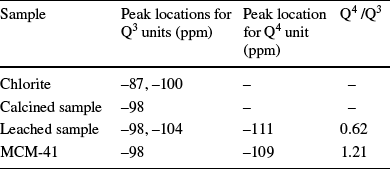
The 29Si MAS NMR spectra (Fig. 7) for chlorite showed two resonance signals located at –87 and –100 ppm, corresponding to Q3 (0Al) ((SiO)3Si(OH)) and Q3 (1Al), respectively (Yang et al. Reference Yang, Tang, Ouyang, Li and Mann2010). This indicated that AlO4 tetrahedra were substituted for SiO4 tetrahedra in the chlorite, as recorded in the literature (Duer Reference Duer2001). After calcination, the resonance signals at –87 ppm attributed to Q3 (1Al) disappeared (Fig. 7), and this was recognized as the collapse of the chlorite crystalline structure. After leaching with acid solution, two new resonance signals, at –104 ppm and –111 ppm, appeared in the 29Si MAS NMR spectrum of the leached sample, which can be assigned to silicon sites Q3 (Si (SiO)3 (OH)) and Q4 (Si (SiO)4), respectively (He et al. Reference He, Guo, Xie, Lin and Li2002). The emergence of a resonance signal at –104 ppm can be attributed to the partial transformation from Si (SiO)3O (Mg, Al, Fe) to Si (SiO)3 (OH), i.e. H atoms replaced Mg atoms during the acid-leaching process (Temuujin et al. Reference Temuujin, Okada, MacKenzie and Jadambaa2001). In addition, the emergence of the sharp peak at –111 ppm indicated the formation of bonded four-coordinated silicon (amorphous SiO2) from the residual Si–O framework after the removal of Mg2+, Al3+, and Fe3+ under acid treatment. During the acid-leaching process of Mg, Si–OH condensation occurred between the silica layers of chlorite, and the Q3 configurations were transformed to Q4 configurations. The presence of a –87 resonance signal in the leached sample indicated the presence of Q3 (Si(SiO)3(OH)) structure units in the leached sample, which were ascribed to chlorite continuing to condense and the Si–O bonded layered structure being partially maintained after removal of Mg2+ and Al3+, in accordance with the SEM results (Fig. 5b).
The 29Si MAS NMR spectrum (Fig. 7) of the leached chlorite was consistent with that of phlogopite (Okada et al. Reference Okada, Nakazawa, Kameshima, Yasumori, Temuujin, MacKenzie and Smith2002) and kaolinite (Okada et al. Reference Okada, Shimai, Takei, Hayashi, Yasumori and MacKenzie1998) reported in the literature. The 29Si MAS NMR spectrum of the synthesized MCM-41 showed two resonance signals at –98 and –109 ppm. The resonance signal at –109 ppm was ascribed to the Q4 framework structural unit, corresponding to a three-dimensional framework structure (Beck et al. Reference Beck, Vartuli, Roth, Leonowicz, Kresge, Schmitt, Chu, Olson, Sheppard, McCullen, Higgins and Schlenker1992; Kresge et al. Reference Kresge, Leonowicz, Roth, Vartuli and Beck1992), while that at –98 ppm was ascribed to the Q3 structural unit corresponding to a layered structural unit or to a three-dimensional framework structure with a non-bridging oxygen site, i.e. one silanol group (Okada et al. Reference Okada, Nakazawa, Kameshima, Yasumori, Temuujin, MacKenzie and Smith2002).
All spectra were simulated and separated using the Gaussian–Lorentzian model (Fig. 8) and the fractions of the peak area of various Si configurations were based on the simulated lines (Table 3). The
 ratio of the framework from the peak area of the 29Si MAS NMR spectra was calculated according to the following equation:
 , where
 is the fraction of the peak area of the Q4 silica configuration and
 is the fraction of peak area of the Q3 silica configuration (Jin et al. Reference Jin, Qiu, Xiao, Chang, Wan and Yang2007). After acid leaching, the silanol structure Si(SiO)3(OH) emerged and condensed to form a Q4 unit. The ratio of Q4 to Q3 configurations increased from 0.91 to 1.21 after hydrothermal synthesis of MCM-41 from the leached chlorite, which demonstrated a greater degree of polymerization of the Si–O structure in ordered mesoporous MCM-41. This can be explained as the reconstruction of silica species during crystallization, forming a loose inorganic–organic complex. Hydroxyl groups condensed on each other, the number of silanol groups decreased, and the Q3 configurations were transformed to Q4 configurations (Liepold et al. Reference Liepold, Roos, Reschetilowski, Esculcas, Rocha, Philippou and Anderson1996).
Peak fitting of 29Si MAS NMR spectra for: a chlorite; b calcined sample; c leached sample; and d MCM-41

29Si MAS NMR results of the samples obtained

Proposed Mechanism from Natural Chlorite to MCM-41
On the basis of WAXRD, 29Si MAS NMR, N2 adsorption–desorption analysis, and other models (Du and Yang Reference Du and Yang2009, Reference Du and Yang2012; Firouzi et al. Reference Firouzi, Kumar, Bull, Besier, Sieger and Huo1995; Monnier et al. Reference Monnier, Schuth, Huo, Kumar, Margolese, Maxwell, Stucky, Krishnamurty, Petrof, Firouzi, Janicke and Chmelka1993; Yang et al. Reference Yang, Tang, Ouyang, Li and Mann2010; Zhou et al. Reference Zhou, Sun, Gao, Alshameri, Zhu, Wang, Qiu, Ma and Yan2014), a possible process for the formation of ordered mesoporous material MCM-41 from natural chlorite is proposed and summarized schematically (Fig. 9).
Schematic model for the possible formation of MCM-41 from natural chlorite

Chlorite has a typical 2:1:1 layer structure (Fig. 9a) consisting of an octahedral sheet sandwiched between two tetrahedral sheets with a brucite sheet in the 2:1 layer, having an interlayer spacing of 1.4 nm. Firstly, chlorite was calcined at 700°C, which led to the escape of OH from the octahedra, and the structural collapse of the ordered, layered structure and structural transformation, finally producing a mixture of amorphous silica and residual talc and quartz impurities. Chlorite was transformed to an activated state. As a result, the ‘binding force’ of the mineral lattice on the Mg2+, Al3+, and Fe2+ cations of the octahedra were weakened, and the ‘activity’ of dissolution of cations in the octahedra was enhanced. The chlorite was then transformed to an easily leached state, providing the basis for the next step. After acid treatment, the acid solution leached selectively the octahedral cations (Mg2+, Al3+, Fe3+) which then dissolved in the acid solution, with the remainder forming amorphous silica (Fig. 9b). The leached sample contained three particular structures (Fig. 9b): region A, region B, and region C, corresponding to resonance signals at –98 ppm, –104 ppm, and –111 ppm, respectively. Region A corresponded to the chemical shift at –98 ppm shown in the 29Si MAS NMR spectra, the layered structure of residual chlorite; region B was attributed to the chemical shift at –104 ppm for the Q3 (Si (SiO)3 (OH)) structure, indicating that Si atom-bearing OH groups were formed upon acid treatment; and region C corresponded to the chemical shift at –111 ppm of the Q4 (Si (SiO)4) structure with a three-dimensional cross-linked framework which originated from the condensation of the hydroxyl groups and formation of siloxane bonds (Du and Yang Reference Du and Yang2009).
As a consequence, the amorphous silica obtained showed high activity toward alkali solution due to the disordered structure of the Si–O–Si framework. The leached chlorite was used as a source of silicon to react hydrothermally with the CTAB surfactant in alkaline conditions (Fig. 9c). The inner surface of the micelle was a hydrophobic group (CTAB), and the outer surface was composed of the hydrophilic end (Br–) of the surfactant. In addition, the Q3 Si–OH on the surface of the silicon chain became ionized to produce Q3 Si–O–. According to the ‘charge density matching’ rule (Monnier et al. Reference Monnier, Schuth, Huo, Kumar, Margolese, Maxwell, Stucky, Krishnamurty, Petrof, Firouzi, Janicke and Chmelka1993), the Q3 Si–O– could be matched with the hydrophobic group CTAB through a cooperative function to generate the ≡SiO–CTAB composite intermediate, settling on the surface of the micellar rods and the interspaces (Fig. 9d). However, only in a suitable pH and temperature environment could the reaction provide sufficient Si–O– to match on the surface of the micelle, and a rapid polymerization reaction with other anionic polymers of silicates around Si–O–. Then, the organized structure underwent the assembly process to form the final ordered hexagonal liquid crystal phase structure. After hydrothermal synthesis, the polymer solidified to form the pore wall and then condensed to form an ordered mesoporous material (Fig. 9e). Finally, a hexagonally ordered mesoporous sample of MCM-41 was obtained after removal of the surfactant template by calcination (Fig. 9f). In the process of forming MCM-41, the charge matching determined the arrangement of the surfactants, and the degree of polycondensation of the silicate species determined the final structure of the product.
Adsorption Isotherm Studies for MB on MCM-41
The adsorbate distribution between the liquid phase and solid phase when the MB uptake had reached equilibrium was assessed by three adsorption-isotherm models: Langmuir (Reference Langmuir1916), Freundlich (Reference Freundlich1906), and Redlich-Peterson (Redlich and Peterson Reference Redlich and Peterson1959).
The Langmuir model assumes that the maximum adsorption corresponds to monolayer coverage of the adsorbent surface, that the adsorption sites are homogeneous, and that no lateral interaction occurs between the adsorbed molecules. A mathematical expression of the Langmuir isotherm is given by:

where C e (mg/L) is the equilibrium concentration of MB in the liquid phase and Q e (mg/g) is the amount of MB adsorbed at equilibrium, b is the Langmuir equilibrium constant (L/mg), and Q m (mg/g) is the maximum adsorption capacity.
The Freundlich isotherm is based on the assumption that adsorption occurs on heterogeneous surfaces with different energies of adsorption and rare, non-identical sites. It is expressed by the following equation:

where KF is the Freundlich constant and n is the heterogeneity factor. The KF value is related to the adsorption capacity; while the 1/n value is related to the adsorption intensity.
The Redlich-Peterson isotherm model contains three parameters and involves features of both the Langmuir and Freundlich isotherms. It is based on the theory, therefore, that the adsorption behavior of the adsorbate on the surface of the adsorbent is both monolayer homogeneous adsorption and multilayer heterogeneous adsorption.

The Redlich-Peterson model has three constants: a, b, g, and its equation becomes equal to the Langmuir model when g = 1. Thus, g provides information on the tendency toward the Langmuir or Freundlich models.
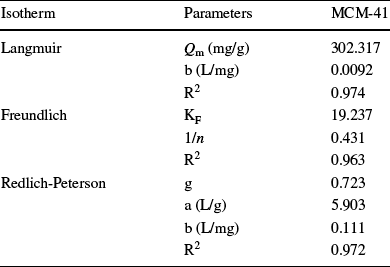
The non-linear fitting profiles and the detailed parameters (Q m, b, KF, and 1/n) of these three models for the MB adsorption isotherms on MCM-41 were studied (Fig. 10, Table 4). According to the results obtained, the correlation coefficient of the Langmuir (R2 = 0.974) was greater than that for Freundlich (R2 = 0.963), indicating that the Langmuir approach accommodated the equilibrium data well and the adsorption process occurred on an homogeneous surface of MCM-41 by monolayer adsorption. According to the Langmuir isotherm modeling, the maximum monolayer adsorption capacities were 302.317 mg/g (Langmuir Q m). Compared with previous reports (Eftekhari et al. Reference Eftekhari, Habibi-Yangjeh and Sohrabnezhad2010; Zhou et al. Reference Zhou, Gao, Luo, Zhou, Wang, Yan and Duan2015), the adsorbent MCM-41 synthesized here had a greater adsorption capacity for MB. Moreover, the value (0 < 1/n = 0.431 < 1) of the Freundlich model parameters proved that the adsorption of MB on MCM-41 was favorable (Ho et al. Reference Ho, McKay and Yeung2003). The value of the Redlich-Peterson isotherm parameter, namely, g = 0.723, revealed that the model tended more toward Langmuir rather than Freundlich. This further indicates that the adsorption process was mainly monolayer.
Langmuir, Freundlich, and Redlich-Peterson isotherms for MB adsorption on MCM-41

Characteristic parameters from the adsorption isotherms

Adsorption Kinetics Studies for MB on MCM-41
The kinetic behavior of the adsorption process was studied at a temperature of 25 ± 0.1°C and pH 7 using a fixed initial MB concentration (300 mg/L) (Fig. 10). The results revealed a rapid uptake of MB within the first 10 min and then equilibrium was reached gradually in 60 min, beyond which no further adsorption took place. To study the determination mechanism of the adsorption process, the pseudo-first order and pseudo-second order models were applied to the experimental data. The best-fit model was selected based on the linear regression coefficient value, denoted by R2.
The pseudo-first order rate expression is given as:

where q e and q t are the amounts of dye adsorbed on the adsorbent at equilibrium and at time t, respectively (mg/g), and k1 is the rate constant of pseudo-first order adsorption (min−1).
The pseudo-second order kinetic model is expressed by the following equation

where k2 is the pseudo-second order rate constant (mg g–1 min–1). This model is based on the assumption that the rate-limiting step may be chemical sorption occurring through sharing or exchange of electrons between the adsorbent and the adsorbate (Seliem et al. Reference Seliem, Komarneni and Abu Khadra2016).
The intra-particle diffusion model is expressed as:

where k3 is the diffusion rate constant (mg g−1 min−0.5) and c is the intercept for any experiment. According to this model, if the plot of uptake, q t, vs the square root of time, t 0.5, is linear and passes through the origin, then intra-particle diffusion is the only rate-controlling step.
The kinetic curves (Fig. 11) and parameters of kinetic models (Table 5) showed that the correlation coefficient, R2, of the pseudo-second order adsorption model for the adsorbent was relatively high (0.999), and the adsorption capacities calculated by the model were also close to those determined by experiment. The pseudo-first order adsorption model is assumed to be more suitable for describing the adsorption kinetics of MB onto MCM-41, so the adsorption of MB on MCM-41 was considered to be chemisorption, related mainly to electron sharing and electron transfer between the adsorbent and adsorbate (Guan et al. Reference Guan, Wang, Wang, Sun, Wang and Hu2018).
Adsorption-kinetics plots of pseudo-first order and pseudo-second order models

Kinetic parameters of MB adsorption on MCM-41

The intra-particle diffusion model was also employed to investigate the adsorption process (Fig. 12), and the results showed a good linear relationship, but the plot did not pass through the origin, indicating that intra-particle diffusion had occurred in the adsorption of methylene blue onto MCM-41, This process, however, was not the only rate-limiting step in the whole adsorption process. Before adsorption equilibrium, the kinetics of adsorption at different times was controlled by the existence of two or more different diffusion pathways, including a rapid diffusion of the initial adsorption followed by a relatively slow diffusion process. In the first stage, MB molecules were adsorbed rapidly on the outer surface of MCM-41 particles and occupied the external active site through electrostatic interaction. The electrostatic interaction existed between the MB cations and Si–O– due to the dissociation of the Si–OH on the MCM-41 surface. The second stage involved a gentle adsorption process, where intra-particle diffusion was dominant, while saturation of active sites of the outer surface and entrance of MB molecules into the pores of the adsorbent resulted in slow diffusion (Shu et al. Reference Shu, Shao, Wei, Wang, Sun, Zhang and Li2015).
Intra-particle diffusion model of MB adsorption by MCM-41

Conclusions
Mesoporous MCM-41 with a surface area of 630 m2/g, a pore volume of 0.46 mL/g, and a pore-size distribution centered at 2.8 nm was synthesized successfully from a leached sample produced by calcination and subsequent acid leaching of natural chlorite. Calcination resulted in structural amorphization and acid solubility transformation of the chlorite, enhancing its activity. The Mg, Al, and Fe components of calcined chlorite were leached selectively by acid, and the residue formed porous silica as a result. The leached chlorite obtained was employed as a source of Si to synthesize MCM-41 under hydrothermal treatment through charge-density matching with a structure-directing agent. The SAXRD and TEM results indicated that the synthesized sample had a highly ordered two-dimensional hexagonal mesoporous structure. The synthesized MCM-41 sample showed a favorable capacity for MB adsorption in basic environments and had a monolayer adsorption capacity as high as 302 mg/g when calculated by the Langmuir model. Adsorption of MB on MCM-41 is described well by pseudo-second order kinetics and the intra-diffusion model, and the equilibrium data are fitted well by the Langmuir model. The adsorbent has potential application prospects in the field of waste-water treatment.
ACKNOWLEDGMENTS
The research work was supported by the National Natural Science Foundation of China (No. 51772153). Experimental support from the Herbert Gleiter Institute of Nanoscience and the Materials Characterization Facility of Nanjing University of Science and Technology is acknowledged.
Funding
Funding sources are as stated in the Acknowledgments.
Declarations
Conflict of Interest
The authors declare that they have no conflict of interest.