Introduction
Family ownership matters are core determinants of the success of family businesses, but the meaning of such ownership is still poorly understood. Research has shown concentrated ownership to be of importance for the strategic development and long-term survival of organizations (Zahra, Reference Zahra1996, Reference Zahra2003; Anderson & Reeb, Reference Anderson and Reeb2003; Miller & Le Breton-Miller, Reference Miller and Le Breton-Miller2005), but our knowledge about controlling owners, especially controlling owner families (Miller, Le Breton-Miller, & Lester, Reference Miller, Le Breton-Miller and Lester2011) and how they reason about and conduct their ownership is surprisingly limited. Articles focusing on family ownership primarily view ownership as the defining or explaining variable, but few deal with the actual characteristic(s) of family ownership. Furthermore, compared with all the research on succession in the management of family firms, the succession of ownership has received much less attention (Thomas, Reference Thomas2002). There is a need to increase our knowledge and develop a more balanced and deeper view of family ownership and what it actually means to family business owners. Such ownership, we argue, is a factor that per se influences management practices and thus differs from the general shareholder value logic. However, knowledge concerning this type of ownership is scarce and family business managerial practices are often treated as an anonymous part of the general management literature. The purpose of this article is to contribute to knowledge base on family ownership by exploring the meaning of ownership in family-controlled businesses and to conceptualize this type of ownership through the introduction and characterization of the construct of ‘family ownership logic’. The concept of logic here refers to cultural values, assumptions, beliefs and norms that shape a line of reasoning and acting in a field (e.g., Friedland & Alford, Reference Friedland and Alford1991; Morgan, Reference Morgan1997; Lounsbury, Reference Lounsbury2007, Reference Lounsbury2008; Thornton & Ocasio, Reference Thornton and Ocasio2008). We use this concept in relation to family ownership as recent studies have shown signs of an ongoing institutionalization in the family business as a special form of organization (Lester & Cannella, Reference Lester and Cannella2006; Melin & Nordqvist, Reference Melin and Nordqvist2007). Together with a supporting infrastructure including actors such as researchers, educators, consultants, journals, associations and lobbying groups, family businesses could be understood as an ‘organizational field’ sharing a general discourse in which family governance is constructed as subject to similar forces.
In line with the above, this study demonstrates that family ownership is a complex phenomenon that constitutes dimensions beyond the juridical and financial aspects of ownership. Together with previous research, our empirical observations show that the ownership and governance logics in family-controlled businesses are strongly influenced by their specific character of having identifiable and influential owners who emotionally bond with the organization and very often have hands-on experience of working in the business. At the same time, family businesses are also influenced by the general ideas and norms of corporate governance. Our argument is that we need to know not only about the values, assumptions, beliefs and norms underpinning corporate governance and ownership in general, but also about the specific logic of family ownership and governance. By taking the competing logics of ownership into consideration, family business researchers can contribute to the growing literature examining sociocultural and behavioural factors in corporate governance relations (Fligstein, Reference Fligstein1996; Fiss & Zajac, Reference Fiss and Zajac2004; Jonnergård, Kärreman, & Svensson, Reference Jonnergård, Kärreman and Svensson2005; Huse, Reference Huse2007; Thornton & Ocasio, Reference Thornton and Ocasio2008).
The remainder of the article is structured in the following way. First, we discuss previous research on family ownership. We then explicate the conceptual framework upon which the theoretical construct family ownership logic is based. Thereafter, we describe our methodology and the way in which we conducted the field study. In the following section, we present our empirical findings organized as seven identified ownership themes that emerged from our case studies of 20 family firms. In the discussion section, we summarize the family ownership logic and discuss both the theoretical and practical implications in relation to theories of psychological and social ownership. The paper ends with conclusions and implications for future research, including a comment on how our findings relate to the socioemotional wealth perspective (e.g., Berrone, Cruz, & Gomez-Mejia, Reference Berrone, Cruz and Gomez-Mejia2012).
Ownership and family businesses
Previous research on family ownership has for a long time paid attention primarily to the problems involved. A common concern is that owners of family firms seem reluctant to sell equity to outsiders or even involve outsider expertise, which may impede business growth and survival (Corbetta & Montemerlo, Reference Corbetta and Montemerlo1999; Westhead, Cowling, & Howorth, Reference Westhead, Cowling and Howorth2001; Gallo, Tàpies, & Cappuyns, Reference Gallo, Tàpies and Cappuyns2004; Zellweger & Astrachan, Reference Zellweger and Astrachan2008). Habbershon and Pistrui (Reference Habbershon and Pistrui2002) argue that a ‘family-in-business mind-set’ with little emphasis on performance outcomes has a negative effect on family business growth in contrast to their recommended ‘family-as-investor mind-set’. Similarly, Miller, Le Breton-Miller, and Lester (Reference Miller, Le Breton-Miller and Lester2011) conclude that owners and CEOs influenced by family stakeholders assume identities and logics of family nurturers more in line with strategies of conversation than strategies of growth and development.
A second type of problem is related to divergent levels of aspiration among family owners. As argued by Thomas (Reference Thomas2002), a common family inheritance can be a strong tie to some owners and of less importance to others. When stock is difficult to liquidate, this can put severe pressure on relations between current owners (Corbetta & Montemerlo, Reference Corbetta and Montemerlo1999; Thomas, Reference Thomas2002). Relations between past, present and future owners can be equally complicated. By transferring ownership to a trust, a founder can retain control of the business even long after the founder's death. When the conditions for business development and ownership change, this might be problematic (McCollom, Reference McCollom1992).
A third common issue in the family ownership literature is the problem of definition. Ownership is usually given a legal and/or financial connotation. In recognizing the importance of the two connotations, Ward and Dolan (Reference Ward and Dolan1998) argue for a definition based on voting shares or voting power before relative economic interest as voting power directly controls the direction of a firm. Astrachan, Klein, and Smyrnios (Reference Astrachan, Klein and Smyrnios2002) draw on the same line of reasoning when they operationalize ownership in the F-PEC Scale of Family InfluenceFootnote 1, as do researchers conducting comparative research on family and non-family ownership (Westhead, Cowling, & Howorth, Reference Westhead, Cowling and Howorth2001; Jorissen, Laveren, Martens, & Reheuhl, Reference Jorissen, Laveren, Martens and Reheul2005).
We too follow the same line of reasoning and operationalize ownership based on voting shares. During the empirical work, however, we also direct attention to the psychological and social dimensions of ownership. When developing our conceptual framework, we attend to the problems of family ownership as discussed above, but also include the potentialities of family governance, which we find indicated in a broad range of governance literature.
Logics of ownership: The conceptual framework
In line with the above, juridical ownership forms the basis and first building block in the theoretical construct of family ownership logic. The second building block is financial ownership. Together, these form the dominant line of reasoning concerning ownership, often referred to as shareholder value (Fligstein, Reference Fligstein1996; Zingales, Reference Zingales2000; Melin, Reference Melin2001; Letza, Sun, & Kirkbride, Reference Letza, Sun and Kirkbride2004). The shareholder value logic is predominant in the media, among stock market analysts and among institutional investors. This logic implies a short-term perspective focusing on the financial performance of the firm and its implications for the value of shares. The specific rules of the game inherent in this logic imply that in each quarterly report firms must satisfy their shareholders and their agents, that is, stock market analysts and business journalists. Consequently, shifts in power are quite frequent in companies driven by this logic, changing dominant coalitions in both ownership and top management. This leads to a relatively jerky development with intermittent strategic reorientations, not necessarily as an adaptation to changing environmental conditions but because of new dominant business approaches and strategic ways of thinking on the part of new owners and top managers (Hellgren & Melin, Reference Hellgren and Melin1991). This stock market-driven logic also implies a striving for pre-eminence through mergers and acquisitions, which are more or less taken for granted as a means of building value. Such a development has been questioned on theoretical grounds but is, nonetheless, a predominant view in this logic. Furthermore, the shareholder value logic is related to a financial conception of the firm (Fligstein, Reference Fligstein1996; Jonnergård, Kärreman, & Svensson, Reference Jonnergård, Kärreman and Svensson2005). According to some researchers, governance practices based on the shareholder value logic and a financial conception of the firm are emerging as the world's governance standard (Rubach & Sebora, Reference Rubach and Sebora1998; Bradley, Schipani, Sundaram, & Walsh, Reference Bradley, Schipani, Sundaram and Walsh1999; Hansmann & Kraakman, Reference Hansmann and Kraakman2001). Other studies show that it is problematic to treat corporate owners as a homogeneous group and that governance practices grounded in an industrial conception of the firm still dominate in some countries and among some types of owners (Dent, Reference Dent1991; Ahrens, Reference Ahrens1996; Fligstein, Reference Fligstein1996; Fiss & Zajac, Reference Fiss and Zajac2004).
The industrial conception of ownership constitutes our third building block in the concept of family ownership logic. An industrial focus refers to an industry-driven (i.e., customer- and product-driven) allocation of resources, knowledge and experience to the core business of the company, including a pronounced strategic direction (Golden & Powell, Reference Golden and Powell2000). Industry leadership tends to differ between family and non-family businesses, possibly because family businesses have stronger corporate networks and therefore have access to more information (Gudmundson, Hartman, & Tower, Reference Gudmundson, Hartman and Tower1999). Family businesses also seem to be more interested in long-term face-to-face relationships with suppliers, customers and competitors. According to Mustakallio, Autio, and Zahra (Reference Mustakallio, Autio and Zahra2002), traditions, strong relationships and loyalty towards the core business as such direct the use of resources in family firms, which would then favour an industrial focus as well as a long-term perspective. The great majority of family businesses are privately held and therefore see no need to follow stock market preferences. The reason why some family-controlled businesses operate in this form is that the ruling family does not rate the shareholder value logic. Family business owners frequently describe themselves as ‘industrialists’ rather than ‘capitalists’ and as more interested in the firms’ industrial development than in its financial statements (Wigstrand, Reference Wigstrand2003), seeing profits merely as means of development. Within the management control literature, a similar governance orientation has been referred to as operational accountability in contrast to financial accountability (Ahrens, Reference Ahrens1996, Reference Ahrens1997) and as the hands-on version of control in contrast to a paper version of control (Mouritsen, Reference Mouritsen1997, Reference Mouritsen1999). With this conception of governance, industrial and operational knowledge is highly valued. When family firms do merge, the industrial aspect of the acquisition is most often the focus (Bjursell, Brundin, Melin, & Samuelsson, Reference Bjursell, Brundin, Melin and Samuelsson2009).
Psychological and socio-symbolic ownership forms the fourth building block in our conceptualization of family ownership logic. Such ownership has previously been linked primarily to job satisfaction and organizational commitment (Mayhew, Ashkanasy, Bramble, & Gardner, Reference Mayhew, Ashkanasy, Bramble and Gardner2007), the ownership and employee relationship (Rousseau & Shperling, Reference Rousseau and Shperling2003), extra-role behaviour (Vandewalle, Van Dyne, & Kostova, Reference Vandewalle, Van Dyne and Kostova1995), organizational citizenship behaviour (Van Dyne & Pierce, Reference Van Dyne and Pierce2004) and justice (Chi & Han, Reference Chi and Han2008). Ownership is here understood from the perspective of psychological and social dimensions (Pierce, Kostova, & Dirks, Reference Pierce, Kostova and Dirks2001; Avey, Avolio, Crossley, & Luthans, Reference Avey, Avolio, Crossley and Luthans2009) as well as an influence dimension (Ikävalko, Pikhala, & Jussila, Reference Ikävalko, Pihkala and Jussila2008). The psychological dimension includes goals, ambitions, motivations, commitment, responsibilities and other matters in the mind of an owner that link him or her to the target of ownership (Belk, Reference Belk1988). It is the ‘state in which individuals feel as though the target of ownership (material or immaterial in nature) or a piece of it is “theirs” (i.e. “It is MINE!”)’ (Pierce, Kostova, & Dirks, Reference Pierce, Kostova and Dirks2001: 299). People investing energy and emotions into a creation process develop feelings of possession that eventually form and become an important part of the identity of the individual ( Van Dyne & Pierce, Reference Van Dyne and Pierce2004; Avey et al., Reference Avey, Avolio, Crossley and Luthans2009) accompanied by emotions of pride, joy and loyalty, but also feelings of accountability and responsibility (Avey et al., Reference Avey, Avolio, Crossley and Luthans2009).
Social ownership takes place in social interaction, includes negotiations regarding ownership and results in mutual agreements concerning ownership. The influence dimension adds to this by emphasizing power elements. Nordqvist (Reference Nordqvist2005) introduces the notion of socio-symbolic ownership, comprising processes of interactions having attributes other than legal ownership and in which meaning is central, for example, ‘to be a family business owner’. These notions are thus emotionally and motivationally linked to ownership. Finally, socio-emotional wealth, an increasingly influential perspective in relation to family firms, is described by authors (Gomez-Mejia, Cruz, Berrone, & De Castro, Reference Gomez-Mejia, Cruz, Berrone and De Castro2011; Berrone, Cruz, & Gomez-Mejia, Reference Berrone, Cruz and Gomez-Mejia2012) as:
.. an all-encompassing approach that captures the ‘affective endowment’ of family owners, including the family's desire to exercise authority, enjoyment of family influence, maintenance of clan membership within the firm, appointment of trusted family members to important posts, retention of a strong family identity, continuation of the family dynasty, and so on. (Berrone, Cruz, & Gomez-Mejia, Reference Berrone, Cruz and Gomez-Mejia2012: 262)
Based on the above, we propose that ownership in the family business context represents a specific type of logic, the family ownership logic, which is different from the shareholder value logic. While juridical and financial aspects form the basis for the shareholder value logic, the family ownership logic rests not only on these, but also on industrial, psychological and social conceptions of ownership. It is important to note that the empirical observations in this and earlier studies do not indicate that firms follow only one logic or the other. The point is that by recognizing organizational environments as multiple and fragmented, for example, regarding different ownership ideals, research projects can generate knowledge about practice variety and about resistance, as well as imitations in governance patterns (Lounsbury, Reference Lounsbury2008). In the findings section, we explore the family ownership logic and characterize the meaning of this logic based on empirical evidence from our field study. However, first we give a brief description of our method.
Method
Choice of cases
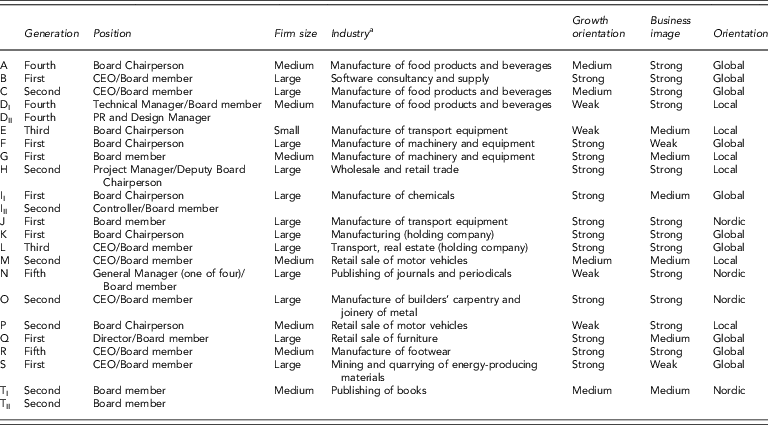
We define a family business as a business in which one family group controls the company through a majority of the ordinary voting shares; this family is represented on the management team and/or an active board and the leading representatives of the family perceive the business to be a family firm (Westhead & Cowling, Reference Westhead and Cowling1996). The selection of businesses to be included in the sample was made with the aim of mirroring the heterogeneity of the family business population, which means including different industries, sizes, generations and stages of life cycles, keeping family control of ownership as the common characteristic. Attempts were also made to include businesses with various degrees of growth orientation, market orientation and awareness of the family business image. Three of the firms are listed companies controlled by family owners (companies F, J and L) and the rest of them are privately held. Each case in this study comprised a review of official company information, such as marketing material, financial reports, web pages and news articles, and in-depth conversations with leading owners in the family businesses. We met with 23 owners, representing 20 different firms. All but six of the interviewees hold the majority of the voting shares in their firms (the exceptions being A, DI, DII, N, TI and TII who hold less than the majority of the voting shares). In 14 of the firms, two or more generations are involved in the management and/or are on the board; in the remaining six firms, only one generation is involved (companies B, E, F, Q, S and T). The interviewee sample includes six women (interviewees DII, H, N, O, TI and TII) and 17 men. Table 1 provides details of the family firms and those interviewed.
Family firm characteristics

Note. aSwedish Standard Industrial Classification (2002).
Procedure
We met the majority of the interviewees on site at their businesses, although two of the interviews took place in the interviewees’ residential homes and three at our business school. The in-depth conversations ranged from 2–4 hr in length and concentrated on issues such as the role and meaning of ownership, the ownership structure in former, present and future generations, the ownership values of the specific firm, relationships between the owners and succession issues. Other focus areas were the differentiation between ownership and management roles, the character of family gatherings and annual general meetings, the strategic goals of ownership, strengths and weaknesses in relation to ownership issues, how concentrated ownership affects and is affected by family members who are not owners of the business in a legal sense, employees, customers, suppliers, the local community and society at large. Each conversation was recorded and transcribed into full text. Nine of the cases are longitudinal as we were able to follow the companies over time in other processes, such as the succession process, in educational programmes and in studies within other projects ranging from 12 to 36 months in length. This applies to companies C, F, G, H, I, J, K, O and R.
Our study builds on the multiple-case principle and a replication logic (Yin, Reference Yin1994), meaning that each case served as a basis to confirm (or not) the conclusions drawn from the other cases. The methodology stems from the tradition of theory-building in case research in which the eight-step process of building theory (Eisenhardt, Reference Eisenhardt1989) helped us to structure the design of the study and the research process. With our focused research purpose in mind, we then selected 20 cases for in-depth case analysis. These number of cases should be sufficient to draw analytical conclusions (Eisenhardt, Reference Eisenhardt1989; Yin, Reference Yin1994).
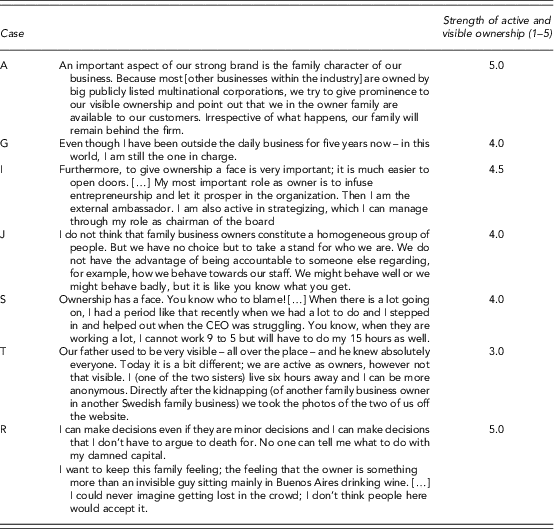
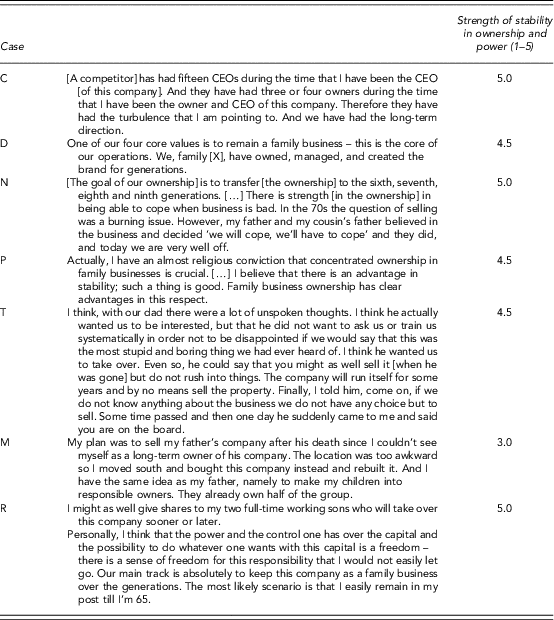
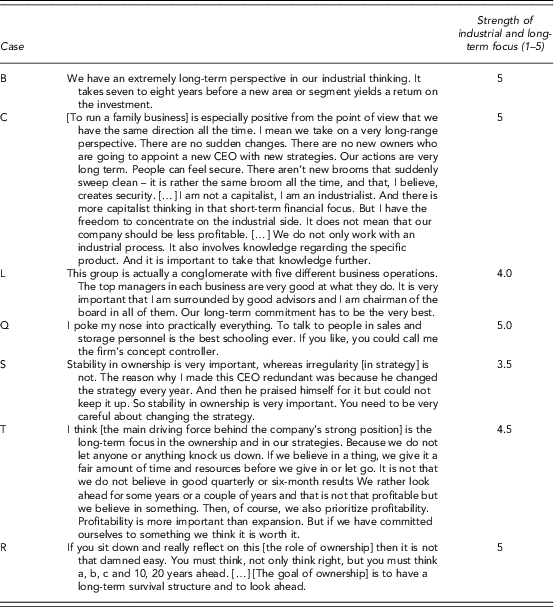
All interviews were transcribed as a first step. Second, we looked for common characteristics of ownership expressed by the 23 family business owners in the 20 cases. Third, each transcribed interview was rigorously interpreted independently by two of the authors in order to search for characteristics and patterns in each respondent's expressed view on his/her ownership. In the next step of the analysis, we categorized these characteristics and patterns into seven themes concerning ownership resulting in the emergence of seven dimensions of a specific logic of ownership in the family-controlled businesses that show the core characteristics of family businesses. These themes were: (1) active and visible ownership, (2) stability in ownership and power, (3) an industrial and long-term focus, (4) multiple ownership goals, (5) autonomy towards capital markets, (6) flexibility in governance structures and (7) identification. The categorization was iteratively informed by existing literature on similar aspects of family businesses. The seven themes thus illustrate the core characteristics of ownership originating from our empirical observations, but at the same time our pre-understanding of ownership characteristics from the existing literature supported our coding to identify possible categories. As a final step, we estimated the strength of each theme through a scale from 1–5, where 1 = ‘very low strength’, 2 = ‘quite a low strength’, 3 = ‘medium strength’, 4 = ‘quite a high strength’ and 5 = ‘very high strength’. This estimation was done independently by the three interviewers/authors; however, beforehand we jointly decided what we should look for with regard to each number of the scale in relation to that specific theme. Such an inter-rater reliability process is deemed adequate for within-group estimations (James, Demaree, & Wolf, Reference James, Demaree and Wolf1984) and has also been used in qualitative research (Frese et al., Reference Frese, Krauss, Keith, Escher, Grabarkiewicz, Luneng, Heers, Unger and Friedrich2007). In our study, the highest agreement was 100% for company B and the lowest was 81.25% for company N. The total average was 95.75% and this figure is considered high and satisfactory being above the concordance range of 69%–82% (cf. Frese et al., Reference Frese, Krauss, Keith, Escher, Grabarkiewicz, Luneng, Heers, Unger and Friedrich2007). The high level of agreement can be explained by the fact that all three researchers were actively involved in the interview process. Typical examples of the strength of each theme are shown in the illustrations below (Tables 2–8). What is notable is that all the themes scored 3.0 or more for all cases, showing that they all emerge strongly in our study.
Illustration of active and visible ownership
Illustration of stability in ownership and power
Illustrations of industrial and long-term focus
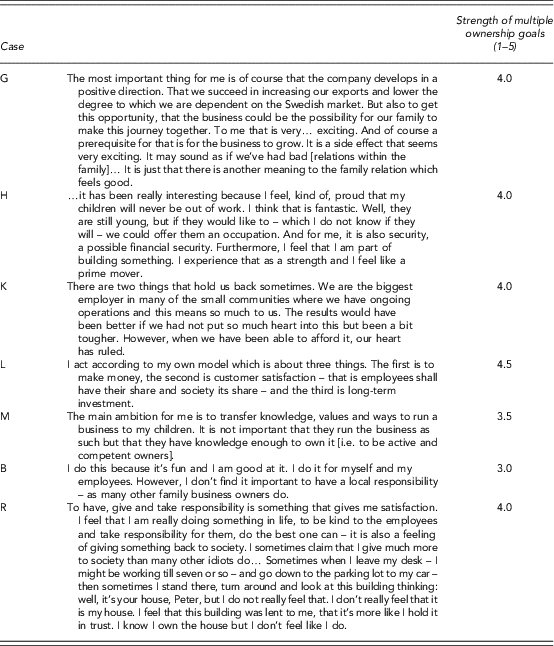
Illustration of multiple ownership goals
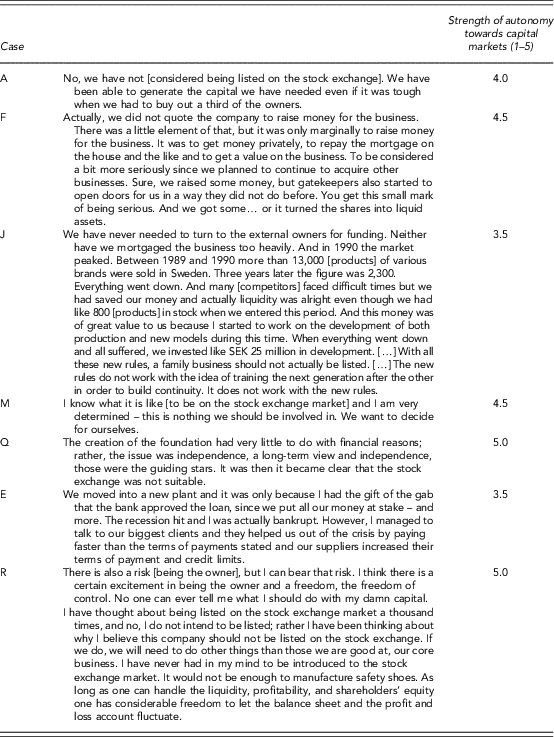
Illustration of autonomy towards capital markets
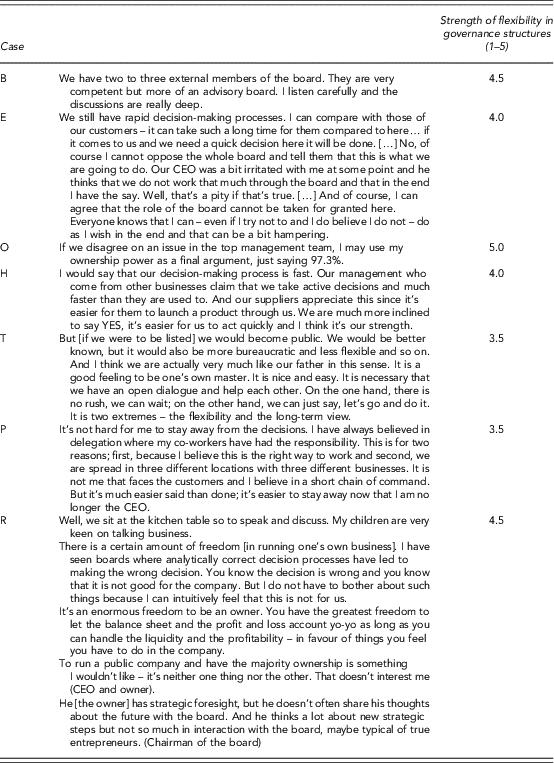
Illustration of flexibility in governance structures
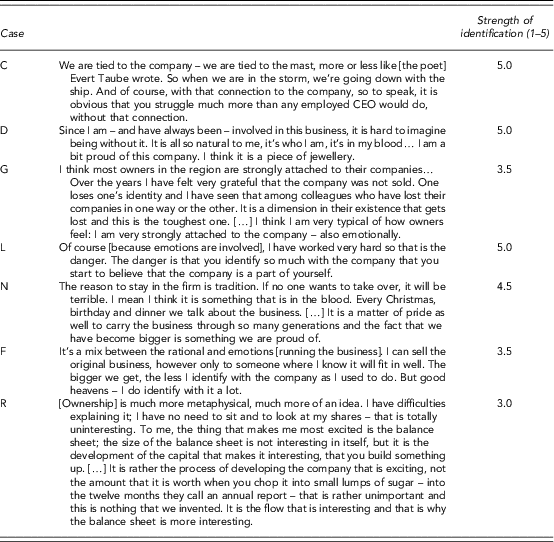
Illustration of identification
Taken together, the seven themes form a coherent and holistic logic of ownership in family-controlled businesses, supported by the fact that all the family owners interviewed represent the logic to a very high degree. In order to illustrate the logic, we address each theme drawing on our cases and informants as well as the relevant literature.
Empirical findings and illustrations
The outcome of the above process is shown in appendix 1, which summarizes the strength of each theme of the family ownership logic for all cases (identified as Firms A–T). The results support our proposal that there is a strong notion of ownership that cannot be explained only by legal or formal ownership. We have found a pattern of ownership in the population studied that can also be connected to informal or ‘emotional’ ownership. We label this coherent pattern family ownership logic with the following seven core characteristics: (1) active and visible ownership, (2) stability in ownership and power, (3) an industrial and long-term focus, (4) multiple ownership goals, (5) autonomy towards capital markets, (6) flexibility in governance structures and (7) identification.
Next, we present each theme starting with a description of the meaning of the theme and relating it to existing literature. From there we provide a grounded basis for the theme using quotations from a selection of the total number of 20 cases. In each theme, case R will be illustrated in order to provide a richer and more holistic picture of one single case through illustrations of all seven dimensions of the family ownership logic. Case R is chosen because it rates high on all themes. Although some of the themes presented here overlap to a certain extent, the overall picture derived from all the seven themes strongly supports our conceptualization of the family ownership logic.
Theme 1: Active and visible ownership
Active and visible ownership means that ownership involves the active commitment of a visible owner. Previous research has shown that the degree of family involvement in family businesses differs, as indeed it does within countries, industrial districts and industries (Corbetta & Montemerlo, Reference Corbetta and Montemerlo1999; Astrachan, Klein, & Smyrnios, Reference Astrachan, Klein and Smyrnios2002; Wigren, Reference Wigren2003). Furthermore, research reveals mixed results on whether family involvement in operations is necessarily a source of strength (Zahra, Reference Zahra2003; Miller & Le Breton-Miller, Reference Miller and Le Breton-Miller2006) or rather contributes to problems such as destructive nepotism or difficulties in separation between ownership roles and management roles within the business (Schulze, Lubatkin, Dino, & Buchholtz, Reference Schulze, Lubatkin, Dino and Buchholtz2001; Habbershon & Pistrui, Reference Habbershon and Pistrui2002). Carlsson (Reference Carlsson2003) argues that active ownership is a key factor in value creation in the market economy and that it requires a distinctive ownership competence. What seems indisputable based on previous research (Micelotta & Raynard, Reference Micelotta and Raynard2011) and the empirical observations in this study is that many family business owners make deliberate decisions to communicate active and visible ownership to their various stakeholders. Table 2 exemplifies active and visible ownership in this study.
According to our respondents, active and visible ownership often involves a clear willingness to communicate family values connected with the business and this means an evident presence in management and/or on boards. The visibility of ownership is often part of the company image and some companies also carry the family name of the owners. All the owners interviewed viewed it as important to make it possible for different stakeholders to identify the responsible ownerFootnote 2 in their business. Most owners argued that their visible and active ownership was considered important both by the employees and by various other stakeholders.
Few of the owners considered active ownership to be the same thing as working in the company at an operational level. Owners who used to work operationally in the business but no longer did so reported that they were sometimes assumed to take a more operational role than they actually did. However, in almost all the cases studied, visibility meant that representatives of the owner family were present more or less daily in the activities of the business.
Based on the above, we propose the following:
Proposition 1 : Active and visible ownership is one core characteristics of the family ownership logic.
Theme 2: Stability in ownership and power
Stability in ownership and power refers to the high degree of continuity in ownership and top management. From previous studies we know that CEOs in family firms tend to have substantially longer tenure than CEOs in non-family firms (Samuelsson, Reference Samuelsson1999; Jorissen et al., Reference Jorissen, Laveren, Martens and Reheul2005). In a study of 73 family businesses matched with 73 non-family businesses, Westhead, Cowling, and Howorth (Reference Westhead, Cowling and Howorth2001) found significant differences in continuity; in particular, family firms employ external CEOs to a lesser degree and when this is the case, the average period a non-family CEO holds this position in a family business is almost half that of a family CEO (8 years compared with 15.7 years). Previous studies thus support our theme that stability in ownership and power are important to the family business owner. Table 3 exemplifies stability in ownership and power in this study.
Most of the family-controlled companies in this study showed a high degree of continuity in ownershipFootnote 3 and top management. Stability is a notion that the owners interviewed clearly relate to their ownership and in several cases it was expressed as an objective in itself.
Stability in ownership and power can be viewed in different ways. On the one hand, some owners view this stability as fulfilled when ownership is stable over one generation or transferred to the next generation. When family business owners communicate their business strategy, they emphasize core values, one of which is remaining a family business. In these cases, stability in ownership seems to be a continuous subject of discussion, including training the next generation to be responsible owners. However, according to a couple of respondents, the desire to remain a family business has not always been shared fully across generations.
On the other hand, stability in ownership and power also involves the continuity of the CEO position and/or other management positions held by a family member. The statements of the family business owners in this study clearly point to long tenures and stability being the ideal, also when business conditions fluctuate and in turbulent times.
Based on the above, we suggest the following as our second proposition:
Proposition 2 : Stability in ownership and power is one core characteristics of the family ownership logic.
Theme 3: An industrial and long-term focus
An industrial and long-term focus indicates a profound and deep interest in the core business and the owners’ long-term strategic development and willingness to make investments in the core business that may go beyond normal pay-off calculations. People who have lived their whole lives closely involved with and alongside the business gain a very sound knowledge of the business, characterized by Nordqvist (Reference Nordqvist2005) as strategic proximity. Thus, they probably become more committed to the business than a CEO holding a position for a shorter period of time. They become deeply involved in the business (Miller & Le Breton-Miller, Reference Miller and Le Breton-Miller2005) and are interested in strategic control, using largely subjective and strategically relevant long-term criteria (Baysinger & Hoskisson, Reference Baysinger and Hoskisson1990; Mustakallio, Autio, & Zahra, Reference Mustakallio, Autio and Zahra2002). Therefore, the findings of previous studies support our theme that an industrial and long-term focus is crucial to family business owners, as illustrated in Table 4.
Long-term management tenure as advocated in many of the statements from owners in our data also seems to play an important role in developing a long-term perspective. All the owners in this study demonstrated an in-depth knowledge of and often hands-on experience in the industries in which their firms operate. Most of them feel strongly about the products or services they deliver and they are proud of their quality and the value added. The owners are interested in strategic issues and typically identify themselves with the long-term strategic development of the firm. Many argued that it is not problematic to wait for a relatively long period of time for an investment to yield a return. Furthermore, most of them explicitly distinguished between industrial versus capital thinking and contrasted their own actions with the short-term perspective that in their view characterizes many actors on the stock exchange market. The interviewees recognized that a financial focus does not as such result in a short-term perspective, but considered that unstable and passive ownership in combination with a strong financial focus can have such a consequence.
Based on the above, we propose as our third proposition:
Proposition 3 : An industrial and long-term focus is one core characteristics of the family ownership logic.
Theme 4: Multiple ownership goals
Multiple ownership goals mean that the family business owners have a wider set of goals than purely financial, such as responsibility towards their employees and the local community as well as to past and future generations in the family-owned firm. Previous research shows that family business representatives, when compared with non-family business managers, are more likely to stress non-financial objectives in addition to financial objectives (Davis & Stern, Reference Davis and Stern1988; Riordan & Riordan, Reference Riordan and Riordan1993; Sharma, Chrisman, & Chua, Reference Sharma, Chrisman and Chua1997; Samuelsson, Reference Samuelsson1999; Littunen & Hyrsky, Reference Littunen and Hyrsky2000). As an example, it has been argued that the prime objective of family firms is to maintain the lifestyle of the owners and to provide employment for family members (Westhead & Cowling, Reference Westhead and Cowling1996). As another example, concepts such as a ‘family-in-business mind-set’ (Habbershon & Pistrui, Reference Habbershon and Pistrui2002) and a ‘peculiar financial logic’ (Gallo, Tàpies, & Cappuyns, Reference Gallo, Tàpies and Cappuyns2004) have been used to explain a focus on aspects other than growth and increased performance in family businesses. Also, the idea of family ownership as related to a strong feeling of responsibility towards the local community has been described in previous studies. Some studies are critical of the limited interest exhibited by family businesses in engagement in the general betterment of society at a global level in contrast to the actions in which many listed firms engage in the name of corporate social responsibility (Gallo, Reference Gallo2004; Uhlaner, van Goor-Balk, & Masurel, Reference Uhlaner, van Goor-Balk and Masurel2004). However, these studies also concede that owner-managed firms typically make an important contribution to their closer community (Jorissen et al., Reference Jorissen, Laveren, Martens and Reheul2005; Uhlaner, van Goor-Balk, & Masurel, Reference Uhlaner, van Goor-Balk and Masurel2004). In the words of Gallo (Reference Gallo2004), ‘family businesses are sensitive to erosions to their most immediate environments’ (p. 144) that could be explained by their integration in the local environment (Jorissen et al., Reference Jorissen, Laveren, Martens and Reheul2005). Table 5 provides empirical illustrations of multiple ownership goals.
The respondents in our study subscribed to a logic characterized by a wider set of goals than those that are purely financial. Their profound knowledge and experience of the industry means that they also focus on operational achievements when they discuss objectives and goals. Most of the owners interviewed also emphasized their responsibility towards their employees and the members of the local community. Many live where the business is situated, are known in town and are often involved in a set of local activities. In addition, they mentioned relations and development within the owner group, including responsibilities to past and future generations, when discussing the goals of their ownership. It should be stressed here that the characteristic of ‘multiple ownership goals’ does not question the importance of financial aspects in family business decision-making.
Based on the above, we suggest a fourth proposition:
Proposition 4 : Multiple ownership goals are core characteristics of the family ownership logic.
Theme 5: Autonomy towards capital markets
In terms of autonomy towards capital markets, we refer to family owners’ preference for using their own resources rather than relying on and being dependent on resources from outside. This attitude reflects the importance of independence and freedom to family owners. Scepticism with regard to external funding on the part of family business owners is supported by previous research (Corbetta & Montemerlo, Reference Corbetta and Montemerlo1999; Westhead, Cowling, & Howorth Reference Westhead, Cowling and Howorth2001; Gallo, Tàpies, & Cappuyns, Reference Gallo, Tàpies and Cappuyns2004). According to Miller, Le Breton-Miller, and Lester (Reference Miller, Le Breton-Miller and Lester2011), strategic priorities, such as relying on external funding, are influenced by the owners’ social contexts and what kind of owners they are. So, for instance, family business owners are affected by their role in upholding transgenerational wealth and loyalties and therefore are more conservative. Lone founders would, according to the same authors, act on the basis of entrepreneurial identity and be more growth oriented. It has also been found that family business owners are reluctant to make new acquisitions in their desire to keep the company concentrated for future generations, although they do have a tendency to diversify the business (Miller, Le Breton-Miller, & Lester, Reference Miller, Le Breton-Miller and Lester2010).
This would indicate that in general, family business owners do not see the need to rely on external capital markets to the same extent as non-family businesses or lone founders (cf. Miller, Le Breton-Miller, & Lester, Reference Miller, Le Breton-Miller and Lester2010, Reference Miller, Le Breton-Miller and Lester2011). Furthermore, Zellweger (Reference Zellweger2007) shows that family firms may invest through two types of investment strategy: perseverance and outpacing. The former allows for investments with lower returns but equal risk compared with firms with a short-term view; the latter entails higher risk with equal returns compared to short-term-oriented firms. Both these alternatives are based on a long-term orientation and allow family business owners to follow their own financial investment strategies autonomously, regardless of the rules of the capital market in which the shareholder value logic resides. Table 6 illustrates autonomy towards capital markets in our study.
Most respondents reported that they rely on their businesses to generate financial resources in combination with a limited amount of long-term loans. The dominant ideal for funding among the owners interviewed is to rely on their own earnings. Otherwise, the attitudes to funding in general and external funding in particular were mixed. Access to capital is often described as limited for family-controlled businesses and the interviewees recognized that family businesses frequently have difficulties finding suitable financing. However, two interviewees suggested that this might be more to do with the timing of when owners realize that they need external capital rather than being a ‘real’ financial problem, that is, they argued that some of their colleagues approached financial backers when they had acute cash flow problems rather than working with investors from a long-term perspective. Others highlighted the importance of not being dependent on external funding. Many owners stressed that harmonious relations with their bank are essential to them and they tend to look after this relationship carefully. Others, however, were somewhat critical towards banks in general and thus argued that it is important not to be dependent on the ‘benevolence’ of banks. In cases in which owners felt their predecessors had been treated badly by the bank, this was used as an argument for not relying on the bank for financing the business. As an example, in the boardroom of Company N there was a miniature model of the house and furniture once mortgaged by the founders as a reminder to the generations presently in control of the business not to rely on bank finance. For two of the companies listed on the stock market, funding was not the main reason to turn to the stock market; rather, they explained that it was a way for owners to obtain a financial return. Furthermore, being listed gives the company status and attention in the media. Nevertheless, owners with experience of stock listing as well as most other owners interviewed were sceptical about the value of stock listing, some because of the demands for quarterly profit, others because of the extensive demands in terms of financial reporting and bureaucracy in governance.
Based on the above, in formal terms we propose:
Proposition 5 : Autonomy towards capital markets is a core characteristic of the family ownership logic.
Theme 6: Flexibility in governance structures
Flexibility in governance structures refers to the family owners’ appreciation of rapid decision making and a flat governance structure. Governance structure includes the relationship between boards and top management teams in which boards are supposed to serve as a protection against mismanagement (Baysinger & Hoskisson, Reference Baysinger and Hoskisson1990) on behalf of the owners. In family businesses, ownership and management often overlap (Zahra, Reference Zahra2003; Miller & Le Breton-Miller, Reference Miller and Le Breton-Miller2006). In such companies, researchers have argued for a focus on both formal and informal rules in the governance model (Gubitta & Gianecchini, Reference Gubitta and Gianecchini2002). The industrial and long-term focus illustrated in Theme 3 makes family business owners prone to act directly and rapidly (Miller & Le Breton-Miller, Reference Miller and Le Breton-Miller2006) and personal involvement tends to result in single-handed strategic decisions as the owners see it as their right to make them (Davis, Schoorman, & Donaldson, Reference Davis, Schoorman and Donaldson1997; Miller & Le Breton-Miller, Reference Miller and Le Breton-Miller2006). Acting on one's own is also explained by the fear of losing control (Gubitta & Gianecchini, Reference Gubitta and Gianecchini2002). The family business owner is thus flexible, that is, has ‘the capacity to adapt’ (Golden & Powell, Reference Golden and Powell2000: 373). Similarly, Gubitta and Gianecchini (Reference Gubitta and Gianecchini2002) suggest that flexibility in governance models stands for the possibility for a company ‘to rearrange its basic elements over time, space, and connections and to refine characteristics to increase the performance level’ (p. 284). The argumentation above is reflected in Table 7 that exemplifies flexibility in governance structures.
Rapid decision making is something that was stressed as an advantage by the family business owners in contrast to organizations with more hierarchal and unwieldy structures. The family business owners argued that their close relationship with the firm enables them to speed up the decision-making process. The role of the board differs among the companies studied and is not always congruent with that of companies with widely held ownership. Not all owners interviewed were convinced of the advantages of the formal role of the board but were aware that an unclear role might cause problems. Whereas, some of them viewed it as their prerogative to bypass the formal decision structures of the firm, others considered it important to try to follow these. The flexibility in governance structures to which we refer here thus varies in the family businesses in this study, but few of them follow the strictly hierarchical governance structure advocated in codes of conduct that regulate the governance of listed companies in many countries.
Many of the family business owners reported holding formal discussions about ownership issues among family members. Approximately half of the businesses studied set up family councils often prescribed by family business associations. Some of these family councils hold meetings that are divided into two parts, one part exclusively for owners with issues only related to the business and one part for all family members.
Based on the above, we put forward our sixth proposition:
Proposition 6 : Flexibility in governance structure is a core characteristic of the family ownership logic.
Theme 7: Identification
Identification refers to family business owners’ strong and unconditional commitment to their firms. Relationships within a family business are often very dense, genuine and unique (Hall, Reference Hall2003). An upbringing in such a setting often creates feelings of being ‘one’ with the business, forming part of the identity of those involved (Pierce, Kostova, & Dirks, Reference Pierce, Kostova and Dirks2001) and a social arena in which they belong. The business becomes an extension of ‘self’ (Belk, Reference Belk1988). The business defines meaning in life, signalling independence and success (Avey et al., Reference Avey, Avolio, Crossley and Luthans2009). With this identification comes a wish to be in control (Avey et al., Reference Avey, Avolio, Crossley and Luthans2009) and a special social meaning of being a family business owner (Nordqvist, Reference Nordqvist2005). Such a strong identification with the firm may make family members unwilling to depart from or sell the firm (Lansberg, Reference Lansberg1988; Salvato, Chirico, & Sharma, Reference Salvato, Chirico and Sharma2010). At times, such identification may become burdensome, leading to feelings of guilt for leaving the family firm or feelings of guilt for staying on (cf. Belk, Reference Belk1988). In general, however, family businesses are governed by a deep and special attachment (Miller & Breton-Miller, Reference Miller and Le Breton-Miller2006). All this supports the notion of identification with the firm as illustrated in Table 8.
All our interviewees expressed total commitment to their businesses. The overwhelming majority were raised ‘into the business’ and tell anecdotes about the business from their upbringing. They also pass down stories from previous generations. They bear witness to a strong emotional attachment to the business and all of them consider that the business is part of their identity. They are willing to put a great deal of effort into the business and, in most cases, cannot imagine selling the firm. There are many privations, they say, but what they value most is the pleasure and pride it gives them to be ‘in charge’ and to be ‘caretaker’ of a business built on traditions.
Based on this, we suggest as our final proposition:
Proposition 7 : Identification is a core characteristic of the family ownership logic.
Discussion: Dimensions of family ownership logic
The family ownership logic has a high degree of consistency despite differences in industry, size, generations and stages of life cycles among the family firms studied. Based on our case studies and the previous studies referred to above, we argue that the family ownership logic has a predominant and common character that is prevalent along all the dimensions discussed, that is, it is an ownership logic in which psychological, socio-symbolic and industrial ownership add to financial and juridical ownership. In order to make our case, we relate the family ownership logic – and thereby our empirical findings – to theories of psychological and socio-symbolic ownership. The aim is to introduce a dimension that can add to our understanding of the special dynamics that seem to encompass ownership held by family members.
In our data, we observe a strong tie between the owner and the owned – the family business. This is explicit in almost all quotations regardless of the theme. Ownership makes the individual regard the owned object as his or hers as much as his/her thoughts, words and emotions (Marx, Reference Marx1978; James, Reference James1980). Similarly, Pierce, Kostova, and Dirks (Reference Pierce, Kostova and Dirks2001) suggest that ownership can include both affective and cognitive dimensions, such as in the expression ‘this is MY business’. Thoughts, including a series of personal appraisals and judgements expressed in the quotations, are thereby part of the psychological and socio-symbolic ownership dimensions in family ownership logic.
The individual's need for a place and a sense of belonging – a home (Pierce, Kostova, & Dirks, Reference Pierce, Kostova and Dirks2001), or in our case a family business – seems to be crucial to well-being and identification. The business can also be the locus of psychological ownership (Heidegger, Reference Heidegger1967), with connotations of warmth, comfort and security, much like ‘When we inhabit something, it is no longer an object for us, but becomes part of us’ (Pierce, Kostova, & Dirks, Reference Pierce, Kostova and Dirks2001: 300). Pierce, Kostova, and Dirks (Reference Pierce, Kostova and Dirks2001) suggest that the need to be in control, for identification and for a place facilitate psychological ownership, but are not necessarily the cause of feelings of possession (Pierce, Kostova, & Dirks, Reference Pierce, Kostova and Dirks2001). In our cases, having talked to the formal business owners, there seems to be a strong relationship between the psychological and the social aspects of ownership and the actual status of being the legal owner. The outcome is a positive attitude towards the business, including an increased self-reliance and accountability (Van Dyne & Pierce, Reference Van Dyne and Pierce2004: 443). There is no doubt that being involved in a family business entails perceived responsibilities and rights, which are suggested to be the sources of psychological ownership (Pierce, Kostova, & Dirks, Reference Pierce, Kostova and Dirks2001; Avey et al., Reference Avey, Avolio, Crossley and Luthans2009).
The strong feeling of being ‘one’ with the family business indicates a strong relationship between owning and one's identity, much like Sartre's (Reference Sartre1969) belief that ‘I am what I have’ (p. 591). Therefore, it seems as if the family firm is an extension of the self (cf. Belk, Reference Belk1988) and the owner's identity. To be owner of and thereby part of the family firm defines meaning in life and contributes to and reflects a person's identity (Belk, Reference Belk1988). In our study, in which each respondent is also the owner in a legal sense, formal ownership is probably a pre-requisite for the family owner to ‘seek, express, confirm, and ascertain a sense of being through what they have’ (Belk, Reference Belk1988: 146). Even if the legal aspect of ownership is not necessarily a condition for psychological ownership, a set of studies have highlighted the importance of a formal ownership system as being positively related to psychological ownership (see Pierce, Rubenfeld, & Morgan, Reference Pierce, Rubenfeld and Morgan1991). It can confer on family owners or family members a symbolic value, namely socio-symbolic ownership (Nordqvist, Reference Nordqvist2005), in terms of who they are and how they want to be defined. In the empirical illustrations, family business owners explicitly state that the business is closely connected to the individual's personality. Thus, we have included the characteristic of identification in the family ownership logic.
To start one's business is probably one of the most powerful examples of investing oneself into a target, gaining control and getting to know the target well, which are the three prime explanatory factors of psychological ownership (Pierce, Kostova, & Dirks, Reference Pierce, Kostova and Dirks2001; Avey et al., Reference Avey, Avolio, Crossley and Luthans2009). They are all part of the extended self and are well illustrated in our quotations and expressed in the family ownership logic when the respondents talk of a lifelong investment in the family firm and in many cases several generations of hard work and sacrifice. Such massive investment calls for a continuation of the firm also after the owner's death. Giving away or transferring ownership to someone else, such as to children, is part of this process as it includes the receiver in the extended self (Sartre, Reference Sartre1969). Judging from our quotations, there is reason to believe that these processes of extending oneself are mainly conscious and intentional, as argued by Belk (Reference Belk1988). The extended self does not necessarily work only at the individual level but also at the group level, where family, friends, long-term employees and various cultural groups (such as family business networks) meet the need to control, to get to know and to create (cf. Pierce & Jussila, Reference Pierce and Jussila2010, and their concept of collective psychological ownership). For the reasons given above, we conclude that it is hard to separate oneself from the family business and therefore family business owners tend to remain in the business over the long term. Therefore, we include stability in ownership and power in the family business logic.
In our study, we have quotes confirming that the power of being the majority owner facilitates the family business owner being – and remaining – in control. Being an active and visible owner, as well as remaining stable in formal ownership and thereby retaining voting power, is a manifestation of being in charge and being able to make others accountable.
According to Lewis (Reference Lewis1998), feelings of a need to be in control (‘this is mine!’) are developed during childhood and continue into adulthood. When children in a family business grow up, they might experience a need to be ‘in control’ even if the business is not theirs legally. This feeling might be a result of the children being channelled into the family culture and values. They might be told over and over again that the business will eventually be theirs or be raised into ownership. The feeling of being in control leads to feelings of efficacy, pleasure and extrinsic satisfaction (Pierce, Kostova, & Dirks, Reference Pierce, Kostova and Dirks2001), to which the joy, energy and entrepreneurial spirit expressed in our quotations bear witness. Furthermore, such pride and satisfaction are expressed in relation to the social value of being part of the family name, goodwill and the like (cf. Danes, Stafford, Haynes, & Amarapurkar, Reference Danes, Stafford, Haynes and Amarapurkar2009). For a family business owner, it makes sense of and renders meaning to the ownership and is linked to the individual's and the family's values and interests (cf. Grunebaum, Reference Grunebaum1987; Nordqvist, Reference Nordqvist2005). Such quotations can be summarized as the strong identification with the business that we have included in the family ownership logic.
Responsibility is expressed in a set of quotations in which emotions, such as being protective, caring and nurturing, and being prepared to make sacrifices and to channel one's full energy and time into the family business are evident. We have summarized these as comprising the core characteristic of multiple ownership goals. However, they are also sensed in the long-term strategic direction of such firms, in which the owners show responsibility to the business rather than focusing outright on the financial aspect in the form of satisfactory quarterly reports. Stewardship and citizenship behaviours are here easily connected with the responsibility concept of psychological ownership (Pierce, Kostova, & Dirks, Reference Pierce, Kostova and Dirks2001). The benefits of stability in ownership together with autonomy towards capital markets also ease the path in working with an industrial and long-term strategic direction according to the owners.
With psychological ownership come perceived rights. Such rights may be of various kinds, such as the right to possess some financial share in the family business, the right to exercise influence and the right to obtain information about the family business. In general, there is a positive relationship between feelings of possession and the family business (see Van Dyne & Pierce, Reference Van Dyne and Pierce2004). In practice, this is expressed in various ways such as in flexibility in governance structures, where family business owners see it as their right to make decisions and take actions regardless of board decisions and/or hierarchical chains of command, primarily for the sake of promptness and having the best interests of the firm in mind – or, as expressed in a quote, for the sake of demonstrating independence.
Emotions are strongly connected with the family business and are salient in most of the statements. Emotionally, to start and build up a business is included in the extended self (Sartre, Reference Sartre1969). In agreement with the reasoning of Ashforth and Humphrey (Reference Ashforth and Humphrey1993), as well as that of Parkinson (Reference Parkinson1995) and Fineman (Reference Fineman1996), concerning the construction of emotions as identity claims, psychological ownership, as illustrated by the family business owners, gives rise to identity claims and results in certain feelings of pride, happiness, satisfaction and the like. Furthermore, in studies on emotions in family business settings it has been concluded that communicated emotions constitute strong driving forces in order to achieve intended goals (Brundin, Reference Brundin2002). It is clear among the family business owners in this study that they develop a specific attachment to the business, a sense of belonging between the members of the family and strong feelings of satisfaction. Being actively involved in a family firm seems to create emotional energy (Collins, Reference Collins2004) – a result of long-term emotions. From the discussion above, it is evident that belonging to a family business implies special and strong emotional ties to the family firm and they are manifestly a component of the family ownership logic. We therefore argue that the role of emotions can be linked to the overarching family ownership logic and describe this strong glue in the family business logic as emotional bonding with the family business; this is inherent in all seven themes of the family business logic, building on the four blocks of financial and juridical, industrial, socio-symbolic and psychological ownership. In a recent study, Björnberg and Nicholson (Reference Björnberg and Nicholson2012) used the concept of emotional ownership, building on emotional value and identification with the family firm. They found that the antecedents of emotional ownership are family capital, higher levels of family governance, a fair process of integration and group support. Their results have similarities with our emotional bonding concept, albeit with some noticeable differences. Whereas, we talked to owners who are active in a juridical sense, Björnberg and Nicholson (Reference Björnberg and Nicholson2012) looked for antecedents of emotional ownership among next generation family members, most of whom were not owners in a financial sense and actually found that financial ownership does not matter. However, in our study, the respondents claimed that such ownership does indeed matter and that it confers freedom to act. We therefore argue, in contrast to Björnberg and Nicholson (Reference Björnberg and Nicholson2012), that emotional bonding is associated with possession, in addition to a cognitive and affective state, and that it encompasses more ownership dimensions. Thus, there may be some differences between those who have financial ownership and act in this position and those who do not.
As a natural consequence of psychological ownership and its connotations of meaning in life, identity creation and being a part of the self, there are also a couple of quotations that illustrate that hard times or the loss of the family business have a major impact on the self and might lessen its sense of meaning (Belk, Reference Belk1988). This may have consequences such as mourning and feelings of losing control. It is reasonable to argue that the more effort and time people have invested in the business and the more they have got to know the business, the harder the mourning process will be, or as Fromm (Reference Fromm1976: 76, as cited in Belk, Reference Belk1988: 146) put it, ‘If I am what I have and if what I have is lost, who then am I’? Identification with the family business can develop into a trap, as expressed by an owner who said that he had inherited something that he was very proud of, yet it is now a burden he wants to get rid of. The owner expressed emotional messiness (Brundin & Sharma, Reference Brundin and Sharma2011) with a mix of positive and negative emotions.
Conclusions and implications for further research
Based on this study, it is possible to draw two general conclusions. First, family business owners explain and rationalize their actions with reference to a governance logic that is different from the shareholder value logic sometimes described as emerging as the world's governance standard (Rubach & Sebora, Reference Rubach and Sebora1998; Bradley et al., Reference Bradley, Schipani, Sundaram and Walsh1999; Hansmann & Kraakman, Reference Hansmann and Kraakman2001). Second, this family ownership logic is characterized by active and visible ownership, stability in ownership and power, an industrial and long-term focus, multiple ownership goals, autonomy towards capital markets, flexibility in governance structures, owners’ identification with the business and an overall emotional bonding. When presenting our empirical findings above, we showed that previous studies deliver support for each of these characteristics. Furthermore, studies by Miller and Le Breton-Miller (Reference Miller and Le Breton-Miller2005, Reference Miller and Le Breton-Miller2006) and Miller, Le Breton-Miller, and Lester (Reference Miller, Le Breton-Miller and Lester2010, Reference Miller, Le Breton-Miller and Lester2011) strengthen the broader conclusion of our study that the strategies and practices of family-controlled businesses are manifested and legitimized by a logic in which the financial and juridical aspects of ownership are closely intertwined with the psychological and socio-symbolic aspects of ownership. In relation to Miller, Le Breton-Miller, and Lester (Reference Miller, Le Breton-Miller and Lester2011), who hypothesized that the more conservative strategies of family-founded firms are legitimized by a familial logic focused on nurturing the family, our results add to the characterization of this logic.
Also, the fast-growing literature on socio-emotional wealth builds on the notion that family firms behave differently to other firms (Gomez-Meija, Haynes, Nuñez-Nickel, Jacobson, & Moyano-Fuentes, Reference Gomez-Mejia, Haynes, Nuñez-Nickel, Jacobson and Moyano-Fuentes2007; Cruz, Justo, & De Castro, Reference Cruz, Justo and De Castro2012). Berrone, Cruz, and Gomez-Mejia (Reference Berrone, Cruz and Gomez-Mejia2012) refer to five dimensions that capture the ‘affective endowment’ of family members, namely: family control and influence, identification of family members with the firm, binding social ties, emotional attachment of family members and renewal of family bonds in the firm through dynastic succession. Of these, emotional attachment and family members’ identification with the firm overlap with our results. While the aforementioned papers are mainly conceptual in character, our results build on empirically grounded data from family business owners. Thus, the studies complement each other in deepening the meaning of family ownership. Both concepts make important contributions to a socially complex phenomenon that needs to be viewed from additional perspectives.
Our research indicates that the family business performance could be related to the ideals of active and visible owners over generations, an emphasis on industrial and hands-on knowledge as important for owners, a sceptical attitude towards a short-term focus on shareholder value, a wish to stay financially independent (often based on narratives concerning the struggles of the founder to establish the business), a desire to keep governance practices straightforward and a strong personal identification with the business.
This article frames and conceptualizes a family ownership logic that has the potential to contribute new insights to the rationale for strategic choices, interpretations of daily operations, similarities and differences in relation to ownership, patterns of action, reasons for family conflicts, contradictory aims of ownership and the possible lock-in effect of psychological ownership.
Although further investigations are needed, the general conclusions regarding the family business logic presented above have several implications for the current debate in the family business field. First, the long ongoing debate as to whether family businesses are rational or irrational can be rejected on the basis of the results of this study as an irrelevant dichotomization. Murray (Reference Murray2002) refers to this dichotomization as ‘an uneasy marriage of emotionality and rationality’ (p. 75). With the family ownership logic to hand, we would say that by realizing the existence of competing logics it is easier to understand the combination of emotions and rationalities in family-controlled businesses and turn it into a characteristic that should be taken as a foundation for researchers, business analysts and other professionals who judge and comment upon the management of such businesses.
Second, ownership as a variable in its own right needs further research attention. In this study, we have identified managerial practices and on the basis of this variable, also influential stakeholders, such as employees, non-family management, customers, suppliers and so on. However, our results may also have at least two consequences for comparative studies. To begin with, some differences observed between family and non-family firms are interpreted in a conflicting manner. While some writers suggest that family businesses benefit from a long-term perspective (James, Reference James1999; Zahra, Reference Zahra2003), others understand their weaker commitment to growth as indicating that they lack a long-term perspective (Gallo, Tàpies, & Cappuyns, Reference Gallo, Tàpies and Cappuyns2004). Our suggestion is that the characteristics of family businesses should be interpreted not only in relation to the dominant shareholder value perspective but also the family ownership logic described in this article. Another issue of importance to comparative research projects is that the identification of the family business logic might also have consequences for the definition of family businesses. As suggested by Astrachan, Klein, and Smyrnios (Reference Astrachan, Klein and Smyrnios2002), comparative work in the family business field is better served by a continuum framework than either/or definitions. In terms of the set of values that the family ownership logic communicates, it represents yet another perspective of culture that in different combinations might construct diverse types of family-controlled businesses. Thomas's (Reference Thomas2002) findings suggest that commitment to the family business logic might vary between different actors. Moreover, from comparative research on family firms in Italy and the United States undertaken by Corbetta and Montemerlo (Reference Corbetta and Montemerlo1999), it seems that the family business logic might vary with cultural differences. Furthermore, there could also be differences in this respect between firms within the ‘same’ national culture. Some firms might recognize that they correspond to most definitions of family businesses without giving this much consideration. For other firms, family ownership and control are not only a source of pride but also aspects that are frequently communicated to different stakeholders. In other words, in some family-owned firms, the family ownership logic is dominant, but in other firms the financially focused shareholder value logic might predominate. As an example of this, the Miller, Le Breton-Miller, and Lester (Reference Miller, Le Breton-Miller and Lester2011) study showed that founders influenced by a wide set of market-oriented stakeholders are less likely to follow a familial logic than founders of businesses in which family members are the salient social constituencies.
Third, besides being an interesting focus for further studies, the idea of actors defending the family business logic also raises questions in line with Habbershon & Pistrui's (Reference Habbershon and Pistrui2002) article. Before arguing for a ‘family-as-investor mind-set’, they pose the question of how research in the family business domain influences family business practice. From their perspective, the field places too much focus on issues not related to financial performance and growth, which they fear locks ‘families into a theoretical projectory that may not allow them to be enterprising’ (Habbershon & Pistrui, Reference Habbershon and Pistrui2002: 224). Other researchers might consider other perspectives and attitudes towards goals and aspirations not so easily translated into financial return; however, the question is, nevertheless, worth attention. What does the family business form mean in different contexts? What are the driving forces and actors behind the institutionalization of the family business form? What are the consequences of such an institutionalization process? For example, family business representatives in family business associations work hard to defend and create acceptance for ‘the family business form’. What role are we as researchers playing in this process?
Fourth, regarding the debate on whether to apply the agency perspective or stewardship theory to family business contexts, our results seem to speak in favour of the latter. The statements made by our family business owners are more in line with the stewardship assumptions that people are collectivists, pro-organizational and trustworthy than the agency assumptions that people are individualistic, opportunistic and self-serving (Davis, Schoorman, & Donaldson, Reference Davis, Schoorman and Donaldson1997). However, even though the values espoused here often correspond to stewardship assumptions, we cannot draw the conclusion that family business owners are either collectivists or individualists. It can be argued though that attributes which the owners themselves consider to be of major importance in family businesses are less likely to receive attention when applying a theory developed mainly for the purpose of analyzing formal agreements and contracts as applied in a principal–agent relationship. Furthermore, this study provides arguments for questioning not only normal agency-theoretical assumptions regarding agents, but also assumptions regarding the goals, objectives and motivations of the principals. We have seen that their financial logic is sometimes seen as irrational and peculiar, so under what circumstances are they understood as competent and trustworthy? It is interesting to note that family ownership is frequently described as being in need of professionalization while at the same time modern management tools (such as EVATM) are marketed towards other organizations as a tool to enhance ‘the feeling of ownership’, ‘making managers into owners’, where ‘pride in one's work, sensible risk taking, and above all accepting responsibility for the success of failure of the enterprise are among the attitudes that separate owners from mere hired hands’ (Stewart, Reference Stewart1991: 223; see discussion in Mouritsen, Reference Mouritsen1998).
A related issue in need of further research is that of responsibility and accountability. Much in line with stewardship theory, the owners, board members and managers focused on here espouse a high degree of responsibility, such as a responsibility to past and future generations, to the local community, to specific family members and to an industrial focus. As a result of these responsibilities, there is room for questions regarding accountability. Accountability is about obligations, as well as abilities to explain, justify and account for one's actions (Roberts & Scapens, Reference Roberts and Scapens1985; Munro, Reference Munro1996). Within this perspective, accountability has been studied as an important ingredient in competence (Jönsson, Reference Jönsson1998). To be recognized as competent and trustworthy, a person needs to be able to account for what happens in a way recognized as meaningful and appropriate. Our respondents have discussed their wide-ranging responsibility, but questions regarding what they are accountable for and to whom deserve further consideration.
In the family ownership logic, we have included formal as well as psychological and social dimensions of ownership. In this particular study, we have turned to the majority shareholder owner. However, in the family business context, individual psychological ownership can also be related to family members who are not owners in a legal sense. Thus, aspects of the emerging ‘collective-based psychological ownership’ (Pierce & Jussila, Reference Pierce and Jussila2010) interrelate with formal ownership in a way that definitely make it a topic for future research.
To conclude, we wish to emphasize that even if the family ownership logic, as defined in this paper, may be valid for many family-controlled businesses, we should still remember that there are many other distinctive differences in the broad family business population. Our findings do not support the recent and ongoing institutionalization of the family firm as a specific form of organization, implying that the family firm population makes up a homogeneous group of firms with, for example, a similar governance structure and practices (Melin & Nordqvist, Reference Melin and Nordqvist2007). Rather, our findings suggest that researchers in the family business field in particular need to take multiple competing logics into consideration. By doing so, researchers in this field can both contribute with new knowledge on family ownership and add to the growing literature on sociocultural and behavioural factors in corporate governance relations.
Acknowledgement
We are grateful for funding from the Swedish Foundation for Humanities and Social Sciences (Riksbankens Jubileumsfond) in order to carry through this project. We also want to thank Professor Charmine Härtel for her valuable feedback.
APPENDIX I Summary of the ownership logic for firms A–T