Introduction
In the nineteenth century, one of the first interventions of the state on behalf of children was legislation to restrict the employment of children. As John Stuart Mill argued:
Labouring for too many hours in the day, or in work beyond their strength, should not be permitted to them, for if permitted it may always be compelled. Freedom of contract, in the case of children, is but another word for freedom of coercion. (Reference Mill1848, V, XI, 30).
In the pre-industrial, rural economy and through much of the industrial revolution, children were from a very early age primarily producers. In industrialised societies, the twentieth century saw a transformation in the nature of childhood. Children, once lacking any rights, came to be seen as humans who should enjoy certain inalienable rights. Yet many aspects of childhood are now causing increasing concern. Neil Postman graphically claimed that the child ‘has been expelled from the garden of childhood’ (Postman, Reference Postman1982: 192).
One of the principal concerns is the growth in commercial pressures on children. A group of 110 professionals and academics working with children wrote: ‘We are deeply concerned at the escalating incidence of childhood depression and children's behavioural and developmental conditions . . . They are pushed by market forces to act and dress like mini-adults and exposed via the electronic media to material which would have been considered unsuitable for children even in the very recent past’ (Daily Telegraph, 12 September 2006).
Yet there is little clarity about what is going on. The purpose of this paper is, first, to analyse some aspects of what is happening to childhood in Britain and to clarify some of the major influences. Second, to examine the evidence on the impact of commercial pressures. Third, to discuss the issues posed for public policy.
Changing childhoods
Of one thing there can be no doubt. Children's lives in Britain have changed radically in the past century.
A century ago Maud Pember Reeves (Reference Pember Reeves1913) described the lives of poor children in London:
As far as close observation could discover, they seemed to spend their play-time – the boys shrilly shouting and running in the streets, and the girls minding the baby and looking on . . . . Indoors there are no amusements. There are no books and no games, nor any place to play the games should they exist.
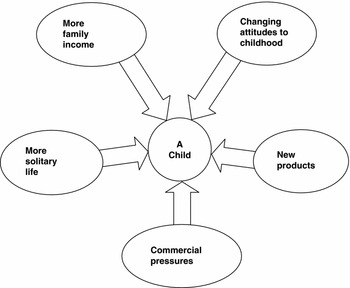
Five changes that have been occurring over the past century, most rapidly over the past few decades, may be distinguished in analysing children's role as consumers.
Family incomes have increased
In real terms, disposable income per head in Britain nearly tripled over the last half century 12005 and doubled over the past 25 years. While many families with children remain far below average income levels, the level of spending on children has increased at least as fast as incomes generally, probably faster since more of additional, discretionary expenditure tends to be spent on children.
Overall, average spending on children amounted in 1997 to around £3,000 per child per year (Middleton et al., Reference Middleton, Ashworth and Braithwaite1997), and had probably risen to at least £4,000 in 2006. Spending on boys and girls was almost the same on average. The variation in spending according to parental economic circumstances was much less than might have been expected. For families on Income Support, what was provided by social security for the children met only 70 per cent of what was actually spent on the children suggesting that many parent(s) were making personal sacrifices to maintain their children's consumption level.
Children lead more solitary lives
The change from childhood being a phase of life involving extensive production to one marked principally by consumption was described by Hardyment (Reference Hardyment1998):
In the past children of all classes had an important domestic role of their own. They helped with domestic management, waited at table, sewed, ran errands, took responsibility for hens, weeded vegetable patches. They also earned money, supplementing low family incomes rather than being a drain on them. Legislation and education have changed all this. Childhood is now an experience of consuming food, clothes and entertainments manufactured outside the home and bought with parents' hard-earned cash, rather than a matter of learning about and contributing to a busy centre of production. The average dual-career family's home is often distinctly dull and lonely for children. Our response has been to supply them with ever more fantastical and hygienic plastic toys, and create special child-orientated environments.
Families are now smaller and more mothers are in paid employment. In 1971, 59 per cent of women aged 16–59 were economically active; by 2005, this proportion had risen to 73 per cent.Footnote 1 Yet, ironically, as mothers are more engaged in paid work, children are less so. Children are generally more protected from work, except school work. This has surely affected their self-reliance and work ethic.
Concerns about safety and growing car ownership have also changed children's lives. In the past almost all children from very young ages went to school and came home on foot or by bus. It was a learning experience in social interaction. Now children walking to school are endangered by fleets of children being ferried to school in cars. Playing outside is restricted because of concerns about safety, but also because areas for play are restricted and adults may be less tolerant of children – ‘no ball games’ is a depressing sign.
At home, in the past, children's bedrooms tended to be shared and were rarely heated. Now much of the time is now spent by children in their own, warm bedroom. This is encouraged by ‘personal’ televisions: 60 per cent of British children aged 9–11 had a television in their bedroom in 1997–98, a substantially higher proportion than in other European countries (Livingstone, Reference Livingstone2002, Table 2.2). The average time spent watching TV by children aged 9–17 in the UK in 1997 amounted to 900 hours (Livingstone, Reference Livingstone2002), substantially more than the time spent in class at school. The centrality of television in British children's lives is indicated by the fact that 9 out of 10 children watch it almost every day and the most frequent activity performed by parents with children was watching television. (Livingstone and Bovill, Reference Livingstone and Bovill1999).
In general, children in Britain are living more solitary lives than in the past.
Attitudes to childhood have changed
Childhood may appear a constant in human existence. Yet the status of and attitudes towards children have been in constant flux, as the work of historians such as Ariès (Reference Ariès1965), deMause (Reference deMause1974) and Cunningham (1995) clearly demonstrate.
Children's treatment has in many ways improved over the past century. Ideas that children should be seen and not heard or that physical violence parading as punishment was good for children now seem dated. In many ways, children grow up faster. Physically children mature earlier, many wear teenage or adult dress at younger ages, sexual activity starts earlier, alcohol consumption is growing, as is drug taking. In some ways, parental authority has diminished and more parents accept behaviour unlikely to have been accepted in the past. Fewer families are eating home-prepared meals in the company of their family. Children spend more time shopping independently.
Yet, while children may have more autonomy and licence than in the past, they remain ultimately subject to the authority of adults − whether in the home or at school – or the police and the courts. It is adults who create the world of the child.
New products have been developed
Twenty-five years ago video recorders were rare and trainers were still called gym shoes. Now few children lack one or more of the new electronic gadget -iPods, MP3 players, Nintendo, Play stations, Xboxes, mobile phones and many more. This electronic revolution has proved particularly fascinating for children and they have adapted to it far faster than older people. In fashion, new magazines expressly targeted at teenagers have been started, such as Teen Vogue, and there are new fashion ranges, such as Armani Junior. Thus in many ways amazing and largely unforeseen opportunities and delights for children have opened up.
Commercial pressures on children have increased
The growth in spending by and for children reflects higher living standards generally but it has undoubtedly been boosted by the efforts of the advertising industry. Marketing targeted at children, including infants, often based on highly sophisticated and manipulative psychology, is a growth area in the advertising industry. While this advertising is increasingly linked to the internet, to product placement, to commercial sponsorship and to movie spin-offs, the main form remains television commercials. It was estimated that children in the US are exposed on average to about 20,000 commercial messages per year (Adler et al., Reference Adler, Lesser, Meringoff, Robertson, Rossiter and Ward1980); the average child in Britain sees at least 10,000 commercials each year.Footnote 2
Twenty-five years ago, children's programmes on both BBC and commercial channels were typically about 10 minutes of cartoons in the morning and 45 minutes of children's programmes in the afternoon. Now far more TV time is directed specifically at children from 6 am onwards. The increase in programme hours understates the increase in commercial content. Twenty years ago most of the children's programmes had no commercial content and even on commercial television there were few commercial breaks. Now on commercial television, there are regular and sophisticated commercials and on BBC there are countless product-related programmes, promotions and prizes.
The rise in the number of television sets in bedrooms has led to ‘very young children increasingly experiencing media messages on their own without any parental supervision. This decreases the parents' ability to serve as a buffer between their children and the commercial’ (Kunkel et al., Reference Kunkel, Wilcox, Cantor, Palmer, Linn and Dorwick2004: 3).
The nature of advertising has changed. It is increasingly being directed at younger age groups. It is no longer restricted to toys but now encompasses a wide range of products; everyday products such as toothbrushes and stationery are being turned into branded goods linked with toys or movies in order to be sold to children.
The most rapid area of growth of advertising directed at children has been in internet advertising, but as yet the scale of this is not well documented. One aspect of many internet sites is the blurring of the lines between commercial and non-commercial content.
Quite apart from direct advertising, there is extensive use of television and films to sell products. The programme or film itself can be almost incidental in commercial terms. It is part of a marketing strategy to sell the toys and spin-off branded goods. Sales of products based around Postman Pat, Noddy and the Teletubbies run into hundreds of millions; Star Wars merchandising is in another league, having made more than $3 billion, and Harry Potter is catching up.
Other more subtle commercial pressures are exerted indirectly and sometimes deviously. For example, it seems unlikely that Coca Cola's sponsorship of the Olympic Games was wholly motivated by a concern for children's health.
The five changes described above have occurred simultaneously and involve complex interactions. The main effects can be illustrated as follows:
There are many interactions between these changes. For example, as new products are developed, commercial pressures are put on children to buy them and as new products are sold, that leads to new pursuits (e.g. more time on computer games), leading to the development of yet more products. More family income leads to more child-related expenditure, leading to advertisers putting more pressure on children and on parents (either directly or indirectly via the ‘pester power’ of children).
Influences on children

Treating all these changes as a complex, inseparable jumble tends to make them all seem inexorable and inevitable. It is important to separate a number of the concurrent changes, particularly if anything is to be done about them. Distinction is needed between:
1 Levels of consumption of children.
2 Levels of expectations about the consumption of children and what children need to consume.
3 The extent of stimulus, bombardment or noise in children's lives and the availability of space and silence for children to be themselves and develop.
4 Commercial pressures resulting in harm to children.
To describe all the changes in childhood as being the result of commercial pressures, as some writers have tended to do, is neither justifiable nor helpful. Families are better off and technological progress has extended the range of children's opportunities. These desirable developments have changed the pattern of children's lives; they cannot sensibly be described as commercialisation or as being directly attributable to commercial pressures. The only element of the changes discussed that can usefully be described as ‘commercialisation’ is the ‘commercial pressures’ component. It is on this that the rest of this paper concentrates. In the next section, the question of whether these commercial pressures matter is addressed.
First, clarification is needed of what is not being discussed. The question here is not whether childhood has improved as a result of all the many changes that have occurred. In many, many respects childhood is now more fun, free and stimulating than it was in the past. This observable fact does not, however, mean that children need no protection or that the extent of commercial pressures is appropriate, desirable or legitimate.
Commercial pressures may be part of modern childhood but their effects need careful examination.
Do commercial pressures matter?
Selling goods is an inherent part of a capitalist economy. All recognise that children require some protection but, broadly speaking, the advertising industry believes this should be minimised. It is argued that the sooner children get used to choosing and consuming the better.
In opposition to this view, many psychologists believe that advertising to children is exploitative because young children do not understand the world in the same way older children and adults do, making them more vulnerable to the influence of advertising (e.g. Levin and Linn, Reference Levin, Linn, Kasser and Kanner2004).
Research by Kunkel et al. (Reference Kunkel, Wilcox, Cantor, Palmer, Linn and Dorwick2004) showed that children aged two or three are unable to distinguish between adverts and normal programmes. They concluded that: ‘there is a significant amount of advertising uniquely designed for and specifically directed at audiences of young children. Such advertising efforts, in our view, are fundamentally unfair because of young children's limited comprehension of the nature and purpose of television advertising’ (p. 23).
Only half of six- to seven-year olds were able to explain that the purpose of advertising was to sell products (Robertson and Rossiter, Reference Robertson and Rossiter1974). It is around the age of seven or eight that children begin to understand that adverts are not always truthful (Roedder John, Reference Roedder John1999). Young children without the ‘cognitive defences’ against advertising that develop as they get older are undoubtedly at risk of exploitation.
Commercial pressures are important for children's health. Increasing childhood obesity suggests that affluence does not necessarily result in sound nutrition. The consumption of crisps, snacks, sweetened soft-drinks and junk food generally is promoted by vast advertising expenditure. It may safely be assumed that this advertising has a positive impact on consumption, and thereby yields financial returns, even if it has a negative impact on physical health.
It is not only physical health that may be affected by commercial pressures. Schor (Reference Schor2004) found that children engrossed in consumer culture suffered more depression, anxiety and lower self-esteem. One of the reasons she suggests for this is that children may find it difficult to keep up with consumer culture, leading to feelings of inadequacy, translating into less confidence in dealing with their friends and even their family. This was illustrated by Ridge (Reference Ridge2002) quoting a child: ‘if you don't wear trendy stuff. . .not so many people will be your friend ‘cos of what you wear’ (p. 68). Kilbourne (Reference Kilbourne, Kasser and Kanner2004) argues consumer culture has a particular influence on young female adolescents who, more than males, are affected by a loss of self-esteem and confidence, contributing to eating disorders; advertising promotes ‘abusive and abnormal attitudes about eating, drinking and thinness’ (p. 257). Girls are being told the most important thing about themselves is the way they look. Adverts portraying the ideal as achieving flawless beauty and suggesting that if they put enough effort in, with the right products, they can achieve this places stress on girls at a confusing period in their lives.
Another commercial pressure affecting mental health and children's development is what has been called ‘age compression’. Products usually used by older children are increasingly being targeted at younger ones. Pufall and Unsworth (Reference Pufall and Unsworth2004) are concerned about advertisers interfering with the development of children's own self-identity. They suggest there should be particular concern about aggressive marketing aimed at toddlers.
Advertising may also add to intra-family conflict by stimulating desires in children which are then refused by parents, generating resentment in the child and arousing guilt in the parents (Furnham and Gunter, Reference Furnham and Gunter1998). Robertson (Reference Robertson, Adler, Lesser, Meringoff, Robertson, Rossiter, and Ward1980) suggests this strain on child–parent relations will be greatest among the economically disadvantaged who will have to deny more of these requests, and this may result in maladaptive behaviour, with parents changing their family's consumption patterns to meet their children's demands.
For parents living in poverty, commercial pressures may intensify the problems of managing on a very low income. Middleton et al. (Reference Middleton, Ashworth and Walker1994) have documented the pressures on low income parents struggling to ensure that their children are not left without. On advertising they concluded:
Advertisers spend vast amounts of money targeting children and the evidence. . . suggests that this is money well spent. Children remember advertisements with great clarity . . . They are aware of the purpose of advertisements but admit to being sometimes influenced by them . . . children – especially older ones – admit to appending their ‘own’ money as a result of advertising . . . Younger children have little spending power in their own right and have to turn to their parents. Like the older children, they consciously use advertising to put pressure on their parents to spend, spend, spend . . . Advertising must be, therefore, yet another source of pressure which falls disproportionately on poorer families. (pp. 85–86)
More tentatively, Gunter et al. (Reference Gunter, Oates and Blades2005) concluded:
Two of the most important influences upon children's consumer socialization are parents and peer groups . . . although there has been little research into the relative importance of advertising influences, parental influence, and peer influence. In fact, it might be difficult ever to establish exactly how these influences interact as the precise balance of influence from advertising and from other sources varies depending on many factors. These factors will include the age of the child, the child's perception of the importance of parents' or peers' comments at the time, and the attractiveness of a particular product. The relationship between such factors is likely to be fluid, and the relative importance of any one factor may be hard to determine. (pp, 167–8)
A survey of young people's shopping carried out for the National Consumer Council found that: ‘Advertising makes poverty bite. The children that have the least, in socio-economic groups C2 and DE, are most interested in consumer and materialist concerns. This ‘aspiration gap’ is most marked in the poorest households’ (Mayo, Reference Mayo2005).
The government in 1999 set the goal of ending child poverty within a generation. The poverty level rises, as it should, with rising living standards generally since what are regarded as ‘needs’ change over time (see, for example, Lister, Reference Lister2004). Direct pressures on children can only tend to inflate what are seen as necessities, in effect making the goal of ending child poverty harder to attain.
A much broader issue is whether advertising increases materialism and whether this is harmful. Advertising is not of course the only cause of materialism – we live in a material world. But Levin and Linn (Reference Levin, Linn, Kasser and Kanner2004) argue that advertising is responsible for rising materialism, noting the ‘message central to almost all advertising campaigns – that a particular product can buy happiness’ (p. 226). Kasser and Kanner (Reference Kasser and Kanner2004) believe marketing culture contributes ‘to the formulation of a shallow consumer identity that is obsessed with instant gratification and material wealth’. Sitcoms and dramas where actors often lead lavish lifestyles and game shows such as ‘Who Wants to be a Millionaire?’ offer visions of great wealth and, supposedly, an end to all material problems.
The extent to which material possessions should be pursued or how far they can lead to happiness have exercised philosophers and religious thinkers for centuries. Modern psychologists have found evidence that there is a negative correlation between levels of materialism and individuals' own assessment of their well-being. Correlations do not establish causation so it is possible that unhappy people seek solace in material objects. But Solberg et al. (Reference Solberg, Diener, Robinson, Kasser and Kanner2004) suggest materialistic people may be more unhappy because there is a gap between their real and desired states and there is no limit to how many possessions someone may have. Equally they believe people may be more depressed because they spend less time with their friends and family because they may work harder in order to be able to purchase more goods. Gunter et al. (Reference Gunter, Oates and Blades2005) argue that ‘consumerism generates a value system driven by self-centredness, individual ambition and achievement, and ultimately greed. In other words it generates a society in which people are motivated primarily by the acquisition of wealth and possessions’ (p. 95).
There seems little doubt that commercial pressures increase children's materialism. It is doubtful if this contributes to the psychological well-being of children.
Public policy issues
Every child is, to a substantial degree, a child of their times. Childhood is largely socially constructed. It is therefore important to think intelligently about what sort of childhood we want our children to experience.
Three things should be remembered. First, children have always been a concern and anxiety about childhood goes back a long way. An inscription on a tablet dated around 2800 BC stated: ‘Children no longer obey their parents. Every man wants to write a book, and the end of the world is evidently approaching.Footnote 3 Second, there are many signs that children in Britain and elsewhere are now more aware environmentally and globally, they engage in more voluntary activities, and they are less tolerant of racism and sexism than ever before. Third, more years are spent by more young people investing more time in education with better results; childhood is not all about consumption.
Yet, even if most children are generally fine, this does not mean that the growing commercial pressures discussed here should be a matter of indifference or that there are not many children who are seriously vulnerable to these pressures.
The evidence presented here indicates that the freedom of children is being eroded and their rights ignored. It is now widely recognised that children have rights. These are set out in the UN Convention on the Rights of the Child, now recognised, in theory at least, by almost all nations. One of these rights (Article 32) is the right of the child to be protected from economic exploitation
The interpretation of economic exploitation has, up to now, for obvious reasons concentrated on child labour. It is hard to argue that this UN Convention is now being respected with respect to children's exploitation as consumers.
Woodhouse, an American academic lawyer, has proposed five unifying human rights principles in relation to children: the right to be treated as a person, not an object; the right to a voice and, sometimes, a choice; the right to equal opportunity; the right of the weak to be protected from the strong; and the right to protection of intimate relationships – ‘a zone of privacy is essential to the functioning of family systems’ (Woodhouse, Reference Woodhouse, Pufall and Unsworth2004: 235–9).
It is clear that children are weak in the face of the strong commercial pressures. It is also clear that these pressures increasingly intrude on intimate relationships within the family. If children are to enjoy a childhood free from commercial pressures, the law can and should be used to protect their rights.
Yet whether commercial pressures on children matter enough to require more effective control ultimately depends on one's view of what childhood is and should be. It depends on answers to some of these questions:
• Are the commercial pressures on children a cause for real concern or only of interest to envious, ageing and puritanical kill-joys?
• Does it matter that children are manipulated for commercial ends?
• Are commercial pressures intruding on the privacy of the family?
• Should childhood be a protected space, free from commercial pressures?
• If childhood should be protected until an age when the pressures can be understood for what they are and those pressures can be resisted, what is that age and what protection is needed?
A study which over 30 years ago raised many of the issues that arise from this study was Richard Titmuss's study of the supply of human blood for medical purposes, The Gift Relationship (Reference Titmuss1970). He compared blood donation in Britain with the private buying and selling of blood in the United States. He concluded that the commercialised market was inferior in terms of economic and administrative efficiency, the price to the patient and the quality of the blood. The freedom of the unfettered market, Titmuss argued, ultimately restricted freedom and undermined the ‘gift relationship’ involved in blood donation:
If it is accepted that man has a social and a biological need to help then to deny him opportunities to express this need is to deny him the freedom to enter into gift relationships.
Titmuss envisaged a freedom-promoting role for social policy in the future:
There are other aspects of freedom raised in this study which are or can be the concern of social policy. Viewed negatively or positively they relate to the freedom of men not to be exploited in situations of ignorance, uncertainty, unpredictability and captivity . . . . It is the responsibility of the state, acting sometimes through the processes we have called ‘social policy’, to reduce or eliminate or control the forces of market coercions which place men in situations in which they have less freedom or little freedom to make moral choices. (p. 242)
The present study is not about blood but about children. It is hard to imagine that Titmuss would have regarded the ‘forces of market coercion’ as adding to the freedom of children. As he wrote of competing claims over how blood should be distributed:
The choice between these claims – between different kinds of freedom – has to be a social policy decision; in other words, it is a moral and political decision for society as a whole. (p. 242)
It is similarly a moral and political decision for society as a whole whether children should have the freedom to grow up free of exploitation by commercial pressures.
Many, perhaps most, treat increasing commercial pressures as part of the way of the world, an inevitable development about which nothing can be done. It may be regrettable but there it is and children must live with it. If childhood is primarily a preparation for an adult commercial world, then, providing there are the sort of minimal protections such as now exist, there is little cause for concern and nothing much needs to be done. This is the approach taken by all recent British governments.
Up to now, the general corporate attitude in Britain has not been irresponsible – advertisements are not allowed to depict children in dangerous settings such as taking sweets from strangers. But the prevailing corporate attitude towards the wider impact on childhood has been aresponsible – an absence of responsibility, with no apparent concern about the overall impact of commercial pressures on children.
An alternative view is that we are all jointly responsible for our children's future – parents, government, civil society and corporations too. This view is encompassed in the African saying, ‘It takes a village to raise a child.’ On this view, corporate responsibility extends to the impact of corporate behaviour on children. If the commercial pressures on children are to be curbed, then the corporate sector can no longer be treated as aresponsible or allowed to act in this way. It also requires the government to act decisively to ban advertising directed at children, at the very least young children.
Such an approach has been taken by the Swedish government, which in 1991 legislated to ban any television advertisements at any time aimed at children under 12, to ban any commercial advertisements before or after a programme intended for children and to prevent anyone appearing on children's television from appearing in any kind of advertisement.
How the regulation of advertising has affected children's behaviour remains uncertain. In part, this is because advertising is only one of many influences; as Gunter et al. (Reference Gunter, Oates and Blades2005) wrote: ‘Advertising certainly plays a role in enhancing the young consumer's product and brand awareness, brand image, brand preference, and in turn, brand selection. Advertising does not act alone in this context, however’ (p. 118). In part it is because of the lack of research; as Livingstone (Reference Livingstone2004) wrote: ‘Surprisingly little research has evaluated the effectiveness of advertising regulation and there is next to none on the effectiveness of banning food advertising from children's television since few if any countries have implemented an effective ban on food advertising. Although most countries in the EU regulate advertising to children, few of these policies have been tested for their effectiveness in changing children's buying behaviour or food preferences’ (p. 4).
From the free bag of samples distributed in maternity units, to commercials on television, websites, videos, computer games and cinemas, passing advertisements in school corridors, swimming pools, streets and supermarkets, with logos attached to shirts and shoes and school sports, children in Britain now experience a relentless stream of marketing messages at home, at school, at play and in the community. For many children this stream starts as soon as they wake up and continues until they go to sleep.
These commercial pressures have been gathering pace with each generation of children. The internet is adding new opportunities and new pressures. As Livingstone (Reference Livingstone2008) put it:
every child still wants – and most get – a television in their bedroom . . . Significantly, they still spend more time with television than with any other medium, and neither more nor less than they did when television was first introduced into Britain half a century ago . . . The internet . . . is highly commercialized, addressing children far more as consumers than as citizens. And, crucially, it introduces as many risks and problems as it promises solutions. (pp. 5–6)
If unfettered, there is no reason to think that commercial pressures on children will do anything but continue to increase. It is up to the whole of society – parents, civil society, corporations and government – to decide if such a future is desirable and acceptable. If not, all must act together to create a better future for children – and in turn, as generation succeeds generation, a better future for the whole society.
The evidence presented here suggests that the freedom of children would be substantially enhanced if commercial pressures were drastically curtailed. This might comprise:
(a) The end of all advertising and other commercial pressures of any sort on any media, directly or indirectly targeted at children aged under seven.
(b) The end of all advertising directed at children aged seven to 15 where this may have adverse effects on some children's health, education or their personal or social development.
(c) Control of this advertising to be made the responsibility of a body whose primary concern is with children, rather than, as now, being left to self-regulation by the advertising industry.
Each child should be free to be a child.
Acknowledgements
David Piachaud is Professor of Social Policy and an Associate of the Centre for Analysis of Social Exclusion at the London School of Economics. He is grateful for helpful comments and assistance from Sarah Ashwin-Siejkowski, Howard Glennerster, Helen Goodman, Andrew MacAskill, Anne MacAskill, Anne West and Pauline Withers-Born and two anonymous referees. Most of all, he is indebted to Lily and Toby Piachaud who have taught him about being a child today.