Introduction
Cities with surrounding suburban areas represent a practical model for studying the effect of urbanization on discrete species and communities of species. McKinney (Reference McKinney2008) showed that the species richness of plants, invertebrates, amphibians, reptiles and mammals decreases in the urban areas. The effect of a moderate degree of urbanization (suburban area) on the species richness of these groups of organisms is variable.
Urbanization affects both free-living and parasitic organisms. Growing cities increasingly intrude into the wild, and affect the distribution and transmission success of parasites. Continued rapid urbanization has increased the importance of research on wildlife diseases in urban landscapes (Bradley & Altizer, Reference Bradley and Altizer2007). Moreover, parasites are very sensitive indicators of environmental degradation (Vidal-Martinez & Wunderlich, Reference Vidal-Martinez and Wunderlich2017), caused by urbanization.
In developing countries, progressive urbanization is associated with the unplanned, uncontrolled and constant migration of people from rural to urban settlements. This migrant population brings, among other things, intestinal parasitic diseases, the level of which is already high in these settlements (Crompton & Savioli, Reference Crompton and Savioli1993). The level of intestinal parasitoses in La Plata, Argentina was reduced as follows: a marginal zone > a suburban neighbourhood > an urban area (Gamboa et al., Reference Gamboa, Basualdo, Cordoba, Pezzani, Minvielle and Lahitte2003).
In a study on the impact of urbanization on the epidemiology of intestinal helminths in red foxes, in Geneva (Switzerland), it was shown that dixenous helminths that depend on rodent intermediate hosts are negatively affected by urbanization, as a result of the lower supply of rodents in the urbanized environments (Reperant et al., Reference Reperant, Hegglin, Fischer, Kohler, Weber and Deplazes2007). Rodents may represent valuable indicators of infection pressure by free-living stages of Echinococcus multilocularis, Toxocara spp. and Toxoplasma gondii for humans in urban environments (Reperant et al., Reference Reperant, Hegglin, Tanner, Fischer and Deplazes2009).
The presence of humans in cities and the associated altered urban landscape characteristics are associated with increased infections with gastrointestinal parasites in house finches (Haemorhous mexicanus) (Giraudeau et al., Reference Giraudeau, Mousel, Earl and McGraw2014). Urbanization leads to a significant reduction in the helminth fauna of the Eurasian blackbird (Turdus merula L.), which is highly adapted to synanthropic habitats (Sitko & Zaleśny, Reference Sitko and Zaleśny2014). Environmental changes, such as changes in land use and wetland characteristics, nutrient runoff, pesticide contamination, biodiversity loss and climate change, have demonstrated the potential to enhance infection with Ribeiroia and Echinostoma in amphibians (Johnson & McKenzie, Reference Johnson, McKenzie, Fried and Toledo2009). The above studies were related to the impact of urbanization on parasites of humans, mammals, birds and amphibians. Investigations of the effect of urbanization on reptilian parasites are still absent.
Reptiles perform important functions in natural ecosystems by serving as predators, prey for predators, pasture inhabitants, seed dispersers and synanthropes; they also serve as bioindicators of environmental conditions (Böhm et al., Reference Böhm, Collen and Baillie2013). The Mongolian racerunner (Eremias argus) is found in eastern Mongolia, China, the western part of the Korean Peninsula and Russia. In Russia, this racerunner is distributed in southern Buryatia and the south-western part of the Zabaikal'skiy region (Ananjeva et al., Reference Ananjeva, Orlov, Khalikov, Darevsky, Ryabov and Barabanov2004). The only helminthological study of the Mongolian racerunner within Zabaikalie was conducted by Sharpilo (Reference Sharpilo1976). The aim of this research was to study the impact of the degree of urbanization on mean abundance, species composition and community structure of the parasites of E. argus.
Materials and methods
Samples
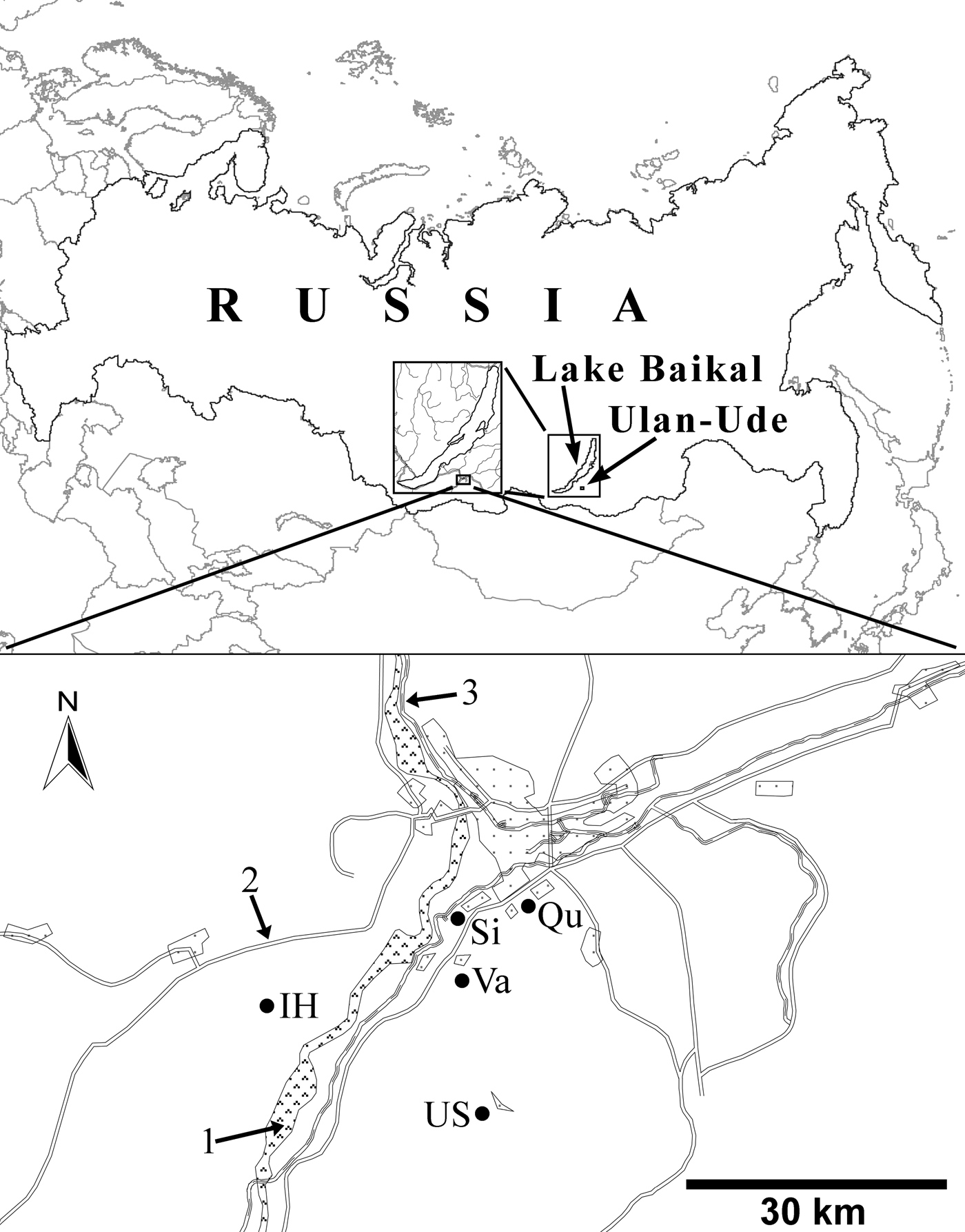
In this study, Mongolian racerunners were captured at five different sampling locations in the city of Ulan-Ude, and Ivolginsk and Tarbagatay regions adjacent to the city of Ulan-Ude. The five key areas are: (1) Ivolginsky Hollow (IH) (Ivolginsk District) (51°43′48″N, 107°22′10″E); (2) Upper Sayantuy (US) (Tarbagatay District) (51°42′22″N, 107°34′09″E); (3) Vakhmistrovo village (Va) (Tarbagatay District) (51°44′02″N, 107°33′14″E); (4) Silikatnyi village (Si) (Ulan-Ude city) (51°45′39″N, 107°33′05″E); (5) Neighbourhood No. 113 (Qu) (Ulan-Ude) (51°45′49″N, 107°35′52″E) (fig. 1).
Map of Baikal region, showing the localities where Mongolian racerunners were collected. Dark circles indicate sampling sites (IH, Ivolginsky Hollow; US, Upper Sayantuy; Va, Vakhmistrovo village; Si, Silikatnyi village; Qu, Neighbourhood No. 113). Polygons with grey squares indicate populated areas; 1, Selenga River; 2, road; 3, railway.

The five key areas were categorized into three grades based on the degree of urbanization, in accordance with the classification of the degrees of urbanization (DEGURBA) of the European Commission (Dijkstra & Poelman, Reference Dijkstra and Poelman2014), which is as follows: (1) thinly populated area (rural area) (outside urban clusters); (2) intermediate density area (towns and suburbs or small urban area) (a density of at least 300 inhabitants/km2); (3) densely populated area (cities or large urban area) (a density of at least 1500 inhabitants/km2). These grades were applied for the statistical analysis of the data.
The key area IH refers to the thinly populated (rural) cluster (rank 1). It is located in the steppe area, outside human settlements. The locations within this key area where Mongolian racerunners may be obtained are scarcely susceptible to urbanization. They are separated by considerable distances from the populated areas, partly located within the forest shelter belts and partly within rocky areas with an extremely rugged terrain (these areas are not arable).
The key areas US and Va are moderately populated (suburbs – rank 2). The first of these areas is located near the eponymous village with a constant population of about 400 people. The area Va is close to the federal highway with heavy traffic. Several suburban settlements are located close to this key area.
The key areas Si and Qu refer to the cluster of densely populated areas (cities – rank 3). In the Si region, buildings and streets are seen. Apartment buildings are also seen in the second area, Qu.
In this study, Mongolian racerunners were obtained during the summers of 2009 and 2011–2012; numbers of specimens: IH, 39; US, 27; Va, 35; Si, 90 and Qu, 17. Most of the lizards (121 specimens) were accidentally caught in pitfall traps for soil insects and transferred to our laboratory for dissection. A total of 87 specimens were caught by hand. Captured lizards were sacrificed with a lethal injection of sodium thiopental. The lizards were dissected in the laboratory, post-mortem examinations of the body cavity, digestive tract, kidneys, liver, lungs, brain, eyes and muscles were examined for helminth parasites, using a stereomicroscope Stemi 2000 (Carl Zeiss, Göttingen, Germany). The worms found were fixed in 70% ethanol. Nematodes and acanthocephalans were mounted temporarily on slides and cleared with lactophenol or glycerin. Cestodes were stained with acetic carmine and, after dehydration, were mounted with Canada balsam. Worms were identified with the use of a microscope (AxioImager.M2, Carl Zeiss). All helminths were identified using the relevant keys (Petrochenko, Reference Petrochenko1958; Sharpilo, Reference Sharpilo1976). Worms were deposited in the helminthological collection of the Institute of General and Experimental Biology, Siberian branch, Russian Academy of Sciences.
Definitions
In this study, species richness was considered as the total number of parasite species found, and the mean species richness was the sum of the number of parasite species in each individual host divided by the number of hosts analysed. Mean number of specimens of helminth species was the sum of the number of helminth specimens in each individual host divided by the number of hosts analysed. Mean abundance was the total number of individuals of a particular parasite species in a sample of a particular host species divided by the total number of hosts of that species examined (including both infected and uninfected hosts). Prevalence was the number of hosts infected with one or more individuals of a particular parasite species (or taxonomic group) divided by the number of hosts examined for that parasite species. The following definitions of parasite communities were applied: infracommunity – all parasite species within an individual host; component community – all parasite infracommunities within a host population (Bush & Holmes, Reference Bush and Holmes1986; Goater et al., Reference Goater, Esch and Bush1987; Bush et al., Reference Bush, Lafferty, Lotz and Shostak1997).
Evaluation of helminth communities
To evaluate the helminth infracommunities of the Mongolian racerunner, four parameters were applied: (1) species richness, (2) dominance, (3) evenness and (4) species diversity based on the relative abundance of species. Species richness was evaluated based on the number of parasite species – mean species richness, Menhinick and Margalef indices; dominance – Berger–Parker index; evenness – Simpson, Camargo, Smith and Wilson evenness indices; species diversity was based on the relative abundance of species – Brillouin index. In addition to these indicators, the number of parasite specimens was determined. To characterize the helminth component communities, the total number of parasite species, the proportion of hosts infested with parasites, the Berger–Parker index of dominance and the Shannon index were used. These indices are widely used for studying various groups of organisms (Smith & Wilson, Reference Smith and Wilson1996; Magurran, Reference Magurran2004; Payne et al., Reference Payne, Schindler, Parrish and Temple2005).
Statistical analyses
The correlations between the mean abundances of the Mongolian racerunner helminths in various key areas and the degree of urbanization of these areas were calculated using Spearman's rank correlation coefficient. This analysis was repeated to establish the relationship between parameters of helminth communities of this host in various key areas and the degree of urbanization of these areas. Further, the mean abundance data of each helminth species of E. argus among key areas were compared using Mann–Whitney's U-test. This analysis was repeated to compare the parameters of helminth infracommunities of this host among the key areas. Thereafter, the proportions of E. argus specimens infected with parasites among the key areas were compared. Statistical analyses were carried out using STATISTICA 6.0 software (StatSoft Russia, Moscow, Russia).
Results
Fauna of helminths
Seven species of helminths were observed in the Mongolian racerunner: the cestodes Oochoristica tuberculata and Mesocestoides lineatus; the nematodes Spauligodon pseudoeremiasi, Abbreviata abbreviata, Skrjabinelazia hoffmanni and Spirocerca lupi; and the acanthocephalan Macracanthorhynchus catulinus. The composition of the helminth fauna of E. argus inhabiting discrete key areas ranged from two species (Qu) to six species (Va).
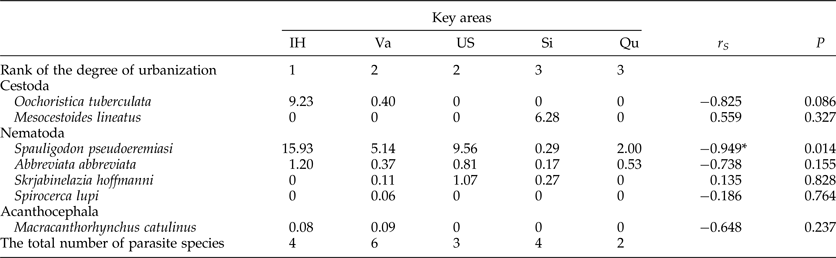
Two species of nematodes, S. pseudoeremiasi and A. abbreviata, were recorded in all key areas. The nematode S. pseudoeremiasi was predominant among helminths of the Mongolian racerunner in four key areas: IH, Va, US and Qu. Si was the only key area where S. pseudoeremiasi could not prevail. There was a statistically significant reduction in the mean abundance of S. pseudoeremiasi with increasing degree of urbanization, with its highest mean abundance being registered in the key area IH and the lowest in the key area Si. Abbreviata abbreviata was a subdominant species.
The high level of infection of E. argus with the cestode O. tuberculata was mainly observed in the key area IH, but rarely in the key area Va. Oochoristica tuberculata was not found in any of the other three areas. The cestode M. lineatus in the Mongolian racerunner was registered only in the key area Si, where it was found to be predominant. The nematode S. hoffmanni was found to have a low prevalence in the host in three key areas – Va, US and Si. Single specimens of acanthocephalan M. catulinus were observed in two key areas (IH and Va) and the nematode S. lupi in one (Va) (table 1).
Correlations of mean abundances of helminths infecting Mongolian racerunner in different key areas with the degree of urbanization of these areas.

*Statistically significant values of r S .
The infracommunities of helminths
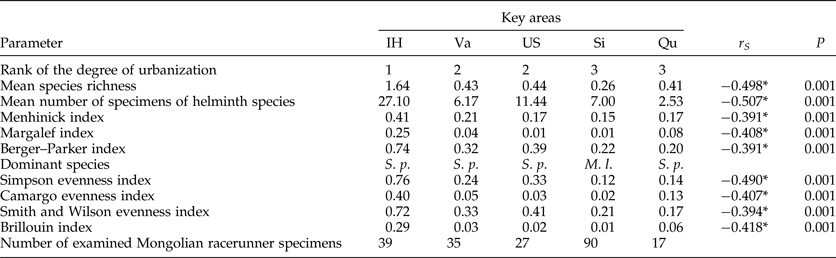
All indicators of the parasite infracommunities of E. argus (the number of species and number of specimens; species richness indices (Menhinick and Margalef); Berger–Parker index of dominance; evenness indices of Simpson, Camargo, Smith and Wilson; Brillouin diversity index) had negative, statistically significant correlations with the degree of urbanization (table 2).
Correlations between parameters of Mongolian racerunner helminth infracommunities and the degree of urbanization of the key areas.

*Statistically significant values of rS. S. p., Spauligodon pseudoeremiasi; M. l., Mesocestoides lineatus.
The parameters of the parasite infracommunities of the Mongolian racerunner (the number of species and number of specimens; the indices of species richness of Menhinick and Margalef; the Berger–Parker index of dominance; Simpson, Camargo, and Smith and Wilson evenness indices; Brillouin diversity index) in the key area IH were statistically higher as compared with all the other key areas (P < 0.01).
The component communities of helminths
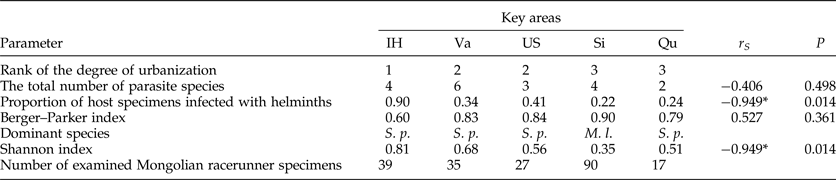
The proportion of host specimens infected with helminths in the component communities of E. argus decreased in a statistically significant manner with increasing degree of urbanization of the key areas. The Shannon index decreased in a statistically significant manner with increasing degree of urbanization of the key areas (table 3).
Correlations between parameters of Mongolian racerunner helminth component communities and the degree of urbanization of the key areas.

*Statistically significant values of rS. S. p., Spauligodon pseudoeremiasi; M. l., Mesocestoides lineatus.
The proportion of the host specimens infected with helminths in the component communities of the Mongolian racerunner in the key area IH was statistically higher as compared with all other key areas (P < 0.001).
Discussion
The nematode S. pseudoeremiasi was the dominant species among helminths of the Mongolian racerunner in four key areas. The life cycle of S. pseudoeremiasi is yet to be described. However, all nematodes of the order Oxyurida have a direct life cycle (Adamson, Reference Adamson1989). Nematodes with a direct life cycle, especially Capillaria inequalis and Thelandros magnavulvaris, dominated the parasite fauna of the salamanders Leurognathus marmorata, Desmognathus quadromaculatus, D. monticola and D. ochrophaeus (Goater et al., Reference Goater, Esch and Bush1987). It is possible that the direct life cycle of S. pseudoeremiasi may contribute to the dominance of the nematode among E. argus parasites. Spauligodon pseudoeremiasi was the only helminth of the lizard, whose infection reduced in a statistically significant manner with increasing degree of urbanization of key areas. Therefore, this parasite species is the most appropriate bioindicator (of the seven species studied) of the degree of urbanization in our research.
The life cycle of A. abbreviata is unknown. Studies have been carried out on A. kazashstanica, whose intermediate hosts are 20 species of insects from five families (Tenebrionidae, Tettigonidae, Acrididae, Gryllidae and Manteidae) and three orders (Orthoptera, Coleoptera and Mantoptera). The diversity of the intermediate hosts contributes to the successful infection of the definitive hosts (Kabilov, Reference Kabilov1980). The subdominant status of A. abbreviata in the Mongolian racerunner may testify to a wide range of its intermediate hosts. This, therefore, promotes the occurrence of this species in all key areas.
The cestode O. tuberculata was observed in E. argus with a high infection level only in the key area IH. It was found sporadically in the area Va, but not reported in the other three areas. The life cycle of O. tuberculata is yet to be identified. It has been found experimentally, in the North American species of the genus Oochoristica, that the life cycle of these cestodes is complex. Their intermediate hosts are beetles of the family Tenebrionidae and Dermestidae, larvae of butterflies of the family Pyralidae and grasshoppers of the family Acrididae (Rendtorff, Reference Rendtorff1948; Millemann, Reference Millemann1955; Widmer & Olsen, Reference Widmer and Olsen1967; Conn, Reference Conn1985; Criscione & Font, Reference Criscione and Font2001). The high level of infection of the Mongolian racerunner with O. tuberculata in the key area IH can be attributed to the high level of trophic relations of lizards with intermediate hosts of the cestode, especially with darkling beetles, which are significantly abundant in this area.
Mesocestoides lineatus is the dominant species among helminths of the Mongolian racerunner only in the key area Si. Data regarding the life cycle of species of the genus Mesocestoides are fragmented. This species has a complex life cycle. The first intermediate hosts of the genus Mesocestoides remain unidentified; it is only known that they are arthropods (insects, mites). The second intermediate hosts of M. lineatus are amphibians, reptiles, birds and small mammals; those in Buryatia are the brown rat Rattus norvegicus, the Chinese striped hamster Cricetulus barabensis, the house mouse Mus musculus, the Siberian chipmunk Tamias sibiricus, the long-tailed ground squirrel Spermophilus undulatus and the wood lemming Myopus schisticolor. The definitive hosts of M. lineatus are carnivorous mammals, mainly foxes, dogs and cats (Chertkova & Kosupko, Reference Chertkova, Kosupko and Ryzhikov1978); those in Buryatia are the dog Canis lupus familiaris, the red fox Vulpes vulpes, the cat Felis silvestris catus, the Eurasian lynx Lynx lynx, the mountain weasel Mustela altaica, the sable Martes zibellina and the Pallas's cat Felis manul (Zhaltsanova, Reference Zhaltsanova1992). The Mongolian racerunner is also a second intermediate host of M. lineatus. The infection of E. argus with tetrathyridia of M. lineatus in the key area Si only, indicates that there are already established stable trophic relations of definitive hosts of the cestode with the lizard in that area. Si is an industrial district of Ulan-Ude, with construction businesses and residential buildings. The presence of abandoned buildings in close proximity to apartment blocks contributes to an increase in the number of packs of stray dogs. Foxes have been observed in the area Si. It has been reported that foxes do not shy away from humans and have become synanthropic species in Europe (Scott et al., Reference Scott, Berg, Tolhurst, Chauvenet, Smith, Neaves, Lochhead and Baker2014). Mesocestoides lineatus was the dominant species in this key area, instead of S. pseudoeremiasi.
Of the genus Skrjabinelazia, the life cycle of only S. galliardi has been studied previously. In S. galliardi, young females are larviparous, they produce thin-shelled eggs, infective stage 3 larvae and likely contribute to propagation within the host. Older large females produce numerous thick-shelled eggs containing infective stage 3 larvae. Eggs can survive in the ambient environment for at least 14 days. These resistant eggs ensure transmission to new hosts (Chabaud et al., Reference Chabaud, Bain and Poinar1988). The life cycle of S. hoffmanni is probably similar to that of S. galliardi. The low level of infection of the Mongolian racerunner with S. hoffmanni is possibly related to the low degree of trophic relationships of the lizard with intermediate hosts (field crickets) within the area.
The life cycle of M. catulinus is complex; it includes intermediate, paratenic and definitive hosts. The intermediate hosts of this parasite are darkling beetles, Adesmia gebleri (Rizhikov & Dizer, Reference Rizhikov and Dizer1954) and Tentyria tessulata (Farzaliev & Petrochenko, Reference Farzaliev and Petrochenko1980). The definitive hosts of this parasite are carnivorous mammals (dog, fox, korsak, badger and others). Macracanthorhynchus catulinus is capable of maturing when transferred from one dog to another (Petrochenko, Reference Petrochenko1958; Sharpilo, Reference Sharpilo1976; Farzaliev & Petrochenko, Reference Farzaliev and Petrochenko1980). The paratenic hosts of M. catulinus are represented by many species of amphibians, reptiles (including the Mongolian racerunner) and mammals.
The life cycle of the nematode S. lupi is complex, involving intermediate, paratenic and definitive hosts. The intermediate hosts of the nematode are various coprophagous beetles. The paratenic hosts of S. lupi are represented by many species of reptiles, wild and domestic birds, as well as small mammals (rodents, rabbits and hedgehogs). The larvae of this nematode are transferred from one paratenic host to another. The final hosts are carnivores, mostly canids (dogs, wolves and foxes) (Bailey, Reference Bailey1972; Van der Merwe et al., Reference Van der Merwe, Kirberger, Clift, Wiliams, Keller and Naidoo2008).
The infection of definitive hosts (carnivores) with the acanthocephalan M. catulinus and the nematode S. lupi through intermediate hosts (beetles) is unlikely or extremely limited. The main source of infection of the definitive hosts with these two species of helminths is paratenic hosts, including reptiles (Sharpilo, Reference Sharpilo1983). Due to their low level of infection, they may be referred to as rare parasites of the Mongolian racerunner.
All indicators of the infracommunities (number of species and number of specimens; the indices of species richness by Menhinick and Margalef; Berger–Parker dominance index; indices of evenness by Simpson, Camargo, Smith and Wilson; Brillouin index), as well as the proportion of host specimens infected with parasites, showed a statistically significant decrease with increasing degree of urbanization (table 2). The decreased number of species and number of parasite specimens of E. argus, indices of species richness by Menhinick and Margalef, and the Brillouin index, as well as the proportion of infected host specimens in the helminth infracommunities with increasing degree of urbanization of the key areas may be attributed to the weakened relations between helminths with complex life cycles and the first intermediate hosts (insects). The decrease in the Berger–Parker dominance index in the helminth infracommunities was due to the diminished infection level of the lizard with the dominant species S. pseudoeremiasi with increasing degree of urbanization in the key areas.
In the component communities of helminths of E. argus, the proportion of host specimens infected with parasites decreased in a statistically significant manner with the increased degree of urbanization in the key areas. This is most likely due to the decreased diversity of insects, including intermediate hosts of helminths, with increase in the degree of urbanization. The statistically significant decrease of the Shannon index in the component communities of helminths of the Mongolian racerunner was based on the gradient of urbanization, reflecting the decrease in number of species and number of specimens in the infracommunities of helminths on this gradient.
Among the five key areas, IH was the only area which referred to the thinly populated (rural) cluster. The other areas were clusters with populations of intermediate and high density. The highest indicators of the infracommunities of parasites of the Mongolian racerunner (number of species and number of specimens, indices of species richness by Menhinick and Margalef; Berger–Parker index of dominance; evenness indices of Simpson, Camargo and Smith and Wilson; Brillouin index), as well as the proportion of host specimens infected with parasites were observed in key area IH. This area has the lowest degree of urbanization in all locations under study. The maximum level of infection with the nematode S. pseudoeremiasi, with most likely a direct life cycle, emphasizes the close relationships among specimens of E. argus within the key area. The highest levels of infection with the cestode O. tuberculata and the nematode A. abbreviata, with complex life cycles, show stable trophic relationships between the lizard and intermediate hosts of helminths (insects). Maximum species richness (six species) was observed in the helminth component community of the Mongolian racerunner in the key area Va, which is due to host infection with M. catulinus and S. lupi. Both of these species are rare parasites of E. argus. At the same time, S. lupi was mainly observed in this key area. The infection of the Mongolian racerunner with M. catulinus and S. lupi, in which the definitive hosts are carnivorous mammals, typically canids, indicated strengthened trophic relationships of these mammals with the lizard. It is likely that the diversity of beetles (first intermediate hosts of these helminths) is relatively high in the Va key area. However, all indicators of the infracommunities and helminth component communities of this host in the key area Va, were noticeably less than in the IH area.
The impact of urbanization manifests through decreased species richness and relative abundance of helminths (Hartson et al., Reference Hartson, Orlofske, Melin, Dillon and Johnson2011; Sitko & Zaleśny, Reference Sitko and Zaleśny2014; Calegaro-Marques & Amato, Reference Calegaro-Marques and Amato2014; Campiao et al., Reference Campiao, Ribas, Silva, Dalazen and Tavares2017). However, an increase in helminth species richness has been observed in rodents inhabiting South-East Asia from forests towards agricultural areas and human settlements (Chaisiri et al., Reference Chaisiri, Chaeychomsri, Siruntawineti, Bordes, Herbreteau and Morand2010). The infection prevalence and magnitude of the multiple infections were greater for red colobus (Procolobus rufomitratus) in the fragmented than the unfragmented forest. An increase in species richness was recorded in parasite communities in the urban areas as compared to the natural areas, only in mammals. This may be due to parasites whose life cycles include humans and domestic animals (Gillespie & Chapman, Reference Gillespie and Chapman2008). The cestode Rodentolepis straminea was observed in wood mouse (Apodemus sylvaticus) only in urban woodland in the British Isles and not in rural and peri-urban areas (Rushworth et al., Reference Rushworth, Boufana, Hall, Brannan, Mastin, Birtles, Craig and Rogan2016). In the present study, the cestode M. lineatus was found in the Mongolian lizard only in the urban area and was not found in the rural area and suburbs. Eremias argus was involved in the circulation of M. lineatus, whose final hosts are canids (dogs and foxes) associated with humans, only in the urban area.
In conclusion: urbanization causes a significant change in the structure of helminth infracommunities of the Mongolian racerunner. All indicators of the parasite infracommunities of E. argus (the number of species and number of specimens; species richness indices (Menhinick and Margalef); Berger–Parker index of dominance; evenness indices of Simpson, Camargo, Smith and Wilson; Brillouin diversity index) and the proportion of host specimens infected with helminths were decreased with increasing degree of urbanization.
Spauligodon pseudoeremiasi can be a sensitive bioindicator of the degree of urbanization, because it is a dominant parasite of the Mongolian lizard and its relative abundance decreases most significantly with increasing degree of urbanization.
There are complex interactions between wildlife, domestic animals and humans in urban areas. Parasites infecting humans are involved in the processes of these interactions. Increasing attention of researchers is necessary for the study of changes in the species composition and structure of parasite communities of reptiles on a gradient of urbanization. There is no doubt that in the course of these studies the role of reptiles in the transmission of zoonotic diseases will be more clearly identified.
Acknowledgements
The authors sincerely thank Natalia Schepina from the Geological Institute of the Siberian Branch of the RAS (Russian Academy of Sciences) and Larisa Khobrakova from the Institute of General and Experimental Biology of the Siberian Branch of the RAS for their help in obtaining the Mongolian racerunner specimens.
Financial support
This research work was carried out within the theme ‘Ecology of parasites of animals in the ecosystems of Baikal region: spatial distribution and parasite–host relationships’ (registration no. AAAA-A17-117011810039-4).
Conflict of interest
None.
Ethical standards
All animal procedures were conducted in accordance with the ethical standards established by the Russian national instructions for the care and use of laboratory animals. There is a Commission on Bioethics in the Institute of General and Experimental Biology of SB RAS, which examines all research projects with the use of animals.