Introduction
Chronic fatigue syndrome (CFS), also known as myalgic encephalomyelitis, is a frequent disorder characterized by intense fatigue that lasts for more than 6 months (Avellaneda Fernández et al., Reference Avellaneda Fernández, Pérez Martín, Izquierdo Martínez, Arruti Bustillo, Barbado Hernández, de la Cruz Labrado and Ramón Giménez2009). A meta-analysis of 14 studies showed that the pooled prevalence of self-reported and clinically assessed CFS in adults is around 3.3% and 0.8%, respectively (Johnston, Brenu, Staines, & Marshall-Gradisnik, Reference Johnston, Brenu, Staines and Marshall-Gradisnik2013). CFS has a significant and deleterious impact on functional status (Nacul et al., Reference Nacul, Lacerda, Campion, Pheby, Drachler, Leite and Molokhia2011), quality of life (Eaton-Fitch, Johnston, Zalewski, Staines, & Marshall-Gradisnik, Reference Eaton-Fitch, Johnston, Zalewski, Staines and Marshall-Gradisnik2020), and suicide risk (Roberts, Wessely, Chalder, Chang, & Hotopf, Reference Roberts, Wessely, Chalder, Chang and Hotopf2016), and is also associated with a major economic burden (Jason, Benton, Valentine, Johnson, & Torres-Harding, Reference Jason, Benton, Valentine, Johnson and Torres-Harding2008). Unfortunately, the etiology of CFS remains unclear (Avellaneda Fernández et al., Reference Avellaneda Fernández, Pérez Martín, Izquierdo Martínez, Arruti Bustillo, Barbado Hernández, de la Cruz Labrado and Ramón Giménez2009), and more research is needed to gain a better understanding of its underlying risk factors.
Recent literature has indicated that CFS is particularly frequent in women and in middle-aged and older adults (Reyes et al., Reference Reyes, Nisenbaum, Hoaglin, Unger, Emmons, Randall and Reeves2003; Rusu, Gee, Lagacé, & Parlor, Reference Rusu, Gee, Lagacé and Parlor2015; Valdez et al., Reference Valdez, Hancock, Adebayo, Kiernicki, Proskauer, Attewell and Proskauer2019). In terms of physical and psychiatric conditions, some studies have found that several disorders are positively associated with CFS (Hanevik et al., Reference Hanevik, Wensaas, Rortveit, Eide, Mørch and Langeland2014; Harvey, Wadsworth, Wessely, & Hotopf, Reference Harvey, Wadsworth, Wessely and Hotopf2008; Tsai et al., Reference Tsai, Lin, Shih, Hsu, Leong, Kuo and Shi2018, Reference Tsai, Chen, Chen, Lio, Kuo, Leong and Wang2019a,Reference Tsai, Chen, Lio, Kuo, Kao, Wang and Yangb; Yang et al., Reference Yang, Kuo, Chen, Chen, Lin, Tsai and Kao2015). For example, a nationwide population-based cohort study of more than 13 000 individuals from Taiwan identified a positive relationship between psoriasis and CFS (Tsai et al., Reference Tsai, Chen, Chen, Lio, Kuo, Leong and Wang2019a). It was also observed in a sample of 5362 participants prospectively followed from birth to the age of 53 years that having a psychiatric disorder between ages 15 and 32 years was a risk factor for a CFS diagnosis later in life (Harvey et al., Reference Harvey, Wadsworth, Wessely and Hotopf2008). These relationships may be explained by shared risk factors such as a dysfunctional immune system and certain personality traits, while dysregulation of the hypothalamic-pituitary-adrenal (HPA) axis may also play a mediating role in these associations. Although the previous studies have yielded interesting findings, they have certain limitations worth noting. First, only a few physical and psychiatric conditions have been investigated so far, and little is yet known about the potential associations between CFS and a wide range of physical and psychiatric conditions. For example, the literature has failed to analyze the relationships between cancer, sleep disorders, and CFS, although evidence suggests that both cancer (Bøhn et al., Reference Bøhn, Thorsen, Kiserud, Fosså, Lie, Loge and Reinertsen2019; Reinertsen et al., Reference Reinertsen, Cvancarova, Loge, Edvardsen, Wist and Fosså2010) and sleep disorders (Pejovic et al., Reference Pejovic, Natelson, Basta, Fernandez-Mendoza, Mahr and Vgontzas2015) may favor the occurrence of CFS. Second, relationships between physical conditions, psychiatric disorders, and CFS have been studied using regression models that were often adjusted for a limited number of comorbidities. This may have biased the statistical analyses and undermined the results of the studies. Third, the majority of this research was conducted in Asian countries (i.e. China (Yang et al., Reference Yang, Kuo, Chen, Chen, Lin, Tsai and Kao2015) and Taiwan (Tsai et al., Reference Tsai, Lin, Shih, Hsu, Leong, Kuo and Shi2018, Reference Tsai, Chen, Chen, Lio, Kuo, Leong and Wang2019a,Reference Tsai, Chen, Lio, Kuo, Kao, Wang and Yangb)), and, since CFS and its symptomatology may vary between cultures (Zdunek et al., Reference Zdunek, Jason, Evans, Jantke and Newton2015), the findings may not be generalizable to European or North American countries.
Therefore, the goal of this case-control study was to investigate the associations of physical and psychiatric conditions with CFS in a sample of almost 19 800 adults treated in general practices in Germany.
Methods
Database
This study was based on data from the Disease Analyzer database (IQVIA), which compiles drug prescriptions, diagnoses, and basic medical and demographic data obtained directly and in anonymous format from computer systems used in the practices of general practitioners and specialists in Germany (Rathmann et al., Reference Rathmann, Bongaerts, Carius, Kruppert and Kostev2018). Diagnoses (International Classification of Diseases, 10th revision (ICD-10)), prescriptions (European Pharmaceutical Marketing Research Association (EphMRA) Anatomical Therapeutic Chemical (ATC) classification system), and the quality of reported data are monitored by IQVIA based on a number of criteria (e.g. completeness of documentation and linkage between diagnoses and prescriptions) (Rathmann et al., Reference Rathmann, Bongaerts, Carius, Kruppert and Kostev2018). The Disease Analyzer database is based on the ICD-10-GM (German Modification) classification system, a German adaptation of the World Health Organization ICD-10 (ICD-10-WHO) system that was developed by the German Institute for Medical Documentation and Information (DIMDI).
The sampling methods used for the selection of physicians' practices have been previously found to be appropriate for obtaining a representative database of general and specialized practices in Germany (Rathmann et al., Reference Rathmann, Bongaerts, Carius, Kruppert and Kostev2018). Prescription statistics for several drugs are very similar to the data available from pharmaceutical prescription reports, while the age groups for certain diagnoses in the Disease Analyzer database also correspond to those in the relevant disease registries.
Study population
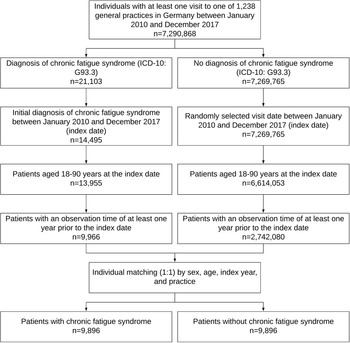
This study included patients diagnosed for the first time with CFS (ICD-10: G93.3) in one of 1238 general practices in Germany between January 2010 and December 2017. Patients were 18–90 years old at the date of first diagnosis (index date) and had been followed for at least 1 year prior to that date. After applying similar inclusion criteria, controls without CFS were matched (1:1) to cases with CFS by sex, age, index year, and practice. For the controls, the index date corresponded to a randomly selected visit date between January 2010 and December 2017 (Fig. 1).
Selection of study patients.

Study variables
Study variables included sex, age, index year, and all physical and psychiatric conditions diagnosed in the year prior to the index date that were found in at least 3% of patients with CFS. Physical conditions included endocrine, nutritional, and metabolic diseases [i.e. other hypothyroidism (ICD-10: E03), nontoxic goiter (E04), diabetes mellitus (E10-E14), obesity (E66), and dyslipidemia (ICD-10: E78)], diseases of the respiratory system [i.e. acute sinusitis (J01), acute pharyngitis (J02), acute upper respiratory infections of multiple and unspecified sites (J06), acute bronchitis (J20), chronic sinusitis (J32), bronchitis, not specified as acute or chronic (J40), chronic obstructive pulmonary disease (COPD) (J44), and asthma (J45)], diseases of the digestive system [i.e. other gastroenteritis and colitis of infectious and unspecified origin (A09), gastroesophageal reflux disease (K21), gastritis and duodenitis (K29), and other functional intestinal disorders (K76)], diseases of the musculoskeletal system and connective tissue [i.e. spondylosis (M47), other intervertebral disc disorders (M51), dorsopathies not elsewhere classified (M53), dorsalgia (M54), other disorders of muscle (M62), and shoulder lesions (M75)], and other diseases [i.e. viral infection of unspecified site (B34), cancer (C00-C99), sleep disorders (G47), hypertension (I10), chronic coronary heart diseases (I25), other dermatitis (L30), and urethritis and urethral syndrome (N39)]. Psychiatric conditions included depression (ICD-10: F32, F33), anxiety disorders (F41), and reaction to severe stress, and adjustment disorders (F43). As somatoform disorders (F45) and other non-psychotic mental disorders including neurasthenia (F48) may overlap with CFS, these two families of conditions were not included in the study.
Statistical analyses
The prevalence of physical and psychiatric conditions was compared between cases with CFS and controls without CFS using Chi-squared tests. Associations between physical and psychiatric conditions (33 potential independent variables) and CFS (dependent variable) were analyzed in an adjusted conditional logistic regression model, and physical and psychiatric disorders were included in the model using forward stepwise selection. Since cases with CFS were matched (1:1) to controls without CFS by sex, age, index year, and practice, the logistic regression analysis was not adjusted for these variables. Variance Inflation Factors (VIFs) further showed that there was no multicollinearity between independent variables. Results from the regression analysis are presented as odds ratios (ORs) with 95% confidence intervals (CIs). p-values of less than 0.05 were considered statistically significant. All analyses were performed using SAS 9.4.
Results
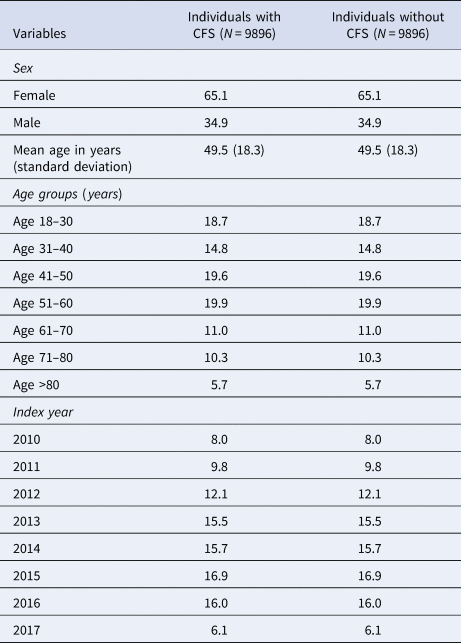
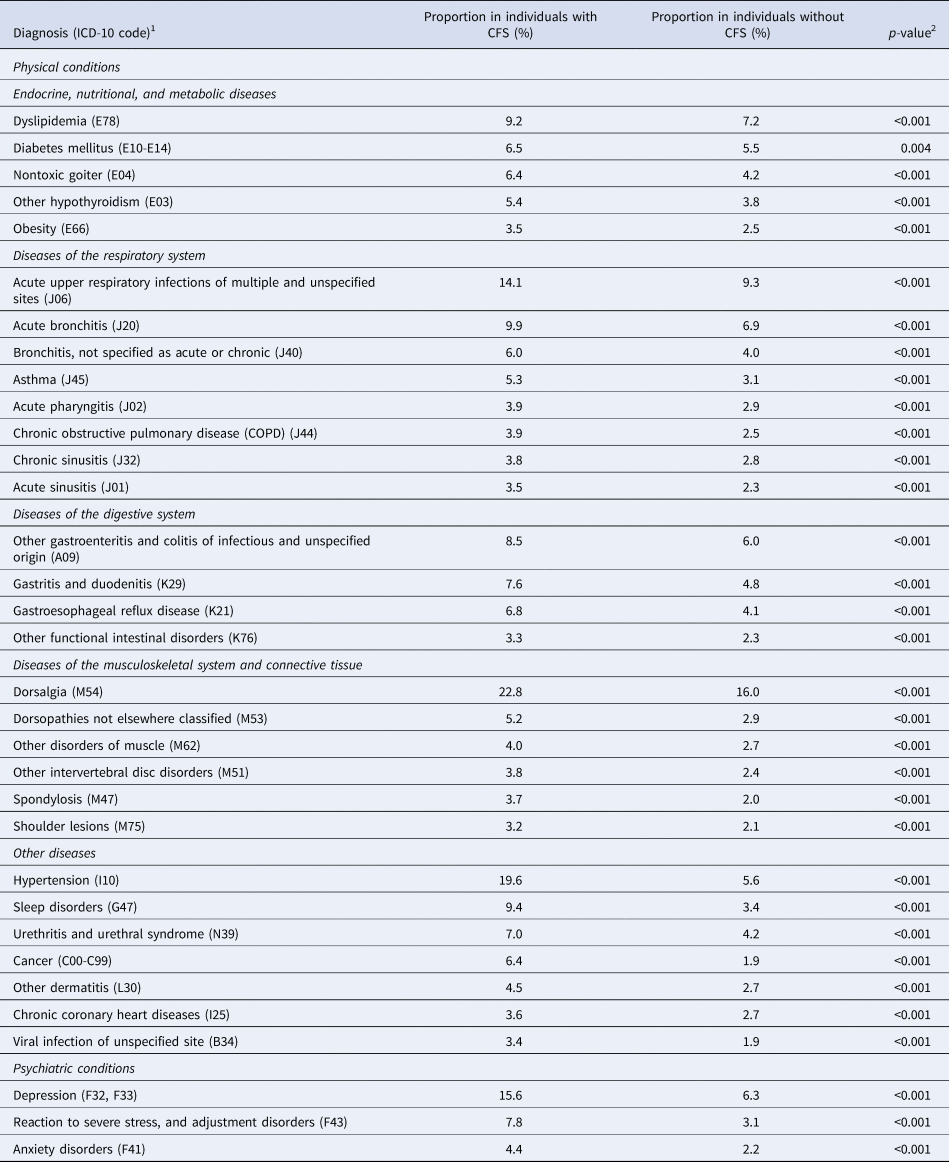
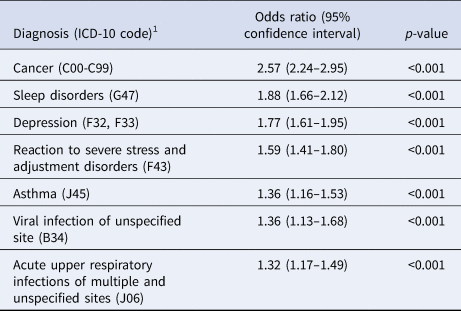
This study included 9896 cases with CFS and 9896 controls without CFS in this study (Table 1). The proportion of women was 65.1%, and the mean (standard deviation) age was 49.5 (18.3) years. This case-control study covered 30 physical and three psychiatric conditions, and all of these disorders were significantly more frequent in patients with CFS than in those without CFS (Table 2). The three most frequent conditions were dorsalgia (22.8% in CFS patients v. 16.0% in those without CFS), hypertension (19.6% v. 5.6%), and depression (15.6% v. 6.3%). The results of the regression analysis are displayed in Table 3. After including physical and psychiatric conditions in the model using forward stepwise selection, seven disorders were significantly associated with CFS. The conditions displaying the strongest relationships with CFS were cancer (OR = 2.57, 95% CI = 2.24–2.95), sleep disorders (OR = 1.88, 95% CI = 1.66–2.12) and depression (OR = 1.77, 95% CI = 1.61–1.95).
Baseline characteristics of study patients after 1:1 matching by sex, age, index year, and physician

CFS, chronic fatigue syndrome.
Data are listed in % unless otherwise stated.
Prevalence of physical and psychiatric conditions in individuals with or without chronic fatigue syndrome

CFS, chronic fatigue syndrome.
1 Physical and psychiatric conditions were included if they were present in at least 3% of individuals with CFS.
2 The prevalence of physical and psychiatric conditions was compared between patients with and those without CFS using Chi-squared tests. It should be noted that this table only displays physical and psychiatric conditions for which the difference between patients with and those without CFS is significant.
Associations of physical and psychiatric conditions with chronic fatigue syndrome in a sample of 19 792 adults from Germany

1 Physical and psychiatric conditions were included as independent variables in the regression model using forward stepwise selection. The table only displays physical and psychiatric conditions that were significantly associated with chronic fatigue syndrome.
Discussion
Main findings
This case-control study showed in a sample of 19 792 adults from 1238 general practices in Germany that the prevalence of more than 30 physical and psychiatric conditions was significantly higher in patients with CFS than in those without CFS. The adjusted logistic regression analysis further revealed that seven physical and psychiatric disorders were positively associated with CFS, and that the ORs were particularly high for cancer, sleep disorders, and depression. To the best of our knowledge, this study is the first to investigate the associations between a wide range of disorders and CFS, while also being one of the largest studies from a high-income country.
Interpretation of the findings
In the present study, cancer was strongly and positively associated with CFS. Before going further, it should be noted that cancer-related fatigue is also very common in cancer survivors. For example, in a US sample of 379 patients treated with chemotherapy, around 17% were found to have cancer-related fatigue (Cella et al., Reference Cella, Davis, Breitbart and Curt2001), while a cross-sectional study conducted on 1749 cancer patients in China revealed that the prevalence of cancer-related fatigue was around 52% (Tian et al., Reference Tian, Lin, Li, Chen, Zhang, Qian and Hu2016). However, cancer-related fatigue and CFS are two distinct entities, and the present research focused on CFS only. Interestingly, although no previous study has formally analyzed the relationship between cancer and CFS using regression analyses, and although there is no significant increase in cancer-specific mortality in CFS patients (Roberts et al., Reference Roberts, Wessely, Chalder, Chang and Hotopf2016), high rates of CFS have been reported in cancer survivors in the scientific literature. A study including approximately 250 women with a history of breast cancer from Norway found that the prevalence of CFS was between 33% and 39% in the 10 years following multimodal breast cancer treatment (Reinertsen et al., Reference Reinertsen, Cvancarova, Loge, Edvardsen, Wist and Fosså2010). Another cross-sectional study conducted in the same country corroborated these results in a sample of almost 1100 young adult cancer survivors, with CFS being diagnosed in approximately 25% of the population (Bøhn et al., Reference Bøhn, Thorsen, Kiserud, Fosså, Lie, Loge and Reinertsen2019). The proportion of participants with CFS was significantly higher for breast cancer (29%), colorectal cancer (29%), and non-Hodgkin lymphoma (27%) than for malignant melanoma (15%), suggesting that the association between cancer and CFS likely varies with cancer type. Furthermore, the occurrence of CFS was predicted by several factors, such as systemic treatment with surgery and/or radiotherapy, presence of comorbidities, and depressive symptoms (Bøhn et al., Reference Bøhn, Thorsen, Kiserud, Fosså, Lie, Loge and Reinertsen2019). Taken together, these findings underline the fact that the association between cancer and CFS may be mediated by both the side effects of oncological treatments and by the psychological impact of cancer.
Another interesting result of this study is the positive relationship between sleep disorders and CFS. A clinical study including 175 patients with sleep-related symptoms and 39 healthy controls indicated that the prevalence of CFS was around 13% in people with sleep-disordered breathing or insomnia, whereas no healthy controls were diagnosed with CFS (Pejovic et al., Reference Pejovic, Natelson, Basta, Fernandez-Mendoza, Mahr and Vgontzas2015). Our study results are also in line with the findings pertaining to another cohort of 13 080 adults from Taiwan, which demonstrated a significant and positive association between sleep disorders and CFS [hazard ratio (HR) = 2.17] after adjusting for sex, age, and several comorbidities (i.e. psoriasis, diabetes, renal disease, depression, and anxiety) (Tsai et al., Reference Tsai, Chen, Chen, Lio, Kuo, Leong and Wang2019a). However, since the previous study failed to adjust for physical conditions that may play a confounding role in the association between sleep disorders and CFS (e.g. asthma (Davies et al., Reference Davies, Bishopp, Wharton, Turner and Mansur2019; Yang et al., Reference Yang, Kuo, Chen, Chen, Lin, Tsai and Kao2015)), the present case-control study is of particular importance and supports the current literature. Finally, a Norwegian study including 89 patients who had been on sick leave for several weeks because of chronic fatigue found that improvement in insomnia severity led to the improvement in levels of fatigue and that this association was mediated by changes in anxiety and depression levels (Vethe et al., Reference Vethe, Kallestad, Jacobsen, Landrø, Borchgrevink and Stiles2018). These results suggest that sleep disorders and CFS are interconnected, as well as that the proper management of patients with CFS likely requires the diagnosis and treatment of associated sleep disturbances.
A third important finding is that depression was significantly and positively associated with CFS. These results confirm the findings of other studies conducted in different settings. Numerous studies from the 1990s have consistently reported a high prevalence of psychiatric disorders in patients with CFS (Katon et al., Reference Katon, Buchwald, Simon, Russo and Mease1991; Walker et al., Reference Walker, Katon and Jemelka1993; Wood et al., Reference Wood, Bentall, Göpfert and Edwards1991), while there is also evidence of an association between overall mental health and CFS (Wessely et al., Reference Wessely, Chalder, Hirsch, Pawlikowska, Wallace and Wright1995). For example, a cross-sectional study of 129 patients showed that the prevalence of current and lifetime major depression was 15.3% and 76.5%, respectively, in those with chronic fatigue (Katon et al., Reference Katon, Buchwald, Simon, Russo and Mease1991). In addition, a more recent cohort study of 11 419 individuals from the UK revealed that premorbid psychopathology at ages 23 and 33 years was a risk factor for the occurrence of CFS at age 42 (Goodwin et al., Reference Goodwin, White, Hotopf, Stansfeld and Clark2011). As previously mentioned, psychiatric disorders may mediate the relationships between several physical conditions (e.g. cancer and sleep disorders) and CFS. However, psychiatric disorders may also have their own independent effects on CFS, while psychiatric disorders and CFS may share common risk factors that are not related to physical conditions. Regarding shared risk factors, a significant body of literature has focused on the relationship between childhood maltreatment and adult mental disorders (Scott et al., Reference Scott, McLaughlin, Smith and Ellis2012; Sugaya et al., Reference Sugaya, Hasin, Olfson, Lin, Grant and Blanco2012; Viner & Hotopf, Reference Viner and Hotopf2004). As a matter of fact, researchers in a British prospective study observed that parental physical abuse was associated with a 2.10-fold increase in the risk of self-reported CFS later in life (Clark et al., Reference Clark, Goodwin, Stansfeld, Hotopf and White2011).
Clinical implications
Based on these findings, general practitioners and other health professionals should be aware that several physical and psychiatric conditions (e.g. cancer, sleep disorders, depression) are positively associated with CFS. Given that treatment response is stronger in patients who have recently been diagnosed with CFS than in those who have been experiencing symptoms for several years, the treatment and the management of CFS should be multidisciplinary and individualized, and should be initiated as early as possible following diagnosis. Interestingly, although the effectiveness of recommended treatment strategies remains under debate, some data suggest that a healthy diet and nutritional supplements likely play a key role in CFS therapy (Castro-Marrero et al., Reference Castro-Marrero, Sáez-Francàs, Santillo and Alegre2017). Furthermore, the management of physical and psychiatric disorders in individuals with CFS may help mitigate the impact of this condition on functional status and quality of life, while potentiating the effects of traditional therapeutic approaches (e.g. cognitive behavioral therapy and physical exercise) (Avellaneda Fernández et al., Reference Avellaneda Fernández, Pérez Martín, Izquierdo Martínez, Arruti Bustillo, Barbado Hernández, de la Cruz Labrado and Ramón Giménez2009).
Limitations
Although the present findings are of particular interest, this study has several limitations that need to be acknowledged. First, previous research has indicated that the prevalence of misdiagnosis of CFS is around 50% in patients referred to a specialized CFS service (Devasahayam et al., Reference Devasahayam, Lawn, Murphy and White2012), and it is, therefore, possible that a significant proportion of CFS patients included in this study in fact had another disorder, which may or may not have been included in the analysis (e.g. sleep disorders, neurasthenia, and somatoform disorders). Second, reverse causality remains a likely hypothesis, meaning that CFS may precede the occurrence of other conditions such as depression and sleep disorders. Therefore, the results of this exploratory case-control study need to be corroborated by further hypothesis testing studies of a longitudinal design. Third, forward stepwise regression was used in this study, and there has been some concern about this statistical method in recent years (Heinze et al., Reference Heinze, Wallisch and Dunkler2018).
Conclusion
In this case-control study including almost 19 800 patients treated in general practices in Germany, 7 conditions were significantly associated with CFS, and the conditions displaying the strongest relationship with chronic fatigue were cancer, sleep disorders, and depression. In terms of future research, longitudinal studies are needed to corroborate the present findings. Better understanding of the mechanisms underlying the associations between physical conditions, psychiatric disorders, and the risk of CFS is also important.
Acknowledgements
Professional English language editing services were provided by Claudia Jones, MA, Radford, Virginia, USA. The authors have received no financial support for the research
Author contributions
Louis Jacob managed the literature searches, wrote the first draft of the manuscript, and corrected the manuscript. Josep Maria Haro contributed to the design of the study and corrected the manuscript. Karel Kostev contributed to the design of the study, performed the statistical analyses, and corrected the manuscript. All authors contributed to and have approved the final manuscript., authorship, and/or publication of this article.
Conflict of interest
The authors declare that they have no potential conflicts of interest with respect to the research, authorship, and/or publication of this article.