Since the founding of the Islamic Republic of Iran (IRI) in 1979, conservative gender ideology has dominated its legal and political frameworks, resulting in numerous discriminatory rulings against women and their intentional marginalization from most positions of political power. Iran currently ranks among the lowest in the world in terms of women's parliamentary presence, at 5.5%, and only one woman has served as a minister (2009–13) since 1979 (Inter-Parliamentary Union 2021). Despite the low numbers of women in political decision-making positions, over IRI's fourty-two year rule, we have witnessed the rise of a few women “critical actors,” who have captured the interest of the electorate through their outspoken criticism of the regime's discriminatory gender policies and their championing of important policy initiatives addressing women's concerns. While in the past, many of these women politicians had familial or personal ties to key male political or religious figures—such as Azam Taleghani (Ayatollah Mahmoud Taleghani's daughter), Faezeh Hashemi Rafsanjani (former president Hashemi Rafsanjani's daughter), and Zahra Rahnavard (former prime minister Mir-Hossein Mousavi's wife)—today, many gain political influence thanks to their high levels of education and political experience within mostly reformist-backed institutions and entities, though some still have familial ties. While many of these women politicians in Iran's theocratic context have religious tendencies, their actions and writings highlight that they see no contradiction between Islam and women's rights.Footnote 1
This article argues that despite their small numbers, women critical actors warrant our attention, since their presence and activism in the formal political arena speaks to numerous concerns of female constituencies in Iran, and their actions can lead to important policy changes. Through an analysis of women critical actors who have been elected and/or appointed in recent years, this research sheds light on the contexts and conditions that have facilitated the rise of outspoken women in politics.Footnote 2 It finds that three interrelated factors have played key roles in their election and appointment: (1) electoral support for and mobilization around gender-progressive political mandates, in which women's rights groups played central roles; (2) willingness of reformist/moderate party elites to be more inclusive of women in politics; and (3) occasional openings in Iran's dynamic and fragmented political structure.
Analysis of these factors highlights how women's substantive representation (representation of women's needs and interests in formal politics) occurs in Iran and who these women critical actors are, with a brief discussion of some of the women-friendly policies that they pursued while in office. Such contextual analysis illuminates the complexities and dynamism of gender politics in Iran, which is generally perceived as static by outsiders, and shows that grassroots mobilization and public opinion can and do at times succeed in progressive reforms, even in conservative and undemocratic contexts. The findings of this research contribute to our understandings of when and under what conditions critical actors can make differences for women when a critical mass of women is absent.
This article also examines public and regime responses to the outspokenness and efforts of women critical actors. It demonstrates that many women's rights groups welcome the efforts of women critical actors as they champion women's rights in public office, leading to their increased popularity among more progressive segments of the population. However, within the regime, institutions and authorities supporting the status quo around women's rights and gender relations often show low tolerance for efforts by these women politicians to substantively enhance women's rights and status. These forces thus attempt to limit the influence of prominent women by marginalizing them from formal politics or by hampering the proper implementation of recently adopted women-friendly policies. Despite this intentional marginalization, this article shows that progressive ideals of women critical actors influence public opinion, a powerful political force in theocratic Iran. While many of Iran's women critical actors are also outspoken on issues other than women's rights, including democratization and transparency in Iranian politics, the central focus of this research is on their efforts promoting women's rights.Footnote 3
CONTEXT AND METHODS
A central feature of the Islamic Republic of Iran has been its extensive Islamization of the legal and social spheres following the 1979 revolution, particularly in the area of women's rights. Within weeks of the revolution, the founders of the theocratic regime reversed many of the Mohammad Reza Pahlavi era's women-friendly laws, implementing policies such as men's unilateral right to divorce, easier grounds for polygyny, and gender segregation in some public settings (Hoodfar Reference Hoodfar1999; Paidar Reference Paidar1995). However, largely thanks to the efforts of women's rights groups and key women (and men) actors of the Islamic regime over the 40-year history of the Islamic Republic, various gender-discriminatory rulings have been reformed or amended and women's rights expanded. These include granting child custody to mothers widowed during the Iran-Iraq War, integrating some women-friendly conditions into the marriage contract, and limiting the grounds for polygyny (Kar and Hoodfar Reference Kar and Hoodfar1996; Osanloo Reference Osanloo2009; Paidar Reference Paidar1995). Key women policy makers championed these reforms in response to grassroots pressure, at times with support from male party leaders who at certain junctures found it expedient to court the female electorate.Footnote 4 While party elites across the political spectrum have expressed varying degrees of support for the enhancement of women's rights, generally Iran's reformists (islahtalaban) have been more supportive of gender reforms than their conservative or principlist (usulgarayan) counterparts.Footnote 5
Pressure to reform unjust and unequal treatment of women continues in Iran, though the political climate and composition of government at any given time impact how such pressure is expressed. With certain openings in politics, such as the rise to power of reformist forces, as happened in the late 1990s and early 2000s, women's rights demands gain prominence and traction through women's rights activism, which, in turn, was supported and represented (to the extent possible) by sympathetic (and particularly women) policy makers in formal institutions such as parliament (Mir-Hosseini Reference Mir-Hosseini2006; Najmabadi Reference Najmabadi2000; Paidar Reference Paidar2001). However, with regime crackdowns on reformists and independent women's rights groups—as happened in the mid-2000s when the regime sought to prevent the election of another reformist-dominated parliament—much of women's rights organizing is forced underground, though activists across the ideological spectrum continue to strategize to take advantage of any opportunity to push for women-friendlier agendas and policies from within and outside of state institutions (Shekarloo Reference Shekarloo2005). Thus, despite Iran's closed and theocratic political structures, efforts by women's rights advocates to mobilize support, in combination with other factors, do sometimes succeed in helping women candidates win seats and gain influence, positioning them to become critical actors on behalf of women.
Through a case study of women critical actors during Hassan Rouhani's presidency (2013–21), this article describes the conditions that engender the rise of women politicians and shape their emergence and impacts as critical actors championing women's rights in Iran's undemocratic and theocratic context. Much of the data were gathered through extensive field research during visits to Iran between 2009 and 2016, studying and observing the main shifts and transitions in women's rights organizing and women's access to political office. This included interviewing women's rights activists, current and former women and men politicians and policy makers, and academics and journalists. As lobbyists for women's rights, consultants to governments, and holders of political office, these informants are well positioned to judge the impact of women critical actors during different administrations. In addition, by following parliamentary and presidential elections over that period and to date, I have been able to observe and analyze the factors that led to important ideological and policy preference shifts in the women (and men) who gained political posts. For instance, under President Mahmood Ahmadinejad (2005–13), Iran's main apparatus for women's affairs, the Vice Presidency for Women and Family Affairs, followed a largely conservative gender agenda, while under President Rouhani, this office proposed and pursued important reforms toward greater gender justice and equality (Tajali, Reference Tajaliforthcoming). I interviewed women who held posts or served as consultants in these offices.
Additionally, my data include a close review of public statements and op-eds by women critical actors, as well as media interviews that highlight their perspectives and stances as they seek to substantively represent women. Using the official portal of the Iranian parliament, I also studied the policy proposals and parliamentary speeches of women legislators during the 10th postrevolutionary parliament (2016–20) to identify those who were outspoken on women's rights in the legislature. As a scholar of Iranian women's rights organizing since 2009, I have also had access to key social media channels and groups run by women activists and politicians, which has afforded me insights into key women's rights debates, concerns, and campaigns.
To identify critical actors, researchers studying women's substantive representation often look to initiatives by women policy makers promoting women's rights (Childs and Krook Reference Childs and Krook2009; Dahlerup Reference Dahlerup1988; Pitkin Reference Pitkin1972). Such initiatives or “critical acts” include formal political policy or bill proposals, such as those for gender quotas, that have the potential to lead to real change (Beckwith and Cowell-Meyers Reference Beckwith and Cowell-Meyers2007; Celis and Erzeel Reference Celis and Erzeel2015; Chaney Reference Chaney2012; Childs and Krook Reference Childs and Krook2009; Franceschet and Piscopo Reference Franceschet and Piscopo2008). In line with these definitions, this research identifies critical actors according to their efforts and initiatives toward the expansion and improvement of women's rights, but it is less concerned with the implementation or long-term impacts of the women's rights policies adopted. This specification is particularly important in the case of Iran, where undemocratic and theocratic structures can hinder effective implementation of rulings, regardless of a bill's adoption or popularity. Furthermore, women-friendly laws are never guaranteed; they are often subject to backlash and reversal by conservative forces, as witnessed even in democratic contexts, including in the West, generally to curry support from a specific base or backers (Roggeband and Krizsan Reference Roggeband and Krizsan2020).
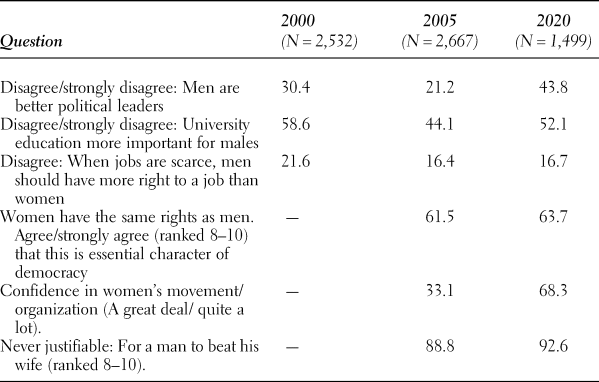
This analysis of women who gain access to positions of influence to challenge Iran's conservative gender mandates highlights a dynamism in the political structures of the Islamic Republic that is not always apparent. It also emphasizes the understudied role of public opinion and grassroots organizing in initiatives that aim to improve women's rights in nondemocracies. Indeed, although they are gradual and often face limited implementation once adopted, many of the reforms advocated by women critical actors help shift public discourse and inform demands made on the conservative elites—that is, public pressure on the ruling elites can deter their complete reversal. The limited data that exist on public attitudes in Iran, from the World Values Survey, demonstrates increasing public support for most measures of gender equality with suitable economic conditions.Footnote 6 According to the 2020 survey, Iranian respondents have great confidence in women's movement or organizations (more than doubled since 2005), while a clear majority support women's equal rights to men and access to university education. In all, 43.8% of Iranian respondents are also supportive of women as political leaders, which is comparable with Lebanon, the most supportive country in the Middle East and North Africa region on this measure at 53.1% (Tripp Reference Tripp2019, 93). Table 1
Attitudes toward gender equality in Iran (percentages)

Source: World Values Survey Database, years in which Iran was included: https://www.worldvaluessurvey.org/wvs.jsp.
CRITICAL ACTORS AND WOMEN'S SUBSTANTIVE REPRESENTATION
The gender and politics research of the past several decades has been occupied with the relationship between women's descriptive representation (the number of women in political decision-making roles) and substantive representation (representation of women's interests and needs while women decision makers are in office). Building on the “politics of presence” literature (Phillips Reference Phillips1995), one of the central justifications for efforts to increase women's access to political office has been the expectation that women policy makers, given their shared experiences, are better equipped and more likely to “act for women” than their male counterparts (Dovi Reference Dovi2002; Mansbridge Reference Mansbridge1999). Related studies have argued that women's substantive representation occurs when there is a “critical mass” of women in policy making (usually 20% to 30%), denoting the minimum percentage of women needed to impact an otherwise male-dominated political arena in order to meaningfully address women's issues and concerns (Grey Reference Grey2002; Hoodfar and Tajali Reference Hoodfar and Tajali2011).Footnote 7
However, other studies question the linear relationship between numbers and outcomes of women's political representation, highlighting multiple factors and conditions that enable meaningful representation of women's needs and interests in formal political institutions, even when their numbers are low (Beckwith and Cowell-Meyers Reference Beckwith and Cowell-Meyers2007; Childs and Krook Reference Childs and Krook2009). These studies emphasize a variety of contextual (and often interrelated) factors, such as the composition of the legislature or the strength of the grassroots women's rights movement, as playing more important roles. Attention to the complex factors that impact women's substantive representation has given rise to research that focuses on critical actors, or “legislators who initiate policy proposals on their own and/or embolden others to take steps to promote policies for women” (Childs and Krook Reference Childs and Krook2009, 138). Such critical actors may also include men who help advance women's policy concerns and those who do not necessarily identify as feminist or liberal (Celis and Erzeel Reference Celis and Erzeel2015; Childs and Krook Reference Childs and Krook2009). The common denominator among critical actors who substantively represent women is that they are “attitudinally strongly motivated to promote women's interests” and “highly active in representing women's issues” (Celis and Erzeel Reference Celis and Erzeel2015, 50).Footnote 8
Such a conceptualization of critical actors has enabled more nuanced and accurate research on how women's substantive representation occurs, particularly when women's descriptive representation is low. However, much of it has been conducted in democratic and Western countries (Chaney Reference Chaney2012; Rodríguez-Garcia Reference Rodríguez-Garcia2015; Thomson Reference Thomson2018), with limited attention to women's substantive representation in nondemocracies. Among the few studies that address women's rights reforms in autocratic regimes or semidemocracies, some correctly focus on instances of state feminism, in that autocratic rulers adopt women's rights as politically expedient moves (Darhour and Dahlerup Reference Darhour and Dahlerup2013; Sater Reference Sater2007; Tripp Reference Tripp2019). Tripp (Reference Tripp2019), for instance, found that authoritarian leaders in the Maghreb (Morocco, Tunisia, and Algeria) strategically use women's rights reforms to serve instrumental purposes such as creating a modernizing image of their society or pushing back against more conservative tendencies, often assisted by opportunities that arise from political upheaval. These top-down legal reforms, often championed by the monarch, have important symbolic implications, and thus they are rarely considered moves that substantively represent women, particularly with attention to their heterogeneity. While women's rights movements have contributed and continue to contribute (often indirectly) to state feminism in autocracies, most women-friendly reforms that Tripp discusses are motivated by the paternalistic and patriarchal intentions of male rulers, with little input from female legislators who wish to challenge the gender status quo. A number of other studies have defined the role of women critical actors who (often unexpectedly) gain access to important political posts, despite their nondemocratic contexts. In combination with a range of other factors, such as a strong women's movement, willing male political elites, and even support from international and transnational actors, women critical actors within a heterogeneous group of politicians are able to pursue women's rights concerns (Fleschenberg Reference Fleschenberg2016; Moghadam and Haghighatjoo Reference Moghadam and Haghighatjoo2016).
This article augments the research on women's substantive representation outside of democratized and Western contexts, with an emphasis on the conditions that enable the rise of female policy makers who aim to boldly represent women's interests. Focusing on the dynamics around women critical actors in Iran, it identifies key contextual factors that have enabled critical acts representing women's interests, thus challenging the dominant gender ideology of a conservative theocracy. Theorizing about the conditions that enable public discussion and action on women's interests in authoritarian contexts such as Iran is significant given the important shifts that can occur in this area in an otherwise stable and male-dominated context.Footnote 9
In discussing “women's interests” and “women-friendly reforms,” it is worth noting that “women” are never a homogenous group, and their interests and needs vary based on their positionalities, experiences, and ideologies.Footnote 10 Thus, women across the ideological spectrum, not only those with feminist or liberal tendencies, can substantively represent women. My findings from Iran, a country where feminist perspectives often face government hostility, emphasize that commitment to challenge the gender status quo matters more than ideological affiliation. Since the IRI's establishment, women from across the political and religious spectrum, including self-identified conservatives who publicly support the regime, have challenged the gender-discriminatory rulings that dominate most aspects of Iranian social and political life (Tajali Reference Tajali2017). In fact, on numerous occasions, women from opposing conservative and reformist camps have joined forces to tackle misogynous bills,Footnote 11 further highlighting that political/ideological affinities are complex and may shift depending on circumstance. Given Iran's theocratic context, however, women's rights activists who make their appeals using religious and revolutionary discourses are often better positioned to pressure the clerical oligarchy.Footnote 12 Next, I introduce some of Iran's women critical actors, with a focus on those active during Rouhani's presidency.
WOMEN CRITICAL ACTORS OF IRAN
Despite the absence of any critical mass of women in Iranian politics, a few women have emerged as critical actors, capturing the interest and support of large sections of the electorate as they have openly challenged the regime's gender restrictions and pushed for women-friendly reforms. As in other countries, political recruitment and nomination in Iran rests in the hands of male elites, thus maintaining a male-dominated political sphere. Additionally, there are institutions in place—most notably, the conservative-dominated Council of Guardians—to preserve the power and influence of the clerical oligarchy by ensuring that only those demonstrably allied with the Office of the Supreme Leader and the regime's version of Islam are approved to run for national political office, including parliament and the presidency.Footnote 13 Consequently, throughout the Islamic Republic's history, many of the women policy makers who have gained access to political decision-making have been closely connected with the regime.Footnote 14 Nevertheless, despite this proximity and/or allegiance, some of them have been critical actors on women's rights, publicly challenging the Islamic Republic's gender-discriminatory discourses and practices.
During the first decades of the Islamic Republic, a number of revolutionary women, or those who had earlier sought (and been imprisoned and tortured as a result) to topple the Pahlavi regime, took the lead in formally representing some of women's key demands. Despite widespread opposition from conservative men in the new regime to women's active presence in the public sphere, women such as Maryam Behrouzi (an influential female preacher and one of Ayatollah Khomeini's only female students)Footnote 15 and Zahra Rahnavard (a scholar, professor, and fierce revolutionary activist, and later the wife of Prime Minister Mousavi), insisted on women's equal rights in political representation, education, and employment, which they justified using egalitarian interpretations of Islam (Paidar Reference Paidar1995).
For instance, Behrouzi, one of only four women elected to the first 270-seat parliament following the revolution, publicly expressed dismay at the anti-woman sentiment of some of her revolutionary male colleagues, arguing that Muslim women, like the women of early Islam described in Muslim texts, have the right and the obligation to serve their country, both as mothers and as political leaders (Afshar Reference Afshar and Afshar2012). To foster women's political representation, she established the Zeinab Society (Jameh Zeinab), a women's party that remains closely tied to the conservative faction. Although Behrouzi remained affiliated with the conservative faction until her death in 2012, she did not see a contradiction between her faith and women's public roles, and she continuously fought for women's greater presence in Iran's elite politics. Her lobbying efforts eventually led to the nomination and appointment of postrevolutionary Iran's first female minister, Marzieh Vahid-Dastjerdi, in the cabinet of conservative President Mahmood Ahmadinejad during his second term in office (2009–13) (Tajali Reference Tajali2015, Reference Tajali2017).
Also using a religious framework, Rahnavard repeatedly fought for gender justice in education, employment, and family law. As the first head of the Women's Social and Cultural Council, one of several government committees established in 1989 to monitor congruence between Iran's policies and its founding revolutionary ideals, she helped lift some of the restrictions on women's equal access to certain fields of study, such as geology, engineering, and medicine, highlighting the necessity of women's contributions to develop and rebuild a war-torn Iran following the eight-year Iran-Iraq War (Vakil Reference Vakil2011).
Through women-centered religious reinterpretations,Footnote 16 Rahnavard and other religious women also ushered in a number of radical changes in women's rights, some of which have been sought by women's rights activists in other Muslim countries (Musawah Reference Musawah2018, Reference Musawah2021). Among them were the wages for housework (Ujrat-ol mesl) law, which came into effect in December 1992, in response to the unilateral male prerogative to divorce that had undermined women's protection and maintenance following divorce, as they had no right to wealth accumulated during marriage. Key religious women at the time drew on Islamic tradition to demand a law stipulating that women who are divorced with no fault to them must be compensated by their husbands for their housework and breast-feeding over the course of the marriage (Vakil Reference Vakil2011).Footnote 17
While notable, the shifts around women's rights as championed by women critical actors in Iran have been gradual. This is because the regime's ultraconservative forces have had little tolerance for outspoken women demanding reform of gender-discriminatory rulings. The presence of such actors seemingly emerges in waves, generally in correlation with other political shifts, including the electoral victories of more reformist or moderate forces in the legislative and executive branches. Conversely, during more restrictive moments in the political sphere, and particularly as conservatives take measures to regain control over elected branches, outspoken women are systematically denied access to formal politics. Thus, for example, several outspoken women members of parliament (MPs) actively pursued women's rights in the 6th postrevolutionary Iranian parliament (2000–2004) after the reformist movement gained power following Mohammad Khatami's 1997 landslide presidential victory (Moghadam and Haghighatjoo Reference Moghadam and Haghighatjoo2016). However, the next parliamentary election process saw the intentional marginalization of many reformist women (and men) candidates by conservatives through the Council of Guardians’ vetting process, with the subsequent 7th (2004–08), 8th (2008–12), and 9th (2012–16) parliaments including only token women MPs who supported conservative gender policy.Footnote 18
During these parliaments, women critical actors were absent, and autonomous women's rights groups had to work diligently to prevent reversals on women's rights. Notably, in major urban and multimember districts such as Tehran, the electorate is likely to turn out in support of women parliamentary candidates who are listed by the reformist faction, demonstrating the public's interest in such potential critical actors. However, conservative-affiliated women gain their seats in such districts especially when reformist-oriented women are intentionally sidelined, resulting in many voters boycotting the elections, as exemplified by the 2020 parliamentary elections (discussed later in this article).
WOMEN CRITICAL ACTORS OF THE ROUHANI ERA
Following years of conservative control over the executive (2005–13) and legislative (2004–16) branches, the 2013 presidential campaign of moderate Hassan Rouhani reenergized many members of Iranian civil society, including women's rights activists, to once again use electoral politics to agitate for their rights. Following Rouhani's surprising landslide victory, activists lobbied him to nominate women ministers, particularly since his predecessor, President Ahmadinejad, had delivered postrevolutionary Iran's first woman minister.Footnote 19 While Rouhani failed to appoint any women ministers, he appointed Shahindokht Molaverdi, a longtime women's rights champion and member of the reformist movement, as his vice president for women and family affairs. This new cabinet position consults the president on women's and family concerns. This appointment was made with the endorsement of key Iranian women's rights activists and scholars, which one Iranian activist described as “an appreciation gift to women who turned out in his support” (personal interview, June 7, 2015).
Despite her limited role as a presidential advisor, an examination of Molaverdi's efforts and policy proposals while in office highlights her critical acts toward women's substantive representation. A lawyer by training, in her cabinet role, the devout Molaverdi diplomatically pushed for important reforms on women's rights (Mir-Hosseini Reference Mir-Hosseini2016). Her efforts helped place women's rights concerns previously ignored by the state on the national agenda and were largely welcomed by Iranian women's groups (personal interviews with Iranian women's rights activists, 2015 and 2016). Molaverdi's policy proposals included support for female-headed households and female breadwinners, especially in Iran's remote rural areas, in the form of economic benefits and insurance plans; stricter policies to combat violence against women and girls; and the promotion and integration of “gender justice” (as opposed to gender equality) into national development plans as a means to grant women the opportunities needed to gain a level playing field in areas such as employment or political leadership (Tajali, Reference Tajaliforthcoming).Footnote 20 In her efforts to substantively represent women, Molaverdi maintained close relationships with Iranian women's rights groups and worked with both parliament and the presidency in pursuit of women's demands.
In my 2015 interview with her, it also became clear that Molaverdi was willing to utilize resources from the international community toward the expansion of women's rights in Iran, and she saw no contradiction between Islamic mandates on women's rights and many international standards. For example, she referred to gender quotas as “a globally recognized tool” to correct the decades-long discrimination faced by women aspiring to political office, a tool that, in her words, could serve to create “more just and by extension, Islamic” legislatures (personal interview, June 7, 2015). During her tenure as vice president for women and family affairs (2013–17), Molaverdi worked toward the adoption of a gender quota provision. While her efforts succeeded in the executive branch adopting a policy mandating that women compose at least 30% of managers in ministries (Mehr News Agency 2017), no similar quota provision was adopted for the parliament.
Nonetheless, Molaverdi's emphasis on affirmative action measures to guarantee women's access to political decision-making assisted in the election of women critical actors to the 10th postrevolutionary parliament (2016–20). Though women made up only 5.9% of this parliament, many consistently spoke out on women's rights concerns and even pursued some of Molaverdi's proposals (on behalf of the Rouhani government) on the parliament floor, although Molaverdi herself was moved in 2017 to another post during Rouhani's second term. Among the noteworthy policies pursued by women MPs were bills to criminalize violence against women, allow mothers to pass on citizenship to their children, and expand women's child guardianship rights after divorce.Footnote 21 The next section outlines the key factors that assisted the rise of women critical actors in Iranian formal politics in recent years.
CONTRIBUTING FACTORS TO THE RECENT RISE OF CRITICAL ACTORS IN WOMEN'S SUBSTANTIVE REPRESENTATION IN IRAN
Women's descriptive and substantive representation are impacted by the opportunities and constraints of a given context (Childs and Krook Reference Childs and Krook2009; Fleschenberg Reference Fleschenberg2016; Tajali Reference Tajali2015). Close examination of the “contexts, identities, and attitudes that motivate and inform” women's representation enhances our understandings of “how structure and agency interact”—that is, how opportunities and obstacles arising out of institutional structures and the larger political environment impact the efforts of women's rights advocates to gain access to politics and to substantively represent women (Childs and Krook Reference Childs and Krook2009, 143–44). Many of the women who gained seats and appointments during President Rouhani's first term in office differed radically from their predecessors in terms of ideological affinity and commitment to promoting women's interests. A close study of the factors that facilitated their access to formal political roles sheds light on how women's substantive representation might be possible in the undemocratic and theocratic context of Iran, where the number of women in formal politics has remained consistently low while institutional constraints have persisted.
Electoral Support and Grassroots Mobilization around Women's Rights
The IRI, as a “hybrid regime,” combines elements of republicanism, such as holding regular elections, with Islamic oversight over those elections and institutions, rendering them essentially undemocratic and unrepresentative (Keshavarzian Reference Keshavarzian, Posusney and Angrist2005). Despite this major shortfall, the republican elements of the state have allowed for effective mobilization and politicization of much of the electorate, including women. Women's increasing politicization since the early days of the 1979 revolution has resulted in their playing active roles in Iran's electoral politics as voters, campaigners, organizers, and aspiring candidates. A large portion of the Iranian female electorate remains determined to use the state's few republican avenues to challenge the conservative clerical elites’ firm hold on power, as exemplified by Iranian women's overwhelming support for reformist and moderate candidates (Hoodfar and Sadr Reference Hoodfar and Sadr2010; Kian-Thiebaut Reference Kian-Thiebaut and Hooglund2002; Osanloo Reference Osanloo2009).Footnote 22
My findings highlight that women's might at the ballot box is not discounted by parties and elites as they formulate candidate lists and party platforms ahead of major elections. Consequently, election campaigns are an important opportunity for women's rights supporters to express demands and lobby elites, opening the way to the election or appointment of women critical actors to influential positions. Despite Rouhani's limited campaigning on women's rights, following his election in 2013, his known sympathy for women's concerns led women's rights groups to marshal their forces, resulting in the appointment of Shahindokht Molaverdi as his vice president for women and family affairs. Significantly, Molaverdi's appointment and her public advocacy for the expansion of women's roles in political decision-making, further encouraged secular women's rights activists to launch a campaign ahead of the 2016 parliamentary elections, demanding “Change to the Male-dominated Face of Parliament” (Barlow and Nejati Reference Barlow and Nejati2017).Footnote 23
In light of the failure to adopt national-level gender quotas, this campaign was a notable example of Iranian women organizing against all odds to enhance women's parliamentary presence despite the absence of institutional structural support. Using mostly social media, the campaign publicized the voting records and views of incumbent and likely MPs on women's rights, hoping that increased public awareness would help defeat misogynist candidates. Echoing Rouhani and Molaverdi's appeals, this campaign also encouraged women to register as candidates, in the hope that their greater numbers would lead to more women candidates being approved by the Council of Guardians. These calls led to the registration of 1,234 women hopefuls for a parliamentary seat in 2016, a threefold increase from the 428 women who had registered during the previous preelection round. Despite the Council of Guardians’ mass disqualification of many reformist-oriented candidates—disqualifying 53% of total registered women and 48% of all registered men candidates—women's organizing nonetheless contributed to the election of 17 women, constituting 5.9% of the parliament, a record for postrevolutionary Iran.Footnote 24 The majority of the newly elected women, though previously unknown to the public, gained their seats thanks to the backing of reformists and moderates who collaborated to create a nationwide candidate List of Hope (explained later), and an optimistic public that turned out to vote overwhelmingly in support of this list. The women MPs elected in 2016 replaced all the conservative-backed women incumbents, some of whom had served for the previous three terms.
Inclusivity of Women: Reformist Elites and the Power of Gender Quotas
As in other parts of the world, gender quotas captured the attention of Iranian women activists following the 1995 World Conference on Women in Beijing. Party women across the political spectrum began to pressure male party leaders to adopt gender quotas, but both factions resisted to disrupt the status quo by promoting more women in politics (Tajali Reference Tajali2015). Ahead of the 2016 parliamentary elections, the efforts of reformist women like Molaverdi and her peers, coupled with pressures from grassroots women's rights groups, resulted in a coalition of reformist and moderate parties adopting a voluntary 30% women's quota for their nationwide list of candidates, dubbed the List of Hope (Omid).Footnote 25 This first-ever attempt at a parliamentary gender quota in Iran's history sought to include women (from among those qualified by the Council of Guardians) on the candidate lists for each of Iran's multimember districts.Footnote 26 Despite promotion of the quota by reformist party leaders, some districts were slightly shy of this goal, including Tehran's highly politicized 30-member district, with eight women (26%) nominated, all of whom won their seats. Of the 17 women MPs elected to the 10th parliament, 12 were List of Hope candidates, while the remaining 5—all from provinces—entered as independents or were backed by regional conservatives.
An examination of the parliamentary speeches and bill proposals of women MPs of the 10th parliament clearly demonstrates that those backed by the reformist coalition were much more vocal on women's rights than their independent or conservative-backed counterparts. This finding in Iran echoes previous research that found women who enter politics with the support of quotas can be more likely to promote women's rights (Franceschet, Krook, and Piscopo Reference Franceschet, Krook and Piscopo2012; Franceschet and Piscopo Reference Franceschet and Piscopo2008). Indeed, as Franceschet and Krook (Reference Franceschet and Krook2008, 18) argue, “when quota campaigns involve wide-spread civil society mobilization, and appeal to arguments about the need for women's distinct voices in politics, they can create mandates for elected women to promote women's interests.”
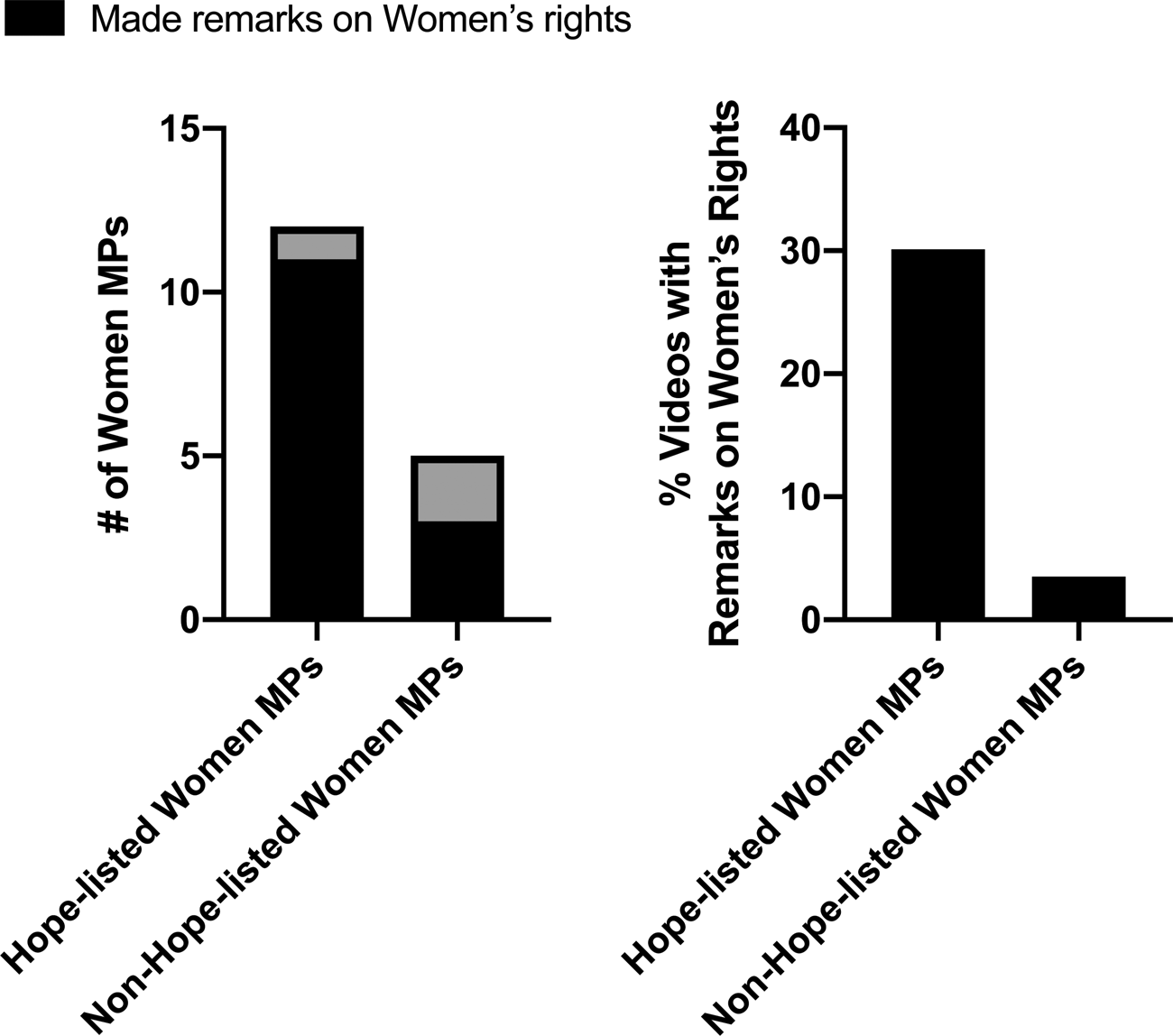
As Figure 1 shows, at least 30% of the parliamentary remarks of reformist-backed women made reference to women's rights in a way that challenged the status quo. However, the same was true of only 3.5% of remarks entered into the parliamentary record from the five non-reformist women MPs. Instances of reforms championed by women critical actors of the 10th parliament included policy proposals on quotas for women in politics, insurance and other benefits for female-headed households, and protection of women and girls from violence. Reformist-oriented women MPs representing Tehran were particularly outspoken on women's rights among other social justice concerns, while those from provinces mostly represented their provincial constituents’ needs.Footnote 27 Among the women critical actors of the 10th parliament were Tehran representatives Parvaneh Salahshouri, Tayebeh Siavoshi, and Fatemeh Zolghadr. Their outspokenness on women's rights and other social justice matters quickly gained the public's attention, and highlighted the potential of gender quotas in electing women's rights advocates.
Critical acts of women MPs of the 10th Iranian parliament. Notes: The official portal of the Iranian parliament provides video recordings of all speeches and remarks from the floor. Of 150 total available videos recording remarks by the 17 women parliamentarians (ranging anywhere from 1 or 2 minutes to 14 minutes in length), 93 include comments from female MPs from the List of Hope, while 57 include remarks from the 5 other female MPs. Eleven of the 12 List of Hope MPs spoke frequently (in 30% of the videos) to the expansion of women's rights, challenging the gendered status quo; while only 2 of the other female MPs did so, and infrequently (in 3.5% of the 57 videos). This figure merely provides a sense of the relative outspokenness (critical acts) of the female MPs on women's rights in relation to their ideological alliances, rather than a comprehensive view of their actions or speeches, given that there are some problems with this data set, including missing or interrupted recordings of some remarks by List of Hope MPs. Source: Data compiled by the author from Islamic Consultative Assembly's website: https://www.parliran.ir/majles/

Unfortunately, the tenure of women critical actors of the 10th parliament lasted only one term, as hardliners redoubled efforts to marginalize reformist forces, particularly outspoken women MPs. Thus, for the 2020 parliamentary elections, as a result of harassment and intimidation from these forces, several outspoken women MPs chose not to run for a second term in protest of “bodies that limit the powers of the parliament and ignore people's views and wishes” (incumbent MP Parvaneh Salahshouri speaking on the floor of parliament, quoted in Radio Farda 2019). Additionally, the Council of Guardians once again disqualified many reformist-oriented candidates, including one-third of the sitting 290 lawmakers, six of whom were Salahshouri's incumbent women colleagues. Similar to the 2016 parliamentary elections, the Council disqualified women at a higher rate than men; this time, it disqualified 59% of all registered female candidates, compared with 54% of all registered male candidates. Again, this demonstrates the Council's greater intolerance of potential progressive women politicians, since women composed only 12% of the total registered candidates.Footnote 28 These mass disqualifications, coupled with a disheartened electorate, many of whom boycotted the 2020 elections, facilitated the election of conservative-backed women.Footnote 29 While the same number of women MPs was elected, the women of the 11th parliament were mostly backed by conservatives and from the provinces. The eight reformist-oriented women MPs for Tehran were replaced by three male MPs and five women MPs with poor records on women's rights advocacy, evidenced by their previous tenures as either MPs or cabinet members in previous conservative-dominated governments.
Occasional Openings in Iran's Fragmented Political Structure
The previous sections outlined two important factors that helped in the appointment of women critical actors in recent years: the role of a mobilized female electorate and the willingness of some political elites to adopt measures for women's greater inclusion in politics. However, a third related factor is the dynamic that allows for the occasional emergence of new critical actors despite Iran's undemocratic and theocratic structures. Scholars studying Iran's electoral politics explain the occasional swings of control over elected institutions between opposing reformist and conservative factions without disruption to the authoritarian status quo as “fragmented authoritarianism.” Keshavarzian (Reference Keshavarzian, Posusney and Angrist2005) explains this concept by highlighting the unelected bodies established by the founders of the Islamic Republic that protect conservative clerical authority and prevent any radical transformation to the regime, despite the occasional victory of softliners. Among such bodies, the Council of Guardians, the Office of the Supreme Leader, and the judiciary are at the “forefront of blocking substantive and procedural policies aimed at moving Iran toward democracy,” while other state-run entities, including state media and law enforcement, work to “mollify protest through patronage” in the case of media, or exert force in the case of police (Keshavarzian Reference Keshavarzian, Posusney and Angrist2005, 80).
As a “hybrid” state, Iran's regular elections have the potential to bring moderate or reform-oriented candidates to power, though the real impact of these individuals is limited given institutions that are committed to maintaining the status quo. Despite the absence of free and fair elections, much of the electorate sees elections as limited opportunities offered by an otherwise closed political system to try to impact political and policy outcomes. Hence, polarizing elections in which the choice is between hardliners and softliners often result in voter turnout well above 70%, as witnessed in the 2013 and 2017 presidential elections that granted moderate Rouhani landslide victories over his more conservative rivals.
It is this extreme polarization that in heightened moments elevates voter engagement to the point that the ultraconservative nonelected branch must make concessions to mollify the Iranian public. Ironically, occasional openings of the political context that witness massive popular participation grant some legitimacy to the theocratic regime, as hardliners are pressed to tolerate some postelection reformist initiatives in order to placate a galvanized pro-reform population.Footnote 30 And, as critical acts for women's rights gain popular support, it becomes too costly for the regime to react harshly. Instead, relying on existing nonelected bodies to curtail reformist initiatives, the regime uses the Council of Guardians’ prerogative to disqualify candidates, sidelining those who challenge the regime's ideology from the next round of elections, effectively barring them from formal politics. The struggle to remedy gender discrimination at the state level is thus a complex tug-of-war between reformists, who often benefit from electoral support and women's grassroots mobilization, and conservatives, who benefit from an unequal political field where ultimate power lies in the hands of conservative clerics. The role of the electorate in this complex dynamic is significant; when it builds to the extent that the ruling elites cannot afford to ignore it, there is a very calculated move by the nonelected branch to allow “safer” moderates to be elected. But having any elected moderate in power, no matter how “safe,” leaves more room for critical actors including women's rights advocates, to further a more progressive agenda.
The results of the 2020 parliamentary elections highlighted these complexities of the Iranian political environment. Following moderates’ domination of the executive and legislative branches under Rouhani, and to correct the outspokenness of women critical actors of the 10th parliament, the February 2020 elections offered the regime's conservatives an opportunity to regain some control. The Council of Guardians, as in previous elections, effectively disqualified many reformist and moderate figures, including a number of outspoken women. Held in the context of an extensive crackdown on a disgruntled population that since late 2017 has repeatedly poured into the streets protesting terrible economic and social conditions affecting millions, the February 2020 elections also saw an electorate that had lost hope of meaningful reform from within the system. The extreme public distrust of the regime intensified the usual calls for an election boycott, including from several key women critical actors. Parvaneh Salahshouri's fiery speech on the parliament floor criticizing the unelected bodies for destroying the “republican nature of the system” encapsulated public sentiment (Radio Farda 2019). In stark contrast with the 2016 parliamentary elections, in 2020, Iran's reformist forces did not promote a united nationwide list of candidates. There was no talk of gender quotas. While in 2016, Iranian women's rights groups and activists used social media to mobilize the female voting bloc to support gender-progressive candidates, in 2020, they used the same platforms to call for a boycott of the election.Footnote 31 Despite the conservative clerical elites’ calls for mass participation, this election saw the lowest voter turnout since the 1979 revolution. Without any real reformist competition, conservatives swept 230 of the 290 parliamentary seats, with the united conservative list winning all of Tehran's 30 seats (Azizi Reference Azizi2020).
Marginalization of reformist voices, including of the female ones, continued for the 2021 presidential election. A number of women critical actors who previously held political posts within the reformist camp supported the nomination of Zahra Shojaee, who had served as President Khatami's advisor on women's affairs, the post that was eventually expanded to vice presidency for Molaverdi. Shojaee's attempt was the first time in Iranian history when a woman aspiring to the presidency advertised her presidential plans, signaling a move beyond merely running for office to challenge the discriminatory stance of the Council of Guardians on women's presidency.Footnote 32 While, as expected, the Council of Guardians rejected Shojaee's candidacy, her efforts and the rallying of other reformist party women (and some men) behind her campaign points to the perseverance of Iranian women activists at a time of conservative control over state institutions.
CONCLUSION
Research on women's substantive representation has increasingly highlighted the role of critical actors, that is, those who act—on their own and through emboldening others—in the interests of and in response to women (Celis and Erzeel Reference Celis and Erzeel2015; Childs and Krook Reference Childs and Krook2009; Pitkin Reference Pitkin1972). There have been a number of such critical actors over the history of the IRI, who have challenged the regime's gender repressive policies from within the state's own institutions, substantively representing women's interests. Highlighting that how such actors go about doing what they do in policy making matters more than their mere number (Childs and Krook Reference Childs and Krook2009), this article argues that even undemocratic contexts can provide important opportunities and conditions that enable advocacy for women's rights in the formal political arena. Three interrelated factors contribute to outspoken women gaining access to formal politics in Iran: the presence of a mobilized and organized female electorate, the willingness of political elites to adopt measures for women's greater inclusion in politics, and Iran's fragmented and dynamic political structure that enables occasional control by moderates or reformists over key institutions.
While it may be tempting to dismiss such efforts given their failure to radically enhance women's rights in theocratic contexts such as Iran, this article demonstrates that the presence of these women critical actors, as well as their activism, buttressed by strong popular support for their efforts, has led to policy changes that gradually challenge the regime's conservative stance on women's rights. As outlined earlier, a number of key policy reforms of the past decade have marked an important shift from the conservative gender ideology prioritized by the ruling elites. For instance, despite the regime's official emphasis on women's domestic duties within the family that discourages their access to the public sphere (Khamenei Reference Khamenei2014), there is a national discussion on women's greater access to political leadership. Thanks to women activists’ pressures, including the critical acts of Shahindokht Molaverdi, these discussions gained prominence during Rouhani's presidency, who promised greater inclusion of women in his cabinet, and repeatedly appealed to women and ethnic minorities to aspire for political decision-making roles. By 2021, as his second term was coming to an end, Rouhani publicly boasted of his administration's ability to nearly achieve the policy objective of ensuring that women compose at least 30% of all managers in government ministries (Rouhani Reference Rouhani2021). Such efforts forced the 2021 presidential candidates, regardless of their ideological backing, to at least pay lip service to women's political representation.Footnote 33 However, the conservatives’ regain of control over the legislative and executive branches in 2020 and 2021, respectively, through their effective sidelining of moderate and reformist forces will likely be detrimental to women's substantive representation.
Another significant instance of women's substantive representation during the Rouhani era included the adoption of a law that granted Iranian women the ability to pass citizenship on to their children, a prerogative that had only been available to Iranian men. This law rectifies a discriminatory ruling that prevented children born to Iranian mothers and foreign fathers from accessing state benefits, such as health care, education, or employment. This reform is particularly important for many Iranian women who have married Afghan immigrants and refugees but whose children have not been recognized as Iranian citizens (Daragahi Reference Daragahi2019). The women's caucus of the Iranian parliament played a key role in the adoption of this law. While previous bills had ultimately failed to pass due to the conservative oversight of the Council of Guardians, leading members of the women's caucus re-introduced the bill and strategized with other factions to ensure its adoption in 2019 (IRNA Plus and Jolodarzadeh 2020).Footnote 34 Despite its delayed implementation following its adoption, this reform also accompanies an important shift on women's citizenship rights and status in the theocracy.
The Iranian electorate plays a significant role in providing women critical actors with sufficient leverage—and at times mandates if elected thanks to feminist-inspired organizing—to boldly pursue women's rights policies. In recent decades, and particularly following the 2009 Green Movement uprisings that protested the contentious reelection of conservative President Ahmadinejad, Iranian women's activism has carved an important space for itself in the larger calls for democracy, freedom, and equality (personal interview with Iranian women's rights activists, 2015 and 2019). This article illustrates that popular demand and grassroots organizing around progressive ideals, including women's rights, are important avenues for achieving change, even in nondemocracies, since they create pressure on ruling elites who derive their legitimacy from the public.
This research also contributes to existing studies on women politicians in Iran as it highlights their ability and perseverance to utilize all available opportunities to push for women-friendlier agendas. This analysis emphasizes the dynamism of a seemingly closed political system, in which certain political openings can nonetheless facilitate the emergence of women with progressive values. Indeed, there has been a continuity of women's critical voices rising from within the IRI, that unexpectedly deliver important policy changes for women. Hence, although a state institution such as the Council of Guardians can help sideline outspoken actors, even this powerful body is limited in its backlash against these political representatives, who speak on behalf of many, since it otherwise risks instigating popular dissent and protest that challenges the legitimacy of the system as a whole. Indeed, the regime is highly attuned to the potential for activist women to mobilize the Iranian electorate and disrupt Iranian political structures.