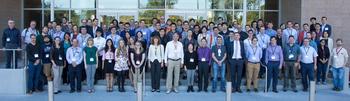
The Fifth International User Workshop focusing on high-power lasers at the Linac Coherent Light Source (LCLS) was held in Menlo Park, CA, USA on September 27–28, 2017 (Falcone et al., Reference Falcone, Glenzer and Hau-Riege2014; Heimann and Glenzer, Reference Heimann and Glenzer2015; Bolme et al., Reference Bolme, Glenzer and Fry2016, Reference Bolme, Mackinnon and Glenzer2017). The workshop was co-organized by SLAC National Accelerator Laboratory (SLAC) and Los Alamos National Laboratory, and it had approximately 100 scientists in attendance. For the first time, this year's workshop was combined with the larger LCLS/SSRL User Meeting. Participants discussed the recent experiments that have been performed using high-power lasers at the LCLS-Matter in Extreme Conditions (MEC) endstation. Ten journal articles have been published during the previous year from research at the MEC instrument (Fletcher et al., Reference Fletcher, Zastrau, Galtier, Gamboa, Goede, Schumaker, Ravasio, Gauthier, MacDonald, Chen, Granados, Lee, Fry, Kim, Roedel, Mishra, Pelka, Kraus, Barbrel, Döppner and Glenzer2016; Nagler et al., Reference Nagler, Schropp, Galtier, Arnold, Brown, Fry, Gleason, Granados, Hashim, Hastings, Samberg, Seiboth, Tavella, Xing, Lee and Schroer2016; Beckwith et al., Reference Beckwith, Jiang, Schropp, Fernandez-Pañella, Rinderknecht, Wilks, Fournier, Galtier, Xing, Granados, Gamboa, Glenzer, Heimann, Zastrau, Cho, Eggert, Collins and Ping2017; Briggs et al., Reference Briggs, Gorman, Coleman, McWilliams, McBride, McGonegle, Wark, Peacock, Rothman, Macleod, Bolme, Gleason, Collins, Eggert, Fratanduono, Smith, Galtier, Granados, Lee, Nagler, Nam, Xing and McMahon2017; Gleason et al., Reference Gleason, Bolme, Galtier, Lee, Granados, Dolan, Seagle, Ao, Ali, Lazicki, Swift, Celliers and Mao2017; Kraus et al., Reference Kraus, Vorberger, Pak, Hartley, Fletcher, Frydrych, Galtier, Gamboa, Gericke, Glenzer, Granados, MacDonald, MacKinnon, McBride, Nam, Neumayer, Roth, Saunders, Schuster, Sun, van Driel, Döppner and Falcone2017; Lu et al., Reference Lu, Hill, Bitter, Pablant, Delgado-Aparicio, Efthimion, Lee and Zastrau2017; Seiboth et al., Reference Seiboth, Schropp, Scholz, Wittwer, Rödel, Wünsche, Ullsperger, Nolte, Rahomäki, Parfeniukas, Giakoumidis, Vogt, Wagner, Rau, Boesenberg, Garrevoet, Falkenberg, Galtier, Ja Lee, Nagler and Schroer2017; Sperling et al., Reference Sperling, Rosmej, Bredow, Fletcher, Galtier, Gamboa, Lee, Reinholz, Röpke, Zastrau and Glenzer2017; Witte et al., Reference Witte, Fletcher, Galtier, Gamboa, Lee, Zastrau, Redmer, Glenzer and Sperling2017), and research performed at MEC has also contributed to several PhD theses. This workshop provided an opportunity for the scientific community to learn about recent accomplishments, as well as to discuss future facility upgrades. SLAC has already begun construction for a major upgrade of the X-ray free electron laser LCLS to LCLS-II, which made the community feedback particularly timely at this workshop. LCLS will be closed during 2019 for the upgrade and will re-commission new and enhanced capabilities in early 2020 (Photo 1).
(Color online) Participants at the Fifth User Workshop on high-power lasers at the Linac Coherent Light Source held at SLAC National Accelerator Laboratory in Menlo Park, CA.

The SLAC Director Chi-Chang Kao started the workshop and talked about the LCLS-II upgrades. He also stressed the importance of feedback from the scientific community to the development of highly productive user facilities. Kramer Akli, the Program Manager for High Energy Density Laboratory Plasma (HEDLP) at the Department of Energy's Fusion Energy Sciences (FES), presented about program funding priorities. The HEDLP program funds the operation of the MEC endstation, and Akli reaffirmed the prioritization of MEC-enabled science in HEDLP. In the 2017 fiscal year, HEDLP provided an additional $1.7 M to upgrade the long-pulse optical laser at MEC.
Hae Ja Lee, one of the three senior MEC instrument scientists, presented the MEC experimental update. MEC has continued to offer standard experimental configurations, which have increased the number of experiments performed by 50%. Most of the experiments using the long-pulse laser were performed using the standard configuration with X-ray diffraction (XRD) and velocity interferometry for any reflector (VISAR) as the diagnostics. During the 6-month long shutdown period to initiate the LCLS-II upgrade, improvements were made to both the short-pulse and the long-pulse lasers at MEC, with the long-pulse laser having recently demonstrated peak energy performance of 75 J in a 10 ns pulse.
MEC has recently undergone a few staffing changes. Gilliss Dyer has become the new MEC department head. MEC is receiving support for the optical laser from the MEC laser scientist Eric Cunningham and laser engineer Michael Greenberg.
Several speakers were invited to present about the opportunities and about other facilities using high-intensity lasers. Phil Bucksbaum (Stanford University and SLAC) is chairing a committee to produce a report for the National Academies of Sciences, Engineering, and Medicine on the use of intense lasers. This study is motivated by recent breakthroughs with ultrafast lasers and advancements in the underlying technology (National Academies of Sciences, Engineering, and Medicine, 2018). Sebastian Goede (European XFEL) presented about upcoming high-energy density (HED) science research opportunities at the European XFEL. The HED endstation will begin commissioning in late 2018 with planned HED environments created by optical lasers, dynamic diamond anvil cells, and pulsed magnetic fields. Toshinori Yabuuchi (SACLA) presented about the research at SACLA, the X-ray free electron laser in Japan, using high-intensity lasers and about laser upgrades that are currently underway.
RECENT EXPERIMENTS AT LCLS-MEC
Dominik Kraus (Helmholtz-Zentrum Dresden-Rossendorf) led off the presentations on the user experiments that were performed in the past year. His experiment was an expansion of his previous experiment (Kraus et al., Reference Kraus, Vorberger, Pak, Hartley, Fletcher, Frydrych, Galtier, Gamboa, Gericke, Glenzer, Granados, MacDonald, MacKinnon, McBride, Nam, Neumayer, Roth, Saunders, Schuster, Sun, van Driel, Döppner and Falcone2017) about diamond formation to examine the effects of higher shock pressures and lower temperatures. This was the first experiment performed after the upgrade of the ns optical laser from 40 to 75 J, and there were a number of difficulties with re-commissioning both the long-pulse and the VISAR lasers that needed to be solved before succeeding in observing diamond formation in triple species shocked matter. Yu Lin (SLAC) led an experiment to investigate the dynamics of crystallization in metallic glass, which she compared with static high-pressure studies under both hydrostatic and non-hydrostatic conditions in diamond anvil cells. Malcolm McMahon (University of Edinburgh) presented his experiment on strength and phase transitions in vanadium. Ray Smith (Lawrence Livermore National Laboratory) presented his experiment on phase transitions in shock-compressed zirconium. Dan Shim (Arizona State University) presented his use of both XRD and X-ray emission spectroscopy to probe the iron spin transitions in iron-bearing silicates, which are common components in the Earth. Emma McBride (XFEL and SLAC) led an experiment with simultaneous imaging and diffraction to probe shock-induced phase transitions normal to the direction of shock propagation. She also capitalized on the differences in focusing between the fundamental and third harmonic X-rays to selectively image and diffract from specific regions of the targets. David McGonegle (University of Oxford) presented on investigations of the relative roles of slip and twinning for plastic deformation in copper and presented on off-Hugoniot compression through the use of layered targets with different impedances. Kyle Ramos (Los Alamos National Laboratory) performed an experiment to probe the phase space of organic explosives using multiple single-crystal orientations and polycrystalline materials. The experimental results will be used to develop anisotropic constitutive models for these materials.
There were two experiments performed using the short-pulse laser in the past year. Thomas Kluge (Helmholtz-Zentrum Dresden-Rossendorf) presented an experiment on the dynamics of solid density plasmas using nano-structured targets. Bob Nagler (SLAC) also presented about solid density plasmas. His experiment was particularly challenging, and it still requires improvements in the pre-pulse contrast ratio of the optical laser in order to form the desired plasma conditions.
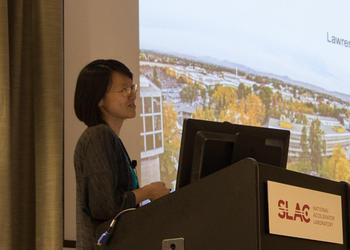
Yuan Ping (Lawrence Livermore National Laboratory) presented on the only experiment at MEC this year that used the LCLS X-rays as the pump. She used the isochoric X-ray heating to create warm dense matter for thermal conductivity measurements (Photo 2).
(Color online) Yuan Ping presented recent experimental results on measuring thermal conductivity in warm dense matter created by the high-intensity X-rays from the LCLS.
LCLS ACCOMPLISHMENTS AND PLANS
The LCLS Director Mike Dunne presented to the combined High Power Laser workshop and LCLS/SSRL User Meeting attendees on the second day of the workshop. He reviewed recent LCLS accomplishments and presented some of the plans for the upcoming LCLS-II upgrade. During the 6-month long shutdown to start construction of LCLS-II, the horizontal offset mirrors were replaced with new larger mirrors. Since the beginning of LCLS operations, these mirrors had resulted in clipping of the X-ray beam. The new larger mirrors are sufficient to transmit the entire beam without distortion of its spatial profile. Additionally, the transmitted intensity of the X-ray beam has increased by 10 s of percent since it is no longer being clipped.
Developments with the LCLS XFEL have continued, providing new and diverse modes of operation. Self-seeding of LCLS has become robust and is now part of routine operations. A wide range of dual-pulse and dual-color modes are available, and development is underway for multi-bunch (4, 8, 16-pulse) operation. Hard X-ray fresh-bunch self-seeding using the new “dechirper” can provide a twofold increase in the brightness of the seeded beam.
The proposal for an additional upgrade to LCLS-II-HE, which would include a high-energy undulator, achieved project status of CD-0 in December 2016. The upgrade to LCLS-II will be completed during 2019, and LCLS will begin coming back online in 2020. There will be a staggered restart and re-commissioning of hutches in early 2020. It is expected that there will be a full review cycle for general user proposals within the first half of 2020.
MEC USER COMMUNITY DISCUSSIONS AND FEEDBACK
The workshop attendees split into two groups to have more focused discussions for providing feedback to the facility and for proposing recommendations for future capability investments. The two groups were focused on either experiments with the long-pulse laser or with the short-pulse laser.
Long-pulse laser discussion
Laser pulse energy
The users in the group noted that significant additional scientific space could be accessed with an order of magnitude increase in the laser energy (up to ~1 kJ). This increased energy would also permit dynamics to be measured for much longer times since larger and thicker specimens could be compressed. Higher energies would also allow access to regions of pressure and temperature above those accessible to laser-heated diamond anvil cells.
Laser repetition rate
An increase in the optical laser repetition rate would be welcome but was not viewed by the users to be as important as an increase in the laser pulse energy. A higher repetition rate would be helpful for experiments that have low signal counts (principally spectroscopies).
Standard configurations
This discussion group requested that the next experimental configuration to standardize be the combined phase-contrast imaging and wide-angle diffraction configuration. Significant resources were used to design and build this set up in 2015 and 2016, but its adoption as a standard configuration has been delayed. When implementing, it was also requested that the positions of the target, the ptychography specimen, and the XRD detector be improved to allow more solid angle coverage by the XRD detector. Because of the high variability in analyzing or reconstructing the X-ray imaging data, the users do not expect MEC to provide analysis software for the image reconstruction associated with this experimental configuration.
The second standard configuration requested was a combination of wide-angle and small-angle X-ray diffraction (SAXS). This configuration has been performed by multiple separate groups and would be very useful as a standard configuration. Since the endstations are being reconfigured for LCLS-II, the users requested that additional distance be available after the target interaction volume to allow larger distances between the target and the detectors for SAXS and for imaging. Currently, the maximum distance allowed is approximately 4 m, but a distance of 8–10 m is requested for better SAXS and imaging measurements. This increased distance will become even more important for measurements using the higher photon energies of LCLS-II-HE.
Electromagnetic pulse mitigation
The electromagnetic pulse that is generated when the long-pulse laser interacts with targets continues to be a problem, most notably with loss of data from the CSpad detectors. Upgrading the CSpad cables and electrical isolation of the target mount were suggested improvements. The users requested that more time and resources from the detector group and the MEC staff would be devoted to resolving or reducing this ongoing issue.
Operations and procedures
The group discussed the importance of further standardizing the procedures and improving the conduct of operations. Two particularly noticeable areas available for improvement are in automating the saving of data for VISAR and for the temporal laser profiles on an oscilloscope. Previous attempts have been made, but a robust solution has not yet been developed.
Diagnostics
MEC is planning a new temporal diagnostic suite that would provide measurements about the optical lasers on each shot. These diagnostics are planned to include a fiber-coupling pick-off signal of the temporal laser profile. It was suggested that the detector includes variable filter attenuation to provide better signal-to-noise for the laser pulse shapes.
The users articulated the strong desire for a way to monitor and measure the spatial profile of the optical laser at an equivalent target plane. This information is often critical to diagnosing inconsistencies during data collection and would be invaluable to the experimenters.
A streaked optical pyrometer was universally requested by the users. Implementing this diagnostic for temperature measurements would make sense when the VISAR system is re-configured for LCLS-II. It was suggested that this diagnostic be developed to concurrently detect two or three wavelengths (e.g. 1000 and 650 nm) to reduce the temperature uncertainty with the specimens of unknown emissivity.
Additional requests
There have continued to be significant problems with the spatial profile of the optical laser on the targets and with fratricide of neighboring targets. The phase plates used for shaping the spatial beam profile produce a halo around the main laser spot, which damages other targets and reduces the compression of the specimen. One user noted that he was able to achieve higher pressures in his samples before the laser was upgraded to 75 J, presumably because more of the available energy was driving the compression of his target.
Another request was to use a much longer translation stage for moving the targets. A longer stage would allow more distance between adjacent targets, which would reduce target fratricide.
Short-pulse laser discussion
Laser characteristics
The needs for a future upgrade of the MEC short-pulse laser were discussed in a short-pulse laser discussion session, and the preferences expressed were varied based on the scientific application. The first priority was for relativistic intensities (~1019 W cm–2) and high repetition rate to achieve statistics in measurements (e.g. 50 J, 50 fs, 0.1 Hz). A laser with these characteristics would be useful for intense laser–matter interaction and as a broadband betatron X-ray source. For creating secondary radiation sources such as proton and neutron beams with high numbers of particles per shot, a high-energy short-pulse laser system would be required, which implies 100 J or more at intensities of order 1021 W cm–2 (e.g. 500 J, 500 fs, shot per 10 min). In the near future (next 10 years), a target solution for high repetition rate at >100 J is not expected to exist. Therefore, a laser providing shot on demand at the high-energy petawatt level, with a capability of high repetition rate >1 Hz at the joule energy level was considered an ideal compromise. Universally, very high-intensity contrast (>1010) was considered essential in accessing the planned physics regimes.
For standard delivery of the short-pulse optical laser to the interaction volume, it would be beneficial to have delivery systems for both a very tight focal spot (1–100 µm) and for a larger focal spot (>250 µm) but with uniform spatial intensity distribution. For achieving these parameters, two sets of focusing optics (high f-number and low f-number parabolas) would be used.
Optical laser diagnostics
Beneficial laser diagnostics would include an online focal spot monitor (should be available in between shots without venting the target chamber) and contrast, energy, and pulse shape measurements on each shot. Additionally, an improvement in measuring the timing jitter to 10 fs was requested.
Diagnostics
Similar to the long-pulse laser discussion, this group also articulated the strong need for a streaked optical pyrometer for measuring temperatures and for small-angle X-ray scattering.
A number of spectral diagnostics were also requested including Thomson parabolas (for electron/proton spectrum measurement under 0 and 45° with respect to the optical laser), imaging spectrometers for X-ray self-emission, and high-resolution X-ray spectrometers covering 100 s of eV up to 5 keV. A standard measurement of the input X-ray spectrum upstream of the interaction volume would be highly useful.
X-ray diagnostics improvements are requested to measure the incident LCLS X-ray photon energy and X-ray intensity in the chamber (error <1%).
Target delivery systems
Standard delivery of liquid and/or cryogenic samples is desired.
Improvements to XRD/XRTS standard configuration
For the XRD setup, it would be beneficial to position one CSpad quad directly above the targets (like the original XRD standard configuration) and place the other quads around it. Currently, there is a gap between the two quads above the target, which adds unnecessary challenges to the data analysis.
It was also requested that the time allocated before standard configuration experiments be increased to ensure proper preparation and commissioning of the endstation before commencement of user experiments. Additional development and implementation of standard procedures for alignment and calibration were noted as areas for improvement, particularly for XRTS.
Other standard configurations to develop
It is desired that future development of standard configurations include SAXS and betatrons, in combination with long-pulse drive and XRD/XRTS.
POSTER AWARDS
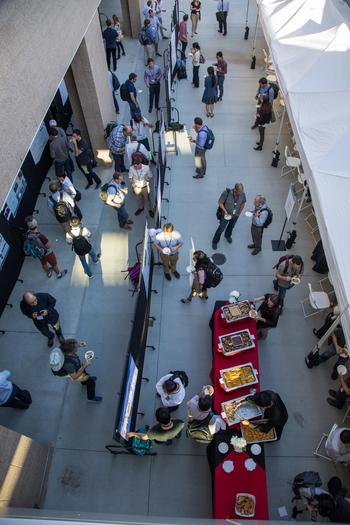
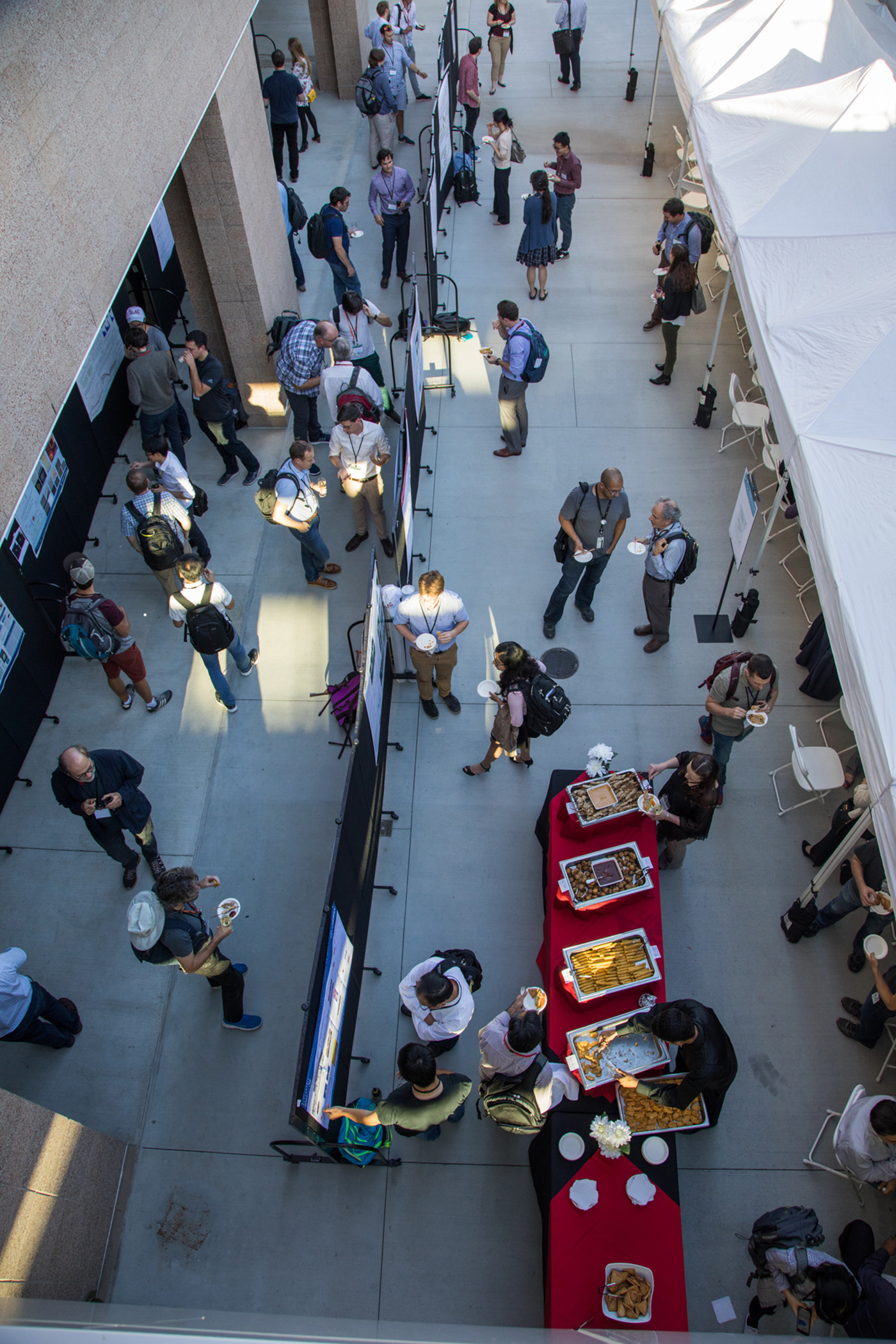
The workshop's poster awards went to Colton Fruhling (University of Nebraska-Lincoln) for his poster about non-linear Thomson scattering and to Sulgiye Park (Stanford University) for her poster on diamondoid-to-diamond phase transitions (Photo 3).
(Color online) Conversation and collaboration among scientists were facilitated during the poster session and receptions.
ACKNOWLEDGEMENTS
Workshop funding was provided by the DOE Office of Science – Fusion Energy Sciences under contract FWP 100189. The authors are grateful for the support of the corporate workshop sponsors: Coherent, General Atomics, Lattice Electro Optics, Leybold, Prism Computational Sciences, and Northrop Grumman. Additional support was provided by SLAC National Accelerator Laboratory. The authors also gratefully acknowledge conference planning and administrative support from Meredith Noe and Suzanne Rose Bennett (Stanford Conference Services) and from Charlotte Chang, Nitssia Harrison, Kari Horwath, and Debbie Tryforos (SLAC National Accelerator Laboratory). Additional information may be obtained at the workshop website: https://app.certain.com/profile/web/index.cfm?PKWebId=0x92900649e7.