INTRODUCTION
Although professional careers in oncology can be rewarding (Kash et al., Reference Kash, Holland and Breitbart2000), staff experience greater signs of stress than their palliative care counterparts (Vachon, Reference Vachon, Hanks, MacDonald and Cherny2004; Pierce et al., Reference Pierce, Dougherty and Panzarella2007) and cancer centers benefit from exploring ways to enhance peer staff support and reduce work stress (Kash et al., Reference Kash, Holland and Breitbart2000). Cancer care is associated with many strains, including derogatory constitutional symptoms and psychosocial adjustments (Le Blanc et al., 2004). Patients' illness trajectories are often uncertain, and many unexpectedly die, potentially eliciting staff grief (Saunders & Valente, Reference Saunders and Valente1994), even when staff maintain professional relationships, including “detached concern” and objectivity (Vachon, Reference Vachon, Hanks, MacDonald and Cherny2004; Le Blanc et al., Reference Le Blanc, Hox and Schaufeli2007). Losses associated with oncologic work can elicit one's own previous losses and existential questioning that can surface at any time in the future (Mount, Reference Mount1986; Vachon, Reference Vachon, Hanks, MacDonald and Cherny2004). Likewise, chronic compounded grief (Felstein & Gemma, Reference Felstein and Gemma1995) may lead to secondary traumatic stress or compassion fatigue (Figley, Reference Figley and Figley1995) and burnout (Papadatou et al., Reference Papadatou, Anagnostopoulos and Monos1994). Busy workloads, lack of support, and role ambiguity may compound staff vulnerability, and interpersonal conflict, job dissatisfaction, and burnout may result (Lewis, Reference Lewis1999; Kash et al., Reference Kash, Holland and Breitbart2000; Le Blanc et al., Reference Le Blanc, Hox and Schaufeli2007). Salient methods used by oncology staff to reduce personal stress include talking with someone, using humor, eating, watching television, drinking coffee (Kash et al., Reference Kash, Holland and Breitbart2000), and partaking in spiritual practices (Holland & Neimeyer, Reference Holland and Neimeyer2005). In addition, support through implementation of specialized programs designed for communication skill development may lead to improved self-efficacy and care delivery (Bylund et al., Reference Bylund, Brown and di Ciccone2008).
Formal support for oncologic staff is intended to reduce burnout, retain staff, and improve patient care through staff education and nurturance (Medland et al., Reference Medland, Howard-Ruben and Whitaker2004; Fillion et al., Reference Fillion, Dupuis and Tremblay2006). Programs may be individually focused, such as counseling (St. Vincent's Health, 2003) and subsidized complementary therapies sessions, including aromatherapy, reiki, reflexology, acupuncture, and massage (Cassileth & Vickers, Reference Cassileth and Vickers2004; Wilson et al., Reference Wilson, Ganley and Mackereth2007). For example, at Memorial Sloan-Kettering Cancer Center, staff frequently make use of such therapies offered through the Integrative Medicine Service. Art programs in cancer settings can also be helpful (Cassileth et al., Reference Cassileth, Vickers and Deng2005). Staff group sessions include retreats (Medland et al., Reference Medland, Howard-Ruben and Whitaker2004) and bereavement support (Lewis, Reference Lewis1999).
Research on the effectiveness of staff support measures in oncology is scant. Convenience sample questionnaire responses indicated that complementary therapies improved participants' worklife and increased their feelings of control, happiness, coping, relaxation, self-awareness, self-esteem, and physical comfort (Wilson et al., Reference Wilson, Ganley and Mackereth2007). In a quasi-experimental study examining a “participator action approach” burnout intervention program, the experimental group felt significantly less exhausted and depersonalized (Le Blanc et al., Reference Le Blanc, Hox and Schaufeli2007).
Although these cost-added programs are clearly useful, there is scant attention on contextual features already within oncology wards and how they may also contribute to staff well-being in their daily work, thus potentially reducing stress and burnout. “Environmental music therapy” in oncology at Beth Israel Medical Center helped staff cope and temporarily escape work demands (Stewart et al., Reference Stewart, Silberman, Loewy, Dileo and Loewy2005). In Australian research that examined the relevance of inpatient oncologic music therapy (what it did and whether it helped), an unexpected finding was that staff reported the personally helpful effects of witnessing and sometimes momentarily engaging in the open ward sessions (O'Callaghan & McDermott, Reference O'Callaghan and McDermott2004).Footnote * Music therapy (MT) research in an American cancer hospital then examined the specific effects of a comparable MT program on staff. This article describes both of these studies and compares their findings. Likewise, the potential ways that supportive services may extend beyond direct staff services, including environmental aspects of MT, are discussed.
ONCOLOGIC MUSIC THERAPY
Music therapy may be defined as the creative and professionally informed use of music in a therapeutic relationship with people identified as needing physical, psychosocial, or spiritual assistance or with people aspiring to experience further self-awareness, enabling increased life satisfaction and quality (O'Callaghan, Reference O'Callaghan, Hanks, MacDonald and Cherny2004). Although numerous theoretical and research papers on MT in hospice and palliative care have been written since 1978 (Munro & Mount, Reference Munro and Mount1978; Hilliard, Reference Hilliard2005), including proceedings from four symposia (Martin, Reference Martin1989; Lee, Reference Lee1995; Rykov & Salmon, Reference Rykov and Salmon2001; Dileo & Loewy, Reference Dileo and Loewy2005), literature on adult oncologic MT is less available and quite varied. MT has been found to reduce anxiety and improve mood in hematological patients undergoing bone marrow transplantation (Cassileth et al., Reference Cassileth, Vickers and Magill2003) and in patients enduring series of radiotherapy treatments (Clark et al., Reference Clark, Isaacks-Downton and Wells2006). Further evidence also indicates that oncologic MT can improve mood, vigor (Magill Bailey, Reference Magill Bailey1983), pleasure, self expression (O'Brien, Reference O'Brien, Baker and Wigram2005), relaxation (Boldt, Reference Boldt1996), energy (O'Brien, Reference O'Brien, Rebollo Pratt and Erdonmez Grocke1999), and group cohesiveness (Waldron, Reference Waldron2001) and reduce anxiety, pain (O'Brien, Reference O'Brien, Rebollo Pratt and Erdonmez Grocke1999), and perceived nausea (Standley, Reference Standley1992). In the earlier mentioned Australian research, which examined patients', visitors', and staff members' perspectives regarding the relevance of MT in a cancer research hospital, the anonymous respondents' predominantly positive experiences included revisited memories and descriptions of their “transportation” to new places, thoughts, and physical sensations (O'Callaghan & McDermott, Reference O'Callaghan and McDermott2004). Mixed method research on MT support groups for people living with cancer in the community or residential support settings has also produced encouraging findings, including that support groups helped participants to identify and express emotions, develop new awareness and group cohesion (Bunt & Marston-Wyld, Reference Bunt and Marston-Wyld1995), experience improved well-being, energy, immunological response (Burns et al., Reference Burns, Harbuz and Hucklebridge2001), life quality, mood (Rykov, Reference Rykov2008), empowerment, and control (Rykov, Reference Rykov2008), and reduced energetic arousal, tension (Burns et al., Reference Burns, Harbuz and Hucklebridge2001), and pain (Rykov, Reference Rykov2008).
Staff seldom participate in MT research, although two recent studies indicate the potential of such enquiry (Amadoru & McFerran, Reference Amadoru and McFerran2007; O'Kelly & Koffman, Reference O'Kelly and Koffman2007). Interviewed staff describing the benefits of MT in a children's hospice added that the MT also helped them through providing a break from routine, allowing them to enjoy being with the children, and improving the hospice ethos (Amadoru & McFerran, Reference Amadoru and McFerran2007). Comparable effects were found in adult hospice environments (O'Kelly & Koffman, Reference O'Kelly and Koffman2007) and are described as “musical environmental therapy” (Aasgaard, Reference Aasgaard and Aldridge1999). Furthermore, caregivers have noted finding “peace” and “comfort” in watching the pleasure their loved ones received from the MT sessions and in knowing that they were in some way able to help them again through these sessions (Magill, Reference Magill2007). These findings suggest that staff could benefit from witnessing the therapeutic impact of MT on patients. This research examines the following question: What are the effects of witnessing patient-focused music therapy programs on staff in two comprehensive cancer centers?
METHOD AND RESULTS
Australian Study: Anonymous and Spontaneous Written Feedback within Broader Research on Oncologic Music Therapy's Relevance
Setting and Method
After receiving approval from management, the music therapist-researcher invited staff in a 94-bed cancer research hospital to write their anonymous views about music therapy's relevance over a period of 3 months (although the MT program had existed in the hospital for approximately 18 months). MT was offered in five inpatient ward settings for 16 hours a week. During the data collection period, 207 patients collectively experienced MT in 356 individual or group sessions, sometimes with visitors, and lasting between 10 and 90 minutes. Occasionally staff spontaneously joined in sessions for brief periods, for example, to request a song, discuss with patients aspects about the music, and sing and dance. A general description of this music therapist's style of work is found elsewhere (O'Callaghan, Reference O'Callaghan2006).
Staff were invited to participate in the research in three ways: through personal invitations by the music therapist-researcher, through e-mail, and through advertisements attached to five locked feedback boxes placed on the inpatient wards and in the Social Work Department. Participants collected a Plain Language Statement (PLS) information sheet located with the feedback boxes or e-mail attachment. The PLS explained the research, requested their feedback, and added that, “Any thoughts or feelings you have about MT, both positive and negative, will be relevant, including your own observations as well as reports of patients or visitors' feedback about the service.” Attached to the PLS was a one-page form requesting that they indicate their role, the number of feedback forms they had previously returned, and their written comments. The textual findings were transcribed and inductively coded, that is, predetermined labels were not used. The codes and their text were systematically condensed, using the grounded theory methodology of comparative analysis, into representative categories and a final theme.
Music therapy sessions and data analysis were conducted by the Australian music therapist-researcher (first author). Two research academics supervised the research and supported data analysis interpretations or provided opportunities to analyze the data further. This interrater process process promotes interpretive rigor in qualitative studies (Kitto, Chesters, & Grbich, Reference Kitto, Chesters and Grbich2008).
Results
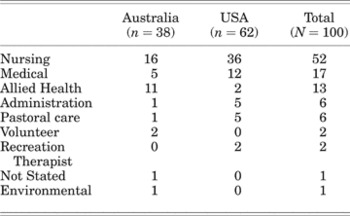
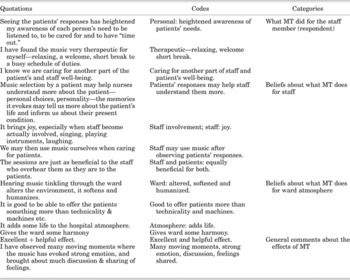
A brief description of the staff's general responses, including their beliefs about music therapy's effect on the patients and visitors, is found elsewhere (O'Callaghan & McDermott, Reference O'Callaghan and McDermott2004). These results focus on the 38 staff responses that included descriptions about what staff thought MT did for them and other staff. Respondents' roles were mostly nursing, allied health, and medical and are found in Table 1. Their written text informed four categories including what MT did for the staff member respondent (informed by 42 codes), beliefs about what MT does for staff in general (19 codes), beliefs about what MT does for the ward atmosphere (15 codes), and general comments about the effects of MT (10 codes). These categories, with examples of text and codes informing them, are found in Table 2. The four categories, their codes, and text were recursively analyzed until a final theme emerged: Staff rarely found MT intrusive; rather, the music and therapist often elicited a range of personally helpful emotions and self-awarenesses, improving individual and team work life and the ward environment.
Respondents' Roles

Sample of Australian Staff's Anonymously Written Quotes and Coding to Inform Categories Depicting Music Therapy's Effect on Staff

USA Study: Interview Feedback in a Focused Research Study
Setting and Method
Over a 4-month period, the full-time music therapist-researcher (second author), who had worked throughout the 437-bed cancer research setting for more than 30 years, invited 62 staff to participate in individual open-ended MT interviews, using theoretical sampling, that is, sampling representing phenomena holistically in order to consider potential data contradictions (Corbin & Strauss, Reference Corbin and Strauss2008; Kitto et al., Reference Kitto, Chesters and Grbich2008). In this case, the researcher sought the staff that appeared to be questioning the effects of MT. Staff were approached who worked in the intensive care unit, operating rooms, presurgical center, postanesthesia care centers, and inpatient wards, and included mostly nurses and medical staff (see Table 1). These staff members were frequent bystanders during MT sessions and had been witnesses, and/or occasional brief participants through singing and dancing, interacting with patients and families, or joining in patient reminiscences and discussions. A general description of this music therapist's style of MT work is found elsewhere (Magill Bailey, Reference Magill Bailey1984; Magill, Reference Magill2006). All staff were eager to share their reflections, and all who were approached participated. They were verbally asked for positive and critical feedback with the following questions as guides: “Do you think MT affects the staff in the hospital?” and “Does the presence of music and/or MT in the hospital affect you in any way?” If responses were affirmative to either question they were also asked, “How?” Other questions were asked according to the earlier responses, including, for example, “What is it like for you when you hear a music therapist with a patient? Do you notice feeling any differently during or after hearing MT? How do you feel during/after hearing music on the floor? Does the presence of music help you in any way? Does the presence of music affect your mood or feelings of stress? How? Would you like time with music for staff if possible?” The music therapist-researcher noted their responses.
The text analysis procedure was identical to the Australian study described earlier. Data collection and analysis were conducted by the U.S. music therapist-researcher. Another experienced researcher also supported data analysis interpretations or provided opportunities to discuss and analyze data further to promote interpretative rigor.
Results
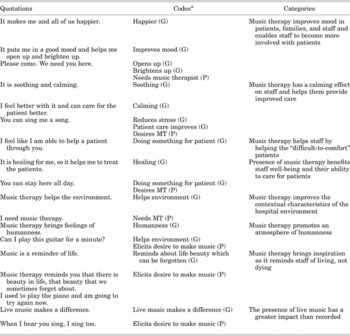
One hundred and ninety-seven statements were made by the 62 staff and these were ultimately condensed into eight categories, including improvement in mood; reduction in stress, enabling improved care; provision of care to difficult-to-comfort patient; provision of healing to staff, enabling improved care; improvement in environment; improvement in feelings of humanness; improvement in sense of meaning through reminders of life and living; and improvement overall as a result of live music. These categories, with examples of text and codes informing them, are found in Table 3. The categories, their codes, and texts were recursively analyzed until a final statement emerged: Staff found that the presence of MT improves the environmental setting and offers multiple personal benefits, enabling staff to almost always provide improved care.
Sample of U.S. Staff Quotes from Interviews and Coding to inform Categories Depicting Music Therapy's Effect on Staff

a(P): how MT affected staff personally; (G): how staff perceived MT helped staff and setting overall.
COMPARISON OF FINDINGS AND DISCUSSION
The narrative reflections in both studies demonstrate that staff often experienced multiple benefits. It is interesting to note that, in both hospitals, staff referred to personal and global perceptions. For example, staff referred to the striking personal impact of seeing and being in the vicinity of music therapists working intimately with patients and families. They frequently referred to the significance of this human and caregiving aspect of MT and the positive influences these qualities have on patient care. Staff in both studies described the ways that the presence of MT helped them improve their own ability to care for patients through its impact on their mood, feelings of well-being, and degree of self/other awareness. Staff also indicated being reminded of life and living again, significant when understood within the context of large cancer care settings wherein staff are commonly surrounded by reminders of life's finality and existential uncertainties. Staff also made multiple personal references to a longing to partake in instruments of their choice, as observed in comments such as: “I play the piano and sing; can you teach me the guitar?” “I need a song too.” or “Please come here. We need you today in the nursing station.” Likewise, staff noted improvement in contextual features of their work environments, such as improved sense of humanness and characteristics of “brightness.” They also commented on the more global impact of MT, for example, the way MT improves the mood of staff overall as well as of patients and families. They perceived that this broader impact of MT “opened the door” to improved interpersonal exchanges and opportunities to reach those with whom they worked. These findings were consistent with the many anecdotal experiences had by both therapist authors.
The American music therapist-researcher purposefully explored staff reflections about the impact of MT following the Australian researcher's unexpected discovery that staff benefited from her patient/visitor-centered MT program. Data emergent from the two sources (anonymous, open-ended questionnaires and open-ended interviews) included positive responses as well as three negative cases, characterized by intrusion (i.e., audiblity, initial suspicion, and the relaxed effect slightly slowing work pace). The two studies' findings were comparable and repetitive; thus data saturation is suggested in relation to these two clinical contexts. Furthermore, amalgamating the two studies' findings, through further comparative analysis, fulfilled the requirements of the grounded theory research paradigm such that a “substantive grounded theory” (Corbin & Strauss, Reference Corbin and Strauss2008) could be proposed about music therapy's effect on oncologic staff bystanders, specific to two cancer centers. Before presenting this theory, it is important to mention the contemporary understanding of a “substantive grounded theory.” Grounded theory research procedures, including theoretical sampling, data saturation, and comparative analysis, can lead to three levels of theory development, substantive, middle range, and formal, representing decreasing levels of specificity to a group and/or place. Theory denotes a set of well-developed codes, categories, and themes that are “systematically interrelated through statements of relationship … that explains some phenomenon … even though … theory may become outdated as new knowledge comes to light” (Corbin & Strauss, Reference Corbin and Strauss2008, p. 55). The substantive grounded theory here may be applied to music therapy at the two cancer hospitals involved in this study.
Cancer research hospital staff often benefit from witnessing, and occasionally engaging in, patient/visitor centered MT sessions; intrusive effects on staff work life are uncommon. MT can elicit a range of personally helpful emotions, mood states, and self-awarenesses, including remembered positive attributes about music, their own personal lives, and the lives of their patients. Staff believe that these factors, and the improved, more humane work environment, can also enhance their care of patients and teamwork. The benefits of MT are contained in the presence of the live music, the presence and style of the music therapist, and the positive effects the experiences elicit.
One can make a “conceptual generalization” (Kitto et al., Reference Kitto, Chesters and Grbich2008) from these findings, that is, the authors' style of music therapy practice (Magill, Reference Magill2006; O'Callaghan, Reference O'Callaghan2006) delivered in comparable cancer settings will lead to similar staff experiences. Hence, the provision of patient- and/or visitor-directed MT in cancer research hospitals should be considered as an incidental, non-cost-added, and significant staff support modality, alongside the more formal modalities, including counseling, complementary therapies, support groups, and so forth. The findings also support statements about MT incidentally supporting staff in hospice care (Aasgaard, Reference Aasgaard and Aldridge1999; Hogan, Reference Hogan and Aldridge1999; Amadoru & McFerran, Reference Amadoru and McFerran2007; O'Kelly & Koffman, Reference O'Kelly and Koffman2007) and oncology (Stewart et al., Reference Stewart, Silberman, Loewy, Dileo and Loewy2005).
Interpretative Rigor
The comparative analysis on the two studies described above meets interpretative rigor requirements for qualitative research (Kitto et al., Reference Kitto, Chesters and Grbich2008), including a representative sample integrating negative cases, interrater reliability procedures, and triangulation in the form of two varied data collection procedures.
Triangulation was also promoted through both music therapists' clinical reflexive journals, in which they recorded their observations and interpretations of the impact of MT on staff. Consequent journal analyses confirmed that MT helped staff in their work with patients and relieved some of the ward tension through promoting staff members “playing together.” For example, one nurse, who entered a MT session during a classical piano piece said, “I've had my fix now.” Although there was evidence that MT helped staff care for patients, there was also evidence suggesting that MT may have reduced some quality of care. For example, in the Australian study, two staff, who were making a bed beside a patient, commented about the “beautiful music” and then loudly talked about personal issues that excluded the patient. Music therapy perhaps offered them a “mask of privacy” that precipitated this behavior. Hence, even when staff perceive that MT may enhance their care of patients, this may not be the patient's experience. This occurrence, however, is rare in this setting.
Limitations and Recommendations
The findings' generalizability to music therapy programs in different settings is subject to the music therapist's style of practice and other wider sociocultural factors. For example, in MT, a “therapist effect” has been observed in pediatrics (Kain et al., Reference Kain, Caldwell-Andrews and Krivutza2004) and throughout the oncology setting (Magill, Reference Magill, Dileo and Loewy2005), and it may be that other music therapists in comparable cancer hospitals also elicit quite different staff responses. In this research, one staff member responded that
the effectiveness of MT depends on the therapist. I have observed other MT and found the patients and staff were not overly impressed, music was obtrusive and loud—patients not played to but played at. Patients felt obliged to contribute. … I have found [current music therapist] to be most therapeutic to patients and staff. She has a calm demure which invites and encourages patients to contribute. … [and] can play music requested.
Further analysis of the “therapist effect” in MT on oncologic staff bystanders is warranted through doing comparable research in varied cancer settings. Also, although the American therapist-researcher asked staff for positive and critical feedback so as to improve music therapy services, a potential bias effect may have occurred as some staff may have censored their statements to not offend. Nevertheless, two respondents still mentioned adverse affects (including one who said he or she would prefer CDs). Future interview studies could include unknown interviewers and assurances that responses will be nonidentifiable to mitigate any bias concerns.
It is believed that this is the first research to examine the incidental effects of patient-centered music therapy sessions on staff. When hospital managers consider supportive care modalities to reduce oncologic staff stress, it may benefit them to take into account and further explore the potential beneficial effects of supportive modalities such as MT. Similarly, although aesthetic artwork, nature, and architectural features are known to promote patient healing in hospitals (Storer, Reference Storer2008), their benefits for staff well-being may also be considered.
Although music preference is associated with positive responses (Stratton & Zalanowski, Reference Stratton and Zalanowski1984), it seems that this is not enough to promote staff well-being in cancer care. As one nurse respondent noted, even if she did not enjoy the music, the important thing was the patient's preference, and that walking into their sessions could still have a “very relaxing effect.” Staff, as well as family caregivers, may benefit from witnessing patients positively responding to MT, rather than through hearing the music themselves (Magill, Reference Magill2007).
This article illustrates how music therapist-researchers can conduct multisite studies on interpretative phenomena pertaining to their clinical practices, such as interpretations about their programs' relevance. Grounded theory research principles are particularly suited to this purpose with its acknowledgment that many alternate sources of data can be relevant to the researched phenomenon, including retrospective and prospective data sources (interviews, questionnaires, observations, diaries, etc.). Furthermore, it is accepted that no two researchers can analyze this kind of data in exactly the same way and, indeed, there is no one correct way to code and categorize (Coffey & Atkinson, Reference Coffey and Atkinson1996). Tables 2 and 3 illustrate how the Australian author used more descriptive codes and less descriptive categories; the American used less descriptive codes and more descriptive categories. However, the principles of comparative analysis still enabled satisfying final representations of the data, as evident in their final thematic statements. Furthermore this article illustrates that, as multiple researchers' data interpretations are shared and varying perspectives discussed, richer and more multifaceted representations of interpretive research phenomena can be developed and potentially support formal grounded theory development (Corbin & Strauss, Reference Corbin and Strauss2008) about subjective experiences in health care.
Grounded theory research methodology was considered as the best method to address this article's research question about the effects on staff when witnessing music therapy. Future research questions, where specific outcomes can be meaningfully measured by psychometric scales and prospective trials, may complement the findings here. Interpretative and positive research investigations would offer different views of the prismatic phenomenon of oncologic staff experience when witnessing patient-centered MT. Future investigations from both research traditions will, we hope, extend understanding about the myriad of ways that music therapy may incidentally support staff.
CONCLUSION
I was thinking about resigning but I don't think I will now.
Nurse with tears whispered, watching a cancer patient struggle out of bed and play the piano
Oncologic staff bystanders often benefited from MT and only seldom found it intrusive in two comprehensive cancer centers. MT elicited a range of personally positive affective and cognitive responses and beliefs about improved work life and patient care. The combined elements of music, music therapist, and the elicited experience of being part of a team providing good patient care helped many staff working in the two cancer hospitals described. It is well known that the healing attributes of music reach beyond words to soothe, restore, refresh, and create a sense of unity. The poignancy of the live music is also affected by the experiential context, the style of the presence of the music therapist, and the presence of staff “carers” within an environment where painful and often humiliating treatments are experienced by cancer patients for whom life is often irreparably damaged and uncertain.
“Sensible cultures know that life is mysterious” (Brady, Reference Brady2007). Music often enables individuals to engage with this mysterious and intangible aspect of life and living, as music can be a place for imagining and conceiving something beyond the apparent. Experiences in and around MT can bring momentary and long-lasting healing to individuals who are enduring and witnessing cancer-related challenges, and such experiences can inspire transformation, enlightenment, and personal enrichment. The potential intrinsic benefits of MT to oncologic staff and the overall hospital ethos may not be fully measurable, but it is hoped that this article inspires further considerations about the incidentally supportive effects of witnessing MT and its warranted presence in oncologic work environments.
ACKNOWLEDGMENTS
Clare O'Callaghan's contribution was enabled through her NHMRC Post Doctoral Fellowship (Palliative Care, 2008-9); Lucanne Magill's contributions were based on her experiences as Manager, Music Therapy Program, Integrative Medicine Service, Memorial Sloan-Kettering Cancer Center. Both authors thank the staff who participated in the studies.