




No CrossRef data available.
THE OBSIDIAN TRADE TO THE TUXTLAS REGION AND ITS IMPLICATIONS FOR THE PREHISTORY OF SOUTHERN VERACRUZ, MEXICO
Published online by Cambridge University Press: 28 March 2006
Abstract
Evidence from the Tuxtla Mountains in southern Veracruz suggests that Teotihuacan established a base at Matacapan, the region's top-ranking center, sometime during the Early Classic period. This development in Tuxtlas's prehistory was associated with the founding of Matacapan, a major shift in settlement pattern, and the presence of substantial amounts of Fine Buff, a lower fired variant of Fine Orange that resembles Copa ware, a common Middle Classic-period ceramic service ware at Teotihuacan. Teotihuacan's influence at Matacapan, as monitored ratios of candelero- and tripod support to rim sherds, increased markedly in the succeeding early Middle Classic period but declined in the late Middle Classic and early Late Classic periods. At the same time, Teotihuacan's influence extended well into the countryside, where it was present not only at other large sites, but also at small villages and hamlets. These developments were associated with changes in the amount and kind of obsidian traded to the Tuxtlas. The total volume of obsidian traded to the Tuxtlas in the Middle and Late Classic periods was huge: from 7.5 to 19.6 metric tons per year. Matacapan had preferred status as far as the consumption of green obsidian was concerned, and in general, pre-Hispanic settlements in the Tuxtlas consumed more of this material than neighboring areas such as La Mixtequilla and the Hueyapan region. When Teotihuacan declined in importance and its influence throughout Mesoamerica waned, a much smaller amount of obsidian—in particular, material from Pachuca—was traded to the Tuxtlas. This is precisely what we would expect if the Central Mexican city was no longer the conveyor of obsidian over long distances, and some other center—perhaps Cantona or El Tajin—replaced Teotihuacan as the primary distributor of obsidian to southern Veracruz.
Information
- Type
- Research Article
- Information
- Copyright
- © 2005 Cambridge University Press
Teotihuacan is one of the largest and most impressive archaeological sites in the Americas. Situated about 40 miles northeast of modern Mexico City it was the dominant power in the Basin of Mexico from the beginning of the Christian era until the eighth century a.d. (Cowgill 1996; Millon 1973, 1981; Sanders et al. 1979). During the Middle Classic period (a.d. 400–700), Teotihuacan was also able to exert “influence” throughout Mesoamerica (by influence, we mean the presence of architecture or artifacts rendered in Teotihuacan style). Many of these Teotihuacan-style artifacts were local imitations, but some were obvious imports from the city. Evidence of this influence has been recorded in such far-flung areas as the Maya Lowlands (Miller 1978), the Maya Highlands (Kidder et al. 1946; Sanders and Michels 1977), the Pacific Coast of Guatemala (Hellmuth 1978; Parsons 1978), the Valley of Oaxaca (Marcus 1980, 1983), western Mexico (Diehl 1976), and the Gulf Coast of Mexico (Santley 1989a; Santley, Ortiz Ceballos, and Pool 1987; Santley, Yarborough, and Hall 1987; Valenzuela 1945; Yarborough 1992). Various reasons have been offered to account for this contact process. These include military conquest (Cheek 1977; Sanders and Price 1968), proselytizing religious programs sponsored by the city's priests (Borhegyi 1971), emulation of Teotihuacan-style ritual and ideology (Clark 1986), and economic imperialism (Santley 1983, 1989a). The most recent evaluations of Teotihuacan's influence have emphasized its highly variable character in time and space (Braswell 2003; Carrasco et al. 2000; Marcus 2003). In the Maya region, for example, it involved political conquest in some cases (Bove and Medrano Busto 2003), the arrival of strangers who later became rulers or married into the royal line in other cases (Fash and Fash 2000; Pasztory 1993; Stuart 2000), and claims to royal legitimacy based on past Teotihuacan associations or the utilization of Teotihuacan imagery to enhance the power and authority of local Maya elites in still others (Laporte 2003; Sharer 2003; Stuart 2000).
The idea that has guided our research on this subject over the years is that Teotihuacan did not conquer a substantial part of Mesoamerica, as the Aztecs did shortly before Spanish contact. Rather, the city dominated the production and distribution of luxury and utilitarian goods, the most prominent of which was obsidian (Santley 1983, 1989a, 1989b; Santley and Arnold 1996; Santley, Ortiz Ceballos, and Pool 1987; Spence 1981). Teotihuacan's domination of obsidian production and distribution took place in stages. Initially, Teotihuacan established control of the Pachuca obsidian source region during the Tzacualli phase of the Formative period, when a number of centers and other sites were established in the Pachuca Mountains, as well as near other sources in central Mexico (Charlton 1978). This obsidian later became the major medium utilized at Teotihuacan and throughout a large part of highland Mexico during the Classic period (Santley et al. 1995; Spence 1981). Control of alternative sources of first-class obsidian from Zaragoza-Oyameles and El Chayal may have also been achieved during Classic times, either directly or, more likely, through its surrogates at Cantona, El Tajin, and Kaminaljuyu (Garcia Cook and Merino Carrion 1998; Sanders and Price 1968; Santley 1983). Presumably, merchants from Teotihuacan were the primary agents responsible for their exchange, as well. Unfortunately, this hypothesis cannot be evaluated in detail with the data at hand from Cantona and El Tajin, although, as we will argue later, it appears to have been the case for the Tuxtlas. As Teotihuacan declined in political and economic importance in the Late Classic period, its influence throughout Mesoamerica dropped by a significant margin, and obsidian from Pachuca ceased to be widely and commonly distributed.
In this paper, we test this model using information from the Tuxtla Mountains in southern Veracruz, Mexico (Figure 1). First, we summarize the archaeological sequence for the Tuxtlas, incorporating information from both excavation and surface survey. Second, we present the evidence for Teotihuacan's influence in the Tuxtlas during five phases of the Classic period. Third, we look at the evidence for obsidian exchange to the Tuxtlas and variations in its rate through time. And finally, we compare the evidence from the Tuxtlas with that from neighboring regions to place the model in wider spatial context.

Map of the Tuxtla Mountains showing the location of major archaeological sites.
The information on Teotihuacan's influence and obsidian exchange in the Tuxtlas comes from a variety of sources: (1) six sets of excavations at Matacapan, the region's principal urban center; (2) an extensive regional survey of a contiguous 400 km2 region around Matacapan; and (3) an intensive re-survey of seventeen sites found during the extensive survey. Most of the excavations at Matacapan were placed in domestic middens associated with residences and ceramic-production areas. Other excavations were situated at Comoapan, Bezuapan, and La Joya, three of Matacapan's southern suburbs. Upper- and middle-status, as well as lower-status, contexts were sampled. The extensive survey employed the field methodology developed in the Basin of Mexico (Sanders et al. 1979). During the extensive survey, a large, contiguous area of the Tuxtlas region was reconnoitered by survey teams who recorded information on site size and internal configuration and retrieved surface collections to date sites (Santley and Arnold 1996). The subsequent intensive survey used a systematic interval-sampling design at a series of sites found during the extensive-survey phase. Here, sets of transects were laid out at 25–50 m intervals across each site, and a series of controlled surface collections was made at 13 m intervals after vegetation removal along each.
PREHISTORY OF THE TUXTLAS REGION
The Tuxtlas region is located approximately 150 km southeast of the modern city of Veracruz, Mexico. The region has a long history of pre-Hispanic occupation, beginning in the Formative period and extending until the Spanish Conquest. (For a more complete discussion of the prehistory of the region, see Santley 1994; Santley and Arnold 1996, and Santley et al. 1997). Formative-period societies in the region were small in scale and comparatively undifferentiated socially and economically. During the Early Formative period (1400–1000 b.c.), it was confined mainly to the area in and around Matacapan in the central part of the Río Catemaco valley. This occupation was largely terminated at the beginning of the Middle Formative by an eruption of the nearby volcanic vent, Cerro Mono Blanco, which undermined agricultural productivity near the volcano. The subsequent Middle Formative-period occupation (1000–400 b.c.) was situated farther downstream, a part of the Tuxtlas less affected by the Mono Blanco ash fall. During the Late Formative period (400 b.c.–a.d. 100), population was largely confined to the same area. Interestingly, there was very little population growth throughout the period, though at Late Formative centers several modest civic ceremonial buildings were constructed. There is also very little evidence of occupational specialization, but El Salado, an Early Formative hamlet, and La Joya, a large Late Formative village, may have engaged in specialized salt production and biface manufacture respectively.
Population levels reached an all-time low in the Terminal Formative period (a.d. 100–300), and the evidence we have for this meager occupation again comes from the lower Río Catemaco valley. The Early Classic period (a.d. 300–450) was a time of change in settlement pattern. The central Río Catemaco valley was re-occupied, and a center was established at Matacapan, which later became the major central place in the region. Why this was the case is difficult to say. We suspect that the volcanic ash deposited earlier had weathered sufficiently to make the middle part of the Río Catemaco valley again a productive agricultural zone, but we lack any direct evidence that supports this conclusion. Another possibility is that, since the Early Classic was the time of initial contact with Teotihuacan, the Central Mexican metropolis may have marshaled resources from afar to sustain the fledgling center of Matacapan, which it founded as a way station to distribute its goods to even more distant regions such as the Maya Lowlands or as an enclave to gain access to local basic resources, such as basalt and fine-paste pottery clay, that were unavailable elsewhere on the southern Gulf Coast.
If Matacapan did in fact support a foreign enclave from the Basin of Mexico, it was not well connected to Teotihuacan. The distances involved would have precluded repeated interactions of the type described for the Hausa in West Africa (Cohen 1969). At best, there may have been a series of diasporas involving individuals, small groups, and, in some cases, larger populations from Teotihuacan to other parts of Mesoamerica at the beginning of the Middle Classic period. Linda Manzanilla (2003) and Saburo Sugiyama (1998) recently reported a period of unrest and political instability at Teotihuacan sometime in the third century a.d. Evidence from the Ciudadela indicates that portions of the Feathered Serpent Pyramid were destroyed, desecrated, and looted, later to be covered up by the Adosada Platform. If the pyramid was dedicated to the royal line at Teotihuacan, as we suspect it was, then there may have been a change in dynasty around a.d. 250, with surviving members of the old royalty and their close supporters leaving central Mexico to escape retribution. It is tempting to suggest this was the event that had repercussions in the Tuxtlas. This presumed diaspora coincides with the founding of Matacapan in the Early Classic period, when the feathered-serpent motif became a common design on Fine Buff pottery, as did representations of the planet Venus. Thus, although Quetzalcoatl may have been a persona non grata at Teotihuacan, he and his associates apparently were well received in the Tuxtlas.
The Middle Classic period (a.d. 450–650) was a time of dramatic population increase. Population levels rose from a low in the Terminal Formative and Early Classic to 35,000, and then to more than 53,000 in the early Middle Classic (a.d. 450–550) and late Middle Classic (a.d. 550–650), respectively. The Middle Classic period was also a time when Matacapan became the dominant center in the Tuxtlas and when a number of small centers and many smaller sites were founded in the lower Río Catemaco valley. In addition, large centers were established at Ranchoapan and Teotepec. Ranchoapan, situated 5 km west of downtown Matacapan, was the region's major obsidian production and consumption site, whereas Teotepec may have had some ceremonial functions comparable to Matacapan's, given the scale of its public architecture. Sites that may have operated as ports were also established at Monte Pio and La Barra, suggesting an increase in connections with regions beyond the Tuxtlas. Teotihuacan's influence at Matacapan and other sites in the Tuxtlas region reached a peak in Middle Classic times. Not only are there more goods of Teotihuacan inspiration at this time, but this influence attained maximum diversity both architecturally and in terms of artifacts.
The Late Classic was a period of demographic and political decline. Population decreased to 41,000 and 16,000 in the early Late Classic (a.d. 650–850) and late Late Classic (a.d. 800–1000), respectively. Why this was the case may relate to emigration to neighboring areas such as the Hueyapan region, where there was a substantial population increase in Late Classic times (Killion and Urcid 2002). Moreover, power was now shared by a number of centers of more or less equal importance. Ranchoapan may have been the most significant of these in the early Late Classic, but it was certainly one of many small centers during the latter part of the period. The Late Classic was also a period of an increased “ruralization” of the region's population. More people now lived in villages and small hamlets than in centers, as they did in the Middle Classic. This was largely due to the decline of Matacapan and Ranchoapan, but many smaller sites were also abandoned. In addition, during the Late Classic the amount of Teotihuacan influence greatly decreased, with ties to the Central Mexican city ultimately severed around a.d. 800.
TEOTIHUACAN INFLUENCE IN THE TUXTLAS
The earliest work at Matacapan revealed that the site was greatly influenced by Teotihuacan (Valenzuela 1945). This evidence later led Michael Coe (1965) to suggest that Matacapan served as a way station for traders on their way to and from the Maya Lowlands. It also provided the basis for later claims that the site supported an enclave of resident Teotihuacanos or their agents (Parsons 1978; Santley 1983). At Matacapan, three distinct lines of evidence have been collected over the past five decades suggesting that the Middle Classic site was heavily influenced by Teotihuacan.
First, at least one ritual-ceremonial structure, Mound 2, was constructed in Teotihuacan talud-tablero style, and its pairing with Mound 1, an adjacent building of similar size and configuration, suggests that it was also erected in Teotihuacan style. The central location of this architecture in a group of buildings adjoining the Main Plaza at Matacapan implies the presence of an important public institution that displayed major ties to Teotihuacan. That institution was central to the elite leadership at Matacapan and probably to the Tuxtlas, as well. Interestingly, Mound 2 at Matacapan was erected over an earlier structure that was not built in talud-tablero style. It probably dates to the Early Classic, the period of initial Teotihuacan influence at Matacapan.
Second, at least one habitation structure was erected in Teotihuacan style. Mound 41 supported a large, multiroom Middle Classic residence, with rooms arranged around small patios interconnected by corridors. The orientation of the building was approximately 15° east of north, an alignment common at Teotihuacan (Aveni 1980; Millon 1973). The burial pattern involved interment under floors of the building, a practice that was also widespread at Teotihuacan (Spence 1971; Storey 1991; Widmer and Storey 1993). Many residential mounds at Matacapan are comparable in size and have a similar orientation, suggesting that other domestic structures were built employing the multiroom apartment-compound format.
Third, many classes of portable artifacts were inspired or influenced by Teotihuacan. Included here are cylindrical tripod vessels with hollow cutout supports, frequently produced in Fine Buff, a local imitation of Copa ware at Teotihuacan; floreros, often with small nubbin supports; single and double-chambered candeleros; imported Thin Orange bowls; braceros with anthropomorphic rim prongs; solid mold-made triangular figurine heads bearing elaborate head dresses, metates with talud-tablero tripod supports; and green obsidian fine prismatic blades. Except for the Pachuca obsidian, most of these materials were produced locally and were not imports from Teotihuacan. These artifacts have been recovered from middens in elite residential contexts (Mounds 3, 22, and 18), nonelite contexts (Mound 41), and ceramic-production contexts (Mound 41, Area 138 in southern Matacapan, and Comoapan to the south of the Río Catemaco). Other contexts include the ballcourt and other residential areas in the western part of the site. The content of this assemblage of portable artifacts implies uses during household ritual and food preparation and consumption, activities often performed by foreigners in ethnographically documented enclaves (Santley, Yarborough, and Hall 1987). Originally, we thought that these materials were confined largely to the Teotihuacan Barrio, the part of the site defined by Mounds 1, 2, 3, and 22. We now know that they occur not only throughout Matacapan but also at many other sites in the countryside.
Most of this information on Teotihuacan-influenced portable technology comes from fieldwork conducted since the late 1970s. To date, we have conducted nine excavation operations at Matacapan (Figure 2). Operations I, II, and III are all situated in the site's central civic-ceremonial district. Operation I is the Teotihuacan Barrio; Operation II consists of a series of excavations located immediately north of Mounds 6 and 7; and Operation III is situated directly to the west of Mound 18, a part of the site that produced a large amount of green obsidian from the Pachuca source. Operation IV is Mound 41, the platform that supported a multiroom residential structure, while Operations V and VII include a series of excavations placed in middens located several hundred meters to the south and northeast, respectively, of Mound 41. Operation VI is Comoapan, a ceramic-production area located in Matacapan's southern suburbs on the south side of the Río Catemaco. Information from this operation is not included here, because the deposits could not be periodized precisely by archaeomagnetic or stylistic dating. Christopher Pool (1990, 1992, 1997; Pool and Santley 1992) also conducted a set of excavations at ceramic-production areas near Mound 41, in southeastern Matacapan (Area 149), and at Bezuapan, a suburb of Matacapan located east of Comoapan. These are termed the Operation IV ceramic-production area (IV-CPA), Operation VIII, and Operation IX.

Isopleth map of Matacapan showing the distribution of Middle Classic surface occupation.
Earlier work on Teotihuacan's influence at Matacapan treated the subject on a static basis (Santley 1989a; Santley, Ortiz Ceballos, and Pool 1987; Santley, Yarborough, and Hall 1987). The present analysis indicates that there was significant variation in its amount through time and across space in the Tuxtlas. Five phases of the Classic period are of relevance here: the Early Classic, the early Middle Classic, the late Middle Classic, the early Late Classic, and the late Late Classic. The Terminal Formative assemblage is not included in this study, as it is poorly defined ceramically, and there is some debate concerning its precise periodization in the sequence (Pool and Britt 2000).
One of our best chronological indicators is Fine Buff, a variant of Fine Orange produced by firing the same clay at slightly lower temperatures. This ware is the primary diagnostic of the Early Classic ceramic assemblage from Mounds 1, 2, 3, 22, 41, and other areas of Early Classic occupation at Matacapan. Fine Buff was frequently produced as cylindrical tripod bowls and hemispherical bowls with annular bases (Figure 3). In many cases, these vessels were undecorated, but in others the cylindrical tripod vases had elaborately incised or excised decoration on their exteriors. In Early Classic deposits, Fine Buff accounts for 31.5% of all ceramic materials, but during later phases at Matacapan it makes up only 3.4% to 5.4% of all. In contrast, pottery grave goods interred with Middle Classic burials in Mound 41 and other residential contexts at Matacapan were generally vessels produced in Fine Buff. This is the pattern for burials from all time periods, even though Fine Buff was not in common use after the Early Classic, indicating an enduring preference by the deceased kinsmen to inter the corpse with vessels made in this ware.

Fine Buff pottery from Matacapan.
Fine Buff also occurs at a few other Early Classic settlements discovered to date, which are typically located near Matacapan. There, Fine Buff makes up only 2.3% of the ceramic assemblage. This figure later declines to .1% in the early Middle Classic and only .05% in the late Middle Classic, only to rise slightly to .07% and .09% in the early Late Classic and the late Late Classic, respectively. Thus, although Fine Buff is a good indicator of influence from Teotihuacan at Matacapan, but much less so at Early Classic sites in the countryside, its relative frequency of usage in both contexts peaks early and follows a similar pattern of fall-off through time.
Many of the cylindrical tripod vessels at Matacapan had hollow supports, often with cutouts bearing motifs common at Teotihuacan (Figure 4). Typological variation in these motifs at Matacapan shows no clear patterning through time, but of the more than 800 tripods from general household midden contexts excavated to date at Matacapan, all but two were supports from Fine Buff vessels. (For a full description of this motif variation on tripod supports, see Ortiz Ceballos and Santley 1998.) Their commonality in the ceramic assemblage, however, does vary considerably when popularity is expressed as the number of tripods per rim per phase. This number was obtained by dividing the number of tripods per phase by the total number of rims recovered from each time period for all ceramic wares. In the Early Classic, there are.002 tripods per rim. The statistic later increases in value to .004 in the early Middle Classic but then drops to .002 and .0007 in the late Middle and early Late Classic, respectively. There is significant variation, however, in different excavated spatial contexts at Matacapan. Operations I and IV follow the general pattern described earlier, with increases in usage occurring from Early to early Middle Classic times and a decrease in the late Middle Classic, while in Operations III, V, and VII, the popularity of vessels with tripod supports actually increases through the Middle Classic. In the “specialized” ceramic-production areas excavated by Pool, the same general pattern of fall-off in popularity is in evidence. In the early Middle Classic, the figure is .0019, followed by values of .0014 and .001 supports per rim in the late Middle and early Late Classic phases. These values, however, are consistently lower than those from “unspecialized” midden contexts from the same phases at Matacapan, in all likelihood because of the swamping effects of specialized production in Fine Gray on the composition of midden ceramic assemblages.

Cylindrical tripod vessel supports from Matacapan.
Candeleros make up another class of archaeological material that has often been reported as artifactual evidence of contacts with Teotihuacan. This material is also commonly found at Matacapan (Figure 5). A complete description of the types of candeleros present at Matacapan is presented in Ortiz Ceballos and Santley (1998) and will not be repeated here. In general, the temporal pattern of occurrence is the same as that for tripod supports, although the absolute values are much lower. During the Early Classic, we encountered .0003 candeleros per rim in the ceramic assemblage from nonspecialized residential middens. The value of this statistic later increased to .001, followed by decreases to .0008 and .0002 in the late Middle Classic and early Late Classic, respectively. Material from Operations I and IV account for most of this variability. Data from Pool's specialized ceramic-production areas show the same pattern; the early Middle Classic statistic is .0018; later, the values are .0008 and .0012 for his assemblages from the late Middle and early Late Classic (Figure 9). Candeleros, then, appear to be much more common in specialized ceramic-production contexts at Matacapan in the early Middle Classic and early Late Classic by an order of magnitude of two to five times when compared with unspecialized contexts, but they are ten times more commonplace in ordinary domestic middens during the late Middle Classic.

Candeleros from Matacapan.
Candeleros and vessels with tripod supports also occur at other sites in the Tuxtlas. Because these materials are extremely rare everywhere, their distribution in the region through time is discussed jointly and only in nominal presence–absence terms. In the Early Classic, tripod supports and candeleros occur at only three small sites besides Matacapan, and they are all located near the center. In contrast, the number of other sites with these materials rises to eleven in the early Middle Classic. These settlements include both large and small centers, as well as smaller villages and hamlets, and they occur throughout the Tuxtlas, not simply in the area around Matacapan, suggesting a greater penetration of Teotihuacan's influence into the countryside. The pattern in late Middle Classic times is very much the same, though the number of sites with this material drops to nine. A major falloff occurs during the early Late Classic; only two sites besides Matacapan have candeleros and tripod supports, and both are situated close to the top-ranking center, indicating a major contraction in Teotihuacan's influence regionally, a pattern that dovetails well with temporal trends in the frequency of candeleros and cylindrical tripod vessels at Matacapan. These materials disappear entirely in the succeeding late Late Classic.
The general pattern of Teotihuacan's influence in the Tuxtlas can be summarized as follows. It occurs on two levels: in civic-ceremonial architecture in downtown Matacapan and in the plan of at least one domestic residential building. It is also present in portable ceremonial and culinary artifacts in both elite and nonelite contexts at Matacapan, as well as in unspecialized domestic and specialized ceramic-production contexts throughout the site. This assemblage of Teotihuacan-style materials is marked in its diversity. With reference to candeleros and cylindrical tripod vessels, the pattern is one of moderate amounts of influence in the Early Classic. These materials increase greatly in number in the succeeding early Middle Classic and then fall off in the late Middle and early Late Classic. The rates of influence in specialized versus unspecialized ceramic-production contexts vary considerably, but the same general temporal pattern is evident in both contexts. These materials are more widely distributed throughout the Tuxtlas in the Middle Classic but are confined mainly to sites near Matacapan during the Early and early Late Classic. This temporal distribution reflects a pattern of initial contact with Teotihuacan, later more intense influence brought about perhaps by colonization from the city, and then the retraction of that influence as Teotihuacan's fortunes in central Mexico and throughout Mesoamerica waned.
THE OBSIDIAN TRADE TO THE TUXTLAS
Obsidian is one class of material that was imported to the Tuxtlas in large quantities. It makes up the vast majority of all lithics used in the region in prehistoric times, and because the nearest sources on which the pre-Hispanic population of the Tuxtlas relied are more than 350–450 km away, all of this trade was long-distance. To monitor variations in the amount of obsidian imported, ratio statistics of the number of pieces of obsidian per ceramic rim or pottery sherd were computed for deposits from the Early Classic through the late Late Classic. All of the material from Matacapan is expressed as the number per rim. However, the material from the surface surveys is given as the number of pieces of obsidian per sherd, not per rim. Also tabulated is the relative amount of green obsidian in the total assemblage from different contexts at Matacapan and other sites in the Tuxtlas. This statistic measures the degree of reliance on Pachuca obsidian, the source in central Mexico that very likely was controlled and widely distributed by Teotihuacan.
Figure 6 shows the general pattern of rates of obsidian usage in the Classic period at Matacapan. The rate of consumption in the Early Classic was.112 artifacts per rim. The rate later increased to.251 in the early Middle Classic, only to fall to .093 and .042 in the late Middle and early Late Classic. The same general pattern is evident in different spatial contexts at Matacapan, though in the late Middle Classic, the inhabitants of Mound 41 used much more obsidian (1.30 pieces per rim) than the occupants of other parts of the site (.07–.27 pieces per rim). To put these values in broader temporal perspective, rates also were computed for the Formative period. They ranged from .041 in the Early Formative to .015 in the Late Formative; in other words, the Classic-period population at Matacapan used obsidian at much greater rates than the Formative occupation, perhaps by a maximum order of magnitude of fifteen times in the early Middle Classic. The early Late Classic value, however, is more comparable to the Formative rates. The pattern of rate-of-obsidian import at Matacapan closely parallels the frequency of usage of candeleros and tripod vessel supports in the same temporal contexts. Moreover, the Formative and Late Classic periods were times when the Tuxtlas were divided into a number of competing political systems and when there were no centers comparable in political and economic power to Teotihuacan anywhere in Mesoamerica.

Number of pieces of obsidian per rim sherd at Matacapan.
Data from the extensive survey show the same trend, although the values are much greater than those from excavated deposits at Matacapan. When the totals are broken down by site type, the two large centers, Ranchoapan and Teotepec, consistently used more obsidian. The peak rate of usage was in the early Middle Classic (2.20 pieces per sherd), followed by declines to 1.01, .432, and .226 pieces per sherd during the remainder of the Classic sequence. Interestingly, the rate of consumption at small centers rises as the rates at large centers declines—from a low of .102 and .103 in the Early and early Middle Classic to .400 and .564 in the early Late and late Late Classic, respectively. For most time periods, the rate of usage at small sites was much lower (.090–.122 pieces per sherd), and there is much less variability through time. The results from the intensive survey at Ranchoapan and smaller sites show a very similar tendency. The higher values found at centers is probably the result of their top-ranking central-place functions. Ranchoapan, for example, was a major obsidian production and consumption site in the Middle Classic but was a political dependent of Matacapan (Santley and Arnold 1996; Santley and Barrett 2002). When these functions began to decrease in importance during the Late Classic as large centers declined in size or were abandoned, they appear increasingly to have been adopted by small centers but not by small sites.
Most of the obsidian imported to the Tuxtlas came from the Zaragoza-Oyameles source complex, with Guadalupe Victoria and Pachuca being the other major sources used (Santley et al. 2001). Guadalupe Victoria and Zaragoza-Oyameles were the primary deposits on which the Tuxtlas relied in the Formative period, whereas Zaragoza-Oyameles and Pachuca were the major sources imported during Classic times, with Zaragoza-Oyameles making u pthe bulk of the material. The degree of reliance on green obsidian in the Tuxtlas varies by site type and through time. Figure 7 tracks the relative contribution of material from Pachuca in the obsidian assemblage at Matacapan. There is no green obsidian in the Terminal Formative assemblage. Pachuca obsidian later appears in the Early Classic, when it made up 5.3% (N = 1,106) of all material, with increases to 6.1 (N = 9,760) and 13.3% (N = 1,211) during the Middle Classic, followed by a major decline to .6% (N = 355) in the early Late Classic.

Percentage of green obsidian per phase at Matacapan.
Tabulation by different spatial contexts shows additional variation (Figure 7). In the Early Classic, 11.2% (N = 275) of all obsidian consumed at Mound 41 was from Pachuca, a value more than three times that for the Teotihuacan Barrio in central Matacapan (3.4%; N = 831). In the early Middle Classic, this pattern changes. Operation VII, situated several hundred meters northeast of Mound 41, produced the greatest amount of green obsidian (23.6%; N = 314), followed by Operation III (18.5%; N = 108) and Operation IV (10.5%; N = 2,556). During the late Middle Classic, 45.9% (N = 197) of all obsidian in Operation III was green, the highest value from any excavated context for all time periods at Matacapan, and in one square the value was 60.3% (N = 89). Survey-collection squares of Middle Classic age from the same area produced comparable results (41.4%; N = 186).
The summary in Figure 8 helps to place this patterning in regional perspective. At Teotepec, a major Middle Classic center located on the western shore of Lake Catemaco, 12.1% (N = 140) of all obsidian consumed was green, a value that compares very favorably with the late Middle Classic figure at Matacapan of 13.3% (N = 1,211). In contrast, at Ranchoapan, the second largest site in the Tuxtlas, only .2–.4% (N = 1,604) of all obsidian recovered was from Pachuca, no matter what the time period. The value for small centers is 1.6% (N = 17) in the Early Classic. It later increases nearly five times, to 7.8% (N = 116) in the early Middle Classic, later to drop slightly throughout the remainder of the Classic period. Small sites, villages, and hamlets consumed about one-half as much green obsidian as small centers (2.0–3.5% versus 5.2–7.8%; N = 1,964), but the general pattern of changing relative reliance over time is about the same. The intensive survey yielded similar results, though the values for small sites are slightly higher in the Middle Classic.

Percentage of green obsidian at sites in the Tuxtlas.
In looking at the degree of reliance on Pachuca obsidian, the following trend emerges. Except for Teotepec, Matacapan consumed more green obsidian than other sites, and this trend generally dovetails with the amount of Teotihuacan influence present, as monitored by the number of supports and candeleros per rim sherd. On a relative scale, Matacapan consumed about twice as much Pachuca obsidian as small centers, which consumed about twice as much of this material as small sites. This is a pattern one might expect if the top-ranking center, Matacapan, dominated the import of obsidian, particularly material produced at Teotihuacan, which it distributed in smaller amounts to progressively less politically important smaller sites. This general tendency associates with a significant increase in the total volume of obsidian traded to Matacapan and other large Middle Classic centers, a pattern that was reversed in the Late Classic, when the Tuxtlas political landscape became progressively more balkanized.
Most of the obsidian from surface contexts at Matacapan comes from the central part of the site, a substantial part of which is green. Downtown Matacapan consists of a large group of mounds arranged around a central plaza. These mounds are of two types: conical “temple” mounds and large rectangular platform mounds, which presumably supported elite residences. The highest densities of obsidian, especially green obsidian, occur near platform mounds—specifically, mounds 14, 16, 17, and 18. Here, densities as high as 186 pieces per 3 × 3 m collection unit occur, the greatest recorded for any surface context at any site in the Tuxtlas. Almost all of this material consists of prismatic blades that show only limited evidence of use, although debitage associated with macro-core and pressure-core reduction is also occasionally present. All of these high-density areas are very limited in size, however, suggesting that they were produced by small groups of obsidian users who were probably the inhabitants of each mound or people who were attracted to these locations to make the material by them. The former were possibly the same individuals who exchanged the green obsidian to small centers and then to small sites.
Ranchoapan is the only center in the Tuxtlas that was apparently largely excluded from this green-obsidian network. It is the second-largest Classic-period site in the Tuxtlas, covering an estimated 225 ha, but most of its obsidian is black, suggesting that the obsidian mainly came from Zaragoza-Oyameles. More than 79% of the assemblage consists of irregular and fine prismatic blades, many of which have very heavily worn use edges. While Ranchoapan's high surface densities are much lower than those at Matacapan (i.e., only 2–12 pieces per collection unit), they come from a single large 5 ha area located in the northern part of the site. This area also produced most of the ceramics from Ranchoapan. The pottery assemblage includes all of the utility and service ceramics in common use during Middle and Late Classic times, as well as most of the figurines and ground stone found at the site. It is likely, therefore, that Ranchoapan supported specialists involved in some obsidian-consuming task. Exactly what this activity was we cannot say at present, but it definitely did not involve any great reliance on material from central Mexico.
One point we have ignored thus far is the absolute total volume of obsidian exchanged to the Tuxtlas during the Classic period. This requires information on population per phase and the average rate of use, here measured in kilograms. The total volume of exchange is therefore the simple product of population per phase and kilogram of obsidian used per person per year. Population in the Tuxtlas grew from 1,662 persons in the Early Classic to a high of 53,168 in the early Middle Classic, then dropped slightly to 53,005 in the late Middle Classic, and finally fell to 40,718 in the early Late Classic (Santley and Arnold 1996). Yearly rates of consumption also varied during the same phases: from .025 kg in the Early Classic to .027 kg in the early Middle Classic, then .070 kg in the late Middle Classic, and ultimately .035 kg in the early Late Classic (see Santley et al. 1985 for a description of the methods of estimation involved in calculating these statistics). The resultant totals thus climb from a low of 41 kg in the Early Classic to 1,436 kg in the early Middle Classic and 3,710 kg in the late Middle Classic, followed by a decline to 1m425 kg in the early Late Classic.
These volumes, however, are based on only information from site contexts. Evidence from Matacapan, other sites in the Tuxtlas, and settlements in the Hueyapan region indicates that, for blades discarded on-site, a minimum of 4.3 blades were disposed of in contexts that were likely situated off-site, because there are too few blades in residential middens to account for the number actually produced, given the number of exhausted pressure cores recovered from those same contexts (Santley and Arnold 2000). Assuming three blade fragments per core (one proximal, one medial, and one distal), each core found at Matacapan would have produced only twenty-four blades or only seventy-two fragments (Santley and Barrett 2002:Table 8.6). We feel that this value is too low and that each core probably yielded about 100 complete prismatic blades (or 300 fragments). A better estimate of total volume of consumption, then, must include the volume of material found on-site, plus at least 4.3 times that amount. These adjusted volumes are 217 kg, 7,611 kg, 19,663 kg, and 7,553 kg for the Early Classic, early and late Middle Classic, and early Late Classic, respectively (Figure 9). Data from other sites in the Tuxtlas and the Hueyapan region suggest that these volumes could be increased even further (Santley and Barrett 2002:Table 8.6). Also presented in Figure 9 are the volumes of green obsidian imported, based on the relative degree of reliance at Matacapan: 5.3%, 6.1%, 13.3%, and .6%. For these phases the estimates are 12,464 kg, 2,615 kg, and 45 kg.

Volume of obsidian traded per phase to the Tuxtlas.
It should be clear, then, that large volumes of obsidian were traded to the Tuxtlas when one includes material likely discarded off-site. These estimates could be increased sevenfold if one used an on-to-off-site ratio of 30:3, which is the case in some assemblages encountered during the surveys (Santley and Barrett 2002). We know that obsidian was discarded in nonresidential contexts off-site because isolated finds of single artifacts were encountered by the survey crews but unfortunately never systematically recorded as sites in the field. Trading obsidian to the Tuxtlas therefore was “big business” for whoever dominated this exchange, in contrast to earlier estimates offered by Santley and Pool (1993). Our suspicion is that this exchange was dominated by Teotihuacan—at least, in terms of its own product, obsidian from the Pachuca source. We also suspect that Teotihuacan was intimately involved in trading the other obsidians from deposits in eastern Puebla and western central Veracruz.
DISCUSSION
Comparison with other regions in southern Veracruz puts our evidence on obsidian exchange to the Tuxtlas in more general perspective. These assemblages come from excavations recently conducted in La Mixtequilla (Heller and Hall 2001), Palo Errado (Knight 1999), surface survey at Tres Zapotes (Pool, unpublished data; Knight 1999), and surface survey in the Hueyapan region (Killion and Urcid 2002; Santley 1998).
Degree of relative reliance on Pachuca in southern Veracruz varied from region to region. Extant data indicate that Matacapan was the major consumer of green obsidian. This is especially the case during the Early and Middle Classic, with the Matacapan peak of 13.3% greatly exceeding the values of .1% in La Mixtequilla and .5% in the Hueyapan region. The Early Classic statistics for these same areas range from .1% to 2.9%, with the values for Tres Zapotes and Palo Errado falling into the lower part of this range. The Late Classic figures for La Mixtequilla and the Hueyapan region are similar, at 1.0–2.1%. Interestingly, the degree of reliance on green obsidian at Matacapan and elsewhere in the Tuxtlas in Early and Late Classic group into the same range (0–5.3% and .6–2.6%, respectively), as do the values at Matacapan and from the Tuxtlas during the Early and Late Formative periods (.6–2.1% and 2.9–3.8%, respectively). The Middle Classic period at Matacapan thus appears to be anomalous when compared with most other sites in the southern Gulf lowlands for all time periods.
Do these shifts in reliance on green obsidian correspond to changes in the rate of import of obsidian? The only comparative evidence currently available comes from La Mixtequilla (Heller and Hall 2001). At Matacapan, the reader should recall, the pattern is one of increasing reliance on Pachuca obsidian from the Early Classic (0%) to the Middle Classic (a maximum of 13.3%), and then a major drop in the early Late Classic (.6%), a trend that is associated with similar changes in the rate of import (i.e., from .112 to .251 and then .042 pieces per rim). In La Mixtequilla, while the rate of import also increases from the Late Formative (.243) to the Early-Middle Classic (.339), with a decline in Late Classic times (.246), the degree of reliance on green obsidian varies in an inverse fashion. In other words, as the rate of import increases, the proportion of the obsidian assemblage that is green decreases. Figure 9 also shows that more obsidian was traded to La Mixtequilla than to Matacapan, although the figures for the Middle Classic are close. Why this was the case is difficult to say.
Teotihuacan-style materials have also been reported in these same regions. They are present at Cerro de las Mesas and other sites in La Mixtequilla (Drucker 1943a; Stark et al. 2001; Yarborough 1992), at Tres Zapotes (Drucker 1943b; Weiant 1943), at Piedra Labrada (Ortiz Ceballos 1987), and at a number of locations in the Hueyapan region (Killion and Urcid, personal communication 1998). Most of these materials are candeleros and cylindrical tripod vessels. Our impression is that this assemblage of Teotihuacan-style artifacts is never very common anywhere in the southern Gulf lowlands, though the assemblages from La Mixtequilla and Tres Zapotes do appear to be somewhat more diverse. Also, rarely do these materials represent actual imports from central Mexico; rather, most were produced in local clays, and many incorporate decorative motifs from local styles. This contrasts greatly with Matacapan, where the diversity of the Teotihuacan-style assemblage is much greater, and Teotihuacan-style materials appear to be more common. Another contrast is that Matacapan is the only site on the southern Gulf Coast with talud-tablero temple architecture.
As we argued earlier, these lines of evidence support the idea that Matacapan supported an enclave of foreigners from Teotihuacan (Santley 1989a; Santley, Ortiz Ceballos, and Pool 1987; Santley, Yarborough, and Hall 1987). Additional support for this viewpoint is the fact that the founding of Matacapan was associated with a major shift in settlement from the lower to the middle Río Catemaco valley (Santley and Arnold 1996). This Early Classic rural population also used significant amounts of Fine Buff, which was often produced as cylindrical tripod vessels. The enclave therefore may have included not only the small emergent center of Matacapan, but also many of the sites in its immediate hinterland. Enclave formation was also associated with an increase in the rate of obsidian traded to the Tuxtlas and an increase in the amount of Pachuca obsidian in the lithic assemblage—at least, at sites in Matacapan's countryside. Elsewhere in southern Veracruz, the Early Classic was not a time when proportionately more green obsidian was imported, implying that very early on Matacapan needed more obsidian from central Mexico for some reason. An increase in the rate of import of all obsidian at Matacapan and La Mixtequilla also occurred at this time. We suspect that these shifts were the result of the development of a larger-scale, higher-volume exchange system dominated by Teotihuacan, which as far as green obsidian is concerned had become increasingly Matacapan-centric.
The early Middle Classic period was a time when Teotihuacan's influence at Matacapan reached maximum diversity and when this influence was the most common. It was also a time when population levels grew by a significant margin and when Teotihuacan's influence extended well into the countryside throughout the Tuxtlas. The extreme rate of population increase suggests immigration from areas outside the Tuxtlas, while the widespread distribution of Teotihuacan-style artifacts implies that the immigrants adopted customs that required Teotihuacan-inspired technology that was formerly only very common at Matacapan and at sites in its immediate hinterland. Fine Orange, a pottery group that has Late Formative and Early Classic roots in the Tuxtlas, is the most common fine-paste-ceramic type at Matacapan (34.3%) and many other early Middle Classic sites (29.8%). Very few cylindrical tripod vessels at Matacapan and from the regional survey were produced in this ware, suggesting that the bulk of this service-ware ceramic assemblage was locally inspired.
These early Middle Classic developments associate with additional increases in the amount of obsidian imported and the degree of reliance on Pachuca obsidian at Matacapan, but to a variable degree at other sites. At Teotepec, small centers, and small sites, for example, there were also increases in the proportion of green obsidian in the lithic assemblage, or its contribution was about the same as at Matacapan. In contrast, Ranchoapan, the region's second-ranking center, used essentially no Pachuca obsidian, but it consumed a much greater amount of obsidian than all other sites, including Matacapan. These associations imply the development of an even more effective system of long-distance exchange, in all likelihood one that was overseen by Teotihuacan and one that favored not only Matacapan but also its general support population. Elsewhere in the southern Gulf lowlands, there apparently was little or no increase in the proportion of green obsidian in lithic assemblages, and in the Hueyapan region, there was actually a decrease in the Middle Classic period. A Tuxtlas-centric obsidian-exchange system is therefore implied.
During the late Middle Classic, Teotihuacan's influence at Matacapan began to wane, although the total population at Matacapan and throughout the region remained about the same. This pattern is not restricted to the Tuxtlas; it also occurs throughout Mesoamerica (Brown 1977; Parsons 1978; Schele and Freidel 1990). The late Middle Classic was also a time when Matacapan's ceramic-production industry probably reached maximum size. Fine Orange and Fine Gray were the primary service wares manufactured, each accounting for about 15% of the ceramic assemblage. The increased popularity of this pottery during both phases of the Middle Classic, combined with the decline in Teotihuacan's influence in the late Middle Classic, may reflect the increased importance of intermarriage between the enclave's original founders and the region's indigenous population. As Pool (1992:51) has observed:
[T]he influx of a large local population could well have represented a political threat to the elite descendants of Matacapan's Teotihuacan founders. An effective response to such a threat would have been to foster an ideology of Teotihuacan descent echoed by Teotihuacan-derived paraphernalia of household ritual. This ploy would have had the dual advantage of obscuring ethnic differences between the rulers and their subjects, while continuing to legitimize the ruler's authority with references to the Central Mexican prestige center.
If true, this process was probably under way by the end of the early Middle Classic, but by the late Middle Classic, when Teotihuacan's influence and prestige were on the decline, Matacapan's elites may have turned their attention to fostering the development of a larger-scale and more internally differentiated ceramic-production industry from which they could derive increasing wealth. This industry, it would appear, was not very closely tied to the interregional economy that the Central Mexican metropolis earlier dominated. Santley and Alexander (1996) have argued that much of Mesoamerica was never well integrated with the economy of the city, but Teotihuacan, its enclaves, and its foreign allies probably did gain economic benefit from participating in a Teotihuacan-dominated “world” system, at least during the early half of the Middle Classic. By the end of the period, however, much of Mesoamerica was likely in left field, with claims of past attachments to foreign powers of great prestige of only limited local political value. For the descendants of the enclave's founders, an outcome of this process would have been less reliance on Teotihuacan-inspired rituals and ceremonies in both public and private contexts and their increasing replacement by a political ideology and associated ritual-ceremonial technology of Gulf Coast derivation.
If this reconstruction of politico-economic change in the Middle Classic period is correct, then there may have been major repercussions on the volume of obsidian circulating to the Tuxtlas and the degree to which Matacapan and its dependencies relied on material from central Mexico. Indeed, there is a dramatic drop in the total rate of import in the late Middle Classic, both at Matacapan and at other large centers, but not at small centers and small sites. Also, this development is not reflected in a fall in the degree of reliance on Pachuca obsidian at Matacapan. In fact, the much greater proportion of green obsidian imported to Matacapan in the late Middle Classic suggests that the center had become more reliant on Teotihuacan for its obsidian. At the same time, there appears to have been few consequences of this retraction of Teotihuacan's influence at sites in Matacapan's hinterland. The degree of reliance on green obsidian, though less than Matacapan's, did not change markedly during the Middle Classic.
An explanation for this apparent anomaly may be that the Tuxtlas maintained a kind of preferred trading status during Teotihuacan's last years. Following this line of reasoning, Teotihuacan had to compete with centers such as Cantona, Kaminaljuyu, Tikal, and Monte Alban. Cantona, the site that probably controlled the Zaragoza-Oyameles source (Ferriz 1985; Garcia Cook and Merina Carrion 1998; Stark et al. 1992), began to oversee the distribution of its own material over long distances. In the early Middle Classic, we believe, this activity was managed by Teotihuacan merchants or their agents, but in the late Middle Classic, centers such as Cantona began to establish independent distribution systems, creating a new economic reality that ultimately cut into Teotihuacan's share of the obsidian market. The city's reaction to this new circumstance may have involved increasing the amount of Pachuca obsidian exchanged to centers such as Matacapan, which earlier had been its close economic ally and a home base for its merchants in the southern Gulf lowlands.
The early Late Classic is the last time period when there is any further evidence of Teotihuacan's influence in the Tuxtlas. The amount of this influence is quite nominal, confined again to Matacapan and sites immediately around it, just as it had been in the Early Classic. Matacapan's principal ceramic-production areas persisted for some time, but eventually they were also abandoned. In addition, the early Late Classic was a time of population loss in the Tuxtlas, both at Matacapan and in its countryside, in great contrast to the pattern of growth and development in the Early and Middle Classic periods. This pattern of population loss continued throughout the remainder of the sequence when political hegemony was apparently shared among a number of centers, none of which maintained particularly strong relationships with newly emergent foreign centers such as El Tajin, Tula, or any of the Late Classic Maya “superpowers.” In the Tuxtlas, this economic realignment is mirrored by further drops in the volume of obsidian exchanged to large centers such as Matacapan. At the same time, smaller centers in the Tuxtlas received more obsidian, the result, we believe, of their expropriation of the top-ranking role that major centers such as Matacapan, Ranchoapan, and Teotepec previously had played. This obsidian material was rarely from central Mexico.
SUMMARY AND CONCLUDING REMARKS
The evidence discussed here suggests that Teotihuacan established a base at Matacapan, the region's top-ranking center, sometime during the Early Classic period. This development in Tuxtlas's prehistory was associated with a major shift in settlement pattern from the lower to the middle Río Catemaco Valley and occurred at a time when population levels in the region had reached an all-time low. A substantial quantity of the service ware utilized in the Early Classic was made in Fine Buff, a lower fired variant of Fine Orange that resembles Copa ware, a common Middle Classic ceramic service ware at Teotihuacan. Many of the incised and excised designs on this ware are widely distributed throughout the southern Gulf lowlands, indicating that, from the very beginning of the Classic period at Matacapan, ceramic producers blended local decorative elements with vessel forms of Teotihuacan derivation. Teotihuacan influence at Matacapan, as monitored by ratios of candeleros and tripod supports to rim sherds, increased markedly in the succeeding early Middle Classic period but declined in the late Middle Classic and early Late Classic periods.
The increase in Teotihuacan's influence in the early Middle Classic occurred at a time when goods produced in the city or imitations of them were widely distributed throughout Mesoamerica. It was also during the early Middle Classic when the population of the Tuxtlas grew by a significant margin, the result, in all likelihood, of immigration from surrounding regions, and some of it perhaps coming from Teotihuacan. This immigration process may have been physically stimulated by the Teotihuacan enclave at Matacapan, perhaps because the emergent urban center needed support to supply its elites and their immediate clientele with greater quantities of basic subsistence goods. At the same time, Teotihuacan's influence extended well into the countryside, where it was present not only at other large sites, but also at smaller villages and hamlets. In addition, in the early Middle Classic there was a shift from Fine Buff to Fine Orange, whose decorated variants have design motifs of local Gulf Coast origin, even though cylindrical tripod vessels continued to be produced in Fine Buff in large quantities. This development suggests a greater fusion in the pottery assemblage of foreign and local decorative elements, the outcome, we have argued, of intermarriage between the descendants of the original Teotihuacan founders at Matacapan and the local Tuxtleco population. Later, this influence declined even further. The Middle Classic was also a time when Matacapan's ceramic-production areas increased in number and became internally differentiated, especially in the later part of the period (Santley 1994; Santley et al. 1989).
This patterning corresponds to similar developments in the amount of obsidian traded to the Tuxtlas. The total volume of obsidian traded to the Tuxtlas in the Middle and Late Classic was huge: from 7.5 metric tons to 19.6 metric tons per year. Matacapan appears to have had preferred status as far as the consumption of green obsidian is concerned, compared with most smaller sites in the Tuxtlas, and in general the Tuxtlas consumed more of this material than neighboring areas such as La Mixtequilla and the Hueyapan region. When Teotihuacan declined in importance and its influence throughout Mesoamerica waned at the end of the Middle Classic, a much smaller amount of obsidian—in particular, material from Pachuca—was traded to the Tuxtlas. This is a development we would expect if the city was no longer the conveyor of obsidian over long distances and some other center, perhaps Cantona or El Tajin, replaced Teotihuacan as the primary distributor of obsidian to southern Veracruz.
Exactly how Teotihuacan was able to secure a base at Matacapan is unknown. Archaeological evidence, however, does suggest that the Tuxtlas were not heavily occupied in the Early Classic period. We also know that the Formative-period population was forced to deal with a series of volcanic events that it was not well equipped to handle. This volcanic hazard forced settlements out of the middle Río Catemaco valley to the southern part of the region. The area where Matacapan is located consequently was largely unoccupied in the Early Classic. In other words, it was a region largely empty of population at the time that Teotihuacan merchants presumably arrived on the scene. This process later may have allowed Matacapan and its support population to better weather the effects of subsequent volcanic eruptions. In the Middle Classic, the population grew by a significant margin; few sites were abandoned on a long-term basis; and settlements were distributed throughout the Tuxtlas. These developments, we suggest, were the result of inclusion of the Tuxtlas and its principal center, Matacapan, in an economy of macro-regional import that was centered in Teotihuacan and could be relied on for some assistance in times of need. After the decline and termination of ties with central Mexico, the regional population in the Tuxtlas dropped to progressively lower levels, and the lower Río Catemaco valley again became the primary focus of settlement. This state of affairs persisted until the early sixteenth century, when the Tuxtlas were in the process of being absorbed into the Aztec Empire.
RESUMEN
Según los datos disponibles, durante el fin del clásico temprano, la metrópoli de Teotihuacan estableció una base en Matacapan, un sitio en la Sierra de los Tuxtlas, Veracruz, México. A través los próximos tres y medio siglos, Matacapan continuó como el sitio principal de la región. La presencia Teotihuacana en dicho centro fue asociado con un cambio dramático en el conjunto de artefactos y el patrón de asentamientos regionales. Por ejemplo, la cerámica “Fine Buff,” un tipo parecido al “Copa Ware” de Teotihuacan, se aumentó notablemente en su frecuencia. Durante el periodo clásico medio, las relaciones de los soportes y los candeleros a los bordes cerámicos también se aumentaron, sugiriendo la continuación de la influencia Teotihuacana. Al mismo tiempo, se encuentran dichos artefactos en los pueblos y las aldeas, una indicación que la influencia Teotihuacana se extendió al “hinterland” alrededor de Matacapan.
Estos desarrollos también se asocian con cambios en la cantidad de la obsidiana que llegaron a los Tuxtlas y las fuentes de la misma. Durante el clásico medio y tardío, propone que el volumen del intercambio del la obsidiana a la región era enorme—desde 7.5 a 19.6 toneladas métricas anuales. Matacapan fue caracterizado por un estado privilegiado en el consumo de la obsidiana verde que pertenece a la fuente de Pachuca; generalmente la población prehispánica de la región de los Tuxtlas usó más de esta obsidiana que otras áreas del sur de Veracruz, como La Mixtequilla o Hueyapan. Y cuando el poder e importancia de Teotihuacan se falló a través el Mesoamerica, también disminuyó la cantidad de la obsidiana verde que entró la región de los Tuxtlas. Este patrón es precisamente lo que se anticipa sí Teotihuacan perdió su control sobre la distribución larga distancia de obsidiana y otro centro, tal vez Cantona o El Tajín re-emplazó a Teotihuacan como el distribuid ador de la vidria natural al sur de Veracruz.
ACKNOWLEDGMENTS
The research discussed here was generously supported by grants from the National Science Foundation. Supplemental funding was provided by the Pittsburgh Foundation, the Wenner Gren Foundation, the University of New Mexico, the Loyola University of Chicago, and several anonymous private donors. We also thank Christopher Pool, who provided unpublished information from Bezuapan, a suburban outlier of Matacapan; Barbara Stark, who supplied unpublished data from her survey and excavations in La Mixtequilla; and Thomas Killion and Xavier Urcid, who allowed access to archaeological collections from the Hueyapan region. The fieldwork summarized here was conducted with the permission of the Instituto Nacional de Antropología e Historia, Mexico City.
References
REFERENCES
Aveni, Anthony F.
1980
Skywatchers of Ancient Mexico.
University of Texas Press,
Austin.Google Scholar
Borhegyi, Stephan F.
1971
Pre-Columbian Contacts—the Dryland Approach: The Impact and
Influence of Teotihuacan Culture on Pre-Columbian Civilizations of
Mesoamerica. In
Man across the Sea, edited by
Carol Riley, pp.
79–105.
University of Texas Press,
Austin.CrossRefGoogle Scholar
Bove, Frederick J., and
Sonia Medrano Busto
2003
Teotihuacan, Militarism, and Pacific Guatemala. In
The Maya and Teotihuacan: Reinterpreting Early Classic
Interaction, edited by
Geoffrey E. Braswell, pp.
45–79.
University of Texas Press,
Austin.Google Scholar
Braswell, Geoffrey E. (editor)
2003
The Maya and Teotihuacan: Reinterpreting Early Classic
Interaction.
University of Texas Press,
Austin.Google Scholar
Brown, Kenneth L.
1977
The Valley of Guatemala: A Highland Port of Trade. In
Teotihuacan and Kaminaljuyu: A Study in Prehistoric Cultural
Contact, edited by
William T. Sanders and
Joseph W. Michels, pp.
205–395.
Pennsylvania University Press,
University Park.Google Scholar
Carrasco, David,
Lindsey Jones, and
Scott Sessions (editors)
2000
Mesoamerica's Classic Heritage: From Teotihuacan to the
Aztecs.
University Press of Colorado,
Boulder.Google Scholar
Charlton, Thomas H.
1978
Teotihuacan, Tepeapulco, and Obsidian Exploitation.
Science
200:1227–1236.CrossRefGoogle ScholarPubMed
Cheek, Charles D.
1977
Teotihuacan Influence at Kaminaljuyu. In
Teotihuacan and Kaminaljuyu: A Study in Prehistoric Culture
Contact, edited by
William T. Sanders and
Joseph W. Michels, pp.
441–452.
Pennsylvania State University Press,
University Park.Google Scholar
Clark, John E.
1986
From Mountains to Molehills: A Critical Review of
Teotihuacan's Obsidian Industry. In
Economic Aspects of Prehispanic Highland Mexico, Research in
Economic Anthropology, Supplement 2, edited by
Barry L. Isaac, pp.
23–74.
JAI Press,
Greenwich, CT.Google Scholar
Coe, Michael D.
1965
Archaeological Synthesis of Southern Veracruz and Tabasco.
In
Handbook of Middle American Indians, 3, edited by
Robert Wauchope and
Gordon R. Willey, pp.
679–715.
University of Texas Press,
Austin.CrossRefGoogle Scholar
Cohen, Abner
1969
Custom and Politics in Urban Africa: A Study of Hausa Migrants in
Yoruba Towns.
University of California Press,
Berkeley.CrossRefGoogle Scholar
Cowgill, George L.
1996
State and Society at Teotihuacan, Mexico.
Annual Review of Anthropology
26:129–161.CrossRefGoogle Scholar
Diehl, Richard A.
1976
Pre-Hispanic Relationships between the Basin of Mexico and North
and West Mexico. In
The Valley of Mexico: Studies in Pre-Hispanic Ecology and
Society, edited by
Eric R. Wolf, pp.
249–286.
University of New Mexico Press,
Albuquerque.Google Scholar
Drucker, Philip
1943a
Ceramic Stratigraphy at Cerro de las Mesas, Veracruz, Mexico.
Bureau of American Ethnology, Monograph 141.
Smithsonian Institution,
Washington, DC.Google Scholar
Drucker, Philip
1943b
Ceramic Sequences at Tres Zapotes, Veracruz, Mexico.
Bureau of American Ethnology,
Bulletin 140, Smithsonian Institution, Washington, DC.Google Scholar
Fash, William L., and
Barbara W. Fash
2000
Teotihuacan and the Maya: A Classic Heritage. In
Mesoamerica's Classic Heritage: From Teotihuacan to the
Aztecs, edited by
David Carrasco,
Lindsey Jones, and
Scott Sessions, pp.
433–463.
University Press of Colorado,
Boulder.Google Scholar
Ferriz, H.
1985
Caltonac, a Prehispanic Obsidian Mining Center in Eastern
Mexico?
Journal of Field Archaeology
12:363–370.CrossRefGoogle Scholar
Garcia Cook, Angel, and
Beatriz Leonor Merino Carrion
1998
Cantona: Urbe prehispanica en el altiplano central de Mexico.
Latin American Antiquity
9:91–216.Google Scholar
Heller, Lynette, and
Barbara A. Hall
2001
Lithic Artifacts. In
Classic Period Mixtequilla, Veracruz, Mexico: Diachronic Inferences
from Residential Investigations, edited by
Barbara L. Stark, pp.
159–170.
Institute for Mesoamerican Studies Monograph 12.
State University of New York,
Albany.Google Scholar
Hellmuth, Nicholas
1978
Teotihuacan Art in the Escuintla, Guatemala Region. In
Middle Classic Mesoamerica: A.D. 400–700, edited by
Ester Pasztory, pp.
71–85.
Columbia University Press,
New York.Google Scholar
Kidder, Alfred V.,
Jesse D. Jennings, and
Edwin M. Shook
1946
Excavations at Kaminaljuyu, Guatemala,
Carnegie Institution of Washington, Publication 561.
Carnegie Institution of Washington,
Washington, DC.Google Scholar
Killion, Thomas W., and
Javier Urcid
2002
The Olmec Legacy: Cultural Continuity on Mexico's Southern Gulf
Coast.
Journal of Field Archaeology
28:1–23.Google Scholar
Knight, Charles L. F.
1999
The Late Formative to Classic Period Obsidian Economy at Palo
Errado, Veracruz, Mexico.
Unpublished Ph.D. dissertation,
Department of Anthropology, University of Pittsburgh.Google Scholar
Laporte, Juan P.
2003
Architectural Aspects of Interaction between Tikal and Teotihuacan
during the Early Classic Period. In
The Maya and Teotihuacan: Reinterpreting Early Classic
Interaction, edited by
Geoffrey E. Braswell, pp.
199–216.
University of Texas Press,
Austin.Google Scholar
Manzanilla, Linda
2003
The Abandonment of Teotihuacan. In
The Archaeology of Settlement Abandonment in Middle America,
edited by
Takeshi Inomata and
Ronald W. Webb, pp.
91–101.
University of Utah Press,
Salt Lake City.Google Scholar
Marcus, Joyce
1983
Teotihuacan Visitors on Monte Alban Monuments and Murals.
In
The Cloud People: Divergent Evolution of the Zapotec and Mixtec
Civilization, edited by
Kent V. Flannery and
Joyce Marcus, pp.
175–181.
Academic Press,
New York.Google Scholar
Marcus, Joyce
2003
The Maya and Teotihuacan. In
The Maya and Teotihuacan: Reinterpreting Early Classic
Interaction, edited by
Geoffrey E. Braswell, pp.
337–356.
University of Texas Press,
Austin.Google Scholar
Miller, Arthur G.
1978
A Brief Outline of the Artistic Evidence for Classic Period
Cultural Contact between Maya Lowlands and Central Mexican
Highlands. In
Middle Classic Mesoamerica: a.d. 400–700, edited by
Ester Pasztory, pp.
63–70.
Columbia University Press,
New York.Google Scholar
Millon, Rene
1981
Teotihuacan: City, State, and Civilization. In
Supplement to the Handbook of Middle American Indians, Volume 1,
Archaeology, edited by
Jeremy A. Sabloff, pp.
198–243.
University of Texas Press,
Austin.Google Scholar
Ortiz Ceballos, Ponciano
1987
Las investigaciones arqueologicas en Veracruz.
La palabra y el hombre
64:57–95.Google Scholar
Ortiz Ceballos, Ponciano, and
Robert S. Santley
1998
Matacapan: Un ejemplo de enclave teotihuacano en la Costa del
Gulfo. In
Los ritmos de cambio en Teotihuacan: Reflexiones y discusiones de su
cronologia, edited by
Rosa Brambila and
Ruben Cabrera, pp.
377–460.
Serie Arqueologia,
Instituto Nacional de Antropología e Historia, Mexico
City.Google Scholar
Parsons, Lee A.
1978
The Peripheral Coastal Lowlands and the Middle Classic
Period. In
Middle Classic Mesoamerica: a.d. 400–700, edited by
Esther Pasztory, pp.
25–34.
Columbia University Press,
New York.Google Scholar
Pasztory, Esther
1993
An Image Is Worth a Thousand Words: Teotihuacan and the Meanings of
Style in Classic Mesoamerica. In
Latin American Horizons, edited by
Don S. Rice, pp.
113–145.
Dumbarton Oaks,
Washington, DC.Google Scholar
Pool, Christopher A.
1990
Ceramic Production, Resource Procurement, and Exchange at Matacapan,
Veracruz, Mexico.
Unpublished Ph.D. dissertation,
Tulane University,
New Orleans.Google Scholar
Pool, Christopher A.
1992
Strangers in a Strange Land: Ethnicity and Ideology at an Enclave
Community in Middle Classic Mesoamerica. In
Ancient Images, Ancient Thought: The Archaeology of Ideology,
edited by
A.S. Goldsmith, pp.
43–55.
Archaeological Association,
University of Calgary.Google Scholar
Pool, Christopher A.
1997
The Spatial Structure of Formative Houselots at Bezuapan.
In
Olmec to Aztec: Settlement Patterns in the Ancient Gulf
Lowlands, edited by
Barbara L. Stark and
Philip J. Arnold III, pp.
40–67.
University of Arizona Press,
Tucson.Google Scholar
Pool, Christopher A., and
Georgina M. Britt
2000
A Ceramic Perspective on the Formative to Classic Transition in
Southern Veracruz, Mexico.
Latin American Antiquity
11:139–161.CrossRefGoogle Scholar
Pool, Christopher A., and
Robert S. Santley
1992
Middle Classic Pottery Economics in the Tuxtla Mountains, Southern
Veracruz, Mexico. In
Ceramic Production and Distribution: An Integrated Approach,
edited by
George J. Bey III and
Christopher A. Pool, pp.
205–234.
Westview Press,
Niwot, CO.Google Scholar
Sanders, William T., and
Joseph W. Michels (editors)
1977
Teotihuacan and Kaminaljuyu: A Study in Prehistoric Culture
Contact.
Pennsylvania State University Press,
University Park.Google Scholar
Sanders, William T., and
Barbara J. Price
1968
Mesoamerica: The Evolution of a Civilization.
Random House,
New York.Google Scholar
Sanders, William T.,
Jeffrey R. Parsons, and
Robert S. Santley
1979
The Basin of Mexico: Ecological Processes in the Evolution of a
Civilization.
Academic Press,
New York.Google Scholar
Santley, Robert S.
1983
Obsidian Trade and Teotihuacan Influence in Mesoamerica. In
Highland–Lowland Interaction in Mesoamerica: Interdisciplinary
Approaches, edited by
Arthur Miller, pp.
69–124.
Dumbarton Oaks,
Washington, DC.Google Scholar
Santley, Robert S.
1989a
Teotihuacan Influence, Obsidian Exchange, and Economic Imperialism
in Mesoamerica. In
La obsidiana en Mesoamerica, edited by
Margarita Goxiola and
John Clark, pp.
321–329.
Instituto Nacional de Antropología e Historia,
Mexico City.Google Scholar
Santley, Robert S.
1989b
Obsidian Working, Long-Distance Exchange, and the Teotihuacan
Presence on the South Gulf Coast. In
Mesoamerica after the Decline of Teotihuacan a.d.
700–900, edited by
Richard A. Diehl and
Janet C. Berlo, pp.
131–151.
Dumbarton Oaks,
Washington, DC.Google Scholar
Santley, Robert S.
1994
The Economy of Ancient Matacapan.
Ancient Mesoamerica
5:243–266.CrossRefGoogle Scholar
Santley, Robert S.
1998
Chipped Stone from the 1998 Hueyapan Archaeological Survey.
Unpublished manuscript, Department of Anthropology, University of New
Mexico, Albuquerque.Google Scholar
Santley, Robert S., and
Rani T. Alexander
1996
Teotihuacan and Middle Classic Mesoamerica: A Precolumbian World
System? In
Arqueologia Mesoamericana: Homenaje a William T. Sanders I,
edited by
Guadalupe Mastache,
Jeffrey R. Parsons,
Robert S. Santley, and
Mari Carmen Serra Puche, pp.
173–194.
Instituto Nacional de Antropología e Historia,
Mexico City.Google Scholar
Santley, Robert S., and
Philip J. Arnold III
1996
Prehispanic Settlement Patterns in the Tuxtla Mountains, Southern
Veracruz, Mexico.
Journal of Field Archaeology
23:225–249.CrossRefGoogle Scholar
Santley, Robert S., and
Philip J. Arnold III
2000
The Obsidian Trade and Teotihuacan Influence in the Tuxtlas.
Paper presented at the Segunda Mesa Redonda de Teotihuacan, San
Juan Teotihuacan, Mexico.Google Scholar
Santley, Robert S., and
Thomas P. Barrett
2002
Lithic Technology, Assemblage Variation, and the Organization of
Production and Use of Obsidian on the South Gulf Coast of Veracruz,
Mexico. In
Pathways to Blades: Sources of Variation in Mesoamerican Lithic
Technology, edited by
Kenneth G. Hirth and
Bradford Andrews, pp.
91–103.
Cotsen Institute of Archaeology,
Monograph 45, University of California, Los Angeles.CrossRefGoogle Scholar
Santley, Robert S., and
Christopher A. Pool
1993
Prehispanic Exchange Relationships between Central Mexico, the
Valley of Oaxaca, and the Gulf Coast of Mexico. In
The American Southwest and Mesoamerica: Systems of Prehistoric
Exchange, edited by
Jonathon E. Ericson and
Timothy G. Baugh, pp.
179–211.
Plenum Publishing,
New York.CrossRefGoogle Scholar
Santley, Robert S.,
Philip J. Arnold III, and
Thomas P. Barrett
1997
The Formative Period in the Tuxtlas: Olmec Archaeology and Its
Implications for Complex Society Development on the South Gulf Coast of
Mexico. In
Olmec to Aztec: Settlement Patterns in the Ancient Gulf
Lowlands, edited by
Barbara L. Stark and
Philip J. Arnold III, pp.
174–205.
University of Arizona Press,
Tucson.Google Scholar
Santley, Robert S.,
Philip J. Arnold III, and
Christopher A. Pool
1989
The Ceramics Production System at Matacapan, Veracruz,
Mexico.
Journal of Field Archaeology
16:107–132.Google Scholar
Santley, Robert S.,
Janet M. Kerley, and
Thomas P. Barrett
1995
Teotihuacan Period Lithic Assemblages from the Teotihuacan Valley,
Mexico. In
The Teotihuacan Valley Project Final Report, Volume 3: The
Teotihuacan Period Occupation of the Valley, Part 2: Artifact
Analyses, edited by
William T. Sanders, pp.
466–497.
Occasional Papers in Anthropology, No. 20.
Matson Museum of Anthropology, Pennsylvania State University,
University Park.Google Scholar
Santley, Robert S.,
Ronald R. Kneebone, and
Janet M. Kerley
1985
Rates of Obsidian Utilization in Central Mexico and on the South
Gulf Coast.
Lithic Technology
14(3):107–119.CrossRefGoogle Scholar
Santley, Robert S.,
Ponciano Ortiz Ceballos, and
Christopher A. Pool
1987
Recent Archaeological Research at Matacapan, Veracruz: A Summary of
the Results of the 1982 to 1986 Field Seasons.
Mexicon
9:41–48.Google Scholar
Santley, Robert S.,
Clare Yarborough, and
Barbara A. Hall
1987
Enclaves, Ethnicity, and the Archaeological Record at
Matacapan. In
Ethnicity and Culture, edited by
Reginald Auger,
Margaret F. Glass,
Scott MacEachern, and
Peter H. McCartney, pp.
85–100.
Archaeological Association,
University of Calgary.Google Scholar
Santley, Robert S.,
Thomas P. Barrett,
Michael D. Glascock, and
Hector Neff
2001
Prehispanic Obsidian Procurement in the Tuxtla Mountains, Southern
Veracruz, Mexico.
Ancient Mesoamerica
12:49–63.CrossRefGoogle Scholar
Schele, Linda, and
David Freidel
1990
A Forest of Kings: The Untold Story of the Ancient Maya.
William R,
Morrow, Gairfield.Google Scholar
Sharer, Robert J.
2003
Founding Events and Teotihuacan Connections at Copan,
Honduras. In
The Maya and Teotihuacan: Reinterpreting Early Classic
Interaction, edited by
Geoffrey E. Braswell, pp.
143–165.
University of Texas Press,
Austin.Google Scholar
Spence, Michael W.
1971
Skeletal Morphology and Social Organization in Teotihuacan,
Mexico.
Unpublished Ph.D. dissertation,
Southern Illinois University,
Carbondale.Google Scholar
Spence, Michael W.
1981
Obsidian Production and the State in Teotihuacan.
American Antiquity
46:769–788.CrossRefGoogle Scholar
Stark, Barbara L.,
Barbara A. Hall,
Stuart Speaker, and
Clare Yarborough
2001
The Pottery Sequence at Excavated Residential Mounds. In
Classic Period Mixtequilla, Veracruz, Mexico: Diachronic Inferences
from Residential Investigations.
Institute for Mesoamerican Studies, Monograph 12, edited
by
Barbara L. Stark, pp.
105–158.
State University of New York,
Albany.Google Scholar
Stark, Barbara L.,
Lynette Heller,
Michael D. Glascock,
J. Michael Elam, and
Hector Neff
1992
Obsidian-Artifact Source Analysis for the Mixtequilla Region,
South-Central Veracruz, Mexico.
Latin American Antiquity
3:221–239.CrossRefGoogle Scholar
Storey, Rebecca
1991
Life and Death in the Ancient City of Teotihuacan.
University of Alabama Press,
Tuscaloosa.Google Scholar
Stuart, David
2000
“The Arrival of Strangers”: Teotihuacan and Tollan in
Classic Maya History. In
Mesoamerica's Classic Heritage: From Teotihuacan to the
Aztecs, edited by
David Carrasco,
Lindsey Jones, and
Scott Sessions, pp.
465–513.
University Press of Colorado,
Boulder.Google Scholar
Sugiyama, Saburo
1998
Termination Programs and Prehispanic Looting at the Feathered
Serpent Pyramid in Teotihuacan, Mexico. In
The Sowing and the Drawing: Termination, Dedication, and
Transformation in the Archaeological and Ethnographic Records of
Mesoamerica, edited by
Shirley B. Mock, pp.
147–164.
University of New Mexico Press,
Albuquerque.Google Scholar
Valenzuela, Juan
1945
Las Exploraciones Effectuadas en los Tuxtlas, Veracruz,
Anales del Museo Nacional de Arqueología, Historia, y
Etnología
3:83–107.Google Scholar
Weiant, C. W.
1943
An Introduction to the Ceramics of Tres Zapotes, Veracruz,
Mexico.
Bureau of American Ethnology, Bulletin 139.
Smithsonian Institution,
Washington DC.Google Scholar
Widmer, Randolph J., and
Rebecca Storey
1993
Social Organization and Household Structure of a Teotihuacan
Apartment Compound: S3W1:33 of the Tlajinga Barrio. In
Prehispanic Domestic Units in Western Mesoamerica: Studies of the
Household, Compound, and Residence, edited by
Robert S. Santley and
Kenneth G. Hirth, pp.
87–104.
CRC Press,
Boca Raton, FL.Google Scholar
Yarborough, Clare M.
1992
Teotihuacan and the Gulf Coast: Ceramic Evidence for Contact and
Interactional Relationships.
Unpublished Ph.D. dissertation,
Department of Anthropology, University of Arizona,
Tucson.Google Scholar
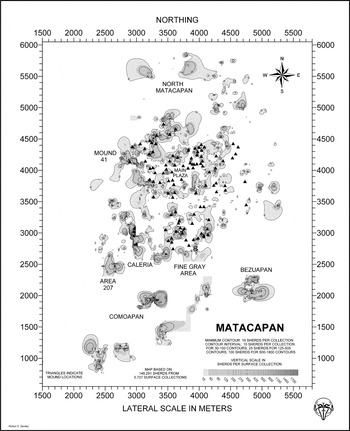
Isopleth map of Matacapan showing the distribution of Middle Classic surface occupation.
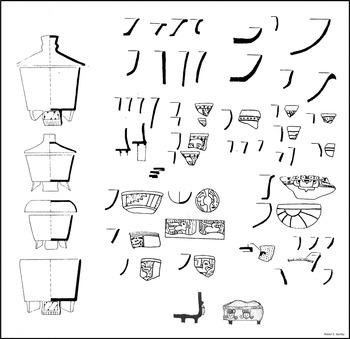
Fine Buff pottery from Matacapan.
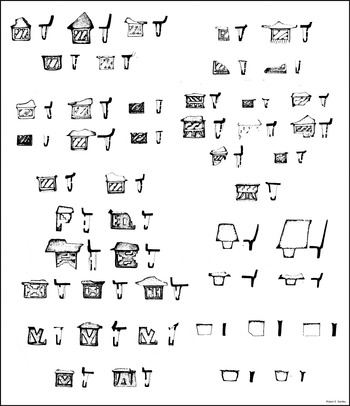
Cylindrical tripod vessel supports from Matacapan.
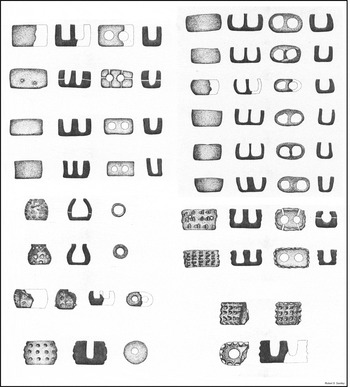
Candeleros from Matacapan.
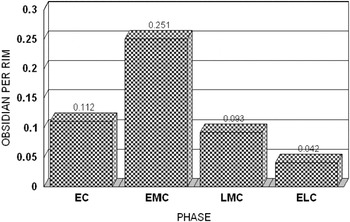
Number of pieces of obsidian per rim sherd at Matacapan.
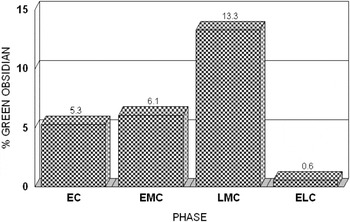
Percentage of green obsidian per phase at Matacapan.
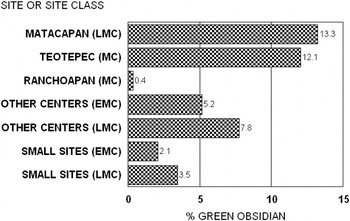
Percentage of green obsidian at sites in the Tuxtlas.
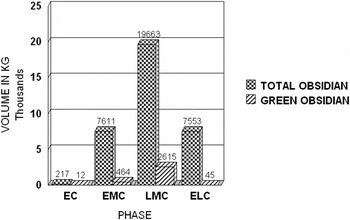
Volume of obsidian traded per phase to the Tuxtlas.
 You have
Access