



Notations
Dans cet article,
 $\mathbb {N} = \{0, 1, 2,\ldots \}$
désigne l’ensemble des entiers naturels. La lettre p désigne systématiquement un nombre premier et
 $\mathcal {P}$
désigne l’ensemble des nombres premiers. Pour
 $x\in \mathbb {R}$
,
 $\pi (x)$
désigne le nombre de nombres premiers n’excédant pas x. Enfin, nous désignons par
 $\Lambda $
la fonction de von Mangoldt définie pour tout
 $n\in \mathbb {N}$
par
 $$ \begin{align*} \Lambda(n) = \left\{ \!\!\!\begin{array}[c]{cl} \log p & \text{si }n=p^\ell\text{ avec }p\text{ premier et }\ell\geqslant 1,\\ 0 & \text{sinon,} \end{array} \right. \end{align*} $$
par
 $\tau $
la fonction qui compte le nombre de diviseurs, et par
 $\omega $
et
 $\Omega $
les fonctions qui comptent le nombre de facteurs premiers, respectivement, sans et avec multiplicité.
Nous désignons par
 $\left \lfloor x \right \rfloor $
,
 $\left \lceil x\right \rceil $
et
 $\{x\}$
respectivement la partie entière inférieure, supérieure et la partie fractionnaire de x. On note également
 $\left \| x \right \| = \min (\{x\},1-\{x\})$
; autrement dit,
 $\left \| x \right \|$
est la distance de x au nombre entier le plus proche. Nous employons la notation
 $\operatorname {\mathrm {e}}(x)=e^{2i \pi x}$
pour
 $x\in \mathbb {R}$
. Nous désignons par
 $\Re (z)$
la partie réelle de
 $z\in \mathbb {C}$
. Si f est une fonction à valeurs complexes et g une fonction à valeurs réelles strictement positives, la notation
 $f\ll g$
signifie que le rapport
 $|f|/g$
est borné. Si f et g sont deux fonctions à valeurs réelles strictement positives, la notation
 $f\asymp g $
signifie que
 $f\ll g $
et
 $g\ll f$
. La notation
 $\mathbb {U}$
désigne le cercle unité du plan complexe.
Afin de détecter les congruences, nous utiliserons la relation d’orthogonalité classique: pour
 $m\in \mathbb {N}^*$
et
 $(a, b)\in \mathbb {Z}^2$
, on a
 $$ \begin{align} \frac{1}{m}\sum_{j=0}^{m-1}\operatorname{\mathrm{e}}\Big(\frac{j(a-b)}{m}\Big) =\begin{cases} 1 & \textrm{si } a\equiv b \bmod m, \\ 0 & \textrm{sinon.} \end{cases} \end{align} $$
1 Introduction
1.1 Numération en base de Cantor
Soit
 $A = (a_n)_{n\geqslant 0}$
une suite d’entiers naturels tous au moins égaux à 2. On définit une échelle de numération
 $(q_n)_{n\geqslant 0}$
par
 $q_0 = 1$
et, pour tout entier naturel n,
 $q_{n+1} = a_n q_n$
, soit donc
 $q_n = a_{n-1}\cdots a_1a_0$
. La suite A est la base associée à cette échelle. Avec la convention classique qu’un produit vide prend la valeur 1, cette formule vaut également pour
 $n=0$
. Alors, tout entier naturel m se représente selon cette échelle de manière unique par
 $$ \begin{align} m=\sum_{j\geqslant 0}\varepsilon_j(m)q_j\quad \text{avec} \quad 0\leqslant \varepsilon_j(m)< a_j = \frac{q_{j+1}}{q_j}. \end{align} $$
Exemple 1. Si
 $q\geqslant 2$
est un nombre entier, le choix
 $a_n=q$
pour tout
 $n\geqslant 0$
correspond à la base q usuelle que l’on qualifiera également de base constante.
Exemple 2. Lorsque
 $a_n=n+2$
pour tout
 $n\geqslant 0$
, on a
 $q_n=(n+1)!$
: c’est la base factorielle.
Ces systèmes de numération sont étudiés par exemple dans [Reference Fraenkel12] and [Reference Knuth20, §4.1].
1.2 Fonctions A-additives
D’après [Reference Dickson6], la fonction somme des chiffres a été étudiée dès 1884 par T.C Simmons. Les notions plus générales de fonctions (fortement) additives et multiplicatives en base constante q – on parle alors de fonctions q-additives et q-multiplicatives – ont été introduites indépendamment par Bellman et Shapiro [Reference Bellman and Shapiro2] et Gelfond [Reference Gelfond13].
Définition 1. Une fonction
 $f:\mathbb {N} \to \mathbb {C}$
est dite A-additive (resp. A-multiplicative) s’il existe une famille de fonctions
 $(\gamma _j)_{j\geqslant 0}$
telle que, pour tout j,
 $\gamma _j$
est définie de
 $\{0,\ldots ,a_j-1\}$
dans
 $\mathbb {C}$
,
 $\gamma _j(0) = 0$
(resp.
 $\gamma _j(0)=1$
), et telle que, pour tout
 $n\geqslant 0$
,
 $$ \begin{align*} f(n) = \sum_{j\geqslant 0}\gamma_j(\varepsilon_j(n)) \quad \Big(\text{resp. } f(n) = \prod_{j\geqslant 0}\gamma_j(\varepsilon_j(n))\Big). \end{align*} $$
Une fonction
 $f:\mathbb {N}\to \mathbb {C}$
est dite fortement A-additive (resp. fortement A-multiplicative) s’il existe une fonction
 $\gamma:\mathbb {N}\to \mathbb {C}$
telle que
 $\gamma (0) = 0$
(resp.
 $\gamma (0)=1$
) et, pour tout
 $n\geqslant 0$
,
 $$ \begin{align*} f(n) = \sum_{j\geqslant 0}\gamma(\varepsilon_j(n)) \quad \Big(\text{resp. } f(n) = \prod_{j\geqslant 0}\gamma(\varepsilon_j(n))\Big). \end{align*} $$
Notons qu’il est nécessaire, dans le cas d’une fonction f fortement A-additive, de distinguer la fonction
 $\gamma $
de la fonction f dans la définition 1 (voir par exemple Hofer et al. [Reference Hofer, Pillichshammer and Pirsic15, remark 1]).
Par ailleurs, il est important de remarquer que si f est A-additive, alors
 $$ \begin{align*} f(kq_\mu+m) = f(kq_\mu) +f(m) \end{align*} $$
pour tout
 $(\mu , k)\in \mathbb {N}^2$
et tout
 $m < q_\mu $
. Si la fonction f est fortement A-additive, on n’a pas nécessairement
 $$ \begin{align*} f(kq_\mu+m) = f(k)+f(m) \end{align*} $$
sous les mêmes hypothèses, ce qui serait le cas en base constante q. En revanche, on a bien
 $$ \begin{align} f(u q_\lambda + v) = f(u) + f(v) \end{align} $$
pour tout
 $\lambda \in \mathbb {N}$
,
 $(u, v)\in \mathbb {N}^2$
tels que
 $0\leqslant u < a_\lambda $
et
 $0\leqslant v < q_\lambda $
.
Exemple 3. Pour le choix
 $\gamma _j(k) = \gamma (k) = k$
, on obtient la fonction somme des chiffres
 $s_A$
en base A, qui est fortement A-additive. Pour tout
 $\alpha \in \mathbb {R}$
,
 $n\mapsto \operatorname {\mathrm {e}}(\alpha s_A(n))$
est fortement A-multiplicative.
Les notions de fonctions A-additives et A-multiplicatives s’étendent aux systèmes de numération plus généraux où la suite
 $(q_n)_{n\geqslant 0}$
est remplacée par une suite d’entiers strictement croissante
 $(G_n)_{n\geqslant 0}$
satisfaisant
 $G_0 = 1$
, la condition 2 étant alors automatiquement satisfaite. On parle alors de fonctions G-additives, resp. G-multiplicatives (voir par exemple [Reference Lothaire22, §7.3] ou [Reference Drmota and Grabner7, §8.4.2]).
Les propriétés asymptotiques de la fonction somme des chiffres et, plus généralement, des fonctions q-additives ont été largement étudiées. On pourra notamment consulter l’article de survol [Reference Drmota and Grabner7]. Plusieurs de ces propriétés ont été étendues aux fonctions A-additives (ou fortement A-additives), voire aux fonctions G-additives. Ont été notamment abordées (nous ne citons ici que des travaux dont les résultats incluent, voire traitent directement le cas des fonctions A-additives) :
-
— la détermination d’une formule exacte pour la valeur moyenne des N premières valeurs d’une fonction A-additive f ([Reference Kirschenhofer and Tichy19]) dans l’esprit du résultat de Delange [Reference Delange5] pour la somme des chiffres en base q;
-
— l’existence d’une loi de répartition limite pour f ou une version normalisée de f; cela comprend des analogues des théorèmes d’Erdős-Wintner et d’Erdős-Kac ([Reference Coquet3, Reference Manstavičius23, Reference Barat and Grabner1, Reference Drmota and Verwee10]);
-
— la répartitition de f dans les progressions arithmétiques ([Reference Hoit16]);
-
— la répartition modulo
 $1$
de f et d’éventuelles estimations de discrépance ([Reference Hoit17, Reference Hofer, Pillichshammer and Pirsic15]).

Comme en témoignent ces différents travaux, le comportement des fonctions A-additives est généralement semblable à celui des fonctions q-additives lorsque la suite A est bornée. Dans le cas contraire, une condition sur la suite A, typiquement une croissance modérée, est habituellement requise pour faire aboutir les méthodes connues. Ce sera également le cas dans cet article.
Décrivons un peu plus précisément les travaux de Hoit sur les fonctions A-additives, dont l’esprit est proche de ce que nous proposons dans le présent article, l’un de nos objectifs étant d’établir des résultats semblables pour les fonctions fortement A-additives le long de la suite des nombres premiers (sous réserve, rappelons-le, que la suite A soit suffisamment régulière).
On dit qu’une fonction A-additive f admet une répartition limite uniforme modulo
 $m\geqslant 2$
si
 $$ \begin{align} \text{ pour tout } k\in\{0,\ldots,m-1\}, \lim_{N\to \infty} \frac{1}{N}\#\big\{ 0\leqslant n < N\,:\; f(n) \equiv k \bmod m\big\} = \frac{1}{m}. \end{align} $$
Hoit [Reference Hoit16] donne des conditions nécessaires et suffisantes sur les fonctions
 $\gamma _j$
(cf. définition 1) pour que ce soit le cas lorsque m est un nombre premier. Il découle du théorème principal de [Reference Hoit16] que la fonction somme des chiffres
 $s_A$
est bien répartie dans les progressions arithmétiques modulo m dès que m est premier. Ce résultat subsiste en fait pour tout nombre entier
 $m\geqslant 2$
. À toutes fins utiles, nous en donnons une preuve en section 12. Entre autres exemples, Hoit étudie également la somme des chiffres d’un nombre entier où seuls certains chiffres, indexés par un sous-ensemble de
 $\mathbb {N}^*$
, sont pris en compte.
Dans un autre article ([Reference Hoit17]), Hoit démontre que, dans toute base de Cantor A, la suite
 $(\alpha s_A(n))_{n\geqslant 1}$
est équirépartie modulo
 $1$
pour tout nombre irrationnel
 $\alpha $
. Lorsque la suite
 $A = (a_n)_{n\geqslant 0}$
satisfait à la condition
 $\sum _{n\geqslant 0} 1/a_n =\infty $
, Hoit fournit une condition suffisante sur une fonction A-additive f pour que la suite
 $(\alpha f(n))_{n\geqslant 1}$
soit équirépartie modulo
 $1$
pour tout nombre irrationnel
 $\alpha $
.
1.3 Problème abordé
Notons
 $s_q$
la fonction somme de chiffres en base constante q. Mauduit et Rivat [Reference Mauduit and Rivat27] sont parvenus en 2010 à obtenir une borne non triviale de la somme d’exponentielles
 $$ \begin{align*} \sum_{n\leqslant x}\Lambda(n) \operatorname{\mathrm{e}}(\alpha s_q(n)) \quad(\alpha\in\mathbb{R}, x\geqslant 1), \end{align*} $$
résolvant ainsi une conjecture due à Gelfond [Reference Gelfond13]. Dans [Reference Mauduit and Rivat28], ils étudient plus généralement la somme
 $$ \begin{align} \sum_{n\leqslant x}\Lambda(n) f(n) \end{align} $$
lorsque f est à valeurs dans le cercle unité si
-
1. f vérifie de bonnes propriétés de propagation de retenues en base constante q (cf. [Reference Mauduit and Rivat28, definition 1]). Cela inclut la classe des fonctions fortement multiplicatives en base q.
-
2. la transformée de Fourier discrète d’une fonction associée à f est relativement « petite » (cf. [Reference Mauduit and Rivat28, definition 2].
Cette méthode repose sur l’estimation des sommes de type I et II associées. Nous adoptons la même démarche en base de Cantor. Mais, dans cette situation, les calculs nécessitent une majoration de transformées de Fourier discrètes de fonctions construites à partir de f par décalage dans la numération en base A, et cette méthode peut s’avérer infructueuse si la suite
 $(a_n)_{n\geqslant 0}$
est trop irrégulière. À cet égard, nous introduisons plus bas la notion de base tempérée. De plus, nous nous limitons dans cet article aux fonctions
 $f: \mathbb {N} \to \mathbb {U}$
fortement A-multiplicatives, cela afin de privilégier l’étude des problèmes posés par la base de Cantor pour ce type de questions. Dans ce cadre, nous obtenons une majoration générale de la somme (5). En guise d’application, nous étudions en base factorielle la répartition dans les progressions arithmétiques ou l’équirépartition modulo
 $1$
de certaines fonctions fortement A-additives, notamment la fonction somme de chiffres
 $s_A$
. Nous étudions également le cas où la suite
 $(a_n)_{n\geqslant 0}$
est bornée et présentons certains exemples « dégénérés ».
Afin d’exposer ces résultats (cf. section 4), il nous faut au préalable introduire la notion de base tempérée et la famille des transformées de Fourier discrètes qui interviennent dans ce problème (sections 2 et 3 respectivement).
2 Numération de Cantor décalée
Il est habituel, dans les problèmes liés à la numération, de se restreindre à des fenêtres digitales, plus précisément à des plages d’entiers dont seuls les chiffres correspondant à certains intervalles varient, les autres étant fixés. En base constante, pour
 $a < q^r$
et
 $b\in \mathbb {N}$
, les entiers de la forme
 $n = a + kq^r + bq^{r+s}$
avec
 $k < q^s$
sont ceux dont l’écriture en base q commence par a (en partant des chiffres les moins significatifs), puis admet s chiffres quelconques et se poursuit par b. En base de Cantor, on dispose d’une écriture arithmétique similaire,
 $n = a + kq_r + bq_{r+s}$
avec
 $a < q_r$
et
 $b\in \mathbb {N}$
grâce à la structure multiplicative (ce n’est plus le cas avec des échelles de numération du type de celle de Zeckendorf étudiée par Drmota et al. [Reference Drmota, Müllner and Spiegelhofer9]), mais, contrairement à ce qui se passe en base constante, le développement de Cantor de k ne se fait pas dans la même base que n, mais dans une base décalée, que nous introduisons ci-dessous.
2.1 Systèmes décalés
L’opérateur de décalage T agit sur les suites
 $A = (a_n)_{n\geqslant 0}$
par
 $ TA = (a_{n+1})_{n\geqslant 0} $
. Si
 $k\geqslant 1$
est un nombre entier,
 $T^k$
désigne la k-ième itérée de T et l’on convient que
 $T^0A = A$
. La base de Cantor
 $T^kA$
est donc définie par
 $$ \begin{align*} a_j^{[k]} = a_{j+k} \quad(j\geqslant 0), \end{align*} $$
ce qui donne pour échelle de numération
 $$ \begin{align*} q_0^{[k]}=1, \quad q_j^{[k]} = a_k\cdots a_{k+j-1} \quad(j\geqslant1). \end{align*} $$
Ainsi, pour i, j et k entiers naturels,

On désigne par
 $(\varepsilon _j^{[k]}(n))_{j\geqslant 0}$
les chiffres d’un entier
 $n\geqslant 0$
dans la base
 $T^k A$
, de sorte que
 $$ \begin{align*} n = \sum_{j\geqslant 0} \varepsilon_j^{[k]}(n) q_j^{[k]}. \end{align*} $$
Observons également que pour
 $j,k\geqslant 0$
,
 $$ \begin{align*} \varepsilon_{j+k}(q_k n) =\varepsilon_j^{[k]}(n). \end{align*} $$
Pour toute fonction A-multiplicative f et
 $k\geqslant 0$
, nous introduisons la fonction
 $T^k A$
-multiplicative
 $$ \begin{align*} f^{[k]} = \prod_{j\geqslant 0} \gamma_{j+k}\circ \varepsilon_j^{[k]} \end{align*} $$
ainsi que ses versions tronquées
 $ f^{[k]} _{\mu,\lambda} = \prod_{ \mu\leqslant j< \lambda} \gamma_{j+k}\circ \varepsilon_j^{[k]} $
qui sont
 $q^{[k]}_\lambda $
-périodiques. On pose également
 $f^{[k]} _{\lambda }= f^{[k]}_{0,\lambda }$
. Nous avons une relation simple, mais importante, entre f et ses décalées
 $f^{[k]}$
: pour tous nombres entiers k et v,
 $$ \begin{align*} f^{[k]}(v) = f(q_k v). \end{align*} $$
On a également, pour tous nombres entiers
 $\mu ,\lambda , v$
tels que
 $0\leqslant \mu \leqslant \lambda $
,
 $$ \begin{align} f_{\mu,\lambda}(q_{\mu} v) = f_{\lambda-\mu}^{[\mu]}(v). \end{align} $$
2.2 Valuation relativement à l’échelle de numération et ses décalées
Soit une échelle de numération de Cantor
 $(q_n)_{n\geqslant 0}$
. Pour tout nombre réel
 $x\geqslant 1$
et tout entier naturel k, on note
 $v^{[k]}(x)$
le nombre de chiffres nécessaires à l’écriture des entiers inférieurs ou égaux à x selon l’échelle décalée
 $(q^{[k]}_n)_{n\geqslant 0}$
. Formellement,
 $v^{[k]}(x)$
est l’unique entier naturel non nul tel que
 $$ \begin{align*} q_{v^{[k]}(x)-1}^{[k]} \leqslant x < q^{[k]}_{v^{[k]}(x)}. \end{align*} $$
En particulier, pour
 $k = 0$
,
 $v(x) = v^{[0]}(x)$
est défini par l’encadrement
 $q_{v(x) - 1} \leqslant x < q_{v(x)}$
. Il est immédiat qu’à k fixé, la fonction
 $x\mapsto v^{[k]}(x)$
est croissante. Par ailleurs, comme
 $q_{\lambda } \geqslant 2^{\lambda }$
, on a toujours
 $$ \begin{align} v(x) \leqslant 1 + \frac{\log x }{\log 2}. \end{align} $$
Exemple 4.
-
(1) En base constante q,
$v(x) = v^{[k]}(x) = \left \lfloor \log x/ \log q \right \rfloor + 1$
ne dépend pas de k. -
(2) Lorsque la suite
$(a_n)_{n\geqslant 0}$
est bornée, on a
$ v(x)\asymp \log x$
. -
(3) En base factorielle, on a
$v(x)! \leqslant x < (v(x)+1)v(x)!$
, d’où, par la formule de Stirling, (9)On en déduit que
$$ \begin{align} \log x = v(x)\log(v(x)) - v(x) + O\big(\log (v(x))\big). \end{align} $$
$v(x) \sim \log x/ \log \log x$
quand x tend vers
$+\infty $
. En reportant l’expression
$v(x) = (1 + \xi (x)) \log x / \log \log x$
dans (9) et en multipliant par
$\log \log x/\log x$
, il vient d’où
$$ \begin{align*} \log\log x = \big(1 + \xi(x)\big)\big[\log\log x - \log\log\log x - 1 + \log(1 + \xi(x))\big] + O\left( \frac{(\log \log x)^2}{\log x}\right), \end{align*} $$
$\xi (x) \sim \log \log \log x/\log \log x$
. En reportant
$\xi (x) = (1 + \varrho (x))\log \log \log x/\log \log x$
dans l’équation ci-dessus et en multipliant par
$\log \log x$
, on obtient d’où
$$ \begin{align*} \log\log\log x = -1 + \frac{\log\log\log x}{\log\log x}(1 + \varrho(x))\big[\log\log x - \log\log\log x\big] + o(1), \end{align*} $$
$\varrho (x) \sim \frac {1}{\log \log \log x}$
et, quand x tend vers
$+\infty $
, (10)Ce développement asymptotique sera utile à la section 12.
$$ \begin{align} v(x) = \frac{\log x}{\log\log x} + \frac{\log x\log\log\log x}{(\log\log x)^2} + \frac{\log x}{(\log\log x)^2} + o\left(\frac{\log x}{(\log\log x)^2} \right). \end{align} $$


2.3 Bases tempérées
Nous introduisons dans ce paragraphe la notion de base tempérée. Nous établissons plusieurs propriétés d’une telle base dont certaines seront utiles dans la suite. Nous donnons également quelques exemples et contre-exemples pour étayer cette notion.
Définition 2. On dit que l’échelle
 $(q_n)_{n\geqslant 0}$
associée à A est tempérée si, pour tout couple
 $(B, d)\in \mathbb {R}_+^*\times \mathbb {R}_+$
, il existe
 $0 < \kappa = \kappa (B, d) < 1$
tel que pour tout
 $(\mu , \rho , k_1, k_2)\in \mathbb {N}^4$
vérifiant
 $\rho \leqslant \kappa \mu $
et
 $\max \left (k_1, k_2\right )\leqslant d\mu $
, on a
 $$ \begin{align} \left( q_{\rho}^{[k_1]} \right)^B \ll_{d,B} q_\mu^{[k_2]}, \end{align} $$
c’est-à-dire
 $$ \begin{align*} \big(a_{k_1}a_{k_1+1} \cdots a_{k_1+\rho-1}\big)^B \ll_{d,B} a_{k_2} a_{k_2+1}\cdots a_{k_2+\mu-1}. \end{align*} $$
Derrière cette définition passablement technique se cache l’idée que, dans une base tempérée, un produit
 $ \prod _{i\in I} a_i$
où I est un intervalle « long » ne peut pas être dominé par une puissance d’un produit
 $\prod _{j\in J} a_j$
où J est un intervalle « court » si
 $\min (I\cup J) \ll |I|$
. Par exemple, en appliquant cette définition avec
 $B=1$
,
 $d=2$
,
 $\mu \geqslant 1$
,
 $\rho =1$
,
 $k_1=\mu +1$
,
 $k_2=0$
, on constate que, dans une base tempérée, il n’existe pas de suite d’entiers
 $(\mu _n)_{n\geqslant 1}$
telle que
 $\lim \mu _n = +\infty $
et
 $a_0 \ldots a_{\mu _n-1} = o(a_{\mu _n})$
lorsque
 $n\to \infty $
. La proposition 1 infra développe cette idée.
Exemple 5.
-
1. Toute échelle à base bornée et, a fortiori, toute base constante, est tempérée. Notons en effet
$e_1 = \min _{n\in \mathbb {N}} a_n \geqslant 2$
et
$e_2 = \max _{n\in \mathbb {N}} a_n$
. Alors, et l’on peut donc prendre
$$ \begin{align*} \left( q_{\rho}^{[k_1]} \right)^B \leqslant e_2^{\rho B} = e_1^{\rho B\log e_2/\log e_1} \end{align*} $$
$ \kappa = \log e_1/(B \log e_2). $
-
2. L’échelle factorielle est tempérée. De fait, on a alors
$q_{\nu }^{[k]} = \frac {(\nu + k + 1)!}{(k+1)!}$
et l’on note que ce quotient est fonction croissante de k et de
$\nu $
. De la formule
$\log n! = n\log n + O(n)$
, on tire alors, pour
$\rho \leqslant \kappa \mu $
et
$\max (k_1, k_2) \leqslant d\mu $
, et l’on peut donc prendre
$$ \begin{align*} \log\frac{\left( q_{\rho}^{[k_1]} \right)^B} {q_\mu^{[k_2]}} & = \log\left( \frac{(\rho + k_1 + 1)!^B\, (k_2 + 1)!}{ (\mu + k_2 + 1)!\, (k_1 + 1)!^B} \right) \leqslant \log\left( \frac{\left\lceil(\kappa + d)\mu + 1\right\rceil !^B}{ (\mu + 1)!\, \left\lceil d\mu + 1\right\rceil!^B} \right)\\ & = \big(\kappa B - 1\big)\mu\log\mu + O(\mu) \end{align*} $$
$\kappa < 1/B$
.
-
3. Le calcul ci-dessus s’étend immédiatement de
$a_n = n+2$
(échelle factorielle) à
$a_n = (n+2)^k$
et
$k\in \mathbb {N}^*$
. De manière similaire, pour
$a_n = (n+2)^{n+2}$
, on obtient ce qui permet de choisir
$$ \begin{align*} \log\frac{\left( q_{\rho}^{[k_1]} \right)^B} {q_\mu^{[k_2]}} = [B(2d\kappa + \kappa^2) - 1]\mu^2\log\mu + O(\mu^2), \end{align*} $$
$\kappa $
et montre que l’on obtient une échelle tempérée.


La condition de tempérance empêche à la fois une croissance trop rapide de la base et de trop grandes irrégularités locales. C’est ce que montrent la proposition 1 et les contre-exemples ci-dessous.
Proposition 1. Soit
 $(q_n)_{n\geqslant 0}$
une échelle tempérée de base
 $A = (a_n)_{n\geqslant 0}$
. Alors,
-
(1) il existe
$\alpha \geqslant 1$
tel que
$\log q_n \ll n^{\alpha }$
; -
(2)
$a_n = o(q_n^{\beta })$
pour tout
$\beta> 0$
.


Démonstration.
-
(1) Comme
$\prod _{j < n} a_j \geqslant 2^n$
, l’exposant
$\alpha $
, s’il existe, est nécessairement au moins égal à 1. Posons
$\kappa = \kappa (1, 1)$
. On définit une suite
${(\mu _n)}_{n\geqslant 0}$
par la relation de récurrence
$\mu _{n+1} = \mu _n + \left \lfloor \kappa \mu _n \right \rfloor $
, la valeur de
$\mu _0$
étant fixée ultérieurement. Par définition d’une échelle tempérée, il existe une constante M telle que
$q_{\left \lfloor \kappa \mu _n \right \rfloor }^{[\mu _n]} \leqslant Mq_{\mu _n}$
pour tout entier n. Il s’ensuit La relation définissant
$\mu _n$
donne de son côté On choisit maintenant
$\mu _0> 1/\kappa $
. Alors, la croissance de
$(\mu _n)_{n\geqslant 0}$
étant d’ordre géométrique.
-
(2) Soit
$\beta> 0$
. La définition d’une échelle tempérée appliquée avec
$B = 1/\beta $
et
$d = 1$
donne
$$ \begin{align*} a_n = q_1^{[n]} \ll q_n^{\beta}.\\[-38pt] \end{align*} $$


Remarque 1. La première assertion de la proposition 1 est équivalente à
 $v(x)\gg (\log x)^{1/\alpha }$
. Par ailleurs, rappelons que (8) donne inversement
 $v(x)\ll \log x$
.
Exemple 6. Soit
 $A = (a_n)_{n\geqslant 0}$
la suite définie par
 $a_0 = a_1 = a_2 = 2$
, puis, pour tout
 $n\in \mathbb {N}^*$
,
 $a_k = k$
si
 $2^{2n-1} + 1 \leqslant k\leqslant 2^{2n}$
et
 $a_k = 2$
si
 $2^{2n} + 1 \leqslant k\leqslant 2^{2n+1}$
. Pour
 $\mu = k_1 = 2^{2n-1} + 1$
,
 $k_2 = 2^{2n} + 1$
,
 $\rho = \left \lfloor \kappa \mu \right \rfloor $
et
 $0 < \kappa < 1$
, il vient
 $$ \begin{align*} \log q_{\rho}^{[k_1]} = \log\big((\mu + \left\lfloor \kappa\mu \right\rfloor - 1)!\big) - \log\big((\mu - 1)!\big) \sim (\kappa\log 2)n 2^{2n} \qquad \text{et}\qquad \log q_{\mu}^{[k_2]} = (\log 2)2^{2n-1}, \end{align*} $$
ce qui montre que l’échelle associée n’est pas tempérée. Comme on a
 $\log q_n = O(n\log n)$
, cet exemple montre aussi sans surprise que les propriétés données dans la proposition 1 ne sont pas des conditions suffisantes de tempérance.
Exemple 7. L’exemple 6 montre que la condition de croissance
 $a_n = O(n)$
n’entraîne pas que A est tempérée. On pourrait penser qu’ajouter une condition de croissance permettrait d’assurer le caractère tempéré; ce n’est pas le cas comme le montre l’adaptation suivante du contre-exemple précédent.
Soit une suite d’entiers
 $(r_k)_{k \geqslant 1}$
strictement croissante avec
 $r_1 = 2$
telle que
 $r_{k+1}> 2r_k$
pour tout
 $k\in \mathbb {N}^*$
. La suite
 ${(a_n)}_n$
est alors construite comme suit:
 $$ \begin{align*} a_0 = a_1 = 2,\quad \forall n\in\mathbb{N}^*\colon \begin{cases} a_n = n&\text{si }r_k \leqslant n < 2r_k,\\ a_n = 2r_k - 1& \text{si }2r_k\leqslant n < r_{k+1}.\end{cases} \end{align*} $$
La suite
 ${(a_n)}_n$
est bien croissante. Soit
 $0 < \kappa < 1$
. De même que dans l’exemple 6,
 $$ \begin{align*} \log q_{\left\lfloor \kappa r_k \right\rfloor}^{[r_k]} \sim \kappa r_k \log(r_k)\quad\text{ et }\quad \log q_{r_k} \leqslant r_k \log(2r_{k-1} - 1). \end{align*} $$
Pour garantir que l’échelle associée à A n’est pas tempérée, il suffit de prendre
 $r_k$
tel que
 $\log (r_k)/\log (r_{k-1})$
tende vers l’infini, par exemple si
 $r_k = r_{k-1}^k$
pour
 $k \geqslant 3$
.
2.4 Valuations dans une base tempérée
La proposition suivante s’intéresse aux ordres de grandeur des valuations décalées de x et de
 $x^{\beta }$
. Nous l’utiliserons essentiellement dans le cas non décalé.
Proposition 2. Soit A une base tempérée.
-
(1) Soit
$\beta ,\delta> 0$
. Pour tout
$x\geqslant 1$
, et tout
$\mu \in \mathbb {N}$
tel que
$\mu \leqslant \delta v(x)$
, on a
$$ \begin{align*} v^{[\mu]}(x^\beta) \asymp_{\delta, \beta} v(x). \end{align*} $$
-
(2) Soit
$0 < \beta < 1$
. Il existe
$c < 1$
et
$x_0\geqslant 1$
tel que pour tout
$x\geqslant x_0$
, (12)
$$ \begin{align} v(x^{\beta}) \leqslant cv(x). \end{align} $$


Démonstration. (1) Posons
 $\kappa _1 = \kappa (\beta , \delta )$
. Par hypothèse,
 $$ \begin{align*} \mu \leqslant \delta v(x) \leqslant \delta \left\lceil\frac{v(x)}{\kappa_1}\right\rceil. \end{align*} $$
De
 $x < q_{v(x)}$
et de la définition d’une base tempérée en prenant
 $k_1 = 0$
et
 $k_2 = \mu $
, on déduit l’existence d’une constante
 $\xi> 1$
telle que
 $$ \begin{align*} x^{\beta} < (q_{v(x)})^{\beta} \leqslant \xi\, q_{\left\lceil v(x)/\kappa_1\right\rceil}^{[\mu]} = 2^{\log_2\xi}\, q^{[\mu]}_{\left\lceil v(x)/\kappa_1\right\rceil} \leqslant q^{[\mu]}_{\left\lceil v(x)/\kappa_1\right\rceil + \left\lceil \log_2\xi\right\rceil}, \end{align*} $$
d’où
 $ v^{[\mu]}(x^{\beta}) \leqslant v(x)/\kappa_1 + \log_2\xi + 2 \ll_{\beta} v(x). $
Pour la minoration, notons tout d’abord que, si m est un entier,
 $m\geqslant 4$
, et
 $0 < t < 1$
, alors
 $$ \begin{align} t\left\lfloor \frac{m-1}{t} \right\rfloor \geqslant t\left(\frac{m-1}{t} - 1\right) \geqslant m - 2 \geqslant \frac{m}{2}. \end{align} $$
Prenons
 $\kappa _2 = \kappa (1/\beta , 0)$
et
 $\kappa _3 = \kappa (1, 2\delta /\kappa _2)$
. Alors, (13) donne
 $$ \begin{align*} \mu \leqslant \delta v(x) \leqslant \frac{2\delta}{\kappa_2}\left\lfloor \kappa_2(v(x) - 1) \right\rfloor. \end{align*} $$
On applique alors deux fois la définition d’une base tempérée. Il vient
 $$ \begin{align*} q_{\left\lfloor \kappa_2\kappa_3 (v(x) - 1) \right\rfloor}^{[\mu]} \ll q_{\left\lfloor \kappa_2 (v(x) - 1) \right\rfloor} \ll \big(q_{v(x) - 1}\big)^{\beta}\leqslant x^{\beta}, \end{align*} $$
d’où
 $ v^{[\mu]}(x^{\beta}) \gg v(x).$
(2) Soit
 $x \in \mathbb {N}^*$
. Posons
 $\lambda = v(x^{\beta })$
. Alors,
 $$ \begin{align} q_{v(x)} \geqslant x^{\beta}\times x^{1-\beta} \geqslant q_{\lambda-1} \times (q_{v(x) -1})^{1-\beta}. \end{align} $$
D’après le (1), il existe une constante d telle que
 $\lambda - 1 \leqslant d(v(x) - 1)$
. Il est donc loisible d’appliquer la définition d’une base tempérée avec
 $k_1 = \lambda - 1$
,
 $\mu = v(x) - 1$
,
 $k_2 = 0$
, d la valeur ci-dessus et
 $B = 1/(1 - \beta )$
. Il existe donc
 $\xi>1$
tel que, pour
 $\kappa _0 = \kappa \big (1/(1 - \beta ), d\big )$
,

Finalement, la synthèse de (14) et de (15) donne, avec (6),
 $$ \begin{align*} q_{v(x)} \geqslant x \geqslant q_{\lambda-1} \times q_{\lfloor \kappa_0(\lambda - 1)\rfloor + \lceil(\beta - 1)\log_2(\xi)\rceil}^{[\lambda - 1]} = q_{\lfloor \kappa_0(\lambda - 1)\rfloor + \lceil(\beta - 1)\log_2(\xi)\rceil + \lambda - 1}. \end{align*} $$
Ainsi,
 $v(x) \geqslant \lfloor \kappa _0(\lambda - 1)\rfloor + \lceil (\beta - 1)\log _2(\xi )\rceil + \lambda - 1 \underset {x\to \infty }{\sim } (\kappa _0 + 1)\lambda $
, d’où, pour tout
 $c> \frac {1}{\kappa _0 + 1}$
, l’inégalité
 $v(x^{\beta }) \leqslant c v(x)$
à partir d’un certain rang.
3 Transformées de Fourier discrètes
Soit
 $\lambda \in \mathbb {N}$
, f une fonction A-multiplicative et
 $\alpha $
un nombre réel. La fonction
 $u\mapsto \operatorname {\mathrm {e}}(\alpha f_\lambda (u))$
est
 $q_\lambda $
-périodique et sa transformée de Fourier discrète est donnée pour
 $t\in \mathbb {R}$
par
 $$ \begin{align} F_\lambda(t) = \frac 1{q_{\lambda}} \sum_{u<q_{\lambda}} f(u) \operatorname{\mathrm{e}}\Big(-\frac{tu}{q_{\lambda}}\Big). \end{align} $$
Plus généralement, si
 $k\in \mathbb {N}$
, la fonction
 $u\mapsto f_\lambda ^{[k]}(u)$
est
 $q_\lambda ^{[k]}$
-périodique et sa transformée de Fourier est donnée par

et nous convenons que  . La moyenne quadratique de cette transformée de Fourier est donnée par la formule de Parseval: pour tout
 $t\in \mathbb {R}$
, on a

Nous pouvons utiliser la factorisation
 $f = \prod _{j \geqslant 0} \gamma _j\circ \varepsilon _j $
(voir définition 1) pour exprimer
 sous forme d’un produit. Nous introduisons pour
 $j\in \mathbb {N}$
et
 $t\in \mathbb {R}$
,
 $$ \begin{align} \theta_{j}(t) = \frac{1}{a_j}\sum_{0\leqslant u<a_j} \gamma_{j}\big(u)\operatorname{\mathrm{e}}(-ut\big). \end{align} $$
Lemme 1. On a pour tout
 $t\in \mathbb {R}$
, tout
 $\lambda \in \mathbb {N}^*$
,
 $k\in \mathbb {N}$
,

Démonstration. Partant de (21), on pose
 $u = v q_{\lambda -1}^{[k]}+r$
avec
 $0\leqslant v< a_{\lambda +k-1}$
et
 $0\leqslant r < q_{\lambda -1}^{[k]}$
. On a alors
 $$ \begin{align*} f^{[k]}(u) = f^{[k]}(vq_{\lambda-1}^{[k]}+r) = \gamma_{\lambda+k-1}(v)f^{[k]}(r) \end{align*} $$
et donc, pour
 $t\in \mathbb {R}$
,

En itérant, on obtient une représentation en forme de produit, typique pour les transformées de Fourier de fonctions additives dans un système de numération.
Lemme 2. Pour tout
 $t\in \mathbb {R}$
,
 $\lambda \in \mathbb {N}$
,
 $k\in \mathbb {N}$
, on a

Démonstration. Fixons k et montrons par récurrence sur
 $\lambda $
que l’on a (25) pour tout
 $t\in \mathbb {R}$
. Puisque
 $q_0^{[k]}=1$
, on a
 et l’identité (25) est vérifiée pour
 $\lambda =0$
. Soit
 $\lambda \in \mathbb {N}$
tel que (25) est vérifiée pour tout
 $t\in \mathbb {R}$
. On a alors, d’après le Lemme 2,

Or,
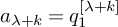 $a_{\lambda +k} = q_1^{[\lambda +k]}$
et (6) donnent
 $q_{\lambda -j}^{[j+k]}a _{\lambda +k} = q_{\lambda -j}^{[j+k]} q_1^{[\lambda +k]} = q_{\lambda -j+1}^{[j+k]}$
, d’où

On peut en déduire la décomposition suivante.
Lemme 3. Pour tout
 $(\mu ,\lambda ,k)\in \mathbb {N}^2$
tel que
 $0\leqslant \mu \leqslant \lambda $
,
 $t\in \mathbb {R}$
, on a

Démonstration. On a
 $$ \begin{align*} F_{\lambda}^{[k]}(t) & = \prod_{j=0}^{\mu-1} \theta_{k+j}\left(\frac{t}{q_{\lambda-j}^{[j+k]}}\right) \prod_{j=\mu}^{\lambda-1} \theta_{k+j}\left(\frac{t}{q_{\lambda-j}^{[j+k]}}\right) \\ & = \prod_{j=0}^{\mu-1} \theta_{k+j}\left( \frac{t}{q_{\mu_-j}^{[j+k]}} \frac{q_{\mu_-j}^{[j+k]}}{q_{\lambda-j}^{[j+k]}} \right) \prod_{j=0}^{\lambda-\mu-1} \theta_{k+\mu+j}\left( \frac{t}{q_{\lambda-\mu-j}^{[j+k+\mu]}} \right)\\ & = \prod_{j=0}^{\mu-1} \theta_{k+j}\left( \frac{t}{q_{\mu_-j}^{[j+k]}} \frac{1}{q_{\lambda-\mu}^{[\mu+k]}} \right) \prod_{j=0}^{\lambda-\mu-1} \theta_{k+\mu+j}\left( \frac{t}{q_{\lambda-\mu-j}^{[j+k+\mu]}}\right).\\[-42pt] \end{align*} $$
4 Présentation des résultats
L’obtention d’un théorème des nombres premiers pour une fonction fortement A-multiplicative f à valeurs dans
 $\mathbb {U}$
, soit une estimation du type
 $$ \begin{align*} \sum_{n\leqslant x} \Lambda(n)f(n) = o(x) \quad(x\to +\infty), \end{align*} $$
repose dans ce travail sur une bonne majoration uniforme des transformées de Fourier
 $F_\lambda ^{[k]}$
définie à la section 3. En pratique, pour les exemples étudiés, qui sont de la forme
 $f(n)=\operatorname {\mathrm {e}}(\alpha g(n))$
avec
 $g:\mathbb {N}\to \mathbb {R}$
fortement A-additive et
 $\alpha \in \mathbb {R}$
, nous obtenons des majorations du type
 $$ \begin{align*} |F_\lambda^{[k]} (t)| \leqslant C \exp\Big( - \sum_{k\leqslant j < k+\lambda} t_j\left\| b_j \alpha \right\|^2\Big), \end{align*} $$
où
 $C> 0$
,
 $t_j> 0$
et
 $b_j\in \mathbb {N}$
. En vue d’énoncer un résultat général, nous introduisons une classe de fonctions fortement A-multiplicatives dont les transformées de Fourier décalées admettent une majoration de ce type. La définition suivante est directement inspirée de [Reference Mauduit and Rivat28, definition 2].
Définition 3. Soit une fonction
 $\sigma \colon \, ]0,\infty [^2 \to \mathbb {R}_+$
telle que:

On désigne par
 $\mathcal {F}_\sigma $
la classe des fonctions fortement A-multiplicatives
 $f:\mathbb {N}\to \mathbb {U}$
telles que pour tout
 $t\in \mathbb {R}^2$
,
 $(k,\lambda ) \in \mathbb {N}^2$
,
 $$ \begin{align} |F_\lambda^{[k]} (t)| \leqslant e^{-\sigma(k,k+\lambda)}. \end{align} $$
Remarque 2. Si
 $f \in \mathcal {F}_\sigma $
, alors d’après l’identité de Parseval (23),
 $$ \begin{align*} 1 = \sum_{0\leqslant v < q_\lambda^{[k]} } |F_\lambda^{[k]} (v)|^2 \leqslant e^{-2\sigma(k,k+\lambda)} q_{\lambda}^{[k]}, \end{align*} $$
de sorte que
 $$ \begin{align} e^{-\sigma(k,k+\lambda)} \geqslant (q_{\lambda}^{[k]})^{-1/2}. \end{align} $$
Nous sommes maintenant en mesure d’énoncer le résultat principal de cet article. Nous rappelons que la définition de la valuation
 $v(x)$
a été donnée au paragraphe 2.2. Étant donnés une fonction
 $\sigma $
satisfaisant à (21), des réels
 $x\geqslant 1$
et
 $c>0$
, nous posons
 $$ \begin{align} \mathcal{K}_\sigma(x,c):= \inf_{v(x^{3/10})\leqslant \lambda\leqslant v(x)} \sigma(c\lambda, \lambda-1). \end{align} $$
Théorème 1. Soit
 $(q_n)_{n\geqslant 0}$
une échelle de numération tempérée,
 $\sigma $
une fonction satisfaisant à (21) et
 $f \in \mathcal {F}_\sigma $
. Il existe des nombres réels
 $0\leqslant c_0<1$
et
 $x_0\geqslant 2$
tels que, pour tout
 $x\geqslant x_0$
,
 $$ \begin{align} \sum_{n\leqslant x} \Lambda(n) f(n) \ll x (\log x)^{9/2} \max \big(\tau(q_{v(x)}), \log x\big)^{1/4} e^{-\mathcal{K}_\sigma(x,c_0)/2} +x^{9/10} \log x. \end{align} $$
Les constantes
 $c_0$
,
 $x_0$
et la constante implicite ne dépendent que de la suite
 $(q_n)_{n\geqslant 0}$
.
Une condition nécessaire pour que la majoration (25) soit non triviale est
 $$ \begin{align*} \lim_{x \to +\infty} \mathcal{K}_\sigma(x,c_0) = +\infty. \end{align*} $$
compte tenu de (22) et (21), cette condition entraîne
 $$ \begin{align} \lim_{\lambda \to +\infty} \left\| F_{\left\lfloor (1-c_0)\lambda \right\rfloor}^{[\left\lfloor c_0\lambda \right\rfloor]} \right\|_\infty=0. \end{align} $$
Notons par ailleurs que d’après la proposition 2, il existe
 $c_1\in ]0,1[$
tel que pour tout x suffisamment grand,
 $ v(x^{3/10})\geqslant c_1v(x)$
, ce qui entraîne
 $$ \begin{align} \mathcal{K}_\sigma(x,c_0) \geqslant \inf_{c_1 v(x)\leqslant \lambda\leqslant v(x)} \sigma(c_0\lambda, \lambda-1). \end{align} $$
La démonstration du théorème 1 repose sur l’estimation de sommes de type I et II. Dans les sections 6 et 7, nous adaptons au cas de la base de Cantor les démonstrations des propositions 1 et 2 de [Reference Mauduit and Rivat28]. La notion de base tempérée intervient lors de l’estimation des sommes de type II, dont le traitement fait rapidement apparaître des phénomènes de décalage dans la numération.
Dans le cas où
 $f(n) = \operatorname {\mathrm {e}}(\alpha s_A(n))$
, la fonction
 $\theta _j$
définie par (24) prend une forme familière: pour tout
 $j\geqslant 0$
,
 $$ \begin{align*} |\theta_{j}(t) |= \frac{\varphi_{a_j}(\alpha-t)}{a_j}, \end{align*} $$
où la fonction
 $\varphi _k$
est définie par
 $$ \begin{align} \varphi_k(t) = \left| \sum_{0\leqslant v < k} \operatorname{\mathrm{e}}(v t) \right| = \left\{ \begin{array}[c]{cl} \left| \sin \pi k t \right|/\left| \sin \pi t \right| & \text{si } t\in \mathbb{R}\setminus\mathbb{Z},\\ k & \text{si } t\in\mathbb{Z}. \end{array} \right. \end{align} $$
Des calculs proches de ceux effectués dans [Reference Mauduit and Rivat27] et [Reference Mauduit and Rivat26] permettent de montrer (cf. proposition 5) que quels que soient la base
 $A=(a_j)_{j\geqslant 0}$
choisie et
 $\alpha \in \mathbb {R}$
, la fonction
 $\operatorname {\mathrm {e}}(\alpha s_A(n))$
appartient à
 $\mathcal {F}_\sigma $
avec
 $$ \begin{align*} \sigma(r,s)=\frac{\pi^2}{36} \sum_{r\leqslant j<s}\left\| (a_{j}-1)\alpha \right\|^2. \end{align*} $$
Nous en déduisons un théorème des nombres premiers pour la fonction
 $s_A$
dans la base factorielle
 $A = (j+2)_{j\geqslant 0}$
. Rappelons qu’en ce cas, la valuation d’un nombre réel positif x vérifie la relation
 $v(x) \sim \log x / \log \log x$
lorsque
 $x\to \infty $
(exemple 4).
Théorème 2. En base factorielle, il existe des nombres réels
 $0\leqslant c_3<1$
et
 $d_3>0$
tels que pour tous
 $\alpha \in \mathbb {R}$
,
 $x\geqslant 3$
,
 $$ \begin{align*} \sum_{n\leqslant x} \Lambda(n) \operatorname{\mathrm{e}}\big( \alpha s_A(n)\big) \ll x \exp\Big( d_3 \, \frac{\log x}{(\log \log x)^2} - \frac {\pi^2}{72} \inf_{ v(x^{3/10}) \leqslant \lambda \leqslant v(x) } \sum_{c_3 \lambda+1 \leqslant j<\lambda} \left\| j\alpha \right\|^2\Big). \end{align*} $$
Nous établissons alors deux applications, standard en la circonstance.
Théorème 3. En base factorielle, il existe
 $c_4>0$
tel que pour tout nombre entier
 $b\geqslant 2$
,
 $\ell \in \mathbb {Z}$
,
 $x\geqslant 3$
, on a
 $$ \begin{align*} \operatorname{\mathrm{card}}\{p \leqslant x \,:\, s_A(p) \equiv \ell \bmod b \} = \frac{\pi(x)}{b} +O\left( x\exp\Big(- c_4\, \frac{\log x}{\log\log x}\Big)\right). \end{align*} $$
La constante implicite dépend de b.
Théorème 4. En base factorielle, pour tout nombre irrationnel
 $\alpha $
, la suite
 $(\alpha s_A(p))_{p\in \mathcal {P}}$
est équirépartie modulo
 $1$
.
Dans la section 10, nous étudions d’autres exemples de fonctions fortement additives en base factorielle. En particulier, la fonction, disons g, qui compte le nombre d’apparitions du chiffre
 $1$
en base factorielle constitue un exemple « négatif » intéressant. Rappelons au préalable que la fonction qui compte le nombre d’apparitions du chiffre
 $1$
en base constante q satisfait un théorème des nombres premiers (cf. [Reference Martin, Mauduit and Rivat25]). Nous obtenons dans le paragraphe 10.3 une estimation de la transformée de Fourier
 $F_\lambda $
associée à
 $f(n)=\operatorname {\mathrm {e}}\big (\alpha g(n)\big )$
, qui permet d’établir en base factorielle pour
 $\alpha \in \mathbb {R}\setminus \mathbb {Z}$
l’estimation
 $$ \begin{align*} \sum_{n\leqslant x} \operatorname{\mathrm{e}}\big(\alpha g(n)\big)= o(x) \quad(x\to \infty). \end{align*} $$
En particulier, cette estimation permet de montrer, grâce à la relation (1), que g est bien répartie dans les progressions arithmétiques modulo m pour tout entier
 $m\geqslant 2$
. Hoit [Reference Hoit16, example (a) p. 198] avait traité le cas où m est premier. En revanche, les transformées de Fourier décalées
 $F_\lambda ^{[k]}$
ne tendent pas uniformément vers
 $0$
lorsque
 $\lambda \to +\infty $
et
 $k = \left \lfloor c\lambda \right \rfloor $
avec
 $c>0$
fixé. Autrement dit, la condition (26) n’est satisfaite pour aucune valeur de
 $c_0$
. Ainsi, notre méthode ne permet pas d’obtenir pour cette fonction g la relation
 $$ \begin{align*} \sum_{n\leqslant x}\Lambda(n) \operatorname{\mathrm{e}}\big(\alpha g(n)\big)= o(x) \quad(x\to \infty). \end{align*} $$
Il semble a fortiori exclu de pouvoir démontrer, avec la méthode développée dans cet article, un théorème des nombres premiers pour la fonction comptant le nombre d’apparitions du bloc
 $11$
en base factorielle, à l’instar de ce qui a été obtenu dans [Reference Mauduit and Rivat28] en base
 $2$
.
5 Lemmes techniques sur les sommes d’exponentielles
Pour la commodité du lecteur, nous redonnons ici quelques lemmes énoncés dans [Reference Mauduit and Rivat28] ainsi qu’un lemme adapté à l’estimation de la moyenne d’une fonction A-multiplicative.
Pour
 $\alpha \in \mathbb {R}$
, on désigne par
 $\chi _\alpha $
la fonction indicatrice de l’intervalle
 $[0,\alpha [$
modulo
 $1$
.
Lemme 4. Pour tout
 $\alpha \in [0,1[$
et tout nombre entier
 $H\geqslant 1$
, il existe des polynômes trigonométriques
 $A_{\alpha ,H}$
et
 $B_{\alpha ,H}$
à valeurs réelles tels que pour tout
 $x\in \mathbb {R}$
,
 $$ \begin{align*} |\chi_\alpha(x)-A_{\alpha,H}(x)|\leqslant B_{\alpha,H}(x), \end{align*} $$
où
 $$ \begin{align*} A_{\alpha,H}(x) = \sum_{|h|\leqslant H} a_h(\alpha,H)\operatorname{\mathrm{e}}(hx),\qquad B_{\alpha,H}(x) = \sum_{|h|\leqslant H} b_h(\alpha,H)\operatorname{\mathrm{e}}(hx) \end{align*} $$
avec des coefficients
 $a_h(\alpha ,H)$
et
 $b_h(\alpha ,H)$
satisfaisant à
 $$ \begin{align*} a_0(\alpha,H) = \alpha, \quad |a_h(\alpha,H)| \leqslant \min\Big(\alpha, \frac1{\pi |h|}\Big), \quad |b_h(\alpha,H)|\leqslant \frac1{H+1}. \end{align*} $$
Lemme 5. Pour tout
 $(\alpha _1,\alpha _2) \in [0,1[^2$
, tous entiers
 $H_1,H_2 \geqslant 1$
et tout
 $(x,y)^2$
, on a
 $$ \begin{align*} &\left| \chi_{\alpha_1}(x)\chi_{\alpha_2}(y)-A_{\alpha_1,H_1}(x)A_{\alpha_1,H_1}(y) \right| \\&\quad\leqslant \chi_{\alpha_1}(x)B_{\alpha_2,H_2}(y)+ B_{\alpha_1,H_1}(x) \chi_{\alpha_2}(y)+ B_{\alpha_1,H_1}(x)B_{\alpha_2,H_2}(y). \end{align*} $$
Lemme 6. Pour tout
 $(z_1,\ldots ,z_N)\in \mathbb {C}^N$
et tous entiers
 $k,R\geqslant 1$
, on a
 $$ \begin{align*} \Big| \sum_{1\leqslant n\leqslant N} z_n \Big|^2 \leqslant \frac{N+kR-k}{R} \Big( \sum_{1\leqslant n\leqslant N} |z_n|^2 +2\sum_{1\leqslant r< R}\Big(1-\frac rR\Big)\sum_{1\leqslant n \leqslant N-kr} \Re(z_{n+kr}\overline{z_n})\Big). \end{align*} $$
Lemme 7. Pour tout
 $(a,m)\in \mathbb {Z}^2$
tel que
 $m\geqslant 1$
,
 $b\in \mathbb {R}$
,
 $U\in \mathbb {R}$
tel que
 $U>0$
, on a
 $$ \begin{align*} \sum_{0\leqslant n < m}\min\Big( U,\Big|\sin \pi \frac{an+b}{m} \Big|^{-1} \Big) \ll (a,m) \, U + m\log m. \end{align*} $$
Lemme 8. Pour tout
 $(A,m)\in \mathbb {N}^2$
avec
 $m\geqslant 1$
et
 $A\geqslant 1$
,
 $b\in \mathbb {R}$
et
 $U\in \mathbb {R}$
avec
 $U>0$
, on a
 $$ \begin{align*} \frac1A \sum_{1 \leqslant a \leqslant A} \sum_{0\leqslant n < m}\min\Big( U,\Big| \sin \pi \frac{an+b}{m} \Big|^{-1} \Big) \ll \tau(m) \, U + m\log m. \end{align*} $$
Lemme 9. Pour tout
 $(z_1,\ldots ,z_N)\in \mathbb {C}^N$
et tout nombre entier
 $Q\geqslant 1$
on a
 $$ \begin{align*} \sum_{q \leqslant Q}\sum_{\substack{a=1\\ (a,q)=1}}^{q}\Big|\sum_{n=1}^N z_n \operatorname{\mathrm{e}}\Big(\frac{an}q\Big)\Big|^2 \leqslant (N-1+Q^2)\sum_{n=1}^N |z_n|^2. \end{align*} $$
Le dernier lemme de ce paragraphe généralise les formules (2.10) et (2.11) de [Reference Grabner14].
Lemme 10. Soient une fonction A-multiplicative f, un entier
 $x = x_k q_k + \cdots + x_0 q_0$
avec
 $x_j = \varepsilon _j(x)\in \{0,\ldots ,a_j-1\}$
pour
 $j\in \{0,\ldots ,k\}$
, et
 $S(x) = \sum _{0\leqslant u < x}f(u)$
. Pour
 $0\leqslant \ell \leqslant k + 1$
, on pose
 $x^{(\ell )} = x_k q_k + \cdots + x_{\ell } q_{\ell }$
avec la convention
 $x^{(k+1)} = 0$
. Alors,
 $$ \begin{align} S(x) = \sum_{0\leqslant \ell \leqslant k} f(x^{(\ell + 1)}) S(q_{\ell}) \sum_{0\leqslant a < x_{\ell}}f(aq_{\ell}). \end{align} $$
Si f est, de plus, à valeurs dans le disque unité, alors
 $$ \begin{align} \left| S(x) \right| \leqslant \sum_{0\leqslant \ell \leqslant k} x_{\ell} \left| S(q_{\ell}) \right|. \end{align} $$
Démonstration. Pour tout
 $j\in \mathbb {N}$
et tout
 $y\in \{0,\ldots ,a_j-1\}$
, on a
 $$ \begin{align*} S(yq_j) = \sum_{0\leqslant u < y q_j} f(u) = \sum_{0\leqslant a < y} \sum_{0\leqslant u < q_j} f(a q_j + u) = S(q_j) \sum_{0\leqslant a < y} f(a q_j). \end{align*} $$
Le caractère multiplicatif de f donne
 $f(x^{(\ell )} + u) = f(x^{(\ell )}) f(u)$
pour
 $u < q_{\ell }$
et il vient
 $$ \begin{align*} S(x) & = \sum_{0\leqslant u < x} f(u) = S(x_kq_k) + f(x_kq_k) S(x - x_kq_k)\\ & = S(x_kq_k) + f(x^{(k)}) S(x_{k-1}q_{k-1}) + f(x^{(k-1)}) S(x - x_kq_k - x_{k-1}q_{k-1})\\ & = \sum_{0\leqslant \ell \leqslant k} f(x^{(\ell + 1)}) S(x_{\ell}q_{\ell}) = \sum_{0\leqslant \ell \leqslant k}f(x^{(\ell +1)})S(q_{\ell}) \sum_{0\leqslant \varepsilon < x_{\ell}}f(\varepsilon q_{\ell}). \end{align*} $$
Si f prend ses valeurs dans le disque unité, alors l’inégalité triangulaire donne
 $$ \begin{align*} \left| S(x) \right| \leqslant \sum_{0\leqslant \ell \leqslant k} \sum_{0\leqslant \varepsilon < x_{\ell}}\left| S(q_{\ell}) \right| = \sum_{0\leqslant \ell \leqslant k} x_{\ell} \left| S(q_{\ell}) \right|.\\[-44pt] \end{align*} $$
6 Sommes de type I
Soient
 $\sigma $
une fonction satisfaisant à (21) et
 $f\in \mathcal {F}_\sigma $
. L’objet de cette section est d’obtenir une estimation pour les sommes de type I de la forme
 $$ \begin{align*} S_I := \sum_{M/2<m\leqslant M} \max_{t\leqslant x/m} \Big|\sum_{n<t} f(mn) \Big|. \end{align*} $$
Nous ne faisons pas ici l’hypothèse que la base A est tempérée. Rappelons par ailleurs que
 $v(y)$
désigne la valuation du nombre y en base A (cf. §2.2).
Proposition 3. Pour des nombres réels
 $x\geqslant 2$
,
 $M \geqslant 2$
vérifiant
 $$ \begin{align*} 1\leqslant v(M^2)\leqslant v(x)-1 , \end{align*} $$
on a
 $$ \begin{align} S_I \ll x (\log x)^2 e^{-\sigma(v(M^2),v(x)-1)}. \end{align} $$
Démonstration. Posons
 $\nu = v(M^2)$
et
 $\lambda = v(x)$
, de sorte que
 $\nu \leqslant \lambda -1$
. Posons également
 $ L = q_{\lambda-1} $
et
 $ L' = \left\lfloor \frac{mt}{L} \right\rfloor. $
Comme f est A-multiplicative, pour
 $t \leqslant x/m$
, on a
 $$ \begin{align*} &\sum_{n<t} f(mn) = \sum_{0\leqslant \ell' \leqslant L'} \sum_{\substack{0\leqslant \ell < L \\ \ell + \ell' L < mt \\ \ell + \ell' L \equiv 0\bmod m}} f(\ell + \ell' L) = \sum_{0\leqslant \ell' \leqslant L'} f(\ell' L) \sum_{\substack{0\leqslant \ell < \min(L,mt-\ell' L) \\ \ell + \ell' L \equiv 0\bmod m}} f(\ell)\\ &\quad= \sum_{0\leqslant \ell' \leqslant L'} f(\ell' L) \sum_{0\leqslant \ell<L} f(\ell) \sum_{0\leqslant u < \min(L,mt -\ell'L)} \frac1{L} \sum_{h<L} \operatorname{\mathrm{e}}\Big(h \frac{u-\ell}{L}\Big) \frac1{m} \sum_{k<m}\operatorname{\mathrm{e}}\Big(\frac{k(\ell+\ell'L)}{m}\Big)\\ &\quad= \frac{1}{m} \sum_{0\leqslant \ell' \leqslant L'} \sum_{h<L} f(\ell'L) \sum_{0\leqslant u < \min(L,mt -\ell'L)} \operatorname{\mathrm{e}}\Big(\frac{hu}{L}\Big) \sum_{k<m}\operatorname{\mathrm{e}}\Big(\frac{k\ell'L}{m}\Big) \frac{1}{L} \sum_{\ell < L}f(\ell)\operatorname{\mathrm{e}}\Big(\frac{k\ell}{m}\Big)\operatorname{\mathrm{e}}\Big(\frac{-h\ell}{L}\Big), \end{align*} $$
d’où

Ainsi,

d’après le lemme 7, avec

En regroupant les nombres entiers k tels que
 $(k,m)=d$
avec
 $1\leqslant d \leqslant M$
, on obtient la majoration

Pour
 $1\leqslant d\leqslant M$
,
 $\lambda _d = v(M^2/d^2)$
. Alors,
 $ 1 = \lambda_M\leqslant \cdots\leqslant \lambda_2\leqslant \lambda_1 = \nu. $
D’après le lemme 3 et la formule (22), on a

La décroissance de
 $r\mapsto \sigma (r,\cdot )$
entraîne que

Comme
 $q_{\lambda _d}q^{[\lambda _d]}_{\lambda -1-\lambda _d}=q_{\lambda -1}$
, on a

donc
 $$ \begin{align*} S_I'(\theta) \leqslant e^{-\sigma(\nu,\lambda-1)} \sum_{1\leqslant d\leqslant M} \frac{S_I^{\prime\prime}(\theta,d)}{d q_{\lambda_d}} \end{align*} $$
avec
 $$ \begin{align*} S_I^{\prime\prime}(\theta,d) = \sum_{M/(2d)\leqslant m<M/d} \sum_{\substack{k<m\\ (k,m)=1}} \frac1m \Big| \sum_{n<q_{\lambda_d}} f(n) \operatorname{\mathrm{e}}\Big(- \frac{n\theta}{q_{\lambda-1}} + \frac{nk}{m}\Big) \Big|. \end{align*} $$
Comme
 $$ \begin{align*} \sum_{M/(2d)\leqslant m<M/d} \sum_{\substack{k<m\\ (k,m)=1}} \frac1{m^2} \leqslant \sum_{M/(2d)\leqslant m<M/d} \frac1{m} \leqslant \sum_{M/(2d)\leqslant m<M/d} \frac{2d}{M} \leqslant 2 , \end{align*} $$
l’inégalité de Cauchy-Schwarz permet d’écrire
 $$ \begin{align*} S_I^{\prime\prime}(\theta,d)^2 \leqslant 2 \sum_{M/(2d)\leqslant m<M/d} \sum_{\substack{k<m\\ (k,m)=1}} \Big| \sum_{n<q_{\lambda_d}} f(n) \operatorname{\mathrm{e}}\Big(- \frac{n\theta}{q_{\lambda-1}} + \frac{nk}{m}\Big) \Big|^2 \end{align*} $$
et l’inégalité du grand crible (cf. lemme 9) donne la majoration
 $$ \begin{align*} S_I^{\prime\prime}(\theta,d)^2 \ll \Big( q_{\lambda_d}+\frac{M^2}{d^2} \Big) q_{\lambda_d} \ll q_{\lambda_d} ^2. \end{align*} $$
On en déduit que
 $$ \begin{align*} S_I'(\theta) \ll e^{-\sigma(\nu,\lambda-1)} \sum_{1\leqslant d\leqslant M} \frac{1}{d} \ll (\log x) \ e^{-\sigma(\nu,\lambda-1)} , \end{align*} $$
ce qui permet d’obtenir (31).
7 Sommes de type II
Soit
 $(q_n)_{n\geqslant 0}$
une échelle de numération tempérée,
 $\sigma $
une fonction satisfaisant à (21) et
 $f\in \mathcal {F}_\sigma $
. L’objectif de ce paragraphe est d’estimer pour
 $\xi \in ]0,1/2[$
,
 $x\geqslant 2$
,
 $x^{\xi }\leqslant M \leqslant N$
,
 $MN \leqslant x $
,
 $(c_m)_{m\geqslant 0}$
et
 $(b_n)_{n\geqslant 0}$
des suites de nombres complexes telles que pour tout
 $m,n$
,
 $|c_m|\leqslant 1$
,
 $|b_n|\leqslant 1$
, la somme de type II
 $$ \begin{align*} S_{II} = \sum_{\frac M2 <m \leqslant M} \sum_{\frac N 2 < n \leqslant N} c_m b_n f(mn). \end{align*} $$
Nous notons
 $\mu $
la valuation de M dans
 $(q_n)_{n\geqslant 1}$
, soit
 $$ \begin{align*} q_{\mu-1} \leqslant M < q_\mu. \end{align*} $$
Remarquons que les hypothèses entraînent l’inégalité
 $q_{\mu -1} \leqslant x/M$
.
Proposition 4. Il existe
 $c\in ]0,1[$
et
 $\mu _0>0$
tels que sous ces hypothèses, pour
 $\mu \geqslant \mu _0$
,
 $$ \begin{align*} S_{II} \ll x (\log x)^{1/2} \max \big(\tau(q_{v(x)}), \log x\big)^{1/4}e^{- \sigma( c\mu, \mu-1)/2}. \end{align*} $$
Les constantes
 $c,\mu _0$
et la constante implicite ne dépendent que de
 $\xi $
et
 $(q_n)_{n\geqslant 1}$
.
La suite de cette section est consacrée à la démonstration de la proposition 4. Une première application de l’inégalité de Cauchy-Schwarz fournit
 $$ \begin{align} S_{II}^2 \leqslant M \sum_{\frac M2 <m \leqslant M} \Big| \sum_{N/2< n \leqslant N} b_nf(mn)\Big|^2. \end{align} $$
7.1 Première application de l’inégalité de van der Corput, propagation de retenues
Nous appliquons à la somme en m dans (32) l’inégalité de van der Corput, soit le lemme 6 avec
 $k=1$
et
 $R = q_\rho ^{[\mu ]}$
, où
 $\rho $
est un nombre entier
 $\geqslant 1$
qui sera fixé ultérieurement (cf. §7.7) de manière à ce que
 $$ \begin{align} R \ll q_{\mu-1} \end{align} $$
et
 $$ \begin{align} q_{\mu+2 \rho-1} \leqslant x. \end{align} $$
En particulier, on a
 $R \ll x/M$
. Notons que l’existence d’un tel
 $\rho $
sera garantie par le fait que l’échelle
 $(q_n)_{n\geqslant 0}$
est tempérée. On a
 $$ \begin{align*} \Big| \sum_{\frac N 2 < n \leqslant N} b_n f(mn)\Big|^2 \ll \frac{x}{MR} \Bigg( \frac{x}{M} + \sum_{1\leqslant r < R}\Big(1-\frac rR\Big) \sum_{\frac N 2 < n \leqslant N-r} \Re\Big(b_{n+r}\overline{b_n}f(mn+mr)\overline{f(mn)}\Big) \Bigg). \end{align*} $$
En conséquence,
 $$ \begin{align*} S_{II}^2 \ll \frac{x^2}{R} + \frac{x}{R}\sum_{1\leqslant r<R} \Big(1-\frac rR\Big) \Re(S_0(r)) \end{align*} $$
avec
 $$ \begin{align*} S_0(r)= \sum_{\frac M2 <m \leqslant M} \sum_{\frac N 2 < n \leqslant N-r} b_{n+r}\overline{b_n}f(mn+mr)\overline{f(mn)}. \end{align*} $$
On échange les sommes en m et en n, puis on applique l’inégalité triangulaire:
 $$ \begin{align*} S_{II}^2 \ll \frac{x^2}{R} + \frac{x}{R}\sum_{1\leqslant r<R}S_1(r), \end{align*} $$
avec
 $$ \begin{align*} S_1(r) = \sum_{ \frac N 2 <n \leqslant N }\Big| \sum_{ \frac M 2 < m \leqslant N} f(mn+mr)\overline{f(mn)} \Big|. \end{align*} $$
Posons
 $\mu _2 = \mu + 2 \rho $
, fixons
 $r\in \{1,\ldots ,R-1\}$
. Pour tout
 $m\in ]M/2,M]$
, on a
 $mr< q_\mu q^{[\mu ]}_\rho = q_{\mu +\rho }$
. Majorons le nombre
 $E(M,N,\rho )$
de couples
 $(m,n)\in ]M/2, M] \times ]N/2,N]$
tels que
 $$ \begin{align} f(mn+mr)\overline{f(mn)} \neq f_{\mu_2}(mn+mr)\overline{f_{\mu_2}(mn)}. \end{align} $$
Comme f est fortement A-multiplicative et à valeurs dans le cercle unité, une condition nécessaire pour que
 $(m,n)$
vérifie (35) est que l’addition
 $mn\mapsto mn+mr$
modifie au moins un chiffre de
 $mn$
d’indice au moins
 $\mu _2$
, donc que l’on ait pour tout nombre entier j:
 $$ \begin{align} \mu+\rho\leqslant j\leqslant \mu_2-1\;\Longrightarrow\; \varepsilon_{j}(mn)=a_j-1. \end{align} $$
Il suffit par conséquent d’évaluer le nombre de couples
 $(m,n)\in \, ]M/2,M]\times \, ]N/2,N]$
tels que
 $$ \begin{align*} mn = k q_{\mu_2} + K + t \end{align*} $$
avec
 $0\leqslant k < x/q_{\mu _2}$
,
 $K = \sum _{\mu +\rho \leqslant j < \mu _2}(a_j-1)q_j$
et
 $0\leqslant t<q_{\mu +\rho }$
. À k et m fixés, le nombre d’entiers n satisfaisant à cette condition est
 $\ll q_{\mu +\rho }/m$
. On a par conséquent
 $$ \begin{align*} E(M,N,\rho) \ll \sum_{ \frac M 2 <m \leqslant M} \sum_{ k\leqslant x / q_{\mu_2}} q_{\mu+\rho}/m \ll \frac{x q_{\mu+\rho} }{q_{\mu_2}}. \end{align*} $$
On a donc
 $$ \begin{align*} |S_{II}|^2 \ll \frac{x^2}{R}+ \frac{x^2q_{\mu+\rho}}{q_{\mu+2\rho}} + \frac{x}{R} \sum_{r=1}^R \sum_{\frac N 2 <n \leqslant N}\Big| \sum_{\frac M 2 < m \leqslant M} f_{\mu_2}(mn+mr)\overline{f_{\mu_2}(mn)} \Big|. \end{align*} $$
Nous élevons au carré, utilisons l’inégalité
 $(a+b+c)^2 \ll a^2+b^2+c^2$
et appliquons l’inégalité de Cauchy-Schwarz à la double somme en r et n. Compte tenu de l’inégalité
 $MN\leqslant x$
, nous obtenons
 $$ \begin{align*} |S_{II}|^4 \ll \frac{x^4}{R^2} +\frac{ x^4q_{\mu+\rho}^2}{q_{\mu_2}^2} + \frac{x^3}{MR} \sum_{r=1}^R \sum_{\frac N 2 <n \leqslant N} \Big|\sum_{\frac M 2 < m \leqslant M} f_{\mu_2}(mn + mr)\overline{f_{\mu_2}(mn)} \Big|^2. \end{align*} $$
7.2 Deuxième application de l’inégalité de van der Corput
On pose alors
 $$ \begin{align*}\mu_1=\mu-2\rho\end{align*} $$
et l’on applique à la somme en m une variante de l’inégalité de van der Corput, soit le lemme 6, avec
 $$ \begin{align*} k = q_{\mu_1}\quad \textrm{ et } \quad R = S = q_{2 \rho-1}^{[\mu-2\rho]}, \end{align*} $$
en notant que
 $kS \leqslant q_{\mu -1}\leqslant M$
. Cela fournit la majoration
 $$ \begin{align*} &\Big|\sum_{\frac M 2 < m \leqslant M}f_{\mu_2}(mn + nr) \overline{f_{\mu_2}(mn)} \Big|^2\\ &\quad \ll \frac{M}{S} \Bigg(M +2\sum_{1\leqslant s<S}\Big(1-\frac sS\Big)\\ &\qquad\sum_{\frac M 2 < m \leqslant M- q_{\mu_1}s} \Re\Big( f_{\mu_2}((m+ q_{\mu_1}s)(n+r))\overline{f_{\mu_2}((m+q_{\mu_1}s)n)} \overline{f_{\mu_2}(m(n+r))}f_{\mu_2}(mn) \Big) \Bigg). \end{align*} $$
Afin d’alléger l’écriture, nous introduisons les notations
 $$ \begin{align*} I = I(s)=\, ]M/2,M- q_{\mu_1}s]\cap \mathbb{Z} \quad\text{ et } \quad J =\, ]N/2,N]\cap \mathbb{Z}. \end{align*} $$
Nous obtenons ainsi
 $$ \begin{align*} \sum_{r=1}^R \sum_{\frac N 2 < n\leqslant N} \Big|\sum_{\frac M 2 < m \leqslant M} f_{\mu_2}(mn + mr)\overline{f_{\mu_2}(mn)} \Big|^2 \ll \frac{xMR}S + \frac{M}S \Re(S_2) \end{align*} $$
avec
 $$ \begin{align*} S_2 = \sum_{1\leqslant r < R}\sum_{1\leqslant s < S} \Big(1-\frac sS\Big) S_2'(r,s) \end{align*} $$
où
 $$ \begin{align*} S_2'(r,s) = \sum_{(m,n) \in I \times J } f_{\mu_2}((m+ q_{\mu_1}s)(n+r)) \overline{f_{\mu_2}((m+q_{\mu_1}s)n)} \overline{f_{\mu_2}(m(n+r))}f_{\mu_2}(mn). \end{align*} $$
À ce stade, nous avons établi la majoration
 $$ \begin{align*} |S_{II}|^4 \ll x^4 \Big( \frac{1}{R^2} + \frac{q_{\mu+\rho}^2}{q_{\mu+2\rho}^2}+ \frac{1}{S}\Big) +\frac{x^3}{RS} \sum_{1\leqslant r < R}\sum_{1\leqslant s < S} |S_2'(r,s)|. \end{align*} $$
Pour clore ce paragraphe, on remarque que pour tous nombres entiers
 $\ell $
et k,
 $$ \begin{align*} \overline{ f_{\mu_2}(\ell+kq_{\mu_1})}f_{\mu_2}(\ell)= \overline{ f_{\mu_1,\mu_2}(\ell+kq_{\mu_1})}f_{\mu_1,\mu_2}(\ell), \end{align*} $$
d’où
 $$ \begin{align*} &S_2'(r,s) \\&\quad= \sum_{(m,n) \in I \times J } f_{\mu_1,\mu_2}(mn+mr+ q_{\mu_1}sn+q_{\mu_1}rs)\overline{f_{\mu_1,\mu_2}(mn+mr)} \overline{f_{\mu_1,\mu_2}(mn+q_{\mu_1}sn)} f_{\mu_1,\mu_2}(mn). \end{align*} $$
7.3 Détection des chiffres de rang intermédiaire, polynômes de Vaaler
Pour
 $a\in \mathbb {N}^*$
, désignons par
 $\mathbf {r}_{\mu _1,\mu _2}(a)$
l’unique nombre entier
 $u\in \{0,\ldots ,q_{\mu _2-\mu _1}^{[\mu _1]}-1\}$
tel que
 $$ \begin{align*} a = k q_{\mu_2}+u q_{\mu_1}+v \end{align*} $$
avec
 $k\in \mathbb {N}$
et
 $v\in \{0,\ldots , q_{\mu _1}-1\}$
. On a l’équivalence
 $$ \begin{align*} \mathbf{r}_{\mu_1,\mu_2}(a) = u \Longleftrightarrow \Big\{\frac{a}{q_{\mu_2}}\Big\} \in \Big[ \frac{u}{q_{\mu_2-\mu_1}^{[\mu_1]}}, \frac{u+1}{q_{\mu_2-\mu_1}^{[\mu_1]}} \Big[ \bmod 1. \end{align*} $$
Pour évaluer
 $S_2'$
, posons
 $\mathbf {r}_{\mu _1,\mu _2}(mn)=u_0$
et
 $\mathbf {r}_{\mu _1,\mu _2}(m(n+r))=u_1$
avec
 $0\leqslant u_0,u_1< q_{\mu _2-\mu _1}^{[\mu _1]}$
. Posons
 $g(n) = f_{\mu _2-\mu _1}^{[\mu _1]}(n)$
(cf. §2.1). On remarque que, d’après (7),
 $$ \begin{align*} f_{\mu_2,\mu_1}(mn+mr+ q_{\mu_1}sn+q_{\mu_1}rs) & = g(u_1+ sn+rs) \\ f_{\mu_1,\mu_2}(mn+mr) & = g(u_1)\\ f_{\mu_1,\mu_2}(mn+q_{\mu_1}sn) & = g(u_0+sn)\\ f_{\mu_1,\mu_2}(mn) & = g(u_0). \end{align*} $$
En désignant par
 $\chi _{\alpha }$
la fonction indicatrice de l’intervalle
 $[0,\alpha [$
modulo
 $1$
, on a ainsi
 $$ \begin{align*} &S_2'(r,s) \\&\quad= \sum_{(m,n) \in I\times J} \sum_{0\leqslant u_0,u_1< q_{\mu_2-\mu_1}^{[\mu_1]}} \chi_{1/q_{\mu_2-\mu_1}^{[\mu_1]}}\Big( \frac{mn}{q_{\mu_2}}-\frac{u_0}{q_{\mu_2-\mu_1}^{[\mu_1]}} \Big) \chi_{1/q_{\mu_2-\mu_1}^{[\mu_1]}}\Big( \frac{mn+mr}{q_{\mu_2}}-\frac{u_1}{q_{\mu_2-\mu_1}^{[\mu_1]}} \Big) \\ &\qquad\times g(u_1+sn+rs)\overline{g}(u_1) \overline{g}(u_0+sn)g(u_0). \end{align*} $$
Le lemme 5, appliqué avec
 $$ \begin{align} H_1=H_2 =H= q_{\mu_2-\mu_1}^{[\mu_1]}S, \quad \alpha_1=\alpha_2 = 1/q_{\mu_2-\mu_1}^{[\mu_1]}, \end{align} $$
conduit à la décomposition
 $$ \begin{align} S_2'(r,s) = S_4(r,s) + O(E_4(r,0)+E_4(0,r)+E_4'(r)) \end{align} $$
avec
 $$ \begin{align*} &S_4(r,s) \\&\quad = \sum_{(m,n) \in I \times J } \sum_{0\leqslant u_0,u_1< q_{\mu_2-\mu_1}^{[\mu_1]}} A_{1/q_{\mu_2-\mu_1}^{[\mu_1]},H}\Big( \frac{mn}{q_{\mu_2}}-\frac{u_0}{q_{\mu_2-\mu_1}^{[\mu_1]}} \Big) A_{1/q_{\mu_2-\mu_1}^{[\mu_1]},H}\Big( \frac{mn+mr}{q_{\mu_2}}-\frac{u_1}{q_{\mu_2-\mu_1}^{[\mu_1]}} \Big) \\ &\qquad \times g(u_1+sn+rs)\overline{g}(u_1) \overline{g}(u_0+sn)g(u_0), \end{align*} $$
 $$ \begin{align*} E_4(r,r') &= \sum_{(m,n) \in I \times J } \sum_{0\leqslant u_0< q_{\mu_2-\mu_1}^{[\mu_1]}} B_{1/q_{\mu_2-\mu_1}^{[\mu_1]},H}\Big( \frac{mn+mr}{q_{\mu_2}}-\frac{u_0}{q_{\mu_2-\mu_1}^{[\mu_1]}} \Big) \\ &\times \sum_{0\leqslant u_1< q_{\mu_2-\mu_1}^{[\mu_1]}} \chi_{1/q_{\mu_2-\mu_1}^{[\mu_1]}}\Big( \frac{mn+mr'}{q_{\mu_2}}-\frac{u_1}{q_{\mu_2-\mu_1}^{[\mu_1]}} \Big) \end{align*} $$
et
 $$ \begin{align*} E_4'(r) &= \sum_{(m,n) \in I \times J } \sum_{0\leqslant u_0< q_{\mu_2-\mu_1}^{[\mu_1]}} B_{1/q_{\mu_2-\mu_1}^{[\mu_1]},H}\Big( \frac{mn}{q_{\mu_2}}-\frac{u_0}{q_{\mu_2-\mu_1}^{[\mu_1]}} \Big) \\ &\times \sum_{0\leqslant u_1< q_{\mu_2-\mu_1}^{[\mu_1]}} B_{1/q_{\mu_2-\mu_1}^{[\mu_1]},H}\Big( \frac{mn+mr}{q_{\mu_2}}-\frac{u_1}{q_{\mu_2-\mu_1}^{[\mu_1]}} \Big). \end{align*} $$
Dans la suite, afin d’évaluer
 $S_2'$
, nous exploitons les propriétés des polynômes trigonométrique
 $A_{\alpha ,H}$
et
 $B_{\alpha ,H}$
rappelées au lemme 4.
7.3.1 Majoration de
$E_4(r,r')$

De l’identité
 $$ \begin{align*} \sum_{0\leqslant u_1< q_{\mu_2-\mu_1}^{[\mu_1]}} \chi_{1/q_{\mu_2-\mu_1}^{[\mu_1]}}\Big( t-\frac{u_1}{q_{\mu_2-\mu_1}^{[\mu_1]}} \Big) =1, \end{align*} $$
valable pour tout
 $t\in \mathbb {R}$
, nous déduisons
 $$ \begin{align*} E_4(r,r') & = \sum_{(m,n) \in I \times J } \sum_{0\leqslant u_0< q_{\mu_2-\mu_1}^{[\mu_1]}} B_{1/q_{\mu_2-\mu_1}^{[\mu_1]},H}\Big( \frac{mn+mr}{q_{\mu_2}} -\frac{u_0}{q_{\mu_2-\mu_1}^{[\mu_1]}} \Big) \\ & = \sum_{|h|\leqslant H}b_h({1/q_{\mu_2-\mu_1}^{[\mu_1]}},H) \sum_{(m,n) \in I \times J } \sum_{0\leqslant u_0< q_{\mu_2-\mu_1}^{[\mu_1]}} \operatorname{\mathrm{e}}\Big(h\frac{mn+mr}{q_{\mu_2}} -\frac{hu_0}{q_{\mu_2-\mu_1}^{[\mu_1]}} \Big). \end{align*} $$
Compte tenu de la relation (1), il s’ensuit
 $$ \begin{align*} E_4(r,r') = q_{\mu_2-\mu_1}^{[\mu_1]} \sum_{\substack{|h|\leqslant H\\ h \equiv 0\bmod q_{\mu_2-\mu_1}^{[\mu_1]}}} b_h(1/q_{\mu_2-\mu_1}^{[\mu_1]},H) \sum_{(m,n) \in I \times J } \operatorname{\mathrm{e}}\Big(h\frac{mn+mr}{q_{\mu_2}}\Big). \end{align*} $$
Nous posons
 $h = h' q_{\mu _2-\mu _1}^{[\mu _1]}$
dans la somme en h, puis appliquons l’inégalité triangulaire et la majoration
 $|b_h(1/q_{\mu _2-\mu _1}^{[\mu _1]},H)|\leqslant 1/H$
. Nous obtenons de la sorte
 $$ \begin{align*} |E_4(r,r')| & \leqslant \frac 1S \sum_{|h'|\leqslant S} \sum_{0\leqslant m< M}\Big|\sum_n \operatorname{\mathrm{e}}\Big(\frac{h'mn}{q_{\mu_1}} \Big)\Big| \\& \ll \frac 1S \sum_{|h'|\leqslant S} \sum_{0\leqslant m<M} \min\Big( \frac{x} M , \Big|\sin\Big(\pi \frac{h'm}{q_{\mu_1}}\Big) \Big|^{-1}\Big). \end{align*} $$
Nous posons alors
 $m = kq_{\mu _1}+m'$
avec
 $k\leqslant M/q_{\mu _1}$
et
 $0\leqslant m' < q_{\mu _1}$
pour aboutir à
 $$ \begin{align*} |E_4(r,r')| \ll \frac{M}{Sq_{\mu_1}} \sum_{|h'|\leqslant S} \sum_{0\leqslant m<q_{\mu_1}} \min\Big( \frac x M , \Big|\sin\Big(\pi \frac{h'm}{q_{\mu_1}}\Big) \Big|^{-1}\Big) \end{align*} $$
Nous distinguons la contribution du terme correspondant à
 $h' = 0$
et majorons la contribution des
 $h'$
restants en utilisant le lemme 8:
 $$ \begin{align*} E_4(r,r') &\ll \frac{x}S + \frac{M}{q_{\mu_1}} \Big(\tau(q_{\mu_1}) \frac x M+q_{\mu_1}\log(q_{\mu_1})\Big) \\ &\ll \frac{x}S + \max(\tau(q_{\mu_1}),\log(q_{\mu_1})) \Big(\frac{x }{q_{\mu_1}} + M \Big)\\ & \ll x \max\big(\tau(q_{v(x)}),\log x \big) \Big( \frac 1{S}+ \frac{1}{q_{\mu_1}}\Big), \end{align*} $$
puisque
 $x/M \geqslant q_\mu $
.
7.3.2 Majoration de
$E_4'(r)$

On commence par effectuer les sommes sur
 $u_0$
et
 $u_1$
. Compte tenu de la relation (1), nous avons
 $$ \begin{align*} E_4'(r) & = \sum_{ |h_0|,|h_1|\leqslant H} b_{h_0}(1/q_{\mu_2-\mu_1}^{[\mu_1]},H) b_{h_1}(1/q_{\mu_2-\mu_1}^{[\mu_1]},H) \\ & \qquad \times \sum_{(m,n) \in I \times J } \sum_{0\leqslant u_0,u_1< q_{\mu_2-\mu_1}^{[\mu_1]}} \operatorname{\mathrm{e}}\Big( h_0\frac{mn}{q_{\mu_2}} -\frac{h_0u_0}{q_{\mu_2-\mu_1}^{[\mu_1]}} \Big) \operatorname{\mathrm{e}}\Big( h_1\frac{mn+mr}{q_{\mu_2}} -\frac{h_1u_1}{q_{\mu_2-\mu_1}^{[\mu_1]}} \Big) \\ & = (q_{\mu_2-\mu_1}^{[\mu_1]})^2 \sum_{ |h_0'|,|h_1'|\leqslant S} b_{h_0' q_{\mu_2-\mu_1}^{[\mu_1]} }(1/q_{\mu_2-\mu_1}^{[\mu_1]},H) b_{h_1'q_{\mu_2-\mu_1}^{[\mu_1]}}(1/q_{\mu_2-\mu_1}^{[\mu_1]},H) \\ & \qquad \times \sum_{(m,n) \in I \times J } \operatorname{\mathrm{e}}\Big(\frac{mn(h_0'+h_1')+mrh_1'}{q_{\mu_1}}\Big). \end{align*} $$
Nous utilisons l’inégalité triangulaire et la majoration
 $|b_h(1/q_{\mu _2-\mu _1}^{[\mu _1]},H)|\leqslant 1/H$
pour obtenir
 $$ \begin{align*} |E_4'(r)| \leqslant \frac{1}{S^2} \sum_{0\leqslant |h_0'|,|h_1'|\leqslant S} \Big| \sum_{(m,n) \in I \times J } \operatorname{\mathrm{e}}\Big(\frac{mn(h_0'+h_1')+mrh_1'}{q_{\mu_1}}\Big)\Big|. \end{align*} $$
Le module de la double somme sur m et n n’excède pas x, donc la contribution des couples
 $(h_0', h_1')$
tels que
 $h_0' + h_1' = 0$
est
 $O(x/S)$
. La contribution des couples
 $(h_0',h_1')$
tels que
 $h_0'+h_1'\neq 0$
est quant à elle majorée par
 $$ \begin{align*} E_5(r) = S^{-2} \sum_{\substack{0\leqslant |h_0'|,|h_1'|\leqslant S \\h_0'+h_1'\neq 0 }}\, \sum_{m\leqslant M} \min\Big( \frac {x} M, \Big|\sin\Big(\pi \frac{m(h_0'+h_1')}{q_{\mu_1}}\Big) \Big|^{-1} \Big). \end{align*} $$
En posant
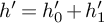 $h' = h_0'+h_1'$
, nous parvenons à
 $$ \begin{align*} E_5(r) &\ll \frac{ 1}{S} \sum_{1\leqslant |h'|\leqslant 2S}\, \sum_{ m\leqslant M} \min\Big(\frac x M,\Big|\sin\Big(\pi \frac{mh'}{q_{\mu_1}}\Big) \Big|^{-1} \Big) \\ & \ll \frac{M}{q_{\mu_1} S} \sum_{1\leqslant |h'|\leqslant 2S}\, \sum_{0\leqslant t<q_{\mu_1}} \min\Big(\frac xM,\Big|\sin\Big(\pi \frac{th'}{q_{\mu_1}}\Big) \Big|^{-1} \Big). \end{align*} $$
D’après le lemme 8,
 $$ \begin{align*} E_5(r) \ll \frac{M}{q_{\mu_1}} \Big(\tau(q_{\mu_1}) \frac xM +q_{\mu_1} \log q_{\mu_1}\Big) \ll \frac{x}{q_{\mu_1}}\max\big(\tau(q_{v(x)}),\log x\big). \end{align*} $$
On a donc
 $$ \begin{align*} E_4'(r) \ll x\max\big(\tau(q_{v(x)}),\log x\big) \Big( \frac{1}{S}+\frac{1}{q_{\mu_1}} \Big). \end{align*} $$
Nous avons ainsi établi que
 $$ \begin{align*} S_2'(r,s) = S_4(r,s) + O\Big( x \max\big(\tau(q_{v(x)}),\log x\big) \Big( \frac{1}{S} + \frac{1}{q_{\mu_1}} \Big) \Big). \end{align*} $$
On a donc à ce stade
 $$ \begin{align} |S_{II}|^4 \ll x^4 \Big( \frac{1}{R^2} + \frac{q_{\mu+\rho}^2}{q_{\mu+2\rho}^2} + \frac{1}{S}\Big)+ x^4 \max\big(\tau(q_{v(x)}),\log x\big) \Big( \frac{1}{S} +\frac{1}{q_{\mu_1}} \Big) \\\nonumber + \frac{x^3}{RS} \sum_{1\leqslant r < R}\sum_{1\leqslant s < S} |S_4(r,s)|. \end{align} $$
7.4 Analyse de Fourier de
$S_4(r,s)$

Rappelons que
 $$ \begin{align*} &S_4(r,s) \\&\quad = \sum_{(m,n) \in I \times J } \sum_{0\leqslant u_0,u_1< q_{\mu_2-\mu_1}^{[\mu_1]}} A_{1/q_{\mu_2-\mu_1}^{[\mu_1]},H}\Big( \frac{mn}{q_{\mu_2}}-\frac{u_0}{q_{\mu_2-\mu_1}^{[\mu_1]}} \Big) A_{1/q_{\mu_2-\mu_1}^{[\mu_1]},H}\Big( \frac{mn+mr}{q_{\mu_2}}-\frac{u_1}{q_{\mu_2-\mu_1}^{[\mu_1]}} \Big) \\ &\qquad \times g(u_1+sn+rs)\overline{g}(u_1) \overline{g}(u_0+sn)g(u_0), \end{align*} $$
avec
 $g(k) = \operatorname {\mathrm {e}}\big (\alpha f_{\mu _2-\mu _1}^{[\mu _1]}(k)\big )$
, suite
 $q_{\mu _2-\mu _1}^{[\mu _1]}$
-périodique. Nous posons
 $$ \begin{align*} u_0+sn \equiv u_2 \bmod q_{\mu_2-\mu_1}^{[\mu_1]} \quad\textrm{ et } \quad u_1 +sn+rn \equiv u_3 \bmod q_{\mu_2-\mu_1}^{[\mu_1]}. \end{align*} $$
En utilisant la relation (1), nous aboutissons à l’identité
 $$ \begin{align*} S_4(r,s) = & \sum_{0\leqslant |h_0|,|h_1| \leqslant H} a_{h_0}(1/ q_{\mu_2-\mu_1}^{[\mu_1]},H)\, a_{h_1}(1/ q_{\mu_2-\mu_1}^{[\mu_1]},H)\\ & \qquad \times \sum_{0\leqslant u_0,u_1,u_2,u_3< q_{\mu_2-\mu_1}^{[\mu_1]}} g(u_3)\overline{g}(u_1)\overline{g}(u_2)g(u_0)\\ \\ & \qquad \times \sum_{(m, n)\in I\times J} \operatorname{\mathrm{e}}\Big( h_0\Big(\frac{mn}{q_{\mu_2}}-\frac{u_0}{q_{\mu_2-\mu_1}^{[\mu_1]}}\Big) + h_1\Big(\frac{mn+mr}{q_{\mu_2}}-\frac{u_1}{q_{\mu_2-\mu_1}^{[\mu_1]}}\Big) \Big)\\ & \qquad \times (q_{\mu_2-\mu_1}^{[\mu_1]})^{-2} \sum_{0\leqslant h_2,h_3< q_{\mu_2-\mu_1}^{[\mu_1]}} \operatorname{\mathrm{e}}\Big( h_2 \frac{u_0+sn-u_2}{q_{\mu_2-\mu_1}^{[\mu_1]}} + h_3\frac{u_1+sn+sr-u_3}{q_{\mu_2-\mu_1}^{[\mu_1]}} \Big). \end{align*} $$
Rappelons la définition de
 $F_{\lambda }^{[h]}$
en (22). En effectuant les sommes en
 $u_0,u_1,u_2$
et
 $u_3$
, nous obtenons

où
 $S_4'$
et
 $S_4^{\prime \prime }$
correspondent respectivement aux contributions des couples
 $(h_0,h_1)$
tels que
 $h_0+h_1=0$
et
 $h_0+h_1\neq 0$
.
7.5 Majoration de
$S_4'$

Lorsque
 $h_0+h_1=0$
les sommations sur m et n sont indépendantes. Supposons que
 $$ \begin{align} H R \leqslant q_{\mu_2}/2. \end{align} $$
On a alors
 $$ \begin{align} \Big|\sum_{m\in I} \operatorname{\mathrm{e}}\Big( \frac{h_1mr}{q_{\mu_2}} \Big) \Big| \leqslant \min\Big(M, \Big|\sin \frac{\pi h_1 r }{q_{\mu_2}}\Big|^{-1} \Big) \leqslant \min\Big(M, \frac{q_{\mu_2}}{|h_1|r}\Big). \end{align} $$
Par ailleurs,
 $$ \begin{align*} \Big|\sum_{n\in J} \operatorname{\mathrm{e}}\Big(\frac{(h_2+h_3)snq_{\mu_1}}{q_{\mu_2}}\Big) \Big| \leqslant \min\Big( \frac{x}M, \Big|\sin \frac{\pi (h_2+h_3)s}{q_{\mu_2-\mu_1}^{[\mu_1]}}\Big|^{-1} \Big). \end{align*} $$
En posant
 $h = h_2+h_3$
et en utilisant la
 $q_{\mu _2-\mu _1}^{[\mu _1]}$
-périodicité de
 , nous obtenons la majoration
 $$ \begin{align*} |S_4'(r,s)| \leqslant S_5(r,s), \end{align*} $$
avec
 $$ \begin{align*} S_5(r,s) & = (q_{\mu_2-\mu_1}^{[\mu_1]})^2 \sum_{|h_1|\leqslant H}|a_{h_1}(1/ q_{\mu_2-\mu_1}^{[\mu_1]},H)|^2 \min\Big(M, \frac{q_{\mu_2}}{|h_1|r}\Big)\\ &\sum_{0\leqslant h<q_{\mu_2-\mu_1}^{[\mu_1]}} \min\Big( \frac{x}M,\Big|\sin \frac{\pi hs }{q_{\mu_2-\mu_1}^{[\mu_1]}}\Big|^{-1}\Big)S_6(h,h_1), \end{align*} $$
où

D’après l’inégalité de Cauchy-Schwarz et la
 $q_{\mu _2-\mu _1}^{[\mu _1]}$
-périodicité de
 , on a
 $$ \begin{align*} S_6(h,h_1) \leqslant S_7(h_1) \end{align*} $$
pour tout
 $h\in \mathbb {Z}$
, avec

D’après le lemme 8, nous avons
 $$ \begin{align*} \frac 1S \sum_{1 \leqslant s <S} \sum_{0\leqslant h<q_{\mu_2-\mu_1}^{[\mu_1]}} \min\Big( \frac x M, \Big|\sin \frac{\pi hs }{q_{\mu_2-\mu_1}^{[\mu_1]}}\Big|^{-1} \Big) \ll \frac x M \tau(q_{\mu_2-\mu_1}^{[\mu_1]}) + q_{\mu_2-\mu_1}^{[\mu_1]} \log q_{\mu_2-\mu_1}^{[\mu_1]}. \end{align*} $$
On a
 $q_{\mu _2-\mu _1}^{[\mu _1]} \mid q_{\mu _2} = q_{\mu +2\rho }$
. Or, d’après (34), on a
 $\mu +2 \rho \leqslant v(x)$
et, par conséquent,
 $q_{\mu +2 \rho } \mid q_{v(x)}$
. Il en résulte que
 $$ \begin{align*} \tau(q_{\mu_2-\mu_1}^{[\mu_1]})\leqslant \tau(q_{v(x)}). \end{align*} $$
Nous obtenons donc
 $$ \begin{align} \frac 1{RS} \sum_{\substack{1\leqslant r < R\\1 \leqslant s <S}} |S_4'(r,s)| \ll \frac{x}{M} \max \big(\tau(q_{v(x)}), \log x\big) \Big( 1+ \frac{ q_{\mu_2-\mu_1}^{[\mu_1]}}{q_{\mu-1}}\Big) \Big( \frac{1}{R} \sum_{1\leqslant r<R}S_8(r)\Big), \end{align} $$
avec
 $$ \begin{align*} S_8(r) = (q_{\mu_2-\mu_1}^{[\mu_1]})^2 \sum_{|h_1|\leqslant H}|a_{h_1}(1/ q_{\mu_2-\mu_1}^{[\mu_1]},H)|^2 \min\Big(M, \frac{q_{\mu_2}}{|h_1|r}\Big)S_7(h_1). \end{align*} $$
Nous subdivisons la somme sur
 $h_1$
en trois sommes
 $S_8'(r)$
,
 $S_8^{\prime \prime }(r)$
et
 $S_8^{\prime \prime \prime }(r)$
suivant que
 $ |h_1|\leqslant q_{\mu_2}/M $
,
 $ q_{\mu_2}/M<|h_1|\leqslant q_{\mu_2-\mu_1}^{[\mu_1]} $
ou
 $ q_{\mu_2-\mu_1}^{[\mu_1]}<|h_1|\leqslant H $
.
7.5.1 Majoration de
$S_8'(r)$

La majoration
 $ \left| a_{h_1}(1/ q_{\mu_2-\mu_1}^{[\mu_1]},H) \right| \leqslant 1/ q_{\mu_2-\mu_1}^{[\mu_1]} $
et l’identité de Parseval conduisent à

Notons que
 $ q_{\mu_2}/M \leqslant q_{\mu_2}/q_{\mu-1} = a_{\mu-1} \cdots a_{\mu_2-1} = q_{\mu_2-\mu+1}^{[\mu-1]} , $
d’où

Utilisons à présent le lemme 3 avec
 $(\mu ,\lambda ,k)$
remplacé par
 $(\mu -1-\mu _1, \mu _2-\mu _1, \mu _1)$
: pour tout
 $h\in \mathbb {Z}$
,

Comme
 $f\in \mathcal {F}_\sigma $
, (22) donne

et, avec l’identité de Parseval, nous en déduisons que
 $$ \begin{align*} \frac 1R\sum_{1\leqslant r < R} S_8'(r) \leqslant 2M e^{-2\sigma(\mu-2\rho,\mu-1)}. \end{align*} $$
7.5.2 Majoration de
$S_8^{\prime \prime }(r)$

Nous utilisons là encore la majoration
 $ |a_{h_1}(1/ q_{\mu_2-\mu_1}^{[\mu_1]}, H)| \leqslant 1/ q_{\mu_2-\mu_1}^{[\mu_1]} $
pour obtenir, grâce à l’identité de Parseval,
 $$ \begin{align*} S_8^{\prime\prime}(r) & \leqslant \frac{q_{\mu_2}}{r} \sum_{ q_{\mu_2}/M < |h_1| \leqslant q_{\mu_2-\mu_1}^{[\mu_1]}} \frac{S_7(h_1)}{|h_1|} \\ & \leqslant \frac{M}{r} \sum_{1\leqslant |h_1|\leqslant q_{\mu_2-\mu_1}^{[\mu_1]}} S_7(h_1) \ll \frac{M}{r}. \end{align*} $$
En conséquence,
 $$ \begin{align*} \frac 1 R \sum_{1\leqslant r <R} S_8^{\prime\prime}(r) \ll \frac{M \log R }{R} =\frac{M}{q^{[\mu]}_\rho} \log q^{[\mu]}_\rho. \end{align*} $$
7.5.3 Majoration de
$S_8^{\prime \prime \prime }(r)$

On utilise cette fois la majoration
 $ |a_{h_1}(1/ q_{\mu_2-\mu_1}^{[\mu_1]},H)| \leqslant 1/(\pi |h_1|) , $
qui conduit à
 $$ \begin{align*} S_8^{\prime\prime\prime}(r) \ll (q_{\mu_2-\mu_1}^{[\mu_1]})^2 \,\frac{q_{\mu_2}}{r} \sum_{q_{\mu_2-\mu_1}^{[\mu_1]}< |h_1| \leqslant H} \frac{S_7(h_1)}{|h_1|^3}. \end{align*} $$
La fonction
 $h_1\mapsto S_7(h_1)$
est
 $q_{\mu _2-\mu _1}^{[\mu _1]}$
-périodique. En décomposant la sommation en
 $h_1$
suivant les intervalles
 $ j q_{\mu_2-\mu_1}^{[\mu_1]} < |h_1| \leqslant (j+1)q_{\mu_2-\mu_1}^{[\mu_1]} $
pour
 $ 1\leqslant j \leqslant H/q_{\mu_2-\mu_1}^{[\mu_1]} $
et en majorant
 $|h_1|^{-3}$
par
 $ j^{-3}(q_{\mu_2-\mu_1}^{[\mu_1]} )^{-3},$
on obtient
 $$ \begin{align*} S_8^{\prime\prime\prime}(r) & \ll (q_{\mu_2-\mu_1}^{[\mu_1]})^2 \frac{q_{\mu_2}}{r} \sum_{j\geqslant 1} \frac{1}{j^3 (q_{\mu_2-\mu_1}^{[\mu_1]})^3} \sum_{0\leqslant h_1 < q_{\mu_2-\mu_1}^{[\mu_1]}}S_7(h_1)\\ & \ll \frac{q_{\mu_2}}{rq_{\mu_2-\mu_1}^{[\mu_1]}} = \frac{q_{\mu_1}}{r} \leqslant \frac{M}{r} \end{align*} $$
et, par suite,
 $$ \begin{align*} \frac 1 R \sum_{1\leqslant r <R} S_8^{\prime\prime\prime}(r) \leqslant \frac{M}{q^{[\mu]}_\rho} \log q^{[\mu]}_\rho. \end{align*} $$
On a donc établi la majoration
 $$ \begin{align*} \frac 1 R \sum_{1\leqslant r <R} S_8(r) \ll M \Big(e^{-2\sigma(\mu-2\rho,\mu-1)} + \frac{ \log q^{[\mu]}_\rho}{q^{[\mu]}_\rho}\Big). \end{align*} $$
En reportant dans (42), il vient
 $$ \begin{align} \frac 1{RS} \sum_{\substack{1\leqslant r < R\\1 \leqslant s <S}} |S_4'(r,s)| \ll x \max \big(\tau(q_{v(x)}), \log x\big) (\log x) \Big( 1+ \frac{ q_{\mu_2-\mu_1}^{[\mu_1]}}{q_{\mu-1}}\Big) \Big( e^{-2\sigma(\mu-2\rho,\mu-1)}+\frac{1}{q^{[\mu]}_\rho} \Big). \end{align} $$
7.6 Majoration de
$S_4^{\prime \prime }$

On effectue la sommation sur m et l’on obtient

Dans la dernière somme, nous posons
 $n = k q_{\mu _2}+t$
avec
 $0\leqslant k \leqslant N/q_{\mu _2}$
et
 $0\leqslant t <q_{\mu _2}$
et nous appliquons le lemme 7 à la somme en t. Comme
 $|h_0+h_1|\leqslant 2 H$
et
 $q_{\mu _2}\leqslant Hq_\mu $
, on a
 $$ \begin{align*} \sum_{n\leqslant N} \min\Big(M, \Big|\sin \pi \frac{(h_0+h_1)n+h_1 r}{q_{\mu_2}} \Big|^{-1} \Big) &\ll \left\lceil \frac{N}{q_{\mu_2}}\right\rceil \big((h_0+h_1,q_{\mu_2})M+q_{\mu_2} \log q_{\mu_2}\big) \\ & \ll \left\lceil \frac{N}{q_{\mu_2}}\right\rceil \big(HM+q_{\mu_2} \log q_{\mu_2}\big)\\ & \ll \left\lceil \frac{N}{q_{\mu_2}}\right\rceil HM\log q_{\mu_2} \ll \Big(1+ \frac{x}{M q_{\mu_2}}\Big) HM \log x. \end{align*} $$
L’inégalité de Cauchy-Schwarz et l’égalité de Parseval donnent les majorations

Par ailleurs,
 $$ \begin{align*} \sum_{|h|\leqslant H}|a_h(1/ q_{\mu_2-\mu_1}^{[\mu_1]},H)| & \leqslant \sum_{|h| \leqslant q_{\mu_2-\mu_1}^{[\mu_1]}} \frac1{q_{\mu_2-\mu_1}^{[\mu_1]}} +\sum_{q_{\mu_2-\mu_1}^{[\mu_1]} < |h| \leqslant H} \frac{1}{\pi |h|}\\ &\ll 1 + \log(H/q_{\mu_2-\mu_1}^{[\mu_1]}) \ll \log x. \end{align*} $$
Ainsi,
 $$ \begin{align} \frac{1}{RS}\sum_{\substack{1 \leqslant r < R\\ 1 \leqslant s <S}} |S_4^{\prime\prime}(r)| & \ll (q_{\mu_2-\mu_1}^{[\mu_1]})^2\big(\log x)^3 \Big(1+ \frac{x}{M q_{\mu_2}}\Big) HM \\ & \leqslant x (\log x)^3(q_{4\rho}^{[\mu-2\rho]})^3 q_{2 \rho-1}^{[\mu-2\rho]} \Big(\frac{M}{x} + \frac{1}{q_{\mu+2\rho}} \Big) \notag \\ & \leqslant x (\log x)^3\frac{(q_{4\rho}^{[\mu-2\rho]})^4}{q_{\mu-1}}. \notag \end{align} $$
Nous déduisons de (43) et (44) la majoration
 $$ \begin{align} \frac{1}{RS}\sum_{\substack{1 \leqslant r < R\\ 1 \leqslant s <S}} |S_4(r)| \ll x (\log x)^2 \max \big(\tau(q_{v(x)}), \log x\big) \Big( K_1(\mu,\rho)+ \frac{(q_{4\rho}^{[\mu-2\rho]})^4}{q_{\mu-1}} \Big) \end{align} $$
avec
 $$ \begin{align*} K_1(\mu,\rho) = \Big( 1+ \frac{q_{4\rho}^{[\mu-2\rho]}}{q_{\mu-1}}\Big) \Big( e^{-2\sigma(\mu-2\rho,\mu-1)}+\frac{1}{q^{[\mu]}_\rho}\Big). \end{align*} $$
7.7 Fin de la majoration de
$S_{II}$

En insérant (45) dans (39), nous obtenons que sous les conditions (33), (34) et (40), soit
 $$ \begin{align} \qquad\kern-2pt\qquad q_\rho^{[\mu]} &\ll q_{\mu-1} \end{align} $$
 $$ \begin{align} q_{\mu+2 \rho-1} &\leqslant x \end{align} $$
 $$ \begin{align} q_{4\rho}^{[\mu-2\rho]} q_{2 \rho-1}^{[\mu-2\rho]} q_\rho^{[\mu]} &\leqslant q_{\mu+2\rho}/2 ,\ \ \end{align} $$
on a
 $$ \begin{align*} S_{II}^4 \ll x^4 (\log x)^2 \max \big(\tau(q_{v(x)}), \log x\big) K_2(\mu,\rho), \end{align*} $$
avec
 $$ \begin{align*} K_2(\mu,\rho) = \frac{1}{\big(q_\rho^{[\mu]}\big)^2} + \frac{1}{\big(q_{\rho}^{[\mu+\rho]}\big)^2} + \frac{1}{q_{2 \rho-1}^{[\mu-2\rho]}} + \frac{1}{q_{\mu-2\rho}} + \frac{\big(q_{4\rho}^{[\mu-2\rho]}\big)^4}{q_{\mu-1}} + K_1(\mu,\rho). \end{align*} $$
Il s’agit à présent de fixer la valeur de
 $\rho $
en fonction de
 $\mu $
de manière à ce que (46), (47) et (48) soient bien vérifiées, puis d’évaluer
 $K_2$
pour
 $\mu $
suffisamment grand en tenant compte du fait que la base A est supposée tempérée.
Commençons par traiter la condition (47). D’après 12, il existe
 $d \in ]0,1[$
et
 $x_0> 0$
tels que
 $v(\sqrt {x}) \leqslant d v(x)$
pour tout
 $x\geqslant x_0$
. On a donc
 $ \mu \leqslant d v(x)$
, puisque
 $\mu = v(M)$
et
 $M\leqslant \sqrt {x}$
, ainsi qu’indiqué dans les premières lignes de la section 7. Pour satisfaire (47), il suffit alors de choisir
 $ \rho = \left \lfloor c_1 \mu \right \rfloor $
avec
 $c_1 = (\tfrac 1{d} -1)/2> 0$
. En effet, on aura pour
 $x\geqslant x_0$
,
 $$ \begin{align*} \mu+ 2 \rho \leqslant (1+ 2 c_1) \mu \leqslant v(x), \end{align*} $$
ce qui entraîne bien (47). La condition
 $x \geqslant x_0$
est vérifiée pour
 $\mu $
suffisamment grand puisque
 $M \leqslant \sqrt {x}$
.
Traitons maintenant les conditions (46) et (48). D’après la définition d’une base tempérée (cf. (11)), il existe
 $A>0$
tel pour
 $\mu \geqslant 2$
et
 $\rho = \left \lfloor c_2 \mu \right \rfloor $
,
 $$ \begin{align} c_2 &\leqslant \kappa(5, 1)/8 \Rightarrow\ (q_{4\rho}^{[\mu-2\rho]})^5 \leqslant A q_{\mu-1}. \end{align} $$
Si l’on pose
 $$ \begin{align*} \rho = \left\lfloor c_2\mu \right\rfloor \quad \text{ avec } c_2 \leqslant \frac{\kappa(5, 1)}{8}\in]0,1/8[, \end{align*} $$
les conditions (46) et (48) sont bien vérifiées: d’une part, on a
 $q_{\rho }^{[\mu ]} \leqslant q_{4\rho }^{[\mu -2\rho ]}$
et, par conséquent,
 $q_{\rho }^{[\mu ]} \ll q_{\mu -1}$
; d’autre part, pour
 $\mu $
suffisamment grand, on a
 $$ \begin{align*} q_{\mu-1} = \frac{ q_{\mu+2 \rho}}{q^{[\mu-1]}_{2 \rho+1}} \leqslant \frac{ q_{\mu+2 \rho}}{2^{2 \rho+1}} \leqslant \frac{ q_{\mu+2 \rho}}{2A}, \end{align*} $$
d’où
 $$ \begin{align*} q_{4\rho}^{[\mu-2\rho]} q_{2 \rho-1}^{[\mu-2\rho]} q_\rho^{[\mu]} \leqslant (q_{4\rho}^{[\mu-2\rho]})^3 \leqslant (q_{4\rho}^{[\mu-2\rho]})^5 \leqslant A q_{\mu -1}\leqslant \frac{q_{\mu+2 \rho}}{2}. \end{align*} $$
Finalement, nous choisissons
 $ \rho = \left \lfloor c\mu \right \rfloor $
avec
 $c = \min (c_1,c_2)$
et
 $\mu $
suffisamment grand de sorte que les conditions (46), (47) et (48) soient bien vérifiées et que
 $c\mu \geqslant 2$
.
À présent, montrons qu’il existe
 $c'> 0$
tel que pour
 $\rho ' = \left \lfloor c'\mu \right \rfloor $
,
 $$ \begin{align*} K_2(\mu,\rho) \ll \frac{1}{q_{\rho'}} + e^{-2\sigma(\mu-2\rho,\mu-1)}. \end{align*} $$
En appliquant (11) à diverses reprises, nous obtenons:
 $$ \begin{align} c' \leqslant c\kappa_1/2 & \Rightarrow \big(q_{\rho}^{[\mu]}\big)^2 \gg q_{\rho}^{[\mu]} \gg q_{\rho'} \quad \text{ avec } \kappa_1 = \kappa\Big(1, \frac 2 c\Big), \notag\\ c' \leqslant c\kappa_2 /2 &\Rightarrow (q_{\rho}^{[\mu+\rho]})^2 \gg q_{\rho'} \quad \text{ avec } \kappa_2 =\kappa\Big( \frac 12, 1+\frac 2 c \Big), \\ c' \leqslant c\kappa_3/2 &\Rightarrow q_{2\rho-1}^{[\mu-2\rho]}\gg q_{\rho'} \quad \text{ avec } \kappa_3 = \kappa\Big(1, \frac{2}{c}-2 \Big).\notag \end{align} $$
Pour la dernière inégalité, on a en effet
 $$ \begin{align*} \mu-2\rho \leqslant \Big(\frac{2}{c}-2\Big)\rho \leqslant \Big(\frac{2}{c}-2\Big)(2\rho-1). \end{align*} $$
Par définition de
 $\rho $
et de
 $\rho '$
, on a directement
 $$ \begin{align} c' \leqslant 1-2c \Rightarrow q_{\mu-2\rho} \geqslant q_{\rho'}. \end{align} $$
En conséquence, en posant
 $$ \begin{align*} c' = \frac{1}{2}\min\Big( c\kappa_1, c\kappa_2, c\kappa_3, 2-4c \Big) \end{align*} $$
et en utilisant (50) et (51), il vient
 $$ \begin{align*} \frac{1}{\big(q_\rho^{[\mu]}\big)^2} + \frac{1}{\big(q_{\rho}^{[\mu+\rho]}\big)^2} + \frac{1}{q_{2 \rho-1}^{[\mu-2\rho]}} + \frac{1}{q_{\mu-2\rho}} \ll \frac{1}{q_{\rho'}}. \end{align*} $$
De plus, d’après (49) et (50),
 $$ \begin{align*} \frac{\big(q_{4\rho}^{[\mu-2\rho]}\big)^4}{q_{\mu-1}} \ll \frac{1}{q_{4\rho}^{[\mu-2\rho]}} \ll \frac{1}{q_{2\rho - 1}^{[\mu-2\rho]}} \ll \frac{1}{q_{\rho'}}. \end{align*} $$
Il s’ensuit
 $$ \begin{align*} K_2(\mu,\rho) \ll e^{-2\sigma(\mu-2\rho,\mu-1)}+\frac{1}{q_{\rho'}}. \end{align*} $$
Dans la suite, nous prenons
 $\mu $
suffisamment grand pour que
 $c'\mu \geqslant 2$
.
Posons
 $d = 2/c'$
,
 $\kappa _4 = \kappa (1,d)$
,
 $c^{\prime \prime } = \min (c, c\kappa _4/2)> 0$
et
 $\rho ^{\prime \prime } = \left \lfloor c^{\prime \prime } \mu \right \rfloor $
. Alors,
 $2\rho \geqslant \rho ^{\prime \prime }$
. Par ailleurs,
 $$ \begin{gather*} \mu-\rho^{\prime\prime} \leqslant \mu \leqslant \frac{2}{c'} \left\lfloor c'\mu \right\rfloor = d \rho' \quad\text{et}\\ \rho^{\prime\prime}-1 \leqslant \rho^{\prime\prime} \leqslant c^{\prime\prime}\mu \leqslant \kappa_4 \frac{c' \mu}{2} \leqslant \kappa_4 \left\lfloor c' \mu \right\rfloor = \kappa_4 \rho', \end{gather*} $$
d’où
 $q_{\rho ^{\prime \prime }-1}^{[\mu -\rho ^{\prime \prime }]} \ll q_{\rho '}$
.
Compte tenu de la décroissance de
 $r\mapsto \sigma (r,\cdot )$
et de la minoration (23), on a alors
 $$ \begin{align*} K_2(\mu,\rho) \leqslant e^{-2\sigma(\mu-\rho^{\prime\prime}, \mu-1)} + \frac{1}{q_{\rho'}} \leqslant e^{-2\sigma(\mu-\rho^{\prime\prime}, \mu-1)} \Big(1 + \frac{q_{\rho^{\prime\prime}-1}^{[\mu-\rho^{\prime\prime}]}}{q_{\rho'}}\Big) \ll e^{-2\sigma(\mu-\rho^{\prime\prime}, \mu-1)}. \end{align*} $$
Nous obtenons l’existence de
 $c^{\prime \prime \prime }> 0$
tel que, pour
 $\mu $
suffisamment grand,
 $$ \begin{align*} S_{II}^4 \ll x^4 (\log x)^2 \max \big(\tau(q_{v(x)}), \log x\big) e^{-2\sigma(\mu-c^{\prime\prime\prime}\mu, \mu-1)}, \end{align*} $$
ce qui conclut la démonstration de la proposition 4.
8 Démonstration du théorème principal
Le théorème 1 se déduit de façon classique des estimations de sommes de type I et II obtenues dans les paragraphes 6 et 7. La démarche est similaire à celle suivie par exemple dans [Reference Martin, Mauduit and Rivat24]. Posons
 $u=x^{3/10}$
. D’après l’identité de Vaughan (cf. par exemple [Reference Davenport4, p. 139]), on a
 $$ \begin{align} \sum_{n \leqslant x} \Lambda(n)f(n) =S_1-S_2+S_3+O(u) \end{align} $$
avec
 $$ \begin{align*} S_1&=\sum_{\substack{m\leqslant u\\ mn\leqslant x}}\mu(m)\log(n)f(mn),\\ S_2&=\sum_{\substack{m_1\leqslant u\\m_2\leqslant u\\ m_1m_2n\leqslant x}} \mu(m_1)\Lambda(m_2) f(m_1m_2n),\\ S_3&=\sum_{\substack{u<m<x\\u<n_1<x\\ mn_1n_2\leqslant x}} \mu(m)\Lambda(n_1)f(m n_1 n_2). \end{align*} $$
On a
 $$ \begin{align*} S_1 & = \sum_{m\leqslant u}\mu(m) \sum_{n\leqslant x/m} f(mn)\int_1^n\frac{d t}{t} = \sum_{m\leqslant u} \mu(m)\int_1^x \sum_{t<n\leqslant x/m} f(mn) \frac{d t}{t} \\ & \ll (\log x) \sum_{m\leqslant u} \max_{t\leqslant x/m} \Big|\sum_{t<n\leqslant x/m} f(mn) \Big| \\ & \ll (\log x)\sum_{m\leqslant u} \max_{t\leqslant x/m} \Big|\sum_{n<t} f(mn) \Big| \\ & \ll (\log x)^2 \max_{M\leqslant u} \sum_{M/2 < m \leqslant M} \max_{t\leqslant x/m} \Big|\sum_{n<t} f(mn) \Big|. \end{align*} $$
D’après la proposition 2, il existe
 $c_5 <1$
tel que, pour x suffisamment grand,
 $$ \begin{align*} v(u^2)=v(x^{6/10}) \leqslant c_5 v(x). \end{align*} $$
En particulier,
 $v(u^2) \leqslant v(x)-1.$
Nous pouvons donc appliquer la proposition 3. En tenant compte de la décroissance de
 $r\mapsto \sigma (r,\cdot )$
, nous obtenons
 $$ \begin{align} S_1 \ll x (\log x)^4 \exp\Big(-\sigma(v(u^2), v(x)-1)\Big) \ll x (\log x)^4 \exp\Big(-\sigma(c_5v(x), v(x)-1)\Big), \end{align} $$
où nous rappelons que
 $v(y)$
désigne la valuation du nombre y en base A (cf. §2.2).
Pour traiter
 $S_2$
, on pose
 $m=m_1m_2$
de sorte que
 $$ \begin{align*} S_2 = \sum_{m\leqslant u^2} \Big(\sum_{\substack{m_1m_2=m\\ m_1\leqslant u\\m_2\leqslant u}}\mu(m_1)\Lambda(m_2)\Big) \sum_{mn\leqslant x}f(mn). \end{align*} $$
De la majoration
 $$ \begin{align*} \sum_{\substack{m_1m_2=m\\ m_1\leqslant u\\m_2\leqslant u}} \left| \mu(m_1) \right| \Lambda(m_2) \leqslant \sum_{m_2\mid m}\Lambda(m_2)=\log m, \end{align*} $$
on déduit que
 $$ \begin{align} S_2& \ll \log x\sum_{m\leqslant u^2} \Big| \sum_{n\leqslant x/m} f(mn)\Big| \notag\\ & \ll \log x\big( S_2^{(1)} +S_2^{(2)}+O(u^3)\big) \end{align} $$
avec
 $$ \begin{align*} S_2^{(1)} &= \sum_{m\leqslant u} \Big| \sum_{n\leqslant x/m} f(mn)\Big| \\ S_2^{(2)} & = \sum_{u< m\leqslant u^2} \Big| \sum_{u< n\leqslant x/m} f(mn)\Big|. \end{align*} $$
Le même calcul que celui réalisé pour
 $S_1$
aboutit à
 $$ \begin{align*} S_2^{(1)} \ll x (\log x)^3 \exp\Big(-\sigma(c_5v(x), v(x)-1)\Big). \end{align*} $$
La somme
 $S_2^{(2)}$
se traite comme une somme de type II. Au prix d’un facteur
 $\log x$
, nous utilisons un lemme de séparation des variables (par exemple [Reference Iwaniec and Kowalski18, Lemma 13.11]) afin d’enlever la condition
 $mn\leqslant x$
. Puis nous découpons les intervalles
 $]u,u^2]$
et
 $]u,x/u]$
suivant des intervalles de la forme
 $]M/2,M]$
et
 $]N/2,N]$
, ce qui fait apparaître un facteur
 $(\log x)^2$
. Finalement, nous parvenons à
 $$ \begin{align*} S_2^{(2)} \ll (\log x)^3 \sup \Big| \sum_{M/2< m\leqslant M} \sum_{N/2< n\leqslant N} b_nc_m f(mn)\Big| \end{align*} $$
où le supremum est pris sur toutes les suites
 $(b_n)_{n\geqslant 0}$
et
 $(c_m)_{m\geqslant 0}$
de nombres complexes de module
 $\leqslant 1$
, tous les nombres entiers M et N tels que
 $MN\leqslant x$
,
 $\min (M,N) \geqslant u$
. D’après la proposition 4 appliquée avec
 $\xi = 3/10$
, il existe
 $c_6 < 1$
tel que
 $$ \begin{align*} S_2^{(2)} \ll x (\log x)^{3+ \frac 12} \max(q_{v(x)},\log x)^{1/4} \sup_{\substack{MN\leqslant x \\ \min(M,N) \geqslant u}} \exp\Big(- \frac 12\sigma(c_6v_{M,N}, v_{M,N}-1)\Big), \end{align*} $$
où nous avons posé
 $v_{M,N} = v( \min (M,N)).$
Comme
 $$ \begin{align*} u=x^{3/10}\leqslant \min(M,N) \leqslant x^{1/2}, \end{align*} $$
on a
 $$ \begin{align*} v(x^{1/3}) \leqslant v_{M,N} \leqslant v(x^{1/2}) \end{align*} $$
et donc
 $$ \begin{align*} S_2^{(2)} \ll x (\log x)^{7/2} \max(q_{v(x)},\log x)^{1/4} \exp\Big(-\frac 12 \inf_{v(x^{3/10})\leqslant \lambda\leqslant v(x^{1/2})} \sigma(c_6\lambda, \lambda-1) \Big). \end{align*} $$
Nous obtenons ainsi la majoration
 $$ \begin{align*} S_2 \ll x (\log x)^{7/2} \max(q_{v(x)},\log x)^{1/4} e^{-T(x)/2} +x^{9/10} \log x \end{align*} $$
avec
 $$ \begin{align*} T(x) =\min\Big( \sigma\big(c_5v(x),v(x)-1\big), \inf_{v(x^{3/10})\leqslant \lambda\leqslant v(x^{1/2})} \sigma(c_6\lambda, \lambda-1) \Big). \end{align*} $$
Enfin, on a
 $$ \begin{align*} S_3=(\log x)\sum_{u<m\leqslant x/u} \mu(m)\sum_{u<n\leqslant x/m} \Big(\frac{1}{\log x} \sum_{\substack{u<n_1\leqslant x\\ n_1n_2=n}} \Lambda(n_1)\Big)f(mn). \end{align*} $$
Nous remarquons que
 $$ \begin{align*} \sum_{\substack{u<n_1\leqslant x\\ n_1n_2=n}} \Lambda(n_1)\leqslant \log n, \end{align*} $$
de sorte que l’on peut réécrire
 $S_3$
sous la forme
 $$ \begin{align*} S_3=(\log x)\sum_{u<m\leqslant x/u} c_m\sum_{u<n\leqslant x/m} b_n f(mn), \end{align*} $$
avec
 $|c_m| \leqslant 1$
,
 $|b_n|\leqslant 1$
pour tous entiers m et n. On peut alors appliquer le même traitement à
 $S_3$
qu’à
 $S_2^{(2)}$
et l’on obtient
 $$ \begin{align*} S_3 \ll x (\log x)^{9/2} \max(q_{v(x)},\log x)^{1/4} e^{-T(x)/2}. \end{align*} $$
Finalement,
 $$ \begin{align*} \sum_{n \leqslant x} \Lambda(n)f(n) \ll x (\log x)^{9/2} \max(q_{v(x)},\log x)^{1/4} e^{-T(x)/2} +x^{9/10} \log x. \end{align*} $$
En tenant compte de la décroissance de
 $r\mapsto \sigma (r,\cdot )$
, on a, en posant
 $c_0 =\max (c_5,c_6)<1$
,
 $$ \begin{align*} T(x) \geqslant \inf_{v(x^{3/10})\leqslant \lambda\leqslant v(x)} \sigma(c_0\lambda, \lambda-1). \end{align*} $$
Cela conclut la preuve du théorème 1.
9 Transformée de Fourier de la fonction somme de chiffres
Soient
 $\alpha \in \mathbb {R}$
et
 $f(n) = \operatorname {\mathrm {e}}(\alpha s_A(n))$
. Cette section a pour but d’établir une majoration de la transformée de Fourier discrète décalée
 $|F_\lambda ^{[k]}|$
associée à f dans une base de Cantor A quelconque. Il s’agit de reprendre et, le cas échéant, de préciser, plusieurs résultats obtenus dans [Reference Mauduit and Rivat26]. Le premier lemme améliore le lemme 3 de [Reference Mauduit and Rivat26]. Rappelons que la définition de
 $\varphi _k$
est donnée en (28).
Lemme 11. Pour tout nombre entier
 $k\geqslant 1$
et tout nombre réel t tel que
 $\left \| t \right \| \leqslant \frac {1}{k}$
, on a
 $$ \begin{align*} \varphi_k(t) \leqslant k\ \exp\left(-\,\frac{ (k^2-1)\pi^2 \left\| t \right\|^2}{6}\right). \end{align*} $$
Démonstration. Pour
 $k=1$
, il y a égalité, donc on peut supposer
 $k\geqslant 2$
. Comme
 $\varphi _k$
est paire et périodique de période
 $1$
, on peut supposer que
 $0\leqslant t \leqslant \frac {1}{k}$
. La fonction f définie par
 $f(0)=1$
et
 $$ \begin{align*} f(t) = \frac{\sin(\pi k t)}{k \sin(\pi t)} \exp\left( (k^2-1) \frac{\pi^2 t^2}{6} \right) \end{align*} $$
est continue sur
 $[0,\frac {1}{k}]$
. Pour montrer l’inégalité attendue, il suffit de montrer que, pour
 $t \in [0,\frac {1}{k}]$
, on a
 $f(t) \leqslant f(0) = 1$
.
La fonction f est strictement positive et dérivable sur
 $]0,\frac {1}{k}[$
et, pour
 $t \in ]0,\frac {1}{k}[$
, on a
 $$ \begin{align*} \frac{f'(t)}{f(t)} = \pi k \cot(\pi k t) - \pi \cot(\pi t) + (k^2-1) \frac{\pi^2 t}{3}. \end{align*} $$
Pour
 $\left | u \right |<1$
, le développement de Taylor
 $$ \begin{align*} \pi u \cot (\pi u) = 1 - \sum_{m=1}^{+\infty} \left| B_{2m} \right| \frac{(2\pi u)^{2m}}{(2m)!} , \end{align*} $$
où
 $(B_n)_{n\geqslant 0}$
désigne la suite des nombres de Bernoulli (en particulier,
 $B_2 = \frac 16$
), permet d’écrire pour
 $t\in \, ]0,\frac {1}{k}[$
,
 $$ \begin{align*} t \, \frac{f'(t)}{f(t)} &= - \sum_{m=1}^{+\infty} \left| B_{2m} \right| (k^{2m}-1) \frac{(2\pi t)^{2m}}{(2m)!} + (k^2-1) \frac{\pi^2 t^2}{3} \\ &= - \sum_{m=2}^{+\infty} \left| B_{2m} \right| (k^{2m}-1) \frac{(2\pi t)^{2m}}{(2m)!} \leqslant 0 , \end{align*} $$
donc f est décroissante sur
 $[0,\frac {1}{k}]$
, d’où, pour tout
 $t\in [0,\frac {1}{k}]$
,
 $ f(t) \leqslant f(0)=1.$
Lemme 12. Pour tout nombre entier
 $k\geqslant 2$
, et tout
 $t\in \mathbb {R}$
, on a
 $$ \begin{align*} \varphi_k\left(\frac{t}{k}\right) \leqslant \varphi_k\left(\frac{\left\| t \right\|}{k}\right). \end{align*} $$
Démonstration. Voir [Reference Mauduit and Rivat26, Lemme 4].
Lemme 13. Pour tout nombre entier
 $k\geqslant 2$
, et tout
 $\delta \in \left [0,\frac {2}{3k}\right ]$
, on a
 $$ \begin{align*} \max_{\left\| t \right\| \geqslant \delta} \varphi_k(t) = \varphi_k(\delta). \end{align*} $$
Démonstration. Voir [Reference Mauduit and Rivat26, Lemme 5].
Lemme 14. Pour tous nombres entiers
 $k\geqslant 2$
,
 $k'\geqslant 2$
et tout
 $\alpha \in \mathbb {R}$
, on a
 $$ \begin{align*} \max_{t\in\mathbb{R}} \varphi_k(\alpha - t)\, \varphi_{k'}(\alpha - k t) \leqslant k k'\ \exp\left( -\,\frac{\pi^2}{18} \left\| (k-1)\alpha \right\|^2 \right). \end{align*} $$
Démonstration. En posant
 $t=\alpha -u$
, on a
 $$ \begin{align*} \max_{t\in\mathbb{R}} \varphi_k(\alpha - t)\, \varphi_{k'}(\alpha - k t) = \max_{u\in\mathbb{R}} \varphi_k(u)\, \varphi_{k'}(k u -(k-1)\alpha). \end{align*} $$
Posons
 $\delta := \frac {\left \| (k-1)\alpha \right \|}{k'+1} \leqslant \frac {1}{2k'}$
. Nous distinguons deux cas:
-
— Si
$\left \| ku-(k-1)\alpha \right \| \geqslant \delta $
, le lemme 13 donne d’où, d’après le lemme 11,
$$ \begin{align*} \varphi_{k'}(ku-(k-1)\alpha) \leqslant \varphi_{k'}(\delta) = \varphi_{k'}\left(\frac{\left\| (k-1)\alpha \right\|}{k'+1}\right), \end{align*} $$
En observant que
$$ \begin{align*} \varphi_{k'}(ku-(k-1)\alpha) \leqslant k'\, \exp\left( -\,\frac{\pi^2 (k'-1)}{6(k'+1)} \left\| (k-1)\alpha \right\|^2 \right). \end{align*} $$
$(k'-1)/(k'+1) \geqslant 1/3$
et, en utilisant la majoration triviale
$\varphi _k(u) \leqslant k$
, on obtient finalement
$$ \begin{align*} \varphi_k(u)\, \varphi_{k'}(ku-(k-1)\alpha) \leqslant k k'\ \exp\left( -\,\frac{\pi^2}{18} \left\| (k-1)\alpha \right\|^2 \right). \end{align*} $$
-
— Si
$\left \| ku-(k-1)\alpha \right \| < \delta $
, alors, d’après le lemme 12, on a
$\varphi _k(u) = \varphi _k(ku/k) \leqslant \varphi _k(\left \| ku \right \|/k)$
. Or, donc, comme
$$ \begin{align*} \left\| ku \right\| = \left\| ku-(k-1)\alpha+(k-1)\alpha \right\| &\geqslant \left\| (k-1)\alpha \right\| - \left\| ku-(k-1)\alpha \right\| \\ &\geqslant \left\| (k-1)\alpha \right\| - \delta = (k'+1) \delta - \delta = k' \delta, \end{align*} $$
$\varphi _k$
est décroissante sur
$\left [0,\frac {1}{2k}\right ]$
, Or, d’après le lemme 11 et la définition de
$$ \begin{align*} \varphi_k(u)\, \leqslant \varphi_k(\left\| ku \right\|/k) \leqslant \varphi_k\left( k'\delta/k \right). \end{align*} $$
$\delta $
, on obtient En observant que
$$ \begin{align*} \varphi_k\left( k'\delta/k \right) \leqslant k\ \exp\left( -\,\frac{\pi^2 (k^2-1) k^{\prime 2} }{6\ k^2 (k'+1)^2} \left\| (k-1)\alpha \right\|^2 \right). \end{align*} $$
$(k^2-1)/k^2 \geqslant 3/4$
,
$k^{\prime 2}/(k'+1)^2 \geqslant 4/9$
et en utilisant la majoration triviale
$\varphi _{k'}(ku-(k-1)\alpha ) \leqslant k'$
, on obtient à nouveau
$$ \begin{align*} \varphi_k(u)\, \varphi_{k'}(ku-(k-1)\alpha) \leqslant k k'\ \exp\left( -\,\frac{\pi^2}{18} \left\| (k-1)\alpha \right\|^2 \right).\\[-38pt] \end{align*} $$


Proposition 5. On a pour tous
 $t\in \mathbb {R}$
,
 $\lambda \in \mathbb {N}^*$
,
 $k\in \mathbb {N}$
,
 $\alpha \in \mathbb {R}$
,

Démonstration. D’après le lemme 2, en regroupant les termes deux par deux, on a

d’où l’on tire

en utilisant pour chaque terme du produit la majoration fournie par le lemme 14. La majoration

s’obtient de manière identique; en effectuant la moyenne géométrique de ces deux majorations, on obtient (55).
10 Étude de la base factorielle
Rappelons que la base factorielle correspond à la suite
 $(a_j)_{j\geqslant 0}$
donnée par
 $a_j = j + 2$
de sorte que
 $q_n = (n+1)!$
et que la valuation
 $v(x)$
d’un nombre réel
 $x\geqslant 2$
dans cette base vérifie
 $$ \begin{align*} v(x) \sim \frac{\log x}{\log\log x} \quad (x\to +\infty). \end{align*} $$
Le théorème 1 appliqué à la base factorielle ainsi que l’estimation (cf. [Reference Erdős, Graham, Ivić and Pomerance11, theorem 1])
 $$ \begin{align*} \tau(n!) = \exp\Big( \frac{C_0 \, n}{\log n}+O\Big( \frac{n}{(\log n)^2}\Big) \Big), \end{align*} $$
avec
 $$ \begin{align*} C_0 = \sum_{k=2}^{\infty} \frac{\log k }{k(k-1)} \approx 1.25775, \end{align*} $$
fournissent l’énoncé suivant.
Proposition 6. Soit
 $\sigma $
une fonction satisfaisant à (21) et
 $f:\mathbb {N}\to \mathbb {U}$
une fonction fortement multiplicative en base factorielle telle que
 $f\in \mathcal {F}_\sigma $
. Il existe
 $c_7, d_7> 0$
tels que, pour
 $x\geqslant 2$
,
 $$ \begin{align} \sum_{n\leqslant x} \Lambda(n) f(n) \ll x \exp\Big(d_7 \frac{\log x }{(\log \log x)^2} - \frac{1}{2} \mathcal{K}_\sigma(x,c_7)\Big)+x^{9/10}\log x, \end{align} $$
où
 $\mathcal {K}_\sigma $
a été défini en (24).
Soient g une fonction fortement additive en base factorielle et
 $\gamma :\mathbb {N} \to \mathbb {Z}$
la fonction vérifiant
 $\gamma (0)=0$
et telle que
 $g = \sum _{j\geqslant 0} \gamma \circ \varepsilon _j $
(cf. définition 1). D’après le lemme 2, la transformée de Fourier décalée
 associée à
 $f(n) = \operatorname {\mathrm {e}}(\alpha g(n))$
définie par (22) vérifie

avec, pour
 $a\in \mathbb {N}^*$
,
 $$ \begin{align} \Theta_{a}(\alpha,t) = \frac{1}{a}\sum_{0\leqslant u<a}\operatorname{\mathrm{e}}(\alpha \gamma(u)-ut). \end{align} $$
Dans ce qui suit, nous évaluons pour diverses fonctions g le produit
 $$ \begin{align*} \Theta_{2a}(\alpha,t) \, \Theta_{2a+1}(\alpha,2at). \end{align*} $$
Cette technique permet dans certains cas d’obtenir une estimation uniforme en t de  et d’étudier in fine la répartition des valeurs de
 $\big (g(p)\big )_{p\in \mathcal {P}}$
.
10.1 La fonction somme des chiffres en base factorielle, preuve des théorèmes 2, 3 et 4
D’après la proposition 5, la fonction
 $f(n)=\operatorname {\mathrm {e}}(\alpha s_A(n))$
en base factorielle appartient à
 $\mathcal {F}_\sigma $
pour
 $$ \begin{align*} \sigma(r,s)=\frac{\pi^2}{36}\sum_{r\leqslant j<s}\left\| (j+1)\alpha \right\|^2. \end{align*} $$
Pour tout
 $c<1$
et
 $x\in \mathbb {R}$
on a donc
 $$ \begin{align} \mathcal{K}_\sigma(x,c) = \frac{\pi^2}{36} \inf_{ v(x^{3/10}) \leqslant \lambda \leqslant v(x) } \sum_{c \lambda+1 \leqslant j<\lambda} \left\| j\alpha \right\|^2. \end{align} $$
Le théorème 2 est donc une conséquence directe de la proposition 6 et de (59). Pour
 $r, s \in \mathbb {N}$
,
 $\alpha \in \mathbb {R}$
, posons
 $$ \begin{align*} \varrho(r,s,\alpha)= \sum_{r< j\leqslant s} \left\| j\alpha \right\|^2, \end{align*} $$
de sorte que
 $$ \begin{align*} \sum_{c \lambda+1 \leqslant j<\lambda} \left\| j\alpha \right\|^2 = \varrho( \left\lceil c\lambda\right\rceil,\left\lceil\lambda\right\rceil-1, \alpha). \end{align*} $$
Proposition 7. Soit
 $(k,b)\in \mathbb {N}^2$
avec
 $1\leqslant k < b$
. Pour tous nombres entiers r et s tels que
 $s-r\geqslant 4b$
, on a
 $$ \begin{align} \varrho(r,s,k/b) \geqslant \frac{s-r}{27}. \end{align} $$
Démonstration. Introduisons la notation
 $$ \begin{align*} T(b) = \sum_{0\leqslant i <b } \left\| \frac{i}{b} \right\|^2, \end{align*} $$
et supposons pour l’instant
 $(k,b) = 1$
. Posons pour
 $r,s\in \mathbb {N}$
,
 $r = Rb+R'$
et
 $s = Sb +S'$
avec
 $0\leqslant R'<b$
et
 $0\leqslant S'<b$
. On a
 $$ \begin{align*} \sum_{0\leqslant j\leqslant s} \left\| j k/b \right\|^2 = S T(b) + \sum_{0\leqslant i \leqslant S'} \left\| \frac{ki}{b} \right\|^2 \end{align*} $$
et donc
 $$ \begin{align*} \varrho(r,s,k/b) = \sum_{r< j\leqslant s} \left\| j k/b \right\|^2 = (S-R) T(b) + \sum_{0\leqslant i \leqslant S'} \left\| \frac{ki}{b} \right\|^2 - \sum_{0\leqslant i \leqslant R'} \left\| \frac{ki}{b} \right\|^2. \end{align*} $$
Il en découle
 $$ \begin{align*} \sum_{r< j\leqslant s} \left\| j k/b \right\|^2 \geqslant (S-R-1) T(b). \end{align*} $$
On note que, pour
 $s-r \geqslant 4b$
,
 $$ \begin{align*} S-R-1 = \left\lfloor \frac{s}{b} \right\rfloor -\left\lfloor \frac{r}{b} \right\rfloor-1 \geqslant \frac{s-r}{b}-2 \geqslant \frac{s-r}{2b}. \end{align*} $$
Par ailleurs, un calcul élémentaire fournit
 $$ \begin{align*} T(b) = \begin{cases} \frac{2}{b^2} V(\frac{b-1}{2}) & \text{ si } b \text{ est impair,}\\ \frac{2}{b^2}V(\frac{b}{2}-1) + \frac{1}{4} & \text{ si } b \text{ est pair,} \end{cases} \end{align*} $$
avec
 $$ \begin{align*} V(m) = \sum_{1\leqslant v\leqslant m}v^2 = \frac{m(m+1)(2m+1)}{6}. \end{align*} $$
Pour
 $b\geqslant 3$
impair, il en résulte
 $$ \begin{align*} T(b) = \frac{(b^2-1) b}{12b^2} = \frac{b}{12} \left(1-\frac{1}{b^2}\right) \geqslant \frac{2b}{27}. \end{align*} $$
Pour
 $b=2$
on a
 $T(b)=1/4$
et, pour
 $b\geqslant 4$
pair, on a
 $$ \begin{align*} T(b) = \frac{(b-2) b (b-1)}{12 b^2} + \frac14 = \frac{b}{12 b^2} (b^2-3b+2 + 3 b) \geqslant \frac{b}{12}. \end{align*} $$
On a donc
 $T(b) \geqslant 2b/27$
pour tout
 $b\geqslant 2$
. En définitive, pour
 $s-r\geqslant 4b$
,
 $(k,b)=1$
, on a
 $$ \begin{align} \sum_{r< j\leqslant s} \left\| \frac{jk}b \right\|^2 \geqslant \frac{s-r}{27}. \end{align} $$
Si
 $(k,b)>1$
, alors
 $$ \begin{align*} \sum_{r< j\leqslant s} \left\| jk/b \right\|^2 = \sum_{r< j\leqslant s} \left\| jk'/b' \right\|^2 \end{align*} $$
avec
 $k'= k/(k,b)$
et
 $b'=b/(k,b)$
. On note que
 $(k',b')=1$
et
 $b'\geqslant 2$
puisque
 $b\nmid k$
par hypothèse. Si
 $s-r \geqslant 4b$
, alors
 $s-r \geqslant 4b'$
et donc, d’après (61),
 $ \sum_{r< j\leqslant s} \left\| \frac{jk}b \right\|^2 \geqslant \frac{s-r}{27}.$
Démonstration du théorème 3. En utilisant la relation (1), on a pour
 $\ell \in \mathbb {Z}$
et
 $b\in \mathbb {N}^*$
,
 $$ \begin{align*} R(x)&:= \Big| \sum_{\substack{n \leqslant x \\ s_A(n) \equiv \ell \bmod b}} \Lambda(n) - \frac{x}{b} \Big| =\Big| \frac{1}{b}\sum_{k=1}^{b-1} \operatorname{\mathrm{e}}\Big(- \frac{k\ell}{b}\Big) \sum_{n\leqslant x}\Lambda(n)\operatorname{\mathrm{e}}\Big( \frac{ks_A(n)}{b}\Big)\Big| \\ & \leqslant \max_{1\leqslant k <b}\Big| \sum_{n\leqslant x} \Lambda(n) \operatorname{\mathrm{e}}\Big(\frac{k s_A(n)}b\Big) \Big|. \end{align*} $$
Appliquons alors la majoration (56). D’après (60) et l’inégalité (12), pour tout
 $c>0$
et
 $x\geqslant x_0(b,c)$
, on a
 $$ \begin{align*} \inf_{v(x^{3/10}) \leqslant \lambda \leqslant v(x)} \varrho( \left\lceil c\lambda\right\rceil,\left\lceil\lambda\right\rceil-1, \alpha) \gg \frac{\log x}{\log \log x}. \end{align*} $$
Nous obtenons donc l’existence de
 $c_4>0$
tel que, pour x suffisamment grand,
 $$ \begin{align*} R(x) \ll x \exp\Big( - c_4 \frac{\log x }{\log \log x}\Big). \end{align*} $$
Il s’ensuit
 $$ \begin{align*} \sum_{\substack{n \leqslant x \\ s_A(n) \equiv \ell \bmod b}} \Lambda(n) =\frac{x}{b} + O\Big( x \exp\Big(-c_4\frac{\log x }{\log \log x}\Big) \Big). \end{align*} $$
Le théorème 3 en découle à l’aide d’une intégration par parties (cf. par exemple, [Reference Mauduit and Rivat27, lemme 11]).
Proposition 8. Soit
 $\alpha \in \mathbb {R}\setminus \mathbb {Q}$
. Pour tous nombres entiers r et s tels que
 $1\leqslant r \leqslant s$
,
 $r \to \infty $
,
 $$ \begin{align*} \varrho(r,s,\alpha) = \frac{s-r}{12}+o_\alpha(r). \end{align*} $$
Démonstration. Comme
 $\alpha $
est irrationnel, la suite
 $(j\alpha )_{j\geqslant 1}$
est équirépartie modulo
 $1$
. D’après un résultat classique sur les suites équiréparties modulo 1 (cf. par exemple [Reference Kuipers and Niederreiter21, theorem 1.1]),
 $$ \begin{align*} \sum_{1\leqslant j\leqslant r} \left\| j\alpha \right\|^2 = r \int_0^1 \left\| t \right\|^2 dt + o_\alpha(r) = \frac{r}{12}+o_\alpha(r), \end{align*} $$
lorsque r tend vers l’infini, ce qui fournit par différence l’estimation attendue.
Démonstration du théorème 4. D’après le critère de Weyl (cf., par exemple, [Reference Kuipers and Niederreiter21, theorem 2.1]), il suffit de prouver que, pour tout nombre irrationnel
 $\alpha $
,
 $$ \begin{align*} \sum_{p \leqslant x } \operatorname{\mathrm{e}}\big( \alpha s_A(p)\big) = o\big(\pi(x)\big) \quad(x\to +\infty). \end{align*} $$
Une intégration par parties montre qu’il suffit pour cela d’établir la relation
 $$ \begin{align*} \sum_{n \leqslant x }\Lambda(n) \operatorname{\mathrm{e}}\big( \alpha s_A(n)\big) = o\big(x\big) \quad(x\to +\infty) \end{align*} $$
pour tout nombre irrationnel
 $\alpha $
. Or, comme
 $\alpha \in \mathbb {R}\setminus \mathbb {Q}$
, d’après (56) et la proposition 8, il existe
 $c_8=c_8(\alpha )>0$
tel que pour x suffisamment grand,
 $$ \begin{align*} \sum_{n \leqslant x }\Lambda(n) \operatorname{\mathrm{e}}\big( \alpha s_A(n)\big) \ll x \exp\Big( -c_8 \frac{\log x}{\log \log x}\Big). \end{align*} $$
10.2 Décompte des chiffres impairs
Dans tout ce paragraphe, on suppose que
 $$ \begin{align*} \forall k \geqslant 1, \gamma(k)= \begin{cases} 1 & \text{ si } k \text{ est impair},\\ 0 & \text{ si } k \text{ est pair}, \end{cases} \end{align*} $$
de sorte que la fonction fortement A-additive g associée à
 $\gamma $
compte le nombre de chiffres impairs d’un nombre entier écrit en base factorielle.
Nous étudions séparément les fonctions
 $\Theta _{2a}$
et
 $\Theta _{2a+1}$
définies en (58) pour montrer que leur produit est toujours petit.
Lemme 15. Pour tout nombre entier
 $a \geqslant 1$
et tout
 $(\alpha , t)\in \mathbb {R}^2$
,
 $$ \begin{align} \left| \Theta_{2a}(\alpha,t) \right| = \frac{\varphi_{a}(2t)}{a} \left| \cos \pi (\alpha-t) \right| \end{align} $$
Démonstration. On a
 $$ \begin{align*} \Theta_{2a}(\alpha,t) &= \frac{1}{2a}\sum_{0\leqslant u<2a}\operatorname{\mathrm{e}}(\alpha \gamma(u)-ut) \\ &= \frac{1}{2a} \sum_{0\leqslant k <a} \operatorname{\mathrm{e}}(-2kt) + \frac{\operatorname{\mathrm{e}}(\alpha)}{2a} \sum_{0\leqslant k <a} \operatorname{\mathrm{e}}(-(2k+1)t) \\ & = \frac{1+\operatorname{\mathrm{e}}(\alpha-t)}{2a} \sum_{0\leqslant k <a} \operatorname{\mathrm{e}}(-2kt), \end{align*} $$
donc, d’après (28) et en remarquant que
 $ \left| 1+\operatorname{\mathrm{e}}(\alpha-t) \right| = 2 \left| \cos\pi(\alpha-t) \right|, $
on obtient (62).
Lemme 16. Pour tout nombre entier
 $a\geqslant 2$
et tout
 $(\alpha ,t)\in \mathbb {R}^2$
,
 $$ \begin{align} \left| \Theta_{2a}(\alpha,t) \right| \leqslant \exp\left(- \frac{\pi^2}{18} \left\| 2\alpha \right\|^2\right). \end{align} $$
Démonstration. En remarquant que
 $ \varphi_2(\alpha-t) = 2 \left| \cos \pi (\alpha-t) \right| $
et en posant
 $t=t'-\alpha $
, on obtient
 $$ \begin{align*} \left| \Theta_{2a}(\alpha,t) \right| = \frac{ \varphi_2(2\alpha-t') \varphi_{a}(2\alpha-2t')}{2a} \end{align*} $$
et le résultat découle du lemme 14.
Lemme 17. Pour tout nombre entier
 $a \geqslant 1$
et tout
 $(\alpha , t)\in \mathbb {R}^2$
tel que
 $\left \| \alpha \right \| \leqslant \frac 25$
, on a
 $$ \begin{align} \left| \Theta_{2a}(\alpha,t) \right| \leqslant \exp\left(- \frac{\pi^2}{72} \left\| \alpha \right\|^2\right). \end{align} $$
Démonstration. Si
 $\left \| \alpha \right \| \leqslant \frac 14$
, alors
 $\left \| 2\alpha \right \| = 2 \left \| \alpha \right \|$
donc, d’après (63), on a
 $$ \begin{align*} \left| \Theta_{2a}(\alpha,t) \right| \leqslant \exp\left(- \frac{2\pi^2}{9} \left\| \alpha \right\|^2\right). \end{align*} $$
Si
 $\frac 14 < \left \| \alpha \right \| \leqslant \frac 25$
, alors
 $\left \| \frac 12-\alpha \right \|\leqslant \frac 14$
, donc
 $$ \begin{align*} \left\| 2\alpha \right\| = \left\| 2\left( \tfrac12-\alpha \right) \right\| = 2\left\| \tfrac12-\alpha \right\| \geqslant 2 \left( \tfrac12 - \left\| \alpha \right\| \right) \geqslant \tfrac15 \geqslant \tfrac12 \left\| \alpha \right\| \end{align*} $$
et, d’après (63),
 $$ \begin{align*} \left| \Theta_{2a}(\alpha,t) \right| \leqslant \exp\left(- \frac{\pi^2}{72} \left\| \alpha \right\|^2\right) , \end{align*} $$
ce qui établit (64).
Lemme 18. Pour tout nombre entier
 $a \geqslant 1$
et tout
 $(\alpha ,t)\in \mathbb {R}^2$
, on a
 $$ \begin{align} \Theta_{2a+1}(\alpha,t) & = \operatorname{\mathrm{e}}(-at) \frac{\sin 2\pi(a+1)t + \operatorname{\mathrm{e}}(\alpha) \sin 2\pi a t}{(2a+1)\sin 2\pi t}, \end{align} $$
 $$ \begin{align} \Theta_{2a+1}(\alpha,t) & = \operatorname{\mathrm{e}}(-at) \frac{\cos \pi(2a+1)t}{(2a+1)\cos \pi t} + \operatorname{\mathrm{e}}(-at) \frac{(1 + \operatorname{\mathrm{e}}(\alpha)) \sin 2\pi a t}{(2a+1)\sin 2\pi t}. \end{align} $$
Démonstration. On a
 $$ \begin{align*} \Theta_{2a+1}(\alpha,t) &= \frac{1}{2a+1}\sum_{0\leqslant u<2a+1}\operatorname{\mathrm{e}}(\alpha \gamma(u)-ut) \\ &= \frac{1}{2a+1} \sum_{0\leqslant k \leqslant a} \operatorname{\mathrm{e}}(-2kt) + \frac{\operatorname{\mathrm{e}}(\alpha)}{2a+1} \sum_{0\leqslant k <a} \operatorname{\mathrm{e}}(-(2k+1)t) \\ & = \frac{1}{2a+1} \sum_{0\leqslant k \leqslant a} \operatorname{\mathrm{e}}(-2kt) + \frac{\operatorname{\mathrm{e}}(\alpha-t)}{2a+1} \sum_{0\leqslant k <a} \operatorname{\mathrm{e}}(-2kt) \\ & = \frac{1}{2a+1} \cdot \frac{1 -\operatorname{\mathrm{e}}(-2(a+1)t)}{1 -\operatorname{\mathrm{e}}(-2t)} + \frac{\operatorname{\mathrm{e}}(\alpha-t)}{2a+1} \cdot \frac{1 -\operatorname{\mathrm{e}}(-2at)}{1 -\operatorname{\mathrm{e}}(-2t)} \\ & = \frac{\operatorname{\mathrm{e}}(-at)}{2a+1} \cdot \frac{\sin 2\pi(a+1)t}{\sin 2\pi t} + \frac{\operatorname{\mathrm{e}}(\alpha-t)}{2a+1} \cdot \frac{\operatorname{\mathrm{e}}((1-a)t) \sin 2\pi a t}{\sin 2\pi t} , \end{align*} $$
ce qui donne (65). On écrit alors
 $$ \begin{align*} \Theta_{2a+1}(\alpha,t) = \operatorname{\mathrm{e}}(-at) \frac{\sin 2\pi(a+1)t - \sin 2\pi a t}{(2a+1)\sin 2\pi t} + \operatorname{\mathrm{e}}(-at) \frac{(1 + \operatorname{\mathrm{e}}(\alpha)) \sin 2\pi a t}{(2a+1)\sin 2\pi t} , \end{align*} $$
et, à l’aide des formules
 $$ \begin{align*} \sin(\pi(2a+1)t+\pi t) - \sin(\pi(2a+1)t-\pi t) = 2 \cos \pi(2a+1)t \sin \pi t \end{align*} $$
et
 $ \sin 2\pi t = 2 \sin \pi t \cos \pi t $
, on obtient (66).
Lemme 19. Pour tout nombre entier
 $a \geqslant 1$
et tout
 $(\alpha ,t)\in \mathbb {R}^2$
tel que
 $\left \| t \right \| \leqslant \frac 13$
, on a
 $$ \begin{align} \left| \Theta_{2a+1}(\alpha,t) \right| \leqslant \frac43 \left(\cos \frac{\pi\left\| \alpha \right\|}{2} \right)^2 \leqslant \frac43 \exp\left(-\frac{\pi^2}{4} \left\| \alpha \right\|^2 \right). \end{align} $$
En particulier, pour
 $\left \| t \right \| \leqslant \frac 13$
et
 $\left \| \alpha \right \| \geqslant \frac 25$
, on a
 $$ \begin{align} \left| \Theta_{2a+1}(\alpha,t) \right| \leqslant \exp\left(- \frac{2}{3} \left\| \alpha \right\|^2 \right). \end{align} $$
Démonstration. Si
 $\left \| t \right \| \leqslant \frac 13$
, alors
 $\left | \cos \pi t \right | \geqslant \frac 12$
donc, d’après (66) et (28), on a
 $$ \begin{align*} \left| \Theta_{2a+1}(\alpha,t) \right| \leqslant \frac{\left| \cos \pi t \right|{}^{-1}}{2a+1} + \frac{2\left| \cos \pi \alpha \right|}{2a+1} \varphi_a(2t) \leqslant \frac{2 + 2 a\left| \cos \pi \alpha \right|}{2a+1} = \left| \cos \pi \alpha \right| + \frac{2 -\left| \cos \pi \alpha \right|}{2a+1} \end{align*} $$
et le membre de droite, qui décroît avec a, est maximal pour
 $a=1$
, d’où
 $$ \begin{align*} \left| \Theta_{2a+1}(\alpha,t) \right| \leqslant \frac{2 + 2 \left| \cos \pi \alpha \right|}{3} = \frac43 \left(\cos \frac{\pi\left\| \alpha \right\|}{2} \right)^2 , \end{align*} $$
ce qui établit l’inégalité de gauche de (67). Celle de droite est donnée par le lemme 11, appliqué avec
 $k = 2$
.
Si
 $\left \| t \right \| \leqslant \frac 13$
et
 $\left \| \alpha \right \| \geqslant \frac 25$
, alors
 $$ \begin{align*} \frac{\pi^2}{4} \left\| \alpha \right\|^2 - \ln \frac43 \geqslant \left( \frac{\pi^2}{4} - \frac{25}{4}\ln \frac43 \right) \left\| \alpha \right\|^2 \geqslant \frac{2}{3} \left\| \alpha \right\|^2 , \end{align*} $$
Lemme 20. Pour tout nombre entier
 $a \geqslant 2$
et tout
 $(\alpha ,t)\in \mathbb {R}^2$
, on a
 $$ \begin{align} \left| \Theta_{2a}(\alpha,t) \, \Theta_{2a+1}(\alpha,2at) \right| \leqslant \exp\left(- \frac{\pi^2}{72} \left\| \alpha \right\|^2\right). \end{align} $$
Démonstration. Si
 $\left \| \alpha \right \| \leqslant \frac 25$
, on a, d’après (64),
 $$ \begin{align*} \left| \Theta_{2a}(\alpha,t) \, \Theta_{2a+1}(\alpha,2at) \right| \leqslant \left| \Theta_{2a}(\alpha,t) \right| \leqslant \exp\left(- \frac{\pi^2}{72} \left\| \alpha \right\|^2\right). \end{align*} $$
On suppose dorénavant que
 $\left \| \alpha \right \|> \frac 25$
.
Si
 $\left \| 2t \right \| \geqslant \frac {1}{3a}$
, alors, d’après (62), le lemme 13 puis le lemme 11 (on rappelle que
 $a \geqslant 2$
), on a
 $$ \begin{align*} \left| \Theta_{2a}(\alpha,t) \right| \leqslant \frac{1}{a} \varphi_a\left(\frac{1}{3a}\right) \leqslant \exp\left(-\,\frac{ (a^2-1)\pi^2 }{54 a^2}\right) \leqslant \exp\left(-\,\frac{\pi^2 }{72}\right) , \end{align*} $$
et, comme
 $4 \left \| \alpha \right \|^2 \leqslant 1$
, on obtient
 $$ \begin{align*} \left| \Theta_{2a}(\alpha,t) \, \Theta_{2a+1}(\alpha,2at) \right| \leqslant \left| \Theta_{2a}(\alpha,t) \right| \leqslant \exp\left(-\,\frac{\pi^2 }{18} \left\| \alpha \right\|^2\right). \end{align*} $$
Si
 $\left \| 2t \right \| < \frac {1}{3a}$
, alors
 $\left \| 2at \right \| < \frac {1}{3}$
, et, comme
 $\left \| \alpha \right \|> \frac 25$
, par (68), on a
 $$ \begin{align*} \left| \Theta_{2a}(\alpha,t) \, \Theta_{2a+1}(\alpha,2at) \right| \leqslant \left| \Theta_{2a+1}(\alpha,2at) \right| \leqslant \exp\left(-\,\frac{2}{3} \left\| \alpha \right\|^2\right) , \end{align*} $$
ce qui établit (69).
Nous pouvons déduire de (69) et de la représentation (57) qu’il existe
 $C>0$
et
 $D\in \mathbb {R}$
tels que la fonction
 $f(n)=\operatorname {\mathrm {e}}(\alpha g(n))$
appartienne à
 $\mathcal {F}_\sigma $
, avec
 $\sigma (r,s,\alpha )=C(r-s)\left \| \alpha \right \|^2+D$
. Le théorème 1 permet ainsi d’obtenir le résultat suivant.
Proposition 9. Soit g la fonction donnant le nombre de chiffres impairs d’un nombre entier dans sa décomposition en base factorielle. Il existe
 $c_9>0$
tel que, pour tout
 $x\geqslant 2$
et pour tout
 $\alpha \in \mathbb {R}$
,
 $$ \begin{align*} \sum_{n\leqslant x} \Lambda(n) \operatorname{\mathrm{e}}\big(\alpha g(n)\big) \ll x \exp\Big( - c_9 \left\| \alpha \right\|^2 \frac{\log x}{\log \log x}\Big). \end{align*} $$
10.3 Décompte du nombre de
$1$
en base factorielle

Dans tout ce paragraphe, on suppose que
 $$ \begin{align*} \forall k \geqslant 1, \gamma(k)= \begin{cases} 1 & \text{ si } k=1,\\ 0 & \text{ sinon,} \end{cases} \end{align*} $$
de sorte que g est la fonction qui donne le nombre de chiffres
 $1$
apparaissant dans l’écriture d’un nombre entier en base factorielle.
Lemme 21. Pour tout nombre entier
 $a\geqslant 5$
et tout
 $(\alpha ,t)\in \mathbb {R}^2$
, on a
 $$ \begin{align} \left| \Theta_{a}(\alpha,t)\Theta_{a+1}(\alpha,at) \right| \leqslant \exp\left( - \frac{2(a-1)}{a^2} \sin^2 (\pi \alpha) + \frac{\pi}{a^2} \right) \leqslant \exp\left( - \frac{8(a-1)}{a^2} \left\| \alpha \right\|^2 + \frac{\pi}{a^2} \right). \end{align} $$
Démonstration. L’inégalité de droite de (70) s’obtient en observant que
 $ \left| \sin \pi\alpha \right| \geqslant 2\left\| \alpha \right\|. $
D’après (58), comme
 $\gamma (0) = 0$
, on a
 $$ \begin{align*} \Theta_{a}(\alpha,t) = \frac{\operatorname{\mathrm{e}}(\alpha - t)+1}{a} + \frac{1}{a} \sum_{2\leqslant u<a}\operatorname{\mathrm{e}}(-ut) \end{align*} $$
et, en effectuant une somme géométrique, on a, pour
 $t\in \mathbb {R}\setminus \mathbb {Z}$
,
 $$ \begin{align*} \left| \Theta_{a}(\alpha,t) \right| \leqslant \frac{2}{a} + \frac{1}{a \left| \sin \pi t \right|} = \frac{2}{a} + \frac{1}{a \sin\left(\pi \left\| t \right\|\right)}. \end{align*} $$
Par périodicité, on peut supposer
 $-\frac 12 < t \leqslant \frac 12$
. En remplaçant a par
 $a+1$
, on obtient pour
 $\left \| at \right \| \geqslant \frac {1}{a+1}$
:
 $$ \begin{align*} \left| \Theta_{a+1}(\alpha,at) \right| \leqslant \frac{2}{a+1} + \frac{1}{(a+1) \sin\left(\pi \left\| at \right\|\right)} \leqslant \frac{2}{a+1} + \frac{1}{(a+1) \sin\frac{\pi}{a+1}} , \end{align*} $$
et, pour
 $a\geqslant 5$
, par concavité du sinus, on a
 $$ \begin{align*} \sin\frac{\pi}{a+1} \geqslant \frac{\pi}{a+1} \cdot \frac{6}{\pi} \cdot \sin\frac{\pi}{6} =\frac{3}{a+1}, \end{align*} $$
donc
 $$ \begin{align*} \left| \Theta_{a+1}(\alpha,at) \right| \leqslant \frac{2}{a+1} + \frac{1}{3} \leqslant \frac23. \end{align*} $$
En étudiant les variations de la fonction g définie pour
 $x>0$
par
 $$ \begin{align*} g(x) = 1 - \frac{2(x-1)}{x^2} + \frac{\pi}{x^2}, \end{align*} $$
on constate que, pour tout
 $x>0$
,
 $g(x)\geqslant g(2+\pi )> \frac 45$
, d’où, pour
 $a\geqslant 5$
,
 $$ \begin{align*} &\left| \Theta_{a+1}(\alpha,at) \right| \leqslant \frac{2}{3} \leqslant g(2+\pi) \leqslant g(a) \\&\quad\leqslant \exp\left( - \frac{2(a-1)}{a^2} + \frac{\pi}{a^2} \right) \leqslant \exp\left( - \frac{2(a-1)}{a^2} \sin^2 (\pi \alpha) + \frac{\pi}{a^2} \right), \end{align*} $$
ce qui établit (70) pour
 $a\geqslant 5$
et
 $\left \| at \right \| \geqslant \frac {1}{a+1}$
.
Si
 $\left \| at \right \| < \frac {1}{a+1}$
, écrivons
 $at = k + \frac {\eta }{a+1}$
avec
 $k\in \mathbb {Z}$
et
 $-\frac 12<\eta <\frac 12$
. Comme
 $-\frac 12 < t \leqslant \frac 12$
, on a
 $$ \begin{align*} -a < 2at = 2k + \frac{2\eta}{a+1} \leqslant a, \end{align*} $$
d’où
 $$ \begin{align*} -a = \left\lceil-a - \frac{1}{a+1}\right\rceil \leqslant 2k \leqslant \left\lfloor a + \frac{1}{a+1} \right\rfloor=a, \end{align*} $$
ce qui implique
 $-\frac {a}{2} \leqslant k \leqslant \frac {a}{2}$
. Si
 $k\neq 0$
, alors
 $$ \begin{align*} \left\| t \right\| = \left\| \frac{k}{a}+\frac{\eta}{a(a+1)} \right\| \geqslant \left\| \frac{k}{a} \right\| - \frac{\left| \eta \right|}{a(a+1)} \geqslant \frac{1}{a} - \frac{1}{2a(a+1)} = \frac{2a+1}{2a(a+1)} \geqslant \frac{1}{a+1} , \end{align*} $$
donc
 $$ \begin{align*} \left| \Theta_{a}(\alpha,t) \right| \leqslant \frac{2}{a} + \frac{1}{a \sin\left(\pi\left\| t \right\|\right)} \leqslant \frac{2}{a} + \frac{1}{a \sin\frac{\pi}{a+1} } \leqslant \frac{2}{a} + \frac{a+1}{3a} = \frac{7}{3a} + \frac13 , \end{align*} $$
d’où, pour
 $a\geqslant 5$
,
 $$ \begin{align*} \left| \Theta_{a}(\alpha,t) \right| \leqslant \frac45 < g(2+\pi) \leqslant g(a) , \end{align*} $$
ce qui établit (70) dans le cas où
 $k\neq 0$
.
Il nous reste à étudier le cas où
 $k = 0$
, c’est-à-dire
 $t = \frac {\eta }{a(a+1)}$
avec
 $-\frac 12<\eta <\frac 12$
. On a alors
 $$ \begin{align*} \Theta_{a}(\alpha,t) &= \frac{\operatorname{\mathrm{e}}(\alpha -t) + 1}{a} + \frac{\operatorname{\mathrm{e}}(-2t)}{a} \sum_{0\leqslant u<a-2}\operatorname{\mathrm{e}}(-ut) = \frac{\operatorname{\mathrm{e}}(\alpha -t) + 1}{a} + \frac{\operatorname{\mathrm{e}}(-2t)}{a} \frac{1-\operatorname{\mathrm{e}}(-(a-2)t)}{1-\operatorname{\mathrm{e}}(-t)} ,\\ & = \frac{\operatorname{\mathrm{e}}(\alpha -t) + 1}{a} + \frac{\operatorname{\mathrm{e}}(-2t)}{a} \frac{\operatorname{\mathrm{e}}(-(a-2)t/2)}{\operatorname{\mathrm{e}}(-t/2)} \frac{\sin \pi(a-2)t}{\sin \pi t} , \end{align*} $$
d’où
 $$ \begin{align*} \operatorname{\mathrm{e}}\left( \frac{t}{2} - \frac{\alpha}{2} \right) \Theta_{a}(\alpha,t) = \frac{2 \cos \pi (\alpha -t)}{a} + \frac{1}{a} \operatorname{\mathrm{e}}\left(-\frac{\alpha}{2} - \frac{at}{2}\right) \frac{\sin \pi(a-2)t}{\sin \pi t}. \end{align*} $$
Ainsi,
 $$ \begin{align*} a^2 \left| \Theta_{a}(\alpha,t) \right|{}^2 = 4 \cos^2 \pi (\alpha -t) + \frac{\sin^2 \pi(a-2)t}{\sin^2 \pi t} + 4 \cos \pi (\alpha -t) \cos \pi\left( \alpha + at \right) \frac{\sin \pi(a-2)t}{\sin \pi t} , \end{align*} $$
donc
 $$ \begin{align*} a^2 \left| \Theta_{a}(\alpha,t) \right|{}^2 &= 4 + \frac{\sin^2 \pi(a-2)t}{\sin^2 \pi t} + 4 \frac{\sin \pi(a-2)t}{\sin \pi t} \\ &- 4 \frac{\sin \pi(a-2)t}{\sin \pi t} \left( 1 - \cos \pi (\alpha -t) \cos \pi\left( \alpha + at \right) \right) - 4 \sin^2 \pi (\alpha -t). \end{align*} $$
Comme
 $ \frac{\sin \pi(a-2)t}{\sin \pi t} \leqslant \left| \frac{\sin \pi(a-2)t}{\sin \pi t} \right| \leqslant a-2 , $
on a
 $$ \begin{align*} 4 + \frac{\sin^2 \pi(a-2)t}{\sin^2 \pi t} + 4 \frac{\sin \pi(a-2)t}{\sin \pi t} \leqslant 4 + (a-2)^2 + 4(a-2) = a^2. \end{align*} $$
Par l’inégalité de Taylor-Lagrange,
 $$ \begin{align*} (a-2) \left( 1- \frac{\pi^2}{6} (a-2)^2t^2 \right) = \frac{\pi(a-2)\left| t \right| - \frac{\pi^3}{6} (a-2)^3\left| t \right|{}^3}{\pi \left| t \right|} \leqslant \frac{\sin \pi(a-2)t}{\sin \pi t} \leqslant a-2 , \end{align*} $$
et, comme
 $\left | t \right | \leqslant (2a(a+1))^{-1}$
,
 $$ \begin{align*} (a-2) (1-A) \leqslant \frac{\sin \pi(a-2)t}{\sin \pi t} \leqslant a-2 , \quad A = \frac{\pi^2}{24} \frac{(a-2)^2}{a^2(a+1)^2}. \end{align*} $$
On en déduit que
 $$ \begin{align*} a^2 \left| \Theta_{a}(\alpha,t) \right|{}^2 &\leqslant a^2 - 4 (a-2)(1-A) \left( 1 - \cos \pi (\alpha -t) \cos \pi\left( \alpha + at \right) \right) - 4 \sin^2 \pi (\alpha -t) ,\\ & \leqslant a^2 - 4 (a-2) \left( 1 - \cos \pi (\alpha -t) \cos \pi\left( \alpha + at \right) \right) + 8 (a-2)A - 4 \sin^2 \pi (\alpha -t). \end{align*} $$
Comme
 $\left | t \right | \leqslant (2a(a+1))^{-1}$
, on a
 $$ \begin{align*} &\left| \cos \pi (\alpha - t) \cos \pi\left( \alpha + at \right) - \cos^2\pi\alpha \right| \\ &= \frac12 \left| \left(\cos \pi (a+1)t - 1 \right) + \left( \cos \pi \left( 2\alpha + (a-1) t \right) - \cos \pi \left( 2\alpha \right) \right) \right| \\ &\leqslant \frac12 \pi (a+1)\left| t \right| + \frac12 \pi (a-1)\left| t \right| = \pi a\left| t \right| \leqslant \frac{\pi}{2(a+1)} \end{align*} $$
et
 $$ \begin{align*} \left| \sin^2 \pi (\alpha -t) - \sin^2 \pi \alpha \right| = \frac12 \left| \cos 2\pi\alpha - \cos 2\pi(\alpha-t) \right| \leqslant \frac12 2\pi\left| t \right| \leqslant \frac{\pi}{2a(a+1)}, \end{align*} $$
ce qui implique que
 $$ \begin{align*} &a^2 \left| \Theta_{a}(\alpha,t) \right|{}^2 \leqslant a^2 - 4 (a-2) \left( 1 - \cos^2 \pi \alpha \right) + \frac{4 (a-2)\pi}{2(a+1)} + 8 (a-2)A - 4 \sin^2 \pi \alpha + \frac{4\pi}{2a(a+1)} \\ &= a^2 - 4 (a-1) \sin^2 \pi \alpha + 2\pi - \frac{6\pi}{a+1} + \frac{8\pi^2}{24} \frac{(a-2)^3}{a^2(a+1)^2} + \frac{2\pi}{a(a+1)} , \end{align*} $$
et comme
 $$ \begin{align*} \frac{8\pi^2}{24} \frac{(a-2)^3}{a^2(a+1)^2} \leqslant \frac{\pi^2}{3(a+1)} \leqslant \frac{4 \pi}{a+1} , \end{align*} $$
on obtient
 $$ \begin{align*} a^2 \left| \Theta_{a}(\alpha,t) \right|{}^2 \leqslant a^2 - 4 (a-1) \sin^2 \pi \alpha + 2 \pi. \end{align*} $$
Cela conduit à
 $$ \begin{align*} \left| \Theta_{a}(\alpha,t) \right|{}^2 \leqslant 1 - \frac{4(a-1)}{a^2} \sin^2 \pi \alpha + \frac{2\pi}{a^2} \leqslant \exp\left( - \frac{4(a-1)}{a^2} \sin^2 (\pi \alpha) + \frac{2\pi}{a^2} \right) \end{align*} $$
et achève la démonstration de (70) en prenant la racine carrée.
Il découle du lemme 21 que, pour la fonction g qui compte le nombre de chiffres
 $1$
en base factorielle, la transformée de Fourier (définie par (21)) de la fonction
 $f(n) = \operatorname {\mathrm {e}}(\alpha g(n))$
vérifie

C’est suffisant pour obtenir le résultat suivant:
Proposition 10. Soit g la fonction qui donne le nombre d’occurrences du chiffre
 $1$
dans la décomposition d’un nombre entier en base factorielle. Uniformément pour
 $(\alpha ,\beta )\in \mathbb {R}^2$
,
 $x\geqslant 2$
, on a
 $$ \begin{align} \sum_{n \leqslant x} \operatorname{\mathrm{e}}\left( \alpha g(n) + \beta n\right) \ll x \left(\frac{\log x}{\log \log x} \right)^{-8\left\| \alpha \right\|^2}. \end{align} $$
Démonstration. Soit
 $x\in \mathbb {N}$
avec
 $x\geqslant q_2=3!=6$
. Posons
 $\lambda _x=v(x)-1$
de sorte que
 $q_{\lambda _x} \leqslant x <q_{\lambda _x+1}$
et
 $\lambda _x \geqslant 2$
. Posons également
 $f(n)=\operatorname {\mathrm {e}}(\alpha g(n))$
. Par (30), on a
 $$ \begin{align*} \left| \sum_{0\leqslant n < x} \operatorname{\mathrm{e}}\left(\alpha g(n)+ \beta n\right) \right| \leqslant \sum_{\lambda \leqslant \lambda_x} x_\lambda \left| \sum_{0\leqslant u < q_\lambda} f(u) \operatorname{\mathrm{e}}\left( \beta u\right) \right| = \sum_{\lambda \leqslant \lambda_x} x_\lambda q_\lambda \left| F_\lambda(-\beta q_\lambda) \right| \end{align*} $$
et, comme
 $x_\lambda \in \{0,\ldots ,a_\lambda -1\}$
, on a
 $$ \begin{align*} \sum_{\lambda < \lambda_x-2} x_\lambda q_\lambda \leqslant \sum_{\lambda < \lambda_x-2} \left( a_\lambda -1 \right) q_\lambda = \sum_{\lambda < \lambda_x-2} \left(q_{\lambda+1} - q_\lambda\right) \leqslant q_{ \lambda_x-2}. \end{align*} $$
D’après (71), on en déduit que
 $$ \begin{align*} \left| \sum_{0\leqslant n < x} \operatorname{\mathrm{e}}\left(\alpha g(n)+ \beta n\right) \right| \ll x_{\lambda_x} q_{\lambda_x} \lambda_x^{-8\left\| \alpha \right\|^2} + x_{\lambda_x-1} q_{\lambda_x-1} (\lambda_x-1)^{-8\left\| \alpha \right\|^2} + x_{\lambda_x-2} q_{\lambda_x-2} + q_{\lambda_x-2}, \end{align*} $$
d’où, comme
 $ x_{\lambda_x-2} q_{\lambda_x-2} + q_{\lambda_x-2} \leqslant a_{\lambda_x-2} q_{\lambda_x-2} \leqslant q_{\lambda_x-1}$
,
 $$ \begin{align*} \left| \sum_{0\leqslant n < x} \operatorname{\mathrm{e}}\left( \alpha g(n) + \beta n\right) \right| \ll \lambda_x^{-8\left\| \alpha \right\|^2} \left( x_{\lambda_x} q_{\lambda_x} + x_{\lambda_x-1} q_{\lambda_x-1} (1-\lambda_x^{-1})^{8\left\| \alpha \right\|^2} + \lambda_x^{8\left\| \alpha \right\|^2} q_{\lambda_x-1} \right). \end{align*} $$
En notant que
 $\lambda _x \geqslant 2$
et
 $\left \| \alpha \right \| \leqslant 1/2$
, on a
 $ (1-\lambda_x^{-1})^{-8\left\| \alpha \right\|^2} \leqslant 2^{8\left\| \alpha \right\|^2} \leqslant 4 $
, donc
 $$ \begin{align*} \left| \sum_{0\leqslant n < x} \operatorname{\mathrm{e}}\left( \alpha g(n) + \beta n\right) \right| \ll \lambda_x^{-8\left\| \alpha \right\|^2} \left( x_{\lambda_x} q_{\lambda_x} + 2 x_{\lambda_x-1} q_{\lambda_x-1} + \lambda_x q_{\lambda_x-1} \right), \end{align*} $$
et, comme
 $ a_{\lambda_x-1} = \lambda_x + 1 $
, on obtient
 $$ \begin{align*} \left| \sum_{0\leqslant n < x} \operatorname{\mathrm{e}}\left( \alpha g(n) + \beta n\right) \right| \ll \lambda_x^{-8\left\| \alpha \right\|^2} \left( x_{\lambda_x} q_{\lambda_x} + 3 \left( a_{\lambda_x-1} - 1 \right) q_{\lambda_x-1} \right) \ll \lambda_x^{-8\left\| \alpha \right\|^2} \left( x_{\lambda_x} + 3 \right) q_{\lambda_x} , \end{align*} $$
puis, en notant que
 $ x_{\lambda_x} \geqslant 1 $
, il vient finalement
 $$ \begin{align*} \left| \sum_{0\leqslant n < x} \operatorname{\mathrm{e}}\left( \alpha g(n) + \beta n\right) \right| \ll \lambda_x^{-8\left\| \alpha \right\|^2} x_{\lambda_x} q_{\lambda_x} \ll x \lambda_x^{-8\left\| \alpha \right\|^2} , \end{align*} $$
et ce, uniformément pour
 $\beta \in \mathbb {R}$
. Puisque
 $\lambda _x = v(x)-1$
et que
 $v(x) \sim \log x/ (\log \log x)$
pour
 $x\to +\infty $
, on obtient bien le résultat voulu.
En revanche, la majoration fournie par le lemme 21 combinée à la proposition 6 est insuffisante pour obtenir un théorème des nombres premiers pour la fonction g qui compte le nombre de chiffres
 $1$
en base factorielle. En effet, si l’on note
 la transformée de Fourier décalée associée à
 $f(n) =\operatorname {\mathrm {e}}\big (\alpha g(n)\big )$
, la proposition suivante montre que pour tout
 $c>0$
, tout
 $\alpha \in \mathbb {R}\setminus \mathbb {Z}$
,

En conséquence, la condition (26) n’est pas satisfaite. La méthode développée dans cet article échoue donc pour établir un théorème des nombres premiers pour cette fonction f.
Proposition 11. Soit
 $g:\mathbb {N}\to \mathbb {N}$
la fonction qui en base factorielle donne le nombre d’apparitions du chiffre
 $1$
. Pour tout
 $k\geqslant 0$
,
 $\lambda \geqslant 20$
,
 $\alpha \in \mathbb {R}$
, la transformée de Fourier décalée associée par (22) à
 $f(n) =\operatorname {\mathrm {e}}\big (\alpha g(n)\big )$
vérifie

Démonstration.
 $$ \begin{align*} \Theta_{a}(\alpha,t) = \frac{1}{a}\sum_{0\leqslant u<a}\operatorname{\mathrm{e}}(\alpha \gamma(u)-ut) = \frac{\operatorname{\mathrm{e}}(\alpha - t)}{a} + \frac{1}{a} \sum_{\substack{0\leqslant u<a\\ u\neq 1}}\operatorname{\mathrm{e}}(-ut), \end{align*} $$
d’où, en particulier,
 $$ \begin{align*} \Theta_{a}(\alpha,0) = \frac{\operatorname{\mathrm{e}}(\alpha)+(a-1)}{a}. \end{align*} $$
Comme
 $$ \begin{align*} \left| \Theta_{a}(\alpha,0) \right|{}^2 = \frac{1 + (a-1)^2 + 2 (a-1) \cos(2\pi\alpha)}{a^2} = \frac{a^2 - 4 (a-1) \sin^2(\pi\alpha)}{a^2} , \end{align*} $$
il vient
 $$ \begin{align*} \left| \Theta_{a}(\alpha,0) \right|{}^2 \geqslant 1 - 4 \pi^2 \frac{a-1}{a^2} \left\| \alpha \right\|^2. \end{align*} $$
Pour tout
 $x\in [0,1/2]$
,
 $1- x \geqslant e^{-2 \log (2) x}$
. Pour
 $a\geqslant 20$
,
 $$ \begin{align*} 4 \pi^2 \frac{a-1}{a^2} \left\| \alpha \right\|^2\leqslant 1/2, \end{align*} $$
donc, d’après (57),

11 Le cas des bases A bornées
Lorsque la suite
 $(a_n)_{n\geqslant 0}$
est bornée, des complications de nature arithmétique peuvent survenir lors de l’étude de la répartition des valeurs prises par une fonction fortement additive. Typiquement, en base constante q, la relation
 $s_q(n) \equiv n \bmod q-1$
induit des biais dans la répartition dans les progressions arithmétiques de la suite
 $\big (s_q(p)\big )_{p\in \mathcal {P}}$
(cf. [Reference Mauduit and Rivat27, théorème 3]). Sur le même principe, on peut construire des exemples de bases bornées non constantes dans lesquelles la suite
 $\big (s_A(p)\big )_{p\in \mathcal {P}}$
est bien répartie dans les progressions arithmétiques, sans pour autant que l’approche par la transformée de Fourier soit concluante.
Commençons par énoncer une version du théorème 1 dans le cas d’une base bornée. Pour évaluer la quantité
 $\tau (q_{\left \lfloor v(x) \right \rfloor })$
en base bornée, nous employons les inégalités classiques suivantes (où
 $P^{-}(n)$
désigne le plus petit facteur premier d’un nombre entier
 $n\geqslant 2$
).
Lemme 22. Pour
 $n\geqslant 2$
, on a
 $$ \begin{align} \tau(n) \leqslant \left(1+\frac{\Omega(n)}{\omega(n)}\right)^{\omega(n)} ,\quad \Omega(n) \leqslant \frac{\ln n}{\ln P^-(n)} \leqslant \frac{\ln n}{\ln 2}. \end{align} $$
Démonstration. Pour
 $n\geqslant 2$
,
 $$ \begin{align*} n = \prod_{p\, \mid \, n} p^{v_p(n)} \geqslant \prod_{p\, \mid \, n} P^-(n)^{v_p(n)} = P^-(n)^{\Omega(n)} \geqslant 2^{\Omega(n)}, \end{align*} $$
ce qui établit la majoration de
 $\Omega (n)$
. L’inégalité arithmético-géométrique permet d’écrire
 $$ \begin{align*} \tau(n) = \prod_{p\, \mid \, n} \tau\left( p^{v_p(n)} \right) = \prod_{p\, \mid \, n} \left( 1 + v_p(n) \right) \leqslant \left( \frac{1}{\omega(n)}\sum_{p \, \mid \, n} (1 + v_p(n)) \right)^{\omega(n)} \leqslant \left(1+\frac{\Omega(n)}{\omega(n)}\right)^{\omega(n)}. \end{align*} $$
Il découle du lemme 22 que si
 $A = (a_j)_{j\geqslant 0}$
est bornée, il existe
 $C>0$
tel que pour tout
 $\lambda \in \mathbb {N}^*$
,
 $$ \begin{align*} \omega(q_\lambda) \ll 1,\, \quad \Omega(q_\lambda) \ll \lambda \text{ et } \tau(q_\lambda) \ll \lambda^C. \end{align*} $$
De plus, d’après (8),
 $v(x) \ll \log x$
. On déduit donc du théorème 1 le résultat suivant:
Proposition 12. Soit A une base bornée. Alors, il existe des nombres réels
 $0\leqslant c_{10} <1$
et
 $d_{10}>0$
tels que pour
 $\sigma $
satisfaisant à (21),
 $f \in \mathcal {F}_\sigma $
et
 $x\geqslant 2$
,
 $$ \begin{align} \sum_{n\leqslant x} \Lambda(n) f(n) \ll x (\log x)^{d_{10}} \exp\Big(- \frac 14 \inf_{v(x^{3/10})\leqslant \lambda\leqslant v(x)} \sigma(c_{10}\lambda, \lambda-1)\Big). \end{align} $$
Appliquons ce résultat à la fonction
 $f(n)=\operatorname {\mathrm {e}}\big (\alpha s_A(n)\big )$
. D’après (55), on a pour tout
 $\alpha \in \mathbb {R}$
,
 $$ \begin{align} \sum_{n\leqslant x} \Lambda(n) \operatorname{\mathrm{e}}(\alpha s_A(n)) \ll x (\log x)^{d_{10}} \exp\Big(- \frac{\pi^2}{144} \inf_{v(x^{3/10}) \leqslant \lambda \leqslant v(x)} \sum_{c_{10}\lambda\leqslant j\leqslant \lambda-1} \left\| (a_j-1)\alpha \right\|^2 \Big), \end{align} $$
estimation qui, à la valeur près de l’exposant
 $d_{10}$
, généralise la proposition 2.1 de [Reference Drmota, Mauduit and Rivat8], qui est une forme effective du théorème 1 de [Reference Mauduit and Rivat27]. Examinons à présent un exemple où ce théorème est inopérant.
Exemple 8. Lorsque
 $a_0=2$
et
 $a_n = 3$
pour
 $n\geqslant 1$
et
 $\alpha =1/2$
, la majoration (76) est triviale. La majoration (55) n’est pas en cause, comme on peut le constater en calculant directement la transformée de Fourier
 $F_\lambda $
de la fonction
 $f(n) = \operatorname {\mathrm {e}}(\alpha s_A(n))$
définie pour
 $(\alpha ,t)\in \mathbb {R}^2$
par
 $$ \begin{align*} F_\lambda(\alpha,t) = \frac 1{q_{\lambda}} \sum_{u<q_{\lambda}} \operatorname{\mathrm{e}}(\alpha s_A(u)) \operatorname{\mathrm{e}}\Big(-\frac{tu}{q_{\lambda}}\Big). \end{align*} $$
En effet, pour tout
 $(\alpha ,t)\in \mathbb {R}^2$
, on a
 $$ \begin{align*} \left| F_{\lambda}(\alpha,t) \right| = \frac12 \varphi_2\left(\alpha-\frac{t}{2\cdot 3^{\lambda-1}}\right) \frac1{3^{\lambda-1}} \prod_{j=1}^{\lambda-1} \varphi_3\left(\alpha-\frac{t}{3^{\lambda-j}}\right), \end{align*} $$
où
 $\varphi _2$
et
 $\varphi _3$
sont définies par (28). Alors, pour
 $\alpha = 1/2$
,
 $$ \begin{align*} \left| F_{\lambda}\left(\frac12,t\right) \right| = \left| \frac1{2 \cdot 3^{\lambda-1}} \cdot \frac{\sin \frac{\pi t}{3^{\lambda-1}}}{ \cos \frac{\pi t}{2\cdot 3^{\lambda-1}} } \cdot \frac{\cos\left(\pi t\right)}{\cos\frac{\pi t}{3}} \cdot \frac{\cos\frac{\pi t}{3}}{ \cos \frac{\pi t}{3^{2}}} \cdots \frac{\cos\frac{\pi t}{3^{\lambda-2}}}{ \cos\frac{\pi t}{3^{\lambda-1}}} \right| \end{align*} $$
d’où, en écrivant
 $ \sin\frac{\pi t}{3^{\lambda-1}} = 2\sin\frac{\pi t}{2\cdot 3^{\lambda-1}} \cos\frac{\pi t}{2\cdot 3^{\lambda-1}} $
et en simplifiant le produit télescopique,
 $$ \begin{align*} \left| F_{\lambda}\left(\frac12,t\right) \right| = \left| \frac{1}{ 3^{\lambda-1}} \frac{\sin\frac{\pi t}{2 \cdot 3^{\lambda-1}}}{ \cos\frac{\pi t }{3^{\lambda-1}}}\cos(\pi t) \right|. \end{align*} $$
On constate que pour
 $ t = \frac {3^{\lambda -1}+1}{2}$
, on a
 $$ \begin{align*} \left| F_{\lambda}\left(\frac12,\frac{3^{\lambda-1}+1}{2}\right) \right| = \left| \frac{1}{3^{\lambda-1}} \frac{\sin\left(\frac{\pi}{4}+\frac{\pi}{4 \cdot 3^{\lambda-1}}\right) }{\cos\left(\frac{\pi}{2}+\frac{\pi}{2\cdot 3^{\lambda-1}}\right)} \right| = \left| \frac{1}{3^{\lambda-1}} \frac{\sin\left(\frac{\pi}{4}+\frac{\pi}{4 \cdot 3^{\lambda-1}}\right) }{\sin\frac{\pi}{2\cdot 3^{\lambda-1}}} \right| , \end{align*} $$
d’où
 $$ \begin{align*} |F_{\lambda}(1/2,t)| \to_{\lambda \to \infty} \frac{\sqrt{2}}{\pi}. \end{align*} $$
Pourtant, la suite
 $\big (s_A(p)\big )_{p\in \mathcal {P}}$
est bien répartie dans les progressions arithmétiques modulo
 $2$
. En effet, dans la base considérée, pour
 $p\geqslant 3$
premier, on a
 $$ \begin{align*} p = 1 + 2 n_1 + 2 \cdot 3 n_2 + 2\cdot 3^2 n_3+\ldots \end{align*} $$
et
 $$ \begin{align*} s_A(p) = 1 + n_1 + n_2 + n_3+\ldots. \end{align*} $$
On remarque que
 $$ \begin{align*} \frac{p-1}{2} = n_1 + 3 n_2 + 3^2 n_3+\ldots \equiv n_1+ n_2 + n_3 + \ldots \equiv s^{(A)}(p) - 1 \bmod 2. \end{align*} $$
On a alors les équivalences
 $$ \begin{align*} s_A(p) \text{ impair } \Leftrightarrow \frac{p-1}{2} \text { pair } \Leftrightarrow p \equiv 1 \bmod 4 \end{align*} $$
et le théorème de Dirichlet garantit ainsi que
 $\big ( s_A(p)\big )_{p\in \mathcal {P}}$
est bien répartie dans les progressions arithmétiques modulo
 $2$
.
Le phénomène décrit à l’exemple 8 peut être généralisé:
Exemple 9. Lorsque
 $a_0$
est quelconque et, pour
 $n\geqslant 1$
,
 $a_n = q$
impair, on a pour tout
 $(\alpha ,t)\in \mathbb {R}^2$
,
 $$ \begin{align*} \left| F_{\lambda}(\alpha,t) \right| = \frac1{a_0} \varphi_{a_0}\left(\alpha-\frac{t}{a_0\cdot q^{\lambda-1}}\right) \frac1{q^{\lambda-1}} \prod_{j=1}^{\lambda-1} \varphi_q\left(\alpha-\frac{t}{q^{\lambda-j}}\right) \end{align*} $$
où
 $\varphi _{a_0}$
et
 $\varphi _q$
sont définies par (28). Pour
 $\alpha = 1/2$
, en utilisant le fait que q est impair,
 $$ \begin{align*} \left| F_{\lambda}\left(\frac12,t\right) \right| = \left| \frac1{a_0 \cdot q^{\lambda-1}} \cdot \frac{\sin\left( \frac{\pi a_0}{2}+\frac{\pi t}{q^{\lambda-1}}\right)}{ \cos \frac{\pi t}{a_0\cdot q^{\lambda-1}} } \cdot \frac{\cos\left(\pi t\right)}{\cos\frac{\pi t}{q}} \cdot \frac{\cos\frac{\pi t}{q}}{\cos \frac{\pi t}{q^{2}}} \cdots \frac{\cos\frac{\pi t}{q^{\lambda-2}}}{\cos\frac{\pi t}{q^{\lambda-1}}} \right| \end{align*} $$
d’où, en simplifiant le produit télescopique,
 $$ \begin{align*} \left| F_{\lambda}\left(\frac12,t\right) \right| = \left| \frac1{a_0 \cdot q^{\lambda-1}} \cdot \frac{\sin\left( \frac{\pi a_0}{2}+\frac{\pi t}{q^{\lambda-1}}\right)}{ \cos \frac{\pi t}{a_0\cdot q^{\lambda-1}} } \cdot \frac{\cos\left(\pi t\right)}{\cos\frac{\pi t}{q^{\lambda-1}}} \right|. \end{align*} $$
On constate que pour
 $ t = \frac {q^{\lambda -1}+1}{2}$
, on a
 $$ \begin{align*} \left| F_{\lambda}\left(\frac12,\frac{q^{\lambda-1}+1}{2}\right) \right| = \left| \frac1{a_0 \cdot q^{\lambda-1}} \cdot \frac{\sin\left( \frac{\pi a_0}{2}+\frac{\pi}{2}+\frac{\pi}{2\cdot q^{\lambda-1}} \right)}{ \cos\left( \frac{\pi}{2\, a_0} + \frac{\pi}{2\, a_0\cdot q^{\lambda-1}} \right) } \cdot \frac{\cos\left(\pi \frac{q^{\lambda-1}+1}{2}\right)}{ \cos\left( \frac{\pi}{2} + \frac{\pi}{2\, q^{\lambda-1}} \right)} \right| , \end{align*} $$
donc
 $$ \begin{align*} \left| F_{\lambda}\left(\frac12,\frac{q^{\lambda-1}+1}{2}\right) \right| = \left| \frac1{a_0 \cdot q^{\lambda-1}} \cdot \frac{\cos\left( \frac{\pi a_0}{2}+\frac{\pi}{2\cdot q^{\lambda-1}} \right)}{ \cos\left( \frac{\pi}{2\, a_0} + \frac{\pi}{2\, a_0\cdot q^{\lambda-1}} \right) } \cdot \frac{\cos \pi \frac{q+1}{2}}{ \sin\left( \frac{\pi}{2\, q^{\lambda-1}} \right)} \right|. \end{align*} $$
Ainsi,
 $$ \begin{align*} \lim_{\lambda \to + \infty} \left| F_{\lambda}\left(\frac12,\frac{q^{\lambda-1}+1}{2}\right) \right| = \frac{2}{\pi a_0} \left| \frac{\cos \frac{\pi a_0}{2} }{\cos \frac{\pi}{2\, a_0} } \right|. \end{align*} $$
Pour
 $a_0$
pair et q impair, nous obtenons
 $$ \begin{align*} \lim_{\lambda \to + \infty} \left| F_{\lambda}\left(\frac12,\frac{q^{\lambda-1}+1}{2}\right) \right| \neq 0. \end{align*} $$
Pourtant, dans ces conditions, on peut montrer que la suite
 $\big (s^{(A)}(p)\big )_{p\in \mathcal {P}}$
est bien répartie dans les progressions arithmétiques modulo
 $2$
. En effet, pour
 $p\geqslant 3$
premier, on peut écrire
 $$ \begin{align*} p = n_0 + a_0 \, n_1 + a_0 \cdot q \, n_2 + a_0\cdot q^2 \, n_3+\ldots \end{align*} $$
avec
 $\operatorname {\mathrm {pgcd}}(n_0,a_0)=1$
et
 $$ \begin{align*} s_A(p) = n_0 + n_1 + n_2 + n_3+\ldots. \end{align*} $$
On remarque que
 $$ \begin{align*} \frac{p-n_0}{a_0} = n_1 + q n_2 + q^2 n_3+\ldots \equiv n_1+ n_2 + n_3 + .... \equiv s^{(A)}(p) - n_0 \bmod 2 \end{align*} $$
Pour
 $r\in \{0,1\}$
, on a alors les équivalences
 $$ \begin{align*} s_A(p) \equiv r \bmod 2 \Leftrightarrow \frac{p-n_0}{a_0} \equiv r+n_0 \bmod 2 \Leftrightarrow p \equiv a_0 r + (a_0+1) n_0 \bmod 2 a_0. \end{align*} $$
Comme
 $a_0$
est pair et
 $\operatorname {\mathrm {pgcd}}(n_0,a_0)=1$
,
 $a_0+1$
et
 $n_0$
sont impairs et l’on peut en déduire que
 $\operatorname {\mathrm {pgcd}}((a_0+1)n_0,2a_0)=1$
. De plus,
 $a_0+(a_0+1)n_0$
est aussi impair, donc si
 $p'$
est un nombre premier qui divise
 $\operatorname {\mathrm {pgcd}}(a_0+(a_0+1)n_0,2a_0)$
, alors
 $p'$
est impair,
 $p'$
divise
 $a_0$
et, finalement,
 $p'$
divise
 $(a_0+1)n_0$
, ce qui est impossible.
Par conséquent,
 $$ \begin{align*} \operatorname{\mathrm{pgcd}}((a_0+1)n_0,2a_0) = \operatorname{\mathrm{pgcd}}(a_0+(a_0+1)n_0,2a_0) = 1. \end{align*} $$
Lorsque
 $n_0$
parcourt toutes les valeurs telles que
 $0\leqslant n_0<a_0$
et
 $\operatorname {\mathrm {pgcd}}(n_0,a_0)=1$
, les classes
 $(a_0+1)n_0$
et
 $a_0+(a_0+1)n_0$
forment une partition de l’ensemble des classes inversibles modulo
 $2a_0$
. En effet, si
 $(a_0+1)n_0 \equiv a_0+(a_0+1)n^{\prime }_0 \bmod 2a_0$
alors
 $n_0 \equiv n^{\prime }_0 \bmod a_0$
et, donc,
 $n_0=n^{\prime }_0$
, d’où
 $a_0 \equiv 0 \bmod 2a_0$
, ce qui est impossible.
Finalement, dans les deux cas
 $r=0$
et
 $r=1$
, le théorème de Dirichlet garantit que
 $\big (s^{(A)}(p)\big )_{p\in \mathcal {P}}$
est bien répartie dans les progressions arithmétiques modulo
 $2 a_0$
.
12 Répartition de la somme des chiffres en base de Cantor
L’équirépartition modulaire modulo m de la fonction somme de chiffres
 $s_A$
dans une base de Cantor quelconque a été établie par Hoit [Reference Hoit16] lorsque m est premier. N’en n’ayant pas trouvé dans la littérature, nous donnons ici une démonstration du cas général où
 $m\geqslant 2$
. On a
 $$ \begin{align*} p_{\ell, m}(N) & := \operatorname{\mathrm{card}}\big\{n < N\,;\; s^{(A)}(n) \equiv \ell\quad \mod m\big\} \\ & = \sum_{\substack{n < N\\ s^{(A)}(n)\equiv \ell \pmod m}} 1 = \sum_{n < N} \frac{1}{m} \sum_{r=0}^{m-1}\operatorname{\mathrm{e}}\left(\frac{r}{m}\big(s^{(A)}(n) -\ell\big)\right). \end{align*} $$
Il s’ensuit
 $$ \begin{align} p_{\ell, m}(N) - \frac{N}{m} = \frac{1}{m} \sum_{r=1}^{m-1}\operatorname{\mathrm{e}}\left(-\frac{r\ell}{m}\right) \sum_{n < N} \underbrace{\operatorname{\mathrm{e}}\left(\frac{r s^{(A)}(n)}{m}\right)}_{g_r(n)} = \frac{1}{m} \sum_{r=1}^{m-1}\operatorname{\mathrm{e}}\left(-\frac{r\ell}{m}\right) S_r(N), \end{align} $$
avec la notation sommatoire du lemme 10,
 $S_r$
étant la fonction sommatoire de la fonction
 $g_r$
. Pour utiliser le lemme 10, la partie délicate consiste à majorer
 $S_r(q_{\lambda })$
.
 $$ \begin{align} S_r(q_{\lambda}) = \sum_{n < q_{\lambda}} \operatorname{\mathrm{e}}\left(\frac{r s^{(A)}(n)}{m}\right) = \prod_{0 \leqslant j < \lambda} \sum_{0\leqslant t < a_j} \operatorname{\mathrm{e}}\left(\frac{r t}{m}\right) = \prod_{0 \leqslant j < \lambda} \varphi_{a_j}\left(\frac{r}{m}\right). \end{align} $$
À
 $r = r_0$
fixé, s’il existe
 $0\leqslant j \leqslant \lambda - 1$
tel que
 $m \mid r_0a_j$
, alors
 $\varphi _{a_j}\left (\frac {r_0}{m}\right ) = 0$
et le produit ci-dessus est nul. Si ce n’est pas le cas, le lemme 13 donne
 $$ \begin{align*} \varphi_{a_j}\left(\frac{r}{m}\right) = \varphi_{a_j}\left(\frac{a_j\frac{r}{m}}{a_j}\right) \leqslant \varphi_{a_j}\left(\frac{\left\| a_j\frac{r}{m} \right\|}{a_j}\right). \end{align*} $$
Alors,
 $$ \begin{align} \frac{1}{m a_j} \leqslant \frac{\left\| a_j\frac{r}{m} \right\|}{a_j} \leqslant \frac{1}{2a_j} \leqslant \frac{1}{4} \leqslant\frac{1}{2}, \end{align} $$
d’où
 $$ \begin{align*} \left\| \frac{\left\| a_j\frac{r}{m} \right\|}{a_j} \right\| = \frac{\left\| a_j\frac{r}{m} \right\|}{a_j} \leqslant \frac{1}{2a_j}. \end{align*} $$
Cette majoration permet d’appliquer le lemme 11, qui donne
 $$ \begin{align*} \frac{1}{a_j}\varphi_{a_j}\left(\frac{r}{m}\right) \leqslant \exp\left( -\frac{1}{6}\left(1 - \frac{1}{a_j^2}\right) \pi^2\left\| a_j\frac{r}{m} \right\|^2\right) \leqslant \exp\left(-\frac{\pi^2}{8m^2}\right) \end{align*} $$
à partir de (79) et de la minoration
 $a_j \geqslant 2$
. Finalement,
 $$ \begin{align*} \left| p_{\ell, m}(q_{\lambda}) - \frac{q_{\lambda}}{m} \right| & \leqslant \frac{1}{m} \left| \sum_{r=1}^{m-1}\operatorname{\mathrm{e}}\left(-\frac{r\ell}{m}\right) S_r(q_{\lambda}) \right| \leqslant \frac{1}{m}\sum_{r=1}^{m-1}\left| S_r(q_{\lambda}) \right| \\ &\leqslant \frac{1}{m} \sum_{r=1}^{m-1} \prod_{0\leqslant j < \lambda} a_j\exp\left(-\frac{\pi^2}{8m^2}\right) = \frac{(m-1) q_{\lambda}}{m} \exp\left(-\frac{\pi^2\lambda}{8 m^2}\right). \end{align*} $$
Soit maintenant
 $N = \sum _{j = 0}^{v(N) - 1} \varepsilon _j(N)q_j$
. Soit
 ${(r_N)}_N$
une suite d’entiers telle que
 $\lim r_N = +\infty $
et
 $\lim v(N) - r_N = +\infty $
. Injectées dans (77), l’inégalité triangulaire et la majoration (30) donnent
 $$ \begin{align} \left| \frac{p_{\ell, m}(N)}{N} - \frac{1}{m} \right| \leqslant \frac{1}{m N} \sum_{r=1}^{m-1}\sum_{0\leqslant \lambda < v(N)} \varepsilon_{\lambda}(N)\left| S_r(q_{\lambda}) \right| \leqslant \frac{m-1}{mN} \sum_{0\leqslant \lambda < v(N)}\varepsilon_{\lambda}(N)q_{\lambda} \exp\left(-\frac{\pi^2\lambda}{8 m^2}\right)\\\nonumber \leqslant \frac{1}{N} \sum_{0\leqslant \lambda < v(N)-r_N}\varepsilon_{\lambda}(N)q_{\lambda} + \frac{1}{N} \exp\left(-\frac{\pi^2 (v(N)-r_N)}{8 m^2}\right) \sum_{v(N)-r_N\leqslant \lambda < v(N) }\varepsilon_{\lambda}(N) q_{\lambda}\\\nonumber \leqslant \frac{q_{v(N)-r_N}}{N} + \exp\left(-\frac{\pi^2 (v(N)-r_N)}{8 m^2}\right) \xrightarrow[N\to\infty]{}0. \end{align} $$
On obtient ainsi, à m fixé, une majoration uniforme en
 $\ell $
. Dans le cas de la base factorielle, prenons pour
 $r_N$
l’entier le plus proche de
 $\frac {\log N}{(\log \log N)^2}$
. Le développement asymptotique (10) donne alors
 $$ \begin{align*} \delta_N = v(N) - r_N = \frac{\log N}{\log\log N}\left[1 + \frac{\log\log\log N}{\log\log N} + o\left(\frac{1}{\log\log N}\right)\right]. \end{align*} $$
Étudions alors l’ordre de grandeur de la majoration (80).
 $$ \begin{align*} \log\left(\frac{q_{\delta_N}}{N}\right) &= \delta_N\log \delta_N - \delta_N - \log N + O(\log\delta_N)\\ &= \frac{\log N}{\log\log N}\left(1 + \frac{\log\log\log N}{\log\log N} + o\left(\frac{1}{\log\log N}\right)\right)\\ &\phantom{\hskip3cm}\Big(\log\log N - \log\log\log N - 1 + o(1)\Big) - \log N + O(\log\log N)\\ &= - \frac{\log N}{\log\log N}\big( 1+ o(1)\big). \end{align*} $$
Finalement, pour
 $N\geqslant 10$
et
 $m\geqslant 2$
, on obtient
 $$ \begin{align*} p_{\ell, m}(N) = \frac{N}{m} + O\Big(N \exp\Big(- \frac{\pi^2}{16 m^2} \frac{\log N}{\log \log N}\Big) \Big), \end{align*} $$
où la constante implicite est absolue.
Competing interest
There is no competing interest.
Data availability statement
No data are associated with this article.



