Echocardiography is a key diagnostic method for evaluation of patients who have undergone cardiac surgery. Early post-operative transthoracic echocardiography facilitates detection of residual structural lesions and overall haemodynamic adequacy of repair. Reference Chin, Vetter and Seliem1 Timely echocardiography can also alter clinical management and indicate the need for surgical revision. Reference Kutty, Attebery and Yeager2 Utilisation of cross-sectional imaging modalities, such as CT and cardiac MRI, have also increased compared to more invasive techniques, such as cardiac catheterisation. Reference Yang, Lin and Jaw3 More specifically, in-patient paediatric utilisation of echocardiography and cardiac MRI has steadily increased in recent database studies. Reference Anderson, Figueroa and McCracken4 Despite the diagnostic utility of non-invasive imaging modalities, the overall utilisation and practice variation of transthoracic echocardiography following cardiac surgery for specific CHD repairs has not previously been reported across multiple centres. Prior studies have reported on multicentre echocardiography laboratory resource utilisation but were unable to describe post-operative utilisation. Reference Lai, Srivastava and Cohen5 There has also been reported single centre practice variation in post-operative echocardiogram utilisation after congenital heart surgery but variation in utilisation has not been evaluated at a larger scale. Reference Arunamata, Axelrod and Kipps6 This study aims to describe the utilisation of transthoracic echocardiography following CHD repair, to report the variation in use based on surgical complexity and hospital centre, and to provide clinically applicable benchmarking data. We hypothesised that patients undergoing more complex CHD surgical repairs would have higher echocardiography utilisation in the post-operative period and there would be high variability across centres with regards to imaging-resource utilisation.
Materials and methods
This is a retrospective analysis of resource utilisation data from the Pediatric Health Information System administrative and billing database (Lenexa, KS). All paediatric patients (age < 18 years) undergoing congenital heart surgery at a Pediatric Health Information System hospital for specified CHDs were included (January 1, 2010 to December 31, 2019). Encounters lacking detailed hospital billing data were excluded. Cardiac surgical encounters were identified in the Pediatric Health Information System database using All Patients Refined Diagnosis Related Groups codes and specific surgical procedures identified using international classification of diseases 9 and 10 procedure codes (Supplemental Table 1). Individual international classification of diseases 9 and 10 codes for each specified CHD were forward and backward mapped using the Agency for Healthcare Research and Quality MapIT tool (https://qualityindicators.ahrq.gov/resources/toolkits) to ensure all relevant International Classification of Diseases codes were captured. Information regarding post-operative hospital length of stay and the frequency of post-operative echocardiogram use were recorded, as well as the phase of care (intensive care unit (ICU) versus non-ICU). These data were described based on the specific cardiac surgery and across Pediatric Health Information System centres.
The surgical repairs for each of the included congenital heart lesions were grouped according to their Risk Adjustment for Congenital Heart Surgery-1 scores (as collected in Pediatric Health Information System data), which range from 1 to 6. Reference Jenkins, Gauvreau and Newburger7,Reference Cavalcanti, de Sá M.P.B., Santos and dos8 For encounters with missing Pediatric Health Information System Risk Adjustment for Congenital Heart Surgery scores, scores were assigned based on the primary diagnosis and international classification of diseases procedure codes (Supplemental Table 2). Given that the bidirectional Glenn and Fontan operations are both encompassed by the same international classification of diseases 9/10 code for cavopulmonary anastomosis, the age at surgery was utilised to assign patients into either the bidirectional Glenn or Fontan groups. Patients under 2 years of age at the time of surgery were assigned to the bidirectional Glenn group and those greater than or equal to 2 years of age to the Fontan group.
Data were analysed using descriptive statistics. Continuous data are reported as median (25th percentile–75th percentile) and categorical data as frequency (percentage). The number of post-operative echocardiograms performed and length of stay for each surgical encounter were calculated. Adjustment for surgical complexity was performed using two different but complementary approaches. To describe variation in echocardiographic utilisation across centres, data were normalised using post-operative length of stay as a surrogate for surgical complexity. This was calculated by dividing the total number of post-operative echocardiograms by post-operative length of stay for each encounter. Data were then described across Pediatric Health Information System centres and graphically displayed using box plots. Subsequently, the Risk Adjustment for Congenital Heart Surgery score was utilised to approximate surgical complexity, without adjustment based on post-operative length of stay. The Kruskal Wallis test or Chi square test was utilised for statistical comparisons of continuous and categorical data, respectively. Welch’s ANOVA was used to compare data across included centres as Levene’s test demonstrated unequal variance across groups.
We analysed the relationship between echocardiogram utilisation and the need for post-operative extracorporeal membrane oxygenation support using two-sample t-tests. We compared age, length of stay, number of post-operative echocardiograms (total), post-operative echocardiograms in the intensive care unit, and Risk Adjustment for Congenital Heart Surgery scores of patients requiring extracorporeal membrane oxygenation versus patients not requiring such support.
The association between imaging costs and total number of post-operative echocardiograms, while adjusting for hospital length of stay, was also evaluated. Total imaging charges for each surgical encounter were converted to costs using hospital- and year-specific cost-to-charge ratios. Costs were adjusted for inflation to 2019 U.S. Dollars using the medical component of the Consumer Price Index. Multiple linear regression was used to assess how the number of post-operative echocardiograms impacted hospitalisation imaging costs while accounting for total length of stay. An additional multivariable linear regression was used to assess additional length of stay per each additional echocardiogram, correcting for Risk Adjustment for Congenital Heart Surgery score.
All analyses were performed in STATA/SE version 15.1 (StataCorp, LLC, College Station, TX). This project was approved by the Pediatric Health Information System and the Vanderbilt University Medical Center Institutional Review Board (VUMC IRB #201564). Data from the Pediatric Health Information System database are not publicly available but are made available to member institutions. Vanderbilt University Medical Center is a member institution, and the study personnel have access to the data.
Results
A total of 37,238 surgical encounters were identified for inclusion in our study from across 48 Pediatric Health Information System centres (Supplemental Table 3). When separated by Risk Adjustment for Congenital Heart Surgery scores, most surgical encounters were assigned a Risk Adjustment for Congenital Heart Surgery score of 2 (56%). Demographic information based on surgical encounters is presented in Table 1. Given the potential for repeated surgical encounters, some patients are represented more than once in the data.
Demographics by surgical encounter (N = 37,238)

CHIP = children’s health insurance programme; ECMO = extracorporeal membrane oxygenation; HMO = health maintenance organisation; ICU = intensive care unit; LOS = length of stay; PPO = preferred provider organisation; RACHS = Risk Adjustment for Congenital Heart Surgery.
Variables reported as n (%) or median (25th–75th percentile).
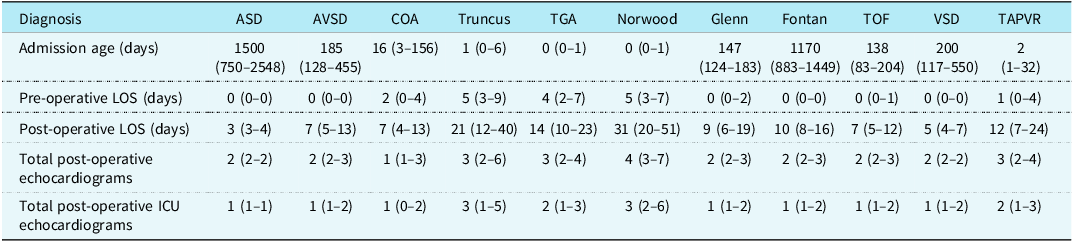
Post-operative length of stay and echocardiogram utilisation increased with increasing Risk Adjustment for Congenital Heart Surgery scores. Risk Adjustment for Congenital Heart Surgery score 1 encounters had the shortest median post-operative length of stay compared to Risk Adjustment for Congenital Heart Surgery score 6, which had the longest post-operative length of stay (3 days versus 31 days, p < 0.001). Risk Adjustment for Congenital Heart Surgery score 1 encounters also had the lowest post-operative echocardiogram utilisation compared to Risk Adjustment for Congenital Heart Surgery score 6 encounters, which had the highest (median 2 versus 4, p < 0.001) (Fig. 1). Echocardiogram utilisation for specific surgical repairs is shown in Table 2. Stage I single ventricle palliation (Norwood procedure) demonstrated the highest post-operative echocardiogram utilisation.
Total post-operative echocardiograms (a) and post-operative length of stay (b) based on Risk Adjustment for Congenital Heart Surgery-1 score. Bold horizontal line indicates median, borders of boxes indicate 25th/75th percentiles, and whiskers indicate minimum and maximum valves. Dashed line indicates the median value across all Risk Adjustment for Congenital Heart Surgery-1 score. RACHS = Risk Adjustment for Congenital Heart Surgery score.

Age of admission, pre- and post-operative lengths of stay, and post-operative echocardiograms for specific surgical repairs

ASD = atrial septal defect; AVSD = atrioventricular septal defect; COA = coarctation of the aorta; ICU = intensive care unit; LOS = length of stay; TAPVR = total anomalous pulmonary venous return; TGA = d–transposition of the great arteries; TOF = tetralogy of Fallot; VSD = ventricular septal defect.
Data reported as median (25th–75th percentile).
Most (65%) of the echocardiograms performed in the post-operative period occurred in the ICU setting for all Risk Adjustment for Congenital Heart Surgery scores. The number of ICU echocardiograms also increased with increasing Risk Adjustment for Congenital Heart Surgery score (1 versus 3 in Risk Adjustment for Congenital Heart Surgery score 1 versus 6, p < 0.001) (Supplemental Table 4).
When accounting for surgical complexity and correcting for post-operative hospital length of stay, there was significant variability in post-operative echocardiogram utilisation across Pediatric Health Information System centres (median daily echocardiogram utilisation range 0.2/day–0.6/day, p < 0.001) (Fig 2). There was no difference in the proportion of patients with high surgical complexity (Risk Adjustment for Congenital Heart Surgery ≥ 4) between centres with high versus low echocardiogram utilisation (p = 0.44).
Total daily post-operative echocardiogram utilisation by Pediatric Health Information System hospital centre, ranked 1–48. Centres displayed in ascending order based on increasing echocardiogram utilisation. Bold horizontal line indicates median, borders of boxes indicate 25th/75th percentiles, and whiskers indicate minimum and maximum valves. Dashed line indicates the median value across all Risk Adjustment for Congenital Heart Surgery-1 score.

Patients who required extracorporeal membrane oxygenation support were younger (mean age 366 days versus 718 days, p < 0.001) and had increased length of stay (46 days versus 15 days, p < 0.001). A greater number of echocardiograms were performed in those who required extracorporeal membrane oxygenation compared to those who did not (total 6.5 versus 2.6, p < 0.001 and ICU 5.3 versus 1.7, p < 0.001).
On multivariable modelling, differences in echocardiogram utilisation and length of stay are estimated to account for up to 62% of the total imaging costs for post-operative hospitalisations. When accounting for length of stay in a multivariable linear regression, each additional post-operative echocardiogram increased hospitalisation imaging costs by $1,739.
Discussion
This study provides previously unpublished benchmark data pertaining to the utilisation of echocardiography following repair of specific CHDs. Post-operative utilisation of echocardiography was higher among surgical encounters with higher Risk Adjustment for Congenital Heart Surgery scores. Surgical encounters with higher Risk Adjustment for Congenital Heart Surgery scores presumably have increased surgical complexity and risk for in-hospital mortality compared to lower Risk Adjustment for Congenital Heart Surgery scores. The added complexity and younger age at time of operation for Risk Adjustment for Congenital Heart Surgery scores 4–6 likely lead to longer hospital lengths of stay for management of accrued comorbidities associated with complex CHD repairs. Encounters with Risk Adjustment for Congenital Heart Surgery scores 1–3 also had shorter pre-operative length of stay possibly attributed to the fact that these patients were likely admitted from outpatient settings for elective surgical procedures. Across Risk Adjustment for Congenital Heart Surgery scores, roughly one post-operative echocardiogram was performed out of the ICU setting, which likely represents a pre-discharge study on the acute care unit. This fact further demonstrates that most of the echocardiogram utilisation in the post-operative period occurs in the ICU setting due to perioperative concerns with haemodynamic compromise or an attempt to identify residual structural disease following repair. This observation was also demonstrated by Arunamata et al. with a median of one transthoracic echocardiogram performed in the ICU setting, as well as one performed on the acute care floor. Reference Arunamata, Axelrod and Kipps6 They also were able to demonstrate that assessment of systolic ventricular function was the primary indication for 40% of the post-operative echocardiograms performed in the ICU.
Across the 48 hospital centres included in our Pediatric Health Information System dataset, there was significant variability amongst centres regarding echocardiogram utilisation determined by post-operative echocardiograms per post-operative length of stay. This practice variation could be attributable to variation in patient complexity or variation in post-operative management protocols that are adopted as standards of care at each member institution. Surgical encounters with Risk Adjustment for Congenital Heart Surgery score 5 had the fewest encounters included. This is likely due to the limited number of patients with truncus arteriosus with interrupted aortic arch in our cohort. This study was the first of its kind to compare echocardiography use across different centres using Risk Adjustment for Congenital Heart Surgery scores, allowing participating institutions to compare use of echocardiography to peer institutions.
Additionally, this study demonstrates an ongoing need to address resource utilisation in the care of patients with CHD, while optimising clinical outcomes. CHD is known to account for the most cost of any other birth defect. Reference Gerberding, Popović and Solomon9 There is significant variation between hospital centres in overall cost dedicated to the care of patients with CHD. Reference Pasquali, Thibault and Hall10 However, there is a significant need to identify areas that can be improved upon to maximise cost-effectiveness. As demonstrated by our study, there is significant variability among hospital centres in post-operative echocardiogram use, demonstrating a possible target for optimising cost and utilisation of resources by echocardiography laboratories. Our study demonstrates an increase in hospitalisation imaging costs for each additional echocardiogram ($1739) and roughly one additional echocardiogram for every 15 days in the hospital. Future studies could focus on quality metrics to assess if there can be an adjustment in utilisation of echocardiography and how many post-operative echocardiograms directly influence a medical or surgical management change, especially in patients with higher Risk Adjustment for Congenital Heart Surgery scores and longer hospital length of stay.
There are several limitations inherent to our study. Our study was retrospective and utilised the Pediatric Health Information System database with previously entered data from all member institutions. This dataset draws from large tertiary children’s hospitals in the United States and therefore likely provides a representative sample of congenital heart surgery programs nationwide. However, given that not all programs are included, these data may not be generalisable across all sites. The use of the database allows for inclusion of many surgical encounters for data collection but does not provide individual patient clinical context and does not allow for further interpretation of data beyond what was provided. It is for this reason that variation in echocardiogram utilisation and its effect on clinical outcomes cannot be fully addressed and there is also no way to ascertain if each echocardiogram obtained was clinically warranted. Additionally, utilising Risk Adjustment for Congenital Heart Surgery scores for separation of patients by surgical complexity and risk for in-hospital mortality also has its own limitations. For example, it is unable to consider numerous confounding variables, such as history of prematurity, weight at surgery, urgent repairs, and complications, which may be associated with longer post-operative lengths of stay. Reference Azhar and Aljefri11 Also, the Risk Adjustment for Congenital Heart Surgery scoring system may not allow for inclusion of complex surgical repairs with multiple separate cardiac lesions into one specific category. The inability of International Classification of Diseases codes to distinguish between superior and total cavopulmonary anastomosis is also a limitation of this analysis. An age cut-off of 2 years was chosen to identify Glenn and Fontan procedures but does not perfectly identify groups in the context of a relatively late Glenn or early Fontan procedure. We also did not account for alternate imaging modalities such as transesophageal echocardiography, cardiac MRI, and cardiac CT that may impact the utilisation of transthoracic echocardiography across centres. This represents an important area for future study.
Conclusion
Our study found a positive correlation between the total number of post-operative echocardiograms performed and post-operative length of stay with increasing surgical complexity as defined by the Risk Adjustment for Congenital Heart Surgery scoring system. There is significant variation in use of echocardiography across congenital heart surgery centres. These data can provide a benchmark for echocardiogram resource utilisation following congenital heart surgery. Further studies would need to be performed to determine the impact of overall echocardiogram utilisation on post-operative management in CHD patients.
Supplementary material
The supplementary material for this article can be found at https://doi.org/10.1017/S1047951123004407.
Acknowledgements
The data that support the findings of this study are available from The Pediatric Health Information System. Restrictions apply to the availability of these data, which were used under license for this study. Data are available from https://www.childrenshospitals.org/content/analytics/product-program/pediatric-health-information-system with the permission of The Pediatric Health Information System.
Financial support
This research received no specific grant from any funding agency, commercial, or not-for-profit sectors.
Competing interests
None.
Ethical standard
Approval for this project was obtained from the Vanderbilt University Medical Center Institutional Review Board and patient consent was waived as all information was de-identified and part of a database review. There is no material being reproduced from other sources. This is a database review and not a clinical trial.