1. Introduction
Currently prevailing theories of bilingual language processing propose that words from both of a bilingual's languages share common conceptual representations and that lexical access is non-selective, meaning that both languages are activated in parallel during language processing (Dijkstra & van Heuven, Reference Dijkstra and van Heuven2002; Green, Reference Green1998; van Heuven & Dijkstra, Reference van Heuven and Dijkstra2010). Evidence for this non-selective access comes from research demonstrating significant effects of the second language (L2) on processing in the first language (L1; see reviews in Brysbaert & Duyck, Reference Brysbaert and Duyck2010; Dijkstra & van Heuven, Reference Dijkstra and van Heuven2002; Kroll, Bobb & Wodniecka, Reference Kroll, Bobb and Wodniecka2006; Kroll, Dussias, Bogulski & Valdes Kroff, Reference Kroll, Dussias, Bogulski, Valdes Kroff and Ross2012). This evidence demonstrates that the non-target language can interfere with the target language during production or comprehension, even in completely monolingual contexts. Thus, bilinguals cannot completely ‘turn off’ one language: both are activated in parallel and can interact with each other, to the detriment, or advantage, of the bilingual language processing system.
The parallel activation of both languages in bilingual language processing necessitates executive control mechanisms in order to manage these cross-linguistic influences. Executive control is a key feature of the human cognitive system, referring to a variety of cognitive situations in which distracting information must be ignored, a specific response must be inhibited, or one must execute cognitive flexibility by switching between task goals. These processes require a number of cognitive functions including working memory, decision making, task maintenance, response selection and/or suppression, conflict detection/resolution, and inhibitory control. For example, task- and goal-switching paradigms assess cognitive control by indexing the ability to overcome the previous task goal. The flanker task (e.g., Bunge, Dudukovic, Thomason, Vaidya & Gabrieli, Reference Bunge, Dudukovic, Thomason, Vaidya and Gabrieli2002; Eriksen & Eriksen, Reference Eriksen and Eriksen1974; Luk, Anderson, Craik, Grady & Bialystok, Reference Luk, Anderson, Craik, Grady and Bialystok2010), which is utilized in the current study, presents directional arrows surrounded by other arrows that either point in the same direction (a congruent condition) or the opposite direction (an incongruent condition). Incongruent conditions generally elicit longer response times (RTs) than congruent or control trials. The difference in RTs between incongruent and congruent conditions (the flanker effect) or incongruent and control conditions (the interference effect) provides a measure of the ability to overcome cognitive conflict.
A number of brain areas are involved in executive control, mainly localized to the prefrontal and parietal cortices (see Nee, Wager & Jonides, Reference Nee, Wager and Jonides2007; Niendam, Laird, Ray, Dean, Glahn & Carter, Reference Niendam, Laird, Ray, Dean, Glahn and Carter2012 for meta-analyses). In particular, the anterior cingulate cortex (ACC) and dorsolateral prefrontal cortex (DLPFC) are involved in conflict detection and resolution (Botvinick, Braver, Botvinick et al, Reference Botvinick, Braver, Barch, Carter and Cohen2001; Botvinick, Cohen & Carter, Reference Botvinick, Cohen and Carter2004; Melcher & Gruber, Reference Melcher and Gruber2009; Peterson, Skudlarski, Gatenby, Zhang, Anderson & Gore, Reference Peterson, Skudlarski, Gatenby, Zhang, Anderson and Gore1999; Peterson, Kane, Alexander, Lacadie, Skudlarski, Leung, May & Gore, Reference Peterson, Kane, Alexander, Lacadie, Skudlarski, Leung and Gore2002; Roelofs, van Turennout & Coles, Reference Roelofs, van Turennout and Coles2006; van Veen & Carter, Reference van Veen and Carter2002); the ‘rostral cingulate zone’ (RCZ), located in the medial frontal cortex and including the ACC, is involved in performance monitoring and response conflict (Ridderinkhof, Ullsperger, Crone & Nieuwenhuis, Reference Ridderinkhof, Ullsperger, Crone and Nieuwenhuis2004); and the left inferior frontal gyrus (LIFG) is involved in suppression of irrelevant semantic information (Novick, Kan, Trueswell & Thompson-Schill, Reference Novick, Kan, Trueswell and Thompson-Schill2009; Novick, Trueswell & Thompson-Schill, Reference Novick, Trueswell and Thompson-Schill2005; Ye & Zhou, Reference Ye and Zhou2009). Subcortical structures like the caudate are also part of the domain-general cognitive control network (Abutalebi & Green, Reference Abutalebi and Green2007; Lehtonen, Laine, Niemi, Thomsen, Vorobyev & Hugdahl, Reference Lehtonen, Laine, Niemi, Thomsen, Vorobyev and Hugdahl2005; Niendam et al., Reference Niendam, Laird, Ray, Dean, Glahn and Carter2012).
Studies using functional magnetic resonance imaging (fMRI) have demonstrated that bilinguals recruit areas involved in executive control to manage cross-linguistic conflict arising from non-selective lexical access (Rodriguez-Fornells, van der Lugt, Rotte, Britti, Heinze & Münte, Reference Rodriguez-Fornells, van der Lugt, Rotte, Britti, Heinze and Münte2005; van Heuven, Schriefers, Dijkstra & Hagoort, Reference van Heuven, Schriefers, Dijkstra and Hagoort2008). For example, van Heuven et al. (Reference van Heuven, Schriefers, Dijkstra and Hagoort2008), using fMRI with a lexical decision task, found that even though the task was performed in a monolingual context, interlingual homographs (words that share the same spelling but have different meanings and pronunciations between languages) elicited enhanced blood-oxygen-level dependent (BOLD) signal in areas of the executive control network, suggesting that the parallel activation of both languages causes cognitive conflict in the bilingual brain. Bilinguals also recruit cognitive control when switching between their languages (see Hervais-Adelman, Moser-Mercer & Golestani, Reference Hervais-Adelman, Moser-Mercer and Golestani2011; Luk, Green, Abutalebi & Grady, Reference Luk, Green, Abutalebi and Grady2012; Rodriguez-Fornells, De Diego Balaguer & Münte, Reference Rodriguez-Fornells, De Diego Balaguer and Münte2006 for reviews). For example, bilinguals show enhanced BOLD signal in executive control areas during language switching, including the ACC, DLPFC, LIFG, left parietal lobe, and head of caudate (Abutalebi & Green, Reference Abutalebi and Green2008; Abutalebi, Brambati, Annoni, Moro, Cappa & Perani, Reference Abutalebi, Brambati, Annoni, Moro, Cappa and Perani2007; Bialystok, Craik, Green & Gollan, Reference Bialystok, Craik, Green and Gollan2009; Crinion, Turner, Grogan, Hanakawa, Noppeney, Devlin, Aso, Urayama, Fukuyama, Stockton, Usui, Green & Price, Reference Crinion, Turner, Grogan, Hanakawa, Noppeney, Devlin, Aso, Urayama, Fukuyama, Stockton, Usui, Green and Price2006; Guo, Liu, Misra & Kroll, Reference Guo, Liu, Misra and Kroll2011; Hernandez, Dapretto, Mazziotta & Bookheimer, Reference Hernandez, Dapretto, Mazziotta and Bookheimer2001; Hernandez, Reference Hernandez2009; Luk et al., Reference Luk, Green, Abutalebi and Grady2012; Price, Green & von Studnitz, Reference Price, Green and von Studnitz1999; Rodriguez-Fornells et al., Reference Rodriguez-Fornells, De Diego Balaguer and Münte2006; Wang, Kuhl, Chen & Dong, Reference Wang, Kuhl, Chen and Dong2009). This research indicates that bilinguals use domain-general (i.e., not specific to language) mechanisms of executive control, such as distractor suppression or inhibition of the non-target language, to manage cross-linguistic conflict during language processing.
1.1 Functional differences in bilingual executive control
Importantly, the areas recruited for bilingual language control (e.g., ACC, DLPFC, and LIFG) are also recruited by monolinguals for non-linguistic executive control. This use of language-non-specific executive control areas for language control suggests that the functional organization and overlap of the executive control and language networksFootnote 1 may be altered by bilingualism. For example, Hernandez (Reference Hernandez2009) has suggested that early bilinguals may develop different language networks from those of late bilinguals or monolinguals, specifically by assimilating areas of the executive control network. Thus in bilinguals, language and executive processing may become co-dependent and co-activated, leading to a fundamental restructuring of these neural networks.
This proposal is supported by evidence from fMRI and magnetoencephalography (MEG) studies demonstrating differences between monolinguals and bilinguals in the extent and location of task-related signal change during non-linguistic cognitive control tasks (Abutalebi, Della Rosa, Green, Hernandez, Scifo, Keim, Cappa & Costa, Reference Abutalebi, Della Rosa, Green, Hernandez, Scifo, Keim, Cappa and Costa2012; Bialystok, Craik, Grady, Chau, Ishii, Gunji & Pantev, Reference Bialystok, Craik, Grady, Chau, Ishii, Gunji and Pantev2005; Garbin, Sanjuan, Forn, Bustamante, Rodriguez-Pujadas, Belloch, Hernandez, Costa & Avila, Reference Garbin, Sanjuan, Forn, Bustamante, Rodriguez-Pujadas, Belloch, Hernandez, Costa and Avila2010; Luk et al., Reference Luk, Anderson, Craik, Grady and Bialystok2010). For example, in a non-verbal task-switching paradigm, Garbin et al. (Reference Garbin, Sanjuan, Forn, Bustamante, Rodriguez-Pujadas, Belloch, Hernandez, Costa and Avila2010) found that monolinguals recruited the right IFG, ACC, and left inferior parietal lobe, whereas bilinguals recruited only the LIFG. They proposed that the involvement of the LIFG, a typically language-related brain area, in non-linguistic control demonstrates an integration of linguistic and non-linguistic control that is unique to bilingualism. Bialystok et al. (Reference Bialystok, Craik, Grady, Chau, Ishii, Gunji and Pantev2005) reported MEG data demonstrating that better performance (faster RTs) on a Simon task correlated with greater signal change in cingulate and superior/inferior frontal regions in bilinguals, but with left middle frontal regions in monolinguals, suggesting different underlying executive control mechanisms. Using task-switching and flanker tasks, Abutalebi et al. (Reference Abutalebi, Della Rosa, Green, Hernandez, Scifo, Keim, Cappa and Costa2012) also reported functional differences between monolinguals and bilinguals: although both groups recruited the dorsal ACC for both tasks, bilinguals used this structure more efficiently than monolinguals, showing reduced BOLD signal change which correlated with better behavioral performance. Therefore bilinguals appear to use different functional networks from monolinguals for executive control tasks. Importantly, such differences have been found even in non-linguistic control tasks, suggesting an interdependence of executive control and language processing that confers functional differences in the organization and recruitment of these networks.
1.2 The functional overlap of executive control and language processing in bilinguals
As yet, there have been no attempts to localize the functional overlap of the bilingual language and executive control networks, yet doing so would provide valuable insight into the nature of the bilingual executive control and language systems. The current study attempted to identify differences between monolinguals and bilinguals in the brain region(s) or network(s) involved in language and both domain-general and linguistically-based executive control.
If the restructuring of bilingual cognitive control stems from the experience of bilingual language processing, and if it is domain-general and extends to non-linguistic executive function, then a brain area or network that is commonly recruited for language processing, linguistic cognitive control, and non-linguistic control should show greater overlap of functional recruitment for these domains in bilinguals compared to monolinguals. However, prior study designs have been unable to fully dissociate these distinctive aspects of cognitive processing. For example, previous investigations have focused on non-linguistic conflict only (e.g., Luk et al., Reference Luk, Anderson, Craik, Grady and Bialystok2010), or linguistic conflict only (e.g., Crinion et al., Reference Crinion, Turner, Grogan, Hanakawa, Noppeney, Devlin, Aso, Urayama, Fukuyama, Stockton, Usui, Green and Price2006; Hernandez, Reference Hernandez2009; van Heuven et al., Reference van Heuven, Schriefers, Dijkstra and Hagoort2008), or have omitted a language processing measure (e.g., Abutalebi et al., Reference Abutalebi, Della Rosa, Green, Hernandez, Scifo, Keim, Cappa and Costa2012; Garbin et al., Reference Garbin, Sanjuan, Forn, Bustamante, Rodriguez-Pujadas, Belloch, Hernandez, Costa and Avila2010). To date, Ye and Zhou (Reference Ye and Zhou2009) have performed the most comprehensive investigation of how these systems overlap by comparing language processing (comprehension of semantically plausible or implausible sentences), linguistic conflict (a Stroop task) and non-linguistic conflict (a flanker task) in Chinese monolinguals. Using a conjunction analysis, they reported that the language and both executive control tasks elicited common conflict-related signal change in the dorsal medial superior frontal gyrus, LIFG, and left inferior parietal lobe. They interpreted these results as indicating that domain-general executive control is recruited for language conflict in monolinguals. However, such a comparison of these three aspects of cognitive processing in bilinguals is lacking.
In a similar design as that used by Ye and Zhou (Reference Ye and Zhou2009), the current study tested monolinguals and bilinguals on separable conditions of linguistic cognitive control, non-linguistic cognitive control, and language processing. A conjunction analysis in each group identified brain regions that were similarly recruited by all three cognitive functions. A modified flanker task with linguistic and non-linguistic distractors was used to directly examine task-related regional similarities and differences for linguistic and non-linguistic executive control in monolinguals and bilinguals. We hypothesized that in both groups, regions of the a priori-defined executive control network would be recruited for control of both linguistic and non-linguistic distractors. In addition, we hypothesized that language processing, as defined by a semantic categorization task, would recruit left-lateralizedFootnote 2 fronto-temporal brain areas (e.g., fusiform gyrus, LIFG, angular gyrus: Binder, Frost, Hammeke, Cox, Rao & Prieto, Reference Binder, Frost, Hammeke, Cox, Rao and Prieto1997; Bokde, Tagamets, Friedman & Horwitz, Reference Bokde, Tagamets, Friedman and Horwitz2001; Braun, Guillemin, Hosey & Varga, Reference Braun, Guillemin, Hosey and Varga2001; Ferstl, Neumann, Bogler & Von Cramon, Reference Ferstl, Neumann, Bogler and Von Cramon2008; Gitelman, Nobre, Sonty, Parrish & Mesulam, Reference Gitelman, Nobre, Sonty, Parrish and Mesulam2005; McCandliss, Cohen & Dehaene, Reference McCandliss, Cohen and Dehaene2003; Richardson, Seghier, Leff, Thomas & Price, Reference Richardson, Seghier, Leff, Thomas and Price2011) in each group. Importantly, this language task was designed to tap into general language processing areas and was not specifically designed to elicit conflict, as in the semantic plausibility task of Ye and Zhou (Reference Ye and Zhou2009). Therefore if monolinguals also use domain-general cognitive control areas for basic language processing, the conjunction analysis should show overlapping functional activation in this group. However, as bilinguals experience a greater need for executive control on a daily basis due to the parallel activation of their two languages, the language and executive control networks may evolve together during bilingual development such that the common recruitment of these two networks is enhanced. Therefore we predict that the conjunction analysis should show a more extensive area of functional overlap between domain-general executive control and language processing in bilinguals than in monolinguals.
The language and executive control networks are extensive and their functions diverse, so bilingualism may consequently affect a widespread network of brain areas. Nevertheless, based on the previous literature of language and executive control, three specific a priori regions may be identified as the site of enhanced functional overlap in bilinguals: the ACC, caudate, and LIFG.
The anterior cingulate cortex
The ACC is a primary hub of the executive control network (Botvinick et al., Reference Botvinick, Braver, Barch, Carter and Cohen2001, Reference Botvinick, Cohen and Carter2004; Roelofs et al., Reference Roelofs, van Turennout and Coles2006; van Veen & Carter, Reference van Veen and Carter2002); its involvement in conflict processing is unequivocal. Although not typically involved in monolingual language processing (e.g., Gitelman et al., Reference Gitelman, Nobre, Sonty, Parrish and Mesulam2005), ACC signal change has been reported for bilingual language control during switching and translation (Abutalebi et al., Reference Abutalebi, Brambati, Annoni, Moro, Cappa and Perani2007; Guo et al., Reference Guo, Liu, Misra and Kroll2011; Price et al., Reference Price, Green and von Studnitz1999) and for cross-linguistic conflict resolution in bilingual production and comprehension (Rodriguez-Fornells et al., Reference Rodriguez-Fornells, van der Lugt, Rotte, Britti, Heinze and Münte2005; van Heuven et al., Reference van Heuven, Schriefers, Dijkstra and Hagoort2008). To illustrate, Abutalebi et al. (Reference Abutalebi, Della Rosa, Green, Hernandez, Scifo, Keim, Cappa and Costa2012) reported a bilingual advantage on flanker and task-switching paradigms compared to monolinguals; furthermore, bilingual performance correlated with increased grey matter density in the dorsal ACC, indicating a more efficient use of this structure by bilinguals. The ACC is thus involved in both bilingual language control and domain-general executive processing, although its participation in more basic language processing is questionable.
Note that the DLPFC is not explicitly predicted to be a site of overlap in executive control and language processing. The ACC and DLPFC are often activated by similar executive control tasks (e.g., MacDonald, Cohen, Stenger & Carter, Reference MacDonald, Cohen, Stenger and Carter2000), and both have been found in tasks of bilingual switching (e.g., de Bruin, Roelofs, Dijkstra & Fitzpatrick, Reference De Bruin, Roelofs, Dijkstra and Fitzpatrick2014; Rodríguez-Pujadas, Sanjuán, Ventura-Campos, Román, Martin, Barceló, Costa & Avila, Reference Rodríguez-Pujadas, Sanjuán, Ventura-Campos, Román, Martin, Barceló, Costa and Avila2013), although neither is generally activated by language processing tasks. Based on the previous work by Abutalebi et al. (Reference Abutalebi, Della Rosa, Green, Hernandez, Scifo, Keim, Cappa and Costa2012), the ACC is included as an a priori region; however, that study makes no mention of the DLPFC. Therefore we do not explicitly expect DLPFC activation in our conjunction analyses, although it is possible that this region might be co-activated with the ACC.
The caudate nucleus
The caudate nucleus is a central structure for language control, involved not only in bilingual translation and language switching (Abutalebi et al., Reference Abutalebi, Brambati, Annoni, Moro, Cappa and Perani2007; Crinion et al., Reference Crinion, Turner, Grogan, Hanakawa, Noppeney, Devlin, Aso, Urayama, Fukuyama, Stockton, Usui, Green and Price2006; Luk et al., Reference Luk, Green, Abutalebi and Grady2012; Price et al., Reference Price, Green and von Studnitz1999; Wang et al., Reference Wang, Kuhl, Chen and Dong2009; van Heuven et al., Reference van Heuven, Schriefers, Dijkstra and Hagoort2008) but also in monolingual linguistic conflict (Ali, Green, Kherif, Devlin & Price, Reference Ali, Green, Kherif, Devlin and Price2010; Crosson, Benefield, Cato, Sadek, Moore, Wierenga, Gopinath, Soltysik, Bauer, Auerbach, Gökçay, Leonard & Briggs, Reference Crosson, Benefield, Cato, Sadek, Moore, Wierenga, Gopinath, Soltysik, Bauer, Auerbach, Gökçay, Leonard and Briggs2003; Mestres-Missé, Turner & Friederici, Reference Mestres-Missé, Turner and Friederici2012; Niendam et al., Reference Niendam, Laird, Ray, Dean, Glahn and Carter2012; Vargha-Khadem, Watkins, Price, Ashburner, Alcock, Connelly, Frackowiak, Friston, Pembrey, Mishkin, Gadian & Passingham, Reference Vargha-Khadem, Watkins, Price, Ashburner, Alcock, Connelly, Frackowiak, Friston, Pembrey, Mishkin, Gadian and Passingham1998; Watkins, Vargha-Khadem, Ashburner, Passingham, Connelly, Friston, Frackowiak, Mishkin & Gadian, Reference Watkins, Vargha-Khadem, Ashburner, Passingham, Connelly, Friston, Frackowiak, Mishkin and Gadian2002). For example, Crosson et al. (Reference Crosson, Benefield, Cato, Sadek, Moore, Wierenga, Gopinath, Soltysik, Bauer, Auerbach, Gökçay, Leonard and Briggs2003), in a language production paradigm in monolinguals, found that the right basal ganglia, including the caudate and putamen, were involved in suppressing other structures that might interfere with language processing. Mestres-Missé et al. (Reference Mestres-Missé, Turner and Friederici2012) demonstrated that grammatical language conflict elicited caudate signal change that varied with the difficulty of processing. The caudate is also implicated in non-linguistic interference control (Bialystok et al., Reference Bialystok, Craik, Green and Gollan2009; Niendam et al., Reference Niendam, Laird, Ray, Dean, Glahn and Carter2012), specifically in inhibiting a prepotent response (Li, Yan, Sinha & Lee, Reference Li, Yan, Sinha and Lee2008; Shadmehr & Holcomb, Reference Shadmehr and Holcomb1999). This structure's involvement in language control and domain-general executive processing thus makes it a likely candidate as a site of functional overlap of these processes in bilinguals.
The left inferior frontal gyrus
The LIFG is typically interpreted as a language processing area given its reliable recruitment in language tasks (Bokde et al., Reference Bokde, Tagamets, Friedman and Horwitz2001; Fiebach, Friederici, Müller & von Cramon, Reference Fiebach, Friederici, Müller and von Cramon2002; Gitelman et al., Reference Gitelman, Nobre, Sonty, Parrish and Mesulam2005; Horwitz, Amunts, Bhattacharyya, Patkin, Jeffries, Zilles & Braun, Reference Horwitz, Amunts, Bhattacharyya, Patkin, Jeffries, Zilles and Braun2003). This area is also commonly involved in bilingual language control (Hernandez, Martinez & Kohnert, Reference Hernandez, Martinez and Kohnert2000; Lehtonen et al., Reference Lehtonen, Laine, Niemi, Thomsen, Vorobyev and Hugdahl2005; Luk et al., Reference Luk, Green, Abutalebi and Grady2012; van Heuven et al., Reference van Heuven, Schriefers, Dijkstra and Hagoort2008): it shows stronger signal change in bilinguals when reading complex sentences (Kovelman, Baker & Petitto, Reference Kovelman, Baker and Petitto2008a) and during the processing of a weaker L2 (De Bleser, Dupont, Postler, Bormans, Speelman, Mortelmans & Debrock, Reference De Bleser, Dupont, Postler, Bormans, Speelman, Mortelmans and Debrock2003; Indefrey, Reference Indefrey2006; Kim, Relkin, Lee & Hirsch, Reference Kim, Relkin, Lee and Hirsch1997; Kovelman et al., Reference Kovelman, Baker and Petitto2008a; Kovelman, Shalinsky, Berens & Petitto, Reference Kovelman, Shalinsky, Berens and Petitto2008b; Marian, Spivey & Hirsch, Reference Marian, Spivey and Hirsch2003; Parker Jones, Green, Grogan, Pliatsikas, Filippopolitis, Ali, Lee, Ramsden, Gazarian, Prejawa, Seghier & Price, Reference Parker Jones, Green, Grogan, Pliatsikas, Filippopolitis, Ali, Lee, Ramsden, Gazarian, Prejawa, Seghier and Price2011; Perani, Abutalebi, Paulesu, Brambati, Scifo, Cappa & Fazio, Reference Perani, Abutalebi, Paulesu, Brambati, Scifo, Cappa and Fazio2003). The LIFG is also involved in domain-general cognitive control: it is recruited in monolinguals not just by linguistic conflict, such as during complex sentence parsing or a Stroop task (Kovelman et al., Reference Kovelman, Baker and Petitto2008a; Novick et al., Reference Novick, Trueswell and Thompson-Schill2005; Ye & Zhou, Reference Ye and Zhou2009), but also by non-linguistic cognitive control (Bunge et al., Reference Bunge, Dudukovic, Thomason, Vaidya and Gabrieli2002; Garbin et al., Reference Garbin, Sanjuan, Forn, Bustamante, Rodriguez-Pujadas, Belloch, Hernandez, Costa and Avila2010; Ye & Zhou, Reference Ye and Zhou2009). For example, Bunge et al. (Reference Bunge, Dudukovic, Thomason, Vaidya and Gabrieli2002) found that LIFG signal change was correlated with behavioral performance during interference suppression and response inhibition in a flanker task. Ye and Zhou (Reference Ye and Zhou2009) reported the LIFG as a site of functional overlap in a conjunction analysis of sentence processing, linguistic conflict processing in a Stroop task, and non-linguistic conflict processing in a flanker task. Overall, the LIFG is thought to be part of the cognitive control network, specifically involved in overriding automatic processes, resolving semantic conflict, and controlling interference from irrelevant information (Thompson-Schill, Bedny & Goldberg, Reference Thompson-Schill, Bedny and Goldberg2005; Ye & Zhou, Reference Ye and Zhou2009). Therefore the LIFG's involvement in language processing and domain-general executive control, in both monolinguals and bilinguals, makes it also a likely candidate for the site of functional overlap in bilinguals.
In sum, the current study predicted that the functional overlap between regions recruited for cognitive control and those recruited for language, as assessed by a conjunction between linguistic executive control, non-linguistic executive control, and language processing, would be larger for bilinguals than for monolinguals. If bilingualism creates a functional overlap and interdependence between domain-general cognitive control and language processing, the bilingual conjunction was expected to show more extensive activation than the monolingual conjunction in the caudate, ACC, and/or LIFG.
2. Methods
2.1 Participants
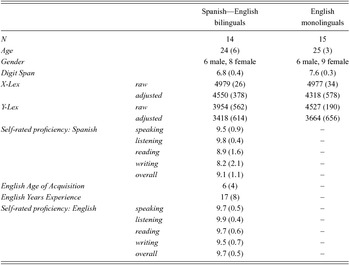
Participants were recruited from the National Institutes of Health (NIH) community in Bethesda, MD and the University of Maryland community in College Park, MD. All participants were right-handed, with no history of neurological disorder or color-blindness and normal or corrected-to-normal vision. The monolingual participants were 15 native English speakers (6 males, 9 females) with a mean age of 24 years (full demographics presented in Table 1). Some (n = 12) had learned other languages, but none considered themselves fluent in anything but English. The bilingual participants were 14 native Spanish speakers (6 males, 8 females) with a mean age of 24 years. The groups did not differ significantly on age (p = 0.98). All bilingual participants had learned Spanish before English or both simultaneously (mean English age of acquisition = 6 years), and were highly proficient in both languages (average subjective Spanish proficiency = 9.1 on a 10-point scale; average English proficiency = 9.7). There was some evidence for higher proficiency in English than Spanish (p = 0.07), which may be expected as these participants were all living in the USA. Participants also completed two vocabulary tests estimating high-frequency (1K-5K: X-Lex: Meara, Reference Meara2005) and low-frequency (5K-10K: Y-Lex: Meara & Miralpeix, Reference Meara and Miralpeix2006) word knowledge in English. Monolinguals scored higher than bilinguals on the Y-Lex raw score (monolinguals: M = 4527, SD = 190; bilinguals: M = 3954, SD = 562; t(16.6) = 3.57, p < 0.01). No other differences in vocabulary were observed (all p's > 0.24; see Table 1). All participants also performed a digit span task to assess working memory (see section 2.3). Monolinguals had a slightly higher digit span score than bilinguals (p = 0.09).
Demographic and proficiency information (standard deviations in parentheses) for the bilingual and monolingual participants. Digit span score is out of a maximum span length of 9. X-Lex and Y-Lex vocabulary test scores range from 0–5000 in 100-point increments; the adjusted score accounts for false alarms.

2.2 Materials and Design
Flanker task
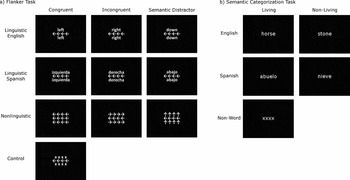
To assess linguistic and non-linguistic cognitive control, an adapted flanker task was created with a target stimulus row of arrows pointing either left or right, to which the participant always responded (Figure 1a). Above and below the central arrows were either rows of congruently- or incongruently-pointing arrows (non-linguistic distractors), or directional words (linguistic distractors, e.g., ‘left’ or ‘right’). In English linguistic conditions, the distractor words consisted of the directional words ‘left’ or ‘right’. In Spanish linguistic conditions (bilinguals only), the directional distractor words were ‘izquierda’ (left) and ‘derecha’ (right). An additional ‘semantic distractor’ condition was also included in the design, consisting of arrows pointing up or down, for non-linguistic distractors, or the words ‘up’ or ‘down’ (for English), or ‘arriba’ or ‘abajo’ (for Spanish), for linguistic distractors. As these distractors were semantically related to the target but not a possible response option, this condition provided a mediation of conflict effects. Finally, the control condition consisted of flanking rows of x's (‘xxxx’), containing no linguistic or semantic information. The target line of arrows was always presented in the center of the screen, with the distractor stimuli presented on two lines above and below. Therefore all conditions maintained the same cognitive task (responding to arrows) and the same visual extent of the stimuli, such that only the nature of the distractor (linguistic or non-linguistic) changed between trials. All stimuli were presented in Courier New font size 36, in white ink on a black background.
Example stimuli for the a) flanker and b) semantic categorization task.

Semantic categorization task
Language processing was assessed via a semantic categorization task requiring the categorization of nouns as either ‘living’ or ‘non-living’. A non-word stimulus (‘xxxx’) was also included, to which participants also performed a motor response. This task was designed such that the word > non-word contrast would eliminate extraneous brain activation associated with lower-level perceptual and motor processes, allowing for a localization of language in the brain. Bilinguals performed this task in both of their languages, although languages were combined for the conjunction analyses.
Semantic categorization stimuli consisted of nouns that were classifiable as living or non-living, such as ‘father’ and ‘book’ (see Figure 1b). An equal number of living and non-living words were included in each run. All words were between 3–7 letters long (average of 5) and were matched across languages and categories on their length and frequency (frequency measures were obtained from SUBTLEX-US and SUBTLEX-Esp; Brysbaert & New, Reference Brysbaert and New2009; Cuetos, Glez-Nosti, Barbón & Brysbaert, Reference Cuetos, Glez-Nosti, Barbón and Brysbaert2011; average frequency over both categories: 3.35 in English, 3.36 in Spanish). Cognates between languages were excluded. Non-word conditions consisted of a row of x's (‘xxxx’), to match the visual stimulation of the words. As in the flanker task, stimuli were presented in white Courier New font, size 36, on a black background.
2.3 Procedure
The study was performed at the NIH and approved by the NIH Institutional Review Board. All subjects gave informed written consent according to the ethics guidelines of the NIH. Prior to the fMRI scanning session, participants practiced the experimental paradigms and performed an adapted version of the forward digit span taskFootnote 3 (e.g., Conklin, Curtis, Katsanis & Iacono, Reference Conklin, Curtis, Katsanis and Iacono2000) to assess working memory capacity. fMRI scanning lasted approximately 1 hour for monolinguals and 1.5 hours for bilinguals, including set-up, structural image acquisition, and experimental testing. Experimental stimuli were administered using Presentation software (Neurobehavioral Systems, Inc., Albany, California, USA). The experimental session for monolinguals consisted of three runs of the flanker task and two runs of the semantic categorization task. The experimental session for bilinguals consisted of four runs of the flanker task and four of the semantic categorization task (two in each language for each task). Task order (flanker/semantic categorization) was counterbalanced between participants, and language order (Spanish/English) was counterbalanced between bilinguals. Within each task block, conditions were presented in an event-related fashion. A resting-state fMRI scan (approximately 5 minutes) was also performed at the end of the scanning session for all subjects. Subjects were monetarily compensated for their participation.
Flanker task
Each run of the flanker task in monolinguals lasted 3.5 minutes, and consisted of 90 trials (12 each of the seven congruencies presented in Figure 1a), giving a total of 36 trials of each type across the three experimental runs. In bilinguals, each run of the flanker task lasted 4 minutes and consisted of 96 trials total (18 each of linguistic congruent, incongruent and semantic control, and 9 each of non-linguistic congruent, incongruent, semantic distractor, and control), giving a total of 36 of each type across the four experimental runs (36 of each language for linguistic conditions). There were also 6 null-event trials in each block for all participants. On half of the null-event trials a blue square appeared in the periphery of the fixation cross (‘attentional null-event trials’), to which subjects were instructed to respond with a button-press. This was included to ensure that participants attended to the entire visual field, rather than fixating on the location of the target arrows. All participants successfully responded to these stimuli.
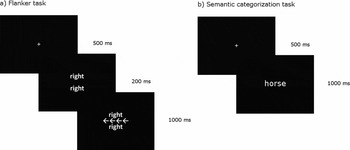
In each trial, a bold fixation cross was presented for 500 ms (Figure 2a). The distractor stimulus (word or arrow) then appeared for 200 ms before the target stimulus (left or right arrows) appeared in the center of the screen. This distractor pre-exposure was included to increase interference: pilot testing established that simultaneous presentation of the word and arrow did not allow for sufficient semantic processing of the word. This word pre-exposure was included to increase interference from the linguistic distracters (e.g., Coderre, van Heuven & Conklin, Reference Coderre, van Heuven and Conklin2013). The same timing was used in the non-linguistic conditions, as pilot testing established that pre-exposure also increased interference on these trials. After target presentation, both target and distractor stimuli remained on the screen for 1000 ms. Participants indicated the directionality of the center row of arrows with their left and right index fingers using an MRI-compatible button-box. In null-event trials, a non-bold fixation cross remained on the screen for 1200 ms. In attentional null-event trials, a blue square appeared in one of the four corners of the target periphery for 200 ms, followed by the non-bold fixation cross for 100 ms. An ISI fixation screen with a non-bold fixation cross followed each trial, varying from 1500–2900 ms in 200-ms intervals (average 2200 ms). Trial order was pseudo-randomly presented to optimize list efficiency, such that trial types were followed equally often by null-event trials and the same trial type did not occur more than 3 times in a row throughout a block.
Example trial timing for the a) flanker and b) semantic categorization task. Duration of each stimulus is indicated on the right.

Semantic categorization task
For both groups, each run of the semantic categorization task lasted 3 minutes 20 seconds and consisted of 82 trials (36 words (consisting of 18 ‘living’ and 18 ‘non-living’ words), 36 non-words, and 10 null-event trials). Monolinguals completed two runs, performing 144 trials total (72 words, 72 non-words); bilinguals completed four runs (two in each language), performing 288 trials total (144 per language, 72 words and 72 non-words per language).
In each trial, a bold fixation cross was presented for 500 ms (Figure 2b), followed by the word/non-word stimulus (no SOA was included, as only one stimulus was presented). On word trials, participants categorized the words as ‘living’ or ‘non-living’ by pressing the button-box with the left (living) or right (non-living) index finger. On non-word conditions, participants were instructed to press either the left or right index finger. In null-event trials, a non-bold fixation cross was presented for 750 ms. An ISI fixation screen with a non-bold fixation cross followed each trial, varying from 1500–3000 ms in 200-ms intervals (average 2200 ms). Trial order was again pseudo-randomized to optimize list efficiency.
2.4 fMRI scan procedure and pre-processing
Structural and functional MRI scans were acquired using a Siemens Skyra 3.0 Tesla scanner at the NIH Magnetic Resonance Imaging Research Facility. A sagittal T1-weighted volumetric sequence (TR 7600 ms, TE 2.3 ms, flip angle 8 degrees, NSA 1.0, FOV 256 mm, 256 × 256 matrix, 1.0 mm slice thickness, no gap, 184 slices) was acquired as a structural reference scan. Approximation of field inhomogeneities was obtained using a GRE field mapping sequence (short TE = 4.92, long TE = 7.38). fMRI was performed using EpiBOLD (echoplanar blood oxygenation level dependent) imaging. For the fMRI sequences, a gradient-echo echoplanar pulse sequence was used (TR 1600 ms, TE 28 ms, flip angle 90 degrees, GRAPPA acceleration factor of 2, resolution 3.3 × 3.3 × 3.5 mm, 30 slices of 3.5 mm thickness with no gap, FOV 210 mm, matrix size 64 × 64).
Pre-processing and data analyses were performed using SPM8 (Wellcome Department of Cognitive Neurology; the FIL methods group, “Statistical Parametrical Mapping”, http://www.fil.ion.ucl.ac.uk/spm/). The first four scans from each functional run were removed from the data files. Field mapping was performed using the FieldMap SPM toolbox (Hutton, Bork, Josephs, Deichmann, Ashburner & Turner, Reference Hutton, Bork, Josephs, Deichmann, Ashburner and Turner2002), which provided a template for subsequent registration. Slice timing correction was performed to account for timing differences due to interleaved slice acquisition. For each subject, functional images were spatially realigned to the first volume of the first run to account for motion during the scan, using the template output from the FieldMap procedure. The anatomical scan was then co-registered to a mean EPI image of the realigned functional scans. The original anatomical scan was segmented using DARTEL (Ashburner, Reference Ashburner2007) into grey matter, white matter, and cerebro-spinal fluid to create a template of transformation parameters for normalizing the anatomical image to an MNI template brain. Functional and structural images were then normalized using these parameters. The normalized functional images were spatially smoothed using a 10 mm FWHM isotropic Gaussian kernel.
2.5 fMRI analyses
Vectors of stimuli onsets were created for each trial type; onsets were defined by the time of first stimulus presentation (i.e., the distractor, in the flanker task)Footnote 4 . Each task (flanker and semantic categorization) was modeled separately at the first level, including all of the runs (i.e., both English and Spanish runs in bilinguals). Behavioral errors and outliers were included as additional vectors in the model specification, as were the two null-event conditions. Six realignment parameters from the realignment step of pre-processing were included in each design matrix as covariates, as well as two autoregressive parameters for each motion direction, a displacement parameter, and the hyperbolic tangent of the displacement parameter (Power, Barnes, Snyder, Schlaggar & Petersen, Reference Power, Barnes, Snyder, Schlaggar and Petersen2012). The stimuli onset vectors were convolved using a canonical HRF plus the temporal derivative. Statistical analyses based on general linear modeling (GLM) were performed by multiple linear regression of the signal time course in each voxel. Digit span was included as a covariate in all second-level analyses to account for baseline differences in working memory capacity (see section 2.1). Significant regions were labeled using the SPM Anatomy Toolbox (Eickhoff, Stephan, Mohlberg, Grefkes, Fink, Amunts & Zilles, Reference Eickhoff, Stephan, Mohlberg, Grefkes, Fink, Amunts and Zilles2005) and the Talairach Client (Lancaster, Rainey, Summerlin, Freitas, Fox, Evans, Toga & Mazziotta, Reference Lancaster, Rainey, Summerlin, Freitas, Fox, Evans, Toga and Mazziotta1997; Lancaster, Woldorff, Parsons, Liotti, Freitas, Rainey, Kochunov, Nickerson, Mikiten & Fox, Reference Lancaster, Woldorff, Parsons, Liotti, Freitas, Rainey, Kochunov, Nickerson, Mikiten and Fox2000). All contrasts were cluster-corrected at FDR p < 0.05.
3. Results
3.1 Flanker task: behavioral data
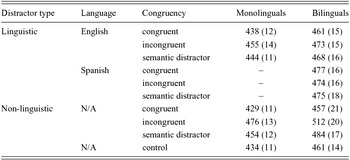
Incorrect responses (monolinguals 2.3%, bilinguals 1.7%) and outliers (RTs of less than 200 or greater than 1000 ms; monolinguals 0.4%, bilinguals 0.8%) were removed before analyses. As error rates were very low, error analyses were not conducted. Mean RTs for both groups are presented in Table 2.
Mean RTs, with standard errors in parentheses, for each group and condition.

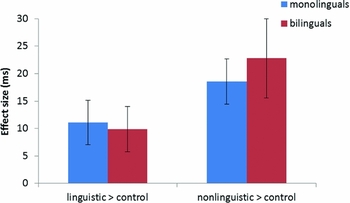
To investigate executive control processing for linguistic and non-linguistic stimuli, the magnitude of the linguistic and non-linguistic distractor effects (average of congruent, incongruent, and semantic distractor RTs minus control RTs) were computed for each group. A paired-sample t-test revealed no difference between English and Spanish distractor effects for bilinguals (p = 0.21), therefore the data from both languages were combined for this group.
The distractor effect magnitudes were entered into a 2 (distractor type: linguistic/non-linguistic) x 2 (group: monolingual/bilingual) ANCOVA with digit span as a covariate. The results are presented in Figure 3. There was a main effect of distractor type (F(1,53) = 4.32, p < 0.05) such that, collapsed over group, distractor effects were larger for non-linguistic distractors (M = 20.6, SE = 4.0) than for linguistic distractors (M = 10.5, SE = 2.8). There was no main effect of group and no interaction between group and distractor type (all F's < 1), indicating no difference in the distractor effects between monolinguals and bilinguals.
Behavioral distractor effect magnitudes in each group (collapsed over language for bilinguals) comparing linguistic and non-linguistic distractors (collapsed over congruent, incongruent, and semantic distractor) to control. Error bars show standard error.

3.2 Flanker task: fMRI data
To assess global effects of distractor type, the data were collapsed over congruency (incongruent, congruent, and semantic distractor): this identified areas involved in ignoring distracting linguistic or non-linguistic information, regardless of the presence of conflict. An initial paired t-test between English and Spanish linguistic distractors in bilinguals revealed no significant regions of activation that survived thresholding at a cluster-level FDR correction of p < 0.05, therefore data were collapsed over the two languages for the bilingual flanker task. The first-level contrasts for linguistic (incongruent, congruent, and semantic linguistic distractors) > control (collapsed over languages for bilinguals) and non-linguistic (incongruent, congruent, and semantic non-linguistic distractors) > control were entered into a second-level full factorial ANOVA with the factors of group (monolingual/bilingual) and distractor type (linguistic/non-linguistic). Digit span was included as a covariate.
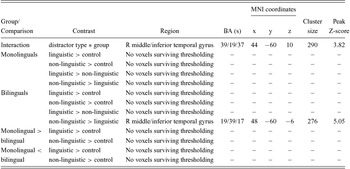
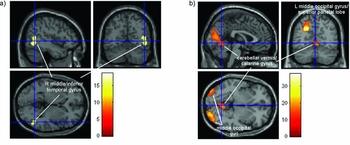
The F-contrast showed an interaction of group and distractor type in the right middle/inferior temporal gyrus (BA 39/19/37; Table 3, Figure 4a). We investigated this interaction effect with post-hoc simple effect comparisons using t-contrasts of distractor type across groups and of groups across distractor type (Table 3). Four t-contrasts were performed within each group: linguistic > control, non-linguistic > control, linguistic > non-linguistic, and non-linguistic > linguistic. Between-group comparisons were done for the linguistic > control and non-linguistic > control contrasts. All post-hoc comparisons were masked with the interaction F-contrast.
Flanker task results of the 2 (distractor type: linguistic > control, non-linguistic > control) x 2 (group) ANOVA, cluster-corrected at FDR p < 0.05. Results of post-hoc tests on regions significant in the interaction are also reported.

a) Results of the flanker task interaction of group * distractor type, crosshairs at [46 −60 0], showing the cluster in the right middle/inferior temporal gyrus. b) Results of the semantic categorization task interaction of group * stimulus type, crosshairs at [−4 −62 −4], with the clusters labeled.

In monolinguals, there were no significant areas of activation for any post-hoc test. However, in bilinguals, non-linguistic distractor conditions showed greater signal change than linguistic conditions in the right middle/inferior temporal gyrus (BA 19/39/37).
3.3 Semantic categorization task: fMRI data
Living and non-living word conditions were combined for the semantic categorization task, as the effect of interest was the neural areas activated by semantic retrieval, regardless of the result of the semantic decision. For bilinguals, an initial paired t-test between English word > non-word and Spanish word > non-word contrasts revealed no regions of significantly different BOLD change at a cluster-corrected FDR of p < 0.05, therefore all subsequent analyses were collapsed over language. The first-level contrasts for word > null (collapsed over languages for bilinguals) and non-word > null were entered into a second-level full factorial ANOVA with the factors of group (monolingual/bilingual) and stimulus type (word/non-word). Digit span was included as a covariate.
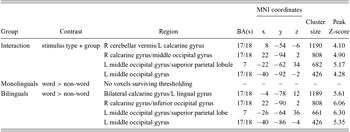
The F-contrast showed interactions of group and stimulus type in the bilateral middle occipital gyri (BAs 17/18), and the left superior parietal lobe (BA 7; Table 4; Figure 4b). We investigated the interaction effect with post-hoc simple effect comparisons using t-contrasts of stimulus type across groups (Table 4). Within each group, the t-contrast of word > non-word was performed. All post-hoc comparisons were masked with the interaction F-contrast.
Semantic categorization results of the 2 (stimulus type: word, non-word) x 2 (group) ANOVA, cluster-corrected at FDR p < 0.05. Results of post-hoc tests on regions significant in the interaction are also reported.

In monolinguals, there were no significant regions of activation. In bilinguals, the word > non-word contrast showed activation in the middle occipital gyri (BAs 17/18) and the superior parietal lobe (BA 7).
3.4 Conjunction analyses
The current study aimed to identify how bilinguals differentially recruit the executive control and language networks compared to monolinguals. This was investigated with conjunction analyses. To investigate areas that were commonly recruited by linguistic control, non-linguistic control, and language processing, respectively, the corresponding first-level contrasts of: 1) linguistic > control; 2) non-linguistic > control; and 3) word > non-word were entered into a second-level three-way (task: linguistic flanker, non-linguistic flanker, semantic categorization) ANOVA. A conjunction of the three contrasts was then performed with all three main effects, and corrected using a voxel-level FDR correction at p < 0.05. Conjunctions were performed separately for each group. Digit span was again included as a covariate.
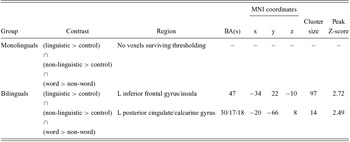
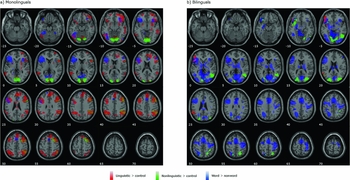
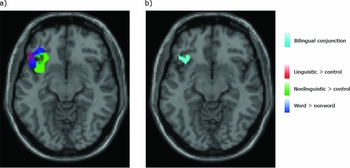
In monolinguals, the conjunction analysis did not show any clusters surviving thresholding (Table 5, Figure 5a). However, in the bilinguals, the conjunction analysis showed a significant cluster in the LIFG (BA 47; Figures 5b and 6), specifically the pars orbitalis, as well as a smaller cluster in the left posterior cingulate/calcarine gyrus (BA 30/17/18).Footnote 5
Conjunctions for each group between the linguistic > control, non-linguistic > control, and word > non-word contrasts, voxel-level corrected at FDR p < 0.05 with a cluster extent of 10 voxels.

Overlaid conjunctions of the linguistic > control, non-linguistic > control, and word > non-word contrasts, voxel-level corrected at FDR p < 0.05, for a) monolinguals and b) bilinguals (collapsed over language). Axial slices are shown from z = −25 to z = 70. In neurological convention, the left hemisphere is presented on the left.

a) Focus on the LIFG in the bilingual conjunction (using an ROI mask of 10 mm around the statistical peak at −34, 22, −10), at z = −10. Regions of overlap between the linguistic control, non-linguistic control, and language processing tasks (collapsed over languages) are indicated by blended colors. b) Conjunction of all three contrasts (collapsed over languages) for bilinguals, at z = −10, showing overlap in the LIFG.

4. Discussion
The current study sought to identify how the functional overlap of the executive control and language networks differs between monolinguals and bilinguals. If the recruitment of executive control during bilingual language processing leads to an integration of these two systems, a specific region or network that is involved in both should be enhanced in bilinguals. To investigate this, linguistic and non-linguistic cognitive control and language processing were compared between and within groups and were contrasted using a conjunction analysis. Each domain is addressed in turn.
4.1 Executive control in monolinguals and bilinguals
To examine executive control processing that is not specific to the presence of conflict, the current behavioral and fMRI analyses collapsed over congruencies in the flanker task to investigate more global differences in how bilinguals and monolinguals handle distracting information when it is linguistic versus non-linguistic. Behaviorally, both groups showed greater distractor effects (distractor compared to control condition) for non-linguistic than linguistic distractor conditions. This could be due to the temporal limitations of semantic access: word reading is a slower process than responding to arrows, so the linguistic distractors may have been too slow to cause strong interference in RTs. Alternatively, ignoring printed words may be a more familiar procedure than ignoring arrows. For example, although the eye fixates on one word when reading, peripherally-visible words must be ignored to avoid distraction and comprehension errors. The distractor words appeared above and below the target stimuli in this paradigm, which may have created a situation similar to reading. If ignoring printed words is a more practiced ability, this could have reduced the influence of linguistic distractors and created smaller effects.
In the fMRI data, there was a significant interaction of group and distractor type in a cluster located in the right temporal gyrus. Post-hoc tests identified that this cluster showed greater signal change for non-linguistic than linguistic distractors, in bilinguals only. The fact that signal change in this area was greater for non-linguistic stimuli may suggest that bilinguals are more efficient at managing distracting information from linguistic stimuli. Activation in the middle temporal gyrus has been previously reported in flanker tasks (Bunge et al., Reference Bunge, Dudukovic, Thomason, Vaidya and Gabrieli2002) in association with interference suppression. Fan, McCandliss, Fossella, Flombaum & Posner (Reference Fan, McCandliss, Fossella, Flombaum and Posner2005) also reported activation in the temporo-parietal junction (BA 39) in association with orienting effects in an ANT task. The middle temporal gyrus also lies close to the right inferior parietal lobe, a region which is involved in attentional control, particularly towards task-relevant targets (Corbetta, Miezin, Shulman & Petersen, Reference Corbetta, Miezin, Shulman and Petersen1993; Culham & Kanwisher, Reference Culham and Kanwisher2001; Milham, Banich & Barad, Reference Milham, Banich and Barad2003; Rushworth, Ellison & Walsh, Reference Rushworth, Ellison and Walsh2001). This activation in the temporal gyrus could thus reflect recruitment of attentional control, which might be greater in bilinguals for non-linguistic distractors than for linguistic distractors, given their experience with managing irrelevant linguistic information.
4.2 Language processing in monolinguals and bilinguals
A semantic categorization task was included as a measure of language processing. In the fMRI data, there were clusters showing a significant interaction of group and stimulus type (word/non-word) in regions of the occipital lobe as well as in the left superior parietal lobe. Post-hoc tests verified that this interaction arose from greater signal change in these areas for words than for non-words, for bilinguals only. The greater signal change in the left superior parietal lobe for bilinguals than for monolinguals could suggest more effortful language processing in bilinguals, as has been previously suggested (Kovelman et al., Reference Kovelman, Baker and Petitto2008a, Reference Kovelman, Shalinsky, Berens and Petitto2008b; Parker Jones et al., Reference Parker Jones, Green, Grogan, Pliatsikas, Filippopolitis, Ali, Lee, Ramsden, Gazarian, Prejawa, Seghier and Price2011).
4.3 The functional overlap of executive control and language in bilinguals
The primary aim of the current experiment was to identify regions of the brain that were commonly activated in linguistic executive control, non-linguistic executive control, and language processing. To address this question, conjunction analyses of these three domains were performed for each group. In monolinguals, there were no significant clusters of overlap, suggesting that monolinguals use disparate areas of the brain for these separable cognitive functions. These results are in contrast to those of Ye and Zhou (Reference Ye and Zhou2009), who found areas of overlap between language processing, linguistic control, and non-linguistic control in the frontal and parietal lobes, including the LIFG, in Chinese monolinguals. (Note that the current results do not indicate that there was no functional overlap at all in monolinguals; rather, that the overlap was not detectable at the statistical threshold defined here.) However, Ye and Zhou (Reference Ye and Zhou2009) may have observed overlap in the LIFG for monolinguals because their language task, a semantic plausibility sentence comprehension task, involved explicit language-based semantic conflict. In contrast, the current study used a semantic categorization task designed to assess basic language processing. While executive processes related to decision making and response selection may have been recruited to some extent, this language task was not designed to elicit conflict, which may explain the disparity between these results and those of Ye and Zhou (Reference Ye and Zhou2009).
In contrast to the lack of functional overlap in monolinguals, the bilingual conjunction showed a significant cluster of overlap in the LIFG. Importantly, this suggests that everyday language processing requires greater recruitment of executive control in bilinguals, leading to a greater functional overlap of language and executive control regions in this group. Therefore this study provides direct evidence of BOLD signal increase in the LIFG for all three cognitive domains in bilinguals, while no such difference was found in monolinguals. This supports the a priori predictions outlined in section 1.2 and is in keeping with previous literature indicating that the LIFG is broadly involved in linguistic cognitive control (Kovelman et al., Reference Kovelman, Baker and Petitto2008a; Novick et al., Reference Novick, Kan, Trueswell and Thompson-Schill2009, Reference Novick, Trueswell and Thompson-Schill2005), non-linguistic executive processing (Bunge et al., Reference Bunge, Dudukovic, Thomason, Vaidya and Gabrieli2002; Ye & Zhou, Reference Ye and Zhou2009), and language control (Costafreda, Fu, Lee, Everitt, Brammer & David, Reference Costafreda, Fu, Lee, Everitt, Brammer and David2006; Montant, Schön, Anton & Ziegler, Reference Montant, Schön, Anton and Ziegler2011). We included digit span scores as a covariate in all analyses, meaning that these differences between groups cannot be explained by uncontrolled baseline group differences in working memory performance. As suggested by Garbin et al. (Reference Garbin, Sanjuan, Forn, Bustamante, Rodriguez-Pujadas, Belloch, Hernandez, Costa and Avila2010) and Hernandez (Reference Hernandez2009), the use of cognitive control during bilingual language processing may restructure the organization of the executive control and language networks such that they become intertwined and co-dependent. As the LIFG is involved in both networks (e.g., Gitelman et al., Reference Gitelman, Nobre, Sonty, Parrish and Mesulam2005; Ye & Zhou, Reference Ye and Zhou2009), it is exercised every time both are recruited. In bilinguals, more extensive daily use of this structure, due to the interdependencies of language and cognitive control, may enhance the functioning of the LIFG such that it becomes a central part of processing for both language and domain-general executive control (Garbin et al., Reference Garbin, Sanjuan, Forn, Bustamante, Rodriguez-Pujadas, Belloch, Hernandez, Costa and Avila2010; Hernandez, Reference Hernandez2009).
In the current data, the specific region of the LIFG activated by all three tasks in bilinguals was the pars orbitalis, BA 47. There has been a recent interest in subdividing the regions of the LIFG into its component parts: pars triangularis, pars orbitalis, and pars opercularis. Specifically, previous research has shown that pars orbitalis is involved in more controlled semantic retrieval (Badre, Poldrack, Paré-Blagoev, Insler & Wagner, Reference Badre, Poldrack, Paré-Blagoev, Insler and Wagner2005; Bokde et al., Reference Bokde, Tagamets, Friedman and Horwitz2001; Dobbins & Wagner, Reference Dobbins and Wagner2005; Hirshorn & Thompson-Schill, Reference Hirshorn and Thompson-Schill2006; Sabb, Bilder, Chou & Bookheimer, Reference Sabb, Bilder, Chou and Bookheimer2007). For example, Badre et al. (Reference Badre, Poldrack, Paré-Blagoev, Insler and Wagner2005) found that BA 47 was sensitive to increased demands on top-down semantic retrieval, “suggesting a role in activating long-term knowledge rather than resolving competition” (p. 913). The fact that BA 47 was the site of functional overlap in the bilinguals tested here may hint at the type of mechanism that is required for bilingual language control. In particular, the common area across all tasks was not one associated with inhibition or resolution of conflict between semantic competitors, but of selection. This could suggest that bilingual language control stems from a selection process rather than an inhibition process. Further research is needed to investigate this claim and replicate these findings, but we feel that the current results offer some direction for how to think about bilingual language control.
It is very likely that a more widespread group of brain areas are commonly involved in the language and executive control networks. Nevertheless, the fact that the LIFG was the only cluster to survive the statistical thresholding suggests that, while other regions may be involved, the LIFG was the region that showed the greatest amount of functional overlap and thus may be the hub of these networks. These results should be interpreted cautiously in light of the lack of behavioral differences found between the groups; nevertheless, the current results suggest that bilingualism seems to affect the recruitment of the LIFG differently than in monolinguals.
Another caveat to mention is that the bilingual sample tested here consisted of early bilinguals who were highly proficient in both languages. Different patterns of results may have been obtained with late bilinguals who had acquired their L2 after puberty. Previous research suggests that there may be different patterns of neural organization for both language and cognitive control between early and late bilinguals (Bialystok et al., Reference Bialystok, Craik, Grady, Chau, Ishii, Gunji and Pantev2005; Garbin et al., Reference Garbin, Sanjuan, Forn, Bustamante, Rodriguez-Pujadas, Belloch, Hernandez, Costa and Avila2010; Hernandez, Reference Hernandez2009; Mahendra, Plante, Magloire, Milman & Trouard, Reference Mahendra, Plante, Magloire, Milman and Trouard2003; Perani, Dehaene, Grassi, Cohen, Cappa, Dupoux, Fazio & Mehler, Reference Perani, Dehaene, Grassi, Cohen, Cappa, Dupoux, Fazio and Mehler1996). Therefore future research should extend this paradigm to late bilinguals to further investigate the impact of age of acquisition on the patterns of results. Future studies should also include larger sample sizes than those tested here. Although our sample was equivalent to or even larger than other fMRI studies investigating similar questions (e.g., Abutalebi et al., Reference Abutalebi, Brambati, Annoni, Moro, Cappa and Perani2007; Hernandez, Reference Hernandez2009; Luk et al., Reference Luk, Anderson, Craik, Grady and Bialystok2010), having larger groups would increase power and may have allowed a more restrictive statistical criterion in the conjunction analysis (see also Desmond & Glover, Reference Desmond and Glover2002). Future studies should also account for other uncontrolled variables; although we included digit span as a covariate in all analyses to account for individual differences in working memory performance, other demographic and individual variables such as intelligence and socio-economic status are known to impact both executive control and language processing (e.g., Calvo & Bialystok, Reference Calvo and Bialystok2014; Gray, Chabris & Braver, Reference Gray, Chabris and Braver2003; Morton & Harper, Reference Morton and Harper2007). Finally, these paradigms only tested comprehension; there is a question in the language and bilingual literature regarding whether comprehension and production tap the same neural resources. Therefore it is possible that a different pattern of effects might have been found with a production language task. This is an interesting question for future research.
5. Conclusions
In sum, the current data suggest different functional organizations of the executive control and language networks in bilingualism. Specifically, the LIFG emerged as the primary area of functional overlap due to its ubiquitous involvement in domain-general processing in bilinguals. The broad involvement of the LIFG in cognitive control and language processing may selectively enhance this structure in bilinguals, reciprocally augmenting domain-general executive processing. This suggests a fundamental interdependence of the executive control and language systems in bilingualism.