Introduction
By nature, heresiographers write with a polemical bias: their aim is to prove that the heretical doctrines they discuss contain errors and inconsistencies. Yet even while narrating the heresies’ inconsistencies, they often inadvertently transmit insightful details about them. Sometimes this outsider perspective on doctrine is not present in the tradition’s own sources; or, in some cases, no original source from the corresponding period is available, and the heresiographical perspective may be our only resource. But even when an emic perspective is available, the heresiographical perspective can still serve as a valuable complement.
A few heresiographical treatises in Arabic dating from the first centuries of Islam include discussion of Zoroastrian doctrines. The best known among these is al-Milal wa-l-niḥal composed by Abū al-Fatḥ Muḥammad ibn ‘Abd al-Karīm al-ShahristānīFootnote 1 (d. 548/1153), which offers a detailed account of Zoroastrian beliefs. Next to this treatise, we have several Islamic theological works from the first centuries of Islam which deal with heresies, including Zoroastrianism. Like the heresiographical treatises, these theological works aim to demonstrate the inconsistencies inherent in the heretical doctrines. One such theological work, written in the tradition of Muʿtazilī theology, provides us with insight into Zoroastrian doctrines: Kitāb al-muʿtamad fī ʾuṣūl al-dīn of Maḥmūd b. Muḥammad al-Malāḥimī (d. 536/1141), known as Ibn al-Malāḥimī.
In this article, we will introduce Ibn al-Malāḥimī’s report on Zoroastrian doctrine and render an English translation of it that we hope will make it accessible to scholars of Iranian religions. Then we will contextualize the Zoroastrian cosmogonies introduced by Ibn al-Malāḥimī within other reports from Zoroastrian and Islamic sources. Finally, we explore the relationship between the accounts of al-Shahristānī and Ibn al-Malāḥimī—two central Islamic writings that both discuss Zoroastrianism and that seem to share similar sources.
On Ibn al-Malāḥimī
Rukn al-Dīn Maḥmūd b. Muḥammad al-Malāḥimī al-Khwārazmī (d. 536/1141), a distinguished Muʿtazilī theologian of Khwārazm in the sixth/twelfth century, is the last well-known representative of this influential school of Muslim theology. Little is known of his person and life. Aḥmad b. Yaḥyā al-Murtaḍā, known as Ibn al-Murtaḍā (d. 840/1436), a biographer of Muʿtazilī theologians, introduces him as one of the pupils of Abū al-Ḥusain al-Baṣrī, an eminent theologian and founder of a school of Muʿtazilī theology.Footnote 2 However, al-Baṣrī died in the year 436/1044, meaning that Ibn al-Malāḥimī lived almost a full century after the death of his master. It thus seems that Ibn al-Malāḥimī’s frequent reference to and defense of al-Baṣrī’s thoughts has caused Ibn al-Murtaḍā to count him as of one the pupils of al-Baṣrī.Footnote 3
It appears that Ibn al-Malāḥimī was a leading authority of the Muʿtazilī school in Khwārazm. Fakhr al-Dīn al-Rāzī (d. 606/1209), the renowned Ashʿarī theologian and Qurʾanic exegetist, learned about the standpoints of al-Baṣrī and Ibn al-Malāḥimī while traveling to Khwārazm. He often quotes them in his works. However, it seems that Ibn al-Malāḥimī’s authority was restricted to the Mu‘tazilī scholars of Khwārazm. Among the Shīʿite Muʿtazilī scholars, namely Zaydīs and Imāmīs of Khurasan, Rayy and North Iran, Ibn al-Malāḥimī’s ideas were largely not accepted, and sometimes were even the object of criticism.Footnote 4
Our sources are silent about the immediate masters of Ibn al-Malāḥimī, nor does he mention any names. He cites the works of Abū al-Ḥusain al-Baṣrī and quotes from them, but cites no works from other members of al-Baṣrī’s school.Footnote 5 We know that it was Abū Muḍar Maḥmūd b. Jarīr al-Ḍabbī al-Iṣfahānī (d. 507/1114), a Muʿtazilī theologian of the fifth/eleventh century, who disseminated the school of Muʿtazilī and the ideas of Abū al-Ḥusain al-Baṣrī in Khwārazm; Ibn al-Malāḥimī might have been one of al-Ḍabbī’s pupils.Footnote 6
On Kitāb al-muʿtamad fī ʾuṣūl al-dīn. Kitāb al-muʿtamad fī ʾuṣūl al-dīn offers a comprehensive treatise on Muʿtazilī theology. A biographical note by ʿAbd al-Salām b. Muḥammad al-Andarasbānī, a Khwārazmian contemporary of Ibn al-Malāḥimī, who mentions al-Muʿtamad as a book by the latter, observes that the book was composed in four volumes.Footnote 7 After finishing this voluminous work, Ibn al-Malāḥimī wrote an abridged version of it, which bears the title Kitāb al-Fāʾiq fī ʾuṣūl al-dīn.Footnote 8 The first edition of al-Malāḥimī al-Khwārazm, prepared by Wilfred Madelung and Martin McDermott in 1991,Footnote 9 was based on two incomplete manuscripts from the Great Mosque of Sanʿāʾ. In recent years, two additional—but also incomplete—manuscripts of the book were found in Yemen. Hence, we are not in possession of a complete manuscript of al-Muʿtamad.Footnote 10 The four manuscripts provided the basis for an extended edition of the book, including chapters which were not present in the first edition.Footnote 11 According to the editors, however, a full four-fifths of this tome are still missing.Footnote 12 Hence, it is important to stress that the first edition of the Kitāb al-muʿtamad contained only about 15 percent of Ibn al-Malāḥimī’s report on Zoroastrianism.Footnote 13 Hence, previously, it was not possible to conduct a thorough study of that section on the basis of the available edition of the Kitāb al-muʿtamad.
In their introduction to the first edition,Footnote 14 the editors discuss in detail Ibn al-Malāḥimī’s methodology for dealing with various Islamic and non-Islamic doctrines in al-Muʿtamad, the relationship between this text and the works of Abū al-Ḥusain al-Baṣrī, the author’s sources, and his contribution to Muʿtazilī theology.Footnote 15 According to the editors, in the heresiographical sections of the al-Muʿtamad, Ibn al-Malāḥimī relies on two main sources: al-Ḥasan b. Mūsā al-Nawbakhtī’s Kitāb al-ārāʾ wa-l-diyānāt, and Abū ʿĪsā al-Warrāq’s Kitāb al-maqālāt.Footnote 16 Neither work is extant.
In his introduction to the al-Muʿtamad, Ibn al-Malāḥimī asserts that he will discuss the doctrines of dualists and Zoroastrians in more detail than other masters of the Muʿtazilī school had previously done, and specifically, that he will discuss some of these groups’ speculations (min shubahihim) in detail.Footnote 17 Hence, this work may be considered a main source of our knowledge about the doctrines of various groups of dualists and Zoroastrians in the late fifth/eleventh and early sixth/twelfth century. But which books served as sources for Ibn al-Malāḥimī’s account? According to the editors, Ibn al-Malāḥimī quotes considerable parts of the Kitāb al-maqālāt of Abū ʿĪsā, which he refers to as Kitāb fī al-diyānāt, and in his discussion on dualism and Christianity he seems to mainly rely on this work.Footnote 18 Consequently, we may consider Abū ʿĪsā, and to some extent al-Nawbakhtī, to be Ibn al-Malāḥimī’s primary sources on Zoroastrianism. As we will see below, Ibn al-Malāḥimī begins his report by referring to Abū ʿĪsā as (one of) his sources. We must, however, scrutinize the extent to which he has relied on the works of Abū ʿĪsā on Zoroastrianism in that section of this book (see below).
On Zoroastrianism in the first centuries of Islam
After the Arab conquest of Iran, the position of Zoroastrianism changed considerably: the state religion of the Sasanians was forced into minority status after centuries of Islamic domination. This reduced status is attributable not only to a reduced Zoroastrian population; the tradition also had to operate without the financial and authoritative assistance from the state. The favorable position that Zoroastrianism had enjoyed for more than four centuries in the Sasanian empire was supplanted by Islam. The first two centuries of Islam seem to have produced few Zoroastrian works, but the third and fourth centuries testify to intensive activity by Zoroastrian theologians. Judging by the transmitted material, these activities constituted the most productive phase in the history of (late) antique Zoroastrian literature.Footnote 19 These texts, mostly apologetic, not only reflected a reformed form of Zoroastrian theology, but also shaped a new form of theology in the mirror of rising Islamic prominence, which was not present in Sasanian Zoroastrianism. What is relevant for our discussion is that a significant new theological point of view is advocated in these texts, namely dualism. Zoroastrianism, famous for its dualism,Footnote 20 seems not to have been so dualist before encountering Islam. Michael Stausberg points out that a Middle Persian term for “dualism” is lacking in the pre-Islamic Zoroastrian literature, whereas we find dōīh, “dualism,” in the Pahlavi literature of the third/ninth century.Footnote 21 He emphasizes, moreover, that the classifications monotheism–dualism–polytheism were of little theological concern in Zoroastrianism before its encounter with Islam. This development comes to the fore in the polemical text under discussion here (see below).
It is ironic that Ibn al-Malāḥimī strove to prove that Zoroastrians advocated dualistic cosmogonies, but at the same time chose to reiterate the Zurwān myth,Footnote 22 a Zoroastrian monistic cosmogony with Eternity as the ultimate principle. This myth appears otherwise mainly in some Sasanian and especially non-Zoroastrian sources. Iranian scholars of the nineteenth and twentieth centuries intensely debated the position of this myth in the history of Zoroastrianism.Footnote 23 Of special importance in these discussions was R. C. Zaehner’s Zurvan: A Zoroastrian Dilemma, which incorporated almost all the known texts related to the Zurwān myth and many others besides; it is by any measure a methodologically problematic work.Footnote 24 The studies of this period constructed a Zoroastrian heresy called “Zurvanism,” but without substantial reflection on underlying methodological issues. It took a groundbreaking article by Shaul Shaked to change scholars’ views on the Zoroastrian cosmogonies and the position of the Zurwān myth among them.Footnote 25 Based on Shaked’s more moderate perspective, which considers Zoroastrianism a dynamic socio-cultural entity, Kianoosh Rezania has tried to depict the historical development of the Zoroastrian cosmogony beyond the sectarianist framework.Footnote 26 Ibn al-Malāḥimī’s account on Zoroastrianism includes some versions of Zurwān myth, and so fruitfully contributes to the discussions about it, as well as to the history of Zoroastrian cosmogonies in the early Islamic period.
Some Arabic sources present a thorough account of Zoroastrian doctrines and introduce the Zurwān myth in this frame. The most important of these is al-Shahristānī’s al-Milal wa-l-niḥal which narrates an abridged version of the myth. Two other Arabic authors, Abū Manṣūr ʿAbd-al-qāhir b. Ṭāhir al-Baghdādī (d. 429/1037) and Shahfūr b. Ṭāhir al-Isfarāʾinī (d. 471/1079), mention the myth as well. The text under discussion here presents the most detailed Arabic version of the Zurwān-cosmogony.Footnote 27
Zoroastrianism and Arabic sources
The Arabic reports on Zoroastrianism are of great importance for reconstructing the history of this religion in the early Islamic period.Footnote 28 There are several reasons for this circumstance: firstly, the majorFootnote 29 Arabic sources on ZoroastrianismFootnote 30 are only around two centuries younger than the Zoroastrian literature from the Islamic period. Therefore, we can consider them primary sources on early Islamic Zoroastrianism alongside the Pahlavi literature from this period. Secondly, the authors of the Arabic sources must have had satisfactory knowledge of Zoroastrianism through direct and indirect contact with it, stemming from their probable Zoroastrian family lineage and/or the common presence of Zoroastrianism in their environment. In many cases, the Arabic authors inform us that they engaged in intellectual interaction with Zoroastrians.Footnote 31 Thirdly, the Arabic sources are not written from the orthodox point of view of Zoroastrian theologians, and therefore present a variety of Zoroastrian ideas current in the early Islamic period, some of which are not reflected in the Zoroastrian sources. To these characteristics, also pointed out by Shaked,Footnote 32 we have to add, fourthly, the geographical variety of the regions from which the authors of the Arabic compositions arose. This suggests some geographical variety in local Zoroastrian traditions, which contrasts with the homogeneous picture presented in the Pahlavi sources written in Baghdad and Fars. In toto, Shaked summarizes the potential of Arabic sources in comparison to their Pahlavi contemporaries as follows: “The Arabic books provide us therefore with a point of view that is both close and intimate, and at the same time detached enough to be free from the inhibitions that a Zoroastrian writer is in danger of suffering from.”Footnote 33
We can thus affirm the variety of early Islamic Zoroastrianism as standing in contrast, to some degree, to the homogeneity of priestly Zoroastrianism; we should point out, however, that some of the authors of the Arabic sources were Muslim theologians. As such, they discuss Zoroastrian notions of gods and especially Zoroastrian cosmogonies from the perspective of Islamic theology. In doing so, they occasionally construct fictive discussions with a hypothetical opponent. Therefore, it is sometimes difficult to determine whether these theological treatises represent an actual or merely a hypothetical Zoroastrian position. With respect to the Arabic reports on Zoroastrianism we encounter another methodical problem: the reports potentially fail to differentiate clearly between Zoroastrianism and other forms of religiosity in early Islamic Iran. Naturally, the religious environment of early Islamic Iran cannot be reduced to Zoroastrianism alone. Nor can Zoroastrianism be reduced to its portrayal in the Pahlavi sources. The reality must lie somewhere in between. Beside this synchronous problem, a diachronic problem emerges as well: we do not know the extent to which the Arabic sources relied on older historical sources and, by doing so, may have depicted circumstances that were no longer a reality in the early Islamic period. We are aware of this threefold problem, and must unfortunately admit that the available sources and methods do not allow us to fully resolve these issues. Nevertheless, we tacitly assume that the Arabic reports represent early Islamic Zoroastrianism with reasonable historical veracity, except where the facts hint otherwise. In any case, we can infer that Zoroastrianism was not a monolithic construct. Zoroastrian literature of the third and fourth centuries mediates only one part of the Zoroastrian cosmogonic spectrum, and the dualism represented by these theological treatises is only one of these cosmogonies.
Some editorial notes
As we assume that many scholars read Arabic more easily in its original script, we present a vocalized account of the text instead of transcription. In our discussion, however, we render the original text in transcription, if necessary. We provide text paragraphs as well as smaller units in paragraphs with numbers for ease of referencing them in the subsequent discussion, and to make it easier for readers to move between the translation and the original Arabic text. At the beginning of each paragraph the corresponding place in the edition has been indicated. The beginning of a new page in the edition is marked as well. Our paragraph divisions generally follow those of the text editors. We mark deviations in footnotes.
We have aimed to produce a readable translation, rather than a literal one. Nevertheless, we try to hold the translation as closely as possible to the original Arabic text. Ibn al-Malāḥimī employs a nuanced language comprising differentiated vocabulary and theological terms. We have tried to reflect his sophisticated language in our translation.
Arabic Text and Translation

Portrayal of Majūs’ Doctrines
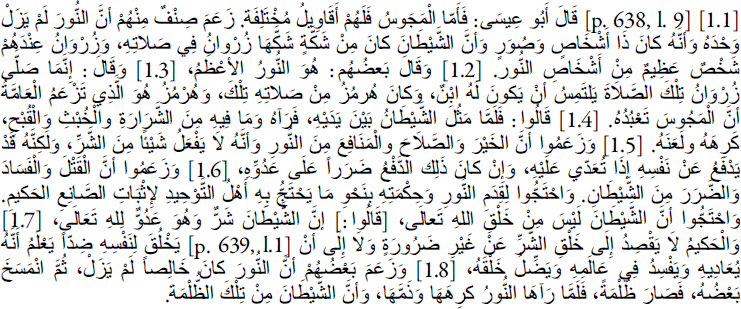
[1.1] Abū ʿĪsā said: Regarding Majūs, they have diverse beliefs: One group believes that light alone is eternal, and it has (various) persons and forms. And SatanFootnote 34 was (born) from a doubt which Zurwān had in his prayer. For some, Zurwān is a great person of the persons of light; [1.2] and others believe he is the greatest light.Footnote 35 [1.3] TheyFootnote 36 say: Zurwān prayedFootnote 37 that prayer in order to have a son and from that prayer Hurmuz was (born). And Hurmuz is the one whom ordinary people think that the Majūs worship. [1.4] They say: As Satan appeared in front of him [= Zurwān], and he saw him [scil. Satan] and saw that which was in him of wickedness and malice and shamefulness [lit. lies], he [= Zurwān] loathed him [scil. Satan] and cursed him. [1.5] And they claim that goodness and welfare and benefit come from the light, and that it does not commit any evil deed. However, when it [scil. the light] is assaulted, it sometimes defends itself, even if that defense causes its enemy harm. [1.6] And they believe that homicide and viciousness and harm come from Satan. And they argue for the pre-existence of light and its wisdom in the (same) way as the monotheists argue in order to prove the Creator and the All-Wise. [1.7] And they argue that Satan was not created by God, the Exalted.Footnote 38 [They believe:]Footnote 39 Satan is evil, and he is an enemy of God, the Exalted, and the All-Wise does not aspire to create evil without necessity, and to create an opponent for Himself, while He knows that he [scil. Satan] will quarrel with Him, will act wickedly in His world and will lead His creatures astray. [1.8] Some of them [= a second group of MajūsFootnote 40] believe that light was pure from eternity, but a part of it later underwent metamorphosis [inmasakha] and became darkness. As light observed this [scil. darkness], it detested and blamed it. And (they believe) that Satan (came into being) from this darkness.

[2.1] A third group among them establishes the pre-existence of light and darkness and believes that there was a void between them where their wandering and blending took place. They do not consider that space a third concept [maʿnā thālithan].Footnote 43 [2.2] They believe that the whole goodness is from light, and evil is from darkness. [2.3] They adduce reasons for this, similar to the reasons of Manichaeism [al-manānīya].Footnote 44 It is said that it is the Khurramdīniyya, which believes in this doctrine. [2.4] Many people narrate from the Majūs that they believe that light is eternal [lit. exists from eternity] and Satan came into being from vileness, which existed there. [2.5] This is the sum total of their beliefs about the genesis [kawn] of Satan.
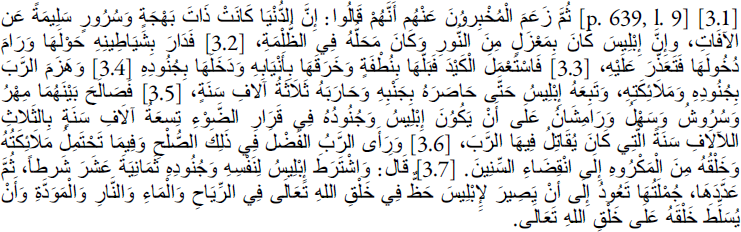
[3.1] In addition to this, reporters claim about them that they believe that the world used to be in happiness and joy, and free from calamities; and that Iblīs was in isolation from light and was placed in darkness. [3.2] He turned around it [scil. the world] with his demons [shayāṭīnihī] and sought to penetrate it, but it was not possible for him. [3.3] Then, he applied a stratagem, moistened it [scil. the world] with a drop, tore it with his tusks and penetrated it with his host. [3.4] And put God with His host and angels to flight. Iblīs pursued Him until he encircled Him from His side,Footnote 45 and fought Him for 3,000 years. [3.5] Then, Mihr, Surūsh, Sahl and Rāmishān made peace between them with the condition that Iblīs and his host would settle in brightness for (only) 9,000 years, which includes the 3,000 years when he was fighting God. [3.6] God saw favor in that peace and in the hardship that his angels and his creatures will bear until the termination of these years. [3.7] HeFootnote 46 said: Iblīs stipulated eighteen conditions for himself and his host. And further he [scil. the reporter] enumerated them [scil. the eighteen conditions]. All of them refer to the point that Iblīs must have a share in the creatures of God, the Exalted, in plants, water, fire and love. And he must (have the ability to) dominate his creatures over God’s creatures.
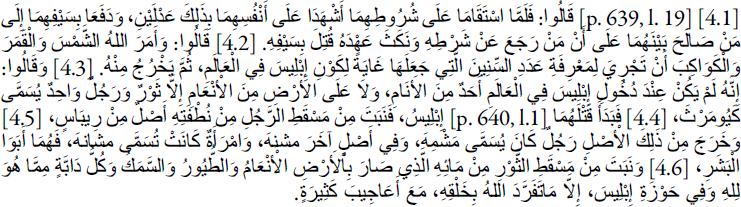
[4.1] They believe that as they [scil. God and Iblīs] stipulated the conditions of their (treaty), they called two trustworthy personsFootnote 47 to bear witness for this. Then, they handed their swords to the ones who settled peace between them in order to kill the one who deviates from his condition and violates the pact with his (own) sword. [4.2] They believe that God ordered the sun, the moon and the stars to move in order to reckon the number of the years which He set as the expiration of Iblīs’ presence in the world. Hereafter, he [scil. Iblīs] will exit it [scil. the world]. [4.3] And they believe that as Ahreman penetrated the world, there was no creature in the world and there were no cattle on the earth except for an ox, and a single man by the name of Kayūmarth. [4.4] Afterwards, Iblīs killed them. Then, a trunk of rhubarb grew from the semen of the man at the place where he fell. [4.5] From that trunk sprang forth a man, who is called /mshmh/, and according to another source [aṣl] /mshnh/, and a woman, who is called /mshʾnh/.Footnote 48 They are the parents of mankind. [4.6] And in the place of the fall of the sperm of the ox, which went into the earth, grew forth cattle, birds, fishes, and all things that belong to God, but in the possession of the devil, except for the ones that God created Himself. They related this with many marvelous stories.Footnote 49

[5.1] It is narrated from some of them [that they believe] that God, the Exalted, was able to eliminate Iblīs from Himself at the time of Iblīs’ penetration (into the world) by His creatures. [5.2] He, however, gave His creatures, who were at the time spirits without bodies, the choice either to relieve them of Iblīs, so that they do not fight him, or to clothe them with bodies so that they bear his [scil. Iblīs’] nuisance, and for which they will receive rich rewards at the end of time. They chose the latter. [5.3] And when they fought him [scil. Satan], Satan captured a number of them.

[6.1] They believe that once the fixed time between them [scil. God and Iblīs] terminates—which amounts to 9,000 years, and nothing will be added to it—light will be devoid from those creatures who disobeyed Him in the hands of Iblīs by committing sin. Afterwards, He will vanquish Iblīs. [6.2] Some of them say that He will kill him and will rest from him. [6.3] Others believe that He will imprison him in a cramped prison. [6.4] Still others believe that He will slay and destroy him.
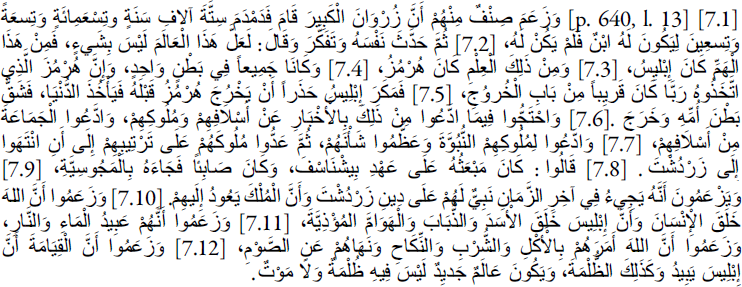
[7.1] A group of them believe that the great Zurwān stood and murmuredFootnote 51 for 6,999 years, so that a son will be for him, but it did not happen.Footnote 52 [7.2] Then, he spoke to himself and reflected and said: “Perhaps this worldFootnote 53 is not worthwhile.” [7.3] From this concern [hamm] emerged Iblīs, and from that knowledge [ʿilm] emerged Hurmuz. [7.4] They were both in the same belly. Hurmuz, the one whom they [scil. this group of Zoroastrians] chose as god, was next to the exit door. [7.5] Then, Iblīs deceived (him [scil. Hurmuz]) because of his concern that if Hurmuz would exit (the belly) before him, he [scil. Hurmuz] would seize the world. Therefore, he [scil. Iblīs] split the belly of his mother and exited. [7.6] They argue for what they claim on the basis of the reports from their ancestors and kings, and they claim the consensus (?) [al-jamā’a] of their ancestors [on these beliefs]. [7.7] And they proclaim prophethood for their kings and glorify them. Furthermore, they list their kings according to the order of their reign until they end with Zardusht. [7.8] They say that his [scil. Zardusht’s] appearance was in Bīshnāsf’s [i.e. Wishtāsp’s] reign, who was Sabean and he [scil. Zardusht] brought him [scil. Wishtāsp] Zoroastrianism [madjūsiyya]. [7.9] And they believe that at the end of time, a prophet of the religion of Zardusht will come to them, and the kingdom will return to them. [7.10] And they believe that God created human beings, and Iblīs created the lion and the flies and the harmful insects. [7.11] They believe, moreover, that they are servants of the water and the fire, and that God commanded them to eat and to drink and to marry and prohibited them from fasting. [7.12] And they believe that at resurrection, Iblīs will perish and so will the darkness, and a new world will appear in which neither darkness nor death will exist.


[8.1] This is the sum of what has been narrated from them. [8.2] From this, it becomes apparent that some of them claim that God and Satan are pre-existent. [8.3] Others say that Satan is created in time, and that God and Satan are material [jismān].Footnote 54 [8.4] It has been narrated by some of them that God is material and Satan does not exist in material (form).Footnote 55 [8.5] It is apparent that they ascribe goodness to God, and He is the light according to them, and ascribe evil to Iblīs, who arose, according to the majority of them, from darkness. [8.6] Their beliefs resemble those of the dualists. It has been narrated from them that the spirits are from God, the Exalted, and the bodies from Satan. [8.7] From all that which has been narrated from them it is apparent that in this they follow their predecessors and forefathers. And if they believed in them as prophets, then imitating them was absolute.
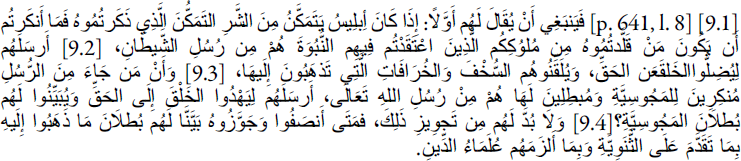
[9.1] It must be told them, firstly: If Iblīs possesses control of evil as you say, then howFootnote 56 do you deny that those, among your kings, whose (teachings) you follow, whom you believe in as prophets, are Satan’s messengers [9.2] sent in order to deceive mankind from truth and teach them the ridiculous and superstitious things that you follow; [9.3] and that the ones among the messengers who are refuters of Zoroastrianism and its invalidators must be the messengers of God, the Exalted, whom He sent to lead mankind to truth and show them the invalidity of Zoroastrianism?Footnote 57 [9.4] They simply must accept this. If they are just (to our premise) and accept it, then we have demonstrated to them the invalidity of what they adhere to, according to what preceded about dualism,Footnote 58 and according to what the theologians [ʿulamāʾ al-dīn] obligated them.
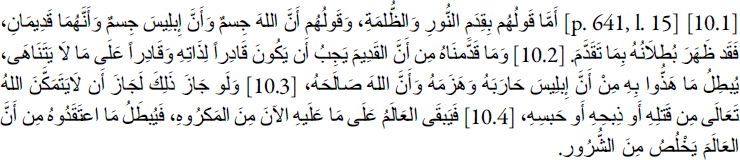
[10.1] Concerning their statement about the pre-existence of light and darkness, and their statement that God and Iblīs are material, and both of them are pre-existent, the falsity of these (statements) becomes apparent from what preceded. [10.2] And what we mentioned earlier, that the pre-existent must of necessity be capable of its own being [dhātihī], and capable of what is endless, invalidates that they say irrationally that Iblīs fought Him and defeated Him, and that God reached an agreement with him. [10.3] If this were permissible, then it would be permissible that God, the Exalted, is not capable of slaying him, beheading him or imprisoning him. [10.4] Consequently, the world would remain in its current undesirable (state). Therefore, this falsifies their belief that the world will be freed from evils.
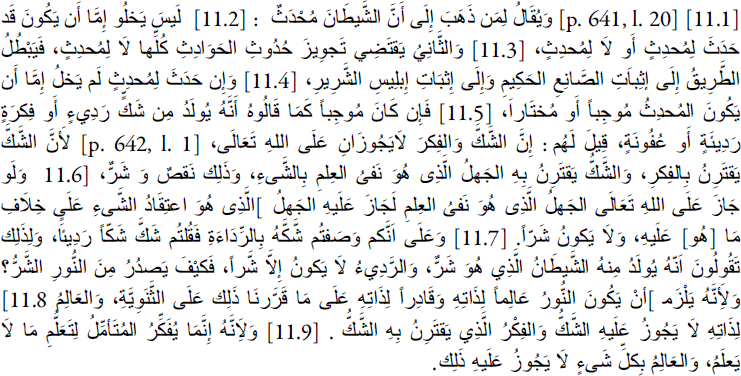
[11.1] And one may say to the person who believes that Satan is created in time: [11.2] There is only one of two options: Either he is created by a creator, or by a non-creator.Footnote 59 [11.3] This second (option) would necessitate the permissibility of the creation of all contingencies by a non-creator. Consequently, the way to prove the Creator, the Omniscient, and to prove Iblīs, the Evil, is annulled. [11.4] If he [scil. Iblīs] is created in time by a creator, there are only these options: Either the creator is a cause [mawjib] or he is a free agent [mukhtār]. [11.5] If he [scil. the creator] is a cause—as they believe that he [scil. Iblīs] was born from a foul doubt [shakkin radīʾ] or foul reflection [fikratin radīʾa] or vileness—one may say to them that doubt and reflection are not permissible (to be ascribed) to God, the Exalted, because doubt is associated with reflection, and reflection is associated with ignorance, which is denial of [having] knowledge of entities, and this is deficiency and evil. [11.6] And if the ignorance which is the denial of knowledge were permissible for God, the Exalted, then the ignorance, which is belief in something in opposition to what it (really) is, would be permissible for Him (as well). (Therefore) it [scil. the ignorance] would not be evil. [11.7] And since you described his [scil. Zurwān’s] doubt with the attribute of vileness, and claimed that He doubted a vile doubt—and therefore you claimed that Satan who is evil was born from Him, and the vileness is nothing but evil—then how does evil arise from light? [11.8] Furthermore, as we established (before) for dualism,Footnote 60 it is necessary for light to have knowledge of its essence and be capable of it, and doubt and the reflection associated with doubt are not permissible for the one who has knowledge about its essence [al-ʿālim li-dhātihī]. [11.9] Moreover, the one who contemplates [al-mutaʾammil] speculates only in order to learn what he does not know, and this is not permissible for the one who is omniscient.
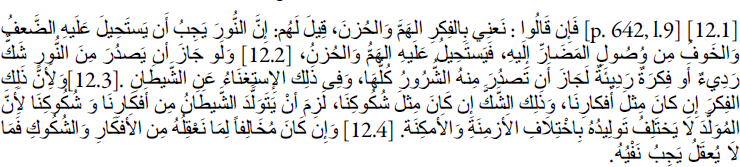
[12.1] And if they say: “By reflection we mean concern and grief [al-hamm wa-l-ḥuzn],” it should be said to them that it must be impossible for light to be weak and to be fearful of getting harmed. Hence, concern and grief are impossible for it [scil. light], as well. [12.2] And if it were permissible for a foul doubt or a foul reflection to arise from light, then it must be permissible for all sorts of evil [al-shurūr kulluhā] to arise from it, and this would mean that there is no need for Satan (to exist). [12.3] (Furthermore) if that reflection resembles our reflections, and that doubt resembles our doubts, this would necessitate that Satan can be born from our reflections and doubts (as well), since the created one [al-muwallad] would not change its nature by the change of time and space. [12.4] And if (this reflection or doubt) differs from the kinds of reflections and doubts which we can comprehend, one must refute things that cannot be comprehended.

[13.1] As for the belief of some of them that he [scil. Satan] was born from a pre-existent vileness: this is false (as well), because this would necessitate him [scil. Satan] to be born from it [scil. vileness in light] everlastingly, since (its) cause is pre-existent. [13.2] This (also) obligates them to accept the birth of all sorts of evil and that of the harmful animals from the pre-existent putridity. [13.3] With this (assumption) there is no need of Satan.
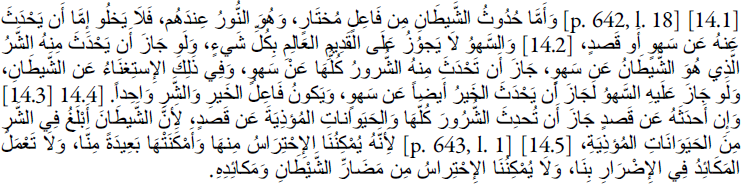
[14.1] The emergence of Satan from a free agent—and this is light according to them—is not free (from these two options): He [scil. Satan] arises from it [scil. light] either inattentively or attentively. [14.2] Inattentiveness is not allowed for the pre-existent one who is omniscient. And if it is permitted that evil, which is Satan, arises from it [scil. light] inattentively, then it is permitted that all sorts of evil arises from it [scil. light] inattentively. By this (assumption) there is no need of Satan. [14.3] Furthermore, if inattentiveness is permitted for it [scil. light], then it is permitted in the same way that goodness arises (for it) inattentively, and the agent [fāʿil] of goodness and evil would become the same. [14.4] If it [scil. light] creates him [scil. Satan] attentively, then it is permitted that all sorts of evil as well as the harmful animals arise attentively because Satan beats the harmful animals in evilness. [14.5] The reason (for this) is that it is possible for us to be wary of them [scil. harmful animals], and they can stay away from us and they do not trick to harm us. However, it is not possible for us to be wary of the harms of Satan and his tricks.
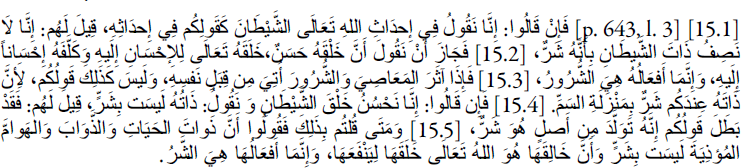
[15.1] If they would say: “Our belief in bringing forth of Satan by God, the Exalted, resembles your belief about the bringing forth of him [scil. Satan],” then it should be said to them: We do not describe the nature of Satan as being evil. [15.2] Therefore, it is permitted (to us) to claim that his [scil. Satan’s] creation is acceptable [ḥasan]. He, the Exalted, created him [scil. Satan] to make a favor to him and assigned him (responsibility) as a favor, and only his [scil. Satan’s] deeds are evil. [15.3] Consequently, if he chooses (to commit) sins and evils, these arise from him himself. This, however, is not your belief, because according to you, his nature is evil, like poison. [15.4] If they would say that we regard Satan’s creation (by God) as acceptable and believe that his nature is not of evil, it should be said to them: (In that case) your belief is falsified that he is born from an origin which is evil. [15.5] When you say this (that the nature of Satan is not evil), then accept that the animate beingsFootnote 62 and (harmless) animals and harmful animals are not from evil and their creator is God, the Exalted! He created them to benefit them, and it is only their actions which is evil.
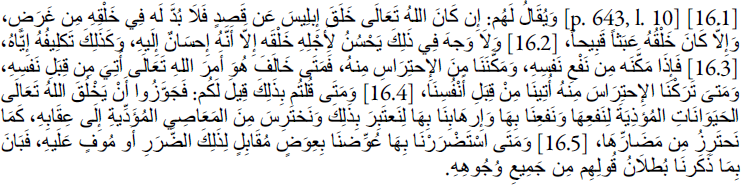
[16.1] Moreover, it should be said to them that if God, the Exalted, created Satan attentively, then it must be an intention for Him [scil. God] in his [scil. Satan’s] creation. Otherwise His [scil. God’s] creation (of Satan) would be absurd and repulsive. [16.2] There is no reason that makes his [scil. Satan’s] creation (by God) acceptable, unless to make a favor to him and to assign him (responsibility). [16.3] If He enables him to be beneficent for Himself, and enables us to be wary of him, whenever he opposes the command of God, the Exalted, this (opposition) arises from him himself, and whenever we are not wary of him, it arises from us ourselves. [16.4] When you accept this, it should be said to you that you must permit that God, the Exalted, creates harmful animals due to their benefit (for God) as well as our benefit from them, and due to frightening us by them so that we take lesson by this, and are wary of the sins which lead to His punishment, as we are wary of their [scil. harmful animals’] harms. [16.5] When we are harmed by them [scil. harmful animals], we are given (equal) compensation [lit. replacement] in response to that harm or (a compensation) which exceeds (an equal) compensation (to that harm). Consequently, by our discussion the falsehood of all aspects of their belief becomes evident.
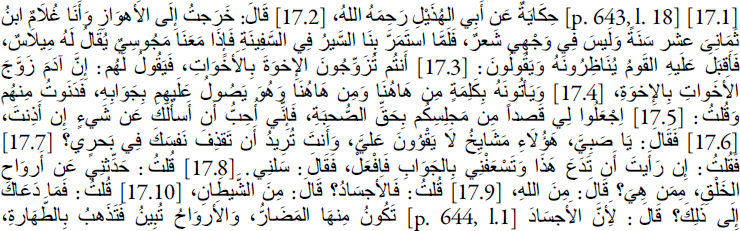

[17.1] A narration about Abū al-Hudhail, may God have mercy upon him. [17.2] He said: “As I was a boy of eighteen years old and there was no beard grown on my face, I left for Ahwaz.Footnote 63 As we proceeded on our journey in a ship, there was a Zoroastrian with us called Mīlās.Footnote 64 Later, the people went to him and disputed with him saying: [17.3] ‘You consent to the marriage of brothers with sisters’. He responded to them: ‘Adam consented to the marriage of brothers with sisters (as well).’ [17.4] They were bringing speeches from here and there and he was attacking them with his responses. Meanwhile, I approached them and said: [17.5] ‘By our companionship, allow me to participate in your gathering! I would like to ask you about something, if you permit me.’ [17.6] He said: ‘Oh youth! Those elders are not able to tackle me, and you want to throw yourself in my sea (of knowledge)?’ [17.7] I said: ‘If you accept to let this (discussion between us) take place, and resign from answering (to others), then let it happen [lit. do it].’ He said: ‘Ask me!’ [17.8] I asked:Footnote 65 ‘Tell me about the spirits of (animated) creatures [khalq]! Who caused them?’ He replied: ‘God.’ [17.9] I asked: ‘What about the corpse?’Footnote 66 He replied: ‘(They belong to) Satan!’ [17.10] I asked: ‘What led you to this?’ He replied: ‘Since the corpses [p. 644] become harmful, and the spirits remain clean and leave (the world) with purity’. [17.11] I asked: ‘Do not the spirits lie, slander, drive bloodshed and do all kinds of harms, once they are still in the bodies,Footnote 67 but as soon as they leave the corpses they cease to do harm?’ He replied: ‘Yes’! [17.12] I said: ‘Then you should either attribute the harms to an instance that once it comes, the harms come with it, and once it leaves, the harms disappear with its absence, or (you should) associate them [scil. harms] with both of them [scil. corpse and spirit]’. He replied to me: ‘Give up (discussing with me) or I will throw myself in this sea!’Footnote 68 [17.13] Then I gave up, and we separated.
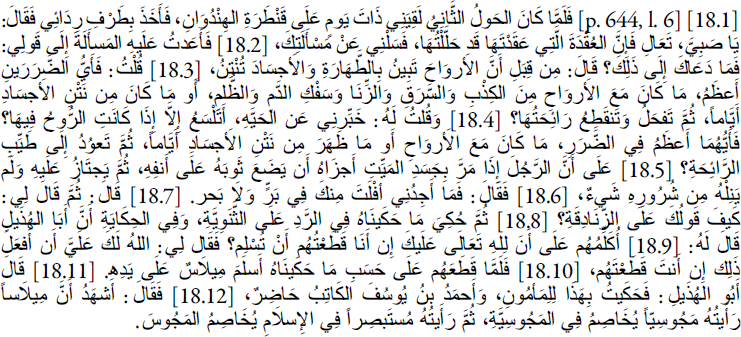
[18.1] “One year later [lit. When it became the second year] (after our first meeting) he saw me one day on the Bridge of HinduwānFootnote 69 and he took the edge of my garment and said: ‘O youth! Come! I solved the problem which you had raised. Ask me your question (again)!’ [18.2] Then I repeated the question for him until I reached my statement ‘What leads you to this?’Footnote 70 He replied: ‘Because souls leave with purity and corpses spoil.’ [18.3] I asked: ‘Which of these two harms is greater: the one that results from souls, such as lying, stealing, adultery, bloodshed and injustice, or the one that results from the perishing of the corpses (only) for some days, and later the corpse dries up and its stink disappears?’ [18.4] Furthermore, I asked him: ‘Inform me about the snake! Does not it sting only when the soul is in it? Which one of these both is greater in harm: the one when the soul is within it [scil. snake], or the one which appears from the perishing of the corpse for some days, and then it turns into the scent? [18.5] Moreover, if one passes by a dead corpse, it suffices to put cloth on one’s nose, then nothing of its [scil. of the corpse] evils traverses to him and reach him.’ [18.6] Thereupon, he said: ‘Nobody more astute than you faced me on the land and on the sea.’” [18.7] He [scil. Abū al-Hudhail] narrated (further): “Then, he [scil. Mīlās] said to me: ‘What is your position in regard to the Manichaeans [al-zanādiqa]?’” [18.8] Then, it was narrated [ḥukiya] what we [scil. Ibn al-Malāḥimī] have depicted [ḥakaynā] on the refutation of the dualism.Footnote 71 According to this narration, (thereupon,) Abū al-Hudhail said to him [scil. Mīlās]: [18.9] “‘Should I dispute with them [scil. Manichaeans], and God, the Exalted, witnesses that you will accept Islam, if I will defeat them?’ He [scil. Mīlās] replied to me [scil. Abū al-Hudhail]: ‘God is for you, I will do so, if you defeat them.’” [18.10] As he [scil. Abū al-Hudhail] defeated them, according to what we [scil. Ibn al-Malāḥimī ] related [ḥakaynā],Footnote 72 Mīlās converted to Islam by his [scil. Abū al-Hudhail’s] hand. [18.11] (Further,) Abū al-Hudhail said: “Later I narrated this to al-Maʾmūn,Footnote 73 while Aḥmad b. Yūsuf, the scribe, was present’. [18.12] He [scil. Aḥmad b. Yūsuf] said: ‘I testify that I witnessed Mīlās who was Zoroastrian and was fighting in favor of Zoroastrianism. Later, I saw him who had embraced Islam [mustabṣir fī al-islām] and was fighting against the Zoroastrians.’”

[19.1] Regarding what belongs to Zoroastrians’ (teaching), that diseases, illnesses and harmful animals are evil, and it is not permissible that they are the creation of God, the Exalted: [19.2] The answer to this will appear in the chapter (about) ‘Sufferings’Footnote 74—so God, the Exalted, will—and by this their endeavor to prove Satan is falsified.
Ibn al-Malāḥimī’s Discussion of Zoroastrianism
Inner-textual structure
Before elaborating on Ibn al-Malāḥimī’s discussion of Zoroastrianism it is helpful to see how this section is contextualized in the whole book. The section on Zoroastrianism is located in the chapter al-kalām ʿalā al-thanawiyya wa-ḥikāya maqālātihim, “Discussion on Dualism and Narration of their Doctrines.” Beside Manichaeism and Zoroastrianism, it comprises discussions of Dayṣanism (dayṣāniyya), Marcionism (marqiyūniyya), Māhāniyya, Buddhism (sumaniyya), Sabianism (ṣābiʾīn), Harranian (ḥurnāniyya) and astrologers’ doctrines. The chapter on dualism is flanked by two chapters on monotheism: “Monotheism” and “The Doctrines of Philosophers on the Origination of the World and the Proof of God and their Beliefs in Monotheism.” The section on Zoroastrianism is the second-largest section in the chapter on Dualism, after the section on astrological doctrines. It consists of ca. 2,100 words in its Arabic original.
The general structure of Ibn al-Malāḥimī’s chapter on Zoroastrianism can be depicted as follows: firstly, he presents different Zoroastrian notions of the origin of evil and different Zoroastrian cosmogonies. (§§1–7) In the first two passages of his text, Ibn al-Malāḥimī briefly classifies the Zoroastrian views on the genesis of evil known to him. Then, he elaborates on these Zoroastrian positions (§§3–7) and subsequently summarizes them (§8). In this passage, we observe a transition from report to disputation, which is presented in subsequent paragraphs (§§9–16). The two following passages, §§17–18, contain a sort of appendix in which Ibn al-Malāḥimī describes an encounter and discussion between a young Abū al-Hudhail and a Zoroastrian named Mīlās. The author ends his comments with a general refutation of Zoroastrianism (§19). Strikingly, Ibn al-Malāḥimī designates the discussion of other dualist groups with a singular noun, qaul or maqāla, but labels the section on Zoroastrianism with the plural noun maqālāt. This demonstrates that the author views Zoroastrianism as a variety of cosmogonical concepts, rather than being a simple error; and indeed, he presents an entire series of Zoroastrian doctrines and refutes all of them. Ibn Malāḥimī’s text has the great advantage that it, like Eznik’s refutation of Zoroastrianism for example,Footnote 75 clearly separates his description of different Zoroastrian cosmogonic ideas from his own refutation of them; this differentiation allows us to more easily separate the factual from the polemical.
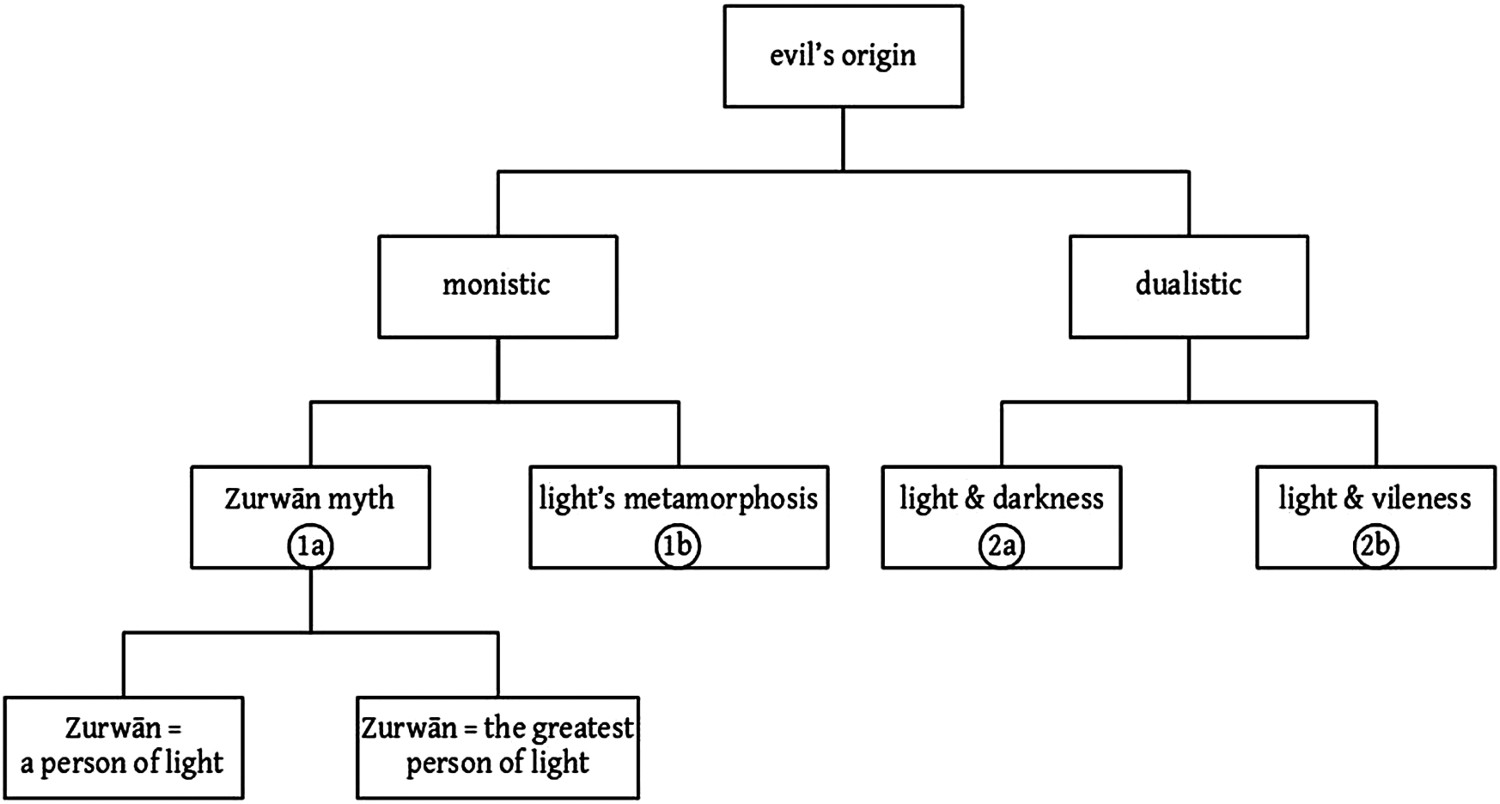
Ibn al-Malāḥimī’s presentation of Zoroastrianism concerns itself primarily with the different ways the Zoroastrians justify the existence of evil in the world. The last sentence of the second passage clarifies this interest: “These are a number of their beliefs about the genesis of Satan” (§2.5). Ibn al-Malāḥimī divides the Zoroastrian cosmogonies into two broad groups with regard to the genesis of Satan: monistic and dualistic (see Figure 1). He divides the former, presented in the first passage, into two subgroups: First, the major monistic cosmogony, which is the famous Zurwān myth (§§1.1–7), which we know from the Armenian and Syriac side-traditions of Sasanian Zoroastrianism (see below). Ibn al-Malāḥimī subtly differentiates Zurwān’s position in this cosmogonic myth according to two Zoroastrian groups: one regards light alone as eternal and Zurwān as a great person of the persons of light (§1.1); the other believes Zurwān to be the greatest light (§1.2). This second monistic subgroup advances the view—according to Ibn al-Malāḥimī (§2.4)—that light alone was pre-existent and it has been pure from eternity.Footnote 76 One part of the light, however, later underwent a metamorphosis and transformed into darkness. This darkness was the origin of evil (§1.8).
Zoroastrian notions of the origin of evil according to Ibn al-Malāḥimī.
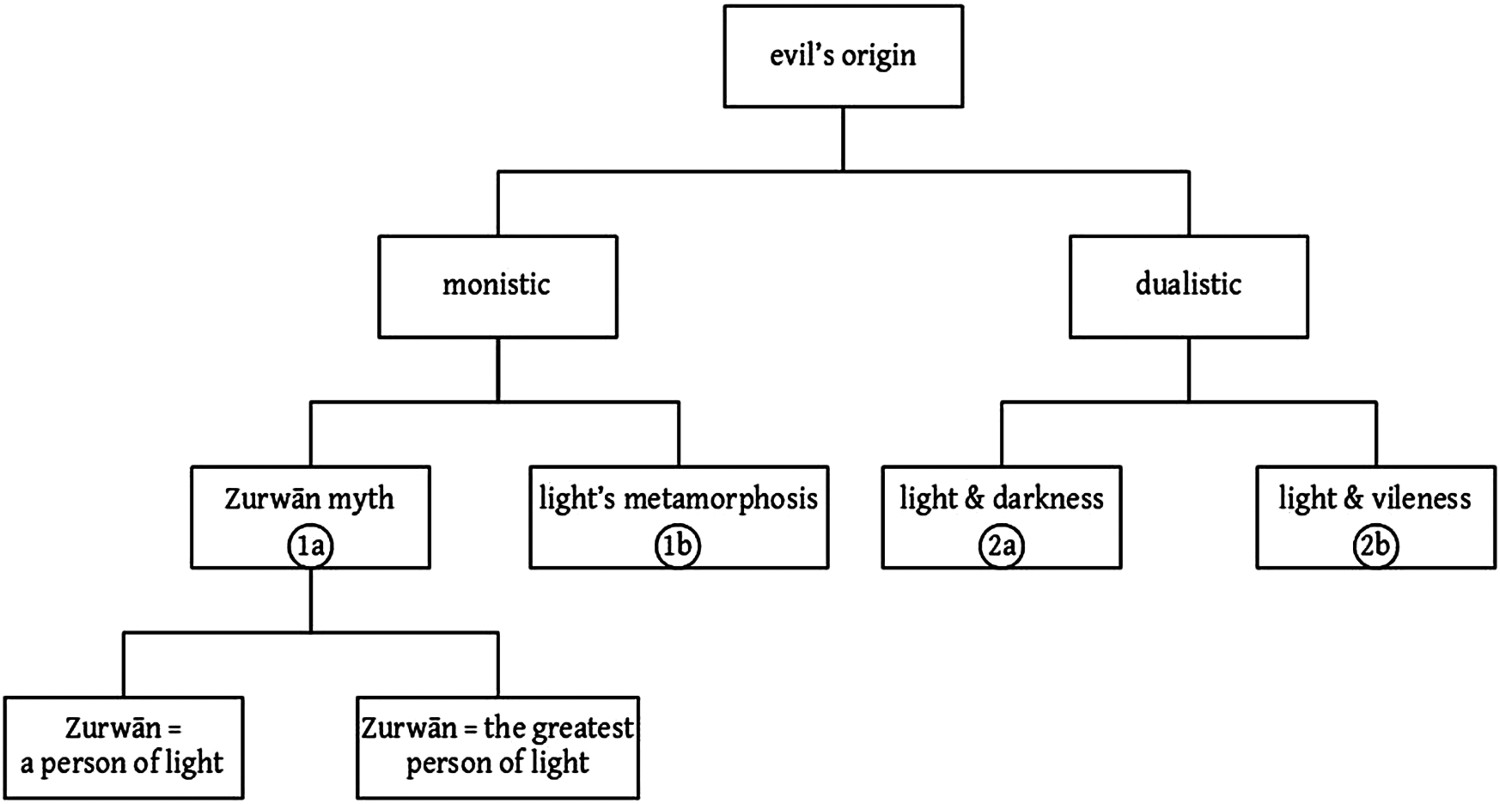
In the second passage of his text, Ibn al-Malāḥimī portrays the dualistic cosmogonies of Zoroastrianism, which we know mainly from the Pahlavi literature of the early Islamic period. In their view, light and darkness were both pre-existent, and there was an empty space between them. Ibn al-Malāḥimī emphasizes that this cosmogony is not a triadic one because these Zoroastrians do not consider space to be a third pre-existent entity (§2.1). According to Ibn al-Malāḥimī this group advances a view similar to that of Manichaeism. Significantly, he reports that it is the Khurramdīnis who support this dualistic view (§2.3). Another Zoroastrian cosmogony, which Ibn al-Malāḥimī describes as a dualistic cosmogony, includes the view that light alone was pre-existent; this is similar to the second monistic subgroup above. In contrast to the first dualistic group, however, they believed that vileness co-existed with light from eternity.
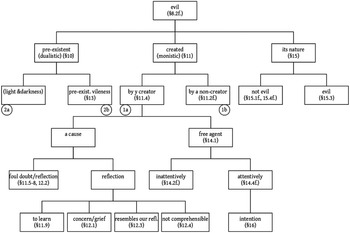
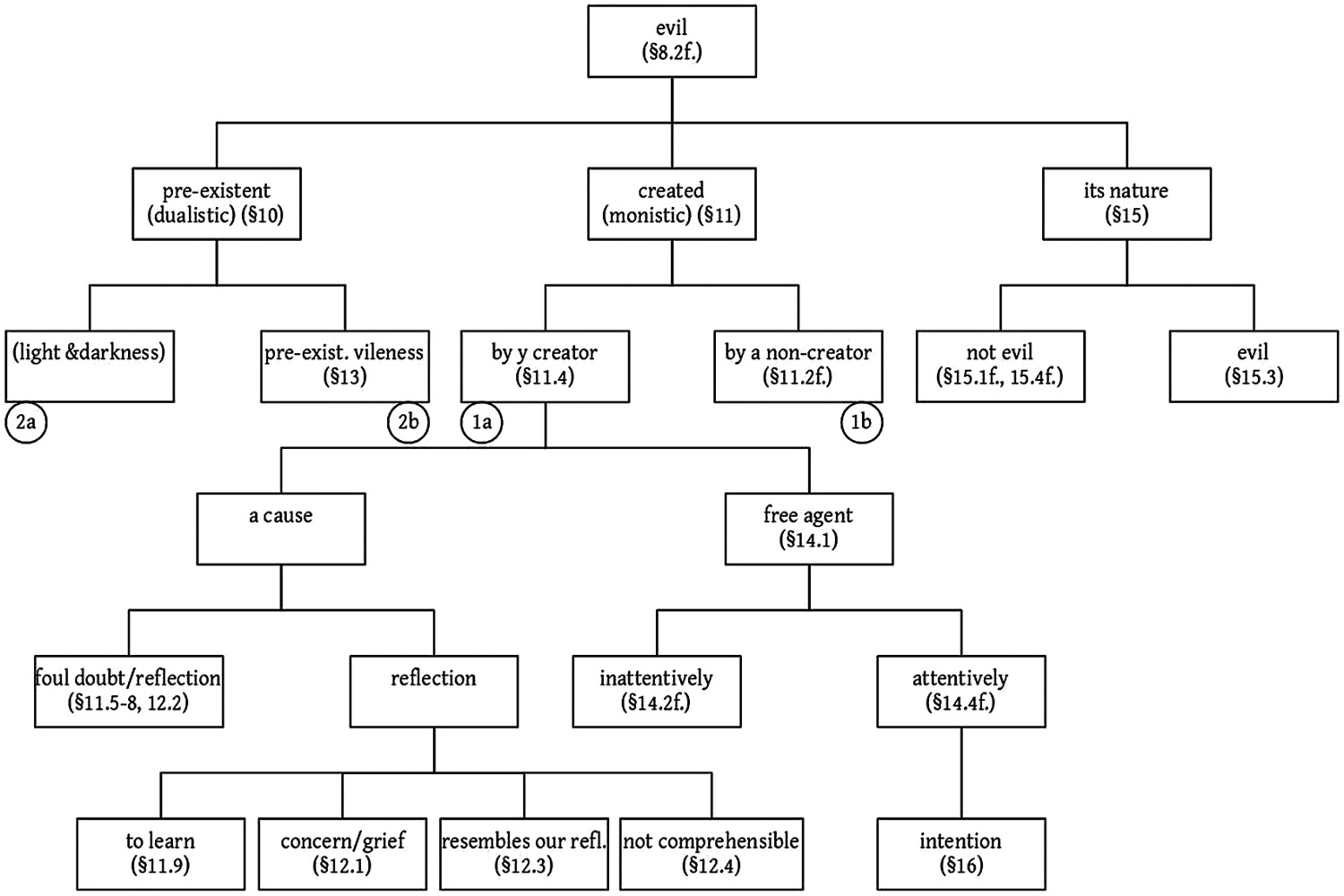
In his refutation, Ibn al-Malāḥimī is mainly concerned with the “errors” inherent in the Zoroastrian doctrines regarding the origin of evil. Yet even here, he only occasionally adopts a strongly polemical tone; a clear Islamic insider perspective is only to be found in the first paragraph of the refutation (§9). Subsequently, he discusses Zoroastrian theories from a philosophically neutral position in order to demonstrate their logical inconsistencies. For this, he adopts a structured style of argumentation (see Figure 2). He starts with the categorical question of whether Satan is pre-existent or created (§8.2f.). He refutes the dualistic cosmogony known from the Pahlavi literature (2a in Figure 1) by referring to arguments against dualism (§§10.1f.) and by summarizing the reasons for his critique (§§10.3f.). The belief in a pre-existent vileness in light (2b in Figure 1) is refuted later in §§13.1–3. In order to argue against the dualistic cosmogonies, Ibn al-Malāḥimī (§§11–16) first has to intensively discuss the Zoroastrian monistic cosmogonies.Footnote 77 He includes the categorical division of Satan’s creation by a creator or by a non-creator (§11.2). He soon discredits this latter possibility (§11.3), whereas he discusses the former at length. He considers two possibilities for Satan’s creator: He is a cause or free agent (§11.4). Ibn al-Malāḥimī seems to ascribe the Zoroastrian notions of Satan’s genesis to a foul doubt or a foul thought, as expressed in the Zurwān myth, to the creator as a cause (§§11.5–8, 12.2). Moreover, he considers the following possibilities for Zurwān’s reflection as the cause of Satan’s genesis: reflection as learning (§11.9), reflection as concern or grief (§12.1), reflection resembling human reflections (§12.3) and finally a reflection that is not comprehensible by human beings (§12.4). As to the possibility of the creator as a free agent, he describes two possibilities: Satan arises from the free agent either attentively or inattentively (§14.1) The author refutes this latter option (§§14.2f.) and then the former one (§§14.4f.). At the end of his refutation, Ibn al-Malāḥimī addresses the possibility that Satan’s creation was intentional and attentive (§§16.1–5). It should be pointed out that Ibn al-Malāḥimī was a Muʿtazilī theologian; as such, the idea that God intentionally created Satan was unacceptable to him. Ibn al-Malāḥimī then addresses the nature of Satan, and again he lists two possibilities: Satan’s nature is not evil but his deeds are, as in Islamic teachings (§§15.1f., 15.4f.); or Satan’s very nature was evil, as Zoroastrians believed but which Ibn al-Malāḥimī refutes (§15.3).
The structure of Ibn al-Malāḥimī’s refutation of Zoroastrianism.
Note: Paragraph numbers refer to the passages of Ibn al-Malāḥimī’s account, numbers in circles to the nodes in Figure 1.
Inter-textual relations
Before the reappearance of the complete report of Ibn al-Malāḥimī on Zoroastrianism in the new edition of his book, al-Shahristānī’s account was the most comprehensive Arabic report on Zoroastrianism in the early Islamic period up to the twelfth century. These authors were more or less contemporaries of one another and lived in the same geographical area and cultural environment, namely in eleventh/twelfth-century Khurasan. The comprehensiveness of these reports, their chronological proximity, as well as the shared geographical and cultural milieu of both authors, all invite comparison of their contributions. In doing so, we hope to better illuminate the background of these Arabic reports as well as the history of Zoroastrianism in this period. The following section illuminates the similarities and differences between these two accounts.Footnote 78
At the beginning of his chapter on Zoroastrianism, Ibn al-Malāḥimī directly refers to Abū ʿĪsā (see below) as his source (§1.1). Al-Shahristānī cites the same authority in his report on dualists,Footnote 79 but remains silent regarding his sources on Zoroastrianism. The scholarship has repeatedly pointed to Abū ʿĪsā as the source of Ibn al-Malāḥimī and al-Shahristānī.Footnote 80 Therefore, in this analysis we will scrutinize the possibility of whether Abū ʿĪsā can be considered the common source of their accounts on Zoroastrianism.
An important shared component of both texts is the Zurwān myth.Footnote 81 This cosmogony has been indirectly referred to at the earliest by Theodor of Mopsuestia (AD 352–428), as cited by Photios (AD 810–93), and directly by Eznik of Kolb’s Against the Sects, written between AD 441 and 448. The latter work transmits the most comprehensive version of the myth known to us,Footnote 82 which seems to represent the official Zoroastrian cosmogony in the latter half of the Sasanian period.Footnote 83 The citation of the myth at the beginning of Ibn al-Malāḥimī’s text (§1.1–4) suggests its importance for Zoroastrian-Islamic theological discussions as well as its relevance in Ibn al-Malāḥimī’s period.Footnote 84 The author presents a more detailed version of the cosmogony in passages 7.1–5, which follows al-Shahristānī’s text almost literally (§8). One difference, however, is worth mentioning here: according to passage §7.3 in Ibn al-Malāḥimī’s text, Iblīs emerges from Zurwān’s concern (al-hamm) and Ohrmazd from his knowledge (al-ʿilm). Al-Shahristānī and other authors, including Ibn al-Malāḥimī himself, however, depict a version of the Zurwān myth that presents Ahreman as a result of Zurwān’s doubt and Ohrmazd of Zurwān’s certainty.
Another shared theme in Ibn al-Malāḥimī’s and al-Shahristānī’s texts, in regard to the Zurwān cosmogony, is the designation of Zurwān as a person of light. Ibn al-Malāḥimī (§1.1f.) designates Zurwān a great person (shakhṣ) among the persons of light, or the greatest light; al-Shahristānī (§7) similarly calls him the greatest person among the persons of light. The term “person” (shakhṣ) has been used by al-Shahristānī (§2) to designate the first principle, actually the prototypical man, Kayūmarth, as well. The Zoroastrian term “person of light” remains specific to these two works.
Ibn al-Malāḥimī (§1.8) and al-Shahristānī (§14) also share the theme of the metamorphosis of light. According to both authors, a group of Zoroastrians believed that only light, which was pure, was pre-existent. A part of the light, however, underwent a metamorphosis and was turned into darkness. In this case, not only the concepts but even the linguistic formulations show striking similarities between both authors.Footnote 85
Both narrate a dualistic version of Zoroastrian cosmogony that resembles the account known from Pahlavi literature.Footnote 86 According to this cosmogony, Ohrmazd was on high in the light from eternity. In contrast, Ahreman was deep down in the darkness. Between the two realms there was empty space where goodness and evil mixed. Ibn al-Malāḥimī’s presentation of the existence of an empty space between the realms of Ohrmazd and Ahreman (§2.1) neatly resembles the presentation of this realm in the Great Bundahišn.Footnote 87 Al-Shahristānī (§13) introduces this concept as well. However, it is not correctly rendered in Shaked’s translation.Footnote 88 Interestingly, both authors attribute dualism to Khurramdīniyya.Footnote 89
Ibn al-Malāḥimī (§2.4) mentions Satan’s genesis from pre-existent vileness, which existed in pre-existent light. He seems to classify this notion as a sub-belief of Zoroastrian dualism. A similar notion has been attested to by al-Shahristānī (§10) as being a subgroup of Zurwāniyya. Accordingly, “there has been something vile with God from eternity, […], and that this is the origin of Satan.”Footnote 90 We can regard this cosmogony as a model that lies somewhere between the monistic cosmogony of the Zurwān myth and the dualistic cosmogony of Pahlavi literature. This point elucidates why the two authors classify the concept differently; Ibn al-Malāḥimī classifies it as dualism and al-Shahristānī as monism. In his refutation of the Zurwān myth, Ibn al-Malāḥimī alludes to vileness again and states that “they believe that he [scil. Iblīs] was born from a foul doubt or foul reflection or vileness” (§11.5). Al-Shahristānī (§5) and ʿAbd al-Jabbār (§2)Footnote 91 mention the motif of “vile thought,” as well.
Another notion in Ibn al-Malāḥimī’s text that deserves our attention is Ahreman and his demons encircling the world (§3.2). The vision of Ahreman standing at the beginning of the creation outside the world, piercing the sky and penetrating it, can be found in al-Shahristānī (§10f.) as well as in Pahlavi literature (Pakzad, Great-Bundahišn [GBd], 4.10, WZ, 2.5). However, the motif of applying a stratagem to enter the world or entering Ohrmazd’s realm is attested to in Arabic sources, as well as in Ibn al-Malāḥimī (§3.3) and al-Shahristānī (§§10f., 13), but not in Zoroastrian texts. This notion is also present in the Zurwān myth, where Ahreman splits Zurwān’s belly in order to be born before Ohrmazd, although his androgenic father, Zurwān, had predetermined that Ohrmazd should be born first. Ibn al-Malāḥimī’s report is unique in this regard, as it describes in detail the stratagem Ahreman applied to enter the world, namely moistening it with a drop, tearing it with his tusks and penetrating it. This motif is not known, to our knowledge, from other Islamic or Zoroastrian sources.
Al-Shahristānī (§§5, 11) uniquely suggests that angels mediated between Ohrmazd and Ahreman in their struggle. As Shaked points out,Footnote 92 this idea can be partly found in the narration of Great Bundahišn (GBd, 1.27), in which the struggle between Ohrmazd and Ahreman is likened to a duel. The motif of angelic mediation is absent in Pahlavi literature, but attested to in some Arabic sources.Footnote 93 In none of the known Arabic sources, however, are the mediating angels introduced by name. Shaked persuasively pointed out that this “mediation” corresponds to the Middle Persian mayānǰīgīh and designates “the act of judgment.”Footnote 94 Consequently, he suggests that the three Zoroastrian deities Mihr, Srōš and Rašn, who are represented in Zoroastrian literature as judges, might have provided the basis for the mediating angels in Arabic sources.Footnote 95 Ibn al-Malāḥimī is the only author who introduces these angels by name; passage §3.5 reads: fa-ṣālaḥa baynahumā mihr wa-surūsh wa-sahl wa-rāmishān. We can easily recognize two Zoroastrian deities, namely Mihr and Srōš,Footnote 96 and in the last lexeme of the phrase, we can recognize the name of the deity Rām, to whom the twenty-first day of the month in the Zoroastrian calendar is dedicated. It seems that his name has been confused here with the verbal noun rāmišn, which is morphologically built on the same verb as rām. rāmišn means “peace, ease, pleasure.”Footnote 97 This meaning provides us with a clue for deciphering sahl in this phrase. This latter lexeme, from the root sahula “It was, or became, smooth or soft, plain or level, or smooth and soft,”Footnote 98 seems to gloss rāmišn, or, in other words, sahl is the Arabic designation of the deity, whose original (Middle) Persian name has been rendered subsequently. This raises the question of whether the third deity of the mediating angels is Rām, or rāmišn is a corrupt rendering or a confusion of Rašn. As the three deities Mihr, Srōš and Rašn frequently appear together,Footnote 99 we might prefer to see in this phrase this triad of Zoroastrian judging deities and by this a proof of Shaked’s ingenious suggestion.
In the context of mediation between Ohrmazd and Ahreman, both Ibn al-Malāḥimī (§3.7) and al-Shahristānī (§38 and alluded to in §11) mention a pact between them including eighteen conditions that Ahreman demands from Ohrmazd. Ibn al-Malāḥimī states that Iblīs stipulated eighteen conditions but he (or his source) does not list them; however, he does mention that his source has recorded the conditions. Al-Shahristānī not only mentions Ahreman’s eighteen conditions but also enumerates them in full. In a recent article, Mojtabā ĀqāyīFootnote 100 aptly points out that Ahreman’s eighteen conditions appear in Pahlavi literature, namely in the Handarz ī dastwarān ō weh-dēnān.Footnote 101 The twelfth and thirteenth passages of the text read:
(12) pursīd kū andar xrafstarān gyān kē kard? (13) guft hād ohrmazd u-š ēd rāy kard čē ahremen tan ī xrafstar dēsīd haštdah paymān ō ohrmazd drāyīd kū gyān andar awēšān kunē ayāb ēnyā pašt nē āwāšam.Footnote 102
(12) One asked: “Who gave the harmful animals life?” (13) One answered: “Ohrmazd. He did this because when Ahreman built the body of harmful animals, he chattered 18 conditions to Ohrmazd: ‘either you will give them life or I would not seal this pact.’”
As Āqāyī states, the evidence makes it probable that we are dealing with an Arabic translation of a lost Zoroastrian Middle Persian text. Al-Shahristānī introduces these conditions in a section titled “Zardusht’s Treatise on Origins” (maqāla zardusht fī-l-mabādiʾ). At the beginning of this text, he refers to al-Jayhānī as his source.Footnote 103 Therefore, we can assume that Ahreman’s eighteen conditions are attributable to al-Jayhānī as well. Ibn al-Malāḥimī’s report, however, realizes a difficulty about his source here. He starts the sentence with the verb qāla without specifying the subject. One possibility is that the subject of the verb is Abū ʿĪsā, mentioned at the beginning of the text. The other possibility is that the name of his authority for this sentence was lost during the process of the transmission of the text. In any case, Ibn al-Malāḥimī’s source on this topic must have not only mentioned the motif of Ahreman’s conditions, but also enumerated them (thumma ʿaddadahā). Ibn al-Malāḥimī, however, instead of listing the conditions, merely summarizes them in the phrase: “All of them refer to the point that Iblīs must possess a share in the creatures of God” (§3.7). If we accept that Ibn al-Malāḥimī and al-Shahristānī both used Abū ʿĪsā’s Refutation of Zoroastrianism in their discussion (see below), we may conclude that the motif of Ahreman’s conditions was not present in Abū ʿĪsā’s book, because al-Shahristānī cited it in his work from writing of al-Jayhānī. Therefore, we might assume that the name of Ibn al-Malāḥimī’s authority for Ahreman’s conditions was lost during the process of text transmission. Ibn al-Malāḥimī’s addition of the verb qāla further in this passage may be evidence that his authority was someone other than Abū ʿĪsā, whom Ibn al-Malāḥimī mentions at the beginning of his report on Zoroastrianism as his authority, and on whom his whole report implicitly relies.
Handing the swords to two trustworthy persons and bearing witness is another detail of the mediation present in both Ibn al-Malāḥimī (§4.1) and al-Shahristānī (§§11, 39). To some extent, here we can even identify an analogy in the formulation of the two authors. According to both authors, Ohrmazd and Ahreman asked two presumably trustworthy deities to bear witness to their pact. They handed the mediating deities their swords and agreed that these deities would kill the one who violated the pact with his own sword. Al-Shahristānī’s citation of al-Jayhānī narrates this motif after the enumeration of Ahreman’s conditions (§38).Footnote 104 In §11, al-Shahristānī alludes to Ahreman’s conditions, according to which Ohrmazd should enable him to act in Ohrmazd’s creation.Footnote 105 Subsequently, he mentions the motif of two trustworthy mediators and the handing over of the swords. Both motifs are narrated in Ibn al-Malāḥimī’s text as well, and in fact in the same order. Therefore, we can conclude that both al-Shahristānī §11 and Ibn al-Malāḥimī §4.1 rely on a common source, namely Abū ʿĪsā. The source of al-Shahristānī, §38f., however, was not Abū ʿĪsā but al-Jayhānī, as he explicitly mentions. Accepting this, we can assume that Abū ʿĪsā’s text—cited by these authors—did not contain the list of conditions. This verifies the hypothesis proposed above, namely that Ibn al-Malāḥimī’s source in paragraph 3.7 was not Abū ʿĪsā’s book. Apparently, Ibn al-Malāḥimī makes a short excursus at that point.
The notion of cosmic history, which is of great significance in Zoroastrian cosmogony, is discussed by Ibn al-Malāḥimī (§§3.5, 6.1) as well. In passage 3.5, he gives the figure of 9,000 years as the length of the cosmic history, or—to use an emic Zoroastrian notion—of the limited time. The author points out that this period includes the 3,000 years mentioned earlier (§3.4), that is, the period in which Ahreman fought Ohrmazd. Therefore, the period of 9,000 years refers to the whole cosmic history.Footnote 106 Similar to Ibn al-Malāḥimī (§3.5), al-Shahristānī (§§2, 11) cites the figure of 9,000 years, including the fighting period; and again here we can identify analogous wording. According to the Zoroastrian literature, cosmic history is divided into three equally long periods: creation (bundahišn), mixture (gumēzišn) and separation (wizārišn).Footnote 107 As Shaked has pointed out,Footnote 108 al-Shahristānī (§2) and Ibn al-Malāḥimī both present another division, namely a 3,000 year period of fighting (= mixture), followed by a period of redemption. Another figure relevant to cosmic history is similarly found in both sources: in his narration of the Zurwān myth, Ibn al-Malāḥimī (§7.1) states that Zurwān prayed for 6,999 years.Footnote 109 This figure echoes the age that al-Shahristānī (§5) gives for the world, 7,000 years, which is known from other Arabic sources as well.Footnote 110 This number is not attested in Zoroastrian literature.
Ibn al-Malāḥimī, moreover, presents another division of limited time, namely its division into static and dynamic periods. According to the Zoroastrian cosmogony, Ohrmazd created the sun, moon and stars, but they stood without movement in the middle of the sky. After Ahreman’s onslaught, Ohrmazd set them in motion. This is reflected in both Ibn al-Malāḥimī (§4.2) al-Shahristānī (§39). The concept is well-known from Pahlavi literature and is present in older Zoroastrianism.Footnote 111 The motif of setting light for the sun and the moon, and phases for the latter, are stated in Qurʾan 10:5, as well.
Ibn al-Malāḥimī (§4.3) cites the prototypical figures of Zoroastrian cosmogony, the prototypical man, Gayōmart, and the prototypical animal, gāw ī ēk-dād “the sole-created ox,” as well. He also depicts the process of differentiation in Zoroastrian cosmogony, which is known from Pahlavi literature,Footnote 112 namely how the prototypical couple, Mašī and Mašyānī, originated as a trunk of rhubarb from Gayōmart’s semen, and how diverse species of animals went forth from the ox’s semen (§§4.4–6). The same presentation can be read in al-Shahristānī’s report (§5), while we can again assert an analogy even in their phrasing. Ibn al-Malāḥimī explicitly expresses that there was, at the beginning of the creation, no creature in the world except for Gayōmart and the ox. Al-Shahristānī seems to give voice to the same circumstance but some translations have misunderstood his text.Footnote 113
Ibn al-Malāḥimī and al-Shahristānī both narrate another topic known from Pahlavi literature: According to the cosmogony presented in the Zoroastrian literature of early Islamic period, Ohrmazd first created his creatures in a spiritual state without material bodies, and afterwards transformed them so that they would have a material state. Before this transformation, according to the Great Bundahišn (§§3.23f.), Ohrmazd offered his creatures two choices: either be transformed into material creation and materially fight with evil and finally get rid of Ahreman, and so become eternal at the end of the limited time; or be endlessly forced to protect themselves from evil. Ohrmazd’s creatures accordingly decided to be transformed into the material state. Ibn al-Malāḥimī (§§5.1f.) and al-Shahristānī (§6) closely recount this motif.
After the Zurwān myth, Ibn al-Malāḥimī (§§7.6, 8.7) notes that Zoroastrians refer to their ancestors and kings as the authorities of their beliefs. Subsequently (§7.7), he briefly represents the structure of Iranian historiography. This is in alignment with al-Shahristānī’s (§16) assertion about Sasanian historiography and what we know about this topic from Pahlavi literature (GBd, 35). Moreover, it fits, in our improved understanding of the Sasanian Xwadāy-nāmag.Footnote 114
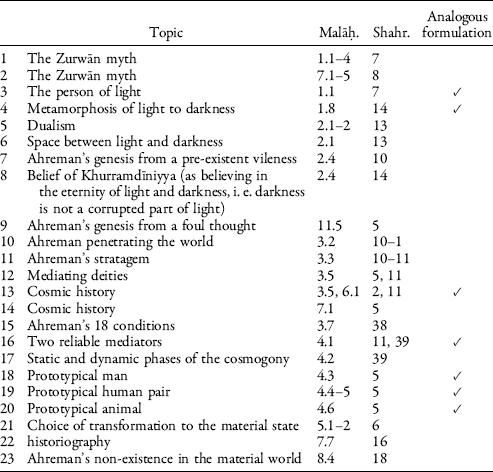
The last motif common between Ibn al-Malāḥimī and al-Shahristānī to be mentioned here is the topic of the non-existence of Ahreman and his demons in the material world.Footnote 115 In terms of placing Ahreman into an analogy of shadow, al-Shahristānī’s text (§18) is ambiguous, whereas Ibn al-Malāḥimī (§8.4) presents this Zoroastrian notion more than clearly. The analogies of al-Malāḥimī’s and al-Shahristānī’s accounts on Zoroastrianism are summarized in Table 1.
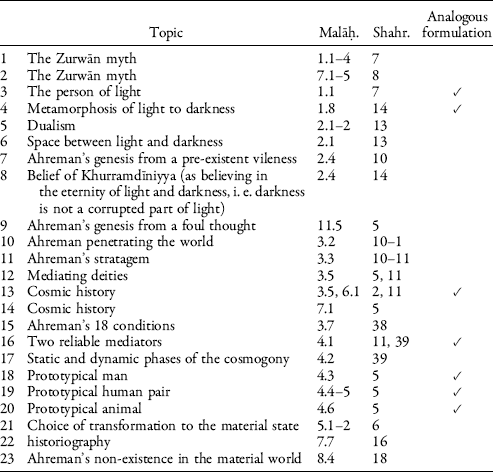
The source of Ibn al-Malāḥimī and al-Shahristānī on Zoroastrianism
The similarities between the reports of these two Islamic theologians suggest that one text may depend on the other, or they may depend on a common source. Simultaneously, however, a sufficient number of existing differences attest to their independent authorship. Some of the differences include the following: Ibn al-Malāḥimī writes an elaborated refutation of the Zoroastrian notion of evil, whereas al-Shahristānī narrates Zarathustra’s vita and the Zoroastrian anthropology, which are absent in Ibn al-Malāḥimī. At the beginning of the previous section, we pointed out that the scholarship regards Abū ʿĪsā as a source for these two reports. Abū ʿĪsā Muḥammad b. Hārūn b. Muḥammad al-Warrāq, an apologist for Shīʿī principles,Footnote 116 lived as a bookseller and publisher in Baghdad in the mid-third/ninth century. He penned nearly twenty books, almost all of them lost.Footnote 117 Among the works ascribed to him, we find three titles related to Zoroastrianism: Refutation of Zoroastrianism (Radd ʿalā al-Majūs), On the Heresies of Dualists and Refutations of Them (Iqtiṣāṣ madhāhib aṣḥāb al-ithnayn wa-l-radd ʿalayhim) and Book of the Narrations of People and Their Distinctions (Kitāb maqālāt al-nās wa-ikhtilāfihim). Abū ʿĪsā was celebrated for his accounts on dualism as well as his refutations of it.Footnote 118 Based on the similarities between al-Shahristānī’s and Ibn al-Malāḥimī’s accounts, we can assume that much of their reports are derived, directly or indirectly, from Abū ʿĪsā’s Radd ʿalā al-Majūs or his other two books. Chronologically, this shifts our focus from the sixth/twelfth century to the third/ninth century and geographically from Khurasan to Baghdad. By this, the two reports on Zoroastrianism do not necessarily reflect the Zoroastrianism of the sixth/twelfth century Khurasan, but the Zoroastrian beliefs of third/ninth-century Baghdad. We know that Baghdad was a significant center of knowledge production for Zoroastrianism in third/ninth century,Footnote 119 and it is quite possible that Abū ʿĪsā composed his works on the basis of knowledge gained about Zoroastrianism there.Footnote 120 Abū ʿĪsā’s discussion of Zoroastrianism, moreover, reveals the strong interactions between Zoroastrian and Muslim theologians in third/ninth-century Baghdad.
If the two authors likely shared a common source, it raises the question of the origins of the unique passages (present in one author, but not the other). Here, there are two possibilities: either they were inserted by each author independently; or their content was likewise derived from Abū ʿĪsā, but either excluded or included based on the respective author’s interests. This raises the question of whether Ibn al-Malāḥimī’s refutation of Zoroastrian doctrine was written by Ibn al-Malāḥimī himself, or whether he cited it from one of Abū ʿĪsā’s works. Significantly, there are no analogous passages among Ibn al-Malāḥimī’s refutation and al-Shahristānī’s account, as Table 1 shows. Taking into consideration that Abū ʿĪsā’s Radd ʿalā al-Majūs involved a refutation of Zoroastrianism, as its title suggests, it is difficult to decide whether ibn al-Malāḥimī’s refutation is his own contribution or a citation from Abū ʿĪsā. However, in his introduction to the Kitāb al-muʿtamad Ibn al-Malāḥimī points out that he discusses the doctrines of dualists and Zoroastrians in more detail than other masters of the Muʿtazilī school; this suggests that his refutations of Zoroastrian doctrines stem from his own pen. At any rate, Ibn al-Malāḥimī certainly demonstrates greater interest in scholastic theology and polemics than does al-Shahristānī. Significant in this regard are designations such as Zarādushtiyya, Zurwāniyya and Kayūmarthiyya, which al-Shahristānī assigns to different Zoroastrian myths, so that his text gives the impression that these terms designate different Zoroastrian schools that were active either in his time or historically. The absence of these designations in Ibn al-Malāḥimī’s text verifies the conclusion, suggested by other scholars,Footnote 121 that these assignments are the result of al-Shahristānī’s heresiographic interest and do not reflect Zoroastrian socio-religious entities.
A final question regarding Ibn al-Malāḥimī’s sources on Zoroastrian doctrines concerns his sources for the discussion between Abū al-Hudhail and a Zoroastrian, Mīlās, placed at the end of his report. Firstly, we give an account of the two figures, who represent two sides of an apologetic discussion.
Abū al-Hudhail Muḥammad b. al-Hudhail al-ʿAllāf (c. 135–c. 227/752–842) was an early Muʿtazilite theologian from Baṣra who was apparently of Persian descent.Footnote 122 He did not have a prominent position as a scholar in Baṣra. He has been reported to have had theological disputes with theologians of other religions as a young man.Footnote 123 In his old age he obtained access to the court of al-Maʾmūn (r. 813–33), the Abbasid caliph. He is said to be a prolific author,Footnote 124 and most of his works were polemical books against non-Muslim religious communities such as Jews, Christians, Zoroastrians and various groups of dualists.Footnote 125 As for Mīlās, we do not find much detail about his life and his person.Footnote 126 Next to the two anecdotes in the Kitāb al-muʿtamad informing us about his religious affiliation, we find a short anecdote about him in Ibn al-Nadīm’s al-Fihrist, which is in fact a combined summary of the two anecdotes in the Kitāb al-muʿtamad: While ascribing a book to Abū al-Hudhail entitled (Kitāb) Mīlās, Ibn al-Nadīm introduces Mīlās as a Zoroastrian who arranged a debate between Abū al-Hudhail and a group of dualists. After Abū al-Hudhail defeated the dualists in the debate, Mīlās converted to Islam.Footnote 127
Regarding Ibn al-Malāḥimī’s source for this anecdote, and therefore the two anecdotes mentioned in Kitāb al-muʿtamad, they might have their origins in the lost (Kitāb) Mīlās, as in both of them Mīlās is involved in debate or conversation with Abū al-Hudhail.Footnote 128 Ibn al-Malāḥimī could have used the (Kitāb) Mīlās of Abū al-Hudhail directly, or may have found quotations from it in one of the books of Abū ʿĪsā.
We thank our colleague Mohsen Zakeri for his valuable comments and edits on an earlier version of this paper. We also acknowledge the two anonymous readers for their erudite comments and the editors of Iranian Studies who coordinated the peer review process and provided additional comments.