Introduction
Cognitive impairment is considered a fundamental feature of schizophrenia (Barch & Keefe, Reference Barch and Keefe2010) and thought to be related to brain neuropathology (Goldman-Rakic & Selemon, Reference Goldman-Rakic and Selemon1997). The nature of this pathology, however, is currently poorly understood. Examination of brain morphology in relation to cognitive function in individuals with first-episode psychosis (FEP) may help to understand disease-related changes in brain anatomy and their impact on cognition. Any correspondences between changes in brain anatomy and disease-related cognitive dysfunction may not be straightforward. We have previously reported evidence that cognitive abilities may be structurally, or qualitatively, different in FEP patients compared with control subjects (CS) (Haring et al. Reference Haring, Mõttus, Koch, Trei and Maron2015b ). It may therefore be hypothesized that FEP patients have different types of structural links between cognitive performance and brain anatomy than CS; however, it may also be that brain structures do not differ, they simply operate differently.
Among CS, imaging studies have demonstrated that scores for general cognitive ability are associated with several features of the brain, such as grey matter (GM) morphology (Colom et al. Reference Colom, Burgaleta, Román, Karama, Álvarez-Linera, Abad, Martínez, Quiroga and Haier2013; Burgaleta et al. Reference Burgaleta, Johnson, Waber, Colom and Karama2014), white matter (WM) tract integrity (Penke et al. Reference Penke, Maniega, Bastin, Hernández, Murray, Royle, Starr, Wardlaw and Deary2012), trajectories of cortical development (Shaw et al. Reference Shaw, Greenstein, Lerch, Clasen, Lenroot, Gogtay, Evans, Rapoport and Giedd2006) and functional efficiency (Neubauer & Fink, Reference Neubauer and Fink2009; van den Heuvel et al. Reference van den Heuvel, Stam, Kahn and Hulshoff Pol2009). Localizing cognitive abilities to specific brain areas has proven difficult, however, as widely distributed loci seem to be engaged in cognitive performance (Vakhtin et al. Reference Vakhtin, Ryman, Flores and Jung2014). Only a limited number of studies have investigated the relationship between cognitive functioning and structural brain morphology in FEP or schizophrenia patients in generally, and the findings have been inconsistent (Antonova et al. Reference Antonova, Kumari, Morris, Halari, Anilkumar, Mehrotra and Sharma2005; Premkumar et al. Reference Premkumar, Kumari, Corr, Fannon and Sharma2008; Minatogawa-Chang et al. Reference Minatogawa-Chang, Schaufelberger, Ayres, Duran, Gutt, Murray, Rushe, McGuire, Menezes, Scazufca and Busatto2009; Gutiérrez-Galve et al. Reference Gutiérrez-Galve, Wheeler-Kingshott, Altmann, Price, Chu, Leeson, Lobo, Barker, Barnes, Joyce and Ron2010; Crespo-Facorro et al. Reference Crespo-Facorro, Roiz-Sántiañez, Pérez-Iglesias, Rodriguez-Sanchez, Mata, Tordesillas-Gutierrez, Sanchez, Tabarés-Seisdedos, Andreasen, Magnotta and Vázquez-Barquero2011; Hatton et al. Reference Hatton, Lagopoulos, Hermens, Scott, Hickie and Bennett2013). The empirical evidence as to whether brain–cognition associations are similar or different between FEP patients and CS thus remains inconclusive.
Among FEP patients, multiregional and heterogeneous structural brain changes have been suggested, including GM volume reductions in frontal and temporal regions, the anterior cingulate cortex, the insula, the hippocampus, the parahippocampus gyrus and, possibly, across the whole brain (Vita et al. Reference Vita, De Peri, Silenzi and Dieci2006). However, these results have not always been found by other similar studies (DeLisi et al. Reference DeLisi, Hoff, Schwartz, Shields, Halthore, Gupta, Henn and Anand1991; Molina et al. Reference Molina, Sanz, Sarramea, Benito and Palomo2004). It has been suggested that cortical thinning (Rimol et al. Reference Rimol, Nesvåg, Hagler, Bergmann, Fennema-Notestine, Hartberg, Haukvik, Lange, Pung, Server, Melle, Andreassen, Agartz and Dale2012) or reductions in cortical area (CA) (Sanabria-Diaz et al. Reference Sanabria-Diaz, Melie-García, Iturria-Medina, Alemán-Gómez, Hernández-González, Valdés-Urrutia, Galán and Valdés-Sosa2010) may be the most important determinants of GM volume reduction in FEP patients.
The objectives of the present study were: (1) to investigate the magnitude of any cognitive dysfunction between the CS and FEP patients, using five computer-based cognitive tests from the Cambridge Neuropsychological Test Automated Battery (CANTAB) (Robbins & Sahakian, Reference Robbins, Sahakian, Copeland, Abou-Saleh and Blazer1994); (2) to detect and describe any regional distribution abnormalities of cortical thickness (CTh) and CA among FEP patients compared with CS; (3) to examine if CTh and CA parameters were related to cognitive performance differences between FEP patients and CS. We also aimed to clarify any differences in structure/function correlations between the aforementioned groups, which to our knowledge had not yet been done by simultaneously using the selected CANTAB subtests and whole-brain CTh and CA parameters. Owing to the findings of previous studies, we predicted that patient cognitive performance would be lower compared with CS and that this would be associated with specific cortical regions, including the prefrontal, temporal, parietal, occipital and cingulate gyrus.
Method
Participants
The patient sample was recruited from among in- and out-patients of the Psychiatry Clinic of Tartu University Hospital, Estonia. A total of 71 patients met the following inclusion criteria: they were aged between 18 and 45 years; had recently experienced a first psychotic episode; duration of untreated psychosis was less than 3 years; they had received no antipsychotic treatment before their first contact with medical services for psychosis. Of the patients, 69 accepted the invitation to participate, but the magnetic resonance imaging (MRI) scans of six did not meet the quality standards required for statistical analysis, resulting in a patient sample size of 63 (mean age was 25.57, s.d. = 5.52 and range = 18–39 years; 52.38% were male; 92.07% were right-handed). At the time of recruitment, patients were in the stabilization phase of a FEP. Diagnoses were based on clinical interviews tailored to meet International Classification of Diseases (ICD)-10 (World Health Organization, 1992) criteria, a review of their medical history, information from family members, and were agreed upon by two clinical psychiatrists. Among the FEP group the diagnoses were: acute polymorphic psychotic disorder without symptoms of schizophrenia (n = 13), acute polymorphic psychotic disorder with symptoms of schizophrenia (n = 10), acute schizophrenia-like psychotic disorder (n = 17), other acute predominantly delusional psychotic disorders (n = 3), other acute and transient psychotic disorders (n = 2), other non-organic psychotic disorders (n = 3), paranoid schizophrenia (n = 14), and undifferentiated schizophrenia (n = 1). For the last two diagnostic categories, the duration of experienced psychotic symptoms was longer than 1 month. Patients had on average received 21.9 (s.d. = 8.8) days of treatment prior to neuropsychological testing, which was the first procedure of this study. They were treated with various atypical antipsychotic medications as clinically indicated and the mean theoretical chlorpromazine dose equivalent (Gardner et al. Reference Gardner, Murphy, O'Donnell, Centorrino and Baldessarini2010) was 378.97 (s.d. = 154.91) mg/day at the time of neuropsychological testing. Of the patients, 51 (81%) were treated with antipsychotics only, five (8%) also needed mood stabilizers, four (6%) received hypnotics and two (3%) took antidepressants in addition to antipsychotic drugs, and one (2%) did not require any psychotropic drugs. Neuropsychological assessments and image acquisition [on average 1.90 (s.d. = 5.46) days apart] were performed when the patients were clinically stable [mean Brief Psychiatric Rating Scale (Overall & Gorham, Reference Overall and Gorham1962) score of 23.42 (s.d. = 12.81)]. A sample of 30 CS was collected from among hospital staff and local members of the general public. Potential CS were questioned regarding their health status and medical history to exclude those with conditions that might interfere with cognitive performance or MRI acquisition, such as neurological disorders, mental retardation or a significant learning disorder, major sight or hearing impairment, or psychotic disorder among their relatives. Mean age of the CS was 25.10 (s.d. = 6.13, range 18–40) years, 50.0% were male and 93.3% right-handed. Both FEP patients and CS were fluent in Estonian. The study was approved by the Ethics Review Committee on Human Research of the University of Tartu (Estonia) and carried out in accordance with The Code of Ethics of the World Medical Association. After a complete description of the study was read to the participants, they all provided written informed consent. All participants were recruited between March 2009 and August 2013.
Measures and procedures
Computerized neuropsychological assessment
Five CANTAB tests shown to be sensitive to the functioning of the frontal, frontostriatal, frontotemporal, frontoparietal and cingulate brain regions were administered to the participants. These were: (i) the intra-/extradimensional shift (IED) test, which assesses visual discrimination, selective attentional set formation and maintenance, shifting and flexibility of attention. The number of errors made in the extra-dimensional stage of the task was recorded as the outcome for the current study, and all participants reached this level of the task; (ii) the Stockings of Cambridge (SOC) spatial planning test. The number of problems solved with minimal moves was recorded as the outcome; (iii) spatial span (SSP), which assesses subjects’ visuospatial short-term memory spans. The number of correct trials (span length) was recorded; (iv) the spatial working memory (SWM) test, which evaluates subjects’ ability to retain spatial information and manipulate these remembered items in their working memory. The number of errors was recorded, as well as a strategy score that consisted of the number of times an ineffective strategy was used; (v) the rapid visual information processing (RVP) test, which is a sustained vigilance task. The probability of a correct hit (sensitivity for detecting sequences) was recorded as the outcome. For more detailed descriptions of these tests, see the CANTAB website (www.cambridgecognition.com).
According to previous studies (Leeson et al. Reference Leeson, Robbins, Franklin, Harrison, Harrison, Ron, Barnes and Joyce2009; Dickinson et al. Reference Dickinson, Goldberg, Gold, Elvevåg and Weinberger2011; Haring et al. Reference Haring, Mõttus, Koch, Trei and Maron2015b ), cognitive performance is structurally different for FEP patients and CS. Therefore, we used CANTAB subtest scores instead of composite scores for comparing the cognitive performance of FEP patients and CS subjects, and mapping the performances onto regional brain systems.
MRI acquisition and processing
MRI examinations were performed using a Philips Achieva 3 Tesla MRI scanner at Tartu University Hospital, Estonia. Three-dimensional T1-weighted scans were acquired.
Cortical surface reconstruction, volumetric segmentation and inter-group comparative correction were performed using FreeSurfer v5.1.0 (http://surfer.nmr.mgh.harvard.edu). This processing included removal of non-brain tissue using a hybrid watershed/surface deformation procedure (Ségonne et al. Reference Ségonne, Pacheco and Fischl2007), automated transformation to Talairach space, segmentation of the subcortical WM and deep GM volumetric structures (Fischl et al. Reference Fischl, Salat, Busa, Albert, Dieterich, Haselgrove, van der Kouwe, Killiany, Kennedy, Klaveness, Montillo, Makris, Rosen and Dale2002, Reference Fischl, van der Kouwe, Destrieux, Halgren, Ségonne, Salat, Busa, Seidman, Goldstein, Kennedy, Caviness, Makris, Rosen and Dale2004), intensity normalization (Sled et al. Reference Sled, Zijdenbos and Evans1998), tessellation of the GM/WM boundary, automated topology correction (Ségonne et al. Reference Ségonne, Pacheco and Fischl2007), and surface deformation by following the intensity gradients to demarcate the GM/WM and GM/cerebrospinal fluid borders at the locations where the greatest shift in intensity occurred and thus defined a transition to other tissue classes (Dale et al. Reference Dale, Fischl and Sereno1999; Fischl & Dale, Reference Fischl and Dale2000). Topological defects were manually edited. All images were aligned to a standard space (Montreal Neurological Institute, MNI 305) and the cortical images smoothed with a Gaussian kernel of 10 mm full width at half maximum (Fischl & Dale, Reference Fischl and Dale2000). The surfaces were averaged across participants using a non-rigid high-dimensional spherical averaging method that aligned cortical folding patterns and provided accurate matching of morphologically homologous cortical locations across subjects on the basis of each individual's anatomy while minimizing metric distortion (Fischl et al. Reference Fischl, Sereno, Tootell and Dale1999). For each point on the tessellated WM surface, the CTh was calculated as the average of the distance from the WM surface to the closest point on the pial surface and back (Fischl & Dale, Reference Fischl and Dale2000). CA estimation was generated according to WM surface geometry and characteristics obtained by computing the area of a triangle in a standardized, spherical atlas space surface tessellation when mapped in an individual subject's space. Measurement of cortical parameters was performed by one of the authors (A.M.). Computations were carried out in the High Performance Computing Centre of the University of Tartu, Estonia.
Statistical analysis
Demographic and cognitive variables
Demographic variables were analysed using t and χ2 tests. Any differences in neuropsychological performance between the groups were evaluated using a general linear model (GLM) and were adjusted for age, gender and education. For both groups, cognitive test scores were transformed into standard scores based on the means and standard deviations for each test using the CS group's data. Analyses were conducted using the statistical software package R (R Core Team, 2015).
Imaging variables
First, in order to quantify whole-brain neuroanatomical alterations, a vertex-by-vertex analysis was used, with the CTh and CA values from the significant clusters found in all subjects modelled as a function of group. This simulation and clustering approach was implemented in FreeSurfer, which assesses significance (p < 0.05, two-tiled) via a combination of a probability threshold and a cluster size threshold. The p values of the resulting clusters from the original data are expressed as cluster-wise probability (p cw), and hereby equivalent to overall α significance level. Second, statistical maps of those clusters sensitive to the cognitive tasks were created using GLM. Third, a GLM analysis was utilized to determine any unique significant correlations between MRI measurements and cognitive test raw scores between the different groups. Tools from FreeSurfer (Query, Design, Estimate and Contrast) were used to generate the contrasts. Age and gender were used as covariates in all models. Left and right hemispheres were analysed separately. To correct for multiple comparisons, statistical maps were thresholded to an expected false discovery rate of 5% (Genovese et al. Reference Genovese, Lazar and Nichols2002) and this threshold was subsequently applied to all the CTh and CA maps.
Ethical standards
All procedures complied with the ethical standards of the relevant national and institutional committees on human experimentation and with the Helsinki Declaration of 1975, as revised in 2008.
Results
Sample characteristics
Differences between the groups with respect to age, gender, years of formal education and handedness were not significant (t 91 = 0.37, p = 0.71; χ2 1 = 0.05, p = 0.83; t 91 = −1.59, p = 0.12; χ2 1 = 0.05, p = 0.83, respectively).
Cognition comparison
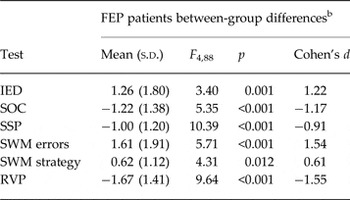
The FEP patients performed significantly lower than the CS at all the neuropsychological tests, indicating impaired cognitive functioning (Table 1). The effect sizes (Cohen, Reference Cohen1977) were all in the order of a large effect (d > 0.80), except for SWM strategy, where the effect size was moderate.
Neuropsychological profile comparisons between FEP patients (n = 63) and control subjects (n = 30) a

FEP, First-episode psychosis; s.d., standard deviation; IED, intra/extradimensional shift; SOC, Stockings of Cambridge; SSP, spatial span; SWM, spatial working memory; RVP, rapid visual information processing.
a All group comparisons were made controlling for the effects of education, age and gender.
b Mean and s.d. values are in standard score units. Positive parameter estimates (effect sizes, Cohen's d) for SWM and IED indices demonstrate higher scores but worse performance in the FEP group, and negative parameter estimates for SOC, SSP and RVP reflect lower scores and worse performance in the FEP group.
Disease-related CTh and CA differences
Participant group comparisons for CTh and CA
Statistical maps of group differences in CTh and CA were generated (online Supplementary Table S1, Supplementary Fig. S1). In the frontal lobes, FEP patients had a significantly thinner cortex compared with CS in two clusters in the left superior frontal (p cw = 0.0019, size = 1283 mm2; p cw = 0.0039, size = 1193 mm2, respectively) and in the same region in the right superior frontal gyrus (p cw = 0.0001, size = 5158 mm2) (online Supplementary Fig. S1a). FEP patients had significantly increased CTh in the left temporal pole (p cw = 0.0093, size = 1051 mm2) and in two areas of the right hemisphere: precentral (p cw = 0.0012, size = 1371 mm2) and temporal (p cw = 0.0084, size = 1107 mm2). FEP patients had an increased CA (online Supplementary Fig. S1b) in the left middlefrontal (p cw = 0.0095, size = 1055 mm2) and right occipito-parietal (p cw = 0.0001, size = 2359 mm2) anatomical areas.
Correlations of neuropsychological tests scores with CTh and CA
Correlations between CTh and CA for each vertex and the selected cognitive test scores were analysed separately for the FEP patients and CS groups (online Supplementary Table S2). Online Supplementary Fig. S2 shows spatially different CTh (a, b) and CA (c, d) maps, which indicates the contribution levels of those brain regions identified by GLM analysis for each cognitive component.
Analyses of the FEP patient sample yielded a distributed pattern of clusters showing significantly negative linear associations between CTh and IED reversal learning scores, indicating that lower performance (higher error score) was related to cortical thinning in the left fusiform, superior frontal, isthmus cingulate and rostral middle frontal, as well as the right superior frontal and posterior cingulate regions. The same trend emerged for both groups between CTh and SWM strategy and error scores, demonstrating significant correlations between poor SWM manipulation and strategy usage with widespread bilateral cortical thinning, predominantly in clusters that contained voxels of the frontal, temporal, parietal and cingulate gyruses. SOC results were positively associated with bilaterally formed temporal gyrus clusters in the CS group, indicating that better performance may predominantly be related to their bilaterally thicker temporal cortex. RVP scores correlated significantly positively with the thickness of the left hemisphere cingulate cortex among the FEP patient group, pointing to the potential importance of the gyrus cinguli during RVP for them. Correlations between CTh and SSP scores were also examined, but did not survive corrections for multiple comparisons with either group.
Online Supplementary Figs S2c and d show spatial p-maps of linear correlations between CANTAB scores and CA in a vertex-wise manner. Among the FEP patient group, a diminished capability to perform set-shifting tasks was significantly correlated with a smaller CA of the left frontal hemisphere (contained areas: pars orbitalis and rostral middlefrontal), and SWM strategy scores were significantly correlated with superior frontal and temporal pole clusters in the left hemisphere and a superior temporal cluster in the right hemisphere, indicating associations between poorer strategy usage (SWM strategy score) and smaller CA in these regions. The ability to retain spatial information and manipulate remembered items in working memory (SWM errors score) was significantly negatively correlated with temporal (contained areas: in the left hemisphere: the middle temporal, temporal pole and superior temporal, in the right hemisphere: the middle temporal, inferior temporal and temporal pole) and frontal (areas: lateral orbitofrontal, pars triangularis and rostral middlefrontal in the left hemisphere; frontal pole, superior orbital and rostral middlefrontal areas in the right) CA in the FEP patient group. A trend for similar correlations (lower performance, smaller CA) emerged among the CS in the left hemisphere (areas: superior frontal, caudal middlefrontal, rostral middlefrontal and superior parietal) and in the right hemisphere (areas: precentral, pars opercularis, pars orbitalis, insula, lateral orbitofrontal, superior frontal and medial orbitofrontal). Working memory capacity was significantly negatively correlated with right hemisphere occipital areas for both groups. No significant CA parameter effects were observed for the spatial planning and and RVP task after controlling for multiple comparisons.
Between-group differences in the correlations between CTh and CA with neuropsychological testing scores
In order to statistically evaluate the degree to which the identified brain–cognition potential relationships were unique to FEP patients, partial correlation coefficients from the group-wise regression analyses were contrasted between the groups in a pairwise manner. The results of this analysis indicated group differences for the correlations between CTh and cognitive measures (online Supplementary Table S3, Supplementary Fig. S3a): the correlations between spatial planning (SOC) and CTh in the left entorhinal and right middle temporal, temporal pole and inferior parietal clusters, as well as the correlations between strategy usage (SWM strategy score) and the right supramarginal cluster were significantly lower in FEP patients. FEP patients demonstrated significantly stronger correlations between the working memory manipulation component (SWM errors) and CTh in the right paracentral cluster, as well as between RVP and CTh in the right lingual cluster (online Supplementary Table S3, Supplementary Fig. S3a). There were significant group differences in the CA–cognition correlations for the set-shifting task, with FEP patients having a significantly weaker association between test scores and CA in the left pars triangularis cluster, as well as significantly stronger scores between spatial planning and CA in the right lateral occipital cluster (online Supplementary Table S3, Supplementary Fig. S3b). FEP patients thus had significantly different cortical structure–cognitive function correlations compared with the CS, primarily pertaining to the frontal, temporal and occipital lobes.
Discussion
Main findings
The main aim of this study was to compare MRI-based structural brain correlates of cognitive performance, as measured by five CANTAB subtests (IED, SOC, SSP, SWM, RVP), between samples of FEP patients and CS.
Neuropsychological findings
To attain our main objective, we first replicated the earlier findings (Bilder et al. Reference Bilder, Goldman, Robinson, Reiter, Bell, Bates, Pappadopulos, Willson, Alvir, Woerner, Geisler, Kane and Lieberman2000) that cognitive impairment in FEP patients is substantial, amounting to moderate to high effect size, and cuts across various neuropsychological measures.
Differences in CTh and CA findings between FEP patients and CS subjects
Our analysis revealed significant bilaterally reduced CTh in the middle- and superior-frontal and left anterior cingulate cortex areas of FEP patients. These findings are in line with studies by Narr et al. (Reference Narr, Bilder, Toga, Woods, Rex, Szeszko, Robinson, Sevy, Gunduz-Bruce, Wang, DeLuca and Thompson2005) and Fornito et al. (Reference Fornito, Yücel, Wood, Adamson, Velakoulis, Saling, McGorry and Pantelis2008). However, our finding of thickened clusters of cortex in the left temporal pole and right middle and inferior temporal cortex in FEP patients compared with CS contradict previous research, which found reductions in left and right temporal poles or no morphological changes at all in these brain regions (Vita et al. Reference Vita, De Peri, Silenzi and Dieci2006; Roiz-Santiáñez et al. Reference Roiz-Santiáñez, Pérez-Iglesias, Quintero, Tordesillas-Gutiérrez, Mata, Gutiérrez, Sánchez, Pazos, Tabarés-Seisdedos, Vázquez-Barquero and Crespo-Facorro2010). Variations in quantitative assessment techniques, as well as use of different covariates and significance thresholds, might explain these inconsistencies. For example, using a region-of-interest approach, Kasai et al. (Reference Kasai, Shenton, Salisbury, Hirayasu, Lee, Ciszewski, Yurgelun-Todd, Kinikis, Jolesz and McCarley2003) reported significant GM volume reduction in the left temporal pole in 13 patients with first-episode schizophrenia, whereas Kuroki et al. (Reference Kuroki, Shenton, Salisbury, Hirayasu, Onitsuka, Ersner-Hershfield, Yurgelun-Todd, Kikinis, Jolesz and McCarley2006) found that GM volumes in the middle temporal gyrus and inferior temporal gyrus were bilaterally smaller in 20 FEP patients than in 23 CS. Using voxel-based morphometry, Nenadic et al. (Reference Nenadic, Dietzek, Schönfeld, Lorenz, Gussew, Reichenbach, Sauer, Gaser and Smesny2015) compared 43 ultra-high-risk (UHR) subjects for psychosis, 24 antipsychotic-naive FEP patients and 49 CS and found reduced regional GM in the left prefrontal, insula, right parietal and left temporal cortices in the FEP group compared with the CS. Moreover, UHR subjects with attenuated symptoms showed GM reductions in the right middle/superior temporal gyrus, and a relative GM increase in a left temporal cluster that included the temporal pole and extended towards the left parahippocampus cortex, as well as in clusters in the right fusiform cortex and hippocampus.
Takayanagi et al. (Reference Takayanagi, Takahashi, Orikabe, Mozue, Kawasaki, Nakamura, Sato, Itokawa, Yamasue, Kasai, Kurachi, Okazaki and Suzuki2011) used the automated surface-based approach provided by FreeSurfer to demonstrate a CTh reduction in 52 FEP patients compared with 40 CS which was most prominent in the prefrontal and temporal cortices (the between-group comparison consisted of the mean thickness of the region of interest). In our study, cortical reconstructions were performed using a similar methodological approach, except that we used an entire cortex surface-based cluster analysis. Using the same methodology, Ansell et al. (Reference Ansell, Dwyer, Wood, Bora, Brewer, Proffitt, Velakoulis, McGorry and Pantelis2015) demonstrated that a non-affective FEP patient group (n = 27) exhibited pronounced cortical thinness compared with CS (n = 27) in frontal regions and did not find overlapping patterns of reduced CTh in the left temporal pole or in the inferior temporal gyrus. Furthermore, they characterized the differential effect of first- and second-generation antipsychotic (FGA and SGA) medication on CTh parameters and found that patients treated with SGAs displayed increased CTh in frontoparietal regions compared with patients treated with FGA, and that the SGA group had higher CTh in the pre- and post-central sulcus than the CS group. Our notably larger study, in which all the patients (n = 63) were treated with SGA, also found increased thickness in the right precentral cluster.
The reasons for the increased CTh among the FEP patients found during our study are not entirely clear. One possible explanation is that such as increased proinflammatory status represents a compensatory effect during the early stage of the disease. Van Berckel et al. (Reference van Berckel, Bossong, Boellaard, Kloet, Schuitemaker, Caspers, Luurtsema, Windhorst, Cahn, Lammertsma and Kahn2008) and Doorduin et al. (Reference Doorduin, de Vries, Willemsen, de Groot, Dierckx and Klein2009) reported increased activation of microglia cells, especially in the temporal lobes, among patients with early-stage schizophrenia compared with CS. Furthermore, astrocytes can be activated by proinflammatory cytokines (e.g. interleukins) and growth factors (e.g. epidermal growth factor, EGF) that may lead to cellular hypertrophy and astrocyte proliferation, which could increase CTh (Liberto et al. Reference Liberto, Albrecht, Herx, Yong and Levison2004). We have demonstrated previously, using the same participants, that antipsychotic-naive FEP patients exhibit alterations in cytokine and EGF levels (Haring et al. Reference Haring, Koido, Vasar, Leping, Zilmer, Zilmer and Vasar2015a ). The CTh increase in the temporal region that we report in the current study may be particularly relevant to the early stage of the disease.
Our results suggest enlarged surface area clusters in the left middlefrontal and right occipito-parietal areas, and thus do not replicate previous findings of surface area reduction or no change in these cortical parameters in FEP patients (Crespo-Facorro et al. Reference Crespo-Facorro, Roiz-Sántiañez, Pérez-Iglesias, Rodriguez-Sanchez, Mata, Tordesillas-Gutierrez, Sanchez, Tabarés-Seisdedos, Andreasen, Magnotta and Vázquez-Barquero2011). Possible explanations for such heterogeneity among results are the differences in sample sizes and or composition. For example, female patients with schizophrenia are under-represented in the literature (Tamminga, Reference Tamminga1997), whereas males and females were equally represented in both groups of the present study. Similarly to the present findings, previous structural MRI studies have suggested that FEP patient brain volume loss, although widespread, is not homogeneous (Keshavan et al. Reference Keshavan, Berger, Zipursky, Wood and Pantelis2005; Vita et al. Reference Vita, De Peri, Silenzi and Dieci2006). Moreover, treatment may reverse temporal gyrus volume reduction (Keshavan et al. Reference Keshavan, Haas, Kahn, Aguilar, Dick, Schooler, Sweeney and Pettegrew1998) and schizophrenia itself may have a non-static nature (Shenton et al. Reference Shenton, Dickey, Frumin and McCarley2001). It has been argued that cortical thinning (Rimol et al. Reference Rimol, Nesvåg, Hagler, Bergmann, Fennema-Notestine, Hartberg, Haukvik, Lange, Pung, Server, Melle, Andreassen, Agartz and Dale2012) or conversely surface area reduction (Sanabria-Diaz et al. Reference Sanabria-Diaz, Melie-García, Iturria-Medina, Alemán-Gómez, Hernández-González, Valdés-Urrutia, Galán and Valdés-Sosa2010) is the most important factor in volume reduction, with some suggestion that cortical folding differences could account for some of the regional differences (Palaniyappan et al. Reference Palaniyappan, Mallikarjun, Joseph, White and Liddle2011). Neuropathological studies suggest that the cellular changes associated with these anatomical properties affect diverse tissue compartments in a regionally heterogeneous way. Cellular shrinkage, reduction in dendritic arborization, an increase in myelination of GM and decreased interneuronal neuropil in the prefrontal cortices, and disruptions in WM bundles connecting cortical association areas, are the pathological mechanisms most probably related to cortical thinning and impaired connectivity and functionality (Selemon et al. Reference Selemon, Rajkowska and Goldman-Rakic1998; Selemon & Goldman-Rakic, Reference Selemon and Goldman-Rakic1999; Casanova et al. Reference Casanova, de Zeeuw, Switala, Kreczmanski, Korr, Ulfig, Heinsen, Steinbusch and Schmitz2005).
Hence, it may be that the measurements of CA and CTh recorded in this study reflect structural aspects other than the columnar organization of the cortex. However, these findings may indicate that changes in the anatomical properties of the cortical mantle underlie the GM volume variations and that it is necessary to explore CTh and CA separately to better understand the neurobiological mechanisms associated with brain abnormalities among FEP patients. Although techniques such as CTh or CA measurements offer a value for cortical parameters, according to current imaging resolution capabilities, one cannot examine brain structure at the cellular level.
Associations of neuropsychological tests scores with CTh and CA
A number of studies have examined correlations between cognitive performance and cortical volume, CTh and or CA in FEP patients (Salgado-Pineda et al. Reference Salgado-Pineda, Baeza, Pérez-Gómez, Vendrell, Junqué, Bargalló and Bernardo2003; Minatogawa-Chang et al. Reference Minatogawa-Chang, Schaufelberger, Ayres, Duran, Gutt, Murray, Rushe, McGuire, Menezes, Scazufca and Busatto2009; Gutiérrez-Galve et al. Reference Gutiérrez-Galve, Wheeler-Kingshott, Altmann, Price, Chu, Leeson, Lobo, Barker, Barnes, Joyce and Ron2010; Crespo-Facorro et al. Reference Crespo-Facorro, Roiz-Sántiañez, Pérez-Iglesias, Rodriguez-Sanchez, Mata, Tordesillas-Gutierrez, Sanchez, Tabarés-Seisdedos, Andreasen, Magnotta and Vázquez-Barquero2011; Hatton et al. Reference Hatton, Lagopoulos, Hermens, Naismith, Bennett and Hickie2012, Reference Hatton, Lagopoulos, Hermens, Scott, Hickie and Bennett2013). With respect to the localized regions of the cerebral cortex where thickness or area correlates with cognitive performance, the findings of the present study are consistent with these previous studies. In the current study a diffuse pattern of asymmetrically reduced CTh and CA (predominantly encompassing frontal, temporal, parietal and cingulate cortices) was correlated with lower attentional set-shifting (IED error score), a diminished capability to manipulate items in SWM (SWM error score) and strategy usages (SWM ineffective strategy usage), and a thicker left cingulate cortex was correlated with better information processing (RVP score or sensitivity for detecting sequences), among the FEP patient group. In general terms, lower performance was associated with a thinner cortex in both groups. Our results agree with the suggestion that neuroanatomical/cognitive ability alterations are not limited to individual brain regions, but rather affect wider neural systems (Friston, Reference Friston1998) and that besides the prefrontal dysfunction, other brain regions may be invoked in a compensatory response to cognitive demands in FEP patients, which is similar to what has been suggested for schizophrenia patients (Tan et al. Reference Tan, Callicott and Weinberger2007). In addition, in the current study inverse correlation between working memory capacity (SSP) and CA was observed for both groups in the pericalcarine/lingual/occipital region, with a thinner cortex associated with better performance. Findings such as this require further investigation with larger samples of subjects.
Furthermore, although the association patterns somewhat overlapped, there was some heterogeneity between the groups and bilateral asymmetry in both groups. The former may capture a mixture of genetic, neurodevelopmental and environmental effects. Alterations in structural measurements suggest disturbances in brain maturation, supporting the neurodevelopmental hypothesis of schizophrenia pathophysiology (Weinberger, Reference Weinberger1987; Murray & Lewis, Reference Murray and Lewis1988). Furthermore, studies support the notion that structural and functional changes seen in schizophrenia patients may be a consequence of disturbed brain regenerative capacities (Falkai et al. Reference Falkai, Rossner, Schulze, Hasan, Brzózka, Malchow, Honer and Schmitt2015).
In general, previous studies have shown that some brain structure/neurocognitive associations tend to be specific to FEP patients (Toulopoulou et al. Reference Toulopoulou, Grech, Morris, Schulze, McDonald, Chapple, Rabe-Hesketh and Murray2004; Cocchi et al. Reference Cocchi, Walterfang, Testa, Wood, Seal, Suckling, Takahashi, Proffitt, Brewer, Adamson, Soulsby, Velakoulis, McGorry and Pantelis2009; Minatogawa-Chang et al. Reference Minatogawa-Chang, Schaufelberger, Ayres, Duran, Gutt, Murray, Rushe, McGuire, Menezes, Scazufca and Busatto2009; Crespo-Facorro et al. Reference Crespo-Facorro, Roiz-Sántiañez, Pérez-Iglesias, Rodriguez-Sanchez, Mata, Tordesillas-Gutierrez, Sanchez, Tabarés-Seisdedos, Andreasen, Magnotta and Vázquez-Barquero2011; Ehrlich et al. Reference Ehrlich, Brauns, Yendiki, Ho, Calhoun, Schulz, Gollub and Sponheim2012; Hatton et al. Reference Hatton, Lagopoulos, Hermens, Scott, Hickie and Bennett2013) and our study provides complementary findings of neuropsychological function–brain structure association alterations in FEP patients compared with CS. However, there is need to consider methodological issues and patients sample characteristics when generalizing findings over studies. In the present study, we demonstrated altered CTh and CA parameter correlation patterns with neuropsychological measures for FEP patients. Furthermore, different studies used different neuropsychological tests to assess the same cognitive function and it is noteworthy to mention that there is a need to differentiate studies that used general ability scores or basic neuropsychological test scores in the correlation analysis.
Studies have emphasized inter-regional interactions rather than abnormality of any single region in the pathophysiology of schizophrenia (Friston, Reference Friston1998). Accumulating evidence suggests that schizophrenia is associated with widespread disconnection in brain networks (Bassett et al. Reference Bassett, Bullmore, Verchinski, Mattay, Weinberger and Meyer-Lindenberg2008). According to the results of the current study, we hypothesize that the cortical parameters that contribute to normal variability in the functions of sustained attention, SWM, spatial planning and set-shifting mental flexibility in healthy individuals may be abnormal in FEP patients. It has also been hypothesized that abnormal neurodevelopment of structural connectivity might cause aberrant functional connectivity in schizophrenia patients (Fornito & Bullmore, Reference Fornito and Bullmore2015). Our study strengthens the evidence for an altered relationship between disease-related changes in brain morphology and clinically important cognitive difficulties in FEP patients.
Methodological issues and limitations
A major strength of our study is that our sample was epidemiological and population based, with all participants (FEP patients and CS) from the same geographical area. This reduced the chance of selection bias. The CANTAB used and surface-based morphometry technique with cluster-based statistics are computer-based and therefore free of the problems that may occur with manually performed methods.
During emerging psychiatric conditions, there are probable complex secondary processes, such as accommodation, reorganization or adaptation, all of which may obscure the ability to characterize pathophysiological mechanisms (Green & Gazzaniga, Reference Green and Gazzaniga2001).
We acknowledge that there were limitations to our study that necessitate a degree of caution when interpreting our findings. First, the limited sample size, especially for the control group, may create important generalizability problems. Second, the current study did not assess the pre-morbid cognitive functioning of the patients, as we lacked properly adapted existing instruments in Estonian, nor did we match groups according to their intelligence quotient or education. Third, several brain areas, including the thalamus, basal ganglia and cerebellum, had to be excluded from the analysis because of the surface-based method used. In addition, we reported linear correlations between the cortical morphological parameters and cognitive functioning, but it is important to acknowledge the possibility that such associations may not follow a linear relationship (Hartberg et al. Reference Hartberg, Lawyer, Nyman, Jönsson, Haukvik, Saetre, Bjerkan, Andreassen, Hall and Agartz2010; Hatton et al. Reference Hatton, Lagopoulos, Hermens, Naismith, Bennett and Hickie2012). As this study was correlational in nature, it is important to note that it is not possible to assert that variations in CTh or CA in the regions identified causally led to better or worse cognitive performance. It should also be emphasized that measurements of CTh or CA did not directly reflect functional activation during task performance. Confounding factors such as monoaminergic transmission may be responsible for the results. Nonetheless, if a set of cortical regions show significant thinning and it is known that those areas are interconnected within the brain cognitive network, it is reasonable to conclude that certain cortical layers and cell types are relevant for cognitive function (Makris et al. Reference Makris, Kaiser, Haselgrove, Seidman, Biederman, Boriel, Valera, Papadimitriou, Fischl, Caviness and Kennedy2006).
Conclusion
We found support for the utility of examining specific potential brain structure–function correlations using metrics such as CTh and CA in relation to cognitive performance as measured with CANTAB tests, which have well-established associations with brain functioning. Our results support previous suggestions that morphological changes in the frontal, temporal, parietal and cingulate cortices may be related to altered cognitive performance in FEP patients and that brain structure–function relationships may be dissimilar for FEP patients compared with CS. Further imaging studies are warranted, including those with larger samples and longitudinal designs that would allow for investigating the strength of cortical parameters–cognition correlations over the course of psychotic disorders.
Supplementary material
The supplementary material for this article can be found at http://dx.doi.org/10.1017/S0033291716000684
Acknowledgements
This research was supported by grants from the Estonian Research Foundation (IUT20-41, IUT20-45). The funding source had no involvement in the study design, in the data collection and analysis, or interpretation of the data, in the writing of the manuscript, and in the decision to submit the paper for publication.
Declaration of Interest
None.