Introduction
Mild cognitive impairment (MCI) is conceptualised as a transitional stage of cognitive decline, whereby individuals experience greater-than-normal impairment in cognitive function, but do not meet established criteria for dementia (Albert et al., Reference Albert, DeKosky, Dickson, Dubois, Feldman, Fox and Petersen2011): namely, they have independent function despite cognitive impairment.
Within a broad MCI population, however, there is heterogeneity in the pattern of cognitive impairments and in the rate and pattern of decline, with some emerging over time as a non-declining stable MCI (Geslani, Tierney, Herrmann, & Szalai, Reference Geslani, Tierney, Herrmann and Szalai2005). There is a need to identify whether an individual with MCI is likely to decline towards dementia, or remain stable over a longer period. A stable MCI may be a consequence of non-degenerative causes (Stone et al., Reference Stone, Pal, Blackburn, Reuber, Thekkumpurath and Carson2015), but some of this heterogeneity may still reflect the complex biological processes underlying cognitive impairment in neurodegenerative diseases. In particular, Alzheimer's disease (AD; McKhann et al., Reference McKhann, Knopman, Chertkow, Hyman, Jack, Kawas and Mayeux2011) and dementia with Lewy bodies (DLB; McKeith et al., Reference McKeith, Boeve, Dickson, Halliday, Taylor, Weintraub and Kosaka2017) are the two most common neurodegenerative dementia syndromes (Vann Jones & O'Brien, Reference Vann Jones and O'Brien2014) and may contribute to symptomology individually, or in combination (Brenowitz et al., Reference Brenowitz, Hubbard, Keene, Hawes, Longstreth, Woltjer and Kukull2017a, Reference Brenowitz, Hubbard, Keene, Hawes, Longstreth, Woltjer and Kukull2017b).
In addition to distinct clinical and neuropsychological profiles of Lewy body (LB) and Alzheimer's diseases in dementia and MCI (Estevez-Gonzalez, Kulisevsky, Boltes, Otermin, & Garcia-Sanchez, Reference Estevez-Gonzalez, Kulisevsky, Boltes, Otermin and Garcia-Sanchez2003; Ferman et al., Reference Ferman, Smith, Boeve, Graff-Radford, Lucas, Knopman and Dickson2006; Rongve et al., Reference Rongve, Soennesyn, Skogseth, Oesterhus, Hortobágyi, Ballard and Aarsland2016), DLB appears to have a faster decline relative to AD (Mueller et al., Reference Mueller, Soysal, Rongve, Isik, Thompson, Maggi and Veronese2019; Price et al., Reference Price, Farooq, Yuan, Menon, Cardinal and O'Brien2017; Rongve et al., Reference Rongve, Soennesyn, Skogseth, Oesterhus, Hortobágyi, Ballard and Aarsland2016), although findings are mixed (Walker et al., Reference Walker, McKeith, Rodda, Qassem, Tatsch, Booij and O'Brien2012).
Predicting the rate of decline may be complicated by heterogeneity within clinical syndromes as well as between them: within population studies and prospective cohorts, patterns of underlying neuropathology (Zaccai, Brayne, Matthews, & Ince, Reference Zaccai, Brayne, Matthews and Ince2015) and emergent symptomology (Donaghy et al., Reference Donaghy, Barnett, Olsen, Taylor, McKeith, O'Brien and Thomas2017) vary greatly. While individual trajectories of decline may differ due to as-yet unaccounted-for biological differences, such as an undiagnosed mixed aetiology (Malek-Ahmadi et al., Reference Malek-Ahmadi, Beach, Zamrini, Adler, Sabbagh, Shill and Reiman2019), these may also be associated with different patterns of clinical symptomology, biomarkers, or imaging findings that are already evident in MCI.
Previous findings from the dementia stages may provide a starting point for identifying hypothesised predictors of decline; findings are mixed as to whether any particular clinical symptom or imaging abnormality is associated with faster decline in DLB, or dementia in general. For example, the presence of abnormal dopaminergic imaging has shown an association with faster cognitive decline (Kramberger et al., Reference Kramberger, Auestad, Garcia-Ptacek, Abdelnour, Olmo, Walker and Aarsland2017). Neuropsychiatric symptoms such as delusions and hallucinations have also been implicated as predictors of faster cognitive decline in AD (Scarmeas et al., Reference Scarmeas, Brandt, Albert, Hadjigeorgiou, Papadimitriou, Dubois and Stern2005), and faster conversion from MCI to dementia (Mauri, Sinforiani, Zucchella, Cuzzoni, & Bono, Reference Mauri, Sinforiani, Zucchella, Cuzzoni and Bono2012). However, some symptoms of neurodegeneration are known to precede cognitive decline by many years in various syndromes and do not appear to be predictive of a faster decline in dementia, such as REM sleep behaviour disorder (RBD; Chwiszczuk et al., Reference Chwiszczuk, Breitve, Bronnick, Gjerstad, Hynninen, Aarsland and Rongve2017).
Latent class analysis has demonstrated utility in identifying subgroups of neuropsychological performance in Parkinson's disease (PD) (Brennan et al., Reference Brennan, Devlin, Xie, Mechanic-Hamilton, Tran, Hurtig and Weintraub2017) and MCI (Hanfelt et al., Reference Hanfelt, Wuu, Sollinger, Greenaway, Lah, Levey and Goldstein2011). These methods may be extended to longitudinal data to identify subgroups characterised by distinct trajectories of decline within a heterogeneous population, such as a prospectively identified neurodegenerative cohort (Leoutsakos et al., Reference Leoutsakos, Forrester, Corcoran, Norton, Rabins, Steinberg and Lyketsos2015; Yu et al., Reference Yu, Boyle, Segawa, Leurgans, Schneider, Wilson and Bennett2015), and to identify predictors of these developmental trajectories.
We aimed to explore the heterogeneity in cognitive trajectories in greater depth by identifying latent classes in an MCI cohort with the distinct profiles of cognitive progression such as a faster or slower decline, stable progression without deterioration or improvement, and to identify the early-stage predictors of eventual trajectories.
Based on the above, we hypothesised that within an MCI cohort, there will be a group of stable/very slow decliners, a group of rapid decliners (largely with LB disease) and an in-between group with slow but clear progression. We hypothesise that faster decline will be more likely in MCI with Lewy bodies (MCI-LB), in MCI featuring visual hallucinations and in those with abnormal dopaminergic imaging findings.
Methods
Participants
As detailed previously (Donaghy et al., Reference Donaghy, Taylor, O'Brien, Barnett, Olsen, Colloby and Thomas2018; Thomas et al., Reference Thomas, Donaghy, Roberts, Colloby, Barnett, Petrides and O'Brien2019), 90 prospective participants were recruited from healthcare trusts in North-East England given the presence of a recent diagnosis of MCI and either any core symptoms of DLB (cognitive fluctuations, complex visual hallucinations, parkinsonism or RBD) or suggestive symptoms non-specifically associated with DLB but also found in AD (autonomic symptoms, history of falls, non-specific sleep disturbance, mood change and hyposmia). All 90 prospective participants were aged ⩾60 years on entry, and gave their written, informed consent to participate. Ethical approval for this study was given by the National Research Ethics Service Committee North East – Newcastle and North Tyneside 2 (Research Ethics Committee No. 12/NE/0290).
Exclusion criteria were:
• Dementia at baseline, based on the reported loss of daily independence
• Suspected vascular or frontotemporal aetiologies
• Established history of PD for over one year prior to the onset of cognitive impairment.
• Clinical Dementia Rating (CDR) of >0.5 or Mini-Mental State Examination (MMSE) score of <20
Seventy-seven participants were confirmed as meeting the entry criteria and included initially. One participant was subsequently diagnosed with a frontotemporal dementia during follow-up review and so was excluded, leaving a final subject count of 76 at baseline.
Participant deprivation level was derived from publicly-available (Department for Communities and Local Government, 2011) English Index of Multiple Deprivation (IMD) score of their home neighbourhood at the time of study entry, sorted into nationally ranked deciles, as in previous studies (Stephens, Chikh, & Leufkens, Reference Stephens, Chikh and Leufkens2014), with higher decile rank indicating greater local deprivation.
Clinical diagnoses
Diagnoses were operationalised as reported previously (Donaghy et al., Reference Donaghy, Taylor, O'Brien, Barnett, Olsen, Colloby and Thomas2018). All patients had health service diagnoses of MCI by board-certified doctors. Within this study, they were also assessed by a board-certified medical doctor who was also a member of the clinical panel (PCD), undergoing physical and neurological examination, and structured interview providing clinical research notes for review by the rest of the panel. When available, an informant or carer was also interviewed. Research clinical notes were reviewed by a three-person panel of old age psychiatrists (AJT, PCD and JPT) independently and blind to the others' diagnosis, but using the research doctor's neurological assessment and medical history information. Diagnosis of MCI was confirmed with a majority (2/3) consensus in accordance with NIA-AA criteria (Albert et al., Reference Albert, DeKosky, Dickson, Dubois, Feldman, Fox and Petersen2011): that is, concern and evidence of decline from prior levels of cognitive function, without loss of independence, and therefore the absence of dementia.
Core clinical symptoms of DLB
Presence of core LB symptoms (cognitive fluctuations, complex visual hallucinations, parkinsonism and RBD) was rated by the same panel, according to the fourth consensus criteria for DLB (McKeith et al., Reference McKeith, Boeve, Dickson, Halliday, Taylor, Weintraub and Kosaka2017), by an independent review of notes, requiring a majority consensus decision on their presence or absence. Study participants had annual reviews, including repeat neurocognitive assessments, and these consensus panel diagnoses of MCI and of the presence of core LB symptoms were also repeated annually.
Dopaminergic imaging
Participants underwent 123I-N-fluoropropyl-2β-carbomethoxy-3β-(4-iodophenyl) single-photon emission computed tomography (FP-CIT SPECT) dopaminergic imaging. A four-personal expert panel including one medical physicist, one neuroimaging analyst and two old age psychiatrists, all trained in visual rating and with relevant previous experience (Thomas et al., Reference Thomas, Donaghy, Roberts, Colloby, Barnett, Petrides and O'Brien2019), visually rated images as normal or abnormal independently, and blind to clinical information. Images without a consensus were reviewed by the whole panel to reach a majority consensus. Imaging results were then incorporated into the final diagnosis as an additional diagnostic feature of DLB.
Differential diagnosis
Participants were classified as probable MCI-LB (NIA-AA diagnosis of MCI and the presence of two or more of the five possible diagnostic features – four core DLB symptoms and abnormal FP-CIT SPECT), possible MCI-LB (MCI and any one of five DLB diagnostic features) or MCI-AD (MCI only, normal FP-CIT imaging, no diagnostic features of DLB and no other evidence of a non-AD aetiology).
Participants ended involvement in the study after withdrawal, development of dementia or upon death. Diagnosis of all-cause dementia (McKhann et al., Reference McKhann, Knopman, Chertkow, Hyman, Jack, Kawas and Mayeux2011) was provided by the same consensus clinical panel at annual re-assessment when participants were judged to have lost their independent daily functioning based on clinical research notes and so no longer met the criteria for MCI.
Differential diagnosis was based on clinical research notes and the presence of DLB clinical features only, and neuropsychological profile was not included in these; the diagnoses are therefore independent of any specific cognitive outcomes, aside from reflecting some level of global decline in CDR and MMSE.
Cognitive and clinical assessment
Participants underwent detailed cognitive and clinical assessment at baseline and follow-up; global cognitive function was assessed with the Addenbrooke's Cognitive Examination – Revised (ACE-R), a clinical global cognitive screening test consisting of attention, fluency, memory, language and visuospatial subdomains, from which MMSE scores were also derived. Instrumental activities of daily living were measured with an expanded scoring system (Cromwell, Eagar, & Poulos, Reference Cromwell, Eagar and Poulos2003), where a higher score corresponds to greater functional impairment, with a range of 8–31. The Unified Parkinson's Disease Rating Scale – Motor Examination (UPDRS) was also administered.
Analysis
Latent class mixture modelling (LCMM) was used to identify subgroups with distinct outcome trajectories using the lcmm package (Proust-Lima, Philipps, & Liquet, Reference Proust-Lima, Philipps and Liquet2017) for R statistical software. This method allows for data-driven identification of classes and their respective characteristics (intercept, slope and curvilinearity). As an extension of mixed-effects methods, the suitability of any models with latent classes may be compared to a typical single-class mixed model by familiar model-fitting criteria, allowing for the possibility that identifying latent classes may not improve the model.
Selection of mixed-model components and the number of latent classes was based on the Bayesian Information Criterion (BIC); a lower BIC value reflects better model fit, with a penalty for extra parameters, therefore favouring parsimony. Models were fit by maximum likelihood methods.
In all longitudinal models, the outcome measure was global cognitive function, measured with the ACE-R total score, and controlling for age, education, gender and deprivation as fixed-effect covariates. Quadratic trajectories of decline were assessed for suitability, but did not improve model fit over the linear alternative in these data.
Predictive value of the diagnostic group, clinical symptoms and imaging for each distinct trajectory class were assessed by two multinomial logistic regression models; latent class was the three-level categorical outcome in both cases, with the intermediate trajectory as the reference. In the first model, diagnostic group was included as a three-level predictive factor, with probable MCI-LB as the reference. In the second model, all five DLB diagnostic features were included as baseline predictors initially; however, this number of predictors would not be supported by the assumptions of logistic regression given the sample size, and so backwards elimination of predictors was used to result in a best-fit model also reported, using BIC to assess changing model fit. Additional assumptions of logistic regression were checked after selection of the best-fitting model to confirm suitability.
The α level was defined as p < 0.05; no corrections were made for multiple comparisons due to the exploratory nature of this analysis, with the use of BIC for conservative model fitting to favour parsimony and retain only the best-supported predictive factor(s).
Results
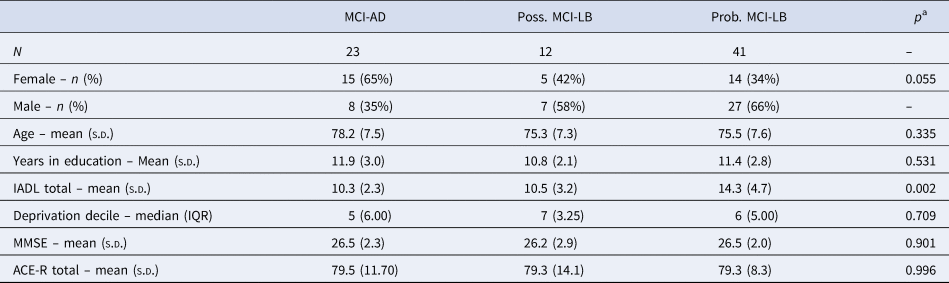
At the time of analysis, participants had been followed-up for a mean of 2.4 years (s.d. = 1.21) after consent at baseline, with a maximum of 5 years. Baseline characteristics of the overall MCI group, and diagnostic subgroups, have been reported in detail previously (Donaghy et al., Reference Donaghy, Taylor, O'Brien, Barnett, Olsen, Colloby and Thomas2018), and are summarised in Table 1. While the groups differed in their baseline functional independence, this was associated with UPDRS scores [Pearson's R(57) = 0.414, p = 0.001] but was not associated with ACE-R scores [R(57) = −0.097, p = 0.464]. This difference was therefore taken to reflect greater motor impairment in the MCI-LB groups, related to the diagnostic presence of parkinsonism.
Baseline characteristics of MCI diagnostic groups

IADL, instrumental activities of daily living; MMSE, Mini-Mental State Examination; ACE-R, Addenbrooke's Cognitive Examination – Revised; Prob. MCI-LB, probable mild cognitive impairment with Lewy bodies; MCI-AD, mild cognitive impairment due to Alzheimer's disease; Poss. MCI-LB, possible mild cognitive impairment with Lewy bodies.
a χ2 tests for gender, ANOVA/Kruskal–Wallis for all others.
Identification of latent classes
Five models were developed to explore; the initial longitudinal mixed model, without accounting for latent classes, provided a BIC value of 1612.07. A two-class model proved better-fitting (BIC = 1593.69), as did a three-class model, albeit less so (BIC = 1604.61). Within each competing model, subjects were assigned a posteriori to the class to which they had the highest membership probability. Any additional groups identified in four- and five-class models were small (n < 10) and indistinct from existing classes.
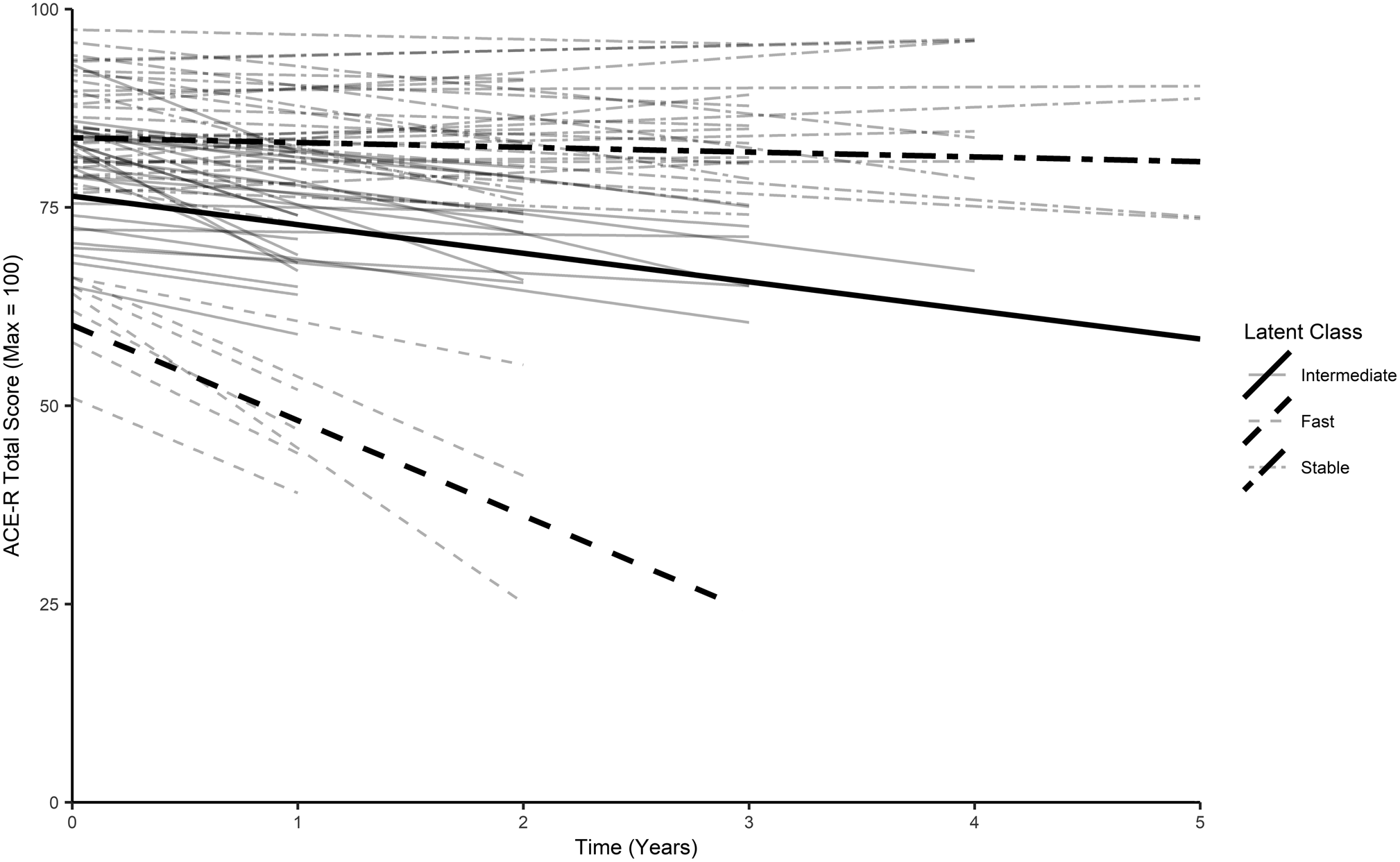
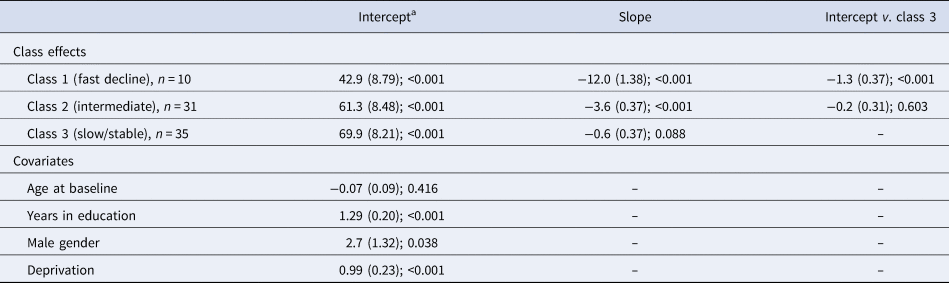
The three-class model was taken forward due to its identification of three clear clinically- and research-relevant groups with distinct trajectories, while maintaining an improved fit over the standard mixed model (Table 2, Fig. 1).
Observed subject-specific (grey) and predicted class-specific (black) linear trajectories of global cognitive change.

Fixed effects on total ACE-R score in a longitudinal model

a Estimate (s.e.); p value.
Class characteristics
The first identified class (n = 10, 13%) represented a rapid declining MCI; they were characterised by a lower baseline function (β = 42.9, s.e. = 8.79) and a steep decline (β = −12.0, s.e. = 1.38) in cognition.
The second class (n = 31, 41%) began with an intermediate level of baseline functioning (β = 61.3, s.e. = 8.48) and a significant, but less aggressive, trajectory of deterioration thereafter (β = −3.6, s.e. = 0.58). This class was treated as the reference group going forward as they approximated the mean decline in the overall MCI group.
The final and largest group (n = 35, 46%) began with the highest level of baseline functioning (β = 69.9, s.e. = 8.21), and did not significantly decline year-on-year over the observed time period (β = −0.6, s.e. = 0.37).
Since baseline function was related to the rate of decline in each group, we sought to examine the influence of impairment level at study entry. When controlling for baseline in the full sample, the mixed model without allowance for latent classes was the best-fitting (BIC = 1417) compared with two- (BIC = 1430), three- (BIC = 1417) and four-class (BIC = 1456) alternatives. We were therefore unable to identify any clear latent classes in the baseline-adjusted model.
Clinical MCI diagnoses in latent classes
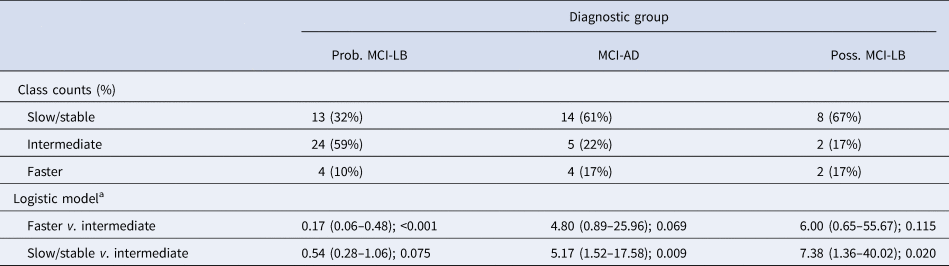
In MCI-AD, 61% progressed with a slow/stable course, 22% had an intermediate trajectory and 17% a fast decline. In possible MCI-LB, 67% followed a slow/stable trajectory, 17% an intermediate decline and 17% a fast decline. In probable MCI-LB, 32% demonstrated a slow/stable progression, 59% intermediate decline and 10% fast decline.
In comparison to probable MCI-LB, possible MCI-LB (OR 7.38, 95% CI 1.36–40.02) and MCI-AD (OR 5.17, 95% CI 1.52–17.58) were significantly more likely to demonstrate a slowed decline relative to the intermediate trajectory (Table 3). Possible MCI-LB and MCI-AD were also overrepresented in the rapid declining group, but neither significantly predicted rapid decline, with wide confidence intervals likely reflecting the low overall prevalence of rapid decline (n = 10).
Latent trajectories observed in each diagnostic group, and multinomial logistic regression for diagnosis as the predictor of prospective trajectory with probable MCI-LB and intermediate trajectory as the respective reference groups

Prob. MCI-LB, probable mild cognitive impairment with Lewy bodies; MCI-AD, mild cognitive impairment due to Alzheimer's disease; Poss. MCI-LB, possible mild cognitive impairment with Lewy bodies.
a Odds ratio (95% confidence interval); p value.
Time course differences: time to dementia
We further explored the effects of time to dementia and baseline function to assess whether trajectory differences between classes could be explained by individuals being at different stages of decline upon study entry (i.e. rapid decliners being simply later-stage MCI than intermediate decliners), by running the LCMM analysis with time zeroed on their study end-stage (observed conversion to dementia, death or withdrawal) rather than baseline assessment date, on the sub-group where this was available (n = 39). In this manner, individual time trajectories were recoded to align at the intercept by their end-point rather than their start; a similar method of zeroing time to the point of dementia transition has previously shown utility in a model of decline in preclinical AD (Verlinden et al., Reference Verlinden, van der Geest, de Bruijn, Hofman, Koudstaal and Ikram2016).
The best-fit model featured two classes, being an improvement over the null mixed model without latent classes (BIC: 687 < 696); these resembled the two declining trajectories observed from the full-sample model. The first and smallest (n = 7) group had a lower estimated function at the intercept (β = 23.0, s.e. = 12.36) and faster decline leading up to this (β = −12.7, s.e. = 1.64). The second group (n = 32) had higher estimated zero-point function (β = 54.1, s.e. = 12.34, p < 0.001) and a slower, but significant, decline to this (β = −3.8, s.e. = 0.80, p < 0.001).
While a three-class model was also a better fit than the traditional mixed model (BIC: 691 < 696), the only further group identified was too small to draw meaningful conclusions from (n = 2).
The numbers in these observed two classes were considered too small to attempt to predict with logistic regression. All seven of the rapid decliners had been classified as rapid decliners with time zeroed to the first observation (100% agreement). Twenty-four of 32 intermediate decliners had been classified as intermediate decliners in the full group (75%), and the remaining eight had been classified as slow/stable decliners (25%). By the nature of their slow decline, those in the original slow/stable group were unlikely to have met dementia criteria, so a sufficiently-sized group with this trajectory could not be identified in this model.
Clinical symptomology and imaging
In the second logistic model, the predictive value of specific symptoms and FP-CIT imaging was also explored in the three-class model. The presence at baseline of RBD, parkinsonism or cognitive fluctuations as clinical symptoms in MCI was not associated with any particular cognitive trajectory (Table 4). Abnormal dopaminergic imaging was also not significantly associated with any particular trajectory of cognitive progression.
Full and reduced best-fit multinomial logistic regression models for included predictors of faster or slower cognitive trajectory in MCI, relative to the intermediate course of decline.

Vis. Halls, complex visual hallucinations; RBD, REM sleep behaviour disorder; Cog. Flucs., cognitive fluctuations; Park., parkinsonism.
aOdds ratio (95% confidence interval); p value.
In the full initial model, and after backwards removal of predictors to reach a best-fitting model under BIC (Table 4), the presence of complex visual hallucinations at baseline was associated with reduced likelihood of slow/stable, rather than intermediate, decline (OR 0.06, 95% CI 0.01–0.52) but was not predictive of fast v. intermediate decline.
Discussion
Prospectively-identified MCI develops in a heterogeneous manner. Our analysis identified three patterns of decline; some people deteriorate at a much faster rate than their peers, others decline slowly or remain stable for several years, and some follow an intermediate trajectory comparable to the overall mean. People with probable MCI-LB were less likely to have a slow/stable course of progression compared with MCI-AD, and the majority declined at the intermediate rate. The majority of those meeting criteria for MCI-AD declined at a slower rate or remained stable. Possible MCI-LB did not clearly differ from MCI-AD in their likelihood of a faster or slower decline. Overall, the presence of visual hallucinations at baseline was specifically associated with intermediate decline rather than a slow/stable cognitive trajectory. Contrary to our hypothesis, abnormal FP-CIT imaging was not associated with a declining trajectory.
Poorer baseline function accounts for some observed faster decline, as controlling for baseline cognitive function performance limits the ability to identify distinct time-courses. Since consent to enter any research study is arbitrary, people will enter at different stages of their natural decline. However, different trajectories may not be due only to observations being at different stages of MCI, as distinct class trajectories are still evident after directly controlling for time to dementia conversion. The lower baseline functions estimated here benefit from the availability of subsequent repeated measures, and the ability to control for numerous covariates; while the group estimates show clear separation, the overall outcome measurement uncertainty at the intercept is much larger. More objective baseline predictors of progression (presence or absence of specific symptoms or biomarkers) may therefore have greater prognostic utility in clinical settings than baseline cognitive scores alone.
Our finding that probable MCI-LB was more associated with progressive decline than MCI-AD fits with previous reports at the dementia stage (Mueller et al., Reference Mueller, Soysal, Rongve, Isik, Thompson, Maggi and Veronese2019; Price et al., Reference Price, Farooq, Yuan, Menon, Cardinal and O'Brien2017; Rongve et al., Reference Rongve, Soennesyn, Skogseth, Oesterhus, Hortobágyi, Ballard and Aarsland2016) and could either reflect a true effect of faster declining subtypes in LB, or may reflect the greater confidence that the observed cognitive disorder is neurodegenerative in nature, rather than subjective or functional. The application of AD-positive biomarkers or eventual post-mortem validation in such an MCI cohort may help to confirm the presence of AD in the absence of LB symptomology.
Whilst complex visual hallucinations were associated with more rapid decline, the absence of visual hallucinations does not necessarily mean that there will not be such a decline, but their presence within an MCI syndrome may forewarn of it. Only one MCI patient out of 13 with visual hallucinations present demonstrated a slow/stable trajectory.
Abnormal FP-CIT imaging was under-represented in the stable group with a low odds ratio, but with large confidence intervals, this was not significant as a predictor of decline. Repeated and quantitative measurement of dopaminergic function may clarify the extent of any relationship if one exists, and the value of FP-CIT imaging in predicting a prospective decline. While dopaminergic imaging alone does not appear to be sufficiently predictive of decline, other imaging methods, diagnostic biomarkers or a combination of these may provide early signs of a prospective decline. Differing rates of decline may reflect different stages of disease course within the MCI stage, or individual burden of neurodegenerative processes, which a combined biomarker approach may be more sensitive to.
This study featured a prospectively-recruited cohort of people with MCI, who were thoroughly assessed by an experienced clinical panel over many years, and therefore clarifies the cognitive prognosis after diagnosis in MCI-LB and MCI-AD. A trade-off of this rigorous assessment is that observed numbers were relatively low; these identified trajectories and predictors require validation with further high-quality prospective data. The rapid declining group was particularly small in absolute number and therefore not susceptible to the analyses of predictors, but of importance in clinical and research settings; there is uncertainty regarding the apparent under-representation of the probable MCI-LB group in the rapid declining group, which could be due to the small number of rapid decliners overall. However, an alternative explanation is that any aetiology responsible for the particularly rapid cognitive decline may also have an obscuring effect on the emergence of clinical symptoms. Rapid decliners were consistently identified after controlling for time to study-end in a post-hoc analysis. Rapid decliners have also been identified by other methods at a rate of approximately 20% in clinical AD groups (Nance, Ritter, Miller, Lapin, & Banks, Reference Nance, Ritter, Miller, Lapin and Banks2019), roughly in line with our data-driven observations in MCI-AD. There is evidence of an expedited decline in mixed AD/DLB (Blanc et al., Reference Blanc, Mahmoudi, Jonveaux, Galmiche, Chopard, Cretin and Sauleau2017) compared to AD alone, and rapid decline within AD may reflect a mixed pathology, of which complex visual hallucinations may be a symptom (Thomas et al., Reference Thomas, Mahin-Babaei, Saidi, Lett, Taylor, Walker and Attems2018), and which has been associated with a faster decline (Brenowitz et al., Reference Brenowitz, Hubbard, Keene, Hawes, Longstreth, Woltjer and Kukull2017a; Reference Brenowitz, Hubbard, Keene, Hawes, Longstreth, Woltjer and Kukull2017b). Higher levels of concomitant AD pathology are also known to obscure the manifestation of clinical features of DLB (Merdes et al., Reference Merdes, Hansen, Jeste, Galasko, Hofstetter, Ho and Corey-Bloom2003), and a mixed AD syndrome with undiagnosed DLB has also been associated with particularly rapid decline, greater than in those with clinically manifest AD and DLB (Malek-Ahmadi et al., Reference Malek-Ahmadi, Beach, Zamrini, Adler, Sabbagh, Shill and Reiman2019), which could explain the potential under-representation of probable MCI-LB in the rapid declining group; the current study is limited in its ability to explain this due to low statistical power in our rapid declining group, and lack of neuropathological confirmation of diagnoses so far, but larger cohorts with a sufficiently sized rapid declining group, or those including neuropathological validation of diagnoses, could build on these findings to characterise the clinical phenotype associated with a particularly rapid decline in MCI.
While the reduced odds of cognitive stability associated with the presence of complex visual hallucinations is both clinically and statistically significant, the confidence intervals around this effect are particularly wide and so the magnitude of this effect is less certain. Additionally, as we did not adjust for multiple comparisons in this exploratory analysis, there is a need for validation of these predictive factors with an independent cohort.
The recruitment methods as detailed may introduce some bias whereby the MCI-AD group may not reflect the typical clinical presentation; all feature some degree of reported symptomology associated with LB disease, such as autonomic symptoms or sleep disturbance, though all lack core DLB features. By the process of exclusion, the MCI-AD cases here meet current NIA-AA criteria for MCI-AD and their syndrome would be treated as such in healthcare settings; confirmation of the exact underlying aetiology will require neuropathological assessment, however.
The delineation between a stable progression and slow decline was not entirely clear; within the slow/stable latent class identified, some cases may be at an early stage of cognitive decline with an undetectably slow progression, prior to any ‘turning-point’ previously observed (Rajan et al., Reference Rajan, Wilson, Barnes, Aggarwal, Weuve and Evans2017), while others may continue with a long-term stable course – possibly suggesting a non-neurodegenerative cause of apparent MCI. Despite the rigorous assessment involved in this cohort, with all participants having a diagnosis of MCI within the health service and having this confirmed according to the NIA-AA criteria within this study, it remains plausible that some of these purported MCI cases may not have any neurodegenerative disease; while classifications vary, past research has identified non-decline at rates ranging from 31% (Pagani et al., Reference Pagani, Dessi, Morbelli, Brugnolo, Salmaso, Piccini and Rodriguez2010) to 55% (Huang et al., Reference Huang, Wahlund, Dierks, Julin, Winblad and Jelic2000) within amnestic MCI. Cognitive impairment secondary to depression, anxiety, or being functional or subjective in nature may be the causes of non-decline (Stone et al., Reference Stone, Pal, Blackburn, Reuber, Thekkumpurath and Carson2015). Being able to identify non-degenerative MCI cases prospectively within clinical settings has many potential benefits for both clinicians and patients, and future research may look to more effectively separate these from slow-declining neurodegenerative cases. The inclusion of a healthy control group for comparison may allow for a clearer separation of slow decline from non-decline, as the latter may be expected to display a cognitive trajectory indistinguishable from that of normal ageing.
Participants were not followed-up after withdrawal, conversion to dementia or death; cognitive trajectories were based on observed data up until any censoring, but any of these outcomes could be equally considered as competing measures of decline, which represents a limitation of this analytical method. With sufficient data, joint modelling of cognitive trajectories incorporating a survival model could be a valid approach to including these.
The early identification of slow/stable, progressive and rapidly progressive MCI groups within MCI-AD and MCI-LB has important implications in clinical practice and research; namely, limiting healthcare costs and individual burden due to diagnostic false-positives in the former and appropriate stratification of samples in research and clinical trials. Lower baseline function and presence of visual hallucinations in MCI may warn of prospective decline.
Acknowledgements
This research was supported by the NIHR Newcastle Biomedical Research Unit (grant numbers BH120812 and BH120878) and by Alzheimer's Research UK (ARUK-PG2015-13). We would like to acknowledge the contributions of the Lewy Body Dementia Association in allowing the use of the Comprehensive Symptom Checklist.
Conflict of interest
None.