The state of Maryland identified its first case of coronavirus disease 2019 (COVID-19) on March 5, 2020. As cases began to surge, Governor Larry Hogan recognized the rising burden on health-care facilities and declared the need to establish alternate care sites. The Baltimore Convention Center became a selected location to set up a 250-bed Federal Emergency Management Agency (FEMA) inpatient care facility, subsequently named the Baltimore Convention Center Field Hospital (BCCFH). Under direction of the Maryland Department of Health, the BCCFH was jointly managed by Johns Hopkins Health System and the University of Maryland Medical System. The field hospital served COVID-19 patients who did not require advanced care in a traditional hospital, but who were not medically stable enough to remain home, or not able to safely quarantine as outpatients. On April 15, 2020, the Maryland Department of Health issued a license for the site to operate as a temporary acute care hospital. Two weeks following the issuance, the facility received its first COVID-19 patient.
Throughout the course of the pandemic, the field hospital took on additional COVID-19 missions: Community severe acute respiratory syndrome coronavirus 2 (SARS-CoV-2) diagnostic testing starting in June 2020, outpatient monoclonal antibody infusions in November 2020, and community COVID-19 vaccinations in February 2021. As the operational plan for each initiative was developed, Infection Prevention and Control (IPC) guidelines were essential for safe operations. For the inpatient care area, IPC plans focused on protecting staff and preventing outbreaks and hospital-acquired infections among patients. For outpatient services, plans centered on preventing the spread of COVID-19 and other communicable respiratory infections among patients and staff. This study describes the approaches taken to develop the infection prevention plans for the initiatives undertaken by the BCCFH.
Discussion
Use of an Infection Prevention and Hospital Epidemiology Team
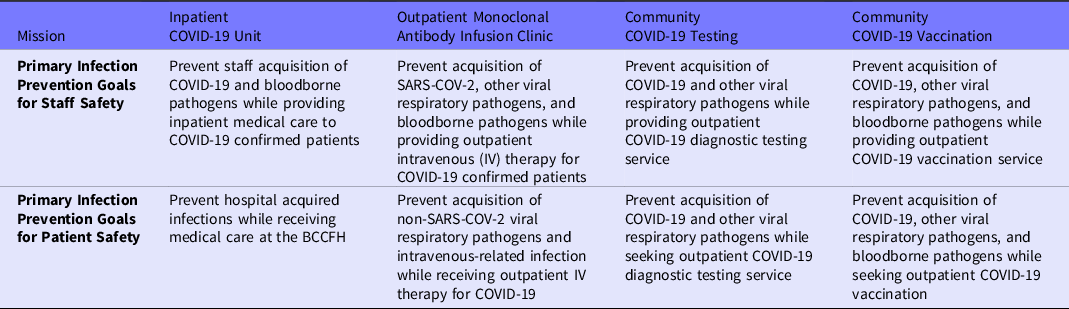
A team of 3 board-certified Infection Preventionists (IP) and a board-certified Infectious Diseases physician and Hospital Epidemiologist from the University of Maryland Medical Center developed the infection prevention framework and assisted the BCCFH team with infection control-related designs. The first goal of the framework was to create an environment and protocols that focused on the safety of staff members (Table 1). The second goal was to establish as much of a classic infection prevention and control program as possible for each mission. Reference Grota, Allen and Ackiss1,2 The largest component of the Infection Prevention Plan was for the COVID-19 confirmed inpatient unit and included the following: completing an infection prevention risk assessment, maintaining standard surveillance and reporting methods, initiating a hand hygiene program for staff and patients, establishing infection prevention and response plans for hospital-acquired infections (HAI) and outbreaks, implementing mandatory masking protocols for all patients, developing relevant infection control policies, creating educational materials for new staff, and instituting employee health protocols for staff immunizations and exposures.
BCCFH missions and primary infection prevention goals

Identifying measurable process and outcome metrics were challenging with few like-facilities to compare. Thus, a primary goal established was to have zero HAIs among hospitalized patients. Once created, the infection prevention program was managed by 1 Infection Preventionist who worked on-site during regular business hours, and episodically on weekends, evenings, and nights.
For the outpatient missions, patients were indoors for a duration of time ranging from 15 min to 3 h, based on the service being provided. Although the outpatient setting has fewer HAI concerns than the inpatient setting, SARS-CoV-2 and seasonal respiratory viruses remained circulating within the community. Hence, infection prevention goals focused most on reducing exposure risks for patients and staff against viral respiratory pathogens within an outpatient setting (Table 1). Additional planning included bloodborne pathogen prevention and exposure response for staff.
Considerations Taken Into Account
Current evidence-based infection prevention and control standards provided the foundation of all IPC recommendations for the BCCFH. Reference Grota, Allen and Ackiss1,3 Infection prevention practices specific to COVID-19 followed current CDC and public health recommendations. 4,5 Literature regarding field hospital establishments often focus on responses to natural disasters and pandemic influenza using crisis standards of care. Reference Sullivan and McDonald6,Reference Lichtenberger, Miskin and Dickinson7 These public health responses tend to use venues that can accommodate hundreds to thousands of individuals. In these settings, IPC best practices become challenging due to shared spaces where both direct and indirect pathogen transmission can occur. Outbreaks of diarrheal and communicable respiratory pathogens are primary concerns, followed by other hospital-acquired infections, such as device-associated infections or the acquisition of multi-drug-resistant organisms.
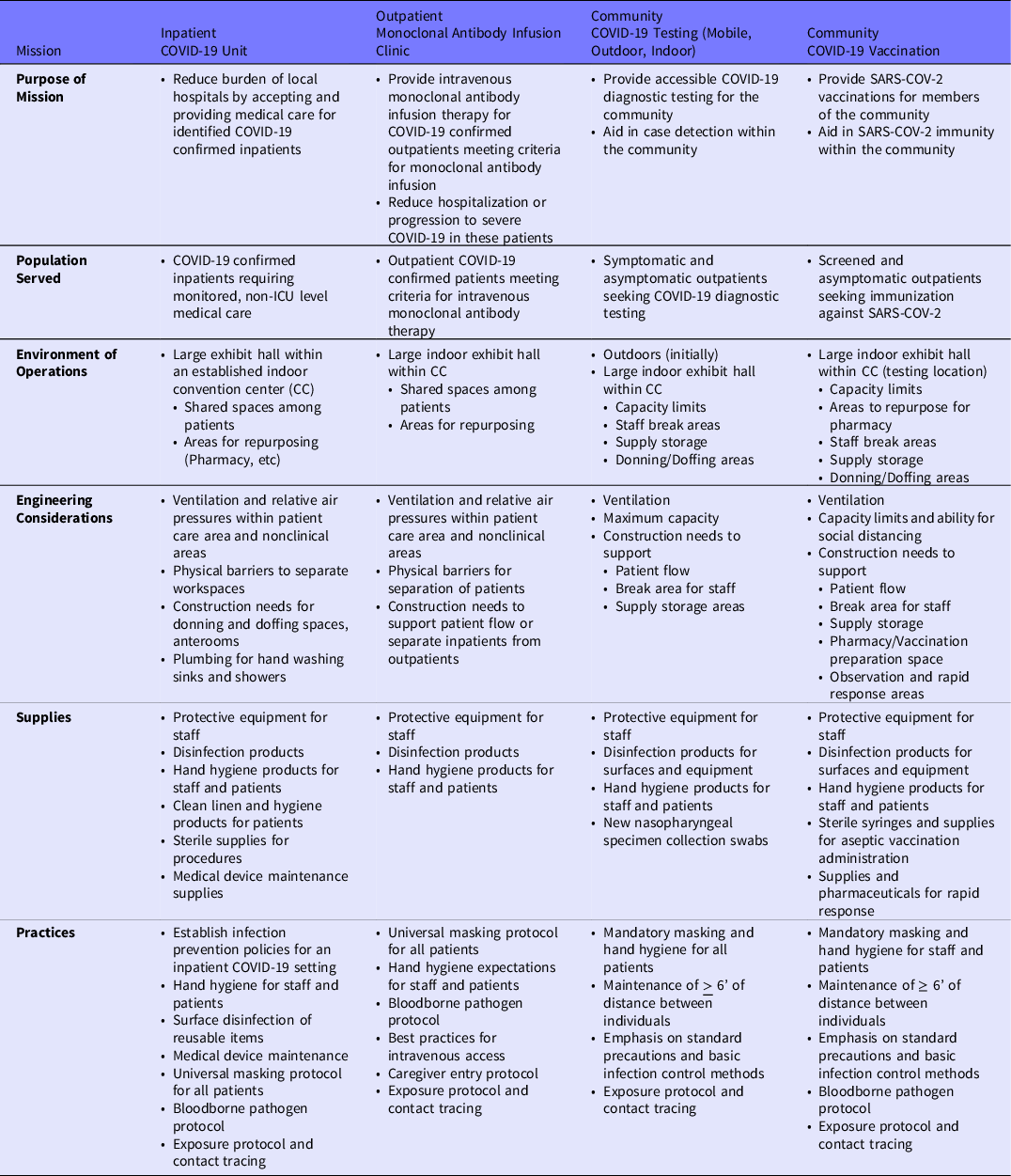
At the onset of the COVID-19 pandemic, definitive transmission routes, infectivity, and disease severity all remained uncertain. Although some literature was of assistance, not all components were addressed for establishing the novel pathogen field hospital. When evidence was limited, Infection Prevention and partner hospital’s epidemiology leadership and BCCFH leadership collaborated to reach final program recommendations. Approaching the BCCFH with existing infection prevention standards, current public health guidance, and answering several key questions described in our PPE-ESP approach (Table 2), led to developing the infection prevention plan and recommendations.
Utilization of PPE-ESP to support infection prevention goals

Note: This table provides examples of considerations made by infection prevention when developing recommendations for missions at the BCCFH
The PPE-ESP Approach to Infection Prevention Considerations
Building on the commonly referenced 4 S’s (staff, space, stuff, and systems), our PPE-ESP framework brings additional focus on IPC considerations, including the following Reference Ajam8,Reference Tadavarthy, Finnegan and Bernatowicz9 : (1) What is the purpose of the mission? (2) Who is the population to be served? (3) What is the operational environment? (4) What engineering modifications are needed to reduce exposure risks? (5) What supplies are needed to help prevent infection among staff and patients? and (6)What practices are needed to prevent infection among staff and patients?
Purpose of the Mission
Defining each mission’s purpose was the first step of a needs assessment for the operation’s required personnel and resources. As listed in Table 2, each mission had a unique purpose in the COVID-19 response.
Population Served
Each of the 4 BCCFH missions had unique populations seeking different services and had different infection risks and preventive measures to consider. Identifying the different groups of patients enabled the team to determine how to successfully serve each group of patients and to prevent pathogen transmission among patients and staff. For each mission’s population, Infection Prevention considered several questions when making recommendations. Questions included, “Can all patients be served in the same space and at the same time?”, “Is there potential for an ill patient to transmit a pathogen to others? If so, how can that be prevented?” and “What, if any, initial screening should take place?”
Physical Environment for Operations
In any health-care scenario, the operation’s physical environment plays a role in infection prevention or acquisition. For example, is the operation to occur in a new and clean building, is the facility older with any obvious environmental concerns such as mold or structural issues, or is this an outdoor site? Further considerations include: ventilation, maximum capacity, areas for hand hygiene and showering, designated spaces for clinical care versus nonclinical space, and existing areas with potential for repurposing.
Considering these factors, Infection Preventionists partnered with the BCCFH team to ensure the space was operationally ready. For the missions that created potential aerosols, ventilation and spatial area considerations significantly contributed to workflow design and capacity limit.
For the inpatient and eventual monoclonal antibody infusion site, existing plumbing was identified to establish hand hygiene stations and shower trailers for inpatients or staff. Due to the urgent need for a rapid setup, water and air testing was not initially performed. The facilities team flushed the pipes upon shower and sink installations before opening them for use. As operations continued, the operations and safety team teams reassessed potential water risks in accordance with CDC and the American Society of Heating, Refrigerating, and Air Conditioning Engineers (ASHRAE) recommendations. 10,11
Community testing for the SARS-CoV-2 virus initially took place outdoors on a blocked off street next to the convention center from June until November 2020. Due to the potential for rapid dilution of respiratory droplets in outside air, this setting provided the ideal environment with the lowest exposure risk for high-volume testing. As winter weather became a safety concern, the team developed a plan to move indoors.
Given the enormous volume and adequate ventilation of the indoor testing space, the site was also selected for the community COVID-19 vaccination mission. This location provided both appropriate ventilation and enough space for patients to maintain at least 6 ft of distance from one another while inside the building. Adjacent to the vaccine administration area, a postvaccination observation section housed individual, spatially distanced chairs and wheelchair spaces. This enabled those who had received the vaccine to maintain a safe distance from others while waiting the recommended 15- or 30-min observation period. Additionally, because SARS-CoV-2 testing required individuals to be unmasked and risk aerosol generation, testing clinic hours always followed vaccination clinic hours. This reduced exposure risks for the vaccination patient population.
Engineering Modifications: Physical Space and Ventilation
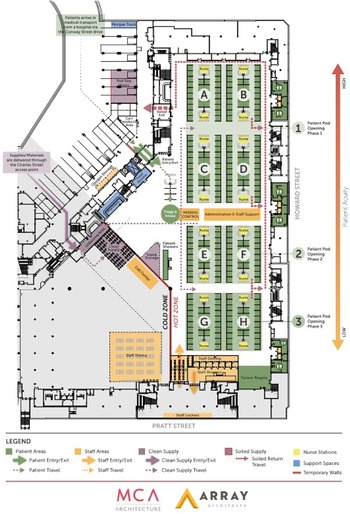
To reduce exposure to infectious respiratory droplets and aerosols, the 2 primary engineering considerations included division of physical spaces and ventilation. Construction teams worked with field hospital leadership, state government agencies, and infection prevention to design the new workspaces for the inpatient area (Figure 1). The 128,000 ft2 patient care space (referred to as the “hot zone”) was separated from nonpatient care areas (“cold zone”) by means of sealed, existing walls in the convention center. Newly constructed walls with entry and exit doors created large anterooms which housed the field hospital’s designated donning and doffing areas. A separately constructed room outside of the doffing space housed the shower trailer and handwashing sinks for staff, offering the opportunity to shower and change into clean clothes before going home.
BCCFH initial design. Four of the 8 pod areas were later redesigned to enhance patient visibility, as seen in Figure 2. Image used with permission.

The physical space within the Field Hospital’s COVID-19 inpatient unit contained 8 bays of 22 to 30 patient beds each (Figure 1). Within the bays, cubicle-like structures with 3 walls and front curtains allowed for private individual space and barrier separation from neighboring patients. These walls reduced possible cross-contamination from a patient with a drug-resistant organism or infectious diarrhea to a neighboring patient. This design is a variation of other potential field hospital layouts where neighboring beds are spatially distanced but lack a physical barrier separation. Reference Tadavarthy, Finnegan and Bernatowicz9,12 Although each patient had an individual cubicle, shared spaces included a patient lounge area, restrooms, and a multiple-stall shower area.
One measure to control airflow within the field hospital was to create negative air pressure in the COVID-19 unit, relative to other areas. 13 Given the original design of the Convention Center, specific pressure monitoring was not feasible. Therefore, ventilation modification included markedly increased positive airflow in the large donning and doffing rooms to create positive pressure relative to the hot zone. Although not monitored electronically, the pressure difference was evident upon opening an entry door or performing a tissue test.
The outpatient infusions took place within the same physical space as the inpatient unit; thus, no additional engineering modifications were made for this ambulatory mission. Last, the hot zone and cold zone had different air supplies and returns to not potentially contaminate air supplied to the cold zone with particles from the hot zone.
Once the physical location was identified for moving testing indoors, ventilation became the next consideration. It was established that the HVAC units for the selected exhibit hall bring 100% outside air into the 32,184 ft2 space with 32-ft ceilings at an exchange rate of 4.128 air changes per hour, with direct exhaust to the outside. To prevent air particles from flowing into adjacent nontesting space, vents and doors that led to office areas were blocked off and checked at the beginning of each testing day. Portable high efficiency particulate air (HEPA) filtering units at each testing table provided additional air filtration and air changes during the testing processes.
For the indoor testing/vaccination location, 1 construction project established entry and exit doors for the facility to assist with organized patient flow. An existing concession stand was repurposed into the pharmacy COVID-19 vaccination preparation area.
Supplies to Prevent Infection Among Staff and Patients
The fifth component of PPE-ESP included infection prevention-related materials. Having an experienced Materials Management team was key in obtaining essential supplies for hospital operations. This department ordered, managed, and maintained all personal protective equipment (PPE) items, hygiene products, disinfectant wipes, medical supplies, and other related infection prevention products commonly used to reduce the risk for hospital-acquired infections.
Availability of PPE fluctuated during the pandemic, but this was managed efficiently as the Materials team had an extensive nationwide network. When certain brands of N95 masks were limited, the team procured alternate brands; this could have resulted in fit-testing difficulties, but the Infection Prevention team partnered with Nursing to ensure multiple staff were competent to fit-test new masks. Additionally, when disposable gowns became short in supply, the team obtained locally manufactured gowns that could be laundered to resolve concerns over running out of isolation gowns. The team consulted with Infection Prevention before purchasing items, such as new gowns or disinfectant wipes.
Practices to Prevent Infection Among Staff and Patients
Several general IPC practices were implemented for staff within the BCCFH. These ranged from onboarding processes to general infection prevention policies and practices within the facility and more specific protocols for various departments. The onboarding process included standard employee health screenings for health-care workers with required vaccinations, tuberculosis screening, and clearance to wear fit-tested respiratory protection. Staff also completed training modules regarding the proper use PPE and general infection prevention practices. Staff were instructed to not come to work if symptomatic or recently exposed to SARS-CoV-2 and to follow up with employee health before returning to work. In the early months of operations, all individuals entering the building received a monitored temperature check. Employees also answered a self-reported application-based screening questionnaire upon clocking in. When temperature checks were identified as having a low relative sensitivity, screening was reduced to the self-reported application-based questionnaire. Infection Prevention collaborated with Employee Health to identify and address employee exposures. Return to work guidance followed CDC recommendations in conjunction with existing employee health protocols.
Universal masking for all individuals upon entry of the building aimed to prevent the spread of infectious droplets. Use of readily available hand sanitizer sought to reduce direct and indirect pathogen transmission, and a spatially distanced staff dining area mitigated the risk of SARS-COV-2 transmission while eating in a shared space. In the cold zone, a designated locker area for staff belongings provided an area for employees to leave their items while working in the hot zone.
Wearing appropriate PPE was an important component of working at the BCCFH. The types of PPE worn by staff depended on the potential exposure risk of their environment. For example, staff providing direct or supportive care to COVID-19 confirmed patients had prolonged exposure to infectious respiratory droplets, potential aerosols, and contaminated surfaces throughout their shift. To reduce exposure risk to SARS-CoV-2, these members of staff wore full PPE that included a fit-tested respirator or powered air purifying respirator (PAPR), a face shield, gloves, and a gown. Due to potential exposure to infectious aerosols during SARS-CoV-2 testing, staff members collecting nasopharyngeal specimens also wore full PPE.
In contrast to staff working with COVID-19 confirmed individuals, staff in the vaccination clinic provided service to masked asymptomatic and screened individuals who were not expected to have COVID-19. Staff also did not participate in potential aerosol-generating procedures, such as nasopharyngeal specimen collection. Thus, staff at the vaccination site wore a surgical mask and eye protection due to close patient contact during vaccination. As a part of standard precautions, staff also performed hand hygiene and donned a new pair of gloves for each vaccine administration.
Posted on each wall within the allocated space for staff perusal, donning and doffing instructions for the field hospital initially followed the CDC’s Ebola recommendations. These instructions were revised based on CDC clarifications specific to COVID-19, or when changes to product or supply availability took place. Due to the limited supply of N95 masks at the start of the inpatient mission, donning and doffing steps also addressed handling and storing of N95s and face shields in accordance with crisis standards for PPE use. 14 Designated PPE “spotters” or observers assisted with the donning and doffing processes and acted as on-site respirator fit-testers.
Infection prevention policies highlighted the leading infection control expectations within the patient care area. The transmission-based precautions policy for the inpatient unit, for example, addressed hand hygiene, equipment disinfection, and when to wear additional PPE. Using a convention center also meant having shared spaces for patients, including patient-only restrooms, a lounge area, walking space, and showers. Given the multiple shared spaces, the BCCFH team agreed that caring for patients with multi-drug resistant organisms, infectious diarrhea, or easily communicated infections created the potential for an outbreak. Thus, it became policy that patients with these types of infections were not accepted into the inpatient unit. The BCCFH leadership and IPC team developed the appropriate infection prevention processes to manage inpatients suspected of developing infectious diarrhea or other non-COVID-19 contagious disease for a ward setting. In some cases, patients were transferred to an acute care hospital where the patient could be better managed in a private room.
A contracted Healthcare Environmental Services (EVS) team performed daily cleaning and disinfection services for all missions throughout the cold and hot zone areas. All waste in the hot zone was designated as regulated medical waste and followed the respective protocols per local regulations. The EVS team collected all soiled linen, which were then laundered by a contracted company. The inpatient cubicle curtains were laundered upon patient discharge of patients with identified colonization or infection with a multi-drug resistant organism or infectious diarrhea to prevent transmission to the next patient being admitted to the cubicle. Within the BCCFH, as in any health-care facility, the Environmental Services team was an essential partner for the infection prevention program and general safe operation.
For the inpatient unit, a contracted catering team prepared all patients’ meals in the convention center’s kitchen area, which was separate from the inpatient area. Radio communication between catering and nursing staff was necessary just before meal delivery to a designated “warm zone” to ensure food did not sit for an extended period. The warm zone provided an anteroom-like area where food was delivered by catering staff, then picked up by clinical staff. Between patient meals, clinical staff picked up snacks for patients from a designated snack area within the hot zone.
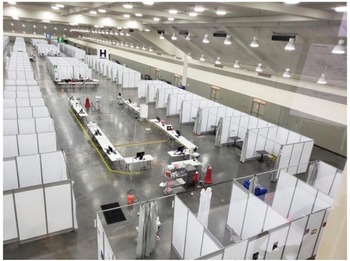
As the pandemic continued into influenza season, the team developed an additional protocol to prevent the transmission of seasonal respiratory infections within the BCCFH. Symptomatic patients admitted to the inpatient unit required at least a negative polymerase chain reaction (PCR) test result for influenza. If the sending facility did not have the testing capabilities, the patient was admitted into a separate patient area (Figure 2; Bay H in Figure 1) where viral respiratory pathogens screening occurred. Patients with a negative PCR test result were moved to the general patient population, whereas a partnering facility accepted patients with a lab-confirmed positive results. In the event of high circulation of influenza within the community, a contingency plan addressed how to accept COVID-19 patients with influenza coinfection within the BCCFH. The contingency plan would have gone into effect if government officials mandated the field hospital to accept these patients. For all outpatient services (community testing, outpatient infusion, and community vaccination), patients entering the facility were required to maintain at least 6 ft of distance from others, wear an appropriate face mask over the nose and mouth, and perform hand hygiene at registration.
Designated patient care area for rule-out patients. To prevent a potential outbreak within the BCCFH, patients suspected of having a non-SARS-CoV-2 viral respiratory pathogen or infectious diarrhea were placed in a spatially separated area. Patients were relocated or transferred based on diagnostic testing and clinical suspicion.

Results
From its earliest design sessions through its multiple pandemic response missions, the BCCFH Infection Prevention program used current IPC standards and collaboration with various agencies and levels of staff. An on-site Infection Preventionist managed and monitored the infection prevention program, performed infection prevention rounds, participated in staff contact tracing, and participated in weekly quality and safety meetings. No infections were identified for CDC defined measures that are required reporting for CMS, including central-line associated bloodstream infection (CLABSI), catheter associated urinary tract infection (CAUTI), methicillin-resistant Staphylococcus aureus (MRSA) bacteremia, C. difficile, and SSI 2. This performance is similar to or better than the benchmark. Additionally, no work-related acquisitions of SARS-CoV-2 were identified and no outbreaks of iatrogenic infections among patients were identified since beginning operations in April 2020.
Limitations
Despite the establishment of infection prevention and control protocols, implementation faced several challenges and limitations. These included staff learning new or unfamiliar processes, staff turnover, multiple agencies working on-site, and variability of supplies. A high turnover rate created a challenge in ensuring thorough staff understanding of the multiple processes and expectations within the BCCFH. Multiple agencies working on-site also made infection control education and contact tracing processes difficult. Varying return-to-work protocols for the various agencies resulted in BCCFH Employee Health and Infection Control not always receiving timely notification of COVID-19 confirmed or exposed staff members, creating challenges for tracing and tracking. Variability of available supplies led to staff having to learn new protocols or having to familiarize themselves with new products. These variabilities occurred more commonly with PPE and disinfection products and contributed to the above-mentioned challenges.
Last, staff compliance with mask use and social distancing within cold zone spaces remained an ongoing challenge throughout the operational timeframe. Direct observations revealed a decline in compliance as the months continued and staff appeared fatigued from the various infection prevention measures. An electronic event reporting platform enabled a managerial review of infection prevention-related incidents and completion of appropriate follow-up items.
Some of the challenges faced may have been overcome by establishing stronger partnerships early on between Infection Prevention and all other departments. This would include working with scheduling services and department managers to establish 1 standard contact tracing protocol and 1 standardized IPC orientation for staff of all agencies at the BCCFH. Partnering with Human Resources and Management to allow Infection Prevention to hold staff accountable may have helped resolve recurrent IP noncompliance. For example, having a policy that allowed Infection Prevention to enter safety infractions to an employee’s file after multiple events of IPC noncompliance. Additionally, having a team of dedicated frontline staff from all departments and shifts trained as the department IP liaisons would have increased the Infection Prevention resources for frontline staff. In absence of the IP, the IP liaisons would be able to answer some of the staff’s questions in real time. Establishing these items upon opening may have created a more solid culture of safety.
Conclusions
The BCCFH was a novel COVID-19 treatment site as the facility and staff were tasked with a range of different COVID-19 response missions, each requiring infection control considerations. Using PPE-ESP while applying CDC guidelines and industry IPC standards enabled the team to safely conduct each operation. Construction and engineering teams created the physical space for a high-functioning COVID-19 facility within a nonhealth-care structure. An experienced supply team ensured that infection prevention-related materials remained at an appropriate level for safe operations, while a health-care environmental services team maintained clean staff and patient areas. Finally, on-site infection prevention and clinical leadership monitored and communicated recommended IPC practices to staff.
As with any implementation program, challenges arose at various stages and required follow-up actions or policy revisions. Nevertheless, the BCCFH team and its partners operated several critical pandemic response efforts within an atypical health-care delivery environment. Combining team collaboration and infection prevention best practices, an operational framework was established to reduce infection risk for those receiving or providing care at the BCCFH during the COVID-19 pandemic.
Acknowledgments
For their contributions to the Infection Prevention Program, the authors recognize Array and MCA Architecture; Gurmehar Singh Deol, MS; the BCCFH Patient Quality & Safety Oversight Committee; and the BCCFH CORE Mission Champion Group. CONQUER COVID Consortium members include Mihir Chaudhary MD, Flora Kisuule, MD, Henry Michtalik, MD, MHS, MPH, and Mark D. Phillips, MD, PhD.