Introduction
Psychiatric in-patients are at greatly increased risk of suicide compared to the general population (Qin & Nordentoft, Reference Qin and Nordentoft2005). There has been a major reduction in mental health in-patient provision and a shift towards community services in many countries (Currier, Reference Currier2000). Levels of morbidity and rates of involuntary admission in the in-patient population may be higher now than in the past (Priebe et al. Reference Priebe, Badesconyi, Fioritti, Hansson, Kilian, Torres-Gonzales, Turner and Wiersma2005; Keown et al. Reference Keown, Weich, Bhui and Scott2011) but the effect of service changes on the rate of in-patient suicide is uncertain. One ecological study from the USA suggested a reduction in public psychiatric beds between 1982 and 1998 was associated with increased suicide rates (Yoon & Bruckner, Reference Yoon and Bruckner2009). In recent years several initiatives have aimed to improve the quality of care of psychiatric in-patients and reduce suicide (CASP, 2004; Joint Commission Resources, 2007; NPSA, 2009; Hampton, Reference Hampton2010). Measures have tended to focus on improving the safety of the physical environment or reducing unauthorized absences from the ward (Department of Health, 2000; Bartholomew et al. Reference Bartholomew, Duffy and Figgins2009).
Comparatively few studies have investigated trends in in-patient suicide over time (Bowers et al. Reference Bowers, Banda and Nijman2010). Our previous work suggested that rates of suicide in psychiatric in-patients in England had fallen between 1997 and 2003 but may have increased in the immediate post-discharge period (Kapur et al. Reference Kapur, Hunt, Webb, Bickley, Windfuhr, Shaw and Appleby2006). A recent study of 279 suicide deaths in Denmark reported that in-patient suicide rates had decreased significantly between 1997 and 2006, at an average of 6% per year (Madsen et al. Reference Madsen, Agerbo, Mortensen and Nordentoft2012). However, most studies to date have not been in a position to consider trends in in-patient suicide risk in relation to potentially important variables such as ethnicity (Bhui & McKenzie, Reference Bhui and McKenzie2008) and diagnosis (Harris & Barraclough, Reference Harris and Barraclough1997). The impact of new services that might be regarded as alternatives to admission (such as crisis resolution/home treatment teams or early intervention teams; Department of Health, 2001) on in-patient suicide rates is unknown. In the current study we aimed to explore suicide in psychiatric in-patients over a 12-year period using a national sample. Our specific objectives were: to investigate longer-term trends in the rate of in-patient suicide; to examine these trends by gender, age, method, ethnicity and diagnosis; and to determine the extent to which in-patient suicide risk may have been transferred to other settings and services.
Method
Case ascertainment
We used the National Confidential Inquiry into Suicide and Homicide by People with Mental Illness database to identify individuals aged ⩾15 years who died by suicide while under psychiatric in-patient care in the years 1997 (the first full year of Inquiry data collection) to 2008 inclusive. The Inquiry methods have been described in detail elsewhere (Appleby et al. Reference Appleby, Shaw, Amos, McDonnell, Kiernan, Davies, Harris, McCann, Bickley and Parsons1999, Reference Appleby, Shaw, Sherratt, Amos, Robinson, McDonnell, McKann, Parsons, Hunt, Burns, Bickley, Kiernan, Davies and Harris2001; Kapur et al. Reference Kapur, Hunt, Webb, Bickley, Windfuhr, Shaw and Appleby2006). In brief, data collection occurred in three stages. First, information on all deaths in England receiving a verdict of suicide or an open verdict at coroner's inquest was obtained from the Office for National Statistics (http://www.ons.gov.uk). Second, information on whether the deceased had been in contact with mental health services in the 12 months before death was obtained from the hospitals and community services providing mental health care in the deceased's district of residence. Third, demographic and clinical data from people who had been in contact with services (‘Inquiry cases’) were obtained by sending a questionnaire to the responsible consultant psychiatrist.
The questionnaire included sections on in-patient suicide. In-patient deaths comprised those that occurred on the ward and those that occurred off the ward (for example, during periods of authorized or unauthorized leave). This definition has been used in previous studies (Lieberman et al. Reference Lieberman, Resnnik and Holder-Perkins2004; Bowers et al. Reference Bowers, Banda and Nijman2010). The questionnaire also included details of whether death had occurred within 3 months of discharge from in-patient care. Diagnoses were those assigned to the patient by the treating clinician according to ICD-10 criteria. In addition, the treatment individuals were receiving at the time of death was recorded. For this study we wanted to identify those who died under the care of services that might be regarded as possible alternatives to in-patient care. One aspect of these specialist treatment settings is to ease the pressure on in-patient units and act as ‘gatekeepers’ for mental health in-patient care. For example, crisis resolution/home treatment teams generally offer 24-h acute care for mental health service users living in the community who experience a crisis or acute exacerbation that requires emergency treatment; assertive outreach teams work with vulnerable adults with severe mental illness who historically have difficulty engaging in mainstream services; and early intervention services provide support to individuals aged between 14 and 35 years who are at the early stages of psychosis.
The overall response rate for questionnaires was 98% but data were less complete for the final year of the study (91%) because of the time delays inherent in the notification process. To make the numerator data comparable across the study period, the number of deaths by suicide in the Inquiry were uplifted to account for the different levels of data completeness in each year. We included only National Health Service (NHS) hospitals in England in the current study.
Denominator data
For rates of suicide in the general population and for Inquiry cases we used mid-year population estimates for England based on the 2001 census as the denominator (http://www.ons.gov.uk).
Hospital Episode Statistics (HES) are based on admission and discharge information for individuals collected directly by hospital providers and collated centrally by the Department of Health (www.hesonline.nhs.uk). They represent the most complete source of clinical denominator data available. For rates of in-patient suicide, the number of in-year NHS bed days for adult mental illness in England was used as the denominator. The denominator included mental illness, forensic psychiatry, psychotherapy and old age psychiatry categories, excluded learning disabilities and day patients, and was based on both finished and unfinished consultant episodes. We also used the average daily number of occupied adult mental illness beds in each year for England obtained from Hospital Activity Statistics as an alternative denominator for in-patient suicide rates (Department of Health, 2009). These data were not available by age and gender and so were used only to calculate overall rates of in-patient suicide.
Rates of suicide by diagnosis were calculated from HES coding of the primary diagnosis (the diagnosis coded as the main reason for admission), classified using ICD-10 codes. Diagnoses were mutually exclusive. In line with diagnostic data collection within the Inquiry, rates of suicide for patients with personality disorder were based on a broad personality disorder categorization (ICD-10 code F60) and did not include subtypes. Rates of suicide by ethnic group (White versus all others) were calculated using HES ethnicity coding. However, levels of missing ethnicity data for the earlier years of the study were as high as 26%, therefore these rates should be treated with caution. To estimate the rate of suicide in the first 3 months after discharge from hospital we used the annual number of NHS adult mental illness discharges in England (obtained from HES) as the denominator.
There were no nationally available comprehensive data on individual contacts with crisis resolution, assertive outreach or early intervention teams. Although some data were collected through the Mental Health Minimum Dataset (MHMDS), coverage was incomplete (MHMDS, 2009). Therefore, the numbers of individuals in contact with these services at the time of death were presented as an alternative to rates.
Statistical analyses
Overall annual in-patient suicide rates were estimated as incidence rates using in-year bed days as true denominators. Rates were estimated by gender, age, method of suicide, ethnicity and diagnosis. Calendar year was fitted as a continuous variable in a Poisson regression model to test for linear trends in the in-patient suicide rate over time (Gardner et al. Reference Gardner, Mulvey and Shaw1995). We tested the Poisson models for evidence of significant overdispersion using the likelihood ratio (LR) test of α = 0 that is generated by the negative binomial model. If the test indicated goodness-of-fit problems in the Poisson model, the parameters from the negative binomial model were reported instead (Gardner et al. Reference Gardner, Mulvey and Shaw1995). We projected our data to account for different levels of data completeness by year. However, because completeness was lower in the last year of the study (2008) we also carried out a sensitivity analysis by examining our findings with the final year of data excluded.
If linear trends were present, simply comparing rates in the first year of the study with rates in the last year of the study could overestimate the degree of change over time. To summarize the findings, for all trends, we therefore compared the mean rate in the first 2 years of the study (1997 and 1998) with the mean rate in the last 2 years (2007 and 2008).
Ethical approval was obtained from the North West Research Ethical Committee. The Confidential Inquiry also has approval under Section 60 of the Mental Health and Social Care Act.
Results
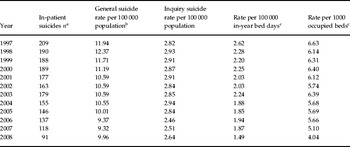
Table 1 shows estimated rates of suicide by calendar year. There was a 20.7% reduction in the general population suicide rate between the first 2 years of the study and the last 2 years. The fall in the rate of Inquiry cases (patients under mental health care) was less marked during this time period (10.3%).
Suicide rates by calendar year, England (1997–2008)

a Data completeness for Inquiry and in-patient samples by year was 91–99 %. Annual figures have been uplifted by a factor so that the estimated numbers reflect 100% completeness.
b The rates of suicide in the general population reported here are somewhat higher than official figures (NIMHE, 2008). Official figures are based on European standardized populations and 3-year rolling averages.
c Calendar year was fitted as a continuous variable in an exponential log-linear Poisson model to generate likelihood ratios (LRs). LR χ2 tests for in-patient suicide were 24.67 (1 df, p < 0.001) per 100 000 in-year bed days and 15.91 (1 df, p < 0.001) per 1000 occupied beds.
Rate of in-patient suicide
There were 1942 deaths by suicide in psychiatric in-patients over the study period. The annual number of in-patient suicides fell from an average of 200 (in 1997 and 1998) to 105 (in 2007 and 2008), that is a 47.6% reduction. The corresponding fall in the rate of suicide among in-patients using in-year bed-days as a denominator was from 2.45 to 1.68 per 100 000 bed days (a 31.2% reduction, with a highly statistically significant linear trend). The fall in rates was sharper in the earlier years of the study. The reduction in suicide rate was statistically significant for deaths that occurred on the ward [LR χ2 test (linear trend; 1 df) 25.28, p < 0.001] and also for deaths that occurred at a distance from the ward [LR χ2 test (linear trend; 1 df) 7.41, p = 0.007] but the magnitude of the reduction was greater for ward deaths (51% v. 22%).
When we based the rate of in-patient suicide on occupied beds, the rate fell from 6.39 (in 1997 and 1998) to 4.57 (in 2007 and 2008) per 1000 occupied beds (a 28.4% reduction, with a significant linear trend).
Rates of suicide by subgroup
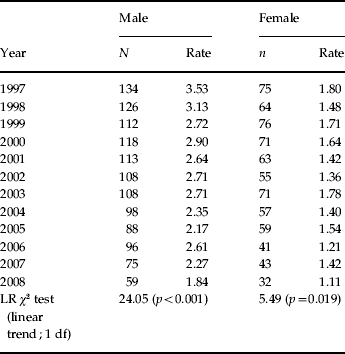
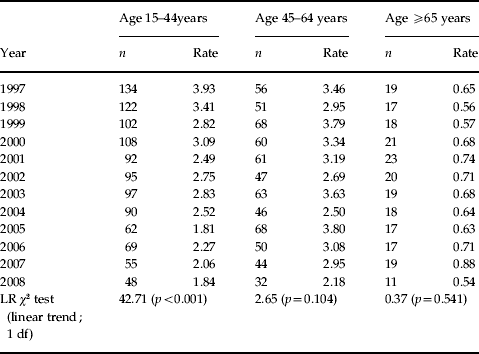
The rate of in-patient suicide was higher in males than females (Table 2), and rates fell significantly in both groups (38.2% and 22.3% respectively). Suicide rates were highest in the youngest age group in the first 2 years of the study (Table 3). Thereafter they were generally highest in those aged 45–64 years. Rates were lowest in those aged ⩾65 years. The fall in rates was only statistically significant in the youngest age group (a reduction in rates of 46.7% between 1997/1998 and 2007/2008, with a highly significant linear trend, p < 0.001).
Rates of in-patient suicide per 100 000 in-year bed days by gender and calendar year, England (1997–2008)
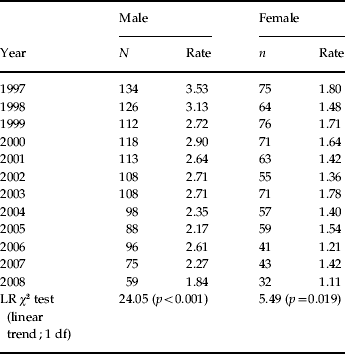
LR, likelihood ratio; df, degrees of freedom.
Rates of in-patient suicide per 100 000 bed days by age group and calendar year, England (1997–2008)
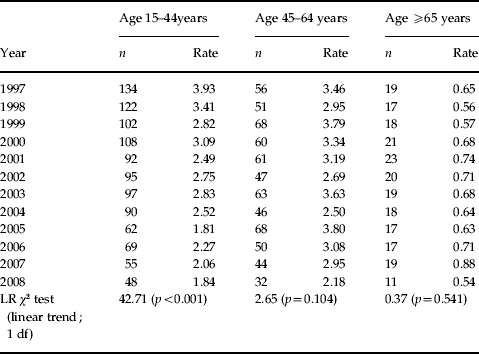
LR, likelihood ratio; df, degrees of freedom.
The total number of deaths may differ slightly from Table 1 because of rounding of figures.
Rates were generally higher for White in-patients compared to those from all other ethnicities. There were statistically significant falls in rates in White (42.0%) patients and in patients from other ethnic groups (57.0%), although the higher levels of missing data in the earlier years of the study mean these reductions should be interpreted with caution.
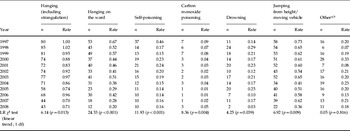
Table 4 shows the rate of in-patient suicide by method. There were statistically significant linear falls in deaths by hanging (30.7%), drug poisoning (48.5%), carbon monoxide poisoning (59.6%), drowning (51.2%) and jumping (28.4%). The fall in deaths by hanging was particularly pronounced for those deaths that occurred on the ward: the mean rate of hanging on the ward fell from 0.60 (in 1997 and 1998) to 0.24 (in 2007 and 2008), a 58.9% reduction, with a highly significant linear trend.
Rates of in-patient suicide per 100 000 bed days by method of suicide and calendar year, England (1997–2008)

LR, likelihood ratio; df, degrees of freedom.
The total number of deaths by suicide may differ slightly from Table 1 because of rounding of figures. Method of suicide was unknown in two cases.
a Because of evidence of overdispersion in the Poisson model, the test result was generated by the negative binomial model (see statistical analysis).
b Includes cutting/stabbing, suffocation, burning, firearms, electrocution and other specified.
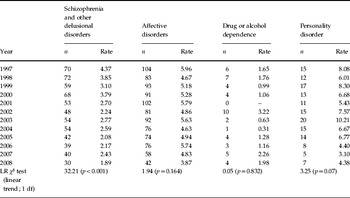
Rates of suicide were higher among in-patients with personality disorder and affective disorder compared to those with schizophrenia or drug or alcohol dependence (Table 5). Rates fell across most diagnostic groups and the falls were statistically significant for those with schizophrenia (47.1%).
Rates of in-patient suicide per 100 000 bed days by primary psychiatric diagnosis and calendar year, England (1997–2008)

LR, likelihood ratio; df, degrees of freedom.
The total number of deaths by suicide may differ slightly from Table 1 because of rounding of figures. Primary psychiatric diagnosis was unknown in eight cases.
Post-discharge suicide and suicide in other settings
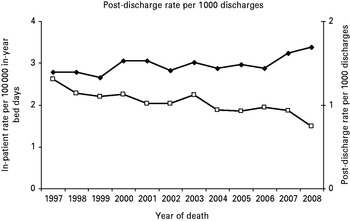
Figure 1 shows the rate of suicide in in-patients (using in-year bed days as the denominator) and the risk of suicide within 3 months of discharge (using discharges as a denominator). The different denominators mean that the two sets of figures should not be compared directly. The rate of in-patient suicide fell by 31.2% between the first 2 years of the study and the last 2 years. The number of post-discharge suicides fell from an average of 265 (in 1997 and 1998) to 208 (in 2007 and 2008), a 21.7% reduction. However, because of a decline in the denominator (the overall number of discharges fell from approximately 190 000 per year in 1997/1998 to 125 000 per year in 2007/2008), the rate of post-discharge suicide in fact rose from 1.39 to 1.66 per 1000 discharges per year. This represented a 19.3% increase between the first 2 years of the study and the last 2 years, with a significant linear trend (p = 0.017).
Rate of in-patient suicide (-□-) and risk of post-discharge suicide (-♦-), England 1997–2008.

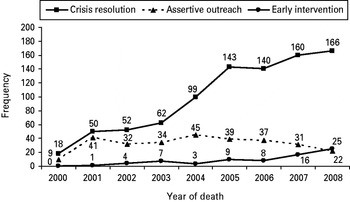
Figure 2 shows the number of community suicide cases in contact with crisis resolution/home treatment teams, assertive outreach or early intervention teams at the time of death from 2000 (the earliest year of data collection by the Inquiry on these services) to 2008. Over this period, there was a large increase in the number of suicide cases who had been under crisis resolution teams [LR χ2 test (linear trend; 1 df = 240.9, p < 0.001)] and in those treated under early intervention teams [LR χ2 test (linear trend; 1 df = 53.4, p < 0.001)], whereas the number under assertive outreach teams remained stable. In 2008, the number of suicide deaths occurring under the care of crisis resolution/home treatment teams was 1.8 times higher than the number of in-patient deaths.
Number of suicides by community patients under crisis resolution, assertive outreach or early intervention teams, England 2000–2008. The increase in suicide deaths is likely to be partly a reflection of the markedly increased numbers of patients under these services (MHMDS, 2009). For example, crisis resolution/home treatment teams were introduced in 2000 and by 2006–2007 there were 343 such teams operating across England (National Audit Office, 2007). However, the lack of availability of denominator data meant that we were unable to calculate rates, and the figures presented here refer to numbers of deaths.

Sensitivity analysis
Sensitivity analysis (with the final year of data excluded) showed similar results to the main analyses, with the exception that rates in females and rates in death by drowning and jumping were no longer statistically significant, nor was the increase in post-discharge suicide rates [LR χ2 test (linear trend; 1 df = 2.65, p = 0.104)].
Discussion
Main findings
Our results suggest that suicide in psychiatric in-patients is becoming less common. We found that 118 fewer individuals died as in-patients in 2008 than in 1997. Using two available denominators we estimate that the rate of suicide among psychiatric in-patients fell by between 29% and 31% during the study period. This fall was observed across genders, ethnicities and methods of death. The fall was most marked for the youngest age group (15–44 years) and in patients with schizophrenia. Although the number of deaths by suicide in the immediate post-discharge period also fell, the rate of post-discharge suicide (using discharge as a denominator) may have increased by as much as 19%. The number of deaths occurring under the care of crisis resolution/home treatment has increased. It is now higher than the number dying under in-patient care, but lack of denominator data means that we are unable to calculate rates.
Strengths and limitations of the study
This is a national study with robust data collection and it was significantly larger than our previous study (Kapur et al. Reference Kapur, Hunt, Webb, Bickley, Windfuhr, Shaw and Appleby2006) and a recent Danish study of 279 deaths (Madsen et al. Reference Madsen, Agerbo, Mortensen and Nordentoft2012). However, our findings should be interpreted in the context of several methodological limitations. Our main source of denominator data was information routinely collected by hospitals and not collected specifically for the purposes of this study. Although HES data have their drawbacks (Kapur et al. Reference Kapur, Hunt, Webb, Bickley, Windfuhr, Shaw and Appleby2006), they are widely used for research and planning purposes (www.hesonline.nhs.uk). Accurate denominator data were not available for some groups that showed a large increase in the number of deaths (e.g. crisis resolution/home treatment services). Case ascertainment relied on the return of information from hospitals and clinicians. However, the Inquiry consistently obtains high response rates (Appleby et al. Reference Appleby, Shaw, Kapur, Windfuhr, Ashton, Swinson, While, Lowe, Bickley, Flynn, Hunt, McDonnell, Rodway, Roscoe, Turnbull, Burns, Hadfield and Stones2006). In addition, whereas most years of Inquiry data were almost complete, the actual number of in-patient suicide deaths for 2008 may have been higher or lower than we projected, but even excluding this year there was a strong downward linear trend in the rate of in-patient suicide. Finally, although we obtained a complete national sample, the findings are not necessarily generalizable to other countries. The devolved nations of the UK (Scotland, Wales, Northern Ireland) were not included in this study. We also did not include privately provided psychiatric beds (although our data indicate that suicide deaths in these settings make up less than 4% of all psychiatric in-patient suicides). However, many of the issues in preventing suicide in psychiatric in-patients are universal (Lieberman et al. Reference Lieberman, Resnnik and Holder-Perkins2004; Qin & Nordentoft, Reference Qin and Nordentoft2005; Cassells et al. Reference Cassells, Paterson, Dowding and Morrison2005) and therefore our findings should be relevant to mental health services internationally, perhaps particularly those that have seen a move towards community mental health services.
We used the generally accepted criteria for suicide deaths in UK research and practice (including both suicide and undetermined deaths). Recent concerns have been raised regarding the increasing use of narrative verdicts. Such verdicts provide more detail regarding immediate antecedents but may result in the miscoding of suicide deaths (Gunnell et al. Reference Gunnell, Hawton and Kapur2011). We consider it unlikely that miscoding will have had a major impact on the findings from the current study. The large increase in narrative verdicts occurred in the years after 2006. Even excluding the last 2 years from our study, there is good evidence for a sustained fall in in-patient suicide rates. The view of the Office for National Statistics based on deaths occurring up to 2009 is that national suicide rates based on existing definitions are robust (Hill & Cook, Reference Hill and Cook2011).
Interpretation of findings
Our results indicate that the rate of in-patient suicide has fallen. This decline has occurred despite a reduction in psychiatric beds and a greater morbidity in the in-patient population (Keown et al. Reference Keown, Mercer and Scott2008). How might these findings be explained? It is possible that our findings simply reflect falling suicide rates generally. However, the fall in the suicide rate for in-patients (29–31%) in this study was greater than that seen in the general population (21%) and in the mental health population (10%) during the same period. We also carried out a post-hoc analysis adjusting trends for changes in the general population rate (by including the general population rate as a confounder in the Poisson model). The downward trend for rates based on bed days remained statistically significant [LR χ2 test (linear trend; 1 df = 11.81, p = 0.001)].
It is also possible that changes to the in-patient case mix could have contributed to the fall in rates. In our previous study we found little evidence for this (Kapur et al. Reference Kapur, Hunt, Webb, Bickley, Windfuhr, Shaw and Appleby2006). We know from an examination of HES data that admissions for affective disorder declined at a faster rate than admissions for schizophrenia during the study period (35% reduction v. 7% reduction). However, one of the major advantages of the current study over previous investigations is that we were able to examine trends in individual demographic and diagnostic subgroups using specific denominator data. We found that rates fell across most groups. However, rates remain high among the middle aged and those with affective or personality disorders.
It seems feasible that an increased awareness of the problem of in-patient suicide through policy initiatives and guidance may have contributed to falling rates (Appleby et al. Reference Appleby, Shaw, Amos, McDonnell, Kiernan, Davies, Harris, McCann, Bickley and Parsons1999, Reference Appleby, Shaw, Sherratt, Amos, Robinson, McDonnell, McKann, Parsons, Hunt, Burns, Bickley, Kiernan, Davies and Harris2001; Department of Health, 2000, 2002a, b). Ligature points have been the focus of suicide prevention efforts in in-patient settings (Department of Health, 2000; NPSA, 2009). The fall in the rate of suicide by hanging on in-patient wards was particularly pronounced (nearly 60%) during the study period. The reduction in suicide rate was greater for deaths that occurred on the ward than for deaths that occurred at a distance from the ward. Rates of in-patient suicide were still higher than the general population rate at the end of our study period: approximately 600 per 100 000 when expressed in terms of in-patient years (rather than in-patient days as in Table 1), or around 60 times the general population rate. Our findings suggest that strategies to further reduce in-patient suicide might focus on the processes for granting leave or preventing unauthorized absences from the ward, as well as the physical ward environment (Appleby et al. Reference Appleby, Shaw, Kapur, Windfuhr, Ashton, Swinson, While, Lowe, Bickley, Flynn, Hunt, McDonnell, Rodway, Roscoe, Turnbull, Burns, Hadfield and Stones2006).
Our figures on the increasing rate of post-discharge suicide should be interpreted with caution. The numbers of such deaths did in fact fall, but because of a large decrease in the number of discharges on the HES database (approximately 34%), the rates seemed to have increased. We checked the fall in the number of discharges against the fall in the number of in-year admissions, and found these to be identical (34%) during the study period. The number of available beds (obtained through Hospital Activity Statistics) fell by a similar amount (27%). One possible explanation for increasing rates of post-discharge suicide is the reduction of the in-patient bed base, which means that services are now managing a higher-risk group of patients. These increased risks may be less controllable in the post-discharge setting than in the in-patient setting (where rates have fallen). Our findings are consistent with a recent UK study (Hoang et al. Reference Hoang, Stewart and Goldacre2011) that found an increasing standardized mortality ratio in discharged patients with schizophrenia or affective disorder (although three-quarters of deaths were from natural causes in that study). By contrast, studies in Finland have shown reduced post-discharge suicide mortality among patients with severe mental illness over time, despite a smaller number of psychiatric beds (Pirkola et al. Reference Pirkola, Sohlman, Heila and Wahlbeck2007; Rantanen et al. Reference Rantanen, Koivisto, Salokangas, Helminen, Oja, Pirkola, Wahlbeck and Joukamaa2009). It has been suggested that this reduction may, in part, be explained by an increase in psychiatric treatment within primary care facilities in Finland, in addition to improved post-discharge community care (Pirkola et al. Reference Pirkola, Sohlman, Heila and Wahlbeck2007; Rantanen et al. Reference Rantanen, Koivisto, Salokangas, Helminen, Oja, Pirkola, Wahlbeck and Joukamaa2009).
Another explanation for our finding of an increased rate of post-discharge suicide could be a transfer of risk from the in-patient setting to the post-discharge period because of earlier discharge from hospital. However, available data would seem to suggest that lengths of stay for most age groups have stayed relatively stable or even increased in the time period covered by this study (www.hesonline.nhs.uk). Whatever the explanation, these findings should remind services of the need to provide prompt and appropriate follow-up after discharge from in-patient care (Appleby et al. Reference Appleby, Shaw, Sherratt, Amos, Robinson, McDonnell, McKann, Parsons, Hunt, Burns, Bickley, Kiernan, Davies and Harris2001; Qin & Nordentoft, Reference Qin and Nordentoft2005). The current study was not designed to examine the impact of our previous recommendations on community follow-up within 7 days of discharge or other aspects of care (Department of Health, 2002 a, 2002 b). This is the focus of ongoing research (While et al. Reference While, Bickley, Roscoe, Windfuhr, Rahman, Shaw, Appleby and Kapur2012).
The number of suicide deaths occurring under the care of crisis resolution/home treatment teams has increased, as would be expected given the expansion of these services (Glover et al. Reference Glover, Arts and Suresh Babu2006). The number of these deaths is now 1.8 times higher than suicide deaths in psychiatric in-patient care. However, expressing our findings just in terms of a transfer of risk from one setting to another may be overly simplistic. In practice these teams have a wider remit than simply preventing in-patient admission and now provide care to many individuals with less severe mental illness (Harrison et al. Reference Harrison, Rajashankar and Davidson2011). We were unable to calculate rates of suicide in specific community settings but, using the MHMDS, we have previously shown that the rates of suicide in mental health patients overall is decreasing (Appleby et al. Reference Appleby, Kapur, Shaw, Hunt, Flynn, While, Turnbull, Windfuhr, Williams, Rodway, Roscoe and Rahman2011). If risk was being transferred from the in-patient to the home treatment setting we might expect the characteristics of patients dying by suicide in the two settings to become more similar over time. However, a post-hoc analysis comparing those who died under the care of crisis resolution/home treatment teams to those who died as in-patients found little evidence to suggest that the characteristics of suicides under these treatment settings were converging. Indeed, fitting an interaction term for time period (2000–2003 v. 2004–2008) showed that only two interaction terms were significant (ethnicity and schizophrenia). Further examination suggested that the in-patient and home treatment groups were in fact becoming less (not more) similar over time with respect to these two variables.
Conclusions
There seems to have been a sustained reduction in the rate of suicide among psychiatric in-patients in England at a time of falling bed numbers. This has been evident across several demographic and clinical subgroups. Changes to in-patient case mix or better quality services are potential explanations, but a transfer of risk cannot be ruled out. In particular, the potentially high rates of suicide in settings that are alternatives to in-patient care warrant further exploration.
Acknowledgements
We thank the administrative staff in NHS Trusts who helped with the Inquiry processes and the clinicians who completed the Inquiry forms. Current staff at the Inquiry (in addition to the authors) are: A. Williams, R. Lowe, D. While, J. Burns, P. Turnbull, A. Roscoe, S. Flynn, P. Stones, P. Clarke, P. Saini and H. Daud.
This study was funded by the National Patient Safety Agency (NPSA, UK). The funders had no role in the study design, data collection and analysis, decision to publish, or preparation of the manuscript. The National Confidential Inquiry into Suicide and Homicide by People with Mental Illness is currently funded by the Healthcare Quality Improvement Partnership (HQIP).
Declaration of Interest
N.K. is Chair of the Guideline Development Group for the National Institute for Health and Clinical Excellence (NICE) self-harm guidelines and a member of the National Suicide Prevention Advisory Group (England). L.A. is the National Clinical Director for Health and Criminal Justice for England. He also chairs the Suicide Prevention Advisory Group at the Department of Health.