1. INTRODUCTION
This article examines the linguistic mechanisms governing the distribution of phonetic variants of the phonemic palatal lateral, /ʎ/, in two obsolescent Romance languages traditionally spoken in France: Occitan and Catalan. In both languages, the palatal lateral is realized as [ʎ] or [j] and this variability may be interpreted as an intermediate stage in a change which will lead to the phonemic merger of the palatal lateral with the palatal approximant (referred to as ieisme in Catalan), neutralizing the /ʎ/~/j/ contrast and entailing loss of the lateral. The varieties examined in this study find themselves in long-term language contact with French, a Romance language in which the /ʎ/>[j] change has come to completion and which no longer contains a phonemic palatal lateral. The /ʎ/>[j] change had taken place in French by the end of the nineteenth century and is commonly considered to be the result of internal simplification, neutralizing a phonemic contrast with a low functional load; indeed, we will show that this change has occurred in other Romance languages that do not find themselves in situations of long-term contact.
For Occitan and Catalan, however, we might assume that contact with and transfer from French is an important factor in the advancement of the /ʎ/>[j] change in these dying languages, but we cannot discount the possibility that the change may also be conditioned by language internal factors, as it has been elsewhere in Romance (e.g. yeísmo and lleísmo in Spanish). In this study, we ask: how do we account for variation and change in obsolescent languages that appears to be due to contact with a dominant language when, in fact, the change has taken place historically in the dominant language and in other, phylogenetically related, language varieties? To answer this question, we examine internal and external mechanisms governing the /ʎ/>[j] change in both Occitan and Catalan, using impressionistic and acoustic phonetic data from 20 Occitan-French and 20 Catalan-French bilinguals. We first examine the transfer from French of phonetic segments and of constraints on variation, before investigating internal linguistic mechanisms governing variation and change in both languages that cannot be attributed to contact with French. In the discussion, we address the issue of the ‘actuation problem’ (Weinreich et al., Reference Weinreich, Labov, Herzog, Lehmann and Malkiel1968: 102), or of determining what actually triggers this change in the first place.
2. CONTEXT
2.1. External history of Occitan and Catalan
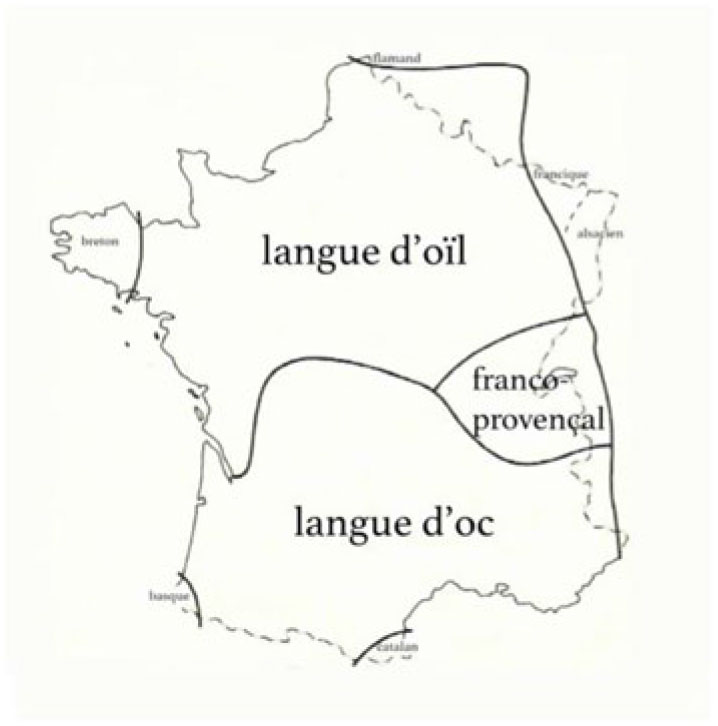
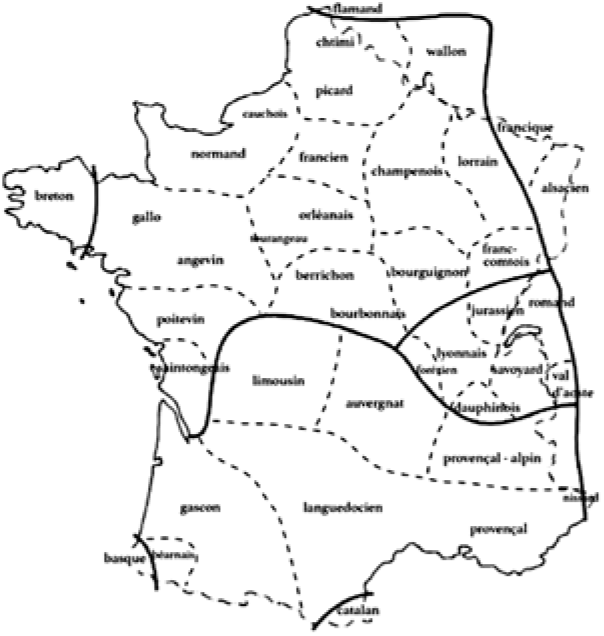
By the tenth century, Latin-based varieties spoken in Gaul had become strongly diversified, with the most significant division within Gallo-Romance between the langue d’oc (often referred to as ‘Occitan’) in the south, and the langue d’oïl, in the north (see Figure 1). The modern langue d’oc area is commonly divided into six main dialects (Bec, Reference Bec1963:37; see Figure 2), with Gascon in the southwest, including the Béarnais sub-dialect (the focus of the present study).
Gallo-Romance languages (Mooney, Reference Mooney2016: 9)

Gallo-Romance dialect areas (Mooney, 2016: 9)

The linguistic classification of Catalan remains controversial (cf. Badía Margarit, Reference Badía Margarit1955 and the use of the term lengua puente), and it is most frequently described as Ibero-Romance, rather than Gallo-Romance. Catalan-speaking areas were subject to unique external pressures, such as the presence of an Arabic-speaking elite in the south of the territory. Most Catalan-speaking regions came under Castilian influence from the early fifteenth century, and the earliest processes of transfer from this powerful superstate are documented around this time. Catalan is divided into two broad dialect areas, Western and Eastern (Veny and Massanell, Reference Veny and Massanell2015), and Northern Catalan (the focus of this article) is a sub-dialect of Eastern Catalan.
Although the classification of Occitan as Gallo-Romance and Catalan as Ibero-Romance is common, some scholars criticize the justification for this decision as superficial. Posner is not alone in maintaining that ‘the end-result looks suspiciously like areal grouping’ (Reference Posner1996: 24), and Juge (Reference Juge2007) defends the notion that Catalan and Occitan should in fact form their own separate sub-branch of Romance. Many studies, including Bec (Reference Bec1963) and Sumien (Reference Sumien2006), have emphasized the common diachronic developments in, and strikingly similar synchronic structures of, Occitan and Catalan: ‘whereas a “Proto-Occitan-Catalan” is a quite plausible concept, a “Proto-Occitan-French” (excluding Catalan) certainly is not’ (Harris, Reference Harris, Harris and Vincent1988: 16). On this basis, ‘Occitano-Romance’ has been proposed as a sub-language family in its own right, distinct from Gallo- and Ibero-Romance, or, in some cases, as a sub-grouping within Gallo-Romance. Bec (Reference Bec1963: 55–58) takes this argument further, proposing two supra-dialectal areas within Occitano-Romance, on the basis of common phonological developments in each area: alverno-méditerranéen (later arverno-méditerranéen; Bec, Reference Bec1973: 18–19), including nord-occitan and Provençal, and aquitano-pyrénéen, including (Pyrenean) Lengadocian, Gascon, and Catalan. Within the aquitano-pyrénéen grouping, which is said to be ‘centré autour du gascon’ (Bec, Reference Bec1973: 18), Pyrenean Lengadocian is identified as ‘le “pont” naturel entre gascon et catalan’ (Bec, Reference Bec1973: 19), but the rest of the Lengadocian dialect is singled out as particularly conservative, emphasizing the structural parallels between the Gascon dialect and Catalan.
2.2. Sociolinguistic profile of Occitan and Catalan
The introduction of the Lois Jules Ferry (1880–1886), which provided free and compulsory education in French, as well as national conscription during the two World Wars, constituted a serious blow to the regional languages of France and instigated a widespread process of language shift throughout metropolitan France. As such, both Occitan and Catalan are in an increasing state of language obsolescence in France.
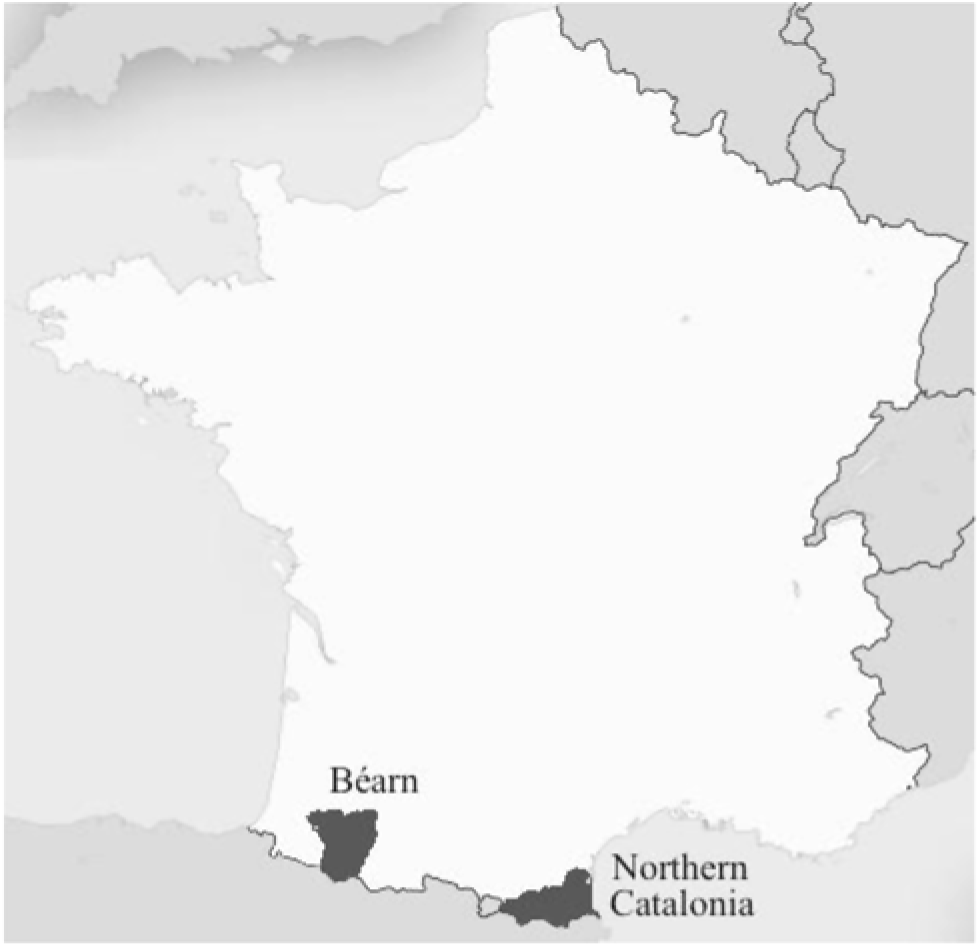
It is difficult to propose speaker numbers for Occitan, and indeed for the langues de France in general, but recent work has cautiously estimated that there are around 500,000 native speakers in total (Martel, Reference Martel2007). In the present study, data will be drawn from speakers of the Béarnais sub-dialect of Gascon (see Figure 3), the historically Romance-speaking part of the Pyrénées-Atlantiques département. In contrast to Martel’s (Reference Martel2007) estimate, Moreux (Reference Moreux2004: 25) suggests that, in the entire historically Gascon-speaking area alone, there are approximately 500,000 speakers in total, ranging from 3 per cent of the population in Bordeaux to 30 per cent in Béarn. This estimate includes, however, both native and semi-speakers and Moreux states that, for the Béarn region at the end of the twentieth century, only about 14 per cent of the adult population were fluent speakers (approximately 40,000 speakers), with more than 50 per cent of these speakers over the age of sixty and rural-dwellers. Active competence among younger generations is rare, but since the 1980s, some public schools and private Calandretas (immersion-education schools) have offered bilingual Occitan-French primary education. The effect of the eight Calandretas on the linguistic competence of the younger generations in the Béarn region is negligible, however, with only approximately 2,000 children in attendance (Moreux, Reference Moreux2004: 33).
Areas of study (adapted from Wikimedia Commons user Giro270)

Northern Catalonia is the name given to the area of France where Catalan is spoken, and largely corresponds to the Pyrénées-Orientales département. Regarding speaker numbers, the government of the Autonomous Community of Catalonia supports distribution of language competence surveys in the area, in conjunction with local partners. A 2015 study indicated that 35.4 per cent of the population of the département claimed to speak some Catalan (approx. 167,000 speakers), and that 20.6 per cent (approx. 97,000) could speak the language either ‘well’ or ‘very well’ (Baylac Ferrer, Reference Baylac Ferrer2016: 35). However, the self-reported nature of these findings may call into question their accuracy. As in Béarn, there is an extremely limited presence of Catalan in the education system, with only 2,452 children receiving some form of Catalan instruction, either in the private Bressola immersion system, or in occasional public language classes.
3. LINGUISTIC BACKGROUND
The palatal lateral approximant [ʎ] is a voiced consonantal segment, articulated canonically with the tongue front as the active articulator and the hard palate as the passive articulator. A full closure is formed between the active and passive articulators but the tongue sides are lowered, allowing the air to escape laterally. Recasens (Reference Recasens2013) has shown, however, that canonical palatal laterals are rarer than ‘alveolopalatal’ articulations, ‘realized through the formation of a simultaneous closure or constriction at the alveolar and palatal zones with a primary articulator which encompasses the blade and tongue dorsum’ (Recasens, Reference Recasens2013: 2). Nonetheless, this section outlines the phonological distribution of the palatal lateral in Occitan and Catalan (Section 3.1), the acoustic phonetic characteristics of which we will turn to in Section 3.2. We also identify the phonemic cognates of the Occitan and Catalan palatal laterals in French, to determine sites for potential transfer.
3.1. Phonological distribution
In the transition from Late Latin to Proto-Romance, intervocalic /ɡl/ (< original –GL– and voiced –CL–) palatalized, leading to the existence of a palatal lateral /ʎ/ in word-final position, post-syncope, e.g. OCULUM > *OCLUM > Gasc. uèlh /weʎ/, Cat. ull /uʎ/, Old Fr. ueil /ɥɛʎ/ ‘eye’. This sound change yielded the same results as later developments in Gallo-Romance involving intervocalic /jl/ and /lj/ (Müller, Reference Müller2011: 99; Ford, Reference Ford1966: 35), e.g. Vulgar Latin TRIPALIĀRE > Occ. tribalhar /tɾibaˈʎa/, Cat. treballar /tɾəbəˈʎa/, Old Fr. traveillier /traveʎɛr/ ‘to work’. In word-initial position, /lj/ sequences also gave rise to palatal laterals in some varieties of Occitan (e.g. southern Gascon), and Catalan, e.g. LEVĀRE > Gasc. lheba /ˈʎebɔ/, Cat. lleva /ˈʎebə/, and remained /lj/ in Old French, e.g. il lieve /il ˈljɛvə/ ‘he rises’; in other Occitan varieties, the word-initial lateral is commonly alveolar.
In Standard Modern French, the palatal lateral /ʎ/ does not survive, having evolved to [j] in intervocalic and final position, e.g. œil /øj/ ‘eye’, travailler /tʁavaˈje/ ‘to work’. In word-initial position, Old French distinguished a stressed present tense with a /lj/ sequence stem in verbs such as lever, e.g. tu liev-es /ty ˈljɛv-əs/ ‘you (s.) raise’, and an unstressed stem with no palatal glide, e.g. vous lev-ez /vuz ləˈv-ɛts/ ‘you (pl.) raise’. Modern French has a stressed stem in which the /lj/ sequence is not present, e.g. tu lèves /ty ˈlɛv/ ‘you (s.) raise’, due to a regular /jɛ/>/ɛ/ change which occurred in thematic presents (Foley, Reference Foley1979: 107–108), leaving /l/ in initial position, e.g. il lève /il lɛv/.Footnote 1 The /ʎ/ phoneme was realized variably as [ʎ] or [j] throughout the seventeenth and eighteenth centuries, with the [j] variant ‘widespread in lower-class Parisian speech in the seventeenth century’ (Lodge, Reference Lodge2004: 189). While the use of the [j] variant was the subject of much metalinguistic commentary, the /ʎ/>[j] change only came to completion at the beginning of the nineteenth century (Ayres-Bennett, Reference Ayres-Bennett1996: 228, 233; Lodge, Reference Lodge2004: 215). Therefore, in Modern French, /l/ now occurs in word-initial position /#_V/, and /j/ occurs in intervocalic /V_V/ and final positions /V_#/ (see Table 1).
Distribution of the palatal lateral in Occitan (Gascon) and Catalan, with French for comparison

Occitan, on the other hand, has been markedly more conservative in its preservation of the palatal lateral consonant. It is, however, useful to distinguish between retention of the palatal lateral in initial /#_V/, intervocalic /V_V/, and final /V_#/ positions when discussing the high level of interdialectal variability in retention rates. In initial position, the palatal lateral is rare cross-dialectally, but in Gascon, it is maintained in a small set of words, namely lhevar ‘to rise’, (di-)lhèu ‘perhaps’, and lhèit ‘bed’ (forming a minimal pair with lèit ‘milk’ in most Béarnais dialects). In intervocalic positions, /ʎ/ is maintained throughout the langue d’oc continuum except Provençal, where it has merged with /j/ (Wheeler, Reference Wheeler, Harris and Vincent1988: 249; Ford, Reference Ford1966: 20), as in Modern French, e.g. trabalhar /tɾabaˈʎa/ > Prov. [tʁ̥avaˈja] ‘to work’. In word-final position, /ʎ/ is depalatalized to [l] in Lengadocian (Bec, Reference Bec1973: 46; Wheeler, Reference Wheeler, Harris and Vincent1988: 249; Oliviéri and Sauzet, Reference Oliviéri, Sauzet, Ledgeway and Maiden2016: 326), e.g. talh /taʎ/ > Leng. [tal] ‘cut’, while in Provençal has both [j] and [w] in word final position, e.g. genolh /d͡ʒeˈnuʎ/ > Prov. [d͡ʒeˈnuj] ‘knee’ and filh /fiʎ/ > Prov. [fj̥ew] ‘son’. In Gascon, /ʎ/ is retained in all positions (see Table 1), violating the general Occitan phonotactic constraint of /ʎ/ being impermissible in coda position; this is characteristic of the conservative Occitano-Romance supra-dialectal grouping of aquitano-pyrénéen (Oliviéri and Sauzet, Reference Oliviéri, Sauzet, Ledgeway and Maiden2016: 327; see Section 2.1); /ʎ/ may also occur in a tautosyllabic consonant cluster with /s/ in coda position, where /-s/ is the inflectional morpheme for the pluralization of common nouns (see Table 1). In Cardaillac Kelly’s (Reference Cardaillac Kelly1973) study of the Gascon variety spoken in Donzac (Tarn-et-Garonne), she notes that /ʎ/ has ‘no variants and no distributional limitations’ (Reference Cardaillac Kelly1973: 32), even noting that [ʎ] transfers variably into the regional variety of French spoken by her bilingual informants, where it replaces French /j/ in intervocalic position (Reference Cardaillac Kelly1973: 69), e.g. veille /vej/ [vɛʎə]. This suggests that [j] is not used as a variant of /ʎ/ in Gascon.
The phonological distribution of the palatal lateral in Catalan is the same as in Gascon, with /ʎ/ retained in all positions (see Table 1). There are, however, two different phenomena that cause [ʎ] to appear in variation with [j]. The first is known as ieisme (literally, ‘[j]-ism’), and results in words that descend from -LI- or -C’L- being variably realized as [ʎ] or [j]. This does not affect words with Latin L- (and as such, does not occur word-initially) or -LL-, is diatopically restricted, and has been attested for centuries (Wheeler, Reference Wheeler2005: 34–35). Within Northern Catalonia, ieisme is traditionally only found in the valley of Vallespir (Recasens, Reference Recasens1996: 322), an area not represented in the present data. The second phenomenon refers to a wholesale replacement of /ʎ/ with [j], and has been the subject of metacommentary for some time, but not systematically studied (Wheeler, Reference Wheeler2005: 35). Recasens (Reference Recasens1996: 324) speculates that this phenomenon might be underway in Northern Catalan due to transfer from French. More recently, he advances that ieisme in Northern Catalonia may be favoured by younger, urban speakers (Recasens, Reference Recasens2017: 325), but offers no empirical support for either explanation.
In summary, Gascon and Catalan are similar in that they retain the phonemic palatal in all positions. Given that all Gascon and Northern Catalan speakers are also bilingual with French, we must highlight the structural correspondences between the surface phonologies of their languages. Flege’s (Reference Flege and Winitz1988, Reference Flege and Kent1990, Reference Flege1991) ‘Speech Learning Model’ (SLM) posits that the phonemes of a bilingual’s languages are equated as cognates and so have the potential to influence each other, in the form of phonological or phonetic transfer (see Mooney, Reference Mooney2017 for discussion). In the case of Gascon-French and Catalan-French bilinguals, word-initial /ʎ/ in Gascon and Catalan is phonemically cognate with /l/ in French, while intervocalic and word-final /ʎ/ is phonemically cognate with /j/ in French (see Table 1).
3.2. Acoustic characteristics
The articulatory gestures associated with the production of lateral segments gives them a characteristic acoustic profile (adapted from Colantoni, Reference Colantoni, Auger, Clements and Vance2004: 86–87): their first formant (F1) is relatively low frequency (300–400 Hz), the second formant (F2) varies according to the location of the constriction, usually falling somewhere in the region of 2000 Hz (Zampaulo, Reference Zampaulo and Haug2015: 75), and the third formant is relatively high in frequency. Tabain et al. (Reference Tabain, Butcher, Breen and Beare2014: 1), for example, report the following average formant frequencies for [ʎ] in Central Australian languages: F1 (339 Hz); F2 (2093 Hz); F3 (2891 Hz); F4 (4001 Hz). Two resonating chambers are involved in the production of the lateral, one formed by the openings on both sides of the tongueFootnote 2 and the other by the cavity on top. This second cavity causes antiformants or zeroes to appear in the spectrum in the F2–F4 range (Fant, Reference Fant and Malmberg1968). Palatal laterals are distinguished from adjacent vowels by sharp changes in the formant frequencies (Fry, Reference Fry1979: 137), though their formant structure is relatively stable and tends not to be affected significantly by vocalic context. Finally, relatively speaking, palatal laterals are long segments when compared with other consonants. The precise acoustic characteristics of the palatal lateral differ cross-linguistically and according to a host of language internal factors, such as stress, for example (see Colantoni, Reference Colantoni, Auger, Clements and Vance2004: 86–87 for an overview of their acoustic profile in Spanish and Portuguese).
4. THEORETICAL BACKGROUND
4.1. Contact-induced linguistic change
Situations of language contact provide ideal conditions for language change. Weinreich (Reference Weinreich1968 [1953]: 18–19) presents a range of potential processes that may take place when languages with different phonemic systems co-occur in the bilingual mind. These include, for example, under-differentiation, where a phonemic distinction is lost in a speaker’s less dominant language (for example, /ʎ/~/j/ in Occitan and Catalan), when it does not occur in the speaker’s dominant language (here, French). Additionally, Occitan shows signs of adopting elements of the groupe rhythmique prosodic structure with phrase-final stress (Sichel-Bazin et al., Reference Sichel-Bazin, Buthke, Meisenburg, Braunmüller and Gabriel2012: 361), while Occitan (Mooney, Reference Mooney, Ayres-Bennett and Carruthers2018) and Northern Catalan (Hawkey, Reference Hawkey2018: 116–126) display extensive use of uvular rhotics, under influence from French.
There is evidence to suggest that Occitano-Romance /ʎ/ is variably replaced by [j] and this is commonly conceived to be due to linguistic transfer from dominant contact languages, as a result of pervasive bilingualism (Wheeler, Reference Wheeler2005: 35). In France, where Gascon and Catalan have found themselves in long-term language contact with French, the overall outcome of unilateral L2-to-L1 contact-induced change would be a reduction in the use of the [ʎ] variant, replacing it with [j]. We might also expect, however, to see an increased probability of transfer in specific linguistic contexts, with language-internal constraints conditioning transfer on the basis of phonemic cognates in the surface phonology of the contact language, French (see Section 3.1): in initial position, Gascon and Catalan /ʎ/ corresponds to /l/ in French; in intervocalic and final position, the corresponding French phoneme is /j/. As such, we may expect to find a statistically significant preference for /ʎ/ to be realised as [j] in non-initial contexts, for example, if the change is due to contact with French.
4.2. Regular sound change
The Neogrammarians of the late nineteenth century held the view that sound changes, such as /ʎ/>[j], occurred in a strictly regular fashion, progressing incrementally from one sound to another, and motivated by internal concerns, such as ease of articulation (Hale, Reference Hale, Brain and Janda2017). Such gradual sound changes do not operate above the level of conscious awareness, and thus do not initially acquire social meaning: these internally motivated ‘changes from below’ (Labov, Reference Labov1972: 178–180) are not triggered by language contact, and can occur in monolingual speech communities. They originate in a subset of the speech community, before being adopted by other groups, after which point they may start to show stylistic variation and be endowed with social meaning.
Palatal laterals have featured in the phonological inventories of most Romance languages; Ford notes that they are traditionally ‘found in all the Romance languages with the exception of Sardinian and Roumanian’ (Ford, Reference Ford1966: 35). The /ʎ/>[j] change is well attested in Romance, but the extent to which the change has progressed in the different languages is highly variable: ‘from almost complete loss in French (Nyrop, Reference Nyrop1923) to preservation in Portuguese (Silva, Reference Silva1999) and Catalan (Recasens et al., Reference Recasens, Farnetari, Fontdevila and Pallarès1993; Recasens and Pallarès, Reference Recasens and Pallarès2001)’ (Colantoni, Reference Colantoni, Auger, Clements and Vance2004: 83). Some studies have suggested that contact cannot (fully) account for the distributional patterning of the variants of /ʎ/, such as Moratal (Reference Moratal2011), where Catalan-Spanish bilinguals had different rates of maintenance in each of their languages, and, indeed, this change has occurred in many Romance varieties that do not find themselves in a situation of long-term contact, such as French (Wheeler, Reference Wheeler2005: 35) or Argentine Spanish (Colantoni, Reference Colantoni, Auger, Clements and Vance2004: 83). Bec (Reference Bec1973: 47) has argued that the explanation is to be found in the low functional load of the /ʎ/~/j/ contrast, therefore advancing a language-internal motivation for the /ʎ/>[j] change. As such, while it seems plausible that the /ʎ/>[j] change in Gascon and Catalan may be due to contact with French, we must acknowledge the fact that it could be occurring as a change from below, ‘probably due to the [phonetic] similarity of the palatal lateral and the glide’ (Colantoni, Reference Colantoni, Auger, Clements and Vance2004: 97; see Section 4.3). In light of this, we must consider the possibility that Gascon and Catalan, as Romance languages, may exhibit variable maintenance of the palatal lateral as a result of internally motivated sound change.
4.3. ‘Hidden variation’ theory (Ohala, Reference Ohala, Breivik and Jahr1989)
The /ʎ/>[j] change may (at least partially) be motivated by the phonetic similarity between the two sounds. Colantoni (Reference Colantoni, Auger, Clements and Vance2004) has shown that, in Argentine Spanish, a palatal approximant [j], or glide-like segment, may emerge in the CV transition from the palatal lateral [ʎ] to the following vowel, as a result of coarticulation.Footnote 3 She argues that this glide-like transition may be the motivation for the /ʎ/>[j] change, interpreting its presence within the framework of Ohala’s (Reference Ohala, Breivik and Jahr1989) ‘hidden variation theory’, sometimes referred to as the ‘listener oriented approach to sound change’. The basic premise of Ohala’s theory is that synchronic phonetic variation is a precondition for sound change:
Speakers exhibit variations in their pronunciation which they and listeners usually do not recognize as variation. When pronunciation is transmitted, however, the existence of this variation can create ambiguity and lead to the listener’s misapprehension of the intended pronunciation norm. A misapprehended pronunciation is a changed pronunciation, i.e. sound change
(Ohala, Reference Ohala, Breivik and Jahr1989: 175)
Therefore, sound change is seen to take place when the listener reinterprets secondary acoustic cues that are present in the signal as important for parsing and producing the segment. These secondary cues can, over time, become phonologized and integrated into the speaker’s lexical representation of words (Ohala, Reference Ohala, Breivik and Jahr1989: 179). Within this framework, we may view the presence of a contextually-conditioned glide-like segment between the palatal lateral and the following vowel as an inevitable consequence of articulatory constraints; the dynamic tongue movement involved in the transition from the configuration for the lateral to that of the following vowel produces a glide segment, and listeners may then interpret this as intentional: ‘If listeners are not able to recover the acoustic signal that identifies the lateral component of [ʎ], they may identify it as a palatal [j] and reinterpret it as such in their sound system’ (Zampaulo, Reference Zampaulo and Haug2015: 75).
Considering the change in Spanish and Portuguese in an Optimality Theory framework, Zampaulo (Reference Zampaulo and Haug2015) argues that it is motivated by a difference in the constraint ranking of the grammars of the listener and speaker, building on Colantoni’s (Reference Colantoni, Auger, Clements and Vance2004) argument that a glide-like segment in the CV transition may motivate the substitution of [ʎ] by a glide. Colantoni notes, however, that ‘the presence of a glide-like CV transition would not account […] for the loss of the lateral’ (Reference Colantoni, Auger, Clements and Vance2004: 84), advancing two alternative (but not mutually exclusive) hypotheses to account for the reduction of the palatal lateral: (i) that the glide becomes longer, and the lateral shorter, until the lateral eventually disappears; (ii) that the constriction of the lateral becomes wider and then more similar to the glide (Colantoni, Reference Colantoni, Auger, Clements and Vance2004: 84). Testing these hypotheses on data from Argentine Spanish, but only considering tokens where the [ʎ] variant was maintained, Colantoni (Reference Colantoni, Auger, Clements and Vance2004) found evidence to support both hypotheses, arguing, however, that the second hypothesis is the most likely explanation for the change.
5. METHODOLOGY
5.1. Variables and hypotheses
The analysis of the palatal lateral in Gascon and Catalan aimed to identify social and linguistic constraints on variation by considering the binary dependent variable /ʎ/ in both languages, with variants [ʎ] and [j]. This analysis tested the first hypothesis (H1), that the sound change is externally motivated:
H1: The use of [j] as a variant of /ʎ/ is a contact-induced change, due to contact with French.
If H1 were true, the probabilistic constraints on variation in Gascon and Catalan would replicate the distribution of the palatal lateral’s surface-phonemic cognates in French, with a higher probability of the lateral being retained in word-initial position and lost in intervocalic and final positions (see Sections 3.1 and 4.1).
Secondly, we considered the duration (in milliseconds) of the palatal lateral as a continuous dependent variable in order to test the study’s second hypothesis (H2), that the sound change is motivated by the presence of a glide-like CV transition to the following vowel and that the loss of the lateral involves a reduction in the lateral’s duration and a concomitant increase in the duration of the glide-like CV transition:
H2: The duration of [ʎ] is inversely correlated with the duration of the glide-like CV transition.
If H2 were true, there would be a statistically significant correlation between the length of the palatal lateral, when present, and the presence of a glide-like CV transition to the following vowel. It is worth noting that this dependent variable can only be tested for tokens where the palatal lateral is present (cf. Colantoni, Reference Colantoni, Auger, Clements and Vance2004), and not in word-final pre-pausal position, where there is no glide-like transition into a following vowel.Footnote 4
5.2. Sampling
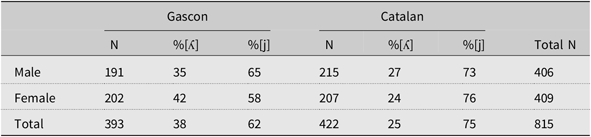
Twenty Gascon-French and twenty Catalan-French bilingual speakers, from Béarn and Northern Catalonia respectively (see Figure 3) performed a wordlist translation task, translating a set of words from French into their L1. All Gascon-French bilinguals were early bilinguals, acquiring Gascon first, and over the age of 65 at the time of recording in 2016 and, as such, constitute a fairly homogenous generational group of active bilinguals. For Catalan, on the other hand, the sample was slightly more diverse. All speakers were Catalan-French bilinguals, and can be divided into two age groups: those under the age of 55 (nine speakers), and those over 55 (11 speakers).Footnote 5 All Catalan speakers can be considered native bilinguals, having acquired both languages in early childhood. While the Catalan sample includes a greater age range than the Occitan sample, they can be considered comparable in that all of the speakers are early bilinguals; in any case, statistical analyses of the Catalan data always include ‘age group’ as an independent variable in the first instance. Each French word in the translation task had a corresponding Catalan or Gascon target word that was known to contain the phonemic palatal lateral; translations that did not result in the target word were excluded. The task included fillers in the form of other words with different linguistic variables under analysis. There were at least five tokens of the phonemic palatal lateral for each of the four phonological environments under investigation (#_V, V_V, V_#, V_/s/) and all recordings took place in informants’ homes, away from extraneous noise, and using a Marantz PMD661 MKII Solid State Recorder with an omnidirectional lavalier microphone placed outside of the shadow of the informant’s chin. This procedure yielded a total of 815 tokens of the /ʎ/ variable; the distribution of the tokens by language and speaker sex is presented in Table 2.
Speaker sample and token counts for /ʎ/ variable

5.3. Impressionistic analysis
Each of the 815 tokens were entered separately into token files for Gascon and Catalan, noting the speaker’s anonymous I.D. code, their year of birth, sex, and place of residence. The first author coded all of the Gascon data and is a native English speaker with native or near-native competence in French, Gascon, and Irish; the second author coded all of the Catalan data and is a native English speaker with native or near-native competence in French, Catalan, Spanish, and Portuguese. The data set for each language was then switched and each author recoded 10 per cent of the data in order to ensure consistency. The tokens were also coded for lexical item, the variant of the /ʎ/ variable ([ʎ] or [j]), as well as for the presence/absence of a glide-like transition between the palatal lateral (when present) and any following vowel. The latter was determined by inspection of the spectrogram and by identification of dynamic formant transitions in the CV transition. In line with Colantoni’s recommendation that ‘results obtained should be compared in the future with the realization of palatal laterals among speakers with a more advanced degree of loss of the lateral’ (Reference Colantoni, Auger, Clements and Vance2004: 89–90), we have included in our sample participants that exhibit a wide range of variability in the use of the [ʎ] and [j] variants.
5.4. Acoustic analysis
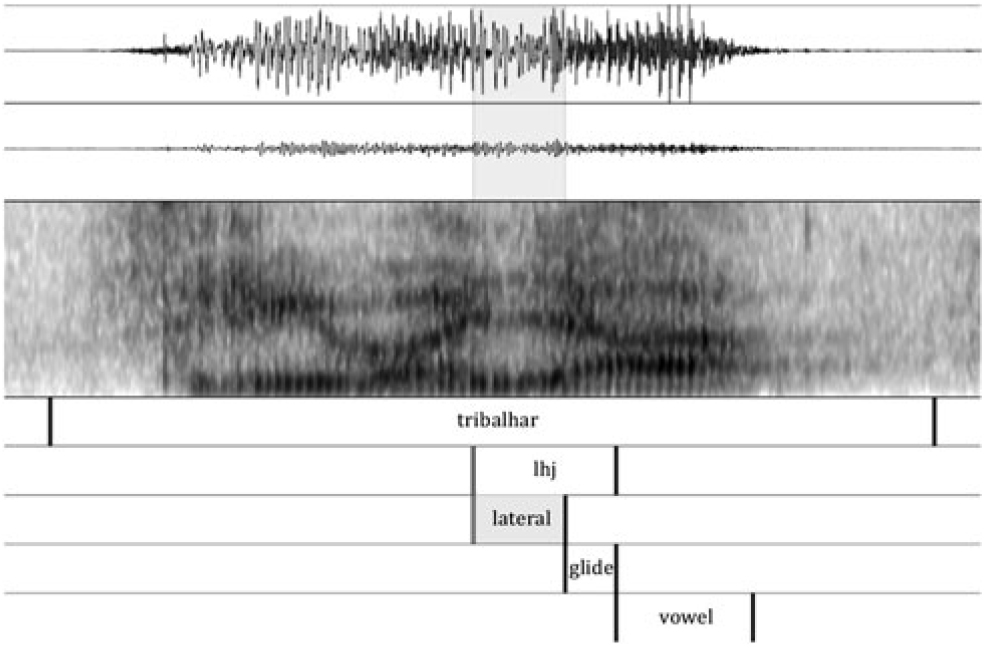
For each lexical item containing the /ʎ/ variable, a TextGrid file with five tiers was created in Praat (Boersma and Weenink, Reference Boersma and Weenink2018). The text grid tiers were used to code the lexical item, the (impressionistic) variant, and the onset/offset of the lateral or glide variant, glide-like transition, and following vowel, when each of these segments was present (see Figure 4). For word-initial tokens, the onset of the variant was labelled at the beginning of the first full glottal pulse; the lateral offset was labelled at the point where F2 began to change, at which point the onset of the following glide-like transition was marked. The offset of the glide-like transition (or glide variant) was labelled at the point of inflection of the formant transitions into the following vowel (cf. Colantoni, Reference Colantoni, Auger, Clements and Vance2004: 95). Intervocalically and finally, the onset of the lateral was labelled when there were sharp spectral changes and a visible drop in amplitude above F0 in the spectrogram window or at the point of formant change for the glide variant, with offsets in intervocalic position marked as described above for word-initial tokens. For laterals in intervocalic and final position, it was often possible to identify a preceding glide-like transition from the preceding vowel, though these will not be analysed in the present study (cf. Colantoni, Reference Colantoni, Auger, Clements and Vance2004). In final position, offsets were marked at the end of the final full glottal pulse.
Text grid with five tiers for Gascon word tribalhar /tɾibaˈʎa/ ‘to work’.

An automatic extraction script was then used to measure the duration of the variant (lateral or glide), glide-like transition (when present) and following vowel (when present). These measurements were then entered into the token files described in Section 5.3 for the Gascon and Catalan data.
5.5. Statistical analysis
The primary statistical analysis technique used was mixed-effects regression in Rbrul (Johnson, Reference Johnson2008): logistic regression for the binary /ʎ/ variable, with variants [ʎ] and [j]; linear for the continuous dependent variables (duration). Mixed-effects models control for variation introduced into the data set by individual speakers and tokens occurring in individual lexical items (Baayen et al., Reference Baayen, Davidson and Bates2008; Drager and Hay, Reference Drager and Hay2012). Each model included ‘speaker’ and ‘word’ as random effects, as well as being coded for the following fixed-effects, or independent variables: variant ([ʎ]; [j]), syllable type (#_V; V_V; V_#; V_/s/), glide-like transition (present; absent); preceding phonological environment (various); following phonological environment (various); speaker sex (male; female); duration of glide-like transition (continuous). The statistical analyses of the Catalan data also included ‘age group’ as an independent variable (see Section 5.2). Not all fixed effects were included in all models; relevant independent variables are indicated for each statistical test presented in Section 6.
6. RESULTS
6.1. H1: Contact-induced transfer
The frequency distribution for the variants of the /ʎ/ variable in Gascon and Catalan, and for male and female speakers, is presented in Table 3. In both languages, there is a strong preference, across positions, for the [j] variant; this is particularly marked in Catalan, with 75 per cent of realizations being [j], compared to 62 per cent in Gascon. When the Catalan data is divided by age group, older speakers (55+ years) use the [j] variant 60 per cent (134/223) of the time, bringing them into line with the elderly Gascon speakers. For the younger Catalan speakers, the [j] variant is used 91 per cent (181/199) of the time, indicating strongly that the /ʎ/>[j] change is not only advanced in both languages, but constitutes a change in apparent time.
Frequency distribution for variants of /ʎ/ variable in Gascon and Catalan

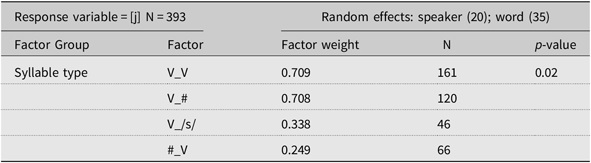
In order to establish if the retention or loss of the [ʎ] variant is favoured in specific linguistic contexts, a regression model was created for this distribution variants, as presented in Table 4 for Gascon: speaker sex was returned as a non-significant fixed effect; preceding and following phonological context also had no effect on the variation observed. Syllable type, however, was returned as a significant independent variable (p < .05): [j] is favoured in intervocalic (V_V) and final (V_#) position; [ʎ] is favoured in final clusters with /s/ and word-initially (#_V).
Regression output for [ʎ] versus [j] in Gascon

Non-significant factor groups were speaker sex (p = 0.37), following phoneme (p = .08), and preceding phoneme (p = 0.24).
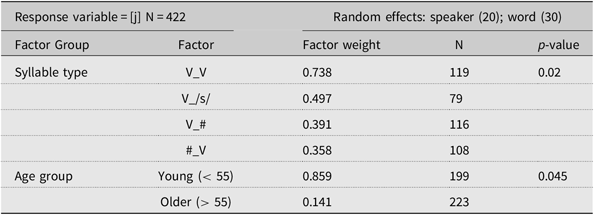
In the Catalan data, participant age group and syllable type are returned as a significant independent variables (p < 0.05) (see Table 5). For the syllable type factor group, [j] is shown to be favoured in intervocalic position, while [ʎ] is favoured in initial and final positions; in final clusters with /s/, both variants are equally probable. In this model, younger participants are shown to favour usage of the [j] variant, confirming the pattern observed in the frequency distribution data (see Table 3), where younger speakers use [j] 91 per cent of the time (versus 60 per cent for older speakers). Again, this implies that the change is proceeding to complete in Catalan. Splitting the data set by ‘age group’ and re-running this model separately for younger and older speakers reveals the ‘syllable type’ factor group to be non-significant for younger speakers when they are considered alone (p = 0.252). It may be that syllabic conditioning was an important factor earlier in the change but that the new variant, [j], is used indiscriminately in all environments at more advanced stages of the change; we will return to this in the discussion below.
Regression output for [ʎ] versus [j] in Catalan

Non-significant factor groups were speaker sex (p = 0.93), following phoneme (p = 0.44), and preceding phoneme (p = 0.09).
The phonemic cognates of Gascon and Catalan /ʎ/ in French are /l/ in initial position, and /j/ elsewhere. The ordering of the regression coefficients for syllable type in Gascon and Catalan appears to indicate that the distribution of the variants is indeed influenced by contact with French (at least for the older Catalan speakers), in that the probability of /ʎ/ being realized as [j] is increased when the phonemic cognate of /ʎ/ is /j/ in French. This is particularly evident in initial and intervocalic position where a lateral and a glide are favoured, respectively. There is more variability in final position, where we would expect [j] if the change were due to contact with French. In Gascon, [j] is indeed favoured in final position, with the exception of the [ʎ] variant is being favoured in the V_/s/ context. In Catalan, however, among the older participants who show an effect of syllable type, [ʎ] is favoured in final position. Overall, the constraints on the distribution of the lateral and glide variants appear to be a partial replication of the French system in both languages, indicating contact-induced, or externally motivated, change for the older Gascon and Catalan speakers. In later stages of the change, as represented by the younger Catalan speakers in our sample, this effect of syllabic environment is no longer significant, perhaps indicating that transfer from French of [j] and constraints on its distribution constitute a powerful external initiator of the change, but that as the change comes to completion, these constraints are lost in the transmission process and that the replacement of /ʎ/ by [j] generalizes to all environments.
6.2. H2: Duration
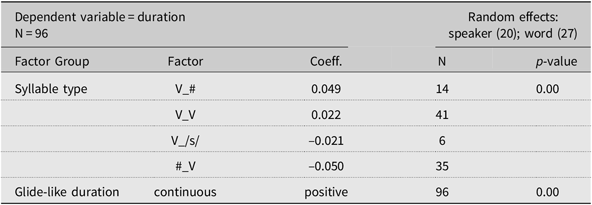
The /ʎ/>[j] change may, however, be (at least partially) internally motivated. In this scenario, we hypothesized that duration of [ʎ] may be inversely correlated with the duration of the glide-like CV transition (H2) or, that the /ʎ/>[j] change may come to completion as a result of the glide-like segment becoming longer, and the lateral shorter, until the lateral eventually disappears. To investigate H2, we excluded all tokens where /ʎ/ was realized as a palatal approximant [j] from the corpus, leaving only tokens where /ʎ/ was realized as [ʎ] (cf. Colantoni, Reference Colantoni, Auger, Clements and Vance2004: 89–90; see Section 5.3). We then examined (a) whether the presence/absence of a glide-like transition had a significant effect on the duration of the lateral segment, and (b) whether the duration of the glide-like transition is significantly correlated with the duration of the lateral.Footnote 6
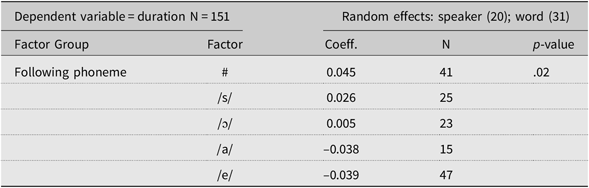
The regression model for Gascon returned the presence/absence of a glide-like transition as a non-significant predictor of the duration of [ʎ] (see Table 6), indicating that the duration of the lateral is not influenced by the presence of a glide-like CV transition and that H2 is not true. Looking only at tokens where a glide-like CV transition is present, a further regression analysis (see Table 7) showed that the duration of the lateral is positively correlated to the duration of the glide-like transition: the longer the lateral segment, the longer the glide-like transition. Again, this provides evidence that contradicts H2: the lateral does not become shorter as the glide-like transition lengthens.
Regression output for [ʎ] duration in Gascon

Non-significant factor groups were speaker sex (p = 0.07), presence/absence of glide-like transition (p = 0.12), preceding phoneme (p = 0.13), and syllable type ‘(p = 0.52).
Equivalent analyses for Catalan are less straightforward because, due to the advanced nature of the /ʎ/ > [j] change, only 107 of the 422 tokens actually contain the palatal lateral and, of these 107 tokens, only 33 have an identifiable glide-like transition; the latter, in particular, does not lend itself well to statistical analysis. Nonetheless, the model in Table 8 returned the presence or absence of a glide-like transition to be a highly significant predictor of [ʎ] duration (see Table 8): [ʎ] was significantly longer when the glide-like transition was absent and significantly shorter when the transition was present, providing evidence to support H2. There is no effect of ‘age group’ in this model, indicating that the data for all Catalan speakers shows some evidence for H2, but only 18 of these tokens come from the ‘younger’ age group. When only the older (55 + years) speakers are considered (89 tokens), the presence is still shown to correlate significantly with shorter lateral durations, though the token counts are too low to make firm conclusions at this point. We have chosen not to consider only tokens where are glide-like transition is present (see Table 7 for Gascon) as there are only 33 tokens that qualify and so the statistical analysis would be essentially meaningless.
Regression output for [ʎ] duration by glide-like transition duration in Gascon

Non-significant factor groups were following phoneme (p = 0.05), speaker sex (p = 0.09), and preceding phoneme (p = 0.33).
Regression output for [ʎ] duration in Catalan

Non-significant factor groups were speaker sex (p = 0.08), age group (p = 0.131) following phoneme (p = 0.44), and preceding phoneme (p = 0.71), and syllable type (p = 1).
Overall, there is more evidence for H2 in Catalan: the lateral segment is shorter when it is accompanied by a glide-like CV transition. In Gascon, the duration of the lateral is not inversely correlated with the presence/absence of a glide-like transition or with the duration of such a transition, when it is present.
7. DISCUSSION
Gascon and Catalan are two closely related language varieties in situations of societal bilingualism with French, and both varieties have retained a /ʎ/ phoneme, which appears to be undergoing replacement by [j]. The typological similarity of Gascon and Catalan, as well as their near-identical sociolinguistic situations, has provided a unique opportunity for comparative study of the /ʎ/>[j] change. Data from both languages revealed that this change is well underway, with a strong preference for the [j] variant, particularly for younger Catalan participants, but how can this be explained?
Evidence for contact-induced change (H1) was found in both languages: syllable type was shown to be a significant predictor of variant choice in Gascon and for older Catalan speakers, with the French distributional constraints for the palatal glide being largely reproduced by older native speakers in both languages. In initial position, a lateral was preferred, and intervocalically, both languages favoured the usage of a glide. However, variants in final position provided less evidence for the change being motivated by contact, with [ʎ] favoured in the V_/s/ context in Gascon, and in the V_# context in Catalan. It is worth noting that the phonemic cognate in modern French of Gascon /ʎ/ in the V_/s/ context is not /j/, but zero, e.g. OCULUM > Gasc. uelhs /weʎs/, Fr. yeux /jø/ ‘eyes’ (see Table 1). In Old French, /-lt͡s/ is attested in this position, realized as [lɣt͡s], e.g. ialz [ialɣt͡s] ‘eyes’. Gascon /-ʎs/ sequences are frequently realized as [-ʎʃ], with palatalization of /s/; this sequence is cognate with /-lt͡s/ in Old French, but we cannot assume that modern bilingual speakers are aware of this historical equivalence. Indeed, Catalan /-ʎs/ is also cognate with Old French /-lt͡s/, and may also be realized as [-ʎʃ], but the retention of the [ʎ] variant is not favoured in final position in Catalan. Younger Catalan speakers did not show any distributional constraints on the use of the [j] variants and, indeed, they used this variant 91 per cent of the time across all syllabic environments, indicating that, while transfer from French may constitute the initial reason for the change, constraints on transfer are not as important as the change progresses.
Evidence for the change being internally motivated is more limited; indeed, some of the findings presented above are based on small token counts and should therefore be considered as preliminary evidence at this stage. In Gascon, there appears to be no evidence for H2, since the lateral does not shorten when the glide lengthens; in Catalan, there was evidence that the lateral segment is indeed shorter when a glide-like transition is present. As stated in footnote 4, there is no evidence that the presence of a glide-like transition causes opening of the lateral’s constriction, in either of the languages studied. Therefore, the overarching hypothesis that the /ʎ/>[j] change is occurring as an internally-motivated change from below (see Section 4.2) as a result of ‘hidden variation’ (see Section 4.3), or of the interpretation of secondary phonetic cues in the acoustic signal as primary, is very much called into question by this preliminary data, at least for Gascon.
The most plausible explanation for the /ʎ/>[j] change in Gascon is contact with French, in that the distributions of the French phonemic cognates appear largely to act as constraints on the distribution of [ʎ] and [j] variants in Gascon and for the older Catalan speakers. In Catalan, the hypothesis that the change is motivated by contact with French seems to best fit the data, albeit with the caveat that in word-final position, there was increased probability of the [ʎ] variant. However, the lateral in Catalan is shorter when a glide-like transition is present, possibly implying a degree of internal motivation for the change, in line with Ohala’s (Reference Ohala, Breivik and Jahr1989) hidden variation theory and with Colantoni’s (Reference Colantoni, Auger, Clements and Vance2004) proposition that the change may proceed gradually, resulting in incremental reduction in the lateral’s duration, and culminating in its complete loss. This is somewhat aligned with the age distribution of the palatal lateral, with younger Catalan participants only using the [ʎ] variant 9 per cent of the time, implying that the /ʎ/>[j] is near completion. For Catalan, then, it appears that the /ʎ/>[j] change may be both internally and externally motivated, or that multiple causation is the most applicable explanation in this case.
Given the typological similarity of Gascon and Catalan, their common classification within the same Romance sub-family, and their strikingly similar sociolinguistic profiles in the French context, we might expect the internal and/or external factors conditioning the /ʎ/>[j] change in both languages to be the same, or at least markedly similar. The change appears to be externally motivated in Gascon, and perhaps due to multiple causation in Catalan, raising, as such, the issue of ‘actuation’: ‘what factors can account for the actuation of changes? Why do changes in a structural feature take place in a particular language at a given time, but not in other languages with the same feature, or in the same language at other times?’ (Weinreich et al., Reference Weinreich, Labov, Herzog, Lehmann and Malkiel1968: 102). In Gascon, the change appears to have been caused exclusively by contact with French, with some 62 per cent of palatal laterals being realized as glides and the transfer of syllabic constraints in evidence, even though it has come to completion at an earlier time in other Occitan dialects (see Section 3.1), such as Provençal, where internal factors, such as the low functional load of the /ʎ/~/j/ contrast (Bec, Reference Bec1973: 47), have been advanced as the reason for actuation. There is no data, however, for younger early Gascon-French bilinguals, comparable to those considered for Catalan, as such speakers are thin on the ground, if not non-existent, in Béarn. In Catalan, the change is comparable to Gascon for the Catalan older speakers, with the [j] variant used 60 per cent of the time and syllabic conditioning also observed, though both contact with French and gradual phonetic change from below may to be involved. For younger Catalan speakers, the change is clearly further advanced (91% of variants are [j]) and no distributional constraints (or transfer of such constraints) was observed. On one hand, it is possible that the /ʎ/>[j] change is more advanced in Northern Catalan due to extra-linguistic factors that do not apply in the Occitan context, such as the covert prestige of ieista, or [j], forms, potentially associated with urban, cosmopolitan varieties of Catalan in Catalonia (Recasens, Reference Recasens2017: 321–322). Alternatively, it is possible that contact with French acts as the initiator or ‘actuator’ of the change and that the change then generalizes, in the speech of younger generations, to all environments and proceeds to completion as it has in other non-contact varieties of Romance.
If, as has been suggested, the Romance languages that have a palatal lateral in their phonemic inventories are somehow pre-disposed to the /ʎ/>[j] because of the presence of phonetic cues for the palatal approximant in the acoustic profile of the palatal lateral, it may be the case that contact with a language such as French, that does not have or retain the palatal lateral has acted as a trigger for the actuation of this change in Gascon and Catalan. In this scenario, external pressure from French may have set the change in motion in syllabic contexts where Gascon and Catalan /ʎ/ is phonemically cognate with French /j/. Subsequently, the change may then proceed gradually in the speech of younger generations, potentially conditioned by internal factors (as indicated by the positive result for H2 in Catalan) but not by external factors; the data from the younger group of Catalan speakers would support this scenario. We must assume that in other varieties of Catalan, or Romance, that the actuation triggers for the change were different. In order to determine why the change happens at a given time, it seems more likely that we will find fruitful explanations in external or extra-linguistic factors, that change or modify themselves at different times, rather than in internal factors, such as the low functional load of phonemic oppositions, which could explain the occurrence of the change at any given time. In the case of Gascon and Catalan, it appears that contact with French initiated a sound change to which both languages are/were potentially pre-disposed.
The argument that the /ʎ/>[j] change in Catalan has been actuated by contact with French and then proceeds gradually to completion as a result, potentially, of internal motivations, does not, however, explain why there is no evidence for internal factors conditioning the change in Gascon, or, indeed, why Provençal lost the palatal lateral at a time when contact with French was less pervasive. This may be because hypothetical younger generations of Gascon speakers have not been considered in this analysis. In the absence of this, however, we can note that Cardaillac Kelly (Reference Cardaillac Kelly1973) did not cite [j] as a variant of /ʎ/ in Gascon, where [ʎ] was retained in all positions. Similarly, for Catalan, Coromines (Reference Coromines1976) does not report [j] as a variant of /ʎ/, and Gómez Duran (Reference Gómez Duran2016: 35) states that replacement by the glide has only occurred in the last 40 years. As such, the /ʎ/>[j] change appears to have proceeded at an accelerated rate in recent decades, for both language varieties. Such acceleration of the rate at which as linguistic change occurs is often considered to be the primary characteristic of language death (Dorian, Reference Dorian1981; Jones, Reference Jones and Verma1998, Hornsby, Reference Hornsby2006).
8. CONCLUSION
In summary, the /ʎ/>[j] change is clearly advanced in Gascon and Northern Catalan, but with potentially different motivations in each case. Contact with French appears to be the most important influential factor in the /ʎ/>[j] change, acting as the potential trigger for the change in both Gascon and Catalan. In Gascon, the change appeared to be externally motivated by contact with French, since the constraints on variant occurrence are influenced significantly by the distribution of the lateral’s phonemic cognates in French, with no internal factors shown to be involved. In Northern Catalan, however, the /ʎ/>[j] change appeared to be both internally and externally motivated, at least for the older generation of speakers. As with Gascon, the distribution of the [j] variant in Catalan indicates transfer of distributional constraints from French in the speech of the older generation. Nevertheless, younger Catalan speakers no longer appear to use these transferred constraints from French and internal factors are also seen to drive this change, in that coarticulatory glide-like transitions appear to replace the lateral by gradually becoming longer. In short, the same sound change appears to have been initiated by both similar factors cross-linguistically, and data from the younger generation of Catalan speakers indicates that the change is now occurring independently and is near completion; there are extra-linguistic factors that complicate the Gascon-Catalan comparison, such as, for example, the covert prestige associated with ieisme in varieties of Catalan spoken outside of France, in Catalonia. What they have in common, however, is that the rate of change involved is characteristic of the difficult socio-political situation that both languages find themselves in in the French context, one of domain restriction, of geographical and social contraction, and of impending death.