Introduction
There is large variability in children's vocabulary growth during infancy and toddlerhood (Fenson et al., Reference Fenson, Dale, Reznick, Bates, Thal and Pethick1994; Huttenlocher, Haight, Bryk, Seltzer & Lyons, Reference Huttenlocher, Haight, Bryk, Seltzer and Lyons1991). Early lexical development involves two interrelated processes: word learning, i.e., associating phonological symbols with corresponding semantic concepts, and lexical access: that is, retrieving the learned associations upon hearing familiar words in meaningful communicative contexts (Law & Edwards, Reference Law and Edwards2015). Lexical processing efficiency (LPE), how fast and accurately children process known words (Lany, Reference Lany2017), is an important measure of children's early vocabulary skill and predicts their acquisition of new words (Hurtado, Marchman & Fernald, Reference Hurtado, Marchman and Fernald2008; Lany, Reference Lany2017; Peter, Durrant, Jessop, Bidgood, Pine & Rowland, Reference Peter, Durrant, Jessop, Bidgood, Pine and Rowland2019). The looking-while-listening (LWL) paradigm is widely used to assess young children's LPE (e.g., Fernald, Zangl, Portillo & Marchman, Reference Fernald, Zangl, Portillo, Marchman, Sekerina, Fernández and Clahsen2008; Peter et al., Reference Peter, Durrant, Jessop, Bidgood, Pine and Rowland2019). It is well documented that toddlers’ LPE is associated with their vocabulary size (e.g., Fernald, Perfors & Marchman, Reference Fernald, Perfors and Marchman2006; Peter et al., Reference Peter, Durrant, Jessop, Bidgood, Pine and Rowland2019). However, we lack knowledge about other linguistic, cognitive and social skills that may contribute to toddlers’ performance on the LWL paradigm. The current study examines whether and how children's vocabulary knowledge, executive functions (EF), and pragmatic skills relate to their LPE and ability to acquire new words. This study also investigates associations between commonly used LPE measures derived from different types of LWL trials (target-initial versus distractor-initial trials) and child-internal correlates of LPE.
Children's lexical processing efficiency and the looking-while-listening paradigm
Starting from six to nine months of age, infants are able to incrementally process speech and direct their gaze to target objects accordingly (Bergelson & Swingley, Reference Bergelson and Swingley2012; Fernald, Swingley & Pinto, Reference Fernald, Swingley and Pinto2001b; Swingley, Pinto & Fernald, Reference Swingley, Pinto and Fernald1999). The LWL paradigm, an adaptation of the inter-modal preferential looking paradigm (Golinkoff, Hirsh-Pasek, Cauley & Gordon, Reference Golinkoff, Hirsh-Pasek, Cauley and Gordon1987), is widely used to assess infants’ and toddlers’ LPE. In addition to measuring children's efficiency in processing familiar words, variations of the LWL paradigm have also been used to explore children's recognition of partial or mispronounced words (Bergelson & Swingley, Reference Bergelson and Swingley2018; Fernald, Pinto, Swingley, Weinberg & McRoberts, Reference Fernald, Pinto, Swingley, Weinberg, McRoberts, Tomasello and Bates2001a), disambiguation processes (Bion, Borovsky & Fernald, Reference Bion, Borovsky and Fernald2013), acquisition of novel words (Ellis, Borovsky, Elman & Evans, Reference Ellis, Borovsky, Elman and Evans2015; Eiteljoerge, Adam, Elsner & Mani, Reference Eiteljoerge, Adam, Elsner and Mani2019; Rajan et al., Reference Rajan, Konishi, Ridge, Houston, Golinkoff, Hirsh-Pasek and Schwartz2019; Wei, Ronfard, Leyva & Rowe, Reference Wei, Ronfard, Leyva and Rowe2019), as well as anticipatory language processing (Fernald, Thorpe & Marchman, Reference Fernald, Thorpe and Marchman2010; Lew-Williams & Fernald, Reference Lew-Williams and Fernald2007).
During a typical LWL trial, two familiar objects are juxtaposed on a screen and children are instructed to look at one of them (e.g., “Where is the doggie?”). Several measures of LPE can be derived from children's looking patterns. Previous studies have used mixed-effects growth curve analyses to model moment-to-moment changes in children's looking behaviors (Law & Edwards, Reference Law and Edwards2015; Peter et al., Reference Peter, Durrant, Jessop, Bidgood, Pine and Rowland2019). Proportion accuracy and reaction time (RT) are also commonly used measures of LPE. Proportion accuracy refers to the proportion of time children fixate on the named object during a pre-determined coding window. RT denotes the latency between the target word onset in the auditory stimuli (“doggie”) and children's gaze shift from the distractor to the named object. Proportion accuracy can be derived from both target-initial trials (where children start on the target and are expected to remain fixated on it) and distractor-initial trials (where children fixate on the distractor at the word onset and are expected to shift their gaze to the target object), whereas RT only comes from distractor-initial trials. Many studies adopting the LWL paradigm include both accuracy and RT as indices of children's LPE in order to triangulate findings (Adams et al., Reference Adams, Marchman, Loi, Ashland, Fernald and Feldman2018; Fernald et al., Reference Fernald, Thorpe and Marchman2010). Others use either proportion accuracy as a measure of processing correctness (Lany, Reference Lany2017; Schwab & Lew-Williams, Reference Schwab and Lew-Williams2018; Wei et al., Reference Wei, Ronfard, Leyva and Rowe2019) or RT as an indicator of processing speed (Hurtado et al., Reference Hurtado, Marchman and Fernald2008).
Importantly, studies using proportion accuracy typically average accuracy scores across all usable target-initial and distractor-initial trials, except for a few studies in which target- and distractor-initial trials were analyzed separately (Fernald et al., Reference Fernald, Thorpe and Marchman2010; Wei et al., Reference Wei, Ronfard, Leyva and Rowe2019). However, averaging accuracy across all trials can be problematic in some cases. In theory, target-initial trials require toddlers to interpret ongoing speech and remain fixated on the correct object, but on distractor-initial trials, children have to decipher the speech, quickly disengage from the distractor, and reorient their attention to the target. Hence, although key capacities underlying children's performance may be similar regardless of trial type, relative to target-initial trials, distractor-initial trials may be more challenging to toddlers and demand more efficient functioning of supporting capacities (e.g., executive functions). Therefore, children's performance on target-initial and distractor-initial trials may be differentially associated with linguistic, cognitive, and social skills underlying LPE. In practice, children naturally tend to have lower proportion accuracy on distractor-initial trials because responding to the stimuli and initiating the gaze shift take time. Hence, pooling all trials together when calculating proportion accuracy may result in biases in favor of children who contribute more target-initial trials and against children who complete relatively more distractor-initial trials. To our knowledge, no studies have evaluated the concurrent validity of LPE derived from each type of LWL trials or the implications of pooling all trials together for proportion accuracy. The current study bridges this important methodological gap and explores whether LPE measures from different types of LWL trials are differentially associated with correlates of LPE.
Toddlers’ lexical processing efficiency, size of vocabulary, and acquisition of novel object labels
Children become increasingly proficient at processing familiar words during toddlerhood (Fernald et al., Reference Fernald, Zangl, Portillo, Marchman, Sekerina, Fernández and Clahsen2008; Hurtado, Marchman & Fernald, Reference Hurtado, Marchman and Fernald2007). LPE is also highly variable and is associated with a variety of endogenous and environmental factors. One of the most robust correlates of LPE is children's size of vocabulary (Fernald & Marchman, Reference Fernald and Marchman2012; Fernald et al., Reference Fernald, Perfors and Marchman2006; Law & Edwards, Reference Law and Edwards2015; Marchman & Fernald, Reference Marchman and Fernald2008; Marchman et al., Reference Marchman, Loi, Adams, Ashland, Fernald and Feldman2018; Peter et al., Reference Peter, Durrant, Jessop, Bidgood, Pine and Rowland2019). First, children's LPE and size of vocabulary are concurrently associated and mutually predictive over time. Fernald and Marchman (Reference Fernald and Marchman2012) found that, among a group of typically developing children and late talkers, children's processing speed and accuracy at 18 months were concurrently related to their size of vocabulary. Law and Edwards (Reference Law and Edwards2015) found a similar concurrent correlation among older typically developing children: 30- to 46-month-olds’ size of vocabulary was concurrently associated with their looking patterns to the target image. Longitudinally, children's LPE predicts their later vocabulary. Peter et al. (Reference Peter, Durrant, Jessop, Bidgood, Pine and Rowland2019) found that children's processing speed at 19 months was related to their expressive vocabulary at 18, 19, 21, 24, 25, 27, 30, 31, and 36 months, all measured using parental reports. Similarly, Marchman et al. (Reference Marchman, Loi, Adams, Ashland, Fernald and Feldman2018) showed that preterm infants’ processing speed at 18 months predicted their receptive vocabulary measured with the Peabody Picture Vocabulary Test at 36 months. Weisleder and Fernald (Reference Weisleder and Fernald2013) found that in Spanish-speaking families low in socioeconomic status, toddlers’ processing accuracy at 19 months mediated associations between the quantity of caregivers’ child-directed talk and children's expressive vocabulary at 24 months reported by parents. Additionally, children's size of vocabulary also predicts their later LPE. Fernald et al. (Reference Fernald, Perfors and Marchman2006) found that children's expressive vocabulary over the second year was associated with their processing speed and accuracy at 25 months. RT and expressive vocabulary at 25 months then each uniquely and simultaneously predicted children's expressive language skills and cognitive development at age eight (Marchman & Fernald, Reference Marchman and Fernald2008).
In addition to their size of vocabulary, toddlers’ LPE is also associated with their vocabulary growth (Fernald & Marchman, Reference Fernald and Marchman2012; Fernald et al., Reference Fernald, Perfors and Marchman2006; Peter et al., Reference Peter, Durrant, Jessop, Bidgood, Pine and Rowland2019). Peter et al. (Reference Peter, Durrant, Jessop, Bidgood, Pine and Rowland2019) found that 19-month-olds’ processing speed predicted their shape of vocabulary growth and increases in expressive vocabulary between 19 and 30 months. Specifically, 19-month-olds who were faster processors showed steady growth in expressive vocabulary between 19 and 30 months and maintained their advantage in vocabulary relative to slower processors. Children who were slower processors at 19 months grew their vocabulary slowly at first, but the growth accelerated after 21 months. Further, among children with larger vocabularies at 19 months, faster processing speed did not lead to larger increase in vocabulary between 19 and 30 months. However, among children with smaller vocabularies at 19 months, those who were fast processors showed more growth in vocabulary than those who were slower processors.
The studies reviewed above relied on caregiver reports and standardized assessments of children's vocabulary. To our knowledge, Lany (Reference Lany2017) is the only study that examined associations between toddlers’ LPE and their word learning during an experimental fast-mapping task. Experimenters taught 17- and 30-month-olds novel object labels using a fast-mapping paradigm. The LWL paradigm was adopted to measure children's processing speed with familiar words and processing accuracy with words taught during a fast-mapping task. Findings showed that 17-month-olds who were faster to process familiar words were more accurate in processing the taught words, controlling for children's expressive vocabulary. Thirty-month-olds engaged in another more challenging word learning task where one object label was introduced in syntactic frames typical of labeling (e.g., “That's a zojee.”) and the other in frames less characteristic of ostensive labeling (e.g., “Do you like zojees?”). Controlling for thirty-month-olds’ expressive vocabulary, their processing speed with familiar words predicted their accuracy in processing the taught words, both of which measured using the LWL paradigm.
Taken together, these studies suggest that toddlers’ LPE and size of vocabulary are closely related and likely synergistically support learning of new words. Researchers have proposed several potential mechanisms underlying the interrelations among LPE, vocabulary, and word learning. The first view is that high LPE frees up cognitive resources which can be used to track distributional properties of words and acquire new words (Fernald & Marchman, Reference Fernald and Marchman2012; Newbury, Klee, Stokes & Moran, Reference Newbury, Klee, Stokes and Moran2015, Reference Newbury, Klee, Stokes and Moran2016). However, it remains unclear which specific cognitive resources are freed up. Second, children with higher LPE and larger vocabularies have more extensive lexical networks and richer experience in hearing, using, and categorizing a larger number of words: which makes it easier for them to uptake information available in environmental input, identify new words, and incorporate new words into their lexicon (Fernald et al., Reference Fernald, Perfors and Marchman2006; Hurtado et al., Reference Hurtado, Marchman and Fernald2008; Law & Edwards, Reference Law and Edwards2015). A related view is that children acquire words through strengthening and pruning associations connecting word forms and object categories to a mental lexicon (McMurray, Horst & Samuelson, Reference McMurray, Horst and Samuelson2012). Children with a more extensive vocabulary may have built stronger associations through hearing and using words and hence enjoy higher LPE. Third, McMurray et al. (Reference McMurray, Horst and Samuelson2012) also contend that familiar word recognition and fast mapping hinge upon the same mechanism of rapidly activating word-lexicon-concept connections within the context of a single naming event, aided by external supports (e.g., pragmatics). Lastly, the CLASSIC model (Peter et al., Reference Peter, Durrant, Jessop, Bidgood, Pine and Rowland2019; but see Swingley et al., Reference Swingley, Pinto and Fernald1999 for counterevidence) posits that children possess a chunk-based learning mechanism constrained by processing limitations. That is, children represent words they hear in sub-lexical chunks and can only represent a limited number of chunks at once. Each chunk, regardless of its length, takes the same amount of time to process. Children with a larger vocabulary typically have a larger inventory of lexical and sub-lexical chunks. Thus, they represent familiar words in fewer and larger chunks and hence process familiar words more rapidly. Moreover, they also encode new lexical information from input in larger and fewer chunks and therefore more rapidly learn new words from fewer exposures.
An additional potential mechanism, relatively less explored in the literature, is that domain general skills, such as executive functions (EF), support both LPE and word learning (Newbury et al., Reference Newbury, Klee, Stokes and Moran2015, Reference Newbury, Klee, Stokes and Moran2016). Lany (Reference Lany2017) acknowledged the possibility that LPE may reflect domain general skills (e.g., memory and attention) that are instrumental to word learning, but her study did not include such skills. The current study aims to provide more experimental evidence for associations between toddlers’ LPE and word learning during a fast-mapping task, and also shed light on the potential role of EF in supporting both lexical processing and word learning.
Potential correlates of lexical processing efficiency: executive functions and pragmatic skills
Besides children's vocabulary knowledge, LPE as measured by the LWL paradigm may also draw upon additional cognitive and social skills, such as EF and pragmatic skills. However, relations between toddlers’ LPE and their EF and pragmatic skills remain unclear.
Language processing and working memory (WM), an important aspect of EF, are robustly correlated in older children and adults. For example, individual differences in adults’ language processing capacity are partially attributable to variations in WM (Just & Carpenter, Reference Just and Carpenter1992). Studies on interrelations among WM, language processing, and language learning have focused on older children's processing efficiency of more sophisticated linguistic structures and found that WM and language processing efficiency are correlated and each explain unique variations in language performance during the preschool and school years (Leonard et al., Reference Leonard, Ellis Weismer, Miller, Francis, Tomblin and Kail2007; Poll, Miller, Mainela-Arnold, Adams, Misra & Park, Reference Poll, Miller, Mainela-Arnold, Adams, Misra and Park2013).
Research has just begun to understand the interrelations among toddlers’ EF (with most studies focusing on WM), LPE, and language development. Marchman and Fernald (Reference Marchman and Fernald2008) found that 25-month-olds’ expressive vocabulary and processing speed measured using the LWL paradigm each uniquely and simultaneously explained variance in WM at age eight. Interestingly, LPE and vocabulary at 25-months were associated with age eight expressive language skills, but these associations were eliminated when WM at age eight was included in regression models, suggesting that the predictive relation between 25-month language measures and expressive language outcome at age eight was entirely attributable to associations between 25-month language measures and age eight WM. Two studies by Newbury and colleagues (Reference Newbury, Klee, Stokes and Moran2015, Reference Newbury, Klee, Stokes and Moran2016) have suggested associations among WM, LPE, and language skills during early childhood, although findings are mixed. Newbury et al. (Reference Newbury, Klee, Stokes and Moran2015) found concurrent associations between 24- to 30-month-olds’ WM and expressive vocabulary, but not between processing speed and expressive vocabulary controlling for WM, phonological short-term memory, and demographic factors. Yet, in a later longitudinal study, Newbury et al. (Reference Newbury, Klee, Stokes and Moran2016) found that two-year-olds’ WM, phonological short-term memory, and processing speed jointly and each uniquely predicted their receptive language skills at age four (measured using the Preschool Language Scale), over and above age two receptive or expressive language and demographic variables. Although the mechanisms underlying the cross-lagged links among older children's EF, LPE, vocabulary, and word learning remain unclear, researchers have proposed the following hypotheses. First, advances in children's LPE and vocabulary may free up cognitive resources and allow for gains in WM (Bayliss, Jarrold, Baddeley, Gunn & Leigh, Reference Bayliss, Jarrold, Baddeley, Gunn and Leigh2005; Marchman & Fernald, Reference Marchman and Fernald2008). Again, it remains underspecified which cognitive resources are freed up. Second, children's domain-general capacities to store and manipulate transient information may contribute to their abilities to acquire novel words and process known words (Marchman & Fernald, Reference Marchman and Fernald2008). The current study explores the concurrent interrelations among EF, LPE, size of vocabulary, and word learning in younger toddlers (18- to 24-month-olds), which extant literature has not examined.
Toddlers’ pragmatic language skills, their ability to use language effectively and appropriately in social communications (Bates, Reference Bates1976; Ninio & Snow, Reference Ninio and Snow1996; O'Neill, Reference O'Neill2007), may also contribute to their performance on LWL trials. Children's pragmatic skills grow rapidly during infancy and toddlerhood, as evidenced by the expansion of their communicative act repertoires (Snow, Pan, Imbens-Bailey & Herman, Reference Snow, Pan, Imbens-Bailey and Herman1996). By two years of age, toddlers have mastered most basic speech acts central to daily communications (Ninio & Snow, Reference Ninio and Snow1996), except for more sophisticated pragmatic skills (e.g., adapting speech based on interlocutor characteristics) which develop during preschool years (Clark, Reference Clark2003). Advances in pragmatic competence goes hand in hand with children's growing understanding of their own and others’ intentions, perspectives, and behaviors (Ninio & Snow, Reference Ninio and Snow1996). Children's early pragmatic skills also predict their later language outcomes, such as their expressive vocabulary (Charman et al., Reference Charman, Taylor, Drew, Cockerill, Brown and Baird2005) and syntactic skills (Rollins & Snow, Reference Rollins and Snow1998). Pesco and O'Neill (2007), for example, found that 18- to 47-month-olds' early pragmatic skills, measured with the Language Use Inventory (LUI, O'Neill, Reference O'Neill2007), predicted their performance on three standardized language assessments (i.e., Diagnostic Evaluation of Language Variation – Norm Referenced; Clinical Evaluation of Language Fundamentals – Preschool, 2nd Edition; and Children's Communication Checklist – Second Edition) at age five to six. Moreover, school-aged children's pragmatic skills were associated with their WM (Freed, Lockton & Adams, Reference Freed, Lockton and Adams2012).
These findings suggest that a more holistic view of young children's language development calls for further understanding of the role of early pragmatic competence (Snow et al., Reference Snow, Pan, Imbens-Bailey and Herman1996). However, little is known about relations between toddlers’ pragmatic skills and their LPE. Bergelson and Swingley (Reference Bergelson and Swingley2012) have hinted at such relations. They found little change in infants’ performance on LWL trials between six and nine months of age, but a notable elevation in performance manifested at 14-months. One potential reason they proposed was that at around 14-months, infants may begin to understand the nature of the experiment – a game of object searching. Although the task does not involve an interlocutor, the audio stimuli are typically recorded in child-directed speech and resemble a female adult speaking to the infant. The current study is the first to examine how toddlers’ pragmatic abilities may contribute to their performance on LWL trials. We hypothesize that toddlers who have an advantage in pragmatic skills can better understand the workings of the LWL task and conceptualize it as a repetitive game of following adult instructions and searching for named objects, which may help them orient their attention and fixate on the correct object.
In sum, although studies on older children and adults have shown associations between EF (mostly WM) and language processing efficiency, such associations are not well understood during toddlerhood. Nor is it clear how toddlers’ emerging pragmatic skills may contribute to their performance on LWL tasks. The current study bridges these important gaps and explores the interrelations among toddlers’ LPE, expressive vocabulary, EF, and pragmatic skills.
The present study
The present study contributes to the literature on toddler's LPE in two important ways. First, it systematically investigates the interrelations among toddlers’ LPE, size of vocabulary, EF, pragmatic skills, and novel word learning. Second, our exploration of the concurrent validity of different LPE measures derived from LWL trials has important methodological implications for future studies adopting the LWL paradigm.
We ask three research questions:
(1) Are LPE measures associated with toddlers’ performance on a fast-mapping task?
(2) Are vocabulary knowledge, EF, and pragmatic development associated with toddlers’ performance on a fast-mapping task?
(3) What are the associations between LPE measures and toddlers’ expressive vocabulary, EF, and pragmatic development?
When addressing these questions, we examined the predictive power of various LPE measures from different types of LWL trials, including RT and proportion accuracy from distractor-initial trials, accuracy from target-initial trials, and the most commonly used accuracy measure – accuracy averaged across both types of trials.
Methods
Participants
Forty-two families with typically developing 18- to 24-month-olds participated in the current study. From this group, two families were excluded because English was not the child's primary language at home. Our final sample consists of 40 families (3 fathers and 37 mothers, 19 boys and 21 girls). Children's mean age was 20 months, SD = 2 months. All participating parents were primary caregivers for their children. Families were recruited through direct mailings and advertisements at local daycare centers and online parents’ groups.
Parents reported their highest level of education in a demographic questionnaire. One parent reported completing some high school (2.5%), one parent reported completing high school (2.5%), 10 parents reported completing college (25%), and 28 parents reported completing graduate school or a professional degree (70%). Twenty-eight parents (69%) were White, and 12 parents (31%) were Black, Latino, Asian, or multiracial.
Procedure
Parents and children visited a university laboratory. Upon arrival, parents completed the consent forms, a demographic questionnaire, and the MacArthur-Bates Communicative Development Inventory (CDI) short form. Then, children sequentially completed: the “Hide-the-Pots” task measuring EF (Bernier, Carlson & Whipple, Reference Bernier, Carlson and Whipple2010), an LWL task (Fernald et al., Reference Fernald, Zangl, Portillo, Marchman, Sekerina, Fernández and Clahsen2008), and a fast-mapping task (adapted from Ellis et al., Reference Ellis, Borovsky, Elman and Evans2015; Puccini & Liszkowski, Reference Puccini and Liszkowski2012), as outlined in Table 1. Between the EF task and the LWL task, families completed a book reading and teaching task. Data from the book reading and teaching task are reported in another paper (Wei et al., Reference Wei, Ronfard, Leyva and Rowe2019). The order of the tasks was fixed to ensure consistency across participants. At the end of the study parents were given the Language Use Inventory (LUI; O'Neill, Reference O'Neill2007) to complete and mail back to the lab.
Summary of Surveys, Tasks, and Measures.

CDI short form
The CDI short form (Fenson et al., Reference Fenson, Marchman, Thal, Dale, Reznick and Bates2007) consisted of 100 word items and asked parents to identify the words their children produce. CDI raw scores were used as a measure of children's expressive vocabulary, M = 39.68, SD = 27.16, Range = 0 to 100, N = 40.
“Hide-the-pots” task
This task (adapted from Bernier et al., Reference Bernier, Carlson and Whipple2010) assessed young children's emerging EF skills. During three warm-up trials, the experimenter presented a tray with three identical opaque cups of different colors, hid an attractive sticker under one of the cups, and asked the child to retrieve the sticker. Then the experimenter administered three test trials. She hid the sticker, covered the tray with a piece of opaque cloth for two seconds, and then asked the child to retrieve the sticker. The relative location of cups and the order in which the sticker was hidden under each cup was randomized. Each test trial was scored as “0” or “1” depending on whether the child successfully retrieved the sticker on the first attempt. Thus, children could obtain a maximum score of 3 out of 3, M = 1.69, SD = .98, Range = 0 to 3, N = 36. Four children did not complete this task because they were too fussy or shy. Success in this task relies on children's ability to hold the location of the stickers in their memory, but also requires other EF skills, such as inhibition, to operate in coordination with working memory.
Looking-while-listening (LWL) task
During the LWL task (Fernald, Marchman & Weisleder, Reference Fernald, Marchman and Weisleder2013), the parent sat approximately eight feet in front of a 46-inch LED TV screen with the child sitting in his or her lap. The parent wore opaque glasses so that he or she could not see the screen and his or her gaze would not influence the child's gaze.
The child watched a six-minute video consisting of 40 trials, each trial lasting seven seconds. For each trial, two objects or animals were juxtaposed on the screen. Eight trials included a novel creature “Wug” and those trials were not analyzed in this paper. Two videos were made with different trial orders, and each was presented to half of the children randomly. Thirty-two trials displayed two familiar objects or animals (e.g., a shoe and a car). The target nouns for familiar objects and animals were taken from Fernald et al. (Reference Fernald, Marchman and Weisleder2013) – baby, doggy, birdie, kitty, ball, shoe, book, and car. Before the session, parents were asked whether their child knew each of these words. Target nouns that children did not know were excluded from the analyses. The target object was presented an equal number of times on both sides of the screen and never appeared more than three times in a row on either side. No clear pattern was available for the child to anticipate where the target object might appear. During each trial, the child was shown the display of objects for two seconds, then a recorded female voice was played, directing him or her to look to one of the objects: “Look at the shoe” or “Where is the shoe”. The voice instructions were recorded with a slow speed, clear pronunciation, and exaggerated tones, resembling the features of “babytalk”, in order to better attract the child's attention. The target words were concatenated to the carrier phrases using PRAAT (Boersma & Weenink, Reference Boersma and Weenink2016), a software for analyses of speech phonetics. The number of times each target word followed each carrier phrase was balanced across trials. Note that we did not find an effect of carrier phrase. Mean accuracy on target-initial, distractor-initial, and both types of trials combined did not differ significantly as a function of carrier phrase, p > .32. The child's eye movements were recorded with a video camera. ELAN (2016), a software for creating annotations on language-related video and audio resources, was used to code the eye movements.
Coding
Video recordings of children's eye movements were analyzed frame-by-frame by a highly-trained coder blind to target side and condition (Fernald et al., Reference Fernald, Zangl, Portillo, Marchman, Sekerina, Fernández and Clahsen2008). The coder first identified codable trials. A trial was marked as non-codable and excluded from eye-movement coding if the child was fussy or distracted during the trial. A first author independently identified codable trials for 25% of the participants, and the agreement between the coder and the first author averaged 98%. The codable trials were then coded for children's eye gaze by the same trained coder. On each frame, the coder indicated whether the child was looking at the left picture, right picture, in between the two pictures, or away from both. This yielded a record of eye movements for each 33-ms interval as the stimulus sentence unfolded, aligned with the onset of the target noun. To determine reliability, 25% of sessions were independently re-coded by a first author, with inter-coder agreement computed in two ways. First, the mean proportion of frames on which coders agreed on gaze location averaged 99 percent. Second, the mean proportion of shifts in gaze on which coders agreed within one frame was also calculated, a more conservative measure which also yielded high reliability (97%). Frames beyond 1800 milliseconds after word onset were not coded because children should have fully processed the acoustic information by the 1800ms threshold and any gaze shift occurring later than the threshold was likely due to irrelevant factors such as habituation (Fernald et al., Reference Fernald, Zangl, Portillo, Marchman, Sekerina, Fernández and Clahsen2008). Trials were later classified as target- or distracter-initial, depending on which picture the child was fixating at target-noun onset. An average of 7.48 codable target-initial trials were coded per child, SD = 4.14, Range = 1 to 15, n = 40. An average of 8.28 distractor-initial trials were coded per child, SD = 3.98, Range = 1 to 19, n = 39. Thus, there were a total of 15.55 total codable trials per child, SD = 7.11, Range = 2 to 30. The average number of codable target-initial and distractor-initial trials did not differ significantly, t(39) = 1.42, p = .16. However, out of 40 children only six contributed the same number target-initial and distractor-initial trials. Of the 34 children who contributed different numbers of trial of each kind, this difference ranged from one trial to eight trials, M = 2.35, SD = 1.77.
Calculation of lexical processing efficiency
Four measures of LPE were calculated for each child, including three measures of accuracy and one of reaction time (RT). Accuracy (all trials) was computed as the mean proportion of looking to the named picture on target- and distracter-initial trials, averaged over 300–1800 ms from noun onset. Accuracy (target-initial trials) and accuracy (distractor-initial trials) were computed in the same manner but for target-initial and distractor-initial trials only, respectively. RT was computed on only distractor initial trials as a measure of the latency for a child to shift from the distractor image to the target upon hearing the target word. As reported above, proportion accuracy was based on an average of 15.55 trials (Mean proportion accuracy = .61, SD = .10), 7.48 target-initial trials (Mean proportion accuracy = .72, SD = .15), and 8.28 distractor initial trials (Mean proportion accuracy = .49, SD = .11). Trials on which the child shifted either within the first 300 ms or later than 1800 ms from target word onset were excluded from analysis of RT, since these early and late shifts were unlikely to be in response to the stimulus sentence (Fernald et al., Reference Fernald, Zangl, Portillo, Marchman, Sekerina, Fernández and Clahsen2008). The mean RT scores for each child was based on at least two shifts, as data from those with only one codable shift were excluded from the relevant analyses (Fernald et al., Reference Fernald, Perfors and Marchman2006). Mean RTs were based on an average of 8.11 trials, SD = 3.52, Range = 2 to 17, n = 37, Mean RT = 683 milliseconds, SD = 345 milliseconds.
Fast-mapping task
Children were taught two disyllabic non-word labels using a fast-mapping task adapted from Ellis et al. (Reference Ellis, Borovsky, Elman and Evans2015) and Puccini and Liszkowski (Reference Puccini and Liszkowski2012). The task included three phases: teaching, practice, and test.
Teaching phase
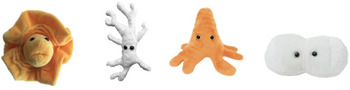
Toddlers were taught two labels attached to two creatures: “pimo” and “moku” (labels used in Ellis et al., Reference Ellis, Borovsky, Elman and Evans2015) (see Figure 1). The experimenter first took one creature out of an opaque box and ostensively named the creature using words and gestures: “Look!” (gaze to the creature, to the child, and back), “A pimo/moku [pointing to the creature]! Look here,” (gaze to the creature and back to the child), “A pimo/moku [pointing to the creature]” (gaze to the creature and back to child). “This is a pimo/moku [pointing to the creature], wow!” (gaze to the creature and back to child), “A pimo/moku [pointing to the creature].” The experimenter then placed the first creature out of sight into the opaque box and presented the second creature using the same script. The order of presentation of the two objects was counterbalanced across children.
From left to right, pictures of “pimo”, “moku”, and two unfamiliar distractors used in the fast-mapping task. The creatures were of similar sizes.

Practice phase
The experimenter placed the opaque box in front of her. She said, “Hmm? Where is the pimo/moku?” and looked inside the box for the creature. Upon finding the creature, the experimenter emoted positively and said “There it is!”; while taking the creature out from the box, showing it to the child, and naming it three additional times – “The pimo/moku [pointing to the creature]! Look! The pimo/moku [pointing to the creature]. Wow, the pimo/moku [pointing to the creature].” The same procedure was repeated for the second creature.
Test phase
The child was shown the two target creatures on a tray along with two unfamiliar objects (see Figure 1). This tray was placed out of reach of the experimenter. The experimenter then pretended that she could not reach the tray and asked for one of the two creatures the child had just learned labels for: “Can you give me the pimo/moku? I can't get it.” The child completed two trials for each word in a counterbalanced order. The experimenter did not provide feedback. Children also participated in a separate LWL task assessing their LPE with “pimo” and “moku”. However, we did not analyze data from that task because toddlers were tired and inattentive towards the end of the visit and contributed few usable trials.
Coding
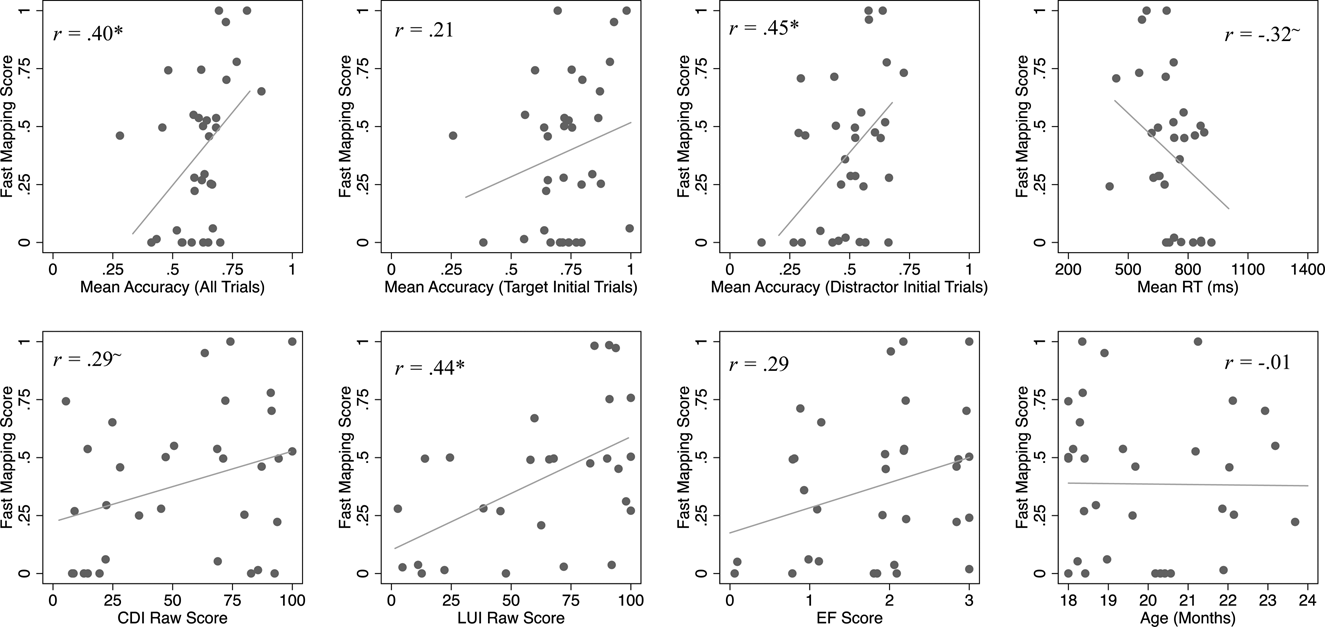
Trials were first coded to identify “usable” trials where a child attempted to retrieve an object following the experimenter's prompts. Usable trials were subsequently coded as correct if a child selected the named object and incorrect otherwise. Seven children completed 0 trials because they were fussy or did not want to participate. Of the remaining 33 children, 28 children completed all four trials, two completed three trials, one completed two trials, and two completed one trial. The total number of correct selections by a child was divided by the number of usable trials for that child. Thus, a child could obtain a maximum score of 1 which represented 100% accurate performance, M = .39, SD = .33, Range = 0 to 1, N = 33. To check the robustness of our results involving children's fast mapping scores (displayed in Figure 2), we reproduced our analyses by 1) excluding participants with fewer than 3 usable trials and 2) using all participants but fitting a mixed effects logistic regression model to predict the probability of success on fast mapping trials. Our results across these three methods were consistent and led to similar conclusions (see Supplementary Materials).
Correlations between Fast Mapping Scores and LPE, CDI, LUI, and EF Measures.
Notes. ~ p < .10, * p < .05, based on unadjusted Pearson correlation (see Table 2 for correlations adjusted for age). Scatterplots include jitter to reveal all data points. Top row shows associations between LPE measures and children's performance on the fast-mapping task. Bottom row shows associations between children's fast-mapping scores and other predictors of children's ability to learn new words (CDI, LUI, EF, Age). To check the robustness of these correlations we conducted additional analyses, which are available in the Supplementary Materials.

Language use inventory
The Language Use Inventory (LUI; O'Neill, Reference O'Neill2007). The LUI is a standardized, norm-referenced parent report measure designed to evaluate young children's pragmatic language development. It focuses on the use of language in daily social contexts. It indexes the pragmatic and social communication skills that develop between 18 to 47 months of age, such as requesting for help, using language to gain information, using language to regulate the actions of others, and adapting conversations to other individuals. There is less focus on later-developing pragmatic skills such as making inferences about indirect meanings and higher-level meta-pragmatic skills. The LUI has been used to assess pragmatic skills in typically developing children and children with developmental disabilities and delays (Pesco & O'Neill, Reference Pesco and O'Neill2012; Tager-Flusberg, Rogers, Cooper, Landa, Lord, Paul, Rice, Stoel-Gammon, Wetherby & Yoder, Reference Tager-Flusberg, Rogers, Cooper, Landa, Lord, Paul, Rice, Stoel-Gammon, Wetherby and Yoder2009). LUI scores have been shown to predict later structural and pragmatic language outcomes in typically developing children (Pesco & O'Neill, Reference Pesco and O'Neill2012). We used LUI raw scores as an index of children's pragmatic skills, M = 60.38, SD = 36.90, Range = 0 to 141. Thirty-four parents returned the LUI and the remaining six parents did not.
Results
We conducted three sets of analyses. First, we examined the associations between our measures of LPE and children's learning of novel labels on the fast-mapping task. Second, we looked at additional factors that may associate with children's performance on the fast-mapping task, including their size of expressive vocabulary, pragmatic abilities, and EF. Finally, we examined the associations between children's LPE and their vocabulary, pragmatic abilities, and EF. For each analysis involving LPE, we used all four measures of LPE (RT from distractor-initial trials, proportion accuracy from target-initial trials, distractor-initial trials, and all trials regardless of type) to examine whether and how these measures are differentially associated with children's performance on other tasks.
Lexical processing efficiency and children's ability to learn novel labels (fast-mapping ability)
When considering all LWL trials, children's accuracy was positively correlated with their performance on the fast-mapping task, controlling for age, partial correlation = .40, p = .025 (see Figure 2 for relevant scatterplots and correlations unadjusted for age, see Table 2 for all correlations reported in this manuscript, controlling for age). When looking at the two types of trials separately, children's performance on the fast-mapping task was positively associated with their accuracy with distractor-initial trials, controlling for age, partial correlation = .46, p = .01, but not target-initial trials, controlling for age, partial correlation = .21, p = .25. With regard to RT, children who were quicker to shift their gaze from the distractor to the target obtained marginally higher scores on the fast-mapping task, controlling for age, partial correlation = -.32, p = .08 In sum, children's LPE as measured by proportion accuracy and RT is associated with their ability to learn novel words in the fast-mapping task. Importantly, proportion accuracy and RT extracted from distractor-initial trials were more predictive than proportion accuracy from target-initial trials. Indeed, children's distractor-initial accuracy scores explained five times as much variance on the fast mapping task as their target-initial accuracy scores, R 2 = .20 versus R 2 = .04, and relative to the pooled accuracy across trials explained a quarter more variance, R 2 = .20 versus R 2 = 0.16.
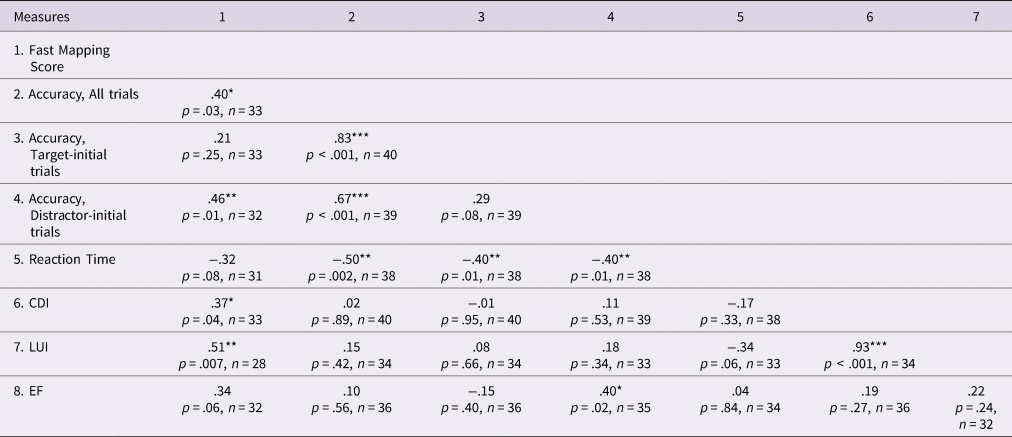
Correlations among LPE, Vocabulary, Pragmatic, and EF Measures, Controlling for Age.

Note. * p < .05, ** p < .01, *** p <.01, Pearson's correlation tests, controlling for age. See Figure 2 and Supplementary Materials for scatterplots depicting all correlations.
Associations between children's word learning and their vocabulary, pragmatic skills, and executive functions
Children's vocabulary, pragmatic skills, and EF were all positively associated with fast-mapping scores (see Figure 2). Controlling for age, these positive associations were marginally significant for EF and statistically significant for CDI and LUI. Specifically, children's EF scores were positively but marginally associated with children's fast-mapping scores, partial correlation = .34, p = .06. Children's expressive vocabulary as measured by CDI raw scores and children's pragmatic abilities as measured by LUI scores were significantly associated with fast-mapping, partial correlation, r = .37, p = .04, and r = .51, p = .007, respectively. Child age (months) was not associated with children's fast-mapping performance, r = -.01, p = .95, n = 33.
In Table 2, we display the associations between CDI, LUI, and EF measures, controlling for age. Inspection of Table 2 reveals strong associations between LUI and CDI, r = .93, p < .001. This strong correlation may suggest that children's early pragmatic skills hinge on their vocabulary knowledge, echoing previous research showing medium to strong associations between children's vocabulary skills and their pragmatic development (Bernard & Deleau, Reference Bernard and Deleau2007; De Rosnay, Fink, Begeer, Slaughter & Peterson, Reference De Rosnay, Fink, Begeer, Slaughter and Peterson2014; see Matthews, Biney & Abbot-Smith, Reference Matthews, Biney and Abbot-Smith2018 for a review). This correlation may also indicate that although CDI and LUI assess different aspects of language development by design, both measures gauge children's vocabulary skills to a certain extent. CDI measures children's size of vocabulary, whereas LUI evaluates children's ability to use various types of gestures, words, and sentences to express diverse communicative intents (e.g., seeking help, directing the parent's attention). For example, LUI asks whether “your child talks about what he/she wants or doesn't want”, and whether “your child says ‘look’ or ‘watch me’ to get your attention”. Children who have a larger vocabulary may score higher on these items, but only when they are able to use familiar words to appropriately convey intents in social interactions. Future psychometric research can examine to what extent the CDI and LUI tap into overlapping skills, which will have important implications for studies adopting these measures.
Associations between children's lexical processing efficiency and their vocabulary, pragmatic skills, and executive functions
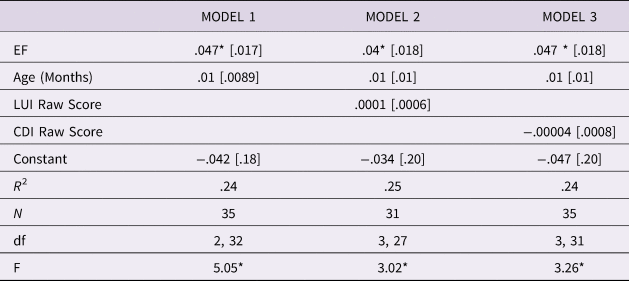
Next, we conducted exploratory analyses of the correlations between LPE measures and additional predictors of word learning, including age, CDI, LUI, and EF (see Table 2). Correlational analyses first reveal only two significant associations, both with LPE measures extracted from distractor-initial trials. First, children's EF scores were significantly associated with their accuracy on distractor-initial trials. To assess the robustness of this association, we regressed children's proportion accuracy on distractor-initial trials (squared to obtain normally distributed residuals) on EF and age (Model 1), controlling for LUI (Model 2), and CDI (Model 3) (see Table 3). This association was robust to the addition of these control variables. Thus, we illustrate the correlation between children's EF scores and their proportion accuracy on distractor-initial trials in Figure 3. Figure 3 shows the time course of looking to the target picture on distractor-initial trials for children who received different EF scores. This figure plots change over time in the mean proportion of trials on which children fixated the target picture, averaged at each 33-msec interval for children who received a 0, 1, 2, or 3 on the EF task. Proportions for each trial and time interval were created, by first averaging all distractor-initial trials by the same child and then averaging across children with the same EF score. Inspection of Figure 3 shows that children with higher EF sustained their attention on the target picture for longer periods than children with lower EF scores. Although the association between RT and EF was non-significant, inspection of Figure 3 indicates that children with an EF score of three reached 70% accuracy (significantly above chance level) at approximately 700 milliseconds on average. Children with lower EF scores did so after 1000 milliseconds. This emerging tendency for children with higher EF scores to shift more quickly to the target and to cross higher accuracy thresholds earlier on distractor initial trials can be explored in larger and more diverse samples in future studies.
Mean Proportion Looking to the Target Picture Averaged at Each 33-Msec Interval for Children Who Received a 0 (n = 5), 1 (n = 8), 2 (n = 14), or 3 (n = 8) on the EF Task.

Ordinary Least Squares (OLS) regression models describing relations between children's proportion accuracy on distractor-initial trials (squared to obtain normally-distributed residuals) and EF, age, LUI, and CDI.

Notes. *p < .05. Standard errors in brackets.
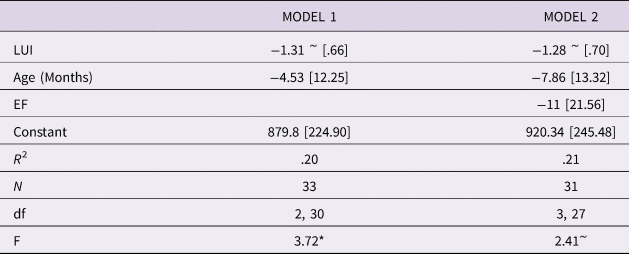
We also found that children who were quicker to shift from the distractor to the target had higher scores on the LUI. However, this correlation was not robust to the addition of control variables (see Table 4). Controlling for children's age and EF scores, the association between reactions time and LUI scores was only marginally significant (Table 4, Model 2, p =.08). Admittedly, we may have been underpowered to detect a significant association.
OLS Regression Models Describing Relations between Children's RT and LUI, EF, and Age.

Notes. ~ p < .10, * p < .05. Standard errors in brackets.
Discussion
The current paper contributes to the literature by illuminating interrelations among children's LPE, size of vocabulary, EF, pragmatic abilities, and their ability to acquire novel words during a fast-mapping task. Moreover, this study is the first to systematically examine the concurrent validity of various LPE measures extracted from different types of LWL trials. The findings will inform future studies adopting the LWL paradigm.
Toddlers’ lexical processing efficiency and novel word learning (fast mapping)
Our findings indicate that children's performance on the fast-mapping task was significantly associated with their proportion accuracy on distractor-initial trials as well as their accuracy averaged across all trials and marginally associated with their RT. These findings are generally consistent with those from Lany (Reference Lany2017). Lany found that 17-month-olds’ processing speed was concurrently associated with their processing accuracy (across all trials) with words taught during a fast-mapping task, and only those with relatively higher LPE showed signs of learning. In a more taxing learning task, 30-month-olds’ processing speed with familiar words predicted their accuracy in processing the taught words. Echoing Lany (Reference Lany2017), our findings further indicate that 18- to 24- month olds (between Lany's two age groups) who were more accurate in processing familiar words performed better on the fast-mapping task. Hence, it appears that toddlers’ proportion accuracy on distractor-initial trials and averaged across all trials is robustly associated with their performance on fast-mapping tasks, whether tested behaviorally or using the LWL paradigm.
It is important to note that fast mapping is the beginning, not the endpoint, of acquiring a new word (Bion et al., Reference Bion, Borovsky and Fernald2013; Samuelson & McMurray, Reference Samuelson and McMurray2017; Smith & Yu, Reference Smith and Yu2008). Beyond the initial form-meaning mapping, children gradually consolidate and enrich their lexical representations over time through accumulated experience hearing and using a given word. Although it remains unclear how entrenched and rich our participants’ representations of the taught words were, our findings suggest that children with higher proportion accuracy more readily established the initial word-referent mapping. Future studies can explore relations between children's LPE and their enrichment and retention of lexical entries beyond the initial mapping.
Measures associated with toddlers’ fast mapping and lexical processing efficiency
Having shown associations between proportion accuracy and fast mapping, we then turn to other predictors of fast-mapping performance and LPE. When controlling for age, we found significant positive correlations between children's pragmatic abilities (LUI raw scores) and fast-mapping scores and between children's expressive vocabulary (CDI raw scores) and their fast-mapping scores. Additionally, children who had more advanced pragmatic abilities were quicker to shift their gaze from the distractor to the target on LWL trials, Pearson's r = -0.44, p = .01, n = 33 (see Supplementary Materials for the scatterplot). However, this association is only marginally significant after controlling for EF and age.
Why are children's pragmatic skills related to their RT? Children with stronger pragmatic skills may have better understood the workings of the LWL task – a game of following instructions and searching for objects. Such understanding may help them more quickly orient their gaze to the named image. Our findings point out a potential new direction for understanding deficits in autistic children's LPE (measures include LWL proportion accuracy based on all trials, RT, and growth curve models) compared to their typically developing (TD) peers (Bavin et al., Reference Bavin, Kidd, Prendergast, Baker, Dissanayake and Prior2014; Ellis Weismer, Haebig, Edwards, Saffran & Venker, Reference Ellis Weismer, Haebig, Edwards, Saffran and Venker2016). Sources of such disparity remain unclear in the literature. Ellis Weismer et al. (Reference Ellis Weismer, Haebig, Edwards, Saffran and Venker2016) found that the weak central coherence theory (i.e., autistic individuals tend to prioritize local processing over global processing) failed to account for autistic toddlers’ deficits in LPE. Our findings suggest a potential alternative explanation: TD children may decipher the workings of the LWL game more efficiently than autistic children who tend to exhibit pragmatic language impairment. Future research can explore this hypothesis.
As to why children's pragmatic abilities were associated with their fast-mapping scores, we propose two hypotheses. First, children who have more advanced pragmatic skills may have used information available in the teaching input more efficiently, and hence more successfully acquired the taught words. Researchers have argued that language learning, especially word learning, relies heavily on pragmatic understanding and inferences (e.g., Bruner, Reference Bruner1983; Markson & Bloom, Reference Markson and Bloom1997; Tomasello, Reference Tomasello2000). Specifically, children draw on their social-pragmatic understanding to decipher ongoing communicative exchanges (Bruner, Reference Bruner1983), disambiguate form-meaning mappings (Bloom & Markson, Reference Bloom and Markson1998), and infer interlocutors’ communicative intents (Tomasello, Reference Tomasello2000), all of which are important for word learning. To succeed in our fast-mapping task, toddlers have to understand the ostensive labeling context, interpret the experimenter's intents, and grasp the social cues accompanying the transient speech (joint attention, eye gaze, pointing gestures). An alternative explanation is that children's pragmatic abilities may have contributed to their performance on the fast-mapping test trials where the experimenter asked the child to help retrieve a particular object. Children with stronger pragmatic skills may have better understood the experimenter's intention and acted more collaboratively.
We also found that EF (controlling for age) were positively but marginally associated with children's fast-mapping scores. EF is also associated with proportion accuracy derived from distractor-initial trials. Specifically, children with stronger EF sustained their attention for longer periods following a switch to the target image than children with lower EF scores, over and above their size of vocabulary, pragmatic skills, and age.
The finding that EF was associated with children's proportion accuracy on distractor-initial trials echoes Newbury and colleagues’ (Reference Newbury, Klee, Stokes and Moran2015, Reference Newbury, Klee, Stokes and Moran2016) finding that working memory at child age 24 to 30 months, an important component of EF, is concurrently correlated with children's RT on LWL trials. Our findings also shed light on the mechanism underlying the links between children's proportion accuracy across all trials and on distractor-initial trials and their ability to acquire novel words, because these findings provide preliminary evidence that EF, a domain general skill, may support both abilities (EF was marginally associated with children's fast mapping scores). Of course, before such a conclusion is drawn, this initial evidence needs to be replicated with a larger sample. These findings have important implications because they suggest that, in some cases, proportion accuracy from distractor initial trials may serve as a more sensitive measure of children's LPE than RT. Because children who are faster at processing the known word tend to fixate longer on the target, proportion accuracy from distractor-initial trials are positively correlated with RT. Hence, in many studies, only RT is used as a measure of LPE. In fact, the current study suggests that proportion accuracy from distractor initial trials is associated with EF, an important cognitive skill, over and above child age, CDI, and LUI, but RT does not. Hence, researchers who adopt the LWL paradigm should consider including both measures to provide a more comprehensive account of children's processing speed and accuracy.
Toddlers’ expressive vocabulary (CDI) was significantly associated with their fast-mapping performance (when controlling for age), but unassociated with their proportion accuracy or RT. The finding that children with a larger vocabulary were better at establishing new form-meaning mappings converges with previous studies (Heibeck & Markman, Reference Heibeck and Markman1987; Mervis & Bertrand, Reference Mervis and Bertrand1994; but see Lucca & Wilbourn, Reference Lucca and Wilbourn2018 where no associations were found between vocabulary and fast-mapping success). Surprisingly, we did not find associations between toddler's expressive vocabulary and their LPE. This may be attributable to our relatively homogenous sample of children from mostly middle-class households with college-educated parents. Studies showing concurrent associations between size of vocabulary and LPE often include families of diverse socioeconomic status (Fernald et al., Reference Fernald, Marchman and Weisleder2013) which may have increased individual differences in CDI scores. The lack of association may also be due to the fact that we used the CDI short-form with 100 word items, while most studies use the CDI long form with 680 words (e.g., Fernald et al., Reference Fernald, Marchman and Weisleder2013). The long form may have better captured individual differences in children's vocabulary knowledge. Alternatively, due to our relatively small sample size, we may have been under-powered to detect associations between LPE and vocabulary.
Concurrent validity of various lexical processing efficiency measures
The current study explored the concurrent validity of four commonly used LPE measures: RT from distractor initial trials, proportion accuracy from target-initial trials, distractor-initial trails, and all trials. Controlling for child age, we found that RT from distractor-initial trials was marginally correlated with children's pragmatic development and significantly correlated with fast mapping scores; proportion accuracy scores from distractor-initial trials was significantly associated with children's fast-mapping scores and EF; accuracy across all trials was related to children's fast-mapping scores; accuracy from target-initial trials was not associated with any measures. In fact, we found that children's target-initial accuracy scores explained five times less variance on the fast mapping task relative to their distractor-initial accuracy scores.
Why is children's performance on different trial types differentially associated with their EF, fast-mapping scores, and pragmatic skills? Although capacities underlying children's LPE, in general, may be similar regardless of trial type, distractor-initial trials may tap into children's EF and pragmatic skills to a greater extent, because they require toddlers to follow instructions, disengage from the distractor, and shift their gaze to the target image. Hence, LPE on distractor-initial trials may be more closely associated with children's EF and pragmatic competence. In contrast, children's looking behaviors on target-initial trials are more varied, because there could be multiple “correct” looking patterns. Some may maintain their gaze on the correct image they started on, whereas others may generate confirmatory target-distractor-target looks (Law, Mahr, Schneeberg & Edwards, Reference Law, Mahr, Schneeberg and Edwards2016). Therefore, target-initial trials may lead to “noisier” looking patterns and may be a less sensitive measure of word recognition.
It is also important to note that RT is a direct measure of children's processing speed, whereas proportion accuracy indicates children's level of correctness in lexical processing. Although proportion accuracy from target-initial trials were not associated with other measures in the current study, it may serve as an important measure in studies where children's correctness in processing newly learned words is under close investigation (Lany, Reference Lany2017; Schwab & Lew-Williams, Reference Schwab and Lew-Williams2018; Wei et al., Reference Wei, Ronfard, Leyva and Rowe2019).
Our findings have important implications for future studies using the LWL paradigm, because they shed light on how and why pooling proportion accuracy from target-initial and distractor-initial trials may lead to biased measures of LPE. First, in the current study, children rarely contributed the same number of target-initial and distractor-initial trials. In fact, only six out of 40 children (15%) contributed an equal number of target-initial and distractor-initial trials. Second, on average, children had lower accuracy scores on distractor-initial trials than on target-initial trials, M = .49 and .72 respectively, SD = .11 and .15, t = 8.68, p <.001. This is unsurprising given that children start on the target in target-initial trials, whereas in distractor-initial trials they have to initiate a gaze shift that takes time. Taken together, given that each child often contributes an unequal number of target- and distractor-initial trials, that children typically have lower accuracy scores on distractor-initial trials than target-initial trials, and that LPE measures from different trial types are of different concurrent validity, we believe it is important to analyze proportion accuracy from target-initial trials and distractor-initial trials separately.
Additionally, children's baseline preferences may lead to an even greater imbalance between the number of target- and distractor-initial trials. Children may show such preferences for various reasons, such as familiarity with the words or images, individual interest, visual salience, and image attractiveness. As a result, pooling proportion accuracy across all trials may lead to even more biased estimates of children's LPE. Hence, it is especially important to take trial types into consideration when children may prefer one word or image over the other on certain trials. Variations of the difference score analysis are especially useful in this case because it considers children's baseline preferences and therefore is less affected by trial types. For example, previous studies have compared proportion accuracy before and after target noun onset, generating a measure of changes in children's looking patterns after hearing the target noun (e.g., Bergelson & Swingley, Reference Bergelson and Swingley2012, 2018; Wei et al., Reference Wei, Ronfard, Leyva and Rowe2019). In theory, this measure is unaffected by trial type because children's baseline looking patterns prior to hearing the target noun (which determines trial type) are partialled out by subtracting the proportion accuracy before target noun onset from the proportion accuracy after target noun onset.
This study has several limitations. First, we had a relatively small sample of toddlers with primarily college-educated parents. Our correlational findings should be interpreted with caution because we may have been underpowered to detect certain associations (e.g., between LPE and vocabulary). Future research could test the robustness of our findings with a larger sample and explore whether findings are generalizable to families from other socio-economic or cultural backgrounds. Second, the current study explores concurrent associations among measures. Future longitudinal or intervention studies are needed in order to draw conclusions about the directionality of influences among measures.
Conclusion and future directions
The current study investigated the interrelations among toddlers’ LPE, expressive vocabulary, EF, pragmatic development, and ability to learn novel labels through fast-mapping. Building on and extending extant literature, our findings show that children who are more accurate in processing familiar words can more efficiently acquire new words through fast-mapping. Additionally, this study reveals that children's LPE, measured using the LWL paradigm, likely hinges on a wide range of linguistic, cognitive, and social skills, such as vocabulary knowledge, EF, and pragmatic skills. This has implications for understanding what causes individual children to differ in their LPE and word learning trajectories (e.g., Fernald et al., Reference Fernald, Marchman and Weisleder2013) and how to best intervene. Lastly, the current study is the first to show different concurrent validity of various widely used LPE measures, and has important implications for future studies adopting the LWL paradigm.
Acknowledgements
This project was funded by startup funds from the Harvard Graduate School of Education to M. Rowe. We are grateful to the families who generously contributed their time to this study. We thank Paul L. Harris, Kathryn Leech, Muanjing Julia Wang, and Han Pearl Li for their help with study design, data collection, and analyses. S. Ronfard, R. Wei, and M. L. Rowe designed the study. S. Ronfard and R. Wei collected data. S. Ronfard analyzed data. S. Ronfard, R. Wei, and M. L. Rowe wrote the paper.
Supplementary Material
For Supplementary Material accompanying this paper, visit https://doi.org/10.1017/S0305000921000106