The more we know about how different communities have responded to the antithetic pressures leading to leveling and standardization, the more we will come to understand these processes themselves.
Tagliamonte and Smith (Reference Tagliamonte and Smith1999:21)This current study of English in the West Virginia region of Appalachia takes up the variable of past be in order to examine the sociolinguistic tug-of-war between standardization and paradigm leveling. Paradigm leveling occurs when the verb paradigm changes from a more diverse set of forms (e.g., was, were) to a less diverse set of forms (e.g., was). Sweeping changes have occurred throughout 20th-century Appalachia, including changes to the vernacular language variation patterns. Paradigm leveling and standardization have clashed in rural communities since the beginning of compulsory education, but in Appalachia, paradigm leveling has traditionally won out over standardization, as has been true in many different kinds of communities (e.g., Cheshire, Edwards, & Whittle, Reference Cheshire, Edwards, Whittle, Milroy and Milroy1993). Considering that traditional features such as a-prefixing (e.g., She's a-working), demonstrative them (e.g., We saw them kids), and the Northern Subject Rule (e.g., The dogs barks) have all faded from regular use in the West Virginia region of Appalachia, a relevant question for researchers of vernacular dialect varieties is whether or not past be variation is still a possible pattern for social differentiation.
Examples of was paradigm leveling are listed in (1) to (8):
(1) Existential there: There was between eight hundred and a thousand people. (Boon Co. 1)Footnote 1
(2) Second person: Well, no, we didn't go to church when you was little, huh-uh. (Tyler Co. 1)
(3) First person plural: We was re-caulking the faucets, so they wouldn't drip. (Greenbrier Co. 5)
(4) Third person plural pronoun: They were in our class, and they wasn't really into nothing. (Boon Co. 3)
(5) Third person plural noun phrase: The rumors was starting down there. (Logan Co. 3)
(6) Collective noun phrase: If they had a family, why, some of them was up again, they needed something to eat. (Monongalia Co. 9)
(7) Conjoined noun phrase: When her and Dad was a-living. (Tyler Co. 1)
(8) Contracted was: I's starting kindergarten. (Monongalia Co. 8)
For the default singular of past be, this paper demonstrates that standardization has lowered the rates of leveled was, but that paradigm leveling now relies on a reduced form to ease standardizing pressures: contracted was (e.g., They's late yesterday). This paper investigates how the sociolinguistic variation of this seemingly stable variable changed at the end of the 20th century under the pressures of standardization. The resulting variable provides extra space for sociolinguistic differentiation. The decline and innovation of was paradigm leveling provides Appalachian speakers with a wider range of options for indexing their social selves.
PREVIOUS RESEARCH ON WAS PARADIGM LEVELING
Past be is a socially significant variable in many regions because it offers different configurations of language variation patterns. Research into was paradigm leveling falls under the category of sociolinguistic morphological analysis of subject-verb concord, a linguistically rich and socially diagnostic research realm. For four decades, past be variation has been studied in many different sociolinguistic contexts, including urban areas (e.g., Cheshire, Reference Cheshire1982; Cheshire & Fox, Reference Cheshire and Fox2009; Fasold, Reference Fasold1972; Labov, Cohen, Robins, & Lewis, Reference Labov, Cohen, Robins and Lewis1968; Tagliamonte, Reference Tagliamonte1998; Trudgill, Reference Trudgill1974; Wolfram, Reference Wolfram1969), more rural areas (e.g., Britain, Reference Britain2002; Hazen, Reference Hazen2000a; Smith, Reference Smith2000; Smith & Tagliamonte, Reference Smith and Tagliamonte1998; Tagliamonte & Smith, Reference Tagliamonte, Smith and Poplack2000; Wolfram & Thomas, Reference Wolfram and Thomas2002), and extremely isolated varieties (e.g., Schreier, Reference Schreier2002, Reference Schreier2008). In an overview of the morphological variation in the British Isles and America, Kortmann and Szmrecsanyi (Reference Kortmann, Szmrecsanyi, Kortmann, Burridge, Mesthrie, Schneider and Upton2004) found past be variation to be a frequent feature. It has also been investigated in many national varieties, including Australian English (Eisikovits, Reference Eisikovits and Cheshire1991), New Zealand English (Hay & Schreier, Reference Hay and Schreier2004), British English (Anderwald, Reference Anderwald2001), and Indian South African English (Mesthrie, Reference Mesthrie, Kortmann, Burridge, Mesthrie, Schneider and Upton2004:990). More recently, several studies have contributed insights into the linguistic and social purposes for which the past be variable has been used. It has been found that ethnic social contexts greatly influenced was/were variation for young speakers in London (Cheshire & Fox, Reference Cheshire and Fox2009). Richards (Reference Richards2010) investigated a variety in Leeds, England, to find that four intermediate variants of was/were are being reallocated according to polarity. Recently, Moore (Reference Moore2011) used past be analysis to examine how factors such as socioeconomic status constrain the agency of practice-based social groups, and Tagliamonte and Baayen (Reference Tagliamonte and Baayen2012) used was/were variation to illustrate the utility of mixed-effects models and conditional inference trees.
Within all these studies, variation has been examined through several different linguistic contextual features. The two most prominent are grammatical subjects and polarity.
The most discussed patterning of grammatical subjects is the Northern Subject Rule (e.g., Smith & Tagliamonte, Reference Smith and Tagliamonte1998). The Northern Subject Rule, so called because of its influence in Scotland and the North of England, operated for be and all other verbs, and it appears to have been carried over by Scots-Irish migrants to the United States, including Appalachia and the Outer Banks (Montgomery, Reference Montgomery1989, Reference Montgomery, Ickringill and Fitzgerald2001; Schneider & Montgomery, Reference Schneider and Montgomery2001; Wolfram, Hazen, & Schilling-Estes, Reference Wolfram, Hazen and Schilling-Estes1999). Essentially for this rule, present tense –s attaches to verbs when the third-person plural subject is not an adjacent they. In a variety with the Northern Subject Rule in place, *They strikes at everyone is extremely rare, but They often strikes at everyone is not unexpected; in addition, –s in The boys paints on the walls would be fully expected. Smith and Tagliamonte (Reference Smith and Tagliamonte1998:116) found notably high rates of the Northern Subject Rule forms in Buckie, Scotland, with no instance of was after they but 81% was after plural noun phrases (NPs).
Contrasting with the Northern Subject Rule is the Southern Subject Rule (Cheshire & Fox, Reference Cheshire and Fox2009:7). Britain (Reference Britain2002) illustrated this subject constraint in East Anglian varieties, where was leveling happens more frequently with they than with plural NPs. His older speakers did have higher rates of was leveling with plural NPs, but as younger speakers increased their rates of was leveling overall, the subject constraint dropped off. This change to constraints could be characterized as linguistic swamping: as the frequency of was leveling rose, the constraints against any differentiation in linguistic environments fell away. As will be illustrated, studies of Appalachia find the same absence of the Northern Subject Rule with past be.
Scholars have proposed specific constraint hierarchies for grammatical subjects. For example, Britain (Reference Britain2002:26) proposed existentials > you > we > they > NP Plural, whereas Chambers (Reference Chambers and Kortmann2004:141) proposed existentials > you > we > NP Plural > they. Existential constructions consist of a semantically null word in the subject slot, as in There was three of them. However, the call for specific hierarchies may have been premature. Many different orderings of grammatical subjects occur in varieties of English around the world. Tagliamonte (Reference Tagliamonte, Filppula, Klemola and Paulasto2009) surveyed 13 English-speaking communities to find that few grammatical patterns clearly stand out, although existentials do favor higher levels of was leveling. Cheshire and Fox (Reference Cheshire and Fox2009:31) surmised, “Our analysis does not provide strong support for previous claims that there is a consistent constraint hierarchy for the effect of the grammatical subject.” However, some trends were evident; for example, they did find that second-person you had higher rates than other subjects did.
Collective NPs are an additional category examined in literature on subject-verb concord. Collective NPs, such as people and a lot of them, are NPs that would be considered plural in American English standard speech but which in British English are treated as singular subjects. Bock, Butterfield, Cutler, Cutting, Eberhard, and Humphreys (Reference Bock, Butterfield, Cutler, Cutting, Eberhard and Humphreys2006) examined how collectives were processed psycholinguistically, distinguishing between US and British language variation patterns. Within the United States, scholars have found that collective NPs correlate with a higher rate of was leveling (Wolfram et al., Reference Wolfram, Hazen and Schilling-Estes1999). The current analysis on the grammatical subject's influence on was leveling by Appalachians yields further data to weigh in on the debate on whether there are trends for grammatical subjects.
Another factor investigated with most studies of past be leveling is the polarity of the verb. Working from the terms of Chambers (Reference Chambers and Kortmann2004), Tagliamonte (Reference Tagliamonte, Filppula, Klemola and Paulasto2009) divided communities into Vernacular Pattern I and Vernacular Pattern II. Vernacular Pattern I consists of was leveling for both positive and negative phrases (e.g., We was there last year and We wasn't there last year). Vernacular Pattern II consists of was leveling for positive phrases (e.g., We was there last year) and were leveling for negative phrases (e.g., We weren't there last year). Cheshire and Fox (Reference Cheshire and Fox2009:6) viewed these as the two possible patterns for polarity in UK English, although positive were leveling is also part of the repertoire for UK English variation (Britain, Reference Britain2002:19), for example, I were there last year. For dialects on the East Coast of the United States, some have Vernacular Pattern II, such as in Ocracoke, North Carolina (Wolfram et al., Reference Wolfram, Hazen and Schilling-Estes1999) and Lumbee English in Robeson County, North Carolina (Wolfram & Sellers, Reference Wolfram and Sellers1999). Other varieties have been found to have Vernacular Pattern I; for example, Fasold (Reference Fasold1972) found was to be the primary negative form in Washington, DC. Yet some other US eastern dialect varieties developed a coalesced form, phonologically separate from was or were for the negative, similar to Richards’ (Reference Richards2010) findings for Leeds; in Warren County, North Carolina, wont is the preferred negative form (Hazen, Reference Hazen1998, Reference Hazen2000b).
Within Appalachia, scholars have identified primarily Vernacular Pattern I for negation, including Christian (Reference Christian1978), Wolfram and Christian (Reference Wolfram and Christian1975, Reference Wolfram and Christian1976), and Christian, Wolfram, and Dube (Reference Christian, Wolfram and Dube1988). Yet, in other aspects of subject-verb concord, Appalachian speakers have been shown to have dialect affinity with Ocracoke and the Outer Banks (Hazen, Reference Hazen1996).
LEVELED WAS IN APPALACHIA
Appalachia is both a rich cultural area and an economically impoverished federal zone, targeted as such for extra municipal funding. However, the federal boundaries are not in line with the social imagination, and although many counties benefit from grants due to their classification as Appalachian, many residents in these areas would not self-identify in this way. So, it would seem that these two conceptions of Appalachia occupy overlapping yet different geographic space. In this study, the region under examination is part of both areas, as West Virginia is the only US state fully contained in the federal region and falls within most people's conception of the traditional Appalachian cultural region. In most popular accounts, a monolithic “Appalachian English” dialect is only spoken by the most socially disadvantaged speakers and contains a set of highly vernacular dialect features. In contrast, this study examines past be variation and change within English in Appalachia.
For the West Virginia region of Appalachia, the sociolinguistic profile of past be was relatively well documented in the early 1970s, providing an excellent opportunity for comparison across generations in this region. Although these previous results do not come from the same speakers or necessarily the same communities in Appalachia, they can certainly be said to come from the same types of speech communities (Patrick, Reference Patrick, Chambers, Trudgill and Schilling-Estes2002). Thus, the differences between the previous and the current results can be viewed as changes to the past be system across the 20th century. Studies by Hackenberg (Reference Hackenberg1972), Blanton (Reference Blanton1974), Wolfram and Christian (Reference Wolfram and Christian1975, Reference Wolfram and Christian1976), and Christian (Reference Christian1978) provided several points of comparison.
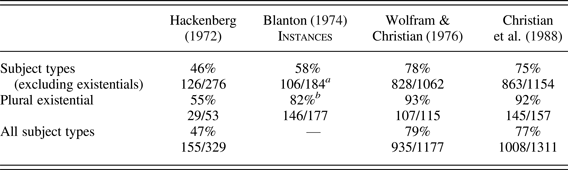
Blanton (Reference Blanton1974:41–43) provided a study of leveled was for 22 speakers in Breathitt County, KentuckyFootnote 2 and Hackenberg (Reference Hackenberg1972:37–47) for 39 speakers from Nicholas County, West Virginia. Wolfram and Christian published three studies of past tense be (rendered as nonstandard concord) for speakers from Monroe and Mercer Counties, West Virginia: Wolfram and Christian (Reference Wolfram and Christian1975, Reference Wolfram and Christian1976:83) was a study of 52 speakers; Christian, Wolfram, and Dube (Reference Christian, Wolfram and Dube1988) reconfigured that dataset and expanded the data to include 62 speakers (47 of whom were part of the original 52) from the recordings done in the early 1970s. The aggregated results from these studies are presented in Table 1.
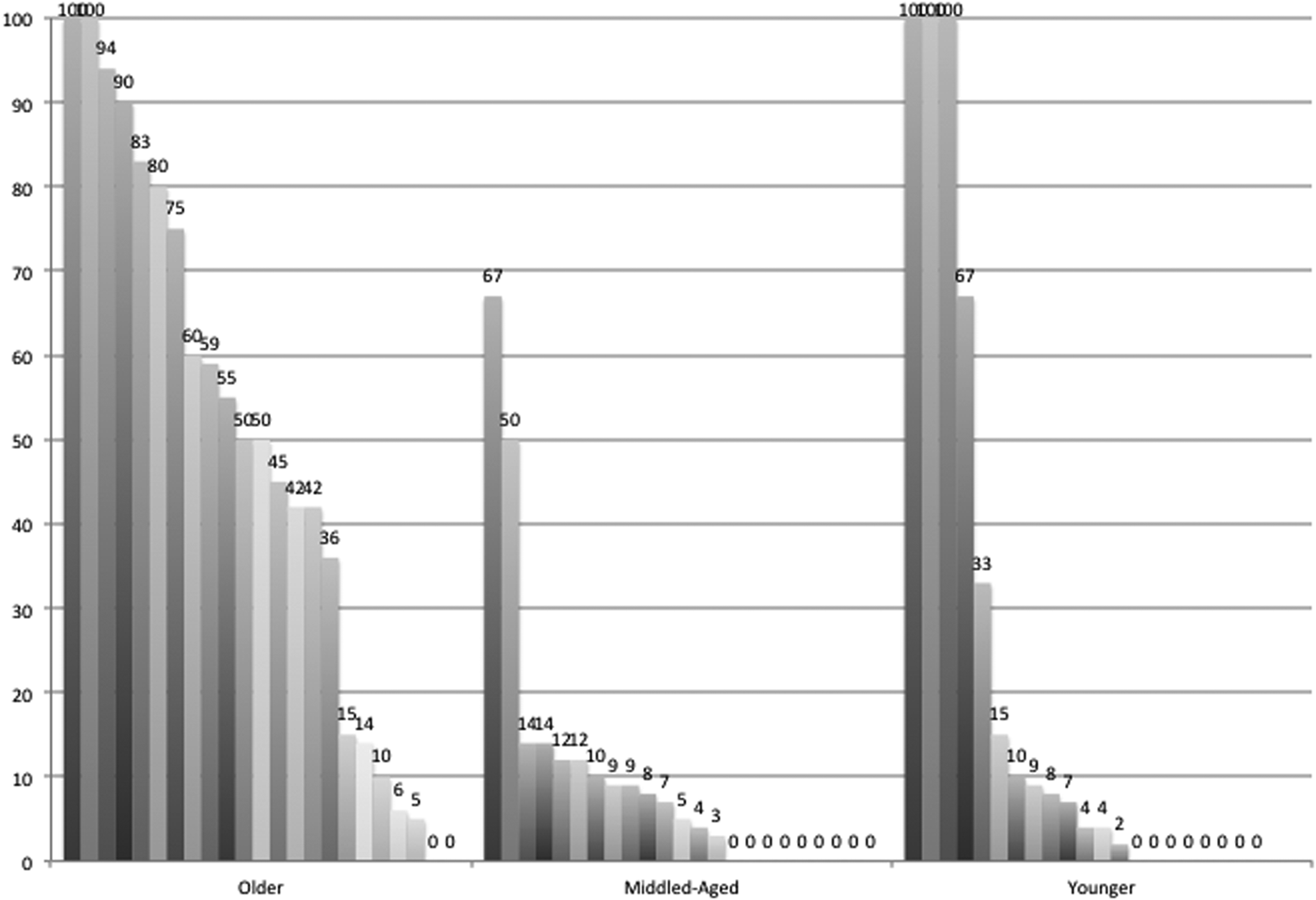
Rates of was leveling without plural existentials for individual speakers.

Previous results from studies of leveled was in Appalachia
Notes: aThis denominator is reconstructed from tables in Blanton (Reference Blanton1974:41–43). bExistential there is/was.
Two findings in Table 1 are relevant to the current study. First, as with other studies of subject-verb concord, existential there was found to provide a more conducive environment for leveled was, with rates higher by 9 to 24 percentage points than those of other subjects. Second, the overall rates of leveled was are high enough for each of the communities studied to be considered extremely vernacular in the early 1970s.
EMPIRICAL DESIGN
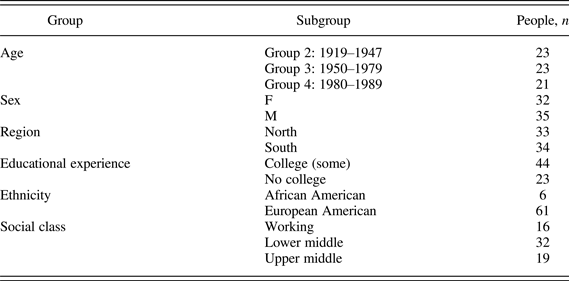
For the investigation of sociolinguistic variation in Appalachia, the West Virginia Dialect Project (WVDP) has conducted sociolinguistic interviews with 183 native Appalachians. From these interviews, 67 speakersFootnote 3 form the basis for the West Virginia Corpus of English in Appalachia (WVCEA), with the demographics shown in Table 2. These speakers were chosen because of the sound quality and extensive discussion in their sociolinguistic interviews, as well as their social distribution in terms of geography, age, sex, and the status of their parents as natives of Appalachia.Footnote 4
Speakers in the West Virginia Corpus of English in Appalachia (WVCEA)
These speakers, born between 1919 and 1989, are divided into three age groups. World War II was a major social event for West Virginia, as it contributed greatly to out-migration both to the military and cities in northern states, and this boundary divides the older and middle-aged speakers. The younger speakers are divided by the economic and educational changes at the end of the 1970s. Each age group is fairly evenly divided by region and sex.Footnote 5 Of the 67 speakers, 6 are African American.Footnote 6 The speakers were born and raised in West Virginia (64) and near the West Virginia borders (Ohio: 2, Pennsylvania: 1), but they all lived in West Virginia at the time of their interviews.
Two social factors require explicit definition: regional division and educational level. The regional division between north and south was designated with a latitudinal line running through the middle of West Virginia from east to west, following Kurath's (Reference Kurath1949:27) division between northern and southern West Virginia. It also echoes the divisions found by Carver (Reference Carver1987) and Labov, Ash, and Boberg (Reference Labov, Ash and Boberg2006). The regional decision was also supported through the speakers' own observations: Most people assured us that a north/south divide runs across the state through Braxton County, West Virginia. The second social factor is the category of educational experience, with the differentiation resting between those speakers with some postsecondary educational experience versus those with none. In this way, this social category is not a measure of accumulated knowledge, such as an associate's degree, but a category of identity and orientation to institutional education.
For social class itself, the categories presented here are designed with traditional indicators like occupation and home environment (Labov, Reference Labov2001). For this study, the WVDP designated social class on the basis of occupation (or occupation of the parents if the subject was a minor), housing conditions (as known), self-discussion of high school cliques, and living conditions (e.g., whether they had to work in high school, their hobbies). These categories were used in addition to other factors, including the speakers' own perceptions of their social class standings, their extracurricular activity choices, and their explanations of their belongings. Previous results from this corpus (Hazen, Reference Hazen2008:128) strongly support these social class divisions: (ING) variation has traditionally been linked to sharp socioeconomic divides (Labov, Reference Labov2001), and such divides appeared as expected with the current social class divisions.
For the variationist sociolinguistic analysis, standard procedure was followed (Tagliamonte, Reference Tagliamonte2006, Reference Tagliamonte2011). The interviews were transcribed orthographically, and the WVDP researchers used those transcripts as maps to navigate through the interviews. Each token was coded with the linguistic and social categories discussed, including those relating to the form of the past be verb (e.g., contracted or full). In other words, rather than simply assessing standard were contexts, we also coded for grammatical subjects in first- and third-person singular to assess whether contraction was restricted to standard were environments.
This analysis used Rbrul (Johnson, Reference Johnson2009) in order to include speaker as a random effect. The factor weights should be interpreted so that numbers closer to 1 have a gradiently higher correlation with leveled was than those closer to 0 do. Additionally, the Rbrul results are arranged to emphasize both the constraint ranking within each factor group and the relative strength of each factor group (see Poplack & Tagliamonte, Reference Poplack and Tagliamonte2001:94). As Tagliamonte (Reference Tagliamonte2006:237) wrote, “Constraint ranking … provides a detailed model of the structure of the relationship between variant and linguistic context, or the ‘grammar’ underlying the variable surface manifestations.” By comparing constraint rankings across several sets of linguistic and social factors, a model of the dialect grammar emerges.
FINDINGS
Linguistic results
This section provides linguistic results within two areas. First, the rate for just plural existentials is compared with the total rates of leveled was. Second, other linguistic constraints, beyond those of the subject type of plural existentials, are weighed against each other to determine their relative influence. These possible constraints include other grammatical-person subject types, contraction of the past be form, negation of the past be phrase, and intervening elements between the subject and verb.
Based solely on Table 3, the rates of was leveling for these speakers might be seen as vernacular: The overall rate of was leveling was 32% (480 of 1513), with 132 occurrences in existential there constructions and 348 in other subject environments. Yet, two comparisons mitigate a uniform vernacular label for these Appalachian speakers. First, as will be discussed, this overall rate is considerably lower than are those found in earlier studies of this variety. Second, in the summary form of Table 3, the range of variation in the data is obscured. Figure 1 provides the rates of was leveling without plural existentials for individuals, grouped by age and then ordered by their rates. Speakers range between 100% and 0%, which is similar to the diversity of rates in (ING) variation with these speakers (e.g., Hazen, Reference Hazen2008) and starkly different from their patterns of coronal stop deletion (e.g., Hazen, Reference Hazen2011). Unlike either of those two variables is the difference in Figure 1 of the age groups, the details of which will be explored.
Overall rates of was leveling

Relevant for all subsequent results is the influence of existential there in Appalachia, as in most varieties of English. Its influence has to be considered separately from that of other subjects. To put it differently, plural existential there is a different type of language variation. Walker (Reference Walker2007) presented strong evidence, including ranking of independent variables, that the form there's is a lexicalized form and that existentials in general should be considered as a separate subject category. Existential there is in itself not a frequent grammatical construction, as Starks and Thompson (Reference Starks and Thompson2009:323) remarked in their study of Niuean English. In the WVCEA, it appears on average 3.5 times per interview, with interviews averaging 10,000 words; however, other studies have found it as frequently as 7 tokens per speaker (Hay & Schreier, Reference Hay and Schreier2004, as cited in Starks & Thompson, Reference Starks and Thompson2009:323). In and of itself, the rate of was leveling in plural existential environments was 55% (132 of 240). This rate is higher than that for nonexistentials, although it is not as high as previously found in Appalachia. With existential there set aside in the data, the rate of was leveling falls to 27% (348 of 1273).
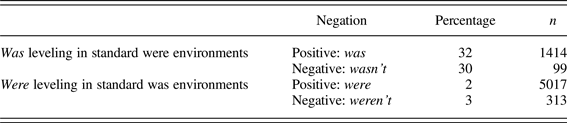
Before existential there is dropped from the remaining analysis, the effect of polarity on the entire dataset is assessed. Polarity has been found to be an important divider between past be systems, with some varieties demonstrating leveled was across both positive and negative paradigms and others showing leveled was for positive contexts and leveled were for negative contexts. Table 4 provides the findings for polarity for these West Virginia speakers, including plural existentials with all other subjects. In Table 4, the extent of were leveling is small in standard was environments, with only 2% in positive contexts and 3% in negative contexts. It is clear that weren't leveling is not a component of language variation in this area of Appalachia, unlike the patterns found for Ocracoke (Wolfram et al., Reference Wolfram, Hazen and Schilling-Estes1999), London (Cheshire & Fox, Reference Cheshire and Fox2009), the Fens (Britain, Reference Britain2002), and other British communities (Anderwald, Reference Anderwald2002). There is no move in these data toward a dichotomous, polarized system where positive was contrasts with negative weren't. Also in Table 4, for standard were contexts, was leveling is more prominent with 32% as an overall rate, and speakers rarely produced were leveling of either kind.
Polarity with past be (including existential there)
With this grammatical system of paradigm leveling clearly identified as Vernacular Pattern I, the relative influence of linguistic and social factor groups can be assessed in was leveling (excluding plural existentials). Rbrul (Johnson, Reference Johnson2009) was used with speaker marked as a random effect; linguistic factors were run separately from social factors.
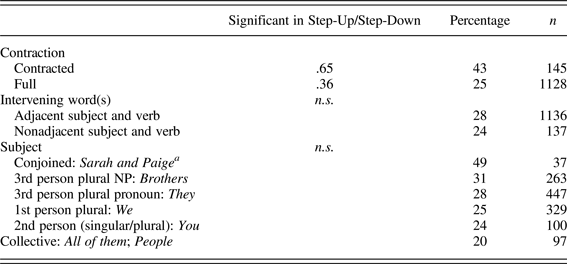
As shown in Table 5, the only factor group found to have a statistically significant influence on the rate of was leveling is the phonological form of was, in other words, whether it is contracted, as in example (8), or not. Some scholars have argued that past tense be does not contract in most varieties (Anderwald, Reference Anderwald2002:28; Bender, Reference Bender2001:88; Labov, Reference Labov1972:Ch. 3; Tagliamonte, Reference Tagliamonte, Filppula, Klemola and Paulasto2009:106). Yet, for English in Appalachia, Christian et al. (Reference Christian, Wolfram and Dube1988:112) remarked that “was often occurred in contracted form with plural subjects.” The WVDP has observed—both within the WVCEA and in our daily interactions with natives—that was is regularly contracted.
Rbrul logistic regression analysis of was leveling for linguistic factor groups with speaker as a random effect (subjects exclude existential there)
Note: N = 1273. n.s. = not significant. aOf 37 conjoined subjects, 30 (81%) had singular final conjuncts. Application value: was + 's. Contracted run input probability: .296; other linguistic factors run input probability: .178. Contraction and subject were run together, and then subject, adjacency, and polarity were run together.
There is legitimate reason to question how we know that was is in the contracted form and not is. The best evidence we have is the contextual information surrounding the contracted forms: we only counted tokens as past be forms that were clearly placed in past-time reference by adverbial markers, surrounding verbs in the dialogue, and real-world information about the speaker (e.g., I's starting kindergarten). The other evidence on this issue is the lack of past-time is forms. The WVDP found no instances of full is with past-tense reference; that is, there were no sentences like Last Monday, she is talking about it before she left.
In accordance with Christian et al.’s (Reference Christian, Wolfram and Dube1988) observation, the presence of contracted was continues in the WVCEA, with 12% of the tokens being contracted (145 of 1273). Contracted forms correlate strongly with was leveling, with 43% of the contracted forms being leveled versus only 25% of the noncontracted forms. The multivariate analysis shows contracted forms strongly favor paradigm leveling, with a factor weight of .65, with the subject factor group marked as nonsignificant in every Rbrul run. The rationale for this pattern will be discussed. The contracted form of was does correlate completely with polarity and adjacency in that all of the contracted forms are positive and adjacent. Accordingly, neither polarity nor adjacency was run with the contraction factor group in Rbrul. Because both polarity and adjacency are still nonsignificant when analyzed without the contraction factor group, the collinearity with contracted was does not explain its tendency for paradigm leveling.Footnote 7
Despite grammatical subject having a wide range of was leveling rates, this factor group was not found to be significant. This finding is in contrast to Cheshire and Fox (Reference Cheshire and Fox2009:21), where a significant pattern was found for inner and outer London adolescents, but in line with the general conclusion of Tagliamonte (Reference Tagliamonte, Filppula, Klemola and Paulasto2009), who argued against any universal hierarchy. The search for a grammatical hierarchy constraining leveled was in earlier literature might have proceeded differently with statistical methods such as mixed models (Baayen, Reference Baayen2008). For this study, the grammatical environment had been statistically significant when there were no random effects, but with speaker as a random effect, grammatical environment was no longer significant.
With both the factor groups of grammatical subject and intervening elements, the lack of influence could result from the previously high rates found in the West Virginia region of Appalachia, wherein the former constraints from such factor groups fell into disuse as leveled was continued as the norm up until the end of the 1970s. Cheshire and Fox (Reference Cheshire and Fox2009:7) remarked on two cases where a change in the rates of leveled was coincided with changed constraints, namely reversed constraints with an increase in the rates of leveled was in East Anglian Fens data (Britain, Reference Britain2002:38) and a loss of constraints with the decline of leveled was in the Corpus of Early English Correspondence (Nevalainen, Reference Nevalainen, Nevalainen, Klemola and Laitinen2006). Cheshire and Fox's (Reference Cheshire and Fox2009:32) own findings, however, do not bolster such an argument.
Within the grammatical subject factor group, there are still some important distinctions to note for the sake of comparison with other studies. The most favoring factor was conjoined NPs with 49% leveled was. Conjoined subjects are, however, a syntactic trompe l'oeil (or, in this case, a trompe l'oreille), given that the final conjunct in most studies is singular at least 80% of the time. With conjoined subjects, speakers could have the notion of plural, but the grammatically singular final conjunct could trigger singular agreement, following the psycholinguistic theory of marking-and-morphing in which “agreement can originate in notional features but relies on lexical and abstract syntactic features during implementation” (Bock et al., Reference Bock, Butterfield, Cutler, Cutting, Eberhard and Humphreys2006:73). Notional agreement should be distinguished from grammatical agreement. In line with Wolfram and Christian (Reference Wolfram and Christian1975), this higher rate for conjoined NPs is best explained by the grammatically singular final individual NP in the conjoined phrase rather than the notional plurality of the conjoined NP as a unit. For Christian et al. (Reference Christian, Wolfram and Dube1988:119), the final member of the conjoined NP was singular 83% of the time; for Ocracoke (Hazen, Reference Hazen2000a:136), the rate was 90%. For the WVCEA data, the final conjunct was singular 81% (30 of 37) of the time.
The lowest rate was found for collective NPs, such as people and all of them (Anderwald, Reference Anderwald2002:172; Bock et al., Reference Bock, Butterfield, Cutler, Cutting, Eberhard and Humphreys2006). This subject category had a rate of 20%, less than half that of conjoined NPs. This relationship contrasts somewhat with the patterns of Ocracoke, North Carolina, where conjoined NPs had a rate of 27% (6 of 22) and collective NPs had a rate of 38% (68 of 179) for all types of nonstandard concord (Wolfram et al., Reference Wolfram, Hazen and Schilling-Estes1999). Hence, for Ocracoke, these two subject types shared the top spot as most enabling grammatical subjects for was leveling. In West Virginia, Wolfram and Christian (Reference Wolfram and Christian1976:83) found collective NPs to have lower rates (by 23 percentage points) than conjoined NPs for was leveling and for other verb types. This Appalachian pattern demonstrates an area of decreasing affinity between the Outer Banks and Appalachia (cf. Hazen, Reference Hazen1996).
The pronouns and nonpronominal NPs form the middle range of subjects correlated with was leveling. Although other varieties have found distinct hierarchies of these grammatical subjects which favor or do not favor was leveling, the rates for these subjects do not markedly distinguish themselves, ranging between 31% for plural NPs and 24% for you. The third-person plural NPs do have the highest rate, as one would expect from the influence of the Northern Subject Rule, but the difference between their rate and the rate of they is not the kind of large gap found in Christian et al.’s (Reference Christian, Wolfram and Dube1988) data compilation, where there is a 15 percentage point difference between pronouns (77%) and the other NPs (62%).Footnote 8
Social results
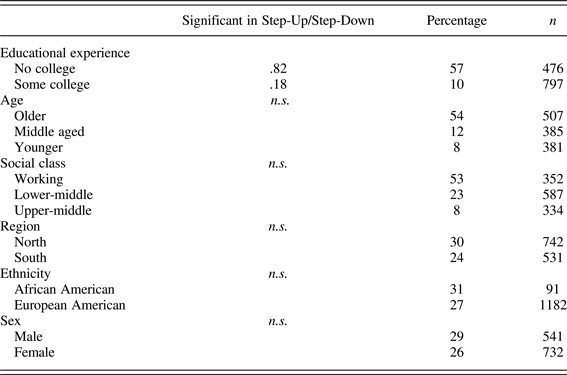
This section reveals the results for possible social constraints on leveled was. These social results include divisions in age, sex, social class, region, and ethnicity, yet only educational experience was deemed statistically significant when holding speaker as a random effect.
Although leveling in the past be paradigm is still an active process, Table 6 indicates that standardization has made wide-reaching gains in the last part of the 20th century. Socially, only one factor group was found to be significant from the regression analysis: educational experience. As discussed earlier, educational experience and social class are different faces of the same die, although only one of them is statistically significant for leveled was in regression analysis. However, they do both provide an ordered set of social identity evaluations along related scales, and they indicate that those speakers with lower social status produce higher rates of leveled was. Conversely, even within the age group divisions, those with some postsecondary educational experience have lower rates of leveled was.Footnote 9
Rbrul logistic regression analysis of was leveling for social factor groups with speaker as a random effect (subjects exclude existential there)
Notes: N = 1273. n.s. = not significant. Application value: was + 's. Input probability: .202.
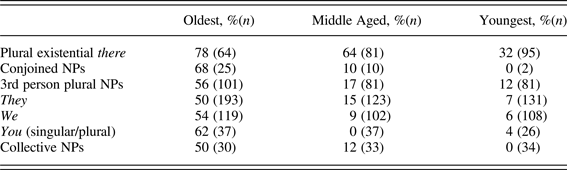
This decline across apparent time occurs for every grammatical category within each generation (see Table 7). Within the youngest group, there appears to be little grammatical conditioning except for the context of existential there.
Rate of was for grammatical subjects by age
In terms of default singulars with existential subjects, Tagliamonte (Reference Tagliamonte, Filppula, Klemola and Paulasto2009:125) wrote, “default singular usage in existential constructions is a variable linguistic phenomenon on the move.” Her results indicate that rates for plural existentials are either increasing or holding steady in most communities, even when rates of was leveling are declining for nonexistential constructions. As noted previously, speakers in Arkansas, Kentucky, and West Virginia demonstrated high rates of leveled was with plural existentials (above 80%) in the 1970s, yet Hackenberg (Reference Hackenberg1972) reported a rate of 55%, the same as the overall rate for existential there in this study. In contrast to these other communities, the rates of was leveling with existential there is actually declining across apparent time, from 78% for the oldest speakers to 32% for the youngest speakers. However, this decline is not completely unprecedented. By exploring the Corpus of Early English Correspondence Extension,Footnote 10 Nevalainen (Reference Nevalainen, Filppula, Klemola and Paulasto2009:93) presented data showing a real-time decline in the rate of was leveling in existential constructions between the first and second halves of the 18th century, from 54% to 28%. The same decline is seen across every grammatical subject in Table 7. The available Ns are low for some categories (e.g., conjoined NPs), but in general, the rankings of grammatical subjects are maintained across apparent time.
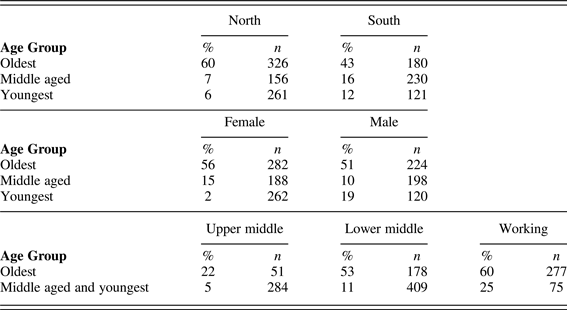
The rapid decline between the age groups is striking, although the age groups themselves were nonsignificant in the regression analysis. In comparison with Wolfram and Christian (Reference Wolfram and Christian1975, Reference Wolfram and Christian1976), where the rates of leveled was remain steady across apparent time, this decline across the generations holds true for every cross-tabulation on past be, including grammatical subject, region, and sex (Table 8).
Rates of leveled was by age for region, sex, and social class
In each social subdivision, as we move through apparent time from the pre-WWII oldest speakers to the post-WWII middle-aged and younger speakers, the rates of leveled was drop. Southern West Virginians do maintain a rate twice as high for leveled was than do Northerners for the middle-aged and youngest speakers, yet this more vernacular status is to be expected given the social divide between the two halves of the state. In general, speakers from the southeastern US states have been found to have more vernacular rates of traditional sociolinguistic variables (e.g., Labov, Reference Labov2001).
For the division between females and males, their comparable rates in the two older age groups diverge in the youngest group, with females dropping to only 2% leveled was and males holding a rate of 19% leveled was. All indications from the sociolinguistic interviews are that the younger subjects are fully aware of prescriptive pressures of standardization, but females appear to be adhering to those norms more than males are. With leveled was becoming more stigmatized over apparent time, females and Northerners are leading the march to standardization. The adherence of females to standard norms has been observed for several decades in sociolinguistic research (Labov, Reference Labov2001; Trudgill, Reference Trudgill1974).
The final confirmation of the advancement of standardization against leveled was comes from the rate of decline after the oldest age group. In Table 8, there is a precipitous drop between the age divisions for each social class: a 17% drop for the upper-middle class, a 42% drop for the lower-middle class, and a 35% drop for the working-class group. Apparently, it is the lower-middle class group who has moved most aggressively toward standardized norms, with the working-class group following closely behind. This social movement is reminiscent of Labov's (Reference Labov2006:152) findings on social-class crossover patterns with R-vocalization in New York City.
In the comparison of speakers across age and social class that can be observed in Table 8, two social reversals are worth noting. The oldest generation has fewer tokens (and speakers) in the upper-middle and lower-middle classes. In West Virginia and the majority of Appalachia, upward mobility and postsecondary education were not viable options for most people born before 1947. After WWII, with the introduction of the GI Bill and the improvement of government funding for colleges, opportunities for some postsecondary education and economic advancement became real for more people. If formal education does affect the speakers’ perceptions of stigmatized variants and standardized norms, if not their production, then any sample of West Virginians from the last third of the 20th century should illustrate the effects of standardization.
SOCIAL PRESSURES OF STANDARDIZATION
Is this kind of decline in leveled forms normal for changing communities? Schreier (Reference Schreier2002, Reference Schreier, Filppula, Klemola and Paulasto2009:73) described the decline of was leveling in the British Isle of Tristan da Cunha as such: “Later generations had lower rates, increasingly having were with second singulars and the plural persons, and this can only be interpreted as an adoption of nonlocal features and thus as the sociolinguistic consequence of the community's opening-up and emergence from endocentricity.” Although the West Virginia region of Appalachia has never been isolated to the extent of Tristan da Cunha, it has undergone socioeconomic changes and stronger connections to national norms in the 20th century, and these trends help explain the decline of leveled was.
Three areas of influence have impacted the economy and society in towns and rural areas during last century: mining, migration, and the military. Mining provided jobs, whereas the military offered a way out for those who sought greener pastures when other steady employment was difficult to obtain. The regular migration of working-age residents out of the state is clearly seen in the data from Wolfram and Christian (Reference Wolfram and Christian1976:8) and continues today. As reported in Hazen and Hamilton (Reference Hazen and Hamilton2008), migration has had continuous effects on the West Virginia population during the last century, including the regular return of older migrants after they have retired. Hazen and Hamilton (Reference Hazen and Hamilton2008) explored the language variation patterns of one family split by migration. Although the migrants and nonmigrants did not display patterns as two cohesive groups, it was clear that migrants returned to West Virginia with an increased awareness of standard norms of language variation. Some of the migrants responded to the increased exposure to standard norms by adhering to them in more formal contexts, whereas others, in contrast, boosted their vernacular patterns beyond even the level of nonmigrants.
In Appalachia, education is another influential and traceable social factor undergoing change in the 20th century. In Figure 2, the percentage of high school graduates in the general population over the age of 25 is represented for the state of West Virginia. The earliest reported percentage (18% from 1940) is an indicator of the state of institutional norms in West Virginia at the time. In the Smoky Mountain region of Appalachia, early 20th-century fieldwork found the lack of institutional norms to be a benefit for traditional dialect research. Joseph Hall (Reference Hall1942:4) wrote, “It was significant … to find a speech which does not show the deep impress of the schoolmaster's influence. Here is a vernacular which grew, for a part of its life at least, outside of his control, and which shows how a language may develop when removed from the conservative forces which restrict its growth.” Considering that high school provides many opportunities to evaluate and critique students’ language under prescriptive rules, it is certain that with the extended exposure to institutional norms, which Hall noted as absent earlier, awareness of prescriptive norms against leveled was increased dramatically over these decades. The increase in educational achievements appears to have had an effect on this particular vernacular feature at the end of the 20th century. Starting in 1950, the first year of birth for the middle-aged group, the rates of high school completion rose from 25% to 75% by the turn of the century. This change coincides well with the decline of leveled was in the two younger age groups, but considering that the rate for 2010 is even higher, does this trend of increased pervasiveness of institutionalized norms foretell the continued decline for leveled was?
Percentage of US and West Virginia population with at least a high school diploma or its equivalent, ages 25 and older, 1940 to 2010 (US Census).
UNASSUMING YET INFLUENTIAL: CONTRACTED WAS
As noted in Table 5, was contraction correlates strongly with leveled was. Much like is contraction, was contraction is the reduction of the verb to an alveolar sibilant with encliticization to the preceding, adjacent subject in past-tense contexts: We's out last night or, with a plural existential, There's three of them last year. Previous scholars have assumed that contraction with past be is not possible, which is probably true for most English varieties. The common finding for scholars of English is that the present tense forms of the verb be are contractible, and the past tense forms are considered not contractible (e.g., Bender, Reference Bender2001; Labov, Reference Labov1972). As Anderwald (Reference Anderwald2002:172) succinctly put it, “Non-negative contraction is not possible for was/were.”
Some scholarship on US dialects points to different possibilities. The Dictionary of American Regional English (Cassidy, Reference Cassidy1985:178) cited the first use of contracted was in 1829 in New England: “He sade no; and then ize up a stump.” It is also found in Texas, Kentucky, and in African American speech (Cassidy, Reference Cassidy1985:178). Tucker (Reference Tucker1966) noted the form as predominantly occurring with first-person I and used in both Pennsylvania and the rural South.
For English in Appalachia, Christian et al. (Reference Christian, Wolfram and Dube1988:112) remarked, “was often occurred in contracted form with plural subjects.” The current study also finds that were contraction occurs (e.g., Barbour Co. 1: We were preps, we're the athletes. We, you know, we were the “involved” people.), with 9% (83 of 926) of all were productions being contracted. As mentioned previously for was contraction, no past-time uses of are were found, and only unambiguous past-time references were coded as were. This contracted form appears to have been in place in Appalachia for some time. Joseph Hall (Reference Hall1942:86) noted that in the Smoky Mountain region of Appalachia, “[w] often disappears in was, will, would when preceded by a personal pronoun; for example, I was … [a·z]; ‘Hit was awful bad’ [ˈhɪt əz ˈɔfəl ˈbæd].” Montgomery and Chapman (Reference Montgomery, Chapman, Rissanen, Ihalainen, Nevalainen and Taavitsainen1992) studied existential constructions in the Smoky Mountain region of Appalachia and found was contraction to be a fading feature, with the oldest generation having 62% contraction for was with plural existentials, but the younger generations decreasing to 31% and 7% contracted was. The WVDP research associates have also observed the regular contraction of was in our daily interactions with natives. In accordance with Christian et al.’s (Reference Christian, Wolfram and Dube1988) observation, its presence continues in West Virginia, with 11% of all past be forms being contracted (145 of 1273).
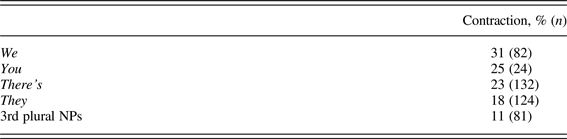
In what linguistic environments does was contraction occur? Though contraction happens slightly more often after vowels, this is most likely a result of the contracted form occurring more after pronouns (see Table 9). The overall rate of contracted, leveled was is 5% (62 of 1273). Contracted were occurred 83 times, making the total number of instances in which either contracted form occurred in a standard were environment 145. For contracted forms in were environments, contracted was has a rate of 43% (62 of 145). However, for full past be forms, such as We was out last night or We were out last night, the rate of paradigm leveling is 25% (286 of 1128). Additionally, the rate of was contraction is higher in plural subject environments (e.g., The women's out last night) with 18% (62 of 348) than in singular subject environments (e.g., Lea's out last night) with 13% (712 of 5378). This finding does not support the current understanding of exemplar theory in that the higher frequency of potential contraction environments should yield a higher rate of contraction (Bybee, Reference Bybee2007).
Percentage of contraction for leveled was forms
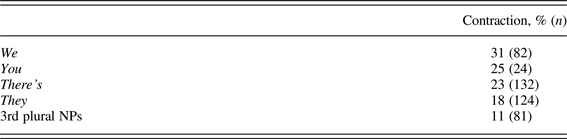
With the full set of subjects, personal pronouns dominate the landscape, and as with most varieties of English, all of them are vowel final. To further explore the possible effect of preceding phonological environment, nonpersonal pronoun subjects were analyzed for their potential phonological effect on was contraction. Table 10 presents the rate of was contraction for third-person nonpronominal NPs, both plural and singular. The preceding phonological environment has no effect on the rate of contraction, as seen in Table 10. In addition, if was contraction happened to be simply a phonological process, the higher number of possible contraction environments would yield the higher rate of contraction (Bybee, Reference Bybee2007), but this is not the case for the data. These patterns indicate that was contraction is favored in plural-subject environments.Footnote 11
Percentage of contraction for all was forms in third person singular and plural nonpronominal NPs
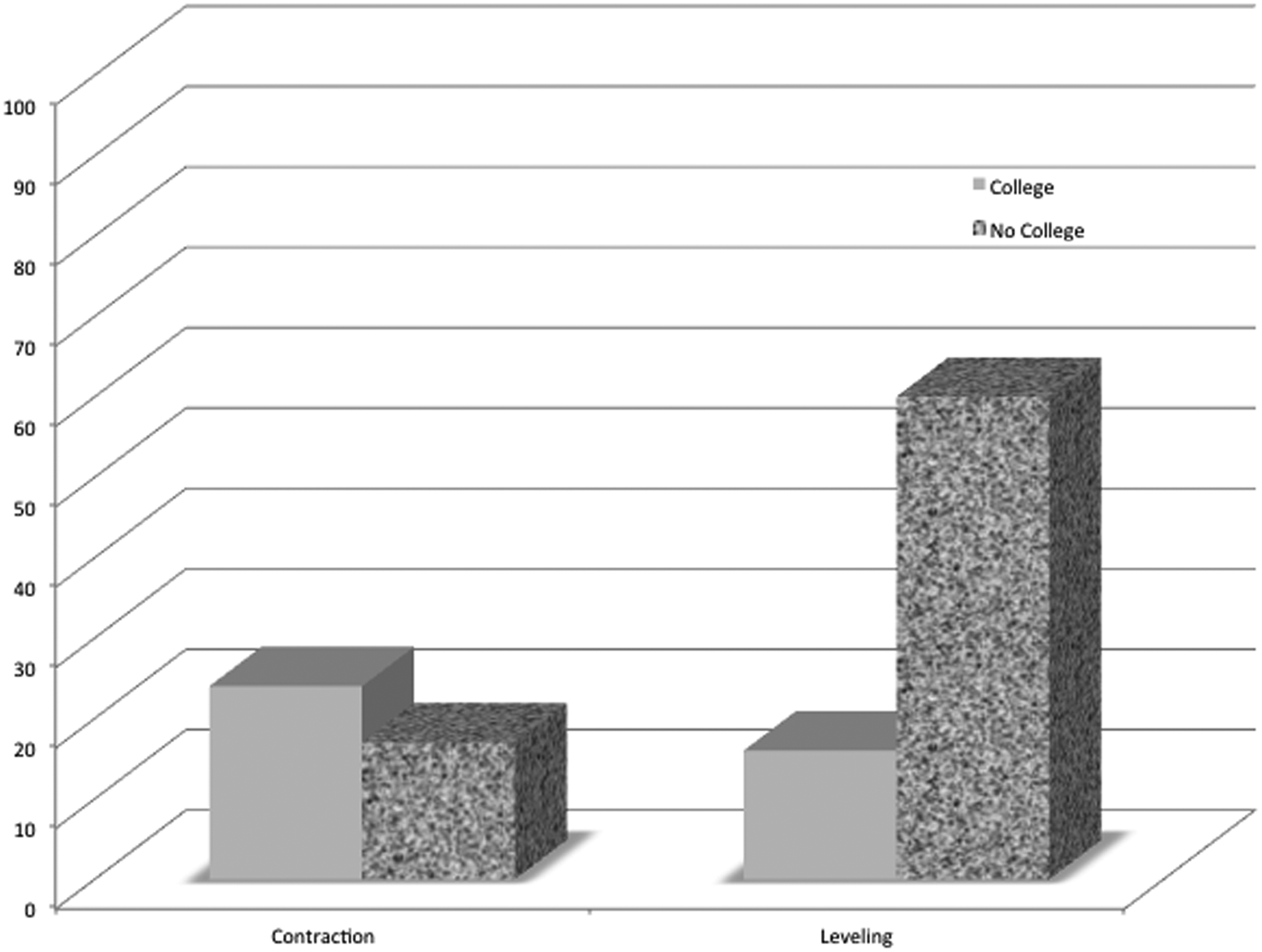
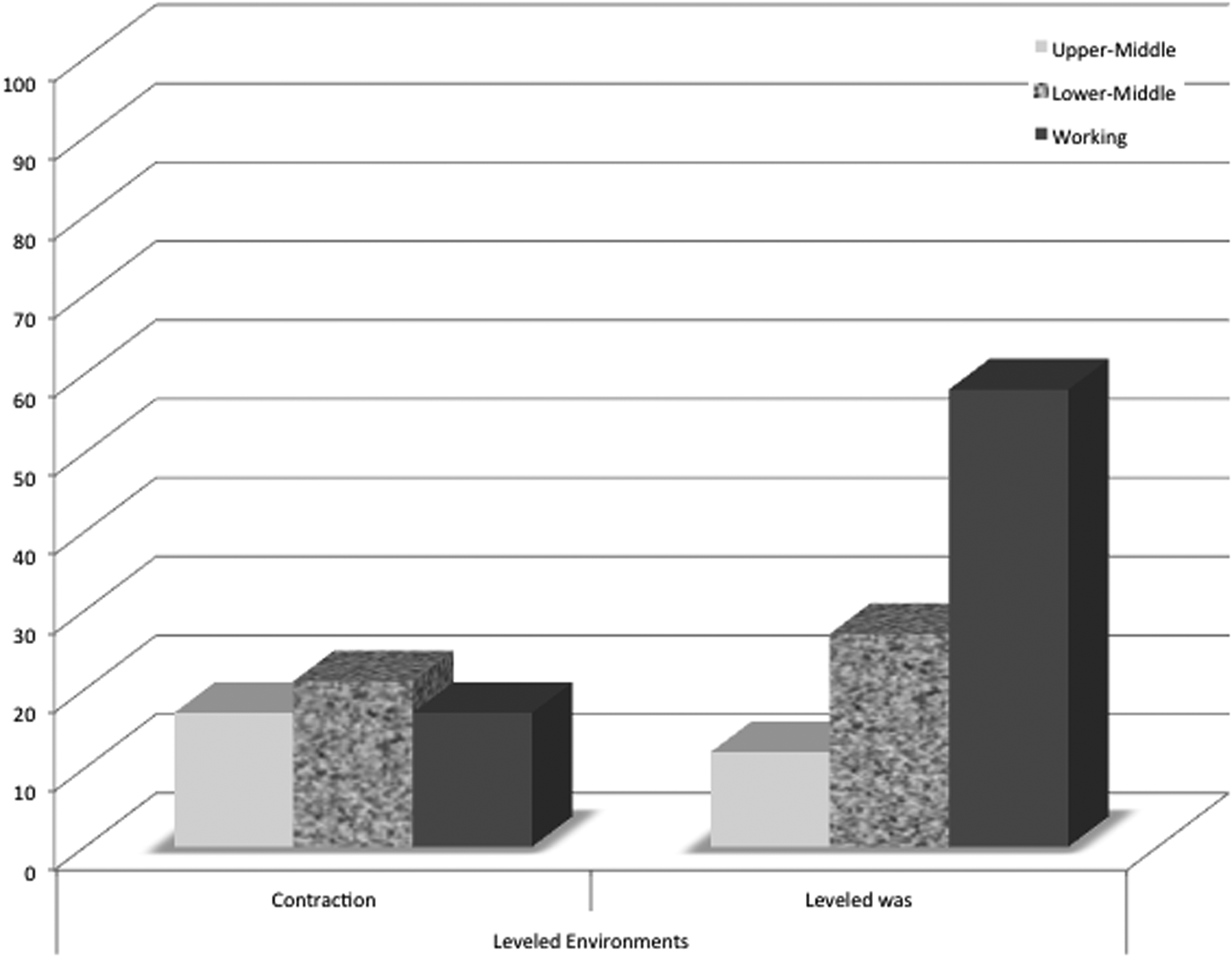
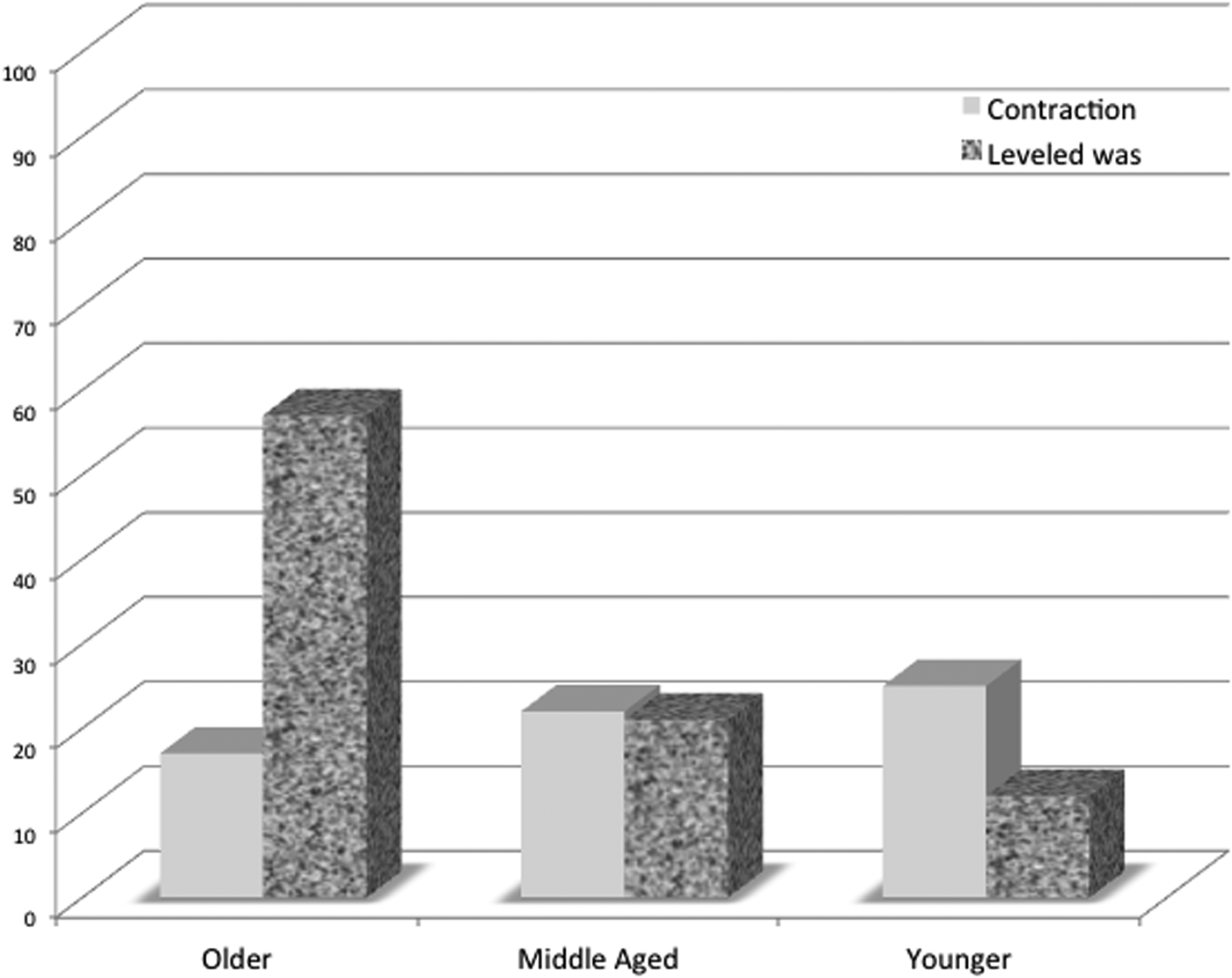
Socially, the correlations with was contraction diverge from those with was leveling overall, a strong indicator of its different social status. Within the set of leveled was, the rates of contraction for social factors do not fit the patterns found for was leveling overall, as shown in Figures 3, 4, and 5. If the contracted version of leveled was happened to be as stigmatized as the full version of leveled was, the same social patterns would be found for it.
Comparison of contracted leveled was and full leveled was by educational experience.
Comparison of contracted leveled was and full leveled was by social class.
Instead, speakers with some college experience have slightly higher rates of contracted, leveled was than those with no college experience (24% to 17%) (see Figure 3). The other point of contrast is that social-class groups do not show the same patterns as they do for leveled was (see Figure 4).
The most telling social indicator is the factor of age. Unlike the pattern for leveled was, the rates of contracted leveled was across apparent time are increasing (see Figure 5). Although the contracted variant is becoming more prevalent across apparent time, it does not have a clear social configuration. As younger West Virginians shy away from the traditionally high vernacular rates, they are embracing was contraction, knowingly or not, as an increasingly regular part of their dialect.
Comparison of contracted leveled was and full leveled was by age group.
DISCUSSION
Leveled was has been subjected to many scholarly studies because it is a useful variable to examine the interplay between linguistic processes and social forces. Some of these studies have focused on linguistic constraints like the grammatical subject in the hunt for a consistent hierarchy of favoring and disfavoring subject environments, and most find some kind of statistically significant ordering (e.g., Cheshire & Fox, Reference Cheshire and Fox2009:21). The findings here are surprising in that the category of grammatical subject itself was not significant when considering speaker as a random effect. With the increased use of mixed models, it will be worth noting whether or not the grammatical subject category will remain a significant factor group for leveled was in the 21st century. Intervening words between the subject and verb have also been tracked as a linguistic constraint, and in this study, this was found to be only partially influential. Its direction of influence goes against the expected trend; adjacent forms have a higher rate of leveled was in comparison with nonadjacent subject and verbs. The only fully significant linguistic constraint was the form of the verb itself, either as contracted ‘s or full was. Although a form recognized by scholars in Appalachia over the 20th century, to the best of my knowledge contracted was has not been noted in other dialects, and this study is the first to reveal it as a statistically significant pattern.
Socially, leveled was has played a role in speaker's identity and social divisions for many studies (e.g., Hazen, Reference Hazen2002; Moore, Reference Moore2011), but in this study only one social factor correlates with leveled was with statistical significance when considering speaker as a random effect. That social factor is the speaker's experience with postsecondary education: Those speakers who had any experience with postsecondary training or education demonstrated significantly lower rates of leveled was than those speakers with no postsecondary educational experience. Other social trends were apparent in the data, however, with the most prominent ones being the dramatic drop in the rate of leveled was across apparent time and the association of working-class speakers with higher rates of leveled was. Now that leveled was is a socially stigmatized dialect pattern in the 21st century, its use to create social meaning might blossom, and it will be tracked for such activity in future comparisons between rural and nonrural areas in West Virginia.
As with most other English speaking areas, this study reveals a pattern with existential there that distinguishes it from other subjects and the was leveling process in general. The data from this study support the argument for there was being lexicalized (Cheshire & Fox, Reference Cheshire and Fox2009:33), although the increased influence of standardized norms during the last half of the 20th century resulted in reduced rates for leveled was in existential there constructions. Most other varieties studied testify to increasing rates for existential there.
Lastly, contracted was is not a recent innovation in Appalachia, and its current variation profile indicates that it will remain a viable option in the future. Linguistically, it is not affected by the preceding phonological environment, and thus it appears to result from a lexical selection process rather than a phonological process of reduction. Socially, it does not follow the patterns of leveled was. Speakers with postsecondary education have it more frequently than do those without, and there are no notable social class distinctions. Surprisingly, contracted was is on the rise across apparent time.
CONCLUSION
Leveled was persists in the West Virginia region of Appalachia, but it has lower rates and a shifting configuration of variants. Like new variants of past be in stigmatized spectrums for other vernacular communities (Hazen, Reference Hazen1998; Richards, Reference Richards2010), contracted was appears to be socially unconditioned not only because of its reduced form, but also its similarity to existential, present tense there's.
Linguistically, one grammatical subject and the status of was contraction significantly influenced the rate of was leveling: existential there and contraction both favored leveled was. Socially, college experience correlated significantly with the rate of was leveling. In general, older, working-class speakers without any postsecondary experience had higher rates of was leveling than speakers who did not have those traits. For individual speakers, and the youngest speakers in particular, the rates of leveled was could reach below 10%. For others, and especially older speakers and working-class speakers, the rates were above 50%, approaching the rates found in the sociolinguistic studies of the 1970s. Through the lens of apparent time (Bailey, Reference Bailey, Chambers, Trudgill and Schilling-Estes2002), the rate of leveled was has declined in recent decades, although it is still an option for most speakers and a daily feature for some.
Language variations are like genetic mutations. Some of them persist and become regular features, but most are pruned away and do not affect many individuals across the species. Linguistic innovations, such as vowel shifts (Labov, Reference Labov1994) and analogical leveling (McMahon, Reference McMahon1994), provide opportunities for systemic diversity in language varieties. At times, such innovations are opportunistic, gaining success through social pressures that create the “right place at the right time” for these changes. For example, the Northern Cities Vowel shift has been propagated through local trends involving gender and social class (Eckert, Reference Eckert2000). Contracted was serves as an example of this type of change, poised to succeed by concealing a vernacular form from the pressures of standardization. While contracted was existed in the 19th and 20th centuries, it is being increasingly employed by West Virginia speakers under the institutional pressures of standardization.
With past be variation in Ocracoke, North Carolina (Wolfram et al., Reference Wolfram, Hazen and Schilling-Estes1999), although leveled was decreased during the last century, nonstandard weren't became part of the island repertoire. Cheshire and Fox (Reference Cheshire and Fox2009:3) cited other situations where trade-offs between past be patterns are taking place in England. For the West Virginia region of Appalachia, was contraction is continuing despite the rapid decline of leveled was across apparent time. West Virginia is not a densely populated region and contains no large urban areas, with its largest city having just over 50,000 people, but Chambers’ (Reference Chambers and Kortmann2004) assessment of standardizing pressures holds true for West Virginia as well. External language variation norms were increasingly imported into West Virginia after World War II (Hazen & Hamilton, Reference Hazen and Hamilton2008), and its largest population came in 1950, as there had been a 100% increase in the state's population since 1900. The population has declined since those peak years, but social norms of improving schools have affected both the middle-aged and younger speakers. It appears that these standardizing norms had effects on some qualities of leveled was, while contracted was carries on with fewer impediments.
Thus, paradigm leveling as a linguistic process lost ground with the full was form in the 20th century, and standardization is the theme underlying that trend of language change. West Virginians went through important social changes in the 20th century, including regular migrations, enhanced institutional education expectations, and generally increased awareness of sociolinguistic norms from other parts of the country. This heightened sociolinguistic awareness did not produce an influx of new dialect features, but it appears to have dampened the frequency of vernacular features. West Virginia is still predominantly a rural state with low population density, but the traditional descriptions of isolated dialects developing along unique paths have little relevance for West Virginians at the end of the 20th century. As an ancient feature of English, was leveling has a distinguished pedigree of language variation that continues today in Appalachia. The sociolinguistic profile of the region demonstrates, however, the continuing struggle between the linguistic impetus for paradigm leveling and the social desire for standardization.