Introduction
Carbapenem-resistant Enterobacterales (CRE) are an urgent threat 1 due to their ability to cause serious, difficult-to-treat infections, primarily in hospitalized patients and nursing home residents. Reference Bulens2,Reference Janelle3 Global increases are attributed to the spread of mobile genetic elements encoding carbapenemase enzymes like New Delhi metallo-beta-lactamase (NDM). Historically, approximately 10% of US CRE isolates from clinical cultures occurred in patients without healthcare exposures; among these community-associated (CA) CRE, a small fraction were carbapenemase-producing (CP) strains. Reference Janelle3 In September 2021, multiple health departments reported NDM-producing CRE infections in patients without healthcare risk factors. Since shifts from healthcare to community acquisition have important implications for control, we investigated.
Methods
The Centers for Disease Control and Prevention (CDC) receives passive reports of CP organisms from health departments, public health laboratories, and healthcare facilities, primarily through the Antimicrobial Resistance (AR) Laboratory Network. As part of a routine response, health departments review the medical records and laboratory reports for patients with CP CRE for demographics and healthcare exposures.
While the CDC had received rare, sporadic reports of NDM-CRE in persons without identified healthcare previously, due to multiple anecdotal reports in fall 2021, health departments were asked to report CA NDM-CRE. Cases were defined as NDM-producing CRE isolated from any specimen collected in an outpatient setting or during the first 3 days of admission to an inpatient setting between September 1, 2021, and September 30, 2022 from a US patient without these risk factors: (1) overnight healthcare stay or invasive procedure outside the United States in the past 12 months; (2) overnight admission to an acute care hospital or long-term acute care hospital in the past 12 months; (3) residence in a long-term care facility; (4) surgery in 12 months prior to culture collection; (5) chronic dialysis at time of culture; or (6) presence of indwelling device at time of or in 2 calendar days before date of culture.
Since 2022, the CDC’s AR Laboratory Network has funded 14 public health laboratories to perform whole genome sequencing of resistant Gram-negative bacteria (including CRE) and upload sequences to the National Center for Biotechnology Information. Sequences from isolates meeting the case definition were analyzed for NDM alleles, multilocus sequence types (STs), Reference Wirth4 and phylogeny using a core genome multilocus sequence typing (cgMLST) scheme. Reference Zhou5
This activity was reviewed by the CDC, deemed not to be research, and was conducted consistent with applicable federal law and CDC policy.Footnote *
Results
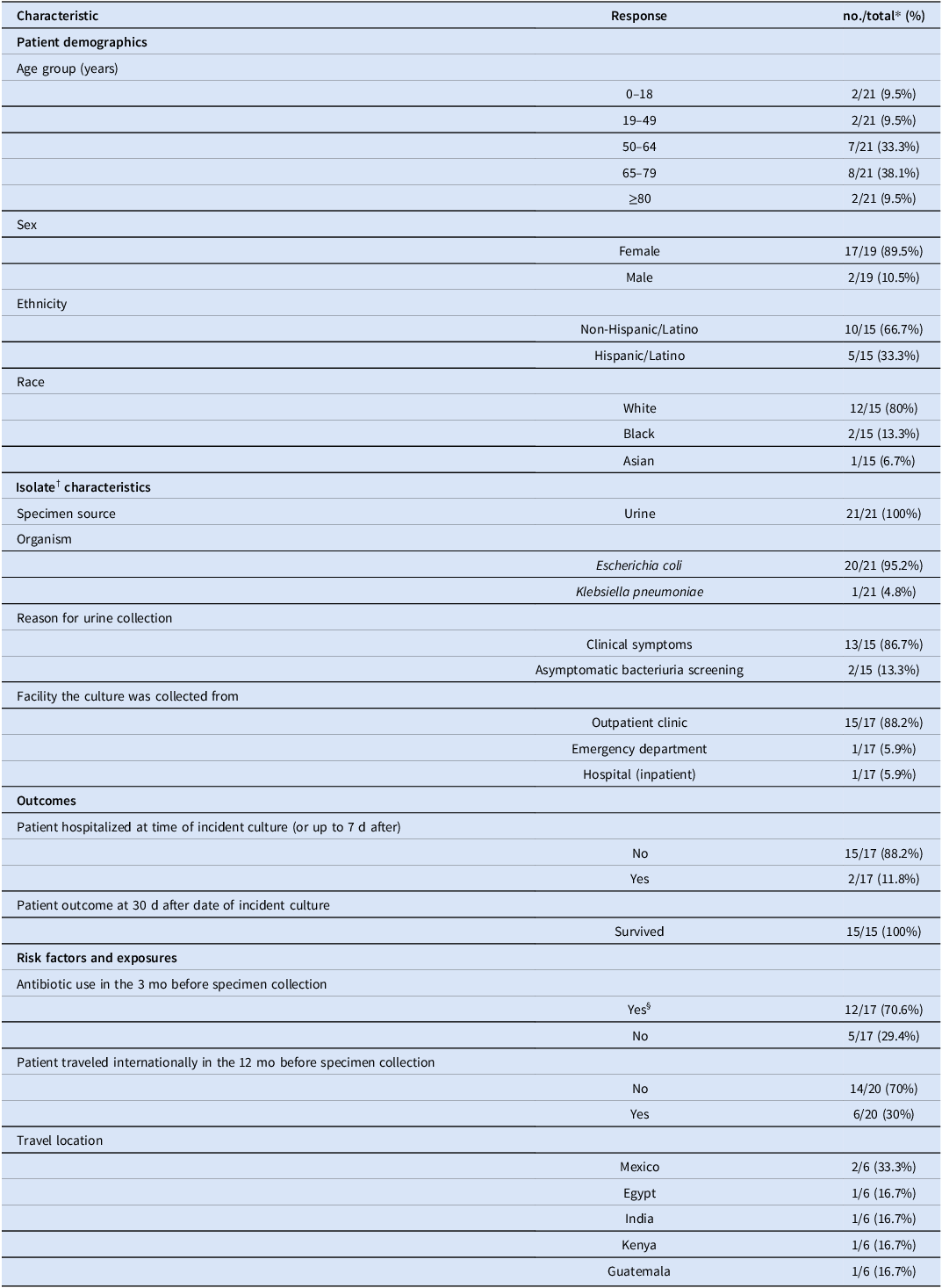
Health departments reported 21 isolates from 21 patients in 14 states that met the case definition. All isolates were from urine; 20 were Escherichia coli, and 1 was Klebsiella pneumoniae (Table 1). Isolates were typically collected in outpatient clinics. Of the patients, 17 of 19 (89.5%) were female, 12 of 15 (80.%) were white, and 11 of 21 (52.4%) were under 65 years of age, including 2 pediatric patients. Among patients with information available, 12 of 17 (70.6.%) reported antibiotic use in the 3 months prior to culture collection, and 6 of 20 (30%) reported international travel in the 12 months prior to culture collection. Two of 17 patients with available information were hospitalized at the time of incident culture or within 7 days. All 15 with follow-up information available were alive 30 days after culture collection.
Demographic, risk factor, and exposure characteristics among patients with suspected community-associated New Delhi metallo-beta-lactamase (NDM)-producing carbapenem-resistant Enterobacterales (CRE), identified from September 2021 through September 2022, n = 21

* Data for patients in the United States were abstracted from medical charts only (n = 9) or medical charts with a provider discussion (n = 3) or medical charts with a patient interview (n = 9). Denominators vary due to missing data. Responses listed as “unknown” and missing data have not been included in the denominator.
† Each patient had only 1 isolate.
§ Antibiotics used, cefuroxime and nitrofurantoin (n = 1), nitrofurantoin (n = 2), nitrofurantoin and Keflex and amoxicillin (n = 1), unknown antibiotics (n = 6).
Whole genome sequencing data were available for 19 isolates, including 1 K. pneumoniae and 18 E. coli (Figure 1). The K. pneumoniae isolate was ST6873 and bla NDM-5. Of the E. coli isolates, 88.9% (16/18) had bla NDM-5, and 11.1% (2/18) had bla NDM-1. The isolates belonged to 6 STs: ST167 (n = 6), ST361 (3), ST617 (3), and ST410, ST349, ST8371, ST8671, ST648, and ST405 (1 each). We compared STs and NDM alleles from CA NDM-producing E. coli to 1700 E. coli with bla NDM from human sources sequenced by US public health laboratories Footnote † ; in both isolate sets, the most common ST and NDM allele were ST167 and bla NDM-5, respectively.
Phylogenetic tree generated from core genome multilocus sequence typing (cgMLST) scheme of 2513 loci for 18 community-associated New Delhi metallo-beta-lactamase E. coli sequences, collected from September 2021 through September 2022. Nodes are colored according to the Antimicrobial Resistance Laboratory Network region (https://www.cdc.gov/antimicrobial-resistance-laboratory-networks/php/about/domestic.html). The color strip to the right is colored by the associated MLST from the 7-gene Achtman scheme. The tree was made using the unweighted pair group method with arithmetic mean.

Discussion
Through passive surveillance, 21 patients with NDM-CRE isolated from urine culture and without identified prior healthcare exposures were identified over a 13-month period. Similar to reports of CA CRE from population-based surveillance, the majority were women of white race. Reference Bulens2 Several patients reported recent antibiotic use and international travel, which are risk factors for the acquisition of antimicrobial-resistant organisms. Reference Janelle3,Reference Voor In ‘t Holt6 Previous studies also found that CA NDM-CRE cases were more likely to be identified in urine specimens from women. This was hypothesized to be due to the increased likelihood of women developing a urinary tract infection, post-menopausal urobiome changes, or the presence of risk factors like diabetes. Reference Bulens2,Reference Erdem7
Although the number of apparently CA NDM-CRE cases was small, these findings raise concern for spread in the community. Our finding that many CA NDM-producing E. coli belonged to globally disseminated ST identified in healthcare outbreaks and non-human sources such as companion animals or food-production animals suggests shared E. coli strains between healthcare and community settings rather than the emergence of distinct community strains. Reference Gronthal8,Reference Ramirez-Castillo, Guerrero-Barrera and Avelar-Gonzalez9 This is concerning for accelerated spread, similar to that observed for extended-spectrum B-lactamases and the successful E. coli strain ST131. Determining the directionality of spread (eg, from healthcare to community or vice versa) and the potential role and impact of community-acquired CRE on transmission in healthcare settings will require further investigation. Reference Gronthal8,Reference Ramirez-Castillo, Guerrero-Barrera and Avelar-Gonzalez9
Nearly one-third of patients reported traveling outside the United States in the 12 months prior to culture collection. International travel has been associated with the acquisition of multidrug-resistant organisms, particularly extended-spectrum beta-lactamases (ESBLs). Reference Voor In ‘t Holt6 Travel-associated acquisition of CP CRE appears relatively infrequent; in 1 US-based study, fewer than 1% of international travelers acquired CP CRE. However, the increasing number of US residents traveling internationally could translate to a large burden of importation.
Two-thirds of patients reported no travel, suggesting acquisition in the United States, similar to previous reports from Colorado. Reference Janelle3 However, these reports from multiple states suggest community acquisition may be occurring in more geographical locations, similar to the increase seen with healthcare-associated cases. Reference Sader10 However, limited epidemiological data, combined with potentially long intervals between acquisition and clinical infection, make it challenging to determine where CRE were acquired. Household transmission of CRE after healthcare acquisition and international travel has previously been reported, representing one possible source. Reference Bulens2,Reference Janelle3,Reference Voor In ‘t Holt6 Additionally, the predominantly detected NDM-CRE strains here, ST167 and ST361, have been isolated from farm animal food products and in companion animals, representing other potential sources. Reference Gronthal8,Reference Ramirez-Castillo, Guerrero-Barrera and Avelar-Gonzalez9
This investigation has several limitations. Cases were identified through passive reporting and represent a convenience sample that may not be representative of the population. Additionally, information was obtained through public health investigations, which vary across jurisdictions; therefore, risk factor data were often missing. It is possible that some healthcare exposures were not identified, resulting in misclassification. Finally, limited data on the timing of antibiotic administration and symptom onset means that we cannot rule out that some antibiotic exposures prior to culture may reflect empiric therapy for the same infection that resulted in culture collection rather than a risk factor.
The identification of patients with CA NDM-CRE might represent a shift in the epidemiology of this historically healthcare-associated pathogen. The association of these cases with internationally successful E. coli clones raises concerns that NDM-E. coli may follow a similar trajectory to ESBL-E. coli, which has shown sustained increases, likely due to healthcare-to-community migration. 1 A better understanding of the reservoirs of NDM-producing E. coli and risk factors for CA CRE is necessary to inform the evolving epidemiology and prevention measures.
Acknowledgments
The State Departments of Health from Alabama, Delaware, Iowa, Mississippi, Minnesota, North Dakota, New Mexico, Oregon, Virginia, and Wisconsin.
Financial support
None reported.
Competing interests
The authors report no conflicts of interest relevant to this article.